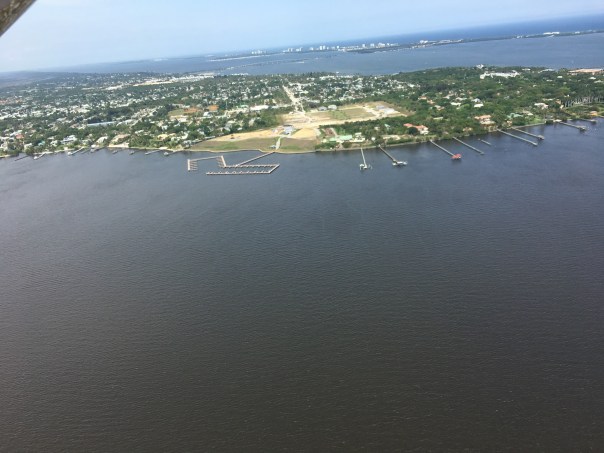
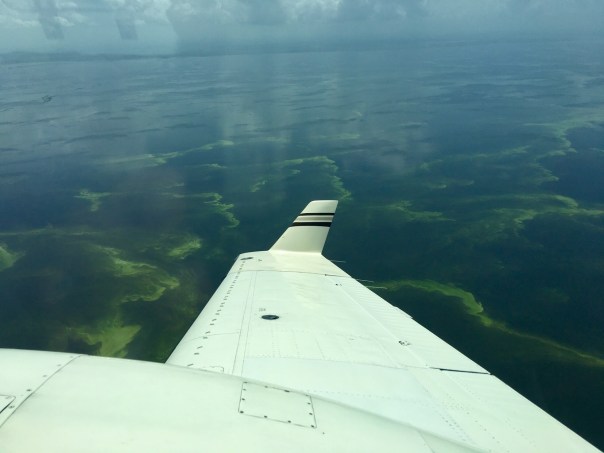
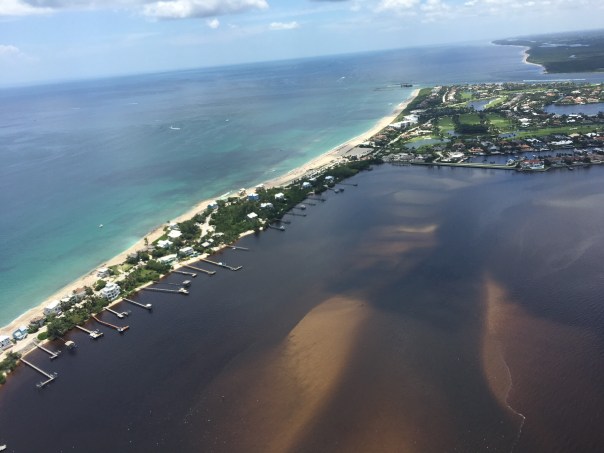
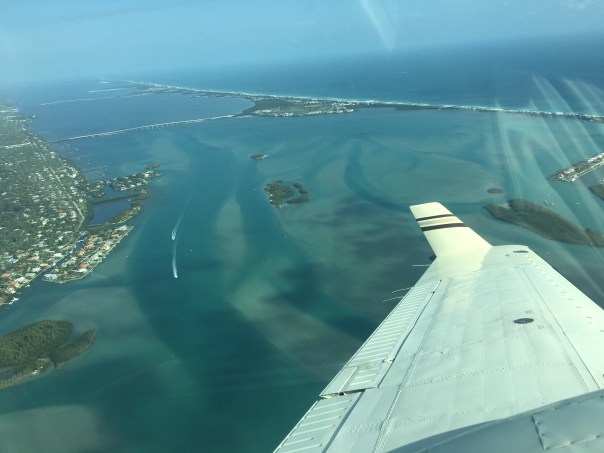
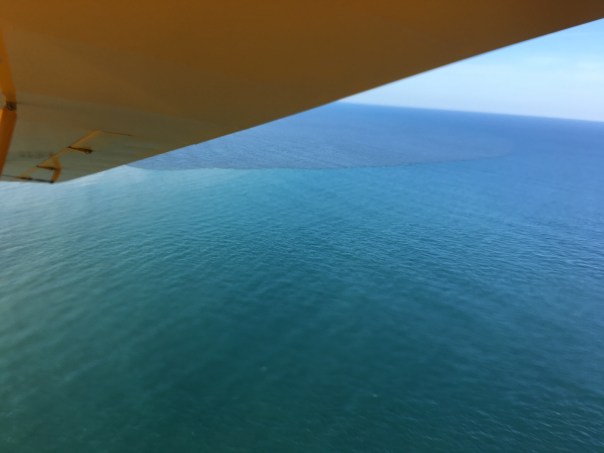
-Indian River Lagoon & St Luice River meet to flow into the Atlantic Ocean as seen over the savannas. Nettles Island , a landmark, juts into the IRL (upper left.) Note peninsula of Sewall’s Point and St Lucie Inlet. Aerial photograph by Ed Lippisch, 9/11/22, 6:15pm.Recently, I have been asking Ed to get a “different view” while flying-something other than the location between Sewall’s Point and Hutchinson Island near the St Lucie Inlet. That area is the heart of the matter when documenting seagrass recovery or destructive discharges from Lake Okeechobee. However, the St Lucie River/Indian River Lagoon includes much more than that. The undeveloped savannas region seen above is quite striking.
Here Ed looks south over the savannas, now Savannas Preserve State Park, an area west of the railroad tracks stretching ten miles between Jensen Beach and Fort Pierce.
As my mother, author Sandra Thurlow writes in her book, Historic Jensen and Eden on Florida’s Indian River, …”ours is not a savanna at all. A true savanna is grassland with scattered, small drought resistant trees. Many eons ago the Jensen Savannas was a lagoon like the Indian River. Now the ancient lagoon is a region of lakes, marsh and pine flatwoods. When polar icecaps formed, bringing Florida out of the sea, tides and winds shaped a primary dune along the east coast of the peninsula. The shallow waters in the wetlands behind the dune were brackish. The ocean levels continued to drop and sand bars just off the coast were exposed, forming Hutchinson Island. What had been the primary dune became the Atlantic Coastal Ridge.”
She goes on to explain that prior to modern times the savannas’ ecosystem was almost 200 miles long, but due to development along the Indian River Lagoon the region has been reduced to just ten ecologically intact miles.
Areas such as these “savannas” are critical to the health of the St Lucie River/Indian River Lagoon and an inspiration for more comprehensive protection in the future.
Reintroducing Myself to Pelican Island’s Warden, Paul Kroegel
-A 30 year old Jacqui meets the Paul Kroegel statue, Pelican Island National Wildlife Refuge, Sebastian, Florida, 1994. Photo by mother, Sandra Thurlow. -A 57 year old Jacqui reintroduces herself to the Paul Kroegel statue, Pelican Island National Wildlife Refuge, Sebastian, Florida, 2021. Photo by husband, Ed Lippisch.
The Story of Recreating the Photo
Last week, when I told my mother I had an Indian River Lagoon Council meeting in Sebastian, she forwarded me a 1994 photograph of me with my hand on the shoulder of statue Paul Kroegel. I vaguely recalled visiting the statue twenty-seven years ago during a family outing to the St Sebastian River.
“You’ll have to reintroduce yourself to our friend, Mr Paul Kroegel,” mom said. “You know, the man who inspired Theodore Roosevelt to create the Pelican Island Reservation that became the nation’s first National Wildlife Refuge in 1903. Mr Kroegel was appointed the United State’s first warden. He loved and protected thousands of pelicans!”
“I’ll do that mom. I’ll find the statue. I do remember that day,” I replied. “You, dad and I were canoeing and got caught in a thunderstorm.” It all started coming back to me…
The more I thought about it, the more I stared getting excited about finding the statue…
On Friday, August 13, I attended the Indian River Lagoon Council National Estuary meeting. Afterwards, using Google Maps, a devise not available in 1994, I found the Kroegel statue in Riverview Park just down the road from Sebastian City Hall.
There Warden Kroegel stood smoking his pipe, pelicans at his feet, just a shiny as ever! Someone had patriotically placed an American flag in his arms. It blew in the wind as pelicans and wading birds flew by. I took a deep breath, stood tall, and using my best manners reintroduced myself to Warden Kroegel. Looking into his bronze eye was almost real. We looked at each other for a long time. I placed my hand on his shoulder as in the original shot but had to turn around to take a modern day selfie. No one was there to take my picture, so I was unable to recreate the 1994 photo for my mother.
-Sculpted by Rosalee T. Hume
Luckily when I got home that night at dinner, I convinced Ed to drive up with me to Sebastian on the weekend, Sunday, August 15, to recreate the photo. We had a blast! First, it is such a beautiful drive to Sebastian from Sewall’s Point along historic Indian River Drive. Second, Sebastian is small and beautiful. A lot like Stuart was when I was a kid. We really enjoyed our visit there. After finding Riverview Park and enjoying the scenery, I introduced Ed to Warden Kroegel and we took the picture!
-Riverview Park, Indian River Lagoon -Ed looks out to the Pelican Island National Wildlife Refuge, Indian River Lagoon -Standing at Paul Kroegel’s statue -Ed takes the iconic recreation photo of Jacqui and Warden Kroegel 27 years later!
Pelican Island and the legacy of Paul Kroegel are on display in Sebastian just about everywhere, but first and foremost at the remains of his Homestead at Kroegel Produce, right at the corner of Indian River Drive and U.S. 1. Pelican Island proper is “right behind” the old Homestead out in the Indian River. On land, the tomatoes were the best I’ve ever had! If you visit Sebastian, please take a photo with Mr Kroegel and send it my way. I’ll share it with my mother too.
And thanks to my husband, Ed, for helping me recreate the 1994 photo with Paul Kroegel. For mom, for fun, for history!
I posted most of these photos on Facebook, but today I will give explanations and document on my blog. From above, our St Lucie/Indian River Lagoon remains beautiful, but we must be sensitive to the losses beneath the waters. These aerials were taken during a “slack tide” between 12 and 2pm on December 9, 2020 by my husband, Ed Lippisch. December 9th was the last of five days the ACOE stopped discharging from Lake Okeechobee; however S-80 was discharging “local runoff.” (Click on chart above.) Unfortunately, due to high lake level and lack of storage reservoirs, since these aerials were taken, the ACOE has begun ramping up Lake discharges once again.
Below Lawrence Glenn of the South Florid Water Management gives a comprehensive ecological report covering low-salinities and loss of oyster spat in the St Lucie and other aspects, positive and negative, for the entire Everglades system.
Below is an explanation of aerials documenting discharges December 9, 2020. All photos by Ed Lippisch.
-S-80 at St Lucie Locks and Dam discharging local basin S-80 runoff on December 9, 2020
S-308 at Port Mayaca, Lake Okeechobee closed on December 9, 2020. No algae visible.
-Plume of along Jupiter Island south of St Lucie Inlet
-Dispersing plume in Atlantic Ocean just past Peck’s Lake in Jupiter Narrows
-St Lucie Inlet -St Lucie Inlet State Park, Sailfish Point, Sewall’s Point, Stuart, Jensen
-Looking north to Sailfish Flats between Sewall’s Point and Hutchinson Island. This area has greatly degraded since 2013 as far as loss of seagrasses and fishing opportunities
-The area below, especially around Sailfish Point, was once considered “the most biodiverse estuary in North America” as documented, first, by Grant Gilmore
-This photo reveals seagrass loss across many areas of the Sailfish Flats
-Another view between Sewall’s and Sailfish Point, a seeming desert…
-Close up, Sailfish Point
-Sewall’s Point, east Indian River Lagoon
-Sewall’s Point is a peninsula surrounded by the St Lucie River on west side, and Indian River Lagoon on east side
Ed Lippisch, selfie. Thank you Ed!
As you can tell, I have lots of people helping me. Whether it is Ed flying or my brother Todd who provides an incredible easy to read website called EyeonLakeO. You can click below to check it out. The more we know, the more we document, the more we can overturn the destruction of our beloved estuary…
Stuart, St Lucie River, Sewall’s Point, Indian River Lagoon, and Hutchinson Island, Atlantic Ocean, Martin County, Florida 1971
St Luice Blvd (L) East Ocean Blvd.(R) 1971, courtesy, archives historian Sandra Henderson Thurlow.
“I have enjoyed looking at this aerial taken in 1971. Too bad our little house on Edgewood is out of the photo. It shows the location of the future Monterey Road through the Krueger property. The Krueger building to house Merrill Lynch has not been built yet but you can see the little surgery center was already built. I think I can see Mimi and Grampy Tom’s house in Snug Harbor–at least the driveway. So many things yet to be built.” Mom
My mom, local historian, Sandra Thurlow, recently shared this aerial with my brother, sister and me as we grew up here in Martin County. It’s a really great photograph capturing a growing community. Look how Hutchinson Island, Sewall’s Point, and even parts of East Ocean were undeveloped. No Indian River Plantation, later renamed “Marriott Hutchinson Island.” No Cedar Point Plaza. No Benihana! White sands shine through the remaining forest denoting scrub habit, home to threatened and endangered scrub jays and gopher turtles. This sand pine scrub habitat that made up most of Florida’s east coast is now considered one of the most endangered habitats in the world. The East Ocean Mall on the right sits next to a flower farm. At this time flower farms were giving way to roads and development. Already, the freshwater ponds have been directed and drained, and obviously thousands of sand pines have been mowed down for condos, houses, farms, roads, and shopping centers. By 1971 this area was fully on its way to build-out as we see below in 2020. Nonetheless, from air and ground this area of Martin County stands out as one of the most beautiful.
But it would be fun to bring back some of the scrub habitat ~easy to do by just altering our yards. How things could change…
Family friend Scott Kuhns is a great dentist, pilot, and photographer. For years, Scott has been one of our “eyes in the sky,” taking flight over the St Lucie River-Indian River Lagoon -and west out to Lake Okeechobee.
Today, Sunday, May 3, 2020, before noon, Scott forwarded these striking photos. He wrote “I can see some algae at Port Mayaca.”
When I first reviewed the impressive photographs -coast to lake- I found it hard to believe, but indeed looking very closely, there is a wisp of algae close to S-308 at Port Mayaca in Lake Okeechobee.
Can you see it? When things are so beautiful, like right now, it’s easy to miss!
Thanks Scott for your continued service “River Warrior” extraordinaire! We will continue to keep an eye on the water as we move closer to hurricane season.
ST LUCIE INLET, CROSSROADS OF INDIAN AND ST LUCIE RIVERS DIVIDED BY SEWALL’S POINT, ~ALL PHOTOS BY DR SCOTT KUHNS
JUPITER NARROWS & ATLANTIC OCEAN SOUTH OF ST LUCIE INLET
C-44 CANAL at ST LUCIE LOCKS AND DAM, S-80
S-308, CONNECTION OF C-44 CANNAL to LAKE OKEECHOBEE
VERY TIP of S-308 with ALGAE WISPS SLIGHTLY VISIBLE, BUT DEFINITELY THERE
INSIDE STRUCTURE S-308, PORT MAYACA LAKE OKEECHOBEE ALONG C-44 CANAL. S-53 ON ANOTHER CANAL. ALSO FPL COOLING POND SURROUNDED ON WEST BY WHAT APPEARS TO BE SUGARCANE FIELDS
REMNANTS OF THE ORANGE GROVE THAT IS NOW THE C-44 RESERVOIR AND STA.
SLR basins. SFMWD. You can see FPL cooling pond just northeast of S-308.
Ed Lippisch -eye in the sky- St Luice River/Indian River Lagoon 2-26-20 3pmOfcouse, it’s important to document from the air during this great new era of no Lake Okeechobee discharges. In any case, the St Luice River is plagued by too many human made canals. The SFWMD basin map below reveals all.Ed’s photos are beautiful but the color of the water is not striking as area runoff from rain is visible in grayish tones. Still, a good time to go outside and enjoy! Thank you to my husband, Ed for flying over the St Lucie River/Indian River Lagoon as I can write all day long, but “a picture speaks a thousand words!” And we will continue to work a thousand times harder to save her.St Lucie InletSailfish Flats IRL east of Sewall’s PointApproaching St Lucie Inlet, Sailfish PointSailfish Flats over Hutchinson Isl.Atlantic & SL Inlet, Sailfish PointLooking south to Crossroads SLR/IRL
1.Ed and the Super Cub 2019. Our “eye in the sky” since 2013.
2.Tip of South Sewall’s Point looking north to Hell’s Gate. Witham Field, Stuart, west.
We continue to document the discharges…
Yesterday, 3-17-19, my husband, Ed, flew the Super-Cub over the St Lucie River/Indian River Lagoon ~ twenty-one days after the ACOE started discharging from Lake Okeechobee on February 24, 2019.
When Ed arrived home, I asked, “So how was it?”
“Brown,” he replied.
“Like dark coffee brown, or kind of like that weird mixed greenish-brown?”
He looked at me, and smiled. “Jacqui, it was brown.”
“OK, I said, I’ll take a look at your photos.”
So here are the photos from Ed’s flight from Witham Field in Stuart, over Sewall’s Point and Hutchinson Island, then out west to S-80 to see the “Seven Gates of Hell” where you can see the one gate discharging now at an average of 250 cubic feet per second, down from an average of 500 cubic feet per second. As you can see from the SFWMD chart below, there has been other runoff locations as well, but the majority is from Lake Okeechobee.
3. Approaching the SL Inlet, algae covered remaining seagrass beds
4.Sandbar formation inside of SL Inlet
5.Blurry but shows boats at the Sandbar and that weird green brown color
6.Sailfish Point and SL Inlet algae covered remaining seagrass beds
7. Ernie Lyons Bridge, IRL with SL inlet and Hutchinson Island in distance
8. S-80 along C-44 Canal or the Seven Gate of Hell, boats going through locks, “250” cubic feet per second coming though
The following phots are of Caulkins Water Farm, a former orange grove that died due to citrus greening that now holds water from the C-44 Canal. This is a wonderful thing! As local ag-man Mr. Hadad, told me once, “Jacqui we spent 100 years taking the water off the land, and we’ll spend the next 100 years putting it back on.” The later photos are of S-80 again with view of C-44 canal leading west to Lake O.(https://www.facebook.com/CaulkinsWaterFarm/)
9.
10.
11.
12.
13.
14.
15.
16.
17.
18.
19.
20.
21.
22.
23.
24.
The following photos are when Ed headed back to Witham Field going once again over the St Lucie Inlet over the Atlantic Ocean. You can see the water looks blue north of Sailfish Point north of the inlet with nearshore reefs visible. Plume is also visible south of St Lucie Inlet. Also in photos is the winding Jupiter Narrows and St Lucie River in the area of Stuart and Rio. You can see Langford Landing with scraped orange soil and docks built into river still under construction since 2015.
Even though the water in yesterday’s photo looked gorgeous, lest we forget, here are some images of the St Lucie River/Indian River Lagoon area during a rainy and cyanobacteria ridden 2018.
Ed and I didn’t start taking pictures until were motivated…
You’ll see that after the rain event, the St Lucie River/Indian River Lagoon looks terrible even with out Lake Okeechobee discharges. This is caused by directed water runoff from C-23, C-24, C-25, C-44 and “local” coastal runoff. Naturally, the river never took all this water. Humans made it this way, and we must fix it.
SFWMD canal and basin map.
Soon after the torrential rain, the Army Corp of Engineers made things even worse and started dumping from Lake Okeechobee through the C-44 Canal into the St Lucie River by opening up the gates at S-308 and S-80.
My husband, Ed, first flew over Lake O on June 1st, just by chance. At this time, he spotted algae on the lake and took a photo. Ironically, the next day, the Army Corp started dumping from Lake Okeechobee on June 2nd!
The algae or cyanobacteria (http://www.ucmp.berkeley.edu/bacteria/cyanointro.html)
that was festering in the Lake began to show up almost immediately thereafter in the St Lucie River that has also become a “nutrient porridge.”
After another long, hot summer, the Army Corp finally stopped discharging in the fall~October 5th… Take a look at the photos and remember to enjoy the blue water when it is here, but NEVER FORGET! Only though looking back, will we have the determination to change the future.
Major rain event in March 2018. Rain filled this vile up many times!
SLR IRL following major rain event in March 2018. This is runoff from C-23, C-24, C-25, C-44, and “locally” from developed areas along the river and uplands made to drain into river. JTL
Following rain event in March 2018. A brown Atlantic.
Following rain event in March 2018, the SLR/IRL ~Scott Kuhns
Following rain event in March 2018 Sailfish Flats between Sewall’s and Sailfish Points ~Scott Kuhns
June 5th. A very dark plume moves south along Jupiter Island, just days after ACOE begins dumping so this is a combination of all pollution/runoff waters…
LAKE OKEECHBEE DISCHARGES ADDED
Ed in the Cub after plume photo
Algae as photographed/spotted by Ed in Lake O on June 1st 2018.
City of Stuart, June 9 2018.
Rio near Central Marine, week of June 12, 2018
Photographing a manatee in the algae along seawall by Mary Radabaugh
Mary Radabaugh manages Central Marine with her husband. JTL
Mary found a dead baby manatee floating in the putrid water shortly after LO discharges. MR
LAKE O: Week of June 16th, June 25th, and July 22nd. Cyanobacteria (blue green algae) blooms and then subsides. ~All the while, this water is dumped into the St Lucie River by the Federal Govt.; the water quality is terrible and this the responsibility not of the Feds but of the State of Florida.
Algae is now very visible in Lake O, June 16, 2018 JTL
June 25, 2018 Lake O, near S-308, Port Mayaca. JTL
C-44 canal leading to SLR from Lake O.
C-44 canal leading from LO to SLR.
Satellite view LO bloom on June 24, 2018. ~At its height.
By July 22, 2018 the bloom in the LO is lessening, JTL
August 29, algae would come and go, throughout the SLR. Here near Overlook Drive JTL
September 4, algae still “coming and going” ~2018 Snug Harbor, Stuart. Photo by my uncle, Dale Hudson
October 5, the ACOE stops dumping from Lake O. The blooms stop almost right away but the damage remains….
December 8, 2018 the river looks “normal” again near Sewall’s Point but it is not. JTL
I’m the kind of person who gets attached. I’m loyal to people and things that are good to me. One of those is the Legend Cub, the little yellow airplane that started flying in Stuart in 2013.
As she began to fly over the St Lucie River/Indian River Lagoon helping spot destruction from Lake Okeechobee discharges, she came to be known by those who saw her from the ground as the “River Warrior.” Over time, she became known far and wide to pilots, guests, reporters, home-owners, boaters, beach-goers, and children. She flew over multiple river rallies tipping wings side-to-side “waving” inspiring thousands of people.
She inspired me too.
When I was too afraid to get up in the air with my husband, it was she who gave me wings. I trusted her to help me tell our River Story and she did. She discovered algae water pouring through S-80 and the gigantic algae blooms documented in Lake Okeechobee…
Looking back on the thousands of photos Ed and I took from her open cockpit, these photos starting with the Treasure Coast Council of Local Governments, were shared and published~during that changing “Lost Summer,” of 2013, and then 2016, and now, 2018.
The River Warrior’s distinctive yellow strutted aerials have been instrumental in gaining statewide and national attention of the government sponsored destruction of our St Lucie River. The little plane gave us our first look from above and she woke us to action, yes, she did.
~Never a stutter and always with a singing engine she flew…
Since 2013, there have been more “Lost Summers,” now complete with disappeared seagrasses, and toxic blue-green algae to boot. She has seen it all. And today, there are now a total of five Cubs in Martin and Lee Counties. Indeed, being so cute and reliable, she stared a trend.
Nonetheless, next week, she is being sold and replaced with a “better” model. For me, there is no better model. She has changed the game; she gave me confidence to fly when I had none; she shall be missed and remembered forever. So if you see her this final week please wave “goodbye” and wish her well.
Farewell and thank you River Warrior plane. May your next adventure be as touching to those around you, as you have been to me. You are, and alway will be, the soul and heart of our river movement legend.
Ed and I have just returned from vacation. Ironically leaving June 28th, the day the ACOE announced a nine-day reprieve due to algae in Lake Okeechobee; and returning July 8, the day before the ACOE may open S-308 into the St Lucie River once again.
It was a great trip and the weather was excellent.
Ed was our pilot, and we flew with stops from Stuart to Michigan. It was remarkable to sit in the airplane and see the land below me ~ever changing from swampland, to farmland, to cites, to forest, to mountains, to rivers, and peppered with hundreds of lakes….
When we finally approached the Great Lakes Region, I was looking for the algae I had read so much about, and yes, there were some lakes turned green. But not in the vast northern waters of Lake Michigan, or Lake Huron, these lakes were deep mirrors of blue.
“The water here looks like the Bahamas,” Ed noted. We both looked in wonder at their hue.
Sometimes, I awoke at night, thinking of home. Thinking about how there is nothing like it, in spite of the many wonders of our great county. In spite of the beautiful, blue, icy waters of Lake Michigan.
On the way home to Stuart, I asked Ed if we could fly inland over Lake Okeechobee just to see. It was midday and the clouds had popped up and I knew we’d have to do my least favorite thing, fly though them. As the turbulence engulfed the airplane, I closed my eyes and prayed. And then finally, as always, we were through.
The lake opened up before us like an ocean.
I could clearly see the algae at about three thousand feet. It was visible roughly a mile off the lake’s east coast out into the lake for as far as the eye could see. Ed flew west and then circled around. The green masses of algae had been pushed into geometric designs by the wind, and they were everywhere. We flew for miles over the middle of the lake and beyond. To my surprise, the repetitive, endless, formations of cyanobacteria caused something unexpected to happen. Rather than my usual disgust, or anger for the destruction of the St Lucie, I felt myself begin to tear-up. “This poor lake,” I thought to myself. “I know you were once so beautiful even mythical; what have we done to you?
Just unbelievable…”
I wiped the tear from my eye, so sad for what is happening to the waters of my beloved Florida. Ed turned the plane, and we headed home…
S-308 algae was visible about a mile off the east coast of the lake and on and off, sometimes heavy, inside of the S-308 structure and in the C-44 canal to S-80 at St Lucie Locks and Dam.
S-80 was open and algae could be seen going through the gates from the C-44 canal
Home at last. Sewall’s Point Park River Kidz FDOT recycled sign art
When the St Lucie River/Indian River Lagoon start to deteriorate due to discharges, things start going downhill fast. And when my husband Ed and I start taking and sharing aerial photos, my world becomes a bit chaotic.
Sometimes there are days of hundreds of photos to look through, and knowing the importance of getting them out immediately, choices have to be made. Facebook is a better medium than my blog for real-time info as it takes less time, but my blog is better for historic documentation as it is “permanent.”
So today I am sharing more of Ed’s photos from 6-5-18, and some you may have already seen. Mind you, after heavy rains, stormwater has been pouring in from many canals but, always, like clockwork, after the ACOE starts discharging from Lake Okeechobee, the river looks not just cloudy-coffee brown, but contaminated.
The ACOE started discharging from Lake Okeechobee on 6-1-18, and as most of you know, now, there are not only algae blooms spotted in the lake, as Ed accidentally found on 6-2-18, and others also documented, but also in the St Lucie River. More than likely, there will be more and more algae bloom popping up as the Lake O water makes its way down the estuary, over the tip of Sewall’s Point, towards the St Lucie Inlet. Algae floating down the river is disgusting enough, but toxicity is the real question…
Ed and I will take and share more aerials in the future, to document the algae blooms should they explode, but until then, here are some photographs from 6-5-18 that I had not yet archived on my blog. Sadly enough, although there is no algae in these pictures, I cannot say they will make you feel any better.
Never take the pressure off politicians to build the EAA Reservoir and get it to where it needs to be to clean and filter this water to send south as Nature intended. Government knowingly contaminating its citizens is not an option. Health, Safety and Welfare is a responsibility.
Photos taken 6-5-18 showing SLR/ILR near Sewall’s Point; Jupiter Narrows; Atlantic Ocean/beach over nearshore reefs along Jupiter Island just south of St Lucie Inlet; out in ocean near Peck’s Lake; Sailfish Point/Sailfish Flats area; and Bird Island, a Critical Wildlife Area, for many threatened and endangered birds.
SLR on west /IRL on east – looking towards Sewall’s Point
Jupiter Narrows near St Lucie Inlet
A Coffee Ocean along Jupiter Island just south of St Lucie Inlet
Discharges in waves looking east to Peck’s Lake
Discharges going over near shore “protected” reefs
Discharge plume
Plume out about 2 miles in Atlantic/documented at 5 over days by fisher people
Similar photos give felling of flying over
Reefs with plume coming on
Selfish Point and Sailfish Flats area one the “most biologically diverse in North America.” Seagrass is gone due to receptive discharges episodes
Circling home- close up souther tip of Sewall’s Point
Again circling ove Sailfish Flats on way back to Witham Field.
Bird Island just off of southeast Sewall’s Point is home to hundreds/thousands of birds. Many threatened and endangered species raise their young on this island that was designated a CWA or Critical Wildlife Area by FWC in 2014. At the time it was the first to be designated in 20 years.
Since my husband, Ed, accidentally spotted an algae bloom in Lake Okeechobee, while running new engines on the Baron, I have posted many photos on Facebook and the word is out.
Nonetheless, for purposes of documentation, I am going to post some of the photos again on my blog for historical purposes and for those who do not use Facebook.
~Ed noticed the “lines of algae” in the lake on June 2, two miles or so northwest of Port Mayaca, the day after the ACOE started discharging from Lake O into the St Lucie River. Absolute chance, fate, or a tip from above, however you decide to look at it.
Since this time others have documented on the ground and DEP should be testing for toxicity.
So, after seeing the bloom on Friday, Ed went back the following day on Saturday in windy conditions so I stayed home–in the yellow plane, the Cub, getting more pictures of bloom, looking about the same but more dispersed from rain perhaps. These photos at lower altitude also include drainage structures around the lake, as well as the destruction of the St Lucie River/Indian River Lagoon at Sewall’s Point and the St Lucie Inlet.
Photos will continue to be taken as we once again, document the discharges, and once again have seen first-hand, like we did in 2016, without the warning of our government, that the algae that contaminates the St Lucie River starts in Lake Okeechobee.
Page 10, historic Stuart Daily News, Special Edition 1937, in celebration of the Stuart to Ft Meyers Cross State Canal courtesy Knight A. Kiplinger
We are up to page 10 in our history lesson and today’s photos are some of my favorite. The first is an aerial of the St Lucie Inlet entitled “Stuart on the St Lucie River.” Since its earliest day’s, Stuart has always been defined by its proximity to the river. Below the aerial it boast: “World Famous For its Fishing, Provides an Ocean Entrance for Small Craft.” And by today’s standards, a rather comical or un-comical plug can’t be missed: “Where the Waters of Lake Okeechobee Meet the Atlantic.”
It is also fascinating to note the shape of the south side of the St Lucie Inlet as today it has shifted and filled in. I am sharing my brother’s Time Capsule Flight used in former posts as it is so interesting and shows the various inlets of this area and land shapes as documented on various historical maps. Although today, we try to make barrier islands, beaches, and inlets permanent, by watching my brother’s video the message is clear: “the only constant is change.”
“The St Lucie River Estuary Leading to Stuart, Six Miles upriver. Here, at Sewall’s Point in the Foreground, Is the Junction of the Intracoastal Waterway and the St Lucie. Stuart Bridge in Background.”
Today, Ft Pierce’s deep water port is the star of the 1937 Stuart Daily News historical newspaper commemorating the completion of the Stuart to Ft Meyers cross-state canal. The port has a long been one of the more developed areas of the Indian River Lagoon and has an interesting start-stop history that is best documented by St Lucie County:
Pages 6-7, historic Stuart Daily News, Special Edition 1937, in celebration of the Stuart to Ft Meyers Cross State Canal courtesy Knight A. Kiplinger
Port Authority History, St Lucie County web site: The Port of Ft. Pierce first came into existence in 1920 when a manmade opening, the Ft. Pierce Inlet, was cut through the land barrier between the Atlantic Ocean and the Indian River Lagoon. St. Lucie County became the Port Authority in 1918 and a continuum of legislation has named the County as the Authority since that time. In 1918 a special act of the Florida Legislature established a taxing district to fund this project. Approximately 65 percent of St. Lucie County was in this Ft. Pierce Inlet District, which was empowered to sell bonds to finance the project and to satisfy bond obligations through real property tax revenues. The Florida Legislature abolished the Ft. Pierce Inlet District in 1947 and replaced it with the Ft. Pierce Port Authority, which retained the same power but was also granted the legal right to acquire and lease real estate. In 1961 a Special Act of the Florida Legislature replaced the Ft. Pierce Port Authority with the Ft. Pierce Port and Airport Authority, both of which were run by St. Lucie County. In 1989 the name of the Authority was changed to the St. Lucie County Port and Airport Authority. In 1997 the Florida Legislature provided reorganizing, updating and clarifying provisions for the Authority. In 1998 the Legislature dissolved the St. Lucie County Port and Airport Authority and transferred its assets, liabilities, and responsibilities to the Board of County Commissioners of St. Lucie County.
Today, the Port of Ft Pierce is ready for more expansion and will be loading more than fruits and vegetables in the near future. I wish them all the best. This portion of the Indian River Lagoon south of Harbor Branch to Ft Pierce Inlet is known as the “healthiest” part of the ailing IRL so may the developers be delicate with their planning and execution! We must save what we love!
Today, we will open this exceptional document and see what’s inside, on page two…
There are five ads on the page. Each one is a peek into history, and for me the final ad from the commercial fishing industry is the most interesting! But first, let’s look at the left hand top of the page.
There is an ad for The English Tavern, south of the Roosevelt Bridge, that welcomes the yachtsman; with ample parking space. This sounds like fun! Why wouldn’t there be ample parking in 1937. 🙂
To the right of that is an Enjoy Sailfishing in the Gulf Stream ad. It ask you to write, wire, or Phone 47-J for reservations. (Note today we have a three-figure area-code and six numbers!) The ad notes: Marine Ways Storage; Marine Supplies Repairs; and Boat Building at Toley’s Boat Yard, Salerno. (Ironically the grandson of Toley, Shawn T. Engebretsen, is my husband’s oral surgery business partner!)
The next ad, on bottom right, is from Stuart Metal Works where one can investigate the opportunities for building in the beautiful St Lucie River Region, Phil Pence, Proprietor. “Plan to make your home in the yachting wonderland!”
And the last of the foursome, in bottom right, is an ad by the Fort Pierce Financing and Construction Co., 208 Orange Avenue, Fort Pierce, stating that “Completion of the Cross-State Waterway is a mark of progress for South Florida.” (People of that era loved this word “progress,” and my mother still uses it!)
~Like when I was a kid, I would see a mowed down forested area made for a parking lot and she would say: “It’s progress honey!”
And last, but not least this insightful ad from the Commercial Fishermen’s Industry of Martin County that reads below a gigantic every-day catch of that era, a gargantuan pile of speckled sea-trout:
“The Commercial Fishing Industry of Martin County, Producing an Annual Revenue of More Than $1,00,000, Requests The Cooperation Of Officials On Charge Of The Lake Okeechobee Project To Maintain Discharge Of Fresh Waters From St. Lucie Canal At A Minimum During The Fishing Season From November To March.”
If you had the time to read yesterday’s blog, Edwin Menninger’s article stated that “Construction of the St Lucie Canal began in 1921 when the fact dawned on the Everglades pioneers that canals through muck lands were useless – they refused to carry water out of the lake. Four of them had been dug, and were utterly worthless. The St Lucie was completed in 1924 and for 13 years has been the ONLY functioning outlet from Lake Okeechobee to the sea.”
Attached is a 1909 map of South Florida from the 1909 State of Florida report “Report on the Drainage of the Everglades of Florida, By J. O. Wright, Supervising Drainage Engineer”. (Not in article but for reference)
The concerns of Stuart’s nationally recognized and often President-visited waters are well documented in my mother Sandra Henderson Thurlow’s book Stuart on the St Lucie. Nonetheless, I never knew that from approximately 1924 to 1937 the St Lucie canal, today’s C-44, was the only outlet for Lake O. Yikes!
The wonderful thing about history is that there is always something to learn!
Last evening, at a gathering of friends of my mothers, I met Mrs Susan Kane. The conversation started as usual with someone I do not know, but quickly, somehow, the our words turned to eagles living along the St Lucie River, Indian River Lagoon.
I told Susan, I had never seen one here flying, ever, but I knew they were here as Greg Braun, formerly of Audubon, took photos of one sitting on a rock at Bird Island…. I had also heard that there was a pair that hunted from a tall, dead, Australian Pine tree by the Marriott’s Indian River Plantation Marina. But again, although I walk the bridge between Sewall’s Point and Hutchinson Island quite often, I had never seen them…Once, while driving on Highway 76 in Indiantown, I did see an eagle, and was so excited that I parked my car on the side of the road and with trucks zooming by I watched it soar. I was smiling from ear to ear.
Susan listened politely, and then replied, “Well recently, Jacqui, I took a photograph of an eagle on the 16th hole of the Sailfish Point golf course.”
“You’re kidding?” I inquired.
“Yes, the eagle captured a fish right there in the pond at the 16th hole of the golf course.”
“That’s incredible.” I replied, taking a large sip of my cocktail, to hide my bird envy.
Over the course of dinner, Susan pulled out her photos and shared. They are wonderful! And today I am sharing her photos with you.
Frances Langford Estate in Rio/Jensen Beach Florida ca. 1960s. Courtesy of Sandra Henderson Thurlow, Thurlow Collection.
You know, I hate to be a broken record from the past, and I know the rules. Fights should lie dormant after they are fought, and won, or lost….
But I just can’t help myself…
Recently my husband Ed and I received a postcard in the mail advertising Langford Landings’ Grand Opening on March 10th, 2018.
It made me so sad to see this card. It looked like an ad from Rooms to Go.
I just don’t see how we as a county allowed such a tropical, historical piece of property to go to the “cookie cutter mill.”
Albeit the homes are expensive, pretty, and modern, they have no character of the original famed, Frances Langford Estate. None. Scraping all the trees off the land was the greatest sin, as these modern homes could look more tropical, more Frances Langfordish, if they had left some of the stately trees that she planted.
Yes, the developer “did not break any rules,” but we did, the Martin County Commission did. The rule broken? To show respect and honor to those who have walked before us. Especially, Mrs Langford.
Photos speak a thousand words.
Below are many from my mother, historian Sandra Thurlow, and Facebook friends, Bobbie Blodgett, and Rebecca Fatzinger. Local, Pop Delancy and others. People who shared with me as the property was be cleared and dismantled beginning in 2015…
2015 Clearing as seen from Palmer Road and Present 2018 Post Card Sent Out Recently For Grand Opening of “Langford Landing,” the former Frances Langford Estate
Frances Langford in her later years stands before photos decorating the Francis Langford Outrigger Resort. Her home was across the street on 53 acres she turned into a tropical paradise. (Public photo)
My husband, Ed, took these photos of the Indian River Lagoon at the St Lucie Inlet on 2-28-18, just a few days ago. They are certainly beautiful enough to sell real estate…The turquoise water is so pretty one could easily overlook the sand desert below the surface waters.
Enjoy the blue water, but know that especially since 2013, our seagrass beds have been decimated by black sediment filled waters and toxic discharges from Lake Okeechobee. Seagrasses are the nursery for all sea life, especially the baby fish. These beds need time to reestablish if they ever will.
True beauty has something to offer, not just “surface water.” Keep your eye on the lake and fight against any coming releases this summer so we can get life back in our dear dead river.
Last night’s twilight flight was a first for me, but not for my husband Ed. Usually, we fly in daylight chasing algae blooms or black Lake Okeechobee water…
Last night was just for fun, but one still feels the pull to protect this sacred place.
The beauty of the lands lighting up beneath us was almost as inspiring as the sunset. Humanity, such promise.
We do live in a beautiful place. A place to protect and call home…
Recently, I convinced my husband, Ed, to come up to Tallahassee with me for the “State of the State” reception at the Governor’s mansion.
It was very exciting; however, we had waited in line for almost an hour, to shake hands with the Governor and First Lady, when a secret service man told me we weren’t going to make the cut. The line was cut off one person in front of me!
“You’re kidding? That’s a bummer.” I thought. “Maybe they’ve had enough of my controversial Constitution Revision Commission environmental proposals? Perhaps I’ve been put on the Affiliated Industries of Florida’s blacklist? Just chance? Hmmm. I can handle it, but poor Ed!”
I tried to negotiate with the secret service man. He was not budging.
While I moped, Ed seemed unaffected, rolled his eyes, smiled, and headed for the bar.
I, on the other hand, could not let go. I was determined to have the Governor see me, or for me to see the Governor, so I moved as far to the front of the room as I could.
When I was right up with the crowd surrounding the Governor, I saw an empty chair. I didn’t see any secret service men staring at me, so I sat in the chair. I could see everything!
But, right at that moment the Governor, First Lady, and crew made a quick exit, and I was sitting there in my black dress, and fake fur, trying to look cool, gazing purposely at a book on the side table.
It was beautiful, very old, and entitled,”Florida Land of Enchantment.” Old-fashioned keys covered the historic book’s fading green face. I stared at it thinking about how the mystique of Florida is “what built Florida.” And how that historic mystique was, and remains, built on the enchantment of Florida’s lands.
Well, Ed and I didn’t get to shake hands with the Governor or First Lady, but I got to see this magnificent book and I’ll never forget it.
This Friday, at 11:00 am, my fourth CRC proposal, P46, or Land Acquisition Trust Fund, goes before the CRC Legislative Committee. The goal of P46 is to have a very needed conversation and to clarify language in Article X, Section 28 of Florida’s Constitution (Amendment 1, 2014) and direct the state legislature to deposit no less that one third of the revenue, not to exceed 300 million annually, into the Florida Forever Trust Fund. This money would go specifically to conservation land purchase as prioritized by the long standing and once “always funded” Florida Forever program.
I already know, there are many reasons, and many conspiracy theories, about why the state legislature has stopped funding Florida Forever. And no matter what occurs at the CRC meeting, the proposal will not be self-executing. We cannot force the legislature to spend money a certain way. That is their prerogative, a power that is derived for them alone from the state constitution.
But a strong message can be sent. A directive can be given. And shouldn’t they listen? They should.
How many years has that book been sitting by the table? Governors and legislatures will come and go, but if “Florida, the land of enchantment,” is to remain, we must continue to invest in Florida Forever.
Growing up in Stuart in the 1970s, my mother and father gave me full reign to explore the undeveloped lands in the area of St Lucie Estates. I remember endless summers, wandering around in “the woods” and of course my eyes were drawn to the vine of the widely dispersed, perfectly shaped, red and black seeds known as rosary peas.
I would collect them tightly in my little, sweaty hands, pushing them far down into my pockets. I recall the first time I brought them home, my mother said, “Yes, they are very pretty, but don’t eat them, they are poisonous.”
“Hmmm,”I thought. “How can something beautiful be poisonous?”
I continued to collect the seeds, and over the years filled up many clear glass bottles that sat in my window sill; the sun never fading their brilliant color.
Later in life, I learned that bright color patterns, especially red, black, and yellow, as with some caterpillars, or the famous, shy, and deadly coral snake, are “warnings” in nature and actually provide the animal with protection from being eaten.
As I walk through Hawk’s Bluff today, I am thankful to my parents who allowed me to explore the natural world and grow confident, unafraid, even with all of its toxic beauty.
Child’s drawing of tailless Winter and new friend baby Hope. Both of these dolphins were rescued from the IRL and now reside at CMA, in Clearwater, Fl.
The first thing I noticed flying in to St Petersburg was that they had a lot of seagrass beds…
“How in can a place with so many people have so much more seagrass than Stuart?” I thought to myself. “Well, number one, they don’t have releases from Lake Okeechobee destroying their estuary every few years, and they are known for the state’s most successful estuary restoration program–of Tampa Bay (http://www.tbep.org) something we are trying to emulate for the Indian River Lagoon (http://www.irlcouncil.com).
It was the new year’s weekend and Ed and I had decided to “get away.”
What I had forgotten is that Clearwater, our destination, is home to Winter and Hope, Indian River east coast dolphins who were rescued by Harbor Branch (http://www.fau.edu/hboi/marine_mammals/) based in St Lucie County who were then rehabilitated at Clearwater Marine Aquarium on the west coast. These dolphins could not be released. Winter, an amputee due to a crab trap cutting off her tail, and Hope, an orphan who was suckling on her dead mother when found never learned life skills…
Today these dolphins are alive, friends, inspiring thousands of people including a multitude of veteran and children amputees, have starred in two feature films, and have made Clearwater a favorite nationwide family destination: (https://www.seewinter.com)
The experience of visiting the aquarium, made me think about how connected we all really are. How much we can do together. If Harbor Branch had not saved these IRL dolphins, Winter and Hope would not be the worldwide ambassadors for their species that they are today.
Yes, we are all connected across our great state! Happy 2018 Florida!
12-4-17, ca. 2:45 pm, photos: Ed Lippisch & Jacqui Thurlow-Lippisch
The Army Corp of Engineers has lessened but not stopped Lake O discharges that started September 20th, 2017 just prior to Hurricane Irma. Perhaps as the discharges have gone on at such a high rate for a comparatively long time, the plume has had a chance to extend its territory. In yesterday’s photos, the dark, filthy plume is reaching clearly south beyond the exclusive Town of Jupiter Island.
Yesterday was a beautiful day, but the river and ocean waters of our entire region were ugly, possibly contaminated. How are we to enjoy our property and lives here?
When viewing the aerials below, please note the blue, sapphire-colored water just on the edge of the discharge plume. Yes, of course all estuaries put forth darkened fresh water after a rain event, and Ed and I could see this occurring just south at Jupiter Inlet. Nonetheless, the black, gigantic plume that we repeatedly endure for the St Lucie River/Indian River Lagoon due to discharges from Lake Okeechobee is an aberration.
Please let’s all support Joe Negron and the public’s work to build the EAA Reservoir; clean & send the water south!
Last Thursday on November 16, the ACOE reported they will reduce the amount of water they are releasing from Lake Okeechobee. The Corp had been releasing at a high rate, on and off, since September 20th. New targets are 2800 cfs east and 6500 cfs west.
Photos below were taken yesterday, 11-19-17 by my husband, Ed Lippisch. We will continue to document the discharges from Lake O, and area canals.
As Thanksgiving approaches, we are thankful the discharges are lessened and that the SFWMD and the public are working hard to plan the EAA Reservoir Senator Negron fought for… We the people of Martin County, will not be satisfied until these discharge stop. The river has its hands full with unfiltered discharges draining agriculture and developed lands from C-23, C-24, C-25 and C-44. All must be addressed.
“And where the river goes, every living creature that swarms will live, and there will be very many fish. For this water goes there that the waters of the sea may become fresh; so everything will live where the river goes…” Ezekiel
St Lucie Inlet, Sailfish Point R, Jupiter Island L, and Sewall’s Point and mainland Stuart in distance.
Sewall’s Point
Manatee Pocket
Hell’ s Gate Sewall’s Point to right
C-23 main SLR
Confluence of SLR/IRL at Sewall’s Point’s southern tip
Sewall’s Point
IRL looking towards Sewall’s Point and Stuart. Incoming tide pushes plume waters north into IRL
somewhere looking down…
SFWMD canal and basin map. C-44 canal is the canal most southerly in the image and was connected to Lake O in 1923. C-23, C-24 and C-25 were built later in the 50s as part of the Central and South Florida Project that over-drianed South Florida causing many of the water problems we live with today.
Atlantic ocean off Jupiter Island, plume water moving south over nearshore reefs
IRL near Sailfish Flats where seagrass forests used to flourish housing many fish…
If the discharge waters of Lake Okeechobee filled up the City of Stuart, Florida. Last Thursday, they would have reached the top of Stuart’s iconic water tower that stands at 134 feet.
Stuart, North of Monterey.
Whereas, if the ACOE’s discharge waters of Lake Okeechobee were “filling up the City of Stuart,” last Thursday, October 26, these polluted waters, would have reached the top of Stuart’s iconic 134 foot water tower…
Whereas, once again, our economy and ecology is completed devastated, and high bacteria levels in the water are exacerbated therefrom….We shall remember this day…
We shall, therefore, designate, Thursday, October 26, as “Water Tower Day” and say together: “Lake O discharges have reached the top; this must STOP!”
Stop the Discharges
Yes, to put the Lake Okeechobee discharges into perspective, last Thursday the cumulative 2017 ACOE/SFWMD discharges from S-80 passed 134 “Stuart Feet”. The Stuart water tower is 134 feet tall. See my brother Todd’s cumulative total page below:
– In the lost summer of 2013, Stuart/Martin County received 284 “Stuart Feet”, 2.1 times the height of the tower.
– In 2017, the gates did not open until September 5. So it took only 52 days to accumulate that same amount of discharges!
– In 2013, the discharges started on May 8 (with the exception of some small pulses earlier in the year). That year, it took 91 days to hit a cumulative “134 Stuart Feet” – on August 7.
In other words, the discharges have been almost twice the rate as they began in 2013. You can see this in the slope of my brother’s graphs in the web page above. This doesn’t really mean a lot though. In 2013 the discharges didn’t really begin to accelerate until mid-July. At that point, the rates of discharge were comparable to what we are getting now.
– At the current average of about 4200 cfs, we would hit the 2013 total of 284 Stuart feet in another 42 days (December 9). If they are saying the discharges could continue for months, this could happen. We could have another record year, even though the disaster didn’t start until September. Maybe they will throttle it back a little or start pulsing again so it won’t be the case. In any event, this is already another lost year…
(This blog post was based on writing and ideas by my brother and contributing blogger, Todd Thurlow, http://www.thurlowpa.com)
* I edited this post from “today” to “last Thursday.” An ever rising story. 🙂 JTL
These aerial photos over the St Lucie Inlet were taken by my husband, Ed Lippisch, Sunday, October 29, 2017, at 1:45pm.
The number one issue here is the polluted waters of Lake Okeechobee being forced into the SLR/IRL because they are blocked by the Everglades Agricultural Area from going south.
The ACOE has been discharging Lake O waters into the St Lucie since mid-September. These over-nutrified and sediment filled waters continue to destroy our economy and ecology on top of all the channelized agricultural and development waters of C-23, C-24 and C-25. Stormwater from our yards and streets also adds to this filthy cocktail.
Near shore reefs, sea grasses, oysters, fish? A human being? Better not have a cut on your hand…Not even a crab has an easy time living in this.
We move forward pushing the SFWMD and ACOE for the EAA Reservoir with these sad photos and the fact that our waters are putrid at the most beautiful time of year as motivation. We will prevail. One foot in front of the other.
Prior to the 1970s, we used to dump sewage directly into the ocean; now we make fertilizer out of our own human waste and spread it on agricultural lands throughout our state. When it rains, nutrients and metals run right back into our estuaries….is this the answer, or another disaster? What are our options?
If you live close by, please attend this Thursday’s Rivers Coalition meeting to learn more. It was Mr. Gary Roderick who inspired me in 2008, when I was a new commissioner for the Town of Sewall’s Point, to take a deeper look at the causes of environmental destruction of our rivers. He is a knowledgeable and versed having worked both in government and as an environmental consultant.
Please join us!
Below, I am including two former blog posts on the subject: 1. Drowning in Our Own Human-Excrement-Fertilizer; and 2. Spreading Refined Human Waste on the Lands, “Biosolids,” St Lucie River/Indian River Lagoon.
Drowning in Our Own Human-Excrement-Fertilizer, SLR/IRL:
Informational links and summary of where name biosolids came from:
“As public concern arose about disposal in the United States of increasing volumes of solids being removed from sewage during sewage treatment mandated by the Clean Water Act, the Water Environment Federation (WEF) sought a new name to distinguish the “clean,” agriculturally viable product generated by modern wastewater treatment from earlier forms of sewage sludge widely remembered for causing offensive or dangerous conditions. Of three-hundred suggestions, biosolids was attributed to Dr. Bruce Logan of the University of Arizona, and recognized by WEF in 1991.” The story of “biosolids” WIKI
Say No to Lake O
“Say No to Lake O,” this is one of the rallying cries of the River Kidz. If only it were as easy as just saying “no.” According my numbers-man, my brother Todd, the “St Lucie River has taken in more than 86+ billion gallons this year, enough to put Stuart under 111 feet of water. This is only enough to take 6 inches off of the lake.” The west coast is taking most of the lake level reducing water and of course they are screaming “say no to Lake O” too.
Eco-Voice, present west coast advocacy, 10/17.Realistically, with the Army Corp of Engineers reporting the Lake level at 17.07, today, it will be a few more weeks of releases to get near or under 16 feet. A safer number for the dike and for the people who live in fear of it breeching. Not to mention the 525,000 of acres of protected sugarcane… http://w3.saj.usace.army.mil/h2o/reports.htm
Black Gold, the muck soils south of Lake Okeechobee. (Photo JTL, 2014.)I do believe the authorities are getting the message, though…so keep screaming. SAY NO TO LAKE O! For everyone!
I think our water culture is changing, and the government is being forced/inspired so they can get reelected and respected…. to improve our water/rivers situation. Just yesterday, I got an email about a woman whose Bascom Palmer doctor notes she has an eye infection in her cornea very possibly from “walking the bridge,” repeatedly over the St Lucie River.
I am not making this up.
These health issues are real. More and more people are realizing this. Lake O and other canal unfiltered pollution must halt.
So it looks like the Lake Okeechobee is going down, but we are still going to get releases for while. (See the info below on my brother’s site.) Things are still bad, but they are getting better.
~Never stop screaming “Say No to Lake O,” we owe it to ourselves, and to the future.
Hydro. Lake is going down._________________________________________________________________
Great information below!
Jacqui,
It looks link the lake is coming back down. See the graph links on my Firm Favorites Page:
It’s hard believe that we have taken 86+ billion gallons this year, enough to put Stuart under 111 feet of water. But this is only enough to take 6 inches off of the lake. The west coast is taking most of the lake level reducing water.
By the way, I have a new link of my Lake O Satellite imagery page that will actively pull up the last 7 days of low res images from all three satellites: St Lucie River Discharges Latest Lake O Satellite Imagery (http://www.thurlowpa.com/LakeOImagery/) Click on the “Terra/Aqua/Suomi Last 7 days icon”.
Best regards,
Todd
Thomas H. Thurlow III THURLOW & THURLOW, P.A. 17 Martin L. King, Jr. Blvd. Suite 200 P.O. Box 106 Stuart, FL 34995-0106 Phone: (772) 287-0980 Facsimile: (772) 220-0815 Email: todd@thurlowpa.com Web: http://www.thurlowpa.com
Guest blog an photos by Geoff Norris, Indian River Plantation POA Group:
Guest blog an photos by Geoff Norris, Indian River Plantation POA Group:
These photographs of the Indian River Lagoon were taken on 11 October 2017, between the bridge at East Ocean Blvd, Stuart and north to Indian Riverside Park and Jensen Beach, Florida. The lagoon waters have been polluted for several days with run-off from Lake Okeechobee making the lagoon various shades of brown, orange, red and grey, with dirty scummy foam a feature at the shorelines and also as foamy windrows and wave crests in open water. The St Lucie River is in much the same state.
During this time the Army Corps of Engineers has been opening the locks at Port Mayaca to discharge water from Lake Okeechobee down the St Lucie Canal to the St Lucie River/Indian River Lagoon estuarine system. Rates vary from 4500 to 5500 cubic feet per second, equivalent to 2.9 to 3.5 billion gallons per day. It has been calculated that this amount of discharge would cover the Stuart peninsula north of Monterey Road with four feet or more of water in one day.
The Florida Oceanographic Society reports for 10 October 2017 that salinities in the Lagoon have been drastically reduced by this lake discharge to between 1 and 3 parts per thousand sufficient to kill many estuarine fish and other plants and animals (normally the salinity would be between about 20 and 25 parts per thousand in this section of the lagoon). The Society has graded the overall health of the Lagoon on either side of the East Ocean Bridge as “Poor to Destructive”. See this link:
The Army Corps of Engineers is aware that they are killing the St Lucie/Indian River Lagoon estuarine system by their actions, but consider it more important to lower the Lake Okeechobee level from the current level of 17.2 (feet above mean sea level) to a desired level of between 12 ft and 15 ft.
These are the facts. It is also a fact that politicians have not managed to stop this destruction.
Flight over SLR/IRL to view canal C-23, C-24, C-25 and especially present high releases from Lake Okeechobee through C-44 Canal. JTL/EL 10-14-17
Yesterday, I asked Ed to take me up in the plane, once again to document the discharges. In the wake of much rain and an active hurricane season, the St Lucie River/Indian River Lagoon continues to sacrifice its economy, health, and ecosystem for the EAA and South Florida drainage. A standard operating procedure that is outdated and dangerous.
The discharges from Lake O. have been on and off since Hurricane Irma hit on September 20th. Presently they are “on,” and it shows. Right now our river and ocean shores near the inlet should be at available to boaters, fisher-people, and youth, in”full-turquoise-glory.” Instead, the estuary, beaches, and near offshore is a ghost-town along a chocolate ocean and a black river. The edge of the plume can hardly be distinguished as all is dark, sediment filled waters. A disgrace.
ACOE 10-15-17
10-15-17 Lake O is high. This is a threat to those who live south and around the lake.
South Florida’s southern Everglades, 1850 & today. The water that used to flow south now is sent to the ocean and Gulf of Mexico through canals C-44 (SLR) and C-43.(Cal.) (Map courtesy of SFWMD.)
Image showing drainage of S. Florida through St Lucie and Caloosahatchee rivers. These rivers, that God did not connect to Lake Okeechobee, have been channelized by humans to dump Lake O. This drainage system put in place in the 1920s does not serve Florida today. Not economically, health wise, or environmentally. We must continue to push to replumb the system the best we can. (Public image.)
I told Ed it’s best not to smile for this photo. We look forward to seeing the model and timeline from the SFWMD and ACOE for Senator Negron’s reservoir, and the beginning of turning this century old nightmare.
SFWMD basin map for SLR showing canal discharge structures.
The following is a texting conversation between my brother, Todd, and me, just over an hour ago. As you can see, Todd keeps me in real-time. Now, I wish to share with you.
Todd: Hi Jacqui, looks like it’s “balls to the wall” —like the old jet fighter saying.
Lake O is at 17 feet and rising…
Jacqui: Holy —! Didn’t Gary Goforth say the max for S-80 is 12,000 CFS? How much is this?
Todd: This is normal high-end. ~4000 cfs. In 2004-2005 it looks like they maxed at 5-6000cfs. I’ll graph against the lake stage.
Jacqui: How do u know it’s 4000? I see nothing posted 4 today on ACOE site.
Todd: S-80 hit 6,727 cfs on 10/06/2004. The lake was at 17.86 and rising it peaked at 18.02 on 10/13/04.
Hurricane Jeanne had hit days earlier on Sept. 25
Jacqui: I remember that. Bad.
Todd: Also. The 4000+ right now is instantaneous. The stats you always see are a mean for the day. Right now that are piling between 1000cfs and the high 5000s. It looks like they did almost hit 6000 earlier today.
Pulsing not piling.
Jacqui: Awful. I think it stinks that unless you know how to access all the technology, you don’t know the river is getting slaughtered until the following days. A nightmare. Thanks Todd. Goodnight.
Today is October 7th, 2017 and I am sharing photos taken October 6th, 2017 in the area of the St Lucie Inlet displaying the recent discharges from Lake Okeechobee and area canals. The plume was measured four miles out, this is very far, and can be seen both north and south of the inlet. The edges are churned up and blurred, and there are many layers fanning out.
I share to document. I share in hope of eventual change, and I share to inspire the so many people who are causing change, change, that one day we will see in a better water future.
Thank you to my husband Ed for piloting, and to passenger, and photographer, Matt Coppeletta.
Sincerely,
Jacqui
All photos taken of the St Lucie Inlet area on 10-6-17 by Ed Lippisch and Matt Coppeletta. Discoloration of water is caused primarily by discharges from Lake Okeechobee but also from canals C-23, C-24, C-25 and area runoff.
The population increase of the Goliath Grouper is one of those rare “feel-good” conservation success stories. With the help of a 1990 law of protection, the species has come back from being historically over-hunted.
I was recently contacted by advocate goliath grouper protectionist, Ms. Katie Carlsson, who spurned my interest in the debate to “reopen hunting on the species.” I also knew I could share my mother’s plethora of historic St Lucie River “Jew Fish” photos labeled such during the non-politically correct era that was part of my childhood and before. In today’s blog post the original terminology is used in the photographs as documented.
Now for today’s “Goliath Grouper!”
I wanted to speak up for Katie’s cause, questioning the reopening of the hunt. She has forward much information on FWC meeting dates, etc. Thank you Katie.
Before presenting you with many links to explore and opinions to read, I will say, that according to the Snook Foundation, “vast technological improvements in spear guns and diving equipment in the 1960s and 1970s made no wreck, cave or hole safe for Goliath grouper to hide. They have few natural predators and little fear of divers.They are easy prey.”
Of course anglers have the right to argue that the grouper in some areas, like South Florida, have been perhaps “too successful” and believe hunting should be reopened.
My question is if the giant fish will basically look you in the eye and let you kill it, or if there is a question as to the efficacy of the conservation program, why do it? There are so many other fish in the sea.
These are the locations and dates for future hearings:
Oct. 9: Jacksonville, Pablo Creek Regional Library, 13295 Beach Blvd.
Oct. 10: Titusville, American Police Hall of Fame & Museum, 6350 Horizon Drive.
Oct. 11: Stuart, Flagler Place, 201 SW Flagler Ave.
Oct. 12: Davie, Old Davie School Historical Museum, 6650 Griffin Road.
Oct. 16: Pinellas Park, Bill Jackson’s Shop for Adventure, 9501 U.S. Highway 19 N.
Oct. 17: Port Charlotte, The Cultural Center of Charlotte County, 2280 Aaron St.
Oct. 18: Naples, Collier County Public Library – South Regional, 8065 Lely Cultural Parkway
Oct. 25: Tallahassee, FWC Bryant Building, Room 272, 600 S. Meridian St. (6-9 p.m. ET)
Man with Goliath Grouper, photo of Harold R. Johns family, c. 1925, St Lucie River, from the archives of Sandra Henderson Thurlow.
Fishermen with Goliath Grouper, Stuart, Florida photo of Harold R. Johns family, c.1925, St Lucie River, from the archives of Sandra Henderson Thurlow.
Goliath Grouper caught near today’s Roosevelt Bridge in downtown Stuart c. 1920. Photo of Homer Hines Stuart Jr. from the archives of Sandra Henderson Thurlow. (This photo is similar to the one below.)
“This photograph of jewfish suspended from a pole resting on a Florida East Coast Railway car was taken in what was called the hole, a rail spur that went down to the St Lucie River near the Stuart freight depot. (Homer Hines Stuart Jr.)From page 50 of “Stuart on the St Lucie” by Sandra Henderson Thurlow.
“This postcard illustrates the use of President Grover Clevland’s name to promote Stuart. Joseph Jefferson, a famous actor of the day, also fished in the St Lucie River region” in the early late 1800s. Cleveland was president 1885-89 and again in 1893-97. (Photo courtesy of page 51 of “Stuart on the St Lucie” by Sandra Henderson Thurlow.)
Photo by Earl Dyer Ricou, Stuart, Fl, c. 1950. (Archives of Sandra Henderson Thurlow.)
A dead Goliath Grouper that washed ashore near Bathtub Beach in Martin County, 2011. Goliath Grouper do not spaun until approximately six years of age and are believed to be able to live from 50 to even 100 years of age. They can weigh over 800 pounds. JTL
My corgi, Baron, gives perspective to the size of a Goliath Grouper. 2011, JTL
Courtney of “Fishens Magazine.” Photo taken prior to restrictions put in place in the 1990s. History shows, unfortunately, it is the nature of people to take more than they need.
This is a link to the hearing in Key Largo. If anyone goes to hearings this can prepare them for what to expect and the information that FFWC is sharing.
In the earlier part of the last century, Atlantic goliath groupers were abundant from Florida to Brazil and throughout the Gulf of Mexico and Caribbean Sea. If you have been lucky enough to be in the water with these creatures, then you appreciate their unflappable personality and awe-inspiring size, which reaches up to 8 feet and 1,000 pounds. The goliath grouper has no natural predators besides large sharks and humans. We are writing with regards to the latter.
Goliath groupers reached commercial extinction in the late 1980s. For this reason, in 1990 a federal and state ban on killing them was implemented for U.S. federal waters and state waters of Florida, Alabama, Mississippi, Louisiana and Texas, followed by a 1993 ban in the U.S. Caribbean. Twenty-seven years of protection have led to a population increase, although not a recovery to pre-exploitation levels, in the state of Florida alone. Spawning aggregations are forming again off the east coast of Florida. It’s the only place in the world where goliath groupers are now reliably found in significant numbers, as juveniles in mangroves, and as adults in reefs, solitary or forming spawning aggregations. People come from all over the nation and the world to see the goliath grouper spawning aggregations in the late summer, bringing big dollars that boost local economies.
“Diving in the Palm Beaches back in the late 1980s, to see a goliath grouper was the holy grail. Many of us dove year after year, and saw perhaps one, maybe none,” said Deb Castellana of Mission Blue. “To witness the resurgence of the species since protections were enacted has been heartening, a real story of hope.”
Yet, the Florida Fish and Wildlife Conservation Commission (FWC) is currently considering allowing the limited take of goliath groupers in state waters. The proposal would allow the killing of 100 goliath groupers per year for 4 years, for a total of 400 goliath groupers. The sizes targeted are breeding individuals. If implemented, the kill will exterminate most of Florida’s breeding population of goliath groupers, destroying 27 years of conservation management effort. This “limited take” is not supported by scientific evidence. Critics of the goliath grouper say the species is overeating and responsible for declining fish and lobster stocks. Yet, actual scientific data from researchers like Sarah Frias-Torres, Ph.D. show that overfishing, not the goliath groupers, is the reason for declining fish and lobster stocks.
Some say that a “sustainable” take of goliath groupers is possible, but many scientists agree that the current population would not last more than one, or perhaps two years after opening the fishery. And groupers have no nutritional value for humans since they contain levels of mercury that are unsafe for human consumption according to the U.S. Food and Drug Administration (FDA) and the U.S. Department of Health.
“I repeatedly asked what scientific evidence the FWC has to support killing the goliath groupers, because all scientific research published to date does not support a fishery for this species and shows the species is highly conservation dependent and highly vulnerable to overfishing,” said Dr. Frias-Torres. “Many don’t realize that goliath groupers actually eat predators of juvenile lobsters, allowing more lobsters to grow to legal size and making more lobsters available to fishers.”
Don DeMaria, a local professional diver, adds, “the annual goliath grouper spawning aggregations that occur off the coast of South Florida are spectacular natural events on a world scale. Efforts by the FWC, and others, to reopen a take of this fish are sure to disrupt, and eventually eliminate this natural wonder.”
If a hunting season is opened on the goliath grouper, the FWC has floated the idea of charging $300 per fish killed. Yet, recreational divers pay around $100 for one goliath grouper sighting. Think of that: a single goliath grouper in the water is supporting local business to the tune of $36,500 per year or more than a million dollars over its lifetime. But one spawning aggregation alone, made by several goliath groupers, generates about half a million dollars a year for one dive business. Financially speaking, that’s a much better investment than collecting a one-time payment of $300 per dead fish.
“Killing goliath groupers will also kill growing economic benefits derived from divers who revel in the opportunity to be in the presence of these iconic animals who are often as curious about us.” – Dr. Sylvia Earle
A Final Message from Katie:
We are aware that the FWC is gathering public input on the possibility of a goliath grouper killing season in Florida. As such, we have called for our supporters to attend one of the many workshops held in the state in August and October, as well as to submit a public comment on FWC’s website. We will also gathering signatures to a petition, which will be delivered to the FWC in anticipation of the goliath grouper decision coming down later this year.
“Although the species has not recovered to pre-exploitation levels, enough goliath groupers are showing up at a few spawning aggregation sites that their presence, and the SCUBA divers that come to visit them, bring a much-needed lifesaver to small businesses in Florida, between late August and early October, just when transition between the summer and winter seasons will leave these businesses in the doldrums,” said Dr. Frias-Torres. “A live goliath grouper is more valuable than a dead one. And living goliaths will keep forming spawning aggregations and contributing to the Florida economy for as long as they live.”
We strongly urge the Commissioners of FWC to maintain protections for goliath groupers in Florida and to deny any requests for opening the fishery. A policy such as this would represent the best interests of the wildlife and humans in Florida, as well as rest on conclusions drawn from the best available science.
HELP US: Ask the FWC to maintain protections for goliath groupers!
You don’t have to live in Florida to help. Please take a moment to tell the FWC to continue protections for the goliaths at this link. Feel free to use the language below as your comment.
“I am disappointed to learn the FWC is considering allowing the taking of goliath groupers. Many countries look up to the United States as a leader in so many fields, including conservation, and here we are about to permit fishermen to take goliaths—a species depleted throughout its range, except Florida—and nursed back to healthy numbers over the course of 27 years of Federal and state protection. We strongly urge you to maintain protections for goliath groupers in Florida and to deny any requests for opening the fishery. A policy such as this would represent the best interests of the wildlife and humans in Florida, as well as rest on conclusions drawn from the best available science.”
I know this is a lot. This is a pretty interesting problem from science, conservation, and politics. The voting in the hearings is by clicker and is shown on the screen so have everyone who goes take a picture and post it. People that are under eighteen can attend and vote. They can also comment online at the FFW link.
Aurthur Ruhnke, post hurricane 1949. Archives of Sandra Thurlow.
The following is a follow-up to my recent post “Our Most Powerful Hurricane,” about the Hurricane of 1949 that devastated Stuart, Florida. It proved to be very popular and my brother Todd relayed more notes that I would like to include. The original post can be found at the bottom of the page.
Hurricane season runs from June 1st through November 30th.
Paths of hurricanes 28, 33, and 49, shared by Todd Thurlow.
Notes:
Jacqui,
Attached is the National Weather Bureau 1949 year-end summary of the hurricane season. It is very interesting to read.
MONTHLY WEATHER REVIEW 339 NORTH ATLANTIC HURRICANES AND TROPICAL DISTURBANCES OF 1949, Richmond T. Zoch
It’s hard to believe that the official reports still reflect a Cat 4 storm at 135mph for the “49 storm with the higher wind speeds being reported. That storm sounds more like a Cat5. The ’28, ’33 and ’49 storms took almost identical paths. See http://bit.ly/2fy4hww
Quotes from the attached report: “The strongest wind occurred, as usual, some distance to the right of the center in the vicinity of Jupiter and Stuart, Florida. The anemometer failed at Jupiter Lighthouse after reaching a velocity of 153 m.p.h. The observer reported that winds were somewhat stronger thereafter, but he felt unable to make a reliable estimate of the peak strength.”
“The water of the lake rose 12 feet or more at places on the southeast and east side of the lake, but the levees held and there was no flooding from the lake.”
“Right now billions of gallons of fertilizer, sewage, and legacy pollution from Lake Okeechobee are spewing into the St. Lucie River, carrying a new threat of toxic algae. Water managers may say Irma left them no choice, but of course that’s a half-truth…”
All photos/videos taken off St Luice Inlet September 30, 2017 JTL/EL
Documentation of primary and secondary plumes at St Lucie Inlet caused predominantly from human directed ACOE/SFWMD discharges post Irma and other from Lake Okeechobee & canals C-44, C-23, C-24, C-25. 10am, September 30, 2017. Primary plume out 3 miles; secondary 3 1/2 and not quite south to Peck’s Lake. We must continue to #ReplumbFlorida #forthefuture #forthewildlife #forthekidz #fortheeconomy for our #indianriverlagoon JTL/EL
Hurricane Irma may be gone, but her waters are not. Our now black river and the giant plume off the St Lucie Inlet attest to this. Clean rain that fell in our region during the hurricane is now filthy “stormwater” discharging, unfiltered, through manmade canals C-23, C-24, C-25, and C-44. Nature did not design the river to directly take this much water; this much water kills.
Every plume looks different, and this one is multilayered with no clear border. Sediment soup, black-brown in color, yesterday it extended out about 2/3 of a mile into a stirred up Atlantic and flowed south, in the rough waves not quite having made it to Peck’s Lake.
Since Hurricane Irma’s rains, area canals dug with no environmental foresight in the 1920s and 50s for flood control, and to facilitate agriculture and development, have been flowing straight into the river. On top of this, in anticipation of the hurricane, three days prior to IRMA the Army Corp of Engineers began discharging from Lake Okeechobee. During the hurricane they halted, and then started up again at high discharge levels reaching over (4000 cfs +/-) this past Friday, September 15th. As Lake Okeechobee rises and inflow water pours in from the north, and is blocked by the Everglades Agricultural Area in the south, we can expect more Lake O discharge on top of the canal releases themselves.
As advocates for the St Lucie River we continue the fight to expedite the building of the EAA reservoir and to create a culture to “send more water south.” In the meantime, we, and the fish and wildlife, and the once “most bio diverse estuary in North America,” suffer…
My brother Todd, has complied many other links on his website’s favorites under St Lucie River and ACOE/SFWMD: http://www.thurlowpa.com/news.htm
Post Irma flight over St Lucie River/IRL 9-17-17
SFWMD canal and basin map. C-44 canal is the canal most southerly in the image. All canals shown here discharge into the SLR/IRL.
The confluence of the St Lucie River and Indian River Lagoon at Sewall’s Point, an area once full of seagrasses and fisheries and formerly considered the heart of “the most bio diverse estuary in North America.”
Waves in plume breaking over offshore reefs; looking north to Hurchinson Island.
Southern edge of plume along Jupiter Island and Jupiter Narrows south of St Lucie Inlet.
Looking south off St Lucie Inlet.
South edge of plume looking south towards Jupiter Island.
As the possibility of a direct hit from Hurricane Irma approaches, I can’t help but reflect.
Looking back, we see that it was the severe flooding and the hurricane season of 1947 that led Florida and the U.S. Government down the track to where we are today through the creation of the Florida Central and South Florida Flood Project, (CSFP).
In 1947, during the United States’ post World War II boom, Florida had a very active and destructive hurricane season. This slightly edited excerpt from the ACOE’s book River of Interest does a good job giving a short overview of that year:
“…Rain began falling on the Everglades in large amounts. On 1 March, a storm dropped six inches of rain, while April and May also saw above average totals. The situation became severe in the summer…
As September approached and the rains continued, the ground in the Everglades became waterlogged and lake levels reached dangerous heights. Then, on 17 September, a hurricane hit Florida on the southwest coast, passing Lake Okeechobee on the west and dumping large amounts of rain on the upper Everglades, flooding most of the agricultural land south of Lake Okeechobee.
George Wedgworth, who would later become president of the Sugar Cane Growers Cooperative of Florida and whose parents were vegetable growers in the Everglades, related that his mother called him during the storm and told him, “ this is the last call I’ll make from this telephone because I’m leaving. . . . “We’ve got an inch or two of water over our oak floors and they’re taking me out on a row boat.”
Such conditions were prevalent throughout the region. Before the area had a chance to recover from the devastation, another hurricane developed, moving into South Florida and the Atlantic Ocean by way of Fort Lauderdale. Coastal cities received rain in large quantities, including six inches in two hours at Hialeah and nearly 15 inches at Fort Lauderdale in less than 24 hours.
The Everglades Drainage District kept its drainage canals open to discharge to the ocean as much of the floodwater in the agricultural area as it could, exacerbating coastal flooding. East coast residents charged the District with endangering their lives in order to please ag- ricultural interests, but this was vehemently denied…
Whoever was to blame, the hurricanes had devastating effects. Although the levee around Lake Okeechobee held, preventing the large numbers of deaths that occurred in 1926 and 1928, over 2,000 square miles of land south of the lake was covered by, in the words of U.S. Senator Spessard Holland, “an endless sheet of water anywhere from 6 to 7 feet deep down to a lesser depth.” The Corps estimated that the storms caused $59 million in property damage throughout southern Florida, but Holland believed that the agency had “under- stated the actual figures.” The destruction shocked citizens of South Florida, both in the upper Everglades and in the coastal cities, and they demanded that something be done.”
Cover of the “Weeping Cow” book. (South Florida Water Management District)
Well, what was done was the Central and South Florida Flood Project.
Key Florida politicians, and the public demanded the Federal Government assist, and as both the resources and will were present, the project was authorized in 1948 with massive additional components making way not only for flood protection, but for even more agriculture and development. In Martin County and St Lucie County this happened by the controversial building of canals C-23, C-24, C-25 and “improving” the infamous C-44 canal that connects to Lake Okeechobee. This construction was basically the nail in the coffin for the St Lucie River and Southern Indian River Lagoon.
Map showing the Jacksonville District’s initial comprehensive proposal, 1947. (Claude Pepper Collection, Claude Pepper Library, Florida State University, Tallahassee, Florida)
But before the death of the environment was clear, the Corps developed a plan that would include 1,000 miles of levees, 720 miles of canals, and almost 200 water control structures. Flooding in coastal cities and in the agricultural lands south of Lake Okeechobee would be minimized and more controllable.
Yes, a goal of the program was to provide conservation areas for water storage, protecting fish and wildlife habitat. Although water conservation areas were constructed, conservation of wildlife did not work out so well, and has caused extreme habitat degradation of the Everglades system, Lake Okeechobee, the southern and northern estuaries, the Kissimmee chain of lakes, and Florida Bay. Nonetheless, this project made possible for over five million people to now live and work in the 18,000 square mile area that extends from south of Orlando to Florida Bay “protected from flooding” but in 2017 living with serious water quality issues.
With problems apparent, in 1992 the Central and South Florida Project was “re-studied” and we continue to work on that today both for people and for wildlife…
Irma many be the system’s greatest test yet…
Yesterday’s Army Corp of Engineer Periodic Scientist Call was focused on saving people’s lives and safety. After the built-system was discussed, Mr Tyler Beck of the Florida Wildlife Commission, and Mr Steve Schubert of the U.S. Fish and Wildlife Service reported on the endangered Everglades Snail Kites and their nests at Lake Okeechobee. Like most birds, pairs mate for life. There are presently fifty-five active nests, thirty-three in incubation, and twenty-three with baby chicks…
In the coming days, as the waters rise on Lake Okeechobee, and the winds scream through an empty void that was once a cathedral of colossal cypress trees, Mother Nature will again change the lives of Florida’s wildlife and its people, just as she did in 1947. Perhaps this time, she will give us vision for a future where nature and humankind can live in greater harmony…
Hurricane Irma as a category 5, 2017
Everglades Snail Kite, Florida Audubon
SFWMD basin map for SLR showing S-308 and S-80 along with other structures.
It is amazing to realize how much of the Florida Constitution ensures protections of the environment, and yet we see the continued degradation of the natural resources of our state. It’s time we learn our constitution by heart, make sure it’s followed, and take action to see if something need be added.
Today, I am going to list the areas of the constitution that have to do with the environment for easy reference. You can click the links below to see the full amendments.
In 1968, “ardent environmentalist” and respected state representative, John Robert Middlemas, of Panama City, insisted that words of support for environmental policy were placed in the historic constitutional revision that same year.
In his honor, I ask that all fellow environmentalists review below, and ask oneself how to make these words take on a new sense of urgency as our springs, rivers, and natural lands need our voice. At the end of this article, and after reviewing our state constitution, if so inspired, please feel free to enter your own constitutional proposal or improve one that’s simply being ignored.
The CRC is considering September 22nd as the deadline for public proposals so please submit soon!
As an aside, it is my honor to serve as the Chair of the CRC’s General Provisions Committee, which is charged with examining Article II of the Florida Constitution. If you have comments or thoughts regarding Article II (or other provisions relating to the environment), please email me at Jacqui.Lippisch@flcrc.gov.
Here is the list of current environmental provisions in the Florida Constitution:
General Provisions (Article II): Section 7, Natural Resources & Scenic Beauty/Everglades Agricultural Area
Miscellaneous (Article X): Section 11, sovereignty lands; Section 16, limiting marine net fishing; Section 17, Everglades Trust Fund; Section 18, disposition of conservation lands; Section 28, Land Acquisition Trust Fund, (Florida Water and Land Conservation Initiative, 2014.)
To enter your own proposal or idea regarding the environment:
Adams Ranch, Bud Adams/Photographer
Go to gov/Proposals/Submit to create a free account and submit your proposed change to the Florida constitution. The online tool allows you to create your proposal using legal language by redacting or adding language. Remember to keep it simple and clear.
Using the same program, submit your proposal to the Constitution Revision Commission and sign up for the alert emails. Commissioners will review proposals and determine which proposals should be placed on Florida’s 2018 General Election ballot.
You can advocate for your proposals by contacting commissioners directly via email or phone at gov/Commissioners. Better yet, attend a public hearing if one is scheduled in your area at a future date (flcrc.gov/Meetings/PublicHearings).
*Proposals can also be emailed to the commission at admin@flcrc.gov, or sent in the mail to: Constitution Revision Commission, The Capitol, 400 S. Monroe St., Tallahassee, FL 32399. Thank you so much for conserving and protecting the great state of Florida!
Manatee, Paul Nicklen, King’s Bay, FL
Mangroves, John Whiticar
Kids swimming/Florida springs, John Moran
Blue Springs, Madison, FL Sandra Henderson Thurlow
We especially must conserve and protect our environment for the future! (My niece, Evie, co-founder of River Kidz http://riverscoalition.org/riverkidz/ photo, Jenny Flaugh)
Photo, Robert M. Pitchford, as seen on page 45 of “Stuart on the St Lucie” by Sandra Henderson Thurlow.
(Bonnie Gross)
Today I share an incredible historic piece about commercial fishing, written by a leading citizen of Stuart’s earliest days, Mr Curt Schroeder. My mother, historian, Sandra Henderson Thurlow, transcribed his writings. They are typed from a handwritten, unpublished, manuscript. The first time she shared the piece with me I was spellbound and even speechless during parts.
As an animal lover, the story of capturing the manatee, eating loggerhead turtles, or having to tie a line around a cabbage palm tree to hold off a net full of thousands of pounds of fighting mullet was unsettling to me. Nevertheless, those were the times, people were struggling to make ends meet, and the river fed them. They were trying to get everything they could get! In time, it was realized that they were “killing the goose that laid the golden egg…”
Mr Schroeder’s excerpt about the effects of the St Lucie Canal’s (C-44) connection to the river and the destruction that followed, only reinforces my present opinion. He writes: “all self-respecting fish left the river, the silt covered the large feeding places, and the continued fresh water killed the mussels, clams and oysters, and changed the depth of our river….”
It’s all quite a story!🐟
Thank you to my mother for her work and for sharing. As it’s a long narrative, I have highlighted some of the most astounding parts for easy reading. Hope you enjoy!
Jacqui
Curt Schroeder emigrated from Germany in 1893 joining his brothers Otto, Ernest, and Albert on the St Lucie River. (SHT)
COMMERCIAL FISHING IN AND AROUND THE ST. LUCIE RIVER
THE MEMORIES, THEORIES AND OPINIONS OF STUART PIONEER CURT SCHROEDER
A manuscript, handwritten by Crut Schroedure during the 1940s, was among the papers of his granddaughter Emily Beach. I have tried to type it as it was written with minimal editing and have not changed the spelling he used for local fishes. Though many of Curt Schroeder’s articles have been published in the Stuart News, I do not believe this piece has ever appeared in print. Sandra Thurlow, July 24, 1994
The crews, two gill net and one seine stayed till mid March, at Palm City, our fish camp. At the beginning of March millions of crabs came into the river and damaged our gill nets, chewing long holes along the lead-line, no sale for crab meat then. One bright moonlit night in February, Capt. John Blakeslee, father of C. D., woke the writer and asked him to get his shotgun and load it with buckshot as there was a black bear across from us, near Noah Parks’ palmetto shack. Slipping into my pants and loading the shotgun with buckshot took a moment. Coming out of our door, I could see across the way near the seine crew shack, something that looked like a bear standing motionless watching. No movement could be detected. From the rear came the encouragement, “Shoot, damn you, shoot!”
Near the line of fire were Noah’s and Sam Young’s bunks. Knowing buckshot to scatter, the watching for movement continued. Finally convinced that there was no animal across from us, we advanced and found Capt. MacCloud’s winter overcoat thrown over a small bush. Part of the overcoat was adorned with black sheepskin. It looked like a bear all right, and if this apparition had been clear of the other shack the writer would have turned loose both barrels.
Speaking of shotguns, my partner that year was a Norwegian, Anderson Stolzwig, who had built our skip jack the “Pompano.” Well Andy owned a single barrel shotgun (maybe some old-timers remember the “Zulu Guns” with the 3 inch firing pins.) This was a 12 gauge. Well in his travel overland and sea, (He had walked from Tampa to Malabar) he had lost the firing pin and used a 20-penny spike in its place. Shooting ducks from the boat, he used to warn anyone with him to stand to the left near him, as the recoil of the shot would throw the 20-penny spike back. Of course, he could not aim this gun as the firing pin would have hit him so he simply pointed the gun. He became a good shot and killed many a duck. But he had no takers when he offered his Zulu to others for a trial shot. Of course the had to carry a pound of 20-penny spikes on his hunting trips, as he never found any of the used ones after firing.
We had lots of visitors at Palm City. Our palmetto shacks stood in a fine palmetto and oak hammock. One evening Noah’s father, Uncle Ben Parks, came to see us about dusk. Standing near the writer, he asked ,”Did you hear him?.”
Of course a head shake was the answer. “Well,” he said, “a big gobbler flew up to roost within 300 yards of us.” He went off located his gobbler and next morning at daybreak, armed with his 10 gauge double-barreled shotgun, he went to the roost and killed the big gobbler.
The first seine fished in our section was manned by Brice Loveless and Noah Parks. In those days, seines ordered were hung at the factory in New York. As the crew lived at Waveland, most fishing was done in the Indian River.
In September 1895, R. D. Hoke, Harry Schultz and George Keller entered into a partnership ordered one 800-yard seine, wings of 9-thread near mid 12-thread and ________15 thread net. A very heavy seine. Their end cables were 3/4 inch rope The steamboat “Lillian” furnished the power to lay out the net, and with trip lines and pulleys hauled it ashore.
Keller was an experienced fisherman and also owned the seine boat. Their first remarkable haul was on Rocky Point in early November, they caught over 50 tons of fish, 20 tons salable, balance foul.
In this haul they had over 10,000 pounds of stingrays some weighing up to 200 pounds. As stated earlier one of the crews fishing out of Palm City was a seine crew, Noah Parks, Captain Sam Young, A. C. MacCloud and Sam Martin the crew. Noah had an accident and hurt his knees badly so to fill his crew he asked the writer to take over and captain his rig. Going towards the inlet after clearing Rocky Point, a large school of mullet was spotted, preparations made for the half circle to enclose the school of fish. Two men were set overboard in knee-deep water, at that time our shorelines were about 50 yards, as soon as the crail or end staff dropped off the boat, these men began to pull for shore. Seining the school of mullet near the shore, the writer used only 2/3 of the net, which was a 500 yard seine and got criticized for not using all the net. Seining the thick school of mullet only a crazy man would have tried to use the entire net, when our boat came near shore we pulled net off to reach shore and tied it securely to a tree. As a strong flood was running, we hauled the end first put over, to keep the net in shape, then next to the end put over last, got same in shape, returned to the first put over end, by this time there were about 250 yards of net out, after pulling a few feet, the school of fish decided it was time for their turn, the fish massed, hit the net and pulled us four men into the river, seeing this, the writer went back and tied the cork line around a cabbage palm standing on the river bank, for a few minutes the crew gained, as this was a slack, a new onset by the mullet, we dug in our heels and it seemed were holding our own, then everyone sat down or fell on the other one behind, the terrific strain was over, we hauled the net in fast, formed about 20 feet of number-9-thread webbing gone between cork and let-line. Picking up we had a 40 dollar haul, but lost about 100.000 pounds of mullet. It was the same day the “Lillian” made her big haul.
When the St Lucie Inlet was permanently opened in 1892 saltwater fish could more easily enter the SLR/IRL and commercial fishing became a local industry. Photo by Robert M. Pitchford, courtesy of Sandra Henderson Thurlow.
About February 1897 Noah and his crew caught a bull sea cow, manatee that weighed a ton. There was demand for sea cow in our northern zoos. The boys put an inch cable around the narrow part in front of the broad tail and fastened the other end of the cable to a cabbage palm. Delivering their catch of fish they went to Juno, the county seat, for permission to sell the manatee, same was granted. Noah came to the writer and asked him if he could load this big bulk. Having studied this beforehand, he was assured, “yes.” As the sale was confirmed on a Sunday, Noah with the crew and the writer, with two large boats went to the scene of capture. The water at the end of the cable, where the manatee rested, was 4 1/2 feet. We sank the large bateaux which could carry 3000 pounds, slipped it under the sea cow, till same rested in the center and bailed the boat dry. For some reason the old bull did not like the planking under him, he rolled over to the side and upset the boat, anticipating some trouble the manatee had not been untied. Well, the same procedure had to be gone through again. The writer dispatched one of the crew to the camp to bring an additional boat. When this boat arrived a boat was lashed to each side holding the middle one with the bull safe. The buyer had a tank built at West Palm Beach, loaded on a flatcar and brought to north Stuart where the manatee was loaded over a ramp with help of block and tackle. About two weeks later one of the New York Sunday papers told how the brave buyer had captured the monster of the deep at peril of his life. Of course our manatees are very timid, the only danger lies in coming too close to the broad tail. In deep water, a blow with that tail will knock a man senseless.
In summer 1894, Cousin Henry Stypmann and the writer had rowed down to Sewall’s Point, while there about one hundred yards off shore, the rear of the row boat went up about 2 feet above water, throwing the writer, who handled the oars, backward, all his hair standing on end. Well Henry set in the back seat laughing, asking for an explanation, he told me that the s—— of the rowboat had hit a sleeping sea cow. I had the same pleasure in the summer of 1918, sailing up river in a light skiff the center board hit a sleeping sea cow knocking the boat about a foot out of the water. The old sea cow got scared and made for the deep. Manatee Creek and Manatee Pocket also called Scobee’s Pocket, seemed to be the favored spots for sea cows to come ashore on high tides and take their sun baths. As many as 7 have been seen there at one time, sunbathing.
During the summer they came up the river and were often seen in the North and South Forks. In the early days when game was plentiful, no one though of eating manatee, but around 1916 young manatees were butchered, pickled and smoked, the meat tasting like pork. In April 1897, C. D. Blakeslee and self decided to take up seining. Charles had ordered a 350 yard specified cotton net. When this net arrived, we went up to his homestead to tar and hang this net. Having given lots of thought to this new undertaking — this was the first seine hung in South Florida. — We hung our cork-line reasonably tight, the lead-line was pulled tight by two men and securely tied, making same 20 feet shorter than the cork line. In hanging the net, each cork and lead were tied separately. Captain John kept our hanging needles filed and Robert, better known as “Pete,” by his friends was the chef, conscientiously cooking three pots of Lima beans each day, the fourth day Pete struck as cook. Our first one-man strike in upper Dade. Pete by inclination and training was a horse trainer, also a good man with cattle. Pete trained trotting horses, owned a rig of his own and won many a race in Yankee land. From 1912 till 1918 he was a teamster and always had fine horses. He passed away in 1926, while this writer was North.
Coming to the fish house with our small seine, Uncle Ernest Stypmann, then part owner of the fish house said, “Once already that seine will never glut our marked.” The 350 yards of light twine 4-inch mesh on wings. Three and one half-inch bunt–looked a very small pile. We ran 100 yard end lines which gave us a 550 yard half-circle. After handling it a few days making paying catches, the two of us made 8 hauls a day. Three weeks after our first landing at the fish house we came in with 1200 pounds of large pompano and about 400 pounds of bottom fish. Well, Uncle Ernest scratched his beard. Ogletree said he’d take 600 pounds of pompano at 6 cents and ship 600 pounds or three barrels on commission, bottom fish 1 cent per pound. It seemed the little seine had glutted the market. Each barrel and packing the fish was $2.00. The commission 10 percent. About six days after our catch, Ogletree made the proposition to give us 6 cents per pound for the fish sent out on commission. Our attitude was that we take what the commission sale would bring, win or loose. These pompano had been sent to Washington D. C. and returned eighty bucks for the 3 barrels, $8.00 for commission and $6.00 for the 3 barrels ice and packing, left $64.00 for the fish. About 10 1/2 cents per pound. No wonder Ogletree wanted to take them at 6 cents. The pompano market became glutted that late spring. To keep on making grits we caught 500 pounds of pompano for M. R. Johns, who paid us $10.00 as we caught the fish in two hauls in less than 3 hours, we were making many.
By 1901 seining was in full swing. There were 3 fish house on the river. In February 1901, a big run of sheepshead had come up the river, the writer was fishing gill nets, Gus Griffin, was our helper, that night the gill nets picked up 50,000 pounds of sheepshead, our boat had 5000 pounds. Charles Blakeslee and hid dad caught 48,000 in their seine haul at Rocky Point. Russian Ed got over 90,000 pounds at Sewall’s Point. The sheepshead were so thick and massed, that a man could have walked on them for a long distance. The sheepsheads will fight a net for a short while, but not as savage and massed as mullet. Two days after these catches the market broke. You could not sell sheepshead for anything.
In 1904 we had three fish houses on the River, and 15 seines running, fishing North and South Fork our main bay, Hogg’s Cove, the sandsprit and the Indian River at Bessey’s Cove. Fishing was good. In February, March and April, big schools of blues came up river to spawn and feed. The seines made big catches of blues. Our first Palmer-powered launches turned out for trawling caught big catches with two lines running. One hundred pound per hour trolling catch was common that spring per boat with one man.
Fall 1902 instead of fishing, a garden was started. Beans, tomatoes, squash were planted on about three acres, located from the east side of the Stuart Department Store to the east end of the Pressel Building, including Osceola Avenue, to near the Post Office, also Seminole Street. As the strong northers were hurting the growth of plants we had to put up a 10 foot high wind brake, getting edgings for same from the Dupont and Middleton Sawmill on the north side of the River, location was South of the Wiley Garage, this mill cut 25,000 square feet each day. The first vegetables planting paid expenses and some profit. Our pineapples were making money and carpenter work during winter months helped out. Prospects were grand. Everyone here was making money. One met none but smiling faces. Our banner crop of 1908 promised great returns, till the F. E. C. turned loose their Cuban Fruit Express. The operation of same has been explained in a former article. Christmas Eve 1909 brought a slight freeze and February 1910 brought a white frost. The writer with John Michelis as a partner and Jack Spiers had farmed at Cane Slough fall 1909 till mid June 1910. The Christmas cold killed our beans, four acres between the three February white frosts killed another four acres. In March, Johns and self had 1 1/4 acre of fine Irish potatoes ready to dry when a heavy rainfall flooded same, loss about $500.00. The three of us had 5, more acres of potatoes on the west side of Big Cane Slough, but same so planted later were badly damaged by the flood and brought only a few bushel large enough to sell locally. That season’s farming will never be forgotten. The writer had never handled teams or plows. Jack and John did our plowing, the three of us had bought a good big horse, “Jim.” as they did the plowing. Well they wished a bull and three oxen on me to do the disking. Oh boy, what a life! The two yokes pulling the disks moved about 1 1/2 miles per hour. As a short handled 10-foot whip went along, it took a very short time to learn how to flick a small piece of hide from the oxen. The bull when whipped, would stop, and the three oxen had to haul the disk and the bull. No more whipping the bull, but speed went down to about 1 mile per hour. On a Saturday night coming to town, saw my friend Pete Blakeslee and asked his advise about the bull — how to accelerate his movements. Well Pete laughed, said believe it or not, but try it, takes a small piece of board put it under the bulls tail take a piece of wood about 2 inches wide 4 to 6 inches long, use the edge of same and scrape the bull’s tail, but be sure you are free of whatever the bull is hitched too. Will next Monday while disking with the ox and bull team, when the bull — he belonged to Hans Olsen –got lazy, the board and scraper was tried. I am glad that Pete had advised to stand clear, as after about four scrapes, the bull tried to run away with the disk and oxen. Only one more scrape treatment was given after that, banging the two pieces of wood was enough to convince the bull it was time to work. Well, the best this ox and bull team would do was one-half acre in 10 hours. Rental for the ox and bull team was 40 quarts of sweet feed per day, also the rounding up of same every morning as these cattle were turned loose to graze. Well on the 8th day the writer went on a strike. No more oxen or bulls– too pay for work returned. We hired Byron Ball’s “Nellie,” a large black mare and with our “Jim” had a fine span of houses, turned out 1 1/2 acres and better per day of well disked land. Growing that year was jinxed: freeze out, frost out, drown out — after the water had run off, John agreed to go in with two acres of tomatoes. Picking out a piece of good prairie land, the writer did his first plowing and turned up two acres in two days. Luckily, Will Crews, had a very large seed bed of tomatoes, ready to plant. Well, we planted our tomatoes in the damp soil and with plenty of fertilizer they grew rapidly and in early May plenty of fruit had set. There was hope that we might retrieve some of our losses. Well you know, “Hope is eternal,” as May sped into June, hope was lost, as we did not have a drop of rain till near the end of June. Our tomatoes were looking fine and had plenty of fruit, but on account of the drought were too small to ship. We sold plenty of tomatoes locally at 10 cents per basket, shipped about 10 crates North.
Our pineapple crop that year was very small, no prospects of any work. Well, when we went out to Cane Slough in early November 1909, we had no debts, some cash money. Coming back we owed the Trueman Fertilizer Company 457 bucks. The feed fill at Parks’ $100.00, our grocery bill nearly $200.00 and we had done seven months of hard work, hours from daylight to dark. As we sold our team, the feed bill was paid, the pineapple crop helped to pay for some of the groceries. Well, things did not look rosy. Talking things over with the boys here, seine fishing was thought of the sinecure.
Well in 1910 it was against the law to seine as matters were grave, the writer went to West Palm Beach, to ask for help from the County Commissioners while in session. The help asked was to allow seining. As the County Commissioners had not made the law, they could not set same aside. Well, Capt. Baker, our first sheriff of Palm Beach County, was tackled, he was told that matters were really desperate. It was a matter of robbing a bank or breaking the law seining. Old Capt. shook his head, “Curt, if you rob a bank, I will put you in the pen, if you seine, well if I don’t see you, I can’t catch you.” Well this oracle was good enough.
With the exception of about 10 elderly men every male went a-seining. John Michaelis and self got an 800 yard used seine weak in spots, a round bottom seine boat with a 5 horse power Palmer and a large bateaux. Seining method had advanced, using 200 yards of 3/8 end-lines on each end of the net, the net was hauled ashore by one man windlass power and about 200 yards of each side of the half circle was hauled in by windlass, balance of 400 yards was hauled in by hand. Six months of fishing paid up the farming debt my share about $600. In the summer of 1910, the river was full of pompano, one thousand pound per single haul occurred often. One day in August, while laying out, our seine got around a school of pompano over on the sandsprit in front of Rio, as we reeled the net to shore the cork line in about the center broke in two and the web tore half way down. We tied the net back together — when the haul was finished we had 853 pounds of pompano. How many got away? Who knows? In September John and self ordered a new net and new lines, our lead lines now were double lines, to avoid the rolling of the seine when hauled in. We tarred one net and hung it. As part of the net was hauled by hand the lead line in an eight hundred yard seine was at least 60 feet shorter than the cork-line, object to form a slack in the web to kind of pocket the fish when pulled ashore — later regular pockets were knit into the bunt. About October John decided to go to West Palm Beach leaving me to look for a new partner. Well, my good friend Bill Baker wanted to try, we fished for two weeks, made about $15.00 between us in that time, one day in the second week we caught an eight pound loggerhead turtle, Bill said, “There is some fine meat. Let’s kill it, when we get home.” Well we got home, sometime, in 1909, while horse trading, the legislature enacted a law, declaring it illegal to kill loggerheads, or have their meat in possession. Knowing the law and also knowing that Bill Baker was our Justice of Peace, Bill was told if his kids needed meat, he was elected to decapitate said Loggerhead. The writer was willing to do the butchering. Well, we ate turtle meat for supper. Bill quit on Saturday night. Pete Blakeslee who had just returned from the nutmeg state was elected to jump in. In our first haul next Monday night we caught about 3000 pounds of mutton fish, snooks and some pompano at total of $35.00. We had made the bill haul, and after making same steady each day took out over $1000.00 in 6 weeks time. Who was jinxed in Bill’s time?
Through the years all obstructions: logs, brush, tree trunks had been hauled ashore. The river bed was cleared, there were a few places up the North Fork and in Hogg’s Cove where the bottom was muck which would foul the lead-line and pull the seine under. These spots were avoided.
When we started seining in July 1910 we started fishing at night, on account of the “no seine law” which Capt. Baker’s dictum had eased considerably. One night, going up the South Fork to make a haul, we came close to the shore near the junction of the North and Sough Forks, someone was hauling a seine there. The Next day we learned that Capt. Hansen with Jack Spiers and Cleve had been nearly caught fishing, when they saw our boat they had taken to the Palmettos believing the law had come for them. Talk about poetic justice, about three weeks later, the same thing happened, only this time John and the writer who melted soundlessly into the saw palmettos, and Jack, Cleve and Hansen had the laugh. After an hour of hiding we came out finished our haul, most the fish got away, we sold about $3.00 worth that night. The opening of the St. Lucie Canal brought great changes. The roiled water ran out all self respecting fish, the silt covered the large feeding places, and the continued fresh water killed the mussels, clams and oysters. During the years it changed the depth of our river. The North and South had an average depth of about 14 feet, our main bay 16 feet and better — figures set up by the 1895 Geodetic Survey of our Government. All these bodies have shallowed more than 4 feet. Most of the clear sand bottom is gone, now filled over with silt and muck. Fishing methods changed in former years it took two boats, power and bateaux, two good men could make two hauls a day an eight hundred yard seine using elbow grease and hand windlass. Now a different style of net is used, hung in reverse to the old customs, the lead line being about 100 foot longer than the cork line. Each crew has two heaving engines, hauling shorelines and net in by power, a seine crew now used 4 boats. The silt bottom changed the method of hauling. In former years the lead line at all times was ahead of the cork line. Now the lead line, weighted down with about 4 times the amount of lead used in former years, drags many feet behind the cork line. This kind of fishing today seems to be all fun and no work.
Seining laws have been enacted several time in the past 40 years. Many theories have been advanced pro and con. The earliest theory advanced was that seining would catch up all the fish and there would be none left to catch. I twice overheard conversations, when a big seine catch was brought in, a gill-net crew said, “It was no use to set the net that night as the damn seiner had caught all the fish in the river.” Another a few days later where a tourist made nearly the same remark. What a nonsense, what folly!
If our river was a closed body of water without ingress or egress to sea, these remarks would have been well founded, but with an inlet at the mouth of our river and more inlets within 20 miles each way, such remarks are more than foolish. Most of our fish varieties are migrating. Our pompano during a part of the year go as far as Africa, coming in from the sea in small schools on the November quarter moon, followed in December and January. When coming in from the sea, they are lean and silver white in color, within four weeks their bellies show a slight golden hue and in three months the fat set only the rich river-fed pompano shows golden color in two-thirds of their body. Pompano feed on small white-shelled clams. Far back in their mouth they have a “kind of nutcracker” with which they crack the clam shell. By the beginning of June the Pompano show roe. By August they have finished spawning. Blues, mackerel, trout and sheephead go north. Mutton fish and snooks, just as the mullets, go and come, many of them stay the year around. The Jew fish–large kind of bass– seems native, same as flounders. Sailor’s choice used to come in large schools and were regular on the first North Easters in September each year. The Gaff-top sail cat migrates and comes back in January and February. Tarpon come up in June to spawn. The young tarpon stay up river and can be found there in considerable schools. All kinds of fish return from October till March to spawn in our shallows. Seining is bringing in considerable amounts of “new” money from out of State. Seines seem to deplete, but at the same time destroys, thousand of game fish that would have devoured near the amounts caught in years to come.
Before the war, fish was a staple food for the poor. Now it seems only rich people can eat fish. Two years ago a three pound flounder was brought home cost, cleaned and dressed, ninety-five cents. Well, well, we used to get three cents for a three pound flounder. Have not had anymore flounders at my house since.
Seining keeps the river bottom clean and free of snags and stranded trees. It helps to mix the spawn dropped by the different varieties of fish. You may know that when fish spawn they go into shallow waters drop their spawn and roil the sand and water, that the commotion will mix the white milky spawn with the yellow roe–fish eggs. The seines hauling over the spawning grounds again stir water and sand and help to fruition much of the spawn that laid there sterile. Of course the haul has to be made within a few hours after the spawning. Mullet and Jack fish could be heard for miles over the river in calm nights while spawning.
Our first outrage against seining was the custom of the seine crew to ‘bail” the foul fish ashore, in the very early days there were few homes on the river but with the influx of people, more and more homes were built along our shores. Well you have heard of tourists. Have you heard of tourist buzzards? I mean the bird. Well, from 1901, for years, there were thousands of buzzards on our and the Indian River. They came in November and left in April. Tons of foul fish were dumped ashore daily. After the seine law in 1909, the buzzards stopped coming. It was common sight to see 100 to 200 buzzards run along the shore in one flock. In September 1917, Russian Ed caught a school of sailor’s choice on the Indian River, sold 50,000 pounds and let more than 100,000 pounds rot there, creating a stench that stayed there for many weeks.
Some of our masons belonging to the Chapter and Commadery at Fort Pierce, used to make weekly runs via Dixie to For Pierce and were near choked traversing that stench zone on the Indian River. We voted seining out that year. The fault that seining has been voted out time and again lies with the fisherman. In the years long ago, it was the dumping of foul fish that raised opposition, later there was “greediness.” by using smaller and smaller mesh in their bunts and pockets.
When we started seining, we used four-inch mesh on wings and three and one-half inch mesh in center. Two pound blues, trout and large mullet would gill, or rather “jam” and were caught. One and a half-pound fish would easily go through the mesh, occasionally we had a one and one-half pound trout or blue, bundled up with other fish but these were exceptions. Today with the small mesh, trout, blues mackerel, mullet and other fish are caught that weigh less than one pound. A two pound fish spawns and reproduces, a one pound fish is not developed for spawning and when caught cannot reproduce. Continued practice of this will help to lower reproduction. A sensible seine law should be passed allowing 800 yard seines, prescribing four-inch mesh wings and the bunt of 150 yards to be three and one-half inch mesh. The web hung four inches and three and one-half inches to each two meshes. This would give half grown fish a chance to find its way through the mesh. Any net with smaller mesh should be confiscated for good, burned or destroyed by rock line, so later legal tricks could not restore such net to some mysterious owner.
Laws of protection for spawning fish should be set out for each species. Fish are spawning the year around when one species finished another starts, etc. These laws would protect the fishermen and assure him and posterity of plenty of fish. Catching pompano of under one pound (in bygone years they brought one cent per pound) a wise fisherman should return these small pompano to the river as the hauling ashore does little harm to them.
But with the seine law, restrictions should be more stringent about gill nets in the forbidden zone of the inlet. Up to 1901 there were no restrictions about fishing in the or near the Inlet. John Michaelis and self fished partner boats with Captain John Houston and his brother, making our circles just outside the mouth of the inlet. Later when the Houstons returned to Eau Galie we fished with Phil O’Brien, and old Bank fisherman from Glouchester, Massachusetts. We saw after 1901 many a net drift end ways out of the Inlets, forbidden waters, then as today. In the old time we used two sets of ten-foot oars. Now power boats capable of making 20 m. p. h. fish these waters, use their bright spotlights to dazzle the fish and catch them easier than the old-timer ever dreamed of. It is not a common practice to fish the forbidden zone, but believe it is fished. This new power method turns many a fish back into sea, that would have come into the river.
Many of the fish here have different methods to evade capture, mullet and pompano will jump the cork line. A trout, watching the encroachment of the net, will back off, get his underfins busy, fan a hole into the sand, stick his snout into the hole and let the lead-line slip over his head and body. We never made big trout catches in the old days. The good old snook will stick his snout into a mesh open his jaws, get his two razor blades, located in front of the gills, busy and cut himself out. A mullet will jump to a light. In the old days it was easy to catch a mess of mullet at night. A lantern sat on the thwart would do the trick, but you sure had to douse the light quickly, as there were more than enough mullet around to sink the boat.
Neither seine nor gill nets have diminished our food-fish supply. The disregard, legal or illegal, of catching fish during spawning periods will make our returning schools of fish ever smaller.
As stated, the different times, each species of food fish should be protected by stringent Federal laws. We had a state mullet law, trying to protect that fine food fish for about 15 days each year. (Who laughed?) Well, our fine Indian River mullet are few and far between, in the 1890s they came in schools of millions.
Seine and gill net fishermen and their dealers should ask for decent laws, including closed seasons of at least 4 weeks for all salt-water food-fish, to protect this great industry that has brought many millions to our state. Get together, there is no use of the pot calling the kettle black.
It is a journey the state, federal, and local agencies don’t always wish to take–a journey to face the numbers of our watershed…
Today, Dr Gary Goforth (http://garygoforth.net) shares his most recent report, “Water Quality Assessment of the St Lucie River Watershed, For Water Year 2017, DRAFT.”
Mind you, for non-scientist people like myself, a “water year” is reported from May of one year, through April the next year, as opposed to a calendar year.
The full report is linked at the bottom of the post and contains numerous helpful charts. I have just included the key findings below.
Dr Goforth wanted to get the draft assessment out before the Florida Department of Environmental Protection’s Basin Management Action Plan workshop scheduled for this Friday Aug. 25th at 10:00 am at Martin County Building Permits Office, 900 Southeast Ruhnke Street, Stuart, FL 34994, Conference Rooms A & B because this is where the rubber hits the road! FDEP: (http://www.dep.state.fl.us/central/Home/Watershed/BMAP.htm)
Reflections in the St Lucie River, JTL
Water Quality Assessment of the St. Lucie River Watershed –Water Year 2017 – DRAFT Gary Goforth, P.E., Ph.D.
Quis custodiet ipsos custodes? (Who watches the Watchers?)
Key Findings:
1. Over the last water year (May 2016 – April 2017), the surface water entering the St. Lucie River and Estuary (SLRE) in general was of poor water quality. The best water quality entering the SLRE was from the highly urbanized Tidal Basins. The largest source of phosphorus, nitrogen and sediment pollution to the SLRE was Lake Okeechobee discharges. The C-44 Canal Basin contributed poor water quality, and was the only basin demonstrating a worsening in water quality over the last ten years.
2. It was estimated that stormwater runoff from agricultural land use contributed more flow and nutrient pollution than any other land use, even contributing more flow than Lake Okeechobee discharges.
3. The annual Basin Management Action Plan (BMAP) progress reports produced by the Florida Department of Environmental Protection continue to indicate water quality conditions in the tributaries of the SLRE are better than they actually are. Examples of flaws in the BMAP assessment process include the omission of Lake Okeechobee pollution loads, the use of simulated data instead of observed data, the inability to account for hydrologic variability, and the inability to assess individually each of the major basins contributing to the SLRE.
4. An alternative to the assessment approach presented in the BMAP progress reports was developed and used to evaluate water quality conditions of major inflows to the SLRE and to assess progress towards achieving the Total Maximum Daily Load (TMDL) load reduction goals. This alternative approach uses observed data, includes Lake discharges, accounts for hydrologic variability, and is applied to each of the major basins contributing pollution loads to the SLRE. For WY2017, observed nitrogen loads to the SLRE exceeded the Phase 1 BMAP target loads (adjusted for hydrologic variability) by 77 percent. Observed phosphorus loads exceeded the Phase 1 BMAP target loads (adjusted for hydrologic variability) by 53 percent.
5. The largest single source of total nitrogen, total phosphorus and sediment load to the SLRE was Lake Okeechobee discharges. In addition, total phosphorus concentrations in Lake Okeechobee discharges to the SLRE remained almost four times the lake’s TMDL in-lake target concentration of 40 parts per billion (ppb). In 2017, the South Florida Water Management District (SFWMD) reported that phosphorus loading to the lake from surrounding watersheds was almost 5 times the Lake’s TMDL of 105 metric tons, yet staff acknowledged the agency does not enforce permits that set numeric limits on phosphorus discharges to the lake[1] (SFWMD 2016, SFWMD 2017). Unfortunately, despite the continued and well-publicized pollution of the lake, the Florida legislature in 2016 enacted a water bill that pushed back deadlines for achieving the lake’s TMDL by decades (Ch. 2016-1).
6. The best water quality entering the SLRE during WY2017 was observed in the highly urbanized Tidal Basins, with concentrations of 97 ppb and 819 ppb for TP and TN, respectively. Each of the remaining source basins, except the C-44 Canal Basin[2], exhibited a slight improvement in nutrient levels compared to their base periods, however, collectively these WY2017 loads did not achieve the alternative BMAP Phase 1 load target (Figures ES-1 and ES-2). The C-23 and Tidal Basins met the alternative BMAP Phase 1 target for TP, while the C-23, C-24 and Tidal Basins met the alternative BMAP Phase 1 target for TN. The predominantly agricultural C-44 Canal Basin exhibited poor nutrient conditions, and in fact, continued a trend of deteriorating nutrient conditions compared to its 1996-2005 base period. As a whole, the water quality entering the SLRE remains poor, although a slight improvement over the 1996-2005 period was observed.
 Recently, I have been asking Ed to get a “different view” while flying-something other than the location between Sewall’s Point and Hutchinson Island near the St Lucie Inlet. That area is the heart of the matter when documenting seagrass recovery or destructive discharges from Lake Okeechobee. However, the St Lucie River/Indian River Lagoon includes much more than that. The undeveloped savannas region seen above is quite striking.