My second period 8th grade English class at Stuart Middle School, 1999.
Part #3 in a series about the Constitution Revision Commission (CRC) and how to get involved, by CRC Commissioner, Jacqui Thurlow-Lippisch 8-30-17.
CRC in the Classroom ~Educating Future Voters (http://flcrc.gov)
The teachable moment….
Sometimes it only comes around every twenty years!
As a former educator, I believe the Constitution Revision Commission (CRC) is a great opportunity to get young people directly involved in the sometimes far-away process of government. Knowing that someone “who can directly affect their lives” is listening on the other side is a tremendous motivator for students.
For instance, when I taught eighth-grade persuasive and expository writing, I had my students address their essays to Mr. Tony George who served on our local school board. After a classroom discussion about what a school board was, and what these board members do, the students wrote in their very best handwriting applying similes, metaphors, quotes, and first-hand experiences in an effort to persuade Mr. George to consider allowing gum-chewing, letting up on the dress code, providing more activities and after school sports … basically, any subject of their choice.
I was amazed at the increased motivation of the young people once they knew they were really writing to “somebody” and not “just writing.” The highlight of the experience was when Mr. George in red pen commented on each of the papers, and later, personally, returned them to our classroom having written his own persuasive essay in response. I read it aloud and the students noted his use of technique in the persuasive arena. It was fun! Without even realizing it, students learned about local government, politics, and most important, became motivated to express themselves in writing.
The Constitution Revision Commission of 2017/18 provides an even greater opportunity to give students an impromptu real-world civics lesson about the role of state constitutions and the difference between state and federal government. To get started, you can follow these steps for your lesson plan:
Introduce the CRC at gov noting that the Florida Constitution is up for review.
Introduce students to the chair and commissioners, the people they will be writing: gov/Commissioners.
Review the Florida Constitution’s twelve articles and selected sections: gov/Constitution.
Remind students that if they are thirteen years old today, in twenty years they will be thirty-three! Put students in groups to brainstorm and discuss what they think will be most important to the state over the next twenty years, and have them figure out what article and section of the constitution their proposal or ideas fits best.
Show students how they can create their own proposals, applying their best English class skills, by using tools on the CRC website to redact or add language: gov/Proposals/Submit.
The deadline being considered for public proposals is September 22, so please submit ideas soon! Student proposals can be submitted on-line gov/Proposals/Submit, emailed to the commission at admin@flcrc.gov, or sent in the mail to: Constitution Revision Commission, The Capitol, 400 S. Monroe St., Tallahassee, FL 32399. If there is not a particular commissioner your class wishes to write, you are welcome to address them to me.
I hope you’ll get your classroom involved. Real-world learning is so effective and fun. Of course, the main motivator is that getting involved with the CRC is a rare, teachable moment, that only comes around once every twenty years!
Me with my first period Pensacola High School 1993, English Class. (Photo courtesy of photography teacher at PHS.)
On Halloween eve, October 30th 1979, the southwest side of the dike embankment at Florida Power & Light Company’s Martin Plant suddenly, and without warning failed catastrophically.
It was the dead of night and certainly the creatures of the nearby Barley Barber Swamp sensed more than their human masters. No person saw the incident. There were no cameras, no guards, no witnesses. It was the 1970s.
We can imagine, though, even though the final report said “not,” that for months sands had been slipping, eroding underground, perhaps led by connection to the old borrow pits dug for the railroad that came through in the 1920s.
My brother Todd’s latest spectacular time capsule flight takes us through this fateful night that by the time Halloween arrived, derailed a southbound train. The conductor reported the incident to his superiors as a “flash flood.” It was eventually realized that this flash flood was part of something much larger in scope!
Even if you know the story, the numbers are staggering…
As Todd notes, when the dike let loose, 100,000 cfs of water (cubic feet per second) blew into L-65, the canal on the edge of the FPL reservoir, and into the C-44 canal connected to the reservoir at S-53. The biggest numbers we hear these days in cfs is about 5000.
Facing west, a wave surged over the sugarcane fields and overtop US 441, traveling north seven miles in the rim canal. S-308 at Port Mayaca flowed backwards, and 4000 cfs entered Lake Okeechobee.
The finally alerted ACOE maxed S-80 at St Lucie Locks and Dam at 15,800 cfs, (over twice the highest amount of the Lost Summer of 2013 at 5700+/-). Crazy! Todd says the max for S-80 into the St Lucie River is 16,900 cfs. Not too far off were they.
Of course, these peaks would have only been for a few hours, but nonetheless, as is often the case, these kind of numbers mean “instant death for the St Lucie.”
This FPL event traveled much further north than the C-44 canal though; the last paragraph of the SFWMD 1980 report’s “failure section” notes:
“The Rim Canal reached a peak the next day (November 1) at the north end of the basin, 17 miles from the St. Lucie Canal. The flood was contained at this northerly point by the Nubbin Slough Tieback Levee along Canal 59. The maximum area flooded, was about 14,100 acres.”
What a story!
Well, it’s only history, right? But then history has a strange way of repeating itself in one form or another doesn’t it?
Photo, Robert M. Pitchford, as seen on page 45 of “Stuart on the St Lucie” by Sandra Henderson Thurlow.(Bonnie Gross)
Today I share an incredible historic piece about commercial fishing, written by a leading citizen of Stuart’s earliest days, Mr Curt Schroeder. My mother, historian, Sandra Henderson Thurlow, transcribed his writings. They are typed from a handwritten, unpublished, manuscript. The first time she shared the piece with me I was spellbound and even speechless during parts.
As an animal lover, the story of capturing the manatee, eating loggerhead turtles, or having to tie a line around a cabbage palm tree to hold off a net full of thousands of pounds of fighting mullet was unsettling to me. Nevertheless, those were the times, people were struggling to make ends meet, and the river fed them. They were trying to get everything they could get! In time, it was realized that they were “killing the goose that laid the golden egg…”
Mr Schroeder’s excerpt about the effects of the St Lucie Canal’s (C-44) connection to the river and the destruction that followed, only reinforces my present opinion. He writes: “all self-respecting fish left the river, the silt covered the large feeding places, and the continued fresh water killed the mussels, clams and oysters, and changed the depth of our river….”
It’s all quite a story!🐟
Thank you to my mother for her work and for sharing. As it’s a long narrative, I have highlighted some of the most astounding parts for easy reading. Hope you enjoy!
Jacqui
Curt Schroeder emigrated from Germany in 1893 joining his brothers Otto, Ernest, and Albert on the St Lucie River. (SHT)
COMMERCIAL FISHING IN AND AROUND THE ST. LUCIE RIVER
THE MEMORIES, THEORIES AND OPINIONS OF STUART PIONEER CURT SCHROEDER
A manuscript, handwritten by Crut Schroedure during the 1940s, was among the papers of his granddaughter Emily Beach. I have tried to type it as it was written with minimal editing and have not changed the spelling he used for local fishes. Though many of Curt Schroeder’s articles have been published in the Stuart News, I do not believe this piece has ever appeared in print. Sandra Thurlow, July 24, 1994
The crews, two gill net and one seine stayed till mid March, at Palm City, our fish camp. At the beginning of March millions of crabs came into the river and damaged our gill nets, chewing long holes along the lead-line, no sale for crab meat then. One bright moonlit night in February, Capt. John Blakeslee, father of C. D., woke the writer and asked him to get his shotgun and load it with buckshot as there was a black bear across from us, near Noah Parks’ palmetto shack. Slipping into my pants and loading the shotgun with buckshot took a moment. Coming out of our door, I could see across the way near the seine crew shack, something that looked like a bear standing motionless watching. No movement could be detected. From the rear came the encouragement, “Shoot, damn you, shoot!”
Near the line of fire were Noah’s and Sam Young’s bunks. Knowing buckshot to scatter, the watching for movement continued. Finally convinced that there was no animal across from us, we advanced and found Capt. MacCloud’s winter overcoat thrown over a small bush. Part of the overcoat was adorned with black sheepskin. It looked like a bear all right, and if this apparition had been clear of the other shack the writer would have turned loose both barrels.
Speaking of shotguns, my partner that year was a Norwegian, Anderson Stolzwig, who had built our skip jack the “Pompano.” Well Andy owned a single barrel shotgun (maybe some old-timers remember the “Zulu Guns” with the 3 inch firing pins.) This was a 12 gauge. Well in his travel overland and sea, (He had walked from Tampa to Malabar) he had lost the firing pin and used a 20-penny spike in its place. Shooting ducks from the boat, he used to warn anyone with him to stand to the left near him, as the recoil of the shot would throw the 20-penny spike back. Of course, he could not aim this gun as the firing pin would have hit him so he simply pointed the gun. He became a good shot and killed many a duck. But he had no takers when he offered his Zulu to others for a trial shot. Of course the had to carry a pound of 20-penny spikes on his hunting trips, as he never found any of the used ones after firing.
We had lots of visitors at Palm City. Our palmetto shacks stood in a fine palmetto and oak hammock. One evening Noah’s father, Uncle Ben Parks, came to see us about dusk. Standing near the writer, he asked ,”Did you hear him?.”
Of course a head shake was the answer. “Well,” he said, “a big gobbler flew up to roost within 300 yards of us.” He went off located his gobbler and next morning at daybreak, armed with his 10 gauge double-barreled shotgun, he went to the roost and killed the big gobbler.
The first seine fished in our section was manned by Brice Loveless and Noah Parks. In those days, seines ordered were hung at the factory in New York. As the crew lived at Waveland, most fishing was done in the Indian River.
In September 1895, R. D. Hoke, Harry Schultz and George Keller entered into a partnership ordered one 800-yard seine, wings of 9-thread near mid 12-thread and ________15 thread net. A very heavy seine. Their end cables were 3/4 inch rope The steamboat “Lillian” furnished the power to lay out the net, and with trip lines and pulleys hauled it ashore.
Keller was an experienced fisherman and also owned the seine boat. Their first remarkable haul was on Rocky Point in early November, they caught over 50 tons of fish, 20 tons salable, balance foul.
In this haul they had over 10,000 pounds of stingrays some weighing up to 200 pounds. As stated earlier one of the crews fishing out of Palm City was a seine crew, Noah Parks, Captain Sam Young, A. C. MacCloud and Sam Martin the crew. Noah had an accident and hurt his knees badly so to fill his crew he asked the writer to take over and captain his rig. Going towards the inlet after clearing Rocky Point, a large school of mullet was spotted, preparations made for the half circle to enclose the school of fish. Two men were set overboard in knee-deep water, at that time our shorelines were about 50 yards, as soon as the crail or end staff dropped off the boat, these men began to pull for shore. Seining the school of mullet near the shore, the writer used only 2/3 of the net, which was a 500 yard seine and got criticized for not using all the net. Seining the thick school of mullet only a crazy man would have tried to use the entire net, when our boat came near shore we pulled net off to reach shore and tied it securely to a tree. As a strong flood was running, we hauled the end first put over, to keep the net in shape, then next to the end put over last, got same in shape, returned to the first put over end, by this time there were about 250 yards of net out, after pulling a few feet, the school of fish decided it was time for their turn, the fish massed, hit the net and pulled us four men into the river, seeing this, the writer went back and tied the cork line around a cabbage palm standing on the river bank, for a few minutes the crew gained, as this was a slack, a new onset by the mullet, we dug in our heels and it seemed were holding our own, then everyone sat down or fell on the other one behind, the terrific strain was over, we hauled the net in fast, formed about 20 feet of number-9-thread webbing gone between cork and let-line. Picking up we had a 40 dollar haul, but lost about 100.000 pounds of mullet. It was the same day the “Lillian” made her big haul.
When the St Lucie Inlet was permanently opened in 1892 saltwater fish could more easily enter the SLR/IRL and commercial fishing became a local industry. Photo by Robert M. Pitchford, courtesy of Sandra Henderson Thurlow.
About February 1897 Noah and his crew caught a bull sea cow, manatee that weighed a ton. There was demand for sea cow in our northern zoos. The boys put an inch cable around the narrow part in front of the broad tail and fastened the other end of the cable to a cabbage palm. Delivering their catch of fish they went to Juno, the county seat, for permission to sell the manatee, same was granted. Noah came to the writer and asked him if he could load this big bulk. Having studied this beforehand, he was assured, “yes.” As the sale was confirmed on a Sunday, Noah with the crew and the writer, with two large boats went to the scene of capture. The water at the end of the cable, where the manatee rested, was 4 1/2 feet. We sank the large bateaux which could carry 3000 pounds, slipped it under the sea cow, till same rested in the center and bailed the boat dry. For some reason the old bull did not like the planking under him, he rolled over to the side and upset the boat, anticipating some trouble the manatee had not been untied. Well, the same procedure had to be gone through again. The writer dispatched one of the crew to the camp to bring an additional boat. When this boat arrived a boat was lashed to each side holding the middle one with the bull safe. The buyer had a tank built at West Palm Beach, loaded on a flatcar and brought to north Stuart where the manatee was loaded over a ramp with help of block and tackle. About two weeks later one of the New York Sunday papers told how the brave buyer had captured the monster of the deep at peril of his life. Of course our manatees are very timid, the only danger lies in coming too close to the broad tail. In deep water, a blow with that tail will knock a man senseless.
In summer 1894, Cousin Henry Stypmann and the writer had rowed down to Sewall’s Point, while there about one hundred yards off shore, the rear of the row boat went up about 2 feet above water, throwing the writer, who handled the oars, backward, all his hair standing on end. Well Henry set in the back seat laughing, asking for an explanation, he told me that the s—— of the rowboat had hit a sleeping sea cow. I had the same pleasure in the summer of 1918, sailing up river in a light skiff the center board hit a sleeping sea cow knocking the boat about a foot out of the water. The old sea cow got scared and made for the deep. Manatee Creek and Manatee Pocket also called Scobee’s Pocket, seemed to be the favored spots for sea cows to come ashore on high tides and take their sun baths. As many as 7 have been seen there at one time, sunbathing.
During the summer they came up the river and were often seen in the North and South Forks. In the early days when game was plentiful, no one though of eating manatee, but around 1916 young manatees were butchered, pickled and smoked, the meat tasting like pork. In April 1897, C. D. Blakeslee and self decided to take up seining. Charles had ordered a 350 yard specified cotton net. When this net arrived, we went up to his homestead to tar and hang this net. Having given lots of thought to this new undertaking — this was the first seine hung in South Florida. — We hung our cork-line reasonably tight, the lead-line was pulled tight by two men and securely tied, making same 20 feet shorter than the cork line. In hanging the net, each cork and lead were tied separately. Captain John kept our hanging needles filed and Robert, better known as “Pete,” by his friends was the chef, conscientiously cooking three pots of Lima beans each day, the fourth day Pete struck as cook. Our first one-man strike in upper Dade. Pete by inclination and training was a horse trainer, also a good man with cattle. Pete trained trotting horses, owned a rig of his own and won many a race in Yankee land. From 1912 till 1918 he was a teamster and always had fine horses. He passed away in 1926, while this writer was North.
Coming to the fish house with our small seine, Uncle Ernest Stypmann, then part owner of the fish house said, “Once already that seine will never glut our marked.” The 350 yards of light twine 4-inch mesh on wings. Three and one half-inch bunt–looked a very small pile. We ran 100 yard end lines which gave us a 550 yard half-circle. After handling it a few days making paying catches, the two of us made 8 hauls a day. Three weeks after our first landing at the fish house we came in with 1200 pounds of large pompano and about 400 pounds of bottom fish. Well, Uncle Ernest scratched his beard. Ogletree said he’d take 600 pounds of pompano at 6 cents and ship 600 pounds or three barrels on commission, bottom fish 1 cent per pound. It seemed the little seine had glutted the market. Each barrel and packing the fish was $2.00. The commission 10 percent. About six days after our catch, Ogletree made the proposition to give us 6 cents per pound for the fish sent out on commission. Our attitude was that we take what the commission sale would bring, win or loose. These pompano had been sent to Washington D. C. and returned eighty bucks for the 3 barrels, $8.00 for commission and $6.00 for the 3 barrels ice and packing, left $64.00 for the fish. About 10 1/2 cents per pound. No wonder Ogletree wanted to take them at 6 cents. The pompano market became glutted that late spring. To keep on making grits we caught 500 pounds of pompano for M. R. Johns, who paid us $10.00 as we caught the fish in two hauls in less than 3 hours, we were making many.
By 1901 seining was in full swing. There were 3 fish house on the river. In February 1901, a big run of sheepshead had come up the river, the writer was fishing gill nets, Gus Griffin, was our helper, that night the gill nets picked up 50,000 pounds of sheepshead, our boat had 5000 pounds. Charles Blakeslee and hid dad caught 48,000 in their seine haul at Rocky Point. Russian Ed got over 90,000 pounds at Sewall’s Point. The sheepshead were so thick and massed, that a man could have walked on them for a long distance. The sheepsheads will fight a net for a short while, but not as savage and massed as mullet. Two days after these catches the market broke. You could not sell sheepshead for anything.
In 1904 we had three fish houses on the River, and 15 seines running, fishing North and South Fork our main bay, Hogg’s Cove, the sandsprit and the Indian River at Bessey’s Cove. Fishing was good. In February, March and April, big schools of blues came up river to spawn and feed. The seines made big catches of blues. Our first Palmer-powered launches turned out for trawling caught big catches with two lines running. One hundred pound per hour trolling catch was common that spring per boat with one man.
Fall 1902 instead of fishing, a garden was started. Beans, tomatoes, squash were planted on about three acres, located from the east side of the Stuart Department Store to the east end of the Pressel Building, including Osceola Avenue, to near the Post Office, also Seminole Street. As the strong northers were hurting the growth of plants we had to put up a 10 foot high wind brake, getting edgings for same from the Dupont and Middleton Sawmill on the north side of the River, location was South of the Wiley Garage, this mill cut 25,000 square feet each day. The first vegetables planting paid expenses and some profit. Our pineapples were making money and carpenter work during winter months helped out. Prospects were grand. Everyone here was making money. One met none but smiling faces. Our banner crop of 1908 promised great returns, till the F. E. C. turned loose their Cuban Fruit Express. The operation of same has been explained in a former article. Christmas Eve 1909 brought a slight freeze and February 1910 brought a white frost. The writer with John Michelis as a partner and Jack Spiers had farmed at Cane Slough fall 1909 till mid June 1910. The Christmas cold killed our beans, four acres between the three February white frosts killed another four acres. In March, Johns and self had 1 1/4 acre of fine Irish potatoes ready to dry when a heavy rainfall flooded same, loss about $500.00. The three of us had 5, more acres of potatoes on the west side of Big Cane Slough, but same so planted later were badly damaged by the flood and brought only a few bushel large enough to sell locally. That season’s farming will never be forgotten. The writer had never handled teams or plows. Jack and John did our plowing, the three of us had bought a good big horse, “Jim.” as they did the plowing. Well they wished a bull and three oxen on me to do the disking. Oh boy, what a life! The two yokes pulling the disks moved about 1 1/2 miles per hour. As a short handled 10-foot whip went along, it took a very short time to learn how to flick a small piece of hide from the oxen. The bull when whipped, would stop, and the three oxen had to haul the disk and the bull. No more whipping the bull, but speed went down to about 1 mile per hour. On a Saturday night coming to town, saw my friend Pete Blakeslee and asked his advise about the bull — how to accelerate his movements. Well Pete laughed, said believe it or not, but try it, takes a small piece of board put it under the bulls tail take a piece of wood about 2 inches wide 4 to 6 inches long, use the edge of same and scrape the bull’s tail, but be sure you are free of whatever the bull is hitched too. Will next Monday while disking with the ox and bull team, when the bull — he belonged to Hans Olsen –got lazy, the board and scraper was tried. I am glad that Pete had advised to stand clear, as after about four scrapes, the bull tried to run away with the disk and oxen. Only one more scrape treatment was given after that, banging the two pieces of wood was enough to convince the bull it was time to work. Well, the best this ox and bull team would do was one-half acre in 10 hours. Rental for the ox and bull team was 40 quarts of sweet feed per day, also the rounding up of same every morning as these cattle were turned loose to graze. Well on the 8th day the writer went on a strike. No more oxen or bulls– too pay for work returned. We hired Byron Ball’s “Nellie,” a large black mare and with our “Jim” had a fine span of houses, turned out 1 1/2 acres and better per day of well disked land. Growing that year was jinxed: freeze out, frost out, drown out — after the water had run off, John agreed to go in with two acres of tomatoes. Picking out a piece of good prairie land, the writer did his first plowing and turned up two acres in two days. Luckily, Will Crews, had a very large seed bed of tomatoes, ready to plant. Well, we planted our tomatoes in the damp soil and with plenty of fertilizer they grew rapidly and in early May plenty of fruit had set. There was hope that we might retrieve some of our losses. Well you know, “Hope is eternal,” as May sped into June, hope was lost, as we did not have a drop of rain till near the end of June. Our tomatoes were looking fine and had plenty of fruit, but on account of the drought were too small to ship. We sold plenty of tomatoes locally at 10 cents per basket, shipped about 10 crates North.
Our pineapple crop that year was very small, no prospects of any work. Well, when we went out to Cane Slough in early November 1909, we had no debts, some cash money. Coming back we owed the Trueman Fertilizer Company 457 bucks. The feed fill at Parks’ $100.00, our grocery bill nearly $200.00 and we had done seven months of hard work, hours from daylight to dark. As we sold our team, the feed bill was paid, the pineapple crop helped to pay for some of the groceries. Well, things did not look rosy. Talking things over with the boys here, seine fishing was thought of the sinecure.
Well in 1910 it was against the law to seine as matters were grave, the writer went to West Palm Beach, to ask for help from the County Commissioners while in session. The help asked was to allow seining. As the County Commissioners had not made the law, they could not set same aside. Well, Capt. Baker, our first sheriff of Palm Beach County, was tackled, he was told that matters were really desperate. It was a matter of robbing a bank or breaking the law seining. Old Capt. shook his head, “Curt, if you rob a bank, I will put you in the pen, if you seine, well if I don’t see you, I can’t catch you.” Well this oracle was good enough.
With the exception of about 10 elderly men every male went a-seining. John Michaelis and self got an 800 yard used seine weak in spots, a round bottom seine boat with a 5 horse power Palmer and a large bateaux. Seining method had advanced, using 200 yards of 3/8 end-lines on each end of the net, the net was hauled ashore by one man windlass power and about 200 yards of each side of the half circle was hauled in by windlass, balance of 400 yards was hauled in by hand. Six months of fishing paid up the farming debt my share about $600. In the summer of 1910, the river was full of pompano, one thousand pound per single haul occurred often. One day in August, while laying out, our seine got around a school of pompano over on the sandsprit in front of Rio, as we reeled the net to shore the cork line in about the center broke in two and the web tore half way down. We tied the net back together — when the haul was finished we had 853 pounds of pompano. How many got away? Who knows? In September John and self ordered a new net and new lines, our lead lines now were double lines, to avoid the rolling of the seine when hauled in. We tarred one net and hung it. As part of the net was hauled by hand the lead line in an eight hundred yard seine was at least 60 feet shorter than the cork-line, object to form a slack in the web to kind of pocket the fish when pulled ashore — later regular pockets were knit into the bunt. About October John decided to go to West Palm Beach leaving me to look for a new partner. Well, my good friend Bill Baker wanted to try, we fished for two weeks, made about $15.00 between us in that time, one day in the second week we caught an eight pound loggerhead turtle, Bill said, “There is some fine meat. Let’s kill it, when we get home.” Well we got home, sometime, in 1909, while horse trading, the legislature enacted a law, declaring it illegal to kill loggerheads, or have their meat in possession. Knowing the law and also knowing that Bill Baker was our Justice of Peace, Bill was told if his kids needed meat, he was elected to decapitate said Loggerhead. The writer was willing to do the butchering. Well, we ate turtle meat for supper. Bill quit on Saturday night. Pete Blakeslee who had just returned from the nutmeg state was elected to jump in. In our first haul next Monday night we caught about 3000 pounds of mutton fish, snooks and some pompano at total of $35.00. We had made the bill haul, and after making same steady each day took out over $1000.00 in 6 weeks time. Who was jinxed in Bill’s time?
Through the years all obstructions: logs, brush, tree trunks had been hauled ashore. The river bed was cleared, there were a few places up the North Fork and in Hogg’s Cove where the bottom was muck which would foul the lead-line and pull the seine under. These spots were avoided.
When we started seining in July 1910 we started fishing at night, on account of the “no seine law” which Capt. Baker’s dictum had eased considerably. One night, going up the South Fork to make a haul, we came close to the shore near the junction of the North and Sough Forks, someone was hauling a seine there. The Next day we learned that Capt. Hansen with Jack Spiers and Cleve had been nearly caught fishing, when they saw our boat they had taken to the Palmettos believing the law had come for them. Talk about poetic justice, about three weeks later, the same thing happened, only this time John and the writer who melted soundlessly into the saw palmettos, and Jack, Cleve and Hansen had the laugh. After an hour of hiding we came out finished our haul, most the fish got away, we sold about $3.00 worth that night. The opening of the St. Lucie Canal brought great changes. The roiled water ran out all self respecting fish, the silt covered the large feeding places, and the continued fresh water killed the mussels, clams and oysters. During the years it changed the depth of our river. The North and South had an average depth of about 14 feet, our main bay 16 feet and better — figures set up by the 1895 Geodetic Survey of our Government. All these bodies have shallowed more than 4 feet. Most of the clear sand bottom is gone, now filled over with silt and muck. Fishing methods changed in former years it took two boats, power and bateaux, two good men could make two hauls a day an eight hundred yard seine using elbow grease and hand windlass. Now a different style of net is used, hung in reverse to the old customs, the lead line being about 100 foot longer than the cork line. Each crew has two heaving engines, hauling shorelines and net in by power, a seine crew now used 4 boats. The silt bottom changed the method of hauling. In former years the lead line at all times was ahead of the cork line. Now the lead line, weighted down with about 4 times the amount of lead used in former years, drags many feet behind the cork line. This kind of fishing today seems to be all fun and no work.
Seining laws have been enacted several time in the past 40 years. Many theories have been advanced pro and con. The earliest theory advanced was that seining would catch up all the fish and there would be none left to catch. I twice overheard conversations, when a big seine catch was brought in, a gill-net crew said, “It was no use to set the net that night as the damn seiner had caught all the fish in the river.” Another a few days later where a tourist made nearly the same remark. What a nonsense, what folly!
If our river was a closed body of water without ingress or egress to sea, these remarks would have been well founded, but with an inlet at the mouth of our river and more inlets within 20 miles each way, such remarks are more than foolish. Most of our fish varieties are migrating. Our pompano during a part of the year go as far as Africa, coming in from the sea in small schools on the November quarter moon, followed in December and January. When coming in from the sea, they are lean and silver white in color, within four weeks their bellies show a slight golden hue and in three months the fat set only the rich river-fed pompano shows golden color in two-thirds of their body. Pompano feed on small white-shelled clams. Far back in their mouth they have a “kind of nutcracker” with which they crack the clam shell. By the beginning of June the Pompano show roe. By August they have finished spawning. Blues, mackerel, trout and sheephead go north. Mutton fish and snooks, just as the mullets, go and come, many of them stay the year around. The Jew fish–large kind of bass– seems native, same as flounders. Sailor’s choice used to come in large schools and were regular on the first North Easters in September each year. The Gaff-top sail cat migrates and comes back in January and February. Tarpon come up in June to spawn. The young tarpon stay up river and can be found there in considerable schools. All kinds of fish return from October till March to spawn in our shallows. Seining is bringing in considerable amounts of “new” money from out of State. Seines seem to deplete, but at the same time destroys, thousand of game fish that would have devoured near the amounts caught in years to come.
Before the war, fish was a staple food for the poor. Now it seems only rich people can eat fish. Two years ago a three pound flounder was brought home cost, cleaned and dressed, ninety-five cents. Well, well, we used to get three cents for a three pound flounder. Have not had anymore flounders at my house since.
Seining keeps the river bottom clean and free of snags and stranded trees. It helps to mix the spawn dropped by the different varieties of fish. You may know that when fish spawn they go into shallow waters drop their spawn and roil the sand and water, that the commotion will mix the white milky spawn with the yellow roe–fish eggs. The seines hauling over the spawning grounds again stir water and sand and help to fruition much of the spawn that laid there sterile. Of course the haul has to be made within a few hours after the spawning. Mullet and Jack fish could be heard for miles over the river in calm nights while spawning.
Our first outrage against seining was the custom of the seine crew to ‘bail” the foul fish ashore, in the very early days there were few homes on the river but with the influx of people, more and more homes were built along our shores. Well you have heard of tourists. Have you heard of tourist buzzards? I mean the bird. Well, from 1901, for years, there were thousands of buzzards on our and the Indian River. They came in November and left in April. Tons of foul fish were dumped ashore daily. After the seine law in 1909, the buzzards stopped coming. It was common sight to see 100 to 200 buzzards run along the shore in one flock. In September 1917, Russian Ed caught a school of sailor’s choice on the Indian River, sold 50,000 pounds and let more than 100,000 pounds rot there, creating a stench that stayed there for many weeks.
Some of our masons belonging to the Chapter and Commadery at Fort Pierce, used to make weekly runs via Dixie to For Pierce and were near choked traversing that stench zone on the Indian River. We voted seining out that year. The fault that seining has been voted out time and again lies with the fisherman. In the years long ago, it was the dumping of foul fish that raised opposition, later there was “greediness.” by using smaller and smaller mesh in their bunts and pockets.
When we started seining, we used four-inch mesh on wings and three and one-half inch mesh in center. Two pound blues, trout and large mullet would gill, or rather “jam” and were caught. One and a half-pound fish would easily go through the mesh, occasionally we had a one and one-half pound trout or blue, bundled up with other fish but these were exceptions. Today with the small mesh, trout, blues mackerel, mullet and other fish are caught that weigh less than one pound. A two pound fish spawns and reproduces, a one pound fish is not developed for spawning and when caught cannot reproduce. Continued practice of this will help to lower reproduction. A sensible seine law should be passed allowing 800 yard seines, prescribing four-inch mesh wings and the bunt of 150 yards to be three and one-half inch mesh. The web hung four inches and three and one-half inches to each two meshes. This would give half grown fish a chance to find its way through the mesh. Any net with smaller mesh should be confiscated for good, burned or destroyed by rock line, so later legal tricks could not restore such net to some mysterious owner.
Laws of protection for spawning fish should be set out for each species. Fish are spawning the year around when one species finished another starts, etc. These laws would protect the fishermen and assure him and posterity of plenty of fish. Catching pompano of under one pound (in bygone years they brought one cent per pound) a wise fisherman should return these small pompano to the river as the hauling ashore does little harm to them.
But with the seine law, restrictions should be more stringent about gill nets in the forbidden zone of the inlet. Up to 1901 there were no restrictions about fishing in the or near the Inlet. John Michaelis and self fished partner boats with Captain John Houston and his brother, making our circles just outside the mouth of the inlet. Later when the Houstons returned to Eau Galie we fished with Phil O’Brien, and old Bank fisherman from Glouchester, Massachusetts. We saw after 1901 many a net drift end ways out of the Inlets, forbidden waters, then as today. In the old time we used two sets of ten-foot oars. Now power boats capable of making 20 m. p. h. fish these waters, use their bright spotlights to dazzle the fish and catch them easier than the old-timer ever dreamed of. It is not a common practice to fish the forbidden zone, but believe it is fished. This new power method turns many a fish back into sea, that would have come into the river.
Many of the fish here have different methods to evade capture, mullet and pompano will jump the cork line. A trout, watching the encroachment of the net, will back off, get his underfins busy, fan a hole into the sand, stick his snout into the hole and let the lead-line slip over his head and body. We never made big trout catches in the old days. The good old snook will stick his snout into a mesh open his jaws, get his two razor blades, located in front of the gills, busy and cut himself out. A mullet will jump to a light. In the old days it was easy to catch a mess of mullet at night. A lantern sat on the thwart would do the trick, but you sure had to douse the light quickly, as there were more than enough mullet around to sink the boat.
Neither seine nor gill nets have diminished our food-fish supply. The disregard, legal or illegal, of catching fish during spawning periods will make our returning schools of fish ever smaller.
As stated, the different times, each species of food fish should be protected by stringent Federal laws. We had a state mullet law, trying to protect that fine food fish for about 15 days each year. (Who laughed?) Well, our fine Indian River mullet are few and far between, in the 1890s they came in schools of millions.
Seine and gill net fishermen and their dealers should ask for decent laws, including closed seasons of at least 4 weeks for all salt-water food-fish, to protect this great industry that has brought many millions to our state. Get together, there is no use of the pot calling the kettle black.
It is a journey the state, federal, and local agencies don’t always wish to take–a journey to face the numbers of our watershed…
Today, Dr Gary Goforth (http://garygoforth.net) shares his most recent report, “Water Quality Assessment of the St Lucie River Watershed, For Water Year 2017, DRAFT.”
Mind you, for non-scientist people like myself, a “water year” is reported from May of one year, through April the next year, as opposed to a calendar year.
The full report is linked at the bottom of the post and contains numerous helpful charts. I have just included the key findings below.
Dr Goforth wanted to get the draft assessment out before the Florida Department of Environmental Protection’s Basin Management Action Plan workshop scheduled for this Friday Aug. 25th at 10:00 am at Martin County Building Permits Office, 900 Southeast Ruhnke Street, Stuart, FL 34994, Conference Rooms A & B because this is where the rubber hits the road! FDEP: (http://www.dep.state.fl.us/central/Home/Watershed/BMAP.htm)
Reflections in the St Lucie River, JTL
Water Quality Assessment of the St. Lucie River Watershed –Water Year 2017 – DRAFT Gary Goforth, P.E., Ph.D.
Quis custodiet ipsos custodes? (Who watches the Watchers?)
Key Findings:
1. Over the last water year (May 2016 – April 2017), the surface water entering the St. Lucie River and Estuary (SLRE) in general was of poor water quality. The best water quality entering the SLRE was from the highly urbanized Tidal Basins. The largest source of phosphorus, nitrogen and sediment pollution to the SLRE was Lake Okeechobee discharges. The C-44 Canal Basin contributed poor water quality, and was the only basin demonstrating a worsening in water quality over the last ten years.
2. It was estimated that stormwater runoff from agricultural land use contributed more flow and nutrient pollution than any other land use, even contributing more flow than Lake Okeechobee discharges.
3. The annual Basin Management Action Plan (BMAP) progress reports produced by the Florida Department of Environmental Protection continue to indicate water quality conditions in the tributaries of the SLRE are better than they actually are. Examples of flaws in the BMAP assessment process include the omission of Lake Okeechobee pollution loads, the use of simulated data instead of observed data, the inability to account for hydrologic variability, and the inability to assess individually each of the major basins contributing to the SLRE.
4. An alternative to the assessment approach presented in the BMAP progress reports was developed and used to evaluate water quality conditions of major inflows to the SLRE and to assess progress towards achieving the Total Maximum Daily Load (TMDL) load reduction goals. This alternative approach uses observed data, includes Lake discharges, accounts for hydrologic variability, and is applied to each of the major basins contributing pollution loads to the SLRE. For WY2017, observed nitrogen loads to the SLRE exceeded the Phase 1 BMAP target loads (adjusted for hydrologic variability) by 77 percent. Observed phosphorus loads exceeded the Phase 1 BMAP target loads (adjusted for hydrologic variability) by 53 percent.
5. The largest single source of total nitrogen, total phosphorus and sediment load to the SLRE was Lake Okeechobee discharges. In addition, total phosphorus concentrations in Lake Okeechobee discharges to the SLRE remained almost four times the lake’s TMDL in-lake target concentration of 40 parts per billion (ppb). In 2017, the South Florida Water Management District (SFWMD) reported that phosphorus loading to the lake from surrounding watersheds was almost 5 times the Lake’s TMDL of 105 metric tons, yet staff acknowledged the agency does not enforce permits that set numeric limits on phosphorus discharges to the lake[1] (SFWMD 2016, SFWMD 2017). Unfortunately, despite the continued and well-publicized pollution of the lake, the Florida legislature in 2016 enacted a water bill that pushed back deadlines for achieving the lake’s TMDL by decades (Ch. 2016-1).
6. The best water quality entering the SLRE during WY2017 was observed in the highly urbanized Tidal Basins, with concentrations of 97 ppb and 819 ppb for TP and TN, respectively. Each of the remaining source basins, except the C-44 Canal Basin[2], exhibited a slight improvement in nutrient levels compared to their base periods, however, collectively these WY2017 loads did not achieve the alternative BMAP Phase 1 load target (Figures ES-1 and ES-2). The C-23 and Tidal Basins met the alternative BMAP Phase 1 target for TP, while the C-23, C-24 and Tidal Basins met the alternative BMAP Phase 1 target for TN. The predominantly agricultural C-44 Canal Basin exhibited poor nutrient conditions, and in fact, continued a trend of deteriorating nutrient conditions compared to its 1996-2005 base period. As a whole, the water quality entering the SLRE remains poor, although a slight improvement over the 1996-2005 period was observed.
Army Corp of Engineer Structure S-80 releases water from Lake Okeechobee in the the C-44 Canal that leads to the St Lucie River. JTLLake Okeechobee.basins of SLR/IRL SFWMD
How do I submit my idea for a constitutional amendment?
Part #2 in a series about the Constitution Revision Commission (CRC) and how to get involved, Jacqui Thurlow-Lippisch, 8-21-17
How Do I Submit My Idea For a Constitutional Amendment to Florida’s CRC?
Now is your opportunity to give input on Florida’s constitution
The Florida Constitution belongs to the people of Florida and is the foundational document of our state government. In that same spirit, I am issuing an open invitation to all interested Floridians to get involved in the Constitution Revision Commission (CRC). Don’t be afraid! The CRC is for you, the public.
Although the words “Constitution Revision Commission” may sound intimidating, the process is not. Getting involved is easy, and you have many options to share your comments, ideas, and proposals with the CRC.
As commissioners, our job is to examine the Florida Constitution and propose changes for voter consideration on Florida’s 2018 General Election ballot. During this process, we consider proposed constitutional changes submitted by Floridians.
*PUBLIC PROPOSAL FILING DEADLINE (SEPTEMBER 22): The CRC is considering September 22 as the deadline to submit public proposals. Many have already been submitted. We encourage all interested Floridians to submit their proposals as soon as possible!
The commission wants to hear about issues that matter most to Floridians, and there are steps you can take to ensure you submit a compelling proposal that best articulates your position. When creating a proposed change or idea for the Florida Constitution, I suggest you conduct personal research and follow these six (6) steps and see links below:
1. Decide if there are issues that you think the state legislature is ignoring or not putting enough emphasis upon – something so important that it would need to be in our state constitution versus other areas of state or local law.
2. Review Florida’s state constitution. It consists of 12 articles and is available online at flcrc.gov/Constitution. After reviewing, decide which section of the state constitution is most relevant to your specific issue.
3. Review concise and clear writing procedures, such as “The Elements of Style” by William Strunk. There are also many free resources available online.
4. Go to flcrc.gov/Proposals/Submit to create a free account and submit your proposed change to the Florida Constitution. The online tool allows you to create your proposal using legal language by redacting or adding language. Remember to keep it simple and clear.
5. Using the same program, submit your proposal to the CRC and sign up for the alert emails. Commissioners will review proposals and determine which proposals should be considered to be placed on Florida’s 2018 General Election ballot.
6. You can advocate for your proposals by contacting CRC Commissioners directly via email or phone (flcrc.gov/Commissioners). Better yet, attend a public hearing if one is scheduled in your area at a future date (flcrc.gov/Meetings/PublicHearings).
Remember, the CRC wants your involvement and the process is meant for you! If you do not want to use the online submission tool you can also email the CRC at admin@flcrc.gov or send us your proposal in the mail at the following address:
Constitution Revision Commission
The Capitol
400 S. Monroe St.
Tallahassee, FL 32399
Thank you for getting involved and for caring about the great state of Florida!
From the air, Barley Barber Swamp is distinctive. Like a thimble, it sticks out into Florida Power and Light’s reservoir in Indiantown, Martin County. The 6700 acre “man made lake” can hold more than 80,000 acre feet of water. It lies just north of the C-44 canal, and east of the dike from a once sprawling Lake Okeechobee. Barley Barber is the “crown jewel.”
“This jewel of a swamp” is a popular tourist destination and considered to be one of the finest remaining old-growth cypress communities in the country. In 1972, FPL purchased the swamp and surrounding lands to build their 6700 acre cooling reservoir that it operates in agreement with the South Florida Water Management District. An intake canal connects to the C-44 and S-153 to the northwest, contains and drains waters that once naturally flowed into Lake Okeechobee.
It is a wonderful thing that FPL saved the remaining 400 acre swamp! Today it is teeming with plant and wildlife species, including ancient bald cypress tress, one qualifying as the largest in the United States. My brother, Todd, notes that some estimates put that tree at 1,000 years old. The Wikipedia entry says its 88 ft. tall with a circumference of 33 ft., while the “Lady Liberty” tree in the same park as the late “Senator” is 82 ft. tall and 32.8 ft circumference – and is claimed to be 2,000 years old?
Hmmm? Maybe in south-central Florida we are really in first place!
Giant cypress tree, Barley Barber Swamp as shared by Modern Mississauga Magazine, 2016.
Cypress are valuable and majestic water trees. It’s so nice to have what’s left, but one can’t help but wonder what the swamp looked like before its ancient branches were cut for lumber, and its massive stumps burned to make way for agriculture?
Well, we can can know…almost… I asked my brother, Todd, historic map expert, if he could show us, and he has created yet another “time capsule flight” video to take us there!
Using 1940 United States Department of Agriculture aerials, a 1953 USGA topographical map, and 1974 Florida Department of Transportation map juxtaposed to Google Earth images from today, we see the swamp in all its glory stretching east with forks, like a “river of trees.” What a beautiful, beautiful swamp it must have been!
Before it was cut down, Todd calculates it at 3076 acres, or 14.81 square miles. Amazing! I wonder what animals lived there? We can imagine alligators, and owls as the images fade in and out. And then we see the swamp’s stately trees replaced by the shape of the reservoir; we see the tree stumps burning, and smoke rising the sky. An offering perhaps…
….as humans we seem determined for the theme of our lives to be “Man over Nature.” Well, sometimes we win, and sometimes we lose…
Today, Todd’s video focuses on the structure and size of the former Barley Barber Swamp, but in Part II, he will share yet another story, the 1979 catastrophic failure of the FPL reservoir that burst through its dike like a tidal wave…
Part #1 in a series about the Constitution Revision Commission (CRC) and how to get involved, Jacqui Thurlow-Lippisch, 8-11-17
Attendees at a CRC public hearing show their approval by displaying a green card.JTL
Who or what is the CRC?
Have you heard about Florida’s Constitution Revision Commission?
Don’t feel bad if you don’t know what it is. Apparently according to a Florida Bar contact, of new members polled in 2017, only 19 percent knew what it was! This makes sense perhaps, as it only convenes once every 20 years.
So what is it anyway?
The Constitution Revision Commission, or CRC for short, is a powerful entity composed of 37 members that meets to examine the Florida Constitution and propose changes for voter consideration. It’s powerful because any constitutional amendments proposed by this entity go directly onto Florida’s 2018 General Election ballot. Thirty six members – or Commissioners as they are called – are appointed by the (15) Governor, (9) Senate President, (9) House Speaker and the (3) Florida Supreme Court Justice. The (1) Attorney General is automatically a member.
I am proud to serve as a Commissioner on the CRC, and for the past few months I have been traveling across the state along with other commissioners to encourage Floridians to share their ideas regarding the Florida Constitution, and boy they have! Over 800 ideas or proposals have been submitted so far this year. (https://www.flcrc.gov/Proposals/Public)
Although thousands of Floridians have come to meet with us at public hearings, we have a lot more work to do to ensure citizens understand the CRC and know more about this historic process. Therefore, I am writing this blog series.
When and why was the CRC created?
The CRC formally came into being in 1968 when it was created by Article XI, Section 2 of the Florida Constitution. The CRC was part of several changes ratified by Florida voters that year, during an era when Florida was under great pressure for reform.
In the years leading up to the 1968 changes to the Florida Constitution, many believed that the legislature was not adequately representing voters. For many years, state politics had been dominated by a group of lawmakers known as the Florida “Pork Chop Gang,” who held disproportionate influence and power in north Florida although the majority of the population now lived in the central and southern parts of the state. They held on to their power at all costs.
This disproportionate power and influence began to crumble following a 1962 federal law suit entitled Baker vs. Carr, that determined “…redistricting issues enabled federal courts to intervene in state redistricting cases.” As Florida was held to be in violation of representative districts, in 1966, Florida’s legislature was federally dissolved and all members had to “go home” and later run under newly-created districts. Can you image! After re-election, representation from Florida’s highly populated cities was prominent for the first time.
The “reapportionment revolution” of the 1960s established the principle of “one man, one vote.” Change doesn’t come easy. It was tumultuous time with the Civil Rights Movement; desegregation of schools; women’s rights; the Vietnam War; the counterculture movement; and the assassinations of President John F. Kennedy, and later civil rights legend, Martin Luther King Jr. among others – – broadcast on the new medium of television– made “it” impossible to ignore.
In unison with the aforementioned upheavals, and “seeing the writing on the wall,” the Florida constitution was being updated from its archaic 1885 amended version, that remained in use, to something more “representative.” The state legislature had created the 1965/66 Constitution Revision “Committee” to research and make recommendations of reform to the legislature. Thus the CRC was born! It was that early “CRC” that put forth the idea of a bi-decade Constitution Revision “Commission.” It was soon after approved by the state legislature in landmark changes of the 1968 legislature and the “new” constitution.
The “every 20 year CRC” remains unique to Florida.
In closing, beloved Chesterfield Smith, chair of the 1965-68 legislative constitution revision committee, had a lot to be proud of, but it was the CRC he considered the diamond of his efforts.
Chesterfield Smith, chair CRC 1968
“It is my own personal judgement that above all other matters, the new provisions in the 1968 Constitution authorizing means for further constitutional law changes are the most important things in the new constitution.” – Chesterfield Smith
We may ask, “why did Chesterfield Smith think the CRC, part of the provisions authorizing further constitutional change, was such an important legacy?”
It was an important legacy because Mr Smith and other leaders who lived through that unforgettable era wanted to ensure that such times, and a constitution so out of step with the people, would never happen again!
In upcoming posts, I’ll discuss how the CRC has evolved over time and how Floridians can get involved. For now, learn more at www.flcrc.gov, which includes an online submission tool that allows you to create and submit proposed constitutional amendments to the CRC. The proposed deadline for accepting proposals is September 22, 2017!
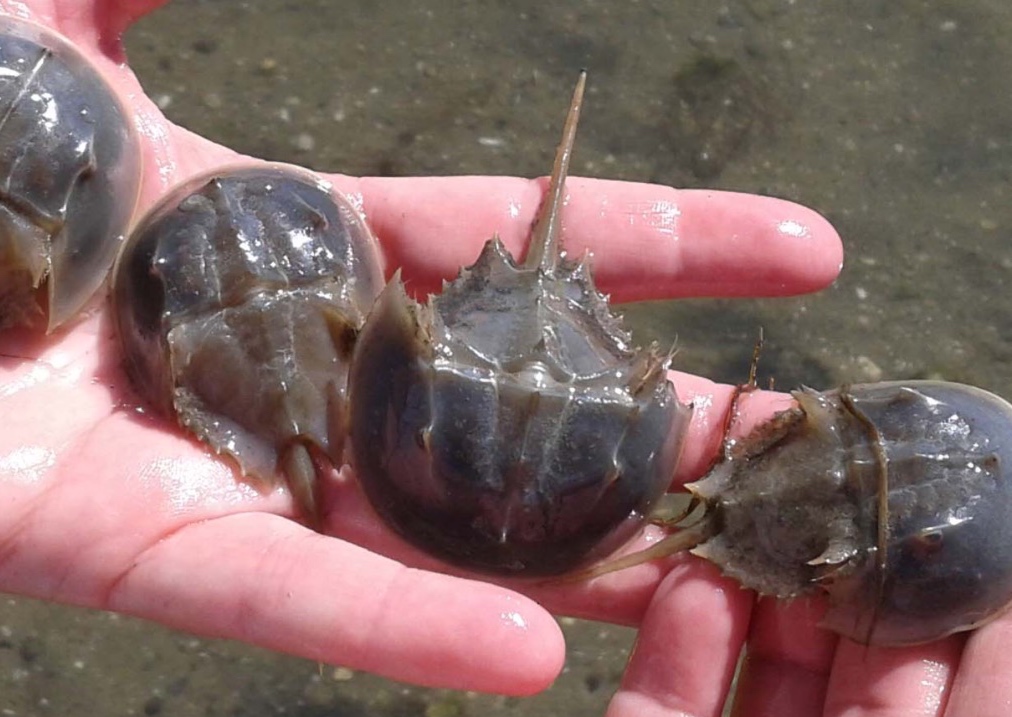
When I was a kid, I often walked to the Indian River Lagoon and just stood there in amazement watching the hundreds, if not thousands, of baby horseshoe crabs winding their way through the sands. They left circular trails, crossing over and over again…
Where were they going? What were they doing? Why were there so many?
Photo by Anthony J. Martin
Every once in a while, I would pick one up and place it carefully in the palm of my hand. Its sharp tail and prickly feet pushed against me. I watched in wonder at its strength as it bent in half. Once returned to the sand, the little crab went back to work immediately as if nothing had happened at all.
My mother had told me the horseshoe crabs were more ancient than the dinosaurs and had been here “forever.” “They are living fossils” she would say. “And they can live over 20 years and take 10 years just to mature.”
Although I picked them up with such care, today, forty years later, when I try to find them, they’re gone.
What happened to the horseshoe crabs of the Indian River Lagoon? How did a creature so ancient, resilient, and prevalent almost “disappear?”
Although there is quite a bit of literature on the Central Indian River Lagoon, I could not find much on the Southern Lagoon. Some of the best documentation came from Gretchen S. Ehlinger and Richard A. Tankersley. On line, they are cited multiple times for their paper “Reproductive Ecology of the American Horseshoe Crab, Limulus Polyphemus, in the Indian River Lagoon: An Overview.” I was also able to read “Evaluation of the Horseshoe Crab Fishery in the Indian River Lagoon Using Catch Data From Two Power Plants,” and a September 2014 “FPL Cape Canaveral Energy Center Horseshoe Crab Deterrent Fence Specifications” publication.
All of these lead to the following observations: decline of the species has been noted for around three decades. There have been UME’s or “Unexplained Mortality Events” where up to a 100,000 have died in the same area around the same time.
Factors that are related to their overall decline in the lagoon include intense coastal development, shoreline breeding grounds destruction, and unbridled human population growth; expansion of agriculture drainage watersheds into the IRL; deteriorating water quality; power plants sucking up as many as 100,000 a year into their intake canals; and over-fishing. The crabs are used as bait, collected for marine purposes, and more recently captured live and bled for their “blue-blood”that is invaluable to human health.
Unfortunately, for many years, the value and importance of the horseshoe crab was not recognized. For instance, Ehlinger and Tankersley note a one year study in the early 2000s at two Indian River Lagoon power plants that recorded a total of 39,097 crabs trapped on the intake screens at Cape Canaveral, and 53,121 at the Orland Utilities Plant. The scientists also mention a previous study from 1975 that estimated 69,662 at the Canaveral Plant, and 104,000 trapped annually at the Orlando Utilitility’s Indian River plant. “This alone could easily account for a decline in the Indian River population.” (Ehlinger and Tankersley 2007)
The St Lucie Power Plant located here in the southern lagoon did not agree to be part of the study and there is very little research one can now find on the subject.
In any case, the good news is that just recently the Cape Canaveral plant has installed a wall to protect the horseshoe crabs and science’s recognition of the species has people wanting them to come back.
The Florida Wildlife Commission notes:
“Horseshoe crabs are extremely important to the biomedical industry because their unique, copper-based blue blood contains a substance called “Limulus Amebocyte Lysate”, or “LAL”.This compound coagulates in the presence of small amounts of bacterial toxins and is used to test for sterility of medical equipment and virtually all injectable drugs. Anyone who has had an injection, vaccination, or surgery has benefitted from horseshoe crabs!”
…”in March 2000, a series of management measures for horseshoe crabs went into effect in Florida. The regulations required a license to harvest and set a limit on the number of animals each licensee could harvest per day (25 to 100 animals allowed per day per person depending on the permit). In 2002, a biomedical permitting rule created a mechanism to allow for biomedical collection.”
Yikes!
Horseshoe crabs being bled. Image as shared by FWC in 2017, first published in Popular Science.
Personally, looking at these photos of the horseshoe crabs being bled is like a science fiction movie to me. Never as a kid would I have imagined my little friends with needles in their heads being milked for their blood.
….But if this is what is going to save them… I must say, if they could talk, I bet now is the strangest part of their 450 million year journey. In my mind, they will always be free and drawing circles in the sand.
The video I am sharing today was filmed by the late Dr. Dale Hipson. Born and raised in Stuart, Dr Hipson was an avid wildlife lover, and very involved at the Stuart Heritage Museum. http://www.stuartheritagemuseum.com
Through the help of my mother, Dale’s family, and the community, I share one of Dr Hipson’s most famous videos from 2006 filming what seems to be hundreds of alligators marching across Powerline Road in the Dupuis Wildlife Area. I recall asking Dr Hipson why they were all crossing the road. “They are seeking more water,” he said, “levels change abruptly all the time.”
In the video, Dr Hipson and Shirley Corley’s “amazements” can be heard in the background. The video is quite delightful, even funny at times, and deserves to be reintroduced to the public. I know you will enjoy it.
A piece of long-leaf virgin pine from the windowsill of my Grandfather Henderson’s house in Gainesville, FLHistoric post card(s), long-leaf pine logging, courtesy Sandra Henderson Thurlow.
Grandaddy Russell Henderson as a young man, late 1920s Madison, FL. Family archives.
Like hard resin, stories of long-leaf pine and towering Florida forests are in me. Since my earliest days, I remember visiting my mother’s family and hearing tales around the dinner table:
“In the 1930s your Granddady and Uncle Gordy dove down to the bottom of the Withlacoochee River, chained those sunken water-logged giant trees, pulled them out with mules, put them on a train to Gainesville, milled them, and built this house by hand. Virgin long-leaf pine that had been on the bottom of that river for 90 years became our home. This house is history.”
At the time, the stories were just part of a lifestyle I did not lead living “down” in Stuart, Florida with the Yankees. In Gainesville we ate boiled peanuts, okra, gigantic breakfasts of bacon, eggs, toast, and homemade jelly. In Stuart, I ate Lucky Charms.
Now that I am becoming an old-pine myself, the story of the long-lost, long-leaf pine is more interesting to me. And “lo and behold,” although public records show the famous long-leaf forest stopping just north of Lake Okeechobee, recently my mother and I learned that they were, indeed, further south, right here in what today is Martin County!
This observation is based on a 1st hand account of 1910 by J.H. Vaughn in an Abstract of Title for Indiantown, Florida, No. 12386.
Florida State Geological Survey 1927 belonging to my grandfather who worked for IFAS and UF in soil science.This public photo off the internet gives scope of the size of the long-leaf pines.
In the early days of our country, long-leaf pine forests covered approximately 90 million acres and stretched across the entire southeastern United States. These trees are documented to have stood from 80 to 175 feet tall and many were up to 400 years in age. Of course multiple animals were dependent on the forest for shelter and food and there were massive benefits to the watersheds. The cleanest waters in the world run off of forests. These amazing trees evolved to completely withstand forest fires, actually thriving in such conditions. Imagine if you would these remarkable trees of our Creator, cut to the ground with the same state of mind as today when mowing one’s lawn….By the 1920s only 3% of the forests remained.
Digital Forest documentation of forest loss in the U.S.
So where were these trees in Martin County? Where do we fit into the incredible history of these magnificent conifers? J. H. Vaughn, a lumber man of the 1800s, negotiating a sale states in the abstract of title below:
“…there is an average of 2000 feet of Long Leaf Yellow Virgin pine per acre.. being on the eastern side of Lake Okeechobee…”.
(The Townships and Ranges listed are today’s Indiantown.)
I think it is incredible that we are part of the long-leaf pine odyssey. As today, the Nature Conservancy and people like M.C. Davies have dedicated their fortunes and lives to bringing back this magnificent species and the animal life that comes along with it. The situation is a lot like St Lucie River and Lake Okeechobee restoration. It’s a generational goal done so that our stories and our lives are remembered, and not “long-lost.”
No 12386
Page 5, original land survey 1855
Today’s map, as printed on-line August 2, 2017.Newspaper article in about cutting of trees and lumber in Indiantown area, 1927. (Thurlow Archives)
My mother looking through a book on trees of Florida. 7/17 JTLKelly Morris, 2017