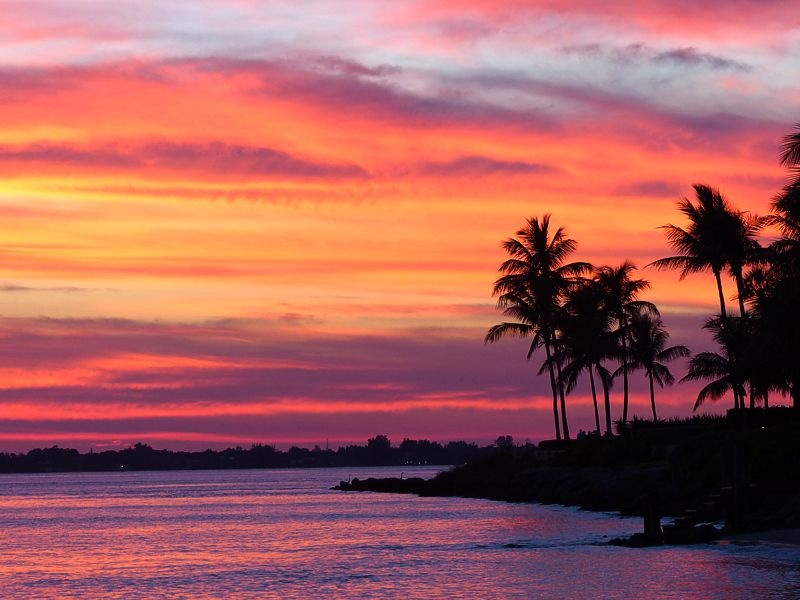
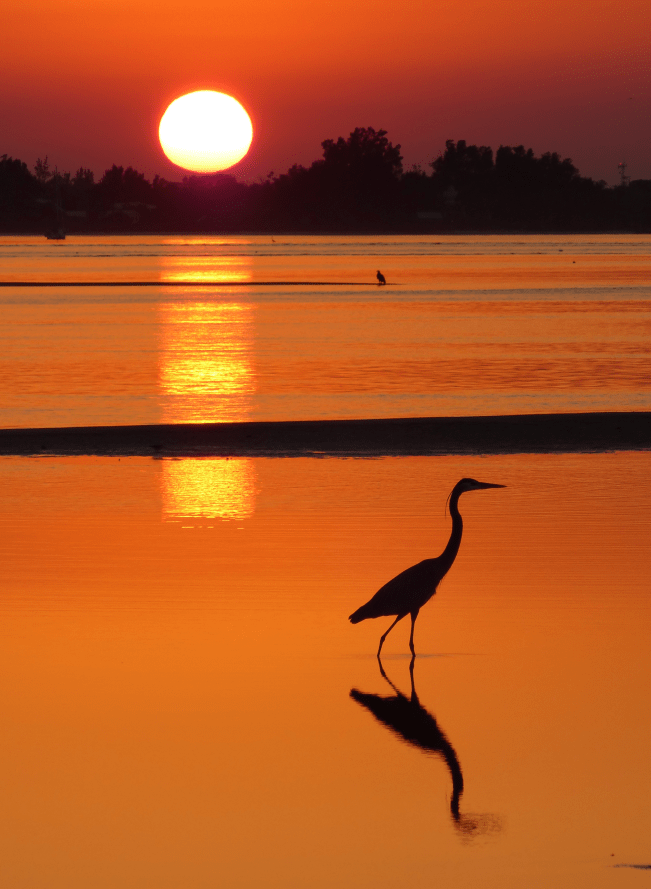
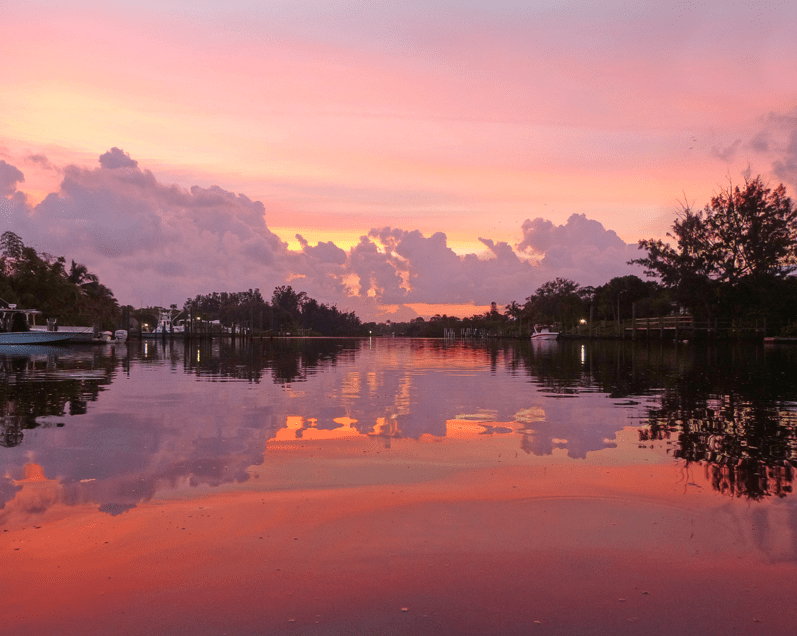
Great Egrets along the Indian River Lagoon. Photo John Whiticar, 8-20-14.
For me, there is no greater beauty than to look up into the sky and see a lone Great Egret making its way back home to Bird Island or other rookery in the early evening light.
I see them often, and every time, I stop what I’m doing, and look and wonder where they are going, and where they have been. They are so elegant, with their perfect flying posture, always looking straight ahead.
When Ed and I first bought our home in Sewall’s Point we had a gold-fish pond behind the house and a very tall Great Egret would come to hunt. I would watch in complete fascination the ancient bird’s posture, patience, and beauty. Like a Japanese painting.
Today, I wanted to share some photos of local Martin County resident, John Whiticar, who I have featured before. John has a talent for capturing the beauty of the sky, the water, and the bird life of the St Lucie River/Indian River Lagoon.
These photos were taken recently on his way to Ft Pierce. Mr Whiticar states: “A bunch of White Herons were spotted on the way to Whiticar North this AM on Indian River Drive this morning. There were at least 10 in a group on the morning calm of the Indian River Lagoon.”
According to the US Park Service, the fishing habits of Great Egrets are among the most efficient of all birds. “They stalk their prey by slowly walking or standing motionless in the shallows and forage with their webbed feet, raking and probing the bottom, snapping up fish in a matter of milliseconds with their quick bill reflex.”
Great Egrets are solitary birds but do congregate during breeding season when both males and females get delicate breeding plumage and their faces take on a fluorescent green color along the beak.
Great Egret in breeding plumage. Public photo.
During the fashion of feathered ladies hats in the late 1800s, the Great Egret and many other shore birds were almost hunted to extinction in the Florida Everglades. The bird’s beauty inspired the Audubon Society to adopt it as their symbol as they helped abolish the destruction of these birds.
Today, across the nation, the Great Egret’s numbers are strong, but over time have declined in many areas along the St Lucie River/Indian River Lagoon due to destruction of shoreline habitat and wetlands for development.
So let’s help our feathered friends in every way we can, and the best way to do that right now to continue working to save our Indian River Lagoon.
August 24, 2014 photograph of blue-green algae bloom east of S-308, Lake Okeechobee/C-44 Canal area. (Photo courtesy of Paul Shindel.
Does the above photo make your stomach turn? What is it?
It is a HAB or Harmful Algae Bloom, taken four days ago, right here in Martin County.
According to the United States Department of Agriculture, “over the past century, alterations of land use and acceleration in the rate of cultural eutrophication have led to widespread increases in harmful algal blooms in Florida, including toxin-producing species.”
First, what is “eutrophication” and why is it “cultural”?
Eutrophication is is when a body of water becomes enriched in dissolved nutrients (such as synthetic phosphorus and nitrogen from fertilizer) that stimulate the growth of aquatic plant life usually resulting in the depletion of dissolved oxygen and a “bloom.” These algae blooms can be toxic.
“Cultural means “created by humans.”
So what are we doing about this especially since “we” caused it?
In 1997 the Florida Department of Environmental Protection formed a Task Force on Harmful Algae Blooms and in 1999 they produced a scientific document, a White Paper: HARMFUL ALGAE BLOOMS, (http://myfwc.com/media/202228/HAB_whitepaper2006_UPDATE.pdf) It is extensive.
In my opinion, as usual, our state governors and legislatures did not pay significant attention to these studies, and failed to implement policies that would help overcome this crisis issue. How many of them even read the report?
Case in point, recently, it was the local governments and local residents of the towns, cities and counties along the west and east coasts of Florida who advocated and achieved strong fertilizer ordinances not allowing fertilizer use during the rainy season while the state continues to fight and support less restrictive rules.
1. Time-Series Sampling in Pinellas and Manatee Counties) Researchers conduct detailed sampling to better understand when, where and under what conditions harmful algal blooms form.
2. Tampa Bay Monitoring ProgramResearchers monitor 10 sites in Old Tampa Bay for the presence of, or conditions favorable to, harmful algal blooms.
3. Red Tide Offshore Monitoring Program
Encouraging people to learn about the program and learn how to become volunteers, collecting water samples around the state to help scientists monitor the Florida red tide.
4. Monitoring Toxic Algae Species and Shellfish in the Indian River Lagoon (2002-present)
Periodic testing of water samples and clams provides an early warning of bloom occurrences and shellfish toxicity and minimizes the risk of human exposure to saxitoxins.
Those are great present HAB programs, so why don’t we hear more about them and why don’t they include Lake Okeechobee, obviously the toxic algae is there as well…
Here at home, when the gates of S-308 open from Lake Okeechobee to the C-44 canal that is connected to the St Lucie River/Indian River Lagoon, the algae in the photo above goes directly into the our river system.
Google Earth image of S-308, structure at Lake Okeechobee that opens to the C-44 canal where above photo was taken. This area always has some spill through the gates. Note the agriculture lands right up to the C-44 canal…
It is 2014. The state has been studying this problem since 1997. They do not have all the answers but we do know by now that HABs are fed by cultural eutrophication due to clearing of land that can no longer clean water on its way to estuaries, rivers and lakes; building of towns and cities that create concrete and asphalt barriers to water reabsorption; fertilizer and other runoff; oil/chemicals from thousands of miles of highway and roads; septic effluent; canals and redirection of water such as Lake Okeechobee to the St Lucie and Caloosahatchee; agriculture’s heavy destruction of native lands and the fertilizer and chemical runoff associated with their business, unregulated golf courses fertilizer run off and re-use of high nutrient water resources….it’s endless.
It is said that “ignorance is bliss,” well the state of Florida doesn’t have that luxury anymore.
“The dinoflagellate, (marine plankton), Pyodinium bahamense is what “produces the light show in the IRL.” Photo credit: https://getupandgokayaking.com
About a week and a half ago, my mother sent me an email with photos of my father and her on a kayak trip at night in the Indian River Lagoon. She had seen an article in the Stuart News about a company called Motorized Kayaks of the Treasure Coast and their trip into the light show of bioluminescence that has been occurring off our shores.
First, I thought about how cool my parents are to be going on kayak trips in their mid- seventies, and second, I thought, “aren’t these little plankton creatures a kind of algae bloom, and aren’t algae blooms bad for the lagoon in spite of bioluminescence’s beauty?”
Algae blooms have been linked to recent 60% plus seagrass die-offs, poor water quality, as well as IRL pelican, dolphin and manatee deaths. Super blooms, brown tides, “regular” and “toxic” algae blooms are “fed” by fertilizer, septic effluent, canal and Lake Okeechobee discharges, especially in the southern lagoon.
[caption id="attachment_2989" align="alignnone" width="300"] My father, Tom Thurlow, preparing for a kayak trip into the Indian River Lagoon to view the bioluminescent light show. (Photo Sandra Thurlow, August 19, 2014)
Well anyway, I decided to contact Dr. Edie Widder of ORCA, the Ocean Research and Conservation Association, in Ft. Pierce, (http://www.teamorca.org/cfiles/home.cfm) and ask.
Dr Widder is a world-renowned bioluminescence expert; she has even worked with the US Navy in the “design” of ships that would not cause bioluminescent disruption in the oceans, and thus give away their location to enemy ships.
This was my question to Dr Widder:
Dear Edie, My parents rented kayaks to go see the bioluminescence in the IRL. It got me thinking. Is the light caused by the same creatures that cause toxic algae blooms in the lagoon? Is the bioluminescence a bad sign for the health of the lagoon? Thank you. Hope all is well.
Her response:
Hi Jacqui – It’s kind of a good news bad news story. The dinoflagellate producing the light show, Pyrodinium bahamense, happens to be one that produces saxitoxin. Interestingly it’s the same dino that’s responsible for the bioluminescent bays in Puerto Rico and in those bays it doesn’t produce the saxitoxin. Here it does. It’s not known why although I have a theory and it has nothing to do with pollution. (It’s a long story having to do with how their bioluminescence functions to protect them from predators under different concentrations.)
Dino blooms are usually preceded by rain events that flush nutrients into the water and then a series of calm sunny days that promote photosynthesis. Blooms like the one we’re seeing now used to be routine according to some of the older fishermen I’ve talked to. They called it fire in the water. The fact is the water can’t be too polluted or the dinoflagellates won’t grow. I’ll send you an article with some pictures I took.
Cheers,
Edie
Here is a photo Dr Widder took of bioluminescence in the lagoon I copied and a link to a remarkable video.
Bioluminescence in the IRL photographed by Dr Edie Widder.
In conclusion, I looked up saxitoxin and learned it is a “paralytic shellfish toxin” that is found is some shellfish and especially puffer fish. It has been found in few other places in the US as well as in the Indian River Lagoon. I guess the little dinoflagellates, the same ones that make the pretty bioluminescence light, not always, but sometimes, will produce this toxin which gets spread to some shellfish and some fish. If such a shellfish or fish is ingested, it will make a human very sick. Around 2002, 28 people got so sick here, in the Merritt Island area, and in a few other areas of the county, that now there is a permanent government ban on harvesting/eating IRL puffer fish in the entire IRL.
Since I am nowhere close to a scientist, I will just share some links below and refrain from speculating what is “good or bad. ” Nonetheless, I think I can safely say that sometimes beauty and danger walk hand in hand in this magical world of our Indian River Lagoon.
Senator Joe Negron and I after a torrential down-pour at “Hands Across the Lagoon” Sept 28, 2013. Sewall’s Point. (Photo Dave Thatcher.)
I am big supporter of Senator Joe Negron. I believe that his intervention has “changed the game” for the Indian River Lagoon and put the St Lucie River/Indian River Lagoon squarely on the map in front of every politician and agency in the state. Now we have a chance to save it.
Yes, there have been champions for the lagoon before, but in my opinion, no one has ever done what Senator Negron has done.
I had been aware of Joe Negron for years but it was not until 2012 that I had any contact with him and that contact changed my life and improved my efforts for saving the Indian River Lagoon.
For half of 2011 and all of 2012 I was the mayor of the Town of Sewall’s Point and in 2011 the River Kidz had started on their own, authentically, in the Town. Two fifth grade girls, Evie Flagh, (my niece) and Naia Mader, held a lemonade stand in Indianlucie giving their proceeds to “those old gentlemen,” the River’s Coalition, who said they “needed youth in their organization.” Columnist, Eve Samples, had written about this and the children filled the calling. River Kidz ended up becoming a force with hundreds of kids joining and spreading to other counties. They even came up with their own mission statement: “Our mission is to speak out, get involved and raise awareness, because we believe kids should have a voice in the future of our rivers.”
As mayor, I made it my priority to help these kids as I have none of my own and am a former teacher. As a lifetime resident, I knew the dying river was a gigantic issue for the town and this all looked like a “good fit.”
Myself, my sister Jenny Flaugh, and good friend Nic Mader, started advocating along with these kids. Many other parents and children joined.
Senator Negron at the River Kidz’ first rally for the river in October 2012. St Lucie locks and Dam. (Photo JTL)
In the late summer of 2012, I thought of who could help the cause of the river and the kidz? Who was in a position to help. “Joe Negron,” I thought. He is our senator and he is the head of the Appropriations Committee, one of the most powerful positions in the state. I was nervous. I really did not know him. He was friends with my husband’s business partner as they had both gone to the Hope Sound Bible School in their youth. I had seen him once at a birthday party. I was certain he had no idea who I was. After much angst, one day I called him. Somehow I got his phone number from my husband Ed I think. I was shaking.
“Hello, Senator Negron. This is Jacqui Thurlow-Lippisch from the Town of Sewall’s Point. I am the mayor. May I speak to you for a minute please?
“Yes,” he replied.”
I was a wreck. Believe it or not, I am not good at “asking.”
“Sir, I am calling for your help. I am calling about the river….and the future…..about the kids….”
By the end of the short conversation, Joe Negron said he had an op-ed idea for awhile…maybe he would send it in to the paper? It had to do with the river. I encouraged him.
“Yes. Yes.” I said, “Please. We need your help. Thank you.”
The day I saw the op-ed, I said to myself, “Wow, he did it.”
In spite of one’s opinion on the situation, this article shook the foundations of the status quo. A state senator, chair of the Appropriations Committee, had said something, written something so taboo and it got the state and federal government’s attention and started a scrutinizing dialogue of the management of the lake and the deathly discharges to our estuaries.
Things ramped up. The ACOE starts releasing water from Lake Okeechobee into the St Lucie River/Indian River Lagoon in June of 2012. The River Kidz held a protest at the locks with their friends and parents. Joe Negron along with Martin County commissioner, Sarah Heard attended. It poured rain but they came. The Kidz feel important. The movement’s volume turned up. More kids and parents got involved. The river seemed to always be in the Stuart News.
Skip forward to the “Lost Summer” of 2013. The ACOE began dumping in May due to early rains. The river is a putrid, toxic mess. The kids can’t go in the water. The River Kidz rally at the locks again. Joe Negron attends, again….
And then Joe Negron, Senator Joe Negron, pulls a rarely used and ultimate political card from his pocket going where he, and we, had never gone before. He organizes the “Senate Select Committee on the Indian River Lagoon and Lake Okeechobee Basin.” It occurs August 22, 2013 at the Kane Center in Stuart. All eyes of the state are upon us. The media, state and national and local, take over. We are on the map like never before. It is an explosion. Even newspapers in Europe cover the story. (http://www.flsenate.gov/Media/Topics/irllob)
By the end of the following year’s legislative process in 2014, more than 200 million dollars goes towards the Indian River Lagoon and related projects supporting “some more” water going south. Everyone is Tallahassee know about the St Lucie River/Indian River Lagoon and Lake Okeechobee. Not a fix but a start. A large start. Senator Negron has put his neck on the line as he is tapped “to be” Senate President. Some are angered by his complete focus on the IRL. He stands firm.
Between the Select Committee and the threat to cut ties with the Army Corp’s abusive relationship over us, change is in the air.
As an aside, I must admit, I have been criticized by some people, for my blatant support of Joe Negron. That is OK. I knew that could happen. Politics is emotional. People are allowed to have their opinions and I have mine.
At my recent Florida League of Cities meeting in Hollywood, all comments were positive. Elected officials were coming up to me from the panhandle, to Tallahassee, to Miami saying they had seen the commercial or heard of it and were impressed with our campaign for the Indian River Lagoon. “I never knew the estuaries got damaged by Lake Okeechobee…” They said.
Now the University of Florida is charged by the Select Committee with “a technical review of options to move water from Lake Okeechobee to the Everglades…” Will it fix the problem, I doubt it, but it will begin to and have some of the most outstanding minds in our state working on the problem now and in the future. In time, it could help solve the problem…
In conclusion, I was raised to repay my debts and to Senator Joe Negron I am indebted. And I am honored to be so. I will do everything I can to help him and keep him in office and to encourage him to help the Indian River Lagoon.
Recently, Eve Samples wrote an article about PACs and monies for Joe Negron’s campaign, which included campaign contribution from US Sugar. What do I have to say about that?
Politics is a hard and imperfect game and everyone is trying to influence powerful people however they can. Thankfully, I have a tool more powerful than money. I appeal to “conscience.” And Joe Negron is a man who listens to his. Of that, I am convinced.
Cover of NOAA/DEP “Draft”Indian River Lagoon System Management Plan, 2014.
My husband came home from the airport yesterday, I was on the couch in the living room reading. “Have you had a good afternoon?” He asked.
“Awesome,” I replied. “I have been reading the most wonderful document that contains all of the important information about the entire Indian River Lagoon.” I energetically held up my gigantic copy of the Florida Department of Environmental Protection and NOAA- Indian River Lagoon, Draft Report for 2014. (http://www.dep.state.fl.us/coastal/sites/indianriver/plan.htm)
Ed smiled and looked at me like he usually looks at me in such instances. “That’s great,” he ironically replied, “government publications are my favorite too, how exciting…”
I am not always enamored with government publications, but I am with this one, especially as it is not finalized yet and the agencies are taking comment from the public.
What I like best about the document is that is deals with the entire lagoon, not just one section, including the lagoon’s four aquatic preserves: 1. Banana River; 2. Malabar to Vero Beach; 3. Vero Beach to Ft Pierce; and 4. Jensen Beach (really just south of the City of Ft Pierce) to Jupiter Inlet.
Locations of the IRL’s four aquatic preserves
According to the document, “each of the four aquatic preserves comprising the IRL System was classified by the state of Florida as OFWs or “Outstanding Florida Waters, “in 1979 (Rule 62-3-2.700 (9) F.A.C.
I was 15 years old at that time. I remember those waters and how they shaped and enriched my life growing up here in Stuart. To think that these “Outstanding Florida Waters,” are now “impaired” makes me sad and makes me angry.
It has been coming for years, but in 2011 through 2013 the lagoon system really “crashed” with the “super-bloom” and brown tides in the central and northern lagoon, killing more than 60% of the area’s seagrass and leading to two federally designated “Unusual Mortality Events” of the endangered manatee, and the protected bottle nosed dolphin.
And also in 2013 the months long toxic algae outbreak in the southern lagoon… This occurred due to blue-green “microcysis aeruginoas” algae water released by the ACOE from Lake Okeechobee, into the St Lucie River/IRL system. The SLR/IRL system was already over stressed from discharges coming from local canals C-44; C-23; C-24 and C-25…the lake Okeechobee water was the nail in the coffin so to speak.
I think there is a disconnect here. Aren’t these waters protected?
According to the publication, the mission statement of the Florida Coastal Office/Department of Environmental Protection is the following:
1. protect and enhance the ecological integrity of the aquatic preserves;
2. restore areas to the natural condition;
3. encourage sustainable use and foster active stewardship by engaging local communities in the protection of aquatic preserves; and
4. improve management effectiveness through a process based on sound science, consistent evaluation, and continual reassessment.
I will refrain from bashing of the Department of Environmental Protection as I do not think our fair state’s leadership over the past hundred and fifty plus years has helped them attain their mission. How do you “direct” an agency to protect something and then simultaneously promote over drainage of natural systems, channelizing, overdevelopment along the lands of these once “outstanding waters,” and allow water districts to over-grant permits for aquifer withdrawal for more agriculture and development?
Another irony I have to add here is that these once “outstanding waters” are what helped bring people to our locations and supported their high real estate values. That is changing as some people are now leaving. Last year, in the Town of Sewall’s Point, although the real estate market improved overall in the county, our property values only increased 0.13%. As a “desirable” water front community with some of the highest property values in the county, this came as a surprise and is certainly directly linked to the “lost summer” and toxic waters of 2013.
The state of Florida needs to “wake up.” The Town of Sewall’s Point is a microcosm for the rest of the state. So what can we do to help? Speak up!
Please if you have time and interest, check out Indian River Lagoon System Management Plan, Draft Report 2014 below. Even if you don’t read it all, which is almost impossible, keep it as an electronic resource, and MAKE A COMMENT to the DEP. Even if it is just one that you appreciate that they are reevaluating their management plan and how much the IRL means to you.
It is only through the continued pressure of a caring public that the Indian River Lagoon will be resurrected and its “living waters” will run through our cities again.
Coat of Arms, Andros, Bahamas, 2014. As seen at Andros Airport. (Photo by Jacqui Thurlow-Lippisch 8-14)
I was recently struck by this beautiful coat of arms, or crest, or piece of art, hanging in the airport in Andros, Bahamas. My husband and I had flown there; it is only a 45 minute flight from Stuart. Adros, as most all the islands in the Bahamas, has a connection to our St Lucie River/Indian River Lagoon region here in Martin and St Lucie Counties.
Before I start, I’d like to say that I was not only struck by the beauty of this crest with its sailfish, flamingo, and conch but somewhat taken aback by the Spanish ship in the middle under the ancient South American Indian sun symbol of the Great Creator.
The words under the crest read, “forward, upward, onward, together…”Hmmm?
Italian, Christopher Columbus, sponsored by Spanish, king and queen, Ferdinand and Isabella, came to the Bahamas first in 1492 by ship; years later as the Caribbean became filled with mining operations and sugar plantations of great wealth, the native Arawak/Lucayns people of the islands were forced into slavery. The natives fiercely resisted, but most died of small pox due to having no immune system against Spanish disease. According to documentation, by 1520 the culture was “extinct.” As a former culture they had thousands (40,000 across the Bahamian Islands.)
The story of their annilation is one of the the most brutal instances of genocide in our human history.
Later captured African slaves were forced to replace the Arawak peoples on plantations, and ironically later in the 1800s the Black Seminoles of the United States emigrated via canoe from Florida to Andros. Many live there today in Red Bay working as sponge divers and artisans. After great tribulation, and they are still struggling today, the Bahamas became independent this time from England in 1973.
Time goes on. Things change and people move on for new dreams. Dreams in America. Where justice prevails for “all.”
One of the black families that came to our Indian River Lagoon Region in 1898, not from Andros but from Exuma was the Christie Family. My family holds the Christie family very dear as my mother, who wrote the History of Sewall’ Point in 1992, formed a close relationship with the Christie family as they had worked not as slaves, but a free men and women over generations, for the Andrews family and others who held great land holdings and beautiful winter properties on the peninsula of Sewall’s Point.
According to historian and author, Sandra Henderson Thurlow, “No one family has lived on Sewall’s Point with out interruption longer than the Christies. Their friendships knew no color barrier.”
The Christie Family’s knowledge and relationships with the powerful early families of Sewall’s Point is really what gave my mother, the ability and foundation to write her first book which has led to her career and great documentation of our area.
For the past seven years, I have served with Commissioner and former Mayor, James A. Christie, Jr. who is one of longest-serving public servants of the City of Stuart along the St Lucie River/Indian River Lagoon. We serve on the Treasure Coast Council of Governments together. As an elected official, Mr Christie has been a great supporter of the river movement. He will be retiring this September; I will be there to honor him.
So, yes, it really struck me, considering the destruction of native peoples, the environment, slavery, the birth of new counties and the death of old ones, that the crest was so happy and beautiful and read “forward, upward, onward, together…” surrounded by the birds and fish and sea life.
May we find the optimism in this difficult and sometimes horrific world. Let’s save our rivers and yes, let’s work together to “overcome.”
——————————
A great book is on “this subject” is History of the Caribbean by Frank Moya Pons
Intricate islands of the central Indian River Lagoon estuary near Vero. (Photo Jacqui Thurlow-Lippisch/Ed Lippisch, 2013.)
Recently, Harbor Branch Oceanographic Institute, located in St Lucie County, (http://www.fau.edu/hboi/) released their “Our Global Estuary,” U.S. National Workshop, Draft Report.
The new program founded in 2013, is incredibly interesting. Harbor Branch, right here in “our own back yard,” has taken a world leadership role in one of the planet’s most important issues, one we all know quite well, the anthropogenic pressures that threaten the ecological benefits of estuaries. Harbor Branch is opening scientific dialogue on these pressures and the evolving technology that may help “save” them, by scientists sharing their experiences on such issues, scientists from all over the world. (http://ourglobalestuary.com)
Dr Megan Davis, Interim Director of Harbor Branch, co-chairing with Dr Antonio Baptista and Dr Margaret Leinen, along with other local and world scientists are leading this project.
It is noted in their publication that “comparing and contrasting estuaries and management approaches worldwide is essential to capturing and a gaining from lessons learned locally.”
The report also notes and I quote that “estuaries are vital to the planet and their extraordinary productivity that supports life in and around them…Nearly 90% of the Earth’s land surface is connected to the ocean by rivers, with much of the water that drains from lands passing through wetlands and estuaries…cleaning species like mangroves and oysters are being limited by stressors caused by humans, such as water withdrawals, hydropower operation, navigation, and the release of fertilizers, contaminants, and municipal wastes. These pressures are increasing and threatening the balance of the systems.”
As one reads on, the report discusses that population growth and land-use choices not only near the estuaries but also many miles upstream can have a significant effects on estuaries. It is noted that “as farm production methods have evolved to increase yields, more nutrients have made their way to the water causing algae overgrowth to the point of suppressing seagrass. These pressures can cause disease and death in fish, marine mammals, birds, and other animals.” Land development also impacts estuaries with its runoff and diversion or redirection of water.
The largest estuaries in the world are listed in the report are not in the United States. 1. Ganges, Indian, Bangladesh, Nepal; 2 .Yangtze (Chang Jiang), China; 3. Indus, Indian, China, Pakistan; 4. Nile, Northeastern Africa; 5. Huang He (Yellow River), China; 6. Huai He, China; 7. Niger, West Africa; 8. Hai, China; 9. Krishna, Indian; and 10. Danube, Central and Eastern Europe.
Personally, I had only heard of half of those places and it made me think about the millions of people living around estuaries all over the world and how much I really don’t know. How small we are comparatively…
Although of course the St Lucie River/Indian River Lagoon is not one of the largest river basins in the world, we were listed under “Estuaries are Receiving More Attention” along with Chesapeake Bay. The section notes water quality is compromised in part by excess nutrients and inland freshwater discharges and diversion of water that historically flowed south through the Florida Everglades. It notes seagrass die offs, manatee, pelican and dolphin mortality, septic, agriculture and lawn fertilizer issues…
About half way down the paragraph under Indian River Lagoon, it says: “Public outcry and accompanying media attention achieved critical mass in 2013, helping convince several municipalities to enact more restrictive fertilizer ordinances and the state legislature to appropriate over 200 million in support for observation and systems remediation for the Lagoon and Everglades.”
Wow.
Once again, like the Dr Seuss children’s book, Horton Hears a Who, where the residents of Whoville together shout WE’RE HERE, WE’RE HERE, finally to be heard, the Treasure Coast is noted for its efforts, this time in a document that will be shared around the world!
Thank you to Harbor Branch for its continued leadership and efforts in ocean and estuary research and thank you to the people of the Treasure Coast or “Whoville” who have been heard and continue to help save the Indian River Lagoon.
An ad running on the west coast of Florida in the area of Lee County, put together with the collaboration of interested parties and local governments, 2014. (Shared by former council lady Marsha Simmons, Bonita Springs.)
Billboards, radio ads, and commercials for clean water. They are already on Florida’s west coast and they may be coming to The Treasure Coast. Lee County and generally the west coast of a Florida have been the leaders in this promotion for educating the public to vote and act out of habit for “clean water.”
I smiled a few years ago when I saw a Facebook post of a billboard on the west coast of a lady in a bikini standing in a pool of algae water holding it in her hands, the caption read ” Why won’t Florida’s politicians protect our water?”I believe Earth Justice, a law firm for the environment, and the Sierra Club helped fund the ad along with private monies.
Lately local governments themselves are helping create and fund these ads, like the one above for fertilizer. “Don’t Feed the Monster,” teaches the public not to over fertilize. It was Sanibel and Sarasota on the west coast that started the strong fertilizer ordinances in their cities, somewhere around 2007. It caught on. In 2009 on Florida’s east coast, the City of Stuart passed the first “state endorsed” fertilizer ordinance and then in 2010 the Town of Sewall’s Point went one step further and passed a “strong fertilizer” ordinance not allowing fertilizing during the rainy season with product containing phosphorus and nitrogen, the nutrients that “feed” algae blooms in our waters. Martin County and others followed and then this strong fertilizer ordinance idea, originally from the west coast, went up the entire treasure coast and beyond. Remarkable!
Will the next move be for Martin, St Lucie and Indian River Counties to have a couple of billboards? Martin County is promoting the “Be Floridian” program or getting ready to….this fertilizer education program came out of Tampa Bay. Their ad is pink flamingos! At the beginning of every rainy season the city hall puts hundreds if not thousands in front of their building and around the city. These pink flamingos remind the public to “not fertilize during rainy season June-September.” The “Be Floridian” program promotes Florida Friendly yards with less turf grass and less fertilizing. It has been wildly successful and Tampa Bay has recovered 45percent more of their sea grasses than they had after World War II since the programs’ inception which occurred around ten years ago.
These ad programs are working and educating for clean water and putting pressure on politicians and agriculture to get more “on board.”
I think the ads are coming to the St Lucie/Indian River Lagoon Region soon, so if you have any clever ideas please share. But one thing for sure, if I’m involved, I will not be wearing a bikini! 🙂
Artist depiction of a Florida in the future. Sea level rise, public photos.
I have read and listened to people speak about sea level rise before, but for some reason, this time it was different…
Last week, in Hollywood, Florida, at the sparkling ocean side resort, the Westin Diplomat, I listened to Dr Harold Wanless, Chairman of the Department of Geological Sciences, University of Miami. I experienced half denial and half fascination as he gave his unemotional, scientific presentation at the Florida League of Cities Annual Conference. The first sentence he said was “Sometime in the next 30 years, people in South Florida with 30 year mortgages will not be able to sell their homes.”
He cited Miami as the ninth most vulnerable city in the world to sea level rise and number one in exposed assets. He noted the warming and expansion of the world oceans, and the melting of Greenland and the polar glaciers. He said the oceans will rise 2-5 feet by the end of the century. Miami International Airport will be a marsh. He calmly projected that there will be forced evacuation of most barrier islands.
“Guess what?” he said. “The ocean has arrived.”
“The ocean city, Sewall’s Point. The island city that is…”I fantasized.
Dr Wanless like a mannequin continued.
The porous sand of Florida will not allow what Holland and New Orleans have done. South Florida will be under water and if not underwater the water will be so close underground that it will make maintaining roads and infrastructure almost impossible for cities…
At two feet increase, 72% of Miami’s land mass will remain above water. At six feet, 44%.
At this point I started doing the math. In years that is. I wrote down my age, 50, and all the ages of my family. In 34 years, with his prediction for two feet, I would be 84. Ed my husband, 92. My parents in heaven. My sister 81; my brother 78; my nieces 44; 46; 47 and 47. “I guess Ed and I can’t leave the house to the “kids…” I thought.
The whole time I was watching my real estate values go down, I was wondering about my beloved Indian River Lagoon. Can we still save her? Will the ocean reclaim her? Will she still be an estuary? Is all our work in vain?
There were two more speakers after Dr Wanless. Attorney Thomas Ruppert and Assistant Public Works Director of the City of Ft Lauderdale, Nancy Gassman. Basically Ruppert said you can’t win and Gassman said not to panic. Cites have gone through changes before…we must believe in humankind. We will keep building; we will adapt and survive.
As someone who has given my life to the preservation of the St Lucie River/Indian River Lagoon, I felt like “preserve” was suddenly a word that was outdated.
I starred thinking…worrying…’
“I must rather help the lagoon “adapt” to changes the best I can. If this to be, which I do not know, but probably is… I cannot preserve her, in fact I never could, she has always been changing. Wow, this is uncomfortable. It’s like my world is upside down. How can I plan if this is to be the future? …I must stay the course; I will not abandon ship. I will keep my values…
I think I’ll go to my room and look out the window, at the ocean…when is happy hour?
I think I will begin to prepare for the storm ahead…”
–thank you to Mayor, Cindy Lerner, Village of Pinecrest and Ryan Matthews, FLC for organizing this presentation.
FLC links:
Sea Level Rise and the Impacts of Climate Change
Commissioner and friend Gil Ziffer of Tallahassee and I serve together on the FLC EENR Committee. (Selfie at evening gathering, 8-16-14, FLC Annual Conference. ) (http://www.talgov.com/commission/commission-officials-ziffer.aspx)No matter the focus of technology, there is nothing more important than human relationships. I believe that the Florida League of Cities and the relationships I and others have made there in the past years have been key in giving statewide recognition to the problems of our St Lucie River and Indian River Lagoon.
Almost all cities and towns are members of the league and membership allows cities to have many business and educational services such as insurance and legal benefits at a reasonable “collective” price. Another aspect of the league is its legislative committees that work months prior to each legislative session to come up with a “policy statement,” for league lobbyist to use during the legislative session to promote the business of the league.
The five committees are Energy, Environment and Natural Resources; Finance, Taxation and Personnel; Growth Management and Economic Development; Transportation and Inter-govermental Relations; Urban Administration.(http://www.floridaleagueofcities.com)
I first joined the Environmental, Energy and Natural Resources Committee in 2010. It was intimidating to sit at the table with fifty or more mayors and commissioners from all over the state but it was enlightening to learn together about their issues.
It was here that I first learned first hand the extent of the destruction of our state aquifers and springs, (http://springseternalproject.org) and it was here that I got my nerve up to share about the problems of the sick St Lucie River/Indian River Lagoon bottle nosed dolphins, and share how the southern Indian River Lagoon, my hometown, has the highest level of lobo mycosis, a terrible skin disease, as documented by Dr Gregory Bossert, formerly of Harbor Branch. It was here at this table I could relay the issue of the documented compromised immune systems of these dolphins due to poor water quality from pollution of local canals and especially the ACOE’s releases from Lake Okeechobee. It was here and this table that I received support. (http://www.ncbi.nlm.nih.gov/pubmed/16426180)
2012 IRL sick dolphins as topic for the FLC EENR Committee discussion.
Over the years, the people on this committee and the staff of the Florida League of Cities like lobbyist/staff Ryan Matthews and Scott Dudley became my friends. I learned about the league and many cities’ environmental problems and they learned about Sewall’s Point’s. Ryan and Scott taught all of us how to advocate in Tallahassee for legislation on our issues.
Then in 2012, something amazing happened to me.
President of the League for 2013-14, Dr. PC Wu, councilman from Pensacola, appointed me Chair of the Environmental, Energy and Natural Resources Committee. I had written Dr Wu asking to chair the committee and he gave me the honor even though I am from a very small town compared to many of my fellow members. Mayor Sam Henderson of the City of Gulf Port was vice-chair. We had a good year and although not much legislation came forth this session, Springs, Septic Tanks and Estuaries, our top priorities, were hot topics of discussion and received funding from the legislature. A start…
This work occurs due to relationships. I believe the only way we will ever really save the Indian River Lagoon or the treasured springs of Florida is “together.” Water knows no boundaries, just as friendship goes beyond political parties, backgrounds, and religion.
I thank my friends from the Florida League of Cites; I will continue teach and learn about your aquifer/springs issues and I thank you for learning about our east coast Indian River Lagoon. Together we will effect change.
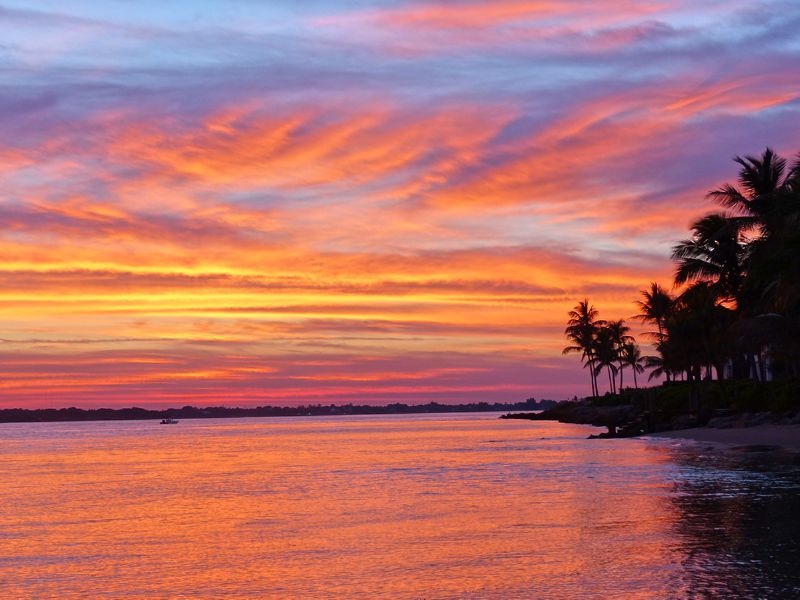
Sunrise, Indian River Lagoon, Jensen Beach, John Whiticar, 2012.
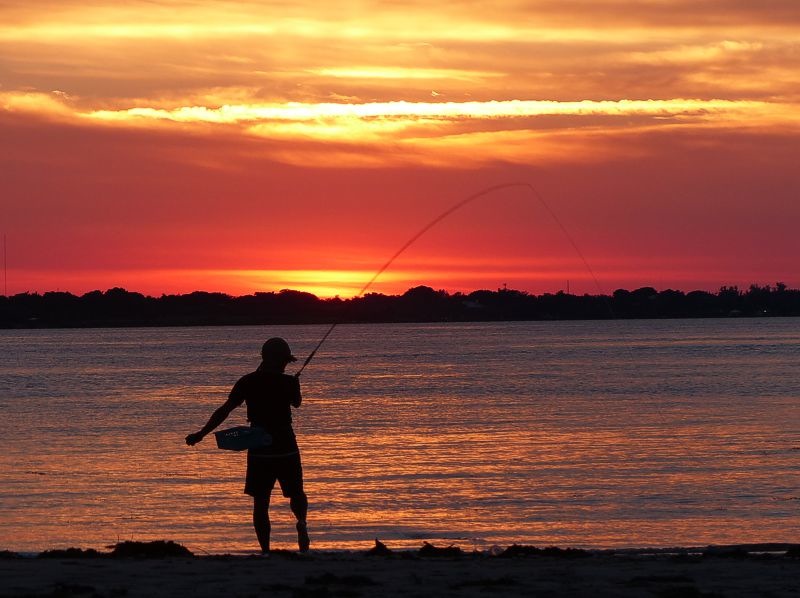
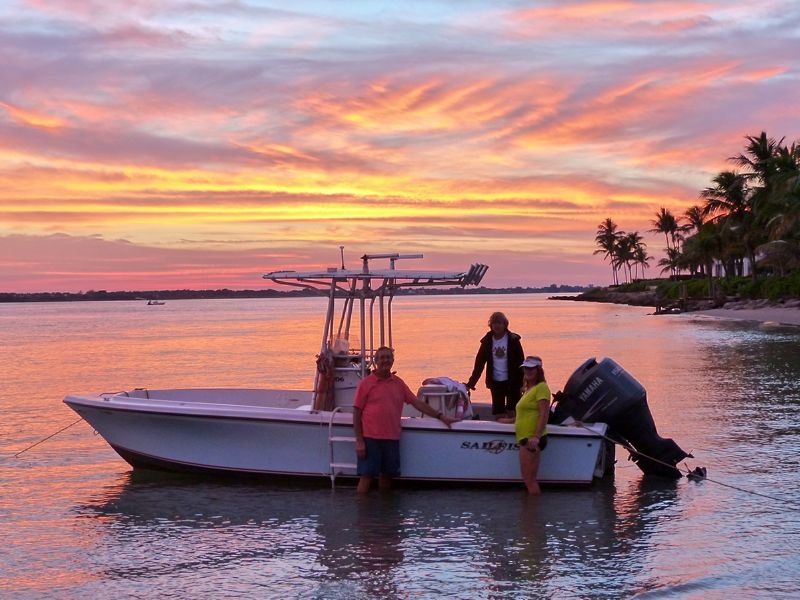
There are two times of day that the St Lucie River/Indian River Lagoon is in her glory, sunrise and sunset. At these times, the “river of light” seems both new and ancient. With the reflection of the sky on the water all the sadness of the river’s demise and destruction seems to fade. We are inspired.
The photos I am sharing today were all taken family friend, Mr. John Whiticar, of the famous local “Whiticar Boatworks” family, (http://whiticar.com).
John’s work captures the beauty of the Indian River Region in a way that is both personal and etherial. I thank John for allowing me to share his photos. You may have seen some of them on Facebook throughout the past years. He has also taken some horrific photos of the lagoon’s destruction, but today I will focus on the beautiful.
May you have a wonderful weekend, and when that moment comes and you see the hand of the Creator upon the waters, please say a prayer or make a wish for a better future and for the rebirth of this spectacular place.
Sunrise/Sunset photos St Lucie River/Indian River Lagoon. Beautiful.(Photos by John Whiticar.)
_____________________________________________
I will be taking a blog break August 11-15th as I will be attending the Florida League of Cities Annual Conference. I am the chair of the Environmental, Energy and Natural Resources Committee for 2013/2014. (http://www.floridaleagueofcities.com)
Fertilizer, pesticides and herbicides “run-off” crops into a canal during a rain storm. This is an example of “non-point pollution.” Lynda Betts, United States Dept. of Agriculture. (Photo, public domain.)
There are many types of pollution that affect the St Lucie River/Indian River Lagoon but two words you will hear over and over are “point” and “non-point pollution.” These are important words to understand especially today as we fight to save our rivers.
Point pollution is basically pollution that you can pin-point coming out of a “pipe.” Point pollution is associated with industry. For instance, a waster water treatment plant that has a pipe releasing into the river is point pollution. In the late 1800s and early 1900s some residences, businesses and industries just let their pollution and or sewage go directly into the St Lucie River and Indian River Lagoon. Yuk!
This practice improved with the advent of sewer systems, septic and organized cities but there were/are still direct pipes releasing very unclean water until very recently. Recognizing the impacts of discharges from wastewater treatment plants, the Florida Legislature passed the Indian River Act (Chapter 90-262) in 1990 requiring waste water treatment plants to cease discharging their effluent, somewhat processed poop, into the lagoon. Because it was easy to pinpoint exactly where these industrial wastewater points are/were located, it is fairly easy to regulate them.
The lagoon and we have befitted from the Indian River Act 90-262 but we still have problems.
Non-point pollution, unlike point source pollution, is pollution that is hard to pin-point because it is coming from “everywhere.” On average it rains 50 inches each year along the Treasure Coast. Highways, parking lots, people’s yards, leaky septic tanks, and agriculture all combine to create a cocktail of oils, heavy metals, fertilizer, pesticides, herbicides, viruses, bacteria and other pollutants that run from flowing rain water into area canals and then straight into the St Lucie River/Indian River Lagoon.
To complicate things more, cities and counties can regulate residential applications (for instance many have recently passed strict fertilizer ordinance outlawing the use of nitrogen and phosphorus fertilizer application during rainy season,) but cities are not allowed to regulate agriculture even if is located in their city or county.
Agriculture is exempt from such laws. Agriculture is regulated and overseen by the Florida Department of Agriculture.
The Department of Agriculture recognizing the need to abate fertilizer and chemical runoff does promote “best management practices,” helping farmers work to lower phosphorus and nitrogen runoff but this is voluntary and not required. Most farmers do comply but it is not easy to judge and measure so agriculture runoff continues to significantly add to river pollution across our nation and state as we know from our C-44 canal that dumps mostly agriculture basin runoff into our rivers.
You will often hear people say, “We must stop pollution at the source!” This is a good idea and our state and federal agencies are doing it with point source pollution but not with non-point source pollution.
Perhaps one day every yard and every agriculture field will have to take a portion of their land to hold rain runoff so the pollutants seep into the earth before they go to our waterways? Perhaps one day the Department of Environmental Protection and the US Environmental Protection Agencies will become more hard-core rather than coming up with programs like TMDLs and BMP–Total Maximum Daily Loads for phosphorus and nitrogen and Basin Management Action Plans, because although those will help over time, like 30 years, we don’t seem to have a lot of time left.
Sandra Henderson Thurlow, historian and author, has written four books about the pioneer culture along the St Lucie River/Indian River Lagoon. (Photo, Tom Thurlow, 2011.)
As the jacket of her Sewall’s Point Book states:
“Sandra Thurlow was a resident of Sewall’s Point for twelve years before she became fascinated by its history. In 1986, the Town of Sewall’s Point commissioners ordered the demolition of a lovely old home that stood on a bluff overlooking the St Lucie River. Queries revealed that it was once the High Point Rod and Gun Club, a wildness retreat for a coterie of politically powerful Philadelphians. Further research uncovered a wealth of local history that needed to the shared and preserved. ”
As you may already know or have guessed, Sandra is my mother and the house was one the children of Sewall’s Point played in and got into trouble having lots of fun….And yesterday, we as a family honored Sandra’s 75th birthday and today she will be featured in my blog. 🙂
Even though she is my mother, it is my opinion that no one has done more for “Stuart’s” local history and no one has written more about the pioneer families who made their way along this wilderness, once known as “Santa Lucia” or the “Indian River Region.”
When I came back to visit Sewall’s Point and Stuart after graduating from University of Florida in 1986, I could tell things had really changed at the Thurlow house. My sister Jenny was getting ready to go off to school, I had been gone four years and our bedrooms were being transformed into offices. –Offices full of shelves and drawers of historic negatives, old maps from my father’s law office, abstracts, camera equipment, historic photos, taped interviews and the beginnings of what would become personal computers.
“Wow, ” I thought, “that’s cool, she and dad certainly will not suffer from empty nest syndrome when Todd leaves in another two years….”
As the years went on, she and my father, dove into the history of our area, and the history of our area is the history of the St Lucie River and Indian River Lagoon. A teacher by early profession and native of Gainesville, by 2008, my mother, with the help of my dad, had written and published four books: Sewall’s Point, the History of a Peninsular Community on Florida’s Treasure Coast; Stuart on the St Lucie; Historic Jensen and Eden on Florida’s Indian River; and together with my sister-in-law Deanna, Gilbert’s Bar House of Refuge, Home of History.
Book covers of the local history books written by Sandra Henderson Thurlow.
My mother taught me not to brag. But today I am bragging. It’s time. She has inspired and educated not only me but thousands of people. She has given talks, presented slide shows, worked with students in our local high schools, and has won state awards for her work.
I think she has helped make Martin County one of the “best documented histories” of our state. And through it all, whether she is writing about Captain Richards and his daughter Lucy of Eden struggling to grow pineapples in the sandy soil along the Indian River; or the first pioneers of Stuart trading with the Seminoles and calling their new-found paradise, “Stuart on the St Lucie;” or the early fish houses pouring over in Jensen Beach; or the shark fishermen in Salerno; or the lonely House of Refuge Keepers longing for the site of a ship or boat in river or ocean and who sustained themselves from the great riches of its waters; and even the documentation of the great detriment that came to this place through the false hope of canals and connection to Lake Okeechobee, she writes about the relationship of people to the land and the relationship of people to the water. The water is our history and we are the water, as that is why we came to this land….
Thank you mom for all of your work and happy birthday! Stuart is 100, you are 75 and I, your oldest, am 50. Time is flying, and the water that defines this place is still defining it as we fight to bring it back to health so that future generations can have some stories and write some books too.
___________________________________
Sandra’s books are available at Stuart Heritage, 161 Flagler Avenue, Stuart, FL 34994 in Downtown Stuart.(http://www.stuartheritagemuseum.com) and through Amazon and Barnes and Nobel.
Cover of “Let’s Keep Florida Beautiful,” the environmental reelection plan for Gov. Rick Scott, 2014. Many Florida springs have stopped flowing and are choked with algae. The SPRINGS ETERNAL PROJECT explains the plight of Florida’s ailing springs: (http://springseternalproject.org) They, like our SLR/IRL, are dying.
Yesterday, I stumbled out of bed by 5:00 A.M to write my blog and make it to Palm City for the Collaborative Chamber Breakfast starting at 7:30 A.M. I had to get up as Governor Rick Scott’s kick off campaign tour to publicize his “Let’s Keep Florida Beautiful Plan,” was kicking off, in of all places, Martin County, Florida. I wanted to hear what he had to say.
Scripps reporter, Isadora Rangel, implies this morning in our Stuart News that Martin County was chosen as the kick off location because “it is the epicenter of grassroots efforts to clean the estuary.”
Reporter Isadora Rangel interviews Democrat, Congressman, Patrick Murphy who attended the breakfast. (Photo JTL)
There were about 200 people at Martin Downs County Club and both Democrats and Republicans and were present. The Lagoon goes beyond political boundaries. But politics abounds…
I greeted everyone from Democrat Maggie Hurchalla, to Republican Senator Joe Negron, and found my seat. I introduced myself to the people at my table. I looked around the room to see a veritable “who’s who.”
Hmmm? I thought.
In spite of the politics. This is pretty cool. Martin County has been chosen to kick off the governor’s reelection campaign. Why?
Because we are the most vocal little county in the state! Because 5000 people protested last summer at the height of the SLR/IRL toxic algae outbreak and releases from Lake Okeechobee. Our voices were heard. We practiced our right to assemble under our constitution. We are fighting still as last weekend’s 1500 plus at the Clean Water Rally showed. We have made a name for ourselves. Some of our politicians helped us, yes. But WE did it. We have called attention the dying St Lucie River/Indian River Lagoon, the canals and Lake Okeechobee and maybe now there will be help.
As I was daydreaming about how great Martin County’s River Movement is, the governor walked to the front of the room and took the microphone.
He was very well dressed and looked more comfortable than usual. He greeted the crowd and then told the story of his life:
Born in Illinois, single mom, did not know his father, step dad, poor, Eagle Scout, Navy, University of Missouri, Law-Southern Methodist, no money, worked since a kid, rose to success, went to church a lot as his mother said he would….no money…family….made money….the importance of jobs…
I sat there thinking that if the governor had a really good P.R. person they would have written a book on the “Eagle Scout” part….and not concentrated so much on the business….
So anyway, his assistants walked around the room and passed out a booklet with a photo of a spring on the front reading “Rick Scott, Let’s Keep Florida Beautiful.”
“Hmmmm? I thought. This is different. A pretty picture of a Florida spring and Rick Scott’s name on it.”
I opened up the booklet and right on the first page it read: DURING MY SECOND TERM I WILL: 1. Ensure that Everglades and Indian River Lagoon Restoration continue to have the vision and funding to provide a restored ecosystem to our children…”
“Remarkable” I thought. After the “Indian River Lagoon” having “no name” in Tallahassee for years, it is now listed in the first sentence of a governor’s reelection booklet. Will it happen? Time will tell. At least we are recognized.
One thing is for sure. Martin County is not just the epicenter for the Indian River Lagoon, it is the epicenter of water change for the whole state. No place has a reputation like we have. The governor choosing Marin County to start his campaign supports this point. Like him or not, that’s cool.
I have included photos I took of the booklet below. Some are blurry but it will give you an idea of what it says.
Politics are as toxic as the waters of the SLR/IRL. And we, little Marin County, have risen to the top of the fermenting algae heap. Be proud and keep fighting for the St Lucie River/Indian River Lagoon!
Booklet passed out at yesterday’s kick off re-election campaign for Rick Scott.
Yesterday’s August 3rd, “2nd Annual March Against the Lake Okeechobee Discharges,” was remarkable. One year later, after the toxic releases from Lake Okeechobee, and the putrid discharges from our local canals, the grass-roots momentum has not stopped and is expanding with respectable allies.
Some 1500 people, artists, news agencies, and many politicians (in office or running to be) came with political signs, costumes and with children in tow. They sat in the baking sun and dead air, under one lone oak tree if they could fit, to listen to almost two hours of “educational speakers” and then to march to the locks. I was inspired.
Most jaw dropping for me, was to see the conservative and well spoken Senior Vice President, Chief Operating Officer and Chief Legal Officer, Robert Lord, (http://www.martinhealth.org/executives) for Martin Memorial Health Systems, climb the stairs and pledge the institution’s support for our St Lucie River/Indian River Lagoon and publicly note the institution’s concern for the SLR/IRL’s related health issues.
“Wow.” I thought. “Now this is a turning point. They can’t call us tree huggers anymore…”
I did not write down what Mr Lord said, but I stood there at his feet basically and watched him. I have known the family for my whole life. His father was a famous Country Western singer/later developer Bobby Lord, and I went to school with Cabot, Rob’s younger brother. Rob noted that he is “sixth generation,” and that his family grew up in the area, and that he, as a child, enjoyed our area and these waters. They were wonderful days. He noted his dear family friend Jo Neeson, a river supporter and organizer of the event, and all the fun they had growing up here. He then said something to this effect:
Robert Lord, MHS, 2014.
I am here today to speak on behalf of Martin Memorial Health Systems. We are concerned…We cannot prove that the many health issues- that have taken place- happened because of contact with river water but we can state that all of these people had contact with the water during the discharges….we are concerned. We are concerned for the health of the people and for the St Lucie River/Indian River Lagoon. For Martin Memorial, I am here today to say we support the movement for the river…
With such support and honest revelation, how can our state and local agencies such as the Army Corp of Engineers, the South Florida Water Management District, the Department of Environmental Protection and the State Department of Health ignore our cries?
They can’t. The hiding is over. The years of allowing destruction of our most precious resource, water, is done. The “cat is out of the bag,” “Pandora’s box is open.” Let’s keep talking and keep pushing and give our children a place to fish, swim, boat and see the magic of a dolphin break the waves…
Thank you Martin Memorial Health Systems and the other who will be coming along as well….
Yesterday’s speakers:
– Sierra Club
– Rivers Coalition
– Stonecrab Alliance
– Florida Oceanographic Society
– Indian Riverkeeper
– Maggy Hurchalla
– Fly & Light Tackle Angler
– River Kid
– Treasured Lands Foundation (Land and Legacy, Amendment 1)
– Miccosukees tribe & Love the Everglades Movement
-Jonathan Flick- Pro Surfer
-Brent Mienhold – Pro Surfer
-Jordan Schwartz – Ohana Surf shop owner
– River Kidz
– Save the Manatee
– West Coast Resident
– Senior Vice President and Chief Operating Officer of Martin Memorial Hospital Services
-Others
Great passions surround issues of the St Lucie River/Indian River Lagoon.
Over the past month, I have have been “corrected,” like a middle school child, not only by some friends but by institutions, for my outspoken comments for or against certain politicians or programs affiliated with the Indian River Lagoon. This berating came as a shock to me as I have not “been corrected” since I lived in my parents house and was constantly corrected. I was not good at it then, and I am not good at it now.
When I complained about this recently, my husband Ed just looked at me and laughed saying, “Get used to it, if you want to be involved in politics!”
“I am working for the river, I replied, not politics.”
Ed looked at me like I was in outer space and again laughed that infectious laugh of his.”
“Sure Jacqui…”
Of course Ed is right. Water is politics. And politics can be even more toxic than our St Lucie River/Indian River Lagoon.
This Sunday, August 3, at 10 a.m. , at Phipps Park, (St Lucie Locks and Dam), the River Warriors with the second year leadership of Evan Miller and the help of the Rivers Coalition, the Indian River Keeper, and the Sierra Club, will hold the “March Against the Lake Okeechobee Discharges.”
There will hopefully be hundreds if not thousands of people there. And even though there will be people of many political affiliations, backgrounds, and beliefs, when the “powers that be” see the group together in one place our differences fade and WE ARE ONE. It is this oneness, this togetherness that has brought us from obscurity to state and national recognition for the problems of Lake Okeechobee, the St Lucie River and Indian River Lagoon in just one short year.
I have an old chest in my living room that came over to the United States in the 1700s. Its owners were French Huguenots who were openly persecuted and killed for their religious beliefs. When I see that chest, I think of its journey across the great ocean and it reminds me that people came to our county for many reasons, but the protections of “free speech” and “freedom of assembly,” to many may have been most important.
May we exercise our American Freedoms with dignity on Sunday and with the protections of the First Amendment of our United States Constitution:
“Congress shall make no law respecting an establishment of religion, or prohibiting the free exercise thereof; or abridging the freedom of speech, or of the press; or the right of the people peaceably to assemble, and to petition the Government for a redress of grievances.”
And please remember, in spite of our differences, or what we believe is the best way to support of our rivers, we are most powerful when WE ARE ONE, and we can still be ONE with our many differences.
__________________________________
History of the First Amendment:(http://illinoisfirstamendmentcenter.com/history.php)
History of the French Huguenots (http://en.wikipedia.org/wiki/Huguenot)