Wild turkey, taking a rest, Sewall’s Point, 2008. (Photo Jacqui Thurlow-Lippisch.)
HAPPY THANKSGIVING!
Taking a break under the American flag. (Photo Jacqui Thurlow-Lippisch, 2008, High Point, Sewall’s Point.)
In 2008 there was a flock of about seven wild turkeys that would fly over from Hell’s Gate across the St Lucie River and visit my street, Riverview, as well as others right here in Sewall’s Point.
The first time I saw them, I thought they were peacocks as there were peacocks here at the time, before the mail man ran over the male and the rest got eaten by bobcats.
At closer look, the tailless peacocks or very brown peahens were skinny, nervous, running wild turkeys! Ed had seen them too, very early in the morning on the way to work, and sent me a photo from his phone. We really enjoyed seeing them!
Over about the course of a year, I really came to like them, and began to feel bad about eating their fat, farmed cousins for Thanksgiving…Since about 2011 they have not visited. I wish them, wherever they may be, as well as you, and your family, a very Happy Thanksgiving this week. In spite of life’s difficulties, there is so much to be thankful for…
On a river note, we have the attention of of government for the Indian River Lagoon, and things may get better, if we keep pushing and calling attention to the river’s plight and how important it is in our lives.
Wild turkey, Sewall’s Point, 2008. (Photo JTL, 2008.)
For the Thanksgiving week, I will be taking a “blog break” to spend time with my local family, visiting relatives, and celebrate Ed’s birthday; he turns 58 today! 🙂
See you next week! And if you see a wild turkey, wish it a Happy Thanksgiving and tell it we’d love to have it and its family back in Sewall’s Point!
Benjamin Franklin preferred the wild turkey as our national bird, as he felt the bald eagle, that sometimes steals food from other birds of prey, had “bad moral character…” Even so, one has to wonder if the United States of America would have ever reached its “greatness” if our national bird had been a turkey.
A beautiful but not quite as stately, wild turkey displays its fanned tail. (Public photo)
Just recently during the Stuart Air Show, my brother Todd, sent me some photos he took of an eagle soaring over the St Lucie River in North River Shores. About three weeks ago, I was pulling into Cedar Point Plaza in Stuart, I looked up and saw the unmistakable white “bald” head, large body enormous wing span of a bald eagle. Incredible! Inspirational! It made my day!
Bale Eagle flying over North River Shores. (Photo by Todd Thurlow, 11-14.)
Today, in our Indian River Lagoon Region, birds of prey are by far more prevalent than when I was a kid growing up in Stuart in the 1970s and 80s. Even if the Indian River Lagoon system was healthier then, than it is now, in the 70s and 80s, rarely did one see the great eagle soaring or the abundant ospreys one sees today.
The reason? Of course DDT, (dichlorodiphenyltrichhloroethane), a powerful chemical used to control mosquitoes and as an agricultural insecticide. Once it became widely known that DDT was a threat to both bird and human health, primarily due to the publication of Silent Spring by Rachel Carson, in 1962, DDT’s use was eventually outlawed in the United States.
So in spite of the St Lucie River and Indian River Lagoon’s extensive decline, there are more eagles about today than before. In Florida, after being designated as “endangered” since 1972, in 1995 the bald eagle was reclassified as “threatened.” The birds and their habitat remain protected.
Eagles mate for life and a pair has been reported in the area of Sewall’s Point for about four years. The photo below was taken by Greg Braun and shows one of the eagles sitting on a rock by Bird Island. Apparently, the pairs may leave each other for many months when traveling great distances, and then return to their nesting sites. There are accounts of their “mating sky dance” where the eagles lock talons hundreds of feet up in the air and then tumble, almost hitting the earth, only to release and regain their flight at the last-minute!
Eagle sitting near Bird Island just off of the Town of Sewall’s Point. (Photo by Greg Braun, 2012.)
An eagle can stand three feet in height, and its wing span can be up to 8 feet! Their eyes are just larger than human eyes and of course, their eye sight is superior, approximately 3 and 1/2 times better than a human with 20/20 vision. For instance, they are able to see another eagle flying 50 miles away and a rabbit moving over the ground a mile away. They love fish and are outstanding hunters. Females are larger than males and dominate the nest, often killing the smaller male sibling. Nature does not sugar coat the eagle’s drive to dominate and survive, especially the females….
Another strong instinct is “pruning” which chicks mimic even before they have feathers by accessing an oil gland at the base of the torso using their curved beak to pretend they are coating each feather. Baby eagles must grow for about five or six years to be sexually mature and attain their white head feathers. Parents take care of the young for many months even though the young start flapping their wings around 8 weeks and are encouraged to take flight. I was lucky to experience this wonder, when a few years ago, Dr Dale Hipson, a friend of the family, took me to his camouflaged hide out in the Corbett Wildlife Management Area to watch eagle parents dutifully feeding and teaching their young. It was an experience I will never forget.
Dr Hipson taught me that the word “bald” is an archaic word for “white” and this is how eagles got their name. Juvenile eagles are brown in color and often mistaken as ospreys or hawks.
Reading about eagles, it is hard to understand their migration patterns and perhaps scientists do not really know as they can’t fly with them, but it seems some eagles in Florida migrate thousands of miles to Alaska (Snow birds!) and some are “resident” eagles remaining here. Florida is the second most eagle-populated state in the nation other than Alaska.
Eagle nests are the largest nests known. (Photo Harbor Ridge reporting/video taping of nesting site, 2011.)Eagle in area of Rio, as taken last week by wildlife photographer and Facebook friend, Rebecca Fatzinger, 11-14.)
In closing, I am happy that some birds are doing well in spite of the poor health of the Indian River Lagoon. And I have to say that with no disrespect to the turkey, I am glad the eagle is our national bird!
Benjamin Franklin preferred the wild turkey to the bald eagle as our national bird as he felt the eagle was of “bad moral character…”
This chart shows “the inherent variability in annual flows to the SLR/IRL.” (Dr Gary Goforth, 2014.)
One of the positive things that has come out of the negativity of the St Lucie River/Indian River Lagoon situation, is building relationships with incredible people who care about our rivers. One of these people is Dr Gary Goforth.
Dr Gary Goforth, 2014. (Photo Jacqui Thurlow-Lippisch)
I first met Dr Goforth last August when he spoke before the “Senate Hearing on the Indian River Lagoon and Lake Okeechobee Basin,” at the Kane Center in Stuart, organized by Senator Joe Negron. Dr Goforth was sitting next to Karl Wickstrom, founder of Florida Sportsman Magazine and outspoken member of the Rivers Coalition.
Listening to Dr. Goforth plead his case, I said: ” Wow, who is this guy?”
He spoke for the St Lucie River/Indian River Lagoon as a scientist showing the SFWMD and ACOE could move more water south, and he knew as he very much helped design the system! I came to learn that he in fact is the “father of the STAs (Storm Water Treatment Areas) in the Everglades Protection Areas and worked for the South Florida Water Management District for I believe almost 20 years. Now he is independent and has his own company. (http://garygoforth.net)
Having access to Dr Goforth is like having access to a “water issues computer” and I am continually blown away by his breadth of knowledge and that he is openly willing to share.
Sometimes our conversations go like this:
“Dr Goforth, I am looking at your chart, and my husband tells me never to speak in public when it comes to numbers…..but what does this mean……?”
He never makes me feel stupid, has the patience of a saint, and goes over the material until I get a hang of it.
The chart at the beginning of this blog entry is an example of complexities made simple through Dr Goforth. The chart, through color coding, shows “the inherent variability in flows” to the St Lucie River through C-23; C-24; Ten Mile Creek; C-44 Basin; Other Tributaries (a huge area around all the developed area of the river); and Lake Okeechobee Discharges. This is shown in AF (acre feet), or an acre of land with a foot of water on it.
Map of St Lucie Basin. Over the years, this basin has been expanded to take in water over 50% of its original footprint. (SFWMD/ACOE map 2014.)
Referring to the chart is enlightening and disturbing to note that for instance in 2005, almost 2,500,000 acre feet of water came into the St Lucie River/Indian River Lagoon; and in 2013, our “Lost Summer” about 1,250,000 acre feet came in. Other years shown on the chart between 1995 and 2013 with “worse” years than 2013 are 1998; 2003; and 2004. To somewhat put this in perspective, the huge EAA, or Everglades Agricultural Area, south and around the Lake Okeechobee is 700,000 acres. So for 2,500,000 acre feet of water, where would we ever find 2,500,000 flat acres of land to put this water on? We would not, and this is why “they” have to deal with volume and deeper storage areas. Mind blowing? YES!
The red colored blocks south of Lake O. are the EAA-700,000 acres of sugar lands and vegetables. South of the EAA are the STAs and water conservation areas .(SFWMD map, 2012.)
So getting back to home, why did we finally “freak out” and go over the edge in 2013, when the flows have been “worse” before? Well, I personally think social media is a big part of this, as well as the aerial photos that “showed” people” the true repugnance of the big picture; and like someone in an abusive relationship, after years and years, we’d finally HAD ENOUGH!
C-44, C-23 and C-24 basin runoff discolor the waters of the SLR/IRL while exiting the St Lucie Inlet over near shore reefs, 7-19-14. (Aerial photo, Ed Lippisch.)
Dr Goforth’s chart also shows that the annual flow to the SLR is 999,468 acre feet; and the average annual flow of Lake Okeechobee water to the SLR is 291,899 acre feet or 29% of the flow. I’ll round that up to 30% and say, “Yes, we here in Martin and St Lucie County have terrible issues with our own local runoff of C-23; C-24; Ten Mile Creek; C-44 Basin; and Other Tributaries; yes, in fact we are almost killing ourselves, SO ACOE and SFWMD PLEASE DON’T TOTALLY KILL US BY RELEASING POLLUTED WATER FROM LAKE OKEECHOBEE ON TOP OF OUR ALREADY HORRIBLE SITUATION!
With that said, I hope you learned something today and if you have time, take a closer look at the chart, it’s really educational; also, if you ever see Dr Goforth around town, go up to him and thank him and shake his hand. He is one of the most outstanding “River Warriors” of all!
The forgotten boulder under the Ernest Lyons Bridge… (All photos by Jacqui Thurlow-Lippisch, 11-16-14.)
Just a few days ago, while walking and trying to “get back into shape,” I saw the giant granite boulder, like Stonehenge, with the sun setting behind it, and the full beauty of the river’s reflection bursting forth.
Immediately, I experienced a kind of flashback. It was 1979; it was raining. I was fifteen years old; I was awkward; and the most important thing in the world to me was my friends who I was hanging out with that day, and experiencing freedom away from my parents, who were just down the causeway.
And then, something I’d never seen happened. A governor was before me. Yes, Governor Bob Graham came out and started speaking, next to this giant rock. Everyone was quiet, even we girls stopped fooling around. The governor was wearing a suit, had presence, and when he started talking his slow cadence and confidence was rather mesmerizing ….He was talking about the St Lucie Inlet and the future of Martin County…
The lone boulder sits unmarked….Alone, unmarked….history is forgotten.
This experience, may in fact, have been the first time I realized a politician could have an effect on people…My mind’s eye still holds the image of seeing the governor, like a photograph.
I am fortunate to have information detectives in my family so after my flashback experience, when I got home, I immediately contacted my mother and brother and asked about the lone boulder that I recognized that was sitting all alone. “What’s its story…?”
I knew that before the “new” Ernest Lyons Bridge, the boulder stood close to the “old” Ernest Lyons Bridge along the Stuart Causeway. One would always see it on the way to the beach, sitting right there, very visible, along A1A. Today it is tucked away under the tall bridge between Sewall’s Point and Hutchinson Island, without so much as a plaque to note its symbolic significance.
Within a short time, my brother, Todd, found a Palm Beach Post Article from 1979 entitled A FESTIVAL FOR ALL—EVEN IN THE RAIN by Jim Reeder. The article tells the story of the thousands of people who showed up to see the dedication of the boulder and Governor Graham at the “St Lucie Inlet Festival.” “This festival was in celebration of the extensive improvements to the inlet miraculously approved by Congress, requiring blasting and dredging that amazingly was “supported overwhelmingly by all the groups that are normally at odds, such as developers and conservationists.”
How quickly things are forgotten….
The lone boulder watches the sun set over the Indian River Lagoon and peek through the Ernest Lyons Bridge. (Photo by Jacqui Thurlow-Lippisch, 11-16-14.)
It is my hope the lone boulder gets a plaque. According to my historian mother, it was one of the gigantic granite rocks to be used to improve the new St Lucie Inlet jetty, set aside for the event to memorialize that special day. This jetty is still out there taking the waves, and is still part of an inlet that has problems, but represents one of the few times, Martin County contingencies “got along.” This is worth recognizing….
The Florida League of Cities advocates the Florida legislature on behalf of over 400 Florida municipalities.
Today I would like to share good news from the Florida League of Cities of which I have been an active member, as an elected official of the Town of Sewall’s Point, since 2009. I was also fortunate to be chosen to chair the league’s environmental committee last year in 2013 and in 2013 the SLR/IRL became a part of the leagues legislative priorities. Today I am happy to share continued support by the FLC regarding the plight of the St Lucie River/Indian River Lagoon and Caloosahatchee River due to excess polluted discharges from Lake Okeechobee.
Only a few years ago, the league had never heard of the St Lucie River/Indian River Lagoon, and thanks to last year’s public outcry and the leadership of Senator Joe Negron, and others, today we are part of their greater lobbying effort!
To give some background, the Florida League of Cities is the “united voice” for Florida’s municipal governments and was first started in 1922. Its goals are to serve the needs of Florida’s cities and to promote local self-government and Home Rule. The league was founded with the idea that local self-government is the keystone of American Democracy. Today there are over 400 municipal members, (towns, cities, villages) represented by the league. (http://www.floridaleagueofcities.com)
Florida League of Cities Legislative Committee, 2014. (Photo Jacqui Thurlow-Lippisch)
Regionally, the Town of Sewall’s Point, City of Stuart, Town of Ocean Breeze, Town of Jupiter Island, St Lucie Village, City of Port St Lucie, Ft Pierce, Fellsmere, Sebastian, Vero Beach and Okeechobee are active members of the league.
There are five legislative committees of the league and ten priorities come out of each legislative session based on the work of the legislative committees that comprise members from all over the state with as many as 50 members sitting on a committee. This year’s Legislative Committee for the FLC occurred November 12-14 in Orlando.
The committees are as follows: Energy, Environmental and Natural Resources; Finance and Taxation; Growth Management and Economic Affairs; Transportation and Intergovernmental Relations; and Urban Administration.
Sam Henderson 2014 Chair for the EENR Committee, presenting with FLC’s Ryan Matthews.
As I mentioned, I chaired the Energy and Environmental and Natural Resources Legislative Committee last year, but this year did not, and I was wondering if estuaries of the SLR/IRL and Caloosahatchee would take a back seat as there is fierce competition and many water problems throughout the state. I was delighted to see that the committee continued its commitment to calling attention on a statewide level to the water problems of our region.
The POLICY STATEMENT for Water Quality and Quantity 2014 reads:
The Florida League of Cities supports legislation that provides recurring allocations of financial resources for local government programs and projects resulting in the protection of water resources, the improvement of water quality and quantity, and the expanded use of alternative sources of water.
The background immediately following this priority is even more specific stating:
Florida is currently dealing with multiple water challenges. South Florida faces water quality problems in the form of massive water releases of nutrient enriched waters. Those releases, which are controlled by the Army Corp of Engineers–a federal agency, pollute the estuaries and water systems that flow to the St Lucie on the east and the Caloosahatchee on the west. North Florida faces an impending disaster in its oyster industry due to increased water usage by neighboring states Alabama and Georgia. Meanwhile all of Florida is struggling with how to efficiently conserve water and avoid devastation to the Florian Aquifer….
I am thankful to the league and to the many elected officials from all parts of our state who supported this legislative policy statement for 2014. This statement will go before the state legislature as the league lobbys and works for policies of the league.
We must be mindful of all of our water issues, from spring degradation, dying lakes and rivers, aquifer depletion, as well as the St Lucie/Indian River/Caloosahatchee/Lake Okeechobee issues we deal with at here home.
Understanding all of our water issues together is necessary, as we are all connected.
Together as cities fighting for what we love, our cities, we can overcome the common apathy of our state legislature and the destruction that has been brought upon our state by overdevelopment and lack of appreciation of our natural systems and the role they play in strong economies and quality of life.
With cities addressing Florida’s water problems together, we just might turn the tide….
Only a thin ribbon of land separates the Atlantic Ocean from the Indian River Lagoon…. (Photo Jacqui Thurlow-Lippisch and Ed Lippisch, 2014.)
As we all know, estuaries are the nurseries of our oceans. Sometimes we think of rivers and oceans as separate, but they are connected and the destruction brought upon one affects the other.
Looking above at this photograph of Hutchinson Island near the House of Refuge one can see how close the Indian River Lagoon estuary and the Atlantic Ocean really are. Not only that, when polluted water flows out of the St Lucie Inlet from the St Lucie River estuary, it covers and negatively affects our “protected” near shore reefs and the tremendous variety of life there.
A photo from Martin County shows polluted runoff flowing over nearshore reefs along Jupiter island south of Hutchinson Island and the St Lucie Inlet, 2011.
According to the Consortium for Ocean Leadership (http://oceanleadership.org) of which locally FAU/Harbor Branch is a member:
“Ocean ecosystems have been subjected to decades of intense fishing, urban and agricultural runoff, and the loss and degradation of estuaries and wetlands. Furthermore, changes in ocean temperatures, salinity, currents and acidity are having significant impacts on marine living resources. The incidence of hypoxia, as in the Gulf of Mexico (http://www.ncddc.noaa.gov/hypoxia/) (dead zones) has increased almost 30 fold in the United States since 1960 with more than 300 systems recently experiencing hypoxia.”
As we all know, the entire St Lucie/Indian River Lagoon is often a “dead zone,” due to toxic algae blooms caused by too much polluted fresh water runoff from canals carrying nitrogen, phosphorus and other pollutants from agricultural canals along the lagoon, and Lake Okeechobee .
The recommendation of the Consortium is as follows:
“…support conservation programs and services to reduce runoff of nitrogen and phosphorus, and sediment from agricultural activities which is causing harmful algae blooms and dead zones.”
Think about this for a minute.
The four agricultural canals we have here in Martin and St Lucie Counties: C-44, C-23, C-24, and C-25 have no filtering system. When it rains, the water falling on thousands and thousands of acres of agricultural as well as urban lands picks up fertilizer, pesticides, herbicides, oil, cow, horse, and pet waste, leaky septic tank effluent, and what ever else is out there; this water then runs into the canals that in turn are released directly into our waterways. When Lake Okeechobee is dumped it too has no filtering process, so not only do we get our pollution but we get “Orlando’s” as well as the Everglades Agricultural Area south of Lake O. forces the lake water to flow east and west rather than south as nature intended…. Is it any wonder why we are a toxic mess?
Canal and basin map SLR/IRL. (Public)
It must be noted that Martin County, the state, and federal government for years have been working on the IRL South Project that is part of CERP. (http://www.evergladesplan.org/pm/projects/proj_07_irl_south.aspx) This project would help hold, filter, and clean polluted water for canals C-23, C-24, and C-25 before it enters the St Lucie River/Indian River Lagoon. These projects are so expensive and political they are a “slow moving slug,”but they are moving.
Clean water does not come easy. The public must push and push. There is fierce competition.
Yes, we the public must learn more about these projects and how to help get these projects funded, along with our fight for a flow way south of Lake Okeechobee.
The government will only move forward with these projects if they know the public is expecting it and helping with it. With Amendment 1’s passage the possibility is even more of a reality, but it is no guarantee. We must advocate.
The line between the estuary and the oceans is very thin, as is the line between the people and their government. Get involved! The river and the ocean both need you!
Blue Heron silhouetted against sunrise, St Lucie River/Indian River Lagoon. (Photo by John Whiticar, 2012.)
Yesterday morning at sunrise, I drove north along Indian River Drive to Harbor Branch Oceanographic Institute in Ft. Pierce. This drive, in the early hours of morning, is the most inspirational of times…
The lone herons and egrets are many, some in groups, but most alone, standing still, and stately, and eternal, waiting for a fish. Waiting for that perfect light “to see…”
Later in the day, I looked up the definition of the word “inspire” as we talked about what this meant and how to achieve such at the board meeting for the foundation. There were various definitions, but a few captured what I felt driving along Indian River Drive in the morning’s early light…
May we all be inspired by the beauty around us, the gift of the river…
inspire, verb:
1. to influence, move, or guide by divine or supernatural inspiration
2. to give someone the enthusiasm to do or create something
3. a divine influence directly and immediately exerted upon the mind or soul
Painting on the fence at TERRA FERMATA in Stuart. (Photo Sandra Thurlow, 2014.)
Today I wanted to find a way to share the above photo that reads: BE NICE TO YOUR MOTHER…..”Mother Earth” that is….Ironically, the photo was taken by none other than my mother, Sandra Thurlow.
The painting is located at Terra Fermata on 6th Street, behind my father and brother’s law office, in expanding Downtown Stuart. The Rivers Coalition has held various fundraisers at Terra Fermata for the St Lucie River/Indian River Lagoon. Ron Hart, the owner, is one of Stuart’s business super-stars, a big supporter of the river, and makes Stuart a much cooler, hipper, younger place. (http://www.terrafermata.com)
The concept of “Mother Earth” is an ancient one and is connected to many cultures. The famous words of Chief Seattle, (http://www.historylink.org/index.cfm?DisplayPage=output.cfm&file_id=5071) a great Native American leader of the west, describe the concept about as well as possible. Apparently these words were written in response to the US Government when the chief was informed the US wanted “buy” their lands….
I think if Chief Seattle were here today, he would be proud of our fight for the Indian River Lagoon, for our Mother….
“The President in Washington sends word that he wishes to buy our land. But how can you buy or sell the sky? The land? The idea is strange to us. If we do not own the freshness of the air and the sparkle of the water, how can you buy them?
“Every part of this earth is sacred to my people. Every shining pine needle, every sandy shore, every mist in the dark woods, every meadow, every humming insect. All are holy in the memory and experience of my people.
“We know the sap which courses through the trees as we know the blood that courses through our veins. We are a part of the earth and it is a part of us. The perfumed flowers are our sisters. The bear, the deer, the great eagle, these are our brothers. The rocky creast, the juices in the meadows, the body heat of the pony, and man, all belong to the same family.
“The shining waters that moves in the streams and rivers is not just water, but the blood of our ancestors. If we sell our land, you must remember that it is sacred. Each ghostly reflection in the clear waters of the lakes tells of events and memories in the life of my people. The water’s murmur is the voice of my father’s father.
“The rivers are our brothers. They quinch our thirst. They carry our canoes and feed our children. So you must give to the rivers the kindness you would give any brother.
“If we sell our land, remember the air is precious to us, that the air shares its spirit with all life it supports. The wind that gave our grandfather his first breath also receives his last sight. The wind also gives our children the spirit of life. So if we sell you our land, you must keep it apart and sacred, as a place where man can go to taste the wind that is sweetened by the meadow flowers.
“Will you teach your children what we have taught our children? That the earth is our mother? What befalls the earth befalls all the sons of the earth.
“This we know: the earth does not belong to man, man belongs to the earth. All things are connected like the blood that unites us all. Man did not weave the web of life, he is merely a strand in it. Whatever he does to the web, he does to himself.
“One thing we know: our god is also your god. The earth is precious to him and to harm the earth is to heap comtempt on its creator.
“Your destiny is a mystery to us. What will happen when the buffalo are all slaughtered? The wild horses tamed? What will happen when the secret corners of the forest are heavy with the scent of many men and the view of the ripe hills is blotted by talking wires? Where will the thicket be? Gone! Where will the eagle be? Gone! And what is it to say goodbye to the swift pony and the hunt? The end of living and the beginning of survival.
“When the last Red Man has vanished with his wilderness and his memory is only a shadow of a cloud moving across the prairie, will these shores and forests still be here? Will there be any of the spirit of my people left?
“We love this earth as a newborn loves its mother’s heartbeat. So, if we sell you our land, love it as we have loved it. Care for it as we have cared for it. Hold in your mind the memory of the land as it is when you received it. Preserve the land for all children and love it, as God loves us all.
“As we are a part of the land, you too are part of the land. This earth is precious to us. It is also precious to you. One thing we know: there is only one God. No man, be he Red Man or White Man, can be apart. We are brothers after all.”
The Central Indian River Lagoon. (Photo by Jacqui Thurlow-Lippisch and Ed Lippisch, 2013.)
Although the Martin County Health Department reports that Vibrio vulnificus, a bacteria found in the waters of the Indian River Lagoon, is not truly a “flesh-eating bacteria,” in rare circumstances it can cause horrific blisters, limb amputations, and even death.
The naturally occurring bacteria is not well understood, but a study published in The Journal of Applied and Environmental Microbiology in 2004 regarding a study in Barnegat Bay, New Jersey states:
“V. vulnificus population dynamics are strongly correlated to water temperature and although the general trend is for V. vulnificus abundance to be inversely correlated with salinity, this relationship depends on salinity levels. Irrespective of temperature, high abundances of V. vulnificus are observed at 5 to 10 ppt, which thus appears to be the optimal salinity regime for their survival…”
This “ideal salinity level” is particularly noteworthy as during the rainy summer months salinities in the Indian River Lagoon lessen, due to polluted freshwater run-off and canal discharges. This situation is exacerbated in the southern lagoon if there are releases from Lake Okeechobee, as there were during the “Lost Summer” of 2013.
People are exposed to the bacteria through an open wound or through ingesting raw seafood, especially infected oysters. Cases occur though out the US, but according to the Center for Disease Control, Florida, Texas, and Maryland report the highest number of cases annually.
Contracting an infection from “vibrio” is extremely rare, and in fact, most people exposed to the bacteria may show no signs of infection at all. Others might experience mild effects such as diarrhea, vomiting, and stomach pain. However, for those who have weak immune systems, chronic liver disease, or other serious health problems, the vibrio can strike very quickly and be fatal.
In 2013, Florida Today reported that Florida averages 50 cases, 45 hospitalizations and 16 deaths annually, most from the Gulf Coast region, according to the Florida Department of Health. They also report that Brevard County, along the IRL, where Melbourne is located, has had 32 cases of Vibrio vulnificus infections since 1993.
Within the past year, two very serious, but non-fatal cases were reported in Melbourne, in Brevard County; and one fatal incident was reported in Ormand Beach, Volusia County, along the Halifax River, which is connected to the northern Indian River Lagoon, north of Ponce Inlet. Ironically, these central and northern IRL areas are the same locations where there have been high dolphin and manatee mortalities as expressed in NOAA’s 2013 “Unusual Mortality Events,” (UME).
As far as the southern lagoon, it was recently reported in Scripps Newspapers that two FAU/Harbor Branch scientists had found Vibrio vulnificus here as well.
This is unsettling, but to be expected, as this bacteria was probably here when I was 5 years old growing up in Stuart, every summer, full of scrapes and cuts swimming around in the warm waters of the lagoon. We must keep our perspective. Thousands of people have contact with Florida’s waters and the Indian River Lagoon and yet few become sick.
Martin County Health Department Director, Klaretta Peck, stated in a press release to Martin County elected officials this year:”
“I am writing today to share some information with you regarding Vibrio vulnificus. As you may have heard, some news media outlets have taken a sensationalistic approach to this issue, going as far as reporting unconfirmed cases, which can cause unnecessary alarm to the public. There are no recent cases of Vibrio Vulnificus in Martin County and though vibrio can cause blisters and lesions, is it not a “flesh eating bacteria” and should not be referred to as such.”
This is reassuring, nonetheless, at the height of summer, a Sewall’s Point mother called me, as I am a town commissioner. She was worried by what she had read in the papers and asked me if I thought it was alright to take her three-year old twins swimming at the Sandbar.
American Society for Microbiology: AEM Journal: “Effects of Temperature and Salinity on Vibrio vulnificus Population Dynamics as Assessed by Quantitative PCR”
Mark A. Randa, Martin F. Polz, and Eelin Limhttp://www.ncbi.nlm.nih.gov/pmc/articles/PMC520858/#!po=85.4167)
Looking at the clouds over the St Lucie River, Roosevelt Bridge, Stuart, Florida. (Photo Jacqui Thurlow-Lipppisch 11-14)
“Darkness cannot drive out darkness; only light can do that…” Martin Luther King, Jr.
The situation for the St Lucie River/Indian River Lagoon remains a bleak one, but I am telling you, “I can see the light!”
At last week’s Water Resource Advisory Commission, (WRAC), of the South Florida Water Management District, (SFWMD), Dr Gary Goforth, (http://garygoforth.net) the great scientist watchdog of the District and former employee who designed and “built” the Storm Water Treatment Areas, (STAs) for the SFWMD, stood before the commission and gave thanks to the District and to the Army Corps of Engineers for “sending more water south” through the STAs to the Everglades in 2014, than since 1995.
273,188 acre feet in fact!
Although 273,188 acre feet of Lake Okeechobee water will not save the St Lucie, sending this much water south is an incredible move on the part of the SFWMD and the ACOE. Of course there is more work to do and the situation wouldn’t be as rosy if we had had as much rain fall as in the “Lost and Toxic Summer of 2013.” Nonetheless, those who worked hard for this must be given credit.
Doing so meant taking risks of breaking the WQBEL, or how much phosphorus can enter the Everglades Protection Area. Over a certain amount is a breach of federal law. Sending so much water south also meant irritating some powerful stakeholders, like the EAA and Homestead sugar and vegetable farmers who need dry feet to grow their crops and stored water to insure they can grow them…..
Dr Goforth’s chart showing amount of Lake O. water sent south to the STAs from 1995-2014.
The situation is difficult, really the”razors edge” as the “water going south” does not just include the waters of Lake Okeechobee but also the waters of the EAA that have precedence.
So….
This year was markedly different. Why?
Because of the pressure put on the ACOE, SFWMD, the Governor, DEP and others by the SLR/IRL and Caloosahatchee River Movements, the public, Scripps Newspapers, Martin County, St Lucie, and Indian River Commissioners, the IRL 5 County Coalition, and powerful “linked-in” politicians, like Senator Joe Negron and Congressman Patrick Murphy who are watching, and forcing the agencies to follow the requirements of state and federal policy to send water south even though it is a very slippery slope.
The clouds and sun are always moving….
Change happens slowly; it requires altering the culture and habits of institutions and society. Looking at what happened this year, is proof that this indeed is occurring.
I am a no “Pollyanna;” I know that what has to happen to save the St Lucie and Indian River Lagoon is tremendous, almost beyond comprehension, but in order to overcome darkness one must begin by recognizing the light…
Moon over the “St Lucie River Bend,” by Highwayman, Livingston Roberts, categorized in 1975.
Last night, you may have seen it? The Indian River Lagoon region became a Highwayman painting…
In early evening, the full moon rose like a wise old sentinel, slowly, beautifully, magically bathing our world in a light belonging only to dreams and to fairy tales…
Moon through the giant oak tree at my parent’s house, Sewall’s Point, 11-6-14. (Photo Jacqui Thurlow-Lippisch.)
In my younger years, my Grandfather Henderson gave me a Highwayman painting by Livingston Roberts. It is a moonscape and when the moon is not out, I look to it for the same inspiration as I felt last night. It is the painting at the top of this blog post.
As shared on the Highwaymen website, Livingston Roberts, the painter of my piece, belonged to the Highwaymen group, an association of young African-American artists that functioned in 1950s and beyond in Ft Pierce, Florida. The Highwaymen artists specialized in painting Florida landscapes in a recognizable and flamboyant style.
Because they were black, it was not possible for them to sell their paintings in art galleries and shows, so they were selling them right from the backs of their cars and trucks. That is how they gained their name – “Highwaymen.”
If you have not discovered the Highwaymen, please visit the Bean Backus Museum in Ft Pierce.
Mr Backus taught Alfred Hair, the group’s founding painter and businessman. Artist, Mr Bean Backus, the father of impressionist natural-landscapes of our region and world renowned, welcomed the young black artists into his studio during a time of great prejudice. This kindness opened a whole new world for the young artists and a new light shone on Ft Pierce….
Like the moon, the story of the Highwaymen is one of a great inspiration.
My niece Evie “holding the moon…” (Photo by Jenny Flaugh, 2012.)
The two painting below were shared by Ann Benedetti. The first is by Highwaymen artist Harold Newton and the second is by Highwaymen founder, Alfred Hair. Thanks for sharing these gorgeous paintings Ann!
Executive Director, Mark Perry, Florida Oceanographic; Dr. Tabitha Cale, Florida Audubon ; Executive Director, Eric Eichenberg, Everglades Foundation; Comr. Sewall’s Point, Jacqui Thurlow-Lippisch; and Dr Paul Grey, Florida Audubon, stand before the St Lucie River, Downtown Stuart, October, 2014.
Last week, at a Rivers Coalition meeting, Eric Eichenberg of the Everglades Foundation and Dr Tabitha Cale of Audubon, gave an impassioned speech in support of Amendment 1. Such calls to action inspired Florida state voters to approve the constitutional amendment yesterday by almost 75%.
It was interesting to me that I did not know of one member of the state legislature who openly lauded support of Amendment 1, Florida’s Water and Land Conservation Initiative, for 2014.
Why not? Because it designates monies. Those in power like to have freedom with the state’s monies, rather than having them marked in stone…
Oh well….
When I first saw the furor and motivation of those working for the amendment, it was almost poignant.
The intense drive was markedly different. It was something that only manifest itself through those who have lost something; of those who have had something they cherish taken away, something they love….
Florida, our paradise, our estuaries, our springs, our rivers, our lakes, our remaining wetlands, our upland forests, our fisheries, our wildlife, our Everglades, our “Fountain of Youth” are all slowly dying. All of us who love it see this clearly, and in an organized backlash to take back what is most dear decided to do anything to save Florida from complete and total destruction, as the state is quickly becoming, some say it already is, the third most populated state in the nation.
Many have tried, but our government has not protected Florida well enough and thus we, the people, have taken this responsibility into our own hands, we have peacefully risen up, to protect Florida through the power and structure of a state constitutional amendment.
Awesome.
Will it work? Only time will tell. As we all know, money often brings out the worst in people, even those with the very best intentions.
Personally, for me there was no other choice. The state has not done its job and we were/are headed for disaster unless something changes. There can be business and paradise, but with out paradise there will be no business…
Our water and most precious land resources, what brought us all to this state in the first place, needs something more.
How the amendment reads is powerful. When you have time, take a look and read the link as well. Please keep your eye on this and the fight over the money as it is truly Florida’s last and final chance. It will only work, and the St Lucie/Indian River Lagoon will only benefit if you stay involved.
SECTION 28. Land Acquisition Trust Fund. —
a) Effective on July 1 of the year following passage of this amendment by the voters, and for a period of 20 years after that effective date, the Land Acquisition Trust Fund shall receive no less than 33 percent of net revenues derived from the existing excise tax on documents, as defined in the statutes in effect on January 1, 2012, as amended from time to time, or any successor or replacement tax, after the Department of Revenue first deducts a service charge to pay the costs of the collection and enforcement of the excise tax on documents. b) Funds in the Land Acquisition Trust Fund shall be expended only for the following purposes: 1) As provided by law, to finance or refinance: the acquisition and improvement of land, water areas, and related property interests, including conservation easements, and resources for conservation lands including wetlands, forests, and fish and wildlife habitat; wildlife management areas; lands that protect water resources and drinking water sources, including lands protecting the water quality and quantity of rivers, lakes, streams, springsheds, and lands providing recharge for groundwater and aquifer systems; lands in the Everglades Agricultural Area and the Everglades Protection Area, as defined in Article II, Section 7(b); beaches and shores; outdoor recreation lands, including recreational trails, parks, and urban open space; rural landscapes; working farms and ranches; historic or geologic sites; together with management, restoration of natural systems, and the enhancement of public access or recreational enjoyment of conservation lands. 2) To pay the debt service on bonds issued pursuant to Article VII, Section 11(e). c) The moneys deposited into the Land Acquisition Trust Fund, as defined by the statutes in effect on January 1, 2012, shall not be or become commingled with the General Revenue Fund of the state.[4]
Juvenile hawk, North River Shores, 11-1-14. “Birds of Prey” have excellent vision. (Photo Todd Thurlow.)
The 2014 mid-term election is now over, but our job is just starting.
We must watch the governor; we must watch his administration and agencies; we must watch our town, city, county, state, and congressional candidates. We are tired yes, but we must not take our eyes off them, not for a second.
Whether you voted for them or not, “winning the election” means that these candidates are working for you. But if you do not communicate with them, or watch what they are doing, don’t be surprised if they wander from their promises and goals. It is only through the pressure and support of the people that the representative process works.
The stately hawk in the photo above was taken by my brother Todd Thurlow, (http://thurlowpa.com) at his North River Shores home this past weekend during the Stuart Air-Show. I think the hawk is symbolic for what we must do and how we must conduct ourselves. The hawk was not afraid of my brother or the loud and larger airplanes in the sky. It just kept watching……
As far as identifying the hawk, I cannot tell if it is a red-shouldered, red-tailed or another type as the bird’s markings have not yet matured, and I am no expert of the avian species. If you know, please share!
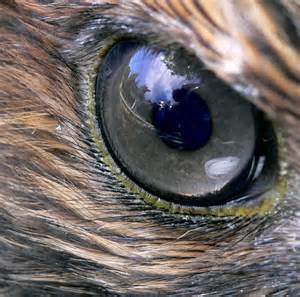
What I do know though, is that this bird’s eyesight, particularly because it is a “bird of prey,” is one of the very best in the animal kingdom.
Close up of hawk eye. Public photo.
“The visual ability of birds of prey is legendary, and the keenness of their eyesight is due to a variety of factors: eyes size to body mass; eyes shape and make up– with more receptors, foveae, rods and cones giving the bird spectacular long distance vision, seeing more than 6-8 times better than humans.”
Let this young hawk inspire us. Let’s not take our eyes off our elected officials!
Help me watch them; help me push them; help me encourage them to fight the next four years for sending more water south from Lake Okeechobee, and over all water quality for our area canals, St Lucie River and Indian River Lagoon.
Hawk with airplanes from air-show in distance. (Photo Todd Thurlow.)
Congratulations especially to winners Senator Joe Negron; Congressman Patrick Murphy and Martin County Commissioner, Ed Fielding whom I supported and promoted in this election. I will be watching! 🙂
Vicki Davis, Supervisor of Elections, Martin County, FL (2013)
The whirlwind of the elections is fully upon us, and today is the “big day…”
There will be winners and there will be losers, but one thing we can count on in our country, county, and state, is that there will be a “peaceful transfer of power.” This is no guarantee in many places around the world. We are fortunate…
My family has been in what would become the “United States” since the mid 1700s on my mother’s side, and since the late 1800s on my father’s side; but, my husband, Ed, was born in Buenos Aries, and his family emigrated from Argentina to the United States in 1960, when Ed was four years old.
When Ed’s father, “Papi,” was still alive, I used to spend hours speaking to him about the political and economic situation that led to him and Mrs Lippisch bringing Ed and Ed’s sister, Lupi, to the United States. No easy feat….
Over many cups of coffee, Papi told me about the dictatorships and the frightening economic up and downs and military coups under the Perons and others during that part of Argentina’s history……(http://en.wikipedia.org/wiki/Juan_Perón)
Sadly, Papi is gone, but his spirit lives as I remember his stories well and they have made me more appreciative my own country in spite of its faults and imperfections….
Today, I wish to thank Mrs Vicki Davis, our Supervisor of Elections for Martin County for all of her hard work and for helping ensure that peaceful transfer of power. She is lovely and hard-working and she is local, having graduated from Martin County High School.
Every time I see her, she thanks me for my work for the St Lucie River and Indian River Lagoon. And every time I see her she introduces me to another “young person” working in her office. Her outreach program is phenomenal. Recently, this summer, in 2014, Vicki attended the River Warriors’ “River Rally” at Phipps’ Park and registered voters in the 100 degree heat and sweltering humidity.
She loves the rivers and she loves her country; and she is a true professional. If you see her today, please say: “thank you.” And whether you are happy with the outcome of today’s election or not, please continue to do all you can to support the St Lucie River/Indian River Lagoon and the peaceful transfer of power in the United States of America.
Because I was born in 1964, I am a child of the 1960s and 70s.
The first time I saw this VOTE sign above it struck a deep chord as I remembered having had the LOVE blocks based on Robert Indianan’s giant art piece on my desk a young person. There is a connection I thought…
LOVE by Robert Indiana
You may not approve of all who win or lose tomorrow. But be a part of the process: CARE, VOTE, LOVE, for the St Lucie River/Indian River Lagoon and for the future.