Monthly Archives: January 2016

We’re “Up the Creek” if We Believe the Myth of Local Basin Runoff, SLR/IRL

S-153 drains this area
S-153 drains this area.
S-53 drains into the C-44 canal and then the St Lucie River
S-153 drains into the C-44 canal and then the St Lucie River
SFWMD canal and basin map. C-44 canal is the canal most southerly in the image.
SFWMD canal and basin map. C-44 canal is the canal most southerly in the image. See S-153 northeast of the C-44 “basin” area.

Water, water everywhere….

The ACOE and South Florida Water Management District are scrambling….they will have to start dumping from the lake and the local basin runoff is exceeding targets ….But is all the runoff into the C-44 really from a local basin? No it’s not.

Let’s drill down a bit.

The ACOE’s recent press release reads:

“FOR IMMEDIATE RELEASE

Corps to increase flows from Lake Okeechobee

The U.S. Army Corps of Engineers Jacksonville District intends to release
more water from Lake Okeechobee starting this weekend as it continues to
manage the lake level in the midst of El Nino conditions.

Starting Friday (Jan. 29), the new target flow for the Caloosahatchee
Estuary will average 2,800 cubic feet per second (cfs) over seven days as
measured at W.P. Franklin Lock (S-79) near Fort Myers. The new target flow
for the St. Lucie Estuary is a seven-day average of 1,170 cfs as measured at
St. Lucie Lock (S-80) near Stuart. However, runoff from rain in the
Caloosahatchee or the St. Lucie basins could occasionally result in flows
that exceed targets as the water passes through the spillway gates at the
Franklin or St. Lucie structures…”

What we have to remember is that the “basin,” the lands that water runs off of into the St Lucie River has been altered by agriculture and development ….so to call “all the water” going into the St Lucie its own basin water is really misleading and not respectful of history….

Let’s look at S-153 for instance, a spillway that is presently dumping approximately 1.2 billion gallons into the C-44 which then goes into the St Lucie River. If man had not altered this area, much of this water would naturally be flowing back into the lake…so again we really should not refer to it as “basin runoff” that belongs to the St Lucie River. Today large portions of this area are agriculture fields and an FPL energy plant so the run off water of this area has been redirected from the lake to us.

S-153 drains this area
S-308 drain LO; S-153 drain area around FPL plant.

Hmmm?

Let’s reflect for a moment on this information from my brother Todd:

“Jacqui,

According to my C-44 page the gates at the locks are up 2ft and dumping 4451cfs which equals 2.8 billion gallons per day.

http://www.thurlowpa.com/C44RealTimeData.htm

http://w3.saj.usace.army.mil/h2o/cam/s80.htm (live picture)

Nothing is coming from the lake so they will say that this is all local runoff because S-308 at Port Mayaca is at 0? That S-153 spillway is dumping 1.2 billion into C-44. It seems to pull water west of Indiantown that would have otherwise gone into the lake not to the St. Lucie?

See also http://w3.saj.usace.army.mil/h2o/reports/StatusDaily_files/slide0178.htm These are all linked on my firm page.”

Todd of course is right. And 1.2 billion gallons of extra fertilized, dirty water is worth noting. Don’t you think? The least they could do is filter it!

Todd and I will look into this further with historic maps of the old creek and ridge system prior to development and how the water historically flowed prior to S-153 flows, etc—– but for now, let’s not entirely be sold “up the creek,” by believing the all this water is “local” basin runoff.

Because it’s not. 🙂

Drainage changes to the SLR. Green is the original watershed. Yellow and pink have been added since ca.1920. (St Lucie River Initiative's Report to Congress 1994.)
Other basin changes are also bringing excess water into the river right now. This map shows general drainage changes to the SLR. Green is the original watershed. Yellow and pink have been added since ca.1920. (St Lucie River Initiative’s Report to Congress 1994.)

Former blog The Myth of Local Runoff: http://jacquithurlowlippisch.com/2015/09/25/the-myth-of-local-runoff-st-lucie-riverirl-rain-event-9-16-15/

A Panther Ten Miles West of Palm City, Florida? Cool. SLR/IRL

....1744:112215:77F:0000:CAMERA1: Florida Panther walks through Martin County, Florida 11/22/15
….1744:112215:77F:0000:CAMERA1: Florida Panther walks through Martin County, Florida 11/22/15
...1745:112215:77F:0000:CAMERA1:3
…1745:112215:77F:0000:CAMERA1:3
.....1745:112215:77F:0000:CAMERA1:3
…..1745:112215:77F:0000:CAMERA1:3
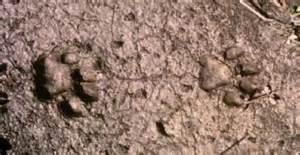
Panther tracks
Panther tracks

So close to the St Lucie River/Indian River Lagoon… Do you see his tracks?

I have been holding back on writing this blog, but today seems like the “puuurfect” day to write! Trapped inside with all this rain has me daydreaming about Florida adventures.

Did you know that a panther was spotted just ten miles west of Palm City in November of 2015? Just two months ago? Maybe he is there today– hiding in the palmettos– trying to get out of this rain.

I learned about the panther’s visit to Martin County when I attended my University of Florida Natural Resources Leadership Institute in January. I didn’t write about as I was not sure I could share the photos. As I have learned the photo are public, I am now sharing. I learned the following from my source:

The person who shared today’s photos with the Florida Wildlife Commission advised that the photos were taken on a trail camera at Allapattah Flats in Martin County’s Wildlife Management Area on November 22, 2015.  He/she advised the camera was in the Wildlife Management Area off of State Road 714, but did not give any more specific location.

Panther biologists confirmed that this is “FP232.”  This panther was hit by a car in Ft Meade in Polk County northwest of Lake Okeechobee, in April of 2014. He is a male and was given veterinary care by the University of Florida for his broken leg, and rehabilitated in Yulee until his release in January of 2015. FP232 was released at Kissimmee River Prairie Preserve State Park, and has since roamed all over south central Florida. It was very exciting to learn of his appearance in Martin county.

I think this is so totally cool. Panthers were once common in Martin County, in all Florida, but now as Florida is full of highways, houses, and swimming pools they are very, very rare; I have written about panthers before, but never thought I’d get to share a photo of one right here. Very rarely are they photographed…

May the panther who visited us have the very best of luck! I will take this public opportunity to name him “Martin” as FP232 is not a name fit for such a magnificent creature.

Previous Panther Blog: (http://jacquithurlowlippisch.com/2014/09/19/local-accounts-of-the-florida-panther-st-lucie-riverindian-river-lagoon/)

Martin County reporter Ed Killer’s panther 2015 article TC Palm: (http://www.tcpalm.com/sports/columnists/ed-killer/ed-killer-on-the-prowl-2550992d-059b-4523-e053-0100007f2974-357239781.html)

Allpattah Flats WCA FWC: (http://myfwc.com/media/2530744/Allapattah-Flats-Map.pdf)

FWC: (http://www.floridapanthernet.org)

UF NRLI –I am part of Class XV –(http://nrli.ifas.ufl.edu)

Frances Langford Estate–2008, SLR/IRL

Langford hut as seen i 2008.
Langford hut as seen in 2008.
...
.....
…..
.....
…..

My Frances Langford theme continues. Today I will share some photos of Frances’ St Lucie River estate treasures given to me by blog reader and salvage director, Bobbi Blodgett. Bobbi recently contacted me. Not only did we have a very interesting conversation regarding the recent destruction of the Langford property and the difficulties of getting developers to “reuse and recycle,” but Bobbi also shared some good news about what was “salvaged” from the Langford Estate in 2008 when it was first being “deconstructed,” as part a tax write off for the developers via Habitat For Humanity.

Her email reads:

“Hi Jacqui,

Langford additional pics during 2008 deconstruction project. Frances was very into Polynesian style and the “tapa cloth” pictured, we salvaged also, It was all handmade and imported. It was laid on the bars, walls etc.

The long bar was in the river house. I believe it was purchased by a couple who bought the house she owned on Hutchinson Island, which is awesome.”

ReUse Salvage Inc.

Bobbi Blodgett, Director
“Green & Clean”
De-construction Services
Removal of Products for Reuse
http://www.reusesalvage.com/

....
….

Thank you to Bobbi for allowing me to share so many pictures. It is fun just to look through them. So many memories! Thank you for this historic documentation. May everyone enjoy!

....
….
...
....
….
....
….
....
….
....
….
....
….
.....
…..
....
….
....
….
....
….
....
….
....
….
....
….
....
….
....
….
.....
…..
....
….
...
....
….
....
….
...
...
...
....
….


....
….
....
….
.....
…..
...
....
….
....
….
....
….
....
….
Frances Langford
Frances Langford 1913-2005
....
….The estate
2016 making room for Langford Landing
2016 scraped clean for Langford Landing (Photo JTL and EL)


Mount Pisgah and the Hills of Martin County, Former Frances Langford Estate, SLR/IRL

Map of our area in the 1982 Coastal Management Zone document showing heights. in MC. (Mark Perry)

Yesterday’s conversation regarding Sewall’s Point’s Mount Pisgah, at 57 feet, in the area of Frances Langford’s former estate got people talking about many things. One of the less controversial, but interesting was “heights.” My brother Todd wrote:

“Jacqui, with respect to Mt. Pisgah being the highest point, I think you are correctly specifying “along” the rivers (e.g. adjacent to the water). There are higher points listed in my video below. But all the ones on the waterfront are less than 37ft. The highest waterfront in Hobe Sound is 50ft and we ran US-1 over it!”

Mr Don Quazzo in his comments noted  the even higher heights than Mt Pisgah of the inland sand hills in the Skyline Drive area….interesting. Fascinating. Talk about history!

Today I will transcribe a piece of “Martin County’s 1982 Coastal Management Zone” shared with me years ago by Mr. Mark Perry. It talks about high places, ancient sand dunes, through out our county.

View Todd’s Time Capsule Flight video “The Hills of Sewall’s Point and Jensen Beach 1950 USGS Topo Map”:  (https://youtu.be/fIwsz5grVg0)

More detail of height in MC.
More detail of height in MC. Figure 3

Here we go:

The 1982 Coastal Zone Management Study of Hutchinson Island, Martin County, Florida, 1982, wa written by Florida Oceanographic Society and the Martin County Development Department.

Part II is entitled “Natural Geologic History.” It reads: “Just before the most recent Ice Age, the Wisconsin, which lasted from 100,000 to 11,000 years before present, the sea level was approximately 25-35 feet above the present mean seal level…At that time the sea was covering most of Martin County except for the Orlando Ridge, which was a narrow peninsula or series of islands and shoals, and the Green Ridge  which was an offshore bar with the crest at sea level…The sea beating against the much smaller Florida coast formed, by erosion and deposition, a broad terrace of Pamlico sands.

These sands were composed of mostly quartz, fossils and some carbon materials. The Atlantic Coastal Ridge was of pre-Pamlico origin was altered by an advancing Pamlico sea. This is evident by the south and north boundaries of the Jensen Beach and Jonathan Dickinson Sandhills which have spit-like structures projecting westward, as shown in Figure 3. (above)

The tall sandhills together with Sewall’s Point and Rocky Point form the backbone of the Atlantic Coastal Ridge. It is breached by the St Lucie River between Sewall’s Point and Rocky Point. During times of high sea level, like the Pamlico Period, the drainage basins of the St Lucie River and Loxahatchee River probably formed and ancient lagoon such as the Indian River Lagoon does today, with the older sandhills of Jensen Beach and Johnathan Dickinson acting as the barrier islands and dunes of that time. It was also during this time when Hutchinson and Jupiter Islands began forming as offshore bars….

—-Excerpt from MC 1982 Coastal Zone Management Study

Whether it is 100,000, 11,000, or 60 years ago, the more we know about the history and formation of Martin County the more likely we are to respect our natural resources.

....
….

Blog post that elicited some discussion on heights and other things: (http://jacquithurlowlippisch.com/2016/01/21/scraped-and-pillaged-the-former-frances-langford-estate-slrirl/)

“Scraped and Pillaged,” the Former Frances Langford Estate, SLR/IRL

Former Langford Estate, 1-20-16 Photo by Ed Lippisch.

Today I continue documentation of the former Frances Langford Estate, the 53 acres bordering Mount Pisgah and the Town of Sewall’s Point. Mount Pisgah, at 57 feet, is the highest point in the region along the St Lucie River and Indian River Lagoon.

I have written on this topic extensively already. Perhaps, too much. So I’ll keep it short and just say, once again…”There has to be a better way to develop property with such historical significance, and once, such tremendous natural beauty.”

Yes—- this type of development is within the law, but is it within our conscience? What was Martin County and the Commission thinking when they approved this transfer? How can we stop this from happening again? Can we?

Anyway—I did recently visit the site and the “Engineer of Record” assured me the high bluff will not be leveled to allow for more homes as is rumored.

“It is the lot’s majestic view of the water that we want…” he said. Six will face the river. You can see that lots are small compared to Sewall’s Point.

Personally, I think it would have looked even more majestic if some of Mrs Langford’s  world-famous tropical vegetation and pond had been left and the lots were not so crammed in.

In conclusion, here are some photos for “the record.”

Thank you to my husband, Ed Lippisch for taking the aerials. All were taken yesterday, January 20th, 2016.

Oh, by the way, when I was leaving I noticed the documents stated that the cleared land had to be “seeded” within 30 days. We’re getting close. The lot was cleared at Christmas.  I bet they put in sod. From tropical paradise to sodded conformity. What a loss.

Front of Langford Landing today. (Photo JTL)
Front of Langford Landing today 1-19-16. (Photo JTL)
Langford home stands on barren hill. (Photo JTL)
Langford home stands on barren hill 1-19-16. (Photo JTL)
The subdivision Langford Landing. 6 houses will be located on bluff overlooking the St Lucie River. (Documents on site)
A 60 boat marina will be put in. The submerged lands went with the property.
.....
…..
...
....
….
....
….

Development documents for subdivision being put on property: Langford’s Landing:
(https://documents.martin.fl.us/Documents2010/content/Agenda_Items/gmd/2015/8D1-2014-12-16%20Langford%20Landing%20Final%20Site%20Plan.pdf)

Previous blog post on topic:(http://jacquithurlowlippisch.com/2016/01/04/langford-landing-a-tribute-to-the-late-frances-langford-st-lucie-riverindian-river-lagoon/)

Emile Gruppe, “The Hut,” and the Heart of Frances Langford, SLR/IRL

Frances Langford's hut as portrayed by Gruppe.
Frances Langford’s tiki hut on her estate as possibly portrayed by Emile Gruppe. (unsigned)

Sometimes things are a mystery and reveal themselves slowly through many days…such is the story of black and white sketch of “The Hut” you see above.

I first saw the piece in an email dated January 14th, 2016, sent to me by my mother, historian Sandra Thurlow. Her email read: “I came across this in a box of treasures. It was an invitation to a joint birthday party for Talley Crary, Frances Langford Stuart, and Jane Merrell. I guess it was “The, with a capital, Hut.” Mom

Prior to receiving this email I had traveled on a yacht up the St Lucie River with my next door neighbor Mr Rohloff—this was two days after Christmas. This was when Ed and I  saw up close the destruction of the former Langford Estate. Cleared to the bone.

Scared clean, Frances Langford estate today. (Photo Jacqui Thurlow-Lippisch)
the Tiki Hut and pond, Frances feeding her swans. (Aurthur Ruhnke courtesy o Sandra Thurlow, 1961)
....
….

When the captain of Mr Rohloff’s yacht heard me gasping as I saw Mrs Langford’s wrecked estate he told me he used to live on there, and was married there, and that he actually worked for Mrs Langford for some time. His name is Rick Copeland. Captain Copland continued to talk about Mrs Langford  throughout the trip and told stories of what a remarkable person she was.

He told a story that as she was aging she gathered all the painting of Emile Gruppe who she and her husband collected and gave them to the artist’ son. “These were very expensive paintings……” She wanted to make certain they were given to the right place and appreciated….

Now fast forward to last weekend. I attended an Environmental Studies Luncheon and sat next to Matt Kelly, who oversees the real estate for Martin Health Systems and years ago was my swimming coach. He took his phone out showing me the same ‘The Hut” piece going back in an email to the son of Emile Grippe and with my sister who works for MHS.

It’s a small world and the heart of Frances Langford lives on!

By just doing a quick search on the internet I found an article about an art show in 2013 in Naples of these Langford/Evenrude paintings! The Gruppe family is very famous and there were three generations of paintings as you will read.

It would be fun if I could find more of the the paintings to share. Here’s one I found. Mrs Langford called her house along the St Lucie River, the “River House,”—maybe this is hers?

Emile Grippe
Emile Grippe
Frances Langford publicly photo.


Naples show of Evinrude/Langford paintings: http://www.news-press.com/story/news/2013/02/01/gruppe-family-painters-to-be-featured-in-world-class-exhibit/4262633/?from=global&sessionKey=&autologin=

Emile Gruppe: http://www.emilegruppegallery.com/biographyemileagruppe.html

“I Have A Dream”–1971 Parker Annex/J.D. Parker, SLR/IRL

Easter party at our home in 1971, Stuart Florida. Students and Mrs Jernigan were from JD Parker.
Easter party at our Thurlow family home in 1971, St Lucie Estates, Stuart Florida. Students and Mrs Jernigan were from JD Parker Elementary School.
.....
…..

In celebration of Martin Luther King Jr. Day, I am going to write a short blog and share some pictures from my baby book about growing up in Martin County. Mind you, I was born in 1964. In 1971 I attended first grade at Parker Annex–J.D. Parker in Stuart.

To view the history of desegregation in Florida’s schools view here:http://www.floridamemory.com/blog/tag/desegregation/

When I attended J.D. Parker Elementary School in Stuart I was six years old, so I never thought about being black or white. I think very young kids innately realize that blood runs red in everyone. We are all the same until we are told we are different.

Although I did not feel “different” when listening to stories of the grown-ups I could tell it used to be very different.

I remember my father being disheartened and sharing stories about how when he was growing up in Stuart, Florida, in the 1950s, there were white and black water fountains, and the black community had to sit in a designated area at the Lyric Theater….Schools were separated. I remember going to the doctor’s office on East Ocean Blvd. and there were two sets of  doors..I would ask: “Mom why are there two sets of doors?” Well Jacqui, not too long ago, one set was for blacks, and the other one was for whites.”

I remember hearing that there were certain beaches along Hutchinson Island and the Indian River Lagoon were for blacks only…even the water was segregated?

All this seemed crazy.

It was not until I became an adult that I realized how near all of this history is. Just one generation away. Hard to believe isn’t it?

When I finally grew up, I taught 9th grade English and German at Pensacola High School and one of my favorite readings for my English students was Martin Luther’s Kings’ “I Have a Dream.”

Every MLK Day I read it aloud and remember…..It is a great inspiration….today or yesterday…

“I have a dream that my four little children will one day live in a nation where they will not be judged by the color of their skin, but by the content of their character…I have a dream today….”

I have a Dream MLK:https://www.youtube.com/watch?v=3vDWWy4CMhE

Florida Schools: http://www.usccr.gov/pubs/022007_FloridaDesegreport.pdf

Pensacola High School 1993, English Class. (Photo courtesy of photography teacher at PHS.)

Power to the Peacocks! The Spirit of Frances Langford, SLR/IRL

Frances Langford publicly photo.
Standing before a giant photo of Frances Langford at Florida Oceanographic event 2013. (Photo Ed Lippisch)
Standing before a giant photo of Frances Langford at Florida Oceanographic’s event 2013. (Photo Ed Lippisch)
The former Langford Estate, cleared for development of Langford's Landing, 2015. (Photo Jacqui Thurlow-Lippisch and Ed Lippisch)
The former Langford Estate, cleared for development of Langford’s Landing, 2015. (Photo Jacqui Thurlow-Lippisch and Ed Lippisch)
Local celebrity Frances Langford stands next to a pen containing peacocks on her property in Rio. The peacocks roamed freely on her land while she was alive.
Local celebrity, Frances Langford, in her later years stands next to a pen containing peacocks on her property in Rio. The peacocks roamed freely on her land while she was alive. (Public photo)
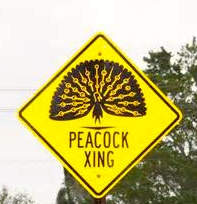
Sign in Rio.
Sign in Rio.

As we all know, movie star and local philanthropists, Frances Langford, was and is very loved in Martin County. Nonetheless, recently her 53 acre river estate, in Rio, was mowed down for development to create ironically “Langford’s Landing.”  Yes, it was legal, but what a shame. What a crime of local history. Part of that history included Frances’ flock of peacocks.

Invasive or not, Frances brought the exotic birds to her property in the 1940s and they had been happily living here ever since. They became part of the cultural landscape of the Rio area. Over the years the county even erected signs warning drivers about the birds.

After Frances’ death in 2005 there were tougher times for the peacocks, peahens, and peachicks but they managed to survive. They had become “wild” living off the land although some residents would joyfully feed them. Kind of like cardinals…. 🙂

Sometimes stopping traffic as they lollygagg across State Road 707, the birds cause smiles and sometimes cursing and horn blowing from drivers. Inconvenient? Maybe— but so cool! So local! So “Frances”…..a reminder of her philanthropic spirit and love for our area with every sighting!

Of course since the 53 acres has been clear-cut and scraped the peacocks have lost their home base habitat. Did anyone even think about this? I mentioned it at a county commission meeting years ago.  Perhaps the county thought no one would notice when the birds fell on hard times or were possibly eradicated?

This was not the case. Not along the Indian River Lagoon…not in the land of River Warriors.

Yesterday there was a great win for the spirit of Frances Langford and the peacocks when resident Toni Rummo used social media to inform the public that a bank and real estate agency had “ordered the trapping of the peacocks at 1547 SW Sottlong  Avenue.”

The house is in foreclosure and the cleaning people were apparently put off by all the birds. This led to the trapping or quote for such.  According to Rummo some birds were trapped but after the outcry the others were left alone. Even the media, Sheriff’s department, and Martin County Commission got involved. It was crazy!

Than you to Toni Rummo and the others! Just to follow up, I spoke to Bill Dean head of Century 21 on Hutchinson Island whose company was incorrectly linked with the sale and he said it was a day like no other. The phone rang off the hook!

At the end of the conversation I said: “But isn’t it great? The love of Frances Langford and the people standing up for her spirit?”

We laughed. I recommended having a gin and tonic in her honor.

Thank you Toni for the peacock win!  It was a  win for the people of Rio. A win for the spirit of Frances Langford, and a win for the spirit of St Lucie River/ Indian River Lagoon!

One of Frances Langford's peacocks in a royal poinciana tree on her estate.
One of Frances Langford’s peacocks in a royal poinciana tree on her estate.
Rainbow over Langford Estate 2014. (Photo JTL)

https://en.wikipedia.org/wiki/Frances_Langford

The Everglades’ sister, Big Cypress Swamp, SLR/IRL

....
Map showing Big Cypress Swamp next to the Everglades. Also note Lake Okeechobee.

The maps and information in today’s blog is taken from an article entitled “Big Cypress Swamp,” by Benjamin F. McPherson, that is included in the 1974, “Environments of South Florida Past and Present,” complied by Patrick J. Gleason.  As I have mentioned previously this week, this text was lent to my by Dr Gary Goforth who gives insight into understanding our St Lucie River/Indian River Lagoon system and our Lake Okeechobee and canal issues.

....
….cover
....The Everglades and Big Cypress Swamp.
….The Everglades and Big Cypress Swamp.

This above map gives one an idea of how far east the Everglades used to go and how much development has crept in (see below)….how come agriculture and development didn’t totally take over Big Cypress? Well, perhaps they could not stop the water….

West of the red lines shows the edge of what was once the Everglades in South Florida. Development has crept and continues to creep over this edge. (Photo/map courtesy of Chappy Young,/GCY Surveyors, 2014.)

Big Cypress Swamp…we may not think of it too much over here on the east coast but we should  study it as well. It is sister to the Everglades and people fought to save parts of it and were successful. It became one of our nation’s first national preserves in the same year Patrick Gleason’s text was published, 1974. I was ten years old and my family had just moved to a very undeveloped Sewall’s Point.

Today I will transcribe from the parts of the summary from McPherson’s work. I like reading the old texts. Sometimes they seem more clear and easier to understand. It helps us understand how things have changed looking an old book like we grew up with instead of  today’s electronic media.

Excerpts from “Big Cypress Swamp,” by Benjamin F. McPherson

“The Big Cypress Swamp differs form the adjacent Everglades in topography, soil, water quality, and vegetation. Because the swamp has relatively more high land, inundation soil deposit are less extensive in  the swamp than the Everglades. Soil in the swamp is usually a thin layer of marl sand or mixture of the two or is absent where limestone crops out where as soil in the Everglades is usually deeper organic peat. Vegetation in the swamp is closely associated with typography, water inundation, and soils,  and is more diverse and forested than in the Everglades…

Big Cypress Swamp is a flat, swamp area of about 3120 square kilometers in SW Florida. It is seasonally inundated over as much as 90 % its surface area. Water moves slowly to the south by overland flow toward the estuaries. Fifty -six percent of the surface water that flows into Everglades National Park comes from the Big Cypress. A substantial amount of water also enters Conservation Area 3 from the Swamp. The western part of the Swamp is drained by canals and no longer floods extensively…

The quality of water in the big Cypress, particularly in the untrained parts is in generally of better quality that the water in the Everglades. Some contamination by metals pesticides and other potentially toxic chemicals does occur however….

Up close map 2 drainage of Big Cypress
Summary
Full summary from article 

Part of Big Cypress Swamp became a national preserve in 1974: https://en.wikipedia.org/wiki/Big_Cypress_National_Preserve. It is to be appreciated and protected. This is all part of our South Florida water system.

Dr Gary Goforth:http://garygoforth.net

Lake Okeechobee 1874,1974, 2074? SRL/IRL

Map from Fred Ober's 1874 expedition.
Map from Frederick Ober’s 1874 expedition.

(For even more insight watch this Time Flight Video by Todd Thurlow, https://youtu.be/sJkMOIqjr_I?t=1m7s “South Bay and Lake Okeechobee”)

Today we continue looking at parts of a 1974 text entitled: “Environments of South Florida, Present and Past,” by Patrick J. Gleason, lent to me by Dr Gary Goforth.

Today’s map of study was created by Frederick A. Ober.

Fred Ober was a man who once ran a shoe shop, but one day, with a dream in mind, literally “threw off his shoes.” He decided to go on an adventure and make something more exciting of his life. In 1974 he visited and documented our Lake Okeechobee and surrounding Everglades.

Our text ironically, looks at Lake Okeechobee 100 years after his visit–published in 1974.

To look at the map and see such notes as “commencement of cypress belt with sandy shore” along the east side; “custard apples, and marshy lands, —-sand beach on the south side”; and “palmetto ridge and Kissimmee Prairie in the north,” really take one to another world.

—A world that basically does not exist anymore.

We scraped it clean. We rearranged it. We built it out. We drained it. We diked it.  We planted seed. We erected houses. Maybe one day the young people will try to put some of it back. It must have been spectacular.

What will it look like in another 100 years? Will today’s Google map below appear as obsolete as Ober’s? What do you think? Is there a way to go back? Envision 2074.

....
….cover of text, 1974
south rim
south rim
Kissimmee River area north
Kissimmee River area, north
NE area of lake
NE area of lake
the lake up close
the lake up close
Today's Google map, 2016.
Today’s Google map, 2016.

Frederick Ober: (https://en.wikipedia.org/wiki/Frederick_A._Ober)

Captain Backus’ 1838 Map of Lake Okeechobee, SLR/IRL

Gleason
1838 Captain E. Backus map of Lake Okeechobee.

This week we will take a look back at Lake Okeechobee, a lake that since 1923–via the C-44 canal,  has been  connected to the St Lucie River/Indian River Lagoon.

Information for these posts is made possible through a book entitled “Environments of South Florida–Past and Present,” by Patrick J. Gleason. This text was lent to me by Dr Gary Goforth. I will transcribe portions of this rare and amazing text in order for us to contemplate the changes that have occurred and how those who first documented this once remote area experienced our region.

It continues to amaze me—the ability of the early map makers and surveyors who functioned without today’s technology.

For me it is noteworthy to notice how the original map of the lake “veers off to the south-east.” Looking below one can see that today this area is today’s Bell Glade and South Bay. These lands are the richest in “black gold” as they have the accumulation of thousands of years of muck. Now we can see why. Tremendous amounts of sugar and vegetable products are produced in this area. Also, I believe these lands are most valuable because they are less likely to freeze due to their proximity to the lake.

As we can see, although we must take the Captain’s map with a grain of salt–interestingly enough—this area was once the lake…

Today's Google map, 2016.
Today’s Google map, 2016.

Here are the words of Captain Backus for us to ponder as I transcribe:

In 1838 map produced by Captain E. Backus had produced a map of Lake Okeechobee, which for a long time remained buried in the national archives records of the Seminole War. It reveals the knowledge of the lake that time, and his version of the lower Kissimmee River shows graphically how that crooked meandering stream flowed thirty-five miles from Fort Basinger to reach the lake only eighteen miles away– as the crow flies…  In a brief statement in the lower left portion of the map, Captain Backus writes: “Many small streams flow into the Okee-cho–bee on the North-East and West side and also on the South- East side, but it is not known that it has any outlet, and probably has none, except at the high water when Grassy Lake (The Everglades) and Okee-cho-bee are united, and probably empties thought some streams into the Atlantic. This is corroborated by the statements of different indians and negroes who profess to have crossed from one side to the other in a canoe at high-water, and to have carried and dragged a canoe many miles over the portage at low tide.”

I wonder how we would have seen the lake had we been there? Would you have crossed it in a canoe? What would you have dreamt it to become?


....
….The handwritten text
....
….Book information and inside cover.

(http://garygoforth.net/index.htm)

Frances Langford Property– time capsule flights– 1940, 1974, 1952, 1958…SLR/IRL


Frances Langford poses here with her first husband, Jon Hall.

Today I am featuring two more time line videos on Frances Langford’s property created by my brother Todd Thurlow. Through viewing history, we get a better understanding of how we got to where we are today…

Langford Property 1940 to 1974

(https://youtu.be/9joOtGz2D44)
Langford Property Flyover 1940, 1952 and 1958

(https://youtu.be/bb224nq_ehU)

Topography and Bathymetry–Frances Langford Estate, SLR/IRL

.....
…..

Video Langford Property Topography and Bathymetry (https://youtu.be/ilQQ1VSXpJ0

A fun thing about working on blog posts with my brother, Todd, is that I learn new words like “Bathymetry. ” It is the study of under water depths. Kind of like topography but underwater. Maybe you already knew the word; I did not! He got on this while we were studying the intense clearning of Frances Langford’s property….

Viewing this short video that compares a historic 1883 map with a 2015 Google map, one clearly sees the differences in the depths of the St Lucie River. It appears that in many areas along and just northwest of the peninsula of Sewall’s Point, where Frances Langford’s historic property is located, the river was as deep as 10 to 12 feet. Today depths are closer 7 or 8 feet or shallower. Mostly a build up of muck from 100 years of releases from Lake Okeechobee I would think….

As far as topography, heights on land, “Mount Pisgah” still stands like a sentinel as the highest point as 57 feet. There is where I always picture Black Beard standing when I drive of the bridge….

What an interesting video, for me, it is amazing to think of the surveyors in the 1800s who calculated such with none of today’s technology! Their maps are quite beautiful. I wonder what surveyor will use in the future?

....
….

What is Bathymetry, NOAA? (http://oceanservice.noaa.gov/facts/bathymetry.html)
Time Flight Videos: Todd Thurlow: http://www.thurlowpa.com

Few Houses but a “Good Game of Golf,” Sunrise Inn, Historic Stuart, Florida, SLR/IRL

Today we look back in history….but you have to look….

These historic photographs are marked “Fairchild Aerial Surveys, Inc.”

According to Mr. John H. Canada, president, Ocean Naval Architects, the year was 1925. You may recognize one of the images as it was used in a former blog post discussing the piled up sand of the C-44 canal. From 1915 to 1925 the government was connecting the canal from Lake Okeechobee to the St Lucie River and Indian River Lagoon.  A big mistake!

These photos below were originally sent to my mother, historian, Sandra Thurlow, by Mr John Whiticar. In their discussion, it is noted that one can see farming where Indian River Plantation is today (The Marriott); one cannot see an Intercostal Waterway–no spoil islands off Sewall’s Point; there was no development on Rocky Point; and most interesting for me, looking at the photo this time: today’s Martin County Golf Course, part of yesteryear’s “Sunrise Inn,” sits right there “in the middle of no where” in 1925. Those were the days!

“By 1923, plans for a new 18-hole golf course with water hazards, tennis courts and clubhouse to be built as part of the newly organized St. Lucie Golf Club and Tennis Court Club.” —-Historic Vignette: Sunrise Inn by Alice Luckhardt:(http://www.tcpalm.com/yournews/martin-county/historical-vignettes-the-sunrise-inn-at-beautiful-port-sewall-ep-381473119-342810492.html)

...
....
….
....
….
....
….
...


“Langford Landing,” a Tribute to the Late Frances Langford? St Lucie River/Indian River Lagoon

Frances Langford and Ralph Eventide photographed before their trademark Tiki Hut and pond, Jensen Beach Estate, 1961. (Photo Aurthur Ruhnke with permission of historian Sandra Henderson Thurlow)
Frances Langford and Ralph Evenrude photographed before their trademark Tiki Hut and pond, Jensen Beach Estate, 1961. (Photo Arthur Ruhnke with permission of historian Sandra Henderson Thurlow)
Frances Langford
Frances Langford as young movie star. April 4, 1913 – July 11, 2005 

“I am sure the new development will be re-landscaped very beautifully, but it is hard to see the once serene property so desecrated.” –Local historian, Sandra Thurlow, 2016

“Frances Langford,” the name is as beautiful as the woman. She is a legend here in Martin County and much of the world. No one has been more generous, loving, and appreciative  towards our community. A true philanthropist, her name graces buildings, parks, and centers from the Indian River Lagoon to Indiantown.

As a singer and movie star, she is best known for “entertaining the troops” during World War II aside Bob Hope. Through her family, young Frances was exposed to Jensen Beach, and later, after the war, came back to create her dream:  “Frances Langford’s Polynesian Outrigger Resort.” It sat along the beautiful St Lucie River and Indian River Lagoon just north of Sewall’s Point.

Over time, inspired by her travels, Frances and her husbands created a tropical paradise known far and wide. Cottages, a restaurant, a marina, palm trees, rare foliage, freshwater ponds, peacocks, and even swans graced the property. Famous movie stars often visited. She gave Martin County a reputation and she put it on the map. She made Martin County’s Jensen Beach her permanent home.

Frances chose to build her personal residence near Mount Pisgah, the highest point of the peninsula. Lore has it that pirates and Indians once lived here too, standing on the high bluff looking for passing ships in the ocean. The property is steeped in beauty, history, and mystery. Sadly, in the end, the remaining 53 acre parcel was treated like any other piece of real estate.

After a long wait since the 2008 Great Recession, the property is finally being developed ironically as “Langford Landing.” The manner in which this is being done has taken most us by surprise.

Is it really necessary to remove every beloved palm tree, stately strangler fig, and blade of grass? Surely Frances thought some of her legacy might stand. It has not. The majority of the property has been scraped clean for new development. My sister said it best: “Jacqui, from the water, it looks like the property has been Napalmed.”

There has to be—-a better way.

the Tiki Hut and pond, Frances feeding her swans. (Aurthur Ruhnke courtesy o Sandra Thurlow, 1961)
The Tiki Hut, bridge and pond, Frances feeding her swans. Many fundraisers were held here and many movie starts attended “in the day.” (Arthur Ruhnke courtesy o Sandra Thurlow, 1961)
Langford Estate 1961. Aurthur Ruhnke.
Langford Estate 1961. (Arthur Ruhnke/ST)
Langford Estate 1961.
Langford Estate 1961. (Arthur Ruhnke/ST)
View of estate from river by kayaker. This photo was sent to me from a Facebook friend.
View of estate from river by kayaker. This photo was sent to me by a Facebook friend.

Video of Ed and my flight over Langford Estate 1-1-16, juxtaposed to historic photographs, created by Todd Thurlow. (https://www.youtube.com/watch?v=cuUVlsk9TXs&list=PLDaNwdmfhj15bmGNQaGhog9QpkQPAXl06&index=1)

Tiki hut in ruins 2016. (Rebecca Fatainger.)
Tiki hut in ruins 2016. (Rebecca Fatzinger)
Around the pond, 2015. (Photo by Rebecca Fatzinger)
Around the pond, palm trees lay in a heap. 2015. (Photo by Rebecca Fatzinger)
Today, photo of Langford property by Rebecca Fatzinger.
Today in 2015/16 photo of Langford property by (Rebecca Fatzinger)
The grounds 2015. Rebecca Fatzinger.
The grounds 2015/16  (Rebecca Fatzinger)
Estate sold for development. (Courtesy Todd Thurlow)
Estate sold for development. (Courtesy Todd Thurlow/Google Earth)
Scared clean, Frances Langford estate today. (Photo Jacqui Thurlow-Lippisch)
From the air–history scraped clean, 1-1-16, Frances Langford’s estate after all foliage has been removed. (Photo Jacqui Thurlow-Lippisch and Ed Lippisch )
Langford Estate 12-3-16. (Photo by Todd Thurlow)
Langford Estate seen from the St Lucie River, 12-3-16. (Photo by Todd Thurlow)
Photo of Frances Langford's peacock on her estate...1980s. (A gift to me from her housekeeper)
Photo of one of Frances Langford’s peacocks on her estate, 1980s. (A gift to me from her housekeeper 2006.)
Young Frances. Public photo.
Frances in her later years.

Development documents Langford’s Landing:

(https://documents.martin.fl.us/Documents2010/content/Agenda_Items/gmd/2015/8D1-2014-12-16%20Langford%20Landing%20Final%20Site%20Plan.pdf)

Frances Langford: (https://en.wikipedia.org/wiki/Frances_Langford)