 Today we will be jumping around the Frog Pond…
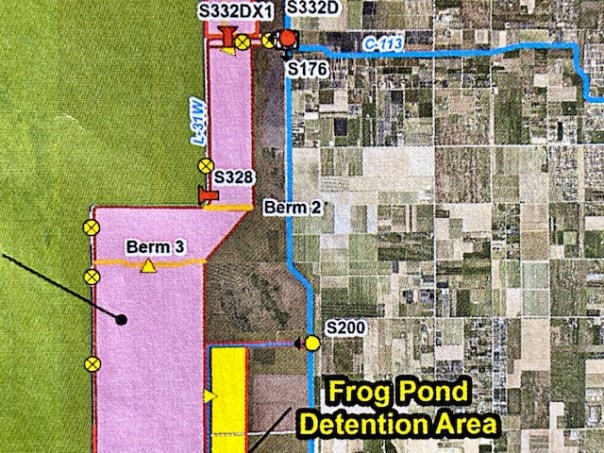
On April 29, 2021, I took a tour, with SFWMD staff, led by LeRoy Rodgers, Section Leader, Vegetative Management, 21 years; Christen Mason, Invasive Species Biologist, 7 years; and Brenda Mills, Principal Project Manger, Everglades Restoration, 23 years. Serious experience! The goal was to tour and learn about Frog Pond restoration, the C-111 project sites, and the 8.5 Square Mile Area.  So what is the Frog Pond anyway? There’s no easy explanation, but I’ll try. The Frog Pond can best described as the “end of the road or the beginning of the road,” Ingram Highway that is. The end of the road for Florida City and the beginning of the road for Everglades National Park. Looking at the map provided by the SFWMD, one can see that the Frog Pond is the long yellow rectangle below; pink contains the C-111 South Dade Project of which Frog Pond is part; and the blue section at the top is the 8.5 Square Mile Area.
 So before we start jumping around…
Ecologically, this area is part of the Everglades Keys, the marl transverse glades, (where water once seeped through from the River of Grass) south of Miami.
-Landscapes and Hydrology of the Predrainage Everglades, page 49, 2011, McVoy. So how about today?
First, we must recognize the hard work of the public, the U.S. Department of the Interior, the USACOE, the National Park system, and others. In the 1980s and 1990 all fought and achieved the Everglades National Park Protection and Expansion Act with the goal of protecting the eastern agriculture areas from flooding, but achieving more water into Everglades Nation Park. No easy task!
“To quote the book, page 257, River of Interests: “The Interior Department and the National Park System agreed that acquisition of Frog Pond was essential, claiming that it would restore freshwater to Florida Bay.” And as all has evolved, this is indeed being accomplished. Here is an excellent 2021 explanation from SFWMD Chief District Engineer and Assistant Executive Director, John Mitnick.
“The Frog Pond Detention Area is a project in South Dade along the eastern side of ENP, and just southeast of the S-332D Detention Area. It is part of the C-111 Spreader Canal CERP project. Originally it was a detention area, meaning water was pumped into it and detained before it would evaporate or seep out into the groundwater table. The purpose being to create a hydraulic ridge in the groundwater table (raise the groundwater elevation) to prevent groundwater and surface water from seeping out of ENP to the east. Around 2016 the District undertook a project called the Florida Bay Project where we modified the detention areas to allow surface water to overland flow out of the detention cells into the headwaters of Taylor Slough after water had passed through the detention cells. This way it was a more direct hydration of the Taylor Slough. Since it was completed, the project has been very effective at providing additional water to Taylor Slough.”
In its days as agriculture fields, the Frog Pond’s marl and limestone was mechanically ground up to create soil for crops. Though helpful for growing a menagerie of delicious things, this practice was very destructive to the ecology of the already drained lands.
Today the SFWMD has the lead on improving these lands. Christen Mason, Invasive Species Biologist and LeRoy Rodgers Section Leader, Vegetative Management, were proud to show me their restoration work.
The photo below is an excellent example comparing the invasive Napier Grass, on the right, which had totally taken over this area, and the restored rocky marl lands to the left-that have been “restored.”
Napier Grass is also called Elephant Grass and is a wicked invasive and very difficult to remove. Another invasive species, Burmese Pythons, are known to hide in it.
I.
-Left restored. Right full of invasive Napier Grass So we can see that what was once a monoculture of invasive African Napier Grass is now a combination of native grasses and shrubs. A place for native birds and wildlife. This has taken decades. In some areas, pine trees were planted. Their pert green shoots explode against a blue sky. I hear chirps and singing insects everywhere! I keep looking for a frog, but don’t hear any.
-Christen Mason shows how the rock was ground up for soil -Native grasses and flowers have returned
 -LeRoy Rodgers holds a wildflower, and beautiful red bug
 -Pretty! Lots of butterflies!
 -Gymnosperma glutinosum, Michelle’s favorite!
 -Calopogon tuberosus
 -a young slash pine reaching for the sky!
 -wild porter weed
 -a future forest
 -Beautiful native grasses and flowers
 -wild milkweed?
 -a cool water filled solution hole keeps life in dry times
 -note hammock in background. Lucky Hammock is most famous and a magnet for birds and bird watchers.
 -Christen poses for the camera. Surrounded by her creations!
II.
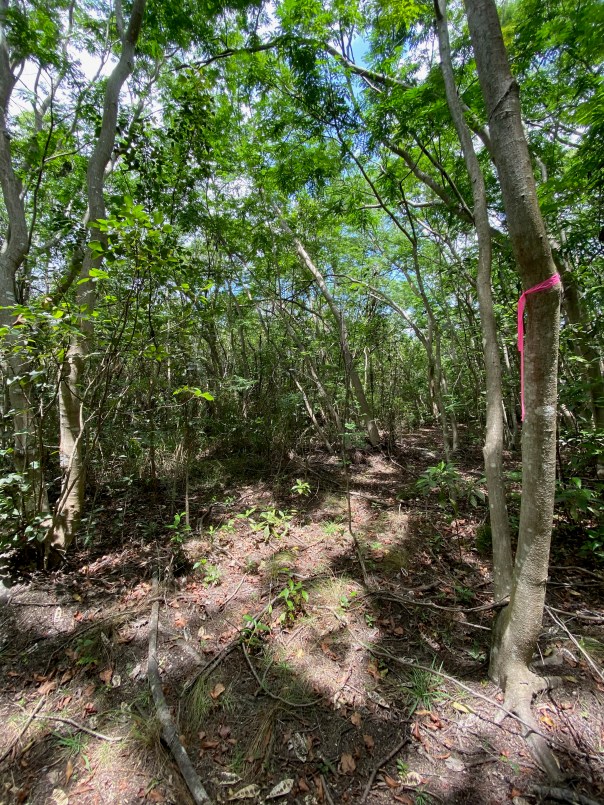
Next we drove north and hopped into a hammock. Frog Pond has famous hammocks especially in the west where lands were less disturbed. As we walked the rocky decline from the road, staff asked me if I was allergic to poison-wood or afraid of rattlesnakes. “Neither.” I replied. Proud my parents raised me like they did. Setting up my chair confidently, I took bite of my sandwich in the cool shade. 

III.
The day was getting hot and we had to drive back to West Palm Beach, so next we jumped right along to the pump station!
Below is Structure-176, not too far north of the Frog Pond. This station pumps water that wants to go through those old marl transverse glades back into structures of the pink area creating the hydraulic ridge Mr Mitnick wrote about. This ridge keeps water inside Everglades National Park- upper ground and surface water.
 -S-176
  -Water is sent back over the lands through the pump station. There are many in area!
 Note the soil color and the solution holes!
We jumped back into the truck, and just when when I thought my trip couldn’t get any better, the most wonderful thing occurred. As we approached I saw all these colored spots in the distance. I strained my eyes.
“Oh my gosh!” I yelled.
Hundreds of wading birds had gathered. Wood storks, ibis, white egrets, blue herons, roseate spoon bills, and many others feasted, crammed together, on collections of fish and crustaceans.
I silently slid out of the truck, watching and trying not to disturb them. But as the trucks went past the birds lifted into the sky, squawking and flapping, then circling right back to their watery dinner table! I was in awe. “This is what it is all about,” I thought to myself. Like a description of Marjory Stoneman Douglas, a sea of birds rose from the Everglades and blocked out the sun. My eyes filled with tears… My hope renewed for our wildlife, our lands, and our waters.
-Birds fly! AWSOME BIRD VIDEO!
I wiped the tears from my eyes. Staff was moved as well. We knew we had just witnessed the best of Everglades restoration. It is working.
For the next leg, I drove with Brenda Mills, Principle Project Manager, Everglades Restoration. I learned she was not only an accomplished engineer but also an avid birdwatcher and had even chaired her local chapter of the Native Plant Society!
As we got out of the trucks for our final look around, I was told we were standing in the at controversial 8.5 Square Mile Area. Lands before me had been scraped and restored, piles of earth rose to the horizon. Behind me, tall Royal Palms blew in the wind. I could see an orange painted house through the Napier Grass, Australian Pines, and animals roaming.
The wind blew, the dust rose. “It will start raining soon.” Brenda said. “This landscape will look totally different then, you should come back.”
“Will do,” I said. “I want to see the waters tumbling into Taylor Slough.” We laughed knowing this area can go from dessert like to Colorado River within hours. I finally knew something about the Frog Pond; I had seen and learned so much. I wished I could stay longer at this amazing place. We all looked at each other, smiling. I kept listening -just hoping that before I left, I would hear one frog chirping. I thought I did, but it must have been a goat. What a day at the Frog Pond!
-SFWMD’s Christen, Rory, and Barbara are doing great work! Thanks for the tour! -Invasive Nadier Grass and Australian Pines in the 8.5 Square Mile Area -An area adjadcent to the 8.5 Square Mile Area that is is slowing being restored. It was once entirely full of Napier Grass. The birds and animals are coming back.

 -one last photo before we drive home 🙂

 I drove slowly hoping to see a gopher turtle, noticing a sign to share the road.
 “This is amazing,” I thought. Once, all along US1 was scrub habitat. Think of all the animals. Think of all the birds. Think of the Native People. Think of the pioneers who where the first to clear this land…
 -Scrub habitat
 -white sands
 -a slash pine
 “Praise to the people who saved these places.” I thought. I could hear the hum of US1 in the near distance…


 As I walked back towards my car, I couldn’t believe my luck. A gopher turtle was happily eating along the dunes. I pondered the passage of time knowing this gopher’s ancestors also ate from these dunes, hundreds of thousands of years ago when they were islands in an inland sea…


