Robert Lord is President and C.E.O. of Martin Health Systems, formally known as Martin Memorial Hospital. “MHS” as it is known for short, is the long time top-employer for Martin County, and a respected and expanding health system. It has been located in Martin County for 75 years. (https://www.martinhealth.org) The origianl institution sits along the shores of the St Lucie River, near downtown Stuart and has grown into both south Stuart and St Lucie County. It is a literal “lifeblood” of our communtiy.
I have known and admired the Lord family since my childhood. Bobby Lord, Robert Lord’s father was a local celebrity in Stuart’s early days as he is a County & Western legend. (https://en.wikipedia.org/wiki/Bobby_Lord )I attended both elementary and middle school, and graduated from Martin County High School in 1982 with Robert’s younger brother, Cabot.
I cannot express how much it meant to me last Thursday to see “Robby” Lord, accomplished attorney, now President and C.E.O. of Martin Health Systems, in his position of leadership and influence, speak in support for Senate President Joe Negron and Senate Bill 10. A bill intended to purchase land south of Lake Okeechobee for a reservoir to begin what must happen to save our river: “clean and send more water south.”
Having known the Lord family all these years, I have followed Rob’s career, especially as my sister, Jenny, is physician recruiter, and has served the hospital loyally for almost 20 years.
So, Bravo Rob Lord! You have created a “hometown game-change,” and as we all know, it is not easy to speak up. There are tremendous pressures to conform and accept things as they are. Over the past few years, outside powers have moved into our area influencing and blurring the lines.
I believe that Rob’s speaking out will clear the blurred lines and change the playing field forever. There is no mistaking it. Lake Okeechobee’s discharges are a health issue and must be stopped. Our state and federal government can ignore this no longer in spite of the influences of power.
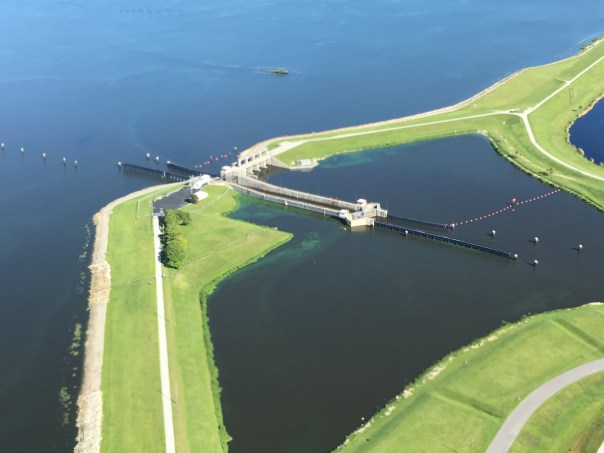
2016, 239 sq. miles algae bloom in Lake O at S-308 entrance to C-44 and St Lucie RiverSt Lucie River 2016 toxic algae bloom brought on by Lake O discharges into SLR
Excerpt from speech:
“…Good morning, my name is Rob Lord. I am President and C.E.O of Martin Health System .. I care deeply about the impact of Lake Okeechobee discharges on the estuaries. I grew up on the Indian River Lagoon. My family moved here in 1969. I have fished these water with my father, my grandfather, and my brother and nephews and nieces. No one values this eco-system more than my family. We watched it change. As CEO of Martin Health System this has been a significant challenge for us. This past year blue-green algae came to our community. We needed to post this sign in our emergency room. We treated this very much like we needed to treat the Ebola situation….”
Dr. Steven Parr, Director of Emergency Medicine at Tradition Medical Center noted there are studies occurring now to determine whether the toxins trigger certain diseases such as Alzheimer’s, Parkinson’s, and ALS also known as Lou Gherig’s disease.
Today I share the second paper of guest, Geoffrey Norris Ph.D. I recently shared Blue-green algal blooms in the lakes, rivers, and marine waters of south Florida surrounding Lake Okeechobee.
I must admit, I hesitated publishing this second paper, “Sugarcane and Indians,” as I am sure some may interpret it as “politically incorrect.” I apologize to anyone who may, but I decided to print Dr Norris’ paper because the main message is important.
The message is:
“Is Sugar’s use of ripening stalks with “Roundup” feeding toxic algae blooms and why are lands/waters south of Lake Okeechobee “protected” while ours of the northern estuaries are not? “
You will learn something about this in Dr Norris’ paper below, and I thank him for sharing his work.
In closing, I believe we have something important to learn from history and the Native People of North America; I admire them. They are great warriors and respect Nature, the gift of our Creator. And in the case of the Miccosukee, they “never surrendered” and if I have anything to do with it, neither will we.
..”In the 1960s, I lived and worked as a petroleum exploration geologist in Tulsa, Oklahoma. Subsequently, I spent almost 40 years at the University of Toronto in teaching and research in geology…A geologist by training, I have a specialized knowledge of fossil algae, their ecology, morphology, and distribution. I have published hundreds of scientific papers on fossil algae and related topics.” ~Geoffrey Norris Ph.D.
rosalex@interlog.com
Sugarcane and Indians
Executive summary
The area around Lake Okeechobee accounts for almost half the total production of sugarcane in the United States.
Sugarcane in south Florida is very needy of phosphorus and potassium fertilizers, but nitrogen fixed in the muck soils largely eliminates the need for extra nitrogen fertilizers.
Sugarcane also demands the use of the phosphorus-rich herbicide “Roundup” (glyphosate) several times each year. Firstly, in the fallow season (approximately May-September) to control weeds and allow the sugarcane underground rhizomes to regenerate. Secondly, as the new shoots come through in the Fall to continue weed control. Thirdly, during maturation and harvesting (October through March) glyphosate is applied to “chemically ripen” the sugarcane and improve sugar yields.
Land south of Lake Okeechobee could be used for storage and bio-cleansing of excess lake water. However, the 1997 water quality agreement between the Environmental Protection Agency and the Miccosukee Indians (aka Mikasuki, Miccosuki) states that phosphorus shall not be present in quantities greater than 10 parts per billion, and that no substance shall be present to stimulate algal growth and produce objectionable algal densities in the 300,000 acres of tribal lands in the Everglades south of Alligator Alley.
This legal agreement would suggest that Lake Okeechobee waters destined for southern storage must be cleaned to rigorous standards before discharge into southward flowing streams feeding the Everglades, at least near the Miccosukee tribal lands.
A case could be made for the sugar industry and related agriculture to “clean up its act” to mitigate the effects of heavy fertilizer and herbicide usage on the environment in general and on lake and stream waters in particular.
Sugarcane and Indians
First about nutrients and farm land and how much is planted in sugarcane.
Here are three maps that graphically answer the question about the extent of sugarcane plantations:
A couple of years ago I had the opportunity the fly over the area south of Lake Okeechobee in a light plane at about 1000ft altitude. The extent of the sugarcane is truly mind-boggling. Its plantations surround the entire southern perimeter of the Lake and reach to the horizon. Smaller plantations occur elsewhere around the Lake. It is a very big operation.
Now to the nutrients themselves. I had a great deal of difficulty finding precise information on how much fertilizer is applied per unit area. There were general articles that confirmed that sugarcane is very needy of nitrogen, phosphorus, and potassium fertilizers together with other elements. It is after all a giant grass, so just think how much stuff you have to put on your own lawn to make it grow green! Apparently, in the south Florida area the need to apply nitrogen fertilizer to sugar cane is not so critical because the mucky soils generate their own nitrates through soil microbial activity. However, phosphates must be applied as fertilizer for sugarcane at various times of the year together with potassium etc. But actual numbers were hard to come by, other than that sugarcane is voracious for fertilizers. This is when I stumbled upon some marvellous work that the U.S. Geological Survey has been doing on the extent and the total quantitates of pesticides being applied to farmland across USA. I used their maps of glyphosate (Roundup) as what I thought might be a reasonable proxy for phosphate fertilizer. In other words, if you use Roundup as a weedkiller on crops, then very likely you will be using fertilizer as well. It turns out I was right and I was wrong! First take a look at this summary map for two separate years, 1992 being the earliest year available in this USGS study:
Details are difficult to see in these summary maps but the originals are much clearer. The area around Lake Okeechobee was already in 1992 applying large amounts of glyphosate, and this intensified in succeeding years. What I didn’t understand was why the sugarcane fields should be so needy of weedkiller – fertilizers OK, but why so much weedkiller? It would seem that 25% of the cost of sugar production is due to heavy nutrient need (up to 75 lbs phosphate per acre, with 400,000 acres in sugarcane in south Florida). But weedkiller. Then I dug deeper following your email comments and found out why. Indeed glyphosate is used at least three ways on sugarcane as follows:
Firstly, during the fallow season (approx. May-September 2016) following harvesting, glyphosate is applied to control weeds which would otherwise grow up and choke out the underground cane sugar rhizomes left in the ground to regenerate as the next crop.
Secondly, glyphosate application continues in different amounts as the new shoots come through in the Fall. This is tricky because glyphosate kills just about anything that is green, but careful control can kill the young weeds while not harming – at least not very much – the young sugarcane shoots. Other herbicides are also involved but glyphosate is the big one.
Thirdly, the sugarcane matures and is harvested in the winter months at various times from October through March. During this time the stem of the sugarcane ripens and becomes rich in sugar (sucrose) prior to going to the mill. Astonishingly (to me anyway) it has been found that about a month or two prior to harvesting, another application of glyphosate will help ripen and enrich the crop with significantly more sugar. This process is called “chemical ripening”. Other chemicals can be involved but glyphosate is a popular choice (it got cheaper once Monsanto’s patent expired in the year 2000).
So yes, I think cane sugar farming is being pursued intensively, but I’m not sure how it can be stopped. Its effects on Lake O could be mitigated as discussed in my previous document but stopping an entire industry would be almost impossible to my mind. Cleaning up the sugar industry might be a more realistic aim.
Change of land usage and water flow.
It would be nice to think that Lake Okeechobee water could be redirected southwards along its original historic course on its way to the Everglades. Here’s a graphic of how things used to be:

For thousands of years, water drained from Lake O through a wide series of shallow tributaries and interconnected lakes to the Everglades. It’s unlikely that this could be recreated but certainly use of land south of the Lake for water transport and storage and bio-cleansing of some sort or another would be an improvement. However, it would seem that this is unlikely given the actions of the U.S. Environmental Protection Agency and its agreement in 1997 re the Clean Water Act with the Miccosukee Indians, a tribe which occupies part of the Everglades.
This agreement set out comprehensively water quality standards for the Tribes drinking water, wildlife habitat water, and recreational water (boating, swimming etc). In particular, Section 3 reads:
MICCOSUKEE ENVIRONMENTAL PROTECTION CODE
SECTION 3. Tribal Water Quality Standards
The following minimum water quality criteria shall apply to all surface waters of the Miccosukee Tribe of Indians of Florida unless those water bodies are designated with higher or stricter water quality standards. Stricter standards for a given water body shall supersede these general Water Quality Standards. These standards shall provide a legal basis for including whole effluent toxicity requirements in all federally issued permits.
(there follows a list of 16 physical, biological, and toxicological conditions of which these two are particularly germane):
E. NUISANCE CONDITIONS: Plant nutrients or other substances stimulating algal growth, from other than natural causes, shall not be present in concentrations that produce objectionable algal densities or nuisance aquatic vegetation, or that result in a dominance of nuisance species instream, or that cause nuisance conditions in any other fashion. Phosphorus and nitrogen concentrations shall not be permitted to reach levels which result in man-induced eutrophication problems. Total phosphorus shall not exceed 10 parts per billion in Class III-A waters. In Class III-B waters, total phosphorous discharges shall not be made which result in undesirable aquatic life effects or which result in chronic or acute toxicity to aquatic life.
N. NUTRIENTS: In no case shall nutrient concentrations of Tribal Class I or Class III-A surface waters be altered so as to cause an imbalance in natural populations of aquatic flora or fauna. Total phosphorus concentrations shall not exceed 10 parts per billion in Class III-A waters. In Class III-B waters, nutrients shall not be discharged which result in undesirable aquatic life effects or which result in chronic or acute toxicity to aquatic life.
So what this and other sections of agreement mean is that nutrient-rich water from Lake Okeechobee must be cleaned to rigorous standards before discharge into southward flowing streams feeding the Everglades. So bio-cleansing within the Everglades – or at least near the Miccosukee tribal lands (about 300,000 acres in the vicinity of the Tamiami Trail and Alligator Alley) is not a possibility within this legal framework.

However what’s good for the goose is surely good for the gander. I looked into the history of the Miccosukee Indians, and it would seem they are only fairly recent arrivals in Florida, arriving about the same time as Stuart was being settled. The Miccosukee appear to have originated in what is now Georgia and then migrated south to north Florida where they became entwined with the Seminoles. After the Seminole wars of the 19th century they migrated to central Florida in the late 1800’s and then decided to disentwine themselves from the Seminoles as a culturally distinct society. They appear to have seen an opportunity during the construction of the Tamiami Trail in the first quarter of the 20th century and migrated further south and became embedded in the adjacent Everglades. First Florida (1957) then federally (1962) they became recognized as a tribe distinct from the Seminoles.
Meanwhile in th early 20th century, as the migrant Miccosuki Indians were settling down in their new home in the Everglades as “Trail Indians”, Stuart was incorporated as a town (1914) then a city (1925) after being settled by migrant northerners about half a century earlier. Total population of Stuart is now about 16,000.
640 migrant Indians – how many are fishing and frogging? 16,000 migrant non-Indian northerners – how many lives and livings are being disrupted by ruined beaches and waterfronts?
the Indians pushed for a great deal from EPA and got it. So now a total of about 640 Miccosukee (Mikasuki) Indians (some now living in Miami-Dade and not the Everglades) can pursue their supposedly traditional way of life (fishing, frogging, subsistence agriculture) plus gaming resorts and casinos and tobacco shops – while many of the 151,000 citizens of Martin County are prevented from pursuing their traditional way of life. Surely our waters (habitat, recreational, drinking) should be subject to the same rigorous standards as laid down by the EPA/Clean Water Act for the people living in the Everglades.
We are all equal – as George Orwell said – but some are more equal than others. Well, so it seems. What do you think?
_________________________________________________________
Writing my blog allows me to meet many interesting people. Recently, fellow Sewall’s Point resident, and active Vietnam Veterans of America member, Mr. Frank Tidikus, introduced me to Canadian and part-time Martin County resident, Professor Geoffrey Norris who is a geologist and algae fossil specialist with a long career at the University of Toronto.
Professor Norris, his wife, and I met at the Prawnbroker and had a lovely exchange. Dr Norris describes himself as such…
...In the 1960s, I lived and worked as a petroleum exploration geologist in Tulsa, Oklahoma. Subsequently, I spent almost 40 years at the University of Toronto in teaching and research in geology…A geologist by training, I have a specialized knowledge of fossil algae, their ecology, morphology, and distribution. I have published hundreds of scientific papers on fossil algae and related topics…
Professor Norris shared two papers composed for his property association at Indian River Plantation on Hutchinson Island along the Indian River Lagoon during the 2016 toxic algae extravaganza. Today, I will share the first entitled: “Blue-green algal blooms in the lakes, rivers, and marine waters of south Florida surrounding Lake Okeechobee.” His second, specifically on Sugarcane, I will provide next week.
Professor Norris’ summary and full paper is below. It is excellent in that it is able to relay complex subjects to the everyday reader interested in water quality and improving the plight of our St Lucie River/Indian River Lagoon.
What is most amazing to me are his comments on glyphosate, most famous for being the active ingredient in Roundup, but now used under many names. Sometimes I hear people screaming so much about Roundup that I tune it out, but Professor Norris’ observations really got to me.
He notes that glyphosate, used excessively in agriculture production around south and central Florida may actually “feed”cyanobacteria (toxic blue-green algae blooms). Also mind-blowing are Professor Norris’ insights into the reproduction of the hungry and ancient cyanobacteria that reproduces through binary fission (copying itself) “producing endless clones” “with no dissipation of mutant genes as a checks and balance to adaptation…”
Yikes! Really?
Blue-green algae mat St Lucie River July 2016, Snug Harbor, JTLWell, enjoy the reading the paper. And know, together we are making a difference!
Jacqui
Public maps info shared by Dr Norris, courtesy of USGABlue-green algal blooms in the lakes, rivers, and marine waters of south Florida surrounding Lake Okeechobee
Executive Summary
This report provides basic information on blue-green “algae” and explains that they are actually bacteria (cyanobacteria). These blue-green bacteria form blooms in Lake Okeechobee that in turn are released by the Army Corps of Engineers into canals and estuaries of south Florida.
The blue-green bacteria grow by using sunlight as an energy source to synthesize elements from the water into more complex compounds used in their cells. When important nutrients such as phosphorus and nitrogen are present in excess, the bacteria multiply rapidly and accumulate as highly concentrated masses of cells, called blooms.
Blue-green bacteria can synthesize nitrates from atmospheric nitrogen, but also need phosphorus dissolved in water to survive and thrive. If phosphorus is scarce in the water, this limits the growth of the bacteria. If it is abundant, blooms can be triggered.
Run-off and back pumping into Lake Okeechobee from surrounding Everglades agricultural lands and upstream from the Kissimmee River watershed is suspected of providing a potential abundant source of phosphorus for blue-green bacteria, in phosphate-rich fertilizers and herbicides such as Roundup (glyphosate).
Glyphosate (2-[(phosphonomethyl)amino]acetic acid) is of particular concern, since it has been used heavily in the agricultural areas around Lake Okeechobee and upstream in the Kissimmee River watershed for at least 25 years. Glyphosate provides a source of phosphorus for blue-green bacteria and recent research by others suggest that glyphosate enhances the growth of blue-green bacteria, which become tolerant and absorb glyphosate directly.
The blue-green bacterial blooms released into the St Lucie Estuary (principally Microcystis) are formed in freshwater but appear to be tolerant of dilute salinities, and recent research suggests can build up resistance to increased salinities such as are found in estuarine waters.
Blue-green algal blooms in the lakes, rivers, and marine waters of south Florida surrounding Lake Okeechobee
I am a property owner in Stuart, Florida and have been alarmed – along with many others – at the spread of blue-green algae (aka cyanobacteria) into the St Lucie River and adjacent areas by water releases from Lake Okeechobee. There has been much publicity and calls for action over the years but very little appears to have been done to solve this long-standing problem at any level of government, until very recently. Now, a State of Emergency has been declared by the Governor of Florida. Recent initiatives, following public meetings in Martin County thanks to the Board of County Commissioners, have been undertaken by Florida Representative Gayle Harrell and Senator Joe Negron and their colleagues in association with Senators Marco Rubio and Bill Nelson and Rep. Patrick Murphy to urge the Army Corps of Engineers to stop immediately the nutrient-laden discharges from Lake Okeechobee.
Although I am a property owner and tax payer in Martin County, I am also a Canadian snowbird and therefore do not have a vote, which is a little constraining when trying to influence political decisions. Therefore, I decided to put my energies into assessing what is known about the current situation of the blue-green blooms. I am a geologist by training and I do have a specialized knowledge in particular of fossil algae that have been extremely important in oil and gas exploration over the decades gone by. I am not a biologist but I do have some knowledge of the literature on algae – their ecology, morphology and distribution in various environments. I have published hundreds of scientific papers on fossil algae and related topics and hope that the following – largely based on biological and agricultural literature – will pass muster.
In the following presentation my aims are twofold:
Firstly, to try and answer commonly asked questions about blue green algae (which are actually bacteria) that might be helpful in clarifying some of the technicalities of a complex subject.
Secondly, to highlight what to my mind is the ultimate cause of the blue-green outbreak: that is, the heavy application of phosphate-bearing fertilizers and herbicides around Lake Okeechobee together with back pumping of agricultural run-off into the Lake. In particular I believe that the well-known weed killer glyphosate (e.g. Roundup) may be implicated as a major contributor to the problem. South Florida and somewhat later Central Florida became major users of Roundup in the early 1990s, long before its popularity spread north into the corn and bean belt.
Feel free to pass this article on to others. I would welcome comments by email at rosalex@interlog.com
What are blue-green algae?
Well, for starters they are not actually algae at all. They were discovered in the 19th century by biologists using newly invented high-powered microscopes. They noticed a variety of microorganisms living in water, some of them with green pigments in the cells that allowed photosynthesis to occur, similar to the well-known photosynthesis occurring in the much larger land plants and driven by chlorophyll. But they were much simpler in organization than the large land plants so were called “algae” (singular alga, from the Latin word for seaweed). Some of these microorganisms contain a rather different bluish pigment and were therefore referred to as “blue-green”, and in these early days were judged nevertheless to be algae – hence blue-green algae.
It was only later that biologists realized that the blue-green microorganisms were crucially different from algae because they had no nucleus in the cell and their pigment was not organized into a “blob” within the cell like most other algae. In the scientific literature they are now regarded as bacteria and the blue-greens are referred to as cyanobacteria – that is, photosynthetic bacteria that use a blue-green pigment to facilitate the use of the sun’s energy to produce organic compounds needed by these organisms.
It is important to understand this difference between the blue-green cyanobacteria on the one hand and the “true” algae on the other. I will come back to the difference between bacteria and algae later, and how this impacts on bloom formation.
Meanwhile, the term “blue-green algae” has gained traction in the news media and is now widely understood to be implicated in the blooms of microorganisms that occur from time to time in lakes and rivers in Florida and elsewhere. I will use either of the terms “blue-green algae” or “cyanobacteria” depending on the context, or just the neutral term “blue-greens”. But remember they are actually bacteria.
What are algal blooms?
An algal bloom is the result of rapid increase or accumulation of algae in a body of water. They can occur in freshwater (lakes, rivers) or in marine water (estuaries, lagoons, coastal embayments). Different types of algae (including the blue-green cyanobacteria) produce different blooms characterized by green, bluish, yellow, brown or red colors. The density of pigmented cells in a bloom is enormous, and measured in the hundreds of thousands to billions of cells per liter (1 liter is almost a quart) depending on the species.
Blooms can be quite localized and appear as a streak on the water or can be very large and visible from space, such as the algal blooms that occur from time to time in Lake Erie and measure tens to hundreds of miles in extent. The recent blue-green algal bloom in Lake Okeechobee was reported to be more than 30 square miles in extent.
What causes blooms?
Blooms occur naturally when the water contains an excess of nutrients such as phosphorus and other compounds. This causes an increase in the growth of algae leading to very high concentrations of cells that become visible as colored streaks and patches in the water. Other factors involved in triggering algal blooms include temperature changes, sunlight intensity, changes in water chemistry and changes in water currents.
What are the red tides that occur in Florida?
A red tide is just another name for a bloom of “true” algae in marine water, and in this case a particular algal group called dinoflagellates. Red tides can be red but more often occur as greenish or yellowish colored water in the coastal areas of Florida. The term “harmful algal bloom” is often preferred in referring to these dinoflagellate blooms that do indeed harm wildlife and human life in different ways e.g. toxic shellfish poisoning; respiratory illness; mass fish kills.
So what caused the blue-green algal blooms in Lake Okeechobee?
First, it is important to understand that blue green algae are uniquely different. Not only are they photosynthetic bacteria but they are also capable of manufacturing their own supply of nitrates from nitrogen in the atmosphere, one of their crucial nutritional requirements. So the blue-greens have plenty of nitrogen to live on but they also need other important elements and compounds to thrive. One of these is phosphorus, which often occurs naturally in water in trace amounts as phosphates. If phosphorus is scarce, then this limits the growth of the blue-greens even though they have potentially a lot of nitrates available. The amount of phosphorus available becomes a limiting factor for growth of the blue-green algae. If phosphorus becomes more abundant in the water, then the blue-green algae thrive and multiply until they become visible as a bloom. It is believed that high phosphorus concentrations in Lake Okeechobee are capable of triggering blue-green algal blooms.
So where did the phosphorus come from in Lake Okeechobee?
Lake Okeechobee is surrounded by agricultural land that is being intensively farmed. Run-off from the farmland appears to be entering Lake Okeechobee, and this includes various phosphate-rich fertilizers and herbicides such as Roundup (glyphosate).
But Lake Okeechobee water levels are higher than the surrounding plain. How can run-off into the Lake happen?
Well, firstly, Lake Okeechobee and the surrounding farmland share a common water table. Transfer of minerals and soluble organic compounds can occur through the groundwater. But probably more importantly, until recently it was common farming practice to back pump excess run-off water from the agricultural land into Lake Okeechobee. Almost certainly this had led to the accumulation of phosphorus and other nutrients in the Lake as well as unused agricultural chemicals. Aerial transmission into the Lake from crop dusting is also possible.
So now that back pumping has been discontinued will this solve the problem?
Not really, because although farmers now are not allowed to back pump into the Lake, the South Florida Water Management District has responsibility to alleviate the threat of flooding. They can – and do – back pump surface water from the surrounding land into Lake Okeechobee, if excessive rainfall conditions threaten to flood the communities around the Lake. Rainwater running off the agricultural land will still contain phosphorus and other compounds derived from fertilizers. Furthermore, from time to time the Army Corps of Engineers controls the level of Lake Okeechobee by releases of lake water into the canals, which in turn feed into the estuaries around Stuart and other coastal communities.
Are there any other agricultural products that are contributing to the appearance of blue-green algal blooms?
Yes, there is one in particular that is of great concern. Glyphosate is the active ingredient in the well-known weed killer Roundup. It is used intensively by farmers over much of North America. South Florida is one of the areas where it is being used very heavily in agriculture, and has been since at least 1992 (the earliest available data). A little further to the north, Central Florida’s usage of glyphosate surged in 1993 and continued until 2013 (the last available data) and may also be a source of glyphosate in Lake Okeechobee but originating further upstream in the Kissimmee River watershed and its interconnected lakes.
Glyphosate is an organic compound with phosphorus as an important component as well as nitrogen in its chemical make-up. It was invented by Monsanto chemists, brought to market in 1974, and its chemical name is N-(phosphonomethyl)glycine (aka 2-[(phosphonomethyl)amino]acetic acid) – glyphosate for short and much more easily remembered. Monsanto’s patent on glyphosate expired in 2000 and since then it has been manufactured by dozens of companies with a significant drop in price and therefore increasing popularity with farmers. In 2007 it became the most-used herbicide in agriculture in USA. It works as a weed killer by inhibiting the production of certain plant amino acids and enzymes. After it has done its deadly work, some of it can break down in the soil into simpler molecules of carbon, hydrogen, oxygen, nitrogen and phosphorus. Excess glyphosate can run off into water, particularly at peak farming times. Its use has been expanding in the agricultural sector by about 20% per year for the last several years.
So far, so good. It kills most green plants, if that is what you want. I personally use it to kill poison ivy on my property. Unfortunately, it has become apparent through a number of recent laboratory-based studies that glyphosate does not act as a killer for some blue-green algae, aka cyanobacteria. Firstly, the blue-greens love the phosphorus in glyphosate or its degradation products, which otherwise is a limiting factor in their survival. They thrive on increased phosphorus. Secondly and more insidiously, recent research has indicated that glyphosate actually enhances the growth of blue-greens. The blue-greens apparently have the ability to absorb glyphosate directly from the water and some are tolerant to it or become adapted to it by rare genetic mutations.
OK, but rare genetic mutations are just that – rare! So what?
Well, you remember that blue-greens are actually bacteria, not true algae. As such their genetic material is distributed throughout the cell, and they reproduce by binary fission producing endless clones. There is no “mix-and-matching” of chromosomes and genes such as occur in nucleated organisms using sexual reproduction that tends to dissipate the effects of mutant genes. Once a cyanobacterium has undergone a mutation, that mutant gene is replicated again and again as the cell divides. It produces clones of the mutant cell, and if that mutant has an advantage (such as resistance to or affinity for glyphosate), it will rapidly spread.
A more familiar example is the recent rise to prominence of so-called superbugs that are resistant to antibiotics. Human infections are often related to bacteria that enter the body, and are treated by the intake of prescribed antibiotics as a course of treatment for a number of days. If the antibiotics are not taken for an adequate period of time, the residual bacterial population includes mutants that resist the drug in question, and in turn that drug becomes less and less effective against new infections. This way a superbug is created e.g. MRSA (methicillin-resistant Staphylococcus aureus). So think of the blue-greens as bacteria (which they are) and glyphosate as an antibiotic (which it is). Those blue-green cyanobacteria that survive the glyphosate thrive as mutants and have the capacity to spread widely.
Do blue-green blooms last forever?
No. Eventually the blue-green bloom uses up available resources and requires more nutrients than are available leading to a decline in the number of cells in the water column. Also in temperate climates, the onset of winter temperatures can put an end to algal blooming for that season.
Then what happens?
The blue-green cells die off and sink to the bottom of the lake or estuary. Other bacteria move in and use the debris from the dead blue-greens as a source of carbon, and use oxygen in the water to fuel their own growth. This in turn leads to oxygen depletion that can be very severe. Without oxygen in the water, normal aquatic life becomes impossible and a dead zone is created: fish move away, and other organisms die that can’t move into more oxygen-rich environments.
How many blue-green algae/cyanobacteria exist?
About 2500 living species have been described in the literature but probably double or treble that number exist and await discovery and description. They have a very long geological history. Fossilized blue-greens have been discovered in rocks 3.5 billion years old.
How many are harmful?
Only a dozen or so species are actually harmful when they form blue-green blooms and emit toxic substances. In the recent outbreak, Microcystis aeruginosa has been identified as a bloom-forming cyanobacterium together with a couple of others.
So which blue-greens are responsible for the Lake Okeechobee and St Lucie River blooms?
The Florida Dept of Environmental Protection (DEP) took a number of samples from sites in Martin County and adjacent areas from Late May to Late June 2016 and the results are available at their website:
Most samples are reported as “mixed algae; no dominant species in the sample”, but a few are reported with more detail (numbers are depth in meters):
Martin County
St. Lucie River, Central Marine Marina (N 27° 12′ 55″, W -80° 15′ 18″)
0.3
Dominant taxon: Microcystis aeruginosa
Martin County
Dire Point Canal (N 27° 12′ 24.47″, W -80° 16′ 16.90″)
0.3 m
mixed algae; no dominant species in sample though specks of Microcystis aeruginosa present.
Martin County
SE Harbor Pointe Dr. (N 27° 12′ 12.44″, W -80° 12′ 44.77″)
0.3 m
mixed algae; no dominant species in sample though specks of Microcystis aeruginosa present.
Martin County
C-44 and S. Fork Mouth (N 27° 7′ 46.13″, W -80° 15′ 58.02″)
0.3 m
mixed algae; no dominant species in sample though specks of Microcystis aeruginosa present.
Martin County
S-80 (N 27° 06′ 41.87″, W -80° 17′ 06.08″)
0.5 m
Dominant taxon: Planktolyngbya limnetica
Martin County
Lake Okeechobee – Port Mayaca S 308 C Upstream Lake Side
N 26° 59′ 6″
W -80° 37′ 16.5″
Water column
Dominant: Microcystis aeruginosa
Hendry County
Lake Okeechobee near Channel Marker 9B
N 26° 46′ 36.6954″
W -80° 54′ 8.676″
Water column
Co-dominant taxa: Microcystis aeruginosa and Dolichospermum circinalis
Clearly, Microcystis appears to be important in several blooms, but quantitative and qualitative data are not provided for the majority of samples, making further evaluation impossible at this time. Dolichospermum (aka Anabaena) is a well known blue-green that produces nerve toxins and liver-damaging toxins, as does Microcystis. Planktolyngbya limnetica is another well known toxic blue-green.
How adequate has the sampling and analysis program by DEP been?
It is difficult to say for sure, since DEP only provides results of their program, not the sampling and analytical strategies themselves. However, from what can be gleaned from their website it would seem that during the month of June 2016 DEP collected 24 samples from 7 counties (Martin, Palm Beach, St Lucie, Lee, Charlotte, Hendry, Glades) over a 29 day period, covering a transect from the Atlantic coast to the Gulf of Mexico (Stuart/Palm Beach to Fort Myers). Of those 24 samples, 83% were reported “mixed algae; no dominant species in the sample” without further details. I would judge this to be a token response to what is clearly a major emergency. The analytical results appear to be lackluster to judge from details available on the website. No doubt DEP activities are constrained by their budget, but the lack of urgency in attempting to characterize these blooms is disappointing at best and may eventually be judged negligent to some degree.
What is known about Microcystis aeruginosa?
Quite a lot. It is the most common harmful algal bloom-forming species in freshwater. The cells are tiny but colonies can be macroscopic in size and contain gas vesicles that allow the colonies to be buoyant and float to the surface of the lake. It produces both neurotoxins and hepatotoxins that contaminate the water and have been known to kill dogs, other large animals and livestock in general that drink the polluted water. The toxins may be carcinogenic. Microcystis has a drastic effect on dissolved oxygen in the water that can lead to mass fish kills.
Can blue-green algae live in salt water?
This depends on the species. Many truly marine blue-greens are known in seas and oceans where they play an important role in nitrogen fixation and are important components of the marine ecosystem. In the case of Stuart and the St Lucie inlet and estuary, these natural estuarine waters have been diluted and/or replaced by fresher water discharges from Lake Okeechobee as shown in recent Florida Oceanographic Society water quality reports:
In turn this has allowed freshwater blue-greens such as Microcystis to establish colonies and blooms in areas that otherwise would support more saline organisms. So, for example, on June 30th 2016, the north and south forks of the St Lucie River, the St lucie River adjacent to Sewells Point, and the Manatee Pocket were reporting salinity values in the range of zero to 13 parts per thousand, areas which otherwise would be in the range of 15 to 30 parts per thousand. Hence some of these diluted saline waters can now support freshwater blue-greens.
Alarmingly, recent laboratory-based research has shown that some blue-greens – such as Microcystis – can build up resistance to increased salinity and, therefore, if this happens in the natural habitat can expand their range from freshwater to higher salinities.
What can be done to improve the situation?
If you have a vote at any level of government, contact your elected politicians to highlight the urgent nature of the blue-green blooms and to bring pressure to bear to use available resources to solve the matter.
Stop the back pumping of run-off water by anyone into Lake Okeechobee.
Curtail the heavy application of phosphorus-rich agricultural chemicals in farmland surrounding Lake Okeechobee.
In particular, request a thorough scientific investigation into the effects of glyphosate (Roundup) on blue-green algae (cyanobacteria) and their blooms.
In the long run, demand that the dike surrounding Lake Okeechobee be rebuilt with a view to diverting southwards the impounded waters back into the Everglades.
The photo below of was shared by my friend, and UF NRLI class member, Florida Wildlife Commission, senior wildlife biologist, Angeline Scotten. Angeline was recently called to Sebring, located northwest of Lake Okeechobee, to identify an unusual and beautiful canine hit by car, a black bobcat. Black bobcats, more properly called “melanistic,” are often reported as “black panthers.”
Melanism, like albinism, is a rare genetic trait that few are able to witness…in the photo below we can see the cat’s unique coloring in the sunlight.
This remarkable creature is one of thousands of animals killed on Florida’s highways every year. I am posting this photo in hopes that by seeing it, somehow it may will help save the life of another. Please drive carefully looking out for bobcats and the rest of God’s creatures!
Melanistic bobcat hit by car in Sebring, Fl. Photo shared by FWC’s Angeline Scotten 2/17.
*Thank you to Angeline Scotten for sharing this photograph.
melanism [mel-uh-niz-uh m] noun Zoology. the condition in which an unusually high concentration of melanin occurs in the skin, plumage, or pelage of an animal.
Historic Postcard courtesy of historian Sandra Henderson Thurlow.Back of post card
If one drives to end of Kanner Highway adjacent to the C-44 Canal connecting the St Lucie River to Lake Okeechobee, there is a gem to see. A place that will take you back to an earlier time. The name of this place is the “Cypress Lodge,” in Port Mayaca.
According the “History of Martin County,” this beautiful lodge first opened its doors in 1938 and is *now operated by Mr and Mrs Charles Dorrell functioning as a resting stop for tired motorist crossing the state from north to south, or east to west.”
Page 253 reads: “The lodge, boasting an outstanding cellar, is colonial in design, built originally as a tavern, has been operating ever since. The two-story all cypress building with a large dining room, is staffed mostly by residents of Pahokee, Canal Point, and surrounding towns. It is said more people work in Port Mayaca than live there.”
Just last week I learned that friend, and long time Stuart resident, Elsie Jean Stewart, has deep ties to the property as her parents were married there. She recently shared with me a wonderful family photo of the young couple. Their tremendous smiles in black in white were full of color. What days these must have been…
I recently drove out past the lodge on my way to Belle Glade while daydreaming what the area was like as in the mid-1800s between Seminole Wars. I saw a giant cypress forest full of wildlife and there was no dike around the lake, so from horseback, I could see over the wide expanse of Lake Okeechobee….
Those things are gone and the lodge was built later, but it is still connected. I have been curious to see the structure as I have been missing it on my recent drives to Belle Glade. On my last trip, I figured out that at some point the historic Connors’ Highway had been rerouted so now at the Lake, one must turn north rather than south to see the familiar structure.
When I found the lodge, I took some photos to share. Still beautiful. Still timeless. I believe today it is a private residence. Thankfully it is still here and remains a gem of Martin County’s fascinating history around Lake Okeechobee.
The Cypress Lodge and Port Mayaca are located west near S-308 at Lake Okeechobee. You can see the C-44’s connection from the Lake to the South Fork of the St Lucie River/Indian River Lagoon.
2-18-17: Correction!
Today I figured out, thanks to an article by the Luckhardts, that although not mentioned in the “History of Martin County” on page 252-3 , it was Paul M. Hoenshel of Miami who originally built and operated the lodge. Hoenshel is the grandfather of Elsie Jean Stewart whose “parents were married in the lodge” that I mention…. Jacqui
Witham Air Field in Martin County is north, just outside of the circles….the circles that designate “No Fly Zones”during Presidient’s Trump’s return home today to Mar-a-Lago in Palm Beach. Many Palm Beachers will be flying into Witham who can’t get into Palm Beach due to the flight restrictions. Perhaps as they pass through they will be learning about the vociferous but sleepy little town of Stuart, to their north, with the toxic water problems stemming from discharges from Lake Okeechobee?
Martin and Palm Beach counties have a long history. In fact, Martin County was formed of north Palm Beach County in 1925. Our destiny is connected…
Looking at the circles on the “Temporary Fly Restriction” map above, sent to my husband, reminded me of some other circles that are also causing a stir. Senate President Joe Negron’s proposed circles for land purchase in the EAA. I know you are familiar with that map! I hope President Trump reads the local paper while he’s here. Or maybe he’ll even get a chance to meet with the President of the Florida Senate?
As we know, in today’s world, anything can happen…
Circles showing Senate President Joe Negron’s proposed land purchase in the EAA
Below is an explanation of the NO FLY as explained by Palm Beach Post reporter Eliot Kleinberg, January 24, 2017
Planned flight restrictions when President Trump is at Mar-a-Lago:
A “no fly” zone in a 1-mile radius. Commercial flights that normally would leave or arrive on a straight line from PBIA must instead angle north or south.
A ring of 10 nautical miles bars all private planes from landing at either PBIA or Lantana unless they came from a “gateway airport,” at which they’ve been screened by the Transportation Safety Administration. Any planes that land at Lantana can’t leave until Trump is gone.
A ring of 30 nautical miles allows only planes traveling to or from fields outside the 10 mile ring, all of those closely monitored by air traffic controllers.
Banned at Lantana during visits: all flight training, practice approaches, parachuting, and flights of aerobatic aircraft, gliders, seaplanes, ultralights, gliders and hang-gliders, balloons, and even crop-dusters. Also banned: banner-towing and sightseeing, maintenance test flights, model rockets and aircraft, utility and pipeline surveys and drones.
A ring of 10 nautical miles bars all private planes from landing at either PBIA or Lantana unless they came from a “gateway airport,” at which they’ve been screened by the Transportation Safety Administration. Any planes that land at Lantana can’t leave until Trump is gone.
And a ring of 30 nautical miles allows only planes traveling to or from fields outside the 10 mile ring, all of those closely monitored by air traffic controllers.
More ominously for Lantana: the restrictions ban from that airport, at leeast while Trump is in town, all flight training, practice approaches, parachuting, and flights of aerobatic aircraft, gliders, seaplanes, ultralights, gliders and hang-gliders, balloons, and even crop-dusters. Also banned: banner-towing and sightseeing, maintenance test flights, model rockets and aircraft, utility and pipeline surveys and drones.
Below is the Report from https://www.aopa.org : Over Palm Beach, FL beginning Friday, February 3, 2017(((Change in times)))
30 NM RADIUS TFR
Location
On the PALM BEACH VORTAC (PBI) 094 degree radial at 1.6 nautical miles.
From the surface up to but not including 18,000 feet MSL.
2 NM EXCLUSION
Location
On the PALM BEACH VORTAC (PBI) 349 degree radial at 30.9 nautical miles.
From the surface up to but not including 18,000 feet MSL.
Location
On the FORT LAUDERDALE VOR/DME (FLL) 004 degree radial at 7.4 nautical miles.
From the surface up to but not including 18,000 feet MSL.
Times:
4:15 PM local Friday, February 3, 2017 until 11:30 AM Monday, February 6, 2017
10 NM RADIUS NO-FLY ZONE
Location
On the PALM BEACH VORTAC (PBI) 094 degree radial at 1.6 nautical miles.
From the surface up to but not including 18,000 feet MSL.
Times:
4:15 PM local Friday, February 3, 2017 until 11:30 AM Monday, February 6, 2017
Affected Public Use Airports
KPBI Palm Beach Intl
KLNA Palm Beach County Park
F45 North Palm Beach County General Aviation
KBCT Boca Raton
No pilots may operate an aircraft in the areas covered by this NOTAM (except as described).
Except as specified below and/or unless authorized by ATC in consultation with the air traffic security coordinator via the domestic events network (DEN):
A. All aircraft operations within the 10 NMR area(s) listed above, known as the inner core(s), are prohibited except for: Approved law enforcement, military aircraft directly supporting the United States Secret Service (USSS) and the office of the President of the United States, approved air ambulance flights, and regularly scheduled commercial passenger and all-cargo carriers operating under one of the following TSA-Approved Standard Security Programs/Procedures: Aircraft Operator Standard Security Program (AOSSP), Full All-Cargo Aircraft Operator Standard Security Program (FACAOSSP), Model Security Program (MSP), Twelve Five Standard Security Program (TFSSP) All Cargo, Or All-Cargo International Security Procedure (ACISP) and are arriving into and/or departing from 14 CFR part 139 airports. All emergency/life-saving flight (medical/law enforcement/firefighting) operations must coordinate with ATC prior to their departure at 561-684-9047 to avoid potential delays.
B. For operations within the airspace between the 10 NMR and 30 NMR area(s) listed above, known as the outer ring(s): All aircraft operating within the outer ring(s) listed above are limited to aircraft arriving or departing local airfields, and workload permitting, ATC may authorize transit operations. Aircraft may not loiter. All aircraft must be on an active IFR or VFR flight plan with a discrete code assigned by an air traffic control (ATC) facility. Aircraft must be squawking the discrete code prior to departure and at all times while in the TFR and must remain in two-way radio communications with ATC.
C. All flight operations not covered in paragraph A. within the 10 NMR area must be security screened by TSA at a gateway airport prior to arriving or departing Palm Beach International Airport (KPBI). Aircraft operators must register with the TSA for gateway screening no less than 24 hours prior to their scheduled departure time. Reservations for screening may begin on February 01, 2017 and last through the duration of the event by calling TSA at 561-616-9650.
D. Gateway airports have been created at Palm Beach International Airport (KPBI), Orlando International Airport (KMCO), Fort Lauderdale International Airport (KFLL), Dulles International Airport (KIAD), Teterboro Airport (KTEB), and Westchester Co. Airport (KHPN) by TSA to accommodate aircraft arriving or departing Palm Beach International Airport (KPBI).
E. TSA screening will not be available on Friday 2/3/2017. TSA screening will be available from 1702041300 UTC (0800 local 02/04/17) to 1702042200 UTC (1700 local 02/04/17), 1702051300 UTC (0800 local 02/05/17) to 1702052200 UTC (1700 local 02/05/17), and 1702061300 UTC (0800 local 02/06/17) to 1702061500 UTC (1000 local 02/06/17). Pilots, crew and passengers must provide valid government-issued photo identification to the TSA at the gateway airport. Gateway screening will include id verification and vetting of all pilots, crew and passengers, screening of persons and baggage, and inspection of the aircraft. No firearms on board aircraft will be authorized.
F. On departure from a gateway airport aircraft must maintain radio contact with ATC and continuously squawk an ATC-assigned discrete code. Intermediate stops while enroute are not authorized unless an emergency exists.
G. The following operations are not authorized within this TFR: flight training, practice instrument approaches, aerobatic flight, glider operations, seaplane operations, parachute operations, ultralight, hang gliding, balloon operations, agriculture/crop dusting, animal population control flight operations, banner towing operations, sightseeing operations, maintenance test flights, model aircraft operations, model rocketry, unmanned aircraft systems (UAS), and utility and pipeline survey operations.
H. FAA recommends that all aircraft operators check NOTAMs frequently for possible changes to this TFR prior to operations within this region.
For me this memorandum, perhaps more than other work published, helps the everyday person understand Senate Bill 10. Thus I share today. Thank you Senate President Joe Negron, “Champion of champions,” for the St Lucie River/Indian River Lagoon!
THE FLORIDA SENATE
SENATOR JOE NEGRON President
MEMORANDUM
SUITE 409, THE CAPITOL, 404 SOUTH MONROE STREET ▪ TALLAHASSEE, FLORIDA 32399-1100 ▪ TELEPHONE (850) 487-5229 Senate’s Website: http://www.flsenate.gov
TO: All Senators
FROM: Joe Negron, President
SUBJECT: Protecting Coastal Counties from Polluted Discharges DATE: January 26, 2017
I greatly appreciate the support many of you have provided over the last several years as my home community and others across our state have been flooded with billions of gallons of polluted water that destroys our estuaries and harms our local economies. Today Senator Bradley filed Senate Bill 10, an act relating to water resources, to begin the formal process of purchasing land to increase water storage south of Lake Okeechobee. This legislation provides a clear plan to address this plague on our communities in a manner that respects the interests of the agricultural community and private land owners. While I have had the opportunity to discuss this critical issue with each of you, I wanted to provide a brief summary of how we arrived at this solution as well as a summary of Senator Bradley’s legislation.
Background: Record rainfall this past year resulted in unseasonably high water levels in Lake Okeechobee, which threatened the integrity of the Herbert Hoover Dike. To maintain safe water levels, the Army Corps of Engineers authorized the release of billions of gallons of water from the Lake to the St. Lucie and Caloosahatchee Rivers. Such freshwater discharges cause significant environmental damage by lowering the salinity levels of the estuaries and introducing pollutants into coastal waters. Due to the discharges this summer, massive amounts of toxic algae that originated in Lake Okeechobee were sent to the estuaries and coastal waterways.
The extent and severity of the blooms resulted in Governor Scott declaring a state of emergency in four Florida counties.
These algal blooms have occurred before and will occur again unless high volume discharges from Lake Okeechobee are stopped and pollution in the Lake Okeechobee basin is abated. Algal blooms are not simply an unsightly nuisance for residents and tourists. They bring real health risks to humans and wildlife and result in severe economic damage to local businesses.
January 26, 2017 Page 2
As a result of the high volume discharges, coastal communities experienced enormous harmful algal blooms with devastating impacts not only to the ecology of local waterways, but also to residents, fishermen, and local businesses.
Despite the sincere efforts of our state and federal government to plan and fund long-term solutions to address rising water levels and pollution in Lake Okeechobee, year after year as the Lake levels rise, the solution is to flood my community and many others across our state with billions of gallons of polluted water.
From Governor Jeb Bush’s historic support of the bipartisan Comprehensive Everglades Restoration Plan (CERP) in 2000 to the recent University of Florida Water Institute study commissioned by the Senate and completed in 2015, for nearly two decades, there has been scientific consensus and recognition by state leaders that additional water storage south of Lake Okeechobee is necessary to stop this ongoing problem. This sentiment was reiterated as speaker after speaker addressed our Appropriations Subcommittee on the Environment and Natural Resources calling for increased storage south of the Lake.
Senate Bill 10 authorizes bonding a portion of proceeds from the Land Acquisition Trust Fund, set aside by the voter-approved Water and Land Conservation Amendment (Amendment 1, 2014), to purchase land and construct a reservoir south of Lake Okeechobee to reduce harmful discharges to the St. Lucie and Caloosahatchee estuaries.
Senate Bill 10 Summary: Senate Bill 10 authorizes the issuance of bonds to raise over a billion dollars to acquire 60,000 acres of land and build a reservoir south of Lake Okeechobee to reduce harmful discharges to the St. Lucie and Caloosahatchee estuaries.The reservoir is expected to hold 120 billion gallons of water, approximately as much water as was discharged from Lake Okeechobee into the St. Lucie Estuary between January and May of 2016. The creation of significant storage capacity south of the Lake will help manage Lake levels in anticipation of periods of high rainfall like this year’s predicted El Nino weather pattern. Storing water during the wet season provides the additional benefit of allowing water to be sent south to hydrate the Everglades and Florida Bay, or for agricultural use, during the dry season.
The estimated cost of a reservoir on 60,000 acres of land providing 120 billion gallons of storage in the area south of Lake Okeechobee is roughly $2.4 billion. With the federal government paying at least half of the cost of such a reservoir, the state’s commitment would be $1.2 billion. The bill authorizes the use of approximately $100 million of documentary stamp tax revenue set aside by the Water and Land Conservation Amendment (Amendment 1, 2014) annually over the next 20 years to finance land acquisition and construction of the reservoir.
January 26, 2017 Page 3
The bill directs the South Florida Water Management District (SFWMD) to begin the formal process of purchasing land from willing sellers. The project is subject to Congressional approval to secure the 50/50 cost sharing agreement authorized for other CERP projects.
If the SFWMD is unable to identify sellers of land appropriate for a reservoir through an open solicitation by the end of 2017, the legislation authorizes the Board of Trustees to exercise the option with U.S. Sugar entered into in 2010 to buy 153,000 acres of land in the Everglades Agricultural Area, for the purpose of securing the 60,000 acres necessary for the reservoir and to begin planning the construction of the reservoir.
If the state is ultimately unable to purchase land for the reservoir by November 30, 2018, the legislation increases the ongoing Legacy Florida appropriation by an additional $50 million for the CERP, which includes a reservoir in the Everglades Agricultural Area as a key component. This is in addition to Legacy Florida’s existing commitment of $200 million. Legacy Florida also requires preference among these projects to be given to projects that reduce the harmful discharges from Lake Okeechobee to the St. Lucie or Caloosahatchee Estuaries.
As we move forward, I have a personal mission to work with the agricultural community, to work with Florida’s best scientists, and to work with every member of the Legislature, to protect our estuaries, to protect our lagoons, and to put the harmful discharges from Lake Okeechobee that destroy our environment and harm our economy into the past pages of history instead of the daily front pages of newspapers. I appreciate your consideration of this proposal and look forward to discussing it further in the days and weeks ahead.
(For a full copy of Senate Bill 10, go to http://www.flsenate.gov/ and put 10 into “Bill” section at top of page.)
Map giving an idea of location of A-1 and A-2A-1 with A-2 in distance
EAA=Everglades Agricultural Area
A-1 is a Flow Equalization Basin located above Strom Water Treatment Area 3/4 that today is part of a state program for EAA water quality improvement called “Restoration Strategies.” The A-1 was once was part of the Comprehensive Everglades Restoration Plan’s EAA Reservoir.
A-2 is to A-1’s west and is presently in agricultural use but scheduled to become another Flow Equalization Basin as part of the Central Everglades Planning Project coordinated by the South Florida Water Management District and the Army Corp of Engineers.
__________________________
Over the weekend, I asked my husband, Ed, to fly me over the A-1 and A-2. He rolled his eyes as he does when I use “acronyms speak,” saying: “Just tell me where you want to go….and get a map.”
I got my old Florida Atlas & Gazetteer that works just fine…
As Ed drank his coffee, I gave him the plan.
“Well we’re going to fly west over the C-44 Canal and then go south around Lake Okeechobee until we get to Belle Glade and there we are going to follow the North New River Canal south adjacent to Highway 27 until the bend, and the A-1 and A-2 should be just past there….”
Ed looked at me like I was crazy, smiling; I remind him that’s why he loves me and we were off!
Today I am sharing our photos of the area of the A-1.
Florida Bay algae bloom, photo Captain Daniel Andrews at 1500 feet, Dec. 20, 2016
Last Thursday, concerned citizens traveled to Tallahassee. Some were from the East Coast, some were from the West Coast, and some were from Florida’s Southern Tip. Those from the Southern Tip, like us from the Northern Estuaries, are experiencing a die off.
But their estuary is even larger and more famous; its name is Florida Bay. The sometimes confusing part of reading about all the present water issues is that Florida Bay’s die off is due to lack of fresh water, rather than too much such as ours. Nonetheless, as with everything in life, it’s all connected.
Florida Bay has been heavily impacted over the years not only because of the redirection of about *20 percent of its waters from Lake Okeechobee that used to flow south, but also due to the encroachment of development into the Everglades’ watershed near Homestead and north thereof. Years ago this development cut off water to Florida Bay especially through Taylor Slough, a shallow river. (See map below)
During a recent visit, my husband and I noted this area east of Everglades National Park experiencing a real estate boom of highway construction and the sell off of agricultural lands for residential development, so this encroachment issue will only increase over the coming years.
Shark River Slough, to the east, is much larger and also feeds the Bay. (See map below)
Although the South Florida Water Management District and Army Corp of Engineers have been “working hard” on the area of the Taylor Slough area of the state, it will not be enough to save the dying Bay that has lost up to 50,000 acres of seagrass recently according to Dr Davis of the Everglades Foundation and reports by local fishermen.
The photos shared in this post by Captain Daniel Andrews of Ft Meyers show the a section of the Bay on December 20th, 2016, at around 1500 feet south of Cape Sable. Cape Sable is west of Taylor Slough but still affected. The waters of the Bay have been decreased not only through Taylor Slough, but also Shark River Slew, of which Lake Okeechobee was once connected as documented by our Native Americans.
Captain Daniel said in an interview: ” The last major die off the Bay had was in 1987, and it resulted in a decade of algae blooms from all the nutrients that were released by the decaying grass. It took ten years for it to recover.”
Now this cycle is happening all over again, in sync with toxic blooms in the St Lucie and Caloosahatchee Estuaries caused by too much water.
Flying over the black gold of the EAA. JTLFields in Pahokee, JTL
Road Trip Series.
Since I began my Glades “Road Trip” Series, I have read three books by Lake Okeechobee historian, Laurence E. Will: Okeechobee Hurricane, Swamp to Sugar Bowl, and A Cracker History of Okeechobee.
These books hold amazing stories of the Glades; if Mr. Will hadn’t written, there would be very few first-hand accounts of farming that became a Florida mega-industry just over the first half century of the 1900s. Today, I will transcribe some of his most interesting descriptions of Lake Okeechobee, the magical landscape that was transformed into today’s contoversial Everglades Agricultural Area, for none other than its MUCK.
EAA below Lake Okeechobee. (Public map SFWMD)Photo of pond apples also know to locals as custard apples in Big Cypress- shared on Flicker by photographer Mac Stone, allow us to envision what this incredible forest looked like. 32,000 acres rimming the southern and eastern shore of Lake Okeechobee. The best muck built up over thousands of years under these roots that worked like a seine as the lake overflowed its edge then running south through the sawgrass. The Everglades….
Florida Memory Project, photo by John Kunkel Small 1869-1938.
Close up of small pond apple on Torry Island, by Lawrence E Will.
Photo from Swamp to Suagrland, showing pond apple with moon vines around Lake O. (Lawrence E Will)
pond apples
When I was on my recent tour with former mayor of Pahokee, J.P. Sasser, I learned the nick-name for Pahokee is “The Muck,” named so for the “black gold” soil that accumulated over thousands of years under the roots of a custard apple forest that rimmed the lake. (Kind of like fresh water mangroves today in the Indian River Lagoon.)
When one drives deeper into the Glades, one finds similar nick-names or “muck mottos,” that have to do with the muck. For instance, Belle Glade’s motto is “Her Soil is Her Fortune;” Clewiston’s is “America’s Sweetest Town,” and South Bay’s refers to its highways, “Crossroads of South Florida,” named so for its intersection of two major roads, East-West State Road 80, and North-South, U.S. Highway 27, roads that get one into the muck, or out of it….
Will first experienced the Lake in the early 1900s as a boy when his father was developing Okeelanta, located about four miles below today’s South Bay. Okeelanta, today a mill location for the Fanjul holdings, was located not in an apple custard forest, but rather in the miles of sawgrass lying south. Although the soil here is excellent, it is different, more peaty and not as “mucky.” Thus the most productive lands lie closer to the lake, deep in the MUCK.
Here is a moving account by Will about the land of muck in “Cracker History of Lake Okeechobee:
“Before the dredges crashed through the custard apple woods to start the first canals, the lake most always stayed high and clear, unbroken except for those islands Kreamer, Torry, and Observation. When I first saw the lake it was still wild. Excusing the trifling settlements at Utopia, Ritta, and Tantie, a score of fishing camps, and the openings to four unfinished canals, it’s swampy shores hadn’t changed since Zachary Taylor found the redskins or probably not since DeSoto anchored in Tampa Bay. It sill was just as the good Lord had fashioned it. The lake was lonely Mack, silent and mysterious as well. But I tell you boy, it was beautiful, and sort of inspiring too.”
Will was absolutely pro development, pro farming/agriculture, but he, like most of the old timers, recognized the tremendous awe-inspiring beauty of the place.
Most all the natural beauty the lakeside shoreline in Martin County, where the FPL Power Plant is today, and north to the town of Okeechobee has also been radically altered as well.
FPL solar plant and “cooling pond” in Martin County looking west towards “Barley Barber Swamp.” This area was once a forest of mostly giant cypress trees and others. JTL
Excerpts by Lawrence E. Will:
“Dense forest ringed the lake around. Along its northern half water oak, maple, cypress, potash, rubber and palmetto trees crowded each other on the lakeshore ridge…the south shore and half way up the eastern side was something else… Here were custard apples, a solid belt of tropical trees, blanketed with a moonvine cover, which stood, two miles or more in width, without break or opening, from near Clewiston’s Sand Point, slap around to Port Mayaca. 32,000 acres of custard apple woods there were, the most of these trees, I wouldn’t doubt, on the whole blamed continent of America.”
“…Although the shores were for the most part black muck, low and flat, there were some fine sandy beaches too. Along the east side for eighteen miles lay beautiful East Beach…”
“Now if Zachary Taylor or Hamilton Disston could return to Okeechobee they would find that farmers have exterminated the custard apple woods. Highways, service stations, super markets and housing projects have replaced the cypress, rubber and maple trees along the ridge. A levee occupies the onetime shore and drainage has lowered by half a dozen feet the water’s elevation. Tractors cultivate the former seining grounds, and unless you as old–and no amount, as some of us, your never heard of town of Tantie, Utopia or Ritta. Civilization has re-made the lake and I’d be the last to say it isn’t better so, but the lakeshore’s one time natural beauty is long gone, and man, wasn’t that old lake a fascinating place.”
Well, to the land of Lake Okeechobee! For all she was, and for all she is. It’s enough to make one exclaim:”What The Muck?!!!”
On May 10th, 2016 there was a knock on my front door. I was expecting somebody. Kait Parker and her team from the Weather Channel had arrived via New York to do a story on the St Lucie River/Indian River Lagoon.
The group was upbeat and friendly. They interviewed Ed and me in our kitchen, and later we took them up in both the Cub and the Baron to shoot footage and to get “the view.” –The aerial view of the discharges from Lake Okeechobee that had started this year on January 29th.
What really struck me about Kait was that although this Texas girl’s beauty, talent, and ambition had moved her beyond the Treasure Coast to Atlanta’s Weather Channel, (Kait had been a well-known and loved meteorologist for three years at WPTV, the West Palm Beach/Treasure Coast NBC affiliate), she had come “home” to see what the heck was going on. She, as so many others, had heard the horrible stories of destruction facing the St Lucie River/Indian River Lagoon.
I commend Kait for coming back to see for herself and for using her fame to share our story with others. This gesture will not be forgotten and “Toxic Lake” is already making waves! Waves of change.
Thank you Kait.
With Kait ParkerGetting camera and barf bag ready just in caseEd explaining something.Smile
Discharges from Lake O through the St Lucie Inlet 5-10-16Plume rounding Jupiter Island through St Lucie Inlet 5-10-16St Luice Inlet 5-10-16Crossroads and SL Inlet 5-10-16
*Thank you Kait Parker,Spenser Wilking,and Andy Bowley.
I would like to thank former mayor of Pahokee, JP Sasser for on November 29th guiding me through a seven hour tour of the Glades! At first you may think JP and I are unlikely “friends.” Actually we have something very much in common in that we have both been mayors of small Florida cities.
Yes, there are also a few serious things we don’t have in common such as our opinion regarding land purchase in the Everglades Agricultural Area, (EAA), for a reservoir to alleviate the destruction of the St Lucie River. Also, Sasser has written extensively about concerns regarding the direction of the Rivers Coalition. I have been on the Rivers Coalition Defense Fund for six years. Mayor Sasser and I have not always been on the same page. For me this is O.K. JP and I having differences of opinion shouldn’t preclude working together. At this point in my river journey, I am going to do all I can to build relationships. To find common ground. “Common muck” should I say?
Anyway, enough politics. My tour was awesome! For this post, I will just concentrate on Pahokee.
JP and I met at Canal Point, at the USDA Sugarcane Field Station that dates back to 1920 about ten miles south of the Martin County/Palm Beach County line at the WPB Canal.
Pahokee has about 6000 residents. It has beautiful new schools. Many of the lands are owned by family farmers and the Fanjul family. The population is about 80% black and 20% white. Everyone I met was friendly and happy to see me.
Locals fishing at marina
JP asked me where I wanted to go. I asked him to take me to the Pahokee Marina and Tiki Bar that he so famously worked for during his mayorship. This marina is within view of Port Mayaca in Martin County. JP’s dream was that this marina would become the basis for economic development and diversity of Pahokee. The city desires economic development. (http://www.mypalmbeachpost.com/news/business/guy-harveys-resort-chain-eyes-site-in-okeechobee-c/nmwGw/)
I learned that Pahokee unlike much of the Glades is thirteen feet above the lake. It is high ground. The town is just a few miles long and 500 feet wide right along the dike. One sees dike, houses, road and then fields…Thus when the ACOE recently wanted to make improvements and “go out 500 feet out from the dike” they would have basically had to had to knock down the city.
I learned that much of the lands close to the Lake were covered with Apple Custard Trees that had been removed in the early 1900s and thus the lands have excellent deep muck soil that grows not only sugarcane, but sod, corn, vegetables, and supports tree farming. Pahokee is known as “Muck City.”
JP then took me off the beaten track to see his horses and donkeys. So here is something else we have in common. A love of animals!
We drove on…JP showed me the remains of the Pelican River which led to Pelican Bay that I had read about in my book. This was the area where the Palm Beach Times reported over 400 dead after the 1928 Hurricane. I tried not to imagine…
We then drove to Pahokee’s original graveyard that had to be moved along with its resting bodies to Port Mayaca in Martin County after the 1928 Hurricane. There was a plaque that listed those who had been buried there. A sad thought, but here is another way Martin County and the Glades are connected.
We visited the airport. Very nice. Right along the lake. In fact this area was once lake bottom. Bizarre. Hmmm…My husband Ed would like this airport I thought. More possibilities for economic development?
Again back to the dike. It always goes back to the dike…
We checked up on ACOE repairs where they had draped the pipes carrying water to the fields over the dike like spaghetti and then JP took to me to lunch….
Part #2 will be entitled: “The Best Fried Chicken of My Life.” Please see photos below.
JP at Pahokee MarinaDriving on road atop the dike by marinaView from dike looking south. Homes stand right next to the dike.Old Pelican RiverTree Farm looking from dikeJP’s horese and donkeys
Original Pahokee graveyard at base of dike
Old GraveyardPahokee’s nice new roads with lovey houses on right and fields on other side of roadCanal and control structure to fieldsLocation of airport, once lake bottom
JPRepair of dike ACOE with water for irrigation from lake over dike so they can get to culverts
As you know, we are on a Road Trip. We are driving through not only to learn about the Glades, but also to learn about ourselves. Whether we realize it or not, we are all connected. We are related by history, by the drainage of the Everglades, and by a “better water future” we have no choice but to build together.
This map of the Glades is from the Florida Memory Project. It maps flood damage from two great hurricanes. Notice that the 1926 Hurricane damaged mostly the western part of the lake near Moore Haven, where as the 1928 Hurricane most intensely hit the eastern communities around Belle Glade. The towns/areas of Canal Point, Pahokee, Bacom Point, Belle Glade, South Bay, Lake Harbor, Bare Beach, Clewiston, Moore Haven and Newell all had to rebuild. “Chosen” near Belle Glade was chosen to be lost…
These past hurricanes define the history and the nature of some of the people of the Glades. The ones who “made-it” are survivors beyond anything we can possibly envision.
As Mr Lawrence E. Will an old family, a politician, and a prolific writer from the area wrote in HURRICANE:
“One word describes it. It was Hell. A raging inferno of rolling, swirling waters, of shrieking, demoniac winds, of lashing rain and of darkness, black and absolute. There were no atheists that night on the shores of Okeechobee! Then for the those still living came the second phase of hell; the phase of desolation and despair; of searching in the flooded woods and marshes, in elder clumps and sawgrass for the horrible remains of family and friends and neighbors; of loading them into trucks by unending scores; and finally of burning them in help of dozens when they could no longer be transported. It is hard to know which hell was worse…”
As we know in the 1930s the Herbert Hoover Dike was built to avoid such a disaster from happening again…but there is always the question of whether it will or not. It is dangerous to live on the low side of a dike.
As advocates of the St Luice River/Indian River Lagoon, we must be sensitive when discussing Senate President Joe Negron’s proposal for 60,000 acres to be purchased south of the lake to store, convey and move water south to the Everlgades. One can see how shouts of “Send the Water South” may send some people living south of the lake “over the edge…”
We must always make clear that when discussing Everglades resoration and improved health of the St Lucie River/Indin River Lagoon, safety, and economic prosperty for the Glades communties comes first. We know and respect their past…
When looking through old ones you can find clues to Martin County’s historical ties with The Glades. Finding things in common is important as we work to improve relations, communications, and our waters.
My mother, historian, Sandra Henderson Thurlow, came across this ad, when looking in a 1921 Stuart City Directory. She writes: “The McCoy Brothers became rum-runners and owned what is now Sailfish Point. What is interesting to me is that in the 1920s, they were taking passengers and freight across the state through Lake Okeechobee via the West Palm Beach Canal.”
As we are learning from our Road Trip series, the West Palm Beach Canal was built in 1917 and intersects with Lake Okeechobee at Canal Point. What we might not know is that the McCoy’s Hutchinson Island land then known as “Coral Strand” became today’s Sailfish Point.
The brothers knew and loved the St Lucie Inlet area well enough to buy this land and establish their business there. The “Everglades Line” was probably one of many. Perhaps the brothers drank ice tea on their way from Sailfish Point down the Indian River Lagoon to Lake Worth’s entrance to the West Palm Beach Canal and through Lake Okeechobee? Although they were famous rum-runners, the most well-known brother, Bill, did not drink!
His obituary notes:
William Frederick McCoy (1877 – December 30, 1948): Bill McCoy was an American sea-captain and rum runner smuggler during the Prohibition in the United States. In running alcohol from the Bahamas to the Eastern Seaboard, he became world-famous as his merchandise was uncut and clean. Thus the saying the “Real McCoy.” McCoy himself never touched liquor and was considered an “honest law-breaker.” He also took pride in the fact that he never paid organized crime, politicians, or law enforcement for protection.
I think we can consider Bill McCoy a Glades/Martin County honest law-breaker common ancestor. “The Real McCoy” a symbol and foundation for building better relations from the Coast to the Glades?
I don’t know about you, but I can’t think of a better place to start. 🙂
Map of Canals 1924 Florida Archives.1950 map by Ben McCoy of the “Coral Strand” and its riches, today known as Sailfish Point.South Hutchinson Island aerial showing mosquito ditches through mangroves and other vegetation. 1952 courtesy of Thurlow Archives.Google map showing Hutchinson Island with Sailfish Point south next to St Lucie Inlet. East is Atlantic Ocean and west is the Indian River Lagoon and Sewall’s Point.Lake Okeechobee.
Recently, in response to Senate President Joe Negron’s proposal to purchase 60,000 acres of land south of Lake Okeechobee, a movement began called #GladesLivesMatter. This group is concerned for the future of their communities due to the intensifying coastal cry: “Send the water south!”
Tension or misunderstanding between the Glades and the Coastal Communities is not a new theme. As we’ll learn, with creativity and determination it has been overcome before. Maybe we can learn something from the past and try to achieve this too?
In 1917, the year the West Palm Beach Canal was constructed and roads were first available from the coast to the Glades, Palm Beach County Chamber of Commerce president, T.J. Campbell wrote a Post article urging his readers to “take a growing interest in the people who live in rural communities, and make their living from the products of the soil.”
According to Palm Beach County historian James D. Snyder, Campbell’s article was unintentionally patronizing in that, “it chastised the urbanite for too often viewing the ruralists with feelings not unmixed with contempt or at least a certain pride of superiority.”
Sound familiar?
After some ruffled feathers, deliberation, and discussion it was decided that Campbell was making a point and that both sides needed each other, and both sides misunderstood the other.
So with the new transportation routes a motorcade (road trip) was organized to Belle Glade. It was a success and the coastal residents were amazed. To show good will, in the months following, the American Legion of the Glades traveled to the coast and marched in the 1921 Palm Beach County parade. They performed a song-poem as the “Muck Rats” and were the hit of the parade!
I’m from old Lake Okeechobee,
Where they raise gators,
Beans and pertaters,
Catfish and termites and Prohibition haters,
Custard apple, moon vine,
Catfish and moonshine,
All the time!
Even if the main thing in common was that many of the Coastal and Glades residents were “Prohibition haters,” of which we’ll learn about tomorrow, this effort of goodwill bettered relationships. And in the end, both sides made the effort. Why not take a drive? A road trip? You just might be amazed… 🙂
Before we begin today’s lesson, two major changes must be recognized. First after almost a year, the ACOE halted the destructive Lake Okeechobee discharges to the St Lucie River. These releases began January 29th, and lasted through November 4th, 2016.
And on Tuesday, November 8th, Donald Trump won the 2016 presidential election over Hillary Clinton, an election considered the most remarkable and unpredictable in over 100 years…
Now back to our Road Trip series:
Most recently we have traveled to Canal Point, the first town south of the Martin County line on the east side of Lake Okeechobee. This almost forgotten little town has an amazing history, and holds the seeds of today’s expansive Everglades Agriculture Area and of United States Sugar Corporation itself.
The easiest way to take this drive through history is a timeline. So let’s crank up the car and begin!
Connors’ Hwy 1920s Florida Memory
1914-1918 – World War 1. Sugar rationing across the nation.
1917- The West Palm Beach Canal is constructed, intersecting at Canal Point, allowing transportation of goods and internal land development around Lake Okeechobee
1918-After the war, Congress holds hearings about concerns that the county should “never again” get into a position where domestic sugar production is just 1.7 billion. The United States Department of Agriculture opens a sugarcane research central at Canal Point that still operates today-a hundred years later.
Original USDA lab/office, Canal Point (Wiki)2016
1920- The American Legion and Federation of Women’s Clubs mount a national lobbying campaign against the high price of sugar. West Palm Beach chapters lead in support of the effort.
1920- Englishman, F.E. Bryant, already a successful farming business man in Lake Worth, forms the Florida Sugar and Food Products Company working with G.T. Anderson at Canal Point. They buy land and build the first sugar mill by 1921 and encourage expanded sugar farming.
1922-Flooding of some cane fields…they plod on…
1923- 900 acres of sugarcane in Palm Beach County, 800 of it in Canal Point. This is a real success.
1924- Connors’ Highway constructed allowing access in and south of Lake Okeechobee for more sugar farming and development
1924- More flooding of cane fields– a major set back so Bryant merges his faltering company into a “better capitalized” company in Clewiston. The name of this company is Southern Sugar Company.
1926- Hurricane
1926 Florida land booms slows, beginnings of the Great Depression for Florida
1928 Hurricane- an historic Category 4/5 hits Lake O area coming through West Plam Beach. Up to 3000 people die. Many are never found.
Coffins at Canal Point, Florida Memory
1931 Businessman and General Motors executive, Charles Stewart Mott purchases Bryant’s failing Southern Sugar Company renaming it United States Sugar Corporation. This is the hugley successful and profitiable Clewiston “US Sugar Corporation” that we know today. http://www.ussugar.com
When I drove through Canal Point a couple of weeks ago, I had no idea that this little town held so much history. A history that eventually and unintentionally led to the diking of Lake Okeechobee and the destruction of the St Lucie River/Indian River Lagoon.
S-352 at Canal Point/WPB Canal
*Thank you to the book Black Gold and Silver Sands, by James D Synder, and the Palm Beach Historical Society as sources.
Canal Point, the lake town just south of today’s Martin County line, was once an epicenter of life changing activity, a road trip there is no turning back from…
As we learned previously, in 1917, the construction of the West Palm Beach Canal created Canal Point, the town of lumber-man and developer, Mr. Gilbert A Watkins. During this era, planting sugarcane in the rich muck soils surrounding Lake Okeechobee was becoming even more of a rage and the federal and state government helped it take shape.
In 1913, Florida’s Internal Improvement Fund appointed an engineering commission to study the feasibility of draining the Everglades. At this same time, roads were assessed. In 1919 those belonging to Southern Land and Timber Company, Hamilton Disston’s heirs’ lands around Lake Okeechobee–some that became Watkins’—were determined to be “inadequate.” The only east/west road was Jupiter -Indiantown, and that was not enough.
Nationally, it was all the rage to be part of South Florida’s new-found” investment. “Buffalo’s New Yorker, Fingy Connors, was perfect for the job. He’d lost his thumb when he was young, but this didn’t keep him from grasping or getting what he wanted. After a visit to the area celebrating the building of the West Palm Beach Canal, he bought lands in the area of Canal Point and built his road.
Connors’ Highway Toll-Road became an “engineering and development marvel” and all knew it was Fingy’s skill as a big time political boss that got it done. Like the video and biography in this post implies, some saw him as a villain, and others as a hero…
What is for sure, is that although a large section of the road was built from Canal Point north to Okeechobee, it later was extended under the lake and across the state becoming Highway-80, paving the way for the future of the sugar industry and what would evolve into the riches of the Everglades Agricultural Area.
William J. Conners, aka Fingy (1857-1929) was born in the slums of the Old First Ward. Fingy obtained his nick-name because he lost his thumb when he was young. When he was 19, his parents passed and he acquired a small saloon/rooming house on Louisiana St. He then bought a 2nd saloon on Ohio St. With Conners’s flashy, tough personality, he managed to form contracts to supply labor all across the Great Lakes utilizing 1,000s. His men would eat, sleep, drink, and spend their earnings at his saloons. He had sovereignty over the work force for over a decade. Next in life, he became a leading real-estate developer, operated his own paving company and brewing company, poultry farm, and started the early stages of the Courier Express. Conners definitely tested the waters by reducing wages of grain scoopers which caused a strike. This strike caught nation-wide attention, as 8,000,000 bushels of wheat were backed up. After dipping into politics, he came to control 85% of the packaged freight business on the Great Lakes (Great Lakes Transit Corporation). Conners donated a small fortune to Buffalo’s poor. Later in life, Fingy resided in Florida for half of the year. Floridians considered Fingy to be of hero stature.
HISTORIC PHOTOS CIA FLORIDA MEMORY, CONNORS’ HIGHWAY 1920s.
Connors’ Hwy. toll area with non-diked Lake Okeechobee in background ca. 1925. (Florida Memory Project)A car drives along Connors’ Hwy. with Everglades fauna to right. (FMP) Connors’ Hwy and Everglades fauna.
Cistern with Lake O in background.Connors’ Hwy along area of canal or rim canal-here I am uncertain but this photo too is included in the Florida Memory Projects documentation of the Connors’ Hwy.
HISTOROR MARKER TEXT AND PHOTO
*Thank you to my mother for the photos retrieved from Florida Memory and the write up of the historical marker and the video history.
Today’s Canal Point is easy to drive right through on one’s way to Pahokee, but the little town has an important past and seeded a great future. As we learn about it, we learn about ourselves, all part of South Florida’s giant drainage and development scheme that continues today. In the future, together, we must work to improve water quality that has been destroyed by development of the Everglades. In studying this area, one thing is clear, almost all has fallen away except the USDA Department of Agriculture Sugarcane Station still standing today, almost 100 years later: https://www.ars.usda.gov/southeast-area/canal-point-fl/sugarcane-field-station/
So how did Canal Point get on the map?
According to the book, Black Gold and Silver Sands, by James D. Snyder, Gilbert A Watkins, an expanding lumber dealer from “nearby” West Palm Beach, acquired lands in the area after 1896 when Hamilton Disston, (the man who first drained Florida’s swamp) died. The lands purchased by Watkins included 4,337 acres near the eastern lakeshore of Lake Okeechobee. Disston’s Southern States Land and Timber owned all the even-numbered, square mile sections east of Lake Okeechobee to the then Broward County line.
In 1917 when the West Palm Beach Canal was dug at the determination of the state’s Internal Improvement Fund, the board developing the state, it was decided to go through Mr Watkin’s property. He became more than a timber owner but a developer as the little town grew. Sugarcane sprouted up as well, and laid the foundation for the success of today’s largest EAA sugarcane cooperations.
The little town that came to be known as Canal Point eventually outpaced Pahokee, Okeechobee and Moore Haven. Tomorrow we will learn more about the United States Department of Agriculture’s Sugarcane Reasearch Center, and the road that got it there….Connors’ Highway. “Fingy” Conners– as his finger had been cut off.
The canal to Lake O became (Structure) S-352 to the WPB Canal as seen on maps belowCanal Point at Lake O. 1920s PBC Historical Society
My “Road Trip to the Glades” series is meant to be an experience of exploration. Exploration into a world many of us from the Coast have not seen. It is my hope that through learning about the Glades communities we can forge insights and hopefully friendships that assist us in our journey for a solution to Lake O’s discharges, Senate President Elect Joe Negron’s land purchase proposal for 2017, and a restored Everglades including a healthy St Lucie River/Indian River Lagoon.
At this point, as river advocates, we must make clear that we wish to attain these things, not at the expense of the communities of Lake Okeechobee. The best way to begin this conversation is to educate and visit there ourselves, because yes, #GladesLivesMatter.
We begin first our journey driving west from Stuart on Kanner Highway, named for Judge A.O. Kanner. “A.O.” had an accomplished legal and legislative career, and in 1925 was chosen to move to Martin County by longtime friend and colleague, Governor Martin, to get newly founded Martin County “off to a good start.” A note of interest is that “Abram” and his wife Mary were one of Martin County’s few Jewish families. At the time, Jews were not allowed to buy in certain subdivisions. But thankfully Kanner was embraced by the Martin County community, and became one of its most respected citizens. He lived in Stuart until his death in 1967. As a legislator, Kanner fought for roads. State Road 76, was the result of his effort to get good roads to the Glades. It is on his legacy that we will drive forward.
Driving west about twenty miles outside of Stuart, we pass Indiantown. We see train tracks, agricultural fields, and wonderful open natural lands such as DuPuis Wildlife Area. All the while the C-44 canal is to our right. An eagle flies overhead. The blue and white clouded sky seems bigger here.
Just a few miles before reaching the Lake we see the looming Port Mayaca Cemetery. In this cemetery are buried in a mass grave 1600 of the 3000 dead from the horrific 1928 Hurricane. A stark reminder of the past, the power of Mother Nature, and how we live dangerously so in a drained swamp. There are graves of others not associated with the hurricane too. Old families. People whose blood and sweat laid the ground for South Florida’s development. Many of the family plots go back to the 1800s.
Getting back into the car and back on Kanner Highway, we drive past sod farms and sugarcane fields. King Ranch has a sign with their brand atop. After about 10 minutes, slowly and with caution we approach Port Mayaca. It is impossible to see Lake Okeechobee herself as a gigantic berm and structure surround her. We do see the ACOE’s S-308, the structure that allows water to enter the C-44 from Lake Okeechobee that eventually flows and destroys the St Lucie River. Strangely, we notice an “advisory” blue-green algae sign prominently displayed while at least four people are fishing in the canal. Pulling onto the once famous toll road of Connors Highway and going south, we see the berm of Lake Okeechobee. We leave Martin and enter Palm Beach County. Large trucks fill the road. It is nerve-wracking but exciting. Some beautiful old homes stand amoungst thickets of royal palms and tropical vegetation. Roses and honey are for sale if one has the nerve to pull over.
After about twelve miles we reach Canal Point. Canal Point is not incorporated, but part of Palm Beach County. At this location is S-352 built in 1917, today’s SFWMD’s structure allowing water into the West Palm Beach Canal, Water Conservation Area 1, as well as being used for irrigation.
We take a sharp turn into the Canal Point Recreation Area praying not to get rear ended. Here we can drive on top of the dike and take a look at Lake Okeechobee and across the street. Fishermen fish near the structure. An alligator waits nearby. It’s nice to see some wildlife.
A beautiful Baptist church stands among tidy homes. A U.S.Department of Agriculture Research Service Sugarcane Station also sits along the Connor Highway that hugs the lake not too far from S-352.
Sugarcane fieldsConnors Hwy. allowed the Glades to develpHomes with dike in background
Canal Point has about 525 people and the town is very small located between Lake Okeechobee and sugarcane fields. From what we can see there is also a post office, one elementary school, and a store. Larger, Pahokee is just a few miles away.
This little town has a rich and important history. In the coming days we will learn about Canal Point’s mark on the Northern Everglades of which we are part.
The chart below provides a good visual of 2016 Lake O releases though the C-44 Canal from S-80 comparing 2016, 2013, and 2015. S-80 discharges include the surrounding man-made basin as well as releases from Lake Okeechobee. This info has been compiled by my brother, Todd Thurlow, http://www.thurlowpa.com/LakeOLiveData/ via SFWMD. (Automatic updates every 7 days.)
Via TT3Via TT3
In order to fix a problem, you have to know what the problem is…..yesterday’s visual makes clear to all the problem. Don’t be mistaken, this problem although overwhelming, can be greatly alleviated –“fixed.”
In March of 2015, the University of Florida published: OPTIONS TO REDUCE HIGH VOLUME FRESHWATER FLOWS TO THE ST LUCIE AND CALOOSAHATCHEE ESTUARIES AND MOVE MORE WATER FROM LAKE OKEECHOBEE TO THE SOUTHERN EVERGLADES. This was an independent technical review by the University of Florida Water Institute.
The 134 document summarizes three things necessary to give relief to the estuaries:
200,000 acre-feet of water storage within the St Lucie River watershed. (*For C-23, C-24, C-25 and C-44 canal alone—not including releases from Lake Okeechobee through C-44 JTL)
400,000 acre-feet of water storage within the Caloosahatchee watershed.
approximately 1,000,000 acres of water storage distributed north and south of Lake Okeechobee.
Senate President Elect Joe Negron’s plan for land purchase in the EAA fulfills part of #3. This reservoir would be “dynamic,” meaning that in simple terms it would hold, clean, and move water south to the Everglades. In other words, it would move multiple acre feet over time.
Our St Lucie River is degrading in ways that may not be reversible. We must work for land purchase south of Lake Okeechobee to begin to alleviate the destruction. —We must not just support, but also help Joe Negron. Get ready for Florida’s legislative session 2017.
Today I will continue my series “Who Owns the Land South of Lake Okeechobee? Mapping out the Future of Water.” Hurricane Matthew caused a slight interruption, but now we shall continue. 🙂
Here we go!
Number two on the TCRPC map (above) is Okeelanta Corporation. “Okeelanta is a division of Florida Crystals, the word is a combination of two made into one. “Okee,” coming from “Okeechobee,” and “lanta,” coming from “Atlantic.” Cleverly named for a location between Lake Okeechobee and the Atlantic Ocean. Okeelanta was a historic town founded by writer and politician Laurence E. Will’s father. The town stood about one mile below South Bay. It was destroyed in the 1928 Hurricane: http://www.pbchistoryonline.org/page/okeelanta
I’m not sure if the company Okeelanta is named after the town, but I believe it was bought, and I know it is now owned by the Fanjul family of Cuba who owns Florida Crystals. As many of us know, the Fanjul family came to South Florida because of Fidel Castro’s 1959 Marxist Revolution. The family moved to Florida along with other wealthy, dispossessed families. Here with the support of the US Government the Fanjuls rebuilt their fortune as the US grew to be a leader in the world sugar trade, at the expense of the Florida Everglades.
In regards to the map, it must be noted that compared to US Sugar Corporation, the Fanjul family are relative”newcomers.” This is why their land holdings are further south of Lake Okeechobee. They acquired lands as the industry expanded after 1960.
Sometimes I say “until the Cuban Revolution there were only 100,000 acres of sugar cane in the EAA.” This is probably off, but you get the point. As Laurence E. Will in his historic book noted in a previous post: “After the Cuban Revolution, for a short time our government permitted the unrestricted panting of sugar cane…”
Again I stress that the expansion of these lands by the US Government is what allowed this area to be convered from Everglades to sugar fields, and it is only our state and national governments that can encourage and fairly compensate land owners for lands purchased in the EAA to allow water storage in an area that should never have been 100% developed in the first place. We have to encourage land owners to please be a part of the solution of allowing storage of excess water and helping more clean water move south…
According the TCRPC map Okeelanta owns 86,793 acres of land in the Everglades Agricultural Area, (EAA.) A lot!
I have colored in the #2s with orange highlighter so you can see these lands more clearly and how the intersect with Senator Joe Negron’s circles for possible proposed land acquisition. Remember that 9 days ago I colored in United States Sugar Corporation’s (USSC) lands in purple crayon. They are #1.
So now we can clearly “see” what lands are owned by USSC and by Okeelanta.
“Okeelanta Corporation, a sugarcane company, engages in farming, milling, packaging, and distributing sugar cane. It has a 67,000 acres facility that includes cane fields, a mill, refinery, packaging and distribution center and a power plant. The company was incorporated in 1984 and is based in West Palm Beach, Florida. Okeelanta Corporation operates as a subsidiary of Florida Crystals Corporation.”
As we shall see in future posts, the Fanjul holdings have various names, thus they own more land than noted in the map above. Like them or not, the family is clever just like the name “Okeelanta” and infamous for their political influence. The two most well known brothers are noted for ties to different political parties: Alfonso Fanjul, Democratic Party while Pepe, contributes to Republican Party. For the record the other brothers names are Alexander and Andres. And they have a sister. Her name is Lillian Banjul Azqueta and she is president and founder of New Hope Charities.
As controversial as the family is, they do a lot of good for the poor Glades communities and they own what we want. We must work together for a better water future for Florida that includes our St Lucie River/Indian River Lagoon.
Senate Pres. Elect Joe Negron’s proposal/landownership in EAA, TCRPC 2016
Yesterday we talked about the importance of maps and how they allow us to have a vision for the future. For today’s lesson we are going to visually compare Senator Joe Negron’s land proposal map with a map of land ownership. This ownership map was recently created by the Treasure Coast Regional Planning Council (TCRPC) and I shared these maps with Senator Negron prior to the choice of land ownership possibilities.
Learning about lands south of Lake Okeechobee can be dizzying. The first thing you have to do, not to lose your sense of direction, is to familiarize yourself with the canals. Your landmarks.
From left to right, the largest canals visible running north/south under Lake Okeechobee are the Miami, New River, Hillsborough, and West Palm Beach. You will also notice the Bolles Canal, (L-21), that runs east/west intersecting. When flying over this area with my husband these canals are the only landmarks that guide me in knowing where I am. Otherwise, it is just miles and miles of sugarcane.
Canal map SFWMD
I love the TCRPC map below with the list of land owners in the Everglades Agricultural Area (EAA). It really makes it easy to “see.” Notice the color coded BLUE: Public (the state or federal government); YELLOW: Private Ownership; and RED: Major Private Ownership.
When I asked the council the difference between private ownership and major private ownership, they said bigger corporations quality as “major private ownership.” One can see by all the red that most of the land under Lake Okeechobee is in major private ownership!
In regard to landownership inside the circles, Isadora Rangel of TC Palm stated in her August 10th article as follows:
“Sugar giant Florida Crystals owns 60 percent of each of those two parcels, Negron said. U.S. Sugar Corp. owns 30 percent of one, and sugar grower King Ranch owns 30 percent of the other. The state and others own the rest of the land. A U.S. Sugar spokesman declined to comment on whether the company will sell. Florida Crystals said it was reviewing Negron’s plan, according to media reports. Negron said he’s “optimistic” the companies will sell and said if the state allocates the money, then negotiations will be easier…”
Well, as we learn about this area (so we can speak in an educated manner to those involved who win on November 8th) let’s look at ALL of the owners on the map.
1.United Stats Sugar Corporation
2. Okeelanta Corp.
3. New Hope Sugar Co.
4. King Ranch Inc.
5. Wedgeworth Farms Inc.
6. SBG Sugar Farms
7. Stofan Co. Inc.
8. Closter Farms Inc.
9. Sugar Cane Growers
10. New Farm Inc.
We know something about one or two but what about the rest?
In the coming days, we will learn about history of these land owners and the history of what was once the “river of grass.” It will benefit us to review the story of the this area, because it our story too, the story of the slow demise of the St Lucie River/Indian River Lagoon.
If we are trying to go somewhere; if we are trying to achieve a goal; if we are tying to win a war; maps are critical for success. They give direction. They give confidence. They provide vision…
The map above is the proposed land purchase of Senator Joe Negron, and before we dive into this map we need to consider the map of the Florida Senate, how its representation will change November 8th, and why this is important to us along the St Lucie River/Indian River Lagoon.
Last year the Senate maps were redistricted due to a law suit, but its effect will play even more out “now.”
According to TC Palm reporter, Isabella Rangel, the redistricting resulted in two things:
new boundaries for state Senate districts that required all 40 seats be on the ballot in 2016; and the renumbering of those districts that determined the fate of many senators.
People elected in odd-numbered districts will have a four-year term. Those in even-numbered districts will have a two-year term, followed by a four-year term if they haven’t reached their term limit.
What a shift! Every seat is up for reelection and the districts and timing has changed…And who is going to be keeping hold of the reigns on this wild stallion should he win his district?
President Elect Senator Joe Negron of course…
For us, advocates for the St Lucie River/Indian River Lagoon, we must think beyond ourselves. When maps change, power shifts. We should be watching this statewide election very closely. Look at the maps now and think of who you know in any of the districts ….because it will take more than Joe Negron to win this war. It will take all of us.
Former Senate districts, 2016Portion of new Florida Senate map. Martin County has changed to District 25 rather than 32 and 21.
Click to see recent satellite images of Lake Okeechobee and algae-full images from this summer: http://www.thurlowpa.com/LakeOImagery/ (Compiled by Todd Thurlow)
I am lucky to know a lot of people who are smarter than me. And one of them is my brother. Ever since we were kids Todd read meteorological books or the Guinness Book of World Records. He likes data. Today, over forty years later, he is helping me apply his knowledge of data to the St Luce River/Indian River Lagoon.
If you are a regular blog reader, you know that this past summer Todd helped publicly identify what became a 240 square mile algae bloom in Lake Okeechobee that was being released into the C-44 causing our river to become toxic. Today, I will share his ideas on avoiding the perfect toxic algae storm.
Here is a photo of Todd and I when we were young in the 70s, when the river was in better shape and we were having fun fishing on Ronnie Nelson’s dock on Hutchinson Island.
Here is a photo of Todd and me today. As you can see we have changed a lot and the river has changed too…
After studying these satellite aerials for a while, I can tell that the blooms are definitely related to sunlight and wind..Our scientists friends would sarcastically say, “no kidding?!”
High pressure system -> a lot of sunlight + no wind = bloom. Clouds + wind = less algae.
The fresh water, phosphorus and nitrogen are always in the lake, but not necessarily the river. Luckily, cloudless days are also the perfect time to spot the algae by satellite.
Maybe the ACOE should add to their discharge schedule that they will hold back the releases when it is forecast to be calm and sunny for several days to prevent the risk of and bloom in the estuaries? Then they can pulse the releases again when the clouds and wind pick up and the algae blows away in the lake – kind of like mother nature.
Jacqui: “Always better if we go with Mother Nature so we don’t end up with such ecological disasters…”
Todd: ” I think Gary Goforth, Mark Perry and others would tell us that the disaster timeline sets up like this:
– A low pressure weather system moves into Florida and dumps a bunch of rain, local runoff begins and the lake starts to rise
– They keep S-308 at Mayaca an other lakeside gates closed and open S-80 because the priority is always to transport the “local” runnoff first and not add to flooding problems by sending lake water through the coastal canals
– The local basins start to drain out and a high pressure weather system moves in. It gets sunny, hot, and the wind dies down to zero.
– With a lot of sun and no wind, the lake starts to bloom. With local runoff subsiding, the tides help flush all to local runoff out to sea but not completely.
– Just when conditions in the lake are “the perfect storm”, the estuaries would otherwise be recovering from the local runoff, the lake is in full bloom and rising, S-308 is now opened to drop the lake at the worst time. All the algae that just exploded in the lake is transported down C-44 through S-80 and into to estuaries. Salinity in the estuaries stays low instead of naturally recovering. With the sunny conditions and unnatural discharges, the estuaries explode with algae blooms.
If they would just delay opening S-308 for just a few days, maybe a week, allowing clouds and wind to return, could the perfect storm be avoided?”
T3
You can access more of Todd’s shared data here under FIRM FAVORITES: http://www.thurlowpa.com
__________________________________
Thank you Todd! Hope the ACOE thinks on this. We don’t want to get in the Guinness Book of World Records 2016 for the estuary with the most toxic algae blooms!
With Lucifer in the garage, Todd, Jenny, Jacqui and Dad. Stuart, Fl ca. 1972. Photo Sandra Thurlow.
One of my most vivid memories of growing up in Stuart, was befriending Lucifer. Lucifer was a Great Dane that lived in the neighborhood. In the 1970s, many dogs roamed free, some of the time anyway….
Lucifer was an amazing creature and he scared the daylights out of us kids. But we would taunt him too. Sometimes, when there was nothing to do, which was most of the time, we would walk outside when our parents were not looking and call “Lucifer….Lucifer….” and this huge, galloping, horse-like dog, with giant teeth and saliva dripping from his lips, would come running out of the bushes—and what would we do? We would smile and start running ourselves!
We would run, and run, and run with Lucifer at our backs, us shrieking, eyeing one another in anticipation of a fall to the earth. And then, if we were lucky, we’d make it to the jungle gym. And there, we would climb to the highest level and look down on Lucifer, as he barked and jumped and tried to climb the jungle gym himself.
It was great fun for us, but not so much for Lucifer…
Somewhere along this journey in St Lucie Estates, a stone’s throw from the St Lucie River/Indian River Lagoon, I realized I was being mean. That Lucifer had not given himself that name, nor had he asked to look so scary. He was just trying to play. I eventually got down off the jungle gym and befriended him. This took time. He was my height and barked and ran around a lot. He jumped on me and knocked me down. But over time, we trusted each other, and then it became my job to keep him from being tortured by the other kids. I took great pleasure taming this wild creature that we kids had called to kill us….this gave me power in the neighborhood kid hierarchy.
Is there a metaphor here for our river? I don’t know, but I looking through the old family photo album my mother gave me and upon reading the headlines this morning, I felt inclined to share this story today.
May we remember that names are given, and that we are really just grown-up kids, and that the power is in taming Lucifer.
As we know, my brother Todd has been keeping his eye on the Landsat satellite images as they provide tremendous insight into the condition of Lake Okeechobee and potential algae blooms that affect the health, safely and welfare of those living around the St Lucie River/Indian River Lagoon. Todd notes that in studying the Landsat images: “Perhaps the algae grows on Rocky Reef? The area just north of this location is were some of the earlier blooms originated.”
Hmmm? Could the Rocky Reef be an area where the water cannot flow in the lake as easily due to its nature? Could it be possible that nutrient rich back pumped waters from the sugar fields fester in this area feeding a lake wide bloom? Worth a thought as we try to fix our problems…
The toxic algae blooms –people are still talking about them….
You may have noticed recently in various publications and “Letters to the Editor” across the state that some are calmly claiming that “algae blooms have been occurring in Florida since the beginning of time…” This may be true, however, this summer’s 240 square mile algae bloom in Lake Okeechobee that led to the outbreak in the St Lucie River was unprecedented. Comparing the situation to prior algae bloom outbreaks of 2013, 2014, or any other is like comparing a dog to a wolf. The same but very different.
Another interesting thing Todd stumbled upon while researching the “Rocky Reef” located basically above Clewiston was a 1977 joint NASA/SFWMD report on, of all things, using Landsat radiance data to study the turbidity and chlorophyll concentrations in Lake Okeechobee.
Since obviously the South Florida Water Management District has been using the Landsat information since 1977, and Martin County has been paying taxes to the District since around the same time, I think it would have been polite if the District had let us know when Lake Okeechobee’s then poisonous waters were overflowing with algae and headed this way. Don’t you as well?
You can learn about Todd’s discoveries about the Rocky Reef below.
Jacqui
___________________________________
In correspondence to Mark Perry, Todd Thurlow provided the following: (http://www.thurlowpa.com)
A. Ruhnke, Stuart Nov. 12, 1956. (Courtesy of Sandra Thurlow)
I started the day looking for a quote of inspiration; this is what I found:
“You can never cross the ocean until you have the courage to lose sight of the shore.”
-Christopher Columbus
There have been some heavy set backs lately, for me and for others. After a year of total dedication and tremendous support, I lost a close race for Martin County commissioner. A race mostly inspired by our river…
Sometimes it may seem that we have fallen overboard and are surrounded by sharks, but we are not. We have just run aground… I believe because of our collective efforts since 2013 there is more wide-scale awareness for the St Lucie River/Indian River Lagoon than in the combined previous 83 years. Progress is being made and will continue. There are always set backs as a goal is being achieved.
Just yesterday, I opened up “Florida Trend Magazine”and right there was the now famous aerial photograph of a beautiful North River Shores peninsula surrounded in fluorescent green algae. The title? Southeast “Bloom Blame, Florida researchers look for links between environmental factors and brain diseases.”
Unbelievable….
As you know, our plight, the plight of the St Lucie River/Indian River Lagoon has become a state issue. A national issue. The sad story of Lake Okeechobee and the St Lucie River is now mainstream, not just for a certain well read group, but for everyone.
Why?
Because we organized, we protested, we taught our youth, we went into schools, we went into churches and synagogues, we spoke at our dinner tables, we created organizations, we exploded on social media, we inspired candidates to run for the river, we inspired incumbents who had not spoken for the river to speak…
We had the courage to lose sight of the shore, this dirty shore that we stand on, and cross the ocean of the unknown. Along this journey, some have been persecuted, others are spreading the word…
This 1956 photo of the City of Stuart nestled in the arms of the St Lucie River was taken eight years before I was born. There were problem with the river then too, but only a few to speak for it, and hardly a way to spread the news…
Such a beautifully composed photograph, isn’t it? With the bridge leading to Stuart and the St Lucie Inlet on the horizon?
Thank you Dr Goforth for allowing me to share this update. Through knowing our subject, we shall prevail! Jacqui
____________________________________
Subject: Updated Lake discharge information, August 23rd, 2016
Updated flows and loads attached.
Since January 1:
· 178 billion gallons of polluted Lake water has been discharged to the St. Lucie estuary, equal to 24% of all Lake discharges. This foul water dumped millions of pounds of pollution into the estuary:
o 247,000 pounds of phosphorus
o 2.4 million pounds of nitrogen
o 47.5 million pounds of sediment
· 372 billion gallons of polluted Lake water has been discharged to the Caloosahatchee estuary, equal to 50% of all Lake discharges. This foul water dumped millions of pounds of pollution into the estuary:
o 325,000 pounds of phosphorus
o 4.7 million pounds of nitrogen
o 19.3 million pounds of sediment
· 21.4 billion gallons of polluted Lake water has been discharged to the Lake Worth Lagoon, equal to 3% of all Lake discharges.
· 45.4 billion gallons of treated Lake water has been discharged to the Everglades, equal to 6% of all Lake discharges, and 60% less than last year at this time.
· 12.6 times more Lake water has been sent to the estuaries than to the Everglades
Despite the high pollution load from the Lake to the St. Lucie estuary in 2016, agricultural runoff has contributed about 70% more phosphorus pollution, and almost as much nitrogen pollution.
Because the Army Corp of Engineers has been discharging into the St Lucie River for the past months and the nightmare of June’s algae situation, my brother has been monitoring satellite images of Lake Okeechobee. Unfortunately, another large bloom has been documented. For awhile the large bloom that reached a size of over 200 square miles seemed to subside and was not not very visible via satellite …
Since August 19th, 2016 a visible bloom is back.
Considering what happened in June and July of this year, we as a community should be prepared for another possible river algae outbreak if this bloom significantly grows or other conditions are right–presently, Todd measured the bloom at just over 40 square miles. (See below)
Many reports and Facebook posts have already surfaced about algae blooms building up again in marinas and along shorelines. Hopefully if there is an outbreak, it won’t be as extreme as earlier this year when the Governor declared a state of emergency.
Thank you Todd for the information and the images.
We will keep reporting.
JTL
———————–
On Aug 20, 2016, at 4:12 PM, Todd Thurlow <todd@thurlowpa.com> wrote:
Jacqui:
I sent this to Mark Perry. They just posted yesterday’s Landsat 8 pass. Algae is clearly visible. The outline around the bloom is 41.4 square miles:
EAA Reservoir in white section-Planning Phase Proposed
Recently, Senator Joe Negron proposed as part of his goal-set as incoming Senate President the purchase of lands in the Everglades Agricultural Area south of Lake Okeechobee. The idea of a reservoir is not a new one, but is certainly an idea whose “time has come.” To have the Present of the Senate supporting this idea is unprecedented!
As we move forward, it is important to know that this concept has been “on the books” since the beginning of Everglades restoration and is doable. We have all been really fighting for land since 2013, but the Comprehensive Everglades Restoration Plan took shape in 2000. Unfortunately is not taking shape very quickly as it is caught in the tar-pits of government and can’t seem to break free.
So now we the state must take leadership.
The chart I want to share with you– in case you are unfamilar —so you can see the “tar-pit”— has a confusing name.
It is called the “Integrated Delivery Schedule” or (IDS).
But what does that mean?
The Army Corp of Engineers “IDS” as seen above, in many colors, is like a goal sheet, but because there are so many moving parts going on simultaneously and they because they are dependent on each other, the chart is multi-dimensional rather than just “one, two, three.” Nonetheless, the projects are “in order”…just think of it as a “list of things to do” from top to bottom…as the money comes in and the ACOE tries to get things done between politicians and stakeholders fighting.
OK to stick on point, I want to call attention to the bottom of the sheet. Third from the bottom in white you will notice a line that reads: “EAA Storage & ASR/Decomp Ph2.”
EAA storage is referring to water storage for Lake Okeechobee in the EAA; ASR is an entire other subject–like deep injection wells in the aquifer to store and retrieve water. Obviously the two concept were seen to work together.
It is all very complicated and I will write more about it in the coming months, but Senator Negron’s proposal has the potential to put the EAA reservoir higher up on the list, save the St Luice River/Indian River Lagoon, promote faster Everglades Restoration and pull us out of the tar-pits.
I for one am very thankful to Senator Negron, and I plan on pulling this Mammoth out by his tusks! 🙂
Jacqui
La Brea Tar Pits,CA
Here are some insightful links on the subject.
1. “Florida Audubon 2016: The Role of the EAA in Everglades Restoration Storing water in the EAA is one of the central components of the Comprehensive Everglades Restoration Plan (CERP). The EAA Reservoir project in CERP sought to hold water from Lake Okeechobee and farm runoff in the wet season and release this water south in the dry season. A er leaving the reservoir, freshwater would move through the network of man-made filter marshes called Stormwater Treatment Areas to remove phosphorus and other nutrients that are harmful to the plants and wildlife before continuing its path through the Central Everglades, Everglades National Park, and Florida Bay. Although an initial plan for the EAA Reservoir project was developed, the project was not constructed. The original location on for the project is now being used for two shallow water storage structures known as Flow Equalization on Basins (FEB). One FEB is part of the Central Everglades Planning Project (CEPP) project while another is part of the State of Florida’s Restora on Strategies plan required to meet water quality standards. These are important projects, but as recognized in the CEPP plan, the EAA Reservoir project is s ll necessary to achieve the goals of restoration on.1 There is an urgent need for state and federal agencies to come together to plan for water storage in the EAA.” (http://fl.audubon.org/sites/g/files/amh666/f/audubon_eaa_reservoir_may2016.pdf)
Visible algae around S-308 at Port Mayaca , August 3 2016.
Algae Flyover…
Included today are aerial images my husband Ed Lippisch took Wednesday, August 3rd and a satellite image for grand overview.
As far as my husband’s photos, the algae is lessened but it there. Look closely. The above image is of S-308 the structure that allows water to enter the C-44 canal, S-80 and then the St Lucie River/Indian River Lagoon. Algae blooms can be identified even from 1000 feet.
The photos included below may be recognizable to many of you showing other views of S-308, S-80, the C-44 canal and the St Lucie River in the area of Palm City. Alage blooms are present.
The Landsat satellite image also from Aug 3rd was shared by my brother Todd Thurlow. As he notes, “it has been cloudy thus viewing is difficult.” Nonetheless, these images are key to knowing what is going on in the lake.
So thank you Ed! Thank you Todd! We will continue to check things ourselves hoping another toxic algae episode is not on the way. Also Thank you to the ACOE/SFWMD for lessening the discharges from Lake Okeechobee to the estuaries since e June 29th. Better but not best. The long term goal? Clean up this water and re-plumb this state.
Rand, McNally, and Co. 1884 (Bloomfields Illustrated Historic Guide) Library of Sandra Henderson Thurlow.
Yesterday, my mother, historian Sandra Henderson Thurlow, came across this map while going through some old things…isn’t it a beauty? Look at the sprawling Everglades! Look at how the St Lucie River was not connected to Lake Okeechobee– at all…Look how at that time the inlet, Gilbert’s Bar, our inlet, was open…naturally.
When my mother came across this image, she wrote my brother and I:
“I know Todd has every map there is but still holding an original is fun and I thought the configuration of Lake Okeechobee was interesting on the 1884 Rand, McNally & Co. map tucked in the back of Bloomfield’s Illustrated Historical Guide. Of course it was too big for me to scan the whole thing. I love it that I know right where I am on this map. I am about on the former Dade/Brevard County line as I type this.” Mom
What is she talking about? Our family home in Indialucie, Sewall’s Point, named so as it is located between the St Lucie River and Indian River Lagoon, sits on the border of what once was Dade and Brevard counties. Since I was a kid there has been a piece of wood nailed to a tree, in my parent’s back yard that reads: “Dade County.”
My, how things change..too bad we didn’t save more our state’s natural water connections. Swamp or no swamp, it must have been beautiful. But I am glad our family home in now in Martin and not Dade County. 🙂
Landsat satellite photo of Lake Okeechobee 7-26-16.
I believe in not being dependent on the federal or state government, but what recently happened along the St Lucie River is ridiculous…
In the months following the June 29th, 2016 “State of Emergency”and toxic algae bloom invasion of the St Lucie River, one thing is clear. Our federal and state governments did not look out for Martin County’s best interests, instead knowlingly discharging toxic algae from the lake into the communities along the St Lucie River— with out so much as “public-peep”— until real tragedy and helath risks had struck. Then suddenly, it was like: “Oh my, where did all this algae come from?”
Well, it happened knowingly because the state and federal government (ACOE/SFWMD/ DEP/ Florida Dept of Health) knew Lake Okeechobee was not “popping” here and there with a few algae blooms as is often the case, but rather was”covered in the stuff.”
By July 2nd commonly distributed government satellite images, like the one above, were showing over 200 square miles of algae bloom that obviously had to grow over time to attain such prominance.
Anyway…the least “they” could have done was to have given the public fair warning to be careful and ready as is standard operating proceedure during a drought when wild-fire conditions are present.
But they did not.
Instead, the Department of Environmental Protection quietly took its tests, reporting to the District and the Army Corp– at their leisure— the few results they attained…They should have warned the county government of more than a bloom here and there. They should have told everyone that a dangerous situation was getting ready to occur. But they did not. Maybe they thought it wouldn’t happen? I doubt it. This is true negligence considering the first duty of government is health, saftey and welfare of the people it levies taxes from…
Thus today, I am sharing a brief exchange between my very technically-savvy brother, attorney, Todd Thurlow, and me, from earlier this week. Todd’s shared images will help us look out for ourselves. Thankfully, the recent Landsat satellite images of Lake Okeechobee, for now, look much clearer of algae than just a few months ago.
The link below the exchange will allow you see the satellite images of the lake over time, dates are also present:
Jacqui: Do the satellite images show any more algae in the lake? J
Todd: I might see some in the southwest quadrant but not definitive. As mentioned before, unfortunately, Landsat 7 has a broken instrument that causes the black lines on the image.
Today I am sharing Dr Gary Goforth’s most recent update from July 26, 2016,entitled:
“Updated Lake Flows and Loads to the Estuaries”
This information is disturbing. Please take this information and fight for change in whatever way you can. Thank you. Jacqui
———————————————————–
Dr Goforth:
Some observations for the period January 1 – July 25, 2016:
· Inflows to Lake Okeechobee are more than twice what they were this time last year
· Approximately 20 times more Lake water has been sent to the estuaries in 2016 than has been sent to the Everglades; unbelievable…
· Only 20% of Lake releases have been sent south this year, including irrigation for the EAA and other users; only 5% of Lake releases have made it to the Everglades through the STAs this year
· Lake releases to the Caloosahatchee (1.1 million acre feet or about 360 billion gallons) have been about twice the Lake flows to the St. Lucie (0.5 million acre feet, or about 167 billion gallons)
· The duration of the 2016 Lake event for the St. Lucie (178 days) has now exceeded the durations of both the 2013 and 1997-1998 events. Fortunately the Lake discharges in 2016 has been about half the flow that occurred during the 1997-1998 event.
· Lake releases to the St. Lucie have carried more than 8 times the phosphorus TMDL for the entire C-44 Canal, and more than 9 times the nitrogen TMDL … yet FDEP refuses to include the Lake loadings when they assess the C-44 Basin for compliance with the TMDL – unbelievable …
· An estimated 37 million pounds of suspended sediment has been dumped from the Lake to the St. Lucie River and Estuary; much of this accumulates on the bottom as muck.
o Because of the filtration effect of the marsh along the western shore of the Lake, the sediment load to the Caloosahatchee Estuary has fortunately been less – about 20 million pounds.
· More than 220,000 pounds of phosphorus and 2.2 million pounds of nitrogen from the Lake has been dumped to the St Lucie Estuary
o Phosphorus loads from agricultural lands in the watershed have amounted to about 390,000 pounds – 75% MORE THAN FROM THE LAKE
o Nitrogen loads from agricultural lands in the watershed have amounted to about 1.5 million pounds
o Septic tank loading of nitrogen from Martin and St. Lucie counties is roughly 5% of the total nitrogen loading to the St Lucie
· More than 340,000 pounds of phosphorus and 4.8 million pounds of nitrogen from the Lake has been dumped to the Caloosahatchee Estuary.
All brought to you by our leaders in Tallahassee and Washington …
Dr Gary Goforth
Sometimes I feel like I’m living in a Carl Hiaasen novel….
On June 16th, I attended a Water Resources Advisory Commission meeting of the South Florida Water Management District.
Of course, by this time, a 33 square mile algae bloom, parts toxic, had been documented in Lake Okeechobee by the Department of Environmental Protection. The St Lucie River, having been discharged into since January 29th, was looking pretty disgusting. Tempers flared.
At the WRAC meeting, water advocates, not just from Martin County, but from around South Florida were once again pleading with the SFWMD Board of Directors to “endorse buying land south of the lake in the EAA for storage, cleansing and conveyance to the Everglades in order to stop damaging discharges to the estuaries and restore freshwater to Florida Bay.”
“Send the Water South!” rang through the rafters. “Send the Water South!” As usual, the Board looked straight ahead….
And then the presentations came, and a well spoken District scientist started taking about the “The Lake Okeechobee Watershed Project,” and how it is tied into the Comprehensive Everglades Restoration Plan form 2000. —-It’s time had come…
A slide appeared showing pink, green, brown, and blue— representing the watersheds of Fisheating Creek, Indian Prairie, and Taylor Slough northwest of Lake Okeechobee.
ACOE Lake Okeechobee Watershed Project
According the Army Corp of Engineers who also attended the WRAC “the objectives of the Lake Okeechobee Watershed, or “LOW Project, “are to improve the quality, quantity, timing and distribution of water entering Lake Okeechobee, provide for better management of lake water levels, reduce damaging releases to the Caloosahatchee, and St Lucie estuaries downstream of the lake, and improve the system wide operation flexibility.”
It is a probably good project… No doubt. Do you wonder more about what goes on behind the scenes? Surely….
It is ironic that when the message of the people is “Send the Water South!” the government is finally getting around to “Blocking the Water North!”
Maybe one day we will all be on the same page so our lives don’t seem so much like a characters in a Funny Farm.
Life’s ironies abound.
Here’s the meeting information. A drive from Stuart to Okeechobee is about 40 minutes.
A “Lake Okeechobee Watershed Project NEPA Scoping Meeting will be led by ACOE’ Gretchen Ehlinger, Ph.D. Senior Biologist in the Okeechobee Auditorium, 3800 NW 16th Boulevard, Suite A, Okeechobee, FL 34972, on Tuesday, July 26 with an open house beginning at 6 p.m., followed by an official presentation at 7 p.m.
As this meeting is run by the ACOE, this meeting will only be able to address the LOW Project.
Let’s all attend the meeting even if Dr Ehlinger has to focus on the northern watershed. Maybe we should invite Carl Haaisen?
First page of letter ACOE dated June 28, 2016Page 2.
The following update Comparison of Lake O Releases was shared by Dr Gary Goforth on 7-14-16. Thank you Dr Goforth. The more informed and studied we are about where the water is going, the better chance we have to change this situation.
1. Lake Okeechobee has received more than twice the watershed inflows since January compared to last year at this time.
2. Discharges from the Lake have increased 25% compared to last year this time, however the distribution of inflows has dramatically changed compared to last year (as you so clearly know):
3. Since January 1, a. approx. 525 billion gallons of Lake water have been sent to the estuaries (including Lake Worth Lagoon) b. Lake flows are averaging about 1 billion gallons per day to the St. Lucie River/Estuary and about 2.1 billion gallons per day, and about 0.1 billion gallons /day to Lake Worth Lagoon, for a total of about 3.2 billion gallons per day c. Twenty-five (25) times more Lake water has been discharged to the estuaries than to the Everglades d Ag runoff has contributed significant nutrient loads to the St. Lucie River/Estuary: i. Nitrogen loads: 36% from ag and 54% from Lake [Dear Gov. Scott and SFWMD Board members: Martin County septic tanks contributed about 2% of the nitrogen load] ii. Phosphorus loads: 53% from ag and 30% from Lake e. 93% of the sediment load to the St. Lucie River/Estuary this year has come from the Lake discharges (37 million pounds)
4. Only 32 billion gallons of Lake water have been sent to the STAs this year – less than 1/3 of the amount sent last year at this time.
Today I share an amazing link to a website of Lake Okeechobee satellite imagery from May-June 2016 as created by my brother, Todd Thurlow. These images reflect the huge algae bloom in the lake that on July 2nd was estimated to be over 200 square miles. The algae has been discharged into the St Lucie River causing the present State of Emergency.
After going through thousands of images, Todd picked and cropped the best “bands” for each satellite. Each of the two Landsat satellites only pass every 16 days. So there are gaps. Plus, he skipped other days because of clouds. The other satellites pass daily but you will see gaps for cloudy and hazy days.
Each folder is arranged in reverse chronological order – most recent image first. The algae seemed to be worst around June 24. The current images from the low-res satellites are fairly clear. It will be interesting to see the next Landsat 8 pass on July 18.
The Army Corp of Engineers has been discharging from Lake Okeechobee since January 29th and toxic algae from the lake has been released into our St Lucie River. We are being invaded. This is horrific for the people, but what about the animals? Thank God someone is documenting their plight….
Facebook friend, Rebecca Fatzinger, is not only a voice for the St Lucie River/Indian River Lagoon, but for its wildlife. With the cries of the people “loud and clear” sometimes it seems the animals are but an afterthought for our local, state, and federal government.
I can’t help but wonder….
The Florida Wildlife Commission? The Department of Environmental Protection–have you written a statement about the wildlife implications of this bloom? What are you thinking? Are you allowed to say?
How could the St Lucie River/Indian River Lagoon once have been the most bio-diverse estuary in North America? How could we be home to some the state’s most important aquatic preserves?
Thank you to Rebecca for documenting and giving us an up close look as the animals try to cope.
Heartbreaking. Disturbing. Disgusting….
This is home?
…….Manatee….SLR……Little Blue Heron…SLR…………LimpkinDove….….Seagull at on shoreline of Atlantic Ocean, Bathtub Beach.Seagull up closePelicans diving in toxic algae–this bloom came back at from DEP 414 mpl. Bathtub Beach.PelicansSt Lucie River wide water looking towards Roosevelt bridge.Crab…Duck….Duck with baby duck…….Night Heron..Water coming out of St Lucie Locks from Lake Okeechobee with visible algae…….Little Blue Heron eyes dead fish in algaeGreat Blue Heron……OystersAnhingaOsprey waits out rain to hunt below………Armored catfishWestern side of C-44 Canal at S-80, St Lucie Locks and Dam. Algae can be seen going through S80 into the SLR hurting wildlife and people. (Photo Dr Scott Kuhns, 6-22-16)St Lucie Locks and Dam 6-25-16 Dr Scott KuhnsThis one is from Megan Remnick also Facebook friend…Aerial of S-80 at St Lucie Locks and Dam. Visible algae flowing through S-80 from western area of C-44 towards the St Lucie River. Photo Ed Lippisch.St Lucie Locks and Dam 6-21-16 JTL…..….VultureSFWMD canal and basin map. C-44 canal is the canal most southerly in the image and is connected to Lake Okeechobee.
THANK YOU TO REBECCA FATZINGER FOR SHARING HER PHOTOS!
7-12-16 NOTE: Although there are no photographs of bottlenose dolphins in this series they are certainly swimming in algae waters further from shore where the algae is more “particulate.” Yesterday, I spoke with Nic Mader of Dolphin Ecology Project and she said she has seen dolphins swimming around in their “normal” areas on her runs. The animals are very “sit specific” (territorial) like people. I also called Dr Gregory Bossert now of Georgia Aquarium formerly of Harbor Branch and his response was that this is just one more layer in an already health-affecting system— noting the animals sicknesses such as low immune system, lobo mycosis, and lessons the animal have been prone to for over 15 years since HERA Heath Environmental Risk Assessment began. Nic has stated if she gets photos she can share she will.
Evan Miller grew up in Stuart, Florida, not far from the St Lucie Locks and Dam. He attended Crystal Lakes Elementary School, Hidden Oaks Middle School, South Fork and Martin County High Schools, graduating in 2002.
As a kid, Evan would ride his bike down to the St Lucie Locks and Dam with his friends. He knew the sad story of the lake and St Lucie River. He knew about the long history and steady destruction of the waterways he loved that one day would come to a head. But little did he know, that it would happen in his lifetime, and he would lead the message.
The story is this—
After graduating, Evan was sponsored as a professional surfer and lived in Costa Rica, and came home in 2012. Upon his return, he saw the river’s decline and innocently put a message on his Facebook page during the “Lost Summer os 2013,” when the river was posted by the Health Department as “off-limits.” Evan’s message read: “Who wants to meet me at the locks?”
Believe it or not, this request turned into a rally of over 5000 people!
Two weeks later, Evan organized a beach rally, putting down stakes and having a surveyor friend help him create the letters–over 2000 people came and spelled out in the sand SAVE OUR RIVER.
Destiny had found its man…
Now in 2016, under even worse conditions, after the St Lucie River and area beaches turned into a toxic-soup from an onslaught of releases from Lake Okeechobee since January—- that in time were dumping toxic algae from the lake into the river—- Evan has used his Facebook talents again.
This past Saturday, on July 3rd, the Martin County Sheriff’s Department reported that over 3500 people, from every walk of life, came out to spell in the sand the message of the masses to fix the lake and river debacle: BUY THE LAND.
This event played out over the 4th of July weekend on national media outlets. People in Martin County were getting phone calls from people in other states they had not spoken to in years. My father got a call from a man in his wedding from 1962 who lives in California. They had not spoken in years…
“What’s going on down there?”
Yes, the world has “seen” the peoples’ message thanks to Evan.
SAVE OUR RIVER/BUY THE LAND!
Sometimes it’s just destiny…
2013/2016 Evan Miller
From the Cub Ed Lippisch and Scott Kuhns2016 The crowd. Rebecca Fatzinger2016, The crowd. Rebecca Fatzingerwith daughter SummerOcean of algae July 2016 (Evan Miller)Evan Miller at the bullhorn. Kenny Hinkle looks on. (Facebook)
1. Lake O algae 6 26 2016Map of bloom2. Lake O algae 6 26 2016SFWMD canal and basin map. C-44 canal is the canal most southerly in the image. S-308 is at the lake, Port Mayaca and S-80 along the C-44 canal. Both discharge into SLR.
Today’s photos were taken by Dr Gary Goforth this past Sunday. During a trip, he flew over Lake Okeechobee.
He writes: “Jacqui–The photos are of the southeast part of Lake; the plane had just passed over Clewiston and is headed northeast. The city of Pahokee is visible along the upper right shoreline. The FPL reservoir is visible in the background. The bloom is enormous – easily over 100 sq miles in extent, although areas are patchy.” GG
___________________________________________
STATE OF EMERGENCY
It’s hard to understand state of emergencies.
Martin County waters are experiencing their third “state of emergency” since 2013–two of those being this year in 2016.
Yesterday, Governor Rick Scott declared one, after our county commission declared one first, over the blue-green algae blooms in the St Lucie River, Indian River Lagoon and Atlantic Ocean —I am very grateful.
What I do not understand is that when you really read between the lines, we will continue to be under siege.
After one sifts through the words of the declaration there are basic things that stand: the emergency order directs Water Management Districts and the Florida Wildlife Commission to stop flows into the lake as soon as possible coming from the north. It also allows a waiver of requirements to purchase pumps to move water south, and increases water testing.
This is all good and well, but there is one problem. This means the discharges from the lake continue– perhaps lessened, but they will continue…full of the same algae that is causing the emergency in the first place. And the lake is very high at 14.90. The dumping could go on for months even if no new water enters the lake from the north…
Until the gates at S-308 and S-80 are closed we will suffer. Like having the dike too high is a safety issue for those south of the lake, sending the lake’s algae waters to the St Lucie River is a safety issue too. Take a look.


 Sugarcane and Indians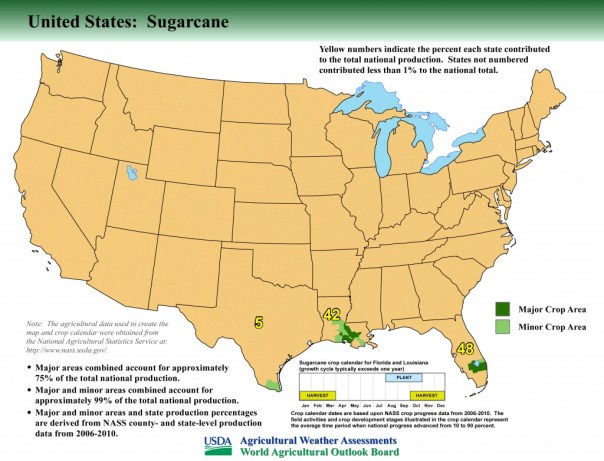


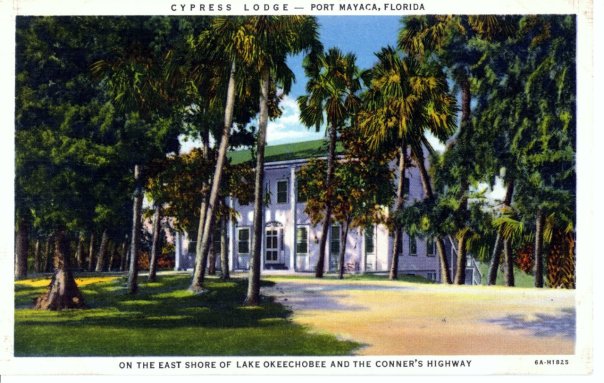


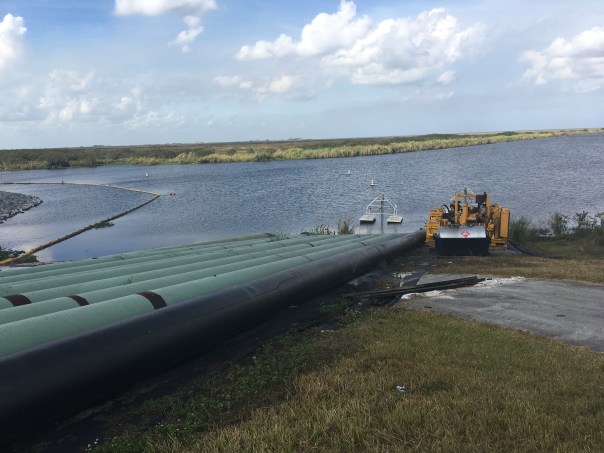


 Driving west about twenty miles outside of Stuart, we pass Indiantown. We see train tracks, agricultural fields, and wonderful open natural lands such as DuPuis Wildlife Area. All the while the C-44 canal is to our right. An eagle flies overhead. The blue and white clouded sky seems bigger here.


 Pulling onto the once famous toll road of Connors Highway and going south, we see the berm of Lake Okeechobee. We leave Martin and enter Palm Beach County. Large trucks fill the road. It is nerve-wracking but exciting. Some beautiful old homes stand amoungst thickets of royal palms and tropical vegetation. Roses and honey are for sale if one has the nerve to pull over.


 Today I will continue my series “Who Owns the Land South of Lake Okeechobee? Mapping out the Future of Water.” Hurricane Matthew caused a slight interruption, but now we shall continue. 🙂