Tag Archives: SLR/IRL

More Rain, but #NoLakeO, SLR/IRL

Thanksgiving was a whirlwind and a lot of fun as Ed’s family including niece and nephew visited. The two days before their arrival on November 22, 2022 was quite rainy -a light, humid, constant rain. After the “rain event” my rain gauge read just under 6 inches! Here along the coast in Sewall’s Point the old saying remains: “when it rains, it pours.”

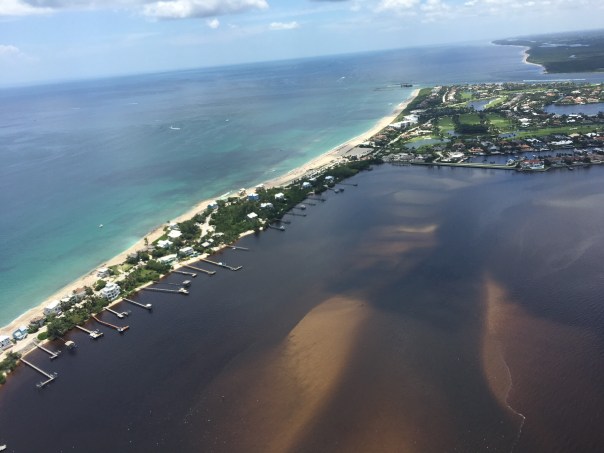
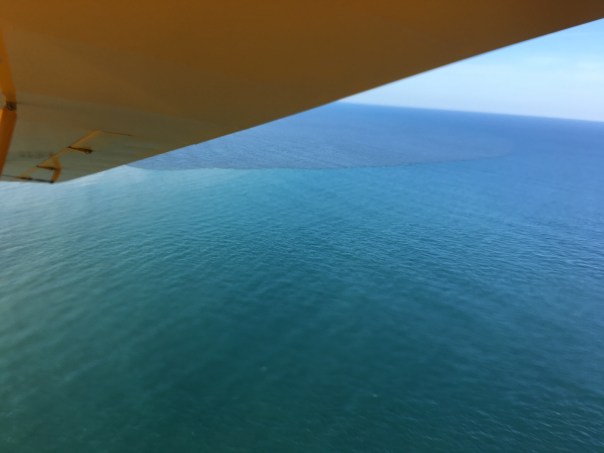
Today, I am sharing my husband Ed’s aerials of the St Lucie River/Indian River Lagoon. They were taken area above Sewall’s Point, the St Luice Inlet, and a few of the Roosevelt Bridge in Stuart -on November 26, 2022 around noon on an incoming tide. Like my previous post , after Hurricane Nicole, the contrast of milky, stirred up ocean water and the dark, fresh, polluted, runoff from area canals and surrounding lands and neighborhoods is extreme.

In my opinion, to witness such events without the discharges from Lake Okeechobee is educational, it makes clear how important not fertilizing and using chemicals on our yards is, and thankfully the tides flush the mouth of the river out over time. When the ACOE starts Lake O discharges, this can go on and on – for months and in worst case scenarios -for years. The river cannot clean out. There have been no major, longstanding discharges from Lake Okeechobee since 2018 and the Sailfish Flats’ seagrass community has been slowly recovering.

Today the lake stands at 16.50 feet. There is a periodic scientists call today of the ACOE when input will be taken regarding lake discharges and other water issues.

Thus Ed and I present these photographs for the record.

-My rain gauge after the rains a few days prior to Thanksgiving on November 24, 2020. almost 6 inches.

-SFWMD Lake O update

-Canal map

SFWMD basin map showing canals that lead to the SLR. The C-44 can dump water in the C-44 basin or water from Lake O or both.

11-29-22 6:17pm slide from ACOE PSC at 2pm


True Beauty, SLR/IRL

-L to R: The peninsula of Sewall’s Point lies between the SLR/IRL. The Sailfish Flats and Sandbar seagrass meadows lie between Sewall’s Point and Hutchinson Island. Witham Field, Stuart, can be seen west. The Atlantic Ocean is east. St Lucie Inlet State Park is located south on Jupiter Island. The St Lucie Inlet is cut between Hutchinson and Jupiter Islands. Today’s photos highlight the area’s returning seagrass meadows after their disappearance primarily because of years of damaging cyanobacteria laden Lake Okeechobee discharges, especially in 2013, 2016, & 2018. Photo Ed Lippisch, 8/26/22.When Ed came home from flying the RV on Friday, August 26, 2022, he said, “I think the aerials look good, you can really see the seagrasses.” I looked at him kind of funny. He never says anything like that. Looking on my phone, I could tell the photos were revealing, but it wasn’t until I viewed them full screen on my computer that I saw their true beauty. Ed’s photos reveal clear water, clear air, defined nearshore reefs, and lush seagrass/micro-algae meadows.

It is exciting to see and am I so glad Ed captured it! In the coming days and weeks tropical weather may be pushing our way. “Thank you Ed, for capturing the river before the height of hurricane season, before possibly more rains and more runoff.”

These just might be the most beautiful recent photos ever taken of the St Lucie River/Indian River Lagoon. Over the past couple of years, we’ve had some good ones of blue water alone, but blue waters cradling seagrass beds, the life of the sea itself, this is “true beauty.”

These improvements have only been possible due to recent  ACOE policy decisions – no major Lake O discharges for over three and one half years, and Mother Nature, who so far, has not brought any of her discontent our way.

At this time, it is in order to thank former City of Stuart Mayor, Merritt Matheson, who went to great lengths over the past four years to hold accountable and build relationships with the Army Corps of Engineers. Mayor Matheson led numerous boat tours and meetings inviting, colonels, commanders, and staff. His St Lucie River tours led by an elected,  passionate, educated, local helped the ACOE understand the fragility of our region and the intense ecological and health impacts caused by discharges from Lake Okeechobee. Mayor Matheson your efforts made a tremendous difference for the health of the St Lucie River. Thank you.

Canal system SLR/IRL, SFWMD


On A “Perfect” Day

My husband Ed, and friend, Dan Velinsky, went fishing yesterday (2-9-21) at “Sailfish Flats” between Sewall’s and Sailfish Point. It was indeed a spectacular day, and Ed returned home smiling even though they didn’t catch any fish. “It was beautiful.” He exclaimed. “But no seagrass, no fish, except hiding by the islands…” Then he turned with wide smile“We even saw seven dolphins and two turtles! I taped them!”

 The whole time Ed was speaking, I couldn’t help it…

I saw a number flashing in my head: 15.41, the level of Lake Okeechobee on February 9, 2021. This number is high from a St Lucie point of view for this time of year. In June will come rainy season….

As ACOE’s Col. Kelly reported last week, the lake is going dow, but: “Today, the lake stage is at 15.42 feet, which is still 2.5 feet higher than it was one year ago, and 2.7 feet higher than it was two years ago.”

FLASH! FLASH! 

I share Ed photos “on a perfect day,” to document-  knowing – we must keep an eye on Lake Okeechobee and the decisions of  Army Corp of Engineers .

Click here to see Lake Okeechobee Level in graph format  

Both videos of dolphins in bluish waters 


Documenting the Discharges, December 2020

Documenting the Discharges, December 2020

Eyeonlakeo

I posted most of these photos on Facebook, but today I will give explanations and document on my blog. From above, our St Lucie/Indian River Lagoon remains beautiful, but we must be sensitive to the losses beneath the waters. These aerials were taken during  a “slack tide” between 12 and 2pm on December 9, 2020 by my husband, Ed Lippisch. December 9th was the last of five days the ACOE stopped discharging from Lake Okeechobee; however S-80 was discharging “local runoff.” (Click on chart above.) Unfortunately, due to high lake level and lack of storage reservoirs, since these aerials were taken, the ACOE has begun ramping up Lake discharges once again. 

Below Lawrence Glenn of the South Florid Water Management gives a comprehensive ecological report covering low-salinities and loss of oyster spat in the St Lucie and other aspects, positive and negative, for the entire Everglades system.

Below is an explanation of aerials documenting discharges December 9, 2020. All photos by Ed Lippisch.

-S-80 at St Lucie Locks and Dam discharging local basin S-80 runoff on December 9, 2020

S-308 at Port Mayaca, Lake Okeechobee closed on December 9, 2020. No algae visible. 

-Plume of along Jupiter Island south of St Lucie Inlet

-Dispersing plume in Atlantic Ocean just past Peck’s Lake in Jupiter Narrows

-St Lucie Inlet -St Lucie Inlet State Park, Sailfish Point, Sewall’s Point, Stuart, Jensen 

-Looking north to Sailfish Flats between Sewall’s Point and Hutchinson Island. This area has greatly degraded since 2013 as far as loss of seagrasses and fishing opportunities 

-The area below, especially around Sailfish Point, was once considered “the most biodiverse estuary in North America” as documented, first, by Grant Gilmore

-This photo reveals seagrass loss across many areas of the Sailfish Flats 

-Another view between Sewall’s and Sailfish Point, a seeming desert…

-Close up, Sailfish Point 

-Sewall’s Point, east Indian River Lagoon 

-Sewall’s Point is a peninsula surrounded by the St Lucie River on west side, and Indian River Lagoon on east side 

Ed Lippisch, selfie. Thank you Ed! 

As you can tell, I have lots of people helping me. Whether it is Ed flying or my brother Todd who provides an incredible easy to read website called EyeonLakeO. You can click below to check it out. The more we know, the more we document, the more we can overturn the destruction of our beloved estuary…

Eyeonlakeo website by my brother, Todd Thurlow. 

Beautiful -But I See Some Algae at Port Mayaca…

Family friend Scott Kuhns is a great dentist, pilot, and photographer. For years, Scott has been one of our “eyes in the sky,” taking flight over the St Lucie River-Indian River Lagoon -and west out to Lake Okeechobee. 

Today, Sunday, May 3, 2020, before noon, Scott forwarded these striking photos. He wrote “I can see some algae at Port Mayaca.”

When I first reviewed the impressive photographs -coast to lake- I found it hard to believe, but indeed looking very closely, there is a wisp of algae close to S-308 at Port Mayaca in Lake Okeechobee.

Can you see it? When things are so beautiful, like right now, it’s easy to miss!

Thanks Scott for your continued service “River Warrior” extraordinaire! We will continue to keep an eye on the water as we move closer to hurricane season. 

ST LUCIE INLET, CROSSROADS OF INDIAN AND ST LUCIE RIVERS DIVIDED BY SEWALL’S POINT, ~ALL PHOTOS BY DR SCOTT KUHNS

JUPITER NARROWS & ATLANTIC OCEAN SOUTH OF ST LUCIE INLET

C-44 CANAL at ST LUCIE LOCKS AND DAM, S-80

S-308, CONNECTION OF C-44 CANNAL to LAKE OKEECHOBEE 

VERY TIP of S-308 with ALGAE WISPS SLIGHTLY VISIBLE, BUT DEFINITELY THERE

INSIDE STRUCTURE S-308, PORT MAYACA LAKE OKEECHOBEE ALONG C-44 CANAL. S-53 ON ANOTHER CANAL. ALSO FPL COOLING POND SURROUNDED ON WEST BY WHAT APPEARS TO BE SUGARCANE FIELDS

REMNANTS OF THE ORANGE GROVE THAT IS NOW THE C-44 RESERVOIR AND STA.

SLR basins. SFMWD. You can see FPL cooling pond just northeast of S-308.


Florida Senate – Water Senators, 2019

l


2019 Senate President Bill Galvano, https://www.flsenate.gov/Senators/s21, recently assigned senators to their committees.  The new Senate President is following Joe Negron. (http://en.wikipedia.org/wiki/Florida_Senate.)

Knowing who has been assigned what committees is important. Let’s learn about a couple of “water-senators ” ~those assigned to committees where water will come up. No pun intended.

First, let’s go to the Florida Senate website and click on the Committees Tab. Look around. What titles have something to do with water or the environment? Here you will see a list of committees. Very interesting! Only a few could apply.

(https://www.flsenate.gov/Committees/#com-list )

For sure, when it comes to  purposes of water, under Standing Committees, Appropriations Subcommittee on Agriculture, Environment, and General Government is key.


Who got this position? Wow! Senator Debbie Mayfield has been assigned to be the chair of the Appropriations Subcommittee on Agriculture, Environment, and General Government. She represents Indian River and  Brevard Counties and in earlier years served in the Florida House of Representatives so she knows about all the toxic “Lost Summers,” and the troublesome “brown tide” that affects her area.(https://www.floridatoday.com/story/news/local/environment/lagoon/2018/03/02/again-killer-brown-algae-responsible-2016-mass-fish-deaths-blooming/381630002/)
When you click on her name you will also see she serves on the Environment and Natural Resources Committee and the Appropriations Committee. Senator Mayfield is very well versed in water issues not only because she is our Indian River lagoon neighbor, but because as she was an ally of former Senate President Joe Negron in 2018.

Mayfield: https://www.flsenate.gov/Senators/S17

Now, take the time now to click on these links below and see if you happen to know any of the other senators serving on either the Appropriations Subcommittee on Agriculture, Environment, and General Government or the Natural Resources Committee or anything else relevant, perhaps Tourism where water really belongs. Take note of these senators. Do you know anyone who may know them? A friend across the state?

Environment and Natural Resources Committee and the Appropriations Committee: https://www.flsenate.gov/Committees/Show/AEG

Appropriations Subcommittee on Agriculture, Environment, and General Government : https://www.flsenate.gov/Committees/Show/EN

Now for one more water senator. He who holds the purse strings!  Appropriations Chair, Senator Rob Bradley, another Negron ally from last year. Senator Bradley represents Marion County, a region where there are many nutrient pollution/flow/algae Springs issues and concerns about development and over aquifer withdrawal.(https://www.ocala.com/news/20180114/study-finds-nitrates-not-only-problem-affecting-springs) Bradley is no stranger to water!

Click on his link and see what other committees he is on as well.

Senator Bradley: https://www.flsenate.gov/Senators/S5

Today I am going to stop here.

There are other important positions, but these two featured Senators that have a track record. These are two you can reach out to now, along with your legislative delegation.

Yes! Start building relationships NOW.

If you can’ reach the legislator him or herself, call, write or go to their office and build a relationship with their staff. Like any relationship this takes time, effort, finesse, and multiple visits. Ask for a meeting just to talk about what is important to you as a citizen, no matter your political affiliation. All Florida politicians represent all Floridians.

Here are some tips about Effective Communication and a visual from last year to refresh our memories about how an idea becomes a law.

Advocate for water now! Once legislative session begins, it’s too late!

https://www.flsenate.gov/About/EffectiveCommunication and also a visual about how an idea becomes a law.

Toxic algae under the Evans Crary Bridge, St Lucie River, Sewall’s Point 2016

History Helps Us “See,” Septic to Sewer Conversion, SLR/IRL

Aerial of Lighthouse Point Feb. 8, 1965, Ruhnke Collection, Thurlow Archives.

At my request, my mother has been sharing historic real estate photos. Regarding today’s aerials, it seems the perfect time to broach the controversial subject of “septic to sewer.”

When I first saw the photographs of Lighthouse Point, I said “What is that?” I thought the land had been created by fill, but then realized it was natural lands filled and dredged. This practice was very common before the 1970s and happened at various locations throughout Martin County, but was more prevalent in destinations like Ft Lauderdale and Cape Coral. Wherever this land use was completed, early photographs allow us to see how strange, how vulnerable,  how naked, the land looks. And we can see its connection, like a sponge, over the surrounding waters…

Let’s take a closer peek at this 1965 photo of Lighthouse Point in the St Lucie River. In 1965, developers had no concerns about nutrient pollution, and every property of course had its own septic tank.

Lighthouse Point/Seagate Harbor 1968, Ruhnke Collection, Thurlow Archives

Fortunately, in the 2000s, Martin County did help residents of Lighthouse Point and neighboring Seagate Harbor, convert from septic to sewer, along with other “hot-spot” communities, as documented in this outstanding presentation by former Martin County Ecosystems Manager, Deborah Drum.

Click to access DDRUM-Rivers-Coalition-June-2017.pdf

Red ballon shows Lighthouse Point/Seagate Harbor neighborhoods in Palm City

See yellow dots, slide from Deb Drum’s presentation of completed projects.

But there is more work to do.

As we know, Septic to Sewer is one of those subjects people passionately fight over as we try to understand why our waterways have become so impaired. This was the case in my own hometown of Sewall’s Point.

Famous for the first strong fertilizer ordinance on Florida’s east coast in 2010, a year of my mayorhood, The Commission flipped this environmental streak, and last year, when I was off the commission, following much back and forth and very poor communication, ~in spite of heroic efforts, but a totally exhausted, confused and furious public, decided not to work with Martin County for a partial sewer conversion. The backlash to this is far-reaching.

I agree that most of Sewall’s Point is not dredge and fill, but some is, and with out a doubt, old septic tanks in flood zones along the Indian River Lagoon are not a good idea.

In Sewall’s Point, and all Martin County residential areas we can “feel better about ourselves” as we know that  Agriculture is the primary nitrogen and phosphorus polluter into our waterways, (and they need to get to work!) by about 88% according to Dr Gary Goforth. (https://jacquithurlowlippisch.com/tag/phosphorus-loading-by-land-use-what-fdep-isnt-telling-us-gary-goforth/) Nonetheless, this does not mean we should act too self-righteous to change out ourselves.

As we all begrudgingly work to lessen nutrient pollution (nitrogen and phosphorus) into our waterways, it is helpful to look backwards as we plan for the future. Thanks mom for sharing your photos; history helps us “see.”

Links:

What is nutrient pollution? EPA https://www.epa.gov/nutrientpollution

Martin County Sewer Conversion: https://www.martin.fl.us/SeptictoSewer

City of Stuart Sewer Conversion: http://cityofstuart.us/index.php/en/sewer-expansion/sewer-expansion-maps

Scientific paper: Earth Sci 2017 estimation of nitrogen load from septic systems
to surface water bodies in St. Lucie River and Estuary Basin, Florida, Ming Ye1 • Huaiwei Sun2,1 • Katie Hallas3: http://people.sc.fsu.edu/~mye/pdf/paper62.pdf

Sandra Henderson Thurlow, local historian: http://www.sandrathurlow.com

Stuart, Florida: From Izaak Walton to River Warriors, SLR/IRL

By Ernest Lyons, 1957 Stuart Chamber of Commerce Fishing Guide, courtesy of historian Sandra Henderson Thurlow

I continue to share now historic advertisements of Florida. Today’s is from my hometown of Stuart, Florida. My mother, historian Sandra Henderson Thurlow, has a trove of these things, and they are interesting to view ~thinking about how much our area has changed.

This 1957 Chamber of Commerce Fishing Guide advertisement, written by Ernest Lyons is entitled: “In the Tradition of Isaac Walton.” So let’s start there: Who was Isaak Walton? !

I had to refresh my memory as well, so don’t feel bad if you did not remember. He is famous for writing  the Complete Angler in 1653,  a book “celebrating the joys of fishing” that inspired thousands of sportsmen, and remains a classic for both men and women today.

Mr Lyons, who was the editor of the Stuart News and an award-winning environmentalist of his era, begins his composition:

“Stuart, Florida means sports fishing in the tradition of Izaak Walton,” and then proceeds to talk about good living, home building, and retirement in a community where the “best things in life are free.”

Fun for me to see, in the collage below, my Aunt Mary Thurlow Hudson is photographed far right playing tennis, and my father, her brother, Tom Thurlow Jr., #7, is shown making a basket for Stuart High School baseball team. Awesome! Those were the days!

My Aunt Mary Thurlow Hudson is photographed far right playing tennis and my father Tom Thurlow making a basket for Stuart High. “Those were the days!’

But we know that nothing is really for free. Stuart, and Florida at large have paid a price for moving so many people here since 1957, and trying to “feed the world” from our rich agriculture fields.

Sixty-one years have passed since 1957. I am now over three times the age of my father and my Aunt Mary pictured here…

Our youth can still golf, play tennis, ride a stallion at a rodeo, play baseball, and football, but water-skiing and fishing? Maybe not.

Before recreating, we must first ask :”Is there cyanobacteria in the water?”

Or God forbid, before going to the beach:  “Is there red-tide?”

The local Chambers of Commerce have not written a fishing guide for years. But if they did the topic sentence would not be, Stuart, Florida means sport fishing in the tradition of Izaak Walton, but rather:

“Stuart,  Florida means fighting for your waters in the tradition of a River Warrior…”

My do things change.

https://en.wikipedia.org/wiki/Izaak_Walton

https://www.audible.com/pd/The-Compleat-Angler-Audiobook/B0038CCZ2I?source_code=GO1GB907OSH060513&gclid=CjwKCAjw3qDeBRBkEiwAsqeO7iOWzzDQ17u9sRDjb0rNzBSnaeeNAjgIBDEZPHBwe95rMgpxxoivfBoCQE8QAvD_BwE&gclsrc=aw.ds

Martin County Chamber of Commerce 2018:https://www.stuartmartinchamber.org

Buy it Like a Real Man! Florida Real Estate That Is… SLR/IRL

Historic real estate advertisement, ca. 1919 Pinecrest, FL, Museum of the Glades, https://www.museumoftheglades.org

I have been looking though my collection of maps and other Florida things, and I came across this remarkable real estate ad by W. J. Willingham. I would think it is from the early part of the 1900s when Barron Collier and James Jaudon, “Father of the Tamiami Trail,”  were developing South Florida. Apparently, Jaudon sold the land that became Pinecrest to Willingham.

What is of most interest to me is the tone of the ad, and how different is it compared to how we sell real estate today.  For instance, the first section reads: “Hesitation:” On the plains of Hesitation bleach the bones of countless millions; some men are just plain quitters, but the most pitiable sight in the whole world of failures, is the man who will not start. Opportunity will knock at your door this week and give you a chance to start. You can deny yourself one or two simple luxuries, drop a useless habit or two, and the start is made. You can own a Pinecrest lot. You can be a true-born American and take a shot at it and if you lose, you can take your loss like a real man. On the other hand, if Pinecrest makes a wonderful town, you can enjoy the pleasures invariably comes when a man uses his head and wins. My friend, it is up to you. Will you hesitate? Or will you start?  W.J. WILLINGHAM

Holy cow. This must have been the way one sold land in the Everglades in the old days, before political correctness, equal rights, and other things. Interesting to ponder, don’t you think? Maybe that’s why they mowed everything down.

Looking at the rest, Mr Willingham’s rant continues:

Here’s another duzzie: “Nerve.” That word nerve spells success. I was looking through some of old papers the other day and I ran across and old advertisement I put in a Florida newspaper a few years ago. At the at time I tried my level best to persuade someone to buy a certain property for $11,000. No one seemed to have the nerve. Finally I persuaded my brother to go in with me and buy it. All that was required a small  cash payment and just a little nerve. Now to make a long story short, we recently sold a part of that property for $137,000 and we have some o the property left. In a few short years you will wonder why you did not accumulate just a little nerve when Pinecrest was just starting. Pincerest has a mighty bright future. I am going to give you an opportunity to pick up a few Pinecrest lots at auction. W.J. WILLINGHAM

This is a good one, today we would write “Do you know of anything that has destroyed America’s Everglades more than Tamiami Trail?

W.J. Willlingham’s final words are a harsh motivator as well: “J.J. Hill Said:” James J. Hill, one of the greatest builders this county has produced, designated thrift as the one qualification without which no man could succeed. He said: If you want to know whether you are destined to be a success or a failure in life, you can easily find out. The test is simple, and infallible. Are you able to save money? In not drop out. You will lose. You may think not. But you will lose as sure as you live. The seed of success not in you.” W.J. WILLINGHAM

The seed of success not in you? Hmmmm. I agree with being thrifty, but how the “seeds of success change.” To be successful, the new developers of South Florida will have to adapt to our new world of rising seas, stronger storms, climate change, and the subtleties of selling to modern society. This could be a challenge; we may have to get some advice from the gators who have around a long, long time.

Alligator, public photo.

Links:

Pinecrest went on to be a very successful community. I wonder what the ads in the future will look like as it goes underwater…

Pinecrest: https://en.wikipedia.org/wiki/Pinecrest,_Florida

Pinecrest History: https://www.pinecrest-fl.gov/our-village/history

Pinecrest website: https://www.pinecrest-fl.gov/our-village

James Jaudon, Father of the Tamiami Trail: http://everglades.fiu.edu/reclaim/bios/jaudon.htm

Roads in the Everglades, Collier, Jaudon, Willlingham: https://books.google.com/books?id=oOvcDAAAQBAJ&pg=PA147&lpg=PA147&dq=wj+willingham+fl+pinecrest&source=bl&ots=TzcvzlZ04_&sig=1uugd2-UG8ag8B1QEy0IyD6oYzM&hl=en&sa=X&ved=2ahUKEwitwbfgwIjeAhWqTd8KHXnuCVcQ6AEwA3oECAcQAQ#v=onepage&q=wj%20willingham%20fl%20pinecrest&f=false

An Owl In My Kitchen, SLR/IRL

A rather remarkable thing happened. There was an owl in my kitchen. Yes, an owl, a real owl.

I woke up, went outside to get the newspaper, and then I fed my fish. When I looked from the dining room into the kitchen, I saw the silhouette of a little owl patiently seated on the back of a chair in our sunroom open to the kitchen. Of course, I did a double-take! And then I thought to myself: “Is it that owl? Is Ed playing a trick on me….?”

Why a trick?

Just a few days ago, I had bought a fake, feathered owl at the Lamp Shop. I attached it to a fake palm tree in my sunroom. You know, the kind of thing with wire for feet, so you can twist it around the branches?

So, in the darkness of early morning, I wondered if Ed had put that thing on the back of the chair just to freak me out.

He had not. I looked again and again, and for certain, a living screech-owl was sitting in my sunroom, in my kitchen. Unbelievable!

I quietly snuck over and closed the surrounding pocket doors to that area. And then quickly went to find my husband, Ed.

From afar, I whispered sounding panicked: “Eddie! Eddie!”

Ed got up out of his chair, leaving the computer with the dogs gleefully trailing behind him.

“Put the dogs in the crates, now!” I said.

Ed looked at me,  confused.

“In their crates! ” Again, I stated.

“O.K. he said.” Looking bewildered.

“Turning around, Ed took Luna, an 80 pound, black, German Shepard, and Bo, an old and now crippled Corgi, to the other side of the house…

Ed returned.

“What’s up with you?” He inquired, irritated. Not even a  “good morning” ?”

“Ed, there’s an owl in our kitchen.”

“What?” He inquired.

“An owl!”

“Do you mean that owl you bought at the store?” Ed snickered.

“No.  A real owl. I think it was attracted to the other owl.”

“What are you talking about?….” He said…

I slowly slid open one of the pocket doors. Sure enough, the beautiful little owl sat there with its head turned towards the fake owl.

Ed let out an explicative and shut the door.

“The owl must have seen the other owl from outside.” I whispered.

” How did it get in?” Ed quietly asked.

“I don’t know, from you? When you let the dogs out? I don’t know, but we have an owl in our kitchen!”

Ed and I looked incredulously at one another, then smiled.

Gently opening the door, we slowly snuck over, as quiet as could be. Ed started removing the screen from behind the joulosy windows. The owl lifted off the chair and flew about the kitchen landing by the fake owl, but the plastic branch sunk under its weight so it flew off and around the kitchen in high circles without a whisper. Ed and I were transfixed, fascinated. When it landed, we took pictures.

Ed  finally got the screen off and cranked the window. It popped open, braking the silence of the morning. Wind blew inside the room.

The owl looked back to its friend, and then, without a sound, flew through the window, and was gone.

same owl with ears up and lit up when it landed a top the refrigerator arrangement

Death by Fertilizer, SLR/IRL

Definition of fertilizer: one that fertilizes specifically, a substance (such as manure or a chemical mixture) used to make soil more fertile so things grow. Usually containing phosphorus and nitrogen.

..

SFWMD 2005

“Death by Fertilizer” or “Our Sick Friends” was originally a booklet created by the River Kidz in 2012 to bring awareness to the ailing health of the bottlenose dolphins in the Indian River Lagoon; I think the message remains a relevant teaching tool today.

Why?

South Florida’s water issues~

~The Lake Okeechobee Watershed: 88% agricultural in nature running into a now sick, eutrophic, algae-ridden, Cyanobacteria filled Lake;  a 700,000 acre Everglades Agricultural Area south of the Lake allowed to back bump when flooding occurs; all this water, in turn, discharged into the ailing St Lucie River and the Caloosahatchee Estuary by the ACOE while the SFWMD and FDEP, and their bosses, the  Executive and Legislative branches of government look on. This putrid, polluted water runs out into the ocean. We think that’s the end of the water destruction, but it’s not, as red tide and seaweed are fertilized, growing into monsters we have never seen before.

Phosphorus Loading by Land Use, Gary Goforth: https://jacquithurlowlippisch.com/tag/phosphorus-loading-by-land-use-what-fdep-isnt-telling-us-gary-goforth/

Septic and sewer pollution is a type of fertilizer too. Some people around the world fertilize their crops with their own human waste; dog poop is also a “fertilizer,” and all this fertilizer leeches or runs off into our estuaries and ends up blending with the polluted Lake O water coming down the pike to the ocean. Every rain event runs right down the storm drains of our neighborhoods and shopping malls with all the “crap” it carries. We designed it that way, years ago, and have not changed this model. The fertilizer put put on our lawns, of course, runs off too.

Yes, it is death by fertilizer that we are experiencing this 2018. Eutrophication, Blooms of algae and cyanobacteria; red tide; too much seaweed suffocating the little sea turtles when they try to come up for air…

The fancy, confusing words of “nutrient pollution” must be replaced with “fertilizer,” something we can all understand. From the time we are children, we learn that “nutrients” are good, they make us strong. Fertilizer can be good, but we instinctively know it can also burn. We know not to eat it; it is not nutritious.  Nutrient Pollution is an oxymoron created by industries and government so we have a hard time understanding what is going on.

In conclusion, fertilizer (phosphorus and nitrogen) from corporate agriculture; poop from animals and people, (mostly nitrogen) and it is feeding, “fertilizing” Lake Okeechobee’s cyanobacteria blue-green blooms that in turn are poured into the St Lucie and Calooshatchee, which in turn this year are feeding, “fertilizing,” tremendous sargassum seaweed blooms, and red tide in the Gulf of Mexico and now in the Atlantic. These blooms are giant multi-celled intelligent, organisms, kind of like a bee-hive. They are hungry and determined and we are feeding them.  It is  a vicious cycle that only we can stop by forcing our government to take charge and coordinate municipal, state and federal programs of education and coordinated implementation. We know what to do.

Developing an effective strategy for reducing the impacts of nutrients, easier understood as “fertilizer over enrichment,” requires all of us to change how we live and the powerful agriculture industry to lead.

Otherwise, it is, and will remain, death by fertilizer.

National Research Council’s book, written in 2000, Understanding and Reducing the Effects of Nutrient Pollution is a step by step guide to this problem: https://www.nap.edu/catalog/9812/clean-coastal-waters-understanding-and-reducing-the-effects-of-nutrient

.

SFWMD 2005

Links:

EPA, Nutrient Pollution: https://www.epa.gov/nutrientpollution/problem

2018 Palm Beach Post, Red Tide:

“Red tide was reported on the east coast in 2007 when it spread to the Treasure Coast south from Jacksonville where LaPointe said discharge from the St. John’s River may have aided its growth. LaPointe said this summer’s plethora of sargassum on southeast Florida beaches could feed red tide with a boost of nutrients leeching into the ocean when the seaweed dies.
Red tide is different from the freshwater blue-green algae, or cyanobacteria, that has spread in Lake Okeechobee, the St. Lucie Estuary and the Caloosahatchee River this summer. But red tide and the cyanobacteria both thrive in nutrient-heavy conditions.
“You have discharges coming out the Jupiter Inlet,” LaPointe said. “Red tide likes the kind of slightly reduced salinity in areas where there’s a river plume.”
https://www.palmbeachpost.com/news/crime–law/new-stretch-beach-jupiter-closed-police-after-odor-sickens-beachgoers/cVD3CBHqrYDrLCFFDV4T7L/

2018 Sun Sentinel, Lake O toxic algae blooms:

“Lake O and Estuaries’ Blooms: Not that this comes as much of a surprise. (Though state leaders feign shock with each new algae outbreak, as if they’ve just discovered gambling in Casablanca.) Environmental scientists have been warning Florida that the watershed lake was an environmental catastrophe since 1969.” Fred Grimm, reporting.
http://www.sun-sentinel.com/opinion/fl-op-column-fred-grimm-lake-okeechobee-algae-returns-20180705-story.html

Close up toxic algae, JTL

2018 Palm Beach Post, Overabundance of Seaweed:

“Palm Beach Post:LaPointe is in the second year of a three-year NASA grant to study how nutrients are changing in the sargassum. What he’s found so far is nitrogen levels have increased, likely from heavy doses of fertilizer and sewage runoff.
“We have altered the nitrogen cycle on our planet and it started with the invention of fertilizer,” LaPointe said. “We think this is what is behind the increased abundance of sargassum.” https://www.mypalmbeachpost.com/weather/why-ugly-thick-brownish-seaweed-cursing-south-florida-beaches/yILMtAMMlxxOXqqYz5H1ZO/

Red tide 2018 #toxic18 site

Plethora of sargassum weed or seaweed at Jensen Beach, 2018 photo Ed Lippisch

Phosphorus Loading by Land Use, What FDEP is not Telling Us, 2018, Gary Goforth: https://jacquithurlowlippisch.com/tag/phosphorus-loading-by-land-use-what-fdep-isnt-telling-us-gary-goforth/

The Late, Great, Johnny and Mariana Jones; Learning From Their Legacy, SLR/IRL

I first met Michelle Jones Connor during 2013’s “Lost Summer,” the year coffee colored, sediment-filled water flowed through the gates of the Army Corp of Engineers for most the year, from Lake Okeechobee into our St Lucie River/Indian River Lagoon. At that time, with energy surging as thousands of peoples’ anger ramped-up the River Movement, at a rally Michelle told me about her environmental-legend grandfather and grandmother, Johnny and Mariana Jones.

Ironically, not too long after this, my mother and father discovered the above plaque while on a field trip to the Hungryland, an area also named after the couple.

Who were these incredible people?

The Florida Wildlife Commission’s dedication to Hungryland explains:

“The Hungryland Wildlife Environmental Area honors the conservation legacy of Johnny and Marianna Jones, passionate advocates for the protection of fish and wildlife resources throughout Florida. During their 61-year marriage, the couple lobbied for environmental issues, were leaders of the Florida Wildlife Federation and were instrumental in the establishment of over 3 million acres of public lands, including the John C. and Mariana Jones/Hungryland Wildlife Environmental Area.”

The list of their achievements is incredible! Almost impossible. Could we ever do something like that today? Of course we could; we just have to learn the tricks of the trade before they are forgotten.

Michelle’s grandparents have recently passed as have so many other of the “greats.” We must fill their shoes. We have no choice but to do so. And learning from the past can be a great help along our journey.

Thankfully, Michelle has given us some of the treasures of her late grandparents.

Today I share with you, with the permission of Michelle, three things from the Joneses and their library. First, a fascinating and insightful 2001 University of Florida interview where Mr Jones answers the question: “What are the two or three most important contributing factors that have led to the present problems in the Everglades?”; Second, “The Marshall Plan, Repairing the Florida Everglades;” and third Johnny Jones’  “The Rain Machine,” my favorite, about how human greed, development, and canalization, and drainage  of Lake Okeechobee and surrounding areas altered Florida’s water cycle ~and thus Florida’s weather itself ~by removing so much water from the land.

Upon reading, you will notice names, such as Marjorie Stoneman Douglas, Arthur R. Marshall, and Nathaniel Reed ~just to name a few. In spite of the difficulties, pressures,  and of course the hottest potato, politics, it was relationships and perseverance  that allowed the Joneses to achieve so much. We must do the same.

Thank you  Michelle  for sharing these rare and valuable documents. We shall honor the legacy of your grandparents and be inspired..

UF/Interview of Johnny Jones by Brian Gridley, 2001:

Click to access EVG_009_Johnny_Jones_5-23-2001Final.pdf

Marshall Plan PDF

The Rain Machine PDF

Michelle Jones Connor 2013, Lost Summer, Michelle is the granddaughter of the late, great Johnny and Mariana Jones.

Link to the Facebook Page Michelle’s Aunt Linda created, shared by Michelle: https://www.facebook.com/FloridaConservation/

Why the name “Hungryland:”…in the mid-1800s, Seminoles seeking to escape the U.S. Army hid out in these wetlands. The Army destroyed and cut off their food supplies, leading local ranchers to refer to the region as “Hungryland.” The slough that still runs through the area was called the Hungryland Slough and was primarily used for grazing cattle.”
FWC: http://myfwc.com/viewing/recreation/wmas/lead/jones-hungryland/history/

Hungryland Slough Guide, FWC: http://discover.pbcgov.org/erm/Publications/HungrylandSloughTrailGuide.pdf

Sofia Memorials, and photo of Johnny Jones above: https://sofia.usgs.gov/memorials/Johnny-Mariana-Jones/

Obituary Johnny Jones: https://www.palmbeachpost.com/news/johnny-jones-remembered-stubborn-advocate-for-the-environment/8va3cqDSp3waubFTm3vBCJ/

Obituary Mariana Jones: https://www.dignitymemorial.com/obituaries/lake-worth-fl/mariana-jones-6456420

UF Interview Johnny Jones/Smather’s Library format: http://ufdc.ufl.edu/UF00005378/00001/1j

Hungryland Field Trip, Sandy and Tom Thurlow, 2014.

To Close the Beach, or Not to Close the Beach, This is not the Question, SLR/IRL

“Yes. No. No. Yes. Oh wait, sure OK…Sorry, No!”

Such has been the direction from Martin County Government of whether the public is allowed to swim at area beaches.

Let’s review recent days….

8-21-18: Bathtub Beach reported as closed

8-24-18 Bathtub Beach reported as not closed

8-25-18 Bathtub Beach, Stuart Beach, and Jensen Beach reported as closed

These changes are very difficult to keep up with!

Although the 2018 pulse release schedule from the ACOE is certainly a good thing, and a positive effort, one has to wonder if that is part of the reason for the recent back and forth scenario reporting. In 2016 with no pulse releases the algae was everywhere and plastered the beaches with no breaks.

screenshot 2.png

In any case, it has been crazy around here, and unfortunately, the only safe way to deal with things, is to take the “may” out of the permanent signs and not to swim in the water anywhere.

When I visited lifeguards at Bathtub Beach on August 24, the word was if one got on a surfboard and paddled out 50 yards, cyanobacteria was floating in clumps in the sea water watered down by fresh water discharges from Lake Okeechobee since June 1st.

~On and off that is…

To try to get a handle on things, Ed and I took up the SuperCub for the first time on Saturday,  the day all beaches were closed, and boy was that a good thing they were closed because blue-green algae was flowing down the St Lucie River in long arched lines. Right in the middle of the river!  And this was a day the ACOE had stopped discharging from the Lake…As Ed and I were flying around up there in heavy winds,  I was trying to figure out the timing of the algae’s 35 or so mile journey from Lake O and how the pulse releases would affect it.

When Ed and I photographed, the algae was just west of the beautiful peninsula of Sewall’s Point and out in the main St Lucie River.

God what have we done?  My home town?

To close the beach or not to close the beach, that is not the question. The question is how did the state of Florida let the most bio-diverse estuary in North America go straight to hell.

The wild thing about flying in the SuperCub is that I can communicate via text and Facebook. As Ed and I were taking photos from the sky of what was heading to Martin County beaches, reports were coming in of the algae blowing up from the ground from my friend Mary Radabaugh at Central Marine, located in the same area Ed and I were flying. Go to Toxic#18 Facebook for more reports.

Martin County Beach Hotline:http://martin.floridahealth.gov/programs-and-services/environmental-health/beach-and-river-sampling/results/index.html

John Moran’s “Florida’s Summer of Slime: Stuart and Lake Okeechobee”

It’s an honor to present:

“Florida’s Summer of Slime: Stuart and Lake Okeechobee,” photo essay by John Moran, August 2018

I reported last month on the plight of the Caloosahatchee River and its befouled waters flowing from Lake Okeechobee; delivering slime to waterfront neighborhoods in Fort Myers and Cape Coral along the way to the Gulf Islands of Southwest Florida.

Next up on our Summer of Slime photo tour is a visit to Stuart and Lake O…Stuart and environs is a glistening jewel born of water. It may well top the list of Florida cities in shoreline per capita. There’s simply water everywhere. Two forks of the St. Lucie River, the Indian River Lagoon, canals and peninsulas and islands, and the Atlantic Ocean beyond. Stuart is pictured above; below is neighboring Hutchinson Island.

But it wasn’t Stuart’s reputation for abundant clean water that drew me south from Gainesville with my cameras. In effect, I’ve become a traveling crime scene photographer—and slime is the crime. A devastating outbreak of toxic algae has once again hit the St. Lucie River and the Treasure Coast, fueled by the polluted waters of Lake Okeechobee and the Kissimmee River basin to the north. Damaging headlines trumpet the story to the nation and the world and Governor Scott has declared a state of emergency. It’s déjà vu all over again.

My hosts in Stuart were water blogger Jacqui Thurlow-Lippisch and her husband, Ed Lippisch.

Ed took me up for a photo flight in his Piper Cub so I could get the big picture.

Seen from a small plane at 500 feet, Florida is a beautiful place.

Here’s Lake Okeechobee and the western terminus of the St. Lucie C-44 Canal. Administered by the U.S. Army Corps of Engineers, the Port Mayaca Lock and Dam has the capacity to discharge 14,800 cubic feet of water per second downstream to Stuart and the St. Lucie River Estuary, 26 miles away.

Sugar industry representatives say the water coming out of Lake Okeechobee is not the problem and that the algae outbreak in Stuart is primarily caused by Stuart’s own septic tanks and urban stormwater. This claim is contradicted by the extensive algae mats seen along the C-44 Canal between the Port Mayaca and St. Lucie Locks, well upstream from Stuart.

Lake Okeechobee historically drained south to Florida Bay, not east and west to the Atlantic and Gulf. The C-44 canal was built in 1916 to divert floodwaters to the coast.

A view of the St. Lucie Lock and Dam, several miles southwest of Stuart. On the day of my photo flight in late July, the dam gates were closed, visibly holding back algae from flowing downstream. Look closely and you can see what some people call The Seven Gates of Hell.

The St. Lucie Lock and Dam are an integral part of South Florida’s complex web of water management structures, born of an age when the Everglades was reviled as a watery wasteland and America was driven to drain it.

Below the St. Lucie Lock and Dam, in Palm City and Stuart, you can still find waterfront homes untouched by the algae bloom. But that’s no consolation for the thousands of Martin County residents whose lives are in upheaval once again this summer. The familiar pattern of algae outbreaks is fueled by fertilizer, manure and urban sources of nutrient pollution, including septic tanks.

All of this is compounded by denial and neglect by elected officials and agencies to whom we entrust the important work of environmental protection and public health.

Jacqui Thurlow-Lippisch took me on a driving tour of the C-44 Canal from Stuart to enormous Lake O, which is more like a stormwater treatment pond than a biologically healthy lake. “There are toxic algae blooms across the globe, but only one place where the government dumps it on you: Florida,” she says.

It’s not just the algae from Lake Okeechobee causing headaches along Florida’s east coast; the sheer volume of freshwater discharges is an environmental pollutant that overwhelms the estuary.

The Lake O gunk visible in the satellite view, above, is shown in the detail photo below.

Fishermen are still drawn to Port Mayaca. On the day we visited, I counted nine.

Dinner in hand (speckled perch), Felix Gui, Jr. has been fishing Lake O for 30 years. “The algae doesn’t affect the fish,” he says. “They eat the same, algae or no algae, and I haven’t gotten sick.” Experts have warned against eating fish exposed to the algae.

A Martin County Health Department sign at Port Mayaca warns against contact with the water but I saw no messaging about whether fish caught in these waters is safe to eat.

Enroute home to Stuart, Jacqui and I stopped at deserted Timer Powers Park on the St. Lucie Canal in Indiantown.

At the St. Lucie Lock, a surreal scene of impaired water, above, and a vortex of slime, below, waiting to be flushed downstream.

A pair of jet-skiers signaled for the lock to be opened, and another pulse of algae-laden water is released towards Stuart and the coast.

Wouldn’t want to anyway, thanks.

Further downstream, the algae spreads…

Nearing the coast, Rio Nature Park and the neighboring Central Marine in Stuart are slimed again. This was the epicenter of the infamous Treasure Coast algae outbreak of 2016.

Reporter Tyler Treadway of TCPalm gathered a sample of the polluted water from a canal behind the offices of Florida Sportsman magazine in Stuart.

Staff complaints of headaches, nausea and dizziness prompted Florida Sportsman publisher Blair Wickstrom to temporarily close the office in late July. “It smells like death,” he said.

The Shepard Park boat ramp parking lot in Stuart was nearly empty on the day we visited.

A man on a mission, Mike Knepper, above and below, posts videos on his Youtube channel documenting the degradation of natural Florida.

“It’s totally unacceptable to me what we’re doing to this planet because we’re very rapidly destroying it,” Knepper says. “My children and grandchildren will be paying the price for all the bad decisions we’re making today. I want to be able to look them in the face and say, ‘I tried to make a difference.’”

Dead-end canals along the St. Lucie River with their limited water exchange have been hardest hit by the toxic blue-green algae, which scientists refer to as cyanobacteria.

A growing body of medical research links exposure to cyanobacteria with neurodegenerative diseases including Parkinson’s, ALS and Alzheimer’s. Google it.

Meanwhile, we’re getting conflicting messages from officialdom. Martin County has erected signs warning against contact with the water but the Florida Dept. of Health website, under the heading How to Keep Your Family Safe While Enjoying Florida’s Water Ways, has this to say: “Cyanobacteria/ blue-green algae…are naturally occurring in Florida’s environment and are also found all over the world. They are part of a healthy ecosystem and help support a wide variety of aquatic life.” (http://www.floridahealth.gov/environmental-health/aquatic-toxins/cyanobacteria.html) In other words, Lighten up, Florida. This is just nature being natural.

An open question remains: What will become of the value of the Florida brand when the world fully sees what we have done to our waters?

Even in disaster, strange beauty emerges.

Greg Fedele has lived in his water-front home since 1991. He grieves for his loss. “I have three kids who can’t enjoy the waterways of Martin County like I did growing up.”

The sign at Ocean Blue Yacht Sales in Stuart echoes a wide swath of community sentiment. Asked to describe in a word how the algae outbreak has impacted his business, president Bryan Boyd replied, “Horrible. The last three years, our bay boat sales have been a third of what they used to be.”

A roadside sign seen in Stuart in late July. If you’re wondering what you can do about the ongoing crisis of Florida waters, we are called to consider our own water footprint, learn about the issues and get involved. And never forget that elections have consequences. Vote for Clean Water. (https://www.bullsugar.org/#)

What we have here in Florida is not just a crisis of water, we have a crisis of democracy and civic engagement.

From the beleaguered springs of North Florida to the sickened rivers and coasts of South Florida, we must understand that no savior is waiting on the horizon who will fix this thing for us.

It took a group effort to create this mess and we need all hands on deck if are to reclaim our waters. Florida needs environmental patriots willing to face down politicians funded by wealthy interests who think nothing of sacrificing our public waters on the altar of their private profits.

We don’t have the luxury of time to get this right. We are losing our waters now. This is our moment. It’s time to set aside our differences and focus on what is at stake, for this is nothing less than a battle for the soul of Florida.

The pictures don’t lie. We the people of Florida bear witness today to nothing less than a crime against nature, and a crime against the children who shall inherit our natural legacy.

A long time ago, Florida political leaders—Republicans and Democrats in common cause—understood there can be no healthy economy without a healthy environment. They wisely enacted laws and regulatory safeguards accordingly.

But that was then and this is now. It’s time to end the popular fiction in Florida that we can plunder and pollute our way to prosperity.

Gov. Reubin Askew said it best when he declared in 1971, “Ecological destruction is nothing less than economic suicide.”

In this, our Summer of Slime, can I get an amen?

by John Moran
August 2018

web: http://johnmoranphoto.com
email: JohnMoranPhoto@gmail.com
cell: 352.514.7670

Feel free to forward or post this photo essay as you wish; attribution is appreciated. Please share this with elected officials and ask them: what’s their plan to clean up our waters?

NCCOS/NOAA Satellite Imagery, Making the Connection, Todd Thurlow

http://www.thurlowpa.com/LakeOImagery/NCCOS%20HAB%20Images/index.html

If you’re like me, you might wonder about the various satellite images in the news and on social media showing the cyanobacteria, also known as blue-green algae, in Lake Okeechobee. What’s the connection between the colorized and the not? How do the scientists determine the colorized image? Where do they come from?

In this post, I share a link to my brother, Todd Thurlow’s latest creation, “NCCOS HAB Images.” This exciting site juxtaposes an experimental product of the National Centers for Coastal Science, NCCOS, being used to track Harmful Algae Blooms, HABs, in Lake Okeechobee, to NOAA True Color, or enhanced traditional satellite images.
The NCCOS images are referenced by The South Florida Water Management District, however, experimental. Experimental or not they are cool, tell us a lot, and they are interesting!

Before relying on a CICyano (Chlorophyll Cyanobacteria Index) image, scientists must first look at the “true color” version to determine if clouds or sunlight reflections have corrupted the data. Todd has made it easy for us to compare the NCCOS “Chlorophyll Cyanobacteria Index” pictures to the corresponding “True Color” picture. He processed hundreds of images, putting them side by side. Generally, if there are clouds on the right image, then the left image may not be so reliable. But if there are no clouds on the right, then the left image is a good indicator of algae.

This site is an awesome visual tool we can now reference as we continue to learn about HABs in Lake Okeechobee. Technology is a powerful path for connecting to a “better water future.”

SEE LINK BELOW FOR SITE: http://www.thurlowpa.com/LakeOImagery/NCCOS%20HAB%20Images/index.html


http://www.thurlowpa.com/LakeOImagery/NCCOS%20HAB%20Images/index.html

LINKS:

National Centers for Coastal Science: http://coastalscience.noaa.gov

NOAA, Harmful Algae Blooms: https://oceanservice.noaa.gov/hazards/hab/

Lake Okeechobee Satellite Images 1982-2018, Todd Thurlow, SLR/IRL


In my last post, I shared my brother Todd Thurlow’s “Lake Okeechobee Satellite Images 1972-2013.” Today, I am sharing his Lake Okeechobee Satellite Images 1982-2018.

Hmmm?

In 1972, I was 8 years old…

In 1982, I was 18 years old…

A lot changes in ten years, and an extra-lot changes in the 100 years we have not taken good care of our state’s largest lake; this is now affecting millions of people and the remaining wildlife we have left.

Todd told me he did not “create by hand,” as I alluded to in my last post, but rather he used a USGS website tool to do it, and then converted, and loaded to YouTube, embed, etc.

In the last video the emphasis was on an a visible algae bloom in 1979, in this “video” the dates of algae blooms are not marked, but you can see clearly blooms towards the end as we reach 2018.

Unless something drastic occurs structurally, socially, and politically, I am sorry to say that we are doomed to have more and more algae blooms in the future.

#VoteWater #MakeAllPoliticiansTalkWaterAlltheTime

SEE LINK BELOW FOR VIDEO:

http://www.thurlowpa.com/LakeOImagery/Landsat4-8_1982-2018.html

Sentinel-2 L1C, True color on 2018-07-15.jpg 1,673×1,674 pixels, http://www.thurlowpa.com/LakeOImagery/

Also see Todd website for updated satellite images he makes easy to access for all to see:

http://www.thurlowpa.com/LakeOImagery/

Previous blog 1972-2013: https://jacquithurlowlippisch.com/2018/07/17/lake-okeechobee-satellite-images-1971-2013-todd-thurlow-slr-irl/

~“The consequences of ignoring ecological planning and environmental protection could be economically devastating in a way not commonly foreseen.” Environments of South Florida Present and Past, by Patrick J. Gleason 1974.

Brian Mast, Even More than a Congressman of His Word, SLR/IRL

It takes a lot for me to trust a politician, probably because at times, I’ve been one myself…

In 2016, when I was running for District 1, Martin County Commissioner, I met Brian Mast. We were both standing on the side of Martin Luther King Boulevard,  with our teams, holding signs in near 100 degree heat and off the chart humidity. There is always time to wipe the sweat off your brow and talk, when no cars are driving by…

Of course, Brian is a striking person, no matter the case, but when he told me the St Lucie River’s health would one of his priorities, although pleased, ~because I had heard that many times only to lead to disappointment, I was doubtful. Only Senator Joe Negron had ever won my full loyalty for his commitment to the river.

Well, by tremendous fate, Joe Negron’s legacy is being pushed, most outstandingly, now by Congressman Brain Mast. Brain’s consistent record for the river, since being elected in 2016, cannot be matched congressionally by anyone else in office at this time.

His two recent letters to the Honorable R.O. James, Assistant Secretary of the Army on June 7th, and yesterday’s letter, dated June 14th, 2018, to LTG Todd Seminole, Commander General of the US ACOE, are unparalleled in direct, passionate, and respectful communication regarding the damaging algae releases from Lake Okeechobee to the northern estuaries, These are game-changer letters, that will be documented, and referenced in the archives of Washington DC building our case for years to come.

I commend Congressman Mast; I thank him for not only keeping his word, but exceeding  expectations. He is more than a soldier of his word, he is am American, and a St Lucie River hero. And he must be reelected.

Please read both letters below.

JTL

Brain Mast’s website: https://mast.house.gov

Meeting with C. Mast with EF in April 2018

Mast’s War Board for the SLR

Toxic Algae 101, Watching it Turn Toxic, SLR/IRL

St Lucie River looking across from Central Marine to Martin Health.

Mary Radabaugh called me this morning.

“Jacqui, get dressed and come on over here to Central Marine! It’s happening again, and this time there are logs, algae logs. I have never seen this before.”

since May 23rd, Mary and I had been exchanging photos of the water in the St Lucie River at the marina she and her husband have managed for many years. The marina that brought national toxic algae coverage in 2016. The marina that the SFWMD and DEP did core samples of river bottom in 2005, but have been quiet since. The marina that is the ground zero of zeros…

So I got dressed and headed over.

The waters have slowly been changing, worsening since the C-44 basin waters opened into the river  about March 15th. And Mary has documented this change on her Facebook page. After June 1st, when the ACOE opened S308 to discharges of Lake Okeechobee, things have sped-up and are starting to crescendo.

Only three days ago the waters of the St Lucie River were primarily a dark cloudy coffee brown sometimes with little specs. Then as winds and tides push the specks and foam in the river into the pocket of the marina, the now green specks of particulate start to organize. It is incredible to see that just from yesterday, to today, the algae has bloomed in bright fluorescent green slicks. In 2016, this happened all over the river, primarily in marinas, coves, along shorelines, against dock pilings and any other place the forever thickening algae would get “hung up.”

It is happening now too, but not as extreme. Yet.

This all happens because over the past 100 years the St Lucie River’s basin has been expanded tremendously, erroneously, taking on developed-land’s, and agricultural canal water (C-44, C-23, C-24) that pollutes and turns the brackish estuary fresh. Once the canals have almost killed the river, then the ACOE opens the gates of Lake Okeechobee without even checking the water quality from the SFWMD, or better yet, the Department of Environmental Protection (DEP). Just let ‘er roar!

This time, as was the case in 2016, an algae bloom in the lake is being transferred into the river through C-44. This is totally obvious with arial photography. The blooms start in the lake.

But since the river is now fresh, from all the canal  water, the microcystis  algae coming and once living in Lake O can live here too, and bloom toxic…

That the federal and state governments do this to their own people is mind-boggling. I know there are many water bodies around the county with algae issues, but we are certainly the only place in America where the government is knowingly dumping it on to a community of people.

There have been many opportunities over the years to fix the situation, but no, pure crises of the past few years is necessary before considering a fix….yes and thank God the EAA Reservoir is on the horizon. We must hold fast!

Today, I am sharing the photos of the Central Marina algae and its blooming.

Tomorrow  we shall see what else it brings….this algae has not been tested yet, but one thing is for sure, if history repeats itself, it surely will be toxic.

In closing, be sure too to watch the poor manatee eating the algae off the seawall. Having survived millions of years as a species, he or she certainly deserves better.

TIMELINE TWO DAYS

Tuesday, June 12, 2018 7:58 AM

By afternoon it was swirling into designs.

Tuesday, June 12, 2018 2:59PM

And then by today, it was filling in those shapes with fluorescent green.

Wednesday, June 13, 2018, 8:30 AM

Wednesday, 6-13-18, 2:02PM

#toxic2018

Documenting the Discharges, June 2018, SLR/IRL

When the St Lucie River/Indian River Lagoon start to deteriorate due to discharges, things start going downhill fast. And when my husband Ed and I start taking and sharing aerial photos, my world becomes a bit chaotic.

Sometimes there are days of hundreds of photos to look through, and knowing the importance of getting them out immediately, choices have to be made. Facebook is a better medium than my blog for real-time info as it takes less time, but my blog is better for historic documentation as it is “permanent.”

So today I am sharing more of Ed’s photos from 6-5-18, and some you may have already seen. Mind you, after heavy rains, stormwater has been pouring in from many canals but, always, like clockwork, after the ACOE starts discharging from Lake Okeechobee, the river looks not just cloudy-coffee brown, but contaminated.

The ACOE started discharging from Lake Okeechobee on  6-1-18, and as most of you know, now, there are not only algae blooms spotted in the lake, as Ed accidentally found on 6-2-18, and others also documented, but also in the St Lucie River. More than likely, there will be more and more  algae bloom popping up as the Lake O water makes its way down the estuary, over the tip of Sewall’s Point, towards the St Lucie Inlet. Algae floating down the river is disgusting enough, but toxicity is the real question…

Ed and I will take and share more aerials  in the future, to document the algae blooms should they explode, but until then, here are some photographs from 6-5-18 that I had not yet archived on my blog. Sadly enough, although there is no algae in these pictures, I cannot say they will make you feel any better.

Never take the pressure off politicians to build the EAA Reservoir and get it to where it needs to be to clean and filter this water to send south as Nature intended.  Government knowingly contaminating its citizens is not an option. Health, Safety and Welfare is a responsibility.

Photos taken 6-5-18 showing SLR/ILR near Sewall’s Point; Jupiter Narrows; Atlantic Ocean/beach over nearshore reefs along Jupiter Island just south of St Lucie Inlet; out in ocean near Peck’s Lake; Sailfish Point/Sailfish Flats area; and Bird Island, a Critical Wildlife Area, for many threatened and endangered birds.

SLR on west /IRL on east – looking towards Sewall’s Point

Jupiter Narrows near St Lucie Inlet

A Coffee Ocean along Jupiter Island just south of St Lucie Inlet

Discharges in waves looking east to Peck’s Lake

Discharges going over near shore “protected” reefs

Discharge plume

Plume out about 2 miles in Atlantic/documented at 5 over days by fisher people

Similar photos give felling of flying over

Reefs with plume coming on

Selfish Point and Sailfish Flats area one the “most biologically diverse in North America.” Seagrass is gone due to receptive discharges episodes

Circling home- close up souther tip of Sewall’s Point

Again circling ove Sailfish Flats on way back to Witham Field.

Bird Island just off of southeast Sewall’s Point is home to hundreds/thousands of birds. Many threatened and endangered species raise their young on this island that was designated a CWA or Critical Wildlife Area by FWC in 2014. At the time it was the first to be designated in 20 years.

The Algae Comes From the Lake, Documenting the Discharges, 2018, SLR/IRL

Since my husband, Ed, accidentally spotted an algae bloom in Lake Okeechobee, while running new engines on the Baron, I have posted many photos on Facebook and the word is out.

Nonetheless, for purposes of documentation, I am going to post some of the photos again on my blog for historical purposes and for those who do not use Facebook.

~Ed noticed the “lines of algae” in the lake on June 2, two miles or so northwest of Port Mayaca, the day after the ACOE started discharging from Lake O into the St Lucie River. Absolute chance, fate, or a tip from above, however you decide to look at it.

Since this time others have documented on the ground and DEP should be testing for toxicity.

So, after seeing the bloom on Friday, Ed went back the following day on Saturday in windy conditions so I stayed home–in the yellow plane, the Cub, getting more pictures of bloom, looking about the same but more dispersed from rain perhaps. These photos at lower altitude also include drainage structures around the lake, as well as the destruction of the St Lucie River/Indian River Lagoon at Sewall’s Point and the St Lucie Inlet.

Photos will continue to be taken as we once again, document the discharges, and once again have seen first-hand, like we did in 2016, without the warning of our government, that the algae that contaminates the St Lucie River starts in Lake Okeechobee.

Saturday, June 2, 2018

Sunday, June 3, 2018

On First Day of Sunshine, ACOE Dumps Lake O into Already Ailing St Lucie, SLR/IRL

I woke up to seeing sunshine through the window. I looked at my phone. My brother’s text read: “S-308 just jumped to 1484 cfs and its climbing.”

(Go to St Lucie River for reports:  http://www.thurlowpa.com/news.htm)

In Sewall’s Point, today is the first morning in three weeks that it hasn’t been raining, or just about to. My porches have been slick with moisture and leaves. The frogs in my pond are so loud at night I have to put in ear-plugs. My husband and I laugh saying you can count sheep, but there is no sleep!

In spite of all of this and the fact that the ACOE has been discharging from C-44 canal basin since around May 16, and the St Lucie River already looks like hell, it is still disappointing and heart-wrenching when they formally “open the gates.” ~To Lake Okeechobee that is…

In spite of the history, or knowing why they do it, it just seems so wrong that little St Lucie has to take basically one-third of the crap water for the state. Sorry and I know my mother will not like that word, but its the truth.  Thank God for Joe Negron and his work last year as President of the Florida Senate and resurrecting the EAA Reservoir. And curse to any new Governor who does not help it be fulfilled.

The natural drainage basin of the St Lucie River shown in GREEN below was much smaller than it is today. The introduction of four man-made drainage canals dramatically altered its size and the drainage patterns. This primarily being C-44, the canal connected to Lake Okeechobee (bottom). One can see from the map image that C-44 Basin and of course Lake O’s water, the most effective assassins, were never part of the St Lucie Basin as were not Port St Lucie’s C-23, C-24, and C-25 system. These canals have killed our river!

The EAA Reservoir must be built, and in time, more water must move south to Florida Bay. We shall be fixed or compensated or a combination of both for our now noxious-reality. We will not accept this fate. Who knows what this summer shall bring. But one thing is for sure, this life along the St Lucie, is now toxic.

Drainage changes to the SLR. Green is the original watershed. Yellow and pink have been added since ca.1920. (St Lucie River Initiative’s Report to Congress 1994.)


A lone Great Egret looks for fish along a putrid looking, foam filled river. All images taken yesterday, 5-31-18 at Ernest Lyons Bridge. JTL

Thank you to ACOE for the following information and press conference yesterday.

Lake O water management slide_20180531: this slide shows lake levels comparatively. The lake is now high going into hurricane season, starting June 1st, ironically today. The lake is managed as a reservoir for agriculture.

Email 5-31-18

All,

The U.S. Army Corps of Engineers (USACE) Jacksonville District will start releasing water from Lake Okeechobee this weekend as part of its effort to manage rising water levels.

The discharges are scheduled to begin Friday (June 1). The target flow for the Caloosahatchee Estuary is 4,000 cubic feet per second (cfs) as measured at Moore Haven Lock (S-77) located in the southwest part of the lake. The target flow for the St. Lucie Estuary is 1,800 cfs as measured at St. Lucie Lock (S-80) near Stuart. Additional runoff from rain in the St. Lucie basins could occasionally result in flows that exceeds the target.

“Historic rain across the region since the middle of May has caused the lake to rise more than a foot,” said Col. Jason Kirk, Jacksonville District commander. “We have to be prepared for additional water that could result from a tropical system. The lake today is above the stage when Irma struck in September, which eventually caused the water level to exceed 17 feet. A similar storm could take the lake to higher levels.”

Today, the lake stage is 14.08 feet, up 1.25 feet from its 2018 low which occurred May 13. The lake is currently in the Operational Low Sub-Band as defined by the 2008 Lake Okeechobee Regulation Schedule (LORS), but within one foot of the Intermediate Sub-Band. Under current conditions, LORS authorizes USACE to discharge up to 4,000 cfs to the Caloosahatchee (measured at S-77) and up to 1,800 cfs to the St. Lucie (measured at S-80).

“Forecasts indicate more rain is on the way in the coming week,” said Kirk. “Additionally, long-range predictions indicate increasing probabilities of above-average precipitation for the rest of the wet season. We must start aggressively managing the water level to create storage for additional rain in the coming wet season.”

For more information on water level and flows data for Lake Okeechobee, visit the Jacksonville District water management website at http://www.saj.usace.army.mil/Missions/CivilWorks/WaterManagement.aspx.

Very Respectfully,

Savannah Hayes Lacy
Hydraulic Engineer
USACE Jacksonville District
Operations Division – Water Management

Pahokee’s Once Prodigious Pelican Lake, Where Did it Go? SLR/IRL

Images from: The Boyer Survey: An Archaeological Investigation of Lake Okeechobee, 2011 by Christopher Davenport and others, PBC.

To archeologists Pelican Lake is regarded to have been the headwaters of what was once Pelican Bay and the Pelican River east of Lake Okeechobee. One of the first to write about this lake was Lawrence E. Will whose family was the first to grow sugarcane in the sawgrass areas rather than the custard apple region south of the lake. Will was an amazing documenter and the Museum of Glades in Belle Glade is named for him today. Although the Will’s have been remembered through the museum the remains of Pelican Lake, Pelican Bay, and the Pelican River are all but forgotten.

For purposes of time, we will first focus on Pelican Lake.

According to the Boyer Survey, other than Will, very few facts were written about Pelican Lake ~named so, obviously, for being the home once to many pelicans. Today, by working backwards, archeologist are finding out more facts, through the study of historic photographs, aerial vegetation and soil patterns, and the use of Google Earth. With these tools, similar to what my brother uses in his Time Capsule Flights (https://jacquithurlowlippisch.com/todd-thurlows-time-capsule-flights/) the ancient river beds are being revealed. Archeologists study such to find the villages of ancient people who lived along these lakes and these so-called “dead rivers,” that were anything but dead. The data revealed about the dead lakes and rivers, “refutes the South Florida Water Management District’s findings suggesting these rivers were “very short.” (Solar et. al 2001:2-19). They were not short; some were miles long! In the case of the Pelican River, it has revealed itself to be 16.3 miles long,  its waters beginning in Pelican Lake. (Boyer Survey  p. 246)

So poor Pelican Lake. If you view the images from the Boyer Survey below you can see how in the early 1900s the lake was drained for development as reclaimed land.

The Boyer Survey: An Archaeological Investigation of Lake Okeechobee, 2011

The Boyer Survey: An Archaeological Investigation of Lake Okeechobee, 2011

The Boyer Survey: An Archaeological Investigation of Lake Okeechobee, 2011

Google Earth 2018. Larrimore Road is the middle of what once was Pelican Lake in Pahokee.

Ancient river beds, lake and bay revealed: The Boyer Survey: An Archaeological Investigation of Lake Okeechobee, 2011

In 1918 famed Botanist John Kunkle Small wrote that Pelican Lake was “the most beautiful lake during the day or night” and was disheartened upon returning to the area seeing that the beautiful lake had been drained and reduced to either “weeds or agricultural fields.” SEE HIS INCREDIBLE PHOTOS HERE:

(https://www.floridamemory.com/items/show/50829?cid=41&pc=John%20K.%20Small%20Collection)

The Boyer Survey notes that Pelican Lake is just one example of how much and how fast the area around  Lake Okeechobee changed as drainage effort progressed. The last major changes occurred when the Herbert Hoover Dike was completed in the 1930s and vast expanses of lakebed were “permanently” made into sugarcane fields.

This is why the lake is smaller by about 30% today and cannot hold as much water. A lot of that water is discharged today destroying the St Lucie and Calloosahatchee Rivers. It is important for us to know our history so we can fix the mess we are in today. There were no dead rivers or lakes. The only dead ones are the ones we killed. The southern edge of Lake Okeechobee was flowing with rivers and life. Life, that we have conveniently forgotten.

The False Edge of Lake Okeechobee, SFWMD

The Boyer Survey: http://www.flarchcouncil.org/reports/BoyerSurveyLakeO.pdf

Lawrence E. Will Museum of the Glades: https://www.museumoftheglades.org

Botanist John Kunzel Small:http://sciweb.nybg.org/science2/libr/finding_guide/small.asp

https://www.floridamemory.com/items/show/50829?cid=41&pc=John%20K.%20Small%20Collection

Bringing Alive the “Dead Rivers” of Lake Okeechobee, SLR/IRL

Florida Memory, early Everglades drawing, Anonymous.

We have really killed them. A Google Search will bring up practically nothing, although they were probably the most interesting Everglades’ feature of all. Lake Okeechobee’s “Dead Rivers,” entitled as such as they were “perceived not to go anywhere…” but they did…they flowed out of Lake Okeechobee, running through the custard apple forest, and then disappeared into the sawgrass river of grass, today known as the Everglades.

The engineer of Hamilton Disston stated that there were 17 rivers leading out of Lake Okeechobee. Some of the larger ones were named the Dead, Democrat, Dowell, Forked, Hidden, Copper, Hutchinson, Leatherman, Menge, Pelican, and Ritta. Some were miles long, over 100 feet wide, and many feet deep. These rivers flowed curvaceously through the custard apple/pond apple swamp that extended from the lake’s rim as far as four miles south. Today these locations encompass the cities south of the lake especially Pahokee, Belle Glade, South Bay, and Clewiston.

Presently, the south and eastern shores of Lake Okeechobee are devoid of these once very rich-with-life rivers as they have been cut-off, redirected into canals, filled in, or diked.  Apparently it was documented that the “dead” rivers could flow north or south depending on rainfall. We found it more efficient to drain the Lake and to eventually erect a dike destroying all of the wildlife highways.

The Boyer Survey: An Archaeological Investigation of Lake Okeechobee, 2011, by Christopher Davenport and others–from which these images and much of the information in this post comes from, show where some of these ancient and now “dead” rivers flowed. One thing is for sure, they were never really dead, until we killed them. I think it is important to, at least for our memories, bring them back to life; we will learn more about them.

IFAS: http://conference.ifas.ufl.edu/geer2008/Presentation_PDFs/Thursday/Royal%20Palm%20VIII/1040%20C%20McVoy.pdf SFWMD notes dead rivers “as a mile or less.”

The Boyer Survey: An Archaeological Investigation of Lake Okeechobee, 2011

The Boyer Survey: An Archaeological Investigation of Lake Okeechobee, 2011

The Boyer Survey: An Archaeological Investigation of Lake Okeechobee, 2011

The Boyer Survey: An Archaeological Investigation of Lake Okeechobee, 2011

The Boyer Survey: An Archaeological Investigation of Lake Okeechobee, 2011

Google Earth 2018.

Source: The Boyer Survey: http://www.flarchcouncil.org/reports/BoyerSurveyLakeO.pdf

Rebuilding Lake Okeechobee, Leaving Some Clues For the Next Generation, SLR/IRL

With my niece Evie Flaugh at Women of Distinction 2018. Evie was recognized for co-founding River Kidz seven years ago.

I hope everyone had a happy Mother’s Day yesterday! One of our “around the table” family discussions went like this:

Jacqui:” I’m getting a new headshot this week because now my hair is gray.”

Sister Jenny: “Why? Are you running for office?”

Jacqui:” No, not now. But I want my blog photo to look like me.”

Sister Jenny: “Why!” 🙂

Whether it’s my hair, or our natural landscape, things are always changing! I think it’s important to let young people, like my niece Evie, Jenny’s daughter, almost 18 and entering the world,  know what our natural landscape looked like “before,” as they will be dealing with water issues we can’t even imagine.

One of the least documented changes of Florida is the demolition of the pond apple belt of Lake Okeechobee. I hope in time, the younger generation finds a way to recreate its original natural purpose that was to strain, slow down, and clean the lake water flowing south into the sawgrass plains of the Everglades. Another benefit was flood protection. Nature’s adapted protections out-do mankind’s every time…

Full image, Lake O pond apple belt. The Boyer Survey: An Archaeological Investigation of Lake Okeechobee, 2011.

The pond apple belt today is gone, replaced by the cities/areas of  Port Mayaca, South Bay, Belle Glade, Pahokee, and Clewiston. The pond apples were torn out to access the value muck soil beneath them. Google Earth image.

In pre-drainage times, the  original features of Lake Okeechobee helped contain it. There was the Okeechobee Sand Ridge; the Southern Ridge; the Spillover Lands;  and the fossilized coral ridge.

The Sand Ridge extended from Martin County to Palm Beach County ~just north of Pahokee. There was a cut in this ridge where water could more easily escape east at today’s historic village of Sand Cut along the eastern shoreline. Archaeologists believe this Sand Ridge running along the lake was an old shoreline. It is stated in the research of the Boyer Survey, An Archaeological Investigation of Lake Okeechobee, by Christian Davenport, Gregory Mount and George Boyer Jr., that only the eastern shore of Lake Okeechobee was “defined by a sand shore.” Today the Army Corp has built a dike along and over this sand shore with the addition of extra boulders for protection. Very unattractive. The original pond apple forest would not just have been more lovely, but would have helped in times of storms ~ similar to how mangroves, even in front of a seawall, do today.

The Southern Ridge was a high muck ridge that had formed at the southern end of the lake and was located in a “massive belt of pond apple trees.” This forest was completely mowed-down to access the deep muck for agricultural purposes. It was 32,000 acres! (Lawrence E. Will) The towns of *Port Mayaca, Pahokee, Belle Glade, South Bay, and Clewiston south today’s Lake Okeechobee are located in what was once the pond apple forest. Surreal, isn’t it?

These trees grow closely together and can get very large. They have weird roots kind of like mangroves. My husband Ed and I bought a lot along Overlook Drive in Stuart and oddly or interestingly enough in this area there are pond apple trees. According to the study, the original lands of Lake Okeechobee sloped towards the lake, meaning the lake  would have been as much as two miles wider during periods of  high water. (The forest and the shape of the land held the water in the lake.) Along the southern edge “dead rivers” cut through this muck ridge and were the primary outlet during times of high waters. (Boyer Survey)

Pond apple

Giant pond apple trunk, near Overlook Drive in Stuart, FL.2017.JTL

Florida Memory photo, pond apples belt at rim of dead river/creek. John Kunzel Small 1869-1938.

Spillover Lands was the archeological term for the lower-sawgrass plains extending beyond the southern side of the pond apple forest. Here sheet flow was created that moved and melded into the Everglades, basically a littoral marsh.

By the way the “dead rivers” were anything but dead, some very deep and very long. The word “dead” was applied as some of the original explores could not find “the end,” and I believe this word suits today’s powers well as the word “dead” makes one think they had no life. The complete opposite is the truth. They were full of life! All the animals of the Everglades, including hundreds of birds colonies lived in these areas that were completely DESTROYED.

The final formation mentioned in the Boyer Survey is an ancient Fossilized Coral Ridge (Reef)  that runs from approximately Okeelanta to Immokalee. In pre-drainage times, this muck covered reef caused a higher elevation that is thought to have helped retain some of the water within the Spillover Lands during times of low water. Hmmm? Another Nature feature that works better than our manmade ideas for drought protection today – deep well injection, and other brilliant ideas….

Well, I hope you enjoyed today’s lesson! And I hope some young people like my niece Evie in the photo at the beginning of this blog read this post some day. Gray hair can be dyed or glorified, but the natural features of Lake Okeechobee in the heart of Florida, they must be rebuilt as part of today’s modern eco-system.

River Kidz workbook 2, “mythical pond apple forest,”
Julia Kelly, 2014.

Former posts on the Pond Apple Forest, JTL:

Agriculture’s Eradication of the Mythical Pond Apple Forest, Lake Okeechobee,SLR/IRL: https://jacquithurlowlippisch.com/tag/pond-apple-tree/

What the Muck? SLR/IR: Lhttps://jacquithurlowlippisch.com/tag/historic-pond-apple-forest/

Remembering Lake Okeechobee’s Moon Flower This Easter, SLR/IRL: https://jacquithurlowlippisch.com/tag/moonvine/

1850s map of Florida


Water-starved West ~Wasted Water of Lake Okeechobee, SLR/IRL

I walked out of the hotel and asked the staff person by the door if he could point me in the direction of the Santa Fe River.

“It’s just on the other side of the road,” he said pointing to Alameda Street.

The man’s name was Ben, and he told me he grew up in the area. “When I was a kid the river was higher and flowed, but now it’s not much more than a trickle.”

I asked him if there was any wildlife in the river. He looked down. “No, not since long ago when they dammed it creating a reservoir back in the 1943.”

Before Ed and I left Santa Fe, New Mexico we decided to drive up and see the reservoir located near the Randall Davey Audubon Center at 1800 Canyon Road. When we got there it was closed, and had been since 1932, in order to protect this precious watershed.

When I pulled up information on the Nichols Reservoir, it said the City of Santa Fe through the Nichols Reservoir and the McClure Reservoir, further up the Sangre de Cristo Mountain Range, have the right to store up to 4000 acre-feet combined for their city’s use. However, the Rio Grand Compact controls 2,939 acre-feet of the capacity depending on the water levels in the Elephant Butte Reservoir…so if Butte is low, the city is obligated to release water from the Nichols Reservoir to supply Colorado and Texas…

http://www.santafedia.org/wiki/index.php?title=File:Nichols_storage.png

I turned to Ed and said, “if I’m not mistaken, over many years the Army Corp has easily discharged over up to 5000 cubic feet per second and that is that is over 9000 acre feet a day- for months at a time- of fresh water Lake Okeechobee discharges into the St Lucie River/Indian River Lagoon.  In 2013, it was over 5700 cubic feet per second for weeks and weeks, and S-80 can release up to 16,900 CFS or 33,520 acre feet per day if necessary.”

What a waste! And those people in New Mexico are fighting over “crumbs.”

Thurlow & Thurlow S-80 Lake O conversion water chart: http://www.thurlowpa.com/C44RealTimeData.htm

There has to be a better way than killing the St Lucie and wasting Florida’s  fresh water…we will start with the #EAAReservoir….


Earning #EAAReservoir Vote One Handwritten Note at a Time, SLR/IRL

When in Washington D.C. last week, the Everglades Foundation and various groups met with both Republicans and Democrats, with new members of Congress and “old.” During the visits I asked what was the best way for the people of Florida to influence members of Congress to “vote for the EAA Reservoir.”

The answer? A handwritten note. ~And yes, it takes two weeks to be thoughtfully and carefully processed for safety reasons, making it even more “valuable.”

I have written about hand-written influencing before:  Advocacy has many faces, but none perhaps more powerful  than a handwritten note or letter. Why? Because it takes effort;  because it is thoughtful; and because it is old-fashioned, rare, and special. My mother taught me this… In a world where furious Tweets and Facebook posts, or better yet, Snapchat allows one to “live in the moment and then erase it,” we are surrounded by communication that holds impermanence.  The hand written note leaves a lasting impression… especially in the “rough and tumble,” yet traditionally based world of politics.

Mind you, your note or letter need not be long; it must just be sincere…

Politicians often get thousands of emails and if they are a “canned” this can almost become a nuisance.  But when the hand written note comes in, the politician takes notice.

Below are the committees that hold the fate of the EAA Reservoir in their hands. Please consider writing  a note, postcard, or letter. Look through the lists of members, who do you know? If none chose one to write to anyway. Your letter need not be technical, just sincere with the spirit of asking for Congress to “Save Our Northern Estuaries, Our Everglades.” 🙂

U.S. Senate Committee on Public Works: https://www.epw.senate.gov/public/index.cfm/members

US House of Representatives, Transportation and Infrastructure Committee, https://transportation.house.gov/about/membership.htm

Subcommittee on Water Resources and Environment: https://transportation.house.gov/subcommittees/subcommittee/?ID=107422

Photos from Washington DC America’s Everglades Summit, April 23, 24 2018. Everglades Foundation, https://www.evergladessummit.org

Ironic Insights ~The Dream of Florida’s Cross-State Canal, by Edwin A Menninger, Stuart Daily News 1937

Stuart Daily News, special  edition, 1937, courtesy of Knight A. Kiplinger.

The year was 1937 and it was a special day…

The opening of the Stuart, Lake Okeechobee, Ft Meyers, Cross-State Canal…

The first sentence of this historic special edition newspaper reads: “Completion of Florida’s one-and-only cross State canal marks the realization of a dream.”

Yes a dream.

Since the other function of the cross-state canal is drainage of Lake Okeechobee, today many of us associate this cross-state canal with a toxic-algae nightmare more than with a “dream come true.” It’s funny how things change over time…

In any case, this rare document gives perspective and insight and is a tremendous history lesson of South Florida development south of Orlando, along the St Lucie River, Indian River Lagoon, Lake Okeechobee, and our sister city, Ft Meyers.

Thank you to family friend, Mr Knight Kiplinger, (https://www.kiplinger.com/fronts/archive/bios/index.html?bylineID=9)
of Washington D.C and Sewall’s Point, who shared this remarkable document with me. It is an incredible read!  So rare! Even my mother, local historian, Sandy Thurlow, had never seen it. And in the following weeks, I will be sharing it with you – transcribing and viewing  its 37 giant pages of aerials, ads, and writings.

Today I will begin with the fairly long, but extremely interesting article gracing front and back, written by famed newspaper publisher, and Stuart flowering tree man, Dr. Edwin A. Menninger (https://www.kshs.org/index.php?url=archives/225898).

Enjoy. Think. Regroup. The best is yet to come!

Jacqui

Completion of Florida’s one and only cross state canal marks the realization of dream. The idea of such a channel to link three great natural waterways ~ the St. Lucie River on the East Coast, the vast expanse of Lake Okeechobee (or Myakka, as it was known half a century ago), and the sweeping Caloosahatchee on the Gulf coast  ~ goes back to the days when white men first settled the south half of the peninsula. But problems that early thinkers never dreamed of, arose to puzzle the empire builders, and the formal dedication in March 1937 of the waterway from Stuart to Fort Myers signalizes in reality the culmination of achievements  stretching over almost fifty years.

It was back in the days of Governor Napoleon B. Broward that first steps were taken to reclaim the Everglades. It was in this years that Isham Randolph was called to make the survey that guided the Glades reclamation project of the next quarter century, and although Broward and Randolph are all but forgotten, their two names stand out as the farsighted leader who started what the rest of us are finishing.

Actually, neither Broward nor Randolph ever gave much thought to the possibilities of cross-state navigation. They were interested in controlling a gigantic lake that has no natural outlet to the sea, and by exercising such control through a series of great canals, they hoped to throw open to cultivation the richest farming land in the United States – the muck lands of the Everglades. The dream of those pioneers was rudely shattered by circumstances far beyond their conception or control, and but for the terrible hurricane of 1928 that drowned 3000 hapless residents of the Glades by literally dumping Lake Okeechobee in their laps the Everglades might conceivably have gone back to the Indians. 

But it was this same great misfortune of danger and death, that focused national attention of the Everglades, put $20,000,000 of federal government funds into the picture to prevent future disasters, and opened the navigable waterways from Stuart to Fort Myers that is to be formally declared in March. With a flourish, Uncle Sam has completed an 8-foot channel, from 80 to 200 feet wide, across Florida from the Atlantic Ocean to the Gulf of Mexico. Dyke protection of the Everglades, plus water control by new methods, may make possible the solution of the State’s reclamation problem, but that is another story. Certainly the Glades have staged a marvelous comeback since Uncle Sam’s intervention, and new leaders are arriving to carry on the traditions of Conners, Bryant & Greenwood, Dahlberg, Sherman and a thousand others who have dreamed of empire.

Construction of the St Lucie Canal began in 1921 when the fact dawned on the Everglades pioneers that canals through muck lands were useless  – they refused to carry water out of the lake. Four of them had been dug, and were utterly worthless. The St Lucie was completed in 1924 and for 13 years has been the only functioning outlet from Lake Okeechobee to the sea.

The Caloosahatchee River was connected to Lake Okeechobee by two linking canals fifteen years ago, but these proved inadequate to discharge water, and the Caloosahatchee itself was so crooked that it held the water back instead of discharging it. Tedious progress was made in boom days by the Everglades Drainage District, tying to open some tiny ghost of a channel into the Gulf outlet, but when taxes ceased to be paid in the first depression years, the efforts collapsed.

In 1930 Congress was induced to cooperate in a flood control program, and it was contemplated that $3,000,000 of federal funds would be spent. Before folks really understood what was happening, the government had tackled the problem, had achieved as much for the cause of navigation as for the cause of flood control, and had spent more than six times the originally contemplated budget.

The end is not yet. Improvement of the harbor facilities at both ends of this gigantic waterway are inevitable corollaries of the farsighted improvement program that has been car-

ried forward to today. Tomorrow’s projects will include the St Lucie inlet (at Stuart) and Fort Myers harbor improvement on far-reaching-scales. This great cross-state waterway that is a reality, not a dream or a blueprint, crosses the East Coast canal at the St Lucie inlet, and this cross-roads is destined to be a focal point in the future development of Florida’s East Coast.

A thousand men have had a part in the promotion of the canal project between Stuart and Fort Myers, over a period of many years. Thousands will cheer next month as this waterway is opened to craft of all kinds drawing up to 6 feet, with a two-day celebration that will carry a watercade from Stuart to Clewiston and then on to Fort Myers.

Yer standing out, head and shoulders above all the others who have given part of their lives to the realization of this waterway dream, stand two great figures in the daily life of South Florida. The “Stuart Daily News” pays tribute of admiration and respect to these two pioneers-

Commodore Stanley Kitching of Stuart.

Honorable W. P. Franklin of Fort Myers.

Those two men symbolize the cross-Florida canal achievement, and today’s special issue of this newspaper is dedicated to them, in recognition of loyal and untiring service to the terminal cities they call home. Hats off to both of you!

Today’s issue of the “Stuart Daily News” presents a panorama of this magnificent waterway, following a geographical sequence from the Atlantic to the Gulf.  An airplane photographer has captured for you a series of  pictures that starts at Stuart, carries you 150 miles through the Everglades communities, and on to Fort Myers. Such a graphic portrayal to the canal permits the reader to understand what this waterway is, what it means, what it does. Copies of this book go to every member of Congress, to yachtsman everywhere who are interested in this aid to navigation, and to others who see in this canal another great forward step for Florida.  And if this book carries to these readers a message of progress, it has served its purpose.

I am particularly indebted to my faithful assistant, Ernest Lyons, and to an understanding photographer, Lowell Hill, for the effectiveness of the edition.

To be continued….

In the Garden of Impatience, SLR/IRL

“Patience is a virtue…” 

Yesterday, I went to my garden. A garden for butterflies that I planted in 2011 during my mayorship for the Town of Sewall’s Point.

It was at this time, that I realized I needed a place to go, close to home, to get away, when I was grinding my teeth so hard at night that I would awake with headaches. This garden has calmed many nerves, and brought both beauty and delight to Ed and my home.

I learn a lot of lessons from my garden. But I still have a lot to learn…

…Upon getting the newspaper from the driveway, I noticed a monarch butterfly that had just emerged from its chrysalis drying its wings on the shrimp plant by my front door. The orange, black, and white pattern against green and red was quite striking. I decided to do something I have never done, watch the butterfly dry its wings, and to wait to watch it fly off.

Every few minutes its stain-glassed wings would open to the sun and wind, and then it would sit motionless. When its wings opened again, I could see its body tighten and contort, pumping liquid deep into its wings. It looked uncomfortable this miraculous metamorphosis. Finally, it seemed erect and proud; I kept waiting for it to fly off, but it didn’t.

I counted the white spots on its wings and body to pass time. I studied its bizarre mouth and antennae. I laid on the ground. I took pictures. I tried to be patient. I thought about all I needed to do. I thought about how I would be breaking a deal with myself ~to see a newborn butterfly fly away, if I walked off.

“Come on butterfly!” I said. “You can do it!” But it did not fly off. It just sat there.

I thought about how in the garden there is no rush, as in my own life, to finish the “task.”  Things take the time needed to take, and that is all…

I waited. I wondered. I wished.

I started to get impatient.

“I can’t believe I am losing my patience with a butterfly,” I thought. “This is not good; my plan is backfiring.”

I took some breaths, calmed myself down, and tried to be like nature. Ever-present. Ever-enduring, patient in my Garden of Impatience…

It did not work. I noticed I was grinding my teeth. ” I’ve got so much to do!” I walked two steps towards the rose-bush, just to regroup, taking my eyes off the butterfly for the very first time… It could not have been more than a second.

When I turned around, the butterfly was gone!

I smiled, in disbelief, thinking for a moment “I can’t believe I wasted all this time,” looking into the sky for fluttering wings, but there were none. There was just the sound of the wind and the warmth of the sun — the eternal.

There is no time wasted in the lessons of nature, I suppose…

I walked back into the house “to get things done.”  🙂

Monarch Butterflies, Florida,IFAS, UF:http://edis.ifas.ufl.edu/uw311

The Eagle of the 16th Hole, Sailfish Point, SLR/IRL

Eagle, Sailfish Point, 3-18, by Susan Kane

Last evening, at a gathering of friends of my mothers, I met Mrs Susan Kane. The conversation started as usual with someone I do not know, but quickly, somehow, the our words turned to eagles living along the St Lucie River, Indian River Lagoon.

I told Susan, I had never seen one here flying, ever, but I knew they were here as Greg Braun, formerly of Audubon, took photos of one sitting on a rock at Bird Island…. I  had also heard that there was a pair that hunted from a tall, dead, Australian Pine tree by the Marriott’s Indian River Plantation Marina. But again, although I walk the bridge between Sewall’s Point and Hutchinson Island quite often, I had never seen them…Once, while driving on Highway 76  in Indiantown, I did see an eagle, and was so excited that I parked my car on the side of the road and with trucks zooming by I watched it soar. I was smiling from ear to ear.

Susan listened politely, and then replied, “Well recently, Jacqui,  I took a photograph of an eagle on the 16th hole of the Sailfish Point golf course.”

“You’re kidding?” I inquired.

“Yes, the eagle captured a fish right there in the pond at the 16th hole of the golf course.”

“That’s incredible.” I replied, taking a large sip of my cocktail, to hide my bird envy.

Over the course of dinner, Susan pulled out her photos and shared. They are wonderful! And today I am sharing her photos with you.

Look at this eagle. Its expression!

What a sight I hope I get to see! 🙂

Eagle of Sailfish Point, by Susan Kane

Photo by Susan Kane

Photo by Susan Kane

Sailfish Point: http://www.sailfishpoint.com

Former post on eagles of the IRL:

I’d Rather be an Eagle Than a Turkey, St Luice River/Indian River Lagoon

Thank you Susan for sharing your photos of the eagle of Sailfish Point along the Indian River Lagoon!!!

The Crashing Ocean, and the Unfazed House Upon the Rock, SLR/IRL

John Whitcar, of the famed local Whiticar Boat Works family,  has been a longtime family friend, and I have featured his incredible photography before. Today’s shared photos were taken on March 5th.

He describes today’s photos below:

House of Refuge Huge Waves
Monday, March 5, 2018 / Stuart Florida, USA
11 ft. waves coming in from North Easter off of New England.
Very little wind / High Tide / ~11:00 am

The story of the House of Refuge is an amazing one, being the last of its kind, Old-Florida pine construction, having endured multiple hurricanes and other forces of time and nature, and still standing since 1876.

“US government houses of refuge were constructed to assist shipwreck survivors and were unique to the east coast of Florida. Ten were constructed between 1876 and 1886, but only but Martin County’s Gilbert’s Bar House of Refuge survives.” ~Historian Sandra Thurlow

The moral of the story?

Build your house upon a rock. ~Including the Anastasia Formation, preferably.

(https://en.wikipedia.org/wiki/Anastasia_Formation)

Thank you John for sharing your wonderful photos of Gilbert’s Bar House of Refuge including its mascots the Blue Angels of Nature, our brown pelicans!

*House of Refuge web site: (http://houseofrefugefl.org/house-of-refuge-museum-at-gilberts-bar/)

The Best Constitutional Recipe is “Self-Executing,” SLR/IRL

Serving on Florida’s Constitution Revision Commission the past year, I have learned quite a bit. Ingredients certainly have their place in the cookbook of Tallahassee, but the final recipe followed belongs to those in power.

Unless…you can come up with a recipe that is failsafe, a recipe that is “self executing.”

Let’s review a definition of self-executing: “A constitutional provision is selfexecuting when it can be given effect without the aid of legislation, and there is nothing to indicate that legislation is intended to make it operative.”

Remember P23, “A Right to Clean and Healthful Environment?” My proposal that was met with tremendous statewide opposition, the one Affiliated Industries of Florida hired four Gunster attorney’s to fight? The proposal that was voted down on January 12 by the Judicial Committee?

I believe that proposal was “so threatening” because many believed, or wanted to believe, that the proposal was “self executing.” Meaning if it got into the Florida constitution, like a light switch everything would just change as it would go into effect without direction from the legislature.

Let’s look at the language of P23

   (c) The natural resources of the state are the legacy of
   27  present and future generations. Every person has a right to a
   28  clean and healthful environment, including clean air and water;
   29  control of pollution; and the conservation and restoration of
   30  the natural, scenic, historic, and aesthetic values of the
   31  environment as provided by law. Any person may enforce this
   32  right against any party, public or private, subject to
   33  reasonable limitations, as provided by law.

On the other hand, if you look at the language for Amendment 1, 2014 that passed by 74.9% by Citizen Initiative, the language is definitely not-self executing.” The legislature has to “make it operative” —as it has to do with money, appropriations….

Florida Constitution, Article X

SECTION 28.Land Acquisition Trust Fund.

(a)Effective on July 1 of the year following passage of this amendment by the voters, and for a period of 20 years after that effective date, the Land Acquisition Trust Fund shall receive no less than 33 percent of net revenues derived from the existing excise tax on documents, as defined in the statutes in effect on January 1, 2012, as amended from time to time, or any successor or replacement tax, after the Department of Revenue first deducts a service charge to pay the costs of the collection and enforcement of the excise tax on documents.
(b)Funds in the Land Acquisition Trust Fund shall be expended only for the following purposes:(1)As provided by law, to finance or refinance: the acquisition and improvement of land, water areas, and related property interests, including conservation easements, and resources for conservation lands including wetlands, forests, and fish and wildlife habitat; wildlife management areas; lands that protect water resources and drinking water sources, including lands protecting the water quality and quantity of rivers, lakes, streams, springsheds, and lands providing recharge for groundwater and aquifer systems; lands in the Everglades Agricultural Area and the Everglades Protection Area, as defined in Article II, Section 7(b); beaches and shores; outdoor recreation lands, including recreational trails, parks, and urban open space; rural landscapes; working farms and ranches; historic or geologic sites; together with management, restoration of natural systems, and the enhancement of public access or recreational enjoyment of conservation lands.
(2)To pay the debt service on bonds issued pursuant to Article VII, Section 11(e).
(c)The moneys deposited into the Land Acquisition Trust Fund, as defined by the statutes in effect on January 1, 2012, shall not be or become commingled with the general revenue fund of the state.

So now Amendment 1 2014, has sat in the Florida constitution since 2015 and funds have been spent have been spent for agency salaries, risk management, vehicles, but not conservation land purchase.

Why because the language is not self-executing. And because the state legislature is not minding the will of the people.

As a CRC member, I took on P46, now know as Article X, Section 28, Land Acquisition Trust Fund because the public repeatedly asked the CRC to address this issue during the public hearings and on-line.

I am now realizing even with new language, or an amendment,  Land Acquisition Trust Fund will remain non-self executing.

I can fight for the intent of Amendment 1, 2014, and that I will, but I cannot make Article x, Section 28 Land Acquisition Trust Fund self-executing. For that we need new cooks in the kitchen.

 CRC - 2017                                                  P 46


       By Commissioner Thurlow-Lippisch
       
       thurlowlj-00052-17                                      201746__
    1                         A proposal to amend                       
    2         Section 28 of Article X of the State Constitution to
    3         revise the manner of the distribution of funds that
    4         are deposited into the Land Acquisition Trust Fund
    5         from a portion of the net revenues derived from the
    6         excise tax on documents.
    7          
    8  Be It Proposed by the Constitution Revision Commission of
    9  Florida:
   10  
   11         Section 28 of Article X of the State Constitution is
   12  amended to read:
   13                              ARTICLE X                            
   14                            MISCELLANEOUS                          
   15         SECTION 28. Land Acquisition Trust Fund.—
   16         (a) Effective on July 1 of the year following passage of
   17  this amendment by the voters, and for a period of 20 years after
   18  that effective date, the Land Acquisition Trust Fund shall
   19  receive no less than 33 percent of net revenues derived from the
   20  existing excise tax on documents, as defined in the statutes in
   21  effect on January 1, 2012, as amended from time to time, or any
   22  successor or replacement tax, after the Department of Revenue
   23  first deducts a service charge to pay the costs of the
   24  collection and enforcement of the excise tax on documents.
   25         (b) Funds in the Land Acquisition Trust Fund shall be
   26  expended only for the following purposes:
   27         (1) No less than one-third of the revenue must be deposited
   28  into the Florida Forever Trust Fund, as defined by the statutes
   29  in effect on January 1, 2017.
   30         (2) The remainder must be expended as provided by law, to
   31  finance or refinance: the acquisition and improvement of land,
   32  water areas, and related property interests, including
   33  conservation easements, and natural resources for conservation
   34  lands including wetlands, forests, and fish and wildlife
   35  habitat; wildlife management areas; lands that protect water
   36  resources and drinking water sources, including lands protecting
   37  the water quality and quantity of rivers, lakes, streams,
   38  springsheds, and lands providing recharge for groundwater and
   39  aquifer systems; lands in the Everglades Agricultural Area and
   40  the Everglades Protection Area, as defined in Article II,
   41  Section 7(b); beaches and shores; outdoor recreation lands,
   42  including recreational trails, parks, and urban open space;
   43  rural landscapes; working farms and ranches; historic or
   44  geologic sites; together with management, restoration of natural
   45  systems, and the enhancement of public access or recreational
   46  enjoyment of conservation lands.
   47         (3)(2) To pay the debt service on bonds issued pursuant to
   48  Article VII, Section 11(e) as may be required.
   49         (c) The moneys deposited into the Land Acquisition Trust
   50  Fund, as defined by the statutes in effect on January 1, 2012,
   51  shall not be or become commingled with the general revenue fund
   52  of the state.

P46 will go before the CRC Legislative Committee on Friday, January 26. You can write committee members here: https://flcrc.gov/Committees/LE/

Jacqui Thurlow-Lippisch is a member of the 2018 CRC: https://www.flcrc.gov/Commissioners/Thurlow-Lippisch

Documenting the Discharges, 12-4-17, SLR/IRL

12-4-17, ca. 2:45 pm, photos: Ed Lippisch & Jacqui Thurlow-Lippisch

The Army Corp of Engineers has lessened but not stopped Lake O discharges that started September 20th, 2017 just prior to Hurricane Irma. Perhaps as the discharges have gone on at such a high rate for a comparatively long time,  the plume has had a chance to extend its territory. In yesterday’s photos, the dark, filthy plume is reaching clearly south beyond the exclusive Town of Jupiter Island.

Yesterday was a beautiful day, but the river and ocean waters of our entire region were ugly, possibly contaminated. How are we to enjoy our property and lives here?

When viewing the aerials below, please note the blue, sapphire-colored water just on the edge of the discharge plume. Yes, of course all estuaries put forth darkened fresh water after a rain event, and Ed and I could see this occurring just south at Jupiter Inlet. Nonetheless, the black, gigantic plume that we repeatedly endure for the St Lucie River/Indian River Lagoon due to discharges from Lake Okeechobee is an aberration.

Please let’s all  support Joe Negron and the public’s work to build the EAA Reservoir; clean & send the water south!

Lake O discharges: http://w3.saj.usace.army.mil/h2o/reports.htm

Looking south along the southern most area of Jupiter Island.

Looking north along Jupiter Island-dark ocean waters. Jupiter Narrows an extension of the IRL on left.

Plume -looking north along Atlantic coast

Edge of plume; note clean sapphire colored water juxtaposed to dark Lake O/canal plume

Another angle, Jupiter Island,  looking south-blur due to wind and camera movement

Back at St Lucie Inlet

IRL, note bare bottom. This area is known as the Sailfish Flats and once had hundreds of acres of seagrass beds.

The Sandbar, a popular weekend recreational area for boaters, especially families, surrounded in dark Lake O discharge waters. This is a health issue.

Barren Sailfish Flats

Sand bottom with no seagrass between Sewall’s Point and Sailfish Point. An area once teaming with life.

The Crossroads — no seagrass beds just sand bottom

IRL looking north

St Lucie River near St Lucie Inlet dark as coffee

North of St Lucie Inlet the plume covers near shore protected reefs as it does south of the inlet.

Blue!

The plume as viewed from under the wing of the Cub

Plume edge: The tainted water we are given by our government; the blue –the water we should have by God & Nature.


Documenting the Discharges 11-19-17, SLR/IRL

Last Thursday on November 16, the ACOE reported they will reduce the amount of water they are releasing from Lake Okeechobee. The Corp had been releasing at a high rate, on and off, since September 20th. New targets are 2800 cfs east and 6500 cfs west.

Photos below were taken yesterday, 11-19-17 by my husband, Ed Lippisch. We will continue to document the discharges from Lake O, and area canals.

As Thanksgiving approaches, we are thankful the discharges are lessened and that the SFWMD and the public are working hard to plan the EAA Reservoir Senator Negron fought for… We the people of Martin County, will not be satisfied until these discharge stop. The river has its hands full with unfiltered discharges draining agriculture and developed lands from C-23, C-24, C-25 and C-44. All must be addressed.

“And where the river goes, every living creature that swarms will live, and there will be very many fish. For this water goes there that the waters of the sea may become fresh; so everything will live where the river goes…” Ezekiel 

St Lucie Inlet, Sailfish Point R, Jupiter Island L, and Sewall’s Point and mainland Stuart in distance.

Sewall’s Point

Manatee Pocket

Hell’ s Gate Sewall’s Point to right

C-23 main SLR

Confluence of SLR/IRL at Sewall’s Point’s southern tip

Sewall’s Point

IRL looking towards Sewall’s Point and Stuart. Incoming tide pushes plume waters north into IRL

somewhere looking down…

SFWMD canal and basin map. C-44 canal is the canal most southerly in the image and was connected to Lake O in 1923. C-23, C-24 and C-25 were built later in the 50s as part of the Central and South Florida Project that over-drianed South Florida causing many of the water problems we live with today.

Atlantic ocean off Jupiter Island, plume water moving south over nearshore reefs

IRL near Sailfish Flats where seagrass forests used to flourish housing many fish…

Hutchinson Island looking to IRL

Roosevelt Bridge SLR

C-23 SLR

Documenting the Discharges 11-8-17, SLR/IRL

A lone sailboat is a sea of blackness, confluence of the St Lucie River/Indian River Lagoon, once considered the most biodiverse estuary in North America and full of seagrasses, a nursery for the ocean..
http://w3.saj.usace.army.mil/h2o/plots/s308h.pdf
I am very fortunate to have a small army of people helping me document the  Lake Okeechobee discharges this year. Presently, it  is the tremendous rate of government sponsored discharge from Lake O that is destroying the regions’ economy and ecology, right before our eyes, ~once again.

Friends of my husband, pilots Dave Stone and Scott Kuhns, took these aerials yesterday, 11-8-17 around 5 pm. When I asked Scott about the plume, he relayed that it went 15 miles south almost all the way to Jupiter Inlet, and since there is also rain driven, fresh, dark- stained water flowing out of the Jupiter Inlet (not over-nutrified, black-sediment water from Lake O) there was no clear delineation of blackened plume to aqua ocean water, like usual–rather, the waters are all dark….

“How far did the plume go east from the St Lucie Inlet?” I asked. “From the coast, as far as the eye could see…”

End of plume, near Jupiter Inlet
Another angle end of plume near Jupiter Inlet
Up close of a boat in the plume. Look at the sediment! Covering what once was seagrasses and killing our near shore “protected” reefs.
Plume in black water. Brown on black. The ocean? You’d think it was an oil spill.
Plume as seen at mouth of St Lucie Inlet near multi million dollar homes in Sailfish Point.
Plume at mouth of St Lucie Inlet on south side as seen against Jupiter Island’s state park/Jupiter Narrows.
A lone sailboat is a sea of blackness, St Lucie River/Indian River Lagoon, once considered the most biodiverse estuary in North America and full of seagrasses, a nursery for the ocean.
Plume exiting St Lucie Inlet
The north Jetty at the St Lucie Inlet with plume waters going into the Atlantic Ocean. The plume goes east for many miles.

http://w3.saj.usace.army.mil/h2o/reports.htm–cfs over 4000 has been going on for weeks. A total blowout.
 

Lake O is connected to the St Lucie through the C-44 canal.
*Lake O level:http://w3.saj.usace.army.mil/h2o/currentLL.shtml

*The ACOE has been discharging from Lake O since Hurricane IRMA hit on Sept 2oth, 2017. The rate of discharge has gone up and down, however increasing over recent weeks. Word is the St Lucie could be dumped on for many more months, possibly through the end of the year. So don’t count on taking your visiting relatives out fishing this holiday season even though you moved here for the water. This ecological disaster is finally seeing light at the end of the tunnel as Senator Joe Negron, alongside the public, and “River Warrior” groups, particularly Bullsugar, has pushed so hard  that the SFWMD and ACOE are finally working  towards building an EAA Reservoir that will begin the long journey of changing water drainage culture in South Florida, and “sending the water south.” Please get involved and learn more by viewing this SFWMD EAA RESERVOIR website:https://www.sfwmd.gov/our-work/cerp-project-planning/eaa-reservoir

*Thank you to the people, and the children, groups such as the C4CW, Rivers Coalition, grandparents’ HOA email chains, leadership at Martin Health System, and to the those working for the agencies trying to help the St Lucie. As the River Kidz say: 

“Adequate Provision” is not enough, Strengthening Florida’s Constitution, SLR/IRL

St Lucie River/Indian River Lagoon, (Photo Jenny Thurlow Flaugh)

Florida’s constitution is important, not only because it is the ultimate law of the state, but because it sets the people’s values before the legislative, executive, and judicial branches. These words are a reference in times of question and must be clearly written on the side of the citizen.

Right now, in Article II, Section 7, (a) “Natural resources and scenic beauty,” the Florida constitution reads: 

(a) It shall be the policy of the state to conserve and protect its natural resources and scenic beauty. Adequate provision shall be made by law for the abatement of air and water pollution and of excessive and unnecessary noise and for the conservation and protection of natural resources.
Because this language is vague, ( what is adequate provision? ), and case law is sparse, these words become “overruled” by Florida Statute that clearly gives “permit holders” standing over citizens, and of course the environment making the present environmental protections in the state constitution “inadequate.”

Florida Statues, Chapter 403. 412. e.) reads:
https://www.flsenate.gov/Laws/Statutes/2013/403.412

No action pursuant to this section may be maintained if the person (natural or corporate) or governmental agency or authority charged with pollution, impairment, or destruction of the air, water, or other natural resources of the state is acting or conducting operations pursuant to currently valid permit or certificate covering such operations, issued by the appropriate governmental authorities or agencies, and is complying with the requirements of said permits or certificates.”

So a citizen is not at liberty to sue if a polluting entity is causing environmental destruction that is acting or conducting operations pursuant to a currently valid permit protected by a state agency. And if someone attempts to sue anyway, they have no real standing in a Florida court of law.

Hmmm?

~But, what if a sinkhole spanning 45 feet opened at a Mosaic phosphate fertilizer facility leaking 215 million gallons of “slightly radioactive water,” but this news did not get to the people who have wells in the area for weeks?

~What if the Army Corp of Engineers, and the South Florida Water Management District knew they were discharging billions of gallons of toxic algae from Lake Okeechobee into a community’s river making some citizens sick, yet there was no discussion, warning, or health notices posted until the entire ocean ran green?

~What if an entity could withdraw so much water from a spring or aquifer that….

What if, is now reality.

Yes, permit holders should be “protected,” nonetheless, having a valid permit should not be a right to infringe on the health, safety, and welfare of Florida citizens. Florida citizens and their environment co-exist. When necessary, citizens should have the right to fight for a clean and healthy environment.

We all know that many of Florida’s waters are “growing greener,  and more toxic.” This was recently reported by TCPalm’s Jim Turner:

“The 2016 report from the Florida Department of Environmental Protection shows a mixed bag for the state’s waters, with many trending toward more-frequent toxic algae blooms, fueled by rising nitrates from farm and residential fertilizers, sewage, pet waste and other human-related sources.”

Florida’s “impaired” waters are growing, not decreasing. More springs, rivers and lakes are in horrible condition. We see it. Like it or not, the only way to ensure an “adequate” future for Florida’s citizen’s and her waters is to find a way to create acceptable language giving people a constitutional right to a clean and healthful environment.

CRC - 2017P 23By Commissioner Thurlow-Lippisch
       
       thurlowlj-00038-17                                      201723__
    1                         A proposal to amend                       
    2         Section 7 of Article II of the State Constitution to
    3         establish that every person has a right to a clean and
    4         healthful environment.
    5          
    6  Be It Proposed by the Constitution Revision Commission of
    7  Florida:
    8  
    9         Section 7 of Article II of the State Constitution is
   10  amended to read:
   11                             ARTICLE II                            
   12                         GENERAL PROVISIONS                        
   13         SECTION 7. Natural resources and scenic beauty.--
   14         (a) It shall be the policy of the state to conserve and
   15  protect its natural resources and scenic beauty. Adequate
   16  provision shall be made by law for the abatement of air and
   17  water pollution and of excessive and unnecessary noise and for
   18  the conservation and protection of natural resources.
   19         (b) Those in the Everglades Agricultural Area who cause
   20  water pollution within the Everglades Protection Area or the
   21  Everglades Agricultural Area shall be primarily responsible for
   22  paying the costs of the abatement of that pollution. For the
   23  purposes of this subsection, the terms "Everglades Protection
   24  Area" and "Everglades Agricultural Area" shall have the meanings
   25  as defined in statutes in effect on January 1, 1996.
   26         (c) The natural resources of the state are the legacy of
   27  present and future generations. Every person has a right to a
   28  clean and healthful environment, including clean air and water;
   29  control of pollution; and the conservation and restoration of
   30  the natural, scenic, historic, and aesthetic values of the
   31  environment as provided by law. Any person may enforce this
   32  right against any party, public or private, subject to
   33  reasonable limitations, as provided by law.
Proposal #23 was a public proposal. It was created by Traci Deen and her students at Barry University. I sponsored their publicly submitted proposal #700450. There were other proposals also on the “rights of environment/nature” topic including 7000672 by Richard Silvestri; 7000216 by Trevor Tezel; 700739 by Richard Grosso; —submitted to Article 1, Declaration of Rights, 700558 a Florida Environmental Bill of Rights by Paul Laura;  and the Rights of Nature submitted independently by Mr. David Hargrove. Thank you to all and the many others!
If you have any ideas or would like to comment, please write me directly at jacqui.lippisch@flcrc.gov or at this blog post.

Jacqui Thurlow-Lippisch is a member of the Constitution Revision Commission 2017/18
http://flcrc.gov/Commissioners/Thurlow-Lippisch

*This proposal will go before the Judicial Committee on November 28 and if it makes through that committee it will go through the General Provisions committee. You can write committees here to support or express concerns:
http://flcrc.gov/Committees

11-8-17

A Chocolate Ocean; A Black River, A Disgrace, SLR/IRL

Flight over SLR/IRL to view canal C-23, C-24, C-25 and especially present high releases from Lake Okeechobee through C-44 Canal. JTL/EL 10-14-17

Yesterday, I asked Ed to take me up in the plane, once again to document the discharges. In the wake of much rain and an active hurricane season, the St Lucie River/Indian River Lagoon continues to sacrifice its economy, health, and ecosystem for the EAA and South Florida drainage. A standard operating procedure that is outdated and dangerous.

The discharges from Lake O. have been on and off since Hurricane Irma hit on September 20th. Presently they are “on,” and it shows. Right now our river and ocean shores near the inlet should be at available to boaters, fisher-people, and youth, in”full-turquoise-glory.” Instead, the estuary, beaches, and near offshore is a ghost-town along a chocolate ocean and a black river. The edge of the plume can hardly be distinguished as all is dark, sediment filled waters. A disgrace.

ACOE 10-15-17

10-15-17 Lake O is high. This is a threat to those who live south and around the lake.

South Florida’s southern Everglades, 1850 & today. The water that used to flow south now is sent to the ocean and Gulf of Mexico through canals C-44 (SLR) and C-43.(Cal.) (Map courtesy of SFWMD.)

Image showing drainage of S. Florida through St Lucie and Caloosahatchee rivers. These rivers, that God did not connect to Lake Okeechobee, have been channelized by humans to dump Lake O. This drainage system put in place  in the 1920s does not serve Florida today. Not economically, health wise, or environmentally. We must continue to push to replumb the system the best we can.  (Public image.)

ACOE, Lake O: http://w3.saj.usace.army.mil/h2o/currentLL.shtml
S-308 and S-80 connected to both LO and C-44: http://w3.saj.usace.army.mil/h2o/reports.htm
C-23,(S97) C-24,(S49) C-25 (S99): http://my.sfwmd.gov/portal/pls/portal/realtime.pkg_rr.proc_rr?p_op=FORT_PIERCE

I told Ed it’s best not to smile for this photo. We look forward to seeing the model and timeline from the SFWMD and ACOE for Senator Negron’s reservoir, and the beginning of turning this century old nightmare.


SFWMD basin map for SLR showing canal discharge structures.


Speak Out Tonight, For the “Little-Big Fish,” the Menhaden, SLR/IRL


One thing’s for sure, if you don’t have small fish, you won’t have big fish. Being a little fish is actually the most important thing in world. A small fish is a “big fish” we could say, part of it anyway…  As kids, we learn about the food chain and it makes perfect sense. All life is dependent upon another; everything is connected.

https://fizzyjinks.deviantart.com/

I have to say when Cameron Jaggerd contacted me, I had to look up “menhaden” in Wikipedia. I was not familiar with the name. When I saw this fish has many names such as shad, bunker, shiner, and pogy, I recognized it.

All those names, incredible! It is obviously an important fish to many regions, and to many people. In fact, I found an article in The American Naturalist entitled “A Study of the Popular Names of the Menhaden,” noting there are over 35 names!

Cameron invited me to attend today’s public hearing to support this important and underrated fish. I hope you can attend too. I myself have witnessed the beauty of terns catching the smallest of these fish, silver-sparkling, like metal against the sun. So beautiful! So important! An inspiration! We must protect these filter-feeding little-big guys, who clean our waters, and feed the world.


Below, Cameron gives great insight and teaches about the history and politics of tonight’s public hearing. His contact info is below.

Hi Jacqui,
My name is Cameron Jaggard and I work on public policy, specifically fisheries management, at The Pew Charitable Trusts. I am based in North Palm Beach and grew up on the southern stretch of the IRL. I am contacting you because there is an important public hearing scheduled for October 10 6pm at the Melbourne Beach Community Center that I thought you’d want to attend. This hearing, the only one in the South, will help decide the fate of “the most important fish in the sea,” also known as Atlantic menhaden or pogy.

After several years in the making, the Atlantic States Marine Fisheries Commission has released menhaden draft Amendment 3 for public comment. The ASMFC will accept written comments until October 24 at 5pm and oral comments at the hearing. Final action will occur this November in MD. Here is the official announcement http://asmfc.org/uploads/file//59c18611pr37MenhadenDraftAm3_Hearings_Revised2.pdf. I have setup a Facebook event for the hearing here https://www.facebook.com/events/1260348224093315/?ref=br_rs . A flyer is attached.

With strong encouragement, the Commission could decide to leave hundreds of millions more menhaden in the ocean to grow abundance and provide for predators, such as tarpon, king mackerel, and osprey, or, without it, they could stick with the current single-species approach and likely take hundreds of millions more out of the ocean for fish meal, pet food, and other products. Issue 2.6 Reference Points – Option E of draft Amendment 3 is the option that gets us to this 21st century approach as soon as possible and as such, enjoys broad support from conservation groups (e.g. Audubon, Earthjustice, Wild Oceans, FWF), fishing organizations (e.g. IGFA, ASA, CCA, TRCP, Anglers for Conservation), and the best available science. As a matter of fact, Stony Brook is currently championing a PhD sign-on letter in support that currently has over 100 signers. This piece from Ed Killer last week gives a nice local take on what’s at stake http://www.tcpalm.com/story/sports/outdoors/fishing/2017/09/28/most-important-fish-sea-discussed-oct-10/711709001/

This hearing is a rare and important opportunity for you, your family, and friends to affect change that could have widespread, positive impacts for menhaden, their predators, and the people who depend on them. I heard the big commercial menhaden fishery had 150-200 folks turnout at hearings up north last week. This will be the only hearing in the South, vey important.

Also…I was trying to think of how you could best relate the story of menhaden to your readers. Some thought bubbles I came up with during this brainstorm are below. Seems there are some clear parallels between menhaden and the IRL. Specifically, that we want management of water and management of menhaden that benefits all, not just a select few businesses. Maybe these thoughts will provide some useful inspiration for your story or maybe not.
· Menhaden might not be well known outside of the fishing world, but their plight should be familiar to all those who have fought for the health of the Indian River Lagoon. Much as Florida’s water management has been shaped by Big Sugar, menhaden have been at the mercy of the commercial menhaden reduction fishery, which nets and vacuums menhaden out of the sea to be ground up and processed, like sugar cane, into ingredients for everything from cosmetics to pet food.
· This one-sided approach has produced very clear benefits for these special interests, while leaving everyone else who depends on healthy estuaries and plentiful menhaden in the lurch.
· Now, a proposed rulemaking, known as Amendment 3 to the…, could flip the tables and see to it that an important public trust resource is managed to the benefit of all.
o With your support, Amendment 3 could put much needed restraints on the commercial menhaden fishery to ensure we leave enough menhaden in the ocean to provide for the predators and people that depend on them from Florida to Maine.
· If you support this equitable approach to managing our precious natural resources, I encourage to attend the menhaden hearing today, October 10 6pm at the Town of Melbourne Beach Community Center and make sure to speak in favor of “Reference Points Option E.” Please also submit a written comment in support of “Reference Points Option E” to comments@asmfc.org with the subject “Draft Amd. 3” by October 24, 2017. For more information on Amendment 3 please visit http://www.pewtrusts.org/en/research-and-analysis/blogs/compass-points/2017/08/31/fate-of-most-important-fish-in-the-sea-hangs-on-commission-decision

FAQ:


(1) What’s happening?
The state officials that set rules for menhaden commercial fishing along the East Coast, the Atlantic States Marine Fisheries Commission, will decide at a November 13 meeting in Baltimore how to move forward a new management model for this important fish. While fisheries managers throughout the country are starting to set catch limits for forage fish like menhaden in a way that leaves enough in the ocean for predators to eat, it will make history if menhaden are managed this way. That’s because menhaden is the biggest fishery by volume on the East Coast, and third in the country, after Alaska pollock and Gulf menhaden.

(2) What’s the timing?
Now is the chance for the public from Maine to Florida to influence the outcome. Until October 24, the Commission is inviting comment on menhaden management from the public in every state through in-person hearings, and emailed or written comments. This hearing is the only one in Florida. ASMFC has asked comments be submitted to comments@asmfc.org with the subject line Draft Amd. 3 . Pew has an action alert for people to submit a comment http://advocacy.pewtrusts.org/page/13431/-/1?_ga=2.234760734.140280769.1505740197-721074420.1504012946 .

(3) Why do people here care?
Menhaden (also called bunker and pogy) are prey for many species that people care about. Recreational fishermen want to see plentiful menhaden in the water for tarpon, king mackerel, billfish and more to eat; same goes for birders looking for eagles and ospreys and whale-watching tourists and residents looking for humpbacks close to shore.

(4) Who can I talk to?
I can arrange a time for you to speak with Pew’s Joseph Gordon, who leads the Mid-Atlantic ocean conservation team and can give you the national context for this issue; here’s his latest Pew blog on menhaden. A member of Joseph’s team will be at each hearing and can help you find people to talk to there, so let me know if you’d like to be in touch with him.

(5) Are there any visuals?
Great visuals are out there on menhaden and their predators. In the last few summers, videos showing these species feasting on menhaden (see this shark video and this humpback video as examples) are popular.

(6) What’s interesting about menhaden?
Many people may not have heard of menhaden, because they don’t end up as seafood in this country. Commercial fishing for menhaden is mostly a “reduction” fishery that grinds them into pet food, fertilizer and fish oil; about a quarter of menhaden caught end up as bait for other fishermen to use. Despite menhaden being one of the country’s biggest fishery by volume, there were no catch limits at all until 2013. While the menhaden population seems to be growing, it is still at near-historic lows. It was much larger in the 1960s, 70s and 80s, before hitting lows in the 1990s and 2000s.

Best Wishes,
Cam

Cameron Jaggard
Principal Associate, U.S. Oceans, Southeast |
The Pew Charitable Trusts | c: 202-590-8954 |
e: cjaggard@pewtrusts.org | pewtrusts.org
Twitter: @Coastal_Cam

______________________________________________________________________


Working info on the species from ShrimpnFishFlorida.com http://www.shrimpnfishflorida.com/bait_fish_identification.html

Menhaden
Shad, bunker, shiner, pogey, and no telling how many other names, are all describing the menhaden (Brevoortia patronus). They grow to approximately one foot and are very similar in appearance to the freshwater shad, but are not the same fish. Menhaden are extremely oily, which is why they have been commercially netted for so many years for the oil and meal that can be produced from them. They are many people’s “secret” bait for almost all species, using them alive, dead, or cut. They should be hooked just like all the other baits that I have written about so far — For trolling, hook them through the nose; for bottom fishing, through the nose or over the anal fin; and as cut bait, they should be cut diagonally and hooked over the top of the cut surface.
Menhaden are plankton filter feeders and can only be caught with a cast net since they won’t bite a hook. Sometimes when you see bait “striking” or rolling on the surface, it is a school of menhaden making surface slurps of minute surface food items. We used to be able to spot menhaden inside Tampa Bay in the summer time by the oil slick that will form over a large school. They also have a very distinctive smell if you are downwind of them. They are a very fast moving fish, and usually by the time you see them on your fish finder, they have moved far enough away from the boat so that you cannot net them. We try blind throws of the cast net in the area where we can see them flipping on the surface; this usually will produce bait. Menhaden are also very intolerant of low dissolved oxygen and will die quickly in a poorly aerated live well. Still, they are five star on my list of baits.
Just as a note, if you have never seen live menhaden, many of them have a small critter that comes crawling out of their mouths when they die. This is quite a surprise the first time you see it. It appears to be some sort of shrimp or crab that looks like a mantis shrimp and must live inside the mouth or gill area without hurting the menhaden. I don’t remember seeing this written about in any of the fish books, but surely some biologist somewhere has seen this.

Goliath Grouper, an Historic and Easy Kill, Ready to Happen Again? SLR/IRL

The population increase of the Goliath Grouper is one of those rare “feel-good” conservation success stories. With the help of a 1990 law of protection, the species has come back from being historically over-hunted.

I was recently contacted by advocate goliath grouper protectionist, Ms. Katie Carlsson, who spurned my interest in the debate to “reopen hunting on the species.” I also knew I could share my mother’s plethora of historic St Lucie River “Jew Fish” photos labeled such during the non-politically correct era that was part of my childhood and before. In today’s blog post the original terminology is used in the photographs as documented.

Now for today’s “Goliath Grouper!”

I wanted to speak up for Katie’s cause, questioning the reopening of the hunt.  She has forward much information on FWC meeting dates, etc. Thank you Katie.

Before presenting you with many links to explore and opinions to read, I will say, that according to the Snook Foundation, “vast technological improvements in spear guns and diving equipment in the 1960s and 1970s made no wreck, cave or hole safe for Goliath grouper to hide. They have few natural predators and little fear of divers.They are easy prey.”

Of course anglers have the right to argue that the grouper in some areas, like South Florida, have been perhaps “too successful” and believe hunting should be reopened.

My question is if the giant fish will basically look you in the eye and let you kill it, or if there is a question as to the efficacy of the conservation program, why do it? There are so many other fish in the sea. 

Snook Foundation article: http://snookfoundation.org/news/38-general/667-goliath-groupers-harvest-them-or-protect-them.html

These are the locations and dates for future hearings:

Oct. 9: Jacksonville, Pablo Creek Regional Library, 13295 Beach Blvd.
Oct. 10: Titusville, American Police Hall of Fame & Museum, 6350 Horizon Drive.
Oct. 11: Stuart, Flagler Place, 201 SW Flagler Ave.
Oct. 12: Davie, Old Davie School Historical Museum, 6650 Griffin Road.
Oct. 16: Pinellas Park, Bill Jackson’s Shop for Adventure, 9501 U.S. Highway 19 N.
Oct. 17: Port Charlotte, The Cultural Center of Charlotte County, 2280 Aaron St.
Oct. 18: Naples, Collier County Public Library – South Regional, 8065 Lely Cultural Parkway
Oct. 25: Tallahassee, FWC Bryant Building, Room 272, 600 S. Meridian St. (6-9 p.m. ET)

More info on meetings here: FWC Goliath Grouper: http://myfwc.com/fishing/saltwater/recreational/goliath-grouper/

Man with Goliath Grouper, photo of Harold R. Johns family, c. 1925, St Lucie River, from the archives of Sandra Henderson Thurlow.

Fishermen with Goliath Grouper, Stuart, Florida photo of Harold R. Johns family, c.1925, St Lucie River,  from the archives of Sandra Henderson Thurlow.

Goliath Grouper caught near today’s Roosevelt Bridge in downtown Stuart c. 1920. Photo of Homer Hines Stuart Jr. from the archives of Sandra Henderson Thurlow. (This photo is similar to the one below.)

“This photograph of jewfish suspended from a pole resting on a Florida East Coast Railway car was taken in what was called the hole, a rail spur that went down to the St Lucie River near the Stuart freight depot. (Homer Hines Stuart Jr.)From page 50 of “Stuart on the St Lucie” by Sandra Henderson Thurlow.

“This postcard illustrates the use of President Grover Clevland’s name to promote Stuart. Joseph Jefferson, a famous actor of the day, also fished in the St Lucie River region” in the early late 1800s. Cleveland was president 1885-89 and again in 1893-97. (Photo courtesy of page 51 of “Stuart on the St Lucie” by Sandra Henderson Thurlow.)

Photo by Earl Dyer Ricou, Stuart, Fl,  c. 1950. (Archives of Sandra Henderson Thurlow.)

A dead Goliath Grouper that washed ashore near Bathtub Beach in Martin County, 2011. Goliath Grouper do not spaun until approximately six years of age and are believed to be able to live from 50 to even 100 years of age. They can weigh over 800 pounds. JTL

My corgi, Baron, gives perspective to the size of a Goliath Grouper. 2011, JTL

Courtney of “Fishens Magazine.” Photo taken prior to restrictions put in place in the 1990s. History shows, unfortunately, it is the nature of people to take more than they need.

Links from Katie Carlsson:

Lake Worth Hearing Article: http://www.wpbf.com/article/future-of-goliath-grouper-unclear/11648857

Panama City Articles: http://www.wjhg.com/content/news/440970113.html; http://www.newsherald.com/news/20170821/limited-goliath-grouper-harvest-considered

Florida Channel:

http://thefloridachannel.org/videos/2817-florida-fish-wildlife-conservation-commission-part-1/

http://thefloridachannel.org/videos/2817-florida-fish-wildlife-conservation-commission-part-2/

http://thefloridachannel.org/videos/2817-florida-fish-wildlife-conservation-commission-part-3/

http://thefloridachannel.org/videos/2817-florida-fish-wildlife-conservation-commission-part-4/

This is a link to the hearing in Key Largo. If anyone goes to hearings this can prepare them for what to expect and the information that FFWC is sharing.

http://thefloridachannel.org/videos/8317-florida-fish-wildlife-conservation-commission-goliath-grouper-workshop/

Another good contact is jim_abernethy on Instagram.
http://cbs12.com/news/local/south-florida-conservationist-fights-to-protect-goliath-grouper

This is an article on the commercial diving business point of view- http://www2.padi.com/blog/2017/08/07/goliath-grouper-may-lose-protection-florida/

This is an article to show that Goliaths are already being sold off to wealthy hunters. The CEO of Bass Pro Shops removed four of these fish from the population for a Sporting and Hunting museum he is building in Missouri. These fish are now lost genetically. How many of them died in transit?
http://www.tcpalm.com/story/sports/outdoors/fishing/2017/07/07/goliath-groupers-stuart-ready-move-midwest/457578001/

A post from Dr. Sylvia Earle’s “Mission Blue:”

In the earlier part of the last century, Atlantic goliath groupers were abundant from Florida to Brazil and throughout the Gulf of Mexico and Caribbean Sea. If you have been lucky enough to be in the water with these creatures, then you appreciate their unflappable personality and awe-inspiring size, which reaches up to 8 feet and 1,000 pounds. The goliath grouper has no natural predators besides large sharks and humans. We are writing with regards to the latter.

Goliath groupers reached commercial extinction in the late 1980s. For this reason, in 1990 a federal and state ban on killing them was implemented for U.S. federal waters and state waters of Florida, Alabama, Mississippi, Louisiana and Texas, followed by a 1993 ban in the U.S. Caribbean. Twenty-seven years of protection have led to a population increase, although not a recovery to pre-exploitation levels, in the state of Florida alone. Spawning aggregations are forming again off the east coast of Florida. It’s the only place in the world where goliath groupers are now reliably found in significant numbers, as juveniles in mangroves, and as adults in reefs, solitary or forming spawning aggregations. People come from all over the nation and the world to see the goliath grouper spawning aggregations in the late summer, bringing big dollars that boost local economies.

“Diving in the Palm Beaches back in the late 1980s, to see a goliath grouper was the holy grail. Many of us dove year after year, and saw perhaps one, maybe none,” said Deb Castellana of Mission Blue. “To witness the resurgence of the species since protections were enacted has been heartening, a real story of hope.”

Yet, the Florida Fish and Wildlife Conservation Commission (FWC) is currently considering allowing the limited take of goliath groupers in state waters. The proposal would allow the killing of 100 goliath groupers per year for 4 years, for a total of 400 goliath groupers. The sizes targeted are breeding individuals. If implemented, the kill will exterminate most of Florida’s breeding population of goliath groupers, destroying 27 years of conservation management effort. This “limited take” is not supported by scientific evidence. Critics of the goliath grouper say the species is overeating and responsible for declining fish and lobster stocks. Yet, actual scientific data from researchers like Sarah Frias-Torres, Ph.D. show that overfishing, not the goliath groupers, is the reason for declining fish and lobster stocks.

Some say that a “sustainable” take of goliath groupers is possible, but many scientists agree that the current population would not last more than one, or perhaps two years after opening the fishery. And groupers have no nutritional value for humans since they contain levels of mercury that are unsafe for human consumption according to the U.S. Food and Drug Administration (FDA) and the U.S. Department of Health.

“I repeatedly asked what scientific evidence the FWC has to support killing the goliath groupers, because all scientific research published to date does not support a fishery for this species and shows the species is highly conservation dependent and highly vulnerable to overfishing,” said Dr. Frias-Torres. “Many don’t realize that goliath groupers actually eat predators of juvenile lobsters, allowing more lobsters to grow to legal size and making more lobsters available to fishers.”

Don DeMaria, a local professional diver, adds, “the annual goliath grouper spawning aggregations that occur off the coast of South Florida are spectacular natural events on a world scale. Efforts by the FWC, and others, to reopen a take of this fish are sure to disrupt, and eventually eliminate this natural wonder.”

If a hunting season is opened on the goliath grouper, the FWC has floated the idea of charging $300 per fish killed. Yet, recreational divers pay around $100 for one goliath grouper sighting. Think of that: a single goliath grouper in the water is supporting local business to the tune of $36,500 per year or more than a million dollars over its lifetime. But one spawning aggregation alone, made by several goliath groupers, generates about half a million dollars a year for one dive business. Financially speaking, that’s a much better investment than collecting a one-time payment of $300 per dead fish.

“Killing goliath groupers will also kill growing economic benefits derived from divers who revel in the opportunity to be in the presence of these iconic animals who are often as curious about us.” – Dr. Sylvia Earle

A Final Message from Katie:

We are aware that the FWC is gathering public input on the possibility of a goliath grouper killing season in Florida. As such, we have called for our supporters to attend one of the many workshops held in the state in August and October, as well as to submit a public comment on FWC’s website. We will also gathering signatures to a petition, which will be delivered to the FWC in anticipation of the goliath grouper decision coming down later this year.

“Although the species has not recovered to pre-exploitation levels, enough goliath groupers are showing up at a few spawning aggregation sites that their presence, and the SCUBA divers that come to visit them, bring a much-needed lifesaver to small businesses in Florida, between late August and early October, just when transition between the summer and winter seasons will leave these businesses in the doldrums,” said Dr. Frias-Torres. “A live goliath grouper is more valuable than a dead one. And living goliaths will keep forming spawning aggregations and contributing to the Florida economy for as long as they live.”

We strongly urge the Commissioners of FWC to maintain protections for goliath groupers in Florida and to deny any requests for opening the fishery. A policy such as this would represent the best interests of the wildlife and humans in Florida, as well as rest on conclusions drawn from the best available science.

HELP US: Ask the FWC to maintain protections for goliath groupers!

You don’t have to live in Florida to help. Please take a moment to tell the FWC to continue protections for the goliaths at this link. Feel free to use the language below as your comment.

“I am disappointed to learn the FWC is considering allowing the taking of goliath groupers. Many countries look up to the United States as a leader in so many fields, including conservation, and here we are about to permit fishermen to take goliaths—a species depleted throughout its range, except Florida—and nursed back to healthy numbers over the course of 27 years of Federal and state protection. We strongly urge you to maintain protections for goliath groupers in Florida and to deny any requests for opening the fishery. A policy such as this would represent the best interests of the wildlife and humans in Florida, as well as rest on conclusions drawn from the best available science.”

I know this is a lot. This is a pretty interesting problem from science, conservation, and politics. The voting in the hearings is by clicker and is shown on the screen so have everyone who goes take a picture and post it. People that are under eighteen can attend and vote. They can also comment online at the FFW link.

Thank you,

Katie Carlsson

Links/JTL:
Fishens Magazine: http://magazine.fishsens.com/survey-study-shows-florida-anglers-want-harvest-goliath-grouper-much-theyll-pay.htm

Melville Spencer’s photo, Florida Memory Project Warsaw grouper (Epinephelus nigritus) caught in the Halifax River displayed at Gene Johnson’s Tackle Shop – Daytona Beach, Florida. https://www.floridamemory.com/items/show/140114

“Billions of gallons of fertilizer, sewage, and legacy pollution from Lake Okeechobee are spewing into the St. Lucie River/Indian River Lagoon…”

“Right now billions of gallons of fertilizer, sewage, and legacy pollution from Lake Okeechobee are spewing into the St. Lucie River, carrying a new threat of toxic algae. Water managers may say Irma left them no choice, but of course that’s a half-truth…” 

*Previous paragraph shared with permission from Bullsugar.org. Please read the rest of Peter Girard’s post here: (http://www.bullsugar.org/eaa_reservoir_plan_needs_sfwmd_model)

Link: (https://www.youtube.com/watch?v=izaNH73GPoI)

Link:(https://www.youtube.com/watch?v=WMkyBDq-4QE)

All photos/videos  taken off St Luice Inlet September 30, 2017 JTL/EL

Documentation of primary and secondary plumes at St Lucie Inlet caused predominantly from human directed ACOE/SFWMD discharges post Irma and other from Lake Okeechobee & canals C-44, C-23, C-24, C-25. 10am, September 30, 2017. Primary plume out 3 miles; secondary 3 1/2 and not quite south to Peck’s Lake. We must continue to #ReplumbFlorida #forthefuture #forthewildlife #forthekidz #fortheeconomy for our #indianriverlagoon JTL/EL