Ed, my husband, and Todd my brother, algae hunters! The Cub.The Baron, Todd and Ed. All of Todd’s photos are linked at the bottom of this post.
On Saturday, my husband, Ed, took my brother, Todd, up in both the Cub and the Baron to look for a the large algae bloom Ed and I had seen last Wednesday in Lake Okeechobee. I went along for the Baron ride, but the Cub only holds two.
Maybe you, like me, after listening to the news the past few days, realized there were other blooms reported, even a “small one” in Pahokee on May 20th by famed biologist Barry Rosen, of USGA. I wondered if Todd and Ed would see more blooms, other blooms…
Saturday, July 22, 2017, was much more overcast than the previous Wednesday, so the lake photos Todd took are not as bright in color, but the “southwest of Port Mayaca” bloom is definitely still there. Todd did not report any others during the trip and the GPS track shows that he and Ed went quite far north and west. (Channel 12 reported on two blooms on Lake O’s western shore…)
Before the flight, Todd also shared the most recent Landsat 8 satellite image that shows where the large “southwest of Port Mayaca” bloom is located although here too, there are a lot of clouds blocking the image…
Approaching Lake O with widespread cloud cover.
After Wednesday’ s post, many were asking me if there were visible blooms in the St Lucie River or C-44 Canal.
The answer: “No.” From 1000 feet up, there are none visible. But there are the “bubble like nutrient swirls” that seem to proceed the blooms in some areas. (You’ll notice these in Todd’s photos and all 350+ photos are linked at end of post.)
I did notice that on Facebook a small bloom was reported at Rivers’ Landing in Palm City, and another one on rocks in the North Fork. The Caloosahatchee has indeed reported a pretty significant bloom…blooms are in the estuaries but the motherload is Lake O.
Have you seen any blooms? If so, here is the link to report algae blooms to the Department of Environmental Protection, “DEP.”
I happened to notice when I visited the DEP website that DEP states: “Blooms are naturally occurring.”
…Yes this is true; so is cancer.
However, nutrient pollution that feeds these algae blooms and is killing our estuaries, and possibly us, is entirely man-made. We know what causes it.
We must be more diligent and creative in stopping the nutrient run of from agriculture and development. “Taking measures”as noted in the DEP quote as the game plan just isn’t enough. After all, this is a war to save our Florida.
Florida’s five water managements districts map DEP.
“There are no short term solutions to rectifying the situation; this is a naturally occurring phenomenon that the State monitors closely. However, the state is taking measures that in the long-term will reduce nutrient loading and improve water quality.” DEP, 2017 website
GPS of trip. 1. Blue Cub. 2. Red Baron.South Fork that connects to C-44 and then Lake O at Port Mayaca, near Palm City; following photos just going west towards Lake Okeechobee. Notice the bubble trails.Rowers near Palm CityAmerican Yachts and 195 overpass is near where C-44 connects to South Fork of St Lucie RiverS-80 where area basin water is allowed into South Fork of St Lucie as well as water from Lake O if S-308 is open at Port MayacaPart of C-44 Reservoir project, the biggest in the state, to hold area basin water, clean and return to C-44.Water and sediment leaving ag canals entering C-44 canalIndiantown area and C-44.FPL cooling pond. This area was once a cypress tree forestPort Mayaca’s S-308 at Lake OkeechobeeC-44 is “running backwards” into Lake O right now, dark color is visibleAlgae is present south west of Port Mayaca but not as bright on this cloudy day…S-308Lake O southwest of Port MayacaS-308 looking east from LakeOthe northwestern shorelineS-308 with C-44 area basin waters going into lake. Usually these waters flow into C-44 and the SLRNorthwestern shorelineWater in northwest
Photo in 2nd plane, the Baron. I went along for this one as you can get a more overall view…Again algae present in Lake O southwest waters but not as intense as seen in blog photos I published four days prior as this day was cloudy and there was little sunlight.My brother noted the algae around the Okeechobee Waterway canal cut into the lake. Interesting!The water flowing backwards from C-44 area basin is certainly one of the things fouling Lake Okeechobee.2. This 1995-2005 map shows phosphorus loads to lake and SRL for that time. (SFWMD)
My brother, Todd, wrote to me on June 8th noting that the C-44 canal was flowing westwards into Lake Okeechobee rather than dumping eastwards into the St Lucie as is standard operating procedure after a big rain…
Yes this canal, as most of the others, can “flow” in either direction, seemly “backwards.”
So how can this happen? This backwards flow?
Dr Gary Goforth says the following:
“Yes this is normal operations; generally when the Lake level is below 14 ft the Corps leaves the locks at S-308 wide open which allows any local runoff to flow into the lake.”
Another way Lake Okeechobee can receive water in an unusual way is if the water is pumped into it–back pumped. This has recently been done from the EAA. Back pumping into Lake O has been outlawed, but it is allowed if communities or farmland would flood.
According to an exchange yesterday on Facebook, with Audubon’s Dr Paul Grey:
“St Lucie (C-44) backflows are just one of many southern inflows now, S-2 is backpumping, three other southern outlets are flowing backward into the low lake (L-8, S354, S-352) the Caloosahatchee was backflowing but appears equalized today. More water is flowing into the lake from downstream areas than upstream right now. Not the end of the world but not desirable either, it is very polluted water. http://w3.saj.usace.army.mil/h2o/reports/r-oke.html “
When I asked Dr Grey if this was being done to gather water in the lake as we’ve recently been in a drought, or to keep the farmlands in the EAA and surrounding areas dry, this was his response:
“Both, they want to fill the lake this summer, and so do I, in concept, but much of this backpumping and flowing is because the farmers have been pumping water so rapdily off their own lands they have made the canals too deep, and risk fooding the communities. And rather than tell the farmers the canal its too deep and they have to modererate their pumping, the SFWMD backpumps/flow it to the lake.”
In any case, when I visited yesterday during my trip to Belle Glade, S-308 was closed at Port Mayaca and no more water was entering Lake O from C-44. I’m not sure about S-2.
The water looks dark and full of sediment. The once beautiful beach is full of gritty rocks. Maybe the lake is healthy in the shallows south, near the islands, but by Port Mayaca it looks terrible. Algae has been reported by S-308 a few weeks ago according to a report from Martin County at the River’s Coalition meeting. But thankfully there is not algae reported in C-44 right now.
We have really made a mess of it. For our rivers and for Lake Okeechobee, the reservoir must be built and we must continue to advocate for sending cleaned water south and re -plumb this outdated system. Forward flow or backwards flow, just say NO.
6-13-17 JTL
____________________________________
Todd Thurlow notes 6-8-17
Jacqui,
Interesting note: if this data is correct, C-44 has poured 10.7 billion gallons (aka 13.82 Stuart Feet) of water into Lake Okeechobee in the last three days. With all the recent “local” runoff into the canal, they have opened S-308, sending the water west to the Lake to help get the low lake level up.
48.5 million gallons passed through S-80 to the St. Lucie on June 5th…
Structures and canals south of LOCanal and basin map, Martin and St Lucie Co,SLR/IRL. SFWMDC-44 canal from Stuart to Lake O.S-308 at Lake O and C-44 canal Port Mayaca
Numerous wood storks and great egrets eating fish in the polluted side canals of C-44:
Sandbar, St Lucie River/Indian River Lagoon, Memorial Day Weekend, 5-29-17, Todd Thurlow.
Today I am comparing and contrasting photos of the St Lucie River/Indian River Lagoon in May of 2016 to photos in 2017. A Lake O dump year to a non-Lake O dump year. “A picture speaks a thousand words”…maybe more.
Jacqui
________________________
Photos of the Sandbar at the confluence of the St Lucie River and Indian River Lagoon this Memorial Day weekend, 2017. Clear, clean water, although meadows of seagrass in Sailfish Flats has not yet returned.
Toxic algae blooms in St Lucie River/Indian River Lagoon in May and June of of 2016 due to dumping of Lake Okeechobee and area canals.
Sandbar area May/June 2016Sandbar 2016, JTLC-44 Lake Okeechobee dumping into St Lucie River May 28 2016. Photo JTLSt Lucie River May 2016, Shepherd’s Park. JTLSt Lucie River, May 2016. ,L.D.
1940s Agricultural Dept. cropped aerial, showing Stuart, Florida’s ponds, wetlands and sometimes “lakes.”1950 Anniversary Edition of the Stuart News, courtesy of Sandra Henderson Thurlow.Nov. 9, 1950 Stuart News reprinting 1924 account by Edwin A. Menninger. Courtesy, historian Sandra H. Thurlow.For some stories there are no pictures, only your imagination…Today I will share a story brought to my attention by my mother in line with my recent interest in ponds.
It was September of 1924, Stuart was still part of Palm Beach County, and few people lived here. It was the “boom era” and residents were excited about building the future. But then it started raining, and raining, and raining…
By Edwin A Menninger, reprinted in the 1950 Anniversary of the Stuart News with my location references.
JUST WHAT WAS STUART LIKE 25 YEARS AGO? THE YEAR STUART ALMOST WASHED AWAY…
…We had just had four days of torrential rain. At one time it rained 36 inches in 36 hours. Stuart was flooded. The railroad tracks washed away at Rio. They washed away also just south of Salerno, and two FEC passenger trains carrying about 500 people were marooned in Stuart till the tracks could be rebuilt. The Vanderbuilts just happened to be on the train!…I published a special FLOOD EXTRA and sold 400 copies…the heavy rains made an enormous lake in th heart of Stuart. (It was before 4th Street (East Ocean) was graded and paved) and a huge lake stretched from the court house to the school.(Today’s Stuart Middle School and Ad. Buildings)
A small ditch to drain off the worst was dug from the lake’s edge (where W.V. King’s house now stands) (Across from Willie Gary’s office on Osceola today) to the St Lucie River; in an hour this became a raging torrent. Water ran so fast it dug a ditch 75 feet wide to the river, undermined houses nearby, threatened extensive damage before Curt Schroeder and his crew got things under control again. The ground was s waterlogged that drainage problems were difficult. Water stood across 4th Street (East Ocean) in deep, big ponds for more than a month in front of where John Demich now lives (today’s 5th and Cortez) and at the tennis court. The old hospital building was surrounded by water for weeks and physicians came and went in boats…
A raging torrent that dug a 75 foot ditch from East Ocean Blvd to the St Lucie River! Doctors going to the hospital in boats? Holy cow. That must have been something. How did they put back the land that washed out? Below I have tried to figure out where that area might have been…
In closing, hope you have enjoyed this week’s pond series. The message remains the same, Lake Okeechobee or a little pond on East Ocean Blvd. “Over drainage has consequences….”
________________________________________________
Notes of location referred to in the 1924 article, by Sandra Thurlow, help to figure out location:
The red dot in this Google Earth image is the historic Pelican Hotel and today the office of famous attorney Willie Gary. The King house referred to in the article was “across from here.” I believe the 75 wide inlet that formed as the canal from the pond eroded away from E Ocean to the St Lucie River would have been somewhere around this location. What do you think? JTL
Mom, where is the King’s house?
The King house was Kay Norris’s parents’ house across from the Pelican Hotel (Willie Gary’s ) The corner of our church property where Mary’s Closet is today used to flood terribly. There was once a rectory there that had to be demolished because it flooded and was ruined. Uncle Dale could tell you all about that. The King house still stands on Osceola I believe. At one time it was Dr. Eckersley’s office.
2. Where was the Dumich house?
Dumich lived on 5th Street about where Cortez intersects it.
3. Mom, remined me about the flooding when I was a kid.
Think of the courthouse. As you probably remember Memorial Park was always flooding. When it was suggested for a site for the library years before, Mary Kanner, (Kanner Highway, Highway 76, is named after her Judge husband) said “I am not going to have the library built in that sometime lake.” The pond that was dug in front of where the Log Cabin was constructed, later became the Middle School Pond. Now, it too, has been made to disappear.
Dept of Ag 1940, Martin County, showing ponds and wetlands, courtesy of UF arrives and help of Todd Thurlow.Notes of Edwin Menninger:
~Edwin A Menninger, The South Florida Developer, 1924
(Menninger purchased the weekly paper, South Florida Developer, in 1923, moving its publication headquarters to Stuart from Canal Point. In 1928 he bought the Stuart Daily News. This excerpt was reprinted in the 1950 Anniversary Edition of the Stuart News.) (This excerpt can also be found on page 453 of a History of Martin County.)
Thank you to my awesome brother Todd Thurlow who created this image after reading today’s blog post. He writes: “Hi Jacqui – If you want to see the 1924 lake, the FEMA flood maps show the low spot pretty well. Check thiis out:” ~Todd
Today’s blog post, created by my brother, Todd Thurlow, just totally blows my mind. His time-capsule flight through images of Google Earth, historic maps from 1850 and 1940, and an aerial from 1958, takes us on a journey through the extensive pond-land/wetland that used to be the area of Downtown Stuart and beyond. Today we all live here, most of us not even realizing what the land once was…this wetland now “magically” drains into the St Lucie River.
In Todd’s video you can see that Stuart Middle School actually is now sitting where an old pond used to be; there were ponds expanding and contracting with the rains in today’s Memorial Park; there were ponds in the areas of today’s County Courthouse; there were ponds scattered over today’s airport, Witham Field; there were extensive ponds along East Ocean Boulevard and Dolphin as featured in last Friday’s popular blog post. Yes, there little ponds just about everywhere!
Sometimes we think the wetlands are “out west” and they are, but years ago they were also here. I have to say am guilty of this too. When I came home after university in 1986 and just about everything was developed, once again, amnesia! Look, after you watch Todd’s video, and notice the drainage canals around Monterey Blvd., St Lucie Blvd, back by Kingswoods Condo, and on the edges of Witham Field and there are many more. Of course like the grates and drains in every parking lot, these canals drain into our ailing St Lucie River. Lake Okeechobee is the big toxic hammer but there is local destruction too…
She describes a 1958 aerial photograph that hangs in my law office. The photo is from my parent’s “Thurlow/Ruhnke” collection. I had used the photo for a Google Earth presentation for Stuart Heritage on May 8, 2012. http://www.stuartheritagemuseum.com/
This is a recording of maps and photographs used for part of that presentation: 1850s Government Land Office Plats, 1940 USDA aerials and the 1958 Thurlow/Ruhnke photo.
There is no sound or text overlays but here are a few features to note:
0:50 –What was called the “Stuart Middle School Pond”. We jumped in that pond on the last day of school to celebrate graduating from 8th grade. A few years ago the pond was filled in to make room for a new building.
1:00 – The end of Fourth Street (what is now called East Ocean Blvd). East Ocean Blvd. ended at the intersection of St. Lucie Blvd/ Oriole Ave. on the left (north) side and Dolphin Drive on the right (south) before it was extended to the “Bridges to the Sea”.
1:14 – The oblique aerial described in Jacqui’s blog. Note the building in the bottom right corner. That is the Broadway Service Center which still stands today. See https://goo.gl/iODQwU
1:47 –The Evan’s Crary Bridge (aka the Ten Cent Bridge) under construction in the background
2:24 – 1940 flyover of Dolphin Drive. Note the single building in the middle of nowhere. That residence is still standing on the corner of SE 6th Street and Flamingo Ave. According to the Martin County Property Appraiser, it was built in 1925, years before the photo was taken.
2:30 –The 1940 view before our current airport. The previous Krueger Airport was off of East Ocean Blvd. Dolphin Drive continued all the way from East Ocean Blvd. to St. Lucie Blvd. by the river. If you have ever taken the “back exit” from the Stuart Air Show onto St. Lucie Blvd, that still existing right-of-way is what used to be the other end of Dolphin Drive.
~Todd Thurlow
Thomas H. Thurlow III
“Time Capsule Flights,” created by my brother, Todd Thurlow, has been a shared favorite on my blog since 2014. In these remarkable videos, Todd uses his legal and historical knowledge to create a living collage juxtaposing historic and modern-day images to achieve dramatic insights into watershed and land use changes in Florida over the past hundred years. These videos are a must for anyone wishing to understand our state’s history or working to restore its waters and lands in the future. You can access all of Todd’s videos here: http://maps.thethurlows.com.
1940s Dept. of Ag. aerials Martin Co. Dark areas are ponds/wetlands.
4th Street/East Ocean Blvd 1957, Stuart, Florida, Arthur Ruhnke. Courtesy archives of historian, Sandra Henderson Thurlow.“See that white strip just below the wetland? That is the extension of Flamingo Drive that skirts the pond behind the old car wash. They just dug a retention pond and conducted the water to it. All of that pineland is covered with condominiums today.” (Cedar Point, Vista Pines, and Kingswood)~ Sandra H. Thurlow
Today we drive over the Indian River Lagoon and St Lucie River surrounded by “civilization,” and forget that once it was once a wetland and pine forest full of wildlife. In the course of a lifetime, these things are long forgotten.
The above 1957 photograph hangs in my brother’s law office. When I visit him, I find myself staring at it for long periods of time. It is one of those rare photos that really puts things into perspective. The road construction through the wetlands, (note it going through the pond, and pine forest) was all taking place around the same time that the “Bridges to the Sea,” from Stuart to Sewall’s Point, and Sewall’s Point to Hutchinson Island, were completed. It’s amazing to see what the landscape once looked like. The road in the photograph, Fourth Street, was renamed “East Ocean Boulevard” in 1960, and is a major thoroughfare to the beaches today.
Jenny, Todd and I 1973, alligator in background.I remember early East Ocean Blvd, although it was already quite changed by the time I was born in 1964. My family lived at 109 Edgewood Drive in Stuart, a short distance away from these wetland ponds under development. I recall Scrub Jays in our back yard and feeding them peanuts. By 1974 the family moved across the river to Sewall’s Point “growing and improving” with the changing landscape.
By 1979, when I was fifteen years old, riding my bike over the bridge to Stuart to work at the Pelican Car Wash, the beautiful wetland pond had been relegated to a retention pond for run off. Over the next two decades, you didn’t see wetlands and ponds anymore, or wildlife, just condominiums, office buildings, and shopping plazas. The state four-laned East Ocean Boulevard and built higher bridges to the ocean too.
Believe it or not, the pond in the aerial is still located behind a gas station that used to be the car wash. It is not even a shadow of its former self. Two days ago, I drove by and noticed that there was an extensive algae bloom in the pond backed up to the parking lot and gas pumps; the water reflecting a sickly shade of green.
I sat there thinking about the long forgotten pond in the middle of East Ocean Boulevard in the photo I love in my brother’s office, wishing the developers had figured out a way to go around the pond. As the shortest distance between two points, over time, is not always a straight line.
East Ocean Blvd 1957, courtesy historian, Sandra Henderson Thurlow
Flamingo and retention pond at Flamingo and East Ocean 2017, once a wetland.Google map of East Ocean Blvd. through what was once wetland and forest, 2017.1940s Dept of Agriculture photographs of Martin County showing wetlands. Courtney Todd Thurlow and UF archives.Overlay 1940 aerials over Google map today, Todd Thurlow.USDA History of Wetland Development in Florida: https://www.nrcs.usda.gov/wps/portal/nrcs/detailfull/fl/newsroom/features/?cid=stelprdb1252222
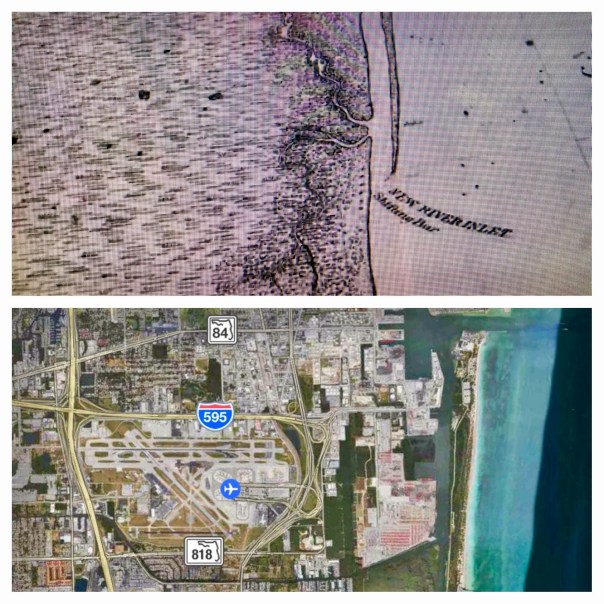
Comparison of 1883 historic map and Google Earth image 2017, Ft Lauderdale’s New River Inlet
Today I am sharing two creations of my brother, Todd Thurlow. Entitled “Ft Lauderdale House of Refuge/Life Saving Station,” and “Short Version,”they were originally for my mother, Sandra Henderson Thurlow and Timothy Dring’s “Image of America, U.S. Life Savings Service” book presentation at the Elliott Museum.
For me, Todd’s videos are mind-boggling as they bear witness to how much and how fast we humans can change the environment. Like an army of ants, we organize; we build; we destroy; we create…
By comparing and contrasting Google Earth maps of today with historic maps from 1883, 1887, and 1935, Todd’s “time capsule flight,” takes us through time and space to see the shifting sands of the multiple New River Inlets; Lake Mabel that morphed into Port Everglades; remnants of the forgotten Middle River that spread and contracted into new canals and developments; and of course, for mom, House of Refuge #4, that once rested north of a New River Inlet that today we can see is completely filled in, while beach-goers relax in reclining chairs like nothing ever happened!
Maybe one day we humans can use all this energy and ability to really fix our waters that have been destroyed during all this construction? Wouldn’t that be a dramatic video?
In closing, in the early 1900s, the New River… that was believed by the Seminoles to once be an underground river that collapsed and the Great Spirit revealed during an earthquake… was selected by modern-day humans as the “natural channel” to connect two of the largest drainage canals from Lake Okeechobee to the Atlantic Coast, the North New River/South New River, and the Miami.
The chart below provides a good visual of 2016 Lake O releases though the C-44 Canal from S-80 comparing 2016, 2013, and 2015. S-80 discharges include the surrounding man-made basin as well as releases from Lake Okeechobee. This info has been compiled by my brother, Todd Thurlow, http://www.thurlowpa.com/LakeOLiveData/ via SFWMD. (Automatic updates every 7 days.)
Via TT3Via TT3
In order to fix a problem, you have to know what the problem is…..yesterday’s visual makes clear to all the problem. Don’t be mistaken, this problem although overwhelming, can be greatly alleviated –“fixed.”
In March of 2015, the University of Florida published: OPTIONS TO REDUCE HIGH VOLUME FRESHWATER FLOWS TO THE ST LUCIE AND CALOOSAHATCHEE ESTUARIES AND MOVE MORE WATER FROM LAKE OKEECHOBEE TO THE SOUTHERN EVERGLADES. This was an independent technical review by the University of Florida Water Institute.
The 134 document summarizes three things necessary to give relief to the estuaries:
200,000 acre-feet of water storage within the St Lucie River watershed. (*For C-23, C-24, C-25 and C-44 canal alone—not including releases from Lake Okeechobee through C-44 JTL)
400,000 acre-feet of water storage within the Caloosahatchee watershed.
approximately 1,000,000 acres of water storage distributed north and south of Lake Okeechobee.
Senate President Elect Joe Negron’s plan for land purchase in the EAA fulfills part of #3. This reservoir would be “dynamic,” meaning that in simple terms it would hold, clean, and move water south to the Everglades. In other words, it would move multiple acre feet over time.
Our St Lucie River is degrading in ways that may not be reversible. We must work for land purchase south of Lake Okeechobee to begin to alleviate the destruction. —We must not just support, but also help Joe Negron. Get ready for Florida’s legislative session 2017.
St Lucie Inlet, Ed Lippisch photos 10-9-16Hurricane Matthew a CAT 4 was 42.8 miles from shore, Google Image via Todd ThurlowHurricane Matthew over Florida, Terra MODIS via Todd Thurlow
Martin County was fortunate to “dodge the bullet” of category 4 Hurricane Matthew, but as long as the St Lucie Indian/River Lagoon is attached to Lake Okeechobee via the C-44 canal, the river cannot. She is shot in the chest each time.
These photos taken yesterday morning by my husband, Ed, show the discharges, like blood, gushing out of the St Lucie Inlet. Melodramatic personification? Perhaps, but true.
A press release by the Army Corp of Engineers on October 7th stated:
“Lake Okeechobee continues to rise; today’s stage is 15.93 feet…
The Corps has resumed discharges from Lake Okeechobee after suspending them during the storm. Water managers have removed target flows and will release as much water as practical through Moore Haven Lock (S-77) located on the west side of the lake, and the Port Mayaca Lock (S-308) located on the east side of the lake…
‘We anticipate inflows to the lake will increase as a result of Hurricane Matthew,’ said Col. Kirk. ‘Therefore, we must maximize outflows in order to slow the rise in the lake and be as prepared as possible for additional hurricane season uncertainty…”
“Additional uncertainty?” Not for the river.
As the Corp has been discharging from the lake since January 29th, 2016 and now the gates are wide open to save life and property south of the lake, the St Lucie did not really dodge a bullet at all. She is hemorrhaging once again.
Until Lake Okeechobee is redirected south as God designed, “dodging a bullet” in Martin County remains an illusion.
This email came in via my brother Todd this morning, amazing how similar the paths of the two hurricanes are. I thought I’d share. In any case, to all “be safe.” Jacqui
“Attached is the 1979 Hurricane David Track vs. the Hurricane Matthew track and forecast track.
Click to see recent satellite images of Lake Okeechobee and algae-full images from this summer: http://www.thurlowpa.com/LakeOImagery/ (Compiled by Todd Thurlow)
I am lucky to know a lot of people who are smarter than me. And one of them is my brother. Ever since we were kids Todd read meteorological books or the Guinness Book of World Records. He likes data. Today, over forty years later, he is helping me apply his knowledge of data to the St Luce River/Indian River Lagoon.
If you are a regular blog reader, you know that this past summer Todd helped publicly identify what became a 240 square mile algae bloom in Lake Okeechobee that was being released into the C-44 causing our river to become toxic. Today, I will share his ideas on avoiding the perfect toxic algae storm.
Here is a photo of Todd and I when we were young in the 70s, when the river was in better shape and we were having fun fishing on Ronnie Nelson’s dock on Hutchinson Island.
Here is a photo of Todd and me today. As you can see we have changed a lot and the river has changed too…
After studying these satellite aerials for a while, I can tell that the blooms are definitely related to sunlight and wind..Our scientists friends would sarcastically say, “no kidding?!”
High pressure system -> a lot of sunlight + no wind = bloom. Clouds + wind = less algae.
The fresh water, phosphorus and nitrogen are always in the lake, but not necessarily the river. Luckily, cloudless days are also the perfect time to spot the algae by satellite.
Maybe the ACOE should add to their discharge schedule that they will hold back the releases when it is forecast to be calm and sunny for several days to prevent the risk of and bloom in the estuaries? Then they can pulse the releases again when the clouds and wind pick up and the algae blows away in the lake – kind of like mother nature.
Jacqui: “Always better if we go with Mother Nature so we don’t end up with such ecological disasters…”
Todd: ” I think Gary Goforth, Mark Perry and others would tell us that the disaster timeline sets up like this:
– A low pressure weather system moves into Florida and dumps a bunch of rain, local runoff begins and the lake starts to rise
– They keep S-308 at Mayaca an other lakeside gates closed and open S-80 because the priority is always to transport the “local” runnoff first and not add to flooding problems by sending lake water through the coastal canals
– The local basins start to drain out and a high pressure weather system moves in. It gets sunny, hot, and the wind dies down to zero.
– With a lot of sun and no wind, the lake starts to bloom. With local runoff subsiding, the tides help flush all to local runoff out to sea but not completely.
– Just when conditions in the lake are “the perfect storm”, the estuaries would otherwise be recovering from the local runoff, the lake is in full bloom and rising, S-308 is now opened to drop the lake at the worst time. All the algae that just exploded in the lake is transported down C-44 through S-80 and into to estuaries. Salinity in the estuaries stays low instead of naturally recovering. With the sunny conditions and unnatural discharges, the estuaries explode with algae blooms.
If they would just delay opening S-308 for just a few days, maybe a week, allowing clouds and wind to return, could the perfect storm be avoided?”
T3
You can access more of Todd’s shared data here under FIRM FAVORITES: http://www.thurlowpa.com
__________________________________
Thank you Todd! Hope the ACOE thinks on this. We don’t want to get in the Guinness Book of World Records 2016 for the estuary with the most toxic algae blooms!
As we know, my brother Todd has been keeping his eye on the Landsat satellite images as they provide tremendous insight into the condition of Lake Okeechobee and potential algae blooms that affect the health, safely and welfare of those living around the St Lucie River/Indian River Lagoon. Todd notes that in studying the Landsat images: “Perhaps the algae grows on Rocky Reef? The area just north of this location is were some of the earlier blooms originated.”
Hmmm? Could the Rocky Reef be an area where the water cannot flow in the lake as easily due to its nature? Could it be possible that nutrient rich back pumped waters from the sugar fields fester in this area feeding a lake wide bloom? Worth a thought as we try to fix our problems…
The toxic algae blooms –people are still talking about them….
You may have noticed recently in various publications and “Letters to the Editor” across the state that some are calmly claiming that “algae blooms have been occurring in Florida since the beginning of time…” This may be true, however, this summer’s 240 square mile algae bloom in Lake Okeechobee that led to the outbreak in the St Lucie River was unprecedented. Comparing the situation to prior algae bloom outbreaks of 2013, 2014, or any other is like comparing a dog to a wolf. The same but very different.
Another interesting thing Todd stumbled upon while researching the “Rocky Reef” located basically above Clewiston was a 1977 joint NASA/SFWMD report on, of all things, using Landsat radiance data to study the turbidity and chlorophyll concentrations in Lake Okeechobee.
Since obviously the South Florida Water Management District has been using the Landsat information since 1977, and Martin County has been paying taxes to the District since around the same time, I think it would have been polite if the District had let us know when Lake Okeechobee’s then poisonous waters were overflowing with algae and headed this way. Don’t you as well?
You can learn about Todd’s discoveries about the Rocky Reef below.
Jacqui
___________________________________
In correspondence to Mark Perry, Todd Thurlow provided the following: (http://www.thurlowpa.com)
Because the Army Corp of Engineers has been discharging into the St Lucie River for the past months and the nightmare of June’s algae situation, my brother has been monitoring satellite images of Lake Okeechobee. Unfortunately, another large bloom has been documented. For awhile the large bloom that reached a size of over 200 square miles seemed to subside and was not not very visible via satellite …
Since August 19th, 2016 a visible bloom is back.
Considering what happened in June and July of this year, we as a community should be prepared for another possible river algae outbreak if this bloom significantly grows or other conditions are right–presently, Todd measured the bloom at just over 40 square miles. (See below)
Many reports and Facebook posts have already surfaced about algae blooms building up again in marinas and along shorelines. Hopefully if there is an outbreak, it won’t be as extreme as earlier this year when the Governor declared a state of emergency.
Thank you Todd for the information and the images.
We will keep reporting.
JTL
———————–
On Aug 20, 2016, at 4:12 PM, Todd Thurlow <todd@thurlowpa.com> wrote:
Jacqui:
I sent this to Mark Perry. They just posted yesterday’s Landsat 8 pass. Algae is clearly visible. The outline around the bloom is 41.4 square miles:
Landsat satellite photo of Lake Okeechobee 7-26-16.
I believe in not being dependent on the federal or state government, but what recently happened along the St Lucie River is ridiculous…
In the months following the June 29th, 2016 “State of Emergency”and toxic algae bloom invasion of the St Lucie River, one thing is clear. Our federal and state governments did not look out for Martin County’s best interests, instead knowlingly discharging toxic algae from the lake into the communities along the St Lucie River— with out so much as “public-peep”— until real tragedy and helath risks had struck. Then suddenly, it was like: “Oh my, where did all this algae come from?”
Well, it happened knowingly because the state and federal government (ACOE/SFWMD/ DEP/ Florida Dept of Health) knew Lake Okeechobee was not “popping” here and there with a few algae blooms as is often the case, but rather was”covered in the stuff.”
By July 2nd commonly distributed government satellite images, like the one above, were showing over 200 square miles of algae bloom that obviously had to grow over time to attain such prominance.
Anyway…the least “they” could have done was to have given the public fair warning to be careful and ready as is standard operating proceedure during a drought when wild-fire conditions are present.
But they did not.
Instead, the Department of Environmental Protection quietly took its tests, reporting to the District and the Army Corp– at their leisure— the few results they attained…They should have warned the county government of more than a bloom here and there. They should have told everyone that a dangerous situation was getting ready to occur. But they did not. Maybe they thought it wouldn’t happen? I doubt it. This is true negligence considering the first duty of government is health, saftey and welfare of the people it levies taxes from…
Thus today, I am sharing a brief exchange between my very technically-savvy brother, attorney, Todd Thurlow, and me, from earlier this week. Todd’s shared images will help us look out for ourselves. Thankfully, the recent Landsat satellite images of Lake Okeechobee, for now, look much clearer of algae than just a few months ago.
The link below the exchange will allow you see the satellite images of the lake over time, dates are also present:
Jacqui: Do the satellite images show any more algae in the lake? J
Todd: I might see some in the southwest quadrant but not definitive. As mentioned before, unfortunately, Landsat 7 has a broken instrument that causes the black lines on the image.
Today I share an amazing link to a website of Lake Okeechobee satellite imagery from May-June 2016 as created by my brother, Todd Thurlow. These images reflect the huge algae bloom in the lake that on July 2nd was estimated to be over 200 square miles. The algae has been discharged into the St Lucie River causing the present State of Emergency.
After going through thousands of images, Todd picked and cropped the best “bands” for each satellite. Each of the two Landsat satellites only pass every 16 days. So there are gaps. Plus, he skipped other days because of clouds. The other satellites pass daily but you will see gaps for cloudy and hazy days.
Each folder is arranged in reverse chronological order – most recent image first. The algae seemed to be worst around June 24. The current images from the low-res satellites are fairly clear. It will be interesting to see the next Landsat 8 pass on July 18.
Cropped image, full image at end of this post. Red shows algae bloom’s size as calculated and drawn by Todd Thurlow. The present bloom in Lake Okeechobee is estimated to be 239 square miles as shown in this NOAA satellite image on 7-2-16 and shared by FOS on 7-6-16.
In the aftermath of last week’s media frenzy and State of Emergencies, let’s consider the following:
1.This year, the ACOE has been discharging from Lake Okeechobee into the St Lucie River/Indian River Lagoon since January 29th, 2016. This has caused the estuary’s waters to become fresh.
2. Lake Okeechobee is a freshwater lake and this year contains a gigantic algae bloom that was first documented to be 33 square miles located in the south-eastern quadrant of the lake, on May 9th, 2016. This bloom is cyanobacteria/microcystis, a fresh water bloom. It does not grow in salt/brackish water. As the estuary has been made fresh, the cyanobacteria can grow here too. This bloom in the lake is now approximately 239 square miles as calculated by my brother Todd Thurlow. Florida Oceanographic has shared this overlay on a NOAA satalite image.
Shared on Facebook by person flying over lake O in early May, bullsugar.org
3. On May 23rd, 2016, Martin County reported that a sample was taken by DEP (The Florida Department of Environmental Protection) upstream of S-308 at Port Mayaca, at 24.4 micrograms per liter (mpl) qualifying as a threat to human health by the World Health Organization’s limit of 10 micrograms per liter. According to Mark Perry two more samples were taken on June 15th and came back at 280 mpl and 387 mpl. The government obviously knew this bloom was toxic, but they kept dumping and did not warn people of what could occur.
4. As the the river was becoming full of algae, on May 30th, 2016 my husband Ed Lippisch flew over S-80 taking photos of algae going through S-80 into the east side of the C-44 canal and into the St Lucie River/Indian River Lagoon. This was done again later by Dr Scott Kuhns. The algae has been coming through for months.
S-80 5-30-16 Ed Lippisch
S-30 5-30-16 Ed Lippisch
5. More photos were taken and shared to document the bloom in the lake on June 26, 2016 as citizen were concerned about algae bloom in the St Lucie River and even beaches but no communication from state or federal agencies as to causes was provided. The people had to blow up before the government would do anything.
Pilot Dave Stone Lake Okeechobee bloom 6-26-16
6. By June 29th, 2016 the St Lucie River’s bloom was “peaking” and blooms were reported along the river in every area of the county. People were panicking. By June 29th, 2016, finally the Martin County Commission, and then Governor Scott had called for a “State of Emergency” helpful for recovering monetary losses but not for health protections or stopping the discharges from Lake O.
Jamie Burns week of June 26th, St Lucie River full of algae bloom from Palm City to Sewall’s Point.Canal off of Sunset Trail near North River Shores, Stuart. Week of June 26th, Baskin family.
7. After emergency state, ACOE’s Col Kirk toured the area and thankfully the ACOE temporarily cut back but did not stop releases to the estuaries.
8. At the tail-end of this crisis something very serious happened. This Tuesday it was reported that the bloom at Bathtub Beach tested on June 30th registered at 414 micro grams per liter. 10 qualifies as toxic. This number is off the chart. This number sits on a DEP web site but no one is discussing it. Why not?
Alge bloom at Bathtub Beach week of June 26th. JTLReport on Bathtub Beach DEP
How can something so dangerous to our citizens and wildlife not be stopped when we know where it is coming from?
Certainly our own dirty water runoff, fertilizer, and our own disgusting septic tanks exacerbate the situation, but they did not start this algae debacle. Dumping from Lake Okeechobee did. This needs to stop.
Under present water law Lake Okeechobee is does not quality as “point source pollution.” If it did a permit would be required to dump into our estuaries. The National Pollutant Discharge Elimination System (NPDES) is the point source discharge permit program authorized by Section 402 of the Clean Water Act.
“All point source discharges to surface waters (“Waters of the United States”) must have an NPDES permit. Permits are issued by EPA and authorized state programs.”
And the bloom? As mentioned, it is getting bigger.
Yes, according to Florida Oceanographic Society, it has grown from 33 square miles to approximately 239 square miles, almost half the lake.
Maybe if it fills the entire lake it won’t only be point source pollution, but the government will get the point. The government is now regretfully poisoning its own people. Laws must be changed. The state’s pluming must be changed. Lake Okeechobee is definitely the point–the point of our point source pollution.
New calculations estimate the algae bloom in Lake Okeechobee to be 239 square miles. Based on the latest images from NASA on July 2nd, the algae bloom has grown from 33 square miles on May 9th to now take up almost 1/3 of the lake. “This toxic algae is what has been discharged into the St. Lucie Estuary and the Indian River Lagoon, making its way through our waterways and onto local beaches. We need to stop the discharges from Lake Okeechobee and send the water south the Everglades, where it is desperately needed.” – Mark Perry, Executive Director (Image created and calculated from NOAA image by Todd Thurlow)
Latest Coverage via Florida Oceanographic Society:
Watch Full Video of WPBF 25 News Special: Algae Crisis from 7/6
Reeking, Oozing Algae Closes South Florida Beaches, New York Times
Toxic Algae Bloom Severely Impacts Local Businesses, CNN
Florida’s Biggest Lake Fouls Coastlines, Orlando Sentinel
Scientist Cautions Blue-Green Algae Can Have Serious Health Impact, WPBF News
Toxic Algae Bloom Crisis Hits Florida, Drives Away Tourists, Tampa Bay Times
Algae Stink Mucking Up Beaches, Business, Stuart Residents Say, WFTV News
Lake O has been drained and lowered so that it is approximately 250 square miles smaller than it was in the mid 1800s. (SFWMD) Florida became a state in 1845.
“Navigable waters of the state” are protected under Florida law. They cannot be sold–they cannot be owned. They belong to the public…
Although the Swamp Lands Act of the 1850s allowed for drainage of Florida’s swamp lands, in some instances the drainage and claims may have been overdone. In accordance with state law “you can’t convey what you do not own.” This is part of what is known as “The Public Trust Doctrine.”
Hmmm? In all the excitement to develop, did the state break its own rules in conveying lands south and around the lake? Certainly powerful entities own those lands today.
—–That would be a bite wouldn’t it?
Let’s look a bit closer….
It is common knowledge that Lake Okeechobee has lost a tremendous amount of its former self, and that large portions of the lake have been drained and diked for agriculture and development.
Just recently while attending a University of Florida Natural Resources Leadership Institute presentation in Clewiston, Jeff Summers of the South Florida Water Management District gave a Power-Point presentation using the slide below. It shows the natural vs. altered conditions of the lake going from approximately 1000 sq miles in the 1850s to 750 square miles today. –Thus the approximate water stage has gone from 20 feet to 14 feet. Definitely a loss of navigable waters–don’t you think? Today those lands around the lake are used for growing mostly sugarcane. Today most of those lands are “owned.” How could this be as they were once under water enough to be “navigable waters of the state?”
Slide from Jeff Summer’s power point presentation SFWMD, 2016.
The excerpt below is straight out of the “Florida Bar Journal” as shared by my brother Todd. After reading the paragraph, click on the link below to read the entire article. It is certainly worth thinking about…The maps below show land ownership.
Florida Bar Journal’s article conclusion:
The Public Trust Doctrine imposes a legal duty on the state to preserve and control title and use of all lands beneath navigable water bodies, including the shore or space between ordinary high and ordinary low water, for public use and enjoyment. The people of this state have raised the protection afforded by the doctrine to constitutional stature. In the most recent challenge to this doctrine, the Florida Supreme Court relied upon this constitutional provision in reconfirming longstanding Florida law that swamp deeds do not create a private property interest in sovereignty lands. Attempts to use swamp deeds as a justification to legislatively redefine the ordinary high water boundary and thus transfer all or part of the shore to the adjacent private owner are similarly inappropriate and unconstitutional.
Map of land ownership south and around Lake O TCRPC 2016. Key below.Key to above map, 2016 TCRPC.The bigger picture: Lake O used to flow to the Everglades but is now directed to the northern estuaries St Lucie/IRL and Caloosahatchee causing great destruction. Google Earth, 2016.
Blue line 2013 releases into SLR/IRL, red 2016. It is only February and we are 1/3 there. Discharge amounts are much higher this time. Slide, Todd Thurlow.Cumulative 2-18-16 Slide created by SFWMD data via Todd Thurlow. Click to enlarge.….
“—Here it is graphically vs 2013 – The year of ‘The Lost Summer.’ As you can see, as we approach 75 billion gallons we are already one-third of the way to the amount released in of all of 2013. It took us until July 30, 2013 to accumulate 75 billion gallons of discharges in that year.” —-Todd Thurlow(http://www.thurlowpa.com)
Today I am sharing numbers from my brother, and photos from my husband. Documenting the St Lucie River/Indian River Lagoon is a family effort. I am very fortunate to have such help.
The St Lucie River/Indian River Lagoon is not so fortunate. Right now as you can see from the two slides above, the cumulative discharges into the rivers are already one-third the total amount released by the ACOE/SFWMD into the estuary during 2013’s “Lost Summer.” We are experiencing another complete ecological disaster and rainy season doesn’t even begin until June 1st…
Sometimes I am speechless… Sometimes my eyes swell with tears thinking about all this and the sun hasn’t even risen….but I take a deep breath and know my duty.
We will not give up. We will shine a light on this issue for all the world to see; and for us to change. And we will.
….SLR approaching SL Inlet. (All photos, Ed Lippisch 2-17-16)…Sewall’s Point once surrounded by rich seagrass bed much fish and wildlife. Years of destruction from discharges especially has taken a great toll.….Sailfish Point…..Crossroads–seagrass beds covered in silt and viewed through blackwater.….Jupiter Island….….Plume leaving inlet. This year Ed says it is skinnier going further south than in 2013. It is reported about 2 miles out the inlet on outgoing tides.…..Jupiter Island….Jupiter Narrows, Jupiter Island…Jupiter Island….Jupiter Island beach
Map of earliest canals built in 1911. The SL Canal was built in 1915-1923 and was then widened and deepened in the 1940s. Florida Archives.Close up of SFWMD map today showing S-structures south of LO. See rim of lake.South Florida has many “S” structures and S-333 is one of a few furthest south, south of WCA 3, allowing water to enter the Everglades and other areas.
Today’s blog will feature a common sense question. The question is basically why isn’t the dumping into the St Lucie River/Indian River Lagoon being alleviated by the large canals south of Lake Okeechobee, specifically the Miami and New River? Those two rivers were used before for drainage before our St Lucie canal was even constructed. The Miami River naturally had rapids before they were blown up with dynamite…Mother Nature had her way of dealing with the some of the spillover waters of Lake Okeechobee. Why aren’t we following that model?
I think a recent exchange between my brother Todd and Dr Gary Goforth gives insight into this question. I learned from it and the conversation is not yet over, thus I am posting it today.
By the way, just in case you don’t know, “S” means “structure” for water releases…. There are hundreds of structures that allow water to drain Lake Okeechobee and thus South Florida. The SFWMD deals with the structures south of the lake and the ACOE deals with the larger structures that go east west to the our northern estuaries.
Here we go:
TODD: http://www.thurlowpa.com/news.htm
“Right now… I am looking at the status map asking: “Why are the WCAs rising while very little water, if any, seems to go out to the New River (S-34) and the Miami River (S-31), which are historical tributaries of the Everglades (they even had rapids!) ?— all while we are getting dumped on because the Water Conservation Areas (WCAs) are over schedule?”
Recently, S-34 flowing into the New River was at 0 cfs. Now I see that it is at 233 cfs. A drop in the bucket compared to the 7523 cfs that has been hitting the St. Lucie for days.
That S-333 doesn’t seem to flow to the Park but instead to the Miami River also. (Someone correct me if I am wrong.) It was at 0 cfs on the 4th and is now at 1200 cfs. Even if that water isn’t going to the Park, at least it is going south and not east/west – but why the wait? The system is more complex than we will ever understand but the more we understand the better. Thank you, Gary, Mark Perry and others for keeping everyone informed.
DR GOFORTH:http://garygoforth.net
Todd – you’re absolutely correct – the New River and Miami Canal were historical tributaries of the Everglades.
“Why are the WCAs rising while very little water, if any, seems to go out to the New River (S-34) and the Miami River (S-31)?”
The short answer is that flood protection for the suburbs of Ft. Lauderdale and Miami takes precedence over conveyance of floodwaters from the water conservation areas. The intervening canals are operated to provide flood protection to the urban areas between S-31/S-34 and the tidal structures (S-26/ – similar to S-80 in the C-44). When heavy rains occur in the suburbs, the canal capacity is primarily devoted to moving the stormwater out of the basin. After the storm events and water levels in the canals subside, S-31 and S-34 can be opened to move so-called “regulatory releases” out of the water conservation areas. This is similar (although not exact) to how S-308/S-80 and the C-44 Canal is operated – flood protection of the local basin takes precedence over Lake releases.
“why the wait?”
Opening S-333 allows water from WCA-3 to move into the Tamiami Canal (aka L-29 Canal); the one-mile bridge along Tamimi Trail allows water from the Tamiami Canal to enter Northeast Shark River Slough (see the map). S-333 couldn’t open without special authorization from the Corps to allow the water level in L-29 Canal to rise, which Gov. Scott requested in his letter last week, and the corps granted this week.
Gary Goforth S-333.
Interesting to think about…maybe there is more to explore here….
Contact the SFWMD should you wish to get a Facility and Infrastructure Location Index Map: (561) 682-6262. The person at this number should be able to direct you.
SLR/IRL St Lucie Inlet 2-7-16 by Ed Lippisch.SFWMD canal and basin map. C-44’s S-80 is the canal most southerly in the image.SFWMD 1955-2015 history of discharges at S-80.
The idiomatic expression “death by a thousand cuts” has been used by many people in many situations…but the St Lucie River/Indian River Lagoon is the expression’s poster child…
Idiom: Death of a thousand cuts Idiom Definitions for ‘Death of a thousand cuts’
“If something is suffering the death of a thousand cuts, or death by a thousand cuts, lots of bad things are happening, none of which are fatal in themselves, but which add up to a slow and painful demise.”
The St Lucie River/Indian River Lagoon has been dying, has been “being killed” by our local, state, and federal governments since before I was born. Since the 1940s when the 1915 “slice” between Lake Okeechobee and the South Fork of the St Lucie River was deepened, widened and made permanent by the ACOE as requested by a state protecting agriculture and development interests.
Does this make it “right?” —That it has been happening for so long? Does this mean we should have nothing to say about the present very high level discharges killing our estuary? Absolutely not.
As in most instances righting cultural wrongs takes time. It takes many years of pain and realization. And then it takes people rising up for change.—- It takes bravery, determination, and exposure.
For instance, it wasn’t until the first TV stations in the 1960s showed black Americans displaying non-violence in the face of attack dogs and beatings; it wasn’t until a few brave women spoke out publicly and were arrested as displayed in the first newspapers of the day that these hundred year old issues began to change.
…….……
For Florida, we are that new issue. Our river is that “new issue.” Without the advent of social media and Go Pros allowing a pilot, like my husband Ed, to attach a camera to his plane and share formerly unseen images with the world, the cuts of Lake Okeechobee and area canal discharges at S-80 would happen again and again and again. But since 2013 images have been shared, social media has ripped through the hearts of people who want something different. Not just here but on the west coast and all across our state. The River Warriors, the Rivers Coalition and thousands of others have stood up. We are primed to do this again but even more effectively. Film it. Share it. Expose it.
The SFWMD chart below, found by my brother Todd, shows the Lake Okeechobee and C-44 area canal releases from Structure-80 displayed from 1955-2015. Dr Gary Goforth has shown us in a blog I wrote in 2013 that in the 1920s the release levels were even higher. We can see the destructive releases have happened many times at horrific levels. They are going down. Now they must stop.
These red lines are the historic destruction that is driving our actions today. Each line a new cut causing a weaker estuary. ——-We are the chosen generation to change this. We are the chosen generation to save the St Lucie River/Indian River Lagoon.
Yesterday, after the vocal encouragement of the River Warriors and others our Martin County Commission unanimously voted to send a resolution to Governor Scott asking for a “State of Emergency.”
In my opinion, this means that not some, but every commissioner must support the purchase of land south of Lake Okeechobee. Because the propaganda of “finishing the projects” as the answer— just isn’t going to cut it.
River Warriors protesting before the MCBOCC 7-9-16. Photo JTL.SFWMD 1955-2015 discharges at S-80.With SFWMD info on bottom of slide.Plume, Ed Lippisch 2-7-16.SL Inlet, 2-7-16, Ed Lippisch.Plume, Sailfish Flats discharges, photo 2-7-16 Ed Lippisch 2016.
View of convergence of SLR/IRL between Sailfish Point and Jupiter Island. Plume from Lake O discharges flowing out into ocean. Photo 2-7-16, Ed LippischCanals in Stuart, C-23, C-24, C-25 built in the 50s and 60s. C-44 connected to Lake Okeechobee constructed in the 1920/expanded in 1940s. The natural basins of the SLR have been tremendously enlarged plus Lake O water. This is killing the SLR/IRL. More water must go south.
It is important to know how to “speak the language” of the ACOE and SFWMD.
The St Lucie River/Indian River Lagoon is once again under siege. The Army Corp of Engineers and the South Florida Water Management District are doing the will of the reigning powers and discharging tremendous amounts of water and pollutants from Lake Okeechobee and altered surrounding lands (basins) into the St Lucie River/Indian River Lagoon.
We must learn how to interpret this destruction and how to use their language of “cubic feet per second,” (cfs), when talking about discharge amounts from Lake Okeechobee and area canals into the SLR/IRL.
I am not good at this interpretation, but someone I know is….
As in most families, each chid in my family was born with different talents. My brother, Todd Thurlow, got all the number and sharp analytical skills that I did not. I am very thankful to him for helping with my St Lucie/Indian River Lagoon educational efforts.
Todd has created a VERY EASY way to convert cubic feet per second (the language of the ACOE/SFWMD discharges) into gallons. All you have to do is click on this link below and put in the numbers. Seriously.
For instance if you click on the link today, it will show that S-80 is last reported to be releasing approximately 6800 (cfs) cubic per second, down from just under 7600. Just enter 6800 in the top box and it will be converted to 1. gallons per second; 2. gallons per day; and 3. “olympic size swimming pools” (in honor of Stuart News reporter Tyler Treadway’s common example for communicating with the public.)
Go to this link now, and try it! You will be amazed at how east this is. To win this war, we must be able to speak “their” language and to understand.
Click on chart below to get started. Save the link to have it handy for this year. It is going to be a difficult one and we are going to need to know what we are talking about in order to negotiate and to communicate.
S-153 drains this area.S-153 drains into the C-44 canal and then the St Lucie RiverSFWMD canal and basin map. C-44 canal is the canal most southerly in the image. See S-153 northeast of the C-44 “basin” area.
Water, water everywhere….
The ACOE and South Florida Water Management District are scrambling….they will have to start dumping from the lake and the local basin runoff is exceeding targets ….But is all the runoff into the C-44 really from a local basin? No it’s not.
Let’s drill down a bit.
The ACOE’s recent press release reads:
“FOR IMMEDIATE RELEASE
Corps to increase flows from Lake Okeechobee
The U.S. Army Corps of Engineers Jacksonville District intends to release
more water from Lake Okeechobee starting this weekend as it continues to
manage the lake level in the midst of El Nino conditions.
Starting Friday (Jan. 29), the new target flow for the Caloosahatchee
Estuary will average 2,800 cubic feet per second (cfs) over seven days as
measured at W.P. Franklin Lock (S-79) near Fort Myers. The new target flow
for the St. Lucie Estuary is a seven-day average of 1,170 cfs as measured at
St. Lucie Lock (S-80) near Stuart. However, runoff from rain in the Caloosahatchee or the St. Lucie basins could occasionally result in flows
that exceed targets as the water passes through the spillway gates at the
Franklin or St. Lucie structures…”
What we have to remember is that the “basin,” the lands that water runs off of into the St Lucie River has been altered by agriculture and development ….so to call “all the water” going into the St Lucie its own basin water is really misleading and not respectful of history….
Let’s look at S-153 for instance, a spillway that is presently dumping approximately 1.2 billion gallons into the C-44 which then goes into the St Lucie River. If man had not altered this area, much of this water would naturally be flowing back into the lake…so again we really should not refer to it as “basin runoff” that belongs to the St Lucie River. Today large portions of this area are agriculture fields and an FPL energy plant so the run off water of this area has been redirected from the lake to us.
S-308 drain LO; S-153 drain area around FPL plant.
Hmmm?
Let’s reflect for a moment on this information from my brother Todd:
“Jacqui,
According to my C-44 page the gates at the locks are up 2ft and dumping 4451cfs which equals 2.8 billion gallons per day.
Nothing is coming from the lake so they will say that this is all local runoff because S-308 at Port Mayaca is at 0? That S-153 spillway is dumping 1.2 billion into C-44. It seems to pull water west of Indiantown that would have otherwise gone into the lake not to the St. Lucie?
Todd of course is right. And 1.2 billion gallons of extra fertilized, dirty water is worth noting. Don’t you think? The least they could do is filter it!
Todd and I will look into this further with historic maps of the old creek and ridge system prior to development and how the water historically flowed prior to S-153 flows, etc—– but for now, let’s not entirely be sold “up the creek,” by believing the all this water is “local” basin runoff.
Because it’s not. 🙂
Other basin changes are also bringing excess water into the river right now. This map shows general drainage changes to the SLR. Green is the original watershed. Yellow and pink have been added since ca.1920. (St Lucie River Initiative’s Report to Congress 1994.)
Map of our area in the 1982 Coastal Management Zone document showing heights. in MC. (Mark Perry)
Yesterday’s conversation regarding Sewall’s Point’s Mount Pisgah, at 57 feet, in the area of Frances Langford’s former estate got people talking about many things. One of the less controversial, but interesting was “heights.” My brother Todd wrote:
“Jacqui, with respect to Mt. Pisgah being the highest point, I think you are correctly specifying “along” the rivers (e.g. adjacent to the water). There are higher points listed in my video below. But all the ones on the waterfront are less than 37ft. The highest waterfront in Hobe Sound is 50ft and we ran US-1 over it!”
Mr Don Quazzo in his comments noted the even higher heights than Mt Pisgah of the inland sand hills in the Skyline Drive area….interesting. Fascinating. Talk about history!
Today I will transcribe a piece of “Martin County’s 1982 Coastal Management Zone” shared with me years ago by Mr. Mark Perry. It talks about high places, ancient sand dunes, through out our county.
View Todd’s Time Capsule Flight video “The Hills of Sewall’s Point and Jensen Beach 1950 USGS Topo Map”: (https://youtu.be/fIwsz5grVg0)
More detail of height in MC. Figure 3
Here we go:
The 1982 Coastal Zone Management Study of Hutchinson Island, Martin County, Florida, 1982, wa written by Florida Oceanographic Society and the Martin County Development Department.
Part II is entitled “Natural Geologic History.” It reads: “Just before the most recent Ice Age, the Wisconsin, which lasted from 100,000 to 11,000 years before present, the sea level was approximately 25-35 feet above the present mean seal level…At that time the sea was covering most of Martin County except for the Orlando Ridge, which was a narrow peninsula or series of islands and shoals, and the Green Ridge which was an offshore bar with the crest at sea level…The sea beating against the much smaller Florida coast formed, by erosion and deposition, a broad terrace of Pamlico sands.
These sands were composed of mostly quartz, fossils and some carbon materials. The Atlantic Coastal Ridge was of pre-Pamlico origin was altered by an advancing Pamlico sea. This is evident by the south and north boundaries of the Jensen Beach and Jonathan Dickinson Sandhills which have spit-like structures projecting westward, as shown in Figure 3. (above)
The tall sandhills together with Sewall’s Point and Rocky Point form the backbone of the Atlantic Coastal Ridge. It is breached by the St Lucie River between Sewall’s Point and Rocky Point. During times of high sea level, like the Pamlico Period, the drainage basins of the St Lucie River and Loxahatchee River probably formed and ancient lagoon such as the Indian River Lagoon does today, with the older sandhills of Jensen Beach and Johnathan Dickinson acting as the barrier islands and dunes of that time. It was also during this time when Hutchinson and Jupiter Islands began forming as offshore bars….
—-Excerpt from MC 1982 Coastal Zone Management Study
Whether it is 100,000, 11,000, or 60 years ago, the more we know about the history and formation of Martin County the more likely we are to respect our natural resources.
Today we continue looking at parts of a 1974 text entitled: “Environments of South Florida, Present and Past,” by Patrick J. Gleason, lent to me by Dr Gary Goforth.
Today’s map of study was created by Frederick A. Ober.
Fred Ober was a man who once ran a shoe shop, but one day, with a dream in mind, literally “threw off his shoes.” He decided to go on an adventure and make something more exciting of his life. In 1974 he visited and documented our Lake Okeechobee and surrounding Everglades.
Our text ironically, looks at Lake Okeechobee 100 years after his visit–published in 1974.
To look at the map and see such notes as “commencement of cypress belt with sandy shore” along the east side; “custard apples, and marshy lands, —-sand beach on the south side”; and “palmetto ridge and Kissimmee Prairie in the north,” really take one to another world.
—A world that basically does not exist anymore.
We scraped it clean. We rearranged it. We built it out. We drained it. We diked it. We planted seed. We erected houses. Maybe one day the young people will try to put some of it back. It must have been spectacular.
What will it look like in another 100 years? Will today’s Google map below appear as obsolete as Ober’s? What do you think? Is there a way to go back? Envision 2074.
….cover of text, 1974south rimKissimmee River area, northNE area of lakethe lake up closeToday’s Google map, 2016.
A fun thing about working on blog posts with my brother, Todd, is that I learn new words like “Bathymetry. ” It is the study of under water depths. Kind of like topography but underwater. Maybe you already knew the word; I did not! He got on this while we were studying the intense clearning of Frances Langford’s property….
Viewing this short video that compares a historic 1883 map with a 2015 Google map, one clearly sees the differences in the depths of the St Lucie River. It appears that in many areas along and just northwest of the peninsula of Sewall’s Point, where Frances Langford’s historic property is located, the river was as deep as 10 to 12 feet. Today depths are closer 7 or 8 feet or shallower. Mostly a build up of muck from 100 years of releases from Lake Okeechobee I would think….
As far as topography, heights on land, “Mount Pisgah” still stands like a sentinel as the highest point as 57 feet. There is where I always picture Black Beard standing when I drive of the bridge….
What an interesting video, for me, it is amazing to think of the surveyors in the 1800s who calculated such with none of today’s technology! Their maps are quite beautiful. I wonder what surveyor will use in the future?
Frances Langford and Ralph Evenrude photographed before their trademark Tiki Hut and pond, Jensen Beach Estate, 1961. (Photo Arthur Ruhnke with permission of historian Sandra Henderson Thurlow)Frances Langford as young movie star. April 4, 1913 – July 11, 2005
“I am sure the new development will be re-landscaped very beautifully, but it is hard to see the once serene property so desecrated.” –Local historian, Sandra Thurlow, 2016
“Frances Langford,” the name is as beautiful as the woman. She is a legend here in Martin County and much of the world. No one has been more generous, loving, and appreciative towards our community. A true philanthropist, her name graces buildings, parks, and centers from the Indian River Lagoon to Indiantown.
As a singer and movie star, she is best known for “entertaining the troops” during World War II aside Bob Hope. Through her family, young Frances was exposed to Jensen Beach, and later, after the war, came back to create her dream: “Frances Langford’s Polynesian Outrigger Resort.” It sat along the beautiful St Lucie River and Indian River Lagoon just north of Sewall’s Point.
Over time, inspired by her travels, Frances and her husbands created a tropical paradise known far and wide. Cottages, a restaurant, a marina, palm trees, rare foliage, freshwater ponds, peacocks, and even swans graced the property. Famous movie stars often visited. She gave Martin County a reputation and she put it on the map. She made Martin County’s Jensen Beach her permanent home.
Frances chose to build her personal residence near Mount Pisgah, the highest point of the peninsula. Lore has it that pirates and Indians once lived here too, standing on the high bluff looking for passing ships in the ocean. The property is steeped in beauty, history, and mystery. Sadly, in the end, the remaining 53 acre parcel was treated like any other piece of real estate.
After a long wait since the 2008 Great Recession, the property is finally being developed ironically as “Langford Landing.” The manner in which this is being done has taken most us by surprise.
Is it really necessary to remove every beloved palm tree, stately strangler fig, and blade of grass? Surely Frances thought some of her legacy might stand. It has not. The majority of the property has been scraped clean for new development. My sister said it best: “Jacqui, from the water, it looks like the property has been Napalmed.”
There has to be—-a better way.
The Tiki Hut, bridge and pond, Frances feeding her swans. Many fundraisers were held here and many movie starts attended “in the day.” (Arthur Ruhnke courtesy o Sandra Thurlow, 1961)Langford Estate 1961. (Arthur Ruhnke/ST)Langford Estate 1961. (Arthur Ruhnke/ST)View of estate from river by kayaker. This photo was sent to me by a Facebook friend.
Tiki hut in ruins 2016. (Rebecca Fatzinger)Around the pond, palm trees lay in a heap. 2015. (Photo by Rebecca Fatzinger)Today in 2015/16 photo of Langford property by (Rebecca Fatzinger)The grounds 2015/16 (Rebecca Fatzinger)Estate sold for development. (Courtesy Todd Thurlow/Google Earth)From the air–history scraped clean, 1-1-16, Frances Langford’s estate after all foliage has been removed. (Photo Jacqui Thurlow-Lippisch and Ed Lippisch )Langford Estate seen from the St Lucie River, 12-3-16. (Photo by Todd Thurlow)Photo of one of Frances Langford’s peacocks on her estate, 1980s. (A gift to me from her housekeeper 2006.)Young Frances. Public photo.Frances in her later years.
Dredge and fill, public photo, 2015.A multi-image of the area in the 1887 NOAA map, the 1925 shot (partially), 1940, a 1958 NOAA map, 1970 and today by Todd Thurlow.
Today’s blog is a full expansion of the 1925 aerial photo I wrote about last Friday.
My brother Todd took this photo creating a time line flight of 1925 and 1940 views of the Sailfish Flats, the Indian and St. Lucie Rivers, and the St. Lucie Canal (C-44).
Todd’s video is a history lesson in “dredge and fill” which was very common throughout all south Florida and the United States until national laws in the 1970s required more scrutiny and often no longer allow such due to heavy impacts and damages on waterways and the natural environment.
Our Martin and St Lucie County canals dug by the ACOE and water management entities C-44, C-23, C-24, C-25 are dredge and fill. Sailfish Point, Sewall’s Point, and Indian River Plantation, just to name a few, have large portions that are dredge and fill. The dike around Lake Okeechobee and the work abound the FPL plant in Indiantown by Barley Barber Swamp are dredge and fill. At the time, it was “how it was done.” People did not foresee the ramifications to the environment or to people living in these areas in the future.
The land was our Play Doh…
1925 aerial by Bob Higgins shared by Sandra H. Thurlow. SLR/IRL
I know you will learn a lot and enjoy watching Todd’s video. The link is above.
—My questions to Todd after I saw the video included:
Jacqui: “So Todd, what are the white lines on the edge of Stuart, Rocky Point etc…more piled white sand? Looks like Jupiter Island was smaller at one point…across from Sailfish…
So how in the world did they dig out the Sailfish Point Marina and what about the straight marina of Sailfish Point that was already there from the days of Mr Rand? Also what about the FPL Pond in Indiantown? Where do you think they put that fill? Holy cow! That’s a lot of fill!
(I have adapted Todd’s words after checking concepts with him so I could present info in a simple manner.)
Todd: “The lines on the edge of Rocky Point were probably a beachy shoreline. With it being more open water at the time and more exposed to the inlet; I’m sure there was more of a beach there. That shoreline matches perfectly the shoreline shown on the early NOAA maps – even before the inlet was there.
With respect to Jupiter Island, you are probably referring to all the spoil that was piled up at the entrance to the Great Pocket – some of that was put there when I was in middle school. The main part of Jupiter Island is more to the east and is now gone – and earlier connected to Hutchinson Island. The old Gilbert’s Bar Inlet was south of that point.
The marina on Sailfish Point was dredge fill. We have some aerials of it in the making. As was the case in areas of Sewall’s Point, the sand dug to build small marinas or subdivisions was piled on the land (Archipelago, Isle Addition) to make the land higher or to create completely new lands.
As far as the giant FPL pond, they probably just dug with a dragline and used the fill to make the dike around the outside of the pond and also to build up the land around FPL.”
Hmmm?
So we live in an environment altered by our forefathers, and now we are experiencing unintended consequences to the health of our St Lucie River/Indian River Lagoon. We must assist the next generation in understanding the past so that we and they can create a better water future. And that we can!
May 1925 aerial for the Sailfish Club by Bob Higgins shared by historian Sandra Henderson Thurlow.
This amazing 1925 aerial photograph of the confluence of the St Lucie River and Indian River Lagoon tells a story….I found this photo looking back through some old emails between me, my mother, and my brother dated 2010. At the time, I did not catch all of the nuances in the photograph….
For instance, look at the beautiful, healthy seagrasses hugging the elbow of the shoreline of Hutchinson Island; what about the dock in the midst of the seagrasses that is no longer there; the gentle, crashing waves over a thriving reef at “Bathtub Beach;” the entire area so pristine with extensive natural vegetation. Look at the wispy sandbars forming in the river… Nearby the St Lucie Inlet had been permanently opened, (1892), but also much “improved,” as 1925 was just before the real estate crash, great depression, and two hurricanes that altered Florida’s history forever.
In 1925, community leaders were actually planning a port, Port Sewall, one to complete with Miami and Jacksonville right in this area! In fact they dug a turning basin for ships just off the southern tip of Sewall’s Point and created Sandsprit Park with the fill. Can you imagine?
Back to the photo…
Notice there were no spoil islands off of Sewall’s Point–no Archipelago or Island Addition…Notice the sparse development of Stuart and the lack of an airport. Notice the basically undeveloped peninsula of Sewall’s Point, Rocky Point, and the even less developed— later named— “Sailfish Point.”….The Manatee Pocket just east of and beyond Sewall’s Point shows some signs of the coming future but not many….Do you see anything else?
For me the most interesting thing of all was caught by my brother Todd’s keen eye.
“What is that huge white stripe on the horizon??” He said. “It’s looks like a giant 20-mile-long spaceship runway. Well, it’s the spoil from the freshly-dug Okeechobee waterway. See it in the attached comparison from Google Earth.”
Looking upward and beyond in the 1925 photograph to the right of the clouds, Todd noticed the piled up sands of the C-44 canal—a long curving snake connecting Lake Okeechobee to the South Fork of the St Lucie River. Can you see them?
Of course we all know that this canal along with others and extensive development, over time, destroyed the healthy seagrasses, great fishing, negatively altering the beautiful paradise of the St Lucie River/Indian River Lagoon..
It’s fun to look back, but its even more fun to think about how we have the ability to improve things in the future.
….Google image 2010 showing C-44 canal to compare to 1925 aerial. (Todd Thurlow)
The barrier island of Hutchinson Island, 1957. Atlantic Ocean on left. Indian River Lagoon on right. Photo courtesy of Thurlow Archives.
The sands of time….shifting, reforming, just like my childhood memories. 1977–Seventh grade—I remember riding my bike with my best friend, Vicki, out to Hutchinson Island. No traffic. Along the way we would take our hands off the handle bars holding them over our heads, laughing and shouting “look mom!”
A veritable paradise and giant playground we left our bikes at Stuart Beach not locking them and jumped into the ocean.
This photo was taken in 1957, twenty years before Vicki and my bike ride, but it was still relatively undeveloped at that time. If my memory serves me correctly Indian River Plantation’s first condo, The Pelican, went up in 1976 and later in the 1980s the establishment filled out to its final glory. Later sold to the Marriott these lands, though altered, remain a beautiful part of Martin County with public beaches for all to enjoy.
I got ahold of this photo from my mother asking her what kind of vegetation pre-development was on the island. This was her reply:
“This aerial was taken on October 16, 1957. The causeway was under construction as were improvements to Stuart Beach. It is hard to tell what kind of trees are there. They were probably a variety of things, oak, salt bush, cabbage palms, palmetto and Australian pine. The later were growing at the House of Refuge at this time so they were no doubt popping up everywhere. It was “disturbed land” since patches of it had been cleared for farming. Mangrove would be growing along the water but I doubt they had reached inland yet. You can see the new piles of sand indicating mosquito ditches had recently been dug. Notice the little Beach Road.” Historian, Sandra Henderson Thurlow
Thinking a bit more about this area I asked my brother, Todd Thurlow, if this area formed “the fan” because it was once an inlet, such as the Gap, he talks about so much. He sent me this:
“The steady forces of long shore drift have operated over the eons to produce not just the current BI and previous BIs such as the ACR on the mainland, but even the peninsula of Florida itself (Schmidt 1997). The strong linearity of the east central and southeast Florida coastline, its low fractal dimensionality (Rial n.d.), indicates the steadiness and consistent directionality of these forces. Chaotic events like storms, on the other hand, produce drastic BI and lagoonal modifications via overwash and tidal inlet cuts, and leave chaotic, or irregular (“squiggly”) backbarrier shorelines, the former producing overwash fans, and the latter producing flood tidal deltas (Figure 3-6).
Figure 4-19. Cartographic signatures of geomorphic stability and instability. Map to left is most north, right map is most south”
Alan Brech, NEITHER OCEAN NOR CONTINENT: CORRELATING THE ARCHAEOLOGY AND GEOMORPHOLOGY OF THE BARRIER ISLANDS OF EAST CENTRAL FLORIDA, 2004.
——————————
Translation: Breaks occurring during storms create overwash fans. (e.g. IRP and Sailfish Point). Tidal inlets produce flood tidal deltas, somewhat like the old Gilberts Bar. BI = Barrier Island; ACR = Atlantic Coastal Ridge. —-Todd Thurlow, “Time Capsule Flights:”(https://www.youtube.com/playlist?list=PLDaNwdmfhj15bmGNQaGhog9QpkQPAXl06)
The shifting sands of time… So many wonderful memories, and so many more to make as times and sands continue to change.
IRP Marriott today, Google Maps 2015.Wide view, red dot is IRP Marriott 2015. Sewall’s Point east.
C-44 canal with Coca Cola’s Minute Maid Orange Groves, 1964. Photo Arthur Ruhnke courtesy of historian Sandra Henderson Thurlow.SFWMD including C-44 R/STA in blue, 2014. This area was once Minute Maid’s orange groves.
The C-44 Reservoir and Storm Water Treatment Area has been in the news over the past few years. Once completed by the SFWMD and ACOE with help funds raised locally, it will clean water from the tremendous and polluting C-44 basin. It is one component of the Indian River Lagoon South Project that is part of the Central Everglades Restoration Plan. But what was all that land used for in the past? That land was orange groves. Thousands and thousands of acres of orange groves! As far as the eye could see….
Today even with the area’s transformation to STA/Reservoir, “Coca Cola” and “Minute Maid” roads remain as reminders of an all too distant past…when oranges were healthy and the St Lucie River/Indian River Lagoon was not impaired.
Today I will share eleven incredible 1964 aerial Ruhnke aerials my mother stumbled upon while creating a presentation for the Martin County Property Appraiser’s office. Arthur Ruhnke photographs are so important to our understanding of our history and I thank my mother for sharing these treasures. Art was a well-known photographer in his day and my parents acquired many of his photos.
The following is an exchange with my mother, Sandy, and long time family friend Jack Norris, who was an executive for Minute Maid. In the exchange, they “talk”about these photographs. Their interplay tells the story best, so I have gotten permission to share.
—-Jack, Tonight Fred asked me if I had any images to illustrate the his Citrus Program. These are from a packet of 10 Ruhnke negatives marked Minute Maid Groves, Indiantown, 1964. Surely the canal shown isn’t C-44? Are those workers’ houses? Sandy
—- Sandy”Hi Sandy – The barn, equipment storage & office are located in the NW corner of the intersection, the buildings in the SW and NE are workers houses, and the buildings in the SE corner are supervisors houses. The canal running N&S was the main source of irrigation, originating at the St. Lucie at the site of the rodeo bowl. It is now substantially enlarged by the SFWMD to carry water to the new reservoir. The NS canal and l the main drainage canal was owned and operated by the Troup – Indiantown Drainage District.” Jack
So then my mother sends this email to me:
—-Jacqui, I am working on my program for the Property Appraisers and thought I needed to say something about western Martin County. I thought I might show the old Minute Maid Grove and say it is now a reservoir. I couldn’t find my aerials. I have finally found them and thought I would share them with you. Understanding them would be an education. Jack Norris was in charge of planting all of those millions of citrus trees.
So I today I am sharing the photos and started researching Minute Maid and the land purchase for the C-44 STA/R; this is what I found: According to a 2011 Stuart News article bout C-44 R/STA by Jim Mayfield:
“The project site, 12,000 acres of former citrus land, was purchased in 2007 for $168 million, $27 million of which came from Martin County taxpayers through the one-cent sales tax for conservation lands, South Florida Water Management officials said. The property is south of the Allapattah Flats Wildlife Management Area near Indiantown. Over the last year, the water management district has spent roughly $5 million to remove trees and rid the topsoil of copper deposits, officials said.” Jim Mayfield
I hope you enjoy these historic photos today. I find these aerials amazing! It is my hope that one day even more of this agricultural land will be converted to hold water as Nature intended. The C-44 STA/Reservoir is a great start.
Orange Groves and C-44 canal. All photographs below taken in 1964 by Arthur Ruhnke and shared by historian Sandra Henderson Thurlow.…..….…….….….………
“Here is one of your pictures – here and now”
(Cool video with historic maps and Google Earth fly over by my brother Todd Thurlow: (https://youtu.be/i9h1d1pzfww)
___________________________________________________
This ACOE sponsored video gives an artists rendition of what the C-44 R/STA will achieve for water polluted by agricultural runoff once complete:video: (https://www.youtube.com/watch?v=4BsC0BoIPJ4)
From bottom to top: Atlantic Ocean, Hutchinson Island, Indian River Lagoon, Sewall’s Point, St Lucie River, Stuart…1947. One notes here Hutchinson Island– so thin… (Fairchild aerial survey ca. 1940s-photo courtesy of Sandra H. Thurlow)Look closely–My mother’s business card shows an historic map of the mid 1800s with an Inlet across from Sewall’s Point at today’s A1A and SP Road. This area is not an inlet today as it was in the 1800s. (Sandra H. Thurlow)
Inlets, the shifting sands of time on our barrier islands. Fascinating, and a reminder of the power of Nature and the limited control of human endeavors….
Recently I looked closely at my mother’s business card and asked “Why is the St Lucie Inlet so far north?” Looking closely one can see it once was located midway across from South Sewall’s Point. “It looks like it was there, because at that time, it was,” she replied.
Such is the matter-a-factness of coastal change…
Today, I am going to feature one of my brother Todd’s amazing flight videos incorporating historic maps and today’s Google images to show the changing sands of time, our barrier islands, in a way you may never have seen before. Todd has a talent for this rare communication format and he will be teaching us more before the end of the year!
This is his write up”
This video is a time capsule review of the inlet of Hutchinson island that appeared on maps between 1515 and 1900. It is a rough draft of a larger project that I wasn’t going to post yet. I planned to drop the music and break it down into 5 shorter videos which were kind of the chapters of the long one: 1. 1515 to 1871 Freducci, Jeffreys and Romans 2. St. Lucie Sound 1763 to 1834 – 5 maps 3. Gilbert’s Bar 1850 to 1861 – 4 survey maps 4. Hurricanes and The Gap 1871 to 1882 – hurricane tracks and 2 maps 5. Digging the St. Lucie Inlet 1887 to 1900 – 2 maps I believe there was an inlet, referred to on the old maps as “The Gap”, that reappeared in the mid 1800s. It was in the general area of today’s Florida Oceanographic Society and probably opened and closed many times like the other inlets. Coincidentally the area was struck by back-to-back Cat 2 and Cat 3 hurricanes around that time (sound familiar?). “The Gap” will be the topic of another project the I would like to post some day on Jonathan Dickinson because I believe that it could be described in his journal. I will update this summary later… Todd Thurlow
“Isle Addition” far left. March 1966. Peninsula of Sewall’s Point with roads at High Point are also visible. Looking south at confluence of St Lucie River/Indian River Lagoon. (Photo Arthur Ruhnke via Sandra Henderson Thurlow’s book Sewall’s Point.)
Today I am going to share some aerial photographs that showcase development in Sewall’s Point during the 1960s, specifically, Isle Edition and Archipelago. To give reference, I was born in 1964. During this time and before, the bulkheading of spoil islands was fashionable. Due to environmental restrictions that were put into law in the 1970s, development on such a scale is no longer allowed.
Bulkheading is basically when one creates a seawall. In the case of a some of the islands off the Town of Sewall’s Point, they were cleared, bulkheaded, filled with sand, and then developed. In some instances the fill is high enough that these islands are not completely in same flood zones as surrounding areas.
According to my mother’s book, “Sewall’s Point, A History of a Peninsular Community on Florida’s Treasure Coast:”
“High Point’s “Isle Addition” was developed by Bessemer in 1966, during the same years Perry Boswell developed Archipelago. Both subdivisions are on bulkheaded islands that were augmented by dredge-and-fill operations. Since laws no longer allow this type of development, there will never be another one on Sewall’s Point.” -Sandra Henderson Thurlow
Looking north. This aerial photograph taken in 1960 shows the spoil islands which were to become Isle Addition and Archipelago. Archipelago is further north. (Dillion Reynolds Aerial Photography via Sandra Henderson Thurlow’s book Sewall’s Point.)
The islands I am referring to are spoil islands. They are not natural islands. These islands were created by the ACOE. The 156 mile long Indian River Lagoon has 137 spoil islands; they were formed from 1953 to 1961 when the U.S. Army Corps of Engineers dredged the Intracoastal Waterway — the main channel through the center of the lagoon. The Corps left behind heaps of sand on either side of the channel.
Archipelago first developed in 1964. Photo courtesy of Sandra Henderson Thurlow.
I am including this video my brother Todd created about the spoil islands from an earlier blog as it is most fascinating as is the coast history of our St Lucie River/Indian River Lagoon region. Enjoy!
South Bay is approximately 5.8 miles from open water, it was once “in” water. Lake O has been drained and altered for agriculture over the past 100 years with most drainage occurring after the 1926 and 1928 hurricanes. (Slide from Todd Thurlow’s presentation)The red line shows where a former canal was located and filled in. The square is Section 2, Township 44, Row 36E, once custard apples and a “dead river” part of the lake, now sugar fileds. (Todd Thurlow.)
Published on Oct 16, 2015
This overlay flight shows the following maps:
– 1907 Official Map of the Everglades Patent 137 conveyed to Florida on January 2, 1905
– Map of the Everglades Patent 137 re-recorded in Plat Books of Broward County, originally recorded in Plat Book B, Page 131, Dade County Florida
– 1924-1925 USCGS Maps of the Airplane Survey of Lake Okeechobee
After taking a counterclockwise lap around the shoreline of Lake Okeechobee while viewing the 1925 surveys, we return to South Bay.
Section 2 of Township 44 South, Range 36 East, north of the town of South Bay, was originally under the waters of South Bay. On 12/31/1888 that section was conveyed by TIFF to the Pensacola and Atlantic Railroad Company. The area of the Lake is now sugarcane farms.
Lake Okeechobee used to be a much larger lake. It crested at about 21 feet to fall over an undefined edge of sawgrass and in some areas a pond apple forest.
Since the late 1800s the lake has slowly had its undefined edge pushed back and dammed. The lake perhaps holds about 30% less water than it originally could. Those overflow waters today are plumed to drain into the St Lucie River/Indian River Lagoon and the Caloosahatchee so that the Everglades Agricultural Area (EAA) can exist. Watch this amazing historic map/Google Earth video created by my brother Todd Thurlow and see for yourself!
South Bay, for instance…Todd explains: “You can see on Google Earth where the canals and levees follow the old shoreline of South Bay, now 5.8 miles from open water, but 2 miles from the rim canal. That Section 2, which was under the bay, was conveyed to the Pensacola and Atlantic Railroad Company by TIIF deed on 12/31/1888. It looks like there is a little town there called South Bay…”
A mullet jumps in the St Lucie River off North River Shores. (Photo Todd Thurlow, 10-10-15.)
Mullet are famous for being excellent jumpers. In fact, Florida Fish and Wildlife states “it’s often easy to identify their locations by simply watching for jumping fish.” Me? When I see a mullet jump, I have a tendency to personify thinking, “now there’s a happy fish!”
This beautiful jumping mullet-sunset photo was taken by my brother, Todd Thurlow, this past Saturday evening, October 10th, 2015 just off of North River Shores.
Former Stuart News editor and river advocate Ernest Lyons wrote about mullet jumping in his essay ” Never a River Like the St Lucie Back Then.”
There was never a river to compare to Florida’s St Lucie I when I was young….the river fed us. You could get all the big fat mullet you wanted with a castnet or a spear. If you were real lazy, you could leave a lantern burning in a tethered rowboat overnight and a half-dozen mullet would jump in, ready to be picked off the boat bottom next morning….at the headwaters of the south fork of the St Lucie….the waters were clear as crystal… (Ernest Lyons 1915-1990)
Today, the water of St Lucie River/Indian River Lagoon are anything but clear, but “hail to the mullet that are still jumping!”
Sunset over the St Lucie, Todd Thurlow, 10-10-15.……….
This image shows St Lucie Farms separated from the entire land purchase of Disston to Reed. IRL east and PSL west.(Overlay created by Todd Thurlow)
Lands purchased by Sir Edward J. Reed from Hamilton Disston, as platted in the late 1880s/early 1900s. This land includes areas of Martin and St Lucie Counties…overlay on Google map by Todd Thurlow.
It all started with a recent comment by Bob Ulevich, at a Treasure Coast Regional Planning Council meeting. In the course of his presentation and questioning on the history of the water management districts, Bob noted that the EAA, the Everglades Agricultural Area, was not historically “just located” where it is today, south of Lake Okeechobee, but basically included all of Disston’s lands. Are you kidding me? “Gulp”….
The red colored blocks south of Lake O. are the EAA-700,000 acres of sugar lands and vegetables. South of the EAA are the STAs and water conservation areas .(SFWMD map, 2012.)
Hamilton Disston. Remember him? The “savior,” “the drainer” of our state—-who basically bought the entire state from a bankrupt entity, the Internal Improvement Fund? (https://en.wikipedia.org/wiki/Hamilton_Disston)
The more I read and think about it, I think what Bob meant was that almost of all the swamp lands sold to Disston and then others were marketed for people to purchase and farm….basically creating a giant Everglades agricultural area…but it wasn’t always so easy….
Orginal Everglades document of the state of Florida. (Downloaded by TT)Ddisston’s AGCCOL Co. (TT)
When I was trying to figure all this out, I went back to a map I had seen before, reread a chapter in my mother’s Jensen and Eden book, and contacted my brother, Todd, to help me answer a question.
Map of Disston’s lands.
“Todd, why isn’t St Lucie Gardens in pink on the Disston map? …And wasn’t this area supposed to be farmland?”
St Lucie Gardens was a huge subdivision in the region of the St Lucie River/Indian River Lagoon including the savannas filed in 1911 by the Franklin Land Company of Jacksonville. According to my mother’s book, “the land was advertised as far away a Kansas and a few families bought land and tried to make a living farming. However land that had been pine flat woods continued to have cycles of flooding a drought and was impossible to farm profitably. The families that came to farm in St Lucie Gardens either gave up or turned to other ways to make a living.”
St Lucie Gardens…overlay by Todd Thurlow.St Lucie Gardens plat map 1910. MC Property appraiser, via Todd Thurlow.The Waters family promoting St Lucie Gardens 1910. (Photo Reginald Waters Rice) from Jensen and Eden by Sandra Henderson Thurlow.Draining the savannas around St Lucie Gardens, 1911. Franklin Land Co. (Reginald Waters Rice) Jensen and Eden, Sandra Henderson Thurlow.Page listing lands of Disston, mind you county boarders were different at this time. Martin was Brevard. (TT)
Todd and I never found our why those lands of the St Lucie River/Indian River Lagoon were not included on the 1881 Disston lands map, and the people who created it are not around to ask, but Todd did create the awesome visuals at the beginning of this post and he did find the deed of the purchase of the lands in our region. To have this document is an incredible part of our history.
Deed of Disston lands sold to Reed, 1881, page 1. (TT)Page 2. (TT)Disston bought 4,000,000 acres from the state of Florida then sold half to Reed. Some of those lands included land in the SLR/IRL region. These lands are not shown on this map. ( Public map, 1881.)
And the EAA? With all the water problems we have today, I am glad it does not include everything in pink and green on the map and that something remains of our Savannas along the Indian River Lagoon.
____________________________________
An interesting email from Todd; Thank you Todd for all the research!
Jacqui,
It was fun to go through some of the stuff on my computer tonight. I just downloaded this publication “Disston Lands of Florida”, published 1885. I attached the intro page.
Disston had the pick of ALL the public lands owned by the state. It took three years to make the selection. Perhaps the pink area had been picked as of the date of the map and St. Lucie Gardens had not yet been picked?
Or maybe the St. Lucie Gardens land is not shown in pink on the map because Disston directed that the St. Lucie Gardens property be deeded directly from TIIF to Sir Edward James Reed. The Florida Land and Improvement Company never took title.
The TIIF deed that we pulled up for Sir Edward James Reed (attached) is dated 6/1/1881. In includes a little more land (21,577 Acres) than ended up in St. Lucie Gardens (e.g. Section 1, of T36S R40E is not part of St. Lucie Gardens but is included in the deed.)
Photo from central IRL near Cape Canaveral, Sandra and Tom Thurlow, 1994.
Today’s blog was inspired by a question on Facebook by beloved Stuart News reporter, Mr Ed Killer.
Yesterday in my blog post, I wrote that I would be going to Apalachicola this week with the UF Natural Resources Leadership Institute. “Ed” commented and this is what he said:
“Tcpalm Ekiller: I want you to think of something while in Apalachicola Jacqui Thurlow-Lippisch : That industry is about a $2 mill /yr industry statewide, with most of that impact in that area. While it stinks for the oyster men that lack of water is a problem, we haven’t been allowed to eat an oyster from our estuary since the 1970s because the DEP downgraded the health of our water to class D. We have (FOS & a few other groups) have added more than $2 million in oyster shell projects to the St. Lucie River to help clean our water knowing we can never harvest the oysters.” Ed Killer
This got me thinking, and I thought, “Yeah, what really did happen to our St Lucie River/Indian River Lagoon oysters and what is their history? In fact, if I think about it, we are surrounded by mounds of ancient oysters, “Indian mounds” that attest to how plentiful they used to be…
Did you know?
Mt Elizabeth, better known today as “Tuckahoe,” at Indian Riverside Park, is said to stands around 40 feet tall. It is a shell mound built up over thousands of years. It consists of oyster shells and some clam shells that come from the Indian River Lagoon region. You can still see the ancient oysters in the dirt under the modern landscaping today.
Tuckahoe 2010. You can see the oysters shells in the soil. (JTL )A view of the IRL from 60 feet at Tuckahoe an ancient Native American shell midden of mostly oyster shells. Shell can be seen i the soil. (JTL, 2010)Ancient oyster shells can still be found at Tuckahoe itself and along the shoreline as seen here. (2015)
The native people of our area did not have to hunt game full-time or at all as they had all they needed from the riches of the estuary. In those days the natural inlets opened and closed on their own as they broke through “Hutchinson Island.” Oysters would have been more plentiful when the inlets broke through as they live in brackish waters.
*Note that the first 1882 chart describes Mt. Elizabeth (Tuckahoe) as located at what is now the top of Skyline Drive (Mt Washington) at the location of Jensen Beach Community Church. The 1883 (lettered 1888) map locates Mt. Elizabeth at what is now Indian Riverside Park at the Tuckahoe Mansion. This can be confusing.
Front page of Todd’s video showing a historic view of seeing Mt Elizabeth from the Shoal off shore in the ocean. Some early sailors mixed up Mt Elizabeth (Tuckahoe with Mt Washington (Sky Line Drive).
So what about after the Native Americans? I remember my mother telling me stories of pioneer accounts, after the St Lucie Inlet was opened permanently in 1892, of people eating oysters “as big as a man’s hand.” One a meal in itself!
Obviously the oysters would grow most plentiful by the inlets, like near Sewall’s Point and today’s Hutchinson Island.
So yesterday I wrote my historian mother, “Mom, do you have any information on oysters in IRL?
And she sent a fabulous historic survey, an old post card from Sewall’s Point, and account from the House of Refuge. Basically at that time too, a lot depended upon the inlets. I am including a lot of information, and more than likely “just a read for the history hardcore,” but you’ll get the idea.
But then the decline….
Historic photo. Florid Memory project. C-44.Historic photo St Lucie Locks and Dam, Stuart Heritage.
—it began in the 1920s with C-44 and the connection to Lake Okeechobee and then was exacerbated by C-23, C-24 and C-25. “Canals of Death…”We over drained the land, we built houses and scraped the wetlands for agriculture fields….we threw poison and fertilizer on the lands so things would grow and pests would go away…slowly, ever so slowly it drained back into the rivers….For a time, we “flourished,” but it has caught up to us, and our rivers are dying, as Ed Killer said in we’ve been “downgraded to a Class D.” Oysters can’t live in that…
May we bind together and turn things around because no one is going to do it but us. Nature, just like people can heal. We just have to give her a chance.
Oysters in the IRL by Cape Canaveral. “Oyster bars were everywhere.” (Photo Sandy and Tom Thurlow, 1994) Look how clear the water was.Post card to Sandra Thurlow, 1987, from Glee Wright about the plentiful oysters growing on the mangroves around 1957 at the Kiplinger Property in Sewall’s Point. (Courtesy of Sandra H. Thurlow)
I. An 1898 excerpt from a magazine of the day about oyster stew made right at the house of Refuge...shared by Sandra Thurlow.
The Caribou
by John Danforth
Excerpted from “Florida Sport” an article in Shooting and Fishing
December 15, 1898
I have decided on one which happened in 1898 in Dade County, Florida. My wife and myself, in company with Ben Crafts, were living on board a twenty-five foot cabin sloop, which had all the conveniences of a shore camp. We cruised on the Indian River, but most of the time we spent on the St. Lucie River and its tributaries.
Our sloop was built by the Bessey brothers especially for cruising the in Florida waters. The Bessey brothers are educated gentlemen, who have modeled and built nearly all the sailing craft owned by the Gilbert’s Bar Yacht Club, and in our sloop they seemed to get as near perfection as one could ask. We had plenty of room for cooking, eating, sleeping and to carry fresh water, provisions, and tackle of all kinds. We had an outfit, so we could leave the sloop anchored, with the cabin locked, and go for a cruise in the woods for days. My object in securing such a boat was not for catching and killing all we could find, but to better support myself and family by becoming a guide for gentlemen who visit Florida for sport.
At the time of which I write the Caribou (our sloop) lay at anchor about a half mile off the mouth of Hup-pee creek in the full moon of June. I had planned to be on the ocean beach at night to welcome the big turtles which come there to deposit their eggs in the sand where they hatch. When their work is done they disappear and are not seen again until the next year at about the same time. From where we lay at anchor to the U. S. Government house of refuge was eight miles across the Indian River. At the house of refuge it was only a stone’s throw from the Indian River to the Atlantic Ocean. The wide sand beach extended north and south as far as the eye could reach was a good place for turtles to come.
We hoisted the mainsail, then the anchor, and as the Caribou moved out Ben set the jib. With the stiff breeze that was blowing we were soon bowling along at lively speed, and it was only a short time when I called Ben to let go the jib. We hove to just off the house of refuge, took in the mainsail, let go the anchor, and soon had things snug for the night. Ben shelled oysters, my wife lighted the gasoline stove, and in a short time we had an oyster stew that was what Ben called “real filling.”
II. 1883 Historic survey as shared by Sandra Thurlow, compliments of surveyor Chappy Young.
S. Coast and Geodetic Survey
E. Hilgard, Superintendent
State: Florida
Descriptive Report
Topographical Sheet No. 1652
Locality: South End of Indian River
1883 Chief of Party:
A. Colonna
S. Coast and Geodetic Survey Office
Washington, Feb. 7th, 1883
Plane Table Sheet No. 1652 Scale 1/20,000
East Coast of Florida Indian River
From Eden Post Office or Richards Southward to Pecks Lake, and including St. Lucie River
Surveyed by E. L. Taney Aid USC&GS in 1882-83, B. A. Colonna Asst. C&GS. Chief of Party
S. Coast and Geodetic Survey
E. Hilgard, Superintendent
State: Florida
On the west Shore of Indian River the ground rises eighty feet above the level of the ordinary height of water in Indian River the higher ridges give quite a pretty land fall when seen four or five miles off shore quite overtopping the land and forest between Indian River and the ocean. On the east shore of Indian River and between it and the ocean the mangrove swamp is about on a level with the water in the River at ordinary stages and near the beach is from 3 to 15 feet above ocean high tide. I had a signal scaffold 45 feet high on top of a hill 82 feet high on the West Side of Indian River (Blue Hill?) from this scaffold I had a fine view of the county to the westward which consisted of numerous parallel ridge of sand with intervening saw-grass ponds the major axis of all of which extended in a northerly & southerly direction. Cattle-men that I met at the St. Lucie P. O. informed me that it was a succession of these ridges back to Okeechobee and that the old government wagon road which ran north and south and was back about 4 to 12 miles from the river was still passable and ran for the most of the distance along such ridges. Nearly all of this country rest on a foundation of marine conglomerate called Cochina [coquina] which is at various depths but occasionally crops out rising from 3 to 5 feet above mean ocean tides. This cochina differs very much in structure from that of Beaufort N. C. and other places north of here, large shells are seldom found in it and some of it presents the appearance of course white or yellow sand stone. When burned it makes a fairly good shell lime and when wet can be readily cut into building blocks with an axe. The sand of which the soil is almost exclusively formed is white or yellowish, it underlies all of the streams, saw-grass ponds, mangrove swamps & two or three feet generally bringings (?) the white sand even in mangrove and other swamps. It is impracticable to dike any of the low grounds because the water on a rise would come in from the bottom. — Whenever pine is indicated there will be found a growth of underbrush of various kinds and ranging in height from 1 to 10 feet. The pine timber itself is of little or no value being of stunted growth and the underbrush is scrub oak, whorttlebun (?), low saw-palmetto etc. etc. Where hard wood is depicted, except the mangrove swamps, the land is always best for cultivation, such hard wood land is called “Hammock-land by the natives and seems to owe its fertility to the fact that cochina lies near the surface and like an impermeable clay holds those chemicals that are gathered from the decaying vegetation, among the trees growing in these hammocks are those locally known as Palmettos, Mastics, Rubber trees, Live Oaks, Iron wood trees, the Crabwood trees and a great variety of others. There are various course grasses growing along the Ocean shore, and several varieties of running cactus, prickly pear in se and mixed in every when, a decided feature on the level sand wastes and elsewhere along the ocean side and occasionally west of the Indian River is the Scrub palmetto, a species of palm that although it has a trunk from 4 to 8 inches in diameter and from 3 to 20 feet in length runs along the ground like a vine and among them progress is very difficult for their trunks cross each other in mast confusion and their leaves are just about 5 feet high and have sharp edges. On the west side of the river among the pines and in the lands along the edges of the saw grass ponds there was nice tender grasses on which deer feed, and I never ate more delicious venison than here. The Indians of whom there are 3 or 400 back in the Glades, remnants of the Seminoles, always burn off the underbrush as much as they can about January or February. The saw grass ponds to which I have alluded are of fresh water generally very shallow and cut up by narrow sloughs or streams, these streams are seldom over 4 feet deep and have hard sandy bottoms on which various water grasses grow. The sawgrass itself has generally in the dry season only 3 or 4 inches of water about its roots but in the wet season the water rises 2 or three feet, the blades of this grass are from 3 to 10 feet long, about an inch wide and their edges are serrated, touch and very sharp. They rapidly cut out the clothing. If there is any hotter place than one of these saw grass ponds when the sun shines down and the myriads of mosquitoes swarm in our face stinging by tens and twenties, I hope it is not on top of the earth. Wherever these saw grass ponds run parallel to the River and within a mile or so of it excellent water can be had had by setting a flour barrel at the river side along the foot of the bluff. But on the east side of Indian River and between it and the Ocean good water is unknown for when fresh it is so strongly impregnated with lime that it is far from wholesome. —The mangroves grow to a greater height here than elsewhere within my experience. The natives divide it into two varieties, the Black and the red. I had the black mangrove cut down from one of the lines of sight that measured 85 feet from roots to top. When season[ed] the mangrove wood looks much like mahogany and is very hard, it takes a high polish. When burned the ashes are very strong in potash, a fact that may prove of value some of these days because the trees are so assessable. The old Gilbert’s Bar entrance, now closed, is shown on this sheet. Whenever the salt and fresh waters meet the mangrove flourishes and such has been the case at Gilbert’s Bar. Once fine oysters grew there and all kinds of fish belonging in these waters were abundant but since the inlet closed the oysters have died and the fish are gone except a few bass and catfish. Just outside however and along the old Gilbert’s Bar (Cochina Reef) there are lots of them Barracuda, Pompano, Bluefish, Cavallies, Green Turtle, Mullet, Sea Bass and a beautiful fish much resembling our Spanish mackerel but having more beautiful colors and very game. Trolling them I have seen them take the hook and bound 5 to 10 feet clear of the water. I had thought the blue-fish game and the taking of it fine sport but one of these beauties far exceeds any thing I ever saw for punk rapidity of motion and beauty of form and color. From October to April the climate is delightful and Indian River is the boatman’s paradise, from May to Sept. the heat although seldom above 85˚ and the mosquitoes and other insets are very troublesome. In all of the waters represented on this sheet eelgrass grows luxuriantly and it is the favorite food and principal feeding ground of the manatee. I have seen a heard of ten feeding in the St. Lucie at one time, they go to bottom, eat, rise, blow the water in a spray from their nostrils and in a few seconds they sink again. Like other grazing animals they feed early in the morning and late after-noon principally. They are very careful of their young and I never saw one turn to flee until the calf was well started. There are a great number of Coots in these waters in the fall & winter and a few ducks. In the woods there are quail, or partridge, and wild turkeys. Very many small birds of various colors migrate from these shores to the Bahama Ids., every winter returning about the first of May. The country in 1880 had but one settlement, it now has several and the tide of immigration seems to be setting towards it. Settlers have located up the St. Lucie near the forks and they are prospecting in every direction. The influences of ocean tides are not felt within the limits of this sheet in the Indian River. During rainy season the water rises one or two feet higher than in the dry season and at all times the prevailing wind exercises great influence— A Northern making high water, a South Easter or S. Wester— making low water. The mean rise and fall of the ocean tide is about 1.8 foot and the prevailing current along the coast is to the Southward. The edge of the Gulf Stream is only 2 or 3 miles off shore and an easterly wind throws it much nearer in-shore the prevailing Southerly current is supposed to be the eddy from the Gulf Stream. The limit of this sheet marks what is probably the northern limit of the successful growth of the Cooco Nut Palm, Oranges, Pineapple, Bananas and sugar cane flourish. The tomato and other vegetables ripen in April, Sweet Potatoes grow the year round and I have eaten from one which I was informed was of two years growth. There was not a horse, an ox, a mule within the limits of this sheet, broken to harness in 1882-3.
House of Refuge No. 2 was the best dwelling within the limits of the sheet and Doctor Baker; was the only place that look[ed] like a home. The Rattle Snake and the largest I have ever seen being from 6 to 7 feet long but they are not very numerous, Alligators are no longer numerous and they have learned to be very shy. Raccoons and opossums are so thick that it is difficult to raise domestic fowls. The wild cats from about 4 ft. 6 ins. from tip to tip when extended, Black Bears come to the beach every year from about the 1st of June and comb it for turtle eggs. When they arrive they are nice and fat and are very good eating but after running (?) up and down the beach so much they get very thin. We were told that a bear could be seen almost any night and once we went over and got one but the mosquitoes were so bad that we did not try it again.
The prettiest land on this sheet is the peninsula laying between the St. Lucie River and the Indian River from Mt. Pleasant South to the point. It is high hammock land, with coquina, foundation and covered by a heavy growth of hard wood and underbrush with now and then a pine. This country had quite a population in it once, just before the Seminole outbreak, and for a time after it, the settlers had oranges, lemons and limes, some of the old trees are still to be found in the vicinity of Eden P. O. and the limes are very fine but the oranges are bitter and the lemons not bearing.
A. Colonna
Asst. U. S. G & C. S.
Chief of Party
_______________________________________________
Other Readings:
Thank you to Mark Perry and Florida Oceanographic who work tirelessly to restore oyster habit in the IRL today:(http://www.floridaocean.org) They often have deployments should you wish to volunteer!
Eagle Scout Project of Riley Carlson with River Kidz at FOS, 2013.
Google Earth image with historic photo overlay, USCG Ft Pierce, Fl. Taken from Todd Thurlow’s Time Capsule Flight.
UNITED STATES COAST GUARD STATIONS FT PIERCE AND LAKE WORTH, THEN AND NOW…
It’s fun when a blog blossoms into more!
My recent post of the historic US Coast Guard station in Ft Piece was one such post…Thank you for the many wonderful comments and insights. Also, Dr Edie Widder is going to have the historic photos printed and hung at ORCA, located in the building itself. Talk about full circle!
As a follow-up, my brother Todd created a “time capsule flight” of the Ft Pierce USCG Station and the Lake Worth station using the historic photos shared by Tim Dring, President of the U. S. Life-Saving Service Heritage Association. Mr Dring had recently shared the photos (discovered in the National Archives) with my mother as she is writing a book on the subject.
My brother’s time capsule flight will take you from the St Lucie River/Indian River Lagoon proper to the Ft Pierce Coast Guard Station, and then jet-off to Peanut Island’s Lake Worth USCG Station. It is wild to see the what our area looked like undeveloped. I have to say although they are invasive, I miss the tall Australian Pine Trees. I can still hear them blowing in the Trade Winds. Such a romantic time it was….Have fun. Wear your seatbelt and don’t lean too far out of the Cub!
My mother, Sandy Thurlow, taking photos and flying in the cub with my husband Ed, 2014. (Go-Pro photo.)
Link to THEN AND NOW, US COAST GUARD STATION FT PIERCE AND LAKE WORTH, Todd Thurlow.
_________________________________________________
Also I am going to include a “funny story” about the “boys of the USCG” in Ft Pierce during WWII sent to me by family friend Stan Field, whose pen name is Anthony Stevens.
Hi there, Jacqui [cheery wave]
I just read your post about ORCA and the old CG station and thought I would share this tale with you. My mother, Emmy, shared this family legend many times. She was a teenager during WWII.
A true story about telephone Operations during WWII.
My mother and her friends, worked as telephone operators during most of the war. In those days, that involved a headphone and a bank of ¼” phone jacks with cables and plugs. There were no automatic dialing systems. Every call was placed manually via party lines with anywhere from four to a dozen phones on each line. Now Emmy and her fellow operators were usually pretty bored and would stay ‘on the line’ when there were military conversations. One night, a very young and very ‘cool’ fellow that everyone loved for his sense of humor, was stationed at the Gilbert’s Bar House of Refuge. A call came into Emmy’s switchboard and she was asked to patch in to the House lookout station. Now all of the watchtowers along Hutchinson Island were on the same party line. When it rang, everybody picked up. The person on the other end asked for the station they wanted and that station would respond. Normally, as soon as you realized it wasn’t for you, you would hang up. This night, the caller asked for the watch on duty at the House of Refuge. The young man’s reply was loud and clear… “Gilbert’s Bar! Wine, women and song, all night long!” There was a dead silence on the line for several seconds and the caller asked in a cold voice… “Do you know who this is, son?” “No sir.” “This is the Captain of the Coast Guard Base in Fort Piece.” Without missing a beat… “Do you know who THIS is, Sir?” “No.” “THANK GOD!” And he hung up. The sound of loud laughter flowed from a dozen headsets that were listening and the Captain hung up in fury. The next day, the Captain passed the word that the person who answered had better confess or the entire post would lose liberty the following weekend. Even though everybody on watch that night knew who it was, NOBODY stepped forward and they all were restricted to barracks that weekend. Needless to say, the young man was a model sailor for the rest of the war… and he owed each of his buddies a great deal.
Ft Pierce USCG station ca. 1930/40s. National Archives. Tim Dring via Sandra Thurlow.Lake Worth USCG Station 1951, Peanut Island, National Archives. Tim Dring via Sandra Thurlow.
Sometimes you just need to take a break! I will be “blog-breaking” to spend time with my husband; I will return 7-15-15.
In review, before I stop blogging, thus far 2015 has not been a particularly rewarding year for river advocates— mostly because of the state legislature’s tumultuous session, their interpretation of Amendment 1, and their refusal to consider the purchase of the US Sugar’s option lands in the Everglades Agricultural Area.
To top it off, the ACOE began releasing from Lake Okeechobee into the St Lucie River very early this year, starting January 16th and continuing until just recently–the end of May. There may be more coming this rainy season….
The ACOE and the SFWMD decided to “dump” because the lake was “too high” to be safe for the Herbert Hoover’s Dike and its surrounding farms and communities. This is “understandable,” but at great expense to our SLR/IRL economy and ecosystem.
Ironically, ample water supply is now a concern for “users,” such as agriculture, with Lake Okeechobee down to 12.20 feet and rapidly evaporating….((http://w3.saj.usace.army.mil/h2o/currentLL.shtml))You may have heard that Miami is already in a drought…on top of this, the Caloosahatchee needs some lake water right now to keep its salinities from going too high but they are not getting it…
It always seems more likely that South Florida will have a hurricane, and that Lake O could fill up quickly with 3-4 feet in one week, too much to dump fast, so the agencies prefer the lake lower during summer’s rainy season… There is that chance though—that it won’t rain, and dry conditions will parch our state as occurred in 2006/2007.
Wouldn’t that be something? After all that water being released? South Florida going into a drought? The farm fields dying? The ecosystem and its animals in danger? And people not having enough water?
It may seem an odd thought, but it is one that is not the “stuff of science fiction”— that one day, in the future, after an extended drought or a climatic shift, people could be fighting over the billions of gallons of fresh water that is wasted to the Atlantic Ocean through the C-44 basin, the St Lucie River, and Caloosahatchee during storm events…
We need to prepare for this. We must not give up our advocacy. We must keep more of this precious water on the land and going south for the Everglades.
On a positive-personal note regarding the year thus far….
You may have noticed—-
I am enjoying collaborating with my family. To have my mother’s history and most recently my brother’s “flying time capsule maps” to share is very rewarding. I have linked some of Todd time capsule flights below. They have been very popular!
My brother Todd and I on Ronnie Nelson’s dock, Martin County, FL, IRL, ca 1974. (Thurlow Family Album)
Todd is six years younger than me as you can see from the photo above. My sister, Jenny, is four years younger. Growing up, Todd and Jenny were more together, and I was kind of “old.” I was out of Martin County High School where as they attended during the same time. Now, the years seems fewer in between…. 🙂
In closing, thank you very much for reading my blog; I wish you a good couple of weeks enjoying the Indian River Region, and I’ll see you soon!
Above: Google Earth/Historic Maps Overlay Flights shared on my blog, created by my brother Todd Thurlow, (http://thurlowpa.com) These flights using Topo and other historic maps combined with today’s Google Earth images flashing between “yesterday and today” give tremendous insight into the water and land changes due to drainage for agriculture and development that have occurred in our region. JTL
This 1914 advertisement for St Lucie Inlet Farms shows and artist rendition of the proposed St Lucie Canal at the time going to the Manatee Pocket rather than the South Fork of the St Lucie River. (Courtesy of Sandra Henderson Thurlow historic archives.)Port Salerno canal advertisement in booklet with photo. (Thurlow archives)
The saga continues!
In yesterday’s blog, I quoted a Department of Environmental Protection document stating that the St Lucie Canal, now known as “C-44,” was originally proposed in the early 1900s to connect Lake Okeechobee to the Manatee Pocket in Port Salerno, rather than the South Fork of the St Lucie River…
So after reading my blog, my mother sends me this awesome historic real estate ad above. Can you believe it? I had heard the tales of “urban legend” for years, but now there is a visual of this historical record!
She wrote: “This was the centerfold for a booklet “Little Journeys to Salerno and the Famous St. Lucie Inlet Farms, 1914.”
Centerfold?
Funny.
I just blows my mind that those old timers were trying to turn Stuart into Miami. If the 1926 depression had not hit, they just may have been successful…
In any case there was a fight for the now dreaded C-44 canal between Stuart and Port Salerno. Stuart “won” to lose…
The historic ad above reads:
“The bird’s-eye view printed here shows the position of the tract as to transportation–the magnificent and picturesque water of the St Lucie River—the Indian River—the St Lucie Inlet where the United States Government has appropriated one-hundred thousand dollars toward the construction of a deep water harbor–the Atlantic Ocean–the automobile thoroughfare, which connects Jacksonville to Miami–and the location of the town of Port Salerno which is clearly destined to become the commercial city and the great shipping point for the products of the winter gardens of the Everglades—the most logical route for the proposed state ship and drainage canal, which is to empty into the St Lucie Inlet and will deliver most of the products from the vast Everglades, for distribution and shipment, at tis point the proposed shore road and bridge connecting the mainland with Sewall’s Point and many other features which go to prove the enviable location of Port Salerno and the St Lucie lnlet Farms.”
Thanks mom, for another amazing piece of history!
Video showing where the C-44 did connect to the South Fork of the St Lucie River: video Todd Thurlow:
Image created of structure S-80 along C-44 canal. ACOE web cam and Doc Snook, 2013.Ca. 1920s, looking west one sees the straight C-44 canal then known as the St Lucie Canal, and its connection to the South Fork of the St Lucie River. (Aerial Thurlow Archives)Looking west towards Lake Okeechobee above the C-44 canal over S-80 structure, St Lucie Locks and Dam, connecting Lake Okeechobee to the South Fork of the St Lucie River. (Photo Jacqui Thurlow-Lippisch and Ed Lippisch, 2013.)
I share a video today that I believe to be my most “insightful” blog post since I began writing in 2013. The video above by my brother, Todd, who is an expert in historic map overlays merged with images from today’s Google Earth, communicates and educates in a manner no one map or document could do independently.
The video’s journey shows exactly where the C-44 canal was connected to the South Fork of the St Lucie River. An historic Hanson Grant map reveals the “Halpatiokee River, meaning “alligator river;” with a basis in multiple Indian languages. Because the St Lucie Inlet was not opened, the forks and river were “fresh,” thus alligators lived there. Then flying over a 1910 plat map of St Lucie Inlet Farms, you will see the South Fork of the St Lucie River mapped out. As the image changes over “time” you will see the construction of the C-44 canal, and how it was built right through the middle of South Fork’s north-western prong. In fact, those prongs today on the northerly side, are “gone” as sections 32 and 33 show. Those lands today are agriculture fields. As the journey continues, in the developed areas of St Lucie Farms you will see a very large lake “disappear” near section 25. I find all of this fascinating and kind of depressing… My brother said it best: “Wealth created at the expense of the environment…” Maybe we could create more wealth today going in the opposite direction?
The canal was built by the Everglades Flood Control District and later the Army Corp of Engineers, at the request of the state of Florida and Stuart Chamber of Commerce head Capt. Stanley Kitching and other “leaders.” (From conversation with historian Sandra Thurlow).
According to the Department of Environmental Protection’s Eco-Summary from 2000, the C-44 canal was begun in 1916 and completed in 1924. The document states:
“Next to the permanent opening of the St Lucie Inlet which changed the St Lucie River from a freshwater river to a brackish estuary, the construction of the C-44 has had the greatest impact on the St Lucie Estuary….Records show people have been complaining since the 1950s and there are numerous problem associated with the C-44 Canal…
UThe article discusses the prevalence of fish lesions due to too much fresh water, sediment smothering benthic communities, seagrass destruction, and the continued heavy nutrient and pesticide loading from agriculture and development in light of a tremendously enlarged basin coupled with massive periodic releases from Lake Okeechobee. (http://www.dep.state.fl.us/southeast/ecosum/ecosums/C-44%20Canal%20.pdf)
The DEP Eco Summary also states: The canal..“was originally designed to enter Manatee Pocket instead of the South Fork of the St Lucie River. ”
Hmmm?
IInteresting isn’t it… to ponder what would have been different if the canal had gone through the Manatee Pocket instead? Certainly the St Lucie River would have been spared but the Pocket, near shore reefs, and inlet surrounding perhaps full of even more contaminated silt and high impact nutrients. Best of all the canal would have never been built but that reality we cannot change…or can we?
Most important today is to know where we have come from so we can redirect where we are. Please take a look at the very short video, put your thinking cap on, and let’s get the state, federal and local governments delivering on what they have documented as problematic for Florida’s waters since the 1970s. Only the people will change this problem, not the government.
Left side of map shows C-44 canal’s abrupt diversion north towards a branch of the South Fork of the SLR. Original plans had the canal continuing its easterly direction to connect with the Manatee Pocket. (DEP Eco Summary/Google Maps 2015.)Another aerial, ca 1920s, looking at the area of connection of C-44 and South Fork. (Thurlow Archives.)