Tag Archives: Wood Storks

A Tough Year for Everglades’ Nesting Birds

Abandoned stork nests, Jetport S colony, WCA 3A, as presented 5-11-23 SFWMD GB

Today I am going to put aside the St. Lucie Canal to discuss another very important subject, the birds of the Everglades. Since the late 1800s drainage, farming, and development  has drastically altered the avian environment. As we try to restore what we can, each year the SFWMD reports on nesting outcomes in SFER or the “South Florida Environmental Report.” This is done in “Water Years” that run from May 1 of one year to April 30th of the next.

At the May 11th, 2023 meeting of the South Florida Water Management District, I asked a question to presenter Lawrence Glenn about the “Ecological Conditions Update.” Mr. Glenn was explaining sensitivity to water/food levels and why it had been observed that hundreds to thousands of wood storks and white ibis in Water Conservation Area 3-A of the Everglades had evacuated their nests abandoning their young.

Mr. Glenn’s chart specifically focused on wood storks (WOST) and white ibis (WHIB).  I inquired about other birds nesting in the Everglades. Mr. Glenn explained that for purposes of this scientific report wood storks and white ibis were the sentinel species.

~Note the decline of these species nests below below.

On May 24, 2023, about two weeks after the governing board meeting, I received an email in response to my question from SFWMD avian expert Dr. Mark Cook.  I had had the pleasure of meeting and flying with Dr. Cook in a rare banner-nesting year, in 2021. Dr. Cook who oversees the SFER nesting bird reports gave an in depth explanation to my question about “other birds,” and how the science works. Thank you to the SFWMD and Dr. Cook for allowing me to reprint below. I wanted to share it with you!

Wood storks, roseate spoonbills, white ibis, courtesy SFWMD


Subject: Following up on your question about nesting in the Everglades (May GB)


Good morning, Ms. Thurlow-Lippisch.  At the May Governing Board Meeting you asked Lawrence Glenn if there were other types of birds nesting in the Everglades aside from white ibis and wood storks.  Dr. Mark Cook has responded to your question (below).


Yes, we have about 14 species of wading birds nesting in the Everglades, all of which are monitored to some degree for the wading bird report.


However, there are four species that are used specifically as indicator species to gage restoration success of the freshwater Everglades and to help guide water management: white ibis, wood storks, snowy egrets and great egrets. Multiple aspects of their reproduction are monitored including nesting effort, timing of nesting, location of nesting and reproductive success (numbers of offspring produced per nest). Of these four species, the stork and ibis are particularly useful for understanding the health of the everglades because they are tactile foragers (feed by touch) meaning they need higher densities of prey to feed effectively compared to the visually feeding egrets and in turn their nesting patterns are highly dependent on getting the water right – the right amount of water at the right time and place. Historical hydrological conditions were particularly conducive to successful nesting of these two species. A good example of this was the relatively wetter conditions on the coastal marshes and western prairie marshes in Everglades National Park that promoted good prey production and allow for early nesting of storks and massive super colonies of white ibis in the coastal colonies.


For Florida Bay we have a single indicator species, the roseate spoonbill. This pink beauty is also a tactile forager and as such is highly sensitive to hydrological conditions within the coastal marshes of eastern Florida Bay. This species was almost exclusively restricted to nesting and foraging in Florida Bay but within the past decade it has moved inland to the freshwater Everglades probably because sea level rise has increased water levels in the coastal foraging areas. This species is generally doing poorly in the bay but relatively well in the freshwater Everglades.


As predicted given the relatively dry antecedent conditions, this nesting season has not been a great year for the five indicator species. Nesting effort (numbers of nests) was about average but nest success has ben very low for all species except perhaps the snowy egret. White Ibis and great Egrets started abandoning nests in March-April probably because prey was limited in the Everglades after last year’s extensive drying of WCA-3A. In addition, extensive rain-driven reversals (loss of concentrated prey) in April finished off many of the remaining ibis and egret nests and led to the complete abandonment of wood stork nests in WCA-3A and significantly reduced their nests in ENP. Surprisingly, snowy egrets seem to be doing quite well, possibly because they are feeding in the STAs or elsewhere. My colleagues from University of Florida, who monitor nesting on the ground, have reported very poor growth rates of nestling and high levels of starvation in all species except snowy egrets. Nesting data are currently being processed and will be available as soon as possible.

Roseate spoonbills, courtesy SFWMD
Group shot, SFWMD
Great Egret, SFWMD
Snowy egret, Audubon


Protecting Bird Island from Kayakers and Lake Okeechobee Discharges

Bird Island, officially known as MC2, is a “no trespassing zone,” with ten large signs around it stating Critical Wildlife Area or (CWA). Recently, there have been complaints to the Florida Wildlife Commission from Sewall’s Point residents that kayakers have been getting on the island to view the birds flushing them from their nests. Terrible! Exposed chicks and eggs are a delicacy for crows and other predators. Bird Island is a state recognized breeding ground for multiple species of endangered and threatened wading birds. It is protected.

This past Wednesday, April 13, 2021, I accompanied the Florida Wildlife Commission and Martin County to do an official state bird count. There were over 300 birds mid-day and the number of nests will be estimated next week. The sound of the nestlings was unceasing with chicks begging for food as parents chirped and clapped back. Incredible! Chicks were hidden down in the mangroves but older ones were perched outside looking around, looking a lot like their parents. I was told it appeared to be an “average year.” It looked pretty good to me!

Today, I share photos and videos. Hopefully these will quench the thirst of those who may want to break the law. Bird Island can be viewed from outside the sign area, but not inside. FWC law enforcement is increasing visibility in the area and hopefully anyone out and about who sees a disturbance will call 1-888-404-3922. 

The most wonderful thing I learned was that since 2010, when I first met Ricardo Zambrero of FWC and the idea with the Town of Sewall’s Point, Nancy Beaver of Sunshine Wildlife Tours, and Martin County crystalized into a hard fought CWA-designation in 2014 ~ the beautiful pink roseate spoonbills have gone from rookery visitors to successful nesters! Last year over thirty roseate spoonbills were reported on the island, young and mature. I saw many the day of the count. Younger birds are lighter in color and one adult bird I saw sitting on a nest was almost red where body met wings.

This incredible place must be protected from curios visitors, just as we must protect if from polluted discharge waters from Lake Okeechobee!

Thank you FWC.

-Approaching Bird Island off South Sewall’s Point in the Indian River Lagoon-A menagerie of birds! A very diverse crew! Strength in numbers!-Wood storks, and roseate spoonbills-Magnificent frigate birds-Wood storks and frigate birds-Signs are posted around the entire island-Martin County works to protect the island from erosion caused by boat wakes and storms

-Wood storks on nests on black mangroves-Another view. Two large black mangroves died in Hurricane Irma in 2017. A huge loss of habitat.-JTL, SFWMD; Ricard Zambrero & Andrea Peyeyra, FWC; and Mike Yustin, M.C.-A pink rosette spoonbill against a blue sky-I think these are cormorants but they sure look like loons!INCREDIBLE VIDEOS

-Bird Island south side distant and up close

-Roseate Spoonbill flies overhead

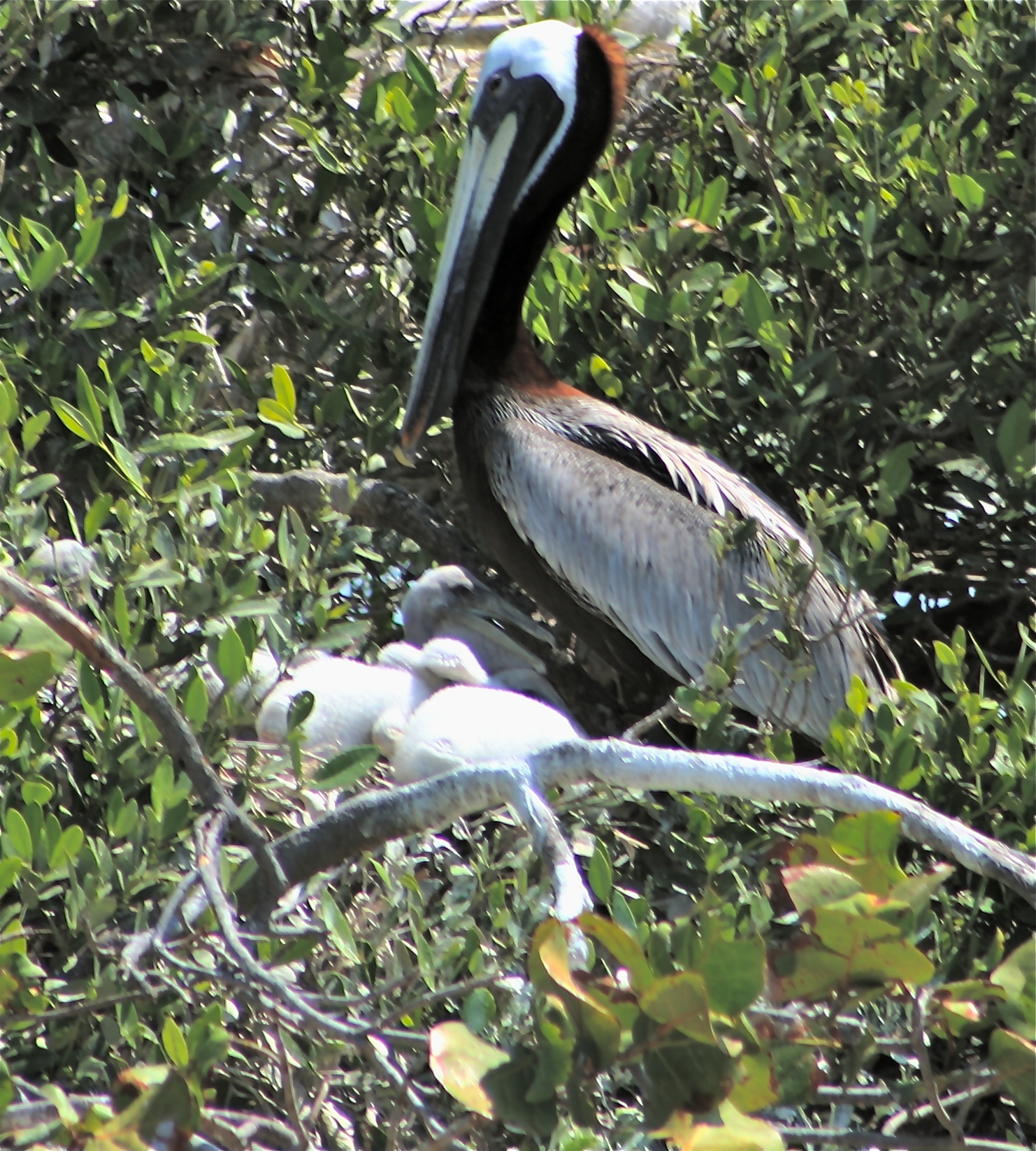
-Many types especially wood storks, great egrets, and a juvenile  brown pelican

-Brown pelican flies from island – view of many birds

-East side of island rocks to protect from erosion. Oyster catchers have nested here!


-Earlier blog post about Bird Island and diversity of species. 

Why are C-44 and S-2 flowing backwards into Lake Okeechobee? 

My brother, Todd,  wrote to me on June 8th noting that the C-44 canal was flowing westwards into Lake Okeechobee rather than dumping eastwards into the St Lucie as is standard operating procedure after a big rain…

Yes this canal, as most of the others, can “flow” in either direction, seemly “backwards.”

So how can this happen? This backwards flow?

Dr Gary Goforth says the following:

“Yes this is normal operations; generally when the Lake level is below 14 ft the Corps leaves the locks at S-308 wide open which allows any local runoff to flow into the lake.”

Another way Lake Okeechobee can receive water in an unusual way is if the water is pumped into it–back pumped. This has recently been done from the EAA. Back pumping into Lake O has been outlawed, but it is allowed if communities or farmland would flood.

According to an exchange yesterday on Facebook, with  Audubon’s Dr Paul Grey:

“St Lucie (C-44) backflows are just one of many southern inflows now, S-2 is backpumping, three other southern outlets are flowing backward into the low lake (L-8, S354, S-352) the Caloosahatchee was backflowing but appears equalized today. More water is flowing into the lake from downstream areas than upstream right now. Not the end of the world but not desirable either, it is very polluted water. http://w3.saj.usace.army.mil/h2o/reports/r-oke.html  “

When I asked Dr Grey if this was being done to gather water in the lake as we’ve recently been in a drought, or to keep the farmlands in the  EAA and surrounding areas dry, this was his response:

“Both, they want to fill the lake this summer, and so do I, in concept, but much of this backpumping and flowing is because the farmers have been pumping water so rapdily off their own lands they have made the canals too deep, and risk fooding the communities. And rather than tell the farmers the canal its too deep and they have to modererate their pumping, the SFWMD backpumps/flow it to the lake.”

In any case, when I visited yesterday during my trip to Belle Glade, S-308 was closed at Port Mayaca and no more water was entering Lake O from C-44. I’m not sure about S-2.

The water looks dark and full of sediment. The once beautiful beach is full of gritty rocks. Maybe the lake is healthy in the shallows south, near the islands, but by Port Mayaca it looks terrible. Algae has been reported by S-308 a few weeks ago according to a report from Martin County at the River’s Coalition meeting. But thankfully there is not algae reported in C-44 right now.

We have really made a mess of it. For our rivers and for Lake Okeechobee, the reservoir must be built and we must continue to advocate for sending cleaned water south and re -plumb this outdated system. Forward flow or backwards flow, just say NO.

6-13-17 JTL

____________________________________

Todd Thurlow notes 6-8-17

Jacqui,

Interesting note: if this data is correct, C-44 has poured 10.7 billion gallons (aka 13.82 Stuart Feet) of water into Lake Okeechobee in the last three days. With all the recent “local” runoff into the canal, they have opened S-308, sending the water west to the Lake to help get the low lake level up.

48.5 million gallons passed through S-80 to the St. Lucie on June 5th…

-Todd

C-44 back flow to Lake O, ACOE

Article in Okeechobee News by Katrina Elsken “St Lucie Water Flowing Into the Big O” http://okeechobeenews.net/lake-okeechobee/st-lucie-water-flowing-big-o/

SFWMD: https://www.sfwmd.gov

ACOE Lake O: http://www.saj.usace.army.mil/Missions/Civil-Works/Lake-Okeechobee/

Structures and canals south of LO
Canal and basin map, Martin and St Lucie Co,SLR/IRL. SFWMD
C-44 canal from Stuart to Lake O.
S-308 at Lake O and C-44 canal Port Mayaca

Numerous wood storks and great egrets eating fish in the polluted side canals of C-44:

Video:(http://www.youtube.com/watch?v=Z-7IwzHGZIM)

Bird Island, Indian River Lagoon, One of Florida’s Most Important Avian Breeding Grounds

Bird Island is one of the most productive breeding grounds for more than 15 species of birds and a rookery/visiting grounds to even more species. The island is owned by the state of Florida and managed by Martin County. It is located 400 feet from the Town of Sewall’s Point. (Most photos by Greg Braun, Sustainable Ecosystems International, story below.)

IMG_2346_3 IMG_2350 IMG_2353_2

Wood stork w nestling at MC-2 - GBraun OLYMPUS DIGITAL CAMERA OLYMPUS DIGITAL CAMERA Wood Stork w nesting material near MC-2 Braun

Just over three years ago, I was going through I guess a kind of mid-life crisis where I really was questioning what I was doing with my life. When I couldn’t seem to get it together, I decided to spend some time going back to “my roots,” to the things that made me happy as a kid. I called up family friend Nancy Beaver of Sunshine Wildlife Tours in Port Salerno, and asked her if I could volunteer on her boat a couple of times a week. She obliged, and slowly, I felt my passion for life return while being surrounded by the animals and birds in the St Lucie River/Indian River Lagoon. The highlight of every tour was “Bird Island,” located off my “very own” Sewall’s Point, as I was mayor of the town at the time.

I had seen the birds from far away, but to see the beautifully colored birds, especially their babies, through binoculars up close was incredible.

Bird Island, located in the Indian River Lagoon, just 400 feet off of the Sewall’s Point’s Archipelago is one of the most valuable nesting bird habitats along Florida’s east coast, really in all of Florida. Rarely are so many different kinds of birds in one location, breeding…

A wonder of nature, birds of all kinds fill the island, over 40 types visiting or roosting and at least 15 species of birds simultaneouly raising young.  At any time of late fall through spring hundreds of birds sometimes over a thousand, some say more, fill the island.

Greg Braun, of Sustainable Ecosystems International, was hired by Martin County for avian monitoring September 2011 thorough August 2012 and he documented observing 240  pairs of birds of 15 species nesting including the Wood Stork; Brown Pelican; Double-crested  Cormorant; Great Egret; Cattle Egret; Anhinga; Tri-colored Heron; Snowy Egret; Great Blue Heron; Litle Blue Heron; Black-crowned Night Heron; Great White Heron; Roseate Spoonbill; Black Vulture; Oystercatcher; and suspected White Ibis and a couple of  invasive Egyptian Geese.

So why this island? There are plenty of others to choose from in the area. Maybe it is for protection? Maybe its the eastern sandbar that keeps boaters at bay and gives the chicks a place to practice swimming and flying and the older birds can just hang out? Maybe its the nearby western seagrasses with its rich production of fish.

Nobody really knows but obviously the birds like it. Originally Bird Island, more scientifically known as “MC-2” was created in the 1940s as a by-product of dredging the Atlantic Intracoastal Waterway, (Braun, Avian Monitoring). My mother, historian, Sandra Thurlow, says there are verbal accounts of birds nesting on the island since the 60s and 70s, but again nobody is really sure when it began…

Man’s involvement remains controversial with the removal of tall Australian Pines a few years  back that the amazing Frigate Birds sat on, and then the building of a $600,000, 400 foot long rip-rap on the island’s northern side by Martin County to offset documented erosion. Now in the process is the Florida Wildlife Commission’s (FWC) possible creation of a  CWA or Critical Wildlife Area so that trespassing onto or very near the island would be a crime.

Personally, I think the  bird’s habitat should be very protected as the importance of the island is obvious and it is a rare thing. As far as the CRA status, the County is working through issues with local fishermen who use the area for bait catching, and other users of the area surrounding the island. I do hope some higher level of protection can be met.

Right now, signs surround the island in hopes of giving the birds the privacy they need to  raise their chicks, but curious kayakers and others often go very close flushing the birds off their nest, with masses of crows waiting  close by, putting the chicks at risk.  Sun exposure can also kill the young chicks. People don’t mean to but they often do disturb the island.

Another common problem is fishing line. Nancy Beaver and the FWC when in the area often see birds entangled in monofilament caught in the mangroves. Many birds are taken to the Treasure Coast Wildlife Center and saved; but many more are euthanized due to emaciation.

Bird Island was definitely affected by last year’s putrid release water from Lake Okeechobee and the other canals as is visible in an aerial photograph included in this blog.  During the releases, 85 percent of seagrasses died last summer according  to Florida Oceanographic Society. The bird’s feeding was/is certainly affected by such loss.

In the end, I do believe everyone agrees that Bird Island is an amazing place. Let’s get along like the many birds do and protect it! And if you have not seen it, maybe put it on your list of things to do!

___________________________________

Sunshine Wildlife Tours: (http://sunshinewildlifetours.com)

Audubon Martin County: (http://audubonmartincounty.org/index.php/home/item/51-bird-island-martin-countys-special-place)

Sustainable Ecosystems International: (http://sustainableecosystemsinternational.com)bird island releases

Bird Island, Greg Braun OLYMPUS DIGITAL CAMERA OLYMPUS DIGITAL CAMERA OLYMPUS DIGITAL CAMERA MC-2 GBraun Oystercatcher on beach - GBraun OLYMPUS DIGITAL CAMERA OLYMPUS DIGITAL CAMERA OLYMPUS DIGITAL CAMERA OLYMPUS DIGITAL CAMERA Green heron -GBraun Little Blue Heron - GBraun Frigatebirds at MC-2 GBraun greg, mike and pelican OLYMPUS DIGITAL CAMERA OLYMPUS DIGITAL CAMERA OLYMPUS DIGITAL CAMERA IMG_1092 IMG_1166 susan Bird Island DSC_9203e OLYMPUS DIGITAL CAMERA MC2 CWA Revised Boundary 5-20-13