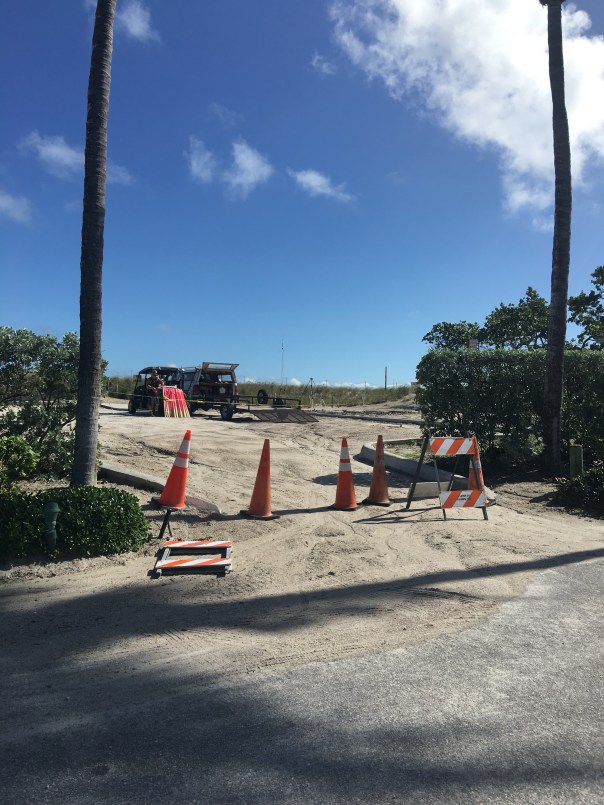
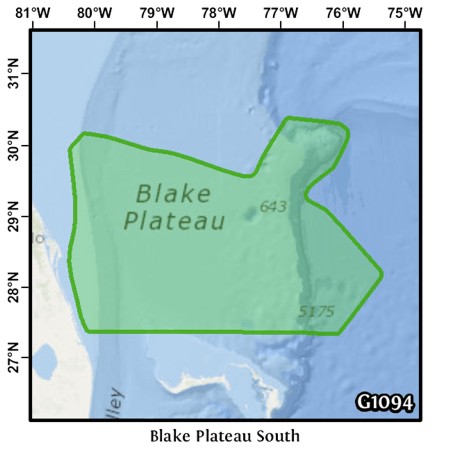
John Whitcar, of the famed local Whiticar Boat Works family, has been a longtime family friend, and I have featured his incredible photography before. Today’s shared photos were taken on March 5th.
He describes today’s photos below:
House of Refuge Huge Waves Monday, March 5, 2018 / Stuart Florida, USA 11 ft. waves coming in from North Easter off of New England. Very little wind / High Tide / ~11:00 am
The story of the House of Refuge is an amazing one, being the last of its kind, Old-Florida pine construction, having endured multiple hurricanes and other forces of time and nature, and still standing since 1876.
“US government houses of refuge were constructed to assist shipwreck survivors and were unique to the east coast of Florida. Ten were constructed between 1876 and 1886, but only but Martin County’s Gilbert’s Bar House of Refuge survives.” ~Historian Sandra Thurlow
The moral of the story?
Build your house upon a rock. ~Including the Anastasia Formation, preferably.
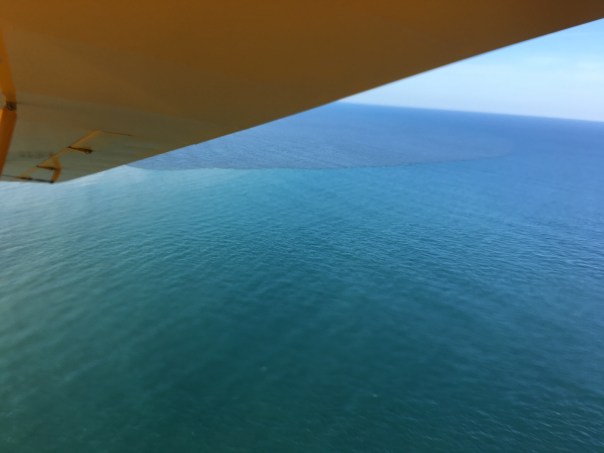
My husband, Ed, took these photos of the Indian River Lagoon at the St Lucie Inlet on 2-28-18, just a few days ago. They are certainly beautiful enough to sell real estate…The turquoise water is so pretty one could easily overlook the sand desert below the surface waters.
Enjoy the blue water, but know that especially since 2013, our seagrass beds have been decimated by black sediment filled waters and toxic discharges from Lake Okeechobee. Seagrasses are the nursery for all sea life, especially the baby fish. These beds need time to reestablish if they ever will.
True beauty has something to offer, not just “surface water.” Keep your eye on the lake and fight against any coming releases this summer so we can get life back in our dear dead river.
I am looking up at an absolutely blue and cloudless sky; white, sparkling sands are hot beneath my feet; and crashing waves of emerald green, mesmerize…
Blue. White. Green. This is all there is. This is the vision, the dream. And it is real. These are my memories of living at Pensacola Beach.
More than twenty years later, I am not dreaming. I am back, and I am fighting for CRC proposal 91, “no oil or gas drilling in Florida’s territorial seas,” our state waters.
In the early 1990s, I came to Pensacola from UF in Gainesville, to teach German and English at Pensacola High School in both the traditional and International Baccalaureate Program.
I learned perhaps as much as my students. It was hard and rewarding work. I matured here one could say.
Maturing didn’t just involve the discipline of being a teacher, but also the responsibility of my first dog. “Dash,” as he was named for his ability to sprint. Dash was a stray I found in Downtown’s Seville Square. He was as beautiful and white as Pensacola Beach with black spots over his eyes. Even my parents visited to meet him!
Every evening he sat by my side for hours as I graded papers long into night. I would leave at 6 am for the first bell at 7:01. When I got home from a day of teaching, Dash and I would swim at Pensacola Beach or take long walks to Fort Pickens and then of course, grade papers,
These were wonderful times! The powerful simplicity of the blue sky, the green waves, the white sands, and my white and black best friend, forever left an impression on me.
Below is a list and very scant summary of each of the 37 proposal that made it through the Constitution Revision Commission committee process, and thus it is now possible for any one of these to get on the 2018 Florida ballot.
Presently, continuing almost one year of work, the CRC is holding public hearings and you are invited to attend! http://flcrc.gov/Meetings/PublicHearing with focus on these 37 issues.
After the hearings the full CRC will decide on the 37…
As there is no easy way on the web site to find the 37 proposals, one can use the following list just to get an idea of the proposal topic. 1.) For complete information go to http://flcrc.gov/Proposals/Commissioner, 2.) then click the link under “Number” on far left side. 3.) Once a new screen comes up, click on “web-page” or “PDF” to read the language of the proposal. It is important to read the entire proposal to understand it in full.
Also, there is the possibility that a proposal that was voted on– and did not pass committee–could be resurrected. These are not on this list.
Thank you for your involvement in the great state of Florida! I hope this list is useful.
P3 Deleting language on prohibiting land ownership by “aliens” ineligible for citizenship
P4 Deleting language barring funds from public treasury to aid church, sect, or religious denomination…
P6 …judges may not defer to administrative agency’s interpretations of statute, must interpret de novo
P9 Veteran’s Affairs/Executive Branch language
P10 Civics education in public schools
P11 Closing the Write in Candidate loophole that closes Open Primaries as specified already in Florida constitution
P12 Deleting amendment for high-speed train as it was already repealed by amendment
P13 Requiring every county (charter/non charter) to elect constitutional officers: sheriff, tax collector, property appraiser and supervisor of elections
P20 Repeal of criminal statute shall not affect prosecution for any crime committed before such repeal
P26 Office of Domestic Security and Counter-Terrorism is created within the Florida Dept. of Law Enforcement
P29 E-Verify-deals (with immigration/business)
P33 All counties must appoint superintendents rather than vote for them
P34 “Clean-up” provision of Dec. of Rights (language)
P37 Only allows for buildings to be named for individuals after they have left office
P39 Must wait six years after leaving position of elected office in to lobby legislature
P41 Retirement age for judges would go from 70 to 75
P43 Would create an 8 year term limit for school board members
P44 University tuition increases would require “more votes” making it more difficult to increase tuition
P45 “nothing” may limit “other” education services —in addition to free public schools
P47 Certain judgeships would require 10 years of Florida Bar membership
P49 Benefits for surviving family members of first responders killed in duty
P50 A candidates for state legislature must live in district he or she is running for…
P54 Certificate of Need – can no longer limit number to given to an area…(i.e. hospitals/Hospice)
P55 Legislature pays off fees for clerks’ offices —where those fees are not taken by county residents
P65 Vaping added to constitution on “smoking in workplace”
P66 Lt. Gov would have official “duties”
P67 Banning betting on greyhound dog racing…
P71 Nothing may limit the legislature from creating alternative processes to authorize the establishment of charter schools…
P72 2/3 vote required of legislature to raise taxes or fees
P83 Specifies the purposes of the state college system and provides for a governance structure
P88 Bill of rights for nursing home residents
P91 Would ban oil and gas drilling in Florida’s state waters
P93 Would authorize school boards in high performing school districts to become “charter districts”
P94 Would allow funds from Statewide Tobacco Education and Prevention Program to go to cancer research
P96 Marcy’s Law- victims’ rights
P97 Not voting on constitutional amendment would be counted as a “no”- makes threshold to pass constitutional amendments more difficult for public
P103 Specifies dates for legislature to convene for regular session –second Tuesday after the first Monday in January of each even-numbered year
Just last weekend, I presented at the “Future of Florida Summit” at the University of Florida’s Graham Center. Eric Eikenberg, CEO of the Everglades Foundation, gave a passionate speech to hundreds of young people during the lunchtime session. My husband, Ed, usually quiet, turned to me saying: ” He is a really good speaker.”
The crowd listened…
Mr Eikenberg noted that he was a graduate of Marjory Stoneman Douglas High School in Parkland, Broward County, Florida and that even though the school was literally built in what was once the Everglades, there had not been studies on that subject while he attended the school. He talked about the importance of our state waters and the need to involve youth in the education of our natural world, especially here in South Florida.
Ironically, four days later, the horrific shooting at Mr Eikenberg’s alma mater, has called attention, once again, to the shortcomings, and cultural sickness in our society.
In 1991, the “Marjory Stoneman Douglas Everglades Protection Act” was enacted by the Florida Legislature becoming the precursor to the Comprehensive Everglades Restoration Plan (CERP). Douglas ended up asking for her name to be removed from the legislation. At the time, she was 103 years old. After fighting for the Everglades for a lifetime, she said she felt the legislation was too favorable to the Sugar Farmers. “Growers should clean up the water on their own land…” meaning the state and federal government shouldn’t be building Storm Water Treatment Areas with taxpayer dollars to do it for them….
In time, Ms Douglas’ name was removed.
I wonder if she were alive today, if she would want her name removed from the school? I doubt it. She may have been tough on those destroying the Everglades, but she had a soft heart for youth. Lore states that when she was starting her famed organization Friends for the Everglades she refused to have the membership fee too high for students to be able to join, as she knew they were the most internal of keys.
My greatest sorrow and prayers for the families of the dead.
May the blood of the slain remind us to stop looking at our phones, and to turn to nature and Nature’s God for insight and inspiration in this crazy and destructive human-made world.
Early in 2017, the work of the Constitution Revision Commission began. There were multiple public hearings around the state and thousands of public proposals were submitted for consideration. Out of the two thousand or so proposals, 103 of these were chosen by commissioners to be sponsored, or considered. 37 made it through the arduous committee process. Here is a list of those 37: http://flcrc.gov/PublishedContent/ADMINISTRATIVEPUBLICATIONS/CRCActiveProposalsHearings2018.pdf
Mind you, this list is difficult to interpret unless you go to the CRC website, hit the “Proposals” tab and put in the number of the proposal to read the text along with the details. This takes a lot of work. http://flcrc.gov
In the end, only a few of these 37 will be placed on the ballot for voter consideration. The full CRC will determine this after the second round of public hearings that is happening now.
As far as my proposals. I had 5 environmental proposals: #23 A Right to a Clean and Healthful Environment; #24 Commissioner of Environmental Protection; #46 Clarifying Amendment 1, Land Acquisition Trust Fund; #48 FWC/Wildlife Corridors; and #91 No Oil and Gas Drilling in Floirda’s Territorial Seas.
One proposal made it through committee out of five. P91 or “No Oil and Gas Drilling in Florida’s Territorial Seas” I am thankful, and cannot look back, or mope over what did not get through; I must now turn all of my energy to this one proposal. And a remarkable proposal it is! I hope you will support it too, even if you had your hopes up for one of the others, as P91 is the sole environmental proposal of the 37, and a monumental opportunity.
This proposal would protect our territorial seas, our state waters, the waters under our jurisdiction. These waters have been drilled before and, hands down, if the oil and gas industry can, they will influence our state legislature so that they can drill our coastal waters again. There is no doubt about it. Just study history!
If this proposal makes it to the ballot it will be absolutely historic. Don’t think about the politics, think about the legacy. We would be the only state in the nation to have this in our state constitution. This would sound a loud environmental message, forever…
We all know, drilling so close to shore, as is done in other coastal southern states, would be visually, environmentally, and economically destructive to Florida’s unique/peninsular marine, wildlife, real estate, and tourism resources.
It is written in Article II of our state constitutional that “we shall protect our natural resources and scenic beauty.” P91 belongs in Florida’s Constitution. It would be an enormous statement on behalf of the people of Florida and would have major policy implications on many, many levels.
Thank you for following the CRC process and I will keep you appraised of P91 as the CRC process continues and we move towards what gets on the ballot for 2018.
I remember my historian mother telling me that Paynes Prairie was once a giant lake and that in the mid-1800s, before a sinkhole drained the lake, famed pioneer and pineapple farmer, Capt. Thomas E. Richards sailed from the St Johns River, in Jacksonville, over the lake, only to wind up at the Indian River Lagoon in Eden, near today’s Jensen.
Well this past Friday, on my way to Gainesville for the “Future of Florida Summit” (http://www.futureoffloridasummit.com) Paynes Prairie looked like it had become a lake once again. Although it is not a truly a lake any longer, it must be flooded as the prairie’s water levels go up and down.
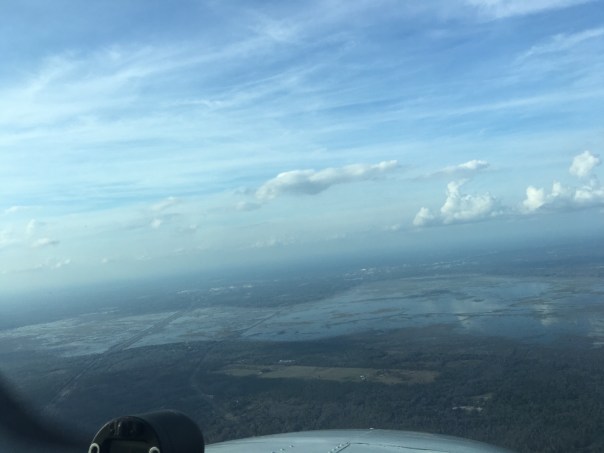
As my grandparents lived in Gainesville and I graduated from UF, I have driven across the prairie many times, but seeing it from the air “all wet looking” really took me aback. Like a miniature Tamiami Trail, one could see Highway 441 going right through this “lake!”
Apparently in 2000, eco-underpasses were installed as it has been widely documented that thousands of animals, mostly reptiles, have been killed on this road. And yet, many animals, reptiles and other, continue to be killed.
I know it would be expensive, but since transportation is perhaps one of the most highly funded of all state departments, in the billions and billions of dollars, and since Florida’s wildlife and natural lands rank as a portion of the state’s number one economic driver, tourism… could not, over time, Hwy. 441 become more like the Tamiami Trail is becoming, more bridged than flat…
It just doesn’t make sense to have a lake, or an Everglades, with a road through it.
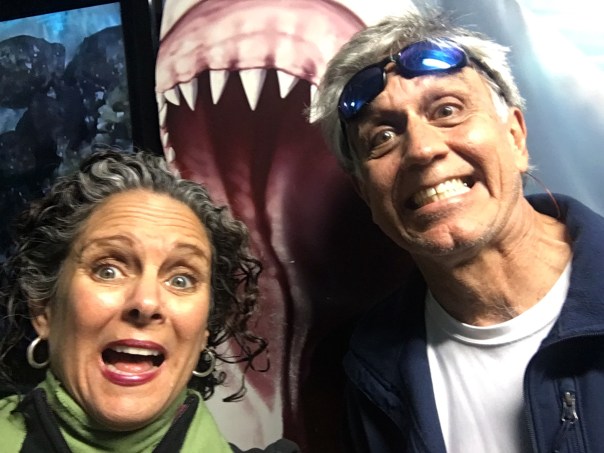
Ed and I, a selfie on the way to GainesvilleA rainbow in the sky
This photo of a panther in Sebring was recently shared by a friend. I do hope this magnificent creature has visited western Martin County. Since late October, it has certainly made the rounds. Males roam hundreds of miles, a female less, but easily could cover ground between almost neighboring Martin and Highlands counties.
Can you imagine trying to navigate today’s world? Freeways, subdivisions, fences, shopping malls, the great forests gone…Canals cutting the lands and watersheds apart?
Over 34 panthers were killed on Florida highways in 2016, and at least 23 in 2017. With an estimated 230 in the total population, those are terrible numbers. We must work harder to complete wildlife corridors across the state to allow these animals to breed and travel into north Florida and Georgia. Being stuck in South Florida is a radio-collared death wish.
If this panther does visit Martin County, we’ll probably never know it; though large they are smart to be very, very, shy.
I must say, lately I’ve been hearing rumors of panthers (yes, a pair) in Martin County near Highway 96 out by South Fork, but no photos yet…
Thank God there is something left to run wild in the world; 😊 it gives me something to dream about.
Last night’s twilight flight was a first for me, but not for my husband Ed. Usually, we fly in daylight chasing algae blooms or black Lake Okeechobee water…
Last night was just for fun, but one still feels the pull to protect this sacred place.
The beauty of the lands lighting up beneath us was almost as inspiring as the sunset. Humanity, such promise.
We do live in a beautiful place. A place to protect and call home…
This past Wednesday, I presented, P91 or “No Oil and Gas Drilling in Florida’s Territorial Seas” to the Declaration of Rights Committee of the Constitution Revision Commission. This was the second and final committee hearing and it passed! My other four environmental proposals were “killed”…
To be clear, as it is confusing, there are coastal territorial seas and there are offshore federal waters. This proposal would protect our territorial seas, our state waters, the waters under our jurisdiction. These waters have been drilled before and, hands down, if the oil and gas industry can, they will influence our state legislature so that they can drill our coastal waters again. There is no doubt about it. Just study history!
We all know, drilling so close to shore, as is done in other coastal southern states, would be visually, environmentally, and economically destructive to Florida’s unique/peninsular marine, real estate, and tourism resouces.
It is written in Article II of our state constitutional that “we shall protect our natural resources and scenic beauty.” P91 belongs in Florida’s Constitution. It would be an enormous statement on behalf of the people of Florida and would have major policy implications on many levels helping to keep all oil drilling away from our state today and in the future.
P91 is now one of 37 proposals of 103 that made it through the CRC committee process.
Today I am publishing the notes from my presentation that should be interesting and informative to readers.
Thank you for following the CRC process and I will keep you appraised of P91 as the CRC process continues and we move towards what gets on the ballot for 2018.
In the end, we must do something for our environment!
Fondly,
Jacqui
P91, presentation Declaration of Rights 1-31-18
Greetings Chair Carlton and Honorable Commissioners; I am Jacqui Thurlow-Lippisch from the Town of Sewall’s Point in Martin County.
This morning, I am pleased to be presenting P91, also known as, “no oil and gas drilling in Florida’s territorial seas.”
~So you may ask,“ what are Florida’s territorial seas?”
The boundaries of Florida’s territorial seas are based on the foresight of our forefathers who expanded the boundaries of Florida, accepted into Florida’s Constitution in 1868 during the era we rejoined the Union. These boundaries are defined as: three marine leagues, or approximately 9 miles, on to the west coast, in the Gulf of Mexico, and extending as far as the shifting Gulf Stream, or three miles east, which ever is further, into the Atlantic Ocean off Florida’s east coast.
The US Code defines Florida’s territorial seas as three marine leagues on the west cost, and three miles out on the east coast.
Most of us have forgotten our history, but in 1944 Florida sold “everything hugging the shore out to 10.36 miles, from Apalachicola to Naples,” on the Gulf Coast to Arnold Oil Company. These lands consisted of of 3.6 million acres.
After decades of embittered fighting, unsuccessful exploration, and a movement to end the leases, in 1989 the Florida legislature banned oil and gas drilling in Florida’s territorial waters and stopped collecting lease money from the oil company that had the rights to these leases lands.
The battle ensued over time and party lines, but in 2002 Governor Jeb Busch with the help of his brother, the president of the United States, arranged for the oil company to accept 12.5 million state dollars to “abandon all further claims.” This transaction was finalized by 2005 with great fanfare of the public that was ecstatic to have Florida’s beautiful beaches and important natural resources “off the table.”
And yet by 2006 there were rumblings and by 2009, there was even serious talk of a bill on the floor of the Florida Legislature allowing for drilling within five miles of Florida’s west coast. Once again, tremendous pressure to reopen Florida’s territorial seas!
In 2010 the nightmare of the BP Deepwater Horizon really took this possibility off the table for discussion, but we must not be naive, especially in the current climate, this threat to our shores is still there!
Today, you as Commissions of the Constitution Revision Commission have a chance to make history by voting “yes” on P91 “no oil and gas drilling in Florida’s territorial seas,” giving the possibility for Floridians to put language into our state constitution in 2018 that would protect Florida.
The next phase of the CRC is public hearings; there is a hearing in Ft Lauderdale tomorrow. After the public hearings the final proposals will be chosen to go on the 2018 ballot. http://flcrc.gov/Media/PressReleases/Show/1071
Jacqui Thurlow-Lippisch is a member of the 2018 CRC, all comments are public record: http://flcrc.gov/Commissioners/Thurlow-Lippisch
Article 11 Sec. 1 of our constitution defines Florida’s boundaries. Our forefathers had foresight in doing this. Our boundaries are much more extensive than other coastal sates. May we have the same foresight in expanding the boundaries to protect or territorial seas.
The Florida Capitol is a walk through our state’s history. It’s really worth a visit just to look around. Over most of the walls, hang portraits and pictures that tell the story of our state.
Today, I thought I would feature what I call the “Hall of Governors” that one passes on the way to the Constitution Revisions Commission’s (CRC) headquarters. My photos are taken right to left as I exited the CRC, adjacent to the Governor’s office.
From what I understand, each governor has input into the mood and composition of his, (as there are yet no “her”), portrait. I find this very interesting. Look closely and see what this reveals.
And what shall be our future?
Le Roy Collins 1955-1961Charlie Crist 2007-2011Claude Kirk 1967-1971Jeb Bush 1999-2007Ruben Askew 1971-1979Buddy MaKay 1998-1999Bob Graham 1979-1987Lawton Chiles 1991-1998Wayne Mixon January 3, 1987-January 6, 1987Bob Martinez 1987-1991
Recently, I convinced my husband, Ed, to come up to Tallahassee with me for the “State of the State” reception at the Governor’s mansion.
It was very exciting; however, we had waited in line for almost an hour, to shake hands with the Governor and First Lady, when a secret service man told me we weren’t going to make the cut. The line was cut off one person in front of me!
“You’re kidding? That’s a bummer.” I thought. “Maybe they’ve had enough of my controversial Constitution Revision Commission environmental proposals? Perhaps I’ve been put on the Affiliated Industries of Florida’s blacklist? Just chance? Hmmm. I can handle it, but poor Ed!”
I tried to negotiate with the secret service man. He was not budging.
While I moped, Ed seemed unaffected, rolled his eyes, smiled, and headed for the bar.
I, on the other hand, could not let go. I was determined to have the Governor see me, or for me to see the Governor, so I moved as far to the front of the room as I could.
When I was right up with the crowd surrounding the Governor, I saw an empty chair. I didn’t see any secret service men staring at me, so I sat in the chair. I could see everything!
But, right at that moment the Governor, First Lady, and crew made a quick exit, and I was sitting there in my black dress, and fake fur, trying to look cool, gazing purposely at a book on the side table.
It was beautiful, very old, and entitled,”Florida Land of Enchantment.” Old-fashioned keys covered the historic book’s fading green face. I stared at it thinking about how the mystique of Florida is “what built Florida.” And how that historic mystique was, and remains, built on the enchantment of Florida’s lands.
Well, Ed and I didn’t get to shake hands with the Governor or First Lady, but I got to see this magnificent book and I’ll never forget it.
This Friday, at 11:00 am, my fourth CRC proposal, P46, or Land Acquisition Trust Fund, goes before the CRC Legislative Committee. The goal of P46 is to have a very needed conversation and to clarify language in Article X, Section 28 of Florida’s Constitution (Amendment 1, 2014) and direct the state legislature to deposit no less that one third of the revenue, not to exceed 300 million annually, into the Florida Forever Trust Fund. This money would go specifically to conservation land purchase as prioritized by the long standing and once “always funded” Florida Forever program.
I already know, there are many reasons, and many conspiracy theories, about why the state legislature has stopped funding Florida Forever. And no matter what occurs at the CRC meeting, the proposal will not be self-executing. We cannot force the legislature to spend money a certain way. That is their prerogative, a power that is derived for them alone from the state constitution.
But a strong message can be sent. A directive can be given. And shouldn’t they listen? They should.
How many years has that book been sitting by the table? Governors and legislatures will come and go, but if “Florida, the land of enchantment,” is to remain, we must continue to invest in Florida Forever.
Serving on Florida’s Constitution Revision Commission the past year, I have learned quite a bit. Ingredients certainly have their place in the cookbook of Tallahassee, but the final recipe followed belongs to those in power.
Unless…you can come up with a recipe that is failsafe, a recipe that is “self executing.”
Let’s review a definition of self-executing: “A constitutional provision is self–executing when it can be given effect without the aid of legislation, and there is nothing to indicate that legislation is intended to make it operative.”
Remember P23, “A Right to Clean and Healthful Environment?” My proposal that was met with tremendous statewide opposition, the one Affiliated Industries of Florida hired four Gunster attorney’s to fight? The proposal that was voted down on January 12 by the Judicial Committee?
I believe that proposal was “so threatening” because many believed, or wanted to believe, that the proposal was “self executing.” Meaning if it got into the Florida constitution, like a light switch everything would just change as it would go into effect without direction from the legislature.
Let’s look at the language of P23
(c) The natural resources of the state are the legacy of
27 present and future generations. Every person has a right to a
28 clean and healthful environment, including clean air and water;
29 control of pollution; and the conservation and restoration of
30 the natural, scenic, historic, and aesthetic values of the
31 environment as provided by law. Any person may enforce this
32 right against any party, public or private, subject to
33 reasonable limitations, as provided by law.
On the other hand, if you look at the language for Amendment 1, 2014 that passed by 74.9% by Citizen Initiative, the language is definitely not-self executing.” The legislature has to “make it operative” —as it has to do with money, appropriations….
Florida Constitution, Article X
SECTION 28.Land Acquisition Trust Fund.—
(a)Effective on July 1 of the year following passage of this amendment by the voters, and for a period of 20 years after that effective date, the Land Acquisition Trust Fund shall receive no less than 33 percent of net revenues derived from the existing excise tax on documents, as defined in the statutes in effect on January 1, 2012, as amended from time to time, or any successor or replacement tax, after the Department of Revenue first deducts a service charge to pay the costs of the collection and enforcement of the excise tax on documents.
(b)Funds in the Land Acquisition Trust Fund shall be expended only for the following purposes:(1)As provided by law, to finance or refinance: the acquisition and improvement of land, water areas, and related property interests, including conservation easements, and resources for conservation lands including wetlands, forests, and fish and wildlife habitat; wildlife management areas; lands that protect water resources and drinking water sources, including lands protecting the water quality and quantity of rivers, lakes, streams, springsheds, and lands providing recharge for groundwater and aquifer systems; lands in the Everglades Agricultural Area and the Everglades Protection Area, as defined in Article II, Section 7(b); beaches and shores; outdoor recreation lands, including recreational trails, parks, and urban open space; rural landscapes; working farms and ranches; historic or geologic sites; together with management, restoration of natural systems, and the enhancement of public access or recreational enjoyment of conservation lands.
(2)To pay the debt service on bonds issued pursuant to Article VII, Section 11(e).
(c)The moneys deposited into the Land Acquisition Trust Fund, as defined by the statutes in effect on January 1, 2012, shall not be or become commingled with the general revenue fund of the state.
So now Amendment 1 2014, has sat in the Florida constitution since 2015 and funds have been spent have been spent for agency salaries, risk management, vehicles, but not conservation land purchase.
Why because the language is not self-executing. And because the state legislature is not minding the will of the people.
As a CRC member, I took on P46, now know as Article X, Section 28, Land Acquisition Trust Fund because the public repeatedly asked the CRC to address this issue during the public hearings and on-line.
I am now realizing even with new language, or an amendment, Land Acquisition Trust Fund will remain non-self executing.
I can fight for the intent of Amendment 1, 2014, and that I will, but I cannot make Article x, Section 28 Land Acquisition Trust Fund self-executing. For that we need new cooks in the kitchen.
CRC - 2017P 46
By Commissioner Thurlow-Lippisch
thurlowlj-00052-17 201746__
1 A proposal to amend
2 Section 28 of Article X of the State Constitution to
3 revise the manner of the distribution of funds that
4 are deposited into the Land Acquisition Trust Fund
5 from a portion of the net revenues derived from the
6 excise tax on documents.
7
8 Be It Proposed by the Constitution Revision Commission of
9 Florida:
10
11 Section 28 of Article X of the State Constitution is
12 amended to read:
13 ARTICLE X
14 MISCELLANEOUS
15 SECTION 28. Land Acquisition Trust Fund.—
16 (a) Effective on July 1 of the year following passage of
17 this amendment by the voters, and for a period of 20 years after
18 that effective date, the Land Acquisition Trust Fund shall
19 receive no less than 33 percent of net revenues derived from the
20 existing excise tax on documents, as defined in the statutes in
21 effect on January 1, 2012, as amended from time to time, or any
22 successor or replacement tax, after the Department of Revenue
23 first deducts a service charge to pay the costs of the
24 collection and enforcement of the excise tax on documents.
25 (b) Funds in the Land Acquisition Trust Fund shall be
26 expended only for the following purposes:
27 (1) No less than one-third of the revenue must be deposited
28 into the Florida Forever Trust Fund, as defined by the statutes
29 in effect on January 1, 2017.
30 (2) The remainder must be expended as provided by law, to
31 finance or refinance: the acquisition and improvement of land,
32 water areas, and related property interests, including
33 conservation easements, and natural resources for conservation
34 lands including wetlands, forests, and fish and wildlife
35 habitat; wildlife management areas; lands that protect water
36 resources and drinking water sources, including lands protecting
37 the water quality and quantity of rivers, lakes, streams,
38 springsheds, and lands providing recharge for groundwater and
39 aquifer systems; lands in the Everglades Agricultural Area and
40 the Everglades Protection Area, as defined in Article II,
41 Section 7(b); beaches and shores; outdoor recreation lands,
42 including recreational trails, parks, and urban open space;
43 rural landscapes; working farms and ranches; historic or
44 geologic sites; together with management, restoration of natural
45 systems, and the enhancement of public access or recreational
46 enjoyment of conservation lands.
47 (3)(2) To pay the debt service on bonds issued pursuant to
48 Article VII, Section 11(e) as may be required.
49 (c) The moneys deposited into the Land Acquisition Trust
50 Fund, as defined by the statutes in effect on January 1, 2012,
51 shall not be or become commingled with the general revenue fund
52 of the state.
P46 will go before the CRC Legislative Committee on Friday, January 26. You can write committee members here: https://flcrc.gov/Committees/LE/
Growing up in Stuart in the 1970s, my mother and father gave me full reign to explore the undeveloped lands in the area of St Lucie Estates. I remember endless summers, wandering around in “the woods” and of course my eyes were drawn to the vine of the widely dispersed, perfectly shaped, red and black seeds known as rosary peas.
I would collect them tightly in my little, sweaty hands, pushing them far down into my pockets. I recall the first time I brought them home, my mother said, “Yes, they are very pretty, but don’t eat them, they are poisonous.”
“Hmmm,”I thought. “How can something beautiful be poisonous?”
I continued to collect the seeds, and over the years filled up many clear glass bottles that sat in my window sill; the sun never fading their brilliant color.
Later in life, I learned that bright color patterns, especially red, black, and yellow, as with some caterpillars, or the famous, shy, and deadly coral snake, are “warnings” in nature and actually provide the animal with protection from being eaten.
As I walk through Hawk’s Bluff today, I am thankful to my parents who allowed me to explore the natural world and grow confident, unafraid, even with all of its toxic beauty.
When I was a kid, many of Stuart’s older restaurants had signs. Some locals may recall Jake’s on US1, or still today, Harry and the Natives in Hobe Sound. There are certainly others, nevertheless, there seem to be fewer restaurants with funny signs hanging on the walls than when I was a kid.
Thus it was awfully refreshing when Ed and I were at Lake Okeechobee this past Monday and I forced him to drive north, close to the rim, on the Old Conners’ Highway to J&S Fish Camp. He was hemming and hawing the whole way, thinking I didn’t know where I was going, but I did. When we finally got there, after driving about four miles north of Port Mayaca, we had a beer in the Tiki Bar, read the collection of signs, listened to an awesome old jukebox playing our favorite songs, and laughed so hard we felt like we were young again.
With all of the development in Florida right now, and 26,000,000 people expected to live here by 2030, places like this become even more wonderful.
That they are “one in a million” is just a sign of the times….
Campgrounds outnumber lodgings along Lake Okeechobee, drawing visitors outdoors. Wayne McSwain, who was raised in Belle Glade, remembers camping along the shoreline of Lake Okeechobee. “You camped along this canal, because there were a lot of trees here,” he said, pointing down from his perch atop the Herbert Hoover Dike, “and you came out here and swam every day, and water-skied… and you didn’t worry about the alligators at all.”
McSwain’s father ran the grocery store on the road to Torry Island, along the way to Slim’s Fish Camp. “It was (started by) the Corbins,” McSwain said. “A lot of people from out of town came over here for fishing.” To get to Slim’s, you cross one of the last remaining manually operated swing bridges in the United States. “I was 14 or 15 when Slim let me turn the rod to make the bridge pivot out of the way,” McSwain said. “It was fun for me, and I bet he got paid for it, too.”
Camping along Lake Okeechobee has changed since McSwain’s youth. With construction of the dike, a key protective barrier given the seasonal threat of water-intensive hurricanes, away went the views and the easy access. Still, the lake draws campers all year. They settle into fish camps, bring RVs for the winter to the campgrounds lining the eastern shore and hike into primitive campsites along the Florida Trail. The one campground with a view of the blue horizon was briefly known as Pahokee State Park. “The land still belongs to the state,” said McSwain, “but they’ve leased it out to campground operators for the past 30 years or so.” It’s now Lake Okeechobee Outpost KOA with a lakefront pool and restaurant.
At J&S Fish Camp, regulars crowd the bar at 10 a.m. “We know we’re the oldest fish camp around the lake,” said manager Ted Miller. “The cabins were built for the people who worked building the dike.” For the price of “a beer and a stay in a cabin,” the murals of alligators and lakeshore came from an artist’s brush, and the 1930s cabins took on tropical hues. Lake levels affect business dramatically. “When the locks are open,” said Miller, “we have fishermen come in for boiled peanuts and a beer and to have a look.”
Face down on the dike at Lake Okeechobee, photo Ed Lippisch 1-15-18
On Monday, I had Ed drive me to the lake. I needed to see it face-to-face, and be reminded of why I am driven to protect Florida’s environment.
It was a beautiful, chilly, day and as I lay on the warm earth, soaking it all in, Ed snapped a photo. I laughed when I saw it, thinking it summarized my experience at the Constitution Revision Commission last week in Tallahassee.
A triple knock out.
But I am back up, and today will fill you in on last week, and note what remains possible for the future.On Thursday, January 11th, I presented two proposals to the Executive Committee; a committee upon which I serve. Both proposals were voted down.
They were: P 24, “Creating a Commissioner of Environmental Protection,” and P48, “FWC/Wildlife Corridors.”
I presented right after highly respected, former Senate President, Don Gaetz, who spoke in favor of a making the Secretary of State, once again, a cabinet position.
We were both voted down. The committee had no tolerance for expanding the executive branch in any form.
On Friday, I awoke to torrential rains and cold temperatures, rushing to make it in the darkness by 8:00 am to stand before the Judicial Committee, finally, for a vote on controversial, Gunster-attorney-fought, and widely reported P23, “A Right to A Clean and Healthful Environment.” It was voted down by every member of the committee as it would have created a new “cause of action,” and given citizens standing, regarding environmental claims, in a court of law. In the committee’s opinion, P23 would have caused a Florida litigation nightmare.
For me, the lack of prioritization for the environment, the over-protection of permit holders, and the “buddy-agency-system,” holding it all in place, is already causing a “nightmare;” thus, I was all for a change and in favor of this student-inspired proposal that spoke for what the CRC is supposed to be speaking for—-its citizens.
In any case, it was quite a lesson for me, bleeding my heart out, and getting denied. I was not embarrassed, just kind of numb. I must say, it was very kind, and I appreciated that many of my comrades complimented my efforts and encouraged me to continue my fight, right before the knock-out punch. 🙂
Thank you to reporter Jim Turner, from the News Service of Florida, who stood with me afterwards as I mumbled trying to find words to instill inspiration in my defeat. His article is a good summary:
P48, “Clarifying Language Amd. 1, 2014, Land Acquisition Trust Fund” and
P91, “No Oil and Gas Drilling in Florida’s Territorial Waters”
No dates have been set to hear these proposals, but in the meanwhile, I am back up on my feet and getting ready for the next round. I know it will come. I have been studying one of my favorite boxers, Sugar Ray Leonard, who was a favorite of my students in Pensacola, for some moves. I’m going to be ready!
Thanks for you support and for your love of Florida’s environment.
Ed on the dike with Bo and Luna, Lake Okeechobee 1-15-18I’m standing….S-308 at Port Mayaca, the awful ACOE structure that allows water in from Lake Okeechobee that destroys the St Lucie River/Indian River Lagoon; note color of water even in winter, video below.
The following are my notes, images, and basic outline for my presentation to the CRC Executive Committee for P24, Creating a Commissioner of Environmental Protection. I will present on January 11th at 11am. JTL
To write to members of Exec. Committee in support or with concerns: https://www.flcrc.gov/Committees/EX/
____________________________________________________
Notes: P24, Creating a Commissioner of Environmental Protection or “CEP.” SAVE THE FLORIDA GOOSE
Inspiration
~”Florida has this magical thing— that one person can make a difference…” CRC Chair Carlos Beruff, 4-12-17, interview, Florida Channel
~2 members of the public verbally presented the idea of Commissioner of Environmental Protection thus a Cabinet position for the environment during the CRC Public Hearings that took place across the state in 2017.
~Public Proposal 700012 was submitted in written form by Mr Gamez below:
PUB 700012: To Make a Broader Approach to Protecting the Environment by Carlos Gamez
ARTICLE IV: EXECUTIVE, New Section. Catchline: Department of Environmental Protection The Legislature may create a department of Environmental Protection and prescribe its duties. The provisions governing the administration of the department must comply with Section 6 of Article VI of the State Constitution.
This led to P24, sponsored by JTL .The people were the inspiration for this proposal.
CRC - 2017P 24
By Commissioner Thurlow-Lippisch
thurlowlj-00025A-17 201724__
1 A proposal to amend
2 Sections 3 and 4 of Article IV and create a new
3 section in Article XII of the State Constitution to
4 establish the office of Commissioner of Environmental
5 Protection as a statewide elected officer, to provide
6 duties of the commissioner, and to include the
7 commissioner as a member of the Cabinet.
8
9 Be It Proposed by the Constitution Revision Commission of
10 Florida:
11
12 Sections 3 and 4 of Article IV of the State Constitution
13 are amended to read:
14 ARTICLE IV
15 EXECUTIVE
16 SECTION 3. Succession to office of governor; acting
17 governor.—
18 (a) Upon vacancy in the office of governor, the lieutenant
19 governor shall become governor. Further succession to the office
20 of governor shall be prescribed by law. A successor shall serve
21 for the remainder of the term.
22 (b) Upon impeachment of the governor and until completion
23 of trial thereof, or during the governor’s physical or mental
24 incapacity, the lieutenant governor shall act as governor.
25 Further succession as acting governor shall be prescribed by
26 law. Incapacity to serve as governor may be determined by the
27 supreme court upon due notice after docketing of a written
28 suggestion thereof by fourthree cabinet members, and in such
29 case restoration of capacity shall be similarly determined after
30 docketing of written suggestion thereof by the governor, the
31 legislature or fourthree cabinet members. Incapacity to serve
32 as governor may also be established by certificate filed with
33 the custodian of state records by the governor declaring
34 incapacity for physical reasons to serve as governor, and in
35 such case restoration of capacity shall be similarly
36 established.
37 SECTION 4. Cabinet.—
38 (a) There shall be a cabinet composed of an attorney
39 general, a chief financial officer, a commissioner of
40 environmental protection, and a commissioner of agriculture. In
41 addition to the powers and duties specified herein, they shall
42 exercise such powers and perform such duties as may be
43 prescribed by law. In the event of a tie vote of the governor
44 and cabinet, the side on which the governor voted shall be
45 deemed to prevail.
46 (b) The attorney general shall be the chief state legal
47 officer. There is created in the office of the attorney general
48 the position of statewide prosecutor. The statewide prosecutor
49 shall have concurrent jurisdiction with the state attorneys to
50 prosecute violations of criminal laws occurring or having
51 occurred, in two or more judicial circuits as part of a related
52 transaction, or when any such offense is affecting or has
53 affected two or more judicial circuits as provided by general
54 law. The statewide prosecutor shall be appointed by the attorney
55 general from not less than three persons nominated by the
56 judicial nominating commission for the supreme court, or as
57 otherwise provided by general law.
58 (c) The chief financial officer shall serve as the chief
59 fiscal officer of the state, and shall settle and approve
60 accounts against the state, and shall keep all state funds and
61 securities.
62 (d) The commissioner of environmental protection shall have
63 supervision of matters pertaining to environmental protection
64 that the Department of Environmental Protection or its successor
65 agency and water management districts are required or authorized
66 by law to implement and administer.
67 (e) The commissioner of agriculture shall have supervision
68 of matters pertaining to agriculture except as otherwise
69 provided by law.
70 (f)(e) The governor as chair, the chief financial officer,
71 and the attorney general shall constitute the state board of
72 administration, which shall succeed to all the power, control,
73 and authority of the state board of administration established
74 pursuant to Article IX, Section 16 of the Constitution of 1885,
75 and which shall continue as a body at least for the life of
76 Article XII, Section 9(c).
77 (g)(f) The governor as chair, the chief financial officer,
78 the attorney general, the commissioner of environmental
79 protection, and the commissioner of agriculture shall constitute
80 the trustees of the internal improvement trust fund and the land
81 acquisition trust fund as provided by law.
82 (h)(g) The governor as chair, the chief financial officer,
83 the attorney general, the commissioner of environmental
84 protection, and the commissioner of agriculture shall constitute
85 the agency head of the Department of Law Enforcement.
86
87 A new section is added to Article XII of the State
88 Constitution to read:
89 ARTICLE XII
90 SCHEDULE
91 Recomposition of the cabinet; commissioner of environmental
92 protection.—The amendment to Section 4 of Article IV relating to
93 the election of the commissioner of environmental protection and
94 the inclusion of the commissioner as a member of the cabinet
95 shall take effect January 3, 2023, but shall govern with respect
96 to the qualifying for and the holding of the primary and general
97 elections for the office of commissioner of environmental
98 protection in 2022.
THE TIME IS NOW for the Environment to get a Seat at the Table.
Florida Chamber’s population growth projections: 6,000,000 more people for a population of 26,000,000 people by 2030…
1000 Friends of Florida “A Population Distribution Scenario for the State of Florida” 2060. This shows the areas projected to become the most populated highly impacting natural lands and water resources.
FEGN- Florida Ecological Green Network Priorities, 2016. This map shows the importance of creating a priorities for Wildlife Corridor creation in the growing state of Florida. Done correctly we can have both growth and connected lands for wildlife and water. But we must plan now for the next 20 years and beyond. We will never have this chance again.
Florida Department of Environmental Protection map below shows Impaired Waters of the State: 53% Rivers; 82% Lakes; 32% Estuaries. This doesn’t even mention our very impacted and magnitude lessened springs.
Water management districts have individual governing boards but the Department of Environmental Protection may exercise general supervisory authority over water management districts (s. 373.026(7), Florida Statutes). I think “may” in this sentence needs to be reinterpreted. It is too weak for today’s pressures.
Creating a Comr. of Environmental Protection would elevate today’s “Department of Environmental Protection” giving it more autonomy and less impact from the often destructive and brutal pendulum swings of politics.
Agriculture already has a Cabinet seat and has a Dept of Water Quality that oversees Best Management Practices. Why shouldn’t the environment be on equal footing with Agriculture? The environment and Florida’s tourism industry are the number one income generator of the state, agriculture claims the number two spot.
We must note that since the last CRC in 1998, our waters have become even more impaired and our lands purchases are not always well represented to the Legislature or mindful of the importance of “connectedness.” Having a Commissioner of Environmental Protection would give us leadership for a higher standard, better communication, and better success for all the public to see.
Would the people of Florida support a Commissioner of Environmental Protection? Absolutely. The people of Florida have spoke loudly in 2014. Amendment 1, 2014 now in the Florida Constitution as Art X, Sec. 28 continues to be controversial as the legislature resented what they saw as forced direction of appropriations/money. Nonetheless, it was the will of the people. A Commissioner of Environmental Protection could help ameliorate this situation with the State Legislature and and the public.
*October 2016 Poll: “Top Concerns of Floridians are economy and environment.”~ Miami Herald. (Water related problems top concern 34%; 20% Loss of Natural Lands for Wildlife second.) “The focus on the environment as top concern behind the economy should not surprise anyone who has lived in Florida…Florida’s economy has long been closely linked to its environmental assets.”
As Chair Beruff stated: “Florida has this magical thing...”
We must think about this….
If we lose the magic, if will don’t protect our environment and the people’s love of it, we lose “Florida,” killing our Goose that lays our Golden Egg…
“A cottager and his wife had a Hen that laid a golden egg every day. They supposed that the Hen must contain a great lump of gold in its inside, and in order to get the gold they killed her. Having done so, they found to their surprise that the Hen differed in no respect from their other hens. The foolish pair, thus hoping to become rich all at once, deprived themselves of the gain of which they were assured day by day…” Aesop’s Fables
In closing:
The need for Leadership; Give the Environment a Seat at the Table with a Florida Cabinet member; CRC can put P24 on the 2018 ballot and allow the electorate to vote for a Commissioner of Environmental Protection in 2022. Save the Florida Goose.
Organizational Chart for Florida 2017P24 proposed change
I was appointed to the Constitution Revision Commission, that meets only once every 20 years, last February, by Senate President Joe Negron (https://www.flcrc.gov). After a dizzying time, I’d say, I feel like I am finally catching my stride. The entire experience has been a lot like when I moved to Berlin, Germany in 1989. It was cold and I did not speak the language, but after many months of study and applying myself, it started to feel natural.
I have learned the CRC history; mastered the insane elevator system at the Capitol; gotten insight into the complexities of power and politics; met people from all over the state with their own serious issues; recognized the incredible importance of staff and of journalists; have learned how to run an effective legislative-style meeting; and how to stand my ground on a vote.
I have tried to apply the “5-Cs” that an army general taught me years ago…. Communication, Collaboration, Compromise, Cooperation, and Consensus…
As you may know, I sponsored 5 CRC environmental proposals. These came from the public’s submittals on-line, or from a public hearing earlier last year. One was a former citizen’s initiative. Today I will review where I am and where I think things are going.
The proposal that has gotten the most attention as well as the most push back–with 4 AIF hired Gunster lawyers, one a former Supreme Court Justice, fighting tooth and nail—has been P23, “A Right to Clean and Healthful Environment.” It was workshopped and heard by the Judicial Committee and I expect it to be voted on Friday, January 12, 2018. Due to the controversy, the prognosis does not look good, but it has raised environmental awareness for all of the proposals, and in my opinion made the business and government community look desperate to hold on to Florida’s “standard environmental operating procedure” that puts corporations and development before people. This power will not last forever, and we are all dependent on Florida’s good nature for our “riches.” —A search will pull up a multitude of editorials, news articles, and opinions, on this subject.
Two others will also be heard this coming week. P24 “Commissioner Environmental Protection”and P48 “FWC/Wildlife Corridors.” Both of these will be discussed and voted on by the Executive Committee of which I happen to sit on. P48 would allow FWC to protect habitat not just species. This seems a no brainer as how can you have species without protecting their habitat; but private property and development rights play into the equation so it will be a fight. I look forward to the discussion and for all of us to realize that one way or another, the only way to approach Florida’s growth filled future is with the pragmatic goal of statewide living wildlife corridors, connected and protected lands.
P24 would establish a Commissioner of Environmental Protection. A cabinet position. Just like Agriculture. Since the environment is linked to our number one state income generator–tourism it seems the time has come….challenging power structures is always a wrestling match, but this is one we can win.
The following week, on January 18, I expect to go before the Legislative Committee for P46, “Clarifying Language in Amendment 1 2014, or Land Acquisition Trust Fund.” It was heard once already but “temporarily postponed” to requests by committee and myself to work on the language. Sue Mullins and Clay Henderson are backbone of this proposal, know the background, etc., and I am fortunate to have their expertise.
And finally…
I expect on January 19 to go before the Declaration of Rights Committee for P91,”No gas and oil drilling in Florida’s territorial waters.”
P91 is the only one of the five proposals to have “passed committee” in December. What is so amazing to me about this proposal is its timeliness. When I took it on, I actually first thought to myself, “You know, isn’t this kind of pase’? The River Kidz were protesting oil drilling with Surfrider Foundation in 2012. This won’t happen here…” But because it was past citizens’ initiative, and the language had already been reviewed, and because Manley Fuller who is a legend in the environmental community and the president of the Florida Wildlife Federation brought it to my attention, recommending I support it, I submitted the proposal three minutes before the deadline.
Now many months have passed and things have quickly changed. As headlines explode with oil drilling and federal opening of submerged lands including Floirda’s…it seems serendipitous that this proposal is lined up for the CRC, every Florida politician — regardless of party affiliation, and the diverse citizens of the state of Florida to support.
Some people would call it a “God-wink;” I like to think so. I will fight for every proposal, but it sure is nice to feel the wind at my back.
Rainbow over the Atlantic Ocean. (Jensen Beach, 2-8-15, Jacqui Thurlow-Lippisch)
As I prepare myself for the continuation and 2018 closure of the Constitution Revision Commission, I am reviewing my history. Thanks to my parent’s historic Florida book collection, I did not have to go any further than their living room bookshelves…
The 1968 Constitution is credited with “making modern Florida,” as written about by Mary E. Atkins. It was the 1885 constitution that was “remade.”
According to historical records, (https://en.wikipedia.org/wiki/Florida_Constitution_of_1885 ) the 1885 constitution ratified at the convention passed with a vote of 31,804 to 21,243. It was “the model” of Florida’s government until 1968 and “represented the regression to racial discrimination which was occurring throughout the South in the post-Reconstruction period.”
The Constitution was weighted in favor of counties. Each new county was entitled to one to three representatives according to population…This overrepresentation of rural areas led to increasing tension in twentieth-century Florida politics, as central and then south Florida grew. It was a major factor leading to the current Constitution of 1968, which changed apportionment.”
It remains interesting to note the eloquence and tone of the times…
There is always something “good” and something “bad” to learn from history. It will be most interesting to see the history the 2018 Constitution Revision Commission leaves behind (https://www.flcrc.gov).
Temporary Chairman, Judge A.E. Maxwell, of Escambia, First Day, Tuesday, June 9, 1885:
...”The unusual and exceeding importance of the work before us can be estimated by the fact that we are the delegates of the people, acting in their sovereign capacity, emphatically delegates, but empowered to construct for them a system of State Government —a Constitution–that fundamental frame work which defines rights of persons and property and at the same time provides an organization by which their rights are to be secured, protected and defended. I trust we are all fully impressed with the heavy responsibilities of such a position, and that we will not permit ourselves to be led away from the discharge of its duties by any petty personal ambition or by any selfish schemes. The people who have put their trust in us feel that they have a guarantee of our good faith in their behalf and our devotion to their interest, in the fellowship which ties us to them as being ourselves a part of the people; and therefore, entirely identified with them in the desire and purpose to establish such government as will relive them from the evils of the present system, and ensure to them and their prosperity the blessings of civil and religious liberty.”
Child’s drawing of tailless Winter and new friend baby Hope. Both of these dolphins were rescued from the IRL and now reside at CMA, in Clearwater, Fl.
The first thing I noticed flying in to St Petersburg was that they had a lot of seagrass beds…
“How in can a place with so many people have so much more seagrass than Stuart?” I thought to myself. “Well, number one, they don’t have releases from Lake Okeechobee destroying their estuary every few years, and they are known for the state’s most successful estuary restoration program–of Tampa Bay (http://www.tbep.org) something we are trying to emulate for the Indian River Lagoon (http://www.irlcouncil.com).
It was the new year’s weekend and Ed and I had decided to “get away.”
What I had forgotten is that Clearwater, our destination, is home to Winter and Hope, Indian River east coast dolphins who were rescued by Harbor Branch (http://www.fau.edu/hboi/marine_mammals/) based in St Lucie County who were then rehabilitated at Clearwater Marine Aquarium on the west coast. These dolphins could not be released. Winter, an amputee due to a crab trap cutting off her tail, and Hope, an orphan who was suckling on her dead mother when found never learned life skills…
Today these dolphins are alive, friends, inspiring thousands of people including a multitude of veteran and children amputees, have starred in two feature films, and have made Clearwater a favorite nationwide family destination: (https://www.seewinter.com)
The experience of visiting the aquarium, made me think about how connected we all really are. How much we can do together. If Harbor Branch had not saved these IRL dolphins, Winter and Hope would not be the worldwide ambassadors for their species that they are today.
Yes, we are all connected across our great state! Happy 2018 Florida!
Seagrass beds as we approach St Petersburg
At the CWA having funClearwater CauswayEd in his Bullsugar shirt along the causeway
I guess one could say the St Lucie River is getting a new year’s present in that yesterday was the last scheduled release from Lake Okeechobee by the Army Corp of Engineers. The entire situation has a similar theme to an abusive relationship where the beaten thanks their oppressor for finally halting…
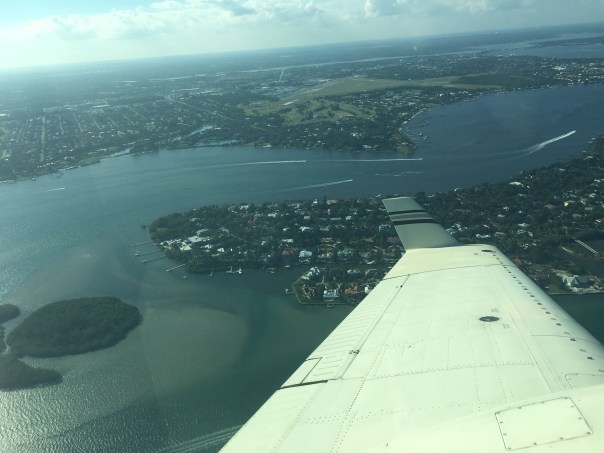
Due to Temporary Flight Restrictions (TFR) because of the President’s visit to Palm Beach, it was not possible to fly south along Jupiter Island from Witham Field in Stuart, however, when the wind and runway changed my husband, Ed, was able to get a few aerials at the Crossroads of the St Lucie River and Indian River Lagoon around Sewall’s Point. No seagrass, but the water already looks better.
After being decimated in 2013; part of 2015; toxic in 2016; and experiencing a no-holds-barred discharge rate since September 20, 2017, post Irma; we will continue to fight for the EAA Reservoir’s success and a better 2018 for our St Lucie River.
We shall never, never, never, give up!
Please see links to my brother Todd Thurlow’s website for St Lucie Canal Real Time Flows S-80 Cumulative 2017 and Latest Lake O Satellite Imagery
As the year 2017 comes to a close, we had a special guest sighted in our offshore waters. On December 17th, a Humpback whale was seen breaching in the Atlantic off of Stuart!
Although these mammoth creatures do migrate, and thus navigate our seas, this is a special and rare site.
Perhaps this is time for reflection…
Just as with the Biblical story of Jonah and the Whale, the Native People also give whale sightings and experiences special significance.
According to native lore, “whales visitors/spirits were used to convey a message of power and might, representing the need for strong, silent deliberation.”
Native Images, whales
In the story of Jonah, having turned away from responsibility, and being thrown as “bad luck” from a ship, Jonah is swallowed by a giant whale, reflects, repents, is renewed, is given a second chance, is ejected, and fulfills his responsibilities….
Perhaps there is a lighter message from our visiting whale, like “Happy Holidays,” and “Merry Christmas,” or a fun breach-splash saying “Yahoo! Keep up the fight for clean water!”
For me, the whale visitation made me reminisce on Ed and my visit to Baja, in 2013, to visit the Grey Whales once slaughtered, and now a great tourist attraction, and how this experience of seeing these huge mammals adapt to our human world, especially the mothers with their calves,–the controversy, and alteration in both human and whale actions—– changed my life, and my outlook forever.
In any case, the season is upon us and I am grateful for all of the work done this year for our waters and for our Florida. Thank you River Warriors! Thank you Bullsugar! Thank you Captains for Clean Water! Thank you people of Florida! Thank you President Negron! Thank you all, so many others across our great state! And in closing, thank you visiting whale!
Sometimes it is hard to stay motivated, but like Winston Churchill said: “Never Give Up.” Our work is so important!
…Yes, in 2018, in spite of the difficulties, we will continue to be the strong, silent or screaming giant that dominates the conscience of Florida…
Video credit:
Mattanza Charters, based in Pirates Cove Resort and Marina in Port Salerno, posted video taken Sunday, Dec. 17, 2017, of humpback whales breaching near Eight Mile Reef in the Atlantic. VIDEO PROVIDED BY CAPT. MIKE MURRAY Wochit
Tallahassee is a beautiful place. Having spent more time there recently, I have grown to appreciate it. Sometimes, in the early morning, as the sun is rising over the hills, I envision Apalachee warriors and families approaching “Anhaica,” their capital. There is a lot of sacred ground here…
Today, I will summarize week 12-11-17. For me, there were battles won, and cease-fires. And the war for Florida’s environment will continue. Thank you to all who wrote members of committees in support in the previous weeks!
St Lucie River/Indian River Lagoon. Photo Jenny Flaugh.
On Tuesday, December 12th, I presented proposal P23, ” A Right to a Clean and Healthful Environment,” to the Judicial Committee (https://www.flcrc.gov/Committees/JU/). I am proud to say P23 has caused a stir, is making people think, and generating tremendous resistance from the “entrenched-status-quo-power” of the government and business communities as it would give every-day Floridians more standing in court for a clean environment. Power would shift to the judicial, rather than the executive and legislative branches of government, and some agencies would be no longer be “puppets.”
The presentation went well, however, based on comments from many members of the committee, and feedback, I felt the vote would not pass. I was offered a “TP” or “temporary postponement” in order to work on the language as I had not been successful at this —with the opposition —-who refused to do so the previous two weeks. They want “no part of P23 in the constitution.”
Unlike local government, where a commission or council can adjust the language of an ordinance during the meeting, this cannot occur during a CRC committee meeting, so the only way to achieve such is to “postpone” and “work on” prior to the next meeting— and try again. (Very inefficient)…
So, I look forward to working on the language, but I am concerned that ameliorating the language to an acceptable point for the opposition will be so far away from the spirit of the original proposal it may not be recognizable or effective. This would not be good.
In the end, it will be the students of Stetson and Barry Universities and their professors who created P23, a totally public proposal, who will give me final direction.
P23 will go before the Judicial Committee again when called. Chances are this will be in January 2018. It could pass; it could die; it could be withdrawn. Should it pass, it will have to go also to the General Provisions committee, and then to the full CRC for a final vote to go to ballot.
The greatest aspect of P23 is working with young people who are our future generation of leaders because as the proposal states: “the natural resources of the state are the legacy of present and future generations…”
On Wednesday, 12-13-17, I presented P46, to the Legislative Committee (https://www.flcrc.gov/Committees/LE/) to “Clarity Language in Article X, Section 28, of the Florida Constitution, Land Acquisition Trust Fund.” Ms. Sue Mullins, who came to my attention through Stuart’s Joan Bausch and the Native Plant Society, was very helpful and knowledgeable and assisted during the presentation. Again, the proposal was “TP-ed” as Chair Pepe Diaz and others such as former Senate President, Tom Lee said they could not support P46 as written and recommended working together on the language. I am confident they meant this, and we shall try between now and when the committee meets again in January. Their concerns are funding requirements, appropriations, of the state legislature; and our concern is the Legislature ignoring a 2014 citizen initiative that passed by 75% for land conservation. P46 too must go to General Provisions should it pass, and then to the whole CRC for a vote to possibly go on ballot.
OILED SCARLET IBIS – Lindsay Carr Created in response to the BP Gulf Oil Spill and auctioned off in support of the clean up operation. In the style of John James Audubon.
On Thursday, 12-14-17, I presented P91 “No Oil or Gas Drilling in Florida’s Territorial Waters.” This was an interesting experience as I was presenting to the committee I chair, General Provisions. (https://www.flcrc.gov/Committees/GP/)
As a presenter, I am just like anybody else.
Mr David R. Mica, Executive Director of the Florida Petroleum Council, AIF, and other business interests spoke against, but fortunately, Mr Manley Fuller, president of the Florida Wildlife Federation, the Sierra Club, and citizens spoke “for,” and were quite convincing. There were even two young children in the audience rooting me on! I was very pleased when the committee voted 5 to 2 in favor of P91! P91 will now go to the Declaration of Rights Committee (https://www.flcrc.gov/Committees/DR/) in January, and then if passes, again, to the full commission to possibly go on 2018 ballot.
OILED SCARLET IBIS – “Notes on a Disaster.” Lindsay Carr created this painting in response to the BP Gulf Oil Spill and auctioned off in support of the clean up operation. In the style of John James Audubon.
CRC Proposal #91, No Oil and Gas Drilling, Yes or No?
This coming Thursday, December 14th, I will be presenting CRC proposal #91 to the General Provisions committee, the committee I chair. For the presentation and vote, I will be turning this part of the meeting over to Vice-Chair, Emery Gainey as is proper form. Just as with any other proposal, #91 needs your support! Please write the members of the committee here to make your support and concerns known or attend the meeting and speak briefly during public comment: http://flcrc.gov/Committees/GP/
With every passing day, I feel more strongly about this proposal. As we are witnessing right now, long-standing, pristine lands across our country are being tapped for oil and gas. Florida’s tourist, beach, and water-economy, and its abundant coastal wildlife, demand there is no oil and gas drilling in the territorial waters of the state.
CRC - 2017P 91By Commissioner Thurlow-Lippisch
thurlowlj-00106-17 201791__
1 A proposal to amend
2 Section 7 of Article II of the State Constitution to
3 prohibit oil drilling for exploration and extraction
4 in specified coastal waters.
5
6 Be It Proposed by the Constitution Revision Commission of
7 Florida:
8
9 Section 7 of Article II of the State Constitution is
10 amended to read:
11 ARTICLE II
12 GENERAL PROVISIONS
13 SECTION 7. Natural resources and scenic beauty.—
14 (a) It shall be the policy of the state to conserve and
15 protect its natural resources and scenic beauty. Adequate
16 provision shall be made by law for the abatement of air and
17 water pollution and of excessive and unnecessary noise and for
18 the conservation and protection of natural resources.
19 (b) Those in the Everglades Agricultural Area who cause
20 water pollution within the Everglades Protection Area or the
21 Everglades Agricultural Area shall be primarily responsible for
22 paying the costs of the abatement of that pollution. For the
23 purposes of this subsection, the terms “Everglades Protection
24 Area” and “Everglades Agricultural Area” shall have the meanings
25 as defined in statutes in effect on January 1, 1996.
26 (c) To protect the people of Florida and their environment,
27 oil drilling for exploration or extraction is prohibited in and
28 beneath all state waters between the mean high tide line and the
29 outermost boundaries of the state’s territorial seas. This
30 prohibition does not apply to the transportation of oil and gas
31 products produced outside of such waters. This section is self
32 executing.
Deepwater Horizon, Gulf of Mexico. Images of disaster, AP 2010.
Adams Ranch, wild turkey in the shade of oak trees, photo courtesy of the late Bud Adams, St Lucie County.
CRC Proposal #46, Land Acquisition Trust Fund, ~Clarifying Language in the Constitution for Citizen Initiative, Amendment 1, of 2014
I will present proposal #46 to the CRC Legislative Committee this Wednesday. You can support this proposal, or express your thoughts on the issue by writing the members of the Legislative Committee: https://www.flcrc.gov/Committees/LE/, or by attending the meeting and speaking briefly during public comment. The Chair is Jose Felix Diaz.
In summary, it is to clarify language so that funds do not include agency salaries, risk management costs, the purchase of vehicles, etc…and clearly states that “no less than one-third of doc-stamp revenue must be deposited into the Florida Forever Trust Fund.”
CRC - 2017P 46By Commissioner Thurlow-Lippisch
thurlowlj-00052-17 201746__
1 A proposal to amend
2 Section 28 of Article X of the State Constitution to
3 revise the manner of the distribution of funds that
4 are deposited into the Land Acquisition Trust Fund
5 from a portion of the net revenues derived from the
6 excise tax on documents.
7
8 Be It Proposed by the Constitution Revision Commission of
9 Florida:
10
11 Section 28 of Article X of the State Constitution is
12 amended to read:
13 ARTICLE X
14 MISCELLANEOUS
15 SECTION 28. Land Acquisition Trust Fund.—
16 (a) Effective on July 1 of the year following passage of
17 this amendment by the voters, and for a period of 20 years after
18 that effective date, the Land Acquisition Trust Fund shall
19 receive no less than 33 percent of net revenues derived from the
20 existing excise tax on documents, as defined in the statutes in
21 effect on January 1, 2012, as amended from time to time, or any
22 successor or replacement tax, after the Department of Revenue
23 first deducts a service charge to pay the costs of the
24 collection and enforcement of the excise tax on documents.
25 (b) Funds in the Land Acquisition Trust Fund shall be
26 expended only for the following purposes:
27 (1) No less than one-third of the revenue must be deposited
28 into the Florida Forever Trust Fund, as defined by the statutes
29 in effect on January 1, 2017.
30 (2) The remainder must be expended as provided by law, to
31 finance or refinance: the acquisition and improvement of land,
32 water areas, and related property interests, including
33 conservation easements, and natural resources for conservation
34 lands including wetlands, forests, and fish and wildlife
35 habitat; wildlife management areas; lands that protect water
36 resources and drinking water sources, including lands protecting
37 the water quality and quantity of rivers, lakes, streams,
38 springsheds, and lands providing recharge for groundwater and
39 aquifer systems; lands in the Everglades Agricultural Area and
40 the Everglades Protection Area, as defined in Article II,
41 Section 7(b); beaches and shores; outdoor recreation lands,
42 including recreational trails, parks, and urban open space;
43 rural landscapes; working farms and ranches; historic or
44 geologic sites; together with management, restoration of natural
45 systems, and the enhancement of public access or recreational
46 enjoyment of conservation lands.
47 (3)(2) To pay the debt service on bonds issued pursuant to
48 Article VII, Section 11(e) as may be required.
49 (c) The moneys deposited into the Land Acquisition Trust
50 Fund, as defined by the statutes in effect on January 1, 2012,
51 shall not be or become commingled with the general revenue fund
52 of the state.
12-4-17, ca. 2:45 pm, photos: Ed Lippisch & Jacqui Thurlow-Lippisch
The Army Corp of Engineers has lessened but not stopped Lake O discharges that started September 20th, 2017 just prior to Hurricane Irma. Perhaps as the discharges have gone on at such a high rate for a comparatively long time, the plume has had a chance to extend its territory. In yesterday’s photos, the dark, filthy plume is reaching clearly south beyond the exclusive Town of Jupiter Island.
Yesterday was a beautiful day, but the river and ocean waters of our entire region were ugly, possibly contaminated. How are we to enjoy our property and lives here?
When viewing the aerials below, please note the blue, sapphire-colored water just on the edge of the discharge plume. Yes, of course all estuaries put forth darkened fresh water after a rain event, and Ed and I could see this occurring just south at Jupiter Inlet. Nonetheless, the black, gigantic plume that we repeatedly endure for the St Lucie River/Indian River Lagoon due to discharges from Lake Okeechobee is an aberration.
Please let’s all support Joe Negron and the public’s work to build the EAA Reservoir; clean & send the water south!
Lake O discharges: http://w3.saj.usace.army.mil/h2o/reports.htmLooking south along the southern most area of Jupiter Island.Looking north along Jupiter Island-dark ocean waters. Jupiter Narrows an extension of the IRL on left.Plume -looking north along Atlantic coastEdge of plume; note clean sapphire colored water juxtaposed to dark Lake O/canal plumeAnother angle, Jupiter Island, looking south-blur due to wind and camera movementBack at St Lucie InletIRL, note bare bottom. This area is known as the Sailfish Flats and once had hundreds of acres of seagrass beds.The Sandbar, a popular weekend recreational area for boaters, especially families, surrounded in dark Lake O discharge waters. This is a health issue.Barren Sailfish FlatsSand bottom with no seagrass between Sewall’s Point and Sailfish Point. An area once teaming with life.The Crossroads — no seagrass beds just sand bottomIRL looking northSt Lucie River near St Lucie Inlet dark as coffeeNorth of St Lucie Inlet the plume covers near shore protected reefs as it does south of the inlet.Blue!The plume as viewed from under the wing of the CubPlume edge: The tainted water we are given by our government; the blue –the water we should have by God & Nature.
Dear Fellow Commissioners, and Citizens of the Great State of Florida:
As many of you know, I firmly believe our quality of life as citizens and our state’s economic vitality greatly relies on the protection and preservation of our environment.
As we begin our important work of examining proposals in committee, I wanted to share additional information about the following five proposals I have sponsored to protect Florida’s natural treasures for future generations.
St Lucie River/Indian River Lagoon (Photo Jenny Flaugh)
1) Proposal 23: At the basis of my environmental protection argument, I believe above all Floridians should have a constitutional right to a clean and healthful environment. Read more about this proposal at the following link: https://t.co/JZiYwr0kMf. I also recently authored an OpEd on this topic in TCPalm at the following link: http://bit.ly/2zSqrl9.
2) Proposal 24: I propose an elected “Commissioner of Environmental Protection” who will have supervision regarding matters pertaining to environmental protection that the Department of Environmental Protection and the Water Management Districts are authorized to implement and administer. Read more about this proposal at the following link: https://t.co/D5lEgRFxNe.
3) Proposal 46: This proposal would help clarify how funds are deposited into the Land Acquisition Trust Fund. Read more about this proposal at the following link: https://t.co/x37BxRu2sj.
Sightseeing Miami
4) Proposal 48: This proposal would give the Florida Fish and Wildlife Commission authority to establish rules limiting impacts to habitat, and wildlife corridors, in the same way they currently establish limits on impacts to individual animals. Read more about this proposal at the following link: https://t.co/5Gh4BfPfIY.
A bird covered in oil after the Deep Water Horizon explosion, 2010. Photo courtesy of Associated Press.
5) Proposal 91: This proposal would prohibit oil and gas drilling in Florida territorial waters. Read more about this proposal at the following link: https://t.co/IkCCIdd4Wj.
The ongoing debate over the deterioration of our environment should not be about politics. Rather, it should be grounded in the welfare of our natural resources, our wildlife, and the citizens of our great state.
It is an honor to serve as a CRC commissioner. Please contact me if you would like more information or have questions and thank you.
Sincerely,
Jacqui Thurlow-Lippisch
Commissioner, & Chair, General Provisions
Constitution Revision Commission 2017/18
The Process:
These proposals will be, or have been referred to a committee, or multiple committees. If they “get through committee,” and are supported later in early 2018 during the final public hearings, they will be voted on by the full CRC to go, or not to go, on the 2018 ballot. You can support or communicate concerns regarding these proposals by going to the CRC website above and writing the commissioners. If you are really determined you can go to the Committee tab and look at what each committee has before it and narrow it down when you write commissioners. You really have to check the website daily to follow. Anything you can do is appreciated; we are a better state when we all make an effort to be part of the process.
Last Thursday on November 16, the ACOE reported they will reduce the amount of water they are releasing from Lake Okeechobee. The Corp had been releasing at a high rate, on and off, since September 20th. New targets are 2800 cfs east and 6500 cfs west.
Photos below were taken yesterday, 11-19-17 by my husband, Ed Lippisch. We will continue to document the discharges from Lake O, and area canals.
As Thanksgiving approaches, we are thankful the discharges are lessened and that the SFWMD and the public are working hard to plan the EAA Reservoir Senator Negron fought for… We the people of Martin County, will not be satisfied until these discharge stop. The river has its hands full with unfiltered discharges draining agriculture and developed lands from C-23, C-24, C-25 and C-44. All must be addressed.
“And where the river goes, every living creature that swarms will live, and there will be very many fish. For this water goes there that the waters of the sea may become fresh; so everything will live where the river goes…” Ezekiel
St Lucie Inlet, Sailfish Point R, Jupiter Island L, and Sewall’s Point and mainland Stuart in distance.Sewall’s PointManatee PocketHell’ s Gate Sewall’s Point to rightC-23 main SLRConfluence of SLR/IRL at Sewall’s Point’s southern tipSewall’s PointIRL looking towards Sewall’s Point and Stuart. Incoming tide pushes plume waters north into IRLsomewhere looking down…
SFWMD canal and basin map. C-44 canal is the canal most southerly in the image and was connected to Lake O in 1923. C-23, C-24 and C-25 were built later in the 50s as part of the Central and South Florida Project that over-drianed South Florida causing many of the water problems we live with today.Atlantic ocean off Jupiter Island, plume water moving south over nearshore reefsIRL near Sailfish Flats where seagrass forests used to flourish housing many fish…Hutchinson Island looking to IRLRoosevelt Bridge SLRC-23 SLR
Everyone has heard the story….Florida voted 75% in favor the 2014’s citizen’s initiative, “Amendment 1,” and once it was in the constitution, the hard-earned constitutional amendment was “ignored” or “reinterpreted” by the state legislature…
In 2015 the Tampa Bay Times wrote: “Few betrayals of the public trust have played out so openly and brazenly as the Florida Legislature’s fraudulent effort to implement Amendment 1, the land-buying measure that three-fourths of voters overwhelmingly approved five months ago. This should be a banner year for protecting the state’s endangered lands. Instead, Amendment 1 is becoming a bait-and-switch that would take Florida back — not forward — in saving its natural resources.” (http://www.tampabay.com/opinion/editorials/editorial-legislators-ignore-voter-intent-on-amendment-1/2227235)
As a commissioner for the Constitution Revision Commission for 2017/18, (http://flcrc.gov) I have sponsored proposal #46 to help fix this issue. Brought to my attention by long time Martin County Native Plant Society member, Mrs Joan Baush, and crafted together with policy advisor, Sue Mullins, and environmental legend, Clay Henderson, this proposal follows at least seven others submitted to the CRC on the subject, not to mention the numerous requests of multiple speakers during the Constitutional Revision Commissions’ statewide public hearings.
The purpose of proposal #46 (originally public proposal #700705) is to “clarify that a percentage of doc-stamp tax revenues will be devoted to the purchase and care of scientifically selected and publicly supported land and water areas for the purposes of conservation.” An explanation, and the proposal are below. To support, please write members of the Legislative Committee, where this will first be heard: http://flcrc.gov/Committees/LE/
The CRC comes around only every 20 years, and is one of five ways Florida can amend its constitution; thus the time is now! Let’s get this clarified!
Land Acquisition Trust Fund Amendment
Section 28, Article X
Explanation
Purpose
This proposed Amendment to S. 28, ART. X is to clarify that a percentage of doc stamp tax revenues will be devoted to the purchase and care of scientifically selected and publicly supported land and water areas for the purposes of conservation.
Background
On November 4, 2014, Florida voters approved the Florida Land and Water Conservation Amendment 1 by 75%.
But the 2015 Legislature determined that the broadness of the measure already allowed them to spend the earmarked revenue of a wide array of programs through the Land Acquisition Trust Fund—some not at all environmental in substance—as well as supplant existing agency operations funding with the “new” Amendment 1 dollars.
The measure was designed to dedicate 33 percent of net revenue from the existing excise tax on documents to the Land Acquisition Trust Fund, where it was assumed its namesake Land Acquisition Trust Fund would denote the purpose and intent of the amendment to acquire and manage environmentally sensitive land.
Because the drafters of Amendment 1 used the Land Acquisition Trust Fund as the receiving account (thinking it would be obvious the intent for the use of funds), without specifying an amount strictly dedicated to land acquisition, they allowed for all expenditures provided in s.375.041, F.S. governing use of funds for the LATF, which at the time, allowed for virtually anything the Legislature wanted to fund.
Once the measure passed by an overwhelming 75% of the Florida electorate, supporters assumed that at least $300 million annually would be devoted to the Florida Forever program. The amount, over 20 years, was thought to finish the job of securing the lands necessary to protect our natural resources, drinking water, habitat and industries such as agriculture and tourism.
That did not happen (see below.).
What this Amendment Does
The intent of this new Land Acquisition Trust Fund Amendment to S. 28, ART. X is to clarify that a percentage of doc stamp tax revenues will be deposited into the Florida Forever Trust Fund to purchase and care for scientifically selected and publicly supported land and water areas for the purposes of conservation.
The proposal simply amends language passed in 2014 as the Land and Water Legacy Amendment 1 by depositing the earmarked funds in an appropriate Trust Fund and clarifying the purposes for use of those funds.
A specified amount, no less than one third of the revenue deposited into the Land Acquisition Trust Fund, is earmarked for deposit into the Florida Forever Trust Fund as it existed in law on January 1, 2017.
This language recognizes that the LATF and other doc stamp-funded accounts should continue to have a suitable amount of revenue to support existing programs such as Springs and Everglades protection, beaches, and local government water projects.
More specificity has been provided in the new amendment by striking the phrase “and improvement” to ensure that Florida Forever funds are spent per the science-based regimen contained within statute (s. 259.105, F.S.), and by adding the phrase “natural” to the type of resources authorized for expenditure.
This Florida Forever Amendment will fix the issue to provide funding to accomplish a majority of Florida’s conservation work through dedicating a set amount each year (depending on revenue, from $175 to $300 million) to be spent according to current statute governing the proven, science-based, willing-seller Florida Forever program.
Implementation of Original Amendment 1
In 2014, a broad coalition of environmental, business and civic leaders proposed the Florida Water and Land Conservation Initiative, which became Amendment 1 to the Florida Constitution. The intent was to recapture the annual amount of funds devoted to land conservation by earmarking a third of the revenue from the doc stamp tax and depositing it into the Land Acquisition TF for the purposes of buying, managing and restoring environmental lands. The measure passed by 75% of voters.
But the Legislature interpreted and appropriated Amendment 1 spending to include agency salaries, IT, risk management insurance, agency vehicles and other non-conservation uses.
The statute has also since been amended to accommodate implementation, per legislative judgement of Amendment 1, to include dedicated funds for Everglades restoration, Springs protection and spending on a broad array of programs and agency expenses.
Historical Context
Florida had a long and distinguished history of scientifically targeting and purchasing the right lands for conservation and recreation purposes since the 1970s, throughout both Republican (Martinez, Bush, Crist) and Democratic (Graham, Chiles) administrations.
Those lands today provide most of the natural resources to support our drinking water supplies, food crops, economic activities and attractive recreational destinations.
The annual funds devoted to Florida Forever had been $300 million, usually issued in bonds paid back by revenue from the documentary stamp tax. Creators of the land programs specifically used the doc stamp tax for its revenue source in order to tie land acquisition to sales in real estate, since all land sales in Florida were assessed a documentary stamp tax.
In 2008, the Legislature discontinued funding for the state’s land conservation program, Florida Forever, citing a poor economy.
Once the economic recovery took hold in Florida, where the state economy in 2013 led the nation in job growth and overall recovery (per University of Central Florida economist Sean Snaith in his first quarter economic forecast on March 25, 2014), it was assumed that the state conservation program funds would be replenished.
Since 2010, the Legislature has declined to fund the non-regulatory approach to environmental protection through land acquisition. Funding for the Florida Forever program has not been reinstated.
The Florida Forever program is hugely successful and is the most often-copied land conservation program in the country. It is based on a scientific analysis of which lands in Florida hold the most natural resource value—those that help cleanse water or purify air, create habitat for fish and wildlife, create corridors for the movement of native plants and animals across the landscape and support the water and wildlife necessary to keep our agricultural, tourism and quality of life intact.
Under its conservation programs, the state has protected almost 5 million of its 37.5 million acres. Together with federal conservation lands, almost 9 million acres is in some form of public management, although thousands of those acres belong to the state corrections and management services agencies, military bases and universities, and are not managed for conservation.
The state has identified an additional 2.2 million acres that should be conserved in some form from conversion to more intensive uses. That doesn’t always necessitate outright full-fee purchase of the property, but could be accomplished using a combination of purchase and conservation easements across large corridors of working lands such as ranches to provide habitat and water resource protection.
Expected Support
Dozens of speakers addressing the Constitution Revision Commission during its public hearings voiced their frustration and disappointment with the Legislature’s use of Amendment 1 funds, and appealed for a fix to the issue to accommodate their intent to fund the land acquisition program.
This new Land Acquisition Trust Fund Amendment is likely to pass by at least 75% of the electorate, even with paid opposition. Previous polls taken by the Florida Chamber have shown 78% support statewide, despite opposition from various anti-conservation groups.
Virtually all news outlets endorsed 2014 Amendment 1 and are already writing of their support for a fix that will finally codify the will of Florida voters.
Some counties, including Broward, Palm Beach and St. Lucie, voted more than 80% in support of Amendment 1. Even inland rural counties supported the measure by a vote of at least 40% in support (see map at beginning of this post.)
*This proposal was schedule to go before the Legislative Committee on 11-29-17 but has been postponed. Chances are it will go through in December. It must clear Legislative and General Provisions. You can write members of these committees to support or express concerns at any time: http://flcrc.gov/Committees
Martin County is furiously fighting erosion at Bathtub Beach. Friend, Amy Galante, sent me a web-cam photo today revealing that ocean water appears to have earlier *breached the remaining man-made dune. When I stopped the by the beach, about an hour ago, at lunchtime, workers assured me no water had entered the parking lot and insisted the area was closed and that I needed to leave immediately. When I got out of my car on the side of the road, it certainly looked as though Mother Nature had left her footprint, but what do I know, I’ve only been visiting Bathtub Beach since I was an infant…
11-15-17: *The County has contacted me asked if I am going to “correct” my post. “The breach you are referring to may be the hole cut in the dune to give equipment access to the beach.” —-I do apologize if my word choice was incorrect. I continue to feel this area of Martin County is one of concern.
Chart 2004-2014. Much re -nourishment has been done since this time. Source: Martin County Government.
A lone sailboat is a sea of blackness, confluence of the St Lucie River/Indian River Lagoon, once considered the most biodiverse estuary in North America and full of seagrasses, a nursery for the ocean..http://w3.saj.usace.army.mil/h2o/plots/s308h.pdfI am very fortunate to have a small army of people helping me document the Lake Okeechobee discharges this year. Presently, it is the tremendous rate of government sponsored discharge from Lake O that is destroying the regions’ economy and ecology, right before our eyes, ~once again.
Friends of my husband, pilots Dave Stone and Scott Kuhns, took these aerials yesterday, 11-8-17 around 5 pm. When I asked Scott about the plume, he relayed that it went 15 miles south almost all the way to Jupiter Inlet, and since there is also rain driven, fresh, dark- stained water flowing out of the Jupiter Inlet (not over-nutrified, black-sediment water from Lake O) there was no clear delineation of blackened plume to aqua ocean water, like usual–rather, the waters are all dark….
“How far did the plume go east from the St Lucie Inlet?” I asked. “From the coast, as far as the eye could see…”
End of plume, near Jupiter InletAnother angle end of plume near Jupiter InletUp close of a boat in the plume. Look at the sediment! Covering what once was seagrasses and killing our near shore “protected” reefs.Plume in black water. Brown on black. The ocean? You’d think it was an oil spill.Plume as seen at mouth of St Lucie Inlet near multi million dollar homes in Sailfish Point.Plume at mouth of St Lucie Inlet on south side as seen against Jupiter Island’s state park/Jupiter Narrows.A lone sailboat is a sea of blackness, St Lucie River/Indian River Lagoon, once considered the most biodiverse estuary in North America and full of seagrasses, a nursery for the ocean.Plume exiting St Lucie InletThe north Jetty at the St Lucie Inlet with plume waters going into the Atlantic Ocean. The plume goes east for many miles.
*The ACOE has been discharging from Lake O since Hurricane IRMA hit on Sept 2oth, 2017. The rate of discharge has gone up and down, however increasing over recent weeks. Word is the St Lucie could be dumped on for many more months, possibly through the end of the year. So don’t count on taking your visiting relatives out fishing this holiday season even though you moved here for the water. This ecological disaster is finally seeing light at the end of the tunnel as Senator Joe Negron, alongside the public, and “River Warrior” groups, particularly Bullsugar, has pushed so hard that the SFWMD and ACOE are finally working towards building an EAA Reservoir that will begin the long journey of changing water drainage culture in South Florida, and “sending the water south.” Please get involved and learn more by viewing this SFWMD EAA RESERVOIR website:https://www.sfwmd.gov/our-work/cerp-project-planning/eaa-reservoir
*Thank you to the people, and the children, groups such as the C4CW, Rivers Coalition, grandparents’ HOA email chains, leadership at Martin Health System, and to the those working for the agencies trying to help the St Lucie. As the River Kidz say:
St Lucie River/Indian River Lagoon, (Photo Jenny Thurlow Flaugh)
Florida’s constitution is important, not only because it is the ultimate law of the state, but because it sets the people’s values before the legislative, executive, and judicial branches. These words are a reference in times of question and must be clearly written on the side of the citizen.
Right now, in Article II, Section 7, (a) “Natural resources and scenic beauty,” the Florida constitution reads:
(a) It shall be the policy of the state to conserve and protect its natural resources and scenic beauty. Adequate provision shall be made by law for the abatement of air and water pollution and of excessive and unnecessary noise and for the conservation and protection of natural resources.
Because this language is vague, ( what is adequate provision? ), and case law is sparse, these words become “overruled” by Florida Statute that clearly gives “permit holders” standing over citizens, and of course the environment making the present environmental protections in the state constitution “inadequate.”
“No action pursuant to this section may be maintained if the person (natural or corporate) or governmental agency or authority charged with pollution, impairment, or destruction of the air, water, or other natural resources of the state is acting or conducting operations pursuant to currently valid permit or certificate covering such operations, issued by the appropriate governmental authorities or agencies, and is complying with the requirements of said permits or certificates.”
So a citizen is not at liberty to sue if a polluting entity is causing environmental destruction that is acting or conducting operations pursuant to a currently valid permit protected by a state agency. And if someone attempts to sue anyway, they have no real standing in a Florida court of law.
Hmmm?
~But, what if a sinkhole spanning 45 feet opened at a Mosaic phosphate fertilizer facility leaking 215 million gallons of “slightly radioactive water,” but this news did not get to the people who have wells in the area for weeks?
~What if the Army Corp of Engineers, and the South Florida Water Management District knew they were discharging billions of gallons of toxic algae from Lake Okeechobee into a community’s river making some citizens sick, yet there was no discussion, warning, or health notices posted until the entire ocean ran green?
~What if an entity could withdraw so much water from a spring or aquifer that….
What if, is now reality.
Yes, permit holders should be “protected,” nonetheless, having a valid permit should not be a right to infringe on the health, safety, and welfare of Florida citizens. Florida citizens and their environment co-exist. When necessary, citizens should have the right to fight for a clean and healthy environment.
We all know that many of Florida’s waters are “growing greener, and more toxic.” This was recently reported by TCPalm’s Jim Turner:
“The 2016 report from the Florida Department of Environmental Protection shows a mixed bag for the state’s waters, with many trending toward more-frequent toxic algae blooms, fueled by rising nitrates from farm and residential fertilizers, sewage, pet waste and other human-related sources.”
Florida’s “impaired” waters are growing, not decreasing. More springs, rivers and lakes are in horrible condition. We see it. Like it or not, the only way to ensure an “adequate” future for Florida’s citizen’s and her waters is to find a way to create acceptable language giving people a constitutional right to a clean and healthful environment.
CRC - 2017P 23By Commissioner Thurlow-Lippisch

       thurlowlj-00038-17                                      201723__
    1                         A proposal to amend
    2         Section 7 of Article II of the State Constitution to
    3         establish that every person has a right to a clean and
    4         healthful environment.
    5
    6  Be It Proposed by the Constitution Revision Commission of
    7  Florida:
    8
    9         Section 7 of Article II of the State Constitution is
   10  amended to read:
   11                             ARTICLE II
   12                         GENERAL PROVISIONS
   13         SECTION 7. Natural resources and scenic beauty.--
   14         (a) It shall be the policy of the state to conserve and
   15  protect its natural resources and scenic beauty. Adequate
   16  provision shall be made by law for the abatement of air and
   17  water pollution and of excessive and unnecessary noise and for
   18  the conservation and protection of natural resources.
   19         (b) Those in the Everglades Agricultural Area who cause
   20  water pollution within the Everglades Protection Area or the
   21  Everglades Agricultural Area shall be primarily responsible for
   22  paying the costs of the abatement of that pollution. For the
   23  purposes of this subsection, the terms "Everglades Protection
   24  Area" and "Everglades Agricultural Area" shall have the meanings
   25  as defined in statutes in effect on January 1, 1996.
   26         (c) The natural resources of the state are the legacy of
   27  present and future generations. Every person has a right to a
   28  clean and healthful environment, including clean air and water;
   29  control of pollution; and the conservation and restoration of
   30  the natural, scenic, historic, and aesthetic values of the
   31  environment as provided by law. Any person may enforce this
   32  right against any party, public or private, subject to
   33  reasonable limitations, as provided by law.
Proposal #23 was a public proposal. It was created by Traci Deen and her students at Barry University. I sponsored their publicly submitted proposal #700450. There were other proposals also on the “rights of environment/nature” topic including 7000672 by Richard Silvestri; 7000216 by Trevor Tezel; 700739 by Richard Grosso; —submitted to Article 1, Declaration of Rights, 700558 a Florida Environmental Bill of Rights by Paul Laura; and the Rights of Nature submitted independently by Mr. David Hargrove. Thank you to all and the many others!
If you have any ideas or would like to comment, please write me directly at jacqui.lippisch@flcrc.gov or at this blog post.
*This proposal will go before the Judicial Committee on November 28 and if it makes through that committee it will go through the General Provisions committee. You can write committees here to support or express concerns: http://flcrc.gov/Committees
If the discharge waters of Lake Okeechobee filled up the City of Stuart, Florida. Last Thursday, they would have reached the top of Stuart’s iconic water tower that stands at 134 feet.
Stuart, North of Monterey.
Whereas, if the ACOE’s discharge waters of Lake Okeechobee were “filling up the City of Stuart,” last Thursday, October 26, these polluted waters, would have reached the top of Stuart’s iconic 134 foot water tower…
Whereas, once again, our economy and ecology is completed devastated, and high bacteria levels in the water are exacerbated therefrom….We shall remember this day…
We shall, therefore, designate, Thursday, October 26, as “Water Tower Day” and say together: “Lake O discharges have reached the top; this must STOP!”
Stop the Discharges
Yes, to put the Lake Okeechobee discharges into perspective, last Thursday the cumulative 2017 ACOE/SFWMD discharges from S-80 passed 134 “Stuart Feet”. The Stuart water tower is 134 feet tall. See my brother Todd’s cumulative total page below:
– In the lost summer of 2013, Stuart/Martin County received 284 “Stuart Feet”, 2.1 times the height of the tower.
– In 2017, the gates did not open until September 5. So it took only 52 days to accumulate that same amount of discharges!
– In 2013, the discharges started on May 8 (with the exception of some small pulses earlier in the year). That year, it took 91 days to hit a cumulative “134 Stuart Feet” – on August 7.
In other words, the discharges have been almost twice the rate as they began in 2013. You can see this in the slope of my brother’s graphs in the web page above. This doesn’t really mean a lot though. In 2013 the discharges didn’t really begin to accelerate until mid-July. At that point, the rates of discharge were comparable to what we are getting now.
– At the current average of about 4200 cfs, we would hit the 2013 total of 284 Stuart feet in another 42 days (December 9). If they are saying the discharges could continue for months, this could happen. We could have another record year, even though the disaster didn’t start until September. Maybe they will throttle it back a little or start pulsing again so it won’t be the case. In any event, this is already another lost year…
(This blog post was based on writing and ideas by my brother and contributing blogger, Todd Thurlow, http://www.thurlowpa.com)
* I edited this post from “today” to “last Thursday.” An ever rising story. 🙂 JTL
These aerial photos over the St Lucie Inlet were taken by my husband, Ed Lippisch, Sunday, October 29, 2017, at 1:45pm.
The number one issue here is the polluted waters of Lake Okeechobee being forced into the SLR/IRL because they are blocked by the Everglades Agricultural Area from going south.
The ACOE has been discharging Lake O waters into the St Lucie since mid-September. These over-nutrified and sediment filled waters continue to destroy our economy and ecology on top of all the channelized agricultural and development waters of C-23, C-24 and C-25. Stormwater from our yards and streets also adds to this filthy cocktail.
Near shore reefs, sea grasses, oysters, fish? A human being? Better not have a cut on your hand…Not even a crab has an easy time living in this.
We move forward pushing the SFWMD and ACOE for the EAA Reservoir with these sad photos and the fact that our waters are putrid at the most beautiful time of year as motivation. We will prevail. One foot in front of the other.
One of the most rewarding parts of my advocacy is the people I meet, especially the “young people.” As a former teacher, and having no children myself, I feel a special connection. If they ask for advice, I encourage them in every way possible to relay their story and their concerns, uncensored. “Speak out! Speak out for the environment!”
A few months ago, a young lady by the name of Mariya Feldman contacted me. She had been working as a teacher in Pahokee, Florida, and was concerned about the poor air quality caused by the burning of nearby sugar fields and the effects it had on her students’ health.
I have experienced this burning from both the air, and the ground; I was interested in her story.
Burning sugarcane fields in the EAA. (Photo Ed Lippisch and Jacqui Thurlow-Lippisch, 2012.)Well, months later, Mariya contacted me again, this time she had completed her video production. She intermixed her topic of interest, poor air-quality and human health, with the health issues regarding the 2016 toxic algae outbreak in the St Lucie River caused by discharges from Lake Okeechobee. In the months previous, I had spoken openly to her and allowed her to record my interview and use it in her video. My interview, interwoven with others is included. Mariya has collaborated well to get her point across. She is a modern day student investigative reporter. I am excited to see where her talents, technological abilities, and passions will take her in the future.
I feature her work today in a You Tube Video below. Please watch it. It will make you think!
I thank Mariya and all the young people working for a clean and healthful environment for the next generation. Never give up. Never stop speaking up! It is up to us for sure.
Martin County High School under construction. The school replaced Stuart High School and opened MCHS doors in 1964. (Ruhnke, Thurlow Collection)
Recently, I attended the ribbon-cutting for Martin County High School’s Administration and Classroom Building. They even opened a time capsule from the school’s origins in 1964. I hardly recognized the place…having graduated in 1982. It was so much bigger and better than when I attended. The place has come a long way from being what was literally once the county dump.
When I got home my mother had sent me a historic photograph via email (above.) I looked at it wondering what it was. I wrote back: “Where is that? Somewhere near Frances Langfords? IRL?”
I couldn’t believe it when she replied that it was an aerial of Martin County High School in 1964. I didn’t even recognize it! All these years, and I have never really realized the school lies so close to the St Lucie River. In fact, it lies not too far from where the South Fork of the St Lucie River was connected to the St Lucie Canal, today known as C-44. The link that allows polluted water in from Lake Okeechobee. A link that should be closed…
This Google map shows location with the purple pin.Another map from Mr Young identifying location.
In her Vignettes, local historian Alice Luckhardt writes about the first school in Stuart. ~Stuart became the county seat of Martin County in 1914:
“Stuart’s first school was a one room building, about 12 x 16 feet, built in 1891 on the banks of the St. Lucie River, to accommodate the community’s children; the first teacher was Kate Hamilton whose salary was about $30 a month, but at that time there were not 12 grade levels and very few students.”
Imagine being taught, along the shores of a clean, beautiful, fish filled, St Lucie River….what a day, what an education, that must have been….
Aerial of Martin County High School, Kanner Highway Stuart, on line -MCHS E. Hassert, TCPalm 2015Martin County, FlSFWMD canal and basin map. C-44 canal is the canal most southerly in the image.
For the record, I would like to report what I have filed, so far, as a member of the Constitution Revision Commission 2017/18.
I have filed two “proposals.”
The first is a “public proposal” (a public submission/language exactly as proposed) entitled: “Floridians’ right to a clean and healthful environment.” This proposal elevates a clean and healthful environment to a right, such as now stated in the Florida constitution: “to enjoy and defend life and liberty, to pursue happiness, to be rewarded for industry, and to acquire, possess, and protect property…” It adds a “clean and healthful environment” symbolically to our highest legal level, our constitution. Right now, the proposal also proposes to give Floridians more standing in a court of law if they have experienced special injury (economic loss) due to environmental destruction of their property. I think the wording can be ameliorated, made more preventative, and less litigious, other states have achieved this and kept their goals in place. Nonetheless, the present language remains a good place to start the conversation.
My second proposal is a “commissioner proposal,” (a proposal with my wording/with help of staff) entitled “to Establish a cabinet position for a Commissioner of Environmental Protection.” Yes, I believe the environment should have a seat at Florida’s most important table. Presently, the Florida cabinet consist of the Attorney General, the Chief Financial Officer, and the Commissioner of Agriculture. These elected public servants make decisions at the top-level with the Governor and are elected, not appointed. They lead the state. I strongly feel that a statewide elected Commissioner of Environmental Protection should exist alongside these others and not be buried under the executive branch with no clear accountability as is presently the case. “Elected and answering to the people,” not to the politics of the state; this is my goal.
The process?
Well, the first proposal, “a right to a clean and healthy environment” has been voted on by the full CRC to move forward to committee. The second will move forward as commissioner proposals do automatically.
But that’s just the beginning!
Soon, Chair Beruff, will determine what committees these proposals will have to be “heard in.” There could be one, or many. If the proposal makes it through committee, it could come out exactly the same, be amended, or die. There is a way to resurrect such later on if it does get killed, but this requires a majority vote and is no easy feat. Nonetheless, it is a possibility. The best thing is to try to get it through committee so the full commission can vote on.
The political process will take its course, and the people will be heard.
It is an exciting time for me, and I plan on submitting other proposals too, but these two, my first, are my priorities.
Below are my two proposals and other information you may find helpful. If you have questions or concerns please write me at jacqui.lippisch@flcrc.gov. I am here to discuss.
CRC - 2017P 23By Commissioner Thurlow-Lippisch
thurlowlj-00038-17 201723__
1 A proposal to amend
2 Section 7 of Article II of the State Constitution to
3 establish that every person has a right to a clean and
4 healthful environment.
5
6 Be It Proposed by the Constitution Revision Commission of
7 Florida:
8
9 Section 7 of Article II of the State Constitution is
10 amended to read:
11 ARTICLE II
12 GENERAL PROVISIONS
13 SECTION 7. Natural resources and scenic beauty.—
14 (a) It shall be the policy of the state to conserve and
15 protect its natural resources and scenic beauty. Adequate
16 provision shall be made by law for the abatement of air and
17 water pollution and of excessive and unnecessary noise and for
18 the conservation and protection of natural resources.
19 (b) Those in the Everglades Agricultural Area who cause
20 water pollution within the Everglades Protection Area or the
21 Everglades Agricultural Area shall be primarily responsible for
22 paying the costs of the abatement of that pollution. For the
23 purposes of this subsection, the terms “Everglades Protection
24 Area” and “Everglades Agricultural Area” shall have the meanings
25 as defined in statutes in effect on January 1, 1996.
26 (c) The natural resources of the state are the legacy of
27 present and future generations. Every person has a right to a
28 clean and healthful environment, including clean air and water;
29 control of pollution; and the conservation and restoration of
30 the natural, scenic, historic, and aesthetic values of the
31 environment as provided by law. Any person may enforce this
32 right against any party, public or private, subject to
33 reasonable limitations, as provided by law.
CRC - 2017P 24By Commissioner Thurlow-Lippisch
thurlowlj-00025A-17 201724__
1 A proposal to amend
2 Sections 3 and 4 of Article IV and create a new
3 section in Article XII of the State Constitution to
4 establish the office of Commissioner of Environmental
5 Protection as a statewide elected officer, to provide
6 duties of the commissioner, and to include the
7 commissioner as a member of the Cabinet.
8
9 Be It Proposed by the Constitution Revision Commission of
10 Florida:
11
12 Sections 3 and 4 of Article IV of the State Constitution
13 are amended to read:
14 ARTICLE IV
15 EXECUTIVE
16 SECTION 3. Succession to office of governor; acting
17 governor.—
18 (a) Upon vacancy in the office of governor, the lieutenant
19 governor shall become governor. Further succession to the office
20 of governor shall be prescribed by law. A successor shall serve
21 for the remainder of the term.
22 (b) Upon impeachment of the governor and until completion
23 of trial thereof, or during the governor’s physical or mental
24 incapacity, the lieutenant governor shall act as governor.
25 Further succession as acting governor shall be prescribed by
26 law. Incapacity to serve as governor may be determined by the
27 supreme court upon due notice after docketing of a written
28 suggestion thereof by fourthree cabinet members, and in such
29 case restoration of capacity shall be similarly determined after
30 docketing of written suggestion thereof by the governor, the
31 legislature or fourthree cabinet members. Incapacity to serve
32 as governor may also be established by certificate filed with
33 the custodian of state records by the governor declaring
34 incapacity for physical reasons to serve as governor, and in
35 such case restoration of capacity shall be similarly
36 established.
37 SECTION 4. Cabinet.—
38 (a) There shall be a cabinet composed of an attorney
39 general, a chief financial officer, a commissioner of
40 environmental protection, and a commissioner of agriculture. In
41 addition to the powers and duties specified herein, they shall
42 exercise such powers and perform such duties as may be
43 prescribed by law. In the event of a tie vote of the governor
44 and cabinet, the side on which the governor voted shall be
45 deemed to prevail.
46 (b) The attorney general shall be the chief state legal
47 officer. There is created in the office of the attorney general
48 the position of statewide prosecutor. The statewide prosecutor
49 shall have concurrent jurisdiction with the state attorneys to
50 prosecute violations of criminal laws occurring or having
51 occurred, in two or more judicial circuits as part of a related
52 transaction, or when any such offense is affecting or has
53 affected two or more judicial circuits as provided by general
54 law. The statewide prosecutor shall be appointed by the attorney
55 general from not less than three persons nominated by the
56 judicial nominating commission for the supreme court, or as
57 otherwise provided by general law.
58 (c) The chief financial officer shall serve as the chief
59 fiscal officer of the state, and shall settle and approve
60 accounts against the state, and shall keep all state funds and
61 securities.
62 (d) The commissioner of environmental protection shall have
63 supervision of matters pertaining to environmental protection
64 that the Department of Environmental Protection or its successor
65 agency and water management districts are required or authorized
66 by law to implement and administer.
67 (e) The commissioner of agriculture shall have supervision
68 of matters pertaining to agriculture except as otherwise
69 provided by law.
70 (f)(e) The governor as chair, the chief financial officer,
71 and the attorney general shall constitute the state board of
72 administration, which shall succeed to all the power, control,
73 and authority of the state board of administration established
74 pursuant to Article IX, Section 16 of the Constitution of 1885,
75 and which shall continue as a body at least for the life of
76 Article XII, Section 9(c).
77 (g)(f) The governor as chair, the chief financial officer,
78 the attorney general, the commissioner of environmental
79 protection, and the commissioner of agriculture shall constitute
80 the trustees of the internal improvement trust fund and the land
81 acquisition trust fund as provided by law.
82 (h)(g) The governor as chair, the chief financial officer,
83 the attorney general, the commissioner of environmental
84 protection, and the commissioner of agriculture shall constitute
85 the agency head of the Department of Law Enforcement.
86
87 A new section is added to Article XII of the State
88 Constitution to read:
89 ARTICLE XII
90 SCHEDULE
91 Recomposition of the cabinet; commissioner of environmental
92 protection.—The amendment to Section 4 of Article IV relating to
93 the election of the commissioner of environmental protection and
94 the inclusion of the commissioner as a member of the cabinet
95 shall take effect January 3, 2023, but shall govern with respect
96 to the qualifying for and the holding of the primary and general
97 elections for the office of commissioner of environmental
98 protection in 2022.
Commissioner Jacqui Thurlow-Lippisch’s CRC webpage:
Appointed by President
Committee Assignments
General Provisions, Chair
Executive
Proposals Introduced
P 0023 GENERAL PROVISIONS, Natural resources and scenic beauty
Last Action: 10/19/2017 Filed
P 0024 EXECUTIVE, Commissioner of Environmental Protection
Last Action: 10/19/2017 Filed
Biographical Information
Occupation: Former Middle and High School German and English Teacher; Presently, Licensed Realtor, Lifestyle Realty Group
City: Town of Sewall’s Point (Martin County)
Commissioner Jacqui Thurlow-Lippisch was born in 1964 at Travis Air Force Base, Fairfield, California. She is a Daughter of the American Revolution, Florida Blue Key member, a lifetime resident of Martin County and member of St. Mary’s Episcopal Church.
Commissioner Thurlow-Lippisch’s mother is a third-generation Floridian and statewide recognized historian. In 1952, Commissioner Thurlow-Lippisch’s New York grandfather founded Thurlow & Thurlow, P.A. in Stuart, which specializes in real estate, and continues today as a family run business. She is married to William E. Lippisch, D.M.D./Oral Surgeon and general aviation pilot. They are well-known on the Treasure Coast for taking thousands of aerial photographs documenting the effect of destructive discharges from Lake Okeechobee on the health of the St. Lucie River/Indian River Lagoon. She shares these photos on her blog entitled “Indian River Lagoon,” which educates thousands of people. Jacqui is a former teacher with years of classroom experience instructing middle and high school students. She continues to work with youth through “River Kidz,” a division of the Rivers Coalition that has also helped promote and inspire efforts to find solutions to the damaging discharges from Lake Okeechobee.
Commissioner Thurlow-Lippisch is a former Mayor (2011-2012) and Commissioner (2008-2016) of the Town of Sewall’s Point and has served in other various public service and leadership capacities, including: Vice-Chair, Treasure Coast Region Planning Council (2016); Chair, Treasure Coast Council of Local Governments; Treasure Coast Florida League of Cities (2008-2016); Chair, Florida League of Cities’ Energy, Environment, and Natural Resources Legislative Committee (2013); Board member, Harbor Branch Oceanographic Institute Foundation, Florida Atlantic University (2013-2016); and Rivers Coalition Defense Fund (2011-present).
Commissioner Thurlow-Lippisch holds a Bachelor of Arts, Journalism & Communications, University of Florida, 1986; Bachelor of Arts, German, University of Florida, 1994; and Master of Arts, Curriculum and Development, College of Education, University of West Florida, 1999. She also graduated from the UF/IFAS Natural Resources Leadership Institute, Class XV, 2016.
Without documentation, there is no record. With no record, there is less chance for improvement.
Yesterday, Ed, Luna, Bo and I continued to document the discharges, right now, coming mostly from Lake Okeechobee.
There are serious signs of stress in the estuary including reports of leisoned fish that I have posted on Facebook. The rest, from above, we can see for ourselves…
“Keep the pressure on” for the reservoir and for replumbing the great state of Florida.
Say No to Lake O
“Say No to Lake O,” this is one of the rallying cries of the River Kidz. If only it were as easy as just saying “no.” According my numbers-man, my brother Todd, the “St Lucie River has taken in more than 86+ billion gallons this year, enough to put Stuart under 111 feet of water. This is only enough to take 6 inches off of the lake.” The west coast is taking most of the lake level reducing water and of course they are screaming “say no to Lake O” too.
Eco-Voice, present west coast advocacy, 10/17.Realistically, with the Army Corp of Engineers reporting the Lake level at 17.07, today, it will be a few more weeks of releases to get near or under 16 feet. A safer number for the dike and for the people who live in fear of it breeching. Not to mention the 525,000 of acres of protected sugarcane… http://w3.saj.usace.army.mil/h2o/reports.htm
Black Gold, the muck soils south of Lake Okeechobee. (Photo JTL, 2014.)I do believe the authorities are getting the message, though…so keep screaming. SAY NO TO LAKE O! For everyone!
I think our water culture is changing, and the government is being forced/inspired so they can get reelected and respected…. to improve our water/rivers situation. Just yesterday, I got an email about a woman whose Bascom Palmer doctor notes she has an eye infection in her cornea very possibly from “walking the bridge,” repeatedly over the St Lucie River.
I am not making this up.
These health issues are real. More and more people are realizing this. Lake O and other canal unfiltered pollution must halt.
So it looks like the Lake Okeechobee is going down, but we are still going to get releases for while. (See the info below on my brother’s site.) Things are still bad, but they are getting better.
~Never stop screaming “Say No to Lake O,” we owe it to ourselves, and to the future.
Hydro. Lake is going down._________________________________________________________________
Great information below!
Jacqui,
It looks link the lake is coming back down. See the graph links on my Firm Favorites Page:
It’s hard believe that we have taken 86+ billion gallons this year, enough to put Stuart under 111 feet of water. But this is only enough to take 6 inches off of the lake. The west coast is taking most of the lake level reducing water.
By the way, I have a new link of my Lake O Satellite imagery page that will actively pull up the last 7 days of low res images from all three satellites: St Lucie River Discharges Latest Lake O Satellite Imagery (http://www.thurlowpa.com/LakeOImagery/) Click on the “Terra/Aqua/Suomi Last 7 days icon”.
Best regards,
Todd
Thomas H. Thurlow III THURLOW & THURLOW, P.A. 17 Martin L. King, Jr. Blvd. Suite 200 P.O. Box 106 Stuart, FL 34995-0106 Phone: (772) 287-0980 Facsimile: (772) 220-0815 Email: todd@thurlowpa.com Web: http://www.thurlowpa.com
Guest blog an photos by Geoff Norris, Indian River Plantation POA Group:
Guest blog an photos by Geoff Norris, Indian River Plantation POA Group:
These photographs of the Indian River Lagoon were taken on 11 October 2017, between the bridge at East Ocean Blvd, Stuart and north to Indian Riverside Park and Jensen Beach, Florida. The lagoon waters have been polluted for several days with run-off from Lake Okeechobee making the lagoon various shades of brown, orange, red and grey, with dirty scummy foam a feature at the shorelines and also as foamy windrows and wave crests in open water. The St Lucie River is in much the same state.
During this time the Army Corps of Engineers has been opening the locks at Port Mayaca to discharge water from Lake Okeechobee down the St Lucie Canal to the St Lucie River/Indian River Lagoon estuarine system. Rates vary from 4500 to 5500 cubic feet per second, equivalent to 2.9 to 3.5 billion gallons per day. It has been calculated that this amount of discharge would cover the Stuart peninsula north of Monterey Road with four feet or more of water in one day.
The Florida Oceanographic Society reports for 10 October 2017 that salinities in the Lagoon have been drastically reduced by this lake discharge to between 1 and 3 parts per thousand sufficient to kill many estuarine fish and other plants and animals (normally the salinity would be between about 20 and 25 parts per thousand in this section of the lagoon). The Society has graded the overall health of the Lagoon on either side of the East Ocean Bridge as “Poor to Destructive”. See this link:
The Army Corps of Engineers is aware that they are killing the St Lucie/Indian River Lagoon estuarine system by their actions, but consider it more important to lower the Lake Okeechobee level from the current level of 17.2 (feet above mean sea level) to a desired level of between 12 ft and 15 ft.
These are the facts. It is also a fact that politicians have not managed to stop this destruction.


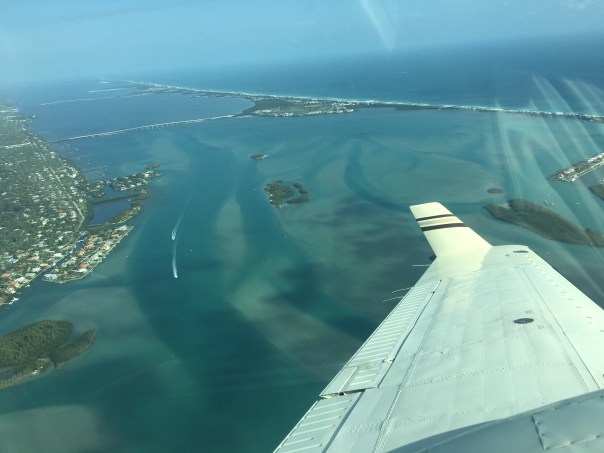


 For years, I have had a reoccurring dream.