1909-11 ACOE Drainage map Kissimmee, Caloosahatchee Rivers and Lake Okeechobee. (Courtesy historian Sandra Henderson Thurlow.)Full map…
It seems like every time I visit my parents, my mother has another cool map for me to look at. Recently she shared this map, a 1909-11 “Drainage Map of the Kissimmee and Calosahatachee Rivers and Lake Okeechobee, Florida.” The map was prepared under the direction of Captain J.R. Slattery, Corps of Engineers, U.S. Army. You can see at the bottom right of the map the document is listed as “House Doc. No. 137; 63rd Congress, 1st Session”.
To me what is interesting about the map other than the fact that the ACOE and our government were already planning and draining South Florida so long ago is the section to the east of Lake Okeechobee going towards the St Lucie River/Indian River Lagoon. It shows a “slough, “a pine forest, a prairie, topography, the Allapattah Flats, and other interesting features no longer around today… I think part of the “swamp” became Port St Lucie and parts of western Martin County…it show the elevations obviously taken for engineering future drainage, and it shows a “cane slough,” very close to the South Fork of the St Lucie River. How ironic with all the sugar cane around here today!
“Cane” according to my mother, meant tall/grassy swamp….not sugar cane. There is actually a road in Port St Lucie named “Cane Sough” that looks more like a concrete interchange than a swampy, grassy area. The cars roar by, and it seems like its been this way “forever”…it has not….
Also interesting on the map are the lake levels noted in Lake Okeechobee: 20.6 for “ordinary lake water” and 24.4 for “extreme high water,” as measured from the Atlantic Ocean. Today we measure from NGVD which is changing or changed to NAVD which is an entirely different story. Nonetheless, today the ACOE and SFWMD “keep”Lake O ideally between 12.5 and 15.5 feet so the man-made, ACOE-dike does not break and flood all of the agriculture and development south and around the lake.
What does the Bible say? “The wise man built his house upon a rock?” Well, we built ours upon a swamp!
Lake LevelsRight corner of map.
_________________________
Thank you to family friend, Stephen Dutcher, who shared this map with my mother.
The St Lucie Canal, or C-44, was built beginning in 1915 and connected to St Lucie River in 1923.
The C-23, C-24 and C-25 canals were built in the late 1940s through the 50s as part of the Central and South Florida Flood Project. Google each canal along with DEP for a good history and explantion.
Historic map with beginnings of Google overlay showing pronged area of South Fork, St Lucie River, C-44 canal’s connection, and the many ponds that once spotted the landscape that are now filled with agriculture and development. (1940 US Government aerials shared by Todd Thurlow.)C-44 canal 1940 map with beginnings of Google overlay emerging. (Todd Thurlow)
0:34 – Roosevelt Bridge 0:39 – Note the Old 1934 two-lane drawbridge in use. The current drawbridge was built in 1964 1:05 – Palm City Bridge 1:22 – Indian Street Bridge 1:27 – Note the increase in width of the river — in some places from approx 225 feet to 460+ feet. 3:24 – Halpatiokee Park 3:24 – Note the old Gaines Highway “Humpback” Bridge (SR-76) in use in 1940. 3:42 – Okeechobee Waterway (C-44) 4:00 – St. Lucie Lock and Dam (—timetable from Todd Thurlow)
I continue to take great pleasure in featuring the “time-capsule flight” historic map and Google Earth work of my brother, Todd Thurlow.(http://thurlowpa.com)
Today’s short video focuses on our beloved South Fork area of the St Lucie River. This video visually juxtaposes 1940s U.S. Government maps to Google Earth images of today. The video begins over an undeveloped Horseshoe Point, Sewall’s Point, and St Lucie River proper and then travels in a southern direction to the wide fork of the St Lucie River and deep along its wild, winding, and African-looking curves. One sees the old Palm City and new Veteran’s Memorial bridges come and go, and notices the build up over time of sand in the fork (maybe some from dredging and some from sediment build-up from Lake Okeechobee releases.) This serpentine and beautiful section of the South Fork is southerly of Highway 76 that runs out to Lake Okeechobee alone the C-44 canal. Today’s I-95 exchange is also visible.
Broad overlay of maps South Fork. (Todd Thurlow)
And the little ponds! My favorite! Just everywhere!This is most incredible to me as today they are “gone.” These hundreds, if not thousands of little ponds, once slowly increased and decreased in depth and size based on rainfall, overflowing at times, into the winding South Fork. One can still see the lush vegetation surrounding some of these areas. Can you imaging the wildlife that used to be in our area? I so would have loved to have seen it but this trip is better than nothing!
As the flight continues, “today’s” development is neatly stacked right up to the winding edge of the fork on the south side in particular…makes me think of septic tanks???
I have to say it nice that there is some land around the areas of the fork and I am sure local environmentalist have fought to keep this over the years. Nonetheless, if we had it to do over again, I think we would decide to leave a much wider birth around these important watersheds.
In the final minutes of the video we travel over the dreaded C-44 canal built in the 1920s, known in its early years as the “St Lucie Canal.” This canal of course, connects Lake Okeechobee to a section of a second prong (fork) in the winding South Fork. The canal itself is wider and apparently the “connection is just “above” today’s Four Rivers which lies beyond the I-95 bridge and exchange and All American Marina.
Zooming in and out in time and place, one can see the cleared lands around St Lucie Locks and Dam and white sand piled high from dredging on the north side of the canal….The picture fades in and out as we view the old locks structure compared to its “new and improved” version today….
I just love this stuff. It makes it all so easy to “see.”
The environmental destruction that is…I guess for others it is the sight of money and making a swamp “useful.” How ever you view it, the journey is an education.
Thank you to Todd for opening my eyes and for allowing me to travel in time and “place.”
C-44 canal Google Earth with St Lucie Locks and Dam. (Todd Thurlow Google Earth)1940 US Gov’t map showing C-44 canal cut from Todd Thurlow’s video. Notice agriculture fields on top of what was a stream.
_______________________________
To see more of Todd’s work on my blog, search his name on my blog’s front page, go to my blog’s “About Jacqui Thurlow-Lippisch” page or just google Todd Thurlow bluewatertt3 on You Tube.
It is an amazing thing to fly through time and space, and this is exactly what I did yesterday with my brother, Todd. He took me on a “flight” over a 1958/Today St Lucie River, North Fork, and Ten Mile Creek. All the while, the images flashing in and out of past and present….Please watch this short video yourself by clicking the link or image above.
At one point along our armchair journey, I said to myself, “Wow, I don’t feel so great,” –just like sometimes when I am with Ed, my husband, in the airplane. I actually got motion sickness having plastered my face right up to the screen to see every moving detail!
A few deep breathing exercises put the feeling off, but next time I’ll take my Dramamine!
Google Earth image at the northern reaches of what was Ten Mile Creek in St Lucie County. Algae in agriculture canals is very visible.
This flight, as the others you may have experienced on my blog with Todd, is amazing. It allows one to really see what the lands were originally like and how they have been developed as residential homes and endless agriculture fields.
Towards the end of the video, you can even see algae growing in the agriculture canals, off of Ten Mile Creek, St Lucie County–“bright green,” for all to see on Google Earth. I have witnessed these green canals too from an airplane.
Due to drainage canals— leading to drainage canals—leading to drainage canals, this water from the ag fields, and from all of our yards, ends up in the now sickly St Lucie River. This problem is exacerbated by ACOE/SFWMD releases from Lake Okeechobee and the basin area of C-44 in Southern Martin County. These canals and the expanded engineered runoff from the lands is what is killing our river.
It is my hope that with visuals like the video above, future generations will find a way, and want to be a part of a new water and land management generation “seeing” how to improve St Lucie River/Indian River Lagoon. Our generation seems stuck in a quagmire….
Like they say: “seeing is believing,” and seeing provides insight for change.
*Thank you to my brother Todd, for this incredible journey using overlays of aerial photographs taken in 1958 by the United States Government, and marrying these aerials over images from today’s Google Earth. (http://thurlowpa.com)
Northern reaches of the North Fork of St Lucie River, Ten Mile Creek in St Lucie County, 1958. Wetlands showing multiple small ponds are visible. These lands were drained in the 1950s by canals C-24, and further south C-23 and further north by C-25. These canals were part of the USACOE and SFWMD’s effort for more flood control and to expand agriculture and development: These canals are part of the Central and South Florida Flood Control Project of the 1950s which allowed more non flooding development and agriculture, but also destroyed our valuable south Florida waterways.
Photo of happy, prancing, sow along IRL, by John Whiticar, 2015.John Whiticar, sow looking forward, IRL 2015.A beautiful photo of the sow enjoying the sunrise along the IRL. John Whiticar, 2015.
I have a soft spot for pigs, or any animal related to a “pig.” Pigs, you may remember, sat upright at the table in George Orwell’s classic novel ANIMAL FARM; they became like humans…
For me, pigs are part of my family history as my grandfather Henderson won a scholarship to the University of Florida for his famous 1926 pig “Charlotte.” This launched a very successful career for him as an agriculture man at the University of Florida. My grandfather’s brother, my uncle, became a wealthy “pig-farmer” in Madison, Florida. I loved visiting there as a kid! The most fun ever! When my family arrived, Uncle Gordy would run out into the fields almost before saying “hello,” and bring back piglets for my brother, sister and I. They were adorable coming in all different colors and patterns. Their small noses scrunching, we were allowed to hold them, and later return the piglets to an irritated, snorting mother. At the time, I didn’t think much about their fate of “becoming bacon….”
My grandfather, Russell Henderson Sr. at 17, in 1926, Madison, Florida. My grandfather became “famous” as a young man in the state of Florida for his breeding of the best pigs. He received a scholarship for his work and had a long career at UF in soil science and worked for the IFAS Extension Office in Gainesville.
As I got older, I realized that often pigs get a “bad wrap”as they are “dirty.” Again, just like humans….They are also very smart, just like humans too. I read somewhere that they are smarter than dogs. Maybe that’s why George Orwell chose them to take over Manor Farm.
Anyway, I have been wanting to write a post on pigs, or wild boars, (males) or sows, (females) since I recently saw marina owner and photographer John Whiticar’s photos of a wild sow he photographed along the Indian River Lagoon.
What great shots and thank you John for allowing me to share! I have seen sows with their piglets on Savanna Road in Jensen at night foraging. I have also seen wild pigs more recently at Billy’s Swamp Safari in Big Cypress. Here a baby pig got separated from its mother and fellow piglets and it followed the mother’s scent very far zig-zagging perhaps a quart mile to find her. And he did! We followed and all clapped when the family was reunited.
“Wild pigs” were brought to Florida by the Spanish in the 1500s, and today they wreak destruction on the environment, just like humans. We have so much in common! It’s amazing! Seriously though, for me, they are one of God’s creatures, and should be treated humanely as all animals. Popular since the early days of Florida, they appear on many of my mother and father’s historic postcards below.
It you see a sow or a boar, know that you are staring Florida history right in the face, and that some might say that we are even “related.” Also remember, like George Orwell’s satire states, unfortunately: ALL ANIMALS ARE EQUAL, BUT SOME ANIMALS ARE MORE EQUAL THAN OTHERS…. 🙂
Historic post card, courtesy of Thurlow Collection.Postcard back 1914.Another historic post card with a wild pig. (Thurlow Collection)Back of postcard reads 1912.Historic post card, wild boar, Thurlow Collection.
Cyanobacteria in the St Lucie River, 2013. Photo Jenny Flaugh.
I prefer not to focus on negative topics in my blog, however, it is important we learn about cyanobacteria or “toxic algae” while it is a hot topic as it has it is being released into our St Lucie River/Indian River Lagoon by the Army Corp of Engineers, as I compose this blog post.
I am going to provide “bullet points,” as I think this will be most effective. I have provided reading material at the end of the post should you be interested in pursuing the topic.
Toxic algae bloom S-308, 2015, Lake Okeechobee. (Photo JTL)
Here we go; as no expert, I will do my best:
CYANOBACTERIA
-Cyanobacteria has characteristics of both bacteria and algae; it is not a “true algae”
-It is referred to as “blue-green algae”
– It is ancient, the oldest form of life on our planet, perhaps 3.5 billion years old
– It is believed to have created the oxygen in Earth’s atmosphere thus defining life on Earth
-It can live in both fresh and salt water environments and in-between
-It exists worldwide in inland and coastal waters (salt and fresh)
-There are “different” cynobacteria in different water environments; they adapt
– 46 species show toxic effects (World Health Organization, 1999)
-The most common FRESHWATER species is microcystis (species found in Lake O)
-The other “most common” species is neuotoxin
-Some species contain both microcysis and neuotoxins
-The World Health Organization recommends governments recognize the “presumption” that all cyanobacteria can be toxic
-Cyanobacteria is buoyant but some can also adjust where they live in the water column to attain the right amount of sunlight
-Buoyancy leads to floating on the water’s surface where winds drive them to shore and they accumulate in a “scum” that is even more “toxic” (concentrated) (Like Lake O)
-Cyanobacteria blooms are a threat to public health and wildlife
Cyanobacteria is encouraged by heavy “nutrients” like phosphorus and nitrogen to “bloom” (grow)
-The present warming trend of the Earth, compounded with human “waste” from agricultural fertilizer, septic and sewer, and “stromwater” from roadways (how we have designed all water to run off into our rivers and lakes) is “feeding” cyanobacteria blooms
-Cyanobacteria blooms are increasing worldwide
-Cyanobacteria can be “controlled” through lessening nutrient pollution from fertilizer and other nutrient producers
Sandsprit Park 2013, (Photo: Bob Voisenet.)
About four years ago, I was at Harbor Branch Oceanographic Institute attending a lecture on “nutrient pollution and our waterways.” At the event, I spoke to Dr Margaret Leinen who is now director of Scripps Research Institution of Oceanography in California. In the course of conversation, she told me she testified before Congress for the National Reasearch Council’s publication, “Clean Coastal Waters, Understanding and Reducing the Effects of Nutrient Pollution, 2000” of which I had just read, and had been discussed at the lecture.
I asked her, why the US Congressional committee wasn’t “stricter” in passing laws to reduce agribusiness fertilizer runoff, and other sources since the scientists “knew” why our waters including the St Lucie River/Indian River Lagoon, and especially Lake Okeechobee were experiencing these toxic blooms.
She, being a lady, just looked at me and said something to the effect of, “Jacqui they don’t always listen….”
Her words have rung in my ears for four years.
No they don’t always listen. Most politicians wait until a crisis ensues as is happening now. We will have to make them listen…all of them: US politicians, state politicians, and local politicians. It is not fun, enforcing laws on polluters, especially if they are campaign donors, but now there is no choice; it is a health issue. We, the St Lucie River/Indian River Lagoon, are a voice for all the world.
_______________________________________________
The sample of toxic algae taken by DEP and reported from Martin County on 4-24-15 from Lake O read as follows: “Toxin analysis showed 8.4 µg of microcystin-LR per liter in the sample.” ( I do not know how to read this or how to compare it but it was “toxic.” )
Radar weather screen shot from 4-29-15. My phone, NOAA site. JTL.
The past two days, I feel like I have been a guest on the TV series “Storm Chasers,” except I have been running from the storms.
Yesterday, I decided I really needed to go look at Lake Okeechobee myself to see the toxic algae bloom that has been reported through social media, TC Palm, and the internet. –The algae bloom that inspired Senator Negron to ask Col. Dodd of the ACOE to refrain from opening the gates, which they did not do. On Tuesday’s, at 2:00 PM, are the Army Corp of Engineers’ “Periodic Scientist Call for Lake Okeechobee” of which I have participated in for almost three years…
“Perfect,” I thought, “I’ll go to the lake for the call a bit early and take some photos. I will be out in Palm City around that time anyway; it’s really not that far…” The drive is about 20 miles.
Signs at Port Mayaca, Indiantown.JTL
In spite of the previous day’s inclement weather, I had not checked the weather closely as I can never figure out how to get radar maps on my phone. Not checking the weather, turned out to be a big mistake.
Satellite photo of Lake O, NOAA. If you look closely, you can see the C-44 canal connecting the St Lucie River in Stuart to the Lake O. This canal runs along Highway 76 in Martin County.Map SFWMD showing canals and basins. Note S-308 or “structure 308” at Lake O, and S-80 east along the C-44 canal. Both of these structures have to open to allow water to flow into the C-44 canal to the St Lucie River, Indian River Lagoon.
Around 1:00 PM, as I approached Port Mayaca going west along Highway 76, suddenly grey clouds in the distance converged overhead spilling out over the sky like black oil. Huge bright lightning bolts struck the ground in the direction of the lake, thunder followed almost immediately; rain dumped out of the sky. …”Oh no, not again…” I thought.
The winds screamed across the landscape. Large trucks coming towards me in the opposite direction splashed wakes hitting my car full force. Eventually, I pulled over at the entrance of DuPuis Wildlife Reserve;” the water was rising on the dirt road. Looking at my surroundings, I realized I was next to the Port Mayaca graveyard where thousands of people were buried in a mass grave after perishing in the 1928 hurricane. I turned on the radio, my windshield-wipers whipping back and forth. The unnerving sound of the Emergency Broadcast System blared and a calm computerized voice said: “Tornado warning for western Martin County.” Shaking, I forced my self to try to find radar on my phone. I found a written tornado warning for Indiantown. I was at ground zero.
All alone with the elements, I wondered what possessed me to do such a thing….I closed my eyes…I prayed…
Within thirty minutes the storm had passed. Thankfully it was not my day to die. I shook off my fear, got my self together, and completed my drive to the lake. This is what I found:
S-308 as, the structure that allows water from Lake Okeechobee to enter the C-44 canal, SLR/IRL. Lake O is in the background.Closer view of S-308 with the beginning of the C-44 canal before its gates. The lake is behind the dike structure.Algae bloom on west side of S-308 gate.West side of S-308 showing all gates. Algae bloom visible.Close up of western side of S-308.Edge of S-308 structure standing on dike, looking east over Lake Okeechobee.East side of S-308 facing the lake.Turning around from S-308 structure to see the rim canal. Dike on left of photo. Lake on left side of dike.
The lake seemed oddly calm after such rage. You could hear a pin drop. I looked around…
Storms tend to break up algae blooms, but under the right conditions of heat and over nitrified water (over-fertilized basically), they come back. In my opinion, this toxic algae issue really forces us all, from the public, to city government, to the office of the Governor, to the state legislature, to the President of the Untied States, and Congress, to ask ourselves the most critical of questions.
“Is it legal for a federal agency to knowingly release toxic water into a local community?”
To me this is situation is different than a toxic algae bloom simply forming in a localized body of water. What we are talking about here is toxic algae being purposefully transferred from one body of water to another, by the government no less…This seems wrong. Un-American.
Then of course there is the other issue, flooding south and around the lake. As I experienced yesterday, things happen very fast around this giant lake, this “big waters,” this Lake Okeechobee.
Take a look again at the first photo I show of S-308 from the bridge. This photo gives perspective of how fragile this dike and structure-gate system is. It is like trying to hold back an ocean with a cement wall. There has got to be a better way to keep our families, healthy and safe….
S-308 is the structure that allows water from Lake Okeechobee to enter the C-44 canal, SLR/IRL. That is Lake O. in the background and the mouth of the C-44 canal in the foreground. This is not much to stop “an ocean of water”…These gates are one set of gates that allow toxic water to endanger communities along the St Lucie River/Indian River Lagoon.
1940 aerial photo from a US Dept of Agriculture flight over Martin County, Fl. 1940. Stuart, Sewall’s Point, Hutchinson Island and Jensen are easily recognized by air along the St Lucie River/Indian River Lagoon. Many small ponds can be seen darkly colored. (Photo courtesy of UF Smather’s Library collation.)
1964 photo, (left to right) uncle and aunt, Dale and Mary Hudson, and my parents Sandy and Tom Thurlow. Me in lap. (Family album.)
From the time I was a baby until growing up, I remember lots of ponds here in the region of the St Lucie River/Indian River Lagoon. Hundreds of ponds intertwined with scrub lands…
Some of these boggy ponds were right outside my neighborhood in St Lucie Estates, just off of East Ocean Boulevard. It was the 1960s and 70s. Over time, especially in the 80s and 90s, when I had grown up and was off to University of Florida and beyond, these ponds simply dried up and “disappeared.” These lands became shopping centers, an expanded Witham Field, gas stations, schools, golf courses, and more neighborhoods. The same thing happened to the lands out west of town, but they became expanded agricultural lands. At a kid, I didn’t think too much about it. Today it blows my mind.
The aerial at the top of this blog post is from 1940. I was born in 1964. The small dark areas are ponds. When I asked my brother Todd, who is very knowledgeable on these old photos and land use, where all the ponds went, he noted that when our area canals were constructed by the water districts and Army Corp of Engineers, from about 1920 to the 1960s, the canals not only drained the lands, but over time, the water table dropped, (the water below the surface of the soil that you don’t see) drying out the many of little ponds, so that these lands could be developed.
Canals in Martin and St Lucie counties, C-23, C-24, C-25 were constructed in the 50s and 60s. C-44 is connected to Lake Okeechobee but also drains the agricultural lands around it. It was constructed in the 1920s.
So most of the 1940 wetlands you see in the aerials throughout this blog are now gone, and “we are here.” This happened all over Martin, St Lucie and almost all counties of south Florida. This on top of the shrinkage and drainage of giant Lake Okeechobee!
Yikes!
There is something is really odd about this. Millions of people living in former wetlands. Like sitting atop a dry sponge. No wonder all the wildlife is gone and the rivers are polluted. I’ve heard people talk about this change forever, and I have lived it myself, but seeing my brother’s video below, really bring the whole thing “home.” Watch and wonder where we should go from here…
Click here to see Martin County’s land use change over time, and watch the little ponds/wetlands “disappear. ” Time flight video by Todd Thurlow:
The flight starts in the area around Pratt & Whitney in northern Palm Beach County / southern Martin County where the land still looks like much of Martin County used to look. We then fly to the area around Bridge Road where the headwaters of the South Fork used to be nice and wet in the 1940s. Hundreds of interconnected ponds and bogs eventually coalesced into the tributaries of the South Fork. Today the ponds have been drained for farming and a few neighborhoods. The smallest tributaries are now drainage ditches. Next we fly over the area around the City of Stuart and Witham Field. You can see how the old ponds and bogs lined up between low ridges that run parallel to the ocean. Many of the bogs are now low-lying dry nature preserves in the neighborhoods and golf courses. –Todd Thurlow
1940 DOA image of border between Martin and St Lucie Counties, where Port St Lucie sits today.1940 aerial of east side of east side of Lake Okeechobee and lands of western Martin and St Lucie counties.Ponds and bogs that are still left in undeveloped areas of Martin County. (Photo JTL 2015.)
Photo of pond apples in Big Cypress, a shared Flicker photo by Mac Stone, 2014.Pond apple is also known as custard apple–this is the custard apple forest as depicted by artist Julia Kelly in the River Kidz second edition workbook, 2015.
The mythical pond apple forest….Imagine, for a mile or two back from the water’s edge the trees grew, and like God’s magic sieve, their colossal roots strained the water of Lake Okeechobee before it inched its way south through the river of grass to the Everglades. Over thousands of years, the lake’s muck built up inside, around, and under, their gigantic roots, a forest grew, until one day the farmer came, the engineer came, the “white man” came, and took it all.
“We are chosen!” they said. “We are chosen to have dominion over the earth! Strip it! Cut it! Burn it! Tear it out! Expose the muck, the precious muck, and let us build an empire. Let us lift ourselves from poverty, feed ourselves, and become rich!”
Pond apple public photo.Pond apple blossom. Photo by Lisa Jefferson, Stuart, Florida, 2015.Pond apple blossom opening, photo Chuck McCartney.
And many of today’s generations have become rich from this soil.
The story of the explosion of agriculture, and the sugar industry below the great lake known as “big waters,” or “Okeechobee,” as the Seminole people called it, is a not a tale for the weak. It is the story of the nature of man, and his destruction of the environment of which he is part. It is the story of “success,” and the difficult journey of a culture to define what “success” really means.
Lawrence E. Will, in his book, “Swamp to Sugar Bowl,” writes in his cracker style in 1968:
“That part of the woods along the south shore and half way up the eastern side, was a dense forest of tropical custard apple trees. For a mile to two miles back from the water’s edge they grew, and on all the islands as well. About 33,000 acres of solid custard apple tress there were, and that’s a heap of woods.”
33,000 acres of custard apple trees destroyed. Gone. Forever.
Today, the Everglades Agricultural Area is 700,000 square miles south of the lake. It produces sugar and vegetables. The growth of the area is the reason why the overflow waters of Lake Okeechobee are directed thorough the northern estuaries killing local economies, rivers, and wildlife. Thus the story of the St Lucie River/Indian River Lagoon.
Once during a conversation with Mr Tom MacVicar, a respected engineer who works with the agricultural and sugar industry, I was told that Lake Okeechobee used to be about “30% bigger.” At the time, I wondered what he was talking about, but over the years through reading and study I have come to understand.
Let me explain. In the late 1800s when the early farmers planted their crops they would do so in winter when Lake Okeechobee’s waters had “receded back” as it was the “dry season.” This would be after the back-breaking work in some areas of tearing out the pond apple trees in order to get to the rich muck, “black gold,” that lies underneath. Over the years the edge of the southern shore of the lake was pushed back and then the “smaller” lake was entirely diked. This is one reason why the lake can’t hold its historical water level. Through Florida and Congress, the history of the South Florida Water Management District and the Army Corp of Engineers is linked to this history of pushing back the lake and building the agricultural empire, although now their mission includes environmental restoration.
Hmmm?
I think it would be fitting to replant some pond apple trees each year until one day, perhaps, we can regain part of the soul of that lake that was ripped out at the roots.
Old military map from 1846 shows the fingers of water south of Lake Okeechobee that are no longer there today as the lake is diked. This would have been one area where the pond apple grew.
EAA below Lake Okeechobee. (Public map.)Today’s black gold south of Lake Okeechobee. (Photo JTL, 2014)Photo from Swamp to Sugarland, showing pond apple with moon vines around Lake O. Lawrence E Will, 1968.Close up of small pond apple on Torry Island, by Belle Glade , by Lawrence E Will, 1968.Florida Memory Project, pond apples in a creek of the Lake Okeechobee area photo by John Kunkel Small 1869-1938.
You work for the State of Florida? That’s great! “Smile and don’t say a word…”
The Department of Environmental Protection, the South Florida Water Management District, Departments of Health,—less so, the Florida Fish and Wildlife Commission….Afraid to speak?
Yes, and to a degree, it has probably always “been this way,” but right now, based on what I’m learning, I believe, it’s the worst it’s ever been.
My feeling now is that many wonderful employees who work for our Florida state agencies, —many historically the “best in the world,” have “gone mum” feeling that in order to survive, or to fit in, to keep their jobs, or positions, they have to remain “quiet and happy.”
The recent climate change debacle in the national and state media is just the tip of the iceberg.
Iceberg image, public photo.
All things start with leadership–with a tone that is set from “above–” This is true whether it be a family or a state agency. In Florida all state agencies are directly answering to the governor, Governor Rick Scott.
I met Rick Scott face to face in 2014. I have to say I liked him. I liked him for coming to Stuart to see our toxic, polluted St Lucie River/Indian River Lagoon. I liked him for sitting on the couch with me at Kevin Power’s house, of the SFWMD Governing Board. I liked that he used a Sharpie blue pen to take notes on a yellow legal pad, and I have taken to signing many documents with a Sharpie as well. (It makes your name stand out…) I do appreciate the great effort that has been made to connect with local leaders and the monies towards area canal runoff for the C-44 STA/Reservoir… but I would be remiss if I did not say that “something is wrong.” Something is terribly wrong when people say they feel stifled, when people feel hand-cuffed, when people feel threatened.
This is as un-American as communism or socialism.
American flag.
The red on our flag stands for the blood that was shed to extract tyranny. There must be a moral code to allow people to speak, to allow the agencies to advise. It is well-known that the golden area of conservation in the state of Florida occurred under both democrats and republicans in the 1970s and 80s when governors allowed talented, educated scientists and specialists to ADVISE and speak. Ofcouse there were “politics” but there was most definitely more freedom than today.
For example, two weeks ago, after 80 people signed up to speak on behalf of getting on the agenda the possibility to buy US option land south of Lake Okeechobee, the Governing Board of the South Florida Water Management District did not say one word. Not the scientists. Not the board. Not leadership.
Another state agency, the Department of Environmental Protection, you would think would be documenting the destruction of our St Lucie River by Lake Okeechobee, was so “gutted” in 2010, that basically their reef protection programs are now funded and run by a federal agency, NOAA. It’s hard for DEP to say a word I am learning because basically no one is around….and yeah, isn’t it the SFWMD that’s been given the job to document the dying seagrasses anyway? No report lately? I wonder why….
Supposedly, if were not for NOAA, the state of Florida probably would not have a Department of Environmental Protection. —-YES. The 2008 Financial Crisis ….I get it. I lived it as a small town commissioner in south Florida. It was scary, but we did not fall over the edge of the cliff, almost, but we didn’t. Money is slowly coming back into the system. But many agency scientists and leaders are still “scared” as under the Scott administration they watched their friends get fired and years of work and institutionalized knowledge get wiped off the map like toy soldiers swiped off a dining-room table. Could it happen again? Absolutely. A precedent was set….OFF WITH THEIR HEADS!
It is time for the governor’s office and those of traditional power and influence, who are running the show behind the curtain, the agriculture community and some water utilities, to look at our flag, and to remember that we are American, and that we are a state tied to the values of our forefathers, and that no government shall abridge the freedom of speech. That tyranny is repugnant….
Whether the chains are seen or unseen, they are chains…
“Smile, don’t enforce protections, and don’t say a word…”
It is also time for state employees to recall that in 1992 Public Employees for Environmental Responsibility, (PEER), was formed. PEER is a non-profit service organization with the goal to protect local, state, and federal government employees “committed to upholding the public trust through responsible management of the nation’s environmental and natural resources.”
PEER objectives include:
-Organizing a support base of employees from public sector resource management agencies, retired public employees, and private citizens.
-Monitoring local, state, and national resource-management agencies in an effort to defend the environment for the public interest.
-Informing the federal and state administrations, politicians, media, and the public about crucial environmental issues.
-Defending public sector “whistle-blowers,” and striving to strengthen their legal rights in regards to environmental issues.
-Providing free legal assistance to “whistle-blowers” and others when necessary.
If you read my blog, you know that I prefer to do a “feel good” piece on Friday as we all go into the weekend. Sometimes this is difficult when it comes to the St Lucie River/Indian River Lagoon.
I have been asked to provide a “simple update” as so much information has occurred lately, plus the Army Corp of Engineers (ACOE), and South Florida Water Management District (SFWMD) have begun releasing more polluted water from Lake Okeechobee (via the Kissimmee River area), and our area canals, C-23, C-24, C-25 and C-44— due to high rainfall.
As you know, the ACOE began releasing in mid January as the lake is “high.” Going into summer the lake should be able to “hold” three to four feet of rain from a hurricane without breaking the dike which in spite of $650 million in repair is still rated as one of the most dangerous in the nation.
So although for one week the ACOE stopped releasing, they have started up again this week at a higher level going from about 200 to 950 cubic feet per second (cfs). (For perspective during the highest discharged in 2013 the releases where around 5000-7000 cfs.)
Releases to SLR/IRL, 3-3-15, SFWMD.
You can see from the above chart, that after the rain last weekend, (that in some areas of Martin County, such as Palm City, was 11 inches) there was a spike. The blue is Lake Okeechobee discharges, and the other colors correspond to area canals and basins.
SLR basins. SFMWD, 2015.
Pretty much “what happens”, every week or so is that there is a stakeholder call and then the ACOE and SFWMD have to come up with a “weekly” decision on how to manage Lake Okeechobee. Not fun.
After they compare notes and get input from state holders, a press release is sent out. This week, it read like this:
PRESS RELEASE ACOE 3-5-15 DISCHARGE INCREASES FROM LAKE O. Classification: UNCLASSIFIED Caveats: NONE All, Corps of Engineers will increase flows on FRI to 2,500 cfs west and 950 cfs east. More information is attached. Please contact me if you have questions. JHC John H Campbell Public Affairs Specialist Jacksonville District, US Army Corps of Engineers Jacksonville, FL Office: 904-232-1004 Mobile: 904-614-9134 Join our online communities: http://about.me/usacejax/ Classification: UNCLASSIFIED Caveats: NONE
The ACOE has to share the bad news as they “control” S-77 and S-308, the giant gates that allow the water to come gushing in to the estuaries St Lucie and Caloosahatee, but really, the decision is made together with the SFWMD, and stakeholders like counties, and state agencies trying to deal with all this exhausting, constant “up and down.”
Pulse release schedule, ACOE, 3-6-15.
Another thing the agencies try to do to “help” is send the water in “pulse releases” instead of in one tremendous “flush.” To understand why this is a good idea, you can see the cartoon below that was very popular during the 2013 “Lost Summer…”
Cartoon of the giant “flush,” 2013.MCHD 3-5-15, Bacteria chart. Under “35” is good.
Another report that came out yesterday from the Martin County Health Department shows the enterococcus bacteria levels found in the St Lucie River at certain check points. Most are” high” again. This corresponds with the high “discharges” from our area canals and from Lake Okeechobee and is believed to be in many cases connected to non-functioning septic tanks–Nonetheless, many pollutants “rise” and “flow” during these high water times causing our bacteria levels to spike…Martin County is working very hard to pin down this issue.
Just to give perspective, during part of the 2013 “Lost Summer,” the chart above was ALL RED, not only at the Roosevelt Bridge, Sandsprit Park, and Leighton Park, but even at the Sandbar which is practically sitting inside the St Lucie Inlet, an area one would expect to be “flushed” with clean sea water at all times….
Sending water south, almost 500,000 Acre Feet has been sent this water year, starting May 1st, 2014.
In spite of all this “bad news” the SFWMD has been trying to alleviate our problems as one can see from the chart above, they have sent almost 500,000 acre feet (500,000 acres with one foot of water on top) of water “south” from Lake Okeechobee and the Everglades Agricultural Area (EAA.) This is truly historic and to be commended. The SFWMD heard our call SEND THE WATER SOUTH. Thank you!
Also this week, thanks to Senator Negron’s IRL Hearing, the University of Florida’s: “Options to Reduce High Volume Freshwater Flows to the St. Lucie and Caloosahatchee Estuaries and Move More Water from Lake Okeechobee to the Southern Everglades” went public discussing constraints and providing quite a few good ideas of how to “overcome them.”
Slide 1 of the SFWMD power point presentation “Constraints to Sending Water South, 2015.)
In summary, I am sorry to say, right now, everything is pointing towards another “lost summer.”
Worst of all is that many fish and oysters begin spawning in March, so their “babies” will get swooped out to sea, lowering the productivity of our estuary by millions of dollars really….and it is almost “Spring”here in Florida—- were we humans, and especially kids, like to play and use the water too. Not mention our real estate values…
“Groundhog Day?” Have you seen the movie?
Watch this very powerful video if you have time, and be ready to defend our St Lucie River/Indian River Lagoon once again— this time asking for the EAA option lands owned by Us Sugar Corporation to be bought south of Lake Okeechobee by our state. As we can all see, it is very sad, and rather embarrassing to admit, but we have become the “toilet” of the great state of Florida. We pay too many taxes to allow this.
Lake O water and some area canal water flowing through SLR after ACOE opened S-308 on 1-16-15. (Waters in St Lucie River east of Roosevelt Bridge) Photo taken 1-25-15 by Ed Lippisch)
One thing to remember is that the St Lucie River and many parts of the Indian River Lagoon are “impaired,” as determined by the state of Florida at least by 2002 and 2008:
This basically means any number of things, but mostly, that there is too much “nutrient” (phosphorus and nitrogen) in the water. This comes from many sources and all of the sources should be addressed. These nutrients encourage algae blooms, sometimes toxic, destroying seagrasses, water clarity, and other “life.”
So no matter how “good” today’s water quality reports may be, or how good the water looks, or whether the Martin County Health Department reports “acceptable” levels of bacteria in the water, the waters of our area are “impaired.” This is especially true, “under the water” where one really can’t see unless you dive in with a mask and flippers.
The state saw this “impairment” status coming for decades due mostly to Florida’s development boom and the gigantic and historic role of agriculture, but…..
Yes, the key word is “but,” it happened any way…
More recently, on January 16th of 2015, the Army Corp of Engineers (ACOE) started dumping from Lake Okeechobee into the SLR/IRL again. This is early in the year to start dumping and historically this foreshadows a bad summer—-BUT Lake O. was high and the ACOE and South Florida Water Management District (SFWMD) like to have 3 to 4 feet of “freeboard” in the lake so if a hurricane comes in summer and the diked lake fills with 3-4 feet of water, the Herbert Hoover Dike doesn’t break. They don’t like the lake to be over 15.5 feet or so. It is “best” if the lake is around 12 feet by summer–BUT they will never tell you that——something to do with “water supply…”
Chart releases 2-24-14 by the SFWMD showing releases from Lake O since January into SLR/IRL.
The above chart provided by the SFWMD shows all releases since January into the SLR/IRL. Blue is Lake O. The ACOE stopped for one week starting February 17th so Martin County could complete a bacteria study.
During this time I went up in the plane with my husband; the water looked great in the Crossroads by Sewall’s Point and the St Lucie Inlet as it was an incoming tide and releases had been halted.
One might think: “Oh the water is healthy again!”
Remember, it is not.
SLR/ILR Crossroads 2-22-15. (Photo JTL)SLR/IRL convergence waters between Sewall’s Point and Sailfish Point 2-22-15. (JTL)
Another factor in all of this is—— if you look at the SLR/IRL reports from Florida Oceanographic (http://www.floridaocean.org) over the entire time of the recent releases, measuring salinity; visibility; and dissolved oxygen, the reports are quite good. And they are good, but this does not remove the “impaired status” of the river.
I apologize they are out-of-order below, but I could not achieve better with out great time and effort.
You can click on the images to enlarge the reports. These charts basically show a consistent grading of “B to A” water quality in the SLR/IRL since January 8, 2015—- other than the South Fork which of course is where the water from Lake Okeechobee is coming into the St Lucie River through C-44!
Anyway, to repeat again, one must remember that at all times and in all places right now no matter how pretty or how good a chart looks, our St Lucie River and parts of the Indian River are “impaired.”
We must work to improve the status of our rivers by lessening area freshwater canal runoff; our own “personal pollution” though fertilizer, septic and other stuff we put on our yards and down the sink; from roads/cars–Florida Department of Transportation (FDOT) canals are everywhere and have no “cleaning;” and most of all, we must work to one day redirect as much water away from Lake Okeechobee as possible.
The purchase of land in the Everglades Agricultural Area south of the lake is about the only place this can be achieved.
It is all so confusing sometimes, BUT one thing is for sure, the more we learn, the more we can help and inspire others to clean up our rivers!
Me standing in front of the Berlin Wall and “No-man’s Land” 1990. Berlin Germany. Alexander Platz in the distance. (Photo by Christian Koch.)The Berlin Wall came down on November 10th, 1989. Many believed this wall would never come down….
Yesterday, I referred to our plight of trying to influence our state legislature and governor to purchase option lands in the Everglades Agricultural Area (EAA)– in order to save the St Lucie River/Indian River Lagoon, as “breaking down a wall…”
To quote:
—–all this pushing IS having effect. I also know it may push the “powers that be” faster into what-ever-it-is that breaks this wall of historical government/agriculture “self-interest,” because water and the flood gates of the people will in time bring this wall down.”
This got me thinking about another wall I have seen come down in my lifetime, and why I remain optimistic in about our journey. If you were alive 1989, you “saw” the Berlin Wall come down in Germany. Many believed this wall of communism would “never come down,” but it did. I was in Germany just months after the wall actually broke open on November 10, 1989 and lived there teaching for two years. I think this is one reason I believe we can achieve our goals. Stranger things have happened…
I think President Reagan’s said it best in his speech. His words remain an inspiration to us today.
“THIS WALL WILL FALL. BELIEFS BECOME REALITY.”
YES…THIS WALL WILL FALL. FOR IT CANNOT WITHSTAND FAITH. IT CANNOT WITHSTAND TRUTH. THE WALL CANNOT WITHSTAND FREEDOM.——Ronald Reagan, 1987
Words of Ronal Reagan from his historic speech.
The EAA is a wall of sorts. A symbolic wall. It is time to break down this wall. I have faith we will do just that…..and really, we already are!
Berlin Wall, as it looked in Germany prior to 1990.(Public image)This image shows a figuarative “wall” surrounding the EAA. (Captiva Conservation 2005.)South Florida’s southern Everglades, 1950 vs. 2003. A wall has been created separating Lake Okeechobee from the Everglades at the expense of the estuaries.(Map courtesy of SFWMD.)Berlin Wall 1990. (Photo public domain.)Maggy Hurchalla…and other River Warriors on the steps of the state capitol trying to break down a wall. (Photo JTL, 2-18-15.)Berlin Wall, 1990. (JTL)Bernauer Strausse, Berlin Wall in background. (JTL 1990.)Wall with “East Germany” feet away…(JTL 1990.)In front of the wall….1990. (Photo Christinan Koch.)Crane taking down the Berlin Wall near Brandenburg Gate 1990. (Public photo.)Wall surrounding stadium. (JTL )
Katy Lewey and her daughter Hannah of St Lucie River Kidz lead the way at the “Clean Water/Amendment 1 Rally,” Tallahassee, Florida 2015. (Photo Jacqui Thurlow-Lippisch.)
Question posed to River Kid: “So do you think you’ll become a politician?”
“Ummm..no…but I think I’ll be a better public speaker….:)”
This blog post is a follow-up to yesterday’s: “Tallahassee or Bust! River Kidz and the Clean Water Rally, Tallahassee, 2015.”
Yesterday, River Mom, Nic Mader, dropped off Naia, Olivia, Keile and I in front of the state capitol building for the Clean Water/Amendment 1 Rally…The sounds of speakers and music filled the air; the bright colors and black skeletons of Janeen Mason’s Solidarity Fish project could be seen in the distance….(http://www.solidarityarts.com); various members of the RIVER WARRIORS, and others, came up to say “hello;” it was a cool, bright, sunny day and a sense of history exuded from every giant oak tree draped with spanish moss….
“Girls stop.” I said.
Naia, 14, Olivia, 13, and Keile, 10 turned around and looked at me inquisitively.
“River Kidz, I want you to look around you for a minute. I want to share something with you that you may not think too much about… “THIS is part of the First Amendment, of the United States of America: “the right of the people to peaceably assemble, and to petition their government”…not all countries of the world allow this. My friend Aletha Jones teaching in China in 1989 when their government brought tanks into Tiananmen Square opening fire. Our country and our form of government, have many failures…but our “right to assemble” is key to what is “good” in our democracy….Participate today and know, you too, are a part of this great history of our country ….”
The girls nodded their heads in partial understanding, used to my occasional rants, and we walked to the steps of the Florida capitol to be a part of the “Clean Water and Amendment 1 Rally” for the State of Florida’s historic 75% passage of the “Water and Land Conservation Initiative, Amendment 1, 2014.” (http://ballotpedia.org/Florida_Water_and_Land_Conservation_Initiative,_Amendment_1_%282014%29)
The rally was a message to the governor and the legislature to spend those monies as is intended within the language of the bill. For those of us coming from the St Lucie River/Indian River Lagoon Region, this means spending some of this money to purchase option lands south of Lake Okeechobee to store, clean and convey water south to the Everglades, in time, saving the dying estuaries of St Lucie/IRL and Caloosahatchee rivers.
Springs sign-Katy Lewey overseeing the SL and Martin River Kidz.
Before the capitol and on its stairs, were people from all over the state; we even saw Dr Bob Knight, a legend in the springs movement. Most of Florida’s springs have been equally deviated by poor “water” decisions by state, federal and local governments.
It was a whirlwind of a day. The River Kidz were able speak at the rally; write short speeches, and to present them before Representative Larry Lee, Senator Joe Negron, and then, again, at the Senate Natural Resources Committee. They passed out their new River Kidz Second Edition Workbook, “Marty the Manatee” inspired by Mr Marty Baum, the Treasure Coast Indian Riverkeeper.
It was a good day.
Did we feel “warm and fuzzy feedback” regarding our request for option land purchase in the Everglades Agriculture Area (EAA) south of Lake Okeechobee?
“No.”
Did I hear such things as “Steve Crisafulli, the House Speaker may want to be the Commissioner of Agriculture, and Adam Putnam does want to be governor.”….”agriculture/sugar does not want to sell the land now”—“and believe you me they are 20 years ahead the rest of you investing millions, if not billions of dollars, on a state and national level—–to influence politicians”…..”but its not all doom and gloom—things are moving”—–“and the subsiding EAA lands”—-“oh yes, and the future of Cuba,” “you never know—- maybe”…..”it’s changing so fast…”the advocacy along the Treasure Coast is noticed and making a difference…”
YES. I did hear such things….
🙂 (I will never reveal my sources but I can tell you I have good ones and spoke to many people…..)
Did we, the River Kidz: did I Jacqui Thurlow-Lippisch, and River Mom , Nichole Mader find “this” discouraging?
“Yes, and No.”
Yes, because coming up against any wall is never fun when one is looking to go forward…
Nonetheless, I also know, and have been told, all this pushing IS having effect. I also know it may push the “powers that be” faster into what-ever-it-is that breaks this wall of historical government/agriculture “self-interest,” because water and the flood gates of the people will in time bring it down.
Of that I am certain.
Thank you River Kidz! Thank you all! For securing a better water future!
Maggy Hurchalla…Mark Perry before the Senate Natural Resources Committee.Cris Costello, Sierra Club.Kidz with aide in Senator Simmon’s Office, delivering their workbook.Senator Dean’s office, chair of the Nat’l Resources Senate Committee.Former Attorney General, and House of Representatives, Bill McCollum and others in background during Senate meeting.Senator Negron’s office.Representative Lee’s office.Senate schedule.Olivia Siegle’s speech.Keile Mader’s speech.Naia Mader’s speech.River Kidz before the capitol building.
Historic photo, ca. 1850s, Martin County, courtesy of Sandra Henderson Thurlow, Thurlow Archives.)
I come from a historic agricultural background, on both sides of my family, so I feel like I can criticize it.
My Thurlow great-great grandparents grew thistles in New York, and my Henderson great-grandparents, from a long farming line, settled in Madison, Florida. My grandfather, Russell Henderson, was a well-respected soli-scientist and taught in the Agriculture Department at the University of Florida, even getting a mural painted including him by citrus legend, Ben Hill Griffen…
I ate boiled peanuts while learning about different crops and cows during my summer vacations as a kid while visiting Gainesville. I understand the connection and importance of agriculture to the success of both my family and to our country.
Florida’s Gov Broward for which Broward County is named, led in leadership to “drain the Everglades,” for agriculture and development. (Public photo.)
Nonetheless, as a product of the Florida Indian River Lagoon region since 1965, I have chosen to focus my energies on “natural preservation.” This is often at odds with agriculture and development’s values.
Again, I respect agriculture; it feeds us….
I just think some aspects of the industry have gone “too far,” and are too coddled by our state, especially regarding the pollution and water resources destruction caused by their now “agribusiness giant-ness.”
Nonetheless, agriculture has a stronghold on our state government beyond comprehension, beyond tourism, or “quality of life or quality for tourists.” Agriculture/sugar brags that agriculture “feeds the world,” not just the state. I guess this is good, but why should my state and local area be “raped and polluted” to feed the world?
Money…
Power…
Greed…
History…
No where is this more evident than the in Everglades Agricultural Area where the sugar industry “reigns king.” As of late, the sugar industry is not supporting the purchase of option lands that are FOR SALE. They have been able to convince the governor, and so far the state legislature, that is it unwise to purchase these option lands to start creating an EAA reservoir to store, clean and convey more water south to the Everglades to begin the journey of saving the Everglades as well as the St Lucie River/Indian River Lagoon and also the Caloosahatchee River. These estuaries and the people and businesses that live along them sufferer from the 1920 redirection of Lake Okeechobee’s waters east and west for the creation of the Everglades Agricultural Area or EAA.
Option Lands Map SFWMD River of Grass, Option 1 is 46,800 acres and shown in brown. (SFWMD map, 2010.)
Honestly, I am not sure why sugar is so against this land purchase. Their land is for sale! Is because they are making money now and not going broke as they were in 2008 when the option lands deal was legally arranged? Or they do just want to hold out for more money on those lands in the future? In any case, they are doing everything they can NOT to allow the option land purchase to occur as part of the 2015 legislatures’ ability to use Amendment 1 monies while the “environmentalist” community begs….and lake O is getting higher every day.
We all know that the sugar industry gives millions of dollars a years to government officials to secure their interests. This is important, but it is not most important.
What is important for all of us to realize is that the influence of the sugar industry and agriculture in general is much deeper than money. It is blood. And this why our fight for the St Lucie River/Indian River Lagoon requires new blood. A revolution of sorts. Don’t get scared by these words. Nothing is more “American.”
Let’s study the history of sugar and the state of Florida’s pact:
In a 1911 Washington DC publication, of the 62nd Congress, document no. 89, entitled:
“Everglades of Florida.” —-Acts, Reports, and other Papers, State and National, Relating to the Everglades of the State of Florida and Their Reclamation,”
—we see that even in is the first documents of the publication produced in 1845, the year of Florida’s statehood, there was a resolution “recommending the adoption of measures for reclaiming the Everglade land in that state.” (By 1847 in a letter from Washington DC’s Honorable James D Westcott, Jr. to the Secretary of the Treasury and shared with the Florida legislature….)
It reads in response to the idea of draining the lands south of Lake Okeechobee…
“What would be the value of the now subaqueous lands, reclaimed by such work, I will not pretend to say….all of those (military men) who have resided in this vicinity, and who have repeatedly informed my that many of these lands would be the best sugar and richest lands in the United States.”
This publication reprinted as SOUTH FLORIDA IN PERIL, can be purchased at Florida Classic Library in Hobe Sound. (http://www.floridaclassicslibrary.com) It documents the early days of the 130 year tie between the federal, and state government as they all organized together with the agriculture industry to create the state of Florida, a sugar haven, that reached its true peak in the 1960 and 1970, with the exclusion of Cuba’s goods…
Here we are today, almost fifty years later and Cuba is perhaps reopening…and our state water issues in south Florida are out of control.
Today’s agriculture UF IFAS sites to help with research for agriculture improvement. Note sugarcane research center in EAA.(Source, UF/IFAS.)
Anyway, the book goes on for 203 pages documenting the state and federal governments’ support for agriculture in the Everglades and “how rich they would all become…”
That they were successful, I am happy; however; they OVER DID it, over-drained it, and refuse to see their own destruction, and their unfair advantage.
Blood is thicker than water….but “blood can’t be blood” without water…time for a change.
Stats of Sugar in Florida, 1991, Source Hazen and Sawyer, 1993.)
“Florida’s major field crop is sugarcane (mostly grown near Lake Okeechobee), which enjoyed a sizable production increase in the 1960s and 1970s, following the cutoff of imports from Cuba.” (http://www.city-data.com/states/Florida-Agriculture.html)
Burning sugarcane fields in the Everglades Agricultural Area near Palm Beach County. This area south of Lake O used to be the Everglades and today is the EAA. This area is a constraint to moving water south. (Photo Jacqui Thurlow-Lippisch, 2014.)
The St Lucie and the Caloosahatechee estuaries are part of the Everglades as was the Everglades Agricultural Area….
A sugar refinery in the Everglades Agricultural Area, (EAA). Refineries are a constraint to moving water south. (Public photo.)Black Gold; the muck soils south of Lake Okeechobee that make the sugar industry wealthy. These soils are a constraint to moving water south. (Photo JTL, 2014.)Refinery near Clewiston– a historical town built of the sugar industry located south of Lake Okeechobee. This city and others are a constraint to moving water south but could benefit from ecotourism economy along with agricultulre. (Photo JTL, 2014.)
Gail M. Hollender, begins her book, “Raising Cane in the ‘Glades, The Global Sugar Trade and the Transformation of Florida,” by stating in Chapter 1:
“…at a point in time usually unspecified, the Everglades made the transition from “worthless swamp” to “cherished wetland.”
Nothing has affected to flow of water south to the Everglades more than the creation of the EAA south of Lake O. The EAA is a constraint. (Map SFWMD.)This satellite photo shows water on lands in 2005. One can see the lands in the EAA are devoid of water. This water has been pumped off the lands into the Water Conservation Areas, sometimes back pumped into the lake, and also stored in other canals. Nonetheless, there are ways to move more water south through these canals and by creating a reservoir to store, clean and convey water south (Captiva Conservation 2005.)Option Lands Map SFWMD River of Grass, Option 1 is 46,800 acres and shown in brown. Option lands could be purchased to help move water south of the lake to the Everglades. (SFWMD map, 2010)
In the 1970s there was a “cultural shift” regarding the importance of “environmental protection.” America recognized the destruction it has promoted in building the country, especially in terms of agriculture and development.
“Cultural shifts” are powerful, and drive the evolution of our world. I believe the “Everglades shift” will eventually drive the restoration of the Everglades as well as the St Lucie River/Indian River Lagoon. It is what the people want…often the broad knowledge of history becomes an enemy to itself. So is it with sugar and the Everglades Agricultural Area. Just look at the photos above.
Nonetheless, sometime the “powers that be,” and their most important stake holders prefer to concentrate on why history should remain as it is, and has been, even if destructive, focusing on “constraints” rather than “possibilities” of the system.
This happened this past Thursday.
I was unable to attend the South Florida Water Management District’s (SFWMD) Water Resources Advisory Commission, (WRAC), (http://www.sfwmd.gov/portal/page/portal/xweb%20about%20us/wrac) because I had a board commitment to attend FAU/Harbor Branch’s Indian River Lagoon Symposium.
I was somewhat taken aback when I returned from a long day at the symposium, looked at my computer, and saw an email from the SFWMD addressed to me, and all members of the WRAC entitled:
“System Constraints Follow-up Details – January and February WRAC”–“…a follow-up to your request to provide specific details associated with the constraints to moving water south through the system– with a professionally created 19 slide power point presentation.
“My request?”
NOT.
Slide 1 of the SFWMD power point presentation “Constraints to Sending Water South,” 2015.
Let me explain..
At the January WRAC meeting, (http://www.sfwmd.gov/portal/page/portal/xweb%20about%20us/gb%20application) I sat in as an alternate for Mr Joe Capra, and in the course of that meeting, a few members of the agriculture industry, as well as a couple of others who often support the agriculture industry, I will not state names but they are important, big players. I like and respect these people, but still— I must call them on this.
They asked the SFWMD to create a presentation showing the “constraints” for sending water south so that people would understand (why it can’t be done…) In other words, why those people along the estuaries should “shut-up.” Why we should preserve a destructive history.
I got my nerve up saying: “Where I come from, we don’t want to talk about constraints; we want to talk about possibilities; we want to talk about change….” implying the District should “show that too.”
Upon seeing the email, I realized the SFWMD did not honor my request, but did show the “constraints” asked to be shown by the agriculture industry. Oh well…usually when government suppresses people, their motivation actually increases.
So is it with me, and I imagine it is so with you…
Dear, SFWMD district, please remember: your core mission is to “manage and protect the water resources of the region by balancing and improving water quality, flood control, natural systems, and water supply.” I don’t see anywhere in here where it says we must keep things the same and focus on constraints.
Sugar Cane historic postcard, ca. 1906 glorifying and “romanticizing”the sugar industry. (Thurlow Collection.)Cartoon postcard showing a modern-day perspective–the cultural shift apparent–mocking the sugar industry and its effects on environmental protection of the SLR/IRL/Everglades. (Public, D. Goldstein, 2014.)
INSPIRATIONAL QUOTE:
“It is time we stopped viewing our environment through prisms of profit, politics, geography, or local and personal pride. It is time for us to work together—to accept the truth about our problems in south Florida, and to set about solving them. It is time for us to do all of these things—because you know as well as I that the alternative will be disastrous to our economy as well as to our environment.”
——Florida Gov. Rubin Askew, (served 1971-1979) Rubin included, by law, the mission of Florida’s water districts to envelop “environmental protection.”
National Geographic’s February 2015 issue has an article entitled “Treading Water,” which discusses among other things, sea level rise and the future loss/threat to sugarcane and oranges south and around Lake Okeechobee in Florida. (NG, photo of page 119.)
My husband Ed was out of town on Friday, so I thought I would get some reading done on something other than the St Lucie River/Indian River Lagoon. That evening, with the dogs at my feet, I began reading the February issue of National Geographic magazine, a publication my parents filled our family home with, and I have kept subscribing to as a window to the outside wonders of our world.
After reading articles on the terrible trauma of “blast force” to US soldiers that served in Iraq and Afghanistan; Hawaiian identity and the sea; and the amazing microscopic revelations of mites; —–at the very end of the magazine, there was an article entitled: TREADING WATER about climate change, seal level rise, and South Florida.
The article focused quite a bit on a Dutch company that sees “profit rather than loss” in floating houses in trendy Miami, but also mentioned a few things that had little silver lining such as an insert on page 112, entitled, “Home on the Water.” This insert briefly noted the 2,100 miles of canals, (that we are all so familiar with), that have been built over the past century to drain the Everglades and empty the state’s water mostly into the Atlantic Ocean. (FOS, 1.7 billion gallon a day on average….)
According to the article, if there is two feet of sea level rise, conservatively predicted by 2060, the gates draining the lands around lake Okeechobee and the Everglades, “will no longer work…”
I’ll be 95 in 2060….hope I can get out of the nursing home to see….
National Geographic page 112. “Given two feet of sea level rise, more than 80 % of the gates will no longer work.”
The article also notes “two key” very threatened and very profitable agricultural industries: sugarcane and oranges.
National Geographic magazine’s February 2015 issue article “Treading Water,” shows locations of sugarcane in the Everglades Agricultural Area, and orange groves both north and south Lake Okeechobee. (NG, photo of page 119.)
Food for thought….
Sea level rise is a factor I deal with as a commissioner in the Town of Sewall’s Point and have been exposed to through the Florida League of Cities. The sea has risen before and it is rising again. Too bad humanity is speeding things up, but we are…
After listening to many state agencies and scientists speak on the issue, I personally do not believe Florida will be abandoned or”sink.” I think it will rise in new form, adapting to change as humanity has done for thousands if not millions of years.
Nonetheless, if I owned sugar groves in the Everglades Agriculture Area, I’d have an exit strategy; if I worked for the Army Corp of Engineers, or South Florida Water Management District, I would reexamine the plumbing; and if I were Florida’s governor, or legislature, I would be talking to scientists about the advantage of fresh water on the land south of lake, pushing back salt water coming up from below and providing drinking water in the future to all those people living on floating houses in Miami…
So much for reading about the “rest of the world”…our St Lucie River/Indian River Lagoon/ Everglades issues are inescapable!
Town of Sewall’s Point: (http://sewallspoint.org )—FEMA houses being lifted, flood map changes are just a few of the things the town is dealing with in regard to sea level rise.
Sunrise along the Indian River Lagoon. Photograph by John Whiticar, 2015.
“Sunrise, sunset, sunrise, sunset,
Swiftly fly the years,
One season following another,
Laden with happiness and tears…”
1st verse, of song from musical “Fiddler on the Roof,” 1964
The beautiful sunset and sunrise photos of our area’s photographers invoke a deep appreciation of our St Lucie River/Indian River Lagoon, as well as the struggles and successes of our lives.
Sunsets and sunrises seems intrinsically linked to inspiration and reflection in all of us.
Thankfully, here in the Indian River Lagoon region, we can still see our sunrises and sunsets, although the health of our river, and thus our ability to enjoy the river, is “impaired.” This was scientifically determined by the Florida Department of Environmental Protection (FDEP) in 2000. (http://www.dep.state.fl.us/southeast/ecosum/ecosums/SLE_Impairment_Narrative_ver_3.7.pdf)
In Beijing, China, last year, the government erected a televised screen showing sunsets, as the people could not see their sunsets any longer— due to the tremendous smog in their city. What a price to pay for economic “success.”
China starts “televising” the sunset in Beijing, as the city is continually blanketed in smog, 2014. (Source earthfirstjournal.org.)
Oddly enough, on some level, we have experienced the same thing. On a level of world comparison, we have a “thriving economy;” however, somehow, over the past 100 years, we have “lost our river.” Yet in most of the adds one sees, the river still looks beautiful and healthy.
Right now, the Army Corp of Engineers (ACOE) is discharging water from Lake Okeechobee, while the South Florida Water Management District canals C-44, C-24, C-23, and C-25 are also dumping polluted water into our estuary. All of this extra water has been “engineered” to come here so agriculture and development can thrive. Us included…
Sunset, St Lucie River, 2014. Todd Thurlow.
So, right now there is “no other way,” and the ACOE and South Florida Water Management District are locked in a cycle of struggle to send more water south when the entire southern area south of Lake Okeechobee is blocked by the Everglades Agricultural Area— other than a few canals, to “send water south.” Plus the water is too dirty for the Everglades—but not for the St Lucie River/Indian River Lagoon that is already “impaired.”
The “mighty” Kissimmee too has been “engineered for the success of farming and ranches and development in its former watershed. It is being partially restored by the SFWMD; this is wonderful, a testament of the ability of the system to recover if given a chance….
And after all, it’s not so bad here right? We can still see the sun…..AGGGGG!
Let’s continue to turn this ship; let’s continue to fix our own yards, towns, cities, and counties; let’s keep pushing the State for a reservoir/flow way to store, clean and convey water south. As Eric Eichenberg, CEO of the Everglades Foundation said yesterday at the Rivers Coalition meeting, this is the “only way” as the Kissimmee River’s continued restoration is simply not enough to hold all the water.
“Sunrise, sunset….sunrise, sunset….”we are thankful and we are inspired….
The first verse of the River Kidz’ Song, written by River Mom, Nicole Mader, and the River Kidz goes:
“The River Kidz are here; Our mission’s quite clear; We love our river and ALL its critters; Let’s hold it all dear…”
The rest of this wonderful song can be found on page 36 of the new workbook below.
After over a year of creative preparation, and community collaboration, the River Kidz’ 2nd Edition Workbook is here!
After long contemplation this morning, I decided to share the entire booklet in my blog; but as WordPress, does not accept PDF files, I have photographed the entire 39 pages! So, not all pages are perfectly readable, but you can get the idea.
The really cool thing about this workbook is that it was written “by kids for kids,” (Jensen Beach High School students for elementary students). The high school students named the main character of the book after Marty Baum, our Indian Riverkeeper. The students had met Mr Baum in their classroom (of Mrs Crystal Lucas) along with other presenters and field trip guides like the Army Corp of Engineers, South Florida Water Management District, and politicians speaking on the subject…
The books will be going into all second grade public school classrooms and many private school classrooms beginning in February of 2015. Teacher training will be underway this February at the Environmental Studies Center in Jensen: (https://www.facebook.com/escmc?rf=132947903444315)
River Kidz will make the booklet available to everyone. Some will be given away, and some will be used to raise money at five dollars a booklet. To purchase the booklets, please contact Olivia Sala, administrative assistant for the Rivers Coalition at olivia@riverscoalition.org —-Numbers are limited.
In closing, enjoy the workbook and thank you to Martin County, Superintendent, Laurie J. Gaylord for encouraging the workbook and for her beautiful letter in the front of the booklet. Thank you to Martin County School Science Leader, Valerie Gaylord; teacher, Mrs Crystal Lucas; Mom, Mrs Nicole Mader; Sewall’s Point artist, Ms Julia Kelly; Southeastern Printing’s Bluewater Editions’ manager and River Dad, Jason Leonard; to River Kidz founders Evie Flaugh and Naia Mader, now 14/13; years old–they were 10 and 9 when this started,—- to the Knoph Foundation, and the Garden Club of Stuart, and to the hundreds of kids, parents, students, businesses, politicians, state and federal agencies, and especially to Southeastern Printing and the Mader Family who made this concept a reality through education, participation. (Please see page 34 below.)
Thank you to all those who donated money for the workbook campaign and to River Kidz over the years, and to the Stuart News, for Eve Samples’ column, and reporter, Tyler Treadway, for including the River Kidz in their “12 Days of Christmas” for two years in a row. River Kidz is grateful to everyone has helped…this is a community effort!
River Kidz is now in St Lucie County and across the coast in Lee County….
Remember, all kids are “River Kidz,” even you!
—-The workbook is in loving memory of JBHS student, Kyle Conrad.
Yesterday, reviewing Everglades/IRL history, we learned about Storm Water Treatment Areas (STAs) that clean Lake Okeechobee water going to the Everglades; today we will take a look at their “older brother and sisters” the Water Conservation Areas ( WCAs),changed but remaining parts of the Everglades, that deliver water to Everglades National Park, and are protected as part of the Everglades themselves…
The Water Conservation Areas, the three large red images in the photo at the beginning of this blog post, comprise 900,000 acres. For reference, the Everglades Agricultural Area (EAA) is 700,000 acres. As we learned yesterday, the STAs were built in 1994; the WCAs are were developed/created in 1948.
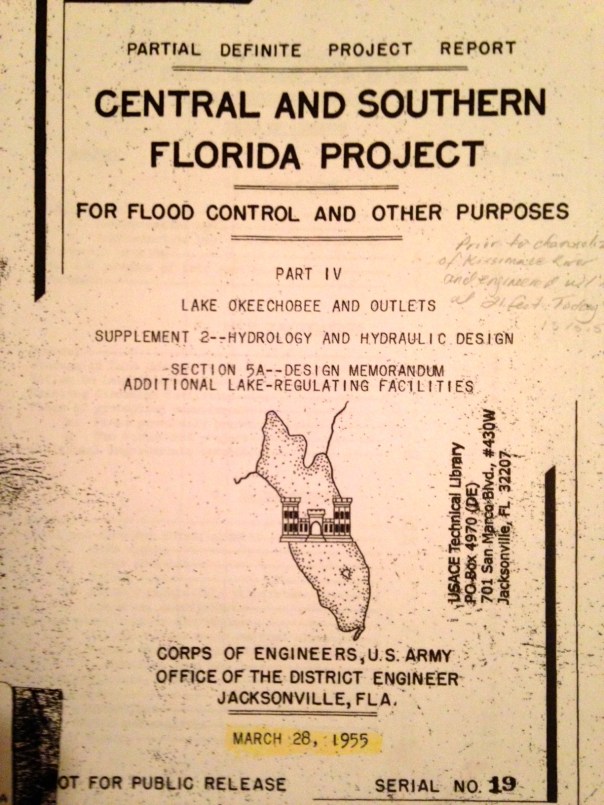
According to United States Geological Survey, (USGA,) the WCAs were developed as part of the (1948) Central and Southern Florida (C&SF) Project.
It followed tremendous flooding in 1947, and inspired the widening and deepening of the C-44, (St Lucie) C-43, (Caloosahatchee) canals, the building of C-23, C-24, C-25 in Martin and St Lucie Counties, as well as many, many, other projects around and south of Lake Okeechobee. The Army Corp of Engineers did what they were charged to by the state and the US Congress, and as usual they did it “too well,” over draining the state with the continued destruction of the northern estuaries. On top of that, today we waste on average 1.7 billion gallons of valuable water to tide every day. (Florida Oceanographic Society, Mark Perry.)
So anyway, the WCAs were also “created”during this time; they on the other hand are a good thing…
According to the USGA web site:
They were designed for use as storage to prevent flooding, to irrigate agriculture and recharge well fields and as input for agricultural and urban runoff.
They are also recharged by rain, but leeves were built around the WCAs so water flows into them and then slowly streams into Everglades National Park by the hand of man, not Nature…
The USGA also states that:
Historic flow of water and the quality of water through the WCAs have been greatly reduced. These conditions have resulted in decreased wading bird populations due to shortened hydroperiods, invasion of the native environments by exotic plants and fish, and conversions of sawgrass communities to cattail/sawgrass mixes.
Recently, Martin County’s Dr Gary Goforth (http://garygoforth.net), formerly of the SFWMD, and one of the primary creators of the STAs, has been revealing publicly at River Coalition meetings and SFWMD meetings that although more STAs have been built since 1994 to bring and clean water into the WCA/Everglades, less water is actually getting there!
2014 was the first year in ten years that a substantial amount of water (over 250,000 Acre Feet) was sent south. (See chart below.) This is odd isn’t it? And until last year, most of that water was EAA water used to water their crops, not “overflow” Lake Okeechobee water.
Dr Goforth’s chart showing amount of Lake O. water sent south to the STAs from 1995-2014.
I believe it was the public outcry that inspired the ACOE and SFWMD to send more water south last year through the STAs and WCAs.. .The problem lies with the SFWMD and ACOE mostly because in 1994, by law, phosphorus was limited into Everglades National Park. This is understandable, but adds to our St Lucie/Indian River Lagoon continued destruction.
Even with all of the STAs and the WCAs nature cannot take up all of the man-made phosphorus and nitrogen from farming and development. So what can we do?
We must return more of the EAA land to nature or at least “man-made” nature…we must purchase the option lands….
Option Lands Map SFWMD River of Grass, Option 1 is 46,800 acres and shown in brown. (SFWMD map, 2010)
With “my kids” at Pensacola High School, 1993, 9th grade English Class. (Photo courtesy of photography teacher at PHS.)
History shows that “things can change.” This doesn’t mean it will be easy, or perfect, but things can change.
Today is Martin Luther King Day, and as a former middle and high school English teacher, I have read Dr King’s speech “I Have a Dream,” many times together with my students, and each time, my eyes filled with tears at the prospect that these words could one day come true in spite of the pain and difficulty of “getting there.”
This held especially true when I was teaching in Pensacola, in Escambia County, which at the time was one on the very poorest counties in the state of Florida and may still be… I had two classes of “at risk” kids and my observation was basically that many of my students were “locked in the past” in their thought processes often quoting the Civil War and why things were as they were in their world.
Approaching Martin Luther King Day, we would read aloud Dr King’s speech, and I would tell them that although things are bad, they must remember, that years ago, things were worse, and most of all with the power of collective thinking, THINGS COULD CHANGE. And for that to occur, they had to believe it, live it, and be part of that of change.
I also taught my students some hard facts, noting that if they didn’t know their history, they would not have the tools, fire, or respect to create change in their world.
I believe that this lesson applies to river advocacy for the St Lucie/Indian River Lagoon as well. To make our advocacy work, we must know the history of Florida, the the Army Corp of Engineers, the South Florida Water Management District, agriculture, the EAA, development, and ourselves: then we must believe in change for the river, and we must be a part of that change.
Below are statistics of the history of the St Lucie River and releases from Lake Okeechobee, from 1931 to 2013. In 2014 there were no releases. Right now, in 2015, the ACOE has started again.
Thank you, to Dr Gary Goforth (http://garygoforth.net) for providing these numbers and an explanation of how he achieved them. The two columns are: “Estimated Releases to the River” (SLSR/IRL) and “Estimated Flow from Lake O to C-44 Canal.” Both are in acre feet. I use the first column often to compare and understand how much water has helped destroy our estuary over the years; ; I hope it becomes useful to you as well. And may we have a dream that things will get even better.
1931-2013 numbers for release from Lake Okeechobee to the St Lucie River. (Courtesy of Dr Gary Goforth, 2014.)1931-19601961-19951995-2013. (2014 = 0 to SLR)
Below is history and explanation from Dr Goforth:
History:
A state-authority – the Everglades Drainage District – constructed the St. Lucie Canal (later known as C-44) between May 28, 1915 and 1928. During this time they also built a lock and spillway at the Lake end of the canal and a lock and spillway at the present location of S-80. On June 13, 1923, water from Lake Okeechobee began flowing through the canal into the St. Lucie River.
In the 1930s and in the late 1940s the Corps enlarged the St. Lucie Canal, and it was then known as C-44.
In the 1940s the Corps completed S-80 – the St. Lucie Lock and Spillway – at the site of the original lock on the east end of the Canal. Flow data beginning 10/1/1952 for S-80 are reported by SFWMD.
In the 1970s the Corps constructed S-308 – Port Mayaca Lock and Spillway – west of the site of the original lock on the west end of the Canal.
Flow estimates:
I cannot find flow data for Lake releases to the Canal prior to April 1, 1931.
Between April 1, 1931 and September 30, 1952, Lake releases to the C-44 are reported by U.S. Geological Service.
I cannot find flow data for Lake releases to the C-44 between October 1, 1952 and December 31, 1964. However, flow data is available for S-80 beginning 10/1/1952, so I estimated Lake flows to the Canal for this period based on the S-80 flows and the correlation between concurrent observed flows at S-80 and S-308 (1965-2013).
Beginning January 1, 1965, Lake releases to the C-44 are reported by SFWMD.
I’ve also provided estimates of Lake releases to the St. Lucie River.
Lake releases are currently made to the C-44 Canal for two reasons: 1. Irrigation demand for agriculture in the C-44 Basin. This Lake water enters the Canal at S-308 but does not leave the Canal at S-80. 2. Regulatory releases from the Lake to the St. Lucie River.
Historically, some Lake water was sent to the St. Lucie River for perceived beneficial purposes – however today both Mark Perry and Deb Drum insist that Lake releases provide NO beneficial purpose to the River.
To calculate the Lake releases to the St. Lucie River, you need to compare the flow that enters the Canal at S-308 with the flow that passes through S-80. The minimum of the two flows is estimated to be the Lake flow to the River.
As an example, say 1000 gallons entered the Canal from the Lake on Day 1. The same day, no water passed through S-80. So for Day 1, the estimated Lake flow to the River is the minimum of (1000, 0) or 0 gallons.
As another example, say 1000 gallons entered the Canal from the Lake on Day 2. The same day, 500 gallons passed through S-80. So for Day 2, the estimated Lake flow to the River is the minimum of (1000, 500) or 500 gallons.
Using this method, we can estimate Lake flows to the St. Lucie River (Figure 2 and Table 2). Because flows were not available at both S-308 and S-80 for the period 1931-1964, I estimated these flows based on the correlation between concurrent observed flows at S-80 and S-308 during the period 1965-2013. Other folks (SFWMD or Corps) may estimate the flows differently based on different assumptions. —-Dr Gary Goforth
Home Page for new SFWMD website “Moving Water South,” 2014.
In case you have not seen it, managers at the South Florida Water Management District have created a wonderful new website entitled “Moving Water South.”
This website shows the incredible “work-around” the District performs to send water through the Everglades Agricultural Area, (EAA), to get water to flow south. The EAA, of course, is one of the nation’s richest agricultural areas and completely blocks the flow of water from Lake Okeechobee to the Everglades. Since the 1920s, the EAA has been the primary reason for the Army Corp of Engineers building canals C-43 and C-44 for the “overflow” waters of Lake Okeechobee. These excess waters are then dumped into our precious estuaries of the St Lucie River/Indian River Lagoon and Caloosahatchee. This destroys them.
If you go to the link above and view the website you will see a combination of ten different structures, (S); stormwater treatment areas, (STA); and water conservation areas (WC) that either basically send, clean, or hold water in its journey south.
They are as follows: Lake Okeechobee; S-354; S-351; S-352; C10A; WC1; WC2; WC3; STA3/4; and STA 2.
I really think this is a great site and as a former 8th and 9th grade teacher, I appreciate that it is something that can be visually shared with young people so that they can easily understand why our estuaries are periodically destroyed; the value, but difficulty of the EAA’s location; and why our Everglades are being starved of the amount of water they originally received.
My greatest hope with tools like this is that future generations will be able to figure out a way for us all “to have our cake and eat it too–” allowing enough water to go south so as not to destroy our estuaries, and allow the state’s long time best friend, historic “Ag” to do what it does, make money and feed people….
I definitiely commend the SFWMD for the transparency of the web-site; let’s take a look at what they are reporting today.
From Nov. 1, 2013, through Oct. 31, 2014, South Florida Water Management District operations moved approximately 339 billion gallons of water from Lake Okeechobee – that’s the same as 782,367 football fields filled with 1 foot of water or about 2.2 feet of water depth of Lake Okeechobee.
Holy Toledo! 339 billion gallons of water. Hmmm? How much is that?
After the 2013 Lost Summer and looking at the ACOE’s website for so long, I understand acre feet better….so how do we convert gallons to acre feet? (An acre foot is one foot of water standing on one acre of land…)
Thankfully, I have friends who can help me answer this question.
My friend, Dr Goforth, (garygoforth.net), a former long time employee of the SFWMD and designer of the Storm Water Treatment Areas told me:
“To convert from gallons to acre feet, divide by 325,872.”
All joking aside, thank you SFWMD for the website. By the way, it is important to recognize that the ACOE and SFWMD have “moved more water south” in 2014 than at least since 1995. Bravo!
In conclusion, in conferring with Dr Goforth, he thought it was a great site too, but mentioned it would be nice if the site explained how much water “made it to Everglades,” as this is a tremendous part of the overall goal.
Below is Dr Goforth’s chart showing water to Everglades among other complicated transactions. Like I said, thank God there are people who can read this stuff and do the numbers; all I really know is that sometimes there is an ocean of water coming into our estuaries and it needs to go somewhere else!
Dr Gary Goforth’s chart for moving water south to the Everglades, May-Oct. 2014.
*Thank you to Ted Guy for calling the Move Water South site to my attention!
12-20-14: After completing the above post, I am adding the chart below of Dr Goforth’s showing how much water by year comparatively moved south into the STAs from 1995 to 2014. I think it is a helpful visual and now I can reference this photo in Comments of this blog post.
Dr Goforth’s chart showing amount of Lake O. water sent south to the STAs from 1995-2014.
I am also adding this Option Lands Map as it too is referred to in the comments on this blog post as a way to send even more water south and create a type of flow way in the future….
This chart shows “the inherent variability in annual flows to the SLR/IRL.” (Dr Gary Goforth, 2014.)
One of the positive things that has come out of the negativity of the St Lucie River/Indian River Lagoon situation, is building relationships with incredible people who care about our rivers. One of these people is Dr Gary Goforth.
Dr Gary Goforth, 2014. (Photo Jacqui Thurlow-Lippisch)
I first met Dr Goforth last August when he spoke before the “Senate Hearing on the Indian River Lagoon and Lake Okeechobee Basin,” at the Kane Center in Stuart, organized by Senator Joe Negron. Dr Goforth was sitting next to Karl Wickstrom, founder of Florida Sportsman Magazine and outspoken member of the Rivers Coalition.
Listening to Dr. Goforth plead his case, I said: ” Wow, who is this guy?”
He spoke for the St Lucie River/Indian River Lagoon as a scientist showing the SFWMD and ACOE could move more water south, and he knew as he very much helped design the system! I came to learn that he in fact is the “father of the STAs (Storm Water Treatment Areas) in the Everglades Protection Areas and worked for the South Florida Water Management District for I believe almost 20 years. Now he is independent and has his own company. (http://garygoforth.net)
Having access to Dr Goforth is like having access to a “water issues computer” and I am continually blown away by his breadth of knowledge and that he is openly willing to share.
Sometimes our conversations go like this:
“Dr Goforth, I am looking at your chart, and my husband tells me never to speak in public when it comes to numbers…..but what does this mean……?”
He never makes me feel stupid, has the patience of a saint, and goes over the material until I get a hang of it.
The chart at the beginning of this blog entry is an example of complexities made simple through Dr Goforth. The chart, through color coding, shows “the inherent variability in flows” to the St Lucie River through C-23; C-24; Ten Mile Creek; C-44 Basin; Other Tributaries (a huge area around all the developed area of the river); and Lake Okeechobee Discharges. This is shown in AF (acre feet), or an acre of land with a foot of water on it.
Map of St Lucie Basin. Over the years, this basin has been expanded to take in water over 50% of its original footprint. (SFWMD/ACOE map 2014.)
Referring to the chart is enlightening and disturbing to note that for instance in 2005, almost 2,500,000 acre feet of water came into the St Lucie River/Indian River Lagoon; and in 2013, our “Lost Summer” about 1,250,000 acre feet came in. Other years shown on the chart between 1995 and 2013 with “worse” years than 2013 are 1998; 2003; and 2004. To somewhat put this in perspective, the huge EAA, or Everglades Agricultural Area, south and around the Lake Okeechobee is 700,000 acres. So for 2,500,000 acre feet of water, where would we ever find 2,500,000 flat acres of land to put this water on? We would not, and this is why “they” have to deal with volume and deeper storage areas. Mind blowing? YES!
The red colored blocks south of Lake O. are the EAA-700,000 acres of sugar lands and vegetables. South of the EAA are the STAs and water conservation areas .(SFWMD map, 2012.)
So getting back to home, why did we finally “freak out” and go over the edge in 2013, when the flows have been “worse” before? Well, I personally think social media is a big part of this, as well as the aerial photos that “showed” people” the true repugnance of the big picture; and like someone in an abusive relationship, after years and years, we’d finally HAD ENOUGH!
C-44, C-23 and C-24 basin runoff discolor the waters of the SLR/IRL while exiting the St Lucie Inlet over near shore reefs, 7-19-14. (Aerial photo, Ed Lippisch.)
Dr Goforth’s chart also shows that the annual flow to the SLR is 999,468 acre feet; and the average annual flow of Lake Okeechobee water to the SLR is 291,899 acre feet or 29% of the flow. I’ll round that up to 30% and say, “Yes, we here in Martin and St Lucie County have terrible issues with our own local runoff of C-23; C-24; Ten Mile Creek; C-44 Basin; and Other Tributaries; yes, in fact we are almost killing ourselves, SO ACOE and SFWMD PLEASE DON’T TOTALLY KILL US BY RELEASING POLLUTED WATER FROM LAKE OKEECHOBEE ON TOP OF OUR ALREADY HORRIBLE SITUATION!
With that said, I hope you learned something today and if you have time, take a closer look at the chart, it’s really educational; also, if you ever see Dr Goforth around town, go up to him and thank him and shake his hand. He is one of the most outstanding “River Warriors” of all!
Looking at the clouds over the St Lucie River, Roosevelt Bridge, Stuart, Florida. (Photo Jacqui Thurlow-Lipppisch 11-14)
“Darkness cannot drive out darkness; only light can do that…” Martin Luther King, Jr.
The situation for the St Lucie River/Indian River Lagoon remains a bleak one, but I am telling you, “I can see the light!”
At last week’s Water Resource Advisory Commission, (WRAC), of the South Florida Water Management District, (SFWMD), Dr Gary Goforth, (http://garygoforth.net) the great scientist watchdog of the District and former employee who designed and “built” the Storm Water Treatment Areas, (STAs) for the SFWMD, stood before the commission and gave thanks to the District and to the Army Corps of Engineers for “sending more water south” through the STAs to the Everglades in 2014, than since 1995.
273,188 acre feet in fact!
Although 273,188 acre feet of Lake Okeechobee water will not save the St Lucie, sending this much water south is an incredible move on the part of the SFWMD and the ACOE. Of course there is more work to do and the situation wouldn’t be as rosy if we had had as much rain fall as in the “Lost and Toxic Summer of 2013.” Nonetheless, those who worked hard for this must be given credit.
Doing so meant taking risks of breaking the WQBEL, or how much phosphorus can enter the Everglades Protection Area. Over a certain amount is a breach of federal law. Sending so much water south also meant irritating some powerful stakeholders, like the EAA and Homestead sugar and vegetable farmers who need dry feet to grow their crops and stored water to insure they can grow them…..
Dr Goforth’s chart showing amount of Lake O. water sent south to the STAs from 1995-2014.
The situation is difficult, really the”razors edge” as the “water going south” does not just include the waters of Lake Okeechobee but also the waters of the EAA that have precedence.
So….
This year was markedly different. Why?
Because of the pressure put on the ACOE, SFWMD, the Governor, DEP and others by the SLR/IRL and Caloosahatchee River Movements, the public, Scripps Newspapers, Martin County, St Lucie, and Indian River Commissioners, the IRL 5 County Coalition, and powerful “linked-in” politicians, like Senator Joe Negron and Congressman Patrick Murphy who are watching, and forcing the agencies to follow the requirements of state and federal policy to send water south even though it is a very slippery slope.
The clouds and sun are always moving….
Change happens slowly; it requires altering the culture and habits of institutions and society. Looking at what happened this year, is proof that this indeed is occurring.
I am a no “Pollyanna;” I know that what has to happen to save the St Lucie and Indian River Lagoon is tremendous, almost beyond comprehension, but in order to overcome darkness one must begin by recognizing the light…
THIS ARTICLE WAS WRITTEN FOR MR LARRY ROBINSON AND HIS “CUB CLUB” THAT WILL BE FLYING INTO HISTORIC BUCKINGHAM FIELD AIRPORT CLOSE TO THE CALOOSAHATCHEE RIVER IN LEE COUNTY; I THOUGHT THIS MIGHT BE OF INTERESTS TO ALL.
Cub Club of Florida
When flying into Buckingham Airport near Ft Meyers, one will surely get a view of the beautiful Caloosahatchee River that runs from Lake Okeechobee to the Gulf of Mexico.
The river, named after the warlike Calusa Indians, has a great history and is unfortunately under great pressure due to man-made changes in its surrounding hydrology. The original lands of the watershed allowed for the waters of the Kissimmee Valley, near Orlando, to move south through the then winding Kissimmee River, into Lake Okeechobee, and then slowly make their way to the Florida Everglades.
Historic flow of Lake Okeechobee. (Map courtesy of Everglades Foundation.)
Before the late 1880s, the Caloosahatchee was not truly connected to Lake Okeechobee; its headwaters started at Lake Hicpochee, west of today’s Clewiston. Marshlands filled from Lake Hicpochee to Lake Okeechobee in times of heavy rain “connecting” the waterway but this was not lasting.
In the late 1800s investor and land owner, Hamilton Disston, following an old Calusa Indian canal, connected the river permanently to Lake Okeechobee by digging a wide canal. This was done in order to drop the level of the lake and drain the surrounding lands for agricultural development.
Disston was not completely successful but he did inspire others to complete his work in the early 1920s.
Redirection of the waters of Lake Okeechobee through the Caloosahatchee and St Lucie Estuaries. (Map courtesy of Everglades Foundation.)
People had been farming in Florida south of the Lake Okeechobee since the late 1800s as the muck was very rich and produced wonderful crops. But flooding was a constant issue.
After the horrific hurricanes of 1926 and 1928 that completely flooded the area south of the lake and took thousands of lives, the state of Florida begged the federal government for flooding assistance which resulted in the Cross State Canal being built from Ft Meyers to Stuart and the building of the Herbert Hoover Dike around southern Lake Okeechobee.
The canal allowed not only for east west navigation across the state, but also redirected the waters of Lake Okeechobee that traditionally flowed south to be sent east and west through nearby estuaries: the Caloosahatchee on the west and the St Lucie River/Southern Indian River Lagoon on the east.
After another great storm and flood in 1948, and repeated outcry of the state and public, the Army Corps of Engineers “improved the system” through the Central and South Florida Project by widening and deepening already constructed canals and by building many more.
By the 1960 the Everglades Agricultural Area (EAA), south of the lake, became the number one sugar and vegetable producer of the state and one of the top in the nation; fortunes were made in the post-wartime era.
Simultaneous to the success of the EAA, development exploded along the two estuaries, the Caloosahatchee, and St Lucie/Southern Indian River Lagoon. Both of these areas depended heavily on fishing, tourism, and real estate values for their economies so when Lake Okeechobee would overflow and billions of gallons of fresh water would pour into the estuaries disturbing the brackish balance, killing seagrasses, destroying fishing stock and wildlife, of course these cities along the coasts complained.
Over time, even more people have moved the Caloosahatchee and St Lucie areas, and the massive population of Orlando has complicated the situation as “Orlando’s” polluted water full of nitrogen and phosphorus from fertilized lawns and farmlands travels south filling Lake Okeechobee. Since the water cannot go south, it is redirected to the estuaries. As a result, the Caloosahatchee and St Lucie estuaries experience toxic algae blooms during heavy destructive discharges.
This “health and safety” situation came to a head recently during the summer of 2013 when the Army Corps released from Lake Okeechobee for five months straight: May 8th- October 21st. This time became known as the “Lost Sumer” as health departments warned citizens and pets to stay out of the water for months on end.
Due to public outcry, Florida Senator Joe Negron, chair of the Appropriations Committee, organized a “Senate Hearing on the Indian River Lagoon and Lake Okeechobee Basin” that included studies of both estuaries. Congressman Patrick Murphy invited citizens to Washington DC.
The east and west coasts and many politicians unified during this time, thousands rallied, and news of the toxic waters was told by local, state, national and global media.
The Florida governor, state legislature, US Congress, along with “water managers,” Army Corp of Engineers and the South Florida Water Management District, felt tremendous pressure to find alternative ways to store water and clean water north of the lake and to “send more water south.”
Under the 2013/14 state legislative sessions the state legislature and federal government designated monies for both estuaries to help abate these issues. Part of the Tamiami Trail was even “opened” to allow more water to flow south and plans are being made to lift and open more areas in the future. University of Florida water experts are studying the issue.
Unfortunately, in spite of what can be done, this is just the tip of the iceberg as the amount of water that needs to be redirected away from the estuaries is enormous, truly beyond comprehension. This is why many believe Everglades restoration plans are taking entirely too long and that we must find a way to fully restore the Kissimmee River and create a third outlet south of the lake.
McCarty Ranch is/was located in St Lucie County and will be the future water supply for the City of Port St Lucie.
The first time I heard about McCarty Ranch was from, at the time, City Manager Greg Orvac. It was 2012 and he invited me up to Port St Lucie to see all the wonderful work they were doing building areas to clean water run off and to learn about how the city was planning for its future water supply.
I was told that the idea of McCarty Ranch was that the city would build a water treatment plant to withdrawal the polluted agriculture tainted water in the C-23 canal before it gets to the river, hold it, treat it, and use it.
“Wow,” I thought. “This is wild, I have heard of things like this in other areas of the state, but right here at home?”
This is great news about cleaning the filthy C-23 canal water that is one of many canals along with Lake Okeechobee releases killing our St Lucie River/Indian River Lagoon, (http://www.dep.state.fl.us/southeast/ecosum/ecosums/c23.pdf) but there is also a tang of future “water wars” in this scenario as cities jostle for securing their future water supply.
Port St Lucie recently has become the 9th largest city in the state of Florida and has approximately 250,000 residents. By 2060 or so, they expect 400,000 or more. Three years before I was born, in 1961, a handful of residents petitioned the legislature for the fish camp area to become a city…
By looking at the Google map above, one can see that McCarty Ranch is located just above the C-23 canal east of Gatlin Boulevard. The C-23 canal is the “county line” between Martin and St Lucie Counties. I do not really know the details, and I think the city and county are still arguing over details in spite of a front page article in Scripps Newspapers today, but one would think the city will either have to also annex some of the lands below the McCarty piece or just have giant pipes connecting it to the C-23 through a small connected parcel. Either way, I am sure over time it will occur. They will build what they need to remove by South Florida Water Management District, (SFWMD), permit, water from the C-23 canal and use it for their citizens.
You may be thinking, the McCarty name rings a bell because you know or because I recently wrote a blog about Dan McCarty awhile back. The blog was about how I stumbled upon a grave in Palms Cemetery along Indian River Drive that read: “Governor Daniel McCarty.”
Yes, the ranch belonged to this prominent St Lucie County, former 1800s pineapple, then ranch and citrus family.
If you have the time to listen to the first video link below, there is a fascinating video interview with Mrs Peggy McCarty Monahan, the granddaughter of Charles Tobin McCarty, talking about her father, the brother of Dan, the governor, saying to her when she was a young girl: “Water is gong to be an issue, water is going to be the most important thing…”
Through these words he was telling her that one day the ranch’s proximity to the City of Port St Lucie would make it ideal for water storage and supply. Many of these old time ranchers preached this theme to their children knowing we had worked so hard to get the water off the land and one day we would be trying to put it back on…
Apparently there are lakes and mined areas on the property for water storage; I am unsure if the original McCarty idea included drawing water from C-23 canal; it very well could be, as C-23 was built in the 50s and 60s and waste tremendous amounts of water to tide in order to drain the surrounding lands for agriculture and development.
C-23 is one of the dirtiest canals dumping into the St Lucie River; it will be good to remove some of the water before it gets to the river but will there ever be a day when it takes too much or Martin County wants that water too?
Sounds far-fetched for sure, but all I know is that stranger things have happened along the St Lucie River/Indian River Lagoon. Who would have though Port St Lucie would one day be projected to have over 400,000 people?
Aerial of what was to become the City of Port St Lucie, 1957. (Photo Ruhnke/Thurlow collection, courtesy of Sandra Henderson Thurlow.)
This aerial shows the area of the future almost 10,000 acres that will become the C-44 Storm Water Treatment Area and Reservoir. A landmark of this area is Indiantown Airport, a grass strip located above and north-east of the lake in this photo. So far the C-44 STA/R. project’s four mile intake canal has been built. The immense lands beyond, east, north and west of this area will become the STA and Reservoir.
I spend a good amount of time studying the St Lucie River/Indian River Lagoon; nonetheless, I am constantly amazed to learn what I don’t know. In a nutshell, the C-44 storm water treatment and reservoir is part of the Indian River Lagoon South Project to clean up the St Lucie River/Indian River Lagoon by storing and cleaning water from our huge C-44 basin.
The project is part of the Comprehensive Everglades Restoration Plan and even though I have read about it for years, I did not know how or the order of it being built. Today I will share my experience in learning just the beginning.
To look back a bit for the history, building the C-44 storm water treatment area and reservoir is combined effort of many years of work of local, state and federal governments and it is one of the most expensive water projects being built in the Florida, with an estimated costs of almost 4 million to complete.
I wanted to SEE this because it is so hard to understand it all.
So a few weeks ago my husband Ed, and his friend Shawn and I are flying over this area and I’m saying “where is it? It’s supposed to be here. I want to take some pictures. Hmmm? I don’t see anything…I was expected a big lake like thing off of the C-44 canal or something.”
Ed calmly, says: ” This is it Jacqui. Over the past years the ACOE has been working hard to build this new intake canal. We have seen it for years as we fly over. It must be built first probably; you can see the results.”
So we flew north over the four mile intake canal that finally stopped in a wilderness of agricultural lands.
Intake canal on east, agricultural lands on west.End of intake canal.
The intake canal was completed in July of 2014 at of cost of 28 million dollars. This is huge accomplishment and this is only the beginning. This is what we can SEE so far.
So what will we SEE in the future?
To get an idea as seen below, the FPL cooling pond off the east coast of Lake Okeechobee is 5,000 acres. The C-44 STA/R. will be almost 10,000 acres. So in the future, when one looks at a Google Maps, there will be another gigantic lake looking thing consisting of the STA (6300 acres) and the reservoir (3, 400 acres) east, north and west of the Indiantown Airport, the red dot below.
Area from Lake O following C-44 canal to St Lucie River in Stuart.Indiantown Airport along C-44 canal.Map of C-44 STA/R black. Basin in pink.Engineering map from ACOE/SFWMD showing where the cells of the C-44 STA/R. will be.
The monies and energy needed to build the C-44 STA and reservoir is and has been tremendous. In spite of one’s political affiliations or the project itself, we must recognize those who have recently helped ensure the success of the project: the SFWMD, the ACOE, Senator Joe Negron, Governor Scott, Congressman Murphy, the Martin County Commission and the public. I am sure there are many others that I do not know. This gigantic project has taken many years and has been no easy feat. Kudos to the decades of people who have worked to make this first step of the intake canal possible. I recognize your efforts.
Yes it is good to be positive, the C-44 STA and Reservoir is a great start, but it is important to also realize that the resovoir will hold about 50,000 acre feet of water. During some storm seasons we get much more than that just from the C-44 basin alone, and that is NOT counting releases from Lake Okeechobee.
We have a lot more work to do, to get to where we want to be, but finally we are beginning to SEE RESULTS of something getting built to help improve water quality, and that is something more than Martin County has ever seen before in its long fight to save its treasured St Lucie River and Indian River Lagoon.
One of Val Marin’s favorite books, “Everglades of Florida,” first printed in 1911, and reprinted as “South Florida in Peril,” 1988, by Florida Classics Library.Florida Classics Library
When I was a kid in the 1970s and 80s, there was a bookstore called VAL’s BOOKS. It was located on East Ocean Boulevard across from the Martin County Courthouse. My parents were very fond of Val and we would often visit, browse, and buy. Visiting the bookstore was an escape from the wonderful but limited world of early Stuart.
Years passed, and the businesses along East Ocean changed, and the beloved owner of Val’s Books, Mr Val Martin, moved his bookstore to Hobe Sound. Today you will see it if you drive south on Dixie Highway from Stuart to Bridge Road. It is located at a fork in the road and is a large, attractive spanish style building. The sign reads FLORIDA CLASSICS LIBRARY. (http://www.floridaclassicslibrary.com)
This bookstore is the absolute coolest for the “river enthusiast,” River Warrior, the person who appreciates Florida history or just wants a break from the norm.
There are copies of very old maps, old books, out of print books that have been reprinted by Mr Martin, and a great selection of children’s books as well. All have to do with Florida.
1856 War Map of Florida Everglades, Florida Classic Library.
It was at this bookstore that I first found maps and books that would give me great insight and historical reference for the destruction of South Florida and our St Lucie River/Indian River Lagoon. Val has fought for the Indian River Lagoon himself since the early days and you will see his name now and again in a Letter to the Editor. At the bookstore, he is a great “guide.”
The first book he called to my attention was the one in today’s featured photo, A Study in Bureaucratic Self-Deception, South Florida in Peril–-How the United States Congress and the State of Florida in cooperation with land speculators turned the River of Grass into a billion dollars sand bar.
It’s cover photos features a poor alligator in the Everglades struggling to find water in a culvert in the same “land” its ancestors thrived.
The book itself is a collection of documented congressional and state meeting minutes/summaries. Reading it is sometimes a collection of nauseating run on sentences but very educational and mind-blowing.
For instance on page 21, in an excerpt from 1881, entitled: Note 2, Agreement Between *Hamilton Disstonand Trustees of the Internal Improvement Fund for the Reclamation of overflowed Lands, the book reads in discussion of Lake Okeechobee, the St Lucie River, and the Caloosahatchee:
State/Federal drainage map of Florida 1911. Florida Classics Library.
“…by cuts or canals, including both those already patented as well as those that may hereafter be patented to said State by the United States, the said lands are to be reclaimed and drained and rendered fit for cultivation by permanently lowing and keeping reduced the waters of Lake Okeechobee, and thereby permanently lowering and keeping reduced the high water level of said river, and by thus lowering the waters…it being understood and agreed that the drainage, reduction of lowering of the waters of Lake Okeechobee may be made by a series of canals or cuts from the waters of said lake to the Caloosahatchee River on the west and by cuts and canals from said lake eastwardly to the waters of the St Lucie or other available point…”
For me, it is hard to believe this conversation took place in 1881!
The book goes on to document the state’s efforts to introduce sugar cultivation into south en Florida around the fertile muck lands of Lake Okeechobee and is a documentary record of “those efforts at both the State and National level to ditch, dike and reclaim the Everglades for agricultural production which ultimately resulted in the legacy of destruction of ecosystems across the south region of Florida and its adjacent seacoast.”
Oh well…
The only way to change history is to know history. A visit to Val Martin’s Florida Classics Library is a great place to start!
__________________________________
The address of Florid Classics Library is: 11300 Se Dixie Hwy, Hobe Sound, FL 33455. Here is the website from which you can also “browse:”(http://www.floridaclassicslibrary.com)
*Hamilton Disston was the first successful “drainer” of our state, it is widely believed that despite his “success” and great riches, he ended up committing suicide in a bathtub because of the repercussions of the “Financial Panic of 1893;” some reports say it was heart trouble. (http://en.wikipedia.org/wiki/Hamilton_Disston)
The collective teamwork of the SLR/IRL River Movement has had a tremendous effect on state agencies such as the ACOE and SFWMD. “KEEP THE GATES CLOSED!” (Photo of River Warrior and River Kidz mom, Cristina Maldonado, donning her homemade protest shirt at the St Lucie Locks and Dam River Rally. Photo Jacqui Thurlow-Lippisch, 2013.)
Today I want to share what I consider a huge recent success of the River Movement and our ability to network and work together to protect our St Lucie River/Indian River Lagoon.
On August 25th, Jensen Beach activist Jackie Trancynger sent out an email blast featuring a photograph taken by Paul Shidel of an awful looking algae bloom he found while photographing birds at Port Mayaca. Port Mayaca is where structure S-308 is located that allows water from Lake Okeechobee to be released into the C-44 canal to the St Lucie River/Indian River Lagoon.
Here’s the photo. You may recall reading about it in one of my previous blogs or seeing it in an email exchange:
August 24, 2014 photograph of blue-green algae bloom east of S-308, Lake Okeechobee/C-44 Canal area/ (Photo courtesy of Paul Shidel.)
So anyway after I saw the photo, I called Jackie Trancynger and got Paul Shidel’s email in order to verify the location of the bloom-certainly appearing to be toxic algae. Paul not only verified the location but provided a map!
Map of algae bloom’s location on east side of S-308, C-44 canal. (Paul Schidel.)
On Tuesday, August 26, I participated as I have for almost two years now, in the ACOE Periodic Scientists Call in my capacity as an elected official from the Town of Sewall’s Point at the invitation of Ms Deb Drum, who oversees Martin County’s Ecosystem Restoration & Management Division.
During this call I sent Paul’s photo and map to the ACOE stating concern that if S-308 were opened this possibly toxic algae would head straight into our SRL/IRL.
Then an amazing thing happened..
The ACOE ask the Department of Environmental Protection (DEP) to test the algae.
Yesterday, Deb Drum from Martin County reported that the testing came back positive as “Microcystis, a toxic blue-green algae.” The county in turn notified the ACOE that the algae exists in that location to document their concern. If the ACOE were to open the locks at S-308, the algae could travel downstream with the water flow into the SLR/IRL. This knowledge could actually make a difference in a decision of the ACOE to open up those structures.
Wow. Thank you Paul!
I have complained before on the ACOE call about toxic algae being released from Lake Okeechobee as the SLR/IRL does not seem to “go toxic” from its local canals, but only when Lake Okeechobee’s waters are unleaded to our shores. Toxic algae has been seen in the area between S-308 and S-80 many times but we need to start documenting this. Documentation is a powerful tool in changing the tide of destruction.
So thank you for your teamwork! Together we can help KEEP THEM CLOSED! The “Gates of Hell” that is…
Subject: Lake Okeechobee, Okeechobee/Glades/Hendry/Palm Beach/Martin Counties: Florida CyanoHAB Tracking Module has received a record update
On August 27, 2014, Florida Department of Environmental Protection’s Southeast District staff sampled an algal bloom found in Lake Okeechobee. A single grab sample was collected of surface scum at the Port Myakka Lock (C-44.) Following are the laboratory results for this sample:
Result: Class Toxin potential * The dominant taxon was: Microcystis aeruginosa Class Cyanophyceae yes
Other taxa present: Dolichospermum circinale ** Class Cyanophyceae yes Pseudanabaena sp. Class Cyanophyceae undetermined Eudorina elegans Class Chlorophyceae – Pediastrum simplex Class Chlorophyceae – Glenodinium sp. Class Dinophyceae
* Information based on literature searches and personal communications; information is continually being updated. “Undetermined” refers to specimens for which the lowest practical level of taxonomic identification is genus and some, but not all, species within that genus have the potential to produce toxins or toxin information not available for the identified species but is available for genus level.
Color graph showing land use and development in South Florida by 1972 made possible by drainage and re-plumbing of Lake Okeechobee waters to the northern estuaries. (SOFIA, Robert Renken team 2000.)
To understand the impacts on the St Lucie River/Indian River Lagoon, it is necessary to look in beyond our boarders. One of the most telling documents helping to explain why the St Lucie River/Indian River Lagoon is forced to take the over flow water of Lake Okeechobee (which in some years, since 1923, has been above 2,000,000 acre feet) is a document entitled “Synthesis of the Impacts of 20th Century Water Management Land Use Practices on Coastal Hydrology of South East Florida,” by Robert Renken and other scientists for the 2000 Greater Everglades Ecosystem Restoration Conference.
Today I will show parts of this document as “food for thought.”
Chart 1, 1900.
As one can see above, in 1900, Lake Okeechobee overflowed naturally to the Everglades to Florida Bay. The green on the eastern coast was a Florida forest.
Chart 2, 1953.
By 1953, the year after my Thurlow grandparents came to Stuart from Syracuse, New York, the Everglades Agricultural Area, (EAA), just south of the lake had caused the destructive redirection of Lake Okeechobee waters; this water was directed to the northern estuaries, the St Lucie River/Indian River Lagoon on the east, and to the Calooshatchee on the west. More agriculture can be seen in dark brown along the eastern coast and south to Homestead. Forests in some areas remain (green). The yellow is urban development. There is some urban development but it is not extensive.
Chart 3, 1972.
By 1972, when I was 8 years old growing up in Stuart, the Everglades Agricultural Area (EAA) now mostly sugarcane, south of Lake Okeechobee, had morphed to gigantic proportions (dark brown), agriculture had also expanded along the eastern coast, and coastal development (yellow) had grown and moved into the eastern Everglades.
Chart 4, 1995.
By 1995, when I was 31 years old, and teaching English and German at Pensacola High School, the EAA had achieved its 700,000 acreage south of the lake, and although there remained extensive agriculture (dark brown) along the east coast, excessive urban development had taken over many of these lands (yellow.)
Today, there is nothing but more rapid population growth projected for this area. There were 5,564,635 inhabitants of the Miami-Dade metropolitan area as of the 2010 Census; it is the most populous in Florida, and southeastern United States. It is the eighth-most populous area in the entire United States. (http://en.wikipedia.org/wiki/Miami_metropolitan_area)
For me, this rapid population and agriculture growth is rather depressing, but I will say Ed and I had a great Cuban meal in West Miami at Islas Canarias Restaurant over the Labor Day weekend…
At the end of the day, this area is going to need more water. With a growing population, documented salt water intrusion, and sinking aquifer level this part of the county will not stand the test of time unless it has more fresh water. Perhaps they would reconsider re-plumbing the canals making releases to the estuaries?
“Move the Water South” may just start being chanted from Miami…
“The dinoflagellate, (marine plankton), Pyodinium bahamense is what “produces the light show in the IRL.” Photo credit: https://getupandgokayaking.com
About a week and a half ago, my mother sent me an email with photos of my father and her on a kayak trip at night in the Indian River Lagoon. She had seen an article in the Stuart News about a company called Motorized Kayaks of the Treasure Coast and their trip into the light show of bioluminescence that has been occurring off our shores.
First, I thought about how cool my parents are to be going on kayak trips in their mid- seventies, and second, I thought, “aren’t these little plankton creatures a kind of algae bloom, and aren’t algae blooms bad for the lagoon in spite of bioluminescence’s beauty?”
Algae blooms have been linked to recent 60% plus seagrass die-offs, poor water quality, as well as IRL pelican, dolphin and manatee deaths. Super blooms, brown tides, “regular” and “toxic” algae blooms are “fed” by fertilizer, septic effluent, canal and Lake Okeechobee discharges, especially in the southern lagoon.
[caption id="attachment_2989" align="alignnone" width="300"] My father, Tom Thurlow, preparing for a kayak trip into the Indian River Lagoon to view the bioluminescent light show. (Photo Sandra Thurlow, August 19, 2014)
Well anyway, I decided to contact Dr. Edie Widder of ORCA, the Ocean Research and Conservation Association, in Ft. Pierce, (http://www.teamorca.org/cfiles/home.cfm) and ask.
Dr Widder is a world-renowned bioluminescence expert; she has even worked with the US Navy in the “design” of ships that would not cause bioluminescent disruption in the oceans, and thus give away their location to enemy ships.
This was my question to Dr Widder:
Dear Edie, My parents rented kayaks to go see the bioluminescence in the IRL. It got me thinking. Is the light caused by the same creatures that cause toxic algae blooms in the lagoon? Is the bioluminescence a bad sign for the health of the lagoon? Thank you. Hope all is well.
Her response:
Hi Jacqui – It’s kind of a good news bad news story. The dinoflagellate producing the light show, Pyrodinium bahamense, happens to be one that produces saxitoxin. Interestingly it’s the same dino that’s responsible for the bioluminescent bays in Puerto Rico and in those bays it doesn’t produce the saxitoxin. Here it does. It’s not known why although I have a theory and it has nothing to do with pollution. (It’s a long story having to do with how their bioluminescence functions to protect them from predators under different concentrations.)
Dino blooms are usually preceded by rain events that flush nutrients into the water and then a series of calm sunny days that promote photosynthesis. Blooms like the one we’re seeing now used to be routine according to some of the older fishermen I’ve talked to. They called it fire in the water. The fact is the water can’t be too polluted or the dinoflagellates won’t grow. I’ll send you an article with some pictures I took.
Cheers,
Edie
Here is a photo Dr Widder took of bioluminescence in the lagoon I copied and a link to a remarkable video.
Bioluminescence in the IRL photographed by Dr Edie Widder.
In conclusion, I looked up saxitoxin and learned it is a “paralytic shellfish toxin” that is found is some shellfish and especially puffer fish. It has been found in few other places in the US as well as in the Indian River Lagoon. I guess the little dinoflagellates, the same ones that make the pretty bioluminescence light, not always, but sometimes, will produce this toxin which gets spread to some shellfish and some fish. If such a shellfish or fish is ingested, it will make a human very sick. Around 2002, 28 people got so sick here, in the Merritt Island area, and in a few other areas of the county, that now there is a permanent government ban on harvesting/eating IRL puffer fish in the entire IRL.
Since I am nowhere close to a scientist, I will just share some links below and refrain from speculating what is “good or bad. ” Nonetheless, I think I can safely say that sometimes beauty and danger walk hand in hand in this magical world of our Indian River Lagoon.
Cover of NOAA/DEP “Draft”Indian River Lagoon System Management Plan, 2014.
My husband came home from the airport yesterday, I was on the couch in the living room reading. “Have you had a good afternoon?” He asked.
“Awesome,” I replied. “I have been reading the most wonderful document that contains all of the important information about the entire Indian River Lagoon.” I energetically held up my gigantic copy of the Florida Department of Environmental Protection and NOAA- Indian River Lagoon, Draft Report for 2014. (http://www.dep.state.fl.us/coastal/sites/indianriver/plan.htm)
Ed smiled and looked at me like he usually looks at me in such instances. “That’s great,” he ironically replied, “government publications are my favorite too, how exciting…”
I am not always enamored with government publications, but I am with this one, especially as it is not finalized yet and the agencies are taking comment from the public.
What I like best about the document is that is deals with the entire lagoon, not just one section, including the lagoon’s four aquatic preserves: 1. Banana River; 2. Malabar to Vero Beach; 3. Vero Beach to Ft Pierce; and 4. Jensen Beach (really just south of the City of Ft Pierce) to Jupiter Inlet.
Locations of the IRL’s four aquatic preserves
According to the document, “each of the four aquatic preserves comprising the IRL System was classified by the state of Florida as OFWs or “Outstanding Florida Waters, “in 1979 (Rule 62-3-2.700 (9) F.A.C.
I was 15 years old at that time. I remember those waters and how they shaped and enriched my life growing up here in Stuart. To think that these “Outstanding Florida Waters,” are now “impaired” makes me sad and makes me angry.
It has been coming for years, but in 2011 through 2013 the lagoon system really “crashed” with the “super-bloom” and brown tides in the central and northern lagoon, killing more than 60% of the area’s seagrass and leading to two federally designated “Unusual Mortality Events” of the endangered manatee, and the protected bottle nosed dolphin.
And also in 2013 the months long toxic algae outbreak in the southern lagoon… This occurred due to blue-green “microcysis aeruginoas” algae water released by the ACOE from Lake Okeechobee, into the St Lucie River/IRL system. The SLR/IRL system was already over stressed from discharges coming from local canals C-44; C-23; C-24 and C-25…the lake Okeechobee water was the nail in the coffin so to speak.
I think there is a disconnect here. Aren’t these waters protected?
According to the publication, the mission statement of the Florida Coastal Office/Department of Environmental Protection is the following:
1. protect and enhance the ecological integrity of the aquatic preserves;
2. restore areas to the natural condition;
3. encourage sustainable use and foster active stewardship by engaging local communities in the protection of aquatic preserves; and
4. improve management effectiveness through a process based on sound science, consistent evaluation, and continual reassessment.
I will refrain from bashing of the Department of Environmental Protection as I do not think our fair state’s leadership over the past hundred and fifty plus years has helped them attain their mission. How do you “direct” an agency to protect something and then simultaneously promote over drainage of natural systems, channelizing, overdevelopment along the lands of these once “outstanding waters,” and allow water districts to over-grant permits for aquifer withdrawal for more agriculture and development?
Another irony I have to add here is that these once “outstanding waters” are what helped bring people to our locations and supported their high real estate values. That is changing as some people are now leaving. Last year, in the Town of Sewall’s Point, although the real estate market improved overall in the county, our property values only increased 0.13%. As a “desirable” water front community with some of the highest property values in the county, this came as a surprise and is certainly directly linked to the “lost summer” and toxic waters of 2013.
The state of Florida needs to “wake up.” The Town of Sewall’s Point is a microcosm for the rest of the state. So what can we do to help? Speak up!
Please if you have time and interest, check out Indian River Lagoon System Management Plan, Draft Report 2014 below. Even if you don’t read it all, which is almost impossible, keep it as an electronic resource, and MAKE A COMMENT to the DEP. Even if it is just one that you appreciate that they are reevaluating their management plan and how much the IRL means to you.
It is only through the continued pressure of a caring public that the Indian River Lagoon will be resurrected and its “living waters” will run through our cities again.
Fertilizer, pesticides and herbicides “run-off” crops into a canal during a rain storm. This is an example of “non-point pollution.” Lynda Betts, United States Dept. of Agriculture. (Photo, public domain.)
There are many types of pollution that affect the St Lucie River/Indian River Lagoon but two words you will hear over and over are “point” and “non-point pollution.” These are important words to understand especially today as we fight to save our rivers.
Point pollution is basically pollution that you can pin-point coming out of a “pipe.” Point pollution is associated with industry. For instance, a waster water treatment plant that has a pipe releasing into the river is point pollution. In the late 1800s and early 1900s some residences, businesses and industries just let their pollution and or sewage go directly into the St Lucie River and Indian River Lagoon. Yuk!
This practice improved with the advent of sewer systems, septic and organized cities but there were/are still direct pipes releasing very unclean water until very recently. Recognizing the impacts of discharges from wastewater treatment plants, the Florida Legislature passed the Indian River Act (Chapter 90-262) in 1990 requiring waste water treatment plants to cease discharging their effluent, somewhat processed poop, into the lagoon. Because it was easy to pinpoint exactly where these industrial wastewater points are/were located, it is fairly easy to regulate them.
The lagoon and we have befitted from the Indian River Act 90-262 but we still have problems.
Non-point pollution, unlike point source pollution, is pollution that is hard to pin-point because it is coming from “everywhere.” On average it rains 50 inches each year along the Treasure Coast. Highways, parking lots, people’s yards, leaky septic tanks, and agriculture all combine to create a cocktail of oils, heavy metals, fertilizer, pesticides, herbicides, viruses, bacteria and other pollutants that run from flowing rain water into area canals and then straight into the St Lucie River/Indian River Lagoon.
To complicate things more, cities and counties can regulate residential applications (for instance many have recently passed strict fertilizer ordinance outlawing the use of nitrogen and phosphorus fertilizer application during rainy season,) but cities are not allowed to regulate agriculture even if is located in their city or county.
Agriculture is exempt from such laws. Agriculture is regulated and overseen by the Florida Department of Agriculture.
The Department of Agriculture recognizing the need to abate fertilizer and chemical runoff does promote “best management practices,” helping farmers work to lower phosphorus and nitrogen runoff but this is voluntary and not required. Most farmers do comply but it is not easy to judge and measure so agriculture runoff continues to significantly add to river pollution across our nation and state as we know from our C-44 canal that dumps mostly agriculture basin runoff into our rivers.
You will often hear people say, “We must stop pollution at the source!” This is a good idea and our state and federal agencies are doing it with point source pollution but not with non-point source pollution.
Perhaps one day every yard and every agriculture field will have to take a portion of their land to hold rain runoff so the pollutants seep into the earth before they go to our waterways? Perhaps one day the Department of Environmental Protection and the US Environmental Protection Agencies will become more hard-core rather than coming up with programs like TMDLs and BMP–Total Maximum Daily Loads for phosphorus and nitrogen and Basin Management Action Plans, because although those will help over time, like 30 years, we don’t seem to have a lot of time left.
System Status Update is a presentation slide from the ACOE periodic scientist calls. It shows how much water is going east/west and south, in this slide, from the Everglades Agricultural Area (EAA) to the Everglades.
Today I am going to share an entire 25 piece slide presentation from the Army Corp of Engineers’ Periodic Scientists Call, 7-25-14. It’s a lot of slides, but I think you’ll enjoy trying to interpret them, and I’ll help the best I can. These presentations include a lot of information and show how the ACOE decides how much Lake Okeechobee water is going to go the estuaries, south, to the Everglades, and held, or released, to other places. This information is UNCLASSIFIED so I can share it.
I first was invited to sit in on these calls in 2012, as I was former mayor and continued commissioner, as today, for the Town of Sewall’s Point. I have talked about this before in my blog but I will restate. I felt like a complete idiot for the first six months as the ACOE kind of speaks in their own language. A military language.
Eventually, I started to catch on, and even gained the confidence to comment. Although not a scientist, as an elected official I am allowed to give succinct perspective.
These calls take place approximately every two weeks depending on the circumstances. During the terrible 2013 releases from Lake Okeechobee into the St Lucie River/Indian River Lagoon and the Caloosahatchee, calls took place every week. “Stakeholders” from the lakes south of Orlando to the Everglades participate in these calls. Representatives from agriculture, the state agencies, counties and others are present.
Here is the entire presentation from the last call on July 25, 2014.
In the slides one sees weather outlooks; inflows/outflows (west, east, south) from Lake Okeechobee and/or the southern flow of water from the EAA or Storm Water Treatment Areas into the Water Conservation Areas and Everglades; position/historical analysis of water levels in the lake; Lake Okeechobee Regulation Schedule (LORS) guidance for releases; estuary salinities; basin and lake runoff/releases into the estuaries; ongoing emergency storage of water…
In all honesty, it’s a lot for me. I mostly pay attention to the level of Lake Okeechobee and how much they may or may not decide to release into the St Lucie River/IRL. Here the LORS guidance said they could release 1170 cfs cubic feet per second into the SLR/IRL but the ACOE chose not to. Yes, many times the ACOE actually cuts us a break. But when the lake is really high, over 15 feet or so, there is no break.
I also pay more attention to how much water is going south, as this would help alleviate our situation. It appears to me that usually the water “going south” is from the Everglades Agricultural Area (EAA), not from the lake, as in this presentation, the canals just south of the lake are not noted or say “0.” Understandably, the agriculture people like to hold the water in the lake, in case a drought comes, as they need water for their crops.
I will never interpret these calls like a scientist and some the scientist may cringe when I make my non-scientific statements. But that’s OK. I am “trying.”
I think the ACOE and shared South Florida Water Management District (SFWMD) slides have gotten better and show more information than when I first started attending. I think they know the people and some politicians of Martin and St Lucie Counties, really all over the state now, are watching like hawks and demanding more disclosure and transparency in how the ACOE and SFWMD decide to manage Lake Okeechobee and surrounding areas.
I do hope you find this information interesting and not overwhelming. You can find some of it on the ACOE Facebook page (Jacksonville District, U.S. Army Corps of Engineers) or on their website (http://www.saj.usace.army.mil).
Personally, I still find the info for the SLR/IRL hard to find. I wish the ACOE would devote a special area on their website to us like the SRWMD has because the more we as citizens can easily learn and pay attention, the better chance we have, one day, for a healthier St Lucie River Indian River Lagoon for our children.
Map for the “Performance Configuration” co-authored in 2009, incorporating Plan 6 ideas for sending more water south.
First thank you to Dr Gary Goforth for providing much of this historical data.(http://garygoforth.net)
There is a lot of controversy surrounding the idea of “sending water south,” mostly because in order to do so privately owned lands would be taken out of sugar productivity. This post is meant to share some of the history of ideas over the years to do so, not debate it.
As we all know, before the lands south of Lake Okeechobee were drained for the budding agriculture industry in the late 1800s onward, when Lake Okeechobee overflowed, ever so gently its waters ran over the southern lip of the lake through a pond apple forest, creating a “river of grass” that became the Everglades.
In the 1920s at the direction of Congress and the State of Florida the Army Corp of Engineers (ACOE) redirected these overflow waters that had functioned as such for thousands of years through canals C-44 to the St Lucie River and C-43 to the Caloosahatchee.
This achieved better flood control for agriculture and development but has caused an environmental disaster for the northern estuaries and for the Everglades.
The environmental destruction and safety issues of the Herbert Hoover Dike were noted early on. As far as the destruction of a local industry, the fishing industry in the St Lucie River was the poster child. This and many other reasons caused many people over the years to seeks “improvements,” to the overall ecological system.
One of the first was the 1955 ACOE Central and Southern Florida Project Part IV. It was a proposal evaluating different options (plans) for “increasing lake outlet capacity. One component was “Plan 6,” a one mile wide floodway extending from the Herbert Hoover Dike to one mile into Water Conservation Area 3. For this report, Plan 6 was the recommended improvement. Dr Gary Goforth notes discharges to the St Lucie would have been lessened about by half, but “not eliminate lake discharges to the St Lucie River.” In the end, the entire plan was not acted upon as many tax payer paid plans are not…but Plan 6 was not forgotten…
Photos taken of 1955 ACOE CSFP Report courtesy of Dr Gary Goforth.Floodway 1955
Various references to Plan 6 and a floodway.
Dr Goforth also notes a “more robust plan,”a plan co-authored in 2009 by Karl Wickstrum, Paul Gray, Maggy Hurchalla, Tom Van Lent, Mark Oncavgne, Cynthia Interlandi, and Jennifer Nelson. (See first photo in this blog.) This plan is referenced by Mark Perry in his well known “River of Grass” presentation.
Mark Perry’s drawing in his presentation for “River of Grass,”used today, 2014.
The Art Marshal Foundation (Art was one of the great conservationist of the early 1960/70s environmental movement and has a wildlife preserve named after him) also notes in their literature that Plan 6 is traceable to the Marshall Plan-1981.
“Marshall Plan 1981 to Repair the Everglades, Why Plan 6 Will Work.” Marshall Foundation publication 2013, Version 2.2.
Most recently in 2013, the Rivers Coalition published on its website “Plan 6 Flowway, River of Grass, Missing Link.”
You can learn more about this version of the plan by clicking on the above link.
All of these plans, I believe, are one way or another based upon the 1955 ACOE Report. it may not have come to fruition but it certainly provided a lot of inspiration!
Also last year, Senator Joe Negron was able to secure $250,000 for a University of Florida study that should occur in 2014 for “Sending more water south.” Wonder what their plan will recommend?
If history repeats itself, even more Plan 6 versions will be created. In any case, let’s keep pushing for change to save the estuaries and find some way to move more water south. And thank you Army Corp of Engineers for the inspiration…
Caulkins Grove off of Citrus Blvd. in Martin County is a pilot project of the SFWMD for water farming. (Photo Jacqui Thurlow-Lippisch 7-18-14.)
On Friday, July 18th, Dr Gary Goforth (http://garygoforth.net/resume.htm) and I met at Indian River State College just after noon. I jumped in his truck, wearing my dress and heels, and we drove the back roads to find our destination. Our destination was long time Martin grove, Caulkins Citrus, located off Citrus Boulvard, near Indiantown, adjacent to the C-44 canal which of course connects to the St Lucie River/IRL and to Lake Okeechobee.
Kevin Powers, of the South Florida Water Management District governing board, longtime Martin County resident, and family friend, had invited Gary and I to see a pilot project of “water farming.” Water farming is idea that has been in the works for the past few years and is now finding its reality. If it works, thousands of acre feet of polluted water along the C-44 canal, in this case, will not find its way to the St Lucie River/ Indian River Lagoon. Farmers are paid for this service and their lands are not sold to development.
How could this be? Farmers “growing” water?
First we have to go back a bit.
In a Stuart News article dated April of 2013, Doug Bournique, executive vice president of the Indian River Citrus League, is interviewed by reporter Paul Ivice. Ivice writes:
“Diseases, (greening and canker), hurricanes and urban expansion have all cut into Florida’s citrus acreage which is down 38% from 1996…Nowhere in Florida has acreage fallen as sharply as in Martin County. It has less than 15% remaining of the 48,221 acres in production in 1994. The county has suffered the greatest loss for four consecutive years and and been declining sine 1994.”
A diseased citrus tree stands in what was once a thriving orange grove, Caulkins Citrus. (Photo JTL.)
As the citrus industry is dying, so is our economy. While farmers figure out what else they can grown on their land, the idea for some farmers to hold precious fresh, all be it polluted, waters on their lands came into being. This helps the river and it helps the farmers and it helps our local economy. Boyd Gunsalus, among other scientist at the SFWMD, has worked long and hard for the past many years on this concept.
Caulkins Citrus is in a prime location and were one of the farms that competed for a bid to try out the new technology and receive a DEP/SFWMD grant.
An example from Google Maps showing C-44’s close proximity to Citrus Blvd. Hwy. 76 is south of canal and Citrus is north.
When Gary and I arrived we were met by Tom Kenny, Kevin Powers, and Ronnie Hataway. After introductions, they explained to us how the “farm”operated, how it was created, their hopes for the future, and gave us a walking and driving tour. It was pretty amazing if not surreal. Egrets and herons perched in the dying orange trees surrounded by water. A deer track was at my feet. Water was everywhere and from what I was told could one day go to the horizon.
Although Gary and I had been somewhat skeptical, we left feeling very hopeful and impressed.
So how did they create it?
Basically the grove is fallow due to poor health, and although the farm is much larger, (thousands of acres) a berm was constructed around a few hundred acres of the grove for the pilot study. Then water was/is pumped from the C-44 canal into the old grove. The berm holds the water inside.
The water can go as high as four feet but according to Mr Kenny it is percolating so well through the soft sandy soils that basically the pump can stay on all the time. The nitrogen and phosphorus and other pollutants are cleaned and eaten by healthy bacteria as the water filters through the earth.
The pilot’s long term goal is to hold 6600 acre feet of water but things are looking like they will be able to hold more. The water is slowly filtered into the water table replenishing the aquifer about 40 feet below. Caulkins is installing a number of apparatuses that they call “wells” that will read where the water is going and what is happening underground. If things work out, Caulkin’s acreage to hold water will be expanded.
Various photos of the SFWMD pilot water farming project at Caulkins Grove: fallow orange groves surrounded by berm, pumps bringing in water from C-44 canal right next door, sandy soil, and deer track.
Although this is wonderful, we must note that it would take many water farms to offset the water flowing into the SLR/IRL.
Dr Goforth states in a recent writing: “For the 34 days between June 13 and July 17, approximately 51,000 acre feet of C-44 runoff was sent to the St Lucie River…”
With that in mind, if a water farm similar to Caulkins could hold 10,000 acre feet, we would need five just to hold the water that has come in this summer SO FAR from C-44 basin runoff. Of course in time, 2020 maybe, the C-44 Storm Water Treatment and Reservoir and Storm Water Treatment Area will be one line, and hopefully working, and that is said to hold about 56,000 acre feet. (http://www.tmba.tv/broadcastanimation/everglades-restoration/everglades-restoration/)
In the end, really though, no one knows how much water can be held until these projects are working. Hopefully all of them, like Caulkins Grove seems to be so far, will exceed expectations.
As we tied up our tour, shook hands and left the property Mr Hataway said, “I have been telling them for years to keep this fresh water on the land….”
Mr Kenny noted, “The goal is to have less water going into the river and out the inlet…”
It is an ironic twist of fate. We worked for 100 years to drain the lands so we could grow agriculture. Now we are trying to keep the water on the land for the health of the river, because fresh water is extremely valuable, and because the citrus industry needs a new crop.
Words such as these about “keeping the water on the land,” especially from successful agriculturally minded businessmen, are an inspiration to me, and give hope for a better water future.
_________________________________________________
After the fact, I am including this 2 page summary provided to me by the SFWMD when I asked about costs on behalf of blog reader George Gill. Click to enlarge.
Toxic Algae bloom washes up along the shoreline. St Lucie River, Riverside Drive, Stuart, Florida. (Photo Jenny Flaugh, summer 2013.)
RECENT HEADLINE: “FUNDING FOR 82 Million in NEW RESEARCH/CAUSES/CONTROL OF ALGAE BLOOMS IN US AND IRL– SPONSORED BY U.S. SENATOR BILL NELSON D-FL”
As much as I am thankful for the politicians and policy makers who have recently gotten monies allotted to fight the “toxic algae in Florida’s waterways,” I am slightly miffed. From what I understand, and have learned over the past years, much of the research to understand these problems has already been accomplished, particularly by the National Research Council.
In 2008, when I was just beginning to really plow in and try to understand why the St Lucie River and Indian River Lagoon issues were happening and basically at the time being ignored publicly and politically, I was recommended to read “Clean Coastal Water, Understanding and Reducing the Effects of Nutrient Pollution,” published by the National Research Council in 2000.
The National Academy of Sciences (NAS) is a non-profit organization in the United States. Members serve pro bono as “advisers to the nation on science, engineering, and medicine”. Election to the National Academy is one of the highest honors in U.S. science. The academy was signed into law under the presidency of Abraham Lincoln in 1863. These public documents are available to all and these agencies give presentations to the US House and Senate and have done such on “algae blooms in coastal waters.”
The National Academy of Sciences is part of the National Academies, which also includes:the National Academy of Engineering (NAE); the Institute of Medicine (IOM); and the National Research Council (NRC).
It is an honor to be a member or to do research for a member and nearly 200 members have won nobel prizes. These scientists and their affilliatoins are the “best of the best.”
Locally, Dr Brian LaPoint working in St Lucie County, helped with the publication. He is from Harbor Branch/FAU. Also Dr Margaret Leinen, the Executive Director of Harbor Branch at the time, now of Scripps Oceanography in California, was invited to speak before Congress on the subject.
Toxic algae, photo by Mary Radabaugh of St Lucie Marina, summer months of 2013.)
So, in 2000, the National Research Council’s book Clean Coastal Waters, Understanding and Reducing the Effects of Nutrient Pollution, was published and it is very clear in its studies, and recommendations. I will quote from the executive summary:
“What common thread ties together such seemingly diverse coastal problems as red tides, fish kills, some marine mammal deaths, outbreaks of shellfish poisonings, loss of seagrass habitats, coral reef destruction, and the Gulf of Mexico’s dead zone? Over the past 20 years, scientists, coastal managers, and public decision makers have come to recognize that coastal ecosystems suffer a number of environmental problems that can, at times, be attributed to the introduction of excess nutrients from upstream watersheds…the driving force is the accumulation of nitrogen and phosphorus in fresh water on its way to the sea. For instance, runoff form agricultural land, animal feeding operations, and urban areas, plus discharge from water water treatment plants and atmospheric deposition of compound releases during fossil fuel combustion all add nutrients to fresh water before it reaches the sea.”
On page 34 the writers note:
” Inorganic fertilizer accounts for more than half of the human alteration of the nitrogen cycle. Approximately half of the inorganic nitrogen fertilizer ever used on the planet has been used in the last 15 years… The increased use of commercial fertilizer over the last 50 years has contributed to dramatic increases in per acre crop yields. But it has also brought problems, (e.g., adverse changes in soil properties and offsite environmental problems caused by runoff.)
Later in the book nutrient pollution is recognized as an enormous, complex and difficult issue but the NAS’s advice is to implement policies in a coordinated effort, locally, state and nationally to control nutrient pollution at its sources. Guidance for this is provided in chapter 9 “Source Reduction and Control.”
For me as a Sewall’s Point commissioner, our commission fought and passed a strong fertilizer ordinance in 2010, and since that time many others have as well along the Indian River Lagoon. This is just a start and local governments will have to do more in the future.
NAS states nutrient pollution problems come from “agricultural land, animal feeding operations, and urban areas plus discharge from water water treatment plants and atmospheric deposition of compound releases during fossil fuel combustion all add nutrients to fresh water before it reaches the sea.” We along the coast in cities, etc..qualify as the “urban areas.” And locally that is all we have the jurisdiction to control. The rest, particularly agriculture issues of “best management practices” and more, has to come from the state and federal governments.
So back to Senator Bill Nelson, who I admire very much, and who grew up in the Melbourne area along the IRL, spearheaded a recent bill by the US Senate that will “fund research into the causes and control of large algae blooms.” This is terrific, but guess what? “We” basically already know the causes.
Let’s get some nerve politicians, and use this money to help and demand those who are not making fast enough efforts to lower their output of nitrogen and phosphorus. Let’s break the wall of not being allowed to implements restrictive laws on the agriculture industry that is protected by the “”right to farm act;” and let’s assist them in the funding they need to make these changes and find other ways to grow crops or different crops to grow…
Lets continue dealing, moving and helping dairies and animal operations close to waterbodies; let’s implement even stricter laws on water treatment plants like the one along the Banana River in the Coca Beach area, in the northern central lagoon, where all the Unusual Mortality Events (UME) occurred last year of manatee, dolphin, and pelican deaths, and the majority of the 60% seagrass loss in the IRL since 2009 has occurred.
Atmospheric compounds? Perhaps require /inspire higher emission standards for cars in our Treasure Coast and continue the fight for clean air on a National/Global level through are Congressional representatives. Learn to “make money” for people from this problem rather than limiting people. No easy task…
“Invasion of government,” you may say. “Yes it is.” And I don’t like it either, but at this point in order to to save the SLR/IRL, is their any other way?
If we need the local data, then lets get it, but I do believe we already know where to start and I do believe we already know what to do.
Aerial photo of C-25 canal depositing what DEP and SFWMD note in their Eco-Summary literature as “nutrients and agriculture chemicals into the Indian River Lagoon.” (Photo Ed Lippisch, July 10, 2014.)
Ed and I returned from California on July 9th and within 24 hours he was up in his plane and took these photos of C-25’s Taylor Creek outlet in Ft Pierce releasing excessive rain water runoff into the Indian River Lagoon. Still recovering from the three hour time difference, I gladly stayed home!
C-25 runoff into IRL. (Photo Ed Lippisch 7-10-14.)
The C-25’s canal outfall, although not connected to Lake Okeechobee, is one of the most dramatic and heartbreaking sites of our Indian River Lagoon’s destruction as it releases very close to the Ft Pierce Inlet so the difference in the water color is extreme. C-23, C-24, and C-44 releasing into the St Lucie River are probably quite similar, however, because the St Lucie River is dark in color and not close to an inlet to the ocean–the brown on brown water does not give the same effect as C-25’s brown on blue.
C-25 canal in Ft Pierce. (Photo Ed Lippisch 7-10-14.)
During last year’s heavy releases from Lake Okeechobee by the ACOE, my husband Ed and I flew up to Ft Pierce and flew the entire length of the C-25 canal which attaches to the C-24 canal, which in turn attaches to the C-23 canal. The water can be”made” to go in any direction by the South Florida Water Management District for agriculture purposes or otherwise. So water from C-23 or C-24 could theoretically be moved into C-25 and visa versa.
So anyway, Ed and I were taking a video for Dr Edie Widder of ORCA who is studying the water issues of the area. The ride was so bumpy and windy I became very sick which is not unusual for me in airplanes.
“Ed can you turn around?” I think I am going to puke.” I muffled through the microphone.
“Sorry babe, we’re in for the long haul with this wind; we should just follow the canal in this direction and ride it out….”
At that point my jacket in the back storage area flew out of the Cub and I envisioned it going over Ed’s face and us crashing, but it did not, and instead floated to the ground below. I held my stomach wondering what the person or cow who saw the jacket fall to the ground thought, hoping it did not land on someone’s windshield.
That trip, along the C-25, C-24 and C-23 back to Stuart was the worst ride of my life and I got sick many times while looking over mostly acres of orange fields and other agriculture. I saw some cows and then development as we got closer to the coast. I really just remember that is was acres and acres of land.
In the wind, the trip took over an hour from Ft Pierce, inland, south, and then back to the east coast of Stuart. The map below shows how the canals are connected and you can see the path we took–like a giant tall open rectangle.
Canal and basin map SLR/IRL. (Public.)
There is great literature on the C-25 and from what I have read the state agencies have been aware of the destruction caused by the canal for many years.
The ECO SUMMARY written by the Florida Department of Environmental Protection 1998, unfortunately, mostly still applies today, as the Indian River South Plan, has not come into being yet. The Indian River South Plan is a component of the Central Everglades Restoration Plan or CERP, that was approved by Congress around 2000. This plan would and hopefully will, one day, acquire lands, to hold water so it doesn’t just run untreated into the lagoon.
C-23, C-24 and C-44 are part of this IRL Plan as well, and as we know we have been fortunate this year and in recent past years to have been appropriated partial monies by our US Congress, the state of Florida and Martin County to build the C-44 Storm Water Treatment and Reservoir system–they are building it now.
But back to the C-25 the Eco-Summary. This link below interestingly states:
“The C-25 Canal was created as past of the Central and Southern Florida Flood Control Project (1950/60s) and discharges into the Indian River Lagoon…The section of the lagoon currently impacted by discharges from C-25 comprises one of the best remaining segments of the lagoon, namely the area just north of Harbor Branch Oceanographic Institution to the Ft Pierce Inlet…Thus C-25 potentially impacts the best of the best.”
“C-25 delivers a greater volume of water and thus a great net pollutant load that the other major upper east coast drainage canals C-23, C-24, and C-44. ( A surprise to me.) C-25 has been shown to transport pesticides, polyaromatic hydrocarbons, and heavy metals into the estuary as well as offshore…”
As you would expect, the C-25 is an “impaired” water body and was determined as such by the Department of Environmental Protection in 2003. Yet the IRL, from Vero to Ft Pierce Inlet, has been designated by the state as a protected Aquatic Preserve since 1975.
Did I just write that?
An impaired canal full of heavy pollutants has been running into an Aquatic Preserve?
Yes, I just wrote that. This is the truth.
This to me is even more heartbreaking than the photo. To know “we” have known the situation since the 1970s really and have not fixed the issue is a crime. We are all guilty as it is we that direct the course of our government.
So please don’t forget:
“The power of the government is derived from the consent of the governed….”Let’s keep pushing our elected officials and be prepared ourselves to do what it takes to fix this mess!
Thank you for reading my blog and for caring about our rivers.
Fresh water releases from basin runoff through local canals C-23, C-24, and C-44 as well as polluted fresh water from releases from Lake Okeechobee through C-44, cover near shore reefs off of Stuart and Jupiter Island. (Photo MC archives, 2011.)
The concept that fresh water is a “pollutant” is sometimes confusing as we typically associate pollution with heavy metals, nutrients like phosphorus and nitrogen from fertilizer, and muck accumulation, on the bottom of the river, from sediments running off of lands, through canals. Believe it or not, too much fresh water is just as polluting and has dire consequences for the St Lucie River/Indian River Lagoon.
This is historically ironic as well, as when the Ais Indians lived in this area, the St Lucie River was a large fresh water “stream.” Throughout history, most of the time, the “St Lucie,” was not connected to the ocean. The natural inlet at what was later called “Gilbert’s Bar” by the Spanish was sometimes open, sometimes not, but never for too long, and the inlet opening was much smaller and shallower than today’s St Lucie Inlet.
Yes, we are going back, before we go forward, but history is important to know!
The “St Lucie Inlet” was permanently opened by hand using shovels, in 1892, by local pioneers who wanted access to the ocean for trade and communication. They had no idea that by doing this they would create “the most bio-diverse estuary in North America.”
As the salt water came in and mixed with the fresh water of the St Lucie and the “fresher than today’s water” of the Indian River Lagoon, one ecosystem, a freshwater ecosystem was destroyed by the salt, and another was born.
Over time, more fish and critters entered the St Lucie/ Southern Indian River Lagoon than at any other time in known history. The forks of the St Lucie, north and especially north, remained more “fresh” as the salt water usually did not go up that high into those areas. Perfect! Salt and fresh water fishing! It was a unique situation and as mentioned in the day before yesterday’s blog, presidents and other famous people swarmed to the St Lucie for its amazing fishing during this era, and all enjoyed.
Then things changed. In the late 1920s and early 30s, due to flooding of agricultural lands and bad hurricanes killing people living and working in the southern area surrounding the lake, the Army Corp built the C-44 canal from Lake Okeechobee to the south fork of the St Lucie River. Then in the 50s and 60s they built canals C-23 and C-24 as part of the Central and South Florida Flood System, another “flood protection project.” Although all of these drainage programs helped agriculture, especially the sugar industry south of the lake, and citrus, in mostly St Lucie and parts of Okeechobee counties, as well as greedy developers, it did not help the St Lucie River. In fact, these drainage canals have been slowly killing the St Lucie and Indian River Lagoon ever since.
How?
Through many things, but believe it or not, mostly through fresh water.
Once the estuary (St Lucie/IRL) became brackish, a mixture of fresh and salt water, this delicate balance was important to the fish, mammals and others critters that made the river/lagoon their home in this new found paradise.
Briefly, I will summarize some of the killer effects of fresh water on its residents:
1. Fish: When there is too much fresh water the fish get lesions. This is from a fungus that only can live and operate in a fresh environment. The name of the fungus is Aphanomycesinvadans and its spores get into fish skin when temperatures are low and water is fresh causing horrible lesions. More lesions have been reported over time in the St Lucie River that any other site in Florida according to the FDEP report at the end of this blog. The worst outbreak was in 1998 after the ACOE had been releasing fresh water from Lake Okeechobee in the winter months due to heavy rains. Thousands of fisherman were reporting fish with lesions; it is well accepted in the literature of our state agencies that this outbreak was connected to the gigantic releases of fresh water from Lake O.
Striped mullet with lesions. St Lucie River, 1998. (Photo, DEP State of Florida.)
2. Bottle nosed dolphins: Dr Gregory Bossert formerly, of Harbor Branch, has done extensive research into lobo-mycosis, an awful skin disease, in dolphins of the SLR/IRL. The highest number of dolphins with lobo in the entire 156 mile Indian River Lagoon system from Jupiter to New Smyrna Beach, are in the Stuart to Sebastian area. Dr Bossert’s 2009-20014 “Application for a Scientific Research Permit” to NOAA states on page 59:
“Water quality in the central and southern segments of the lagoon, is influenced by infusion of water from flood control drainage canals, e.g., in particular, run-off form agricultural watersheds and fresh water releases from Lake Okeechobee. (Sime, 2005.) Discharges from these sources introduce higher amounts of nutrients, metals, pesticides and suspended solids into the system (Woodward-Clyde, 1994). Analysis of spatial distribution of presumptive cases showed that the highs rates occurred in the IRL segments 3 and 4 confirming our earlier observations.” (Mazzoil, 2003/Rief, 2006).”
(Sections 3 and 4 are the “south central” and “south” IRL/SLR-from-south of Sebastian Inlet, to Stuart’s St Lucie Inlet. IRL dolphins are “site specific” staying usually in a 30 mile range. The St Lucie River is considered part of the southern IRL.)
S. Indian River Lagoon Dolphin with lobo mycosis. (Photo Dr Gregory Bossert.)
3. Seagrasses: Seagrasses are the basis of health for the entire SRL/IRL. Seagrasses that live in an “estuary” need sunlight and brackish (part salt/part fresh) water to survive. among other problems, the fresh water releases cause turbidity in the water so the grasses can’t get light and they die. Mark Perry of Florida Oceanographic states that during the Lake Okeechobee and canal releases from 2013, that lasted five months, up to 85 percent of the seagrasses died around the St Lucie Inlet. All nursery fishes are affected by this and of course it goes right up the food chain. Manatees, an endangered species, that live exclusively off of seagrasses, are very affected and reduced to eating drift algae that in some cases kills them. Dolphins are swimming around saying: “Where are the fish?!”
Unhealthy looking seagrasses coated in algae as seen 6-14 near St Lucie Inlet at low tide. (Aerial photo, Jacqui Thurlow-Lippisch)
4. Near shore reefs: The reef system in our area is the northern most of a tropical reef system that goes all the way south to the Keys. It cannot survive with fresh water dumping sediment on its delicate system and altering the salinity of the St Lucie Inlet. Insaine. These reefs are supposedly “protected.”
Freshwater pollution and near shore reef, St Lucie Inlet. (MC archives, 2011.)
I could go on and on, but I will stop here. I’m sure you get the point. Salinity is a delicate and important part of a healthy estuary. Generally short lived fresh water releases during heavy rains by our local canals are bad enough, but long term dumping of Lake Okeechobee releases on top of that, is certain death. It must stop. Send the water south.
_______________________________________________
(NOTE: The links below were removed by the Florida Department of Environmental Protection in 2016. When I called and asked why, I was told they were archiving…JTL)
If you have ever visited a marine park in the United States, chances are you have seen a dolphin, or its offspring perform, that once lived in the Indian River Lagoon. A total of 68 dolphins were captured and permanently removed from the lagoon between 1973 and 1988 for captive display at mostly US marine parks.
I myself went to Discovery Cove in 2008 with my husband Ed, and witnessed a freak accident when Natasha, “our” assigned dolphin, was killed during a stunt when she slammed into another dolphin while preforming back flips in the confined area. What was to be a wonderful day, turned into a disturbing experience and it caused me to reevaluate and think more deeply about capturing and holding bottle-nosed dolphins and other marine mammals in captivity. In 2008, I had just become a commissioner for the Town of Sewall’s Point and started my journey, some may call it, my obsession, with the health of the Indian River Lagoon. This horrible experience at Discovery Cove has fed my obsession.
In 2010-11, I served as mayor of Sewall’s Point, and at this time, through my interactions with the Treasure Coast Council of Local Governments, I became a volunteer in the Marine Mammal Department for FAU’s Harbor Branch Oceanographic Institute in Ft Pierce, through the help of Steven McCulloch. I learned a lot during this time, and Steven taught me about the history of dolphins in the IRL because he had lived it.
He explained to me that things started to look better for dolphins in the late 1980s as prior to this time they were being captured for marine parks.
The Marine Mammal Protection Act of 1972 was the beginning of change and awareness for dolphins.
The Marine Mammal Protection Act of 1972 (MMPA) was the first act of the United States Congress to call specifically for an ecosystem approach to natural resource management and conservation. MMPA prohibits the taking of marine mammals, and enacts a moratorium on the import, export, and sale of any marine mammal, along with any marine mammal part or product within the United States. The Act defines “take” as “the act of hunting, killing, capture, and/or harassment of any marine mammal; or, the attempt at such.”
In November 1989, a temporary ban on the practice of removing dolphins by permit from the IRL and other Florida waters was passed federally. The last dolphin to be captured and removed from the Indian River Lagoon was in 1988.
Dolphins of course are mammals and they like humans, have very strong social ties. They live in pods, or groups and display site fidelity. Dolphin calves are raised by a group of females and will stay with the mother and nurse for up to four years. Generally, only males leave the original group and even so these dolphins have lifelong family relationships. These bonds are fierce and serve the animals in their survival.
Steve MuCulloch started and oversaw the Marine Mammal Department at Harbor Branch and is the most incredible person I know in this arena. No longer with the institute he helped build, he was responsible for overseeing the health assessments (HERA) that occurred in the IRL and has provided tremendous scientific information with the help and permitting of NOAA and Dr Gregory Bossert. Steve always showed a passion and attachment to the animals that defied the norm. I was fascinated and ask him to tell me his story.
A sick dolphin is assessed by Dr Gregory Bossert at HBOI. (Photo Brian Cousins)
Eventually, he told me of his history with the dolphins of the IRL and explained that in the early days, he had helped with their capture for marine parks. He told a heart wrenching story of how this changed for him when once on a mission, the take included a calf and the mother swam frantically along side the boat jumping and whistling/speaking with her calf. The calf struggled and clicked and whistled back.
Steven McCulloch who built the marine mammal department at Harbor Branch. (Photos Brian Cousins, HBOI 2012.)
Steve said a powerful feeling overcame him and he knew this was the last dolphin he would ever help remove from the lagoon; he would now make it his life to keep them safe and the families together. He yelled out: “The calf is not going to make it! Release!” This was policy if it appeared a dolphin was over stressing, as they are known to die in stressful situations with humans. The others on the boat stood speechless as McCulloch released the fretting, but not “over stressing,” calf back into the water with its mother. McCulloch said the mother happily reunited with her calf and then lifted her head out of the water looking straight at him as if to say “thank you!” Over time, Steve McCulloch became the charismatic local leader in marine mammal studies, research, fund raising and rehabilitation.
Things do change. Hearts change. Laws are passed for the good of the environment. Perceptions of yesteryear become archaic reminders of how far we as humans have come as a species.
Today, there are new threats due to poor water quality, excessive agricultural and urban runoff, emerging diseases, algae blooms, and an increasing number of boat hits, but at least the dolphins are free.
Life changing, good things have happened for the lagoon in the past and will be happening again. Please remember this and be inspired next time you see our protected friends, the beautiful Indian River Lagoon bottle nosed dolphins.
The S-80 structure at St Lucie Locks and Dam. C-44 canal in background goes miles to Lake Okeechobee where the S-308 structure is located at the eastern edge of Lake O. (Photo Scott Kuhns, 2013)Drainage basins into the St Lucie River, note C-44 south. (SFWMD, 1999.)
The locks are back in the news again. WPTV, “hard working for the river reporter,” Jana Eschbach, broke the story yesterday, that the Army Corp of Engineers did not alert the public that they would be releasing polluted canal, C-44 basin water through the S-80 structure into the St Lucie River. Jana, like most people, feels that the public should be alerted when polluted water will be coming into the estuary in that we swim and fish. She is also concerned the water in the area of Palm City and the Roosevelt Bridge, which has been reported to have high levels of bacteria, will be pushed to the popular Sandbar area.
This can be confusing. Don’t we just care about lake water? Also, if the locks are open, doesn’t that mean the ACOE is releasing Lake Okeechobee water? Not necessarily, and the basin water can be just as damaging to the estuary and the public. So how does releasing basin or lake water work?
There are two structures along the C-44 canal which runs along the side of Highway 76 from the South Fork of the St Lucie River, to Lake Okeechobee: S-308 at the edge of Lake Okeechobee, and S-80, 20 miles or so, east, at the St Lucie Locks and Dam.
This ACOE canal and structure map shows S-308 at Lake O. and S-80 along the C-44 inland.
S-80 serves duel purposes. First to release water through Lake Okeechobee, but only if S-308, at the lake, is open first, allowing water into the C-44 canal. Then S-80 lets the water pour into the St Lucie River.
Second, S-80 can be opened just to allow water from the C-44 to flow into the St Lucie River, as the C-44 canal is surrounded by a 185 square mile basin, mostly agriculture, that has been directed to flow into the canal when it rains. Agriculture also uses this water in the C-44 canal to water their crops. To make things more confusing, C-44 can “deliver” local basin runoff in both directions: to Lake Okeechobee and to the St Lucie Estuary. The ACOE decides where the water “needs” to go by opening and closing the structures of S-308 and S-80.
It must be noted that the water from the C-44 basin is polluted, as is the water from Lake Okeechobee. The Florida Department of Environmental Protection writes: “…the construction of the C-44 canal has had the greatest impact of the St Lucie Estuary–and nearly all of that impact has been bad, FDEP 2001.) The charts below show how much nitrogen and phosphorus come into the river from the C-44 and other basins. C-44 is the highest. Phosphorus and nitrogen mostly from fertilizer, feed toxic algae blooms in the hot summer months.
Similar charts shows amounts of nitrogen and phosphorus runoff into the SLR. Note C-44 basin is the highest. (SFWMD, 1995.)
Fortunately, there is good news due to the help of our local, state and federal governments. The almost 3 billion dollar “C-44 Storm Water Treatment Area/Reservoir” has received first stage fundings and is under construction in Indiantown. It has been since 2011. This reservoir will hold the release water from the C-44 basin and clean it before it is returned to the St Lucie River. This is a huge positive, although it will not stop the releases from Lake Okeechobee.
An educated public is the best defense against the continued destruction of the St Lucie River/Indian River Lagoon. Thank you for being part of the solution and hopefully, next time, the ACOE opens any structure for any reason, they will alert the public, because here in Martin and St Lucie counties, we want to know!