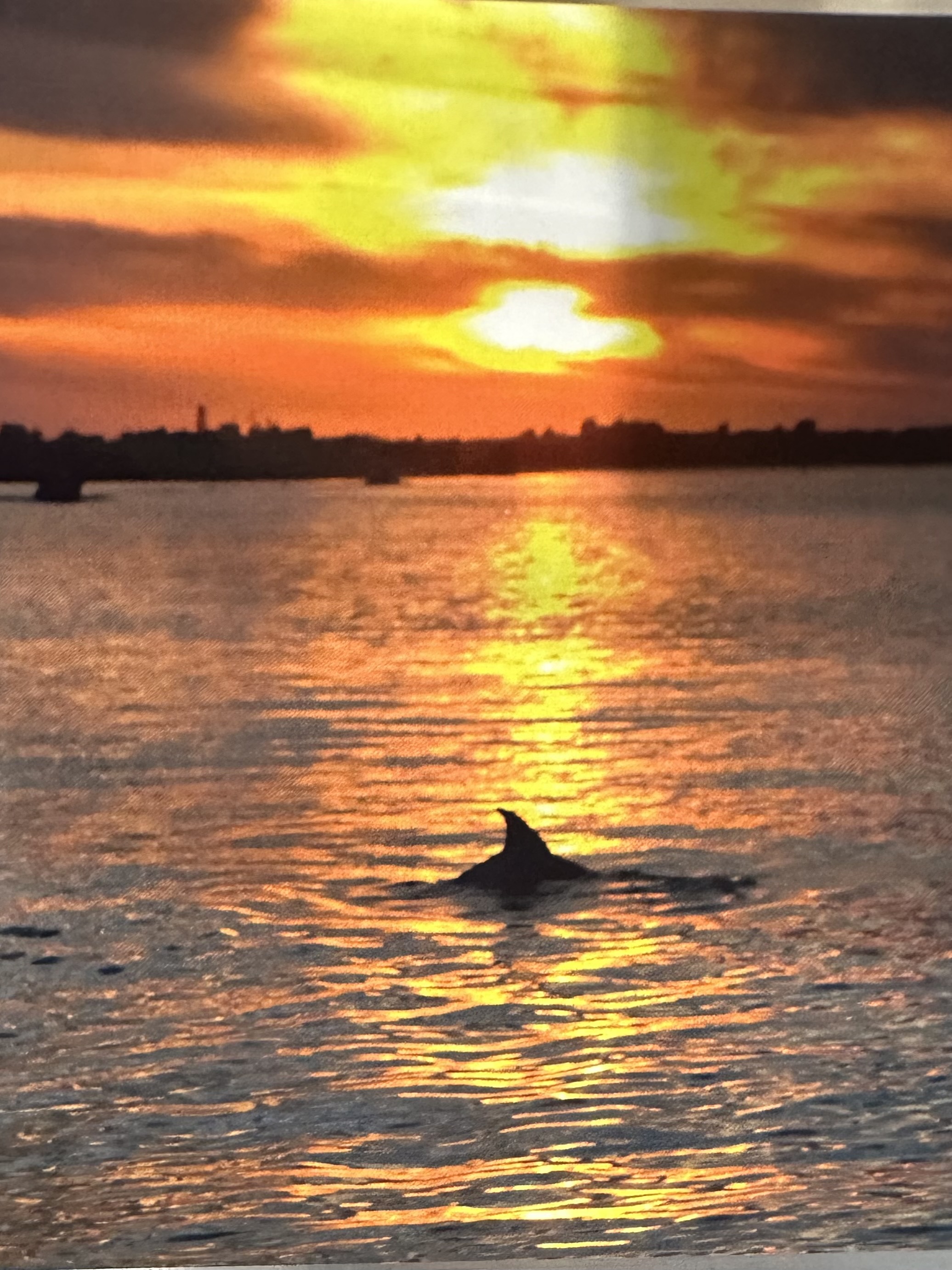
Bottlenose dolphin on post card, NC Maritime Museum, Beaufort, NC
I walked into the gift store at North Carolina’s Maritime Museum at Beaufort and saw a postcard: a bottlenose dolphin swam peacefully in the reflection of a setting sun…
“Wow.” I thought to myself, What a 180″.
I had just walked out of an exhibit telling the history of North Carolin’a whaling past. Bottlenose dolphins are technically whales. They are a toothed whale in the order of Cetacea. And not too long ago, bottlenose dolphin were hunted just like whales.
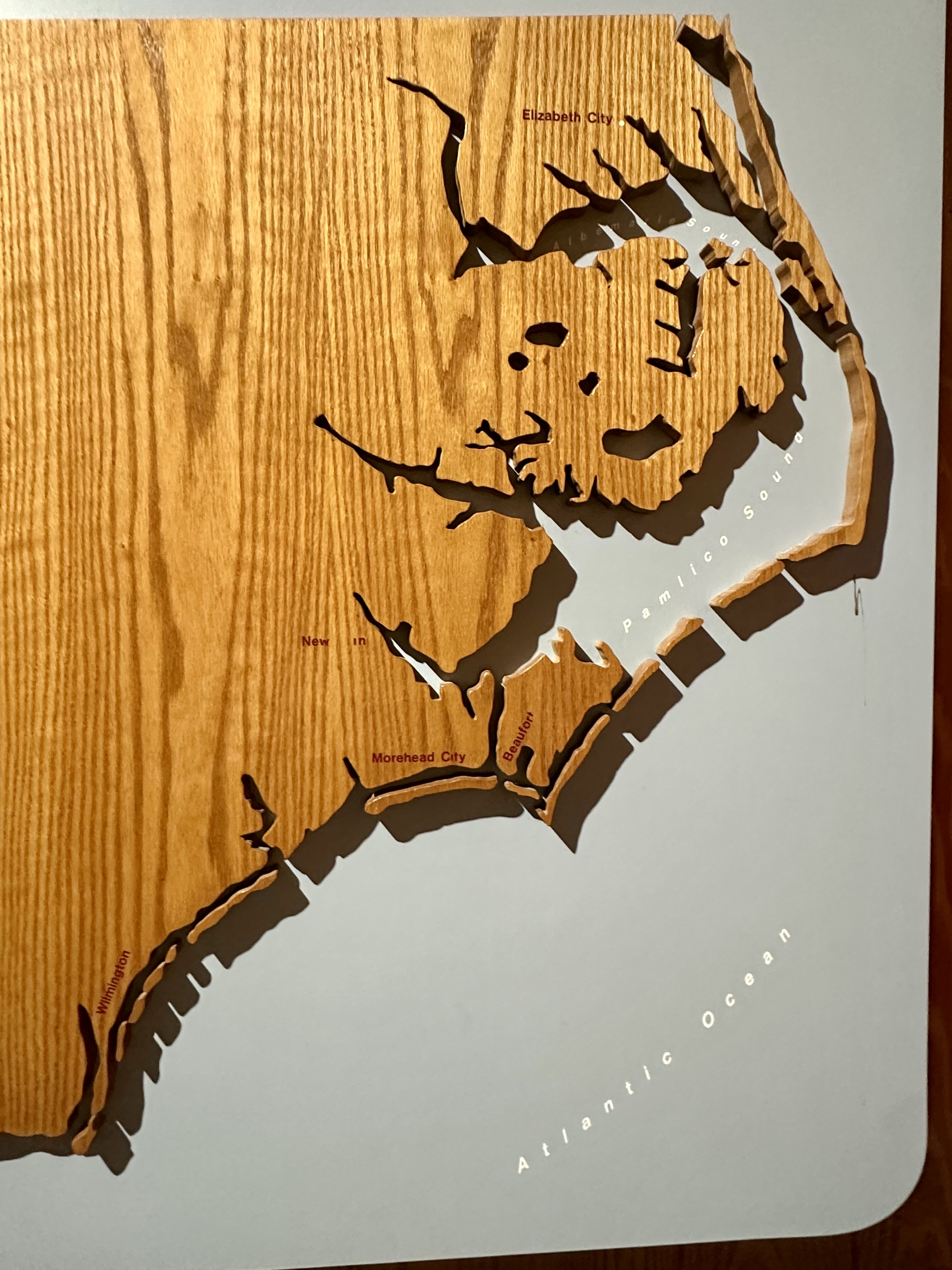
From about 1790 to 1920 per season several thousand bottlenose dolphins, mostly off Beaufort and Hatteras, were encircled with long nets and hauled to the beach to be “processed.” Beaufort’s Shackleford Banks lie just to the southeast and are part of a long string of barrier islands extending northward into the Atlantic as the Outer Banks, cresting at Cape Hatteras.
Carving shows NC’s Outer Banks.
I can’t even imagine what occurred while killing and processing the thousands of dolphins, but it is probably similar but en masse to the deaths of the much larger Right Whales, that also migrate and bring their young to these magnificent shorelines. This over-hunting remains with us today. Right Whales are now endangered with about 380 remaining and there are two stocks of bottlenose dolphins passing through North Carolina waters that are designated by NOAA as “depleted”.
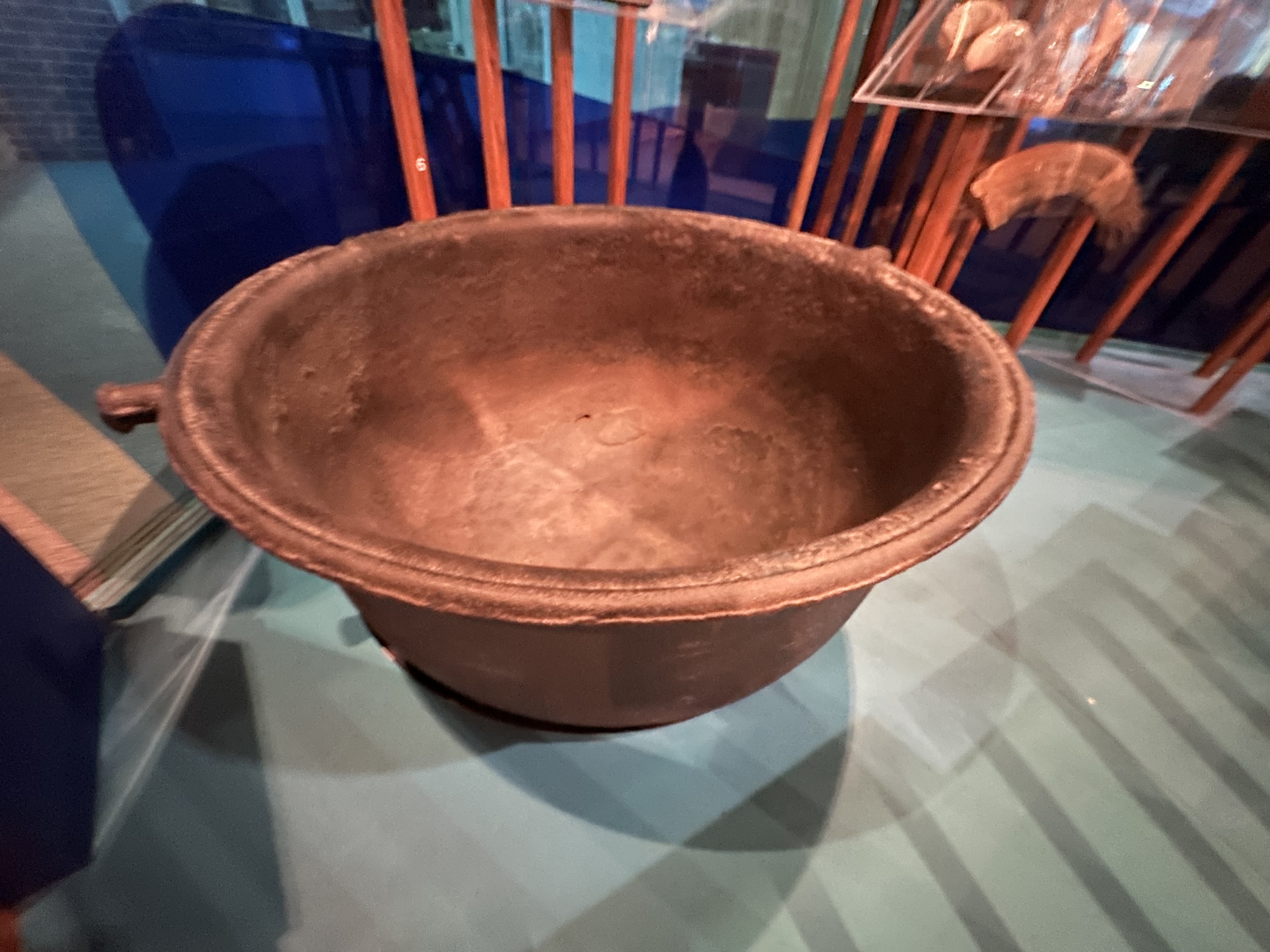
Why were the dolphins hunted? For the same reason whales were hunted. Dolphins, what locals called “porpoises”, were hunted for their very valuable oil. In fact those on the beach were called “oilers”. The oil was taken from bottlenose dolphin jaws and melons (used for echo location) and utilized for many fine purposes including lighthouses and watch lubricant. Blubber was cooked down in large pots.
A huge pot used for cooking-down, NC Maritime Museum
Today in 2026, just over one-hundred years later, locals are not hunting dolphins but offering dolphin sunset tours. Do you think the dolphins know that we hunted their ancestors? I would think so as they are highly intelligent and perhaps transfer oral histories that we cannot understand.
The commercial fishing of dolphins lost steam in the 1920s when cheaper petroleum based products became available and the fishing industry fell upon difficult economic times. By the 1970s hunting dolphins had become illegal. In an incredible reaction to the loss of life, the Marine Mammal Act of 1972 banned the hunting, killing, capturing and harassing of all marine mammals in U.S. waters and protects all marine mammals, including whales, dolphins, porpoises, seals, sea lions, manatees, sea otters and polar bears.
So here I am in Beaufort today, and I’m purchasing a post card with a dolphin on it, an animal that was once hunted by the thousands, by the hundreds of thousands.
Incredible….
As a nation, and as states, we have made 180s before, and we can do it again.🐬
Jacqui and Ed, Beaufort, NC we have turned around from here!
If you have ever visited a marine park in the United States, chances are you have seen a dolphin, or its offspring perform, that once lived in the Indian River Lagoon. A total of 68 dolphins were captured and permanently removed from the lagoon between 1973 and 1988 for captive display at mostly US marine parks.
I myself went to Discovery Cove in 2008 with my husband Ed, and witnessed a freak accident when Natasha, “our” assigned dolphin, was killed during a stunt when she slammed into another dolphin while preforming back flips in the confined area. What was to be a wonderful day, turned into a disturbing experience and it caused me to reevaluate and think more deeply about capturing and holding bottle-nosed dolphins and other marine mammals in captivity. In 2008, I had just become a commissioner for the Town of Sewall’s Point and started my journey, some may call it, my obsession, with the health of the Indian River Lagoon. This horrible experience at Discovery Cove has fed my obsession.
In 2010-11, I served as mayor of Sewall’s Point, and at this time, through my interactions with the Treasure Coast Council of Local Governments, I became a volunteer in the Marine Mammal Department for FAU’s Harbor Branch Oceanographic Institute in Ft Pierce, through the help of Steven McCulloch. I learned a lot during this time, and Steven taught me about the history of dolphins in the IRL because he had lived it.
He explained to me that things started to look better for dolphins in the late 1980s as prior to this time they were being captured for marine parks.
The Marine Mammal Protection Act of 1972 was the beginning of change and awareness for dolphins.
The Marine Mammal Protection Act of 1972 (MMPA) was the first act of the United States Congress to call specifically for an ecosystem approach to natural resource management and conservation. MMPA prohibits the taking of marine mammals, and enacts a moratorium on the import, export, and sale of any marine mammal, along with any marine mammal part or product within the United States. The Act defines “take” as “the act of hunting, killing, capture, and/or harassment of any marine mammal; or, the attempt at such.”
In November 1989, a temporary ban on the practice of removing dolphins by permit from the IRL and other Florida waters was passed federally. The last dolphin to be captured and removed from the Indian River Lagoon was in 1988.
Dolphins of course are mammals and they like humans, have very strong social ties. They live in pods, or groups and display site fidelity. Dolphin calves are raised by a group of females and will stay with the mother and nurse for up to four years. Generally, only males leave the original group and even so these dolphins have lifelong family relationships. These bonds are fierce and serve the animals in their survival.
Steve MuCulloch started and oversaw the Marine Mammal Department at Harbor Branch and is the most incredible person I know in this arena. No longer with the institute he helped build, he was responsible for overseeing the health assessments (HERA) that occurred in the IRL and has provided tremendous scientific information with the help and permitting of NOAA and Dr Gregory Bossert. Steve always showed a passion and attachment to the animals that defied the norm. I was fascinated and ask him to tell me his story.
A sick dolphin is assessed by Dr Gregory Bossert at HBOI. (Photo Brian Cousins)
Eventually, he told me of his history with the dolphins of the IRL and explained that in the early days, he had helped with their capture for marine parks. He told a heart wrenching story of how this changed for him when once on a mission, the take included a calf and the mother swam frantically along side the boat jumping and whistling/speaking with her calf. The calf struggled and clicked and whistled back.
Steven McCulloch who built the marine mammal department at Harbor Branch. (Photos Brian Cousins, HBOI 2012.)
Steve said a powerful feeling overcame him and he knew this was the last dolphin he would ever help remove from the lagoon; he would now make it his life to keep them safe and the families together. He yelled out: “The calf is not going to make it! Release!” This was policy if it appeared a dolphin was over stressing, as they are known to die in stressful situations with humans. The others on the boat stood speechless as McCulloch released the fretting, but not “over stressing,” calf back into the water with its mother. McCulloch said the mother happily reunited with her calf and then lifted her head out of the water looking straight at him as if to say “thank you!” Over time, Steve McCulloch became the charismatic local leader in marine mammal studies, research, fund raising and rehabilitation.
Things do change. Hearts change. Laws are passed for the good of the environment. Perceptions of yesteryear become archaic reminders of how far we as humans have come as a species.
Today, there are new threats due to poor water quality, excessive agricultural and urban runoff, emerging diseases, algae blooms, and an increasing number of boat hits, but at least the dolphins are free.
Life changing, good things have happened for the lagoon in the past and will be happening again. Please remember this and be inspired next time you see our protected friends, the beautiful Indian River Lagoon bottle nosed dolphins.