Aerial of S-80 at St Lucie Locks and Dam. Visible cyanobacteria bloom flowing through S-80 from western area of C-44 towards the St Lucie River. These blooms were documented in Lake Okeechobee and around S-308 weeks ago and are now being released into our now fresh river. Photo Ed Lippisch.
I have been questioning the sick irony of the government sanctioned “toxic algae” releases into the St Lucie River since 2014. This was questionable, until now…
Let’s back up a bit…
My blog post on July 8th, 2014 was entitled: “Do the ACOE and SFWMD Release Lake Okeechobee Into to SLR When There is Toxic Algae?”
At that time there was a question for me; now there is not.
The 2014 post told the story of seeing cyanobacteria’s fluorescent blooms in the lake when my husband Ed and traveled through the St Lucie River to Lake Okeechobee by boat passing the St Lucie Locks and Dam (S-80) and Port Mayaca, (S-308) in 2009. This was just when I was beginning to focus my interests on the health of the St Lucie River/Indian River Lagoon as I had been elected to office in the Town of Sewall’s Point in 2008. During this trip it hit me that the algae started in the lake. Ed and I had traveled throughout the St Lucie River and C-44 canal, and when we got to Port Mayaca, at the lake, there it was….the fluorescent green algae.
Not being a scientist or biologist –it finally hit me “this is a fresh water bloom.” It blooms in the lake….not in the river that is more saline. But once the river is fresh from releases from the lake and canals, it can spread there too.
Hmmm?
The story of the blog continues into 2013, when I saw the SFWMD testing the water at S-80, St Lucie Locks and Dam, and to my surprise I could see the unmistakable flourescent green cyanobacteria that often becomes “toxic”going right though the gates! I found this unsettling. Obviously the SFWMD, the ACOE, DEP, the Florida Health Dept and other official entities were in full knowledge that these dangerous blooms were being sent down the river to the residents of Stuart, Florida. Here I was an elected official representing a peninsular community and I had no clue. I had never even heard of this. Something is weird here, I thought. There is no warning to local governments. There is no press for the public. This is just everyday business….the everyday business of quietly poisoning Martin County’s citizens.
How could this be? I wondered…Maybe I am missing something? Maybe I am exaggerating?
Over time, I wrote other posts about this too.
I decided that this concept could be widely shared and understood, but we needed a good visual.
Well the ultimate visual is here…
Thank you to my husband, Dr Ed Lippisch for these photos and two short videos taken on Memorial Day, May 30, 2016 of tremendous blooms knowingly being sent through the open gates at S-80 towards the St Lucie River. We don’t have to wonder anymore.
In broad daylight, for all to see. State and Federal agencies….you’re busted.
*Thank you to the Stuart News, the River Warriors, Bullsugar.org and other river advocates for all of their work identifying and reporting the blooms especially in the lake and around Lake O this 2016.
Toxic Algae blooms (Microcystis/Cyanobacteria) :https://en.wikipedia.org/wiki/Microcystis_aeruginosa
Cover of the Witchery of Archery, 1879, Maurice Thompson.A young Maurice Thomson as photographed for book publication.
One of Lake Okeechobee’s earliest accounts was written by Maurice Thompson in 1879. Thompson’s book the “Witchery of Archery” is “credited with reviving the sport” and is still considered an American classic.
For me what is most interesting is Chapter VIII, entitled: “The Mysterious Lake,” written about an “untouched” Lake Okeechobee in South Florida just west of our St Lucie River/Indian River Lagoon.
You can go to the link at the end of this blog and read the entire book or chapter on-line, however for the blog reader, and for the beauty of the visual, I am providing some slides of the first few pages, and will quote–pulling, changing tense, and mixing a few lines:
“Lake Okeechobee, formerly called Mayaco, or Macaco, ever since the discovery of Florida by Europeans.. and long before, —has slept in a sort of poetical fog of mystery.
No doubt the far-famed story of the Fountain of Youth hidden away in the wild tangles of the Land of Flowers, being once disproved let fall something of its delightful romance upon the lake, which though hemmed in with most impassable swamps marshes, and everglades, and jealously guarded by all the cunning of its wild owners, really did and does exist…
This vast body of water lies on the Floridian peninsula, far towards its southern point, having a shape not unlike that of a great spider, from whose elliptical outline of body radiate short, crooked legs…
All around it stretch the cypress swamps and wet prairies, through which innumerable dark sluggish streams crawl like indolent serpents. Its shores are in most places low, only a few inches above the water, and a great portion is unapproachable…
The islands in the lake…are wild gardens of tropical fruit and parterres of fabulously beautiful flowers among which all sorts of gaudy birds and butterflies float and feast the year round. Springs of health giving water well up through he snow while sands and perpetual breezes blow cool from the rippling lake…
Vegetation is variegated and luxuriant beyond compare; gorgeous flowers and gay foliage make the woods and banks dazzlingly bright and beautiful…
No wonder the lake is jealousy guarded by the Indian, and still less the wonder that his descriptions of it are touched with the coloring of romance, and bathed in an atmosphere of fascination and mystery. “
How beautiful this place, our Lake Okeechobee, must have been…
*Lake Mayaco, Macaco, and names of similar derision were named after the native Maraca people of Florida who came from the upper area of the St. Johns River and migrated to the Lake Okeechobee region in the early 18th century. “Port Mayaca” on the east side of the lake in Indiantown, Martin County, preserves their name today.
1. Chapter 8 “The Witchery of Archery” first shared with me by historian, Sandra Henderson Thurlow.2.3.
Historic aerial of Port Sewall’s Golden Gate area in 1954, US1 and Dixie in foreground. (Photo courtesy of historian, Sandra Henderson Thurlow)
If you ever drive the easterly location of Indian Street in Martin County, you are in the historic subdivision for the proposed Town of Port Sewall. According to the “History of Martin County,” in 1910, Hugh Willoughby and Captain Henry Sewall established the Sewall’s Point Land Company which developed Port Sewall–of which Golden Gate is part.
I was taken by these old aerials from 1954 showing the straight roads of the Golden Gate section of the development with Sewall’s Point and St Lucie Inlet in the distance; I wanted to compare the photo to a cool old plat map and a Google map of today.
I love this old area of Martin County. So much history. It is fun to drive along Old St Lucie Boulevard and through Golden Gate. There are still remnants of the past. To visit the old Golden Gate building on Dixie Highway now getting a new life as the office of House of Hope—that was once a real estate office…..an awesome old Whiticar Boatworks from a bit later…
One of the long forgotten thing about this area is that Sewall and Willoughby’s vision for this development was a deepwater port off of Sewall’s Point. According to historian Sandra Thurlow, “The port was to be established at the junction of the waterways known today as the Crossroads. It would be called “Port Santa Lucia” and would handle the vast amounts of produce that would be shipped out of the interior of Florida via the cross state canal.”
The cross-state canal in this reference? Yes, the cross state canal of the 1920s was the dreaded St Lucie Canal or more lovingly know today as C-44…the canal that connects Lake Okeechobee to the St Lucie River/Indian River Lagoon.
Willoughby and Sewall’s development and the Port of Santa Lucia never succeeded as the Great Depression of the 1920s killed that dream. But unfortunately part of the dream of that era lived on. Today the cross state canal or since named “Okeechobee Waterway” (C-44 in Martin County) does not transport vast amounts of fresh produce, but rather is used to “manage” the waters of Lake Okeechobee and to send sediment and nutrient filled Agricultural run off to feed algae blooms and destroy the property values of Sewall’s Point, Port Sewall, Golden Gate, and the rest of Martin County.
Golden Gate 1954Historic Port Sewall plat map 1913 – Version 2 (rotated for comparison.)Google maps of Port Sewall area today, 2016.SFWMD canal and basin map. C-44 canal is the canal most southerly in the image. The canal goes from Lake Okeechobee to the St Lucie River exiting at the ocean near Sewall’s Point and Hutchinson Island.Waters off of Sewall’s Point where the Port was to be located in August 2013 during high levels of discharges from Lake Okeechobee. (JTL)Releases from Lake O at tip of Sewall’s Point at the Crossroads, 2016. Photo Ed Lippisch.
Dr. Gary Goforth has more than 30 years of experience in water resources engineering, encompassing strategic planning, design, permitting, construction, operation and program management. (Photo JTL, 2015)…
The following was written by Dr Gary Goforth as a response to U.S. Sugar Corporation’s months long ad campaign in the Stuart News. http://garygoforth.net
· The health and economies of the St. Lucie River and Estuary, the Caloosahatchee Estuary, and Florida Bay have been sacrificed for decades by the management of Lake Okeechobee for the protection of US Sugar and other agricultural lands south of the Lake.
The recent ad blitz by US Sugar appears to be an attempt to divert the public’s attention away from this preferential treatment and from an egregious betrayal of south Florida taxpayers perpetrated by US Sugar, the Florida legislature and the Governor’s administration – the failure to exercise the willing seller contract to purchase US Sugar land south of the lake. Failure to secure needed land south of the Lake is the single biggest obstacle to long-term protection of the St. Lucie and Caloosahatchee estuaries from destructive Lake discharges, and providing Florida Bay and lower east coast wellfields with needed water.
· Water storage necessary to reduce high flows to the estuaries by about 90% will require about 10% of the land in the EAA – not complete elimination of farming in the area. The recent UF Water Institute study reconfirmed what scientists have been saying for decades – additional storage and treatment beyond what is currently planned in CERP and CEPP is needed south of the Lake: “If this required storage were to be provided strictly though deep 12-ft reservoirs, new land area between approximately 11,000 and 43,000 acres would be required south of Lake Okeechobee.” The upper limit – 43,000 acres – is less than ¼ of the amount of land US Sugar was willing to sell to the state (187,000 acres).
· Regarding the numbers in the ads – some are accurate, some are completely fictitious (e.g., the distribution of water from Lake Okeechobee), and many critical numbers are missing, e.g.,
-millions of pounds of nitrogen and phosphorus from lake Okeechobee that feed algal blooms and wreak havoc on the ecology of the river, estuary, lagoon and near-shore reefs. (million off pounds of nutrients that the State of Florida ignores in their BMAP progress reports for the St Lucie River.) – the hundreds of millions of pounds of Lake Okeechobee sediment that turned a once sand-bottom clear water estuary into a muck-filled lagoon that belches blackwater every time it rains. – the hundreds of millions of dollars of economic impact to local businesses, tourism and real estate values attributable to poor water quality If you’re interested go to the SFWMD’s (or my) website.
· Most of the area that the ads calls “local waterways” did not flow into the St. Lucie River (SLR) until after the major agricultural drainage canals (C-23, C-24, C-25 and C-44) were dug, connecting more than 250,000 acres to the SLR. Historically these areas flowed north into the St. Johns River watershed, south into the Loxahatchee and Everglades watersheds, evaporated or recharged the groundwater.
· The ads ignore the fact that more than half of the “local watershed” is agriculture, and that more than half of the flows and nutrient loads to the St. Lucie River and Estuary come from agricultural land use.
· Nutrient loads from septic tanks along the Indian River Lagoon need to be addressed in cost-effective ways based on good science. Nevertheless, nutrient loading and sediment from Lake Okeechobee and agricultural runoff constitute a far greater threat to the health of the St. Lucie Estuary than does loading from Martin County septic tanks. The loading from septic tanks in Martin County have been overstated by upwards of 200-300%.
· The 2016 Florida Legislature was an unmitigated disaster for the environment of Florida, with misappropriations of Amendment 1 funds for the second year in a row and the passage of a water bill that rolled back environmental protection for the benefit of agricultural interests. What role did lobbyists for US Sugar and other agricultural interests play in this debacle? —–Dr. Gary Goforth
*Dr. Goforth has more than 30 years of experience in water resources engineering encompassing strategic planning, design, permitting, construction, operation and program management. For the last 25 years, his focus has been on large-scale environmental restoration programs in the Kissimmee-Okeechobee-Everglades ecosystem. He was the Chief Consulting Engineer during the design, construction and operation of the $700 million Everglades Construction Project, containing over 41,000 acres of constructed wetlands. He is experienced in public education, water quality treatment design and evaluation, engineering design and peer review, systems ecology, statistical hydrology, hydrologic modeling, hydrodynamic modeling, water quality modeling, environmental permit acquisition and administration, hydrologic and water quality performance analyses. (Website: http://garygoforth.net)
Lake Okeechobee’s S-308 at Port Mayaca, Ed Lippisch, May 13, 2016.
The first time I ever laid eyes on Lake Okeechobee, I was eleven years old. I remember thinking that I must be looking at the ocean because I could not see across to the other side. Just enormous!
In spite of its magnificent size, over the past century, Lake Okeechobee has been made smaller–around thirty percent smaller– as its shallow waters have been modified for human use–pushed back, tilled, planted, diked, and controlled. Today, it is managed by the South Florida Water Management District and the Army Corp of Engineers. Sprawling sugar fields, the Everglades Agricultural Area, (EAA), canals, highways, telephone poles, train tracks, processing facilities, a FPL power plant, and small cites surround it.
S-308, (the “S” standing for “structure), opens easterly into the St Lucie Canal, also known as C-44, (Canal 44). About twenty miles east is another structure, S-80, at the St Lucie Locks and Dam. It is S-80 that is usually photographed with its “seven gates of hell,” the waters roaring towards the St Lucie River/Indian River Lagoon, and the City of Stuart, but it is actually S-308 that allows the waters of Lake Okeechobee “in” from the lake in the first place.
Such a fragile looking structure to be the welcome matt of so much destruction…a sliver unto an ocean. So strange…
Today I will share some aerial photos that my husband took on Friday, May 13th, 2016 at about 700 feet above the lake. I asked Ed if from that height he could see the algae bloom so much in the news last week even though over time blooms migrate, “bloom” and then sink into the water column, becoming less visible but still lurking.
“Yes.” He replied.
” It’s harder to see from that altitude, and it depends on the light, but it’s still visible. It’s green in the brown water. The lighting shows were it is. You can see a difference in texture about 100 yards west of S-308. It is not right up against the structure, but further out. Boats are driving through it leaving a trail. It’s appears that is slowly being sucked in to the opening of the S-308 structure , like when you pull the drain out of the sink….”
S-308 at Port Mayaca, Indiantown, Martin County. Ed Lippisch, 5-13-16Dike and rim canal around Lake Okeechobee near S-308. Ed Lippisch, 5-13-16…ELopening S-308 EL…Looking towards S-308 from Lake O, boat going through bloom. Ed Lippisch, 5-13-15Remnants of bloom seen bunched in waves. Ed Lippisch 5-13-16.…EL…EL……ELC-44 or St Lucie Canal that is connected by S-308 to Lake Okeechobee.ELCloser view of algae bloom in C-44 near Indiantown “downstream” of Port Maraca and S-308 headed to Stuart. (JTL 5-10-16)SFWMD SLR basin and canal map showing S-308 and S-80 along with other structures.Algae Bloom in Lake Okeechobee: This aerial was taken last week by Will Glover as he was flying over Lake Okeechobee in a commercial airplane. It was shared on Facebook.
TC Palm’s Tyler Treadway reported on 5-13-16: “The lake bloom was spread over 33 square miles near Pahokee, the South Florida Water Management District said Thursday. The Florida Department of Health reported Friday the bloom contains the toxin microcystin, but at a level less than half what the World Health Organization says can cause “adverse health impacts” from recreational exposure.”
Pahokee is south and west of Port Maraca and S-308. (Florida Trails)
Economic Survey of Ft. Pierce and St Lucie County, 1936. Shared by historian Sandra Henderson Thurlow.
Looking back at history is such an amazing thing.
It clearly allows us to see “where we have come from,” and “how we got to where we are today”–especially in regards to our St Lucie River/Indian River Lagoon region.
In the early decades of the 1900s, Chapter 298 of Florida Statues allowed for Drainage Districts to be created, (most still exist today), by early settlers across the state so they could begin the hard work of “settlement.” These early Floridians often chose areas around rivers for their location, riches and soils.
Nonetheless, “drain baby, drain!” was the mantra.
Drainage of small tributaries of the forks of the rivers such as the St Lucie created rich farmlands and the ability to develop the lands. This was expected of settlers. During this same era, giant public works projects such as the St Lucie Canal, (C-44), linking Lake Okeechobee to the South Fork of the St Lucie River, were dug through the cooperation of state and federal governments to create what would become the Everglades Agricultural Area, or EAA, south of Lake Okeechobee.
“The rest is history…”
As we sit here today with news of a substantial blue-green algae bloom in Lake Okeechobee, and cringe as the ACOE dumps it into our estuary, I find this small booklet my mother came across recently “a through looking-glass” —–of the mentality of the times when all this over-drainage was the goal and the repercussions were not understood.
Counties all over our state had such little booklets. As you can read, this one is from St Lucie County connected to the North Fork of the St Lucie River. These hard-working people of the day dug their canal around 1936 so it would “veer to the southeast and then east to the St. Lucie River….” certainly they were not thinking about toxic algae blooms or water quality at this time. It did not even cross their radar. But it does ours….What will our little booklets look like for future historians to read ? Well, that’s for us to decide.
US Sugar ad, Stuart News, May 1, 2016.Full page ad 5-1-16 US Sugar, Stuart News.
It’s easier to communicate your message when you have billions of dollars, but it is not a limiting factor if you don’t…
Today, I will share a “Draft Report” from Dr Gary Goforth. This report is a response he has created specifically to U.S. Sugar Corporation’s May 1st full- page ad in the Stuart News entitled: “The Water That Ends Up In Our Local Waterways.”
This is one of multiple full-page ads U.S. Sugar Corporation has run in the local Martin County paper over that past months trying to “educate” our citizenry. Why are they spending so much money doing this? Why all the propaganda? Because they know that though our advocacy for the St Lucie River/Indian River Lagoon, we are changing the course of human events. For the first time, many people and some important politicians and are looking at South Florida and saying “It needs to be re-plumbed…..”
Dr Goforth (http://garygoforth.net) is no stranger to these water issues, nor to the controversy and ability to manipulate the numbers complicated by the historic and supportive relationship between those doing business in the Everglades Agricultural Area south of the lake and today’s South Florida Water Management District. Thus the intertwined propaganda.
So here we go, each idea is presented on a separate slide. You can click the slide to enlarge if you need to. Thank you Dr Goforth!
DRAFT COMMENTS ON U.S. SUGAR AD—G.GOFORTH 5-4-16
12.
3.4.5.6.7.8.9.Full page ad 5-1-16 US Sugar, Stuart News.
Comparison of Lake Okeechobee releases to the St Lucie River & Estuary 2016, Dr Gary Goforth.
This year, the Army Corp of Engineers– with input from the South Florida Water Management District, and other stakeholders— has been discharging from Lake Okeechobee into the St Lucie River and southern Indian River Lagoon since January 29th, 2016. Today will review an April update.
We as citizens must pay attention and know what is happening to the river so that we can intelligently fight for its future.
Dr Goforth’s chart above gives a good visual comparison of 2016’s discharges, thus far, compared to those of 1997/98, another El Nino year with fish lesions, fish kills, and toxic algae reports. This chart also compares 2013, our recent “Lost Summer,” when toxic algae blooms filled the river, on and off, for about three out of five dumping months. (–Running May through October, 2013.)
One can see, that Lake Okeechobee’s 2016 discharge amounts are quickly approaching the total numbers released in 2013— although well below those of 1997/98.
Although discharges have been lessened lately, with the Army Corp of Engineers reporting a possible La Nina indications for the 2016 Hurricane season, (4-26-16 ACOE Periodic Scientist Call) considerably more rain could be on the way.
With the lake sitting at 14.29 today, —a high level going into “wet season,” starting June 1st—we should all be watching the situation very closely. Hopefully 2016’s total Lake O release numbers will be nowhere close to 1997/98.
We must continue to advocate hard for a third outlet, and land purchase south of the Lake Okeechobee, as this is the only way to spare our rivers’ repeated total destruction.
Thank you to Dr Goforth for his contribution today.
The following is from an email dated from Dr Gary Goforth on April 26, 2016 including the slide used for today’s blog and others of interest. Click on image to enlarge.
Hi all,
Attached are
1. Summary of the 2016 Lake discharge event to the St. Lucie River and Estuary.
2. Preliminary Water Year 2016 (May 1, 2015 to March 31, 2016 – missing April 2016) summary, including a. Inflows to Lake Okeechobee by basin, with comparison to last year b. Outflows from Lake Okeechobee by region, with comparison to last year c. Flow diagram for Lake releases, with comparison to last year d. Lake releases to STAs, with comparison to last year e. Nutrient and TSS load from Lake discharges to the St Lucie and Caloosahatchee Estuary f. The graphs are shown for both acre feet and billion gallons
Lake O has been drained and lowered so that it is approximately 250 square miles smaller than it was in the mid 1800s. (SFWMD) Florida became a state in 1845.
“Navigable waters of the state” are protected under Florida law. They cannot be sold–they cannot be owned. They belong to the public…
Although the Swamp Lands Act of the 1850s allowed for drainage of Florida’s swamp lands, in some instances the drainage and claims may have been overdone. In accordance with state law “you can’t convey what you do not own.” This is part of what is known as “The Public Trust Doctrine.”
Hmmm? In all the excitement to develop, did the state break its own rules in conveying lands south and around the lake? Certainly powerful entities own those lands today.
—–That would be a bite wouldn’t it?
Let’s look a bit closer….
It is common knowledge that Lake Okeechobee has lost a tremendous amount of its former self, and that large portions of the lake have been drained and diked for agriculture and development.
Just recently while attending a University of Florida Natural Resources Leadership Institute presentation in Clewiston, Jeff Summers of the South Florida Water Management District gave a Power-Point presentation using the slide below. It shows the natural vs. altered conditions of the lake going from approximately 1000 sq miles in the 1850s to 750 square miles today. –Thus the approximate water stage has gone from 20 feet to 14 feet. Definitely a loss of navigable waters–don’t you think? Today those lands around the lake are used for growing mostly sugarcane. Today most of those lands are “owned.” How could this be as they were once under water enough to be “navigable waters of the state?”
Slide from Jeff Summer’s power point presentation SFWMD, 2016.
The excerpt below is straight out of the “Florida Bar Journal” as shared by my brother Todd. After reading the paragraph, click on the link below to read the entire article. It is certainly worth thinking about…The maps below show land ownership.
Florida Bar Journal’s article conclusion:
The Public Trust Doctrine imposes a legal duty on the state to preserve and control title and use of all lands beneath navigable water bodies, including the shore or space between ordinary high and ordinary low water, for public use and enjoyment. The people of this state have raised the protection afforded by the doctrine to constitutional stature. In the most recent challenge to this doctrine, the Florida Supreme Court relied upon this constitutional provision in reconfirming longstanding Florida law that swamp deeds do not create a private property interest in sovereignty lands. Attempts to use swamp deeds as a justification to legislatively redefine the ordinary high water boundary and thus transfer all or part of the shore to the adjacent private owner are similarly inappropriate and unconstitutional.
Map of land ownership south and around Lake O TCRPC 2016. Key below.Key to above map, 2016 TCRPC.The bigger picture: Lake O used to flow to the Everglades but is now directed to the northern estuaries St Lucie/IRL and Caloosahatchee causing great destruction. Google Earth, 2016.
Florida is like Africa. We have a wet season and a dry season. This dry season has been very wet!
In today’s blog, I will share the most recent update by Dr Gary Goforth sent to Martin County on 3-13-15 entitled: “Summary of Dry Season Flows, November 1, 2015 – February 29, 2016.” Dr Goforth gives a summary and provides wonderful visuals. The “pages” he mentions in his summary for this post have been converted to slides. (Please view slides from left to right.)
Thank you Dr Goforth. (http://garygoforth.net)
Are are an integral part in helping us understand why we must sent the water south…
Engineer, Dr Gary Goforth.SFWMD satellite map, S.Fl. Water Conservation Areas (WCAs) are below the Everglades Ag. Area (EAA) which is just under Lake O.
” All,
Thought you might be interested in this comparison of dry season inflows to, and discharges from, Lake Okeechobee. Inflows to the Lake were 79% higher this dry season (Nov. 1 2015 – February 29, 2016) compared to a year ago, but Lake discharges have only been 1% higher due to the inability to send water south. Hence Lake stages have increased more than a foot above the level it was at this time last year.
The basins with the biggest increases in Lake inflows are those along the north and northwest shores of the Lake – but not the Upper Kissimmee, which exhibited a 50% reduction in flows to the Lake compared to last year.
As we’ve seen, because of the heavy rains south of the Lake and the agencies delay in moving water out of the Water Conservation Areas, WCAs, the estuaries have taken the brunt of Lake releases this year.
The flow estimates on the first 5 pages are in acre feet and in billion gallons on the second 5 pages.
Gary Goforth
Dry Season Summary slides Dr. Gary Goforth 3-15-16.
Today I am sharing a “gallery” of discharge photographs from my husband Ed’s flight over Ft Pierce, Sebastian, and Stuart’s St Lucie Inlets. The photos were taken yesterday, March 6th, 2016, around 2pm.
A picture speaks a thousands words…(In this case through about 106 frames.) Yesterday was an absolutely beautiful day, yet area waters estuarine and ocean were not necessarily so. —-Certainly not those surrounding the St Lucie River/Indian River Lagoon near the St Lucie Inlet.
The discharge levels and reports for Lake Okeechobee can be reviewed at the Army Corp of Engineer’s Jacksonville website here: http://w3.saj.usace.army.mil/h2o/reports.htm. Lake Okeechobee is reported at 15.68.
The ACOE will be releasing less according to a recent press release.
Ft Pierce, Sebastian, and Stuart’s St Lucie Inlet, 3-6-16, Ed Lippisch
Dr Gary Goforth has been kind enough to update his “Flows South Comparison”report. I posted his previous one just this week on 2-22-16. His most recent comparison is included below in slide format. Please click on the slides to enlarge and view information.
The numbers are staggering.
At this point, more than 171,000 acre feet (55.99 billion gallons) of Lake Okeechobee water (blackwater) has been dumped to the river/estuary during just the first 26 days of the 2016 Lake releases; this is equal to 41% of the entire 2013 releases and 16% of the 1997/98 El Nino event. …
We are in for a very difficult, long year of discharges for our St Lucie River/Indian River Lagoon; and they have more than likely “just begun.” We must remain updated, educated, and vocal —and documenting–take photos share what you see. Last night I was told there are dead fish in the area of Sailfish Marina. If you see such a thing take a photo and post it or send it to me with location etc….(jthurlow@me.com) Also continue contacting our state and federal partners and advocating that land be purchased south of the lake to offset these type of events. We shall and are turning this Titanic.
Map of earliest canals built in 1911. The SL Canal was built in 1915-1923 and was then widened and deepened in the 1940s. Florida Archives.Close up of SFWMD map today showing S-structures south of LO. See rim of lake.South Florida has many “S” structures and S-333 is one of a few furthest south, south of WCA 3, allowing water to enter the Everglades and other areas.
Today’s blog will feature a common sense question. The question is basically why isn’t the dumping into the St Lucie River/Indian River Lagoon being alleviated by the large canals south of Lake Okeechobee, specifically the Miami and New River? Those two rivers were used before for drainage before our St Lucie canal was even constructed. The Miami River naturally had rapids before they were blown up with dynamite…Mother Nature had her way of dealing with the some of the spillover waters of Lake Okeechobee. Why aren’t we following that model?
I think a recent exchange between my brother Todd and Dr Gary Goforth gives insight into this question. I learned from it and the conversation is not yet over, thus I am posting it today.
By the way, just in case you don’t know, “S” means “structure” for water releases…. There are hundreds of structures that allow water to drain Lake Okeechobee and thus South Florida. The SFWMD deals with the structures south of the lake and the ACOE deals with the larger structures that go east west to the our northern estuaries.
Here we go:
TODD: http://www.thurlowpa.com/news.htm
“Right now… I am looking at the status map asking: “Why are the WCAs rising while very little water, if any, seems to go out to the New River (S-34) and the Miami River (S-31), which are historical tributaries of the Everglades (they even had rapids!) ?— all while we are getting dumped on because the Water Conservation Areas (WCAs) are over schedule?”
Recently, S-34 flowing into the New River was at 0 cfs. Now I see that it is at 233 cfs. A drop in the bucket compared to the 7523 cfs that has been hitting the St. Lucie for days.
That S-333 doesn’t seem to flow to the Park but instead to the Miami River also. (Someone correct me if I am wrong.) It was at 0 cfs on the 4th and is now at 1200 cfs. Even if that water isn’t going to the Park, at least it is going south and not east/west – but why the wait? The system is more complex than we will ever understand but the more we understand the better. Thank you, Gary, Mark Perry and others for keeping everyone informed.
DR GOFORTH:http://garygoforth.net
Todd – you’re absolutely correct – the New River and Miami Canal were historical tributaries of the Everglades.
“Why are the WCAs rising while very little water, if any, seems to go out to the New River (S-34) and the Miami River (S-31)?”
The short answer is that flood protection for the suburbs of Ft. Lauderdale and Miami takes precedence over conveyance of floodwaters from the water conservation areas. The intervening canals are operated to provide flood protection to the urban areas between S-31/S-34 and the tidal structures (S-26/ – similar to S-80 in the C-44). When heavy rains occur in the suburbs, the canal capacity is primarily devoted to moving the stormwater out of the basin. After the storm events and water levels in the canals subside, S-31 and S-34 can be opened to move so-called “regulatory releases” out of the water conservation areas. This is similar (although not exact) to how S-308/S-80 and the C-44 Canal is operated – flood protection of the local basin takes precedence over Lake releases.
“why the wait?”
Opening S-333 allows water from WCA-3 to move into the Tamiami Canal (aka L-29 Canal); the one-mile bridge along Tamimi Trail allows water from the Tamiami Canal to enter Northeast Shark River Slough (see the map). S-333 couldn’t open without special authorization from the Corps to allow the water level in L-29 Canal to rise, which Gov. Scott requested in his letter last week, and the corps granted this week.
Gary Goforth S-333.
Interesting to think about…maybe there is more to explore here….
Contact the SFWMD should you wish to get a Facility and Infrastructure Location Index Map: (561) 682-6262. The person at this number should be able to direct you.
Water Conservation Areas as seen below the Everglades Agricultural Area. South Florida is compartmentalized to control water to “protect” farms and people ….this does always work.
We are in rain-year not seen before….
The state is overflowing…..
Our St Lucie River/Indian River Lagoon is again being destroyed by too much fresh, dirty, water….
Why is it so hard to send this water south?
It is “so hard to move water south” because the state of Florida has been compartmentalized to protect the Everglades Agricultural Area south of Lake Okeechobee and to keep-dry much of the lands that we live on. And now our waters are polluted…
Imagine, if you would, what would be going on here in South Florida now if modern man had never “conquered” it….Basically it would be a clean free-flowing marsh all the way from Shingle Creek in Orlando through Lake Okeechobee to the Everglades.
Well that it is no longer the case, is it? Since the 1920s, and more so since the 1940s, these lands have been drained, and diked, and altered, so that humans can grow food, and live here –inadvertently polluting the system. It is an imperfect situation and we must try to understand it, so we can make it better as we all need clean water.
1850s map of FloridaToday’s flow into SLR and Caloosahatchee from Lake Okeechobee used to flow south.
So for the everyday person trying to figure out “what is going on” right now, let’s take a look at “today:”
It has been raining lot. Since the end of January, the St Lucie River/Indian River Lagoon and Caloosahatchee are being destroyed once again as the state of Florida and the U.S. Army Corp of Engineers dump incoming waters out of Lake Okeechobee so that the Everglades Agricultural Area south of the lake and surrounding communities are not flooded. Drainage and property in our area is part of this too.
A rare situation occurred this past week where Florida’s governor, Rick Scott, issued an order to release water south through a canal into the Everglades. He had to confer with the US ACOE to do this. (Due to poor water quality and safety, just “sending water south” is not allowed. But now with so much water, it is an emergency.)
The Water Conservation Areas south of the EAA, —these gigantic areas (see bottom slide) that are considered part of the Everglades and full of wildlife and in some places sacred Native American tree islands, are so full of water that they have to be dumped first. If they are lowered, then more water can enter from the Everglades Agricultural Area and hopefully Lake Okeechobee itself. Then, and only then, would there be less dumping into the St Lucie River/IRL and Caloosahatchee. We have a long way to go and its not even “rainy season.”
I commend all those working hard to alleviate the overflowing system and I encourage investment in working to improve this relic as well as investment in the children who must be part of the goal to re-plumb this system. Dr Gary Goforth shows us how it is working right now as I asked for a simple explanation to share with the River Kidz.
Gary Goforths’ image to explain “water going south.”
“Jacqui—
Due to increased stormwater pumping from the EAA and surrounding areas and direct rainfall, the water levels in the WCAs are too high. Last week the Gov. sent a letter to the Corps requesting authorization to raise water levels in the Tamiami Canal allowing increased flows into the Park through Northeast Shark River Slough. Yesterday the District began making those increased discharges through structure S-333. Whether or not the District will send additional Lake water south is yet to be seen – lowering the stage in the WCAs should help. See the map above. (from page 2 of the attached).”
FOR IMMEDIATE RELEASE
February 11, 2016
CONTACT: GOVERNOR’S PRESS OFFICE
(850) 717-9282
media@eog.myflorida.com
DEP and FWC Issue Orders to Allow Army Corps of Engineers to Ease Effects of Flooding
TALLAHASSEE, Fla. – Today, the Florida Department of Environmental Protection (DEP) and the Florida Fish and Wildlife Conservation Commission (FWC) issued orders that will allow the U.S. Army Corps to move more water south through Shark River Slough to ease the effects of flooding in South Florida. Click HERE (http://www.flgov.com/wp-content/uploads/pdfs/FFWCC.pdf)
to see the orders.
Earlier today, Governor Scott sent a letter to the U.S. Army Corps of Engineers to take immediate action to relieve the flooding of the Everglades Water Conservation Areas and the releases of water from Lake Okeechobee to the Caloosahatchee and St. Lucie Estuaries. To read the letter, click HERE (http://www.flgov.com/wp-content/uploads/2016/02/2.11.161.pdf).
Chart by Dr Gary Goforth accompanying his letter comparing pollutants into SLR/IRL from Lake O and C-44 basin area 1980-2015For many years Dr Gary Goforth led STA projects for the SFWMD. He is now independent.
“Death by the numbers”…
Simply click on the image above to view 1980-2015. Numbers showing Lake Okeechobee and C-44 Basin flow rates and pollutants into the St Lucie River/Indian River Lagoon as presented by Dr Gary Goforth in his letter to Martin County dated February 9th, 2016.
This letter indeed helped the Martin County Commission decide to call a State of Emergency and perhaps Senator Joe Negron shared it with the Governor as well, inspiring the Governors’ call to the Asst. Secretary of the Army Corp of Engineers to “stop the discharges.” Great requests.
It would probably be easier for the ACOE to achieve such with some significant land south of the lake…..
Hmmmmm?
Anyway—-
The state knows it. The federal government knows it. We all know it. The St Lucie River/Indian River Lagoon have been sacrificed —–not for the common good, but for the interests of agriculture and development.
It is “death by the numbers” and it should stop.
Excerpt from Dr Gary Goforth letter to Martin County, 2-9-16.:
1. The intentional destructive Lake releases knowingly cause environmental and economic damage to the region; the State of Florida and US government intentionally cause these by sacrificing our region in order to protect the area south of the Lake, and should therefore, the Lake releases should be considered Emergency Operations. The BOCC should declare a State of Emergency and ask the State/feds to do the same. This may free up funds to help the region’s businesses and residents that will suffer losses as a result of the discharges.
2. In addition to water, the Lake releases carry significant amount of pollution and sediment/muck – the amount of nitrogen from the Lake over the next few months will likely dwarf the amount coming from septic tanks, and greatly exceed the TMDLs for nitrogen and phosphorus.
3. We can’t forget that the River & Estuary also receive local basin runoff in addition to Lake releases, so the Lake releases are destructive above and beyond impacts from local runoff. The “local” watershed is more than twice the natural drainage due to addition of C-23, C-24, C-25 and C-44 Canals.
4. The BOCC should ask the State and Corps to stop the releases immediately. They should ask that inflows to the Lake be reduced, that the Kissimmee Chain of Lakes be operated per their regulation schedules and NOT FOR USFWS purposes, that Holey Land and Rotenberger be used to the maximum safe depth (temporarily exceeding their 0-1 ft operating schedules), that the STAs receive as much Lake water as possible – based on hydraulic not water quality criteria, allow the WCAs to temporarily be operated above the regulation schedules up to maximum safe depths to allow Lake inflows, and that the District temporarily put water on as many public lands (e.g., a portion of DuPuis) as dispersed water management.
2-10-16, 9AM Looking at peninsula of Sewall’s Point, SLR/IRL. Photo by Dave Stone and Ed Lippisch. Incoming tide pushes plume back into IRL and SLR. Witham Airport seen beyond in Stuart/Martin County.
Today’s first photo was taken by Dave Stone a good friend of my husband and a professional pilot. Taken with an iPhone it shows and incoming tide yesterday, 2-10-16, over the once seagrass rich Sailfish Flats.
The video below the photo shows yesterday’s Lake O/canals/run-off plume having traveled out the St Lucie Inlet moving along Jupiter Island south of Bridge Road far past Peck’s Lake. The video is taken using a Go-Pro by Ed Lippisch.
These videos and photographs are helpful tools of understanding and documentation. Recent others are included below.
Thank you to my husband and the pilots of Witham Aero Club.
2-7-16 Ed Lippisch view of SL Inlet Hutchinson and Jupiter Island from ocean.2-7-16 Ed Lippisch SL Inlet and Sailfish Flats.SL Inlet looking north from Jupiter Island, Ed Lippisch.
Sunrise over the St Lucie River’s Willoughby Creek, by John Whiticar.
Today, I will once again feature the work of local photographer and famous Stuart boat building family member, Mr John Whiticar. I have shared his gorgeous photographs many times, but this time may be the most important.
This morning, as I walked to the mailbox—- in the darkness of Sewall’s Point—-the peninsula lying between the two massacred rivers of St Lucie and Indian, I saw the “rosy-fingered dawn” rising— silhouetted— against arching gumbo limbo and ancient oaks trees.
I thought to myself, “you know, on this day I shall not share more photos of destruction, but rather the recent sunrise photos of Mr Whiticar…..”
In the face of the present destruction, we will find inspiration for our rivers. We must not despair but be the light for a new generation.
St Lucie River, John Whiticar.St Lucie Sunrise, John Whiticar.Mangrove Indian River Sunrise, John Whiticar.
Mr John Whiticar, Feb 4th, 2016.
“The mangrove island is on the Indian River. The sad part is the water was finally starting to clear up only to get trashed again by new releases from the c-44 canal. The last release was bad but this may be the worst ever. Massive back-pumping to save crops from record-setting rain yields higher amounts of sediments and nutrients.
The second panorama was taken…on the St. Lucie… The location is a few blocks north of the (Whiticar) Boat Yard… sunrise was taken at the Boat Yard on Willoughby Creek.”
JW
Thank you to Mr Whiticar for his beautiful and inspirational photographs and for allowing me to share.
View of convergence of SLR/IRL between Sailfish Point and Jupiter Island. Plume from Lake O discharges flowing out into ocean. Photo 2-7-16, Ed LippischCanals in Stuart, C-23, C-24, C-25 built in the 50s and 60s. C-44 connected to Lake Okeechobee constructed in the 1920/expanded in 1940s. The natural basins of the SLR have been tremendously enlarged plus Lake O water. This is killing the SLR/IRL. More water must go south.
It is important to know how to “speak the language” of the ACOE and SFWMD.
The St Lucie River/Indian River Lagoon is once again under siege. The Army Corp of Engineers and the South Florida Water Management District are doing the will of the reigning powers and discharging tremendous amounts of water and pollutants from Lake Okeechobee and altered surrounding lands (basins) into the St Lucie River/Indian River Lagoon.
We must learn how to interpret this destruction and how to use their language of “cubic feet per second,” (cfs), when talking about discharge amounts from Lake Okeechobee and area canals into the SLR/IRL.
I am not good at this interpretation, but someone I know is….
As in most families, each chid in my family was born with different talents. My brother, Todd Thurlow, got all the number and sharp analytical skills that I did not. I am very thankful to him for helping with my St Lucie/Indian River Lagoon educational efforts.
Todd has created a VERY EASY way to convert cubic feet per second (the language of the ACOE/SFWMD discharges) into gallons. All you have to do is click on this link below and put in the numbers. Seriously.
For instance if you click on the link today, it will show that S-80 is last reported to be releasing approximately 6800 (cfs) cubic per second, down from just under 7600. Just enter 6800 in the top box and it will be converted to 1. gallons per second; 2. gallons per day; and 3. “olympic size swimming pools” (in honor of Stuart News reporter Tyler Treadway’s common example for communicating with the public.)
Go to this link now, and try it! You will be amazed at how east this is. To win this war, we must be able to speak “their” language and to understand.
Click on chart below to get started. Save the link to have it handy for this year. It is going to be a difficult one and we are going to need to know what we are talking about in order to negotiate and to communicate.
An “S” structure south of Lake Okeechobee as seen on flight to Clewiston passing Bell Glade. (Photo JTL, pilot Shawn Engebretsen 2014).S-2 Image SFWMD image showing piled up vegetation against structure.SFWMD map. Notice the S-2 structure south of the lake, near Bell Glade. The SFWMD oversees the S-structures south of the lake. The ACOE oversees the structures going into the SLR and Caloosahatchee.Wider view of SFWMD map.S-80 releasing at StLucie Lock and Dam.
After much controversy, today the South Florida Water Management District has halted its recent “backpumping.”
“Backpumping” —kind of an odd word isn’t it? What does it mean? And why in spite of multiple law suits, some changes, appeals, and “back and forths” on what is allowed is it still going on?
Basically, in reference to Lake Okeechobee, backpumping means that water that would normally be flowing south is pumped north—Pumped back into Lake Okeechobee to keep it out of the Everglades Agricultural Area (EAA).(https://nicholas.duke.edu/wetland/eaa.htm)
The satellite/GIS image below gives one an idea. This image is from 2005, also a rainy year. Through this satellite image shared by the Captiva Conservation Organization one can see how the EAA remained dry(er) and yet southern and central parts of the state are wet. This is basically what the EAA is trying to achieve now.
My explanation and example is certainly oversimplified but gives an idea to those who may not quite understand all the controversy surrounding backpumping.
Let’s continue…
Many do know that when Lake Okeechobee is “too high” the ACOE and SFWMD work together to dump the water into the St Lucie River/Indian River Lagoon and the Caloosahatchee estuaries usually with devastating effects. Thus locals are protesting again.
….Satellite/GIS image 2004 /2005. Blue is water.
So why does the ACOE and SFWMD dump?
People, property, and farmlands are south of the lake. In 1926 and 1928 there were horrific hurricanes that killed thousands of people and destroyed property. We live in fear of this happening again, and oh yes, we need those sugar fields dry…don’t we?
So what is the answer for not destroying the estuaries and not flooding Bell Glade and other communities south of Lake Okeechobee?
That is for the experts to work on, and the “we, the people” to encourage….
One thing is for sure, there has to be a better way. We must have vision.
The Belle Glade Everglades experiment station after the hurricane of 1928. Palm Beach Post file photo BELLE GLADE — An undated photo taken in the aftermath of the 1928 hurricane shows the damage done to a cluster of scientific work stations. Thousands drowned on Sept. 16 that year when hurricane-force winds blew a wall of water from Lake Okeechobee through a makeshift dike. The official death toll is 1,836, but historians and hurricane researchers say it’s probably closer to 2,500 or 3,000. Palm Beach Post online.
Please note this correction to this blog post from Mark Perry. My post originally read under the first and second photos: “An “S” structure south of Lake Okeechobee as seen on flight to Clewiston passing Bell Glade. (Photo JTL, pilot Shawn Engebretsen 2014). These structures can pump forward (downhill) into the EAA to water fields or backwards (up hill) into Lake O when there is “too much” water.”–These pumps can work in both directions.”
Mark Perry, Florida Oceanographic, kindly corrected my mistake and I am thankful for the correction. We all learn from each other as we try to understand things. Thank you Mark!
“Hi Jacqui,
Thanks for you post of “Backpumping 101” but I need to offer a correction.
Below your aerial photo of the S2 pump station you stated that “These pumps can work in both directions”. This is incorrect as the S2 and S3 pumps only go in ONE DIRECTION, from the EAA canals INTO the Lake. The gate structures next to the pumps (S-351 & S-354) can flow both ways depending on which side has higher water elevation. (See Attached Photo- Note Blue Arrows for flow). As of yesterday, 1-31-16, the Lake was at 16.16 feet and the canals were at 11.11 feet (at S-354see below) so if the gates were opened, the water would flow from the Lake into the canals that is why they are keeping them closed. You can see the pump flows in cfs for S3 (745) and S2 (856) as of yesterday.
Hope this helps to make it clear. Backpumping in not good for the Lake or eventually the Estuaries where the water will go.
Call me if you want to discuss this.
Thanks for your posts.
Mark
Mark D. Perry
Executive Director
Florida Oceanographic Society
890 NE Ocean Blvd.
Stuart, Florida 34996
772-225-0505 x103
772-486-3858 (Cell)
772-225-4725 (Fax) http://www.FloridaOcean.org
Florida Oceanographic’s mission is to inspire environmental stewardship of Florida’s coastal ecosystems through education and research.
Please consider the environment before printing this e-mail. Reduce, Reuse & Recycle”
S-153 drains this area.S-153 drains into the C-44 canal and then the St Lucie RiverSFWMD canal and basin map. C-44 canal is the canal most southerly in the image. See S-153 northeast of the C-44 “basin” area.
Water, water everywhere….
The ACOE and South Florida Water Management District are scrambling….they will have to start dumping from the lake and the local basin runoff is exceeding targets ….But is all the runoff into the C-44 really from a local basin? No it’s not.
Let’s drill down a bit.
The ACOE’s recent press release reads:
“FOR IMMEDIATE RELEASE
Corps to increase flows from Lake Okeechobee
The U.S. Army Corps of Engineers Jacksonville District intends to release
more water from Lake Okeechobee starting this weekend as it continues to
manage the lake level in the midst of El Nino conditions.
Starting Friday (Jan. 29), the new target flow for the Caloosahatchee
Estuary will average 2,800 cubic feet per second (cfs) over seven days as
measured at W.P. Franklin Lock (S-79) near Fort Myers. The new target flow
for the St. Lucie Estuary is a seven-day average of 1,170 cfs as measured at
St. Lucie Lock (S-80) near Stuart. However, runoff from rain in the Caloosahatchee or the St. Lucie basins could occasionally result in flows
that exceed targets as the water passes through the spillway gates at the
Franklin or St. Lucie structures…”
What we have to remember is that the “basin,” the lands that water runs off of into the St Lucie River has been altered by agriculture and development ….so to call “all the water” going into the St Lucie its own basin water is really misleading and not respectful of history….
Let’s look at S-153 for instance, a spillway that is presently dumping approximately 1.2 billion gallons into the C-44 which then goes into the St Lucie River. If man had not altered this area, much of this water would naturally be flowing back into the lake…so again we really should not refer to it as “basin runoff” that belongs to the St Lucie River. Today large portions of this area are agriculture fields and an FPL energy plant so the run off water of this area has been redirected from the lake to us.
S-308 drain LO; S-153 drain area around FPL plant.
Hmmm?
Let’s reflect for a moment on this information from my brother Todd:
“Jacqui,
According to my C-44 page the gates at the locks are up 2ft and dumping 4451cfs which equals 2.8 billion gallons per day.
Nothing is coming from the lake so they will say that this is all local runoff because S-308 at Port Mayaca is at 0? That S-153 spillway is dumping 1.2 billion into C-44. It seems to pull water west of Indiantown that would have otherwise gone into the lake not to the St. Lucie?
Todd of course is right. And 1.2 billion gallons of extra fertilized, dirty water is worth noting. Don’t you think? The least they could do is filter it!
Todd and I will look into this further with historic maps of the old creek and ridge system prior to development and how the water historically flowed prior to S-153 flows, etc—– but for now, let’s not entirely be sold “up the creek,” by believing the all this water is “local” basin runoff.
Because it’s not. 🙂
Other basin changes are also bringing excess water into the river right now. This map shows general drainage changes to the SLR. Green is the original watershed. Yellow and pink have been added since ca.1920. (St Lucie River Initiative’s Report to Congress 1994.)
There are only a handful of people who are qualified to help us navigate the turbulent and murky waters of Lake Okeechobee and its effects on our beloved St Lucie River/Indian River Lagoon….
One of these rare individuals is Dr Gary Goforth. “Gary” has more than 30 years of experience in water resources engineering, encompassing strategic planning, design, permitting, construction, operation and program management.
For the last 25 years, his focus has been on large-scale environmental restoration programs in the Kissimmee-Okeechobee-Everglades ecosystem. He was the Chief Consulting Engineer during the design, construction and operation of the $700 million Everglades Construction Project, containing over 41,000 acres of constructed wetlands.
With all this experience Gary spends a tremendous amount of time at River Coalition and SFWMD meetings, and with every day people, advocating to local, state, and national officials telling the story in a manner that the average person can understand but with the power and expertise of a scientist.
Dr Goforth teaches us that we CAN HOLD THE ACOE, AND ESPECIALLY THE SOUTH FLORIDA WATER MANAGEMENT DISTRICT ACCOUNTABLE.
We can ask such questions as “are you sending the maximum practicable amount of water south?” “Is it 28% more than in 1994 as required by the Everglades Forever Act?” ” Is an average per year of 250,000 acre feet going south from the lake to the Everglades as required by the Everglades Forever Act?” “Are the Storm Water Treatment Areas being used to full capacity?” “Is the truth of the destruction of the estuaries being reported?” “Should 2008 LORS, Lake Okeechobee Regulation Schedule, been revised?” “Should the Everglades Settlement’s Q-Bell (limit of Phosphorus) be reviewed-is it realistic?” “Is a large reservoir being created in the Everglades Agricultural Area as is called for in the Central Everglades Restoration Plan?” “Who are the Lake and the STAs really serving?”
In order to hold the agencies accountable we must be educated! We must ask questions. We must look at the figures for water flowing south of the lake every year and compare.
Dr Goforth provides regular public updates on these issues, directly and indirectly holding the fire to the agencies. Today I am publishing in full his DRAFT–WET SEASON 2015 LAKE DISCHARGE report.
Please read it, study it, familiarize yourself with it. Dr Goforth has a website if you have any questions. Thank you Dr Goforth for the gift of shared knowledge. It is the greatest gift of all.
Draft – Wet Season 2015 Lake Discharges by Dr Gary Goforth:
Goforth – December 18, 2015
Flows into and out of Lake Okeechobee were examined for the period May 1, 2015 – October 31, 2015, corresponding to the first half of the annual water year (May 2015 to April 2016), and roughly corresponding to the south Florida wet season. The flows and associated Lake water levels were compared to same period from last year. In light of the influence of the current strong El Nino, Lake water levels were compared to the levels that occurred during May- November 1997 which preceded over 1 million acre feet (347 billion gallons) of destructive Lake releases to the St. Lucie Estuary between December 1997 and May 1998.
Flows into Lake Okeechobee – excluding rainfall. For the period May 1 to October 31, 2015, surface inflows to Lake Okeechobee amounted to 1.43 million acre feet (466 billion gallons) (Table 1). This is 20 percent less than for the same period in 2014 (Table 2 and Figure 1).
Flows out of Lake Okeechobee – excluding evapotranspiration. For the period May 1 to October 31, 2015, surface outflows from Lake Okeechobee amounted to 780,000 acre feet (254 billion gallons) (Table 3). This is 37 percent more than for the same period in 2014 (Table 4 and Figure 2). Approximately 30 percent more Lake water was sent to the EAA and L-8 Canals during 2015 than 2014, likely in response to higher water supply demands (due to lower rainfall than in 2014).
Lake Okeechobee water levels. The level of Lake Okeechobee varied from 13.81 ft on May 1 to 14.55 ft on October 31, 2015, reaching a low level of 11.96 ft on July 16 (Figure 3). For 2014, the level of Lake Okeechobee varied from 13.07 ft on May 1 to 15.85 ft on October 31, reaching a low level of 12.32 ft on June 11. Lake water levels rose only 0.74 feet during the 2015 wet season compared with a rise of 2.78 ft during the same period in 2014. The Lake level on October 31, 2015 was approximately 1.3 ft lower than it was a year earlier, and approximately 0.5 ft lower than October 31, 1997 (Figure 4). In addition, the Lake level on November 30, 2015 was approximately 1 ft lower than it was on November 30, 1997, which preceded over 1 million acre feet (347 billion gallons) of destructive Lake releases to the St. Lucie Estuary between December 1997 and May 1998. Two important differences between 1997 and today that could influence Lake discharges to the estuary include rainfall over the Lake Okeechobee watershed and the regulation schedules governing Lake operations. According to the South Florida Water Management District (District), November 2015 was the wettest November since 1998, indicating inflows to the Lake over the next month may be substantially larger than average. Additionally, the Lake is currently operated under the LORS2008 schedule which was anticipated to result in increased frequency and magnitude of Lake releases to the estuaries compared to the regulation schedule in place during 1997-1998.
Lake flows to the STAs. Beginning in August 2015, the District began operating the EAA A-1 Flow Equalization Basin (FEB), which is approximately 15,000 acres in size and can store water up to 4 feet deep. The FEB can receive Lake releases and EAA runoff, and distribute flows either to STA-2, STA-3/4 or to the EAA for irrigation. At this time incomplete flow records are available to the public through the District’s DBHYDRO database to fully account for the various flow paths, and until additional data are available, the estimates of Lake releases and runoff to STA-2 and STA-3/4 will be subject to revision. Using these preliminary estimates, approximately 13 percent less Lake water has been sent to the STAs in 2015 compared with 2014 (Figures 5 and 6 and Table 5). During the same period, approximately 32 percent less basin runoff was sent to the STAs, reflecting less wet season rainfall in 2015.
Flows to the estuaries. Lower rainfall in 2015 resulted in less basin runoff to the estuaries for the period May to October than occurred in 2014 (Table 6). However, due to the Lake releases that occurred during January through May 2015, Lake discharges to the estuaries in 2015 far exceeded Lake releases during 2014.
SUMMARY. Lower rainfall during the May to October 2015 period resulted in about 20 percent less inflows to Lake Okeechobee than in 2014. However, outflows from the Lake increased compared to 2014, likely in response to higher water supply demands (due to lower rainfall than in 2014). Lake water levels rose only 0.74 feet during the 2015 wet season compared with a rise of 2.78 ft during the same period in 2014. The Lake level at the end of October 2015 was about 1.3 ft lower than in 2014. In addition, the Lake level on November 30, 2015 was approximately 1 ft lower than it was on the same date on November 30, 1997, which preceded over 1 million acre feet (347 billion gallons) of destructive Lake releases to the St. Lucie Estuary between December 1997 and May 1998. However, differences in rainfall and Lake regulation schedules prevent a forecast of potential 2016 Lake discharges compared to the 1997-1998 discharges to the estuaries based on Lake levels at the end of November.
Dredge and fill, public photo, 2015.A multi-image of the area in the 1887 NOAA map, the 1925 shot (partially), 1940, a 1958 NOAA map, 1970 and today by Todd Thurlow.
Today’s blog is a full expansion of the 1925 aerial photo I wrote about last Friday.
My brother Todd took this photo creating a time line flight of 1925 and 1940 views of the Sailfish Flats, the Indian and St. Lucie Rivers, and the St. Lucie Canal (C-44).
Todd’s video is a history lesson in “dredge and fill” which was very common throughout all south Florida and the United States until national laws in the 1970s required more scrutiny and often no longer allow such due to heavy impacts and damages on waterways and the natural environment.
Our Martin and St Lucie County canals dug by the ACOE and water management entities C-44, C-23, C-24, C-25 are dredge and fill. Sailfish Point, Sewall’s Point, and Indian River Plantation, just to name a few, have large portions that are dredge and fill. The dike around Lake Okeechobee and the work abound the FPL plant in Indiantown by Barley Barber Swamp are dredge and fill. At the time, it was “how it was done.” People did not foresee the ramifications to the environment or to people living in these areas in the future.
The land was our Play Doh…
1925 aerial by Bob Higgins shared by Sandra H. Thurlow. SLR/IRL
I know you will learn a lot and enjoy watching Todd’s video. The link is above.
—My questions to Todd after I saw the video included:
Jacqui: “So Todd, what are the white lines on the edge of Stuart, Rocky Point etc…more piled white sand? Looks like Jupiter Island was smaller at one point…across from Sailfish…
So how in the world did they dig out the Sailfish Point Marina and what about the straight marina of Sailfish Point that was already there from the days of Mr Rand? Also what about the FPL Pond in Indiantown? Where do you think they put that fill? Holy cow! That’s a lot of fill!
(I have adapted Todd’s words after checking concepts with him so I could present info in a simple manner.)
Todd: “The lines on the edge of Rocky Point were probably a beachy shoreline. With it being more open water at the time and more exposed to the inlet; I’m sure there was more of a beach there. That shoreline matches perfectly the shoreline shown on the early NOAA maps – even before the inlet was there.
With respect to Jupiter Island, you are probably referring to all the spoil that was piled up at the entrance to the Great Pocket – some of that was put there when I was in middle school. The main part of Jupiter Island is more to the east and is now gone – and earlier connected to Hutchinson Island. The old Gilbert’s Bar Inlet was south of that point.
The marina on Sailfish Point was dredge fill. We have some aerials of it in the making. As was the case in areas of Sewall’s Point, the sand dug to build small marinas or subdivisions was piled on the land (Archipelago, Isle Addition) to make the land higher or to create completely new lands.
As far as the giant FPL pond, they probably just dug with a dragline and used the fill to make the dike around the outside of the pond and also to build up the land around FPL.”
Hmmm?
So we live in an environment altered by our forefathers, and now we are experiencing unintended consequences to the health of our St Lucie River/Indian River Lagoon. We must assist the next generation in understanding the past so that we and they can create a better water future. And that we can!
Aerial photo of plume from C-44; C-23, C-24, Tidal Basin, and 10 Mile Creek, along Jupiter Island south of St Lucie Inlet. Photo taken at 1000-1500 feet on 10-10-15 through a green glass canopy. Jupiter Narrows, part of the Indian River Lagoon, is visible west of Atlantic Ocean. Photo Cam Collins/Pilot Ed Lippisch.
Today I will be sharing aerial photos of the recent plume along Jupiter Island south of the St Lucie Inlet, taken this past Saturday, October 10th at 9:34 am. These photos are courtesy of friend Mr. Cam Collins. My husband, Ed, took Cam up in an acrobatic plane, the Extra 300, a plane I have not flown in yet. Doing “Half-Cubans” and “Loops” over the Atlantic Ocean is not my favorite way to see the St Lucie River/Indian River Lagoon….
Typically I am sharing photographs taken in the Legend Cub, an open aircraft; most photos are taken at around 500 feet. Cam’s photos are taken at about 1000-1500 feet, thus there is a much broader perspective. The effect is powerful.
I was surprised to see the giant plume considering the major rain event from tropical activity occurred on September 17th, 2015, over three weeks ago. Out of curiosity, I went back and looked at the ACOE Periodic Scientists Call information to review what the release numbers from C-44, C-23, C-24, the Tidal Basin, and Ten Mile Creek have been. No Lake Okeechobee so far. This is what I found:
8-25-15/8-31-15 was reported at 1985 cfs (cubic feet per second)
9-8-15/ to 9-14-15 was reported at 2108 cfs
9-15-15/9-21-15 was reported at 5877 cfs (rain event)
9-22-15/9-28-15 was reported at 2311 cfs
9-29-15/10-5-15 was reported at 1418 cfs.
Cubic feet per second is very hard to understand. For reference, I can share that at the height of releases from Lake O during 2013, the cfs were between 5000 and 7000 cfs at S-80. (http://www.midtel.net/~dccinc/sample_graph.html)
SFWMD discharge chart via ACOE 10-6-15.
So I wonder how long it takes the discharge water to travel through the St Lucie River/Southern Indian River Lagoon and out of the St Lucie Inlet? September 17th’s rain event was three weeks ago? It seems that water would have passed through by now…..what water is the water in Cam’s photographs? Is October’s plume September’s water? If you have an idea, please write in.
——In any case, thank you Cam and thank you Ed. We will continue to document the discharges, Lake O or otherwise, that are killing our St Lucie River and Indian River Lagoon.
SFWMD canal and basin map. These canals have expanded the basin of the SLR/IRL 5 times or more its natural water flow. (Florida Oceanographic Society)Cam Collins, 10-10-15.2.3.4.5.6.
To get involved, advocate, and learn about St Lucie River/Indian River Lagoon issues please attend a Rivers Coalition meeting: (http://riverscoalition.org)
What a wonderful world! Sunset on the St Lucie River, photo by Jenny Flaugh, 2009.
The words of Ernest F. Lyons, famed fisherman, environmentalist, and veteran editor of the Stuart News, can be used over, and over, and over again…
Lyons grew up in Stuart in the early 1900s and witnesses first hand the destruction of his beloved St Lucie River/Indian River Lagoon. In the 1940s and 50s, for “flood control” and EAA interests, he watched St Lucie Locks and Dam, C-44, and S-80 be “improved,” by the ACOE and SFWMD—-destroying fishing grounds that will never be replaced…He witnessed canals C-23, C-24 and C-25 be constructed to scar the land and pour poisonous sediment from orange groves and development into the North Fork and central estuary.
But even amongst this destruction, Lyons never stopped seeing the miracle of the world around him. And no where did life continue to be more miraculous than along his beloved river.
This week so far, I have written about things that bring light to the destruction of our rivers, I must not forget that in spite of this destruction, beauty and life still exist….To do our work as advocates for the St Lucie River/Indian River Lagoon we cannot become negative, we must be inspired….one of the best ways to achieve this is to recall the work and words of our forefathers….to “recycle inspiration.”
Although Ernie Lyon’s work was first read on the pages of the Stuart News, my mother historian Sandra Henderson Thurlow, has clipped old pages, been in touch with Ernie’s children, and transcribed many of Lyon’s columns as part of the work of Stuart Heritage. Stuart Heritage helps keeps our rich “river-heritage” alive. After all, our founding name was “Stuart on the St Lucie.”
……Ernest Lyons– copy of column, ca 1950.Copied from old Stuart News paper. Sandra H. Thurlow.
“What a Wonderful World”
I get an indescribable “lift” from the habit of appreciating life.
All of us, even the most harried, have moments when we are fleetingly aware of the glory that surrounds us. Like moles that occasionally break throughout their tunnels, we infrequently catch a glimpse of the natural beauty and awesome majesty outside the corridor within which we have bound ourselves.
And pop back into our holes!
The habit of appreciation—–the cultivation of the sense of awareness—are forgotten roads to enrichment of personal experience. Not money in the bank, or real estate, or houses, or the exercise of power are true riches. By the true tally, the only value is “how much do you enjoy life?”
All around each of us are the wonders of creation—the shining sun, a living star bathing us with the magic mystery of light…we look to the heavens at night and wonder at the glittering panoply of suns so distant and so strange, while accepting as commonplace our own.
We live in a world of indescribable wonder. Words cannot tell why beauty is beautiful, our senses must perceive what makes it so.
What we call art, literature, genuine poetry, and true religion are the products of awareness, seeing and feeling the magic which lies beyond the mole-tunnel view.
One man, in his mole-tunnel, says he is inconsequential, a slave to his job, of dust and to dust going. Another, poking his head our into the light, realizes that he is a miraculous as any engine, with eyes to see, a mind which to think, a spirit whose wings know no limitations.
The mole-man is bound to a commonplace earth and a commonplace life. He lives among God’s wonders without ever seeing them. But those who make a habit of appreciation find wonder in every moment, and every day, by the sense of participation in a miracle.
They see the glory of the flowers, the shapes and colors of trees and grass, the grace of tigers and serpents, the stories of selfishness or selflessness that are written on the faces men and women. They feel the wind upon their faces and the immeasurable majesty of distances in sky and sea.
And in those things there is the only true value. This a wonderful world. Take time to see it. You’re cheat yourself unless you appreciate it.—–E.L.
Ernest F. Lyons: (http://www.flpress.com/node/63)

This image shows St Lucie Farms separated from the entire land purchase of Disston to Reed. IRL east and PSL west.(Overlay created by Todd Thurlow)
Lands purchased by Sir Edward J. Reed from Hamilton Disston, as platted in the late 1880s/early 1900s. This land includes areas of Martin and St Lucie Counties…overlay on Google map by Todd Thurlow.
It all started with a recent comment by Bob Ulevich, at a Treasure Coast Regional Planning Council meeting. In the course of his presentation and questioning on the history of the water management districts, Bob noted that the EAA, the Everglades Agricultural Area, was not historically “just located” where it is today, south of Lake Okeechobee, but basically included all of Disston’s lands. Are you kidding me? “Gulp”….
The red colored blocks south of Lake O. are the EAA-700,000 acres of sugar lands and vegetables. South of the EAA are the STAs and water conservation areas .(SFWMD map, 2012.)
Hamilton Disston. Remember him? The “savior,” “the drainer” of our state—-who basically bought the entire state from a bankrupt entity, the Internal Improvement Fund? (https://en.wikipedia.org/wiki/Hamilton_Disston)
The more I read and think about it, I think what Bob meant was that almost of all the swamp lands sold to Disston and then others were marketed for people to purchase and farm….basically creating a giant Everglades agricultural area…but it wasn’t always so easy….
Orginal Everglades document of the state of Florida. (Downloaded by TT)Ddisston’s AGCCOL Co. (TT)
When I was trying to figure all this out, I went back to a map I had seen before, reread a chapter in my mother’s Jensen and Eden book, and contacted my brother, Todd, to help me answer a question.
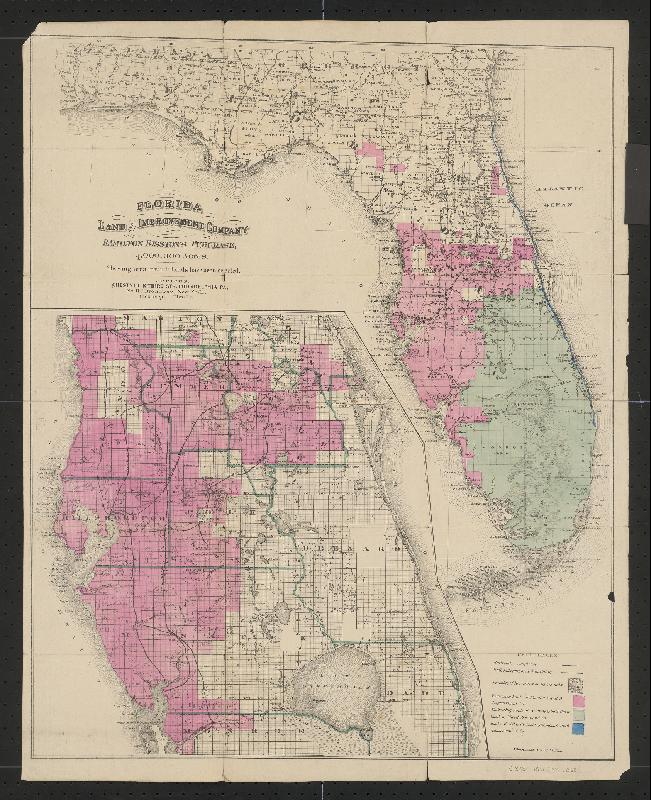
Map of Disston’s lands.
“Todd, why isn’t St Lucie Gardens in pink on the Disston map? …And wasn’t this area supposed to be farmland?”
St Lucie Gardens was a huge subdivision in the region of the St Lucie River/Indian River Lagoon including the savannas filed in 1911 by the Franklin Land Company of Jacksonville. According to my mother’s book, “the land was advertised as far away a Kansas and a few families bought land and tried to make a living farming. However land that had been pine flat woods continued to have cycles of flooding a drought and was impossible to farm profitably. The families that came to farm in St Lucie Gardens either gave up or turned to other ways to make a living.”
St Lucie Gardens…overlay by Todd Thurlow.St Lucie Gardens plat map 1910. MC Property appraiser, via Todd Thurlow.The Waters family promoting St Lucie Gardens 1910. (Photo Reginald Waters Rice) from Jensen and Eden by Sandra Henderson Thurlow.Draining the savannas around St Lucie Gardens, 1911. Franklin Land Co. (Reginald Waters Rice) Jensen and Eden, Sandra Henderson Thurlow.Page listing lands of Disston, mind you county boarders were different at this time. Martin was Brevard. (TT)
Todd and I never found our why those lands of the St Lucie River/Indian River Lagoon were not included on the 1881 Disston lands map, and the people who created it are not around to ask, but Todd did create the awesome visuals at the beginning of this post and he did find the deed of the purchase of the lands in our region. To have this document is an incredible part of our history.
Deed of Disston lands sold to Reed, 1881, page 1. (TT)Page 2. (TT)Disston bought 4,000,000 acres from the state of Florida then sold half to Reed. Some of those lands included land in the SLR/IRL region. These lands are not shown on this map. ( Public map, 1881.)
And the EAA? With all the water problems we have today, I am glad it does not include everything in pink and green on the map and that something remains of our Savannas along the Indian River Lagoon.
____________________________________
An interesting email from Todd; Thank you Todd for all the research!
Jacqui,
It was fun to go through some of the stuff on my computer tonight. I just downloaded this publication “Disston Lands of Florida”, published 1885. I attached the intro page.
Disston had the pick of ALL the public lands owned by the state. It took three years to make the selection. Perhaps the pink area had been picked as of the date of the map and St. Lucie Gardens had not yet been picked?
Or maybe the St. Lucie Gardens land is not shown in pink on the map because Disston directed that the St. Lucie Gardens property be deeded directly from TIIF to Sir Edward James Reed. The Florida Land and Improvement Company never took title.
The TIIF deed that we pulled up for Sir Edward James Reed (attached) is dated 6/1/1881. In includes a little more land (21,577 Acres) than ended up in St. Lucie Gardens (e.g. Section 1, of T36S R40E is not part of St. Lucie Gardens but is included in the deed.)
St Lucie Inlet and Sailfish Point area after approximate 7-10 inches of regional rainfall in area 9-16-15. Photo taken on 9-23-15, Ed Lippisch.
“From 7 a.m. Wednesday to 7 a.m. Thursday, the heaviest rainfall was reported at the Savannas Preserve State Park in southeastern St. Lucie County, with 7.67 inches. Next highest in 24-hour rainfall, according to the Weather Service, was 6.87 inches at Hobe Sound.” —-from article y Elliot Jones, TCPalm, 9-17-15
SFWMD chart showing releases through canals recently. Note spike after recent rainfall.
Today I will share aerial photos of the St Lucie River/Indian River Lagoon taken by my husband, Ed, on 9-23-15. I asked Ed to document the after effects of the tremendous rainfall event in the region from September 16th through the 17th, 2015. After reviewing his photos, the St Lucie River/Indian River Lagoon has dark waters, this is evident, but first, let’s set some things straight….
We hear a lot about “local runoff,” however, it is becoming more and more understood, there is no such thing as “local runoff” for the St Lucie River/IRL…. The canals that dump into the St Lucie River/Indian River Lagoon are regional canals that have been “plumbed” over the past 100 years to drain and dump waters off the lands from as far away as western Martin County, Okeechobee County, and even what used to be the north flowing waters of the St Johns River in Indian River County! Then when things are really bad, since the water can’t flow south, “they” dump the overflow waters of Lake Okeechobee into the St Lucie River to boot.
The poor St Lucie River is inundated with “everyone’s water” not just “its own.”
Drainage changes to the SLR. Green is the original watershed. Yellow and pink have been added since ca.1920. (St Lucie River Initiative’s Report to Congress 1994.)SFWMD canal and basin map. The St Lucie’s natural basin as seen above in green has been very much enlarged by the C-44 canal built in the 1920s —with expanded basin and often Lake O overflow; also C-23, C-24 and C-25 were built ca. 1950 to drain lands in St Lucie County for orange groves/agricultural development and land development by General Development Corp and others.
It is critical that we study and understand what happens in our area after a huge rain, with or without the “extra-extra killing waters of Lake Okeechobee.” Why? Because maybe, just maybe, if the SFWMD, ACOE, as well as state and federal politicians will see how much the river is already suffering, they will do all they can, “not to kill it more.”
So here are Ed’s photos, taken one week after the rain event. It takes the water coming in through the canals some time to move through the St Lucie River; I imagine a lot had already exited the St Lucie Inlet. The 23rd was the soonest Ed could “get up in the air.”
I am thankful to my husband, as for me going up in that plane? It is really amazing to be flying, but also very stressful. Somehow to me it seems God only meant for birds to fly….
At least with the Cub, I feel like if something ever happened, over the ocean anyway…. we could just jump out!
2013 Ed Lippisch/Jacqui Thurlow-Lippisch.St Lucie Inlet at Sailfish Point. 9-23-15.Crossroads, Sewall’s Point and Sailfish Flats. 9-23-15.St Lucie Inlet 9-23-15.Water in Jupiter Narrows very close to St Lucie Inlet. 9-23-15.Unusual in that plume was flowing north and south. Here north at Sailfish Point at SL Inlet. 9-23-15.Northerly movement of plume. 9-23-15.Sailfish Flats of SLR/IRL confluence as seen from ocean over Hutchinson Island. 9-23-15.Heading back…9-23-15.On the way back to Witham Field. Sewall’s Point Crossroads 9-23-15.
Early rendition of a portion of the “Everglades” (Painting in my parents home, Tom and Sandra Thurlow.)Cover of book, 1910 by Walter Waldin.…..…..…….
This past Friday, I attended a Treasure Coast Regional Planning Council meeting and was treated to a wonderful presentation entitled: “A Brief History of Florida Water Management 1800-2000 Ponce to CERP.” The talk was given by Mr Bob Ulevich, president of Polymath Consulting Services, L.L.C. ” (http://polymathconsultingservices.com). Bob” is a beloved man who has a long history himself as senior water resources project manager for the South Florida Water Management District. Bob is considered the “father of water farming.”
His presentation left me speechless, once again being reminded of the history of agriculture in the state of Florida and its deep intertwinement with the state’s government and politicians….basically they are one in the same. This is how it is….St Lucie River/Indian River Lagoon and every inch of the rest of the state. “We” may not like this, but we must accept this…
With rumor that Adam Putnam, the Commissioner of Agriculture, could be our next governor, it is critical to refresh our memory on this historic relationship. Today I will share a book a from my historian mother’s shelf and also post the raw iPhone footage of Bob speaking before the council. It is my belief that we have got to learn to understand this historic relationship along with the power agriculture yields and “work with it,” in our quest for better water quality. They too are “naturalist” at heart….they are. Some of them in our South Floirda region have just “morphed,” and need some help getting back to their roots. 🙂 They hold the key to Florida’s water future.
The first page of the booklet talks about “getting back to nature” as farming is deeply intertwined with nature. Unfortunately today many of the intense practices of farming destroy nature and our water resources.
…
This is an another excerpt from the book:
….the independent countryman’s life must appeal, for he is a free man, master of himself, is conversant with nature in its many moods, enjoys the first fruits of the earth with the gleam still on them, and all its first impulses and pleasures….”
…..
“No wonder, then, the cry of today is, “Back to the back and nature.” And back we must and will go, for this threatening catastrophe is too appalling to be passed by unchallenged.”
The catastrophe Mr Waldin is speaking of is that so many people were leaving America’s lands to go to the cities, that the “vitality of our nation was being drained proportionately…” Mr Waldin feared the lands would be empty and all would move to the cities…..It basically has happened, hasn’t it!
Below are the links to Mr Ulevich’s presentation, his presentation does not encompass the little book. I added that. Bob speaks on “A Brief History of Water Management 1800-2000 and although my “Jacqui home videos” are poor quality, you can hear the message. I had to break the videos up into 15 minutes sections as my You Tube account is not set to post anything over 15 minutes…Bob’s presentation is excellent. For those of you who have time to listen, you will enjoy it very much and learn a ton! Bob will finish his presentation next month covering approximately from 1910 to today.——– And that’s where we get to hear “the rest of the story….” 🙂
Riverview and South Sewall’s Point Road flooded in the Town of Sewall’s Point 9-16-15 (JTL)
When I was a kid growing up in Indialucie, named so as it is located between the Indian River Lagoon and the St Lucie River….it flooded a lot. We kids loved it. We would play and play! Just like kids did in the Town of Sewall’s Point when it rained so hard the past couple of days. I was told yesterday by Pam Hopkins, water quality specialist, at Florida Oceanographic that their gauge showed 8.5 inches!
Kids play in the retention pond in Sewall’s Point, 9-16-15. (Photo courtesy of Simone McPhee)
Rain is not the problem. It’s the drainage…
Florida was drained so agriculture and development could flourish. But we have literally outgrown the plumbing system of the 1920, 30s, 40, 50, 60, and 70s….we must begin to think anew.
Rain events like the past couple of days allow us to clearly see the problem and to be creative in thinking about solutions. —-One thing is clear, when Lake Okeechobee’s water is added on top of such events, “not only are we flooded, but we are drowning.”
Whether it is the overflow waters of Lake Okeechobee, runoff from area canals, or “local flood waters,” such experiences highlight the need for storage, as fresh water is a resource and should not be wasted.
I have used the basin/canal map a lot recently as it applies to just about everything. Here you can see the drainage system draining the lands into the SRL/IRL; of course there is other local infrastructure drainage such as street “gutters,” drains, and underground piping that do not show up on this map. In any case, the goal is to “get the water off the land as soon as possible” and drain it to the lowest point, the river……
Well that has got to change.
SFWMD canal and basin map. C-44 canal is the canal most southerly in the image.South Sewall’s Point Road 9-16-15….(JTL)…….……………….
BELOW, HUTCHINSON ISLAND, FLORIDA OCEANOGRAPHIC AREA/PUBLIX
……..……..A flooded Publix parking lot on Hutchinson Island….Oil atop the water from parking lot and street. This all drains into the river.
To get the current conditions of drainage from canals around Lake O excluding C-23, C-24, and C-25 see this ACOE link; also the drainage from around the coastal area like Stuart, Sewall’s Point etc…is not shown here but estimated in other models.
Current Conditions report ACOE drainage: (http://w3.saj.usace.army.mil/h2o/reports/StatusDaily_files/slide0178.htm)
Sunrise over Florida’s “Waters of the State,” SLR/IRL region.
The more I learn about water, “the more I learn what I don’t know”…Federal laws….state laws…and local governments living with the “sins of the fathers,” —just trying to keep up…
Because I taught eighth and ninth grade for so many years, it is my training to try to break down complicated information, so that it can be understood on a basic level and shared. Obviously, I am no expert on water law so please chime in!
Today’s lesson? CLASSIFICATION OF FLORIDA SURFACE WATERS
Classifications and designated uses of water by the state of Florida are required by the Clean Water Act of the United States. “The act requires that the surface waters of each state be classified according to “designated uses.” Florida has six classes with associated designated uses, which are arranged in order of degree of protection required.” DEP
Classification, Waters of the State, FAQ Fl. Dept. of Environmental Protection, 2012.
Class III Fish Consumption, Recreation, Propagation and Maintenance of a Health, Well-Balanced, Population of Fish and Wildlife
Class III-Limited the same Class III but “with limited physical/habitat conditions…
Class IV Agriculture Water Supplies
Class V Navigation, Utility and Industrial Use.
I wonder what category the St Lucie River/ Indian River Lagoon falls under? This is not easy to find on-line. Let’s guess….Look at the chart above closely….
What do you think?
My guess would be Class III-Limited, but I don’t know. I could not find it “for sure” on-line.
Looking at the chart and reading the DEP website, it sounds like all waters of the state of Florida are “Class III” regular “unless otherwise specified….”
—–Finding a simple list of class designations for waters of the state is not easy. This download is what I found and it does not make sense.
Now to complicate the issue, certain classes of water that are listed as Class III or otherwise can also be listed separately as “Outstanding Waters of the State,” or as “Aquatic Preserves.” How can this be?
—–For instance, the North Fork of the St Lucie River is listed as an “Aquatic Preserve” and “Outstanding Water” of the State. Also the Indian River Lagoon has parts, including parts in St Lucie and Martin Counties, that are also Aquatic Preserves. This doesn’t make sense to me. These bodies of water have been designated as “protected” since the 70s but they are not protected with canals dumping pollution into them. We all see that!
SFWMD canal and basin map.C-24 dumps pollution into North Fork of SLR, C-23 dumps into main area of SLR, C-44 dumps into South Fork, and C-25 into IRL near Ft Pierce. The North Fork of the SLR and parts of the IRL are Aquatic Preserves/and or Outstanding Florida Waters…..this makes no sense.Aquatic Preserves of the IRL as shown in DEP’s IRL Management Plan draft June 2014.
Now I am going to share some photos of the Southern Indian River Lagoon, (an Aquatic Preserve), that my husband, Ed, took last Sunday, September 13th. The photos are of the C-25 canal which is dumping into the Indian River Lagoon in Ft Pierce. I don’t know about you, but I don’t think it makes sense to dump pollution into an aquatic preserve, no matter what class the waters are.
To be fair, I must mention that I recently received an email from Mr Glenn Henderson, the senior grants writer for St Lucie County. He noted that a blog reader sent him the shocking photographs of C-25 recently published. Mr Henderson noted that he and others are working together with the St Lucie Issues Team to get a grant from the state for the San Lucie storm water detention project. The San Lucie is an old subdivision that has dirt roads, few swales and no structures to hold stormwater — and it’s less than a mile from the IRL. This is one of the many things running into the lagoon.
Thank you Glenn and everyone! And the state? “Let’s get back to class!”
Algae fills C-25 as this water is dumped into the IRL in Ft Pierce, an aquatic preserve. (Photo Ed Lippisch 9-13-15)C-25 9-13-15 (EL)C-25 9-13-15 (EL)C-25 9-13-15 (EL)
C-25 at Taylor Creek, exits into the IRL near Ft Pierce Inlet. (Photo Ed Lippisch 9-2-15)
On Wednesday, my husband Ed and I sat down for dinner. “Did you see my photos of the river? He asked.
“No, I’m sorry, I haven’t looked at them yet…”
“They are pretty dramatic,” he replied, taking a swig of his Lagunitas.
I didn’t think much more about it, but later that evening, when I reviewed his shots, I understood.
Today I will share Ed’s recent photos of the Indian River Lagoon and St Lucie River that he took on Wednesday, September 2nd between 11:30AM-1PM. The first set of photos are from the Ft Pierce area around Taylor Creek where canal C-25 dumps into the IRL near Ft Pierce Inlet. C-25’s discharge can also be from C-24 or C-23 as they are all connected and can be manipulated to flow in different ways by the South Florida Water Management District. C-25, C-24 and C-23 ARE NOT connected to Lake Okeechobee. These photos are just showing rain runoff and all that is carried along with it and brought in by rising ground waters.
Canal and basin map SLR/IRL. (Public, SFWMD)Drainage changes to the SLR. Green is the original watershed. Yellow and pink have been added since ca.1920. The watershed has been unnaturlaly expanded to include up to 5 times the amount of water in the natural watershed.LO is the final blow when it comes. (St Lucie River Initiative’s Report to Congress 1994.)SFWMD chart showing flow into C-25 over past days.
I believe there have been recent improvements made at Taylor Creek (C-25), but perhaps there should be more as the outflow still looks like an oil spill. A cocktail of agriculture, development, residential, and road runoff….a “river of death…”
Once a reader wrote me saying,” Jacqui I like your blog but when it rains anywhere in the world there are these freshwater plumes….you are being misleading….”
I nicely replied. “I agree there are freshwater plumes all over the world, but I have to say, ours in the SLR/IRL region are beyond freshwater-soil plumes…they are deadly, full of heavy pollution. You can read it on agency web sites if you look hard enough…It is unnatural…and it is killing the St Lucie River/Indian River Lagoon.”
C-25 Canal in Ft Pierce. 9-2-15. (EL)C-25 discharging into Taylor Creek and the Marina, IRL Ft Pierce. 9-2-15. (EL)9-2-15 EL9-2-15 EL9-2-15. EL
_____________________________________
This second set of photos is from the same day, but further south along the Indian River Lagoon where it meets the St Lucie River at Sewall’s Point. Here you will see a plume at Hell’s Gate, not so dramatic as the C-25 plume, but a definite plume nonetheless.
The ACOE did recently dump BASIN runoff from around the C-44 canal (see map above) in preparation for ERIKA, but they DID NOT dump from Lake Okeechobee. In fact the canal is higher than the lake. I think this blog makes clear we have enough problems even with out releases from Lake Okeechobee.
Well, hope you learned something. Have a good Labor Day weekend as we honor the American Labor Movement and the contributions laborers have made to the strength, prosperity, and well-being of our country. —Sounds like just who we need to rework our canals….
ACOE/SFWMD slide showing breakdown of runoff into SLR. (9-1-15)ACOE website shows no releases from S-308 or Lake O.
ACOE website does show releases from S-80. In this case this is from the C-44 basin only. The basin is huge and mostly agricultural. See above chart.Plume at Hell’s Gate St Lucie River, west side of Sewall’s Point. This water is from rain runoff probably from C-44, C-24, and C-23 unless the SFWMD is dumping C-23 and C-24 through C-25 in Ft Pierce. (Photo EL 9-2-15)9-2-15 EL Another angle of Hell’s Gate and SP, SLR9-12-15 ELIncoming tide still clear around southern tip of Sewall’s Point. 9-2-15 EL –Hell’s Gate jutting forward far left.Confluence of SLR/IRL between Sailfish Point and Sewall’s Point. St Lucie Inlet in full view. (Photo EL 9-12-15)EL 9-2-15. Another view. Sailfish Point, SLR/IRL This areas seagrasses have still not recovered from 2013 even though water is blue in this photo.Sailfish Flats in distance SLR/IRL EL 9-2-15.
What is Pecha Kucha? JTL’s attempt, “Love the Everglades, 2015,” the Rights of Water, Miccosukki Tribe. (Still from Kenny Hinkle’s video with word overlay..)
________________________________________________________________
When Miccosukee Tribe member, Houston Cypress, recently informed me that I needed to prepare a “Pecha Kucha” for the “Rights of Water” symposium at Love the Everglades August 22, 2015, I was amiss.
“What’s Pecha Kucha? Or was that Pechu Kuchu? Pecha, what? ” I inquired, thinking it must be a Native American term.
Houston calmly replied:
“It is Japanese for “chit-chat,” Jacqui. It consist of 20 slides in power point format that run only 20 seconds each” It keeps presentations interesting and succinct. Pecha Kuchas are now a popular format all over the world.”
“Wow, that’s cool,” I replied.” Thinking to myself, “The Miccosukee—near Miami–ahead of the game—I live in Stuart, 30 years behind the curve….Hmmm? I’ll act like I get it….”
“This should be easy.” ….I said to Houston. “20 seconds, 20 slides? Sure! Count me in!”
The weeks went by and I realized, well, I was wrong! The fast-moving slides force a familiarly and adaptability that I had never before adjusted to while speaking. Practice took on a new meaning because you really couldn’t. You just had to know your subject. “Live” became the theme.
I was terrified and realized I could not look at notes or do what I usually do when I speak, especially in an unfamiliar place. My husband, Ed watched me sweat and stumble trying to prepare. Scratching my plan altogether at least twice. He smiled just telling me to “look it over….”My slides that is…
“PechaKucha Night,” now in over 800 cities, according to their web site, was devised in Tokyo in February 2003 as an event for young designers to meet, network, and show their work in public.
Today I will share my attempt of a Pecha Kucha for the St Lucie River/Indian River Lagoon at the Miccosukee’s “Love the Everglades Conference “and the RIGHTS OF WATER 2015. Thank you to Ed for helping me prepare; thank you to videographer, activist, and friend, Kenny Hinkle, for his finesse in taping this experience. Also thank you to those whose photographs and maps I used in my presentation and help me all the time: Joh Whiticar, Dr Gary Goforth, Ed Lippisch, Sandra Thurlow, Nic Mader and the River Kidz, Julia Kelly, Sevin Bullwinkle, Val Martin, and Greg Braun. The slides are below.
Last, thank you most of all to Houston Cypress and the Miccosukee Tribe of South Florida for the opportunity to grow and to share, because from what I am learning, getting out of one’s comfort zone is where it all begins as we continue “our war” of which we too, “will never surrender” —St Lucie River/Indian River Lagoon.
Pecha Kucha slides: 20×20
1. John Whiticar SLR/IRL2. John Whiticar SLR/IRL3. Ais, from Theodore Morris book of painting of “Florida'”native tribes, via Sandra Thurlow. 4. 1856 US Seminole war map. via Val Martin, Florida Classics Library.5. Gary Gorforth’s shared map of J.O. Wright 1909.6. Canals showing St Lucie (public)7.1920s C-44 St Lucie Connection, Ruhnke Collection/via Sandra Thurlow collection.8. Harry Hill/Florida Photographic Concern photo, White City, fishing along the SLR via Sandra Thurlow.Little boy and giant grouper Jenen Beach ca. 40 or 50s. Ruhnke Collection via Sandra Thurlow.
10. C-24 canal JTL/EL.11. SFWMD basin map for SLR.12. LO and other canals’ plume Jupiter Island 2013 (JTL/EL)13. Plume over nearshore reefs. (Martin County files)14. River Kidz member, Veronica Dalton, speaks, protest for SLR/IRL, St Lucie Locks, and Dam, 2013. At this event she spoke before more than 5000 people. (Photo Sevin Bullwinkle)15. Marty the Manatee, River Kidz work book 2015. (Julia Kelly.)16. RK oyster deployment with FOS, 2014. Nic Mader.17. Dolphin calf with mother 2014, SLR/IRL. Nic Mader.18. White Ibis, Bird Island, Greg Braun.19. Dirty Water Kills. River Kidz recycled FDOT sign, Rachel Goldman. 2013.20. Last slide: A Miccosukki word for the Everglades….left on screen.
Aerial of SLR/IRL. Confluence of St Lucie River/Indian River Lagoon near St Lucie Inlet with low tide exposed sea grasses looking bleak. (Photo Ed Lippisch; plane piloted by Scott Kuhns 8-20-15.)Most recent chart showing discharges into the SLR from area canals C-23, C-24, C-44 Ten Mile Creek, and “Tidal Basin” –from rainfall. No Lake O. (From ACOE Periodic Scientist Call 8-18-15. Image courtesy of the SFWMD.)Basin chart, SFWMD.
As we all know, until last week, it has been raining a lot! Almost daily it seems the grey clouds gather and beat their chests threateningly; most often making good on their promise. This past week was the first time in a long time, my husband, Ed, could get up in the Cub and photograph the river. I will share these photos today.
Following are two sets of photos; the first Ed took on Thursday, August 20, 2015, and the second set were taken by Ed and friend Scott Kuhns, Sunday, August 23, 2015.
The point of the blog is to share the photos, and celebrate our 2015 “clearer waters” near the Indian River Lagoon’s southern inlets, but also to feature the weaker-looking “rain-event, fresh-water plumes.” You may recall the wretched, horrific looking plumes of the Lost Summer of 2013 during the discharges from Lake Okeechobee and area canals? Here is a photo to remind you taken in September 2013:
St Lucie Inlet September 2013 looking towards Sailfish Point.(JTL)
2015’s summer rain induced plumes do not include Lake Okeechobee releases, or the other conditions of 2013; this summer’s plumes are not as severe looking as 2013’s as you will see. Thus we have “clear water,” even when there is a lot of rain.
Last, I ask you to note the photos of the seagrasses around the Sailfish Flats area between Sewall’s Point and Sailfish Point. I am no scientist, but I think they look awful. Recently, I was told having some algae on the seagrasses is good in that when they are exposed during low tide they are protected from the burning sun. That is nice to know. Nevertheless, they look weird. Like there is too much algae; they do not look healthy. They appear grey and sickly. It is obvious they are not recovered yet from 2013 and before.
Seagrass beds of the St Lucie River/Indian River Lagoon near St Lucie Inlet 8-20-15.
I do not have a “before aerial.” but this photo from the St Johns River Water Management District show up close what healthy seagrasses look like and I do not think ours look anything like this right now.
Photo by Lauren Hall, SJRWMD, “up close” showing what healthy seagrasses should look like in the IRL. (From Save the Manatee Website)
So here are the photos, enjoy the clearer water thus far this summer, and please stay on the Water Districts and politicians noting that clear water doesn’t mean healthy seagrasses. We have a long way to go!
Sailfish Flats outskirts off Sewall’s Point near St Lucie Inlet. Beautiful blue waters but odd-looking sea grass beds. 8-20-15. (Ed Lippisch)St Lucie Inlet with weak plume exiting northerly through jetty with most going south. 8-20-15. (Ed Lippisch)Sewall’s Point, 8-23-15. (Ed Lippisch)Sailfish Flat between Sailfish Point and Sewall’s Point. Here aside Hutchison Island looking southwest. 8-23-15. (Ed Lippisch)St Lucie Inlet 8-20-15. (Ed Lippisch)Weak rain plume exiting SL Inlet with near shore reefs in clear view through clear ocean water. 8-24-15. (Ed Lippisch)View of rain plume hugging shoreline as it leaves St Lucie Inlet along Jupiter Island. 8-24-15. (Ed Lippisch)
THESE LAST PHOTOS ARE OF FT PIERCE INLET. FT PIERCE INLET GETS WATER FROM C-25 WHICH DOES NOT DISCHARGE INTO THE ST LUCIE BUT DIRECTLY INTO THE IRL JUST OUTSIDE OF THE FT PIERCE INLET AT TAYLOR CREEK. C-25 IS NOT SHOWN ON THE CHART AT THE BEGINNING OF THIS POST FOR THE ST LUCIE RIVER. C-25 CAN ALSO RELEASE WATER FROM THE C-23 AND C-24 CANALS IF THE SFWMD DIRECTS SUCH. SEE CANAL MAP BELOW.
Canal and basin map SLR/IRL. (SFWMD)Ft Pierce Inlet takes water from C-25. This water exits directly into the IRL at Taylor Creek and Marina. 8-23-15. (Ed Lippisch)Ft Pierce Inlet 8-23-15. (EL)Ft Pierce Inlet. 8-23-15. (EL)
Thank you to my husband Ed Lippisch, friend Scott Kuhns for these photos. Also thank you the ACOE and SFWMD for sharing their chart information.
1909 map of South Florida from the State of Florida report: “Report on the Drainage of the Everglades of Florida, By J. O. Wright, Supervising Drainage Engineer.” (Courtesy of Dr Gary Goforth.)
Just say “No!” To wasteful canals that is….
There are over 2000 miles of canals draining precious fresh water off South Florida; it’s a good idea to know the main ones. I started thinking about this after going through some old files and finding this awesome 1909 Map Dr Gary Goforth shared with me showing a plan in 1909 to drain the Everglades and Lake Okeechobee WITHOUT killing the St Lucie River/Indian River Lagoon.
1909 map of South Florida from the 1909 State of Florida report on the Drainage of the Everglades of Florida, By J. O. Wright. (Goforth)
Well as they say: “The rest is history….” As we know, the C-44, or St Lucie Canal, was later built.
So when I was looking on-line for a good map to show the canals of South Florida today to compare to Gary’s canal map of 1909, believe it or not, I could not find one! One that was well labeled anyway. So I made my own.
It’s pretty “home-school” but its readable. From left to right, below, you will see canals Caloosahatchee, (C-43); Miami, (L-23); New River, (L-18); Hillsboro, (L-15); West Palm Beach, (L-12); L-8 that never got a name as far as I am aware; and St Lucie, (C-44.) I do not know why some are labeled “C” and others are “L,” but you can follow them to see where they dump.
I believe the first two built were the Miami and the New River— by 1911, as I often see those two on historic maps prior to 1920. Today our state canal plumbing system is outdated and wasteful sending on average over 1.7 billion gallons of fresh water to tide (to the ocean) every day. (Mark Perry, Florida Oceanographic.)
Even though I grew up in Stuart, I was never really taught about the canals. As a young adult and even older, I drove around for years not knowing about these canals and others like C-23, C-24, and C-25. If I “saw” them, I did not “recognize” them. I knew the land had been “drained” but really had no conception of what that meant or the extent thereof…
I remember my mom used to say if we were driving around in Ft Pierce in the 80s, “And to think there used to be inches of water covering all this land at certain times of the year….” I just stared at her but didn’t really “get it.” The pine trees flashed by and it seemed “impossible” what she was saying…
In any case, the young people today should be learning in detail about these canals so they can be “updated,” “refreshed,” “reworked,” and “replugged.” Say “no” to old-fashioned canals, and “hello” to a new and better South Florida!
South Florida major canals: L to R. Caloosahatchee, Miami, New River, Hillsboro, West Palm Beach, L-8, and St Lucie. (SFWMD canal map 2013)
Below is a history of the South Florida canals as written in an email to me by Dr Gary Goforth. It is very enlightening. Thanks Gary!
Hi Jacqui
As you know, plans to manage the level of Lake Okeechobee (by discharging to tide) in order to develop and protect the agricultural lands south of the lake were developed before 1850 and evolved through the mid-1950s.
1. Buckingham Smith, Esq. in 1848 proposed connecting the Lake with the Loxahatchee River and/or the San Lucia (report to the Sec. of the US Treasury; copy available).
2. In 1905, Gov. Broward rejected a proposal to lower the Lake with a new canal connecting to the St. Lucie River.
3. Attached is a 1909 map of South Florida from the 1909 State of Florida report “Report on the Drainage of the Everglades of Florida, By J. O. Wright, Supervising Drainage Engineer”. The importance of this map and report is the recommendation to manage the water level in Lake Okeechobee via drainage into multiple canals from the Lake to the Atlantic Ocean – but NOT the St. Lucie Canal. The primary canal for moving Lake water to the Atlantic was to be the Hillsboro Canal which would connect the Lake to the Hillsboro River in present day Deerfield Beach / Boca Raton. Note the recommendation is to construct what is now called the “West Palm Beach Canal” and route Lake water into the Loxahatchee River and then out to the ocean via the Jupiter Inlet – this is actually being accomplished as part of CERP and the Loxahatchee River restoration program.
4. In 1913, the State accepted the recommendation of an NY engineer (Isham Randolph) to construct a canal connecting the Lake to the St. Lucie River (report available). The Everglades Drainage District was formed the same year, and was responsible for the construction of the canal and associated locks/water control gates. (historical construction photos available). Construction lasted from May 1915 through 1924, and the first Lake discharges to the St. Lucie occurred June 15, 1923 (ref: Nat Osborn Master’s thesis 2012, copy available)
5. After the 1928 hurricane, the State asked for and received federal assistance. The canal was enlarged by 1938; new St. Lucie Locks was rebuilt in 1941; the new spillway was constructed in 1944. —Dr Gary Goforth (http://garygoforth.net)
This slide was to sent to me from Jeff Kivett of the SFWMD. It shows Regional Flows “south,” for Water Year 2014-2015 or May 2014 thorough April 2015.Map south of Lake O. showing EAA, STAs, and WCAs. Everglades is south as is Florida Bay. (Map public.)
I was a teacher for many years. I taught 8th, 9th, and 11th grade English and German. Throughout my career, whether the students were 13 or 17 years old, there was nothing better for them than “getting an A.”
I don’t think in my ten-year career, I ever gave an A plus.
Until now that is…. 🙂
The South Florida Water Management District deserves an A plus for their creative, determined, and difficult work “sending water south” in a politically explosive environment. —-Probably the worst mine fields in the state…
For “WATER YEAR REGIONAL FLOWS May 2014, through April 2015” at least 585,000 acre feet of water was sent south to the Storm Water treatment Areas and into the Water Conservation Areas. This translated into 565,000 acre feet of water to starved Everglades National Park.
To appreciate this achievement one must compare:
This chart from Dr Gary Goforth shows water flow comparisons for water years 1995-2015. (Courtesy Dr Gary Goforth who worked for the SFWMD and was key in designing the STAs. 7-22-15.)
The chart above, courtesy of Dr Gary Goforth, shows acre feet of water going to STAs from 1995-2015. The highest number ever. The colors show the different STAs the water went through.
Sometimes when studying “sending water south” it gets VERY confusing as more water was sent south in 1995, but this water was sent when there were very few STAs and so Florida Bay got pounded with nitrogen and phosphorus laden Lake Okeechobee, and I would think some water from the Everglades Agricultural Area….
The Storm Water Treatment Areas clean the water…
It must be noted that some grading the system may think differently as South Florida certian water users and agriculture have been afraid we were, or are almost going into a drought or that the STA were overused. Some may say the ACOE and SFWMD district “should not have sent so much water south, but rather stored it in the lake…” Maybe they are right. Today I will not judge, but reward.
So anyway, “to repeat myself IRL students,” 🙂 THIS YEAR THE SOUTH FLORIDA WATER MANAGEMENT DISTRICT HAS SENT MORE WATER SOUTH TO THE STAs THAN EVER BEFORE.
You may recall that the Army Corp of Engineers opened the gates to the St Lucie River on January 16th 2015 and this did not stop until late May. This water charted going south this year helped alleviate our destruction. It could have been worse… If they weren’t sending it south, it may have gone to “us.”
My hope is that water management becomes the top-cool thing to do for future generations, and that many River Kidz and even more young people from all over the world and our nation, come to our state to work, learn and study water management. It is a politically explosive and difficult work environment, but nothing is more important for the people and the for wildlife of our state.
I admit that I am part of that politically explosive environment..but my heart really is with the living creatures of the Earth and its waters. May we overcome our genetically wired warlike behavior, send the water south, and save the St Lucie River/Indian River Lagoon….
Thank you South Florida Water Management District for your outstanding work! Yes there are great difficulties, but for a better water future, we are counting on you!
The next generation! (Public photo of a shore bird baby in the Everglades.)
A pipe into the Indian River Lagoon from a cottage along the Indian River Drive goes directly into the river disposing of sewage. In our Treasure Coast’s regions’ early days there were no laws prohibiting this. Photo archives of historian Sandra Thurlow. ca late 1950/60s.
It’s been a tough week for river lovers.
It was reported by the Stuart News and others that a gentleman died suddenly after being “stuck by a fish.” He had put in his line in the Indian River Lagoon, near Harbor Branch, in St Lucie County. Just a few days later, the headlines noted the experience of Mr Bruce Osborn whose “knee and leg turned black, swelled up, and became hot to the touch after he dove into the confluence of the St Lucie River/Indian River Lagoon. Mr Osborn was boating near the Sandbar which is located within sight of the St Lucie Inlet…
Mr Osborn had an open sore….he recovered with prompt, emergency-room, antibiotic-treatment and a good wife.
Today in Stuart New’s “Letters to the Editor” a retired New York sheriff is of the opinion that the news of the fisherman had been “sensationalized” noting that “no autopsy had been performed on the man– who died…..”
Who is right? Who is wrong? Or does “truth” lie somewhere in between?
Who knows…But it is all certainly worth thinking about.
Interestingly enough, in this river or near-ocean story, the culprit would not be a shark or anything scary like that, but rather a microscopic bacteria or virus that cannot even be seen….
Bacteria is everywhere. In soil and in water. On our skin and in our bodies. For humans there is “good” and “bad” bacteria.
How do we know where there “bad” bacteria is in the river?
Canal and basin map SLR/IRL. (Public) The basin has been expanded at least 5x its natural size since 1920.
I don’t know, but I do know numbers of bacteria everywhere in water communities are highest in the sediment. Sediment is the sand, clay and other soil types that build up on the bottom of the river in the St Lucie River/Indian River Lagoon and all estuaries of the world.
Muck from the bottom of the Indian River Lagoon. (Public photo)
In our area, the most recent hundred years of sediment, this “muck,” has been heavily affected by human alteration of the environment, especially by drainage canals, like C-44, the drainage of Lake Okeechobee, C-23, C-24, and C-25, as well as shoreline development’s tear down of native vegetation along the shoreline. (That can no longer filter runoff.)
Giant, mile-long canals drain mostly agricultural lands from out west. Many if not most of these lands never even drained into the St Lucie River/Indian River Lagoon in the first place. Not by God. Not by Nature. Just by “us” since around 1920.
So now literally thousands of pounds of fertilizers, pesticides, herbicides, metals, oils from cars and roads, septic effluent…..the list goes on and on….so these pollutants run into our waterways building up in the sediments of the river, —-to be re-suspended with every storm, with every boat that races by……as the sediment builds and flocculates, bacteria grows–especially if it is warm..many fish live on the bottom of the river….
Estuary depiction public photo.
On the positive side, as far as water, many things have changed for the better since my childhood.
During my lifetime, in the early 60s, sewage was directly dumped into the St Lucie River/Indian River Lagoon from homes and boats….I swam and skied in this water every weekend….Not many people lived here. As kids, we did not know or notice although we used to make jokes about “logs passing by…”
🙂
And yes, since the 1960s and 70s tremendous improvements in sewage treatment plants, packaging plants, septic systems, “Best Management Practices” for Agriculture to lower runoff, etc…have been made. This is fantastic.
Ag runoff DEP photo.
But we can never catch up….We are always chasing our tail….Because we keep putting more pollution into the system than we can clean up. Like putting too many fish in a fish tank, and not cleaning your gravel often enough…our relatively closed lagoon system has met its limit…
The chart below just goes to the year 2000. Florida is now the third most populated state in the nation with over 19 million people. 19 million people’s’ waste….19 million people’s yards, and not just small time farmers anymore, but agribusiness– hundred of thousands of acres of fields and chemicals….a huge portion seeping into our water. Best Management Practices. That’s just not enough…Oh. Let’s not forget what runs down from Orlando….
What’s the truth? The truth is there are too many fish in our fish tank. And we whether we know the cause or not, until we stop draining so much of our personal and agricultural waste into our waterways, we will continue to “drown in our own filth.”
Confluence of SLR/IRL at Sewall’s Point. “The Crossroads.” 7-22-15. (Photo Ed Lippisch)
Of course when it rains the waters of the St Lucie River/Southern Indian River Lagoon get darker due to runoff into the river. But unless it keeps raining, the water will clear up. The government likes to call this water “storm water.” This is all of the water that flows into the river from people’s yards, roads, agriculture fields, etc….
Lately it seems to me, our recent storms, like yesterday, and a few days before have concentrated right along our coast. I am not certain, but I looked on the South Florida Water Management District’s website and it did not appear that C-23, C-24 and C-25 were open or if they were it was not a lot. To check C-44 you have to go to the ACOE website; it is definitely not open. So I think most of what we are seeing right now in our river is runoff from the lands closest to the coast not necessary connected to canals. You can see a basin map below.
Canals in Stuart, C-23, C-24, C-25 built in the 50s and 60s. C-44 connected to Lake Okeechobee constructed in the 1920s.
So anyway, the photo above with the murky-grey colored water was taken yesterday 7-22-15; it was an outgoing tide; and it was around 11AM. Thank you Ed!
Today, I will share some of Ed’s photos and then compare others from when there was some rain, and the ACOE was dumping into our river JUST FROM LAKE O, and others from very rainy times when dumping from Lake O and the area canals of C-23, C-24, C-25 and C-44 by ACOE/and SFWMD was “constant.”
THESE PHOTOS IMMEDIATELY BELOW FROM yesterday 7-22-15 in the area of Sewall’s Point. They show grayish-murky waters from storm water coastal runoff but green-blue shines through…
Confluence of SLR/IRL at Sewall’s Point. “The Crossroads.” 7-22-15. (Photo Ed Lippisch)Sailfish Flats looking towards Sewall’s Point. Hutchinson Island in foreground. 7-22-15. Photo Ed Lippisch.Runoff plume as seen over St Lucie Inlet 7-22-15. Jupiter Narrows on left and S. Hutchinson Island. (Photo Ed Lippisch)Reefs off Hutchinson Island. north of SL Inlet 7-22-15 St Lucie Inlet so appear clear. (Photo Ed Lippisch)
THIS PHOTO BELOW IS FROM July 14th, 2015, a week ago. It had not recently rained and my yard was bone dry. It was an incoming tide. Sewall’s Point and confluence of SLR/IRL appears very “blue.” It is beautiful although seagrasses and the benthic community are still “recovering.” Blue does not mean the river is “healthy,” but BLUE IS GOOD.
Sewall’s Point looking north SLR/IRL from the air 7-14-15. (Photo Ed Lippisch)
THIS PHOTO BELOW IS DATED May 18th 2015. This is the tip of South Sewall’s Point looking towards the St Lucie Inlet and Jupiter Narrows. Sailfish Point is under the wing. It was not raining much at this time in March of 2015, but the ACOE/SFWMD was dumping from Lake Okeechobee because the lake was “too high.” The river looked brown and gross.
Flying north at convergence of SLR/IRL at St Lucie Inlet. (Photo Jacqui Thurlow-Lippisch, 3-18-15.)
Ironically, now we appear to be on the verge of a serious “water shortage”….too bad there isn’t a place to store this water somewhere north and/or south of Lake O….that the ACOE and AFWMD dump during the dry season trying to get the lake down in case there is a hurricane….The agriculture community could use that water now as could the Everglades, Miami/Dade, wildlife etc…..the C-44 STA/Reservoir is wonderful and we are thankful but it is only for C-44 BASIN RUNOFF not Lake O.
THIS PHOTO BELOW IS SEWALL’S POINT’s west side, IRL, looking north with the confluence of the SLR/IRL in foreground. This was September of 2013 during some of the highest releases from Lake O and C-23, C-24, C-25 and C-44. This is when the river was toxic and there were signs not to touch the water. It is very dark brown. Too dark.
Looking north toward Sewall’s Point on east/left. The Sailfish Flats are to the right/east as is Sailfish Point. (September 2013.)
THIS DISGUSTING SHOT BELOW is of the St Lucie Inlet with Sailfish Point foreground. This photo was also taken in September 2013 during very high discharges from Lake O especially and the C-23, C-24, C-25 and C-44. Yes. It was raining! And certainly coastal storm-water runoff not going into canals as seen in the photo at the beginning of this blog was also included. It was all horrible, but the biggest single overdose during this time was from Lake O.
September 2013, St Lucie Inlet JTL.
At this time our river was almost black in color and had a strange consistency due to all of the sediment and pollution in the water. During this year of 2013 our river lost about 85 percent of its seagrasses and ALL of its oysters. The releases lasted from May through October. Salinity was way down and 0 in some places. Algae blooms, toxic in nature, were documented from Palm City to Stuart to Sewall’s Point. The Sandbar at the mouth of the inlet was posted as a health hazard area by Martin County. Real estate sales were lost and animals were absent; it was a true state of emergency as filed with the state by many local governments.
We live in a state of unbalance.
South Florida is a swinging pendulum of too much water and not enough water. It makes no sense. We waste water, yet we encourage more people to come to South Florida when do often don’t have enough as it is because we are dumping it all…
We want things to be like they were in 1970 and 80….
We want to be the sugar and vegetable basket for the world, and have everyone move here… Well no matter how much sugar we produce, or how many houses we build, “we can’t have our cake and eat it too.”
We need more storage south and north of Lake Okeechobee. If we can engineer to send a camera to photograph Pluto 2.7 billion miles away, can’t we fix things here at home?
Well, unless we can figure out how to live on Pluto, we are going to have to—
Pluto 2015 as photographed by NEW HORIZONS spacecraft.
Contrast June 21, 2015 and June 28, 2013. St Lucie Inlet, Martin County, Fl. (Photos JTL and EL)
I hope you and your family had a happy Father’s Day. The water was beautiful this weekend, so I thought today I would compare some aerial photos my husband Ed and I took this weekend to some we took in June of 2013 during the “Lost Summer.” No wonder we all fight for clean water and fewer discharges from Lake Okeechobee and area canals. What a difference!
Of course other than “history,” rain has a lot to do with discharges into the St Lucie River/Indian River Lagoon, and it has not been raining too much lately— thus the blue waters rather than the ugly dark brown plumes. It is important for all of us to understand why our paradise sometimes turns into a disgusting toxic mess so we can keep working for policy to change this problem.
The first and worst part of the problem lies in southern Martin County—the C-44 canal built by the Flood Control District of the era and later the Army Corp of Engineers to connect Lake Okeechobee to the South Fork of the St Lucie River. This canal was connected in 1923 for agriculture and transportation. So now, not only is there the agricultural lands’ runoff from the C-44 basin that pours into the river, but also the periodic often huge releases from Lake Okeechobee. In spite of claims that this lake water is “only 30%” of total discharge water coming into the estuary, when it comes it is tremendous, filthy, and always a killer.
I think a decent metaphor would be that one could drink alcohol all time (from the C-23, C-24, C-25) and have problems like an alcoholic but function, however, if one downed two bottles of gin in a short period of time, one would kill oneself. Lake Okeechobee and its periodic huge slugs are death each time for our St Lucie River/Indian River Lagoon.
Canals in Stuart, C-23, C-24, C-25 built in the 40s, 50s and 60s. C-44 connected to Lake Okeechobee constructed in the 1920s.
Next we must recognize the other problem-part of our canal system in the northern region…
After a tremendous hurricane/storm and flooding (because we are a swamp….) in 1947 the state of Florida and the federal government worked to appropriate monies for the Central and South Florida Flood Project which created the plumbing system we know today for all South Florida.
The part “we got” was the building of canals C-25, C-24 and C-23. The state and federal government acted like this was “just for flooding” but it wasn’t. It was also to allow for more agriculture and development in the region by draining the lands. (Mostly citrus and development of Port St Lucie). These canals were built and “improved” throughout the 50s and 60s and expanded the water being drained into the St Lucie River by about five times!
So now water from Okeechobee and St Lucie counties, and even water that had been flowing north into the St Johns River, through Indian River County and beyond— drains into the St Lucie River! (The headwaters of the St Johns River started flowing north in the marshes west of Sebastian and Vero—they have been directed to the SLR…)
Crazy isn’t it?
You know these “guys” —these politicians and business people, knew they were killing the river. They were just so driven by the pay-off of citrus/agriculture and cheap lands to sell….that they didn’t care…The river dies slowly so many of them did not see the “close to total death” —what we see today…but they knew what they were doing.
There were those who objected trying to protect the river’s fishing industry and wildlife….But their voices were not enough to stop the train….sound familiar?
Drainage changes to the SLR. Green is the original, natural, watershed,. Yellow and pink show the expanded drainage to the SLR/IRL. St Lucie River Initiative, Letter to Congress 1994.
The map above shows the “expanded watershed” in yellow and pink going into the St Lucie River. This is why I very much object also when I hear “how 70-80%” of the water polluting the St Lucie “is from our local watershed.”
Like we are supposed to feel responsible? Most of it’s not local!!!!! Plus it is the SFWMD’s job to oversee these canals. FIX THEM!
The moral of the story though is that the “local watershed” does not exist anymore….
“Wealth (agriculture and development) at the expense of the environment….” The story of our state.
Of course the grand irony is that we all came here for the “environment” ….the water, the fishing, the wildlife, the beauty…..
So here we are in Martin County living in a world where the pendulum swings between “paradise and hell.”
Paradise is not what it used to be, but it is still here. We saw some of it this past weekend…And we could bring back more if we really tried….If we want it, our job is to get more of the water coming into the St Lucie River/IRL back onto the land, going south, and returned or held north, and not draining or being released into our watershed.
Sounds reasonable doesn’t it? Well, the problem is we don’t have 30 years….or 50 years….like “the plan” (CERP) calls for now….(http://www.evergladesrestoration.gov)
There is alway hope we could do it faster. We must make hope a reality….all of us.
As newspaper man and famed environmentalist Ernie Lyons said: “What men do, they can undo…..and the hope for our river is in the hundreds of men and women in our communities who are resolved to save the St Lucie…” (Ernest Lyons, Editor and reporter, Stuart News)
This weekend I think we were all inspired! 🙂
Comparison 2015 and 2013 Atlantic shoreline with nearshore reefs, Jupiter Island south of St Lucie Inlet. (JTL)
_____________________________
September 2013–plume as it exits St Lucie Inlet.Another aerial from September 2013- plume along Jupiter Island that had exited the St Lucie Inlet.
King Arthur is historically noted for creating the concept of a “round table.”
Yesterday, at the Wolf Technology Center, on the campus of Indian River State College, Todd Reid, the Deputy Chief of Staff and State Director for the Office of Marco Rubio oversaw a “Lake Okeechobee Roundtable.” New US Army Corp of Engineers Lt Col. Jennifer Reynolds broke the ice with her introduction, noting she was curious as to whether there would truly be a “roundtable…” She smiled saying she was happy to see the “rectangle-roundtable…” Her comments were funny and refreshing. The point was everyone was sitting around the table—“together,” like in King Arthur’s days….
Agenda, L.O. Roundtable, Office Senator Marco Rubio, 2015Agenda.
I want to thank Senator Rubio’s office and Senator Rubio himself for the meeting. Could the meeting have been politically motivated? I hope so! Political motivation in any form is the gas that drives the bus. I’ll take it and I’ll hitch a ride….
The meeting was a rare opportunity to sit face to face in a non-charged environment and to listen, to ask questions, to learn, and to get to know each other.
Other than the many Army Corp, South Florida Water Management, and Rubio official leaders that sat at the table, some regional names you might recognize who also were there are: Comr. Ed Fielding, Kate Parmalee and Don Donaldson, Martin County; Richard Gilmore, Mayor, Sebastian; Dr Jacoby, St John’s River Water Management District; Nyla Pipes; Meagan Davis, HBOI; Mark Perry; Rae Ann Wessel, Caloosahatchee; Jason Bessey, SLC and myself. Sorry if I missed anyone. There were a few some empty chairs with name tags prepared for people who did not make it. Their loss. Of course Gayle Ryan of the River Warriors was in the audience as were others! 🙂 Thank you PUBLIC!
I have written many times, that “building relationships” is what is going to get us beyond the St Lucie/Indian River Lagoon nightmare we live in today. I appreciate the opportunity to build those relationships.
I did learn a lot.
The “Roundtable…” Photo Jax ACOE Twitter 6-18-15.
One thing I learned again is that the ACOE and SFWMD don’t know how to promote the good things they do. Perhaps this is because they are “government.”
For instance Jim Jeffords, Chief of the ACOE Operations Division noted very quietly that the ACOE under the LORS (Lake Okeechobee Regulation Schedule) this water year had only released 40% of the Lake O water that COULD HAVE gone to the Caloosahatchee River; and only 24% on the water that COULD HAVE gone to the St Lucie. Holy Cow? Are you kidding me?
I don’t really get the complexities of the entire system, but basically LORS has huge ranges and it gives the ACOE flexibility so they use discretion in determining how much water is actually released rather than just opening the gates to match the number on the chart. So even though they released from Lake O into our SLR since January 16 until a few weeks ago–apparently it could have been worse. —Kind of like when you got into trouble in my day as a kid and got sent to the office and the principal only spanks you three times when he or she could have spanked you fifteen times. You still walk away crying and humiliated, but it could have been worse….We never thank the ACOE for “not releasing even more,” a lot more, because basically we don’t know that they could….they don’t tell us..they don’t brag. I do; I guess that’s why I’m a “civilian….”
LORS schedule releases SLR 2014 and some of 2015.(Photo ACOE Twitter)
And then Jeff Kivett, Divisions Director Operations, Engineering and Construction SFWMD, gave a really nice and erudite presentation with an awesome color copy packet and he just kind of goes right through what for me, if I were him, would have been the most important part: “the SFWMD has sent more than 500,000 acre feet of water south this dry season.” I get this all mixed up like “water year,” “annual year,” dry season, from Lake O, or from the sugar farmer in the EAA, —-in any case for me what’s important is they sent so much water south!
Dr Gary Goforth has written about this and if I remember correctly the most ever sent was in 1995 (like a million acre feet and it killed Biscayne Bay’s reefs) but after 2002 it really slowed to almost “nothing” due to the consent decree’s law suit on phosphorus numbers —but then after 2013’s toxic estuary disaster the SRWMD started sending more water south again. Because now that water is CLEAN due to STAs. (Storm Water Treatment Areas–they are still nervous to send “too much with too much phosphorus…”)
I know I am rambling, but two years ago I remember being happy water sent was over 250,000 acre feet and now the District has sent more than 500,000 acre feet almost two years in a row… This is awesome and to be commended. If I worked at the SFWMD I would be jumping up and down screaming from the rooftops, but government people just kind of “mention it…..”
Anyway–Good job guys and gals. Good job!
Also, there was also a presentation on the slow but steady-going, expensive repair of the Herbert Hoover Dike by Ingrid Bon, and an update by Howard Gonzales on ecosystem restoration projects. Yes the ones whose names we know by heart that have been taking eight billion years to complete but are actually getting closer! There were also hopeful updates on CEPP (Central Everglades Planning Project) and Ten Mile Creek’s recovery…again very slow-moving like molasses, but moving…maybe….yes….no maybe….YES! How old am I now? Will the projects be done before I am dead? Not funny, but sometime you wonder.
In the end, it was a great meeting and I appreciate that I was allowed to sit “at the roundtable.” It was so good to see Greg Langowski who I have known through Rubio’s office since my early days in the Treasure Coast Council of Local Governments, as well as my dear friend mayor, Richard Gilmore of Sebastian! We are all getting older, but wiser too, and if we stick together, we just might make a difference for the St Lucie River/Indian River Lagoon, and for the kids of the future that just want to fish, swim and boat in the river and just be a “kid.”
Thank you for the Roundtable Senator Rubio. I hope there will be more…
Great visual from Jeff Kivett’s presentation on changes to the Everglades system.
The 1916 cartoon says it all, doesn’t it? “You can have all these lands, if you drain and develop them….”
How does the saying go? “Be careful of what you wish for…”
We sure got what we wanted and more. We’ve gotten so much we’ve killed it, or are in the process thereof….Uncle Sam gave us a gift in the Swamp Land Act of the late 1800s and we, the State of Florida, have killed it–the Swamp that is…and even with the “retched swamp mentality” of the 1800s, no one, not even Governor Napoleon Broward himself, envisioned real estate surrounded by putrid, polluted water…
This year our state legislature did not seem to recognize the sense of urgency in Florida regarding clean water and the health of the state’s natural resource’s as reflected in their decisions made, or not made, this 2015 legislative session. Amendment 1 was all but ignored. But from north Florida’s springs, to the estuaries of the St Lucie River/Indian River Lagoon and Caloosahtchee, to Biscayne Bay the people of the state still recognize this urgency. And this urgency is not just answered by money. It can be answered by beginning to have real discussion state-wide on these issuers. Florida voters know our past and we know what we want for the future.
The will of the people will be done.
Repressed desires only get stronger….
We all know that there are many ways to help, and we must do all we can, but in the long run there is only one way to change the “big picture,” for South Florida.
There must be a third outlet south of Lake Okeechobee as discussed since the earliest days of water management…we must stop wasting 1.7 billion gallons of water to tide every day, stop creeping development into the remaining Everglades, and most important, the agriculture community in the EAA must actively become part of the land acquisition solution for reconnection of Lake Okeechobee to Everglades National Park.
Drainage canal being dredged Davie 1913.Map showing estuaries– now drainage ditches, Everglades National Park boundaries as well as Water Conservation Areas north of the park and other areas. (Map courtesy of Backroads Travels website, 2013.)West of the red lines shows the edge of what was once the Everglades in South Florida. Development has crept and continues to creep over this edge. (Photo/map courtesy of Chappy Young,/GCY Surveyors, 2014.)EAA below Lake Okeechobee. (Public map.)
“Drainage and development of south Florida has had major environmental consequences in the Everglades. Saltwater intrusion into freshwater aquifers has extended as far as 6 miles inland from the coast in some areas. The land surface has subsided as much as 6 feet in some agricultural areas because of lowered water tables, oxidation of drained peat, and subsequent peat fires.
Mercury contamination of fish has resulted in a ban on the consumption of fish from the central part of the Park, WCA-2, and WCA-3 and is implicated in the deaths of endangered Florida panthers. Populations of wading birds have decreased by almost 95 percent from 1870 to 1973. In high-nutrient areas, cattails are replacing native sawgrass.
Plant and animal communities in the Everglades have been altered by changes in timing and duration of inundation; invasion of exotic plants as a result of drainage and land clearing, nutrient, and (or) contaminant-enrichment of water that flows into Everglades from agricultural and urban areas; and loss of habitat…”
Dead panthers from eating fish full of mercury?
This is not what we will leave our children…is it?
Toxic Algae bloom washes up along the shoreline, St Lucie River, Riverside Drive, Stuart, Florida. (Photo Jenny Flaugh, 7-13)Sign with Seminole in canoe 1913, Tamiami Trail. (Public photo)Original flow Everglades. http://seawifs.gsfc.nasa.gov/jason/HTML/EXPEDITIONS_JASON_7_croc_model.html )Drainage today via canals.Sofia Everglades drainage map 2015.Our flag.
Anyway, today I will once again to try to boil-down some fancy government terms to help you understand what our state is doing to try to fix the “impaired waters of the state…” such as our St Lucie River and Indian River Lagoon. I will focus on a report about “what is impeding its progress.” This report will be discussed at the Treasure Coast Regional Planning Council on 6-19-15.
“Impediments to Implementation of the Indian River Lagoon Basin Management Action Plans” by the East Central Florida Regional Planning Council and the Treasure Coast Regional Planning Council was prepared with technical assistance from the Florida Department of Economic Opportunity, 5-27-15.
For a full copy of this report please contact Mr Michael Busha at mbusha@tcrpc.org
Here we go:
The Background section of the report notes:” …In the past century the IRL has been affected by many activities including the creation of inlets, dredging of navigational channels, impoundment of mangroves for mosquito control, shoreline development, and alteration of the watershed basins draining into the lagoon. Today water quality the single most important issue impacting the lagoon. The decline in water quality is attributed to an increase in nutrient input, sedimentation, turbidity, atmospheric deposition, nutrient releases from legacy muck deposits, and changes in salinity due to freshwater discharges. The issue is complex because the impact comes from a variety of sources, including non point sources of stromwater entering the lagoon through major canals systems as well as through smaller creeks, tributaries, and individual outfall structures.”
State BMAP 2015. TCRPC
Here I must state something not noted in the report in case you don’t know: Not until a water body is declared as “impaired” does it get the help of the state creating a Basin Management Action Plan through the implementation of TMDLs—-or the determination of Total Maximum Daily Loads.
I wrote something in the past about this and likened a “total maximum daily load” to a “maximum daily allowance of cigarettes that one is allowed to smoke before one gets cancer…..a “total daily maximum daily load” of phosphorus and or nitrogen is what the government is talking about with the river. How much it can take before it gets sick/impaired.
Phosphorus and nitrogen come from different sources; I always note fertilizer as an example because it is written right there on the bag, and fertilizer from farming and people’s yards is a huge source of the LOAD of phosphorus and nitrogen going into our St Lucie River/Indian River Lagoon….
Right now all our water bodies get too much nutrient pollution (too many cigarettes) so now the government is figuring out how to cut back slowly over time….the problem is the river may die while we are “trying to kick the habit…”
Now, back to the official document: There are currently 20 adopted BMAPs in Florida. Portions of the IRL are addressed by four of the adopted BMAPs. They are North IRL; Banana River: Central IRL; St Lucie River and Estuary.
IRL BMAPs 2015.
Each plan varies but has the same goal: to lessen nutrient pollution, to improve water quality, and whether the plan says it or not, to increase sea grasses….The plans outline specific project that are expected to provide load reductions of phosphorus and nitrogen. All plans are implemented in 5 year periods spread out over 15 years. Plans can be many things, turning dirt, holding water, implementing best management practices not to allow runoff….
Polluted runoff causes impairment…
The St Lucie River was determined as “impaired” in 2002. (Report at end of blog.)
The SLR/IRL BMAP was adopted in 2013. So to figure out how this plan will work….in 2018 the state will have a goal for load reduction; then again in 2023; and then again in 2028. Each time period the load numbers should be going down, and if they are not, cities, counties, and other stakeholders, like agriculture, and other polluters, should be in trouble if there is not a reduction in loads. DEP oversees all of this.
Kind of confusing isn’t it? And I am not sure my dates are correct, but hopefully you get the idea….Perfect science? No. But at least there is a plan…I just wish they’d get us off the cigarettes faster. Like make us go “cold turkey.”
The report list the following impediments the BMAPs.
1. Inadequate Funding….
2. Nutrient Load from Muck not Addressed. (Muck holds nutrients so when it get stirred up from winds or storms it is “re-released…” (Second hand smoke….)
3. Nutrient Loads from ground water are not being addressed. (Groundwater comes up from the ground as tides rise and bring nutrients like from septic tanks into the river and lagoon—gross.)
4. No Incentive for Stormwater Management. I am not really sure about this one but obviously it has to do with incentives; seems like the government could help create incentives if we would reward clean water….(inventions, lessen people’s taxes if they achieve clean water “loads.”) Hey doesn’t the Dept of Economic Opportunity do stuff like this?
5. Incomplete water quality data. Collecting data is expensive. Maybe high school kids could get credit if they did it…..and let’s face it: WE KNOW the WATER’S DIRTY. Focus on the source and stop acting like we don’t know where all this nutrient pollution is coming from!
6. Inadequate Water Quality Monitoring. Same thing as above. Figure it out. Guess….
7. Unequal treatment of public and private entities, agriculture, and water control. This is complicated, but basically in my opinion the Right to Farm Act puts less stringent standards on agriculture to prove they are lessening loads than on municipalities and counties. BMPs vs NPDS (Best Management Practices vs. National Pollutant Discharge Elimination System…)This is a huge problem. Ag has to enter the 21st century. All ag. Best Management Practices are “voluntary.” This is not enough!
8. Onerous conditions attached to BMAP projects
9. Inadequate technology to meet TMDL goals
10. BMAPS are based on flawed TMDLs
11. Trends in nutrient loading from atmosphere not being considered. (Phosphorus and nitrogen come in from rains and winds from as far away as the Europe, Africa and other nations polluting too…
12. Legacy Loading in Lake Okeechobee. THIS IS MY FAVORITE. How can surrounding governments and stakeholders be held responsible for lowering loads when periodic releases from Lake O through the C-44 canal pollute the water as fast as we can clean it up? For instance this year the ACOE and SFWMD have released into the estuary since January 16th and just stopped three weeks ago…MAJOR SECOND HAND SMOKE!!!!!!
13. Lack of Operations Monitoring
14. Load allocation process is not consistent between BMAPs. This has to do with undeveloped land being removed from the maps as nutrient reductions are not required on those lands…
There is a lot more to the report but that is a summary.
This whole process of BMAPS and TMDLs is confusing, but I wanted to at least give you an idea of the report. We must remember not to be too negative for the state workers implementing the BMAP. Negativity will not inspire more work, it will inspire less. Also it is not their fault. Fault lies in leadership.
Rather that telling businesses, citizens, and most of all agriculture to QUIT SMOKING, leadership —-and this is going back many years and includes Democrats and Republicans—is basically paying for our rehab over a period of 15 to 35 years.
Florida’s waters do not have time for rehab. They must be fixed today. Tough love is really the only answer.