Category Archives: Lake Okeechobee

Leading Up to LOSOM

LOSOM is a component of the Central & Southern Florida System Operating Plan and stands for LAKE OKEECHOBEE SYSTEM OPERATION MANUAL. This manual will update Lake Okeechobee operations including discharge amounts and timing to the estuaries. 

When Ed told me he was going to take the Maverick out this morning, I decided it was a good time for me to document the Lake Okeechobee System Operating Manual. This very technical process has been well reported but remains difficult to understand. Today, I will share a few slides from a recent South Florida Water Management District Meeting on the subject for those who may wish to catch up and for purposes of documentation.

Tomorrow, July 19, 2021, at 1:30 pm the Army Corp of Engineers will announce what they call their “preferred plan” for a new lake schedule referred to as LOSOM. This is very exciting yet stressful, and numerous people have been working on this for years. Even with the announcement, the new lake schedule will not be implemented until 2023 as this slide from SFWMD’s Jennifer Reynold’s displays.

Although many are talking about “enhanced” plans, the Army Corp will be choosing one published plan to begin their “balancing process.” You can view an overview of the plans below. Different stakeholders like different plans depending on their positions. The St Lucie stakeholders have rallied around Plan CC “with enhancements.” At the most recent SFWMD governing board meeting another plan based on CC, entitled S.R. 3.5 was used as an example of how to “optimize” the CC plan. You can watch the meeting here to see the presentations and discussions.

Presentation SFMWD, Jennifer Reynolds, 7-15-21.

Suplemental Material SFMWD

SFMWD meeting 7-15-21 video/all documents. 

In the end, there was discussion about the 3.5 model (positive and negative) but board members supported the policy considerations and “direction” the SFWMD was headed. Please watch the meeting video above for specific comments. (Only 8 hours!)  For tomorrow, the main thing is to keep one’s eyes on the above charts, as those are the charts the Army Corp will be referring to to chose a “preferred plan” as the process for “balance”‘ continues. The Army Corps next step after choosing a preferred plan is to travel around for a “listening tour.” So be sure to look for announcements of their visit to your area.

Back to the slides!

Here are the SFWMD governing board policy considerations building upon Alternative CC. Note algae blooms are now a consideration.

Both Governor DeSantis and the SFWMD put forth statements earlier in the year for the goals of LOSOM. All were big shift in favor of the environment.

As this contentious process continues, we must recognize how much progress has been made for the estuaries. Never before have the estuaries had such a central seat at the table. This will certainly translate into improvements!

Thank you to the Army Corp of Engineers for this remarkable LOSOM NEPA environmental process. I look forward to your decision tomorrow and the continuation of an optimized plan that we  can all be proud of.

Vice Mayor, City of Stuart, Merritt Matheson speaks for the SLR.
Congressman Brian Mast stayed the entire meeting speaking for the SLR.

Reviewing Discharges to the St Lucie -so far-2021

July 9, 2021

Click here to view Chart

If you are like me, it feels like 2021 is flying by. With the Fourth of July weekend having just passed, now is a good time to review this year’s southern Martin County discharges into the St Lucie River/Indian River Lagoon. In order to do this, I am presenting a wonderful chart created by my brother, Todd Thurlow. It is one of the many, displayed “in easy to read fashion,” on his web-site under “live-data” EyeOnLakeO. 

The image is best viewed large, but I’ll review first. Let’s look at how the chart is set up. Months are along the bottom and water amounts along the sides. We can easily see the green lines above 0. These lines show the times so far this year when the ACOE has been discharging from Lake Okeechobee. Blue lines show the surrounding basin runoff of the C-44 Canal. The red line displays S-308 Daily and the cream color shows S-308 Cumulative. S-308 is the structure at Lake Okeechobee; it can allow water to flow in two directions: from the lake into the canal, or from the canal into the lake. When the red line goes below 0 this means the water from the C-44 canal is going back into the lake. This is usually done for water supply reasons, is part of the historic lake operating schedule, and no matter when it’s done, is beneficial to the St Lucie.

My brother pointed out on Saturday, July 3, 2021, that the back flow was -3,344 cubic feet per second. This may have been occurring because the canals were being lowered for Tropical Storm Elsa. Todd notes “how different the weekend would have been with 3,344 cubic feet per second coming into the St Lucie River. All the weekend sandbar people would be flushed out with green brown water.” 

I agreed!

Take a look at Todd’s chart, and hopefully you had a wonderful Fourth of July weekend.


Aerials 6-27-21 -St Lucie to Lake O

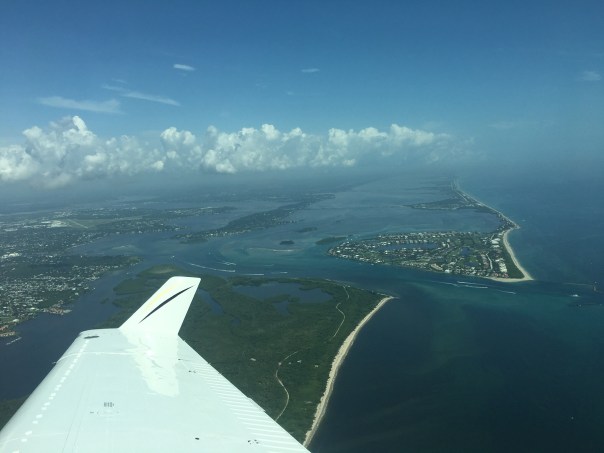
Yesterday, Sunday, 6-27-21 -at 2:15 pm, my husband, Ed, took a flight over the St Lucie River/Indian River Lagoon. In spite of significant local basin runoff, due to local rains, the river looked good.

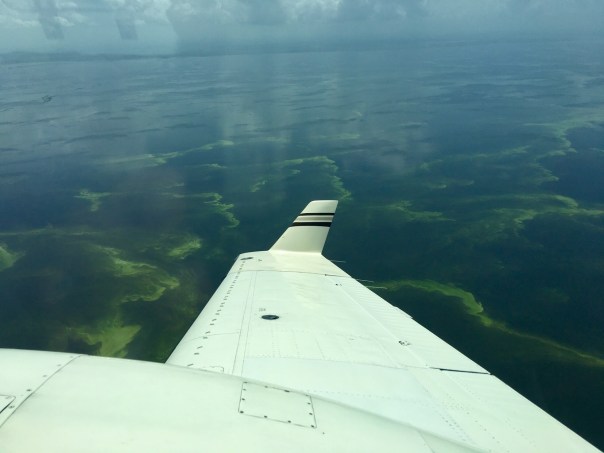
Flying west -Lake Okeechobee at Port Mayaca showed no visible signs of algae from 1000 feet, however also on 6-27-21, Mike Connor, Indian RiverKeeper reported cyanobacteria within and around Port Mayaca’s S-308 gate; and on June 24, 2021, the Martin County Hearth Dept issued a BLUE-GREEN ALGAE BLOOM ALERT FOR THE WATERS NEAR PORT MAYACA. As expected,  The Department of Environmental Protection reports Algae in Lake Okeechobee at this time.

Florida Oceanographic gave a “B” for water quality in the St Lucie River for June 17-23.

Check out the SFWMD Ops_Position_Statement_Jun_22_28_2021

The ACOE reports the lake is at 12.66 feet 6-28-21 and there have been no Lake O discharges since April 10, 2021. Thank God! We continue to advocate for the health of the St Lucie and its residents. #NoLakeO

Enjoy the Flight! Enjoy the Water in the SLR/IRL! Ed and I visited Boy Scout Island on Saturday and the water was beautiful. The way Martin County is supposed to be! 

~Thank you Ed for being our Eye in the Sky since 2013~

-Sandbar St Lucie River/Indian River Lagoon-Sailfish Point, Sailfish Flats and Sandbar. Seagrasses are few, but there. Hopefully they will grow back if there are no Lake O discharges this year. Photo below is from Boy Scout Iland boat trip very near the Sandbar on 6-26-21.-Another view-Area between Sewall’s and Sailfish Points-Sewall’s Point visible on left-St Lucie Inlet at Sailfish Point- various photos -Great shot of St Lucie Inlet State Park, Jupiter Island looking north to Sailfish Point, Hutchinson Island. Here opens St Lucie Inlet from confluence of St Lucie River and Indian River Lagoon.-Ed taking a rare selfie! I think his first. “Thanks Ed!” 🙂-Lake Okeechobee at Port Mayaca, raining near Pahokee and south rim of lake. No visible algae but hard to see in this light. In any case, S-308 the gates at Port Mayaca are open only for water supply to agriculture and S-80 at St Lucie Locks and Dam remains closed thanks to the ACOE. Thus no Lake O water to the St Lucie. Hopefully they will remain closed for all 2021 and beyond!

My brother Todd Thurlow’s website EYEONLAKEO will keep you in the know!

River Warrior Times 6-1-21

River Warrior Times 6-1-21

Summary

Since I last wrote #2, the St Lucie River has NOT been bombed and is in pretty good shape as the ACOE is not discharging from Lake Okeechobee thought the St Lucie Locks and Dam, S-80 structure. Algae is coming in through S-308 at Port Mayaca as this water is being used for agricultural water supply, but for now, it is relegated to the edges of the C-44 canal. Cities in Palm Beach County near the Lake Worth Lagoon have not been so fortunate as a cyanobacteria was found in their water supply right at the start of the Memorial Day weekend; and the Caloosahatchee on the west coast, which has been taking Lake Okeechobee discharges while the St Lucie has not, has pockets of blue green algae reported.

Things may start heating up even more for all waterbodies as June is the month one “normally” finds cyanobacteria in Lake Okeechobee.  May, this 2021, was very early to have such a large bloom. Please see my brother, Todd’s, website EYEONLAKEO for updates on both the St Lucie and now also the Calooshatchee daily discharge numbers  ~and much much more!

In case you did not view in the paper, a very remarkable letter to coastal residents was written by Colonel Jason E. Kelly, Commander, South Atlantic Division, ACOE. Never before have I seen a two page letter written by the ACOE regarding the estuaries and operation of Lake Okeechobee! This letter is really worth the read. Obviously, the Corp is listening.

I.

Photos of St Lucie River/Indian River Lagoon-

St Lucie River/Indian River Lagoon. Boaters enjoy at sandbar Memorial Day weekend, 5-30-21. The water from the lake and C-44 is not getting to the river as S-80 is closed.  All photos Ed Lippisch

Blue Green Algae not far away in C-44 canal kept inside by S-80 at St Lucie Locks and Dam.

Visible algae at the S-308, Port Mayaca, Lake Okeechobee leading into C-44 canal

II.

Water Advisory

West Palm Beach, Palm Beach and South Palm Beach. The best article to explain this situation was written by reporter Kimberly Miller in Sunday’s Palm Beach Post. The situation is complicated in that these cities receive their drinking water via surface waters. Sometime used is water brought in through Lake Okeechobee. In late April blue-green algae (cyanobacteria) was found in the canals leading into this area from Lake Okeechobee and immediately this input was shut down. The cyanobacteria found in Clear Lake is not microcystin we are so used to talking about, but another, cylindrospermopsin. Nonetheless, this cyanobacteria was documented in Lake Okeechobee in 2001 by the state algae task force. I think this situation will be a serious game changer for the state of Florida and it’s failure to address significant and meaningful water quality regulations.

III.

Algae in Calooshahatchee River

For me, the best way to follow the day to day water situations on the Calooshahatchee is to follow John Cassini, Calusa Waterkeeper. He has the support of pilots and drones to share visuals of the area. One of the main areas where cyanobacteria has collected is at S-79 structure and the SFWMD is using “innovative technology” to try to clean up the area.

S-79 algae bloom, Caloosahaatchee River, credit SFWMD


The River Warrior times is meant to be a summary of top issues.

Previous Summaries 2021:

River Warrior Times #1 

River Warrior Times #2

Day 35 ~Discharges to St Lucie Stop, April 10, 2021

Documenting the Discharges 2021

On Friday, April 9, the Army Corp of Engineers announced it would halt discharges to the St Lucie River/Indian River Lagoon on Saturday, April 10. The Corp has been discharging from Lake Okeechobee since March 6th. Today Lake Okeechobee sits at 14.14 feet. Please read above link for details.

These aerials were taken by my husband, Ed Lippisch, yesterday, Saturday, April 10, 2021 at approximately 1:30 pm during an outgoing tide, from 3000 feet over the St Lucie River/Indian River Lagoon, and 1500 feet over Lake Okeechobee and the C-44 Canal.

There have been documented reports of algae near Port Mayaca at Lake Okeechobee as well as on the the west coast -April 8. Ed’s photos from April 10 reveal some algae in C-44 canal near the railroad bridge just inside the S-308 structure, but none was visible in Lake O near S-308 from the altitude of the airplane.

Ed, myself, and the River Warrior crew will continue flights documenting the visual condition of the St Lucie River/Indian River Lagoon. Always watching. Always sharing.

When we are not flying, you can follow along  electronically via my brother Todd Thurlow’s website eyeonlakeo. 

J&E

-Sandbar and barren (no visible seagrass) Sailfish Flats area of the St Lucie River/Indian River Lagoon. Visually, water is a mixture of blue and brown, mostly transparent, near St Lucie Inlet. -Discharges exiting St Lucie Inlet over nearshore reefs. It will take a few days for the river to clear up. -At Lake Okeechobee, Port Mayaca, S-308 Structure to C-44 Canal leading to St Lucie River-C-44 Canal at railroad bridge just inside S-308 structure. Algae visible on right side. -C-44 at St Lucie Locks and Dam S-80 Structure AKA “The 7 Gates of Hell.”

Information:

Florida Oceanographic Society  WQ Report “B” March 31-April 7, 2021

SFWMD Operations Position Statement April 6-April 12, 2021 Ops_Position_Statement__Apr_06_Apr_12_2021

Todd Thurlow’s website EyeonLakeO 

To learn more and sign a petition to stop the discharges:  RiversCoalition.org 

28 Days After the Discharges~2021

Documenting the Discharges, Saturday, April 3, 2021.

Since last week, the ACOE has lowered discharges to the St Lucie River from 500 cubic feet per second to 300. The lake is now down to 14.44 feet from over 16. Blue-green algae has been spotted in the C-44 canal near S-80 at St Lucie Locks and Dam. This canal connects Lake O to the St Lucie River and blue-green algae is always of concern as reported my Max Chesnes of TCPalm. Ed and I saw no algae at S-308 on Lake Okeechobee from the air. The water does have an odd hue-perhaps due to wind. We did not get over S-80 due to weather conditions.

This go around, the ACOE began discharging on March 6, 2021 to the St Lucie River, so yesterday, when these photos were taken it was 28 days after the discharges. The aerials were taken from about 3000 feet, at approximately 3:30pm, on an outgoing tide. Conditions were  windy, cloudy, and all  waters were stirred-up.

Please note federal, state, and local links on subject following  photographs.

~Wishing all a Happy Easter and Spring time! See you next week. Ed & I will continue to document the discharges.

J&E

Running images of S-308 at Port Mayaca, Lake Okeechobee and over the St Lucie River/Indian River Lagoon near Sewall’s Point the dividing peninsula of these waters-merging at the Crossroads and Sailfish Flats near the St Lucie Inlet. Photos Ed Lippisch.

USACE to reduce Lake Okeechobee releases beginning April 3, 2021.
U.S. ARMY CORPS OF ENGINEERS, JACKSONVILLE DISTRICT
Published April 2, 2021: (https://www.saj.usace.army.mil/Media/News-Releases/Article/2560023/usace-to-reduce-lake-okeechobee-releases-beginning-april-3/)

-Notice of Algae (https://www.saj.usace.army.mil/Missions/Civil-Works/Navigation/Notices-to-Navigation/Notice-to-Navigation-2021-007-Okeechobee-Waterway-Algae-Notice/)

(B) Florida Oceanographic Society WQ Report March 31, 2021:(https://mailchi.mp/floridaocean/waterqualityreport2021-1215216?e=0a1cb67484)

South Florida Water Management District operations recommendation to the ACOE March 30-April 5 2021. Ops_Position_Statement__Mar_30_April_05_2021

SFWMD March 31, 2021 visual water levels update and newsletter sign up.

Martin County Health Department Blue Green Algae St Lucie River, April 2, 2021.

Canals killing the St Lucie River-

SFWMD canal and basin map. C-44 canal is the canal most southerly in the image connected to Lake Okeechobee. Note S-308 at Lake O and S-80 at St Lucie Locks and Dam.

SLR/IRL up to 7000 feet

~Documenting the St Lucie/Indian River Lagoon. Sewall’s Point, Ed and my home, lies between the St Lucie & Indian River Lagoon. My husband, Ed Lippisch, flew high, up to 7000 feet, to take photos of the St Lucie River/Indian River Lagoon, and S-80 (St Lucie Locks and Dam), on Sunday, February 21. The pictures were taken around 2:45pm on a very windy day. (Thus I declined an invitation!) Ed basically made a big circle. 

I am including all 52 photos as each one presents a slightly different perspective. Ed flew from the Crossroads and inlet of the SLR/IRL west to S-80 along the C-44 canal. There he saw no discharges coming through the gates from either the C-44 basin or Lake Okeechobee. Most recently, the ACOE halted discharges on January 9th, 2021 after 3 months of discharging. The river is starting to recover in appearance, but not soul.

Today, Lake Okeechobee is at 15.42 feet.

Tomorrow at 3pm the ACOE will hold a media call to announce their operational decisions for the coming week/s. James Yochem, spokesman for the Corp, has shared the following media advisory. The public usually does not speak on these calls but can listen-in. 

MEDIA ADVISORY:

The U.S. Army Corps of Engineers Jacksonville District will conduct a briefing with interested media representatives regarding water management for Lake Okeechobee and south Florida. The media briefing will be held Feb. 25 at 3 p.m.

Please join the call using this information:

US Toll Free    844-800-2712
Access code     199 453 9583

If you are asked for an attendee ID number, dial #

It is very important that we are paying attention to “all things river”and “speaking up for the St Lucie” when possible as we approach wet and hurricane seasons. 

Thank you Ed for the recent aerials!

~To view Ed’s photo essay documentation prior to this one on February 3, 2021, see Milky Waters!

~To review what happened to the St Lucie in Toxic 2016, see Too Unthinkable.

About Jacqui Thurlow-Lippisch 

Simplifying LOSOM

-Lake Okeechobee’s northwestern shoreline on a beautiful day, 2020. Photo Ed Lippisch and Jacqui Thurlow-Lippisch “LOSOM.” Sounds rather ominous doesn’t it? 

You may have heard the acronym recently and wanted to get involved. Today, I will try to simplify the major aspects of LOSOM best known as the “Lake Okeechobee System Operation Manual,” by splitting the process into three sections, past, present and future. It is my hope that this helps the everyday-person make sense of a complicated process and provides tools for effective advocacy.

Getting involved with LOSOM is about the most important thing we can do to “be a voice for the estuaries” because it means influencing a very complex lake operating system that for years has favored water users at the expense of the estuaries. Over time, priorities change, it is time to be fair, and now is an opportunity to speak-up. This occasion comes along only every decade, or two…

So here we go! 

I. Past 

The ACOE’s lake operation systems entail a lot of complicated science, however, one thing we can all understand is lake level. The modern lake regulation schedules began in the 1970s. Outstanding author and scientist, Thomas E. Lodge, states on page 153, in his book, The Everglades Handbook, Fourth Edition : “Since the 1930s, Lake Okeechobee’s water levels, or stages, have been regulated in an effort to balance often conflicting goals.” 

These original goals were defined back in 1948 in the“Comprehensive Report on Central and Southern Florida for Flood Control and Other Purposes,” when the ACOE reworked (some would say overworked) South Florida’s canal system. These goals or priorities  remain with us today as we work through LOSOM. Understanding these goals gives us solid ground to stand on in an often shifting arena.            

-1948 C&SFP map (Revised, 1982) 

The goals/so called benefits of expanding the canal system and draining Florida were the following: 1. Flood control; 2.Land Use (creation of the Everglades Agricultural Area, and more drained land for development throughout the system);  3. Navigation;  4. Fish and Wildlife; 5. Water Supply, and 6. Recreation.

What is not mentioned, nor was considered in times past, is “Health.” 

In recent years, poor water quality, due to non-point and point source pollution build-up over many years, has led to large toxic algae blooms on Lake Okeechobee;  unfortunately due to irresponsibility and carelessness, it has reached mammoth proportions. When discharged to the estuaries, St Lucie, Caloosahatchee, and the Lake Worth Lagoon (not yet formally considered an “estuary”) local economies, as well as wildlife and human health is threatened to the point of catastrophe. 

The NOAA satellite image below shows a cyanobacteria bloom on Lake Okeechobee in July of 2016.  Absolutely unbelievable. To deal with this dangerous situation, over the past couple of years, the Army Corp has implemented a Harmful Algae Bloom Deviation. It will more than likely become part of LOSOM.

-Lake O, NOAA satellite image 2016. Table 11.2 below  is an excerpt from Dr Lodge’s  book and is extremely  helpful in understanding the history of the Army Corp of Engineers’ regulation schedules and management of Lake Okeechobee. LOSOM will come next, starting in 2022. 

-According to Dr Lodge, a 1913 Corp of Engineers’ report “established the wet season level of Lake O at 20.6 feet NGVD. Seasonal low was 19.2 feet. Since 1913 the lake has multiple canal outlets and is now smaller and enclosed by a dike (1933). Regulation schedules since the 1970s are listed below. CLICK TO ENLARGE TABLE BELOW. 

After studying the chart, one can see that we are entering the 6th modern Lake Okeechobee regulation schedule. 

 As mentioned, right now 1. Flood control (this includes dike and flood water safety); 2. Land Use; 3. Navigation; 4. Fish and Wildlife; 5. Water Supply and 6. Recreation are the goals lake regulation schedules of the past have worked under. But as the HAB deviation tells us, times are changing and priorities must be defined by the times we live in.

Let’s think…

Which category do think has priority now? Which one/s had priority in the distant past? Why? Where do you want the priorities in the future? Should there be yet another priority such as health?

Now is the time! 

II. Present

The image below, LAKE OKEECHOBEE SYSTEMS OPERATION MANUAL UPDATE, is from Feburary’s  SFWMD Governing Board meeting (go to 133.38-205.25 to hear the discussion from Mr John Mitnick, P.E. Chief District Engineer, and the board.)  If you have the time, watching this will be very helpful. 

Mr Mitnick shared the slide below during this WATER CONDITIONS SUMMARY, which now includes LOSOM. Notice the word “health” is used a lot. Interesting.  

The world of LOSOM is a world of scientific models. And it is these scientific models that will help determine the future. The South Florida Water Management District’s expertise as a local sponsor of the Central and Southern Florida Plan puts them in charge of the modeling for the Army Corp of Engineers. Groups of volunteer and experts have been discussing these models since January of 2019. They have narrowed the models down from over 120,000. Now you can jump in too! 

Note the numbers to left of each sub-objective or goal. For instance, the number next to “Enhancing ecology in the St Lucie” is 4C. The scientific models that benefit the St Lucie are 4C models. The number next to “Enhancing ecology in the Caloosahatchee” is 4B. The models that benefit the Calooshachee most are 4Bs. The ideal lake operation conditions for these two estuaries are not quite the same. For instance, the St Lucie wants 0 discharges, but the Caloosahatchee needs some discharges due to salinity issues. When the LOSOM process gets to “balancing” these things will have to be worked out along with all the other stakeholder goals and wishes. Get the idea? 

So here’s your chance. What is your priority for your water body or other? Of course they are all important but what stands out for you TODAY? 1. Flood control; 2. Land Use; 3. Navigation; 4. Fish and Wildlife; 5. Water Supply; and 6. Recreation and/or 7. Health. 

Think Estuaries: St Lucie, Caloosahatcee, Lake Worth Lagoon, Biscayne Bay, Florida Bay, Lake Okeechobee itself? Once upon a time, Lake Okeechobee was once part of the greatest estuary in the world-our River of Grass! 

In the art of negotiating, or “balancing,” as the ACOE calls it, start strong with your first priority. Ask yourself which category has taken a back seat? Maybe you are not pleased with any of them. Which priority should come forward?  Perhaps its a combination. You decide! 

III. Future

So where are we in this complicated process? The SFWMD will hold workshops for the board and public in the coming months. But consider getting involved now. 

The SFWMD image below shows that we are in the green phase: January 2021-May 2021, where 13 models will be chosen from the 27,000. This is too much to think about. Just focus on your goal. Your number from the above chart.

The yellow rectangle that is so hard to read says: “Iteration 2, Balanced Array of Lake Schedules” (May 2021-July 2021). After July we will enter the orange phase and all of the feedback (advocacy and input)  will be “balanced.” Negotiated. 

Negotiated in the public arena! When all is said and done, the new lake plan —the Lake Okeechobee System Operating Manual (LOSOM) —will take effect in 2022.

So speak up now! Write the Army Corp, the address is below or better yet, attend Monday’s February 22, 2021 meeting if possible. There will be others, but put your foot in the water now. 🙂

Even though, this has been a relatively complicated post, I hope it has helped simply the LOSOM process: thank you for being a voice for the estuaries and our waters!  


IV. ACTION ITEM

PLEASE READ BELOW

Let’s seize this moment to advocate! 
Join the Army Corps LOSOM meeting!
 
When: 10 a.m.-noon Monday, Feb. 22 
 
Or call in by phone at (844) 800-2712.
The dial in access code is 199 737 9512. The password is 1234. 
 
Can’t make the meeting?
If you’d prefer to send written comments, you can email them to Lisa.E.Aley@usace.army.mil.
 
Thank you!
 
-Lake O’s northwestern shoreline on a not so beautiful day, 2020. Photo EL & JTL
 
Jacqui Thurlow-Lippisch is a member of the SFWMD Governing Board


What is a HAB Deviation?

-Shadow in Toxic algae, Central Marine, St Lucie River, Stuart, FL 2016. Photo JTLSince February 1, 2021, the St Lucie River has fallen under an Army Corp of Engineer’s “HAB Deviation” or Harmful Algae Bloom Deviation. If you are not familiar with it, this is a complex situation, and it took a lot to get there; however, I am going to try to explain it in easy terms.

Basically, HAB Deviation means that the ACOE has the authority to discharge from Lake Okeechobee in order to avoid another toxic summer. The HAB Deviation gives the ACOE the ability,  if necessary, to discharge more flexibly than is documented in the present Lake Okeechobee Regulation Schedule, or LORS 2008. The HAB Deviation may dovetail with new requirements in 2022, when a new, updated lake regulation schedule called LOSOM, is delivered. The HAB Deviation may or may not exist then. But for now, it does.

“Why?” you may ask. 

Because actually the ACOE is trying to protect the estuaries from a precarious future. For example, this year, today, (2-14-21) Lake Okeechobee, is at 15.40 feet. This is considered “high” from a St Lucie/Caloosahatchee point of view because looking forward to June 1st 2021, when rainy season begins, it appears the estuaries may be receiving discharges. 

Again, the purpose is for the ACOEs to be able to discharge -to get the lake down early- so they don’t “have” to massively discharge come summer -when the lake undoubtably will have algae blooms. The goal is to avoid discharging algae. Thus the term HAB DEVIATION.

As we can tell from this UF thesis (Gayle) written in 1975, algae blooms have been documented in Lake Okeechobee since 1967. Water Quality is the responsibility of the State, but things got so bad in 2016 and 2018 for the St Lucie and Calooshatchee that the ACOE stepped in and created the HAB DEVIATION SCHEDULE. 

So far the ACOE has not started discharging to the St Lucie River under the HAB DEVIATION, but we should be prepared. 

“Is it better to get the discharges during the winter months when there is not algae in Lake Okeechobee?” This is a difficult question. 

Best would be not to get any at all…

Today, I share because it is all so confusing. At a recent SFWMD meeting, I realized that I didn’t even understand that although the St Lucie is not receiving discharges, the deviation has already begun…

Approved Planned Deviation from LORS 2008 to reduce risk from Harmful Algal Blooms

2020 Planned Deviation to the Water Control Plan for Lake Okeechobee and Everglades Agricultural Area (LORS 2008)

Glades, Hendry, Martin, Okeechobee, and Palm Beach counties

Final Supplemental Environmental Assessment and Finding of No Significant Impact (Oct. 8 2020)

Supplemental EA and FONSI

Appendix A

Appendix B

Appendix C.1

Appendix C.2

Appendix D

NOTE: very large files may take several minutes to open and download.

-2016 Toxic Algae Bloom, St Lucie River at Central Marine. The algae blooms start in Lake Okeechobee. When discharged to the St Lucie River the blooms are exaserbated by poor water quality and the freshness of the once brackish estuary due to long releases from the Lake Okeechobee. This pattern must stop. More water must flow south. Photo JTL 


On A “Perfect” Day

My husband Ed, and friend, Dan Velinsky, went fishing yesterday (2-9-21) at “Sailfish Flats” between Sewall’s and Sailfish Point. It was indeed a spectacular day, and Ed returned home smiling even though they didn’t catch any fish. “It was beautiful.” He exclaimed. “But no seagrass, no fish, except hiding by the islands…” Then he turned with wide smile“We even saw seven dolphins and two turtles! I taped them!”

 The whole time Ed was speaking, I couldn’t help it…

I saw a number flashing in my head: 15.41, the level of Lake Okeechobee on February 9, 2021. This number is high from a St Lucie point of view for this time of year. In June will come rainy season….

As ACOE’s Col. Kelly reported last week, the lake is going dow, but: “Today, the lake stage is at 15.42 feet, which is still 2.5 feet higher than it was one year ago, and 2.7 feet higher than it was two years ago.”

FLASH! FLASH! 

I share Ed photos “on a perfect day,” to document-  knowing – we must keep an eye on Lake Okeechobee and the decisions of  Army Corp of Engineers .

Click here to see Lake Okeechobee Level in graph format  

Both videos of dolphins in bluish waters 


A Ten Year Calendar View, Discharges to the St Lucie Estuary

A Ten Year View, Discharges to the St Lucie Estuary

Today I share images that help tell the story of the St Lucie Estuary over the past ten years. The first image is from the website eyeonlakeo. My brother, Todd Thurlow, takes data from D-Hydro of the SFWMD and puts it into a format that the average person can understand. 

The chart above shows the “S-80 spillway at St Lucie Locks’ cumulative discharges by CALENDAR YEAR, 2011-2020.”

Scientists use Water Years, May 1 of one year, through April 30 of the next year. This splits up the years making it more confusing to remember or understand. We, as people, live our lives in calendar years. 

We can see by looking at Todd’s chart that 2016’s calendar year is highest overall discharge year with 842,775 acre feet (one foot of water covering one acre) of water going to the St Lucie from what is called “local runoff” (all canals and surrounding areas) as well as discharges from Lake Okeechobee.

How large is 842,775 acres? Comparatively, Martin County is 347, 520 acres. 2020 is 188,723 acre feet and climbing. We are talking tremendous amounts of water! 

In descending order, we see 2016; 2013; 2017; 2018; 2015; 2020; 2012; 2014; 2019; and 2011.  The brown of line of 2020 crests 2015 as when the year is completed, 2020 will more than likely be higher than 2015.

I also wanted to share some very helpful charts I recently requested -in my research- from the South Florida Water Management District.  

This was my request:

“Could you please get me a chart or graph showing discharges to the St Lucie River for 2012-2020 by month. Please present this information from January through December of each calendar year and break it out from S-80 and S-308 and also give a total combined number. Please also note for each of those calendar years, the highest level Lake Okeechobee got that year.” 

To view this information, click on Charts in red below for visuals, and data in red below for numerical charts. As mentioned this information below is from the SFWMD. This compiled information provides great perspective. 

Charts

data

I, as many, participated in yesterday’s Army Corp of Engineers‘ Periodic Scientist Call. During the course of the call, it was alluded that the ACOE may be letting up or halting Lake Okeechobee discharges to the St Lucie Estuary soon. As soon as they do, we will begin to chart calendar year 2021. All things considered, everything in me believes it will be better than 2020! 


Documenting the Discharges 2020

Today is October 26, these photos/videos were taken over the weekend on October 24, 2020. The first is the St Lucie River looking off the Evan’s Crary Bridge at Sewall’s Point; the second is a video of the St Lucie River taken between Rio and Stuart; and the third is a video of a brown ocean at Peck’s Lake. The St Lucie River/Indian River Lagoon and much of the east coast of South Florida have endured tremendous, repetitive downpours in 2020, causing massive “local basin runoff.” The St Lucie has been stressed for months, and since October 14, there are also discharges from Lake Okeechobee. Prior to that, there had been no Lake O discharges since March of 2019. This post is written to document this discharge era for today and for later reference.

1-Video visual water quality from boat, wide St Lucie River near Rio 10-24-20


2-Video visual water coloring, Atlantic Ocean at Peck’s Lake, south of St Lucie Inlet 10-24-20


DOCUMENTING THE DISCHARGES 2020

Map SFWMD showing canals and basins. C-44 is designed to discharge both basin and Lake O water, depending. When flowing, C-23 and C-24 are constant polluted discharges. More often than not, the St Lucie receives more polluted fresh water discharges from these canals than the river can handle.

Covid-19, an active hurricane season, and the 2020 presidential election have captured our attention, but most of know, as this Tyler Treadway Stuart News article reports, much to our dismay, due to a high rate of Lake Okeechobee rise, and after weeks of media briefings, and warnings, a reluctant  ACOE started discharging to the St Lucie River on October 14th. Thankfully, for much of the time, it has been difficult due King Tides. The discharges are expected at least another week longer if not a month depending weather and rainfall from Tropical Storm Zeta. See link below from the ACOE’s  most recent, 10-20-20, Periodic Scientist Call for more info. 

Periodic_Scientists_Call_2020-10-20

EASY REFERENCE FOR ALL 

The most comprehensive place to keep track of all this is Todd Thurlow’s website  (http://eyeonlakeo.com) that provides a multitude of easily interpreted information. Check it every day, especially LIVE DATA and Satelitte NCCOS HAB images of Lake Okeechobee.

FACEBOOK UPDATES

Michael Conner, THE INDIAN RIVERKEEPER keeps an active Facebook page on Lake O discharge and other local issues and is often on the ground reporting.


I am not happy about the discharges, however, I am pleased to report that the SFWMD has created a transparent website page where one can learn all that is being doing to try to curb the harmful discharges to the estuaries. The SFWMD is working hard to send water south even during this very rainy hurricane season. And each year we must figure out how send even more water south. https://www.sfwmd.gov/content/district-actions-reduce-harmful-discharges-northern-estuaries

Also on 10-14-20 The Florida Department of Environmental Protection put out a press release: “Governor Ron DeSantis Announces Preparation for Algae Bloom Mitigation Following Announcement by Corps of Releases From Lake O.” This technology has not been needed thus far. 

I can’t forget to include that October 11, 2020, right before the discharges began,  Ed and I took this video documenting a significant algae bloom in the middle of Lake Okeechobee. Since that time it has been too stormy, or cloudy to go up. Usually, rain and lack of sunshine minimize visual blue-green algae blooms as can be seen on Todd’s website. The algae does remain in the water column. This image/video was shared by many news stations and posted on Facebook.

3-Large algae bloom in middle of Lake Okeechobee, 10-11-20.

Next , I would like to document  Florida Oceanographic CEO, Mark Perry’s recent op-ed as it gives us pause. “Why can’t, why aren’t we able to send more water south?” We know a lot has been done, and we are grateful, however,  2020 is not 1948, we must continue to advocate for a better water future…

OP-ED MARK PERRY,  PUBLISHED IN STUART NEWS, October 15, 2020

Lake Okeechobee discharges can go south now.

As the water level rises in Lake Okeechobee, the U.S. Army Corps of Engineers is considering discharges to the coastal estuaries, the St. Lucie to the east and Caloosahatchee to the west.

According to the Lake Okeechobee Regulation Schedule, the Corps considers where the lake level is at this time of year within the “operational band,” which ranges from 10.50 to 17.25 feet of elevation. Then, based on the rainfall outlook and tributary conditions, they determine “allowable Lake Okeechobee releases” to the water conservation areas and to the estuaries.

The water conservation areas (900,000 acres) are the remnant Everglades, south of the Everglades Agricultural Area (EAA) which is the 700,000 acres immediately south of the lake used primarily for growing sugarcane.

For “allowable Lake Okeechobee releases” to the estuaries, the Corps has specify flow amounts going to each estuary, which can be “up to 4,000 cubic feet per second (cfs) to the Caloosahatchee and 1,800 cfs to the St. Lucie.” 

That is where they are right now with the lake at 16.02 feet elevation.

But the “allowable” releases to the water conservation areas are always “up to maximum practicable.” What does that mean? Well, they rarely talk about how much they can release to the water conservation areas, and never tell us how much should be considered to go south.

In fact, water has been flowing south into the water conservation areas all throughout this wet season, May through October.

But it is not coming from the lake.

About 955,000 acre feet (311 billion gallons) has been going into the water conservation areas from the EAA basin runoff. This means that they are keeping the EAA water table down to 10.5 feet — ideal for crops — by draining all this water through our 57,000 acres of stormwater treatment areas and into the water conservation areas — the Everglades.

Meanwhile, the Corps says they must discharge Lake Okeechobee to the estuaries because they can’t release it to the south. Well, they can — they have been doing it for months and they still are today, but it is all coming from the EAA basin runoff!

All this time, we could have been releasing lake water to the water conservation areas, and we could do the same right now instead of killing the estuaries with releases and wasting this water to tide.

But for that to happen, we need to tell the EAA to store and treat runoff on their own land so the stormwater treatment areas can be used for water flowing south from Lake Okeechobee.

The Corps and South Florida Water Management District are jointly responsible for managing water in south Florida. We need to have them focus on restoring more natural water storage and treatment north of the lake, in the 2.5 million acre watershed, so the lake doesn’t fill up so fast.

But we must also get them to flow south from the lake to the Everglades during the wet and dry seasons. We don’t have to wait for huge regional projects to be authorized and completed, we can do this now.

The lake is rising quickly because the EAA is using the capacity to send water south. Agricultural interests would like it to stay high because during the dry season, November thru April, the EAA will demand water from the Lake, about 350,000 acre feet, as water supply for their crops.

These are ideal conditions for the EAA, but not so good for the lake, the greater Everglades ecosystem and the coastal estuaries.

Mark Perry is executive director of the Florida Oceanographic Society in Stuart.

Below are Florida Oceanographic’s most recent St Lucie River/Indian River Lagoon water quality reports

October 14, 2020:

October 21, 2020

—————–

Finally: During Rivers Coalition meeting 10-22-20 more expansive documentation/reporting  of on-going seagrass loss/slow recovery in the St Lucie River/Indian River Lagoon was requested. It was noted that SFWMD “Ecological Reports” cover only two historical seagrass areas of the once lush and healthy Sailfish Flats. 

Lake O Algae Visible Again

You may have seen my most recent Lake Okeechobee post from July 25, 2020? After algae aerials since May 8th, my dear husband, Ed, said he saw no algae. Ed and I had a back and forth -me saying the algae “was hiding.” Hiding in the water column. Ed saying it was gone. Well, guess what? I was correct… 

Today, July 29, only four days later, the cyanobacteria is back. There was one positive to it all. Ed added to his long list of esteemed flight guests, Ft Meyer’s Captains Chris Whitman and Daniel Andrews – the faces of Captains for Clean Water. The east and west coasts of Florida have been advocating together since the days of the Sugarland Rally in 2013. East and west, an important water alliance. 

According to Ed, “the algae was bright and visible over the majority of the western,  and southern-central portion of the lake, but became less dense as one approached Port Mayaca.” 

“Were you surprised the cyanobacteria had returned?” I asked. 

Ed had a very simple answer: “yes.” 

Ed also said it was a great to hosts the Captains. What an honor. 

Below are some of Ed and Captain Daniel’s photographs from Wednesday, July 29, 2020. You will see, with the sun shining, the lake is once again, visibly, full of algae. This is important documentation for the Army Corp of Engineers as we possibly face a very wet weekend. 

Havens and Hoyer diagram from study of cyanophyte movements.Courtesy, Joe Gilio.
Courtesy of Captain Daniel Andrews-off southwestern shore

Courtesy of pilot Ed Lippisch-southern to southwestern shore of L.O.

Wind Blows LakeO Algae Bloom West

Today’s flight, 7-18-20,  revealed a lack-luster colored algae bloom blown to the southwest area of Lake Okeechobee. Rather than the florescent green often seen, there was more of a pea-green conglomeration against the west side. But it was there. 

We continue to be your eye in sky…

Jacqui & Ed

LakeO Update Sunday, July 5, 2020

Keeping up the Lake Okeechobee algae bloom documentation, Ed and I flew from Stuart to Lake Okeechobee during a hazy, hot high-noon, on Sunday, July 5, 2020. The algae was much toned down from our previous flights in June. Nonetheless, one could see the pattern, the outline, of the giant bloom from above. Rain may have disrupted its perk but the bloom remains in the water column. The most visual appeared to be in the middle of the lake and again, about a mile or so off Port Mayaca. 

I have included photographs of the journey: St Lucie River at Palm City; flying over western lands and under construction C-44 Reservoir/STA ; FPL cooling pond; algae in Lake O; Clewiston; south rim of lake with agriculture and sugar fields; Indiantown and Hwy. 710; DuPuis and Corbett Wildlife Areas;  one glance back to Lake Okeechobee; and an updated 2020 “Covid-19 portrait” of Ed and me. 

We will continue to document throughout the summer. Keep up the fight! Stop the Discharges! Stop the Algae

~Your eye in the sky

Jacqui & Ed 

St Lucie River at Palm City
Western lands and C-44 Reservoir/STA under construction-5 STA cells  filled
FPL cooling pond and edge of LO
Algae in LO off Port Mayaca
Closer to center of LO

Clewiston
Southern shoreline and agriculture fields, mostly sugarcane
Southeastern shoreline
Port Mayaca, DuPuis, Corbett Wildlife Management Area-dark green

This shot, below, was taken flying back east over the Village of Indiantown. Highway 710 is seen bisecting neighboring Dupuis and Corbett Wildlife Area and John and Mariana Jones Hungryland Wildlife Area. I will be writing more about the protected areas and the highway that cuts through them in the future. 

“Hey get rid of that plastic water bottle would ya? 100 degrees or not!” Jacqui & Ed 2020

Algae Overview North, South, East, West LakeO

Because the Baron needs hours on the engine, my husband Ed and I have been up in the sky a lot lately. Sometimes I am with him and sometimes I am not, but through technology we are always connected. 

Today I am sharing all aerials Ed took yesterday, 6-17-20, that continue to document a very expansive algae bloom in Lake Okeechobee. 

So where exactly is the algae? I can tell you, from the sky, flying over the central and southern part of the lake -at two, to five thousand feet -going two-hundred miles per hours -it sometimes becomes one giant blur of green. Right now, the bloom is visible mostly in the south central (east, west and central) areas of the lake, not in the north.

Seeing the algae depends on lighting and some areas are brighter than others, but when the sun hits the water just right, a sheen is everywhere.

About a mile and a half off Port Mayaca’s S-308 on the east side is the brightest and weirdest of all often displaying geometric formations due to boat traffic through the channel.

The ACOE has been flowing C-44 into the lake at S-308 but this certainly is not the cause of all the algae. Ed and I have years of documentation. The lake is eutrophic. Winds also affect the collection and formation of the algae. For a deeper dive into this you can visit my brother Todd Thurlow’s website EyeOnLakeO.

Here are all photos 6-17-20 with some comment clues and GPS. I have made one comment and then all photos that follow are the same location just a different angle. Use the GPS too. Question? Just ask! 

~Eye in the Sky 

MOVIE SOUTHEASTERN LAKEO, 6-17-20 

Documenting SLR and LO-June 2020

Documenting St Lucie River and Lake Okeechobee, Saturday, June 13, 2020

Today’s post includes two sets of photos taken from two different planes: the Supercub and the Baron. The Supercub is the classic yellow “River Warrior” open-air plane, and the Baron is a closed cockpit twin-engine with the distinctive upturned wing-tip. The Supercub can fly low and slow, the Baron can fly higher and faster. Both offer unique perspectives to photograph our waterways. 

I.

Dr. Scott Kuhns and Steve Schimming shared photos taken from the Supercub in the morning hours of Saturday, 6-13-20. Scott uses a quality Nikon camera thus his photos offer a wider or closer perspective. Thank you Scott and Steve, long time River Warriors and  friends. Their photos reveal the coffee color of the St Lucie following torrential rains.

Canal systems dumping fresh water into SLR  presently is primarily from C-23 and C-24. Good for the S.L. the SFWMD is advocating and the ACOE is allowing the water in the C-44 to run back into L.O. as lake was not in “ecological envelope.” Note: presently there are no discharges from LO into the SLR. ~Image SFWMD

St Lucie Inlet

Confluence SLR/IRL
Looking southt to St Lucie Inlet and Jupiter Narrows
Seagrasses looking bleak

Bird Island
Sailfish Point
Sailfish Point
Crossroads SLR/IRL

Sandbar
Sandbar
Sandbar
Bird Island IRL
Photos Dr Scott Kuhns: Sewall’s Point

II.

This next set of aerials was taken by my husband, Ed Lippisch, and myself the same day, 6-13-20,  a few hours later, closer to noon.  Again, it is important to note the St Lucie area recently experienced particularly heavy rains, only Broward County and parts of Miami- Dade had more. So we can learn about this, I am sharing the most recent Water Conditions Report of the SFWMD for details of all the St Lucie and all south and central Florida. See link under Rainfall Distribution Comparison slide below. 

The first group of photos from Ed and I in the Baron is of the St Lucie River and the second set is of algae blooms in Lake Okeechobee. NOTE THE ACOE IS NOT DISCHARGING INTO THE ST LUCIE AT THIS TIME.

We continue to document and thank all who are working towards projects and ways of life that better water quality in the state of Florida. We know what we need to do! 

https://apps.sfwmd.gov/webapps/publicMeetings/viewFile/25566


Sailfish Flats IRL
Exiting St Lucie Inlet looking south along Jupiter Narrows/Jupiter Island
Plume becoming visible
Looking back again into southern edge of SL Inlet

Now back at the St Lucie River and St Lucie Inlet at higher altitude
St Lucie River/Indian River Lagoon
Sailfish Point St Lucie River/Indian River Lagoon
Plume from higher perspective
Veteran’s Bridge in Palm City looking back to Stuart, note Witham Field and ocean in distance
Circling around- Hobe Sound looking north to St Lucie Inlet.
Heading west over Atlantic Ridge natural area
Approaching Lake O. FPL cooling pond visible.
S-308 at L.O. and C-44 Canal
My brother Todd Thurlow’s website shows that algae in L.O. is now showing on low resolution satellite imagery: Terra, Aqua, Suomi: http://eyeonlakeo.com/LakeO3x7days.html; http://eyeonlakeo.com
algae bloom southern rim
algae bloom like this was basically throughout southern area of lake, but denser in some areas and not so dense in others….
Ed’s palne GPS, present location south L.O.
South Lake O over southern rim
LakeO lapping towards Port Mayaca not FPL cooling pond, this area is by far the most algae ridden

Lake O
Lake O
Lake O
Lots of algae in Lake Okeechobee

MOVIE:

Now after flying west again over Lake Okeechobee algae here as well but more spread out

Another great SFWMD is the most recent Ecological Report as it discusses effects of water quantity and quality on fish and wildlife for all central and S.F.: (https://apps.sfwmd.gov/webapps/publicMeetings/viewFile/25567)

Satellite View, All Aerials, 2020 Algae Bloom Lake Okeechobee

Regarding: yesterday’s post, Eutrophic Lake Okeechobee

This morning, for purposes of documentation, I am posting the path my husband, Ed Lippisch, flew over Lake Okeechobee yesterday (6-10-20) and all aerials taken. Thank you to my brother Todd Thurlow, who shares technical information on his website, for re-creating Ed’s path via Flight Aware, and for also sharing the latest satellite high resolution images of Sentinel 2 retrieved 6-9-20. All of Ed’s phots displayed in gallery format below were taken from 2000 to 1500 feet on return flight along southern portion of Lake Okeechobee ending at Port Mayaca, east central, Martin County. His flight to the west coast was at 5000 feet and Ed said he saw no algae visible from that perspective.

High Res links to 6-9-20 Sentinel 2 imagery


(http://eyeonlakeo.com/NCCOS%20HAB%20Images/sentinel-3b.2020161.0609.1532C.L3.SF3.v950V20193_1_2.CIcyano-Crop%2BTruecolor.tif)

EyeonLakeO website, TT

All aerials, Ed Lippisch flight, 6-10-20, Moore Haven to Port Mayaca: if you are having trouble viewing this gallery please go to (https://wp.me/p3UayJ-b0a)


Aerials~St Lucie & LakeO-“After the Rain” 4-18-20

Last night, 4-18-20, after a hiatus, Mother Nature decided to “let it rain” and this morning friends Dr Scott Kuhns and daughter-in-law, Dr Mary Kuhns went for a flight over the St Lucie River and Lake Okeechobee to check things out.
Ed and I thank them for sharing their photographs!
Update-No visible algae at S-308 or along the C-44 canal. The waters of the St Lucie River are grayish from rain water runoff. Things look good, considering.  
~The rainfall numbers across the SFWMD can be viewed at the SFWMD’s 24 Hour Realtime Rain Gauge Site.
S-308 at Port Mayaca, Lake O
Along C-44 canal, do you see algae?
South Sewall’s Point, rain runoff visible
Hole in the wall & St Lucie Inlet
Rain plume exciting St Lucie Inlet

SFWMD 

Lake O 11.34 feet NVGD

JAXACOE

Canals in Martin & St Lucie Co.that are connected to the St Luice River: C-23, C-24, C-25 built in the 50s and 60s. C-44 is also connected to Lake Okeechobee constructed in the 1920s. The natural basins of the SLR have been tremendously enlarged damaging the river.

Thank you SFWMD & ACOE for info. 

Times Change! When Lake Okeechobee Was an Inland Sea

After my most recent blog post, people were asking me about the shells I found along the eastern shoreline of Lake Okeechobee. My mother even shared a rare visit to her collection-closet revealing a huge ten-inch Busycon contrarium ~also known as a whelk. She brushed the dust off the amazing “fossil.” On it, a shiny pink ribbon held a note that read:

“This Busycon contrarium blank was purchased from Lottie Huff a Seminole at the Brighton Reservation. She had a little craft store on highway 721 that runs through the reservation from State Road 70 to State Road 78. Her husband Stanley found it in some material dug up by heavy equipment. She had cleaned it up. 7/3/95.

Then she emailed me: “So are those shells in Lake Okeechobee from the years when the ocean covered Florida, like the shark teeth found in today’s freshwater creeks and streams?” 

I did not know. I do not know. I started researching and I still don’t know! 


There is a plethora of literature about the formation of Florida and most documents agree about geology and that Lake Okeechobee was formed about six-thousand years ago. Long before that, Florida was an inland sea. Thus today, our state is a destination for shell fossil hunters  and much larger ancient megafauna, and even calcite fossilized clams

Florida Geological Survey 

Florida is an amazing place with so much history. Now if only I can get answers about those shells I found! Do you know the answer? Please write me if you do. I will continue the hunt myself, but in the meanwhile,  let’s admire my mother‘s incredible busycon contrarium! 

Lake Shells Tell, the Eastern Beach of Lake O was Miraculous Indeed!

SHELLS COLLECTED FROM THE SHORELINE OF LAKE OKEECHOBEE 4-5-20

With time on my hands, I have started rereading “The Boyer Survey: An Archaeological Investigation of Lake Okeechobee” by Christian Davenport, Gregory Mount and George Boyer, Jr., written in 2011 and begun in 2006. I have written extensively on this publication  before and find it one of the best historical accounts of our Great Lake Okeechobee.

What got me thinking about it again was a recent visit with my husband and our dog Luna. While we were there, I saw the wide exposed eastern shoreline of Lake Okeechobee for the very first time. Due to a lake level of about 11.70 feet on April 5th, part of the shoreline was beach like and exposed. I felt compelled to walk on it, and dreamt of what the surrounding may have looked like hundreds of years ago. Of course a true ancient shoreline would have been located further east. Drainage, the Herbert Hoover Dike, and Conners Highway give the illusion that things “always looked this way.” 

I was struck by the multitude of small clams shells and snail shells covering the entire shoreline. Some appeared ancient and others not. In any case, I had never seen them before either. They were beautiful even though some were draped in blue-green algae. It was a rare experience. I even found a green piece of “sea-glass along the beach!”

So back to the Boyer Survey. Today for some insight on Lake O’s ancient beach, we will review the  Chapter 1, Introduction, of the Boyer Survey. The first paragraph reads: 

“The circumstances that led to the Boyer Survey of Lake Okeechobee began in the fall of 2006. South Florida water managers lowered the level of Lake Okeechobee behind the Herbert Hoover Dike in anticipation of a predicted severe hurricane season accompanied by a potentially unprecedented amount of rainfall. Neither the hurricanes not the rainfall materialized. In fact, a severe drought set in. This lowered water levels throughout south Florida and combined with the already lowered water levels of Lake Okeechobee, reduced the lake’s depth from a normal  5.49 to 6.10 m (18-20 feet) to a record low of 2.69m (8.8 feet). (Obviously this the ACOE was not following LORS 2008 at this time.)

A concerned citizen called Palm Beach County in February 2007 to report that ancient human remains and artifacts were exposed on the lakebed…

The Boyer Survey project area is situated in the southeast section of Lake Okeechobee encompassing about 42,092 square miles.  

…The lake is a low lying basin with unique features near its south end that helped shape and contain it. These include the Okeechobee Ridge, the Southern Ridge the Spillover Lands, and the fossilized coral ridge. 

The Okeechobee Ridge is a sand ridge that extends from the Martin County /Palm Beach county line to just north of Pahokee. This ridge is thought to represent an old shoreline of the lake. The only place there is a gap in the ridge is around the modern hamlet of Sand Cut. Smith (1848) stated only the eastern shore of Lake  Okeechobee was well defined by a hard sand shore….

A lower lake has positive and negative effects. Let’s look at one that is positive. While it has been documented by the ACOE and SFWMD that record amounts of submerged aquatic vegetation are growing in the north western and western areas of Lake Okeechobee, the eastern shoreline is ailing as the photos below document.

 I do hope that one day there will be more of an effort to create a modern eastern shoreline, an Okeechobee Ridge, that mimics the ancient lake okeechobee shoreline as referred to in the historic Lake Okeechobee account of the Boyer Survey. As the lake shells tell, the Okeechobee Ridge is there, somewhere. The eastern beach of Lake Okeechobee must have been miraculous indeed! 


Very Good-Not So Good~St Lucie to Lake O (4-7-20)

Hi. Today I will provide a water update. Some is good; some is not so good. 

St Lucie River

Although the coronavirus and social distancing is hampering everyones’ ability to visit the St Lucie in large groups, the water in the St Lucie River -at least near the inlet- remains beautiful right now. If you have not been out, you can witness this blue water in photos taken by my husband and me on Saturday, April 4, 2020.

Lake Okeechobee. 11.70 feet. 

The South Florida Water Management District  and Army Corp of Engineers report Lake Okeechobee’s submerged aquatic vegetation, SAV, is really expanding the sun can reach the grass; this is fantastic for fish and wildlife and water quality, however the closely diked east side of the lake does not get the SAV benefit as it is too deep; the slight algae bloom reported there last week remains.  We must be honest and recognize many people feel the lake is too low, but fortunately, there is little chance of discharges from Lake O to the St Lucie and this is a good thing.

~We must note that today the SFWMD made a call for water conservation as much of South Florida is very dry.

~We most keep in mind that predictions are for an above normal hurricane season.  It should start raining in the coming weeks. 

~In all situations, we must keep our eye on lake O.

Please see the photos below a water update! JTL 

LOOKING BLUE! ST LUCIE RIVER AND INDIAN RIVER LAGOON BETWEEN SEWALL’S POINT AND SAILFISH POINT, AN AREA KNOWN AS THE SAILFISH FLATS. SEAGRASS SLOWLY RETURNING. 4-4-20 JTL/EL

ST LUCIE INLET AS SEEN FROM ATLANTIC 


LAKE O 


Submerged Aquatic Vegetation has greatly improved in Lake Okeechobee;  this is great news. The grasses are located in shallow areas but not along the eastern edge where S-308 opens to the St Lucie. The lake is 730 square miles, topography varies. The lake was reported by the ACOE to be 11.70 feet NVGD on 4-6-20. Areas along the shallow western shore look like below. 


SFWMD WEEKLY ENVIRONMENTAL CONDITIONS REPORT 4-1-20 (IMAGES FROM…)


LAKE OKEECHOBEE’S EASTERN SHORELINE, 5000 FT. THIS SHORELINE WAS DIKED CLOSE IN, THE EDGE IS DEEP SO NO SAV GROWS HERE. 4-4-20JTL/EL.

FPL COOLNG POND EASTERN SHORE, ST LUCIE CANAL or C-44 Canal. S-308 at Lake O. YOU DON’T SEE ALGAE FROM THIS FAR UP. JUST A SHADE OF GREEN. 


KISSIMMEE RIVER ENTERS LAKE O. LAND EXPOSED DUE TO LOWER LAKE LEVEL. PRETTY HERE. 4-4-20 JTL/EL.

BUCKHEAD RIDGE 


Below: THESE PHOTOS WERE TAKEN THE FOLLOWING DAY, SUNDAY, 4-5-20 ON THE GROUND CLEARLY SHOW BLUE GREEN ALGAE ALONG THE EASTERN SIDE OF LAKE OKEECHOBEE AND THE S-308 STRUCTURE THAT ALLOWS WATER INTO THE C-44 CANAL FOR AGRICULTURAL IRRIGATION.

AT THIS TIME NO WATER FROM LAKE O IS GOING THROUGH S-80 AT THE ST LUCIE LOCKS AND DAM TO THE ST LUCIE RIVER. WE WILL CONTINUE TO REMEMBER THE ALAGE BLOOMS BROUGH ON BY LAKE O IN 2016 AND 2018 AND KEEP OUR EYE ON LAKE O

EASTERN SHORELINE OF LAKE O ALGAE IS APPARENT! VERY DARK WATERS.

SITTING ON ROCKY SHORELINE OF EAST LAKE OKEECHOBEE,  SUGARCANE BURNING BEHIND ME, ANCIENT SHELLS IN HAND. ~Photo Ed Lippisch 

WALKING THE EASTERN SHORELINE OF LAKE O (VIDEO) 


SHELLS ALONG AN EXPOSED BEACH DUE TO LOWER LAKE LEVEL 

BLUE GREEN ALGAE INSIDE S-308 STRUCTURE/C-44 CANAL

INSIDE C-44 NEAR A CULVERT 

LOOKING OUT OF THE C-44 CANAL TO OPENED S-308 STRUCTURE FOR BOATS

BACK OF S-308 

INSIDE S-308

LOOKING SOUTH WEST, LAKE O. THE S-308 STRUCTURE IS TO THE LEFT OUT OF PICTURE

ED AND OUR GERMAN SHEPHERD LUNA LOOK ON

Thank you to my brother Todd Thurlow for his web site http://www.eyeonelakeo and thank you to my husband Ed Lippisch for being on this journey with me for the past twelve years. Onward! 

*Friend Paul Millar shared these photos of S-308 today, 4-6-20 3:30pm, so this post is now very updated.  Thank you Paul! 


Faint Algae Bloom at LakeO, S-308, C-44 Canal, Martin County

First of all, let’s recognize that we are stressed out enough social distancing due to the coronavirus. Nonetheless, for our waters, we must pay attention on every front. Right now, the St Lucie River and nearshore reefs are absolutely beautiful, and there is not a threat from Lake Okeechobee or area canals as it is not raining very much. Lake Okeechobee is at 11.85 feet NVGD, therefore, the chances of discharges into the St Lucie River are basically none. If another Hurricane Dorian comes this summer, that could be a different story.

SFWMD

SFWMD WEEKLY ENVIRONMENTAL CONDITIONS REPORT 3-25-20

SFWMD WEEKLY ENVIRONMENTAL CONDITIONS REPORT 4-1-20

We know our waters suffer from nutrient pollution overdose. Thankfully the State Legislature under the leadership of Governor DeSantis is now paying attention. It will take some time for the bills passed this past legislative session to bear fruit and some will need to be expanded, but when it comes to our waters we are in a better position politically this year and last year than in recent years. 

Nonetheless,  we must continue our advocacy and continue to document. 

The above Jacksonville Army Corp of Engineers map distributed during the March 31, 2020 Periodic Scientist Call shows how much water is going where from Lake Okeechobee. One can see that water for agricultural irrigation is being sent east into the C-44 Canal via S-308; at 191 cubic feet per second. This is fine, and I hope all the water users get the water they need, but algae blooms in our waters is a concern for me. 

ACOE Periodic Scientists Call 3-31-20

So to get tho the point, today I share my husband, Ed Lippisch and friend, Scott Kuhns’ flight photos taken today, April 2, 2020 around 11:00am. The aerials show the beginning of an algae bloom in Lake Okeechobee near the S-308 structure at Port Mayaca (Ed said it appeared much brighter than in the photos) as well as clearly in the C-44 Canal near the FPL retention pond and its structure S-153.

Continuing to fly east, there appears to be no algae at S-80, St Lucie Locks and Dam further down the C-44. Keep in mind, the water that is going into the C-44 canal via S-308 at Lake O, Port Mayaca  is not going east through S-80 but being used before it gets that far for water supply in the western part of the almost 30 mile C-44 canal.

~Confusing, I know! The C-44 is long and has multiple abilities. 

Here are the aerials, as long as possible, we will continue to document the St Lucie River and Lake Okeechobee. 

BELOW: LOOKING EAST OVER LAKE OKEECHOBEE, FPL COOLING POND VISIBLE 

BELOW: FAINT GREEN ALGAE CAN BE SEEN NORTH OF S-308 ALONG SHORELINE OF LAKE OKEECHOBEE FROM 2000 FEET. 

ALGE NORTH OF S-308 and RIM CANAL LAKE O  

BELOW: ENTRANCE OF S-308 AT LAKE O GOING INTO C-44 CANAL 

BELOW: S-80, St Lucie Locks and Dam, further east along the C-44 Canal, no algae visible

SFWMD basin map for SLR showing S-308 and S-80 along with other structures.

Color-coded Nutrient Pollution Maps Shine the Light! LakeO/SLE

I have been wanting to write about these water quality maps for months. Now that I am at home, social distancing, due to the coronavirus pandemic, I have no excuse. So today, we begin.

Some history: about six months ago my brother, Todd Thurlow and Dr Gary Goforth started collaborating to create nutrient pollution color coded maps. The data is compiled by Dr Gary Goforth via South Florida Water Management District’s DBHydro water quality database; and the graphics are generated by Todd. All of these computer generated images can be found on my brother’s website, eyeonlakeo. This is a site you are probably familiar with as it led the charge on Harmful Algal Bloom Lake O satellite imagery before that went public in 2018. My goal is to do the same with these maps. In time, have them “go public.” The form this data exists in the District’s reports today is very sophisticated and thus confusing for the general public. With help from Gary, Todd, and a former eighth grade teacher, (me) it doesn’t have to be!

So let’s start with overview color. Basically, any color other than green is a flashing light, especially orange-red, or dark russet! 

When looking at these maps, one must keep in mind that the map is in WATER YEARS. A water year begins on May 1 of a year and goes through the following year ending April 30th. The above map labeled “Lake Okeechobee Watershed Total Phosphorus Concentrations,” is Water Year 2019. (May1, 2018 – April30, 2019.)

Next, one must learn to think in terms of SUBWATERSHEDS and BASINS. The image above is for the entire 3.4-million acre watershed of Lake Okeechobee, and is broken into sub-watersheds and basins from large to small based on the way the water “flows” or used to. The sub watersheds are identified in bold in the table to the left and the basins are listed below.

The colors on the map are shown by scale at the bottom from green to dark red. You don’t have to be a genius to see that for instance S-154 Basin is one of the darkest color reds with a concentration of 857 “µg/L” (microgram per liter, commonly expressed as “parts per billion”, or “ppb”). In 2001, the State of Florida established a Target for the average phosphorus concentration in water entering Lake Okeechobee of about 40 ppb, so this basin’s concentration of 857 ppb is 21.4 times the Target concentration for the Lake; hence this basin has a “Target Multiple” shown in the table of 21.4.  

The color coding gives you a quick and easy way to identify which basins are close to the target (green basins) and which basins need a lot of improvement in their non-point source controls (red basins).  For a more quantitative assessment, you can check out the  “” values in the table for each basin.  It’s important to remember that while concentrations are very important to identify which basins need additional non-point source controls, such as farming or urban best management practices (BMPs), the “load” entering the lake from each basin is also important.  We’ll talk about loads in a future blog. Now let’s take a look above at map number two, the “St Lucie Estuary and Watershed Total Nitrogen Concentrations” map.   Nitrogen is the other important nutrient besides phosphorus that affects our water quality, including algae blooms.  Since we already know now how to interpret the color coding, we can easily see that the Tidal Basins – the largely urban areas around the estuary – has the lowest nitrogen concentration, i.e., the Tidal Basins has the best nitrogen water quality.  The Tidal Basin had a concentration of 824 ppb, and with a Target Multiple of 1.1 this concentration is still about 10% higher than the Target set by the State of 720 ppb.  So while this basin has the best nitrogen levels in the watershed, it still has some improvements to make in order to meet the nitrogen Target.  By contrast, Lake Okeechobee discharges, and runoff from the C-23 and C-24 basins are the darkest red and therefore have the poorest water quality, with nitrogen concentrations about 2 times the Target.    The orange to red colors for these and the C-44 and Ten Mile Creek basins indicate these basins need to implement considerably more effective source controls in order to meet the Target for the Estuary.

Todd’s website and Gary’s (http://garygoforth.net/Other%20projects.htm) show phosphorus and nitrogen maps for the Lake and St. Lucie Estuary watersheds.  They are working on maps for the Caloosahatchee River and Estuary Watershed.

In closing, these powerful visual maps give us the ability to easily “see” where the greatest problems of nutrient runoff are located; the nutrients come from many sources, including urban and agricultural activities, e.g., fertilizer application. And although the numbers and colors don’t tell us exactly where this pollution is coming from, we can determine it is problematic in the designated basins.

That’s enough for our first day. Hope it was a good one!

Changing of the…Lieutenant Colonel, ACOE

Left to Right: Lt Col Todd Polk, Lt Col Jennifer Reynolds, Col. Andrew Kelly, ACOE, SFWMD lunch time, Sept 2019. Photo JTL

When I took this photo recently at a South Florida Water Management District meeting, I thought to myself “score!” It is a rare thing to see all in one place, the latest changing of the ACOE guard.

As we know, the Army Corp of Engineers, Jacksonville District, changes out its leadership top positions, almost like clock-work, every three years. I say “almost” because Lt. Col. Jennifer Reynolds stayed for four years during a time of change and controversial issues like toxic algae being discharged into the St Lucie and Caloosahatchee Rivers and the beginnings of the updating of LORS (Lake Okeechobee Regulation Schedule) to LOSOM (Lake Okeechobee System Operating Manual: https://www.saj.usace.army.mil/LOSOM/) . Acronyms aside — “how Lake Okeechobee is operated” being updated –now to possibly include considerations for cyanobacteria and human health.

Today we set our issues aside to welcome Lt. Col. Todd Polk who has now officially  replaced Lt. Col. Jennifer Reynolds. (Col. Kelly has another two years.)

In case you have not met him already, as he has been being phased-in for a couple of months now,  we welcome Lieutenant Colonel, US Army Deputy District Commander, South Floria, Todd F. Polk, PMP!

You can read his impressive bio below. HIs email is todd.f.polk@usace.army.mil should you like to welcome him too!

Lt Col Todd Polk, ACOEO website 2019

Lieutenant Colonel Todd F. Polk

Lt. Col. Todd Polk joined the Jacksonville District as the Deputy District Commander for South Florida, U.S. Army Corps of Engineers in August 2019. He oversees the planning, construction, and operations of Corps projects in central and south Florida.  Polk joins the Corps from the U.S. Army Garrison at Fort Drum, New York.  While at Fort Drum he served in two positions, most recently as the Chief of Engineering and Design Branch for the Department of Public Works, and Chief of strategic and community planning for the Plans, Analysis, and Integration Office.  In 2016-2017, Polk deployed in support of the U.S. Military Observation Group previously serving on the Force Headquarters Staff for the United Nations’ Stabilization Mission in the Democratic Republic of Congo.  Prior to his deployment to Africa, Polk was a Project Manager for Military Construction and Sustainment and Restoration projects with the U.S. Army Corps of Engineers, Alaska District, 2015-2016.  His previous assignments include the Executive Officer for the 6th Brigade Engineer Battalion (Airborne), 4th Infantry Brigade, 25th Infantry Division (A), Fort Richardson, Alaska from 2014-2015; and, Brigade Engineer and Chief of Plans, 4th Inf. Bde., 25th Inf. Div. (A), Fort Richardson, Alaska from 2013-2014.

Polk’s earlier assignments include Battalion Operations Officer, Executive Officer, and Observer-Controller/Trainer for the Sidewinder Team, Operations Group, National Training Center, Fort Irwin, California from 2010-2012.  Brigade Engineer for the 3rd Infantry Brigade Combat Team (IBCT), 10th Mountain Division (Light) in Operation Enduring Freedom (OEF) 10, and A Troop Commander, 3rd Squadron, 71st Cavalry in Logar Province, Afghanistan, OEF 9-10, in 2009, Headquarters and Headquarters Troop Commander, 3rd Squadron, 71st Cavalry, 3rd IBCT, in OEF 6-7, Kunar Province from 2006-2007.  G-3/5/7 Operations Officer 10th Mountain Division, Fort Drum, New York, from 2004-2005.  Battalion Maintenance Officer, Headquarters and Headquarters Company Executive Officer and C Company Platoon Leader, 65th Engineer Battalion, 25th Infantry Division (L), Schofield Barracks, Hawaii from 2000-2003.

Polk was commissioned as an Engineer Officer in 1999 from the University of Kentucky.  He holds a Bachelors of Arts in Communications from the University of Kentucky, Lexington, Kentucky, and a Masters of Arts in Public Administration from Webster University, Saint Louis, Missouri.  His military Education includes the Engineer Officer Basic and Captains’ Career courses; Combined Arms Services and Staff School; Army Command and General Staff College; Airborne, Air Assault and Ranger courses; and, Joint Planner and Joint Fire Power courses.  He is a registered Project Management Professional.

His military awards and decorations include the Bronze Star Medal with one Oak Leaf Cluster (OLC), the Meritorious Service Medal (3 OLC), the Joint Commendation Medal, the Army Commendation Medal, the Army Achievement Medal (5 OLC), Meritorious Unit Citation (1 OLC), Army Superior Unit Award, Airborne Badge, Air Assault Badge, Combat Action Badge, Ranger Tab, and the Bronze Order of the de Fleury Medal.

Polk is a native of Cincinnati, Ohio.  He is married and has two children.


Holding Lake Okeechobee’s Algae at Bay

My husband, Ed, was able to fly the Baron yesterday. As the plane has been in service, we have not taken photos of Lake Okeechobee or the St Lucie River from a higher altitude in almost two months.

Because the satellite images have been showing Lake Okeechobee’s bloom lessening, I wasn’t sure what Ed would find. Well, he found a large blue-green algae bloom right outside the gates of Port Mayaca at S-308.

http://eyeonlakeo.com/NCCOS%20HAB%20Images/index.html via Todd Thurlow

On his way back to Stuart, he also took pictures of the St Lucie Inlet showing plentiful seagrass recovery near the Sandbar at the confluence of the St Lucie River/Indian River Lagoon, the ocean/river looking blue and inviting ~ not like the black coffee sediment and toxic nutrient-filled discharges seen recently in 2013, 2014, 2016, 2017, and 2018.

I am thankful to the ACOE and all involved for this summer’s reprieve. The Saint Lucie River really needed it!

We must keep in mind that with all of the recent rain, of course, Lake Okeechobee is rising. Today lake is at 12.99 feet. Hopefully, in the coming and most active months of hurricane season, there will not be a tropical system that could rapidly increase the lake level. In years past hurricanes have brought as much as three or four feet. There are many factors, but usually, the ACOE starts releasing at 15.5 feet to protect the Herbert Hoover Dike’s integrity and those living south and in the shadow of our diked lake.

Humans may have figured out how to “control” the state’s water, but Mother Nature holds the final card.

SFWMD 8-19-19


LAKE OKEECHOBEE AT PORT MAYACA AND LAKE O’S N.E. RIM SHOWING ALAGE BLOOM. IF S-308 were open, this bloom and freshwater that sustains blooms would be pouring into the St Lucie River/Indian River Lagoon. Photos by Ed Lippisch 3-18-19.

Lake O

N.E. Lake Okeechobee and Rim Canal

Boat tracks through algae bloom off Port Mayaca


Looking toward Lake Okeechobee at S-80, A.K.A. “The Seven Gates of Hell.” These gates can be opened by the ACOEO to discharge water from Lake O into the St Lucie River.  Photo Ed Lippisch 8-18-19.

C-44 Canal connects Lake Okeechobee to St Lucie River, photo Ed Lippisch 8-18-19


ST LUCIE RIVER/INDIAN RIVER LAGOON AT ST. LUCIE INLET showing nearshore reefs, blue waters, and recovering seagrasses ~even with high local rains and discharges from canals C-23, and C-24. This area between Sewall’s Point and Sailfish Point was once considered the most bio-diverse in North America. This year, 2019, there have been no discharges from Lake Okeechobee allowing the area to begin to recover from years of destructive discharges from Lake Okeechobee.

St Lucie Inlet at the confluence of SLR/IRL, #Clean2019

Darker shades are recovering seagrasses!

Flight Aware Track:

SFWMD canal and basin map. C-44 canal is the canal most southerly in the image and connected to Lake Okeechobee.

Gary Goforth Ph.D ~Comments for BMAP Deadline

As I wrote about yesterday, Governor DeSantis’ Executive Order 19-12 calls for the Basin Management Action Plans around Lake Okeechobee to be “updated” by January 10, 2020.

https://wp.me/p3UayJ-a2Q

Dr Goforth (http://www.garygoforth.net/Other%20projects.htm ) is a familiar and trusted friend in our fight to protect the St Lucie River/Indian River Lagoon. Today, I am sharing his comments made during the development of the Basin Management Action Plan for the St Lucie River; and also his easy to read charts presented at the June 10, 2019, SFWMD Northern Estuary Workshop. It is my hope, that my very oversimplified post from yesterday can be complemented by Dr. Goforth’s input.

From Dr. Gary Goforth, Ph.D

  1. Subject: Estuary Water Quality Protection, July 8, 2019

Looking forward to a productive workshop on Wednesday…

Gary Goforth

*Please see attached:

Key Recommendations for Enhancing the SLRE BMAP


2. Subject: RE: Estuary Water Quality Protection, July 12, 2019

Thank you for a very productive workshop Wednesday on water quality and its impacts to the northern estuaries.

I’ve been asked for copies of the documents I held up during my public comments. These were developed pursuant to the 2007 Northern Everglades and Estuary Protection Program (NEEPP), and were to serve as the technical foundation for an expanded Works of the District (Rule 40E-61) regulatory program administered by the SFWMD. These documents summarize the most comprehensive analyses of water quality and hydrology for the Lake Okeechobee and estuary watersheds. These were presented to DEP during the development of the BMAPs – but DEP chose not to take advantage of them. Even worse, prior SFWMD management worked with an agricultural lobbyist to remove all references to these documents from the 2015 SFWMD annual environmental report (“In 2014, South Florida water managers were on the verge of an agriculture pollution crackdown, but at the last minute reversed course. TCPalm obtained emails that show how a lobbyist influenced water policy. The South Florida Water Management District changed course immediately after a Dec. 3, 2014, meeting with U.S. Sugar Corp. lobbyist Irene Quincey, eventually halting its planned policy in favor of a plan that takes polluters at their word and holds no one accountable if water quality suffers.” http://www.tcpalm.com/story/news/investigations/2017/08/30/u-s-sugar-lobbyist-influence-over-florida-water-pollution-rules/464671001/).

They can be downloaded from the following links; I’m sure staff could provide hardcopies (they’re several hundred pages in length).

Lake Okeechobee Watershed:

Click to access Draft_LOW_TSD_-_Feb_2013.pdf

St. Lucie Watershed:

Click to access TSD%20for%20SLRW%20-%2012%2018%202013.pdf

Caloosahatchee Watershed:

Click to access Deliv%203%2015%20Draft%20TSD%20for%20the%20CRW%20-%209%2030%202013.pdf

Let me know if I can be of further assistance.

Gary Goforth
http://www.garygoforth.net/Other%20projects.htm

Dr Gary Goforth

Since 1970, Lake O reported as “Sick”-dying of eutrophication

eu·troph·i·ca·tion
/yo͞oˌträfəˈkāSH(ə)n/
noun
  1. excessive richness of nutrients in a lake or other body of water, frequently due to runoff from the land, which causes a dense growth of plant life and death of animal life from lack of oxygen.

    6-16-18  Lake O cyanobacteria bloom, JTL

Although once known for her great life and beauty, modern-day Lake Okeechobee, has been dying for years…

Since the early 1970s, scientists were forecasting the imminent demise of the huge lake due to the tremendous influx of fertilizers and waste (oddly termed “nutrients”), especially from the Kissimmee River. The river had been channelized  in the 60s, made straight, for flood control and the “benefit” of creating more agricultural lands. This was done by none other than the U.S. Army Corp of Engineers and, of course, supported by Florida politicians.

All of these problems were one of the reasons that Florida politicians reversed course and took action in the 1970s to do something for the environment.  According to the book River of Interests “during the 1972 legislative session, the Florida Legislature passed several land and planning measures, including an authorization of a major study on eutrophication of Lake Okeechobee.

Although, I could not find any of the original reports of the Florida Department  of Environmental Regulation, (the original name of the Florida Department of Environmental Protection – God forbid we say the word regulation!), I did come across the U.S. Environmental Protection Agency National Eutrophication Survey of 1977.

It is interesting to read, as if we are watching the soap opera General Hospital, where one can come back after many years and the same plot is playing out. In our soap opera episode today, most glaringly shown by non-point pollution still causing over 95% of the contamination. (https://www.epa.gov/nps/basic-information-about-nonpoint-source-nps-pollution)

Nonetheless, there have been positive changes in the characters!

A huge thing that has changed is that the Belle Glades sewage treatment plant, that once discharged into the Hillsborough Canal and was back pumped into Lake O, ~approximately 1/3 of the year, no longer does. This is no surprise. When I was a kid in Stuart in the 70s, there were still houses along the Indian River Lagoon that discharged sewage directly into the river! GROSS!

So I guess the plot has changed bit, but not enough yet to save Lake Okeechobee. We need to change the channel and do what we have known we need to do since I was ten years old…

Me, my sister Jenny, and me brother Todd in the 1970s…

You can read the full 1977 report at this long link below:

https://nepis.epa.gov/Exe/ZyNET.exe/9100D2F8.TXT?ZyActionD=ZyDocument&Client=EPA&Index=1976+Thru+1980&Docs=&Query=&Time=&EndTime=&SearchMethod=1&TocRestrict=n&Toc=&TocEntry=&QField=&QFieldYear=&QFieldMonth=&QFieldDay=&IntQFieldOp=0&ExtQFieldOp=0&XmlQuery=&File=D%3A%5Czyfiles%5CIndex%20Data%5C76thru80%5CTxt%5C00000013%5C9100D2F8.txt&User=ANONYMOUS&Password=anonymous&SortMethod=h%7C-&MaximumDocuments=1&FuzzyDegree=0&ImageQuality=r75g8/r75g8/x150y150g16/i425&Display=hpfr&DefSeekPage=x&SearchBack=ZyActionL&Back=ZyActionS&BackDesc=Results%20page&MaximumPages=1&ZyEntry=1&SeekPage=x&ZyPURL

Book River of Interests, ACOE: http://141.232.10.32/docs/river_interest/031512_river_interest_2012_complete.pdf

The Heart of the 1947 Central and South Florida Project, the SFWMD

Everglades National Park, JTL

Sometimes the history of the Everglades is really confusing.  Why, with all of the environmental advocacy, since the 1970s, does the health of our environment remain crippled?  One way to simplify it is to think in terms of before and after the 1947 U.S. Central and South Florida Plan. Of course there is extensive history before 1947, but it was after 1947 that things in South Florida’s water world became culturalized, compartmentalized, and legally defined. Before we talk about this 1947 Central and South Florida Plan, let’s review some important highlights pre-1947.

1. Hamilton Disston begins the drainage of Lake Okeechobee (1881)

2. Governor Napoleon Broward hires U.S.D.A. scientist James Wright who determines that “eight canals would indeed drain 1,850,000 acres of swampland” (1904)

3. The U.S. Congress’ Rivers and Harbors Act  includes significant funds to deepen  the manmade Hamilton Disston connection of the Calooshahatchee River to Lake Okeechobee (ca.1910)

4. The scandal of James Wright (from #2 above) who was deemed “a fraud” for the failure of the land to drain as expected ~causing the slump in swampy real estate sales (1914)

5. The resurgence of confidence in sales and a 1920s real estate boom fueled by advances in soil science, and the success of agricultural start-ups located in Moore Haven, Belle Glade, and Clewiston south of Lake Okeechobee

6.  Land in a defined “Everglades Drainage District” more fully being systematically cut into sections for development with canals draining agricultural fertilizers and other chemicals into the waters of the state (1924)

6. Two very powerful hurricanes causing thousands of deaths and the destruction of property, and thus the state’s “call for a higher dike” (1926 and 1928)

7. The state’s reaction to the hurricanes, the 1929 establishment of the “Okeechobee Flood Control District” for the “Everglades Drainage District” as well as the Federal Government’s Army Corp of Engineers taking over “field operations”around Lake Okeechobee ~including the building of a thirty-five foot earthen dike and ingeniously using navigation funding to build the cross-state-canal, connecting the Caloosahatchee and the St Lucie Estuaries to Lake Okeechobee ~conveniently working as discharge-escapes through those estuaries when “necessary”

So, as we can see, a lot happened pre-1947, but it was what happened after, were things really changed…

In 1947 it rained and rained, and there were two hurricanes. From Orlando to Florida Bay the agricultural and developed lands, that had been built in drained, once marshy, swampy areas, really flooded, and in some places a foot of water sat for months. There was great economic loss.

The crying cow booklet, above, was sent to every member of the U.S. Congress.

The country as a whole was empowered with its post World War II success and prosperity, and with that same determination, the U.S. Congress came to Florida’s rescue…

To fight Florida’s destructive “flood waters” the 1948 U.S. Congress adopted legislation for the CENTRAL AND SOUTH FLORIDA PROJECT, a twenty year flood plan from Orlando to Florida Bay that included the formal creation and protection of the Everglades Agricultural Area south of Lake O, the Water Conservation Areas, intertwined with thousands of miles of canals and structures to control the once headwaters and River of Grass. HOUSE DOCUMENT 643 – 80TH CONGRESS (00570762xBA9D6)

Next, mirroring the same terminology the United States Government had used (the Central and South Florid Project) the state of Florida created the “Central and South Florida Flood Control District” to manage that CENTRAL and SOUTH FLORIDA PROJECT. A bit confusing huh? A tongue twister. And in a way one could say, at that time, the Central and South Florida Project and the  Central and South Florida Flood Control District “became one.” The overall goal above all other things was flood control. And this marriage of the Central and South Florida Project and the Central and South Florida Flood Control District was successful at controlling the waters, but it also killed the natural environment, thus Florida herself.

This embedded cultural philosophy of “flood control only” was challenged in 1972 with the birth of the national environmental movement, and a consciousness that the natural system that supported Florida’s tourism, quality of life, agriculture, not to mention valuable wildlife,  was in tremendous decline.

As Florida matured came Governor Claude Kirk, a republican,  in 1968, who was advised by environmentalist Nathaniel Reed. Then came Governor Reubin Askew, a democrat. The Florida Legislature, seeing the destruction of the state’s natural resources, passed a very important piece of legislation, the “Florida Water Resources Act,” today’s Chapter 373 in Florida Statures. (http://www.leg.state.fl.us/statutes/index.cfm?App_mode=Display_Statute&URL=0300-0399/0373/0373ContentsIndex.html)

This law created five Florida water management districts with expanded responsibilities for regional water resources management including environmental protection not just flood control.

Accordingly, the Central and South Florida Flood Control District changed its name, but not its heart, becoming the South Florida Water Management District, we know today…(https://www.sfwmd.gov)

Everglades National Park, JTL

What if the EAA had Become “The Promised Land, “Okeechobee Fruit Lands Company… SLR/IRL

“Eager salesman from the Florida Fruit Lands Company crossed the country, promoting the Everglades as a “Garden of Eden”, a “Tropical Paradise,” “The Promised Land”. These “swamp boomers” enticed potential buyers with sales literature quoting government officials who extolled the possibilities of the Everglades…” 

Okeechobee Fruit Lands Co., early 1900’s map, ~Museum of the Glades.

For years, Ed and I have flown over the Bolles Canal, just south of Lake Okeechobee in the Everglades Agricultural Area, and for years, I wondered who the east/west canal in the EAA was named for…

Just goes to show, even if you become famous, or even “infamous,” over time, chances are, even people who should know your name may not have a clue…

Like Hamilton Disston, Richard “Dicky” J. Bolles was a millionaire of the late 1800s and early 1900s set up to help Florida get out of debt and grow an empire out of this “swamp.”

We get the picture here:

“Bolles founded the first of his Florida enterprises, the Florida Fruit Lands Company, to dispose of 180,000 acres in Dade and Palm Beach Counties. The company divided the lands into 12,000 farms of varying size and designated a townsite, ‘Progreso’, with plans for streets, factories, schools, churches, and public buildings. For the price of $240, a buyer could purchase a contract from Florida Fruit Lands Company, entitling them to bid on a farm and town lot through a scheduled auction. This same scheme was employed by other sales ventures pitching swamp land in Florida, including Okeechobee Fruit Lands Company, which dealt in Bolles’ remaining 428,000 acres around the shores of Lake Okeechobee….

Eventually, Federal prosecutors initiated a case against Bolles and his cohorts, producing a 122-page indictment and more than 100 witnesses from across the country. Bolles was arrested on December 18, 1913 and tried the following March — he was found to be “an honest man”… ~Library of Congress, http://everglades.fiu.edu/reclaim/bios/bolles.htm

Florida Fruit Lands Co. Map ca. 1907, Museum of the Glades.


Okeechobee Fruit Lands plat map once again.

It’s fascinating to look at the Okeechobee Fruit lands map and imagine what would have happened, what could have happened, if Dicky J. Bolles had been successful in his underwater private swampland “scheme.” Look at his plan for this multicolored plat map!

Instead over time, the Great Depression set in, and the Federal Government, ACOE, came in just over a couple of decades later to help save us from Mother Nature and from ourselves, creating unified protections of the EAA under the 1848 Central and Southern Florida Plan, House Document 643.

And we all know the rest of the story…

What coulda, woulda, been?

HOUSE DOCUMENT 643 – 80TH CONGRESS (00570762xBA9D6)

Image up close, Museum of the Glades~although I see no date was obviously created prior to the 1914-1923, the dates of the  first digging of the St Lucie Canal which has been worst part of  the  St Lucie’s River’s complete and total destruction. This canal has been deepened and widened many times, reinforced by the CSFP of 1948. Interesting to note penciled in blue line to Jupiter, perhaps this was a possible canal never built.

Links to story of Richard “Dicky” J. Bolles, Reclaiming the Everglades, 1884-1934, U.S. Library of Congress: http://everglades.fiu.edu/reclaim/bios/bolles.htm

Special Edition Everglades Presentation by Fritz David 2004:

Click to access 04-11-everglades.pdf

ACOE Central and Southern Florida Project:http://www.saj.usace.army.mil/CFS-CSFC/

Hamilton Disston, UF:http://www.uflib.ufl.edu/spec/ingraham/expedition/DisstonDrainage.htm

Death by Fertilizer, SLR/IRL

Definition of fertilizer: one that fertilizes specifically, a substance (such as manure or a chemical mixture) used to make soil more fertile so things grow. Usually containing phosphorus and nitrogen.

..

SFWMD 2005

“Death by Fertilizer” or “Our Sick Friends” was originally a booklet created by the River Kidz in 2012 to bring awareness to the ailing health of the bottlenose dolphins in the Indian River Lagoon; I think the message remains a relevant teaching tool today.

Why?

South Florida’s water issues~

~The Lake Okeechobee Watershed: 88% agricultural in nature running into a now sick, eutrophic, algae-ridden, Cyanobacteria filled Lake;  a 700,000 acre Everglades Agricultural Area south of the Lake allowed to back bump when flooding occurs; all this water, in turn, discharged into the ailing St Lucie River and the Caloosahatchee Estuary by the ACOE while the SFWMD and FDEP, and their bosses, the  Executive and Legislative branches of government look on. This putrid, polluted water runs out into the ocean. We think that’s the end of the water destruction, but it’s not, as red tide and seaweed are fertilized, growing into monsters we have never seen before.

Phosphorus Loading by Land Use, Gary Goforth: https://jacquithurlowlippisch.com/tag/phosphorus-loading-by-land-use-what-fdep-isnt-telling-us-gary-goforth/

Septic and sewer pollution is a type of fertilizer too. Some people around the world fertilize their crops with their own human waste; dog poop is also a “fertilizer,” and all this fertilizer leeches or runs off into our estuaries and ends up blending with the polluted Lake O water coming down the pike to the ocean. Every rain event runs right down the storm drains of our neighborhoods and shopping malls with all the “crap” it carries. We designed it that way, years ago, and have not changed this model. The fertilizer put put on our lawns, of course, runs off too.

Yes, it is death by fertilizer that we are experiencing this 2018. Eutrophication, Blooms of algae and cyanobacteria; red tide; too much seaweed suffocating the little sea turtles when they try to come up for air…

The fancy, confusing words of “nutrient pollution” must be replaced with “fertilizer,” something we can all understand. From the time we are children, we learn that “nutrients” are good, they make us strong. Fertilizer can be good, but we instinctively know it can also burn. We know not to eat it; it is not nutritious.  Nutrient Pollution is an oxymoron created by industries and government so we have a hard time understanding what is going on.

In conclusion, fertilizer (phosphorus and nitrogen) from corporate agriculture; poop from animals and people, (mostly nitrogen) and it is feeding, “fertilizing” Lake Okeechobee’s cyanobacteria blue-green blooms that in turn are poured into the St Lucie and Calooshatchee, which in turn this year are feeding, “fertilizing,” tremendous sargassum seaweed blooms, and red tide in the Gulf of Mexico and now in the Atlantic. These blooms are giant multi-celled intelligent, organisms, kind of like a bee-hive. They are hungry and determined and we are feeding them.  It is  a vicious cycle that only we can stop by forcing our government to take charge and coordinate municipal, state and federal programs of education and coordinated implementation. We know what to do.

Developing an effective strategy for reducing the impacts of nutrients, easier understood as “fertilizer over enrichment,” requires all of us to change how we live and the powerful agriculture industry to lead.

Otherwise, it is, and will remain, death by fertilizer.

National Research Council’s book, written in 2000, Understanding and Reducing the Effects of Nutrient Pollution is a step by step guide to this problem: https://www.nap.edu/catalog/9812/clean-coastal-waters-understanding-and-reducing-the-effects-of-nutrient

.

SFWMD 2005

Links:

EPA, Nutrient Pollution: https://www.epa.gov/nutrientpollution/problem

2018 Palm Beach Post, Red Tide:

“Red tide was reported on the east coast in 2007 when it spread to the Treasure Coast south from Jacksonville where LaPointe said discharge from the St. John’s River may have aided its growth. LaPointe said this summer’s plethora of sargassum on southeast Florida beaches could feed red tide with a boost of nutrients leeching into the ocean when the seaweed dies.
Red tide is different from the freshwater blue-green algae, or cyanobacteria, that has spread in Lake Okeechobee, the St. Lucie Estuary and the Caloosahatchee River this summer. But red tide and the cyanobacteria both thrive in nutrient-heavy conditions.
“You have discharges coming out the Jupiter Inlet,” LaPointe said. “Red tide likes the kind of slightly reduced salinity in areas where there’s a river plume.”
https://www.palmbeachpost.com/news/crime–law/new-stretch-beach-jupiter-closed-police-after-odor-sickens-beachgoers/cVD3CBHqrYDrLCFFDV4T7L/

2018 Sun Sentinel, Lake O toxic algae blooms:

“Lake O and Estuaries’ Blooms: Not that this comes as much of a surprise. (Though state leaders feign shock with each new algae outbreak, as if they’ve just discovered gambling in Casablanca.) Environmental scientists have been warning Florida that the watershed lake was an environmental catastrophe since 1969.” Fred Grimm, reporting.
http://www.sun-sentinel.com/opinion/fl-op-column-fred-grimm-lake-okeechobee-algae-returns-20180705-story.html

Close up toxic algae, JTL

2018 Palm Beach Post, Overabundance of Seaweed:

“Palm Beach Post:LaPointe is in the second year of a three-year NASA grant to study how nutrients are changing in the sargassum. What he’s found so far is nitrogen levels have increased, likely from heavy doses of fertilizer and sewage runoff.
“We have altered the nitrogen cycle on our planet and it started with the invention of fertilizer,” LaPointe said. “We think this is what is behind the increased abundance of sargassum.” https://www.mypalmbeachpost.com/weather/why-ugly-thick-brownish-seaweed-cursing-south-florida-beaches/yILMtAMMlxxOXqqYz5H1ZO/

Red tide 2018 #toxic18 site

Plethora of sargassum weed or seaweed at Jensen Beach, 2018 photo Ed Lippisch

Phosphorus Loading by Land Use, What FDEP is not Telling Us, 2018, Gary Goforth: https://jacquithurlowlippisch.com/tag/phosphorus-loading-by-land-use-what-fdep-isnt-telling-us-gary-goforth/

Large Swath of Dead Mangroves, but Why? SLR/IRL

Google Earth image showing dead mangroves, 9-11-18

Recently a gigantic swath of dead mangroves, east of the Indian River Lagoon on Hutchinson Island in Jensen Beach was brought to my attention. About a year ago, I had noticed the dead forest of trees; however, with my full attention on toxic-algae, water-quality, or lack thereof, I had put this graveyard of walking trees out of my mind. Until I got a phone call a couple of days ago…

My contact, as many others, proposes fundamental changes, such as culverts or another small inlet between the barrier island and the IRL to allow more flushing and increase salinity, pointed out that the primary reason the mangrove forest died, post Hurricane Irma, was too much fresh water. He also noted that the toxic-algae, as bad as it is, is not the worst killer for our St Lucie River. The worst killer is an old enemy: too much fresh water from Lake Okeechobee and area canals. The fluorescent toxic algae has just “put a face” on the carrier, the real enemy, too much fresh water.

The St Lucie is an estuary (https://oceanservice.noaa.gov/facts/estuary.html) and needs salt water to exist, also the microcystin toxin cannot survive in a brackish system. The constant discharges,  from Lake Okeechobee especially,  continually push fresh water through a once brackish system, poisoning it, and toxic algae is along for the ride…

I found this message a powerful tool in visualizing what has happened to our St Lucie River. The dead mangroves are indeed a metaphor for the entire St Lucie River/Indian River Lagoon system: our lush seagrass beds have died and the water quality is terrible, leaving little or no wildlife.

We must remember, below our waters, too much fresh water has caused a dead forest too.

#Stop the Discharges

Algae and Cyanobacteria in Fresh Water, World Health Organization: http://www.who.int/water_sanitation_health/bathing/srwe1-chap8.pdf

9-11-18 El/JTL

Photos taken on a sunny day, 9-15-18 JTL/EL

______________________________________________________

Below, I am including Martin County’s response to my inquiry about the dead mangrove forest as a matter of public interest and education.

Jacqui,

This loss of mangroves at the JBI site prompted a serious investigation by the Mosquito Control and Environmental Resources Divisions. Given the large-scale mortality event, testing was conducted to rule out site contamination. Water quality testing was also conducted to determine dissolved oxygen, pH, salinity, and hydrogen sulfide levels. The Florida Department of Environmental Protection, St. Johns Water Management District, Smithsonian, a local mangrove arborist and Ecological Associates Inc. were all consulted regarding concerns over the mangroves. The majority opinion was that heavy late season rain and high water levels were the primary cause of the mangrove mortality with hurricane stress and suspended solids associated with storm surge as secondary causes. Additionally, lack of species and age structure diversity contributed to the loss, more diverse communities are associated with greater resiliency. Areas in close proximity to the JBI show evidence of mortality caused by ‘ponding’ in which high freshwater levels result in the loss of vegetation.

Recommendations going forward are to improve hydrological connectivity through the installation of additional culverts, clear out channel sedimentation, and install spillways. These actions will improve water quality by allowing for more exchange with the IRL and also increase the discharge capacity of the south cell to prevent high water levels associated with heavy rain and storm surge. In order to accomplish these actions, a capital improvement plan for the site was tentatively approved by the board on April 10th, 2018. Additional funding opportunities will be sought for site improvements and the board granted permission on July 24th, 2018 for staff to pursue State Wildlife Grant funding from the Florida Fish and Wildlife Commission.

While funding opportunities are being sought, in-house activities have been pursued. Specifically, staff gauges have been installed to monitor natural tide conditions to allow for careful water level monitoring. The Project Engineer from Field Operations has put together a conceptual plan. A failed culvert is in the process of being replaced. Blockages along the perimeter have been identified and several have been cleared. Transects are being put in for vegetative monitoring. New growth can be seen within the JBI site, however, this is primarily restricted to the areas in closest proximity to the IRL. Culverts are currently opened to allow for natural recruitment and mosquito control is being accomplished through alternative means to allow the area to reseed.

Let me know if you would like to meet to discuss this.

Terry B. Rauth, P.E., Public Works Director, Martin County Board of County Commissioners

The dead mangrove forest can even be seen from Google Earth just east and north of JB Bridge where map reads Jensen Beach Park, note brown area.

Canal systems dumping fresh water into SLR, C-44 from LO is most constant over long period of time, when Lake O is high, SFWMD

Comment from my mother w/historic photo” “My goodness. I am glad the county is correcting the problem that seems to me, to be that there was no longer tidal action in the mosquito ditches. When I interviewed pioneers like the Pitchfords, who I believe once owned this land, they said originally there were no mangroves. The government dug mosquito ditches connected to the lagoon by culverts causing the mangroves to flourish. Then laws protecting mangroves, made it impossible to develop the property. I guess there were ways to get around this because Sailfish Point and Indian River Plantation were criss-crossed with mosquito ditches and covered with mangroves. I have many photographs I would like to share but I do not know how to add them to this.” Sandy Thurlow (photo Aurthur Ruhnke 1956, Thurlow Collection)

What is Deep Well Injection? What are Estuary Protection Wells? SLR/IRL

Image courtesy of FDEP – Locations, Deep Injection Wells, South Florida 2018

“Deep Well Injection” is a term uncommon at most dinner tables. However, it is becoming more so because the South Florida Water Management District has interest in creating deep well injection “Estuary Protection Wells” around Lake Okeechobee. These wells would “lessen discharges from Lake Okeechobee to the St Lucie and Caloosahatchee Estuaries,” hence the name. Of course there is a spin factor here as Estuary Protection Wells sounds better than Deep Well Injection that has a negative connotation, in spite of its popularity in the state of Florida.

So what is deep well injection?

In the 1930s the petroleum industry pioneered the technology, injection of liquids (produced brine from their processing) into underground formations. Over time, this procedure was adapted to many other forms of waste byproduct. According to the U.S. Environmental  Protection Agency’s website, as the popularity of injection wells expanded,  the Federal Government set protections. In 1974, Congress passed the Safe Drinking Water Act,  requiring the U.S. Environmental Protection Agency to develop regulatory requirements to control underground injection. These regulations are called underground injection control rules (UIC)  and continue to regulate safety of drinking water throughout the United States today. (EPA: https://pubs.usgs.gov/of/1988/0477/report.pdf)

EPA website Class I DWI

For the Environmental Protection Agency deep injection wells fall into six categories:

Class I industrial and municipal waste disposal wells 
Class II oil and gas related injection wells
Class III solution mining wells
Class IV shallow hazardous and radioactive waste injection wells
Class V wells that inject non-hazardous fluids into or above underground sources of drinking water
Class VI geologic sequestration wells
(https://www.epa.gov/uic/class-i-industrial-and-municipal-waste-disposal-wells)

Interestingly enough, again, according to EPA’s website “approximately 30 percent of Class I wells in the U.S. are municipal waste disposal wells and these wells are located exclusively in Florida. It must have something to do with Florida’s geology, or the laziness of our state to want to clean up the water. (Sorry, I could not resist.)

You can see from the 2013 map below exactly where these wells are located; a number of them are located in Martin and St Lucie Counties. Partially treated grey-water or waste water is sent thousands of feet below the Earth’s surface into a “boulder zone” where there is space to hold it and it is “separated” by geological barriers from aquifers and surface waters.  Generally it is believed this boulder zone is connected or has an outfall many miles out in the ocean and would leak ever so slowly, if it did at all, and  in a time frame so slow it would be incomprehensible to humans…. Hmmm? (https://wasteadvantagemag.com/wastewater-deep-injection-wells-for-wastewater-disposal-industries-tap-a-unique-resource/)

So if the SFWMD is able to implement Deep Well Injection, it would not be unknown technology, it would be nothing new, nothing Florida isn’t already doing ~taking the easy way out…not cleaning the water on land…

Is it laziness, just more of the same, or something to consider as the Comprehensive Everglades Restoration Plan (CERP) is painstakingly implemented as mentioned in the **UF Water Institute Report of 2015?

Doing the right thing is not easy, however, in the meanwhile the estuaries could totally die. Purchasing the land, insuring funding from Congress every two years, dealing with stakeholders, enduring the slow-pace of the Army Corp of Engineer’s approval process, designing Storm Water Treatment areas that don’t make anybody mad, planting the new vegetation to clean the polluted water running from industrial farms and fewer municipalities into Lake Okeechobee without wrecking the environment for another animal like a poor gopher turtle, takes a lot more time and effort…

In fact, it might be decades before things are in place…

And this is why the South Florida Water Management is considering the wells. I will not say that I agree, but as I sit here surrounded by a dead, toxic-algae filled St Lucie Estuary, I  will admit, I empathize.


Source of 2013 map: http://www.gwpc.org/sites/default/files/event-sessions/Haberfeld_Joe.pdf

LINKS:

*Thank you to Robert Verrastro, Lead Hydrogeologist SFWMD for meeting with me: 2017 Concept for Deep Well Injection in the Northern Everglades, SFWMD,  Verrastro & Neidrauer: https://apps.sfwmd.gov/webapps/publicMeetings/viewFile/10856

NPS/CERP: https://www.nps.gov/ever/learn/nature/cerp.htm

FDEP: https://floridadep.gov/water/aquifer-protection/content/uic-wells-classification

2018 SFWMD Estuary Protection Wells: https://www.sfwmd.gov/news/nr_2018_0824_managing_high_water

2007 SFWMD: https://www.sfwmd.gov/sites/default/files/documents/Deep%20Well%20Injection%20Feasibility%202007%20Final%20Report_0.pdf

Celeste De Palma, Director of Everglades Policy at Audubon Florida, DWI is Not an a Remedy for Water Management: https://www.news-press.com/story/opinion/contributors/2018/07/07/deep-injection-wells-not-remedy-water-management/763586002/

Diverted Water From Lake O, Killing the Northern Estuaries, Florida Oceanographic: https://www.floridaocean.org/blog/index/pid/263/id/23/title/stop-killing-the-estuaries-and-everglades#.W4_XWC2ZOi4

TCPalm Gil Smart: What the Push with DWI? https://www.tcpalm.com/story/opinion/columnists/gil-smart/2017/06/13/gil-smart-whats-behind-push-deep-injection-wells-near-lake-o/389838001/

Brandon Tucker, SFWMD,Op Ed: http://sunshinestatenews.com/story/if-were-serious-about-clean-estuaries-we-should-be-looking-emergency-protection-wells

Sierra Club: Don’t let Governor Scott’s South Florida Water Managers throw away water needed for drinking, Everglades Restoration and agriculture! http://www.sierraclubfloridanews.org/2017/08/dont-let-governor-scotts-south-florida.html

**Pg. 107: 2015 UF Water Institute Study: https://waterinstitute.ufl.edu/research/downloads/contract95139/UF%20Water%20Institute%20Final%20Report%20March%202015.pdf

SFWMD Public Meeting Info: https://apps.sfwmd.gov/webapps/publicMeetings/viewFile/10856

Mark Generales, News Press, Corps Wrong not to Support: Op Ed: https://www.news-press.com/story/opinion/contributors/2017/06/13/army-corps-wrong-not-support-deep-injection-wells/391913001/

Sun Sentinel, Deep injection wells would waste water and money | Opinion: http://www.sun-sentinel.com/opinion/fl-op-injection-wells-20170630-story.html

TC Palm: State upset over deep well injection rejection:
http://www.tcpalm.com/story/news/local/indian-river-lagoon/health/2017/06/09/state-upset-over-deep-well-injection-rejection/384264001/

Everglades Trust and SFWMD DWI and communication:

Click to access Everglades_Trust_Feb%20_16_2017_email%20.pdf

Martin County. DWI and waste water: https://www.martin.fl.us/sites/default/files/meta_page_files/cares_2018_usd.pdf.

EPA explanation of Deep Well injection with visual thousands of feet underground in boulder zone: https://www.epa.gov/uic/class-i-industrial-and-municipal-waste-disposal-wells

EPA categorized: https://www.epa.gov/uic/general-information-about-injection-wells#categorized

1989 Report, History of DWI/UIC: https://pubs.usgs.gov/of/1988/0477/report.pdf

Haberfield Doc with map of DWI in Fl 2013:

Click to access Haberfeld_Joe.pdf

AN OVERVIEW OF INJECTION WELL HISTORY IN THE UNITED STATES OF AMERICA
VanVoorhees: https://www.env.nm.gov/wqcc/Matters/14-15R/Item32/007B_RobertFVanVoorhees-OverviewPublication06-15-15.pdf

Waste Water Advantage Magazine: https://wasteadvantagemag.com/wastewater-deep-injection-wells-for-wastewater-disposal-industries-tap-a-unique-resource/

EPA Class 1 Wells: https://www.epa.gov/uic/class-i-industrial-and-municipal-waste-disposal-wells#non_haz

Janicki Omni-Processor hope for a cleaner future of waste and water: https://www.janickibioenergy.com/janicki-omni-processor/how-it-works/

The “Michigan J. Frog” Blue-Green Algae of the IRL

Harborage Marina here and below, an area the algae is “always present” looks clear on 8-19-18. JTL

When I was I kid, I loved to watch Looney Tunes. For some reason, my favorite cartoon was the story of “Michigan J. Frog,” the singing frog that would stop singing when its “owner” would take it out of the box to perform.

Although our St Lucie cyanobacteria issues are no performing frog, and are anything but funny, sometimes I do feel like I am in Looney Tunes. And most certainly, the singing frog analogy stands.

Recently, when some big-names came to visit our area to “see” the algae, I must admit, when it wasn’t, I wanted it to be there. This happened with famed conservation photographer Max Stone, and the next day with gubernatorial candidate Ron DeSantis’ ToxicTour with Congressman Brian Mast.

In both cases, just a day apart, we would be staring at an area famous for caked, stinking algae, photographed thousands of times, and the area would look “clean,” completely devoid of the thick green-blue mats. In a desperate attempt for credibility, I’d be showing Max Stone or Congressman DeSantis pictures on my phone displaying how the algae looked “just last week”….”just yesterday!” “See those grey lines on the seawall, they were blue!”

They believed me of course, they’d seen the national news, but it would have been so much more convincing if I had been able to show them the fierce algae face to face! AGGG!

But that’s not my decision. The algae comes and goes. And most important, thick or thin, it is always there. The particulate algae is just as bad as the mats, just not as emotionally charged.

And of course, the moment these big names left, just the next day in fact, the algae started coming back ~like these photos shared this morning by Mary Radabaugh from famed Central Marine in Rio.

Maddening! Isn’t it?

8-23-18 Mary Radabaugh shares photos here and below of cyanobacteria blue green algae” back in Marina. It was not visible like this when I visited just days before.

I guess the lesson is, and what we must know, and be able to explain, is that the algae, like the character Michigan J. Frog, during times when Lake Okeechobee is being discharged, the algae whether performing or not, is always there in the box/in the river.  Only the cyanobacteria/blue green algae will decide if and when it will sing…

Not so visible particulate cyanobacteria (blue-green algae) in the SLR, August 2018. JTL

And it probably won’t when you want it to, and it probably will when you wish it would not…it is a living creature with a mind of its own in tune with temperature and nutrients (food) not thinking of people at all.

In closing, take Bathtub Beach yesterday for a final example, now closed due to cyanobacteria. The same thing! I went to visit after hearing the beach had been closed, but by the time I got there the tide and winds had pushed most of the cyanobacteria out to sea. But it was still there, just quiet. Looking closely, the particulate clumps were gathered at the shoreline waiting to perform. Be certain, the frog, one day, of its own accord, will sing.

MichiganJ.  Frog: https://www.youtube.com/watch?v=Bh376GzsSKI

John Moran’s “Florida’s Summer of Slime: Stuart and Lake Okeechobee”

It’s an honor to present:

“Florida’s Summer of Slime: Stuart and Lake Okeechobee,” photo essay by John Moran, August 2018

I reported last month on the plight of the Caloosahatchee River and its befouled waters flowing from Lake Okeechobee; delivering slime to waterfront neighborhoods in Fort Myers and Cape Coral along the way to the Gulf Islands of Southwest Florida.

Next up on our Summer of Slime photo tour is a visit to Stuart and Lake O…Stuart and environs is a glistening jewel born of water. It may well top the list of Florida cities in shoreline per capita. There’s simply water everywhere. Two forks of the St. Lucie River, the Indian River Lagoon, canals and peninsulas and islands, and the Atlantic Ocean beyond. Stuart is pictured above; below is neighboring Hutchinson Island.

But it wasn’t Stuart’s reputation for abundant clean water that drew me south from Gainesville with my cameras. In effect, I’ve become a traveling crime scene photographer—and slime is the crime. A devastating outbreak of toxic algae has once again hit the St. Lucie River and the Treasure Coast, fueled by the polluted waters of Lake Okeechobee and the Kissimmee River basin to the north. Damaging headlines trumpet the story to the nation and the world and Governor Scott has declared a state of emergency. It’s déjà vu all over again.

My hosts in Stuart were water blogger Jacqui Thurlow-Lippisch and her husband, Ed Lippisch.

Ed took me up for a photo flight in his Piper Cub so I could get the big picture.

Seen from a small plane at 500 feet, Florida is a beautiful place.

Here’s Lake Okeechobee and the western terminus of the St. Lucie C-44 Canal. Administered by the U.S. Army Corps of Engineers, the Port Mayaca Lock and Dam has the capacity to discharge 14,800 cubic feet of water per second downstream to Stuart and the St. Lucie River Estuary, 26 miles away.

Sugar industry representatives say the water coming out of Lake Okeechobee is not the problem and that the algae outbreak in Stuart is primarily caused by Stuart’s own septic tanks and urban stormwater. This claim is contradicted by the extensive algae mats seen along the C-44 Canal between the Port Mayaca and St. Lucie Locks, well upstream from Stuart.

Lake Okeechobee historically drained south to Florida Bay, not east and west to the Atlantic and Gulf. The C-44 canal was built in 1916 to divert floodwaters to the coast.

A view of the St. Lucie Lock and Dam, several miles southwest of Stuart. On the day of my photo flight in late July, the dam gates were closed, visibly holding back algae from flowing downstream. Look closely and you can see what some people call The Seven Gates of Hell.

The St. Lucie Lock and Dam are an integral part of South Florida’s complex web of water management structures, born of an age when the Everglades was reviled as a watery wasteland and America was driven to drain it.

Below the St. Lucie Lock and Dam, in Palm City and Stuart, you can still find waterfront homes untouched by the algae bloom. But that’s no consolation for the thousands of Martin County residents whose lives are in upheaval once again this summer. The familiar pattern of algae outbreaks is fueled by fertilizer, manure and urban sources of nutrient pollution, including septic tanks.

All of this is compounded by denial and neglect by elected officials and agencies to whom we entrust the important work of environmental protection and public health.

Jacqui Thurlow-Lippisch took me on a driving tour of the C-44 Canal from Stuart to enormous Lake O, which is more like a stormwater treatment pond than a biologically healthy lake. “There are toxic algae blooms across the globe, but only one place where the government dumps it on you: Florida,” she says.

It’s not just the algae from Lake Okeechobee causing headaches along Florida’s east coast; the sheer volume of freshwater discharges is an environmental pollutant that overwhelms the estuary.

The Lake O gunk visible in the satellite view, above, is shown in the detail photo below.

Fishermen are still drawn to Port Mayaca. On the day we visited, I counted nine.

Dinner in hand (speckled perch), Felix Gui, Jr. has been fishing Lake O for 30 years. “The algae doesn’t affect the fish,” he says. “They eat the same, algae or no algae, and I haven’t gotten sick.” Experts have warned against eating fish exposed to the algae.

A Martin County Health Department sign at Port Mayaca warns against contact with the water but I saw no messaging about whether fish caught in these waters is safe to eat.

Enroute home to Stuart, Jacqui and I stopped at deserted Timer Powers Park on the St. Lucie Canal in Indiantown.

At the St. Lucie Lock, a surreal scene of impaired water, above, and a vortex of slime, below, waiting to be flushed downstream.

A pair of jet-skiers signaled for the lock to be opened, and another pulse of algae-laden water is released towards Stuart and the coast.

Wouldn’t want to anyway, thanks.

Further downstream, the algae spreads…

Nearing the coast, Rio Nature Park and the neighboring Central Marine in Stuart are slimed again. This was the epicenter of the infamous Treasure Coast algae outbreak of 2016.

Reporter Tyler Treadway of TCPalm gathered a sample of the polluted water from a canal behind the offices of Florida Sportsman magazine in Stuart.

Staff complaints of headaches, nausea and dizziness prompted Florida Sportsman publisher Blair Wickstrom to temporarily close the office in late July. “It smells like death,” he said.

The Shepard Park boat ramp parking lot in Stuart was nearly empty on the day we visited.

A man on a mission, Mike Knepper, above and below, posts videos on his Youtube channel documenting the degradation of natural Florida.

“It’s totally unacceptable to me what we’re doing to this planet because we’re very rapidly destroying it,” Knepper says. “My children and grandchildren will be paying the price for all the bad decisions we’re making today. I want to be able to look them in the face and say, ‘I tried to make a difference.’”

Dead-end canals along the St. Lucie River with their limited water exchange have been hardest hit by the toxic blue-green algae, which scientists refer to as cyanobacteria.

A growing body of medical research links exposure to cyanobacteria with neurodegenerative diseases including Parkinson’s, ALS and Alzheimer’s. Google it.

Meanwhile, we’re getting conflicting messages from officialdom. Martin County has erected signs warning against contact with the water but the Florida Dept. of Health website, under the heading How to Keep Your Family Safe While Enjoying Florida’s Water Ways, has this to say: “Cyanobacteria/ blue-green algae…are naturally occurring in Florida’s environment and are also found all over the world. They are part of a healthy ecosystem and help support a wide variety of aquatic life.” (http://www.floridahealth.gov/environmental-health/aquatic-toxins/cyanobacteria.html) In other words, Lighten up, Florida. This is just nature being natural.

An open question remains: What will become of the value of the Florida brand when the world fully sees what we have done to our waters?

Even in disaster, strange beauty emerges.

Greg Fedele has lived in his water-front home since 1991. He grieves for his loss. “I have three kids who can’t enjoy the waterways of Martin County like I did growing up.”

The sign at Ocean Blue Yacht Sales in Stuart echoes a wide swath of community sentiment. Asked to describe in a word how the algae outbreak has impacted his business, president Bryan Boyd replied, “Horrible. The last three years, our bay boat sales have been a third of what they used to be.”

A roadside sign seen in Stuart in late July. If you’re wondering what you can do about the ongoing crisis of Florida waters, we are called to consider our own water footprint, learn about the issues and get involved. And never forget that elections have consequences. Vote for Clean Water. (https://www.bullsugar.org/#)

What we have here in Florida is not just a crisis of water, we have a crisis of democracy and civic engagement.

From the beleaguered springs of North Florida to the sickened rivers and coasts of South Florida, we must understand that no savior is waiting on the horizon who will fix this thing for us.

It took a group effort to create this mess and we need all hands on deck if are to reclaim our waters. Florida needs environmental patriots willing to face down politicians funded by wealthy interests who think nothing of sacrificing our public waters on the altar of their private profits.

We don’t have the luxury of time to get this right. We are losing our waters now. This is our moment. It’s time to set aside our differences and focus on what is at stake, for this is nothing less than a battle for the soul of Florida.

The pictures don’t lie. We the people of Florida bear witness today to nothing less than a crime against nature, and a crime against the children who shall inherit our natural legacy.

A long time ago, Florida political leaders—Republicans and Democrats in common cause—understood there can be no healthy economy without a healthy environment. They wisely enacted laws and regulatory safeguards accordingly.

But that was then and this is now. It’s time to end the popular fiction in Florida that we can plunder and pollute our way to prosperity.

Gov. Reubin Askew said it best when he declared in 1971, “Ecological destruction is nothing less than economic suicide.”

In this, our Summer of Slime, can I get an amen?

by John Moran
August 2018

web: http://johnmoranphoto.com
email: JohnMoranPhoto@gmail.com
cell: 352.514.7670

Feel free to forward or post this photo essay as you wish; attribution is appreciated. Please share this with elected officials and ask them: what’s their plan to clean up our waters?

NCCOS/NOAA Satellite Imagery, Making the Connection, Todd Thurlow

http://www.thurlowpa.com/LakeOImagery/NCCOS%20HAB%20Images/index.html

If you’re like me, you might wonder about the various satellite images in the news and on social media showing the cyanobacteria, also known as blue-green algae, in Lake Okeechobee. What’s the connection between the colorized and the not? How do the scientists determine the colorized image? Where do they come from?

In this post, I share a link to my brother, Todd Thurlow’s latest creation, “NCCOS HAB Images.” This exciting site juxtaposes an experimental product of the National Centers for Coastal Science, NCCOS, being used to track Harmful Algae Blooms, HABs, in Lake Okeechobee, to NOAA True Color, or enhanced traditional satellite images.
The NCCOS images are referenced by The South Florida Water Management District, however, experimental. Experimental or not they are cool, tell us a lot, and they are interesting!

Before relying on a CICyano (Chlorophyll Cyanobacteria Index) image, scientists must first look at the “true color” version to determine if clouds or sunlight reflections have corrupted the data. Todd has made it easy for us to compare the NCCOS “Chlorophyll Cyanobacteria Index” pictures to the corresponding “True Color” picture. He processed hundreds of images, putting them side by side. Generally, if there are clouds on the right image, then the left image may not be so reliable. But if there are no clouds on the right, then the left image is a good indicator of algae.

This site is an awesome visual tool we can now reference as we continue to learn about HABs in Lake Okeechobee. Technology is a powerful path for connecting to a “better water future.”

SEE LINK BELOW FOR SITE: http://www.thurlowpa.com/LakeOImagery/NCCOS%20HAB%20Images/index.html


http://www.thurlowpa.com/LakeOImagery/NCCOS%20HAB%20Images/index.html

LINKS:

National Centers for Coastal Science: http://coastalscience.noaa.gov

NOAA, Harmful Algae Blooms: https://oceanservice.noaa.gov/hazards/hab/

Blue-Green Algae Present, Lake O Bloom Subsiding, SLR/IRL


Documenting the discharges, is critical whether by air, on the ground, or from outer space.

The two videos above were taken by me over S-308 at Port Mayaca,  the opening from  Lake Okeechobee to the St Lucie River, and over S-80 at St Lucie Locks and Dam on Friday, July 20th, 2018. The satellite images below, my brother Todd Thurlow provided, were taken the same day.

It is clear that the blue-green algae/cyanobacteria, covering, at its height, 90% of Lake Okeechobee, has run its course and bloomed. Now, as the “flower falls,” we see what’s  left.

As seen in the aerials, and what the satellite images cannot portray, is that the algae is still there just lessened. Flying out over the lake a light green algae film remains over the water, a pastel shadow of its once flourescent self.

7-20-18, light colored algae, Lake O off eastern shoreline, JTL

The seven aerials at the end of this blog post were taken by my husband, Ed,  this afternoon, July 22, 2018 around 4pm. The tremendous green shock is gone, but squiggly lines of nutrient bubbles remain, and blue-green algae visibly lines the eastern shoreline to be sucked into the gates…

Will another gigantic bloom arise? Another flower to replace the dropped blooms of yesterday? Only time shall tell…

One thing is certain. Nutrient pollution (Phosphorus and Nitrogen) is destroying Florida’s waters, and unless non-point pollution, especially fertilizer runoff from the agriculture community, is addressed, faster than Florida’s Basin Management Action Plan requires- pushed out 30  or more years, we are will be living with reoccurring blooms indefinitely.

A great book on this subject is Clean Coastal Waters, Understanding and Reducing the Effects of Nutrient Pollution, National Reaseach Council 2000, https://www.nap.edu/catalog/9812/clean-coastal-waters-understanding-and-reducing-the-effects-of-nutrient

Read below how Florida is trying to fix its impaired waters; nice try but no urgency. As we all know, there is no time to wait.

Florida Dept. of Environmental Protections Basin Management Action Plan: https://floridadep.gov/dear/water-quality-restoration/content/basin-management-action-plans-bmaps


Sentinel-2 L1C, SWIR on 2018-07-20.jpg 1,638×1,637 pixels, courtesy of Todd Thurlow. Visit his site here: http://www.thurlowpa.com/LakeOImagery/%5B/

Sentinel-2 L1C, True color on 2018-07-20.jpg 1,668×1,668 pixels, courtesy of Todd Thurlow. Visit Todd’s site here: http://www.thurlowpa.com/LakeOImagery/

Ed Lippisch S-308 at Port Mayaca, the opening form Lake O to C-44 Canal and SLR, 7-22-18

Ed Lippisch 7-22-18

Ed Lippisch 7-22-18

Ed Lippisch 7-22-18

Ed Lippisch 7-22-18

Ed Lippisch 7-22-18

Ed Lippisch 7-22-18

Timely quote for thought by the late Mr Nathaniel Reed 1933-2018

“…The fact that the Department of Environmental Protection and the Everglades Foundation have at last identified every polluter in the vast Okeechobee headwaters is an astonishing feat. The sheer number of polluters is mind-boggling.

The failure to enforce the possibly unenforceable standard (best management practices) shines through the research as testament to the carelessness of our state governmental agencies about enforcing strict water quality standards within the watershed.

There is not a lake, river nor estuary in Florida that is not adversely impacted by agricultural pollution.

As one of the authors of the 1973 Clean Water Act, I attempted late in the process to include agricultural pollution in the bill, but the major congressional supporters of the pending bill felt that by adding controls on agricultural pollution the bill would fail.

Now, 54 years later, fertilizer and dairy wastes are the main contributors to the pollution of the waters of our nation. Algal blooms are all too common even on the Great Lakes.”

Excerpt, Letter to the Editor, Stuart News, 2017

Lake Okeechobee Satellite Images 1982-2018, Todd Thurlow, SLR/IRL


In my last post, I shared my brother Todd Thurlow’s “Lake Okeechobee Satellite Images 1972-2013.” Today, I am sharing his Lake Okeechobee Satellite Images 1982-2018.

Hmmm?

In 1972, I was 8 years old…

In 1982, I was 18 years old…

A lot changes in ten years, and an extra-lot changes in the 100 years we have not taken good care of our state’s largest lake; this is now affecting millions of people and the remaining wildlife we have left.

Todd told me he did not “create by hand,” as I alluded to in my last post, but rather he used a USGS website tool to do it, and then converted, and loaded to YouTube, embed, etc.

In the last video the emphasis was on an a visible algae bloom in 1979, in this “video” the dates of algae blooms are not marked, but you can see clearly blooms towards the end as we reach 2018.

Unless something drastic occurs structurally, socially, and politically, I am sorry to say that we are doomed to have more and more algae blooms in the future.

#VoteWater #MakeAllPoliticiansTalkWaterAlltheTime

SEE LINK BELOW FOR VIDEO:

http://www.thurlowpa.com/LakeOImagery/Landsat4-8_1982-2018.html

Sentinel-2 L1C, True color on 2018-07-15.jpg 1,673×1,674 pixels, http://www.thurlowpa.com/LakeOImagery/

Also see Todd website for updated satellite images he makes easy to access for all to see:

http://www.thurlowpa.com/LakeOImagery/

Previous blog 1972-2013: https://jacquithurlowlippisch.com/2018/07/17/lake-okeechobee-satellite-images-1971-2013-todd-thurlow-slr-irl/

~“The consequences of ignoring ecological planning and environmental protection could be economically devastating in a way not commonly foreseen.” Environments of South Florida Present and Past, by Patrick J. Gleason 1974.

Is it Time to Address South Florida’s Greatest Taboo? “Shared Adversity,” SLR/IRL

LAKE OKEECHOBEE REGULATION SCHEDULE (LORS) http://www.saj.usace.army.mil/Portals/44/docs/h2omgmt/LORSdocs/2008_LORS_WCP_mar2008.pdf

The second she said it, I was at full attention. This past Tuesday, Sanibel-Captiva Conservation Foundation Director, Ms. Rae Ann Wessel, spoke on the Army Corps of Engineers Periodic Scientists Call. In seven years of listening, in seven years of agency and public comment, I had never heard, seriously, and scientifically, someone address South Florida’s greatest taboo.

Ms Wessel said something like this:

Part of the LORS (Lake Okeechobee Release Schedule 2008)  addresses “shared adversity.” Lake Okeechobee is approximately 470,000 acres. Would it be possible to put the water the Corps plans  to release from the lake over approximately 484,000 acres of  crop lands just south of the lake, rather than into estuaries? The Caloosahatchee algae situation is already at its absolute worst…

You could hear a pin drop…

Wessel was recommending options to the Army Corps and stakeholders regarding the ACOE restarting discharges to the estuaries. Since the previous week’s call, due to NOAA images showing 90% of the lake covered in cyanobacteria blooms, and crisis of algae in both estuaries, the Governor and other powerful politicians asked the federal agency to temporarily stop discharges considering all options before discharging, once again.

Just the previous day, before Wessel’s comment, after viewing the putrid algal mess in the Caloosahatchee, Gov. Rick Scott called for a State of Emergency encompassing seven counties.

Some history, earlier this year, the Caloosahatchee was almost begging the South Florida Water Management District and ACOE for water, but was denied. Now the Caloosahatchee is receiving so much water, with algae to boot, that they are experiencing a toxic summer similar to what the St Lucie experienced in 2016. The Caloosahatchee has had it especially tough this year.

The elephant in the room, or perhaps better described as the Tyrannosaurus rex in the room, is that with Lake Okeechobee over 14 feet, and the fact that we are now approaching the most turbulent part of hurricane season, the ACOE “has to start releasing again,” like now! And everybody knows this.

Therefore, Rae Ann was looking for options, for sharing adversity, and this was fair as the Calloosahatchee has bore most of the adversity this year. She wasn’t talking about flooding the cities in the EAA, she was inquiring about flooding the fields, by less than a foot of water that would evaporate quickly at that extension and depth, maybe stressing but not killing the crops. Sugarcane in particular, is a hardy and durable crop for intermittent periods of water.

Shared adversity… Certainly, the estuaries have have their “fair” share…

So why does the ACOEhave to dump to the estuaries? Why is it taboo to talk about flooding the fields? Because although the 2008 LORS talks about shared adversity the EAA is federally protected by an older and more important document. 

The ACOE in not a teacher picking favorites, they are the military taking orders from Congress.

The federal “law,” connected to the Central and South Florida Project (http://141.232.10.32/about/restudy_csf_devel.aspx) is complex, but perhaps best explained by sharing an excerpt from the book, River of Interests, by the Army Corp of Engineers. Page 35, discusses the 1948 Central and South Florida Project, what it did, and requires of the ACOE.(http://sccf.org/downloadable-files/5b465bf85f38152b048d1cce.pdf)

First, the Corps would build a levee from northwest Palm Beach County to the south of Dade County along the east coast, thereby preventing flooding from the Everglades to the coastal communities. Second, the Corps would modify control facilities and levees around Lake Okeechobee in order to create more water storage, and it would increase the discharge capacity from the lake in order to prevent flooding. Third, the Corps would create three water conservation areas in Palm Beach, Broward and Dade counties for water storage. Fourth, the Corps would construct canals, levees, and pumping stations to protect 700,000 acres of agriculture south of Lake Okeechobee in Palm Beach, Hendry, and Glades counties, known as the Everglades Agricultural Area (EAA). Fifth, the Corps would build canals and water control structures to handle drainage in Dade, Broward, Palm Beach, Martin, and St. Lucie counties.

This bolded section is the key, this is why Rae Ann Wessel’s question rung so loudly in the silence of the ACOE call. For the ACOE, it is “understood,” that no matter the case, even with LORS, and in spite of “shared adversity,” that 700,000 acres of agriculture fields, south of Lake Okeechobee is to be protected from flooding destruction.

But as we all know, nothing lasts forever.

Just like other laws of our great county, some do, indeed over time, become outdated for the times. Things change. Among other issues, in 1950, when the Central and South Flood Project law was structured and voted upon to protect the crops in the EAA as part of flood control  2.81 million people lived in Florida. Today, 20 million people reside here. In the old days, the discharges did not have the impact as they do today, the rivers were healthier, and the Lake, it wasn’t so polluted. But now, seventy years later, water quality, pollution, and human health issues have risen to a point of question. “In emergency situations”, is discharging cyanobacteria water from Lake Okeechobee into the now heavily populated areas along the estuaries to prevent flooding of the Everglades Agricultural Area in the state’s best interest, or is it archaic, like the T-Rex in the room?

It might be time to re-evaluate South Florida’s greatest taboo.

-Above aerials: Caloosahatchee algae bloom 7-6-18, photo courtesy pilot Dave Stone.

What is the Everglades Agricultural Area: https://en.wikipedia.org/wiki/Everglades_Agricultural_Area

Gov.Rick Scott State of Emergency proclamation: https://www.flgov.com/2018/07/09/gov-scott-issues-emergency-order-to-combat-algal-blooms-in-south-florida/

SCCF: (https://fortmyersbeach.news/rae-anne-wessel-of-sanibel-captiva-conservation-foundation/)

What are the ACOE Periodic Scientists Calls? Former blog post 2014: https://jacquithurlowlippisch.com/2014/03/06/the-acoes-periodic-scientists-call-and-the-indian-river-lagoon/

A Tear for Lake Okeechobee, SLR/IRL

Ed and I have just returned from vacation. Ironically leaving June 28th, the day the ACOE announced a nine-day reprieve due to algae in Lake Okeechobee; and returning July 8, the day before the ACOE may open S-308 into the St Lucie River once again.

It was a great trip and the weather was excellent.

Ed was our pilot, and we flew with stops from Stuart to Michigan. It was remarkable to sit in the airplane and see the land below me ~ever changing from swampland, to farmland, to cites, to forest, to mountains, to rivers, and peppered with hundreds of lakes….

When we finally approached the Great Lakes Region, I was looking for the algae I had read so much about, and yes, there were some lakes turned green. But not in the vast northern waters of Lake Michigan, or Lake Huron, these lakes were deep mirrors of blue.

“The water here looks like the Bahamas,” Ed noted. We both looked in wonder at their hue.

Sometimes, I awoke at night, thinking of home. Thinking about how there is nothing like it, in spite of the many wonders of our great county. In spite of the beautiful, blue, icy waters of Lake Michigan.

On the way home to Stuart, I asked Ed if we could fly inland over Lake Okeechobee just to see.  It was midday and the clouds had popped up and I knew we’d have to do my least favorite thing, fly though them. As the turbulence engulfed the airplane, I closed my eyes and prayed. And then finally, as always, we were through.

The lake opened up before us like an ocean.

I could clearly see the algae at about three thousand feet. It was visible roughly a mile off the lake’s east coast out into the lake for as far as the eye could see. Ed flew west and then circled around. The green masses of algae had been pushed into geometric designs by the wind, and they were everywhere. We flew for miles over the middle of the lake and beyond. To my surprise, the repetitive, endless, formations of cyanobacteria caused something unexpected to happen. Rather than my usual disgust, or anger for the destruction of the St Lucie, I felt myself begin to tear-up. “This poor lake,”  I thought to myself. “I know you were once so beautiful even mythical;  what have we done to you?

Just unbelievable…”

I wiped the tear from my eye, so sad for what is happening to the waters of my beloved Florida. Ed turned the plane, and we headed home…

S-308 algae was visible about a mile off the east coast of the lake and on and off, sometimes heavy, inside of the S-308 structure and in the C-44 canal to S-80 at St Lucie Locks and Dam.

S-80 was open and algae could be seen going through the gates  from the C-44 canal

Home at last. Sewall’s Point Park River Kidz FDOT recycled sign art

All photos take on July 7, 2018, 3pm. JTL/EL