El Nino means possible heavy rains for our SLR/IRL region during the coming winter.
I woke up this morning to the percussion of hard, fast rains hitting our tin roof… In my foggy state of slumber, I bumped Ed’s shoulder, “How are you going to take out the dogs?”
Rolling over, I started thinking about what I’d heard on Tuesday’s Army Corp of Engineer Periodic Scientist Call: “…How are we going to prepare if NOAA’s El Nino rain predictions are right? What if there is up to seven feet of water that fills the lake?….”
Seven feet? That would mean releases from Lake Okeechobee this Florida winter.
Remember 2008 and Tropical Storm Fay? For reference, that storm raised Lake Okeechobee by more than three feet in no more than few weeks. The lake fills up six times faster than it can be “drained”….and as we all know, we are the drainage pipe.
It’s an odd thing how the flow of water going south to the Everglades is blocked by the EAA (Everglades Agricultural Area) so now the over-flow is directed to the St Lucie River and Caloosahatchee. But it’s a reality. A reality that one day must be changed.
We must restore the flow of water to the Everglades and halt releases to the SLR/IRL. This requires land purchases and reservoirs.
Remember–too much fresh water, as during releases from Lake Okeechobee, is a pollutant to our St Lucie River/Indian River Lagoon— altering salinity, destroying spawning/fisheries, wiping out seagrasses and food throughout the food chain, lowering property values and the right of residents and their children to have “peaceful enjoyment” of their property…Yes, I can clearly state that toxic algae blooms and fish lesions do not precipitate peace for the Town of Sewall’s Point, nor for Martin and St Lucie Counties.
So how do we prepare? We must educate ourselves ahead of time; we shouldn’t over fertilize; we should get our septic tanks checked; and we should contact our legislators now saying we want to see a plan. We want to know ahead of time what may happen if indeed seven feet of water fills the lake between December and this coming May. How will we adapt to knowns and unknowns? We can’t just wait. Not when it’s this clear…we must be proactive on every level.
Legislative delegation Senate President Negron, Representative Harrell and Magar, what are we doing now to deal with all this water and what are we going to do in the future? The C-44 Reservoir/STA is great but it does not address Lake Okeechobee…. Why are we wasting the valuable water? What about Amendment 1 and the purchase of lands?
South Bay is approximately 5.8 miles from open water, it was once “in” water. Lake O has been drained and altered for agriculture over the past 100 years with most drainage occurring after the 1926 and 1928 hurricanes. (Slide from Todd Thurlow’s presentation)The red line shows where a former canal was located and filled in. The square is Section 2, Township 44, Row 36E, once custard apples and a “dead river” part of the lake, now sugar fileds. (Todd Thurlow.)
Published on Oct 16, 2015
This overlay flight shows the following maps:
– 1907 Official Map of the Everglades Patent 137 conveyed to Florida on January 2, 1905
– Map of the Everglades Patent 137 re-recorded in Plat Books of Broward County, originally recorded in Plat Book B, Page 131, Dade County Florida
– 1924-1925 USCGS Maps of the Airplane Survey of Lake Okeechobee
After taking a counterclockwise lap around the shoreline of Lake Okeechobee while viewing the 1925 surveys, we return to South Bay.
Section 2 of Township 44 South, Range 36 East, north of the town of South Bay, was originally under the waters of South Bay. On 12/31/1888 that section was conveyed by TIFF to the Pensacola and Atlantic Railroad Company. The area of the Lake is now sugarcane farms.
Lake Okeechobee used to be a much larger lake. It crested at about 21 feet to fall over an undefined edge of sawgrass and in some areas a pond apple forest.
Since the late 1800s the lake has slowly had its undefined edge pushed back and dammed. The lake perhaps holds about 30% less water than it originally could. Those overflow waters today are plumed to drain into the St Lucie River/Indian River Lagoon and the Caloosahatchee so that the Everglades Agricultural Area (EAA) can exist. Watch this amazing historic map/Google Earth video created by my brother Todd Thurlow and see for yourself!
South Bay, for instance…Todd explains: “You can see on Google Earth where the canals and levees follow the old shoreline of South Bay, now 5.8 miles from open water, but 2 miles from the rim canal. That Section 2, which was under the bay, was conveyed to the Pensacola and Atlantic Railroad Company by TIIF deed on 12/31/1888. It looks like there is a little town there called South Bay…”
What a wonderful world! Sunset on the St Lucie River, photo by Jenny Flaugh, 2009.
The words of Ernest F. Lyons, famed fisherman, environmentalist, and veteran editor of the Stuart News, can be used over, and over, and over again…
Lyons grew up in Stuart in the early 1900s and witnesses first hand the destruction of his beloved St Lucie River/Indian River Lagoon. In the 1940s and 50s, for “flood control” and EAA interests, he watched St Lucie Locks and Dam, C-44, and S-80 be “improved,” by the ACOE and SFWMD—-destroying fishing grounds that will never be replaced…He witnessed canals C-23, C-24 and C-25 be constructed to scar the land and pour poisonous sediment from orange groves and development into the North Fork and central estuary.
But even amongst this destruction, Lyons never stopped seeing the miracle of the world around him. And no where did life continue to be more miraculous than along his beloved river.
This week so far, I have written about things that bring light to the destruction of our rivers, I must not forget that in spite of this destruction, beauty and life still exist….To do our work as advocates for the St Lucie River/Indian River Lagoon we cannot become negative, we must be inspired….one of the best ways to achieve this is to recall the work and words of our forefathers….to “recycle inspiration.”
Although Ernie Lyon’s work was first read on the pages of the Stuart News, my mother historian Sandra Henderson Thurlow, has clipped old pages, been in touch with Ernie’s children, and transcribed many of Lyon’s columns as part of the work of Stuart Heritage. Stuart Heritage helps keeps our rich “river-heritage” alive. After all, our founding name was “Stuart on the St Lucie.”
……Ernest Lyons– copy of column, ca 1950.Copied from old Stuart News paper. Sandra H. Thurlow.
“What a Wonderful World”
I get an indescribable “lift” from the habit of appreciating life.
All of us, even the most harried, have moments when we are fleetingly aware of the glory that surrounds us. Like moles that occasionally break throughout their tunnels, we infrequently catch a glimpse of the natural beauty and awesome majesty outside the corridor within which we have bound ourselves.
And pop back into our holes!
The habit of appreciation—–the cultivation of the sense of awareness—are forgotten roads to enrichment of personal experience. Not money in the bank, or real estate, or houses, or the exercise of power are true riches. By the true tally, the only value is “how much do you enjoy life?”
All around each of us are the wonders of creation—the shining sun, a living star bathing us with the magic mystery of light…we look to the heavens at night and wonder at the glittering panoply of suns so distant and so strange, while accepting as commonplace our own.
We live in a world of indescribable wonder. Words cannot tell why beauty is beautiful, our senses must perceive what makes it so.
What we call art, literature, genuine poetry, and true religion are the products of awareness, seeing and feeling the magic which lies beyond the mole-tunnel view.
One man, in his mole-tunnel, says he is inconsequential, a slave to his job, of dust and to dust going. Another, poking his head our into the light, realizes that he is a miraculous as any engine, with eyes to see, a mind which to think, a spirit whose wings know no limitations.
The mole-man is bound to a commonplace earth and a commonplace life. He lives among God’s wonders without ever seeing them. But those who make a habit of appreciation find wonder in every moment, and every day, by the sense of participation in a miracle.
They see the glory of the flowers, the shapes and colors of trees and grass, the grace of tigers and serpents, the stories of selfishness or selflessness that are written on the faces men and women. They feel the wind upon their faces and the immeasurable majesty of distances in sky and sea.
And in those things there is the only true value. This a wonderful world. Take time to see it. You’re cheat yourself unless you appreciate it.—–E.L.
Ernest F. Lyons: (http://www.flpress.com/node/63)

This image shows St Lucie Farms separated from the entire land purchase of Disston to Reed. IRL east and PSL west.(Overlay created by Todd Thurlow)
Lands purchased by Sir Edward J. Reed from Hamilton Disston, as platted in the late 1880s/early 1900s. This land includes areas of Martin and St Lucie Counties…overlay on Google map by Todd Thurlow.
It all started with a recent comment by Bob Ulevich, at a Treasure Coast Regional Planning Council meeting. In the course of his presentation and questioning on the history of the water management districts, Bob noted that the EAA, the Everglades Agricultural Area, was not historically “just located” where it is today, south of Lake Okeechobee, but basically included all of Disston’s lands. Are you kidding me? “Gulp”….
The red colored blocks south of Lake O. are the EAA-700,000 acres of sugar lands and vegetables. South of the EAA are the STAs and water conservation areas .(SFWMD map, 2012.)
Hamilton Disston. Remember him? The “savior,” “the drainer” of our state—-who basically bought the entire state from a bankrupt entity, the Internal Improvement Fund? (https://en.wikipedia.org/wiki/Hamilton_Disston)
The more I read and think about it, I think what Bob meant was that almost of all the swamp lands sold to Disston and then others were marketed for people to purchase and farm….basically creating a giant Everglades agricultural area…but it wasn’t always so easy….
Orginal Everglades document of the state of Florida. (Downloaded by TT)Ddisston’s AGCCOL Co. (TT)
When I was trying to figure all this out, I went back to a map I had seen before, reread a chapter in my mother’s Jensen and Eden book, and contacted my brother, Todd, to help me answer a question.
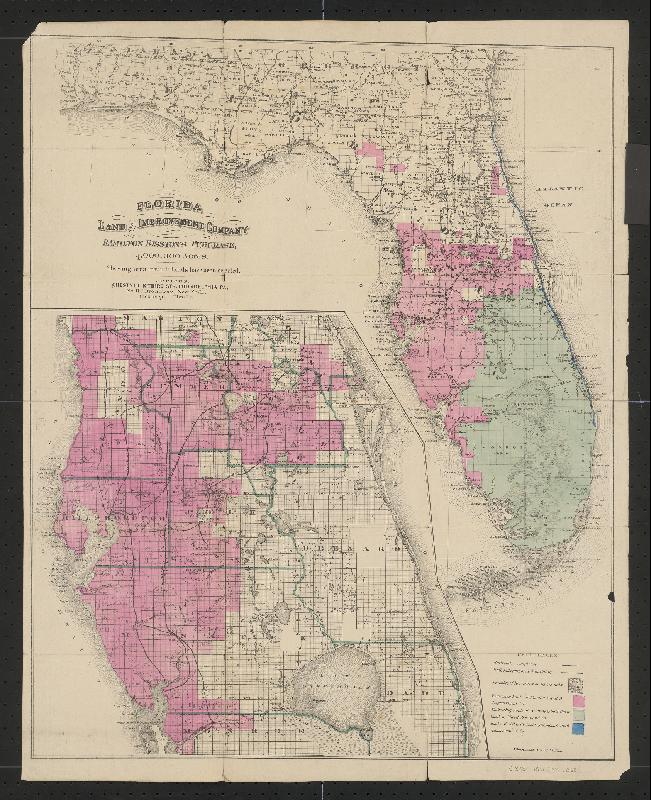
Map of Disston’s lands.
“Todd, why isn’t St Lucie Gardens in pink on the Disston map? …And wasn’t this area supposed to be farmland?”
St Lucie Gardens was a huge subdivision in the region of the St Lucie River/Indian River Lagoon including the savannas filed in 1911 by the Franklin Land Company of Jacksonville. According to my mother’s book, “the land was advertised as far away a Kansas and a few families bought land and tried to make a living farming. However land that had been pine flat woods continued to have cycles of flooding a drought and was impossible to farm profitably. The families that came to farm in St Lucie Gardens either gave up or turned to other ways to make a living.”
St Lucie Gardens…overlay by Todd Thurlow.St Lucie Gardens plat map 1910. MC Property appraiser, via Todd Thurlow.The Waters family promoting St Lucie Gardens 1910. (Photo Reginald Waters Rice) from Jensen and Eden by Sandra Henderson Thurlow.Draining the savannas around St Lucie Gardens, 1911. Franklin Land Co. (Reginald Waters Rice) Jensen and Eden, Sandra Henderson Thurlow.Page listing lands of Disston, mind you county boarders were different at this time. Martin was Brevard. (TT)
Todd and I never found our why those lands of the St Lucie River/Indian River Lagoon were not included on the 1881 Disston lands map, and the people who created it are not around to ask, but Todd did create the awesome visuals at the beginning of this post and he did find the deed of the purchase of the lands in our region. To have this document is an incredible part of our history.
Deed of Disston lands sold to Reed, 1881, page 1. (TT)Page 2. (TT)Disston bought 4,000,000 acres from the state of Florida then sold half to Reed. Some of those lands included land in the SLR/IRL region. These lands are not shown on this map. ( Public map, 1881.)
And the EAA? With all the water problems we have today, I am glad it does not include everything in pink and green on the map and that something remains of our Savannas along the Indian River Lagoon.
____________________________________
An interesting email from Todd; Thank you Todd for all the research!
Jacqui,
It was fun to go through some of the stuff on my computer tonight. I just downloaded this publication “Disston Lands of Florida”, published 1885. I attached the intro page.
Disston had the pick of ALL the public lands owned by the state. It took three years to make the selection. Perhaps the pink area had been picked as of the date of the map and St. Lucie Gardens had not yet been picked?
Or maybe the St. Lucie Gardens land is not shown in pink on the map because Disston directed that the St. Lucie Gardens property be deeded directly from TIIF to Sir Edward James Reed. The Florida Land and Improvement Company never took title.
The TIIF deed that we pulled up for Sir Edward James Reed (attached) is dated 6/1/1881. In includes a little more land (21,577 Acres) than ended up in St. Lucie Gardens (e.g. Section 1, of T36S R40E is not part of St. Lucie Gardens but is included in the deed.)
This slide was to sent to me from Jeff Kivett of the SFWMD. It shows Regional Flows “south,” for Water Year 2014-2015 or May 2014 thorough April 2015.Map south of Lake O. showing EAA, STAs, and WCAs. Everglades is south as is Florida Bay. (Map public.)
I was a teacher for many years. I taught 8th, 9th, and 11th grade English and German. Throughout my career, whether the students were 13 or 17 years old, there was nothing better for them than “getting an A.”
I don’t think in my ten-year career, I ever gave an A plus.
Until now that is…. 🙂
The South Florida Water Management District deserves an A plus for their creative, determined, and difficult work “sending water south” in a politically explosive environment. —-Probably the worst mine fields in the state…
For “WATER YEAR REGIONAL FLOWS May 2014, through April 2015” at least 585,000 acre feet of water was sent south to the Storm Water treatment Areas and into the Water Conservation Areas. This translated into 565,000 acre feet of water to starved Everglades National Park.
To appreciate this achievement one must compare:
This chart from Dr Gary Goforth shows water flow comparisons for water years 1995-2015. (Courtesy Dr Gary Goforth who worked for the SFWMD and was key in designing the STAs. 7-22-15.)
The chart above, courtesy of Dr Gary Goforth, shows acre feet of water going to STAs from 1995-2015. The highest number ever. The colors show the different STAs the water went through.
Sometimes when studying “sending water south” it gets VERY confusing as more water was sent south in 1995, but this water was sent when there were very few STAs and so Florida Bay got pounded with nitrogen and phosphorus laden Lake Okeechobee, and I would think some water from the Everglades Agricultural Area….
The Storm Water Treatment Areas clean the water…
It must be noted that some grading the system may think differently as South Florida certian water users and agriculture have been afraid we were, or are almost going into a drought or that the STA were overused. Some may say the ACOE and SFWMD district “should not have sent so much water south, but rather stored it in the lake…” Maybe they are right. Today I will not judge, but reward.
So anyway, “to repeat myself IRL students,” 🙂 THIS YEAR THE SOUTH FLORIDA WATER MANAGEMENT DISTRICT HAS SENT MORE WATER SOUTH TO THE STAs THAN EVER BEFORE.
You may recall that the Army Corp of Engineers opened the gates to the St Lucie River on January 16th 2015 and this did not stop until late May. This water charted going south this year helped alleviate our destruction. It could have been worse… If they weren’t sending it south, it may have gone to “us.”
My hope is that water management becomes the top-cool thing to do for future generations, and that many River Kidz and even more young people from all over the world and our nation, come to our state to work, learn and study water management. It is a politically explosive and difficult work environment, but nothing is more important for the people and the for wildlife of our state.
I admit that I am part of that politically explosive environment..but my heart really is with the living creatures of the Earth and its waters. May we overcome our genetically wired warlike behavior, send the water south, and save the St Lucie River/Indian River Lagoon….
Thank you South Florida Water Management District for your outstanding work! Yes there are great difficulties, but for a better water future, we are counting on you!
The next generation! (Public photo of a shore bird baby in the Everglades.)
Sometimes you just need to take a break! I will be “blog-breaking” to spend time with my husband; I will return 7-15-15.
In review, before I stop blogging, thus far 2015 has not been a particularly rewarding year for river advocates— mostly because of the state legislature’s tumultuous session, their interpretation of Amendment 1, and their refusal to consider the purchase of the US Sugar’s option lands in the Everglades Agricultural Area.
To top it off, the ACOE began releasing from Lake Okeechobee into the St Lucie River very early this year, starting January 16th and continuing until just recently–the end of May. There may be more coming this rainy season….
The ACOE and the SFWMD decided to “dump” because the lake was “too high” to be safe for the Herbert Hoover’s Dike and its surrounding farms and communities. This is “understandable,” but at great expense to our SLR/IRL economy and ecosystem.
Ironically, ample water supply is now a concern for “users,” such as agriculture, with Lake Okeechobee down to 12.20 feet and rapidly evaporating….((http://w3.saj.usace.army.mil/h2o/currentLL.shtml))You may have heard that Miami is already in a drought…on top of this, the Caloosahatchee needs some lake water right now to keep its salinities from going too high but they are not getting it…
It always seems more likely that South Florida will have a hurricane, and that Lake O could fill up quickly with 3-4 feet in one week, too much to dump fast, so the agencies prefer the lake lower during summer’s rainy season… There is that chance though—that it won’t rain, and dry conditions will parch our state as occurred in 2006/2007.
Wouldn’t that be something? After all that water being released? South Florida going into a drought? The farm fields dying? The ecosystem and its animals in danger? And people not having enough water?
It may seem an odd thought, but it is one that is not the “stuff of science fiction”— that one day, in the future, after an extended drought or a climatic shift, people could be fighting over the billions of gallons of fresh water that is wasted to the Atlantic Ocean through the C-44 basin, the St Lucie River, and Caloosahatchee during storm events…
We need to prepare for this. We must not give up our advocacy. We must keep more of this precious water on the land and going south for the Everglades.
On a positive-personal note regarding the year thus far….
You may have noticed—-
I am enjoying collaborating with my family. To have my mother’s history and most recently my brother’s “flying time capsule maps” to share is very rewarding. I have linked some of Todd time capsule flights below. They have been very popular!
My brother Todd and I on Ronnie Nelson’s dock, Martin County, FL, IRL, ca 1974. (Thurlow Family Album)
Todd is six years younger than me as you can see from the photo above. My sister, Jenny, is four years younger. Growing up, Todd and Jenny were more together, and I was kind of “old.” I was out of Martin County High School where as they attended during the same time. Now, the years seems fewer in between…. 🙂
In closing, thank you very much for reading my blog; I wish you a good couple of weeks enjoying the Indian River Region, and I’ll see you soon!
Above: Google Earth/Historic Maps Overlay Flights shared on my blog, created by my brother Todd Thurlow, (http://thurlowpa.com) These flights using Topo and other historic maps combined with today’s Google Earth images flashing between “yesterday and today” give tremendous insight into the water and land changes due to drainage for agriculture and development that have occurred in our region. JTL
Perhaps the greatest tragedy that is constantly playing out in our declining St Lucie River/Indian River Lagoon is the tremendous sediment infill covering its once white sands, seagrasses, and benthic communities. This began heavily in the 1920s with the connection of the St Lucie Canal (C-44) connecting Lake Okeechobee to the South Fork of the St Lucie River, and then increased in the 1950s and beyond with the construction of canals C-23, C-24 and C-25.
It must also be noted that the St Lucie River/SIRL underwent great changes when the St Lucie Inlet was opened permanently by local pioneers at the encouragement of Capt Henry Sewall in 1892. (Historian, Sandra Henderson Thurlow) Prior to that time, the Southern Indian River Lagoon and St Lucie River had been “fresh” —-fresh and brackish waters and their communities of plants and animals “came and went” with nature’s opening and closing of the “Gilbert’s Bar Inlet” over thousands of years….
Since 1892 the St Lucie River has been a permanent brackish water “estuary…” and until the opening of the St Lucie Canal was teeming with fish and wildlife and considered the “most bio-diverse estuary in North America.” (Gilmore 1974)
Anyway, today we have a very special guest, and one of my favorite people in the world, Dr Gary Goforth, to share with us information on 2015 sediment statistics entering the St Lucie River from C-44, our most damaging canal. (DEP 2001:(http://www.dep.state.fl.us/southeast/ecosum/ecosums/C-44%20Canal%20.pdf)
Dr Goforth recently sent out an email, and I ask him if I could share the information; he agreed. He states:
“The pollutant that has been consistently left out of discussions is the sediment load to the estuaries from Lake Okeechobee – over 2 million pounds to the St. Lucie River and Estuary in 2015 alone; almost 4 million pounds to the Caloosahatchee Estuary.” (Dr Gary Goforth)
Isn’t that awful? “We” are filling the river in….smothering it.
The slides Dr Goforth included are the following:
Flows and loads for the period January 1, 2015-May 31, 2015. (Dr Gary Goforth 2015)
Please click on image above to read the numbers. Mind boggling!
This second and complicated image below shows “flows” into the estuaries from Lake O into the St Lucie, Caloosahatchee, and to the Everglades Agricultural Area. Generally speaking, the Army Corp of Engineers in discussions with the South Florida Water Management District, began releasing into the St Lucie River January 16, 2015 until late May/early June. About 3 weeks ago.
Flows between January 1 and May 31, 2015. All flows in acre feet and subject to revision. (Dr Gary Goforth,, 2015)
Recently our river waters have looked very beautiful and blue near Sewall’s Point and the Southern Indian River Lagoon and water quality reports have been more favorable. Nonetheless the river, especially in the South Fork and wide St Lucie River, is absolutely impaired as there is not much flushing of these areas and the sediment infill is tremendous. The seagrasses around Sewall’s Point and Sailfish remain sparse and algae covered when viewed by airplane. Blue waters does not mean the estuary is not suffering!
Months ago I wrote a blog, that is linked below, focusing on south Sewall’s Point’s river bottom infill history, and depths that have gone from 19, 15, and 14 feet in 1906, to 4, 8, and 7 in 2014—and looking on the Stuart side, north of Hell’s Gate, the 1906 map shows 10, 8 and 12 feet and a 2014 NOAA map reads 2; 3; and 4 feet!
Insane….so many changes!
Our government has filled and dredged our precious river…elements of this inputting sediment become MUCK…..
I’ll end with this:
The River Kidz say it best, although my mother didn’t approve of the tone: 🙂
River Kidz “Get the Muck Out” campaign, 2014.
__________________________________________
For interest, I am going to include two more images Dr Goforth included in his email on sediment loading; please click on image to see details.
Thank you Dr Gary Goforth for sharing you expertise on the science of the St Lucie River/Indian River Lagoon, Lake Okeechobee and Everglades. Please check out Dr Goforth’s website here:((http://garygoforth.net))
Lake Releases to the South. (Dr Gary Goforth, 2015)Lake Releases to STAs (Storm Water Treatment Areas) (Dr Gary Goforth, 2015)
King Arthur is historically noted for creating the concept of a “round table.”
Yesterday, at the Wolf Technology Center, on the campus of Indian River State College, Todd Reid, the Deputy Chief of Staff and State Director for the Office of Marco Rubio oversaw a “Lake Okeechobee Roundtable.” New US Army Corp of Engineers Lt Col. Jennifer Reynolds broke the ice with her introduction, noting she was curious as to whether there would truly be a “roundtable…” She smiled saying she was happy to see the “rectangle-roundtable…” Her comments were funny and refreshing. The point was everyone was sitting around the table—“together,” like in King Arthur’s days….
Agenda, L.O. Roundtable, Office Senator Marco Rubio, 2015Agenda.
I want to thank Senator Rubio’s office and Senator Rubio himself for the meeting. Could the meeting have been politically motivated? I hope so! Political motivation in any form is the gas that drives the bus. I’ll take it and I’ll hitch a ride….
The meeting was a rare opportunity to sit face to face in a non-charged environment and to listen, to ask questions, to learn, and to get to know each other.
Other than the many Army Corp, South Florida Water Management, and Rubio official leaders that sat at the table, some regional names you might recognize who also were there are: Comr. Ed Fielding, Kate Parmalee and Don Donaldson, Martin County; Richard Gilmore, Mayor, Sebastian; Dr Jacoby, St John’s River Water Management District; Nyla Pipes; Meagan Davis, HBOI; Mark Perry; Rae Ann Wessel, Caloosahatchee; Jason Bessey, SLC and myself. Sorry if I missed anyone. There were a few some empty chairs with name tags prepared for people who did not make it. Their loss. Of course Gayle Ryan of the River Warriors was in the audience as were others! 🙂 Thank you PUBLIC!
I have written many times, that “building relationships” is what is going to get us beyond the St Lucie/Indian River Lagoon nightmare we live in today. I appreciate the opportunity to build those relationships.
I did learn a lot.
The “Roundtable…” Photo Jax ACOE Twitter 6-18-15.
One thing I learned again is that the ACOE and SFWMD don’t know how to promote the good things they do. Perhaps this is because they are “government.”
For instance Jim Jeffords, Chief of the ACOE Operations Division noted very quietly that the ACOE under the LORS (Lake Okeechobee Regulation Schedule) this water year had only released 40% of the Lake O water that COULD HAVE gone to the Caloosahatchee River; and only 24% on the water that COULD HAVE gone to the St Lucie. Holy Cow? Are you kidding me?
I don’t really get the complexities of the entire system, but basically LORS has huge ranges and it gives the ACOE flexibility so they use discretion in determining how much water is actually released rather than just opening the gates to match the number on the chart. So even though they released from Lake O into our SLR since January 16 until a few weeks ago–apparently it could have been worse. —Kind of like when you got into trouble in my day as a kid and got sent to the office and the principal only spanks you three times when he or she could have spanked you fifteen times. You still walk away crying and humiliated, but it could have been worse….We never thank the ACOE for “not releasing even more,” a lot more, because basically we don’t know that they could….they don’t tell us..they don’t brag. I do; I guess that’s why I’m a “civilian….”
LORS schedule releases SLR 2014 and some of 2015.(Photo ACOE Twitter)
And then Jeff Kivett, Divisions Director Operations, Engineering and Construction SFWMD, gave a really nice and erudite presentation with an awesome color copy packet and he just kind of goes right through what for me, if I were him, would have been the most important part: “the SFWMD has sent more than 500,000 acre feet of water south this dry season.” I get this all mixed up like “water year,” “annual year,” dry season, from Lake O, or from the sugar farmer in the EAA, —-in any case for me what’s important is they sent so much water south!
Dr Gary Goforth has written about this and if I remember correctly the most ever sent was in 1995 (like a million acre feet and it killed Biscayne Bay’s reefs) but after 2002 it really slowed to almost “nothing” due to the consent decree’s law suit on phosphorus numbers —but then after 2013’s toxic estuary disaster the SRWMD started sending more water south again. Because now that water is CLEAN due to STAs. (Storm Water Treatment Areas–they are still nervous to send “too much with too much phosphorus…”)
I know I am rambling, but two years ago I remember being happy water sent was over 250,000 acre feet and now the District has sent more than 500,000 acre feet almost two years in a row… This is awesome and to be commended. If I worked at the SFWMD I would be jumping up and down screaming from the rooftops, but government people just kind of “mention it…..”
Anyway–Good job guys and gals. Good job!
Also, there was also a presentation on the slow but steady-going, expensive repair of the Herbert Hoover Dike by Ingrid Bon, and an update by Howard Gonzales on ecosystem restoration projects. Yes the ones whose names we know by heart that have been taking eight billion years to complete but are actually getting closer! There were also hopeful updates on CEPP (Central Everglades Planning Project) and Ten Mile Creek’s recovery…again very slow-moving like molasses, but moving…maybe….yes….no maybe….YES! How old am I now? Will the projects be done before I am dead? Not funny, but sometime you wonder.
In the end, it was a great meeting and I appreciate that I was allowed to sit “at the roundtable.” It was so good to see Greg Langowski who I have known through Rubio’s office since my early days in the Treasure Coast Council of Local Governments, as well as my dear friend mayor, Richard Gilmore of Sebastian! We are all getting older, but wiser too, and if we stick together, we just might make a difference for the St Lucie River/Indian River Lagoon, and for the kids of the future that just want to fish, swim and boat in the river and just be a “kid.”
Thank you for the Roundtable Senator Rubio. I hope there will be more…
Great visual from Jeff Kivett’s presentation on changes to the Everglades system.
The 1916 cartoon says it all, doesn’t it? “You can have all these lands, if you drain and develop them….”
How does the saying go? “Be careful of what you wish for…”
We sure got what we wanted and more. We’ve gotten so much we’ve killed it, or are in the process thereof….Uncle Sam gave us a gift in the Swamp Land Act of the late 1800s and we, the State of Florida, have killed it–the Swamp that is…and even with the “retched swamp mentality” of the 1800s, no one, not even Governor Napoleon Broward himself, envisioned real estate surrounded by putrid, polluted water…
This year our state legislature did not seem to recognize the sense of urgency in Florida regarding clean water and the health of the state’s natural resource’s as reflected in their decisions made, or not made, this 2015 legislative session. Amendment 1 was all but ignored. But from north Florida’s springs, to the estuaries of the St Lucie River/Indian River Lagoon and Caloosahtchee, to Biscayne Bay the people of the state still recognize this urgency. And this urgency is not just answered by money. It can be answered by beginning to have real discussion state-wide on these issuers. Florida voters know our past and we know what we want for the future.
The will of the people will be done.
Repressed desires only get stronger….
We all know that there are many ways to help, and we must do all we can, but in the long run there is only one way to change the “big picture,” for South Florida.
There must be a third outlet south of Lake Okeechobee as discussed since the earliest days of water management…we must stop wasting 1.7 billion gallons of water to tide every day, stop creeping development into the remaining Everglades, and most important, the agriculture community in the EAA must actively become part of the land acquisition solution for reconnection of Lake Okeechobee to Everglades National Park.
Drainage canal being dredged Davie 1913.Map showing estuaries– now drainage ditches, Everglades National Park boundaries as well as Water Conservation Areas north of the park and other areas. (Map courtesy of Backroads Travels website, 2013.)West of the red lines shows the edge of what was once the Everglades in South Florida. Development has crept and continues to creep over this edge. (Photo/map courtesy of Chappy Young,/GCY Surveyors, 2014.)EAA below Lake Okeechobee. (Public map.)
“Drainage and development of south Florida has had major environmental consequences in the Everglades. Saltwater intrusion into freshwater aquifers has extended as far as 6 miles inland from the coast in some areas. The land surface has subsided as much as 6 feet in some agricultural areas because of lowered water tables, oxidation of drained peat, and subsequent peat fires.
Mercury contamination of fish has resulted in a ban on the consumption of fish from the central part of the Park, WCA-2, and WCA-3 and is implicated in the deaths of endangered Florida panthers. Populations of wading birds have decreased by almost 95 percent from 1870 to 1973. In high-nutrient areas, cattails are replacing native sawgrass.
Plant and animal communities in the Everglades have been altered by changes in timing and duration of inundation; invasion of exotic plants as a result of drainage and land clearing, nutrient, and (or) contaminant-enrichment of water that flows into Everglades from agricultural and urban areas; and loss of habitat…”
Dead panthers from eating fish full of mercury?
This is not what we will leave our children…is it?
Toxic Algae bloom washes up along the shoreline, St Lucie River, Riverside Drive, Stuart, Florida. (Photo Jenny Flaugh, 7-13)Sign with Seminole in canoe 1913, Tamiami Trail. (Public photo)Original flow Everglades. http://seawifs.gsfc.nasa.gov/jason/HTML/EXPEDITIONS_JASON_7_croc_model.html )Drainage today via canals.Sofia Everglades drainage map 2015.Our flag.
NASA aerial Lake Okeechobee, Florida, with text, JTL.
A tidal wave….always a scary thought, and usually associated with the ocean, however, tidal waves or “seiches,” can occur in enclosed bodies of water as well, such as a lake— like that of “big water,” or Lake Okeechobee.
As we have entered hurricane season and live in Florida, the most vulnerable state in the nation for strikes, it is important that all of us in the St Lucie River/Indian River Lagoon/Lake Okeechobee region know our evacuation plan should one be necessary….
A while back, I wrote about my frightening experience with a storm in the proximity of Lake Okeechobee and my friend, Dr Gary Goforth, wrote me back. Today I will share his thoughts on the subject of “tidal waves” in Lake Okeechobee.
Since “we” first walled the lake for agriculture in the 1920s, “white man” has changed the dynamics of both water and of storms….Recently, the ACOE has spent over 65 million dollars to repair the aging dike. As you know, nature evolved so Lake Okeechobee’s overflow waters would slowly flow south to the Everglades. This is no more, and her overflow waters are directed with great destruction through the Northern Estuaries…
So now about seiches…..or tidal waves…..
EAA A.K.A. Everglades Agricultural Area, below Lake Okeechobee, public image.S-308 as, the structure that allows water from Lake Okeechobee to enter the C-44 canal, SLR/IRL.(JTL, 2015)Lake Okeechobee is tremendous in size, 730 square miles. It was once closer to 1000 aware miles before it was diked for agriculture use around and south of the lake. When looking across, one cannot see across to the other side. (Photo Jacqui Thurlow-Lippisch, S. Engebretsen pilot, 2014.)
Your comments on the “tidal waves” within the Lake inspired me to chart the fluctuations in water levels in the Lake resulting from the 2004 hurricanes Frances and Jeanne…
The attached images below show two charts and a reference map.
The first chart shows the fluctuation in Lake stage as Hurricane Frances slowly moved through the area and the 2nd is a similar chart for Hurricane Jeanne. An interesting feature is that as the storm approached the Lake, strong north winds blew the water to the southern rim against the HHDike (as reflected by the rising red line: water level along the south shore) and simultaneously moved water away from the northern sections of the Dike (as reflected by the descending blue line: water level along the north shore). This phenomenon contributed to the catastrophic flooding south of the Lake in the 1926 and 1928 storms as the muck dike failed. For Hurricane Frances, the water level along the south shore rose by more than 5 ft as the eye approached!
As the eye of the storms passed over the Lake, the wind quickly changed direction and the water that was piled up along the south shore moved to the north rim of the Dike (rising blue line). For Hurricane Frances, the water level along the north shore rose by 10 ft or more when the winds shifted! For Hurricane Jeanne, which was moving faster than Frances, the water level on the north shore rose by more than 4 ft per hour – I suspect it looked like a slow-moving tidal wave coming towards the Dike!
For both storms, the water levels overtopped the stage gauges at both stations – so the fluctuations were actually greater than depicted in the charts!
For more information, you can read up on Lake seiches (http://en.wikipedia.org/wiki/Seiche) which are large waves sloshing back and forth in large bodies of water.
—Gary, Dr Goforth 4/15
Chart 1 Dr Gary Goforth, 2015.Dr 2 Gary Goforth chart, 2015.Dr Gary Goforth, 3. 2015.
Thank you Dr Goforth for an interesting lesson. Let’s all be safe and smart this hurricane season.
My niece, Evie, stands at the edge of the east side of Lake Okeechobee at Port Mayaca. (Photo Jacqui Thurlow-Lippisch 2013)
If you are a regular reader of my blog, you may know that I prefer to write a “happy-Friday” St Lucie River/Indian River Lagoon post…Sometimes though, the news of the day is too pressing, and it is more important to respond to the “question of the day.”
So here we go…
Early this morning, I get a call…
“Jacqui, did you sees the ad in the Stuart News? Who is “We”? Is the ad from the SFWMD?Did the South Florida Water Management District pay for this ad? That would be wrong!”
My husband had already placed the paper by my bedside; the ad’s headline read: WE DON”T NEED SUGAR’S LAND FOR EVERGLADES….With a foggy head, I recalled that there was a full-page ad in yesterday’s paper from US Sugar:
Ad 6-11-15 Stuart News.
Getting up, pouring a cup of coffee, and perusing the ad, I noted the right bottom corner: “Brought to you by: Western Palm Beach County Farm Bureau.”
I am familiar with Farm Bureaus as my Grandfather Henderson, a soil scientist, UF teacher, Gainesville IFAS-Extension employee, and leader of the 1952-1969 “Agronomy Project,” was an active member throughout his lifetime. There are farm bureaus throughout Florida; they are key in education, and supporting the rights of farmers. They are powerful, historical entities.
Of course, the Western Palm Beach County Farm Bureau is the largest and most powerful of all… So going to the internet on my phone, I noted who was listed on their board.
I didn’t know anybody except Ms, Judy Sanchez, from US Sugar Corporation, Clewiston. I have met Ms Sanchez. She is really nice and an excellent PR lady; US Sugar is very lucky to have her. This is her job and she does it very well. I would imagine the others listed are also “in the business” of the Everglades Agricultural Area south of Lake Okeechobee too…
Board of Directors WPBCFB 2015
So why is this ad in today’s paper with the headline WE DON’T NEED SUGAR’S LAND FOR EVERGLADES “dangerous?” Well, I think it is dangerous because to the public it could appear that the ad comes from the SFWMD as it uses information from an Op-Ed written by SFWMD Board Chair Dan O’keefe that ran in the Miami Herald but not here on the Treasure Coast. WE is next to Dan Okeefe’s head. Dan chairs the SFWMD Governing Board. The way the ad reads, it almost appears as if the ad is from the SFWMD itself. WE should be clearly referring to the West Palm Beach County Farm Bureau.
Thus mostly the reason for the early morning call….
In case you don’t know, the SFWMD is a “special taxing district.” If you look at your tax bill you will see we all pay taxes to the District. This money is not to be spent on “ads” but rather on their mission “to manage water and related resources for the benefit of the public: the key elements of the Mission are environmental protection and enhancement, water supply, flood protection and water quality protection.” (Data Directory 1999) Maybe their mission has altered since 1999 but I don’t have time to look for the 2015 version. This should be close enough…
Portion of my and Ed’s tax bill 2014 showing SFWMD assessments taken from our taxes: $150.73.
In information wars it is very important that players show no “questionable impropriety.” In my opinion, this ad does not achieve this goal.
“Be Floridian. Don’t Fertilize.” Photo adapted from “Beauty of Nature” photos sent to me by Anna Marie Wintercorn, 2015.*
The “Be Floridian” program was born over a decade ago of the Tampa Bay area. This program has many elements, but most noteworthy is that “strict” fertilizer ordinances evolved collaboratively along the counties and cities of Florida’s “southerly” east coast.
Today, Tampa Bay has more seagrass than it did in the 1940s. This is in spite of the area’s high population. Certainly, they have different issues than we, and “no Lake O,” but the goal is clear: “if they did it there; we can do it here…improve our waters.”
On Florida’s east coast, in 2010, the peninsular Town of Sewall’s Point, my community, was the first to implement in a strong fertilizer ordnance. With the 2011-2013 melt down of the Indian River Lagoon due to super-algae blooms killing approximately 60% of the northern/central lagoon’s seagrasses, and the toxic “Lost Summer” of excessive dumping from Lake Okeechobee and area canals along the St Lucie River/Indian River Lagoon, communities all along the Indian River pushed their governments to implement strong fertilizer ordinances. —Making a statement that they were “fed-up” with dead waters, and were willing themselves to put “skin in the game.”
In case you don’t know, there are variations, but basically a “strong fertilizer ordinance” is one that does not allow fertilization with phosphorus and nitrogen during the summer rainy/hurricane season.
Recently there was an article in the “Stuart News” asking the question of whether or not these strong fertilizer ordinances are “working” along the IRL. The expert on hand replied it is “too soon to tell…”
I beg to differ, and here is why.
Of course they are working.
A four-year old can tell you they are working.
Ad in Stuart News. Martin County has a strong fertilizer ordinance and is now promoting the BE FLORIDIAN program here in Martin County. Dianne Hughes and Deb Drum deserve applause for these great ads, 2015.
I use this analogy a lot when discussing Lake Okeechobee and the Everglades Agricultural Area’s 700,000 acres south of the lake blocking the natural flow of water from the northern estuaries to the Everglades.
In spite of the sugar and vegetable empires south of the lake trying to convince us that it is water from Orland and the Kissimmee River killing our St Lucie River/Indian River Lagoon, any four-year old studying the River Kidz program will point to the area directly south of the lake as biggest problem forcing the water up and out the estuaries rather than allowing it to flow south as nature intended…We need a third outlet south of the lake. There is too much water to hold it all north. End of story. I don’t need a study to tell me this. I know it. A four-year old knows it. You know it.
Back to fertilizer….last night it rained hard here in Sewall’s Point. My rain gauge says two inches. Seemed like more than that. If my yard had been fertilized of course that fertilizer would have gone into the gutter and down the drain and into the Indian River Lagoon. You can go out and watch this from my driveway.
It must be noted that until the ACOE and SFWMD (collaborating at the direction of our government) stop dumping from the lake and out over expanded canals, we will never know our “area’s” levels of phosphorus and nitrogen.
For example, the ACOE began releasing into our SLR/IRL this January and just stopped a few weeks ago, so if a scientist had done her or her study recently, they would be measuring nutrients that came into our river from “other places” too.
But we, here, are doing our part and can feel good about this…keeping our house in order will help push order in the houses of the state and federal governments that are presently quite un-orderly.
Enforcement? Let’s focus on education. As we can see. It’s working! Five years ago people weren’t even aware that fertilizer was an “issue.”
As a sidebar before I close, I recently had the pleasure of meeting Mr Woody Woodraska who headed the SFWMD in the 1980s before it was under the anvil of the governor and the state legislature. The topic of visiting Cuba arose. My husband Ed and I will be visiting Cuba this fall with our church, St Mary’s.
Mr Woodraska said: “Oh, you are going to love it..”
In the course of telling his story visiting as a competitor in the Ernest Hemingway competition, he alluded to Cuba’s long repressed economy and how this kept fertilizers, via the agriculture industry, from ruining Cuba’s waters, fish and wildlife. Thus overall, Cuba’s waters are healthy and beautiful today.
We here in Florida, on the other hand, have developed every piece of land right up to edge of every river, some with septic tanks, and torn out the native plants and replaced with plants that we must fertilize; agriculture is a corporate producer going through literately tons of fertilizer every day; canals not only to drain our land, but we build houses along them; a turf grass industry flourishes in South Florida that sells 25% of all turf-grass in the WORLD; wonderful universities, like my alma mater and family connected University of Florida, do research and watch the industry’s back to “keeping our economy rolling!”
Yeah…rolling right over our fish, and our wildlife, and over ourselves as we see our own economy suffering from dirty waters.
Whew. I need a cup of coffee.
Sorry to be so opinionated, but I just can’t stand it. Fertilizer that is. In fact I have a file on my computer called DEATH BY FERTILIZER. Here are some pictures; thanks for reading my rant, have a good day, and I will not say “happy fertilizing!” 🙂
Grass going right over edge of canal….photo DEP.Ag runoff from fields into canals DEP photo.An ad from the west coast of Florida, 2014.When it rains a lot all runoff from yards goes into the SLR/IL taking fertilizer, pesticides and herbicides with it. This kills seagrasses by supporting algae blooms Animal and fish suffer. (JTL)Ad west coast near springs.Ad on bus west coast or Gainesville.River Kidz protest Florida legislature’s trying to outlaw local governments from creating stricter fertilizer ordinances than the states. 2012. (Nic Mader)
RK artwork 2011. Save the dolphins. Fertilizer is not good for their skin, or seagrasses needed by the fish they eat.
The National Research Council’s book “Clean Coastal Waters, Understanding and Reducing the Effects of Nutrient Pollution,” National Academy’s Press, 2000, is the best book I have read on this subject. It can be ordered on line.
The most rewarding part of my St Lucie River/Indian River Lagoon journey is working with young people. Today I share a video created by Geoffrey Smith Jr., a graduating senior at the Pine School in Hobe Sound.
Many of you may have viewed this video on Facebook as it has been a big hit and already has over 500 views, but in case you are not the “Facebook type, “today, I am sharing it through my blog. The video production is part of Geoffrey’s Capstone Project for graduation.
I commend Geoffrey for his interest on the topic of water and pollution issues in Florida. His video required many hours and includes interviews those below. I especially was impressed that Geoffrey interviewed Mr. Sonny Stein, president of Stein Sugar Farms, and multi-generational farmer in the Everglades Agricultural Area. Both sides must always be represented at the table of judgment…
As you will see, Geoffrey also had a chance to interview Michael Grunwald, author of “The Swamp.”
I know my part chosen for the video is very hard on the agriculture industry…as you’ll hear later, I am doing my best to clean up my own yard…
How does the saying go?
“Shine the light, and the people will find their way….
“Thank you Geoffrey for shining the light, may we all find our way, good luck with graduation this week, and we all look forward to seeing more of your work in the future!
Nathaniel Osborn author of “Oranges and Inlets, An Environmental History of the Indian River Lagoon”Mark Perry, Executive Director of Florida OceanographicSonny Stein, long time sugar family farmerJacqui Thurlow-Lippisch, commissioner, Town of Sewall’s Point, Martin CountyMarty Baum, Indian RiverkeeperNic Mader, Dolphin Ecology ProjectMichael Grunwald, author of “The Swamp”Geoffrey Smith and I at Town Hall during interview. Geoffrey is a senior at the Pine School.Roseate Spoonbill…according to Florida Audubon, since the early 1900s, the bird population of Florida’s Everglades is down 95% due to the over-drainage of South Florida and the agriculture and development of the state.
It is human nature to “miss something once it’s gone.” This is true whether it’s the St Lucie River/Indian River Lagoon, or something else.
Such was the case for me this weekend and I tried to prepare for the “miss.” My husband’s red and white Cessna 340 is being sold. Knowing the plane would available no more, I arranged a date yesterday for videographer and River Warrior, Kenny Hinkle to fly in the plane. I had been wanting to do this for a long time, but as is so often the case, “never got a round tuit.”
Kenny and Mike Connor’s big win with their video of the toxic algae bloom at S-308 last Friday at Lake Okeechobee causing Senator Joe Negron to immediately call Army Corp of Engineers Col. Dodd, who then stopped the discharges was a big win! Thank you to all involved. Reeling from this positive occurrence, I thought I would like to help Kenny get some more footage for his “next big win.” The 340 is the perfect “vehicle” for that…
The plane provides a great “overview” flying 1500 feet or much higher, and can cover long distances quickly.
Thank you to my husband for providing this trip, this farewell…In fact thank you to my husband for all of this. If it were not for him, the river would not be documented as it is!
It was actually this plane, the Cessna 340, that took the first photo on June 28th of 2013, during the toxic Lost Summer, that inspired me to start taking photos of the river and discharges regularly. As you can see below, this photo was/is so alarming, showing the impact and damage caused to property values and the environment by the releases from area canals and by Lake Okeechobee. Lake Okeechobee always the nail in the coffin….
Cessna 340 June 28th 2013 photo showing plume from area canals and Lake Okeechobee exiting St Lucie Inlet.Hand drawn map of flight path over option land map. 2015, JTL.
So today, I am going to provide the farewell videos I took, and one other You Tube video I finally published so that if you ever want to, you can see for yourself what it looks like to fly from Stuart over the St Lucie River and C-44 canal, around the south rim of the “ocean of water” known as Lake Okeechobee, and then along the lake’s rim passing areas/cities of Pahokee, Bell Glade, and South Bay, then turning south along the New River Canal, flying through the sugarcane fields, (the Everglades Agricultural Area), until finally seeing the water conservation area/s, and Alligator Alley (even though I think I mistakenly say Tamiami Trial in the video….) and then flying back up the Miami canal to Clewiston before I stopped filming due to turbulence.
The videos are raw footage. Nothing fancy, the reality of a low plane ride. Many try to convince me to make them more professional. I like them as they are. Real. They show the view, the conversations, the thoughts, the heat, the noise, the turbulence….the miracle of being above ground!
The videos are split into 5 parts covering most of the trip and I included one other at the end that was taken in 2014 by Ed with a Go-Pro as it shows clearly the US Sugar option lands that are now being so hotly debated for Everglades restoration and purchase with Amendment 1 monies.
To use another cliché, “seeing is believing.” Yes, see, believe, and know, that we are changing our world.
Photo of pond apples in Big Cypress, a shared Flicker photo by Mac Stone, 2014.Pond apple is also known as custard apple–this is the custard apple forest as depicted by artist Julia Kelly in the River Kidz second edition workbook, 2015.
The mythical pond apple forest….Imagine, for a mile or two back from the water’s edge the trees grew, and like God’s magic sieve, their colossal roots strained the water of Lake Okeechobee before it inched its way south through the river of grass to the Everglades. Over thousands of years, the lake’s muck built up inside, around, and under, their gigantic roots, a forest grew, until one day the farmer came, the engineer came, the “white man” came, and took it all.
“We are chosen!” they said. “We are chosen to have dominion over the earth! Strip it! Cut it! Burn it! Tear it out! Expose the muck, the precious muck, and let us build an empire. Let us lift ourselves from poverty, feed ourselves, and become rich!”
Pond apple public photo.Pond apple blossom. Photo by Lisa Jefferson, Stuart, Florida, 2015.Pond apple blossom opening, photo Chuck McCartney.
And many of today’s generations have become rich from this soil.
The story of the explosion of agriculture, and the sugar industry below the great lake known as “big waters,” or “Okeechobee,” as the Seminole people called it, is a not a tale for the weak. It is the story of the nature of man, and his destruction of the environment of which he is part. It is the story of “success,” and the difficult journey of a culture to define what “success” really means.
Lawrence E. Will, in his book, “Swamp to Sugar Bowl,” writes in his cracker style in 1968:
“That part of the woods along the south shore and half way up the eastern side, was a dense forest of tropical custard apple trees. For a mile to two miles back from the water’s edge they grew, and on all the islands as well. About 33,000 acres of solid custard apple tress there were, and that’s a heap of woods.”
33,000 acres of custard apple trees destroyed. Gone. Forever.
Today, the Everglades Agricultural Area is 700,000 square miles south of the lake. It produces sugar and vegetables. The growth of the area is the reason why the overflow waters of Lake Okeechobee are directed thorough the northern estuaries killing local economies, rivers, and wildlife. Thus the story of the St Lucie River/Indian River Lagoon.
Once during a conversation with Mr Tom MacVicar, a respected engineer who works with the agricultural and sugar industry, I was told that Lake Okeechobee used to be about “30% bigger.” At the time, I wondered what he was talking about, but over the years through reading and study I have come to understand.
Let me explain. In the late 1800s when the early farmers planted their crops they would do so in winter when Lake Okeechobee’s waters had “receded back” as it was the “dry season.” This would be after the back-breaking work in some areas of tearing out the pond apple trees in order to get to the rich muck, “black gold,” that lies underneath. Over the years the edge of the southern shore of the lake was pushed back and then the “smaller” lake was entirely diked. This is one reason why the lake can’t hold its historical water level. Through Florida and Congress, the history of the South Florida Water Management District and the Army Corp of Engineers is linked to this history of pushing back the lake and building the agricultural empire, although now their mission includes environmental restoration.
Hmmm?
I think it would be fitting to replant some pond apple trees each year until one day, perhaps, we can regain part of the soul of that lake that was ripped out at the roots.
Old military map from 1846 shows the fingers of water south of Lake Okeechobee that are no longer there today as the lake is diked. This would have been one area where the pond apple grew.
EAA below Lake Okeechobee. (Public map.)Today’s black gold south of Lake Okeechobee. (Photo JTL, 2014)Photo from Swamp to Sugarland, showing pond apple with moon vines around Lake O. Lawrence E Will, 1968.Close up of small pond apple on Torry Island, by Belle Glade , by Lawrence E Will, 1968.Florida Memory Project, pond apples in a creek of the Lake Okeechobee area photo by John Kunkel Small 1869-1938.
School bus reads HAVANA OR BUST! My father’s Stuart High senior trip for Stuart High, went to Cuba in 1954. (Photo Tom Thurlow)My father’s 1954 senior class, Stuart High School, Martin County, Florida. My father is in back row, far right second from end.(Photo Tom Thurlow)The book “Swamp to Sugar Bowl” was written in 1968 by Lawrence E. Will. (Borrowed from the library of Sandra Henderson Thurlow, historian.)
It is good to learn about the history and issues of the Everglades, South Florida, and our St Lucie River/Indian River Lagoon so that one day, in spite of the difficulties we face today, we will be able to fix our problem in the future…
Perhaps the greatest reason the our former Everglades are now overflowing with sugarcane fields is due to politics between Cuba and the United States. My father graduated from Stuart High School in 1954, and believe it or not, his senior trip was to Havana! Soon after, Castro’s revolutionaries took over Cuba in 1959. And as they say the “rest is history…” as the growing sugar fields blocked the flow of water south to the Everglades, the fate of our precious St Lucie River/Indian River Lagoon seemed forever doomed. But it is not, as nothing lasts forever.
This weekend my mother handed me a book entitled “Swamp to Sugar Bowl” by historian, author, businessman, and politician, Lawrence E. Will. I read the little book with great enjoyment. Although many things have changed since the book was written in 1968, it provides great insights.
This week I will be sharing some aspects of the books. Today I will quote a few excerpts from chapter 22, “Florida’s Sugar Bowl.”
“Brother if you’re addicted to using sugar you should come here to these Everglades. Sugar and molasses bring in 110 million to these glades each year, so let’s take a quick look at this sugar bowl. Back in 1922, at Moore Haven, the first feeble attempt was made at producing sugar, but the following year in Canal Point the first successful mill began to operate.
Map showing Canal Point. (Laurence E. Will)
This company was taken over by Southern Sugar Company, now the U.S. Sugar Corporation which ground its first cain in Clewiston in 1929. Although this company owned some 100,000 acres of the best land around the lake, under the US government’s regulation, the state of Florida was permitted to produce only nine-tenths of one percent of this nation’s needs.
However when Fidel Castro took over Cuba, the Everglades reaped the benefit. For a short time our government permitted the unrestricted planing of sugar cane. Oh brother, you should have seen how cow pastures and vegetable fields were plowed up and planted! Now we have 189,500 acres of sugar cane in the Glades.” –Lawrence E Will, 1968
US Sugar and Florida Crystals map ca. showing ownership of lands, and option to buy lands for state of Florida, 2008.Stats of Sugar average in Florida, 1991, Source Hazen and Sawyer, 1993)
I am not certain how much land U.S. Sugar Corporation owns today, but the Everglades option map from 2008 and IFAS statistics from 1993 show over 450,000 acres combining US Sugar and Florida Crystals.
Sugar has been grown in the glades since the 1920s but it exploded in the glades in the 1960s and became heavily supported by the US government due mostly to political reasons.
File photo, WWII bomber, “flying over fields”. (Public photo.)
I must begin by saying that my recent blogging has been somewhat “uncomfortable” for me, as I was raised to act like a “lady,” and recently I feel more like a fighter pilot.
Politics sometimes makes “being a lady” a difficult goal, so I do apologize to anyone, such as my mother, who may be offended by my relentless “fighting” blog posts recently regarding the importance of state purchase of the 46,800 acres of option lands for sale by US Sugar Corporation.
As a warning, mom and others, today’s blog post will be more of the same, as a “type of war” has started.
—-A war of information. A war to influence our governor and legislature….a war over how to use Florida’s Amendment 1 monies….a war to save the St Lucie River/Indian River Lagoon, Caloosahatchee, Everglades, and drinking water for South Florida, or just to keep the “status-quo…”
In order to explain this, I will share what has happened over the past few days…
Option Lands Map SFWMD River of Grass, Option 1 is 46,800 acres and shown in brown. US Sugar and the state are resisting the purchase of these lands with Amd. 1 monies…(SFWMD map, 2010.)
On Wednesday, February 18th, Eric Draper, the Executive Director of Florida Audubon, (http://fl.audubon.org) was quoted in a “Sunshine State News” piece as saying (regarding the flow way south) “—it will never happen, it’s pie in the sky…”
Knowing Mr Draper and knowing that words in news articles often are twisted for effect, I wrote Audubon immediately asking about the situation. Mr Draper replied with an apologetic email and a letter he had written that day to Governor Scott in support of purchasing the option lands. See below:
In my effort to promote the idea of an EAA reservoir and distinguish that from the hard to explain Plan Six I unwittingly played into a storyline not my own. I found the story confusing and somewhat unrelated to what I was trying to say. Nevertheless, I am sure that folks are disappointed to hear me discount the flow way and that was not my word or intent. As an 30 year advocate for the Everglades and Lake Okeechobee I feel strongly about moving water south. Audubon will continue to work on getting the US Sugar land purchased for the purpose of establishing a CERP reservoir.
I apologize to both of you and to all the supporters of the idea of Plan Six and a flow way.
Eric Draper Executive Director
Audubon FLORIDA
Email from Eric Draper regarding article and quote. (2-18-15)
Eric Draper, Florida Audubon’s, letter to Governor Scott. (2-18-15.)
I believe Mr Draper did not mean for his words as they were reported. Speaking with the media is sometimes tricky business and anyone who speaks to them long enough will feel that he or she has been “misquoted.” Mr Draper’s work is one of the main reasons Amendment 1 passed in the first place, and you can see by his letter above to Governor Scott he supports buying the option lands.
OK, one bomb down…Two to go….
So then on Saturday, Feb 21st, I get an email from my Florida League of Cities colleague, Teresa Heitman, who is a councilwoman for the City of Naples. She simply forwarded me an email she had received from US Sugar Corporation. You can click on the image below to read it, but basically it says: “Send the Water South?” “Not so fast”…and gives three articles supporting why the option lands should not be purchased, why the “enviros”are nuts, and one of the articles quoted is the one quoting Eric Draper that I mentioned above!
As an aside, and as an elected official myself, I must say that I find it in poor taste that this email was sent from US Sugar Corporation directly to an elected official. Maybe Council- woman Heitman is on a “mailing list” for US Sugar, but this seems doubtful to me.
How many other elected officials were sent this email and why is US Sugar sending it out?
On the other hand, it kind of made me feel good when I saw it–like they were threatened by the grassroots river movement here along the St Lucie River/Indian River Lagoon and the Everglades in general. Kind of ironic to think that US Sugar would need to influence elected officials with direct emails; seems like they already do that with everything else they do like spending millions of dollars on lobbying politicians…….sending this “tiny” email makes them look kind of desperate….
—obviously we have more influence than we realize….
Hmmm?
Also, the thought of a “David and Goliath” fight is very appealing to me, as in that story, as we all know, David wins…
US Sugar email forwarded to me 2-22-15.US Sugar Corporation heading on email.
Below is part of the email from US Sugar, just so you can see it. I also made sure the hyperlinks worked in case you want to read the “email bombs” being sent out.
Buy the land? Send the water south? Not so fast…
Dear Teresa,
In case you missed it, please find below highlights from a few recent articles discussing the constraints, risks and concerns with purchasing the U.S. Sugar land option to create a flow-way to send water south to the Everglades:
You can access the articles in their entirety by clicking on the hyperlinked titles. 1. Officials to enviros: Buying land, moving lake water south has risks
By: Christine Stapleton, Palm Beach Post February 12, 2015
——–From an email from US Sugar Corporation sent out 2-22-15.
Two bombs down, one more to go!
OK, so tonight, Sunday, February 22nd, a friend contacted me asking: “Jacqui, did you see the commercial? The “buy the land” commercial!” I said I had not, and read the link he sent.
Commercial for Saving Florida’s Waters, purchase the US Sugar option lands. (2-22-15.)
The 60-second TV spot starts airing 2-22-15 and sponsored by the Everglades Trust (http://www.evergladestrust.org) is running on cable and broadcast stations in Tampa Bay, Orlando, Fort Myers, West Palm Beach and Tallahassee.
The scrip reads:
“Decades of uncontrolled pollution in the Everglades and Lake Okeechobee is endangering our health, killing our wildlife and threatening our drinking water.
Four years ago, the sugar industry signed a binding written contract to sell us land to clean up their pollution, and for a reservoir to protect our water.
It’s been called the most critical piece of land ever for Everglades restoration. Last November, 75% of Floridians voted YES to Amendment 1, making vital land purchases for the Everglades a part of the Florida Constitution.
Now, it’s up to the Governor to back it and the Legislature to fund it.
Call the Governor, call your legislator, and tell them to buy the land. Build the reservoir. And save Florida’s drinking water. Now, while there’s still time.
So I think that this is a war of sorts. Between US Sugar and the Everglades Trust. For most readers of my blog interested in saving the St Lucie River/Indian River Lagoon, our ideology is that of the Everglades Trust….
In closing, when you have some extra time, please write to Governor Scott below, and sign the petition above, asking to support the purchase of option lands. And feel good about the influence you are already having in the war to save the Indian River Lagoon!
Me standing in front of the Berlin Wall and “No-man’s Land” 1990. Berlin Germany. Alexander Platz in the distance. (Photo by Christian Koch.)The Berlin Wall came down on November 10th, 1989. Many believed this wall would never come down….
Yesterday, I referred to our plight of trying to influence our state legislature and governor to purchase option lands in the Everglades Agricultural Area (EAA)– in order to save the St Lucie River/Indian River Lagoon, as “breaking down a wall…”
To quote:
—–all this pushing IS having effect. I also know it may push the “powers that be” faster into what-ever-it-is that breaks this wall of historical government/agriculture “self-interest,” because water and the flood gates of the people will in time bring this wall down.”
This got me thinking about another wall I have seen come down in my lifetime, and why I remain optimistic in about our journey. If you were alive 1989, you “saw” the Berlin Wall come down in Germany. Many believed this wall of communism would “never come down,” but it did. I was in Germany just months after the wall actually broke open on November 10, 1989 and lived there teaching for two years. I think this is one reason I believe we can achieve our goals. Stranger things have happened…
I think President Reagan’s said it best in his speech. His words remain an inspiration to us today.
“THIS WALL WILL FALL. BELIEFS BECOME REALITY.”
YES…THIS WALL WILL FALL. FOR IT CANNOT WITHSTAND FAITH. IT CANNOT WITHSTAND TRUTH. THE WALL CANNOT WITHSTAND FREEDOM.——Ronald Reagan, 1987
Words of Ronal Reagan from his historic speech.
The EAA is a wall of sorts. A symbolic wall. It is time to break down this wall. I have faith we will do just that…..and really, we already are!
Berlin Wall, as it looked in Germany prior to 1990.(Public image)This image shows a figuarative “wall” surrounding the EAA. (Captiva Conservation 2005.)South Florida’s southern Everglades, 1950 vs. 2003. A wall has been created separating Lake Okeechobee from the Everglades at the expense of the estuaries.(Map courtesy of SFWMD.)Berlin Wall 1990. (Photo public domain.)Maggy Hurchalla…and other River Warriors on the steps of the state capitol trying to break down a wall. (Photo JTL, 2-18-15.)Berlin Wall, 1990. (JTL)Bernauer Strausse, Berlin Wall in background. (JTL 1990.)Wall with “East Germany” feet away…(JTL 1990.)In front of the wall….1990. (Photo Christinan Koch.)Crane taking down the Berlin Wall near Brandenburg Gate 1990. (Public photo.)Wall surrounding stadium. (JTL )
Katy Lewey and her daughter Hannah of St Lucie River Kidz lead the way at the “Clean Water/Amendment 1 Rally,” Tallahassee, Florida 2015. (Photo Jacqui Thurlow-Lippisch.)
Question posed to River Kid: “So do you think you’ll become a politician?”
“Ummm..no…but I think I’ll be a better public speaker….:)”
This blog post is a follow-up to yesterday’s: “Tallahassee or Bust! River Kidz and the Clean Water Rally, Tallahassee, 2015.”
Yesterday, River Mom, Nic Mader, dropped off Naia, Olivia, Keile and I in front of the state capitol building for the Clean Water/Amendment 1 Rally…The sounds of speakers and music filled the air; the bright colors and black skeletons of Janeen Mason’s Solidarity Fish project could be seen in the distance….(http://www.solidarityarts.com); various members of the RIVER WARRIORS, and others, came up to say “hello;” it was a cool, bright, sunny day and a sense of history exuded from every giant oak tree draped with spanish moss….
“Girls stop.” I said.
Naia, 14, Olivia, 13, and Keile, 10 turned around and looked at me inquisitively.
“River Kidz, I want you to look around you for a minute. I want to share something with you that you may not think too much about… “THIS is part of the First Amendment, of the United States of America: “the right of the people to peaceably assemble, and to petition their government”…not all countries of the world allow this. My friend Aletha Jones teaching in China in 1989 when their government brought tanks into Tiananmen Square opening fire. Our country and our form of government, have many failures…but our “right to assemble” is key to what is “good” in our democracy….Participate today and know, you too, are a part of this great history of our country ….”
The girls nodded their heads in partial understanding, used to my occasional rants, and we walked to the steps of the Florida capitol to be a part of the “Clean Water and Amendment 1 Rally” for the State of Florida’s historic 75% passage of the “Water and Land Conservation Initiative, Amendment 1, 2014.” (http://ballotpedia.org/Florida_Water_and_Land_Conservation_Initiative,_Amendment_1_%282014%29)
The rally was a message to the governor and the legislature to spend those monies as is intended within the language of the bill. For those of us coming from the St Lucie River/Indian River Lagoon Region, this means spending some of this money to purchase option lands south of Lake Okeechobee to store, clean and convey water south to the Everglades, in time, saving the dying estuaries of St Lucie/IRL and Caloosahatchee rivers.
Springs sign-Katy Lewey overseeing the SL and Martin River Kidz.
Before the capitol and on its stairs, were people from all over the state; we even saw Dr Bob Knight, a legend in the springs movement. Most of Florida’s springs have been equally deviated by poor “water” decisions by state, federal and local governments.
It was a whirlwind of a day. The River Kidz were able speak at the rally; write short speeches, and to present them before Representative Larry Lee, Senator Joe Negron, and then, again, at the Senate Natural Resources Committee. They passed out their new River Kidz Second Edition Workbook, “Marty the Manatee” inspired by Mr Marty Baum, the Treasure Coast Indian Riverkeeper.
It was a good day.
Did we feel “warm and fuzzy feedback” regarding our request for option land purchase in the Everglades Agriculture Area (EAA) south of Lake Okeechobee?
“No.”
Did I hear such things as “Steve Crisafulli, the House Speaker may want to be the Commissioner of Agriculture, and Adam Putnam does want to be governor.”….”agriculture/sugar does not want to sell the land now”—“and believe you me they are 20 years ahead the rest of you investing millions, if not billions of dollars, on a state and national level—–to influence politicians”…..”but its not all doom and gloom—things are moving”—–“and the subsiding EAA lands”—-“oh yes, and the future of Cuba,” “you never know—- maybe”…..”it’s changing so fast…”the advocacy along the Treasure Coast is noticed and making a difference…”
YES. I did hear such things….
🙂 (I will never reveal my sources but I can tell you I have good ones and spoke to many people…..)
Did we, the River Kidz: did I Jacqui Thurlow-Lippisch, and River Mom , Nichole Mader find “this” discouraging?
“Yes, and No.”
Yes, because coming up against any wall is never fun when one is looking to go forward…
Nonetheless, I also know, and have been told, all this pushing IS having effect. I also know it may push the “powers that be” faster into what-ever-it-is that breaks this wall of historical government/agriculture “self-interest,” because water and the flood gates of the people will in time bring it down.
Of that I am certain.
Thank you River Kidz! Thank you all! For securing a better water future!
Maggy Hurchalla…Mark Perry before the Senate Natural Resources Committee.Cris Costello, Sierra Club.Kidz with aide in Senator Simmon’s Office, delivering their workbook.Senator Dean’s office, chair of the Nat’l Resources Senate Committee.Former Attorney General, and House of Representatives, Bill McCollum and others in background during Senate meeting.Senator Negron’s office.Representative Lee’s office.Senate schedule.Olivia Siegle’s speech.Keile Mader’s speech.Naia Mader’s speech.River Kidz before the capitol building.
Historic photo, ca. 1850s, Martin County, courtesy of Sandra Henderson Thurlow, Thurlow Archives.)
I come from a historic agricultural background, on both sides of my family, so I feel like I can criticize it.
My Thurlow great-great grandparents grew thistles in New York, and my Henderson great-grandparents, from a long farming line, settled in Madison, Florida. My grandfather, Russell Henderson, was a well-respected soli-scientist and taught in the Agriculture Department at the University of Florida, even getting a mural painted including him by citrus legend, Ben Hill Griffen…
I ate boiled peanuts while learning about different crops and cows during my summer vacations as a kid while visiting Gainesville. I understand the connection and importance of agriculture to the success of both my family and to our country.
Florida’s Gov Broward for which Broward County is named, led in leadership to “drain the Everglades,” for agriculture and development. (Public photo.)
Nonetheless, as a product of the Florida Indian River Lagoon region since 1965, I have chosen to focus my energies on “natural preservation.” This is often at odds with agriculture and development’s values.
Again, I respect agriculture; it feeds us….
I just think some aspects of the industry have gone “too far,” and are too coddled by our state, especially regarding the pollution and water resources destruction caused by their now “agribusiness giant-ness.”
Nonetheless, agriculture has a stronghold on our state government beyond comprehension, beyond tourism, or “quality of life or quality for tourists.” Agriculture/sugar brags that agriculture “feeds the world,” not just the state. I guess this is good, but why should my state and local area be “raped and polluted” to feed the world?
Money…
Power…
Greed…
History…
No where is this more evident than the in Everglades Agricultural Area where the sugar industry “reigns king.” As of late, the sugar industry is not supporting the purchase of option lands that are FOR SALE. They have been able to convince the governor, and so far the state legislature, that is it unwise to purchase these option lands to start creating an EAA reservoir to store, clean and convey more water south to the Everglades to begin the journey of saving the Everglades as well as the St Lucie River/Indian River Lagoon and also the Caloosahatchee River. These estuaries and the people and businesses that live along them sufferer from the 1920 redirection of Lake Okeechobee’s waters east and west for the creation of the Everglades Agricultural Area or EAA.
Option Lands Map SFWMD River of Grass, Option 1 is 46,800 acres and shown in brown. (SFWMD map, 2010.)
Honestly, I am not sure why sugar is so against this land purchase. Their land is for sale! Is because they are making money now and not going broke as they were in 2008 when the option lands deal was legally arranged? Or they do just want to hold out for more money on those lands in the future? In any case, they are doing everything they can NOT to allow the option land purchase to occur as part of the 2015 legislatures’ ability to use Amendment 1 monies while the “environmentalist” community begs….and lake O is getting higher every day.
We all know that the sugar industry gives millions of dollars a years to government officials to secure their interests. This is important, but it is not most important.
What is important for all of us to realize is that the influence of the sugar industry and agriculture in general is much deeper than money. It is blood. And this why our fight for the St Lucie River/Indian River Lagoon requires new blood. A revolution of sorts. Don’t get scared by these words. Nothing is more “American.”
Let’s study the history of sugar and the state of Florida’s pact:
In a 1911 Washington DC publication, of the 62nd Congress, document no. 89, entitled:
“Everglades of Florida.” —-Acts, Reports, and other Papers, State and National, Relating to the Everglades of the State of Florida and Their Reclamation,”
—we see that even in is the first documents of the publication produced in 1845, the year of Florida’s statehood, there was a resolution “recommending the adoption of measures for reclaiming the Everglade land in that state.” (By 1847 in a letter from Washington DC’s Honorable James D Westcott, Jr. to the Secretary of the Treasury and shared with the Florida legislature….)
It reads in response to the idea of draining the lands south of Lake Okeechobee…
“What would be the value of the now subaqueous lands, reclaimed by such work, I will not pretend to say….all of those (military men) who have resided in this vicinity, and who have repeatedly informed my that many of these lands would be the best sugar and richest lands in the United States.”
This publication reprinted as SOUTH FLORIDA IN PERIL, can be purchased at Florida Classic Library in Hobe Sound. (http://www.floridaclassicslibrary.com) It documents the early days of the 130 year tie between the federal, and state government as they all organized together with the agriculture industry to create the state of Florida, a sugar haven, that reached its true peak in the 1960 and 1970, with the exclusion of Cuba’s goods…
Here we are today, almost fifty years later and Cuba is perhaps reopening…and our state water issues in south Florida are out of control.
Today’s agriculture UF IFAS sites to help with research for agriculture improvement. Note sugarcane research center in EAA.(Source, UF/IFAS.)
Anyway, the book goes on for 203 pages documenting the state and federal governments’ support for agriculture in the Everglades and “how rich they would all become…”
That they were successful, I am happy; however; they OVER DID it, over-drained it, and refuse to see their own destruction, and their unfair advantage.
Blood is thicker than water….but “blood can’t be blood” without water…time for a change.
Stats of Sugar in Florida, 1991, Source Hazen and Sawyer, 1993.)
“Florida’s major field crop is sugarcane (mostly grown near Lake Okeechobee), which enjoyed a sizable production increase in the 1960s and 1970s, following the cutoff of imports from Cuba.” (http://www.city-data.com/states/Florida-Agriculture.html)
Satellite image of south Florida. From top to bottom, one can see the Kissimmee chain of lakes, Kissimmee River/canal; Lake Okeechobee; the Everglades Agricultural Area (in red) ; the Water Conservation areas below that; and finally Everglades National Park and Florida Bay. (Public photo NASA, 1980.(http://www.nasa.gov/vision/earth/environment/wetland_freeze.html)
The number one thing I learned as a teacher was that I had to do my best, at all times, and with all students, to be “fair.” This required calling students out when they did something inappropriate, as well as praising them when they did something great.
Two days ago, our friend, Dr Gary Goforth, (http://garygoforth.net),”architect of the STAs,” reported that so far, the SFWMD has sent more water south from Lake Okeechobee, through the Storm Water Treatment Areas, (STAs) than even in 2014, which itself was a “record year.”
This will help save the St Lucie River/Indian River Lagoon….
You may recall prior to 2014, comparatively “little” water had been “sent south,” for a long, long time…meaning more of it went into our estuaries.
Let’s learn:
Below, are summary notes from Dr Goforth that I have edited for simplicity of communication:
Attached is a snapshot of the current flows into and out of Lake Okeechobee for WATER YEARS 2015 (May 1 – January 2015).
Current flows into and out of Lake Okeechobee for Water Year 2015 (May 1 – January 2015). (Chart, Dr Gary Goforth.)
Highlights:
Water years chart showing Lake O water sent to STAs 1995-2105. (Chart Dr Gary Goforth, 2015.)
The District continues to send large volumes of Lake water to the STAs and WCAs: over 416,000 acre feet (136 billion gallons)! which coincidently is the volume of the Lake releases made to the St. Lucie River/Estuary in 2013. During the 3 months of the current dry season (November-January) they have sent over 207,000 AF to the STAs. They are on pace to greatly exceed my target of 250,000 acre feet during the dry season! And they said it couldn’t be done. On a side note – STA performance continues to improve in association with the additional flows.
“Water Year” 2015 now is in the record books for the most Lake water ever sent to the STAs
Also, “Water Year 2015” now is in the record books for the most Lake water ever sent to the Everglades since 1994.
The obvious bad news is that Lake discharges continue to the St. Lucie River/Estuary – at a rate that has practically no effect on reducing the stage of lake Okeechobee (less than 0.1 of an inch per day – less than evaporation).
*Jacqui-please feel free to share this information, with the caveat: “Estimates are preliminary and subject to revision.”
Thank you Dr Goforth for sharing the above good news and kudos to the SFWMD!
___________________
Now as a side bar—I don’t want to confuse anybody, but I do want to share, in case you have noticed too, that sometimes these charts are reported in WATER YEARS and sometimes in ANNUAL YEARS.
For instance, the chart below that I shared in a blog reporting 2014 flows last year shows the report in CALENDAR YEARS. Dr Goforth’s chart above is in WATER YEARS and that is why 2014 in his above chart does not look as high as one would expect it to–as 2014 was also a “record year,” (above 250,000 acre feet sent south.)
Water Sent South report Dr Goforth, 2014 in ANNUAL YEARS. This shows 2014’s water south above 250,000 acre feet reported in CALENDAR YEARS whereas the chart above shows in WATER YEARS.
So what’s the difference? A WATER YEAR is May through April over a two-year period; whereas a CALENDAR YEAR is just that, a calendar year….
I guess the scientists people usually use WATER YEARS…
But sometimes it gets reported in CALENDAR YEARS. Sometimes they don’t specify….Ag!
So anyway, it can be is confusing interpreting these charts. I wanted to make sure that everybody knew both: that in 2014 the SFWMD district sent over 270,000 acre feet south; and in 2015 they have already sent 416,000 acres south! Two great record years after the public outcry following the “lost summer” of 2013.
Although all this water going south is fantastic news, it must be noted as Dr Goforth did, that this is not enough water to “save” the St Lucie River/Indian River Lagoon. This is why the river movement is advocating for the state legislature to purchase option lands south of Lake Okeechobee in order to create an eventual reservoir to store, clean, and convey –closer to the 150,000 acre feet that is necessary to go south so as not to destroy the estuaries…..
But today we focusing on praising good work….
Thank you to all of the hard-working members of the SFWMD who try to balance politics with science, a very difficult classroom! We recognize your good work; we commend you, we thank you. Please keep raising that bar!
Today, I am going to try to simplify and share the idea of an “EAA reservoir.” You probably have been hearing a lot about this, but you may not know how it fits into a an option lands purchase and the “sending more water south” concept that will help save the St Lucie River/Indian River Lagoon, and the Everglades.
This is not fully understood by me either, so I contacted Dr Thomas Van Lent of the Everglades Foundation; he sent me some information that today will share with you.
For me all of this is part of a “flow way concept,” though some may disagree.
Dr Tom Van Lent, Everglades Foundation, (EF). (Photo 2015.)
LAND PURCHASE: In order to do anything that will actually take a significant amount of water off of Lake Okeechobee, so the ACOE doesn’t have to discharge to the SLR/IRL and Caloosahatchee, there needs to be land to “store, clean and convey that water south.”
Because over the past 95 years, the EAA took up all the southerly land to create their Everglades Agricultural Area, 700,000 acres of land south of Lake Okeechobee, we are “forced” to purchase lands in the EAA to move any water south. Thankfully, land is for sale; although US Sugar rather not sell it. (Long drama….let’s just leave it at that–the land is for sale; I believe the state should buy it with Amendment 1 monies and /or “bond it.”) This Option 1, the brown lands below, runs out in October of 2015.
Option Lands Map SFWMD River of Grass, Option 1 is 46,800 acres and shown in brown. (SFWMD map, 2010)
So after getting the land purchase necessity out-of-the-way, let’s look at Dr Van Lent’s write-up and slides:
Jacqui, I’ve attached a graphic that I hope will help explain.
I think everyone can agree that the best solution to the estuaries’ problems is to send more water south. But the major limitation to doing that today is (1) the water is polluted and would irreparably damage the Everglades and (2) the dams in the Everglades prevent you from getting the water out, so adding more water would drown tree islands and other habitats. So, the bottleneck to flow is actually further south, in the Everglades, and not in the EAA.
The solution is to clean the water and then remove the dams. But if you just pull out the dams so water flows when it’s wet, then the Everglades will dry up and burn when it’s dry. So an essential step to pulling out the dams is to add water supply reservoir so that you can keep the Everglades wet during droughts.
The Central Everglades Plan started to open up the dams in the Everglades, but was limited because it did not build any storage. With storage, you can open up the Everglades even more, sending more water south.—–Dr Van Lent
—-I have to say I don’t know much about the dams in the Everglades, but that’s OK, let’s move on….
Slide 1. (EF, 2015.)
(Refer to above slide.) Discharges to the Everglades are limited because the STA’s (Storm Water Treatment Areas) (1.) are too small and cannot clean enough water. Also, dams in the Everglades (2) limit the flow through the Everglades. This leaves the St Lucie/S IRL and Caloosahatchee (3) as the primary outlets for Lake Okeechobee.
Slide 2. (EF, 2015.)
(Refer to above slide.) The “*Restoration Strategies” expansions to STAs (1) and water quality features in *CEPP (2) expanded the ability to treat Lake water going to the Everglades. Moreover, CEPP and Tamiami Trail (3) bridging opened up the Everglades to take more flow, improving conditions in the national park and Florida Bay. The means that significantly less water could be discharged to the St Lucie and Caloosahatchee estuaries (4). The EAA Reservoir (5) supplies water during dry periods so the Everglades remains set seven when the dams are removed. That is why a reservoir is critical to sending water south; it allows the dams in the Everglades to be breached.
Thank you Dr Van Lent!
__________________________________________
In case you are wondering, I have added the following below, to explain Dr Van Lent’s slide explanation.
*Restoration Strategies is basically making the STAs larger due to a long going law suit of the federal government against Florida that was finalized in the past few years under Gov, Scott. The lawsuit occurred because of the dirty water from Lake O polluting the Everglades: This IS happening and the state has to pay for it, 880 million.(http://www.sfwmd.gov/portal/page/portal/xrepository/sfwmd_repository_pdf/rs_waterquality_plan_042712_final.pdf)
*CEPP the Central Everglades Planning Project of part of CERP (the Central Everglades Restoration Project.)(http://www.saj.usace.army.mil/Portals/44/docs/FactSheets/CEPP_FS_September2013_508.pdf) This is a project that was “fast tracked,” by the ACOE and SFWMD. Congressman Patrick Murphy helped a lot with this. It was not taken on as part of WRDA the Water Resources Development Act that funds projects so it is still on the burner really and will have to be approved the next time a WRDA bill is passed by the US Congress. So right now it is NOT happening but hopefully will in the future…
In closing, I hope these slides, and the explanation from Dr Van Lent helped you in your journey of understand all this. I believe all these things are part of a greater whole. I am very appreciative to Dr Van Lent for sending the slides. What an honor to correspond with him.
When one looks at such, one certainly realizes we are planning for a far off future…and nothing is guaranteed. This can be discouraging, but don’t let it be!
It is our responsibility to the children of the future.
Please write a short email to the Florida Senate in support of purchasing Option Lands this 2015 Legislative Session: (http://www.flsenate.gov/media/topics/wlc) Thank you!
Burning sugarcane fields in the Everglades Agricultural Area near Palm Beach County. This area south of Lake O used to be the Everglades and today is the EAA. This area is a constraint to moving water south. (Photo Jacqui Thurlow-Lippisch, 2014.)
The St Lucie and the Caloosahatechee estuaries are part of the Everglades as was the Everglades Agricultural Area….
A sugar refinery in the Everglades Agricultural Area, (EAA). Refineries are a constraint to moving water south. (Public photo.)Black Gold; the muck soils south of Lake Okeechobee that make the sugar industry wealthy. These soils are a constraint to moving water south. (Photo JTL, 2014.)Refinery near Clewiston– a historical town built of the sugar industry located south of Lake Okeechobee. This city and others are a constraint to moving water south but could benefit from ecotourism economy along with agricultulre. (Photo JTL, 2014.)
Gail M. Hollender, begins her book, “Raising Cane in the ‘Glades, The Global Sugar Trade and the Transformation of Florida,” by stating in Chapter 1:
“…at a point in time usually unspecified, the Everglades made the transition from “worthless swamp” to “cherished wetland.”
Nothing has affected to flow of water south to the Everglades more than the creation of the EAA south of Lake O. The EAA is a constraint. (Map SFWMD.)This satellite photo shows water on lands in 2005. One can see the lands in the EAA are devoid of water. This water has been pumped off the lands into the Water Conservation Areas, sometimes back pumped into the lake, and also stored in other canals. Nonetheless, there are ways to move more water south through these canals and by creating a reservoir to store, clean and convey water south (Captiva Conservation 2005.)Option Lands Map SFWMD River of Grass, Option 1 is 46,800 acres and shown in brown. Option lands could be purchased to help move water south of the lake to the Everglades. (SFWMD map, 2010)
In the 1970s there was a “cultural shift” regarding the importance of “environmental protection.” America recognized the destruction it has promoted in building the country, especially in terms of agriculture and development.
“Cultural shifts” are powerful, and drive the evolution of our world. I believe the “Everglades shift” will eventually drive the restoration of the Everglades as well as the St Lucie River/Indian River Lagoon. It is what the people want…often the broad knowledge of history becomes an enemy to itself. So is it with sugar and the Everglades Agricultural Area. Just look at the photos above.
Nonetheless, sometime the “powers that be,” and their most important stake holders prefer to concentrate on why history should remain as it is, and has been, even if destructive, focusing on “constraints” rather than “possibilities” of the system.
This happened this past Thursday.
I was unable to attend the South Florida Water Management District’s (SFWMD) Water Resources Advisory Commission, (WRAC), (http://www.sfwmd.gov/portal/page/portal/xweb%20about%20us/wrac) because I had a board commitment to attend FAU/Harbor Branch’s Indian River Lagoon Symposium.
I was somewhat taken aback when I returned from a long day at the symposium, looked at my computer, and saw an email from the SFWMD addressed to me, and all members of the WRAC entitled:
“System Constraints Follow-up Details – January and February WRAC”–“…a follow-up to your request to provide specific details associated with the constraints to moving water south through the system– with a professionally created 19 slide power point presentation.
“My request?”
NOT.
Slide 1 of the SFWMD power point presentation “Constraints to Sending Water South,” 2015.
Let me explain..
At the January WRAC meeting, (http://www.sfwmd.gov/portal/page/portal/xweb%20about%20us/gb%20application) I sat in as an alternate for Mr Joe Capra, and in the course of that meeting, a few members of the agriculture industry, as well as a couple of others who often support the agriculture industry, I will not state names but they are important, big players. I like and respect these people, but still— I must call them on this.
They asked the SFWMD to create a presentation showing the “constraints” for sending water south so that people would understand (why it can’t be done…) In other words, why those people along the estuaries should “shut-up.” Why we should preserve a destructive history.
I got my nerve up saying: “Where I come from, we don’t want to talk about constraints; we want to talk about possibilities; we want to talk about change….” implying the District should “show that too.”
Upon seeing the email, I realized the SFWMD did not honor my request, but did show the “constraints” asked to be shown by the agriculture industry. Oh well…usually when government suppresses people, their motivation actually increases.
So is it with me, and I imagine it is so with you…
Dear, SFWMD district, please remember: your core mission is to “manage and protect the water resources of the region by balancing and improving water quality, flood control, natural systems, and water supply.” I don’t see anywhere in here where it says we must keep things the same and focus on constraints.
Sugar Cane historic postcard, ca. 1906 glorifying and “romanticizing”the sugar industry. (Thurlow Collection.)Cartoon postcard showing a modern-day perspective–the cultural shift apparent–mocking the sugar industry and its effects on environmental protection of the SLR/IRL/Everglades. (Public, D. Goldstein, 2014.)
INSPIRATIONAL QUOTE:
“It is time we stopped viewing our environment through prisms of profit, politics, geography, or local and personal pride. It is time for us to work together—to accept the truth about our problems in south Florida, and to set about solving them. It is time for us to do all of these things—because you know as well as I that the alternative will be disastrous to our economy as well as to our environment.”
——Florida Gov. Rubin Askew, (served 1971-1979) Rubin included, by law, the mission of Florida’s water districts to envelop “environmental protection.”
National Geographic’s February 2015 issue has an article entitled “Treading Water,” which discusses among other things, sea level rise and the future loss/threat to sugarcane and oranges south and around Lake Okeechobee in Florida. (NG, photo of page 119.)
My husband Ed was out of town on Friday, so I thought I would get some reading done on something other than the St Lucie River/Indian River Lagoon. That evening, with the dogs at my feet, I began reading the February issue of National Geographic magazine, a publication my parents filled our family home with, and I have kept subscribing to as a window to the outside wonders of our world.
After reading articles on the terrible trauma of “blast force” to US soldiers that served in Iraq and Afghanistan; Hawaiian identity and the sea; and the amazing microscopic revelations of mites; —–at the very end of the magazine, there was an article entitled: TREADING WATER about climate change, seal level rise, and South Florida.
The article focused quite a bit on a Dutch company that sees “profit rather than loss” in floating houses in trendy Miami, but also mentioned a few things that had little silver lining such as an insert on page 112, entitled, “Home on the Water.” This insert briefly noted the 2,100 miles of canals, (that we are all so familiar with), that have been built over the past century to drain the Everglades and empty the state’s water mostly into the Atlantic Ocean. (FOS, 1.7 billion gallon a day on average….)
According to the article, if there is two feet of sea level rise, conservatively predicted by 2060, the gates draining the lands around lake Okeechobee and the Everglades, “will no longer work…”
I’ll be 95 in 2060….hope I can get out of the nursing home to see….
National Geographic page 112. “Given two feet of sea level rise, more than 80 % of the gates will no longer work.”
The article also notes “two key” very threatened and very profitable agricultural industries: sugarcane and oranges.
National Geographic magazine’s February 2015 issue article “Treading Water,” shows locations of sugarcane in the Everglades Agricultural Area, and orange groves both north and south Lake Okeechobee. (NG, photo of page 119.)
Food for thought….
Sea level rise is a factor I deal with as a commissioner in the Town of Sewall’s Point and have been exposed to through the Florida League of Cities. The sea has risen before and it is rising again. Too bad humanity is speeding things up, but we are…
After listening to many state agencies and scientists speak on the issue, I personally do not believe Florida will be abandoned or”sink.” I think it will rise in new form, adapting to change as humanity has done for thousands if not millions of years.
Nonetheless, if I owned sugar groves in the Everglades Agriculture Area, I’d have an exit strategy; if I worked for the Army Corp of Engineers, or South Florida Water Management District, I would reexamine the plumbing; and if I were Florida’s governor, or legislature, I would be talking to scientists about the advantage of fresh water on the land south of lake, pushing back salt water coming up from below and providing drinking water in the future to all those people living on floating houses in Miami…
So much for reading about the “rest of the world”…our St Lucie River/Indian River Lagoon/ Everglades issues are inescapable!
Town of Sewall’s Point: (http://sewallspoint.org )—FEMA houses being lifted, flood map changes are just a few of the things the town is dealing with in regard to sea level rise.
Sunrise along the Indian River Lagoon. Photograph by John Whiticar, 2015.
“Sunrise, sunset, sunrise, sunset,
Swiftly fly the years,
One season following another,
Laden with happiness and tears…”
1st verse, of song from musical “Fiddler on the Roof,” 1964
The beautiful sunset and sunrise photos of our area’s photographers invoke a deep appreciation of our St Lucie River/Indian River Lagoon, as well as the struggles and successes of our lives.
Sunsets and sunrises seems intrinsically linked to inspiration and reflection in all of us.
Thankfully, here in the Indian River Lagoon region, we can still see our sunrises and sunsets, although the health of our river, and thus our ability to enjoy the river, is “impaired.” This was scientifically determined by the Florida Department of Environmental Protection (FDEP) in 2000. (http://www.dep.state.fl.us/southeast/ecosum/ecosums/SLE_Impairment_Narrative_ver_3.7.pdf)
In Beijing, China, last year, the government erected a televised screen showing sunsets, as the people could not see their sunsets any longer— due to the tremendous smog in their city. What a price to pay for economic “success.”
China starts “televising” the sunset in Beijing, as the city is continually blanketed in smog, 2014. (Source earthfirstjournal.org.)
Oddly enough, on some level, we have experienced the same thing. On a level of world comparison, we have a “thriving economy;” however, somehow, over the past 100 years, we have “lost our river.” Yet in most of the adds one sees, the river still looks beautiful and healthy.
Right now, the Army Corp of Engineers (ACOE) is discharging water from Lake Okeechobee, while the South Florida Water Management District canals C-44, C-24, C-23, and C-25 are also dumping polluted water into our estuary. All of this extra water has been “engineered” to come here so agriculture and development can thrive. Us included…
Sunset, St Lucie River, 2014. Todd Thurlow.
So, right now there is “no other way,” and the ACOE and South Florida Water Management District are locked in a cycle of struggle to send more water south when the entire southern area south of Lake Okeechobee is blocked by the Everglades Agricultural Area— other than a few canals, to “send water south.” Plus the water is too dirty for the Everglades—but not for the St Lucie River/Indian River Lagoon that is already “impaired.”
The “mighty” Kissimmee too has been “engineered for the success of farming and ranches and development in its former watershed. It is being partially restored by the SFWMD; this is wonderful, a testament of the ability of the system to recover if given a chance….
And after all, it’s not so bad here right? We can still see the sun…..AGGGGG!
Let’s continue to turn this ship; let’s continue to fix our own yards, towns, cities, and counties; let’s keep pushing the State for a reservoir/flow way to store, clean and convey water south. As Eric Eichenberg, CEO of the Everglades Foundation said yesterday at the Rivers Coalition meeting, this is the “only way” as the Kissimmee River’s continued restoration is simply not enough to hold all the water.
“Sunrise, sunset….sunrise, sunset….”we are thankful and we are inspired….
The first verse of the River Kidz’ Song, written by River Mom, Nicole Mader, and the River Kidz goes:
“The River Kidz are here; Our mission’s quite clear; We love our river and ALL its critters; Let’s hold it all dear…”
The rest of this wonderful song can be found on page 36 of the new workbook below.
After over a year of creative preparation, and community collaboration, the River Kidz’ 2nd Edition Workbook is here!
After long contemplation this morning, I decided to share the entire booklet in my blog; but as WordPress, does not accept PDF files, I have photographed the entire 39 pages! So, not all pages are perfectly readable, but you can get the idea.
The really cool thing about this workbook is that it was written “by kids for kids,” (Jensen Beach High School students for elementary students). The high school students named the main character of the book after Marty Baum, our Indian Riverkeeper. The students had met Mr Baum in their classroom (of Mrs Crystal Lucas) along with other presenters and field trip guides like the Army Corp of Engineers, South Florida Water Management District, and politicians speaking on the subject…
The books will be going into all second grade public school classrooms and many private school classrooms beginning in February of 2015. Teacher training will be underway this February at the Environmental Studies Center in Jensen: (https://www.facebook.com/escmc?rf=132947903444315)
River Kidz will make the booklet available to everyone. Some will be given away, and some will be used to raise money at five dollars a booklet. To purchase the booklets, please contact Olivia Sala, administrative assistant for the Rivers Coalition at olivia@riverscoalition.org —-Numbers are limited.
In closing, enjoy the workbook and thank you to Martin County, Superintendent, Laurie J. Gaylord for encouraging the workbook and for her beautiful letter in the front of the booklet. Thank you to Martin County School Science Leader, Valerie Gaylord; teacher, Mrs Crystal Lucas; Mom, Mrs Nicole Mader; Sewall’s Point artist, Ms Julia Kelly; Southeastern Printing’s Bluewater Editions’ manager and River Dad, Jason Leonard; to River Kidz founders Evie Flaugh and Naia Mader, now 14/13; years old–they were 10 and 9 when this started,—- to the Knoph Foundation, and the Garden Club of Stuart, and to the hundreds of kids, parents, students, businesses, politicians, state and federal agencies, and especially to Southeastern Printing and the Mader Family who made this concept a reality through education, participation. (Please see page 34 below.)
Thank you to all those who donated money for the workbook campaign and to River Kidz over the years, and to the Stuart News, for Eve Samples’ column, and reporter, Tyler Treadway, for including the River Kidz in their “12 Days of Christmas” for two years in a row. River Kidz is grateful to everyone has helped…this is a community effort!
River Kidz is now in St Lucie County and across the coast in Lee County….
Remember, all kids are “River Kidz,” even you!
—-The workbook is in loving memory of JBHS student, Kyle Conrad.
Blue heron pair together in nest SLR/IRL. Photo by Paul Shidel, 2015.
In my youth, I remember a time in Rio, when my friend Vicki and I found a Great Blue Heron tangled in fishing line and hooks along the St Lucie River. Vicki, always being the leader, designated me to save the bird. I recall walking out into the shallow river and determining how I could help this gigantic and magnificent creature that stood almost as tall as myself.
The bird’s yellow/gold eyes were wild and frightened as it struggled against the line. To me, its markings resembled Indian war paint; its purple/blue coloring extraordinary. I was inspired and scared by its strength, beauty, and fight to survive.
Vicki barked directions at me, threw me a towel, and some scissors. Being careful not to hurt the bird, I cut the line from the mangrove, bringing it into my arms, gently holding its sharp beak, and then trounced back up to the shoreline. Vicki’s older sister, Beth, drove us to a wildlife veterinarian who took the line and hooks off the bird and returned it to the St Lucie River/Indian River Lagoon. This must have been sometime in the late 1970s…
The above photo, by local photographer, Paul Shidel, was recently shared, and brought back memories of this childhood experience. Birds tie into a week of blogging about destructive changes and history to the Everglades’ system.
J. James Audubon’s “Great Blue Heron” ca. 1830. (Public photo)
Believe it or not, the National Audubon Society states that only 10% of the bird life remains in the Everglades compared to its pre-development glory. We are part of the Everglades. The Northern Everglades.
*90 % of the bird life is gone….
When you see a great blue heron know you are witnessing a “survivor.”
Have you ever watched them fly? Head forward; legs back; and a steady eye on the horizon. Completely focused. We too must keep our eyes on the horizon and be completely focused.
We have a long fight forward to save the St Lucie River/Indian River Lagoon. And that we will.
* Eric Draper of Florida Audubon quoted “90% loss of birds in the Everglades” 1-22-15 during his presentation to Martin County Audubon. This statistic is widely noted.
Map showing SFWMD boundaries overall, as well as Everglades National Park, and Water Conservation Areas. (Map courtesy of Florida Backroads Travel.)
This week, in our attempt to save and be knowledgeable about the St Lucie River/Indian River Lagoon, we have learned about the STAs, Strormwater Treatment Areas, and the WCAs, Water Conservation Areas; today, will we will ask the question, “Where do the WCAs end, and where does Everglades National Park begin?”
After all, “send the water south” means to the Everglades…
On the Army Corp of Engineers’ Periodic Scientist Calls, the South Florida Water Management District is alway reporting how “full” or “not full” the WCAs are, so as to explain how much water “they have been able to send south/or not” through them…. The SFWMD has even created an amazing web site, that if you take the time to navigate, will teach you more than any of my blog posts ever can: (http://sfwmd.maps.arcgis.com/apps/MapTour/index.html?appid=a9072c94b5c144d8a8af14996ce23bca&webmap=d8e767997b0d494494243ffbc7f6f861)
The point is: in order to save the St Lucie/Indian River Lagoon, we have to keep an eye on the “big picture,” saving the Everglades…or what’s left, as “Everglades National Park.”
We have developed and altered this area so much very little is remaining–the drainage of the land, the redirection of the Lake Okeechobee’s waters through the estuaries, the construction of the Everglades Agricultural Area, as well as development of the coast and inland, is a testament to the impressive determination of humankind and our ability to alter our environment; but it is also an embarrassment of our inability to constrain ourselves or think long term. (See below.)
South Florida’s southern Everglades, 1950 vs. 2003. (Map courtesy of SFWMD.)Redirection of water to the estuaries. Late 1800 and early 1900s.(Map Everglades Foundation.)
So back to the original question, where do the WCA stop and Everglades National Park begin? Well, looking at the map below, we can see that Everglades National Park “proper” pretty much starts right under the Tamiami Trail. And we can tell from the other maps that the WCAs are above this area, as well as above the development on the south-east coast and inland areas of Florida, especially the City of Homestead. (See image 2 down.)
Knowing about the STAs, the WCAs and ENP will help us to save the SRL/IRL!
Yesterday, reviewing Everglades/IRL history, we learned about Storm Water Treatment Areas (STAs) that clean Lake Okeechobee water going to the Everglades; today we will take a look at their “older brother and sisters” the Water Conservation Areas ( WCAs),changed but remaining parts of the Everglades, that deliver water to Everglades National Park, and are protected as part of the Everglades themselves…
The Water Conservation Areas, the three large red images in the photo at the beginning of this blog post, comprise 900,000 acres. For reference, the Everglades Agricultural Area (EAA) is 700,000 acres. As we learned yesterday, the STAs were built in 1994; the WCAs are were developed/created in 1948.
According to United States Geological Survey, (USGA,) the WCAs were developed as part of the (1948) Central and Southern Florida (C&SF) Project.
It followed tremendous flooding in 1947, and inspired the widening and deepening of the C-44, (St Lucie) C-43, (Caloosahatchee) canals, the building of C-23, C-24, C-25 in Martin and St Lucie Counties, as well as many, many, other projects around and south of Lake Okeechobee. The Army Corp of Engineers did what they were charged to by the state and the US Congress, and as usual they did it “too well,” over draining the state with the continued destruction of the northern estuaries. On top of that, today we waste on average 1.7 billion gallons of valuable water to tide every day. (Florida Oceanographic Society, Mark Perry.)
So anyway, the WCAs were also “created”during this time; they on the other hand are a good thing…
According to the USGA web site:
They were designed for use as storage to prevent flooding, to irrigate agriculture and recharge well fields and as input for agricultural and urban runoff.
They are also recharged by rain, but leeves were built around the WCAs so water flows into them and then slowly streams into Everglades National Park by the hand of man, not Nature…
The USGA also states that:
Historic flow of water and the quality of water through the WCAs have been greatly reduced. These conditions have resulted in decreased wading bird populations due to shortened hydroperiods, invasion of the native environments by exotic plants and fish, and conversions of sawgrass communities to cattail/sawgrass mixes.
Recently, Martin County’s Dr Gary Goforth (http://garygoforth.net), formerly of the SFWMD, and one of the primary creators of the STAs, has been revealing publicly at River Coalition meetings and SFWMD meetings that although more STAs have been built since 1994 to bring and clean water into the WCA/Everglades, less water is actually getting there!
2014 was the first year in ten years that a substantial amount of water (over 250,000 Acre Feet) was sent south. (See chart below.) This is odd isn’t it? And until last year, most of that water was EAA water used to water their crops, not “overflow” Lake Okeechobee water.
Dr Goforth’s chart showing amount of Lake O. water sent south to the STAs from 1995-2014.
I believe it was the public outcry that inspired the ACOE and SFWMD to send more water south last year through the STAs and WCAs.. .The problem lies with the SFWMD and ACOE mostly because in 1994, by law, phosphorus was limited into Everglades National Park. This is understandable, but adds to our St Lucie/Indian River Lagoon continued destruction.
Even with all of the STAs and the WCAs nature cannot take up all of the man-made phosphorus and nitrogen from farming and development. So what can we do?
We must return more of the EAA land to nature or at least “man-made” nature…we must purchase the option lands….
Option Lands Map SFWMD River of Grass, Option 1 is 46,800 acres and shown in brown. (SFWMD map, 2010)
Map of the 6 Storm Water Treatment Areas south of Lake Okeechobee. (Image courtesy of SFWMD, 2014)
This week, focusing on learning our Everglades-St Lucie/Indian River Lagoon history, we turn our attention to the Storm Water Treatment Areas, better known as “STAs.” These STAs are controversial in two areas that you may have heard about: “Can they hold more Lake Okeechobee water;” and “why does the Everglades Agricultural Area (EAA) get to put their water through them with priority over straight Lake Okeechobee water?” This short write-up will not explore these questions in depth, but rather give an overview of what the STAs are and why they are there.
The Florida’s Everglades Forever Act of 1994 (http://www.floridadep.com/everglades/efa.htm) is the reason the STAs were constructed; the act mandated and funded construction of treatment areas for cleaning phosphorus from stormwater through “recreated wetlands.” The building of the STAs was basically due to a law suit from “downstream” as phosphorus, mostly coming from the Everglades Agricultural Area (EAA), but also from other developed areas, was causing tremendous problem with flora and fauna and wildlife habitat as it flowed into lands south of the lake like the Miccosukee Indian Reservation, as well as Everglades National Park.
Presently, there are six STAs: “STA 1 West and East; STA 2; STA 3/4; and STA 5/6. They are read on a map “backwards” so to speak. You read them right to left, or east to west, like Hebrew. Maybe they built them that way…? This threw me off for a while, but now I’m getting it.
Anyway, let’s learn a little more.
STAs or Storm Water Treatment Areas take up phosphorus through aquatic plants. The dirty storm water from agriculture and development must be cleaned before it reaches the Everglades. (Image SFWMD, 2014)
The building of the STAs has been a huge success story and our own Martin County resident, Dr Gary Goforth, (http://garygoforth.net) worked intimately them when he worked at the SFWMD.
At present, 57,000 acres of land south of Lake Okeechobee, most once in the EAA, have been converted to STAs. In 2014 more water was put through the STAs than in years before as the SFWMD has been apparently afraid putting too much water through them would “hurt” them or they would exceed the phosphorus level allowed to go into the Everglades by a “consent decree.” Dr Goforth had encouraged using the STAs to their full capacity, and so far, from what I hear, the STAs are doing well, maybe even better being fully utilized.
According to the ACOE Periodic Scientist Calls I attend, the only STA that does not seem to get used as much is STA 5/6 in Hendry County. Supposedly this has something to do with how hard it is to get water into the STA.
Hmmmmmmm?
Well that’s enough for today! Lots more to talk about though! 🙂
With “my kids” at Pensacola High School, 1993, 9th grade English Class. (Photo courtesy of photography teacher at PHS.)
History shows that “things can change.” This doesn’t mean it will be easy, or perfect, but things can change.
Today is Martin Luther King Day, and as a former middle and high school English teacher, I have read Dr King’s speech “I Have a Dream,” many times together with my students, and each time, my eyes filled with tears at the prospect that these words could one day come true in spite of the pain and difficulty of “getting there.”
This held especially true when I was teaching in Pensacola, in Escambia County, which at the time was one on the very poorest counties in the state of Florida and may still be… I had two classes of “at risk” kids and my observation was basically that many of my students were “locked in the past” in their thought processes often quoting the Civil War and why things were as they were in their world.
Approaching Martin Luther King Day, we would read aloud Dr King’s speech, and I would tell them that although things are bad, they must remember, that years ago, things were worse, and most of all with the power of collective thinking, THINGS COULD CHANGE. And for that to occur, they had to believe it, live it, and be part of that of change.
I also taught my students some hard facts, noting that if they didn’t know their history, they would not have the tools, fire, or respect to create change in their world.
I believe that this lesson applies to river advocacy for the St Lucie/Indian River Lagoon as well. To make our advocacy work, we must know the history of Florida, the the Army Corp of Engineers, the South Florida Water Management District, agriculture, the EAA, development, and ourselves: then we must believe in change for the river, and we must be a part of that change.
Below are statistics of the history of the St Lucie River and releases from Lake Okeechobee, from 1931 to 2013. In 2014 there were no releases. Right now, in 2015, the ACOE has started again.
Thank you, to Dr Gary Goforth (http://garygoforth.net) for providing these numbers and an explanation of how he achieved them. The two columns are: “Estimated Releases to the River” (SLSR/IRL) and “Estimated Flow from Lake O to C-44 Canal.” Both are in acre feet. I use the first column often to compare and understand how much water has helped destroy our estuary over the years; ; I hope it becomes useful to you as well. And may we have a dream that things will get even better.
1931-2013 numbers for release from Lake Okeechobee to the St Lucie River. (Courtesy of Dr Gary Goforth, 2014.)1931-19601961-19951995-2013. (2014 = 0 to SLR)
Below is history and explanation from Dr Goforth:
History:
A state-authority – the Everglades Drainage District – constructed the St. Lucie Canal (later known as C-44) between May 28, 1915 and 1928. During this time they also built a lock and spillway at the Lake end of the canal and a lock and spillway at the present location of S-80. On June 13, 1923, water from Lake Okeechobee began flowing through the canal into the St. Lucie River.
In the 1930s and in the late 1940s the Corps enlarged the St. Lucie Canal, and it was then known as C-44.
In the 1940s the Corps completed S-80 – the St. Lucie Lock and Spillway – at the site of the original lock on the east end of the Canal. Flow data beginning 10/1/1952 for S-80 are reported by SFWMD.
In the 1970s the Corps constructed S-308 – Port Mayaca Lock and Spillway – west of the site of the original lock on the west end of the Canal.
Flow estimates:
I cannot find flow data for Lake releases to the Canal prior to April 1, 1931.
Between April 1, 1931 and September 30, 1952, Lake releases to the C-44 are reported by U.S. Geological Service.
I cannot find flow data for Lake releases to the C-44 between October 1, 1952 and December 31, 1964. However, flow data is available for S-80 beginning 10/1/1952, so I estimated Lake flows to the Canal for this period based on the S-80 flows and the correlation between concurrent observed flows at S-80 and S-308 (1965-2013).
Beginning January 1, 1965, Lake releases to the C-44 are reported by SFWMD.
I’ve also provided estimates of Lake releases to the St. Lucie River.
Lake releases are currently made to the C-44 Canal for two reasons: 1. Irrigation demand for agriculture in the C-44 Basin. This Lake water enters the Canal at S-308 but does not leave the Canal at S-80. 2. Regulatory releases from the Lake to the St. Lucie River.
Historically, some Lake water was sent to the St. Lucie River for perceived beneficial purposes – however today both Mark Perry and Deb Drum insist that Lake releases provide NO beneficial purpose to the River.
To calculate the Lake releases to the St. Lucie River, you need to compare the flow that enters the Canal at S-308 with the flow that passes through S-80. The minimum of the two flows is estimated to be the Lake flow to the River.
As an example, say 1000 gallons entered the Canal from the Lake on Day 1. The same day, no water passed through S-80. So for Day 1, the estimated Lake flow to the River is the minimum of (1000, 0) or 0 gallons.
As another example, say 1000 gallons entered the Canal from the Lake on Day 2. The same day, 500 gallons passed through S-80. So for Day 2, the estimated Lake flow to the River is the minimum of (1000, 500) or 500 gallons.
Using this method, we can estimate Lake flows to the St. Lucie River (Figure 2 and Table 2). Because flows were not available at both S-308 and S-80 for the period 1931-1964, I estimated these flows based on the correlation between concurrent observed flows at S-80 and S-308 during the period 1965-2013. Other folks (SFWMD or Corps) may estimate the flows differently based on different assumptions. —-Dr Gary Goforth
“Chronology of Water Management Changes” map. Reconstructed pre-drainage landscapes, source, McVoyet al., 2011. Presentation of Robert Johnson, Director of South Florida Natural Resources Center at Everglades National Park,Everglades Coalition, 2015. (With words added: “Water Started Flowing South 2014, JTL”.)
After the horrendous “Lost Summer of 2013,” and public outcry, more water has been sent south to the Everglades by the Army Corp of Engineers and South Florida Water Management District in 2014/15 than in the past ten years. But we are still drowning…
Hanging over our heads is the fact that Lake Okeechobee is at 15.04 feet today, and chances are that to prepare the lake for a predicted El Nino rainy winter/spring, the ACOE is going to “have to” start releasing water soon. Although it’s being worked on right now, the system is not even close to being able to hold the ocean of overflow-lake water and “send it south….” plus we are handcuffed by 10 parts per billion phosphorus goals.(http://www.sfwmd.gov/portal/page/portal/xrepository/sfwmd_repository_pdf/derivation_wqbel_stas_toc_4-20-10.pdf)
With this in mind, the Everglades Coalition’s 30th Annual Conference (http://evergladescoalition.org) was a whirlwind; its theme “Send it South: Water for America’s Everglades.”
Let’s begin, by looking at some water/land maps and think about the big picture.
The image below is a “simplified chronology of water management changes,” and shows the canals and structures that waste water to the ocean destroying our precious estuaries. This map was shared by Robert Johnson during the coalition meeting. It made a big impression on me, because it gives historical perspective, is simple, and is clear.
Map again from above to review.
The red lines are canals that drain lake Okeechobee. We know them well: the Caloosahatchee (C-43); the Miami: the North New River: the Hillsboro: the West Palm Beach; and our own St Lucie (C-44). The grey shows the Herbert Hoover Dike built around Lake Okeechobee in the 1930s after the terrible hurricanes of the late 1920s; the Eastern Protective Levee is also in grey, on the far right, and basically is like a giant underground wall between the Everglades and eastern coastal development; the Everglades Agricultural Area Levee System, which I think is the grey line depicting a structure built south and almost around the Everglades Agricultural area; the Water Conservation Area Levees (WCAs-areas where water slowly travels south after being cleaned in Storm Water Treatment Areas (STAs) above them) are the grey lines around the WCAs; and last on this chart, the South Dade Conveyance System…
There are other canals as well. Thousands of miles of them….
These canals make our lives a living hell along the Indian River Lagoon, and must be re-plumed, but we must note that they also have allowed South Florida to rise above the poverty of our ancestors, and to develop some of the world’s most “productive” sugar and vegetable farms. Too bad they had to build their riches south of Lake Okeechobee blocking the flow of the lake! Also, much of this drainage system has allowed development of the east coast of south Florida, inside the Everglades’ boundary which is in yellow on the map above and red below.
The red line, shows were development has “crept into the Everglades.” This is obviously a problem for sending water south. Therefore, whatever is created to “send more water south,” must be created so as to avoid destroying lives or property.
West of the red lines shows the edge of what was once the Everglades in South Florida. Development has crept and continues to creep over this edge. (Photo/map courtesy of Chappy Young,/GCY Surveyors, 2014.)
So narrowing this down to “our” needs, how does one build a way to send more water south? And aren’t we already doing that? Let’s look at the projects being built first before we conclude our goals for more storage.
There are many projects on the books to help with sending water south: some include CERP (http://www.evergladesplan.org/about/about_cerp_brief.aspx) and CEPP…(http://www.evergladesplan.org/docs/fs_cepp_jan_2013.pdf), in fact parts of the Tamiami Trail are being raised right now, but according to many experts at the coalition, one thing is missing, enormous amounts of LAND. Land would help these projects come into being. There must be land to hold some of the tremendous amounts of water, and to clean it. Also realistically, the above projects will take generations to complete. Land purchase or no land purchase.
One thing is for sure, more land south of the lake would help the situation tremendously. As even a five year old can see, lack of lands south of the lake is the true disconnect. But where is there that much land and what are our options?
Below is a map of “Option 1,” and “Option 2”, lands in the Everglades Agricultural Area, lands that US Sugar agreed to sell in 2008. These lands remain for sale.
Perhaps US Sugar rather not sell these lands anymore. In 2008 they were going broke, but today, ironically after an infusion of cash from the South Florida Water Management District that was given to buy the paired down 26,800 acres purchased, and since the economy has improved since, US Sugar is thriving again.
But a “contract is a contract,” and thus there remains a contract allowing for the state of Florida to buy the option lands.
General consensus for many at the Everglades Coalition meeting was “buy the lands” with the new Amendment 1 (http://ballotpedia.org/Florida_Water_and_Land_Conservation_Initiative,_Amendment_1_%282014%29) monies starting with Option 1 because it is less expensive than Option 2, and can be traded for other lands, and because the option expires in October of 2015. The secondoption expires around 2020.
Option Lands Map SFWMD River of Grass
Would purchasing these slow everyone down even more, taking moneys and energy away from other projects?
Hmmmm? Maybe, but according to some very seasoned River/Everglades Warriors, it is worth it.
At the Everglades Coalition meeting Nathaniel Reed, Maggie Hurchalla, Mary Barely, former governor Bob Graham, and Mark Perry gave the group a “call to action” to purchase these option lands. It is a lofty goal and one that would change the game forever.
But there is not much time, and the legislature is in committee meetings “now.” (January through Feburary) and convenes (starts) March 3, 2015, and then ends in May! A rabbit race!
There is not a second to spare.
So long story short, there may be options as far a purchasing the sugar lands, but there is no option when it comes to advocating for such. Should this be your goal, you must start today! Start writing and calling below and thank you for being a part of history!
Looking at the clouds over the St Lucie River, Roosevelt Bridge, Stuart, Florida. (Photo Jacqui Thurlow-Lipppisch 11-14)
“Darkness cannot drive out darkness; only light can do that…” Martin Luther King, Jr.
The situation for the St Lucie River/Indian River Lagoon remains a bleak one, but I am telling you, “I can see the light!”
At last week’s Water Resource Advisory Commission, (WRAC), of the South Florida Water Management District, (SFWMD), Dr Gary Goforth, (http://garygoforth.net) the great scientist watchdog of the District and former employee who designed and “built” the Storm Water Treatment Areas, (STAs) for the SFWMD, stood before the commission and gave thanks to the District and to the Army Corps of Engineers for “sending more water south” through the STAs to the Everglades in 2014, than since 1995.
273,188 acre feet in fact!
Although 273,188 acre feet of Lake Okeechobee water will not save the St Lucie, sending this much water south is an incredible move on the part of the SFWMD and the ACOE. Of course there is more work to do and the situation wouldn’t be as rosy if we had had as much rain fall as in the “Lost and Toxic Summer of 2013.” Nonetheless, those who worked hard for this must be given credit.
Doing so meant taking risks of breaking the WQBEL, or how much phosphorus can enter the Everglades Protection Area. Over a certain amount is a breach of federal law. Sending so much water south also meant irritating some powerful stakeholders, like the EAA and Homestead sugar and vegetable farmers who need dry feet to grow their crops and stored water to insure they can grow them…..
Dr Goforth’s chart showing amount of Lake O. water sent south to the STAs from 1995-2014.
The situation is difficult, really the”razors edge” as the “water going south” does not just include the waters of Lake Okeechobee but also the waters of the EAA that have precedence.
So….
This year was markedly different. Why?
Because of the pressure put on the ACOE, SFWMD, the Governor, DEP and others by the SLR/IRL and Caloosahatchee River Movements, the public, Scripps Newspapers, Martin County, St Lucie, and Indian River Commissioners, the IRL 5 County Coalition, and powerful “linked-in” politicians, like Senator Joe Negron and Congressman Patrick Murphy who are watching, and forcing the agencies to follow the requirements of state and federal policy to send water south even though it is a very slippery slope.
The clouds and sun are always moving….
Change happens slowly; it requires altering the culture and habits of institutions and society. Looking at what happened this year, is proof that this indeed is occurring.
I am a no “Pollyanna;” I know that what has to happen to save the St Lucie and Indian River Lagoon is tremendous, almost beyond comprehension, but in order to overcome darkness one must begin by recognizing the light…
Sugar Hill Sector Plan and Airglades Airport’s location in reference to Lake Okeechobee, (Maps, iPhone, 2014.)
Since last week, you may have seen press on “Sugar Hill and Airglades Airport,” a land use change proposal located in Hendry County southwest of Lake Okeechobee. This is a highly controversial, approximately 67 square miles, of present “farmland” that could change to residential, (up to 18,000 homes), and commercial lands, built around an airport that is already in place with the potential to expand.
Just for comparison, the Airglades Airport runway is 5900 feet long while Witham Airport’s in Stuart is 5800 according to my husband Ed. (http://en.wikipedia.org/wiki/Airglades_Airport)
Anyway, this morning I do not have time to debate this issue in detail, but I will say of course that it is a true “game changer.” I wanted to SHOW where these lands are located in reference to lands that are still available for purchase by the state of Florida due to an option you may have heard of as well.
If purchased, these “option” lands would be key in Everglades restoration from Lake Okeechobee to the Everglades and restoring some pathetic remnant of its historic flow.
Presently, the state does not want to buy these lands because politicians claim there is no money to maintain them and if they were bought the lands will just end up “sitting there,” at great expense until a possible time they could be utilized in the future, like 2060.
This argument may sound “reasonable” but in order to save the Everglades and the St Lucie River/Indian River Lagoon, purchasing these lands is critical and should be done “now” because if these lands are not purchased “now,” as the Sugar Hill Sector Plan shows, their land use could be changed and then the lands will be too expensive for the state to ever purchase. Market value for agricultural lands is less than residential. Sometimes life demands you spend money now to save in the future.
So, just so we know where we are talking about, where are these Sugar Hill and Airglades lands located? See map below.
Airglades Airport and the Sugar Hill Sector plan are located south west of Clewiston by about five miles on the west side of Lake O along Hwy. 27.
They are located on Highway 27 west of Clewiston. Highway 27 runs through the Everglades Agricultural Area south of Lake Okeechobee connecting both coasts. The Airglades Airport and Sugar Hill Sector Proposal are located right before the highway shoots north. See red dots above and below. The 67 square miles of Sugar Hill Proposed Sector lands are “around” the airport. I do not know exactly where, but I would think mostly south.
At closer view, one can see the Airglades Airport amongst the sugar fields.
Now if we look at a partial map of the option lands we can see that the Airglades Airport and Sugar Hill Sector Proposal are located in lands that were designated for purchase to one day benefit Everglades restoration for posterity. (Dark green is of “most importance” and yellow is of “importance,” both are option lands…)
Map showing option lands close to Clewiston.
Overall EAA option lands:
Option Lands marked for purchase for Everglades restoration under former Gov. Charlie Crist. The deal fell apart due to politics and the financial crisis of 2008–a much smaller land purchase ensued.
OK…so how would this fit into the Plan 6, River of Grass restoration? Please keep in mind Plan 6 and all “plans” are fluid as they have not happened yet…The amount of water we are talking about it almost beyond comprehension and requires great areas of land beyond lines on a sheet of paper. So even though this Plan 6 chart concentrates flow between the Miami and New River Canals the lands west of this area where Sugar Hill would be located are part of the overall restoration plan for this area as we can tell from the option lands maps above.
Plan 6.Plan 6 flow, River of Grass.
In conclusion, and to repeat myself: all the lands marked as option lands are important for the overall Everglades/Northern Estuaries restoration project. The Sugar Hill Sector Plan, if successful, is setting a precedent for changes in agricultural land use in Florida. There may be no turning back on this at this point as the Scott Administration gutted the Department of Community Affairs that used to keep such land use changes in check. As usual the state of Florida has put development before restoration of natural lands and water’s protection.
When Florida’s future waters are just one big toxic algae bloom, and people do not want to live here, I wonder if some of our politicians will wish they had voted another way? Oh but they will be dead like me, so I guess it doesn’t matter….
It does matter. It matters almost more than anything in the world. Please make your voice known and let’s leave something to the children of the future other than cookie cutter homes.
Historic postcard ca. 1910 “Growing Sugar Cane.” Postcard courtesy of Sandra Henderson Thurlow.
The problem with “Sugar” is its location.
The war cry of the Rivers Coalition is “Move the Water South!”
Right now, this is not possible as the majority of the lands south of Lake Okeechobee are “blocked,” “taken,” “owned,” by the sugar industry. The 700,000 acres of the Everglades Agricultural Area (EAA) consist of mostly sugar cane on prime agricultural muck lands, some of “the most productive in the world.” “Cha, Ching!”
These lands that formerly allowed sheet flow from waters north of the lake to overflow and to nourish the Everglades have been drained since the early 1900s on a small level and then extensively after World War II and the Cuban Revolution. It was earlier in 1923 that Lake Okeechobee was first connected to the St Lucie River/Indian River Lagoon by the Army Corp of Engineers (ACOE) through the construction of the C-44 canal allowing massive drainage from Lake Okeechobee into the St Lucie River/IRL keeping the lands south of lake “dry.”
EAA. SFWMD map.
According to David McCally in his book The Everglades, An Environmental History published in 1999:
“What drainage accomplished in the Everglades was the conversion of a derelict system to a developmental one. A developmental system results when the natural world is converted into the basic infrastructure for intensive human development. Ironically, the modern American version of development is actually rooted in extensive destruction, but since that destruction does not lay waste human achievements, it is often ignored, and the close relationship between human development and the destruction of the natural world is overlooked.”
Proposed Everglades canal system/drainage, state of Florida, 1914.
Perhaps in the past this “destruction” was overlooked, but not today. A new value system has arisen. The people want the natural systems of the Northern Estuaries and the Everglades “to return.”
In my opinion, part of returning this paradise is finding a way for a third outlet from Lake Okeechobee. There are many parts to the puzzle and this is one of the major pieces.
It will be interesting with the governor’s race warming up to see what the message is on “moving water south.” The University of Florida study sponsored by Senator Negron’s Senate Hearing on the Indian River Lagoon and Lake Okeechobee Basin will not be finished until Spring of 2015. Therefore the candidates will have to speak on their own.
Rick Scott and Charlie Christ have basically kept silent on sugar/water issues so far. At some point, both, who have close ties to the sugar industry, will have to speak on the difficult position of sugar blocking the Everglades’ waters and destroying the northern estuaries.
Let’s sum it up now, before I start to sweat and need a sweet tea.
“Location, location, location….” Some things never change, but some things do, and that is up to us.
First major canals south of Lake Okeechobee, Miami and New River 1911. Drawing shows marsh lands, “swamp,” of the Everglades.
West of the red line shows the edge of what was once the Everglades in South Florida. Development has crept and continues to creep over this edge. (Photo/map courtesy of Chappy Young,/GCY Inc. Surveyors, 2014.)
We in Martin and St Lucie Counties make up what is referred to as the “Northern Everglades.” Before the Army Corp of Engineers, (ACOE), changed the course of Lake Okeechobee’s waters in the 1920s and directed it to go east and west through canals to the estuaries, Lake Okeechobee’s water would slowly crest over the southern edge of the lake and flow south. For many, myself included, the long term goal of saving our St Lucie/IRL and Caloosahatchee estuaries includes recreating a type of “flow way, or floodway south” to Everglades National Park. The parched park needs our water just as Nature intended.
There are many challenges to this scenario but the most visual are the following.
The first is the Everglades Agricultural Area, (EAA), 700,000 acres located just south of the lake; the second is east coast development that has crept in over the years “into the Everglades.”
The red colored blocks south of Lake O. are the EAA,700,000 acres of sugar lands, vegetables, small historic agricultural communities, and infrastructure. South of the EAA are the water conservation areas in purple and green. (SFWMD map, 2012.)The red line surrounding Lake O. shows the Everglades wetlands that historically filtered the water before it got to Florida Bay. As we can see humankind has “filled in” a lot of this. (SFWMD map, 2012.)
I have written before about the “seepage barrier” an underground permeable wall that runs along the east coast to keep the water out of these developed areas through pumps that send the seeping water back inside the Everglades. Crazy. If needed, the EAA also pumps its ground water and surface water off its lands to keep the level as needed for the crops. They are assisted by the SFWMD. This is a historic relationship. It is how our state was “built.”
This satellite photo shows in blue the water on lands in 2005. One can see the lands in the EAA just south of the lake are devoid of water. This water has been pumped off the lands into the water conservation areas, sometimes back pumped into the lake, and also stored in other canals. The water would flood the crops if it were on the lands. (2004-2005 SFWMD aerial photography.)
The above photo shows the EAA dry while surrounding lands are wet.
I really do not have an answer of how to build a flow way through all this agriculture, infrastructure, and development as I am not a scientist. But I have not given up the idea. I have faith one day there will not be another choice.
What I confidently can say is that we all know water is valuable, “the new oil.” Water issues whether they be pollution or the need for water usage in a growing state demand attention and we know with the future coming we should not build anything else inside those red lines. No port, no windmill farms, no more development, no more agriculture.
FWC map for 2060 projected population growth, state of Florida, 2011.
If the the Florida Wildlife Commission’s map is right and Florida’s population in 2060 is around 36 million, (today it is 19 million), we are going to need more fresh water. Also if we are to save the northern estuaries and the Everglades so our children have some semblance of what the planet once was, we must redirect more water to go to where it once did, south.
Let’s draw a new line for water. A line that clearly shows we know its value not just to agriculture and development, but to the environment, and the children of the future.
This chart shows that even though more Storm Water Treatment Areas (STAs) came on line (red) in 2004, actually less water is “going south,” (blue). Why? (Chart by engineer, Dr. Gary Gorforth, formerly of the SFWMD, 2014.)
The first time I saw Gary Goforth speak (http://garygoforth.net/services.htm) at Senator Joe Negron’s Senate Hearing on the Indian River Lagoon and Lake Okeechobee in 2013, I was very impressed. He was sitting next to Karl Wickstrom, the founder of Florida Sportsman Magazine, who I sit with on the Rivers Coalition Defense Fund. I knew if Dr Goforth had Karl’s “blessing” he belonged to an elite group of people in the River Movement, as Karl, who I love, is understandably critical of everyone.
I came to learn that this accomplished and well spoken man, had worked at the South Florida Water Management District (SFWMD) as a Ph.D. engineer, most of his esteemed career and in fact “built” the Storm Water Treatment Areas (STA) in the Everglades Agriculture Area (EAA) as head engineer for the district’s projects in 2004 on onward. Today he runs his own engineering company here in Martin County independent of the district. (See link above.)
Map south of Lake O. showing EAA, canals, STAs, and Water Conservation Areas, (WCAs.) (Map SFWMD, public.)
An STA is an area that filters water through vegetation taking up nutrients like phosphorus and nitrogen and even pollution before it goes into a water conservation area and then to the Everglades. It is an area engineered to do what Mother Nature did before we transformed her into farmlands and urban landscapes.
Aerial of STA in EAA surrounded by sugar fields, northern area. (Public photo.)
When the Everglades Forever Act was passed by the Florida legislature in 1994, and after Governor Chiles “laid down his sword,” the SFWMD was required to build more STAs to filter the polluted water running into the Miccosukee lands and Everglades further south. The Miccosukee had sued the US government and the SFWMD, (a long, famous lawsuit starting in 1988), as specifically the high phosphorus from fertilizers and pollution from the EAA’s sugar farms was destroying their reservation’s waters and fauna and therefore all that lived there. The law suit accomplished two major things. It called for 10 parts per billion phosphorus rather than 200 plus so the STAs were built and it called for a certain amount of water to go south to sustain the life of the Everglades.
So in comes the law regarding amounts: In chapter 3773.4592, Florida Statues, “1994 Everglades Forever Act” the SFWMD was directed to send an additional 28 % water to the Everglades, including 250,000 acre feet of Lake Okeechobee water based on base flow statistics from 1979-1988. The Everglades needs water to live.
It is confusing, but although the STAs can send both EAA water and lake water south to the Everglades, the SFWMD gives the EAA water (from the lake, used to water their crops), priority in moving south. Lake water goes south only if the STAs have room….
OK. Here is the kicker.
Although in the recent past, the EAA spent tons of money removing toxic chemicals from the lands they had to give up for STAs and although the tax payers spent billions of dollars building the STAs on those lands for cleaning EAA water and Lake Okeechobee water, Gary Goforth’s charts and engineering show that since 2004, actually less lake water is going south to the Everglades. And most of the water going south is EAA water, very little Lake water comparatively ….Why?
Well, from what I think I understand, even though all this money has been spent in the EAA and tax payers building the STAs, the EAA and SFWMD who work together, are “scared” to send too much water south because if they go over the 10 parts per billion phosphorus limit (an annual limit) they could be sued again. Thus they hold the EAA water in the STAs letting it dribble out and therefore there is no room for Lake O’s water most of the time.
Hmmm?
As Dr Goforth points out, it is the St Lucie River and Caloosahatchee that do not get what was legislated for them: a minimum of 250,000 acre feet of lake water sent south a year.
As stated in an email to me:
“The 1994 Everglades Forever Act (Florida legislation Ch. 373.4592, F.S.) directed the South Florida Water Management District to send an additional 28 percent water to the Everglades, including 250,000 acre feet of Lake water. The 1979-1988 base period flows to the Everglades included an average of 100,931 acre feet from Lake Okeechobee – resulting in a targeted increase of Lake water to the Everglades of 148 percent.
For the most recent 10-year period (May 2005-April 2014) an average of 71,353 acre feet of Lake water was sent to the Everglades – or an average decrease of 29 percent from the 1979-1988 base period.
So – the target was a 148 percent increase – and the reality was a 29 percent decrease. This was in exchange for a billion dollars of public funding for the STAs. Who holds the State accountable?” Gary Goforth
Another chart showing the same ideas.) (Gary Goforth 2014.)
If you are like me, this all may remain confusing, but I think the point is made… I hope so anyway.
“Legally, not enough Lake O water is going south.”
This is a serious situation. Really, only the people can hold the state accountable, but do we really want to sue again? Can this be resolved?
Many say it is impossible to send the water south at 10 ppb. This may be the case. Nonetheless, I say the Miccosukee Indians finally won something after generations of sadness to their people, after being forced to live on a postage stamp, so as “tough as it sounds,” I believe the EAA, the SFWMD, and the state of Florida have some more work to do.
The delay of CEPP, the Central Everglades Planning Project, may end up symbolically being the beginning of Florida’s 4th Seminole War as people fight for water to move south. (Photos public.)
I really did not want to write about the failure of the Central Everglades Planning Project, CEPP, as I have been trying to forget about it. The whole thing is so depressing to me. However, last night, before I went to bed, my husband said, “Dan thinks you should write about what’s going to happen now that CEPP did not make it into the WRDA bill…” So, I had a long series of nightmares, now it’s morning, and for Dr Daniel Velinsky, I will do the right thing, and try to write this piece.
First some history.
It is well documented that Florida’s three Seminole Wars were the longest, bloodiest, and most costly of all the Indian wars fought by the United States, fought on and off between 1814 and 1858. In the end, no treaty was signed and the few hundred remaining native peoples hid in their well known Everglades swamp to resurrect themselves as today’s Seminole, Miccosukee, and unaffiliated Independent Seminole Tribes.
They never surrendered and today their successful 1980s/1990s law suit against the Federal Government and the State of Florida requiring the polluting of Everglades Agricultural Area run off water onto their lands, to be reduced from sometimes over 300 to 10 parts per billion/phosphorus, in my opinion, is a key reason, along with its tartiness and other issues, why CEPP was not included in the Water Resources Development Act, WRDA, bill by the U.S. Army Corp of Engineers.
I can hear the D.C. ACOE now: “Even if we had the designated land, the mass of water could not be sent south—it’s too dirty. We need so much more land to clean it. So we’ll build all this structure but we won’t be able to send but a dribble of water south…Florida has to lessen the water quality requirements or …”
Well first of all, I say “kudos” to the Seminole and Miccosucci for holding the state responsible for cleaning up its water, even if it is an”impossible” number to achieve under present circumstances. I’d say in the karma department, “we had it coming.”
So now what do we do? Well in my opinion a type of war is going to start, and I liken the people of the St Lucie River/Indian River Lagoon to the “Fourth Indian War Warriors.” We will not surrender.
The failure of CEPP to pass will historically be the beginning of this war. And like the Indians of the 1880s, we were indirectly lied to, and part of it was our fault for believing what we were told, knowing the facts of history.
We all watched and participated along with the South Florida Water Management District and the Jacksonville Army Corp of Engineers for three years, putting full concentration of resources and creativity– forcing dedicated staff from both agencies to produce a document, CEPP, that the US Army Corp of Engineers more than likely knew, would never make it. So now, “they” want us to continue rallying for another two years for next WRDA bill. “Oh sorry maybe it will be seven years….”
I don’t think so.
Guess what? The people are tired of waiting. They put their money on the state and federal governments’ horse, and our horse wasn’t even allowed to run.
Do you feel the chain pulling and digging into your neck? I do.
This tactic is not new, and honestly I think it is simply part of a dysfunctional federal and state government. Let’s look back.
In the 1990s governor Lawton Childs had the state halt the famous water quality law suit and actually “laid down his sword” in a courtroom-how courageous, but look where we are now; in the mid 2000s Charlie Christ’s “Sugar Land Deal” was downsized due to the Economic Crisis of 2008 and other politics; before that, Jeb Bush started the “Acceler8 Program to quickly complete eight of over 60 Central Everglades Restoration Plan’s (CERP) projects. The SFWMD, functioning under the governor, worked diligently like they did recently for CEPP–the eight projects were not completed; and since 2011/12, under the Rick Scott administration, the entire focus was on CEPP, which also would have bundled some of the CERP projects to begin “moving faster” and to “move the water south.” After years of laser like dedication, for now, the project is “dead.”
Florida has water quality and quantity issues brewing like a hurricane, and our Indian River Lagoon area will be the eye in November of 2014, as former governor Charlie Christ runs against Governor Rick Scott. The race would have been messy anyway, but now it is going to be war as the different sides configure how to “send the water south” with out CEPP. Start thinking about how you want to send the water south or stored, and “never, never, never give up.”
A portion of the restored Kissimmee River. Note discolored and filled C-38 canal juxtaposed to winding restored, greener oxbows. (Photo Jacqui Thurlow-Lippisch, 2014).
Last week, on a hazy smoked filled afternoon, Ed and I flew over Lake Okeechobee and the once mighty Kissimmee River. There was the normal stress involved with me giving Ed directions and the fun of an adventure. It went something like this:
“Oh there it is, the Kissimmee’s opening to the lake, over there!”
I can’t fly north of “over there,” it’s off limits; it’s a near a bombing range or air force base…” says Ed, shooting me a serious glance.
“What a bombing range-air force base? You’re kidding, close to of some of the state’s richest wildlife habitat? How symbolic…”
Ed rolls his eyes, I can feel it. But he tries harder…
Somehow, Ed talks to Miami Air Traffic Conrol and we get lucky. It is a Sunday and we are allowed to fly over at least part of the area I wish to see.
On the way, we fly over the southwest area of the lake’s agricultural lands. The hand of humankind is reflected in organized, perfect sized boxes of agriculture and straight canals.
We veer off to the northwestern area of the Lake Okeechobee where earth and water meet; on this side of the lake the hand of the Creator still evident. Little specks of light blend together in a blinding symphony of light.
We near the area in Okeechobee County where the mouth of the once great Kissimmee meets Lake Okeechobee. The straightened canal looks out of place among the lush greenery and a small town is evident. There are people here. Flooding is an issue.
It is great seeing “it all” from above as I have never really been able to figure out on a map where the Kissimmee River restoration is happening. It starts about 20 miles north of the lake.
The Kissimmee river was once 103 miles of wildlife/fish filled meandering oxbows, but it was canalized to a depth of 30 feet as C-38 from 1962-71. This was part of the Army Corp of Engineers and the Central and South Florida “Flood Control Project” of 1954. The state had asked for help after two back to back hurricanes and wide spread flooding and destruction in 1945. The state got help but with untended consequences…
The Kissimmee River that once meandered south to Lake Okeechobee as part of a two mile wide flood plane now shot down to the lake with grave environmental effects that included the destruction of the estuaries, St Lucie/Indian River Lagoon and Caloosahatechee.
Since 1994, around 23 miles of the now 56 mile long canal, C-38, from Lake Kissimmee to Lake Okeechobee has been/is being backfilled and considered part of “the” most ambitious environmental restoration project in the world.
Recently, the ACOE and SFWMD have been in a dispute over the completion of the restoration project. The project is tremendously expensive requiring federal and state funding which has not come easy since 2008. The two agencies “cost share” in its completion. Word is they are “working things out…”
The long term goal is to continue the restoration of at least 20 miles more of the 56 miles of the canal.
In light of the dying Indian River Lagoon, it is important to see that restoration can be accomplished. Mother Nature is quick to rebound once given the chance.
The Kissimmee’s restoration is critical, as the polluted waters coming from Orlando south carry sediment, and urban and agricultural runoff into the lake. As we know, when the lake gets too full the water is diverted to the estuaries because the water is not presently allowed to flow south, as the EAA (Everglades Agricultural Area) is located there along with cities of people.
So we here along the St Lucie Indian River Lagoon, are fighting a two front war. One north and the other south of the lake. We are winning in the north because the ACOE and SFWMD recognized their/our mistakes, and have been working since 1994. We are also getting closer in the to finding a safe way to “move the water south…” CEPP (Central Everglades Planning Project) is not looking good right now, but the pressure is on, and even Tallahassee is saying “move the water south!”
We must have inspiration or we will never complete our goal of saving the estuaries. The Kissimmee River is a place to look and find hope.
2014 Google Earth map of restored area of Kissimmee River.
Understanding sending water south and storing north requires familiarity with the canal structures and pump systems north and south of Lake Okeechobee. ACOE, April 18th, 2014.
I have been getting a lot of calls asking me to explain how South Florida’s canal systems work; how more water will be stored north of Lake Okeechobee and more sent south to the Everglades in light of everything that is recently in the newspapers. So in this short space, I will attempt to give just an overview of South Florida’s canal and drainage system. Mind you, you may come up with some of your own ideas to add to what is already being proposed…
As an aside, I must note that the main way the “powers that be” keep the public from changing “things” is that they don’t talk a lot about “how things work.” So it is our job to be proactive and figure this our by ourselves. There are many resources at our disposal should we seek, and if we help each other interpret the data.
First of all, the natural water system of Florida has been completely altered since the early 1900s and even more so since World War II. Look below at the pink line surrounding the lake; this is the approximate boundary of the original greater everglades drainage basin. Look at all of the houses built inside the pink line from Palm Beach County south. Next, look at the yellow line inside of the pink line, on the right side; this is the East Coast Protective Levee, a giant concrete permeable slab along with pumps, that keeps the natural ground water from “seeping permanently” into the area built inside the drainage basin.
Now we will look north of Lake Okeechobee to see the Kissimmee River, that has was channelized, or made straight, in the 60s and 70s that dumps tons of water into Lake Okeechobee, that in turn is diverted to our estuaries. The great river once had a wide, winding, drainage basin that held water, but it was straightened so now it all pours quickly into the lake full of agricultural and urban filth. An approximate 20 mile long section is now slowly being restored as best possible, in light of ranching and regaining right of ways. We must encourage them to restore it all in time.
Now let’s take a good look south of the lake. One can see that the entire area is now the EAA, or Everglades Agricultural Area. This area has very productive land, as it, like the Nile River in Egypt, naturally floods and overflow its banks, enriching the surrounding areas with layers of rich soil. But rather than just grow crops when the river receded, we diked the lake permanently and now grow crops year-round south of the lake, not allowing the waters to flow south if the lake starts to overflow.
Agriculture is the monetary and cultural heritage of Florida but it is interesting to note that today agriculture is the second biggest industry in Florida after tourism. With the estuaries areas growing population, today, there is substantial tourism money connected to the estuaries; there was not in the 1900 through the 1970s. But the canal system is still set up for the agriculture industry to thrive as it has since about World War II and we do need agriculture. Here in lies the tension.
Also, of course, the water being diverted into the estuaries protects people south of the lake inside that pink area from being flooded as well. So figuring “this one”out is very tricky business. Nonetheless, we must create a flow way south as hopefully CEPP will start to do.
What a change to Mother Nature. Is this now a permanent system or could it be altered to accommodate changes in values and concerns for today? Like all things, in order to survive, it must adapt.
So slowly a flow way south of the lake must be the goal; the Kissimmee River must be fully restored so its flood plain can hold and filter more water; the St Lucie River and Caloosahatchee Rivers must be restored.
I think we have all noticed that, the River Movement is finally catching traction, and we must not let up. We are excited for our seeming progress but remember, “smoke and mirrors” will appear. But this is no magic trick to be amazed by, this is real.
We are making progress. Let’s keep educating ourselves, and continue fighting and inspiring our government and our children to keep working to store more water through the restoration of the Kissimmee and send more water south. Let’s learn about South Florida’s canal and drainage system and think of ways to adapt it for a better future.
*Most of these maps can be purchased through the South Florida Water Management District or at Val Martin’s bookstore in Hobe Sound, Florida Classics Library: (http://www.floridaclassicslibrary.com)