The barrier island of Hutchinson Island, 1957. Atlantic Ocean on left. Indian River Lagoon on right. Photo courtesy of Thurlow Archives.
The sands of time….shifting, reforming, just like my childhood memories. 1977–Seventh grade—I remember riding my bike with my best friend, Vicki, out to Hutchinson Island. No traffic. Along the way we would take our hands off the handle bars holding them over our heads, laughing and shouting “look mom!”
A veritable paradise and giant playground we left our bikes at Stuart Beach not locking them and jumped into the ocean.
This photo was taken in 1957, twenty years before Vicki and my bike ride, but it was still relatively undeveloped at that time. If my memory serves me correctly Indian River Plantation’s first condo, The Pelican, went up in 1976 and later in the 1980s the establishment filled out to its final glory. Later sold to the Marriott these lands, though altered, remain a beautiful part of Martin County with public beaches for all to enjoy.
I got ahold of this photo from my mother asking her what kind of vegetation pre-development was on the island. This was her reply:
“This aerial was taken on October 16, 1957. The causeway was under construction as were improvements to Stuart Beach. It is hard to tell what kind of trees are there. They were probably a variety of things, oak, salt bush, cabbage palms, palmetto and Australian pine. The later were growing at the House of Refuge at this time so they were no doubt popping up everywhere. It was “disturbed land” since patches of it had been cleared for farming. Mangrove would be growing along the water but I doubt they had reached inland yet. You can see the new piles of sand indicating mosquito ditches had recently been dug. Notice the little Beach Road.” Historian, Sandra Henderson Thurlow
Thinking a bit more about this area I asked my brother, Todd Thurlow, if this area formed “the fan” because it was once an inlet, such as the Gap, he talks about so much. He sent me this:
“The steady forces of long shore drift have operated over the eons to produce not just the current BI and previous BIs such as the ACR on the mainland, but even the peninsula of Florida itself (Schmidt 1997). The strong linearity of the east central and southeast Florida coastline, its low fractal dimensionality (Rial n.d.), indicates the steadiness and consistent directionality of these forces. Chaotic events like storms, on the other hand, produce drastic BI and lagoonal modifications via overwash and tidal inlet cuts, and leave chaotic, or irregular (“squiggly”) backbarrier shorelines, the former producing overwash fans, and the latter producing flood tidal deltas (Figure 3-6).
Figure 4-19. Cartographic signatures of geomorphic stability and instability. Map to left is most north, right map is most south”
Alan Brech, NEITHER OCEAN NOR CONTINENT: CORRELATING THE ARCHAEOLOGY AND GEOMORPHOLOGY OF THE BARRIER ISLANDS OF EAST CENTRAL FLORIDA, 2004.
——————————
Translation: Breaks occurring during storms create overwash fans. (e.g. IRP and Sailfish Point). Tidal inlets produce flood tidal deltas, somewhat like the old Gilberts Bar. BI = Barrier Island; ACR = Atlantic Coastal Ridge. —-Todd Thurlow, “Time Capsule Flights:”(https://www.youtube.com/playlist?list=PLDaNwdmfhj15bmGNQaGhog9QpkQPAXl06)
The shifting sands of time… So many wonderful memories, and so many more to make as times and sands continue to change.
IRP Marriott today, Google Maps 2015.Wide view, red dot is IRP Marriott 2015. Sewall’s Point east.
Bobcat, Sewall’s Point, 2008. Photo courtesy of Jackie Pearson.
I have had many phones since 2008. I have dropped them, lost them, and forgotten them…Throughout all of my phones, only one image has graced its screen: the “Bobcat of Sewall’s Point,” by Jackie Pearson.
In this photo, the bobcat, in all its athletic beauty, looks up, as if recognizing a greater power…
In the hectic bustle of my days, I often look to this image as a reminder of what’s important to me.
Today I will share a few other bobcat images I have compiled over the years. If you are lucky enough to see one of these secretive and shy survivors that has adapted to our human world of the St Lucie River/Indian River Lagoon, don’t be afraid, be amazed!
Sewall’s Point bobcat 2008, Jackie Pearson.Bobcat up in oak tree, Sewall’s Point, 2010, Beverly Beavis Jones.Domestic cat juxtaposed to wild bob cat–drinking from my mother’s bird bath, Sewall’s Point. Sandy Thurlow, 2012.
C-44 canal with Coca Cola’s Minute Maid Orange Groves, 1964. Photo Arthur Ruhnke courtesy of historian Sandra Henderson Thurlow.SFWMD including C-44 R/STA in blue, 2014. This area was once Minute Maid’s orange groves.
The C-44 Reservoir and Storm Water Treatment Area has been in the news over the past few years. Once completed by the SFWMD and ACOE with help funds raised locally, it will clean water from the tremendous and polluting C-44 basin. It is one component of the Indian River Lagoon South Project that is part of the Central Everglades Restoration Plan. But what was all that land used for in the past? That land was orange groves. Thousands and thousands of acres of orange groves! As far as the eye could see….
Today even with the area’s transformation to STA/Reservoir, “Coca Cola” and “Minute Maid” roads remain as reminders of an all too distant past…when oranges were healthy and the St Lucie River/Indian River Lagoon was not impaired.
Today I will share eleven incredible 1964 aerial Ruhnke aerials my mother stumbled upon while creating a presentation for the Martin County Property Appraiser’s office. Arthur Ruhnke photographs are so important to our understanding of our history and I thank my mother for sharing these treasures. Art was a well-known photographer in his day and my parents acquired many of his photos.
The following is an exchange with my mother, Sandy, and long time family friend Jack Norris, who was an executive for Minute Maid. In the exchange, they “talk”about these photographs. Their interplay tells the story best, so I have gotten permission to share.
—-Jack, Tonight Fred asked me if I had any images to illustrate the his Citrus Program. These are from a packet of 10 Ruhnke negatives marked Minute Maid Groves, Indiantown, 1964. Surely the canal shown isn’t C-44? Are those workers’ houses? Sandy
—- Sandy”Hi Sandy – The barn, equipment storage & office are located in the NW corner of the intersection, the buildings in the SW and NE are workers houses, and the buildings in the SE corner are supervisors houses. The canal running N&S was the main source of irrigation, originating at the St. Lucie at the site of the rodeo bowl. It is now substantially enlarged by the SFWMD to carry water to the new reservoir. The NS canal and l the main drainage canal was owned and operated by the Troup – Indiantown Drainage District.” Jack
So then my mother sends this email to me:
—-Jacqui, I am working on my program for the Property Appraisers and thought I needed to say something about western Martin County. I thought I might show the old Minute Maid Grove and say it is now a reservoir. I couldn’t find my aerials. I have finally found them and thought I would share them with you. Understanding them would be an education. Jack Norris was in charge of planting all of those millions of citrus trees.
So I today I am sharing the photos and started researching Minute Maid and the land purchase for the C-44 STA/R; this is what I found: According to a 2011 Stuart News article bout C-44 R/STA by Jim Mayfield:
“The project site, 12,000 acres of former citrus land, was purchased in 2007 for $168 million, $27 million of which came from Martin County taxpayers through the one-cent sales tax for conservation lands, South Florida Water Management officials said. The property is south of the Allapattah Flats Wildlife Management Area near Indiantown. Over the last year, the water management district has spent roughly $5 million to remove trees and rid the topsoil of copper deposits, officials said.” Jim Mayfield
I hope you enjoy these historic photos today. I find these aerials amazing! It is my hope that one day even more of this agricultural land will be converted to hold water as Nature intended. The C-44 STA/Reservoir is a great start.
Orange Groves and C-44 canal. All photographs below taken in 1964 by Arthur Ruhnke and shared by historian Sandra Henderson Thurlow.…..….…….….….………
“Here is one of your pictures – here and now”
(Cool video with historic maps and Google Earth fly over by my brother Todd Thurlow: (https://youtu.be/i9h1d1pzfww)
___________________________________________________
This ACOE sponsored video gives an artists rendition of what the C-44 R/STA will achieve for water polluted by agricultural runoff once complete:video: (https://www.youtube.com/watch?v=4BsC0BoIPJ4)
From bottom to top: Atlantic Ocean, Hutchinson Island, Indian River Lagoon, Sewall’s Point, St Lucie River, Stuart…1947. One notes here Hutchinson Island– so thin… (Fairchild aerial survey ca. 1940s-photo courtesy of Sandra H. Thurlow)Look closely–My mother’s business card shows an historic map of the mid 1800s with an Inlet across from Sewall’s Point at today’s A1A and SP Road. This area is not an inlet today as it was in the 1800s. (Sandra H. Thurlow)
Inlets, the shifting sands of time on our barrier islands. Fascinating, and a reminder of the power of Nature and the limited control of human endeavors….
Recently I looked closely at my mother’s business card and asked “Why is the St Lucie Inlet so far north?” Looking closely one can see it once was located midway across from South Sewall’s Point. “It looks like it was there, because at that time, it was,” she replied.
Such is the matter-a-factness of coastal change…
Today, I am going to feature one of my brother Todd’s amazing flight videos incorporating historic maps and today’s Google images to show the changing sands of time, our barrier islands, in a way you may never have seen before. Todd has a talent for this rare communication format and he will be teaching us more before the end of the year!
This is his write up”
This video is a time capsule review of the inlet of Hutchinson island that appeared on maps between 1515 and 1900. It is a rough draft of a larger project that I wasn’t going to post yet. I planned to drop the music and break it down into 5 shorter videos which were kind of the chapters of the long one: 1. 1515 to 1871 Freducci, Jeffreys and Romans 2. St. Lucie Sound 1763 to 1834 – 5 maps 3. Gilbert’s Bar 1850 to 1861 – 4 survey maps 4. Hurricanes and The Gap 1871 to 1882 – hurricane tracks and 2 maps 5. Digging the St. Lucie Inlet 1887 to 1900 – 2 maps I believe there was an inlet, referred to on the old maps as “The Gap”, that reappeared in the mid 1800s. It was in the general area of today’s Florida Oceanographic Society and probably opened and closed many times like the other inlets. Coincidentally the area was struck by back-to-back Cat 2 and Cat 3 hurricanes around that time (sound familiar?). “The Gap” will be the topic of another project the I would like to post some day on Jonathan Dickinson because I believe that it could be described in his journal. I will update this summary later… Todd Thurlow
Official seals are as ancient as Mesopotamia. Whether ancient or modern, seals symbolize what is important to us and how we see ourselves. Throughout history, seals are often recreated to represent new perceptions and values. All seals, of every era, hold great historic importance. Let’s take a look at the seals of Martin County, Florida, and its surrounding municipalities.
Recently my mother, historian Sandra Henderson Thurlow, gave a presentation at Indian River State College. I was intrigued by the early seal of Stuart and its changes throughout the years.
I was also struck that the St Lucie River, the original reason people moved to our area, was removed in favor of the sailfish and ocean sometime in the 1970s or 80s. I was also struck that the Railroad was so prominent, and today we are fighting it. —-Today the prominent symbol is a sailfish. A sailfish is certainly a wonderful and attractive symbol, however, it seems repetitive in that both Martin County and the City of Stuart use the sailfish. View both seals below.
Martin County sailfish.City of Stuart sailfish.
Let’ s reflect. Stuart became the sailfish capital of the world in the 1930s and 40s, very cool, but Stuart was originally named “Stuart on the St Lucie ” for the river….Stuart became a city if 1914; Martin became a county in 1925.
In any case, how much do we promote sports fishing since it is the symbol of both the city and the county? The sports fishing industry a huge money-maker and is directly related to the health of the St Lucie River/Indian River Lagoon. If the river is sick, and the polluted canal plume waters from C-23, C-24, C-25, C-44 and Lake Okeechobee are belching off our inlet, it is more difficult for the sailfish to have a successful spawning season.
Why isn’t the river at all represented anymore?
It’s all tied together— the river and the inlet ocean area…partially due to the degradation of our waterways we are really no longer truly the “Sailfish Capital of the World.” How can we become the sailfish capital of the world again?
How can we honor our sailfish history and have an eye for a better water future? Is it time for updated seals? Should Stuart and Marin County both be sailfish? What do you think? I suppose the most important questions are: “What is most important to us today, and what do we really stand for?”
Stuart City seal 1914 with East Coast Railroad Bridge over the St Lucie River and docks. No auto bridge. Image shared by Sandra Henderson Thurlow.City of Stuart seal showed the railroad and an auto bridge over the St Lucie River in 1978. Seal taken from city stationary. Courtesy of Sandra Henderson Thurlow.City of Stuart seal changed to sailfish sometime after 1978. (Sandra Henderson Thurlow)
Here are some other seals of Martin County’s incorporated cities and towns:
Town of Jupiter Island, palm tree and wavy waters, 2015.Town of Sewall’s Point seal brown pelican and satin leaf plant unique to its hammock, 2015.The Town of Ocean Breeze does not appear to have an official seal that I could find, but this image is displayed often, 2015.
Stuart’s City Seal The original seal of Stuart was designed by a committee of three, A. T. Hogarth, J. A. Hancock and Curt Schroeder. It showed the confluence of the north and south forks of the St. Lucie River and the Florida East Coast railroad bridge. The original seal, adopted when Stuart was incorporated on May 7, 1914, served through the 1970s. (Sandra Henderson Thurlow, Stuart on the St Lucie)
The ironies of life in Stuart and Martin County are grand.
Here are a few:
Business tycoon, Henry Flagler, is said to have first planned to run his railway through and develop Sewall’s Point and then across the St Lucie River to Rocky Point rather than developing Palm Beach. Title problems with the Hanson Grant, of which Sewall’s Point encompassed, led Henry to change the path of his railroad, instead taking it through Potsdam, later named Stuart.
Stuart’s orignal seal, adopted in 1914, shows only the railroad going through Stuart as there was no “auto bridge” at that time. The docks sticking out into the St Lucie River can be seen on the seal due to their importance to property and commerce at that time in history. —The St Lucie River was important to “commerce” like the train at that time.
Stuart was first on the north side of the railroad over the St Lucie River. When leaders wanted to change the name to “Port St Lucie” the railroad company “denied” this as there was already a town by the same name north. So the clever leaders of the town just moved the train station over the river to Potsdam and changed the name to Stuart. When things don’t work, smart business men take another path…
All Aboard Florida and East Coast Railroad, Henry Flagler’s company, is now owned by Fortress; their plan to expand Mr Flagler’s business is likely to fail.
City of Stuart seal showed the railroad and an auto bridge in 1978. Seal taken from city stationary. Courtesy of Sandra Henderson Thurlow.
Today proposed All Aboard Florida is not following Henry Flagler’s one famous quote: “To help others is to help yourself,” in the age of paternalism such was the justification of the railroad….not today… Fortress Corporation is doing nothing to help others, like putting a stop at every pineapple plantation, but rather figuring how much money they can make for themselves barreling right through and then failing for bigger and better things…like Panama Canal freight. Luckily their plan is falling apart.
The following information was simplified and explained by Mr Len Sucsy, of CARE, Citizens Against Railroad Expansion. He is a business expert. He gives us the inside scoop in layman terms we can understand.
You probably know about the Martin County and Indian River County lawsuits that are pending, but the specifics of All Aboard Florida’s failing business deal makes its vulnerability easier to understand:
“All Aboard Florida is having difficulty selling their $1.7 billion tax exempt, junk bond issue. Municipal bond investors are being quoted in Bloomberg, the Chicago Tribune, and other media sources as being “uncomfortable” with the business model not only because no passenger train in the history of the country has been profitable but also the real estate above and around some train stations is speculative and yet to be built. Other freight rail cash-flowing services are also future events and speculative. The high leverage of the deal is also been noted…. a problem. A well known muni manger of a $36 billion fund passed on the deal for “credit risk” reasons.
Fortress, Inc., parent company of All Aboard Florida and Florida East Coast Railway, is closing its flagship macro hedge fund. At its peak, it managed $1.6 billion which now stands at $400 million due to investor flight. Last year the fund lost .6% and this year is down 17.5%. Managing partner and billionaire co-founder of Fortress, Michael Novogratz will leave the firm. The company share price (FIG, NASDQ) has dropped 32% this year…”
AAF CAN’T SELL ITS BONDS. THEY ARE A BAD DEAL. SPREAD THE WORD. WRITE IT ON FACEBOOK. CALL YOUR FRIENDS UP NORTH. PUT UP A SIGN.
Maybe our sign should read: “HENRY FLAGLER WOULDN’T HAVE BOUGHT AAF BONDS.”
A train on the original wooden bridge that spanned the St Lucie River 1894. Historical Society of Martin County via Sandra H. Thurlow’s book St on the St Lucie.
“Isle Addition” far left. March 1966. Peninsula of Sewall’s Point with roads at High Point are also visible. Looking south at confluence of St Lucie River/Indian River Lagoon. (Photo Arthur Ruhnke via Sandra Henderson Thurlow’s book Sewall’s Point.)
Today I am going to share some aerial photographs that showcase development in Sewall’s Point during the 1960s, specifically, Isle Edition and Archipelago. To give reference, I was born in 1964. During this time and before, the bulkheading of spoil islands was fashionable. Due to environmental restrictions that were put into law in the 1970s, development on such a scale is no longer allowed.
Bulkheading is basically when one creates a seawall. In the case of a some of the islands off the Town of Sewall’s Point, they were cleared, bulkheaded, filled with sand, and then developed. In some instances the fill is high enough that these islands are not completely in same flood zones as surrounding areas.
According to my mother’s book, “Sewall’s Point, A History of a Peninsular Community on Florida’s Treasure Coast:”
“High Point’s “Isle Addition” was developed by Bessemer in 1966, during the same years Perry Boswell developed Archipelago. Both subdivisions are on bulkheaded islands that were augmented by dredge-and-fill operations. Since laws no longer allow this type of development, there will never be another one on Sewall’s Point.” -Sandra Henderson Thurlow
Looking north. This aerial photograph taken in 1960 shows the spoil islands which were to become Isle Addition and Archipelago. Archipelago is further north. (Dillion Reynolds Aerial Photography via Sandra Henderson Thurlow’s book Sewall’s Point.)
The islands I am referring to are spoil islands. They are not natural islands. These islands were created by the ACOE. The 156 mile long Indian River Lagoon has 137 spoil islands; they were formed from 1953 to 1961 when the U.S. Army Corps of Engineers dredged the Intracoastal Waterway — the main channel through the center of the lagoon. The Corps left behind heaps of sand on either side of the channel.
Archipelago first developed in 1964. Photo courtesy of Sandra Henderson Thurlow.
I am including this video my brother Todd created about the spoil islands from an earlier blog as it is most fascinating as is the coast history of our St Lucie River/Indian River Lagoon region. Enjoy!
Hutchinson Island is located on the east side of the Indian River Lagoon–
“Captain Billy Pitchford” with the black bear he killed with a .303 Savage when it was raiding bee hives on Hutchison Island opposite Jensen Beach. This was the last bear killed on Hutchinson Island, 1926. (Stuart (Florida) News, 1969, archives, historian Sandra Henderson Thurlow)FWC Conservation and Youth Camp Ocala, (JTL)Lake Eaton
I find myself thinking of bears…recently I was in Silver Springs with my UF Natural Resources Leadership Institute class. We were staying at the Florida Wildlife Commissions’ Ocala Conservation Center and Youth Camp. That night, I couldn’t sleep, tossing and turning—the springs under my mattress squeaked relentlessly through the dead-aired, dark, dusty cabin. I knew I was keeping my bunk-mates awake. It was 2:00AM. I decided to get up. Walking out the door into cool darkness the stars shone like diamonds in a velvet sky; Orion looked down on me as he has since my childhood.
Standing alone in glory of the night, I wondered if I would see a bear. After all, I was in “bear country”…There had been a lot of talk about bears and the controversies of hunting during our session. I imagined that if I did see a bear, I would do what they say to do. I would stand tall and slowly back up. I would not run.
Later that night I fell asleep in my car, and dreamt of bears. In my dream, I forgot the rules and I ran. The bear did not chase me, but rather stood up like a human and summoned me to a large rock; I went to him and he told me a story… his story of being the last bear shot on Hutchinson Island in Martin County, 1926…
Black Bear public image.Story: The Last Black Bear on Hutchison Island. Stuart (Florida) News, 1926. (Courtesy of historian, Sandra Henderson Thurlow’s archives)
The bear looked me straight in the eye and began speaking in a steady, low voice:
“For countless centuries there were black bears on Hutchinson Island…they co-existed with the Indians whose mounds are found there. We roamed the beaches on the long summer nights, digging up loggerhead turtle eggs. When the white settlers came a few sailed over from the mainland to put out bees on the island and we knocked over the hives to get the honey…
It was tough being a bear….white men and bears were enemies in a one-sided war. In 1926 I was shot by Captain Billy Pitchford. I was the last bear on Hutchinson Island…”
Suddenly I awoke. My car window was open; I heard owls hooting close by and the wind whistling through the spanish moss. My bones ached and moisture coated everything. I rolled on my side thinking about my dream. Thinking about the last bear shot on Hutchinson Island and the old Stuart News article my mother had given me…
Bears, I though…
“A one-sided war….”
That was the message.
The Florida Wildlife Commission sanctioned bear hunt, the first since 1994, will begin in two days on October 24th. There is nothing wrong with hunting, but a man of dignity should never take pride in winning a one-sided war.
_______________________________________
Bridges across the St Lucie River, ca. 1920. The swing span (metal span) of the auto bridge was moved to Torry Island, Lake Okeechobee in 1938. (Photo archives Sandra Henderson Thurlow)Location of Torry Island, Belle Glade, Lake Okeechobee where the St Lucie Bridge was moved to in 1938..
Few people realize that a little piece of Stuart history sits on Torry Island near the City of Belle Glade. Belle Glade of course sits south the man-made southern shore of Lake Okeechobee….I didn’t know about the bridge connection either, until I visited my mother last week.
When I got to her house, she handed me what appeared to be a gold leaf yearbook, but when I looked closer it read: “Florida Trails to Turnpikes 1914-1964, Florida State Road Department.” Page 216 was marked:
“The old original bridge across the St Lucie River had been built by E.P. Maule in 1917 with a twelve-foot-wide roadway swing span across the navigation channel. We moved that swing span of barges down the St Lucie Canal and down Lake Okeechobee to Torry Island. Should you cross from the mainland over the canal onto Torry Island today, you would cross on the old swing span of th abridge that originally went across the St Lucie River.”
“Wow that’s cool mom. Like you always say, we’re all connected.”
“Your father and I visited not too long ago. The Corbin family has been manning the bridge for generations. It’s a fascinating story that you should know about.”
A short history is explained here:
“The story of the bridge’s origins flow smoothly from Corbin… The 1928 hurricane that ravaged the Glades set in motion the chain of events that would bring the bridge to Belle Glade. The storm destroyed the original dike that surrounded the lake. To build the replacement dike, the federal government spooned out a canal, separating Torry Island from Belle Glade, and used the dirt for the dike. The new canal, called the Okeechobee Waterway, needed a bridge. In 1938, state contractors built the Point Chosen Bridge, replacing a pontoon bridge with a swing bridge that was built in 1916 and relocated from the St. Lucie River near Stuart. The bridge consisted of the movable portion and wooden trestles on each end.” Associated Press article, 2009.
The Corbin family has manned the swing span for many generations. Photo of a photo shared by Sandra Henderson Thurlow.
“Very interesting. Do you have any pictures of your and dad’s field trip ?”
My mother disappeared and was back within minutes:
….Torry Island, Belle Glade, Lake Okeechobee.…..the bridge at Torry Island…plaque….Bridge at Torry Island with swing spanI took this of your dad with Lake Okeechobee behind him but it was not taken at Torry Island. The Lake just blended with the sky.” Sandra Thurlow
“Thanks mom”…..as I read more about it, I learned that the bridge’s name, “Point Chosen Bridge,” was chosen because there used to be town named “Chosen” located there. Chosen was one of the original towns along the shores of Lake Okeechobee. It was destroyed in the 1928 hurricane. So the bridge swing span from Stuart was chosen to rest at Chosen. Wow. An intertwined history indeed….
Florida Trails to Turnpikes, 1964.Transcription via Sandra Thurlow from Florida Trails and Turnpikes 1964 about the St Lucie swing span being moved to Torry Island.Article, undated via Sandra Thurlow.
Blue sea glass. (Photo via “West Coast Sea Glass.”)
One of my favorite childhood memories is searching for sea glass along our beaches, on the other side of the Indian River Lagoon…
My parents’ friends, the Nelsons, were one of the first to build “out there,” on Hutchinson Island; I would often spend the night with their daughter Lynda. Lynda and I would wake up in the morning before dawn, climb the stairs to the roof, and wait for the sun to rise. Like yellow gold, it would emerge over the ocean, and we would begin our treasure hunt for sea glass.
In those days, in the late 1960s and 1970s, our Martin County beaches were not “renoursished,” and if you picked the sand up in the palm of your hand, it was beautiful and consisted of thousands of little crushed shells of every imaginable color….often a piece of sea glass would be there too.
Lynda and I had baskets her mother had given us, and on any given weekend we could fill a small basket full with glass. The most common color was brown, then green, then clear, and the rarest of all was blue! Blue was the prize. Blue was goal…Lynda always won!
Sea glass comes in many colors. (Photo via “Odyssey Sea Glass.”)Sea glass rarity color chart. (Image via “Find Sea Glass.”)Along the beach, Jupiter Island, 1968. Lynda Nelson, Cyndi Luce, and me. (Thurlow family archives, via Sandra Henderson Thurlow.)
It is harder to find sea glass today. And this is a very good thing…
Prior to the 1970s, and many places until the 1990s, trash was dumped from barges off the shores the United States. It was not until the 1972 passage of the “Marine Protection Research and Sanctuaries Act” that laws, regulations, and public awareness stopped this practice.
The plethora of glass along Atlantic beaches came from the bottles dumped with the trash. After years of being tumbled in the sea, once sharp pieces emerged rounded and frosted by nature….just beautiful!
What do they say? “One man’s trash is another man’s treasure?” Thankfully in this case, there is less “treasure” to find.
What a wonderful world! Sunset on the St Lucie River, photo by Jenny Flaugh, 2009.
The words of Ernest F. Lyons, famed fisherman, environmentalist, and veteran editor of the Stuart News, can be used over, and over, and over again…
Lyons grew up in Stuart in the early 1900s and witnesses first hand the destruction of his beloved St Lucie River/Indian River Lagoon. In the 1940s and 50s, for “flood control” and EAA interests, he watched St Lucie Locks and Dam, C-44, and S-80 be “improved,” by the ACOE and SFWMD—-destroying fishing grounds that will never be replaced…He witnessed canals C-23, C-24 and C-25 be constructed to scar the land and pour poisonous sediment from orange groves and development into the North Fork and central estuary.
But even amongst this destruction, Lyons never stopped seeing the miracle of the world around him. And no where did life continue to be more miraculous than along his beloved river.
This week so far, I have written about things that bring light to the destruction of our rivers, I must not forget that in spite of this destruction, beauty and life still exist….To do our work as advocates for the St Lucie River/Indian River Lagoon we cannot become negative, we must be inspired….one of the best ways to achieve this is to recall the work and words of our forefathers….to “recycle inspiration.”
Although Ernie Lyon’s work was first read on the pages of the Stuart News, my mother historian Sandra Henderson Thurlow, has clipped old pages, been in touch with Ernie’s children, and transcribed many of Lyon’s columns as part of the work of Stuart Heritage. Stuart Heritage helps keeps our rich “river-heritage” alive. After all, our founding name was “Stuart on the St Lucie.”
……Ernest Lyons– copy of column, ca 1950.Copied from old Stuart News paper. Sandra H. Thurlow.
“What a Wonderful World”
I get an indescribable “lift” from the habit of appreciating life.
All of us, even the most harried, have moments when we are fleetingly aware of the glory that surrounds us. Like moles that occasionally break throughout their tunnels, we infrequently catch a glimpse of the natural beauty and awesome majesty outside the corridor within which we have bound ourselves.
And pop back into our holes!
The habit of appreciation—–the cultivation of the sense of awareness—are forgotten roads to enrichment of personal experience. Not money in the bank, or real estate, or houses, or the exercise of power are true riches. By the true tally, the only value is “how much do you enjoy life?”
All around each of us are the wonders of creation—the shining sun, a living star bathing us with the magic mystery of light…we look to the heavens at night and wonder at the glittering panoply of suns so distant and so strange, while accepting as commonplace our own.
We live in a world of indescribable wonder. Words cannot tell why beauty is beautiful, our senses must perceive what makes it so.
What we call art, literature, genuine poetry, and true religion are the products of awareness, seeing and feeling the magic which lies beyond the mole-tunnel view.
One man, in his mole-tunnel, says he is inconsequential, a slave to his job, of dust and to dust going. Another, poking his head our into the light, realizes that he is a miraculous as any engine, with eyes to see, a mind which to think, a spirit whose wings know no limitations.
The mole-man is bound to a commonplace earth and a commonplace life. He lives among God’s wonders without ever seeing them. But those who make a habit of appreciation find wonder in every moment, and every day, by the sense of participation in a miracle.
They see the glory of the flowers, the shapes and colors of trees and grass, the grace of tigers and serpents, the stories of selfishness or selflessness that are written on the faces men and women. They feel the wind upon their faces and the immeasurable majesty of distances in sky and sea.
And in those things there is the only true value. This a wonderful world. Take time to see it. You’re cheat yourself unless you appreciate it.—–E.L.
Ernest F. Lyons: (http://www.flpress.com/node/63)

This image shows St Lucie Farms separated from the entire land purchase of Disston to Reed. IRL east and PSL west.(Overlay created by Todd Thurlow)
Lands purchased by Sir Edward J. Reed from Hamilton Disston, as platted in the late 1880s/early 1900s. This land includes areas of Martin and St Lucie Counties…overlay on Google map by Todd Thurlow.
It all started with a recent comment by Bob Ulevich, at a Treasure Coast Regional Planning Council meeting. In the course of his presentation and questioning on the history of the water management districts, Bob noted that the EAA, the Everglades Agricultural Area, was not historically “just located” where it is today, south of Lake Okeechobee, but basically included all of Disston’s lands. Are you kidding me? “Gulp”….
The red colored blocks south of Lake O. are the EAA-700,000 acres of sugar lands and vegetables. South of the EAA are the STAs and water conservation areas .(SFWMD map, 2012.)
Hamilton Disston. Remember him? The “savior,” “the drainer” of our state—-who basically bought the entire state from a bankrupt entity, the Internal Improvement Fund? (https://en.wikipedia.org/wiki/Hamilton_Disston)
The more I read and think about it, I think what Bob meant was that almost of all the swamp lands sold to Disston and then others were marketed for people to purchase and farm….basically creating a giant Everglades agricultural area…but it wasn’t always so easy….
Orginal Everglades document of the state of Florida. (Downloaded by TT)Ddisston’s AGCCOL Co. (TT)
When I was trying to figure all this out, I went back to a map I had seen before, reread a chapter in my mother’s Jensen and Eden book, and contacted my brother, Todd, to help me answer a question.
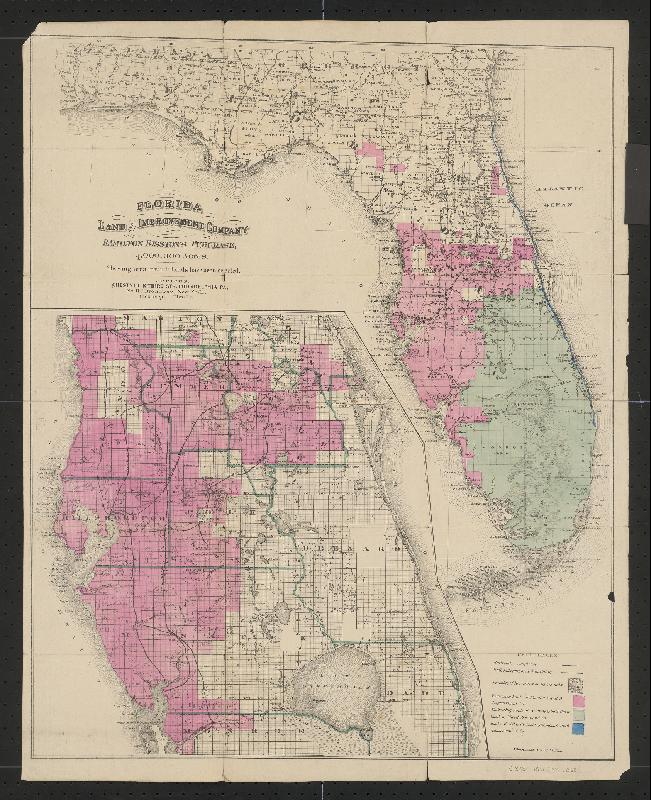
Map of Disston’s lands.
“Todd, why isn’t St Lucie Gardens in pink on the Disston map? …And wasn’t this area supposed to be farmland?”
St Lucie Gardens was a huge subdivision in the region of the St Lucie River/Indian River Lagoon including the savannas filed in 1911 by the Franklin Land Company of Jacksonville. According to my mother’s book, “the land was advertised as far away a Kansas and a few families bought land and tried to make a living farming. However land that had been pine flat woods continued to have cycles of flooding a drought and was impossible to farm profitably. The families that came to farm in St Lucie Gardens either gave up or turned to other ways to make a living.”
St Lucie Gardens…overlay by Todd Thurlow.St Lucie Gardens plat map 1910. MC Property appraiser, via Todd Thurlow.The Waters family promoting St Lucie Gardens 1910. (Photo Reginald Waters Rice) from Jensen and Eden by Sandra Henderson Thurlow.Draining the savannas around St Lucie Gardens, 1911. Franklin Land Co. (Reginald Waters Rice) Jensen and Eden, Sandra Henderson Thurlow.Page listing lands of Disston, mind you county boarders were different at this time. Martin was Brevard. (TT)
Todd and I never found our why those lands of the St Lucie River/Indian River Lagoon were not included on the 1881 Disston lands map, and the people who created it are not around to ask, but Todd did create the awesome visuals at the beginning of this post and he did find the deed of the purchase of the lands in our region. To have this document is an incredible part of our history.
Deed of Disston lands sold to Reed, 1881, page 1. (TT)Page 2. (TT)Disston bought 4,000,000 acres from the state of Florida then sold half to Reed. Some of those lands included land in the SLR/IRL region. These lands are not shown on this map. ( Public map, 1881.)
And the EAA? With all the water problems we have today, I am glad it does not include everything in pink and green on the map and that something remains of our Savannas along the Indian River Lagoon.
____________________________________
An interesting email from Todd; Thank you Todd for all the research!
Jacqui,
It was fun to go through some of the stuff on my computer tonight. I just downloaded this publication “Disston Lands of Florida”, published 1885. I attached the intro page.
Disston had the pick of ALL the public lands owned by the state. It took three years to make the selection. Perhaps the pink area had been picked as of the date of the map and St. Lucie Gardens had not yet been picked?
Or maybe the St. Lucie Gardens land is not shown in pink on the map because Disston directed that the St. Lucie Gardens property be deeded directly from TIIF to Sir Edward James Reed. The Florida Land and Improvement Company never took title.
The TIIF deed that we pulled up for Sir Edward James Reed (attached) is dated 6/1/1881. In includes a little more land (21,577 Acres) than ended up in St. Lucie Gardens (e.g. Section 1, of T36S R40E is not part of St. Lucie Gardens but is included in the deed.)
“Indian River Reflections,” by Vera Zimmerman, 1987. (Collection of Tom and Sandra Thurlow) JTL, 2015.……
Recently at my parents’ home, I noticed a piece of artwork hanging the wall. I had seen it many times, but somehow this time, it looked different. Upon inspecting the title written at the bottom, I noticed that it read: “Indian River Reflections,” Vera Zimmerman, 1987.
The painting shows a menagerie of people standing by the river, their reflection shining in the shallow waters…
“Mom, tell me about this please. Who are these people?”
“Well these are the many people of the Indian River Lagoon. There are Native Americans, African-Americans, the Spanish, Jonathan Dickinson, the cattlemen, the “pioneers…”
….
My eye kept going to the little girl and the dog…
“Things are different but the same,” I thought.
“Who is Vera Zimmerman, the artist, again? I know you have told me about her before.”
“She is an artist and an archeologist up in Brevard County…”
My mother left to clear the table and I stood there looking at the sketch…thinking about all of the people who have gone before us…
We too stand on the edge of the Indian River Lagoon, our reflections staring back. I wonder how one day, we will be painted?
Map of Florida’s shoreline expanded and contracted over the millennium with various ice ages, rising and falling seas. BARR MAPS
__________________________________________________________________
Associations of Vera Zimmerman:
Mr Reginald Waters with black bears killed on Hutchinson Island, around 1930. (Photo credit Sandra Thurlow, Sewall’s Point,” A History of a Peninsular Community on Florida’s Treasure Coast”/Reginald Waters Rice)Photo from my mother: Bill Pitchford’s “last bear.”
A friend of mine, Mrs Mary Chapman, once described Stuart News reporter, Ed Killer, as “the only reporter in America who got her to read the sports page.” I feel the same way. Ed Killer’s past Sunday article entitled: “Bearing Down for the Bear Hunt,” was quite the read, and I have been thinking about it the past few days.
Bears….to think that they used to live right here in along the waters of the St Lucie River and Indian River Lagoon, and now there are none.
Today I thought I’d share a photo I have shared before, but it is certainly worth dusting off and bringing out of the archives again.
The above photos are from my mother’s book, “Sewall’s Point,” and shows Mr Reginald Waters with multiple black bears he killed on Hutchinson Island, a mother and two cubs, around 1918. The other is the “last bear shot on Hutchinson Island, 1926.” Historian, Alice Luckhardt, wrote a comprehensive piece on these black bears that once roamed our region. Here is an excerpt from a recent vignette:
“At one time, Florida black bears existed in fairly large numbers along the ocean coast between Jupiter and Fort Pierce, living in and among the mangroves and feeding on palmetto fruits and turtle eggs buried in the beach sand. However, as more people began settling the area, bears became unwelcome guests, and many were hunted and killed by early pioneers.
By the 1920s and early ’30s there were still a few wild black bears in the area. They found a tasty delight in honey and bee larvae from the numerous beehives in operation on Hutchinson Island at that time.
Jensen resident William Pitchford felt the only solution was to hunt down the bear that had been raiding his bee hives during the summer of 1931. Pitchford first thought to capture the bear using a steel trap he set out over several nights near the hives. The bear, however, was too smart to fall for that trap, avoiding it each night and still getting into the honey, destroying several hives.
Determined to end the bear’s raids, Pitchford, with the assistance of a neighbor, Vincent Wortham Sr., laid in wait one Saturday night, Aug. 8, 1931, with weapons in hand. As hoped, in the darkness of night, the bear appeared and the men turned on their flashlights. Pitchford immediately fired three times using his 303 Savage rifle, and Wortham fired his 32-20 Smith and Wesson revolver twice at the animal. The seriously wounded bear managed to scramble a short distance away before the two men later found him dead near the Pickerton farm. They managed to bring the 200-pound animal back to Jensen where photos documented the event, as this marked the last bear killed on Hutchinson Island.”
So, quite sad as far as I am concerned that we killed all the bears here. Let’s figure out how FWC, the Florida Wildlife Commission, the agency making the laws on bear hunting today “works.” —How do they fit into Florida government? How were they able to determine it is OK to shoot bears this season? For one thing FWC is not “under the governor,” a situation many state agencies would “kill for.” Oh, no pun intended… 🙂
Also, I must state that the structure of the agency is confusing like everything else in government.
There is “US Fish and Wildlife,” a federal agency, and then there is FWC, or the Florida Wildlife Commission, a state agency. One will also hear this same agency referred to as Florida Fish and Wildlife Conservation Commission. Why I am not sure. So Florida Wildlife Commission (FWC) and Florida Fish and Wildlife Conservation Commission (FFWCC) are the same thing. If anyone knows more about this please let me know….
In 2004 the agency, FWC. was restructured by an act of the Florida Legislature:
This excerpt below explains:
“The FWC was established with a headquarter in Tallahassee, the state capital on July 1, 1999 after an amendment to the Florida Constitution approved in 1998. The FWC resulted from a merger between the former offices of the Marine Fisheries Commission, Division of Marine Resources and Division of Law Enforcement of the Florida Department of Environmental Protection (DEP}, and all of the employees and Commissioners of the former Game and Fresh Water Fish Commission.
The Florida Department of Environmental Protection (DEP) serves as the environmental regulatory agency for the state, enforcing environmental legislation regarding air and water quality, for example. In 2004, the Florida Legislature approved a reorganization of the FWC that integrated parts of the Division of Wildlife, Division of Freshwater Fisheries, and the Florida Marine Research Institute to create the ‘Fish and Wildlife Research Institute’ (FWRI) in St. Petersburg, Florida.It has over 600 employees. As of 2014 FWC had over 2,000 full-time employees, maintained the FWRI, five regional offices, and 73 field offices across the state.”
FWC commission 2015Organizational Chart FWC 2015Organizational Chart DEP
Looking at the structure one can see that the commissioners are at the top of FWC chart and the “people” are over the governor for DEP chart….
Hmmmm?
If the bears had a seat at the table, I wonder where they would be?
Black bear sitting at a picnic table, a popular image on Facebook, 2014.
____________________________________
Full note from my historian mother when she sent the “last bear” photo:
“Jacqui, Here is a photograph of Bill Pitchford’s “last bear” that Alice Luckhart wrote about. I have a file on the Waters family who lived in Walton on Indian River Drive. The photograph of Russell Waters with the mother bear and two cubs had “1918” written on it. I am glad Ed Killer’s article explain that hunters will not be allowed to kill a mother with cubs. Reginal Waters Rice who supplied the photograph said his uncle Russell felt very bad about killing “the three bears.” Mom
Early rendition of a portion of the “Everglades” (Painting in my parents home, Tom and Sandra Thurlow.)Cover of book, 1910 by Walter Waldin.…..…..…….
This past Friday, I attended a Treasure Coast Regional Planning Council meeting and was treated to a wonderful presentation entitled: “A Brief History of Florida Water Management 1800-2000 Ponce to CERP.” The talk was given by Mr Bob Ulevich, president of Polymath Consulting Services, L.L.C. ” (http://polymathconsultingservices.com). Bob” is a beloved man who has a long history himself as senior water resources project manager for the South Florida Water Management District. Bob is considered the “father of water farming.”
His presentation left me speechless, once again being reminded of the history of agriculture in the state of Florida and its deep intertwinement with the state’s government and politicians….basically they are one in the same. This is how it is….St Lucie River/Indian River Lagoon and every inch of the rest of the state. “We” may not like this, but we must accept this…
With rumor that Adam Putnam, the Commissioner of Agriculture, could be our next governor, it is critical to refresh our memory on this historic relationship. Today I will share a book a from my historian mother’s shelf and also post the raw iPhone footage of Bob speaking before the council. It is my belief that we have got to learn to understand this historic relationship along with the power agriculture yields and “work with it,” in our quest for better water quality. They too are “naturalist” at heart….they are. Some of them in our South Floirda region have just “morphed,” and need some help getting back to their roots. 🙂 They hold the key to Florida’s water future.
The first page of the booklet talks about “getting back to nature” as farming is deeply intertwined with nature. Unfortunately today many of the intense practices of farming destroy nature and our water resources.
…
This is an another excerpt from the book:
….the independent countryman’s life must appeal, for he is a free man, master of himself, is conversant with nature in its many moods, enjoys the first fruits of the earth with the gleam still on them, and all its first impulses and pleasures….”
…..
“No wonder, then, the cry of today is, “Back to the back and nature.” And back we must and will go, for this threatening catastrophe is too appalling to be passed by unchallenged.”
The catastrophe Mr Waldin is speaking of is that so many people were leaving America’s lands to go to the cities, that the “vitality of our nation was being drained proportionately…” Mr Waldin feared the lands would be empty and all would move to the cities…..It basically has happened, hasn’t it!
Below are the links to Mr Ulevich’s presentation, his presentation does not encompass the little book. I added that. Bob speaks on “A Brief History of Water Management 1800-2000 and although my “Jacqui home videos” are poor quality, you can hear the message. I had to break the videos up into 15 minutes sections as my You Tube account is not set to post anything over 15 minutes…Bob’s presentation is excellent. For those of you who have time to listen, you will enjoy it very much and learn a ton! Bob will finish his presentation next month covering approximately from 1910 to today.——– And that’s where we get to hear “the rest of the story….” 🙂
Crowd having fun surrounded by hanging home made coconut heads at Pitchford’s Bar, Jensen Beach, ca. 1950s. Billy Pitchford is behind the bar. (Photo shared by Bob Washam/info. from historian Sandra Thurlow)1943 aerial photograph: Indian River Drive shoreline along the Indian River Lagoon approaching today’s Downtown Jensen Beach. Wooden bridge in distance. As shown on page 20 of “Historic Jensen Beach and Eden on Florida’s Indian River,” by Sandra Thurlow-Henderson, 2004.(Jensen School in center.)
Recently, I visited Bob Washam and his wife Cynthia in their home along the Indian River Lagoon in Jensen Beach. Because Bob has recently retired and had a very long career at the Martin County Health Department, I wanted to interview him about the river and the history of toxic algae blooms. Obviously this is a very serious topic, and I kept trying to ask him questions, but I couldn’t keep my eyes off the coconut head hanging in his kitchen.
“Sorry to go off topic, but what’s the story with the coconut head in the kitchen Bob? It looks authentic. Old. It’s really cool.”
“Oh that’s Connie.” He matter-a-factly replied…
“Connie the coconut head” belonging to and photographed by Bob Washam. The now historic coconut head once hung in the old Pitchford’s Bar that used to be on Indian River Drive in Jensen. (Photo Bob Washam)
Bob told me that when he was a young man and went to college at FIT in Jensen in 1975 Pitchford’s Bar was closed, “but the heads were still hanging there.” Eventually he was given one. It’s a special reminder of Jensen’s earlier days…Bob took out some old photos and allowed me to share them with you today.
Jensen establishments, Seymour’s Inn, Pitchford’s Bar, and Poor Bobs were all located right next to each other on Indian River Drive, just north of the Jensen (Frank Wacha) Bridge. Their popularity somewhat overlapped, but over the years they all deteriorated. Nonetheless, these establishments left wonderful memories for thousands of people. Bob Washam also has great memories. He told me a story about “Pineapple Louie,” a Jensen Beach local character from the 70’s.
“One day when I was working at Poor Bob’s, he ran into kitchen, grabbed a big knife and chased another bar patron onto Indian River Drive. That was our big excitement back in those days. That and dancing with…ladies at Seymours after our work shift. ” –Bob Washam
Poor Bobs. (Bob Washam and Sandra Thurlow) ca. 1950s.Poor Bobs. (Courtesy of Bob Washam) ca. 1950s.Pitchford’s Bar. (Courtesy of Bob Washam)ca. 1950s.Seymour’s Inn ca. 1950s. (Photo courtesy of Bob Washam. Taken by Art Ruhnke)Even famous Francis Langford would come by for a cocktail! Here with Seymour Giddeon, who became a Martin County Commissioner, and an unidentified man who certainly looks like a movie star. (Photo archives Sandra Thurlow, ca 1940/50s)
My mother writes more historically about Seymour’s Inn in her book “Historic Jensen and Eden on Florida’s Indian River.”
“Jensen’s main attraction was its wonderful fishing. The mile long bridge was not only lined with fishermen on both rails, it was a social gathering place. What was needed was a place to enjoy a cold beer after a day of fishing…
Seymour’s Inn officially opened on December 13th, 1936 in the former filling station building and grew through the years with numerous additions. Seymour’s became the “fun spot” of Martin County. There was square dancing, round dancing, and mixers seven days a week. Seymour, the owner, played harmonica, musical groups performed, and there were Sunday afternoon jam sessions and costume parties…
…War came in the 1940s and Seymour’s became a popular place with servicemen stationed in the area in the 1940s during World War II. Following the war, Seymour’s continued to be popular and drew people from miles around…
Today, times have changed, but the spirit of these places along Indian River Drive absolutely lives on….next time you drive by, if you slow down and listen, you may even hear the music and laughter of the age. 🙂
Close-up from “Historic Jensen and Eden on Florida’s Indian River Lagoon.” Sandra Henderson Thurlow. Page 23. Notice clear water and healthy seagrasses.Full page 23 with text. SHT
Seymour’s Inn is-now popular attraction Conchy Joes owned by the famous and generous Fred Ayres; Pitchford’s Bar much later became Dena’s Restaurant, and now is under new ownership with the funny huge shark with a ladies legs hanging out on the facade; and Poor Bob’s is an empty lot just north of the bridge.
*All of Sandra Thurlow Henderson’s books on local areas, Stuart, Jensen, Sewall’s Point and the House of Refuge can be purchased at Barnes and Noble on US 1 in Stuart, near Jensen Beach Boulvard.
Google Earth image with historic photo overlay, USCG Ft Pierce, Fl. Taken from Todd Thurlow’s Time Capsule Flight.
UNITED STATES COAST GUARD STATIONS FT PIERCE AND LAKE WORTH, THEN AND NOW…
It’s fun when a blog blossoms into more!
My recent post of the historic US Coast Guard station in Ft Piece was one such post…Thank you for the many wonderful comments and insights. Also, Dr Edie Widder is going to have the historic photos printed and hung at ORCA, located in the building itself. Talk about full circle!
As a follow-up, my brother Todd created a “time capsule flight” of the Ft Pierce USCG Station and the Lake Worth station using the historic photos shared by Tim Dring, President of the U. S. Life-Saving Service Heritage Association. Mr Dring had recently shared the photos (discovered in the National Archives) with my mother as she is writing a book on the subject.
My brother’s time capsule flight will take you from the St Lucie River/Indian River Lagoon proper to the Ft Pierce Coast Guard Station, and then jet-off to Peanut Island’s Lake Worth USCG Station. It is wild to see the what our area looked like undeveloped. I have to say although they are invasive, I miss the tall Australian Pine Trees. I can still hear them blowing in the Trade Winds. Such a romantic time it was….Have fun. Wear your seatbelt and don’t lean too far out of the Cub!
My mother, Sandy Thurlow, taking photos and flying in the cub with my husband Ed, 2014. (Go-Pro photo.)
Link to THEN AND NOW, US COAST GUARD STATION FT PIERCE AND LAKE WORTH, Todd Thurlow.
_________________________________________________
Also I am going to include a “funny story” about the “boys of the USCG” in Ft Pierce during WWII sent to me by family friend Stan Field, whose pen name is Anthony Stevens.
Hi there, Jacqui [cheery wave]
I just read your post about ORCA and the old CG station and thought I would share this tale with you. My mother, Emmy, shared this family legend many times. She was a teenager during WWII.
A true story about telephone Operations during WWII.
My mother and her friends, worked as telephone operators during most of the war. In those days, that involved a headphone and a bank of ¼” phone jacks with cables and plugs. There were no automatic dialing systems. Every call was placed manually via party lines with anywhere from four to a dozen phones on each line. Now Emmy and her fellow operators were usually pretty bored and would stay ‘on the line’ when there were military conversations. One night, a very young and very ‘cool’ fellow that everyone loved for his sense of humor, was stationed at the Gilbert’s Bar House of Refuge. A call came into Emmy’s switchboard and she was asked to patch in to the House lookout station. Now all of the watchtowers along Hutchinson Island were on the same party line. When it rang, everybody picked up. The person on the other end asked for the station they wanted and that station would respond. Normally, as soon as you realized it wasn’t for you, you would hang up. This night, the caller asked for the watch on duty at the House of Refuge. The young man’s reply was loud and clear… “Gilbert’s Bar! Wine, women and song, all night long!” There was a dead silence on the line for several seconds and the caller asked in a cold voice… “Do you know who this is, son?” “No sir.” “This is the Captain of the Coast Guard Base in Fort Piece.” Without missing a beat… “Do you know who THIS is, Sir?” “No.” “THANK GOD!” And he hung up. The sound of loud laughter flowed from a dozen headsets that were listening and the Captain hung up in fury. The next day, the Captain passed the word that the person who answered had better confess or the entire post would lose liberty the following weekend. Even though everybody on watch that night knew who it was, NOBODY stepped forward and they all were restricted to barracks that weekend. Needless to say, the young man was a model sailor for the rest of the war… and he owed each of his buddies a great deal.
Ft Pierce USCG station ca. 1930/40s. National Archives. Tim Dring via Sandra Thurlow.Lake Worth USCG Station 1951, Peanut Island, National Archives. Tim Dring via Sandra Thurlow.
What is Pecha Kucha? JTL’s attempt, “Love the Everglades, 2015,” the Rights of Water, Miccosukki Tribe. (Still from Kenny Hinkle’s video with word overlay..)
________________________________________________________________
When Miccosukee Tribe member, Houston Cypress, recently informed me that I needed to prepare a “Pecha Kucha” for the “Rights of Water” symposium at Love the Everglades August 22, 2015, I was amiss.
“What’s Pecha Kucha? Or was that Pechu Kuchu? Pecha, what? ” I inquired, thinking it must be a Native American term.
Houston calmly replied:
“It is Japanese for “chit-chat,” Jacqui. It consist of 20 slides in power point format that run only 20 seconds each” It keeps presentations interesting and succinct. Pecha Kuchas are now a popular format all over the world.”
“Wow, that’s cool,” I replied.” Thinking to myself, “The Miccosukee—near Miami–ahead of the game—I live in Stuart, 30 years behind the curve….Hmmm? I’ll act like I get it….”
“This should be easy.” ….I said to Houston. “20 seconds, 20 slides? Sure! Count me in!”
The weeks went by and I realized, well, I was wrong! The fast-moving slides force a familiarly and adaptability that I had never before adjusted to while speaking. Practice took on a new meaning because you really couldn’t. You just had to know your subject. “Live” became the theme.
I was terrified and realized I could not look at notes or do what I usually do when I speak, especially in an unfamiliar place. My husband, Ed watched me sweat and stumble trying to prepare. Scratching my plan altogether at least twice. He smiled just telling me to “look it over….”My slides that is…
“PechaKucha Night,” now in over 800 cities, according to their web site, was devised in Tokyo in February 2003 as an event for young designers to meet, network, and show their work in public.
Today I will share my attempt of a Pecha Kucha for the St Lucie River/Indian River Lagoon at the Miccosukee’s “Love the Everglades Conference “and the RIGHTS OF WATER 2015. Thank you to Ed for helping me prepare; thank you to videographer, activist, and friend, Kenny Hinkle, for his finesse in taping this experience. Also thank you to those whose photographs and maps I used in my presentation and help me all the time: Joh Whiticar, Dr Gary Goforth, Ed Lippisch, Sandra Thurlow, Nic Mader and the River Kidz, Julia Kelly, Sevin Bullwinkle, Val Martin, and Greg Braun. The slides are below.
Last, thank you most of all to Houston Cypress and the Miccosukee Tribe of South Florida for the opportunity to grow and to share, because from what I am learning, getting out of one’s comfort zone is where it all begins as we continue “our war” of which we too, “will never surrender” —St Lucie River/Indian River Lagoon.
Pecha Kucha slides: 20×20
1. John Whiticar SLR/IRL2. John Whiticar SLR/IRL3. Ais, from Theodore Morris book of painting of “Florida'”native tribes, via Sandra Thurlow. 4. 1856 US Seminole war map. via Val Martin, Florida Classics Library.5. Gary Gorforth’s shared map of J.O. Wright 1909.6. Canals showing St Lucie (public)7.1920s C-44 St Lucie Connection, Ruhnke Collection/via Sandra Thurlow collection.8. Harry Hill/Florida Photographic Concern photo, White City, fishing along the SLR via Sandra Thurlow.Little boy and giant grouper Jenen Beach ca. 40 or 50s. Ruhnke Collection via Sandra Thurlow.
10. C-24 canal JTL/EL.11. SFWMD basin map for SLR.12. LO and other canals’ plume Jupiter Island 2013 (JTL/EL)13. Plume over nearshore reefs. (Martin County files)14. River Kidz member, Veronica Dalton, speaks, protest for SLR/IRL, St Lucie Locks, and Dam, 2013. At this event she spoke before more than 5000 people. (Photo Sevin Bullwinkle)15. Marty the Manatee, River Kidz work book 2015. (Julia Kelly.)16. RK oyster deployment with FOS, 2014. Nic Mader.17. Dolphin calf with mother 2014, SLR/IRL. Nic Mader.18. White Ibis, Bird Island, Greg Braun.19. Dirty Water Kills. River Kidz recycled FDOT sign, Rachel Goldman. 2013.20. Last slide: A Miccosukki word for the Everglades….left on screen.
“Looking south towards Thumb Point.” USCG Station, Ft Pierce, Florida, ca. 1940s/50s (Photos courtesy of Tim Dring via Sandra Henderson Thurlow)
“READY, RESPONSIVE, AND RESOLUTE” —U.S.C.G
Today, I am going to feature “two in one.” –historic photos of the U.S. Coast Guard Station in Ft Pierce, and ORCA, the Ocean Research and Conservation Association. The now historic U.S.C.G. station building has resided along the Indian River Lagoon since the late 1930s, and today ORCA is housed at the same location.
Thank you to my mother, historian Sandra Henderson Thurlow, and Tim Dring, President of the U. S. Life-Saving Service Heritage Association who discovered these photos in the National Archives and recently shared them with my mother.
Last week, my husband Ed and I, as well as my parents, attended the ORCA grand opening at the Elliott Museum on Hutchinson Island, just over the bridge from Sewall’s Point.(http://www.elliottmuseum.org)
That evening, Dr Edie Widder, famous scientist and gifted communicator, was greeted by a full house. If you have not seen the exhibit, “Illuminating the Deep,” you must! It features her science fiction like deep-sea creature photographs, enhanced by fellow scientist Dr Bernstein, as well as write ups about these creatures that will truly blow your mind. The bioluminescent world under sea we do not know….The exhibit also relates the importance of the Indian River Lagoon’s health and its connection to ocean health.
“Illuminating the Deep” at the Elliott Museum. (JTL)Dr Edie Widder and JTL (Photo Ed Lippisch)From exhibit. Our toxic soup run off killing the IRL and our oceans.The USCG Ft Pierce, Fl. The location of ORCA as viewed on their website.
It was a great evening. Ed and I had a great time at the exhibit. I was completely inspired as usual when I heard Dr Widder speak. Really amazing. That night, I thought a lot about how incredible it is that ORCA resides right here along the Treasure Coast in Ft Pierce! I even dreamt about squids.
My photo on the floor of the Elliott with a rendition of the Giant Squid eating me. You may know that Dr Widder so famously made the giant famous!
So I wake up and go to my computer, the general format of my life these days…..And what do I see? Multiple emails from my mother. Her message read:
“Jacqui, Ironically, I am working on Coast Guard images of the ORCA facility. Maybe they will be of interest.”—-Mom
So here are the wonderful photographs my mother shared from the early days. They are priceless. I believe most are from the 1930s and 40s. Life is one big circle indeed! And here we are today—-
—-ORCA and the U.S. Coast Guard at Ft Pierce, both “ready, responsive, and resolute” for our Indian River Lagoon!
Coast Guard men out front. (National Archives TD/SHT)4 photos USCG Ft Pierce, 1937 (National Archives TD/SHT)Aerial of land and Ft Pierce Inlet. (National Archives TD/SHT)USCG Station Ft Pierce. “Made land.” (National Archives TD/SHT)USCG (National Archives TD/SHT) “Shows islands.”Side view of USCG building, 1937.(National Archives TD/SHT)USCG building with Thumb Island in background. (National Archives TD/SHT)Labeled 1955 USCG and Ft Pierce Inlet. “Fill..” (National Archives TD/SHT)
Photo of a stuffed “Carolina Paroquet,” displayed in a glass container. “The bird was given to Mrs. Carlin at Jupiter and was owned by her son Carlin White who died at 105.” The birds were prevalent and lived in Florida’s swamps and old growth forest until overshooting, the pet trade, and loss of habitat led to their extinction. (Photo Palm Beach County Museum, quote by Sandra Henderson Thurlow)
Sometimes on a sunny day, I hear gregarious green parrots in the cabbage palms of Sandsprit Park near Port Salerno. When my husband, Ed, and I recently visited his niece at University of Miami two huge, gorgeous multi-colored macaws swooped down over cars stuck in traffic.
“Holy moly!” I exclaimed. “What was that?”
“Parrots.” Darcy calmly replied. “They got loose from the zoo after the hurricanes. Now they live here; they have chicks in a royal palm tree on campus.”
Pretty cool. Life adapts, unless you go extinct that is…Extinct: “No longer existing or living; dead.”
This was the fate in the early 1900s of a beautiful bird known as the “Carolina Parakeet,” last reported between 1910 and 1920. The “paroquet” as the old timers referred to them, had an expansive range that included much of the eastern United States, west into Colorado, and south into Florida. Their habitat? Swamps and old growth forests… what our state used to be.
As these habitats were cleared and filled for timber and development, especially from the late 1800s into the early 1900s, their range became limited, and their numbers declined. According to documentation, some of the last remaining lived in our Indian River Lagoon region.
The birds were sought after for their bright feathers and friendly voices. People kept them as pets and wore them on ladies’ hats prior to Florida Audubon’s rampage.
Perhaps the most poignant tale of their story is that the birds were very social, and like people, if a member of their group were shot, all the others would “flock to the injured,” making capture, or shooting of all others, “easy-pickings.” This compassion, an “advanced, evolved trait” sealed their fate in the extinction-book of history.
Ironically one of the most famous reports of the stunning birds occurred in the area of the Sebastian River and its confluence of the Indian River Lagoon. A local man, Chuck Fulton, whose relation was my principal at Martin County High School, seems to have guided Chapman thorough the areas as a lad when he stayed at Oak Lodge in Sebastian where his great-great grandmother lived. (Sandra Henderson Thurlow)
Mind you Frank Chapman was like a movie star of his day. This would have been very exciting for young Chuck. “Frank Michler Chapman”—scientist, explorer, author, editor, photographer, lecturer, and museum curator, —-one of the most influential naturalist and greatest ornithologists of his era.
In a book “Letters to Brevard County” shared by my mother, historian, Sandra Henderson Thurlow, Chapman accounts his travels of our region:
Frank M. Chapman
“The Sebastian is a beautiful river, no words of mine can adequately describe it.” Half a mile wide at its mouth, it narrows rapidly and three miles above appears as a mere stream which at our camp, eight miles up, was not more than fifty feet in width and about fifteen feet in-depth. Its course is exceedingly irregular and winding. The banks as we found them are high and for some distance from the water grown with palms and cypresses which arching meet overhead forming most enchanting vistas, and in many places there is a wild profusion of blooming convolvulus and moon flower…Here we observed about fifty colorful paroquets, in flocks of six to twenty. At an early hour, they left their roost in the hammock bordering the river, and passed out into the pines to feed….
In the “spirit of the day” Chapman goes on to describe how unafraid the birds were of him and then shoots a few birds for “science,” leaving alone those that come to the rescues of their fallen comrades…..
In all fairness, it must be noted Chapman also appealed to President Teddy Roosevelt to establish Pelican Island as a national preserve– which in time became the first U.S. National Wildlife Refuge, (also in Sebastian), and he is also credited with starting the Audubon Christmas Bird Count, where birds are counted, and not shot. Even today “scientific” specimens must be killed in order to be recorded as a new species. One day perhaps a photograph will be sufficient.
Quite a story….and so close to home.
So next time you see a brown pelican gracefully flying past, picture a flock of fifty, squawking, colorful parakeets happily trailing behind. What a colorful world our Indian River Lagoon must have been!
8-25-15 10PM: I am including a photos and comment sent to me by Dr. Paul Grey, Okeechobee Science Coordinator, Florida Audubon. Very interesting!
“Jacqui, thanks for the parakeet story. Look at the tags on these parakeets, these are the skins of the birds Chapman shot that still are in the Museum of Natural History in NY. There is a statue of the bird at the Kissimmee Prairie Preserve that Todd McGrain did for his Lost Bird Project…Worth seeing.” —Paul Grey
*NOTE THE LITTLE CARD THAT SAYS “SEBASTIAN RIVER!”
Chapman’s birds, Museum of Natural History. (Paul Grey)Carolina Parakeet sculpture at Kissimmee Prairie Preserve, by Todd McGrain. (Paul Grey)
Close up, Herons. The Knockabout Club–Lake Okeechobee, 1887.
Beauty and adventure abound in the pages of a classic 1887 book known as the “Knockabout Club in the Everglades–Lake Okeechobee. ” A book from the days when it was “a man’s world,” it is one in a series of exotic hunting and survival tales, written, and “documented, ” by F.A. Ober and Estes Lauriat.
When reading this text about Florida, one is transported to a time when Lake Okeechobee and our Indian River Lagoon Region, easily competed with the continent of Africa in wonder and wildlife. Bears, panthers, alligators, crocodiles, wolves, native people, limitless fish, and a million birds in every different color, shape, and size. –Knobby-kneed trees stretching to heaven forcing the eye to God…
My mother shared this book with me awhile back, and although I have not read every page, I remain moved by its recollections, its revelations, and its confessions.
Today I will share a smidgen of its art work, and a whisper of its words. The entire book has been electronically preserved and even reprinted due to “its importance and value to society.” The link is below.
As with so many things relating to Florida, the text leaves one wondering….wondering how we perhaps unknowing destroyed such a paradise, and if one day our collective conscience will find redemption by restoring some of the destruction we have caused.
This excerpt is from page 196 of the electronic copy:
“As the sun came down, behind the pines, scattered groups of herons came flying towards the island where we were concealed. Now a great heron, now a small blue heron, and occasionally a night heron. The sun disappeared and the moon came out and shed a faint light over the marshes and the lonely island, disclosing to the waters there the hurrying dusky forms in the sky, many of which fell at the fire of the marauders stationed beneath the trees…
When we left (I now grieve to state) we had nearly a score of herons of various kinds. Gleaming white in the moonlight, our back loads of herons appeared more like sheeted ghosts and verily, if all wicked deeds are requited in kind, the slayer of these innocent birds deserved to have their nights disturbed during the remained of their lives by the apparitions of their victims.
Looking back on that heron hunt, I can say it was a shameful thing to do,–to shoot unsuspecting birds as they came winging their way joyfully home to their nests. It was a most inexcusable act; yet we did it in our search for the rare and curious, not giving heed to the chiding’s of conscience—-until we had shot the birds.”
Cover of 1887 book: The Knockabout Club in the Everglades. Library of Sandra and Thomas Thurlow.)1.Copyright page2. Title page3. Herons4. Flats and Prairie of the St Johns5. Herons and Alligator6. The Home of the Heron7. Indian Burial Place8. The Gloom of the Cypress9. Pelicans of the Great Okeechobee10.Little Bay at Oleander Point11. Contents12. Illustrations
Thank you to my mother, historian Sandra Henderson Thurlow, for sharing this book.
Man next to artesian well, IRL. “Mr Doug Witham allowed me to copy this photograph he purchased over eBay. It is of an unidentified man in St. Lucie Gardens. That is the huge subdivision of land Sir. Edward Reed purchased from Hamilton Disston. Since the notation on the back was written at Walton it is probably some place pretty close to the Indian River Lagoon.” Sandra H.Thurlow 8-15)Plat map St Lucie Gardens, along IRL. Sandra Henderson Thurlow)
“Artesian well…”
The words hold such poetry for me…something from a time long, long ago when Florida was wild and pure. In all honesty, I don’t know much about artesian wells, but throughout my life I have heard stories that have intrigued, and yet sometimes confused me. It is of these wells that I will write briefly on today.
When I was growing up, my historian mother told me stories of artesian wells made by simply hammering a pipe into the ground right here along the Indian River Lagoon. They would just flow and flow and both people and animals would drink from them. Many of these wells were made for irrigating farmland and for supplying the needs of pioneer families. My brother, Todd, recently told me of an artesian well located in the shallow waters off of Hutchinson Island that the pirates and sailors would stop to drink from to refresh themselves on their long and dangerous journeys…it was created by pressure under the earth by Nature. Not man-made but natural.
So an “artesian wells” can be natural or man-made. Apparently in 1957 the state started capping them as there were so many they were lowering the ground water level, and in some cases allowing salt water intrusion.
Most of them are gone today. I definitely consider myself someone who supports water conservation, and I still have memories when I take a shower of my parents yelling up the stairs to us as kids: “turn off the water while soaping up!!!!” Nonetheless, the romantic image of a free-flowing well on a wild Florida piece of land is a beautiful image indeed…. 🙂
(I added this photo my mother shared on 8-17-15.) Photographed is an artesian well on Bud Adam’s Ranch in St Lucie Lucie County west of Ft Pierce. Photo L to R Tom Thurlow, my father, and Dr and Mrs Powers long-time,good family friends. (Photo by Sandra Thurlow, ca 2007.)
_____________________________________
Document to cap Florida Artesian Wells, 1957
STATE OF FLORIDA
STATE BOARD OF CONSERVATION Ernest Mitts, Director
FLORIDA GEOLOGICAL SURVEY Robert O. Vernon, Director
INFORMATION CIRCULAR NO. 21
FINAL REPORT
ON AN INVENTORY OF
FLOWING ARTESIAN WELLS IN FLORIDA
LEADING TO THE ENFORCEMENT OF SECTIONS 373. 021-373. 061 FLORIDA STATUTES
1957
Mr. Ernest Mitts, Director
Florida State Board of Conservation
Tallahassee, Florida Dear Mr. Mitts:
I respectfully transmit the final report on an inventory leading to the enforcement of Sections 373.021-373.061, Florida Statutes, 1957, prepared by Charles W. Hendry, Jr.
and James A. Lavender of the Water Investigations, Florida Geological Survey.
This report published as Information Circular No. 21, together with the interim report published in 1957 as Infor- mation Circular No. 10, Florida Geological Survey, illus-
trates as completely as possible the situation that now exists among the freely flowing wells of the State.
Submitted,
Robert O. Vernon, Director
An abandoned 8-inch well flowing in excess of 800 gallons per minute. This well is located in section 32, T. 7 S., R. 30 E., St. Johns County,
Florida.
iv
CHAPTER 28253, 1953 LAWS OF FLORIDA SENATE BILL NO. 57, 1953
AN ACT to protect and control the Artesian Waters of the State; providing duties of certain State and county officers in regard thereto; and providing a penalty for the viola- tion of this Act.
Be It Enacted by the Legislature of the State of Florida:
Section 1. Everyperson, stockcompany, association or corporation, county or municipality, owning or controlling the real estate upon which is located a flowing artesian well in this state, shall, within ninety (90) days after the passage of this act, provide each such well with a valve capable of controlling the discharge from such well, and shall keep such valve so adjusted that only such supply of water shall be avail- able as is necessary for ordinary use by the owner, tenant, occupant or person in control of said land for personal use and in conducting his business.
Section 2. The owner, tenant, occupant or person in control of an artesian well who shall allow the same to flow continuously without a valve, or mechanical device for check- ing or controlling the flow, or shallpermit the water to flow unnecessarily, or shall pump a well unnecessarily, or shall permit the water from such well to go to waste, shall be guilty of a misdemeanor and subject to the penalties provided by law.
Section 3. For the purposes of this act, an artesian well is defined as anartifical hole in the ground fromwhich water supplies may be obtained and which penetrates any water
bearing rock, the water in which is raised to the surface by natural flow, or which rises to an elevation above the top of the water bearing bed. Artesian wells are defined further to include all holes, drilledas a source of water, that penetrate any water bearing beds that are a part of the artesian water system of Florida, as determined by representatives of the Florida Geological Survey.
Section 4. Waste is defined for the purposes of this act to be the causing, suffering, or permitting any water flowing
v
from, or being pumped from an artesian well to run into any river, creek, or other natural watercourse or channel, or into anybay or pond (unless used thereafter for the beneficial purposes of irrigation of land, mining or other industrial purposes of domestic use), or into any street, road or high- way, or upon the land of any person, or upon the public lands of the United States, or of the State of Florida, unless it be used thereon for the beneficial purposes of the irrigation
thereof, industrial purposes, domestic use, or the propaga- tion of fish. The use of any water flowing from an artesian well for the irrigation of land shall be restrictedto a minimum by the use of proper structural devices in the irrigation
system.
Section 5. The state geologist, assistant geologists, or any authorized representative of the Florida Geological Sur- vey, the sheriff or any deputy sheriff, shall have access to all wells in the state with the consent of the owner.
Should any well be not provided with a valve as required in section one (1) of this act, or should any well be allowed to flow in violation of section two (2) of this act, then and in such event, the state geologist, assistant geologists, or any authorized representative of the Florida Geological Survey, or the sheriff or any deputy sheriff shall, upon being informed of such fact, give notice to the owner to correct such defect, and if the same be not corrected within ten (10) days there- after, shall have authority to install the necessary valve or cap upon such well and control the flow therefrom in accord with the provisions of section one (1) and two (2) of this act. The cost of such installation of such valve and the control of the flow from such wells if made by such officials shall be at the expense of the owner, and for the payment thereof, the agency or party incurring the expense shall have a lien upon the lands upon which such well is located.
duly recorded in the public records in counties wherein such lands are located and may be enforced by foreclosure in the circuit courts of the circuit wherein such lands are located. In such foreclosure proceedings,
reasonable attorney’s fee to the plaintiff for the preparation and recording of such lien and the legal proceedings incident to the foreclosure of same. Such liens shall be assignable.
Full document “LEADING TO THE ENFORCEMENT OF SECTIONS 373. 021-373. 061 FLORIDA STATUTES”
1957: http://aquaticcommons.org/1538/1/UF00001081.pdf
A Lagoon on the Mt Pisgah Property, ca. 1950. (Photo Aurthur Ruhnke via Sandra Henderson Thurlow.)
When I was a young person growing up in Sewall’s Point, things were unlike today. Very few people lived here and some of the old estates sat empty for us kids to explore with out the Sewall’s Point cops arresting us for trespassing.
In the late 1970s and early 80s, I often rode my bike to what I called “Paradise Found,” or the “Secret Lagoon” which I later learned was part of the north Sewall’s Point Mt. Pisgah estate, last owned at that time, by Mr Louis Dommerich and his wife Margaret. This large parcel was later developed as “Plantation.” It is the northern most subdivision in Sewall’s Point. It is a lush amazing piece with all sorts of palms planted by the Dommerichs and many lagoons attached to the rising and falling tides of the St Lucie River.
After school, I would ride my bike up the long, winding driveway as fast as I could so my skinny 10-speed Schwinn wheels would not sink in the shell-like sand. Upon getting to the top of the hill, lay a veritable jungle, as beautiful a thing as one has ever seen. There were egrets and herons and jumping fish. I could think here; I could wander in the most gorgeous nature ever seen; I could be away from my “nagging” parents whom I now know were just trying to raise a disciplined and productive child.
An empty house sat like a lone sentinel amongst the vines and sweeping palm trees. I never approached the house as it seemed to hold too many memories, but I made the lagoons my second home.
Margaret and Louis Dommerich’s Sewall’s Point home. (Aurthur Ruhnke via Sandra Henderson Thurlow.)Shore birds–Florida Audubon photo.
In my mind of memories, this area is a sacred place and I feel so lucky that I was able to wander its magical shores. I somehow feel the spirit of the place helped form the person I am today.
A lot has changed since those day, but I still recall it all with great fondness…
Very recently my mother contacted me saying she had a hunch, and had it for quite some time. Her hunch was that the Dommerichs of Sewall’s Point may be related to Louis F. Dommerich and Clara J. Dommerich who founded Florida Audubon.
Wow that would be cool! Why wouldn’t we know this?!
It is well-known and written about recently in “Conservation in Florida, A History of Heroes,” by Gary L. White, that the Dommerichs of the United States became wealthy socialites, and used it for “good cause.”
“On March 1, 1900, in their Maitland, Florida home, near Orlando, they organized with friends the first Florida Audubon meeting. In time, Florida Audubon changed the world, and the fate of shore birds in Florida. Until the Florida Audubon campaign these birds were being recklessly slaughtered in late 1800s for their beautiful feathers. Their chirping, starving, chicks were left to rot in the sun. Thousands, and thousands, and thousands of birds were shot—entire rookeries decimated—all to adorn ladies hats….
Within a decade, through advocacy and education, Florida Audubon had turned this slaughter around. Today we protect birds, and ten percent of what once graced the skies is remaining…
What a legacy….saved by a shoe-string.
So back to our detective work. The couple that owned the Mt Pisgah property were Margaret and Louis Dommerich, Louis died in 1982. The older Louis F. must have died in the early 1900s. Could Louis be related to Louis?
I knew just who to contact to find out, my mom’s friend historian Alice Luckhardt who specializes in genealogy. I wrote her and she wrote back in one day. Mom’s hunch was right!
From: “Alice L. Luckhardt”
Subject: Dommerich Family
Date: August 1, 2015 at 4:31:49 PM EDT
To: Jacqui Thurlow-Lippisch <jthurlowlippisch@comcast.net>
Hi Jacqui –
As you and your Mom know finding information on families is my special area of research.
I have attached a MS Word document I did up of what I found and attached a photo of Louis Ferdinand Dommerich (1841-1912) – the one with his second wife, Clara who started the Florida Audubon Society – bring together many of the local branches across the state. In the Blake Library on microfilm are the obits (Stuart news issue dates) for Louis and his wife Margaret, who lived in Sewall’s Point, who both died in 1982.
Alice
Louis Ferdinand Dommerich (1841-1912) photo provided by historian Alice Luckhardt.
DOMMERICH, LOUIS F. November 14, 1982 Pg A8 OB DOMMERICH, LOUIS FERDINAND November 15, 1982 Pg A5 DA DOMMERICH, MARGARET WHITEHEAD October 29, 1982 Pg A8 OB
Louis Ferdinand Dommerich born Feb. 2, 1841 in Germany, died July 22, 1912 in NYC
Louis F. Dommerich was born on February 2, 1841 in Cassel Germany. His father was a college professor. In 1858-1859, Dommerich came over to the United States where he worked for as an apprentice in a German factory, Noell & Oelbermann, which served as a direct agent for a foreign manufacturing. He was employed there for ten years before becoming a partner in the renamed E. Oelbermann & Co. In 1889 the company was renamed once again to Oelbermann, Dommerich and Co. His company specialized in dry goods exchange and bank dealing in textile commerce, and became so successful that it had manufacturing companies all across the United States and Europe.
In 1885 Dommerich visited Florida for the first time, and two years later he visited Winter Park and stayed in the Seminole Hotel. In 1891 Dommerich bought 400 Acres of land in Maitland, Orange Co., Florida. His holdings included the orange groves on Lake Minnehaha. It was there that he built his first home in Maitland and called it “Hiawatha Grove” to serve as his winter residence. He kept also a home in NYC. The house constructed was a 30 room-mansion surrounded by 130 acres of landscaped grounds and 72 acres of citrus trees. The mansion was an impressive three-story frame house containing multiple turrets and gables. His wife, Clara J. Dommerich (his second wife, married in Oct. 1884) established the Maitland Public Library in 1896 — started with 360 books and Louis Dommerich was its major contributor. In 1907 he donated $3,000 in memory of his late wife, who died in 1900. From 1897 to 1904, Dommerich served on the Rollins College Board of Trustees. He and his wife founded the Florida Audubon Society in mid-1900 in the their home because of the all the bird feathers being used in fashion hats and served as president from 1901 to 1911. Supporters of the Florida Audubon Society in 1900 were President Theodore Roosevelt, railroad baron Henry M. Flagler, Gov. William Jennings, the presidents of Rollins and Stetson colleges and the editors of leading newspapers in the state. In 1903 Dommerich donated $5,000 towards Rollins College’s first endowment. In 1907 Dommerich donated $500 to help secure Carnegie Library and in 1910 he donated $1,000 to help secure a science building. Back on the Board in 1909, he remained a trustee until his death in 1912.
Louis Ferdinand Dommerich died at the age of 72 on July 22, 1912. His son Alexander Louis Dommerich served on the Board of Trustees as his other son Otto Louis Dommerich helped Hamilton Holt finance the College in 1927. By the time Louis Ferdinand Dommerich died, his company had become one of the most prominent commercial banking houses in the world. Hiawatha Grove stood until 1954, when the property was sold for $420,000, the house was torn down to make way for homes in the area.
Louis Ferdinard Dommerich and first wife Julie Louise Dommerich (1843-1882) – one of their sons was Otto Louis Dommerich (1871-1938). A son of Otto was Louis Ferdinard Dommerich, born May 4,1906 in NYC, married to Margaret, their had a home first in NYC and later in Deer Park Meadow in Conn. and on Sewall’s Point.
Louis F. Dommerich, born 1906 died in Martin County on Nov. 11, 1982. His wife Margaret died in 1982. This Louis was the grandson of Louis F. Dommerich who with his second wife, Clara started the Florida Audubon Society.
Their son was Louis Alexander Dommerich, born 1929 and died 2004.
Well thank you Alice and thank you mom! And thank you that I was born in a time when I got to experience “Paradise Found”, because so much of paradise has been lost.
The Google Map photo shows the lagoons today just along the curve of North Sewall’s Point. If you look closely, you will see them.Photo of Mt Pisgah area in 1957 featuring the Langford Estate. the Dommerich’s property can be seen in the upper right corner where the vegetation has not been cleared for orange groves. (Photo from “Sewall’s Point a History of a Peninsular Community of Florida’s Treasure Coast” written by Sandra Henderson Thurlow.)Geodetic marker at Mt Pisgah. This ancient sandbar rises 57 feet above today’s sea level. IT is the highest point in Sewall’s Point. (Photo Sandra H. Thurlow.)Today the lagoon and palm still remain. A 7 acres estate is now owned by friends Jack and Ceejay Heckenberg. Their home and surrounding acreage is perhaps the most beautiful in the Town of Sewall’s Point.
Thank you my mother’s (Sandra H. Thurlow) chapter on Mt Pisgah in her book Sewall’s Point, a History of a Peninsular Community on Florida’s Treasure Coast,” form which content and photos come.
Storm forming over the Indian River Lagoon around sunset, North Sewall’s Point. (Photo JTL 8-11-15.)
Low clouds of storm approaching over the IRL. (JTL)
Late yesterday afternoon, I walked the Ernest Lyons Bridge between Sewall’s Point and Hutchinson Island. There was a storm in the west–way off in the distance over Palm City perhaps. In what seemed like minutes the storm had flattened and stretched out over the St Lucie River and Indian River Lagoon. It was upon me.
For a moment I was scared. There was lightning in the near distance. Cold rain pelted down. The winds generated tremendous power and the birds flying back to Bird Island were caught in place suspended like mobiles.
I started running, not something I do ever anymore….
After stopping and starting, and taking photos….. 🙂 I got safely to the other side.
I had ‘made it.” I felt invigorated. It’s good to be aware of your smallness against nature every once in a while….
Today I will share “Reflections on Reflections on a Jungle River” written by famed environmentalist and “Stuart News” editor Ernest Lyons. The work is transcribed by my mother, historian Sandra Henderson Thurlow. I think Ernie’s essay “captures the storm better than I ever could…although he is writing about the St Lucie or Loxahatchee, the sister Indian River seems just the same…
Looking overhead –storm forming in iridescent blue and white. (JTL)
Drifting on the surface of a Florida jungle river, like the South Fork of the St. Lucie or the Northwest Branch of the Loxahatchee, I experience the feeling that nothing is ordinary, nothing is commonplace.
The onyx surface of the water reflects in perfect color the images of the bushy headed cabbage palms, the moss draped live-oaks and cypresses along the banks.
Cascading clumps of wild asters and a fragile white spider-lily are mirrored on the smooth blank film. I drift in my rowboat on top of an image of scenery. There is probably, a natural law which some logically minded egghead can recite to explain how a color image can be reflected on the face of a river, but please don’t quote it. I would rather marvel.
What has happened to awe? Where has wonder gone? I suspect that too much has been “explained” by the ignorant to the stupid. Modern man’s greatest loss of spirit may be that he has ceased to be amazed at the wonders all around him.
Looking up from the tunnel of trees one sees more intimately the blue sky and white clouds. Why blue? Why white? Why are the palm fronds that glittering green? Why is that crimson color on the air plant’s flowering spikes? I glance at the molten sun above the palm trees. Just a glance. What frailty is in us that we can not ever look the sun in the eye? I remember a snatch of Alfred Noyes’ poem to the sun: “My light upon the far, faint planets that attend me…whose flowers watch me with adoring eyes…”
A flower can do what a man cannot; it can look the sun in the eye. Mighty Ra to whom the ancient Egyptians built temples on the banks of the Nile. The Sun God who controlled the seasons, the droughts and the floods. We smile at the fantasies of the Pharaohs and have replaced them with plain, old ordinary sun among millions like it sending out radiation as it burns nuclear fuel. But it still does what Ra did — and sunlight remains as great a mystery now as then.
The river on which I drift begins in that distant flaming sphere pouring our rays of light that suck mists from the sea to make clouds in the sky.
So simple a process. There’s really nothing to it. Just done with light. All of the rivers and all of the clouds all over the world are children of a star. The sun is their father, the sea is their mother and they are born and reborn again so long as the light shines on the waters. We yawn at continuing creation. It is all explainable, if you just have a logical mind. I’m glad I don’t.
Storm in distance over Sewall’s Point. (JTL)Storm rapidly approaching, IRL. (JTL)
I would make a good Druid. I believe in magic and in miracles, in mysteries and wonders, and that trees, mountains, rivers, even clouds and certain secret places have personalities. I like storms. I enjoy watching the maneuvering of giant thunderheads, edging around each other, moving in closer, muttering and grumbling and threatening, coming together and destroying each other with furies of wind, crashes of lighting and deluges of rain.
They remind me of the ponderous movements of great governments coming in on each other toward a war which everyone wants to avoid —until caught in the thick of it, when all must make the best of it. One is a storm of mist, the other a storm of belief —and the second is the least tangible and the most destructive. The sun makes one from water; we from the other from thoughts and beliefs. As we believe, they are shaped. What a power for good or evil is the human mind, making its own storms, malignant and benign.
Storms up the river remind me of creatures that sneak up and pounce. You hear them muttering, you see them coming, you figure they are going to miss you—and there is a time when you could do something about avoiding them. Then there is a point of no return. You are definitely caught, can do nothing to escape. There is no place to go.
You look at the bright side. You are glad you are not in a small boat at sea. You are going to get wet, but you are not going to be drowned. You are, after all, a land creature, and having shielding trees and firm land close by is relatively comforting. How human it is that, our first thought about the threat of nuclear storms is that perhaps—just perhaps, but hopefully—we may burrow into the earth and escape.
Hauled under a leaning palm, I endure the storm, but it finds me out and soaks me to the skin. And it is gone. Nothing is so completely gone as a storm that has passed or Druids or Pharaohs or empires in which people have stopped believing.
There are trickles and rivulets and creeklets coming into the river, making it whole again, flowing to the sea to be warmed once more by the sun and made into clouds to fill the river again.
What is light? I glance at incandescent Ra, but dare not look him in the eye. “You wet me good,” I say, “Now warm me up.”
A pipe into the Indian River Lagoon from a cottage along the Indian River Drive goes directly into the river disposing of sewage. In our Treasure Coast’s regions’ early days there were no laws prohibiting this. Photo archives of historian Sandra Thurlow. ca late 1950/60s.
It’s been a tough week for river lovers.
It was reported by the Stuart News and others that a gentleman died suddenly after being “stuck by a fish.” He had put in his line in the Indian River Lagoon, near Harbor Branch, in St Lucie County. Just a few days later, the headlines noted the experience of Mr Bruce Osborn whose “knee and leg turned black, swelled up, and became hot to the touch after he dove into the confluence of the St Lucie River/Indian River Lagoon. Mr Osborn was boating near the Sandbar which is located within sight of the St Lucie Inlet…
Mr Osborn had an open sore….he recovered with prompt, emergency-room, antibiotic-treatment and a good wife.
Today in Stuart New’s “Letters to the Editor” a retired New York sheriff is of the opinion that the news of the fisherman had been “sensationalized” noting that “no autopsy had been performed on the man– who died…..”
Who is right? Who is wrong? Or does “truth” lie somewhere in between?
Who knows…But it is all certainly worth thinking about.
Interestingly enough, in this river or near-ocean story, the culprit would not be a shark or anything scary like that, but rather a microscopic bacteria or virus that cannot even be seen….
Bacteria is everywhere. In soil and in water. On our skin and in our bodies. For humans there is “good” and “bad” bacteria.
How do we know where there “bad” bacteria is in the river?
Canal and basin map SLR/IRL. (Public) The basin has been expanded at least 5x its natural size since 1920.
I don’t know, but I do know numbers of bacteria everywhere in water communities are highest in the sediment. Sediment is the sand, clay and other soil types that build up on the bottom of the river in the St Lucie River/Indian River Lagoon and all estuaries of the world.
Muck from the bottom of the Indian River Lagoon. (Public photo)
In our area, the most recent hundred years of sediment, this “muck,” has been heavily affected by human alteration of the environment, especially by drainage canals, like C-44, the drainage of Lake Okeechobee, C-23, C-24, and C-25, as well as shoreline development’s tear down of native vegetation along the shoreline. (That can no longer filter runoff.)
Giant, mile-long canals drain mostly agricultural lands from out west. Many if not most of these lands never even drained into the St Lucie River/Indian River Lagoon in the first place. Not by God. Not by Nature. Just by “us” since around 1920.
So now literally thousands of pounds of fertilizers, pesticides, herbicides, metals, oils from cars and roads, septic effluent…..the list goes on and on….so these pollutants run into our waterways building up in the sediments of the river, —-to be re-suspended with every storm, with every boat that races by……as the sediment builds and flocculates, bacteria grows–especially if it is warm..many fish live on the bottom of the river….
Estuary depiction public photo.
On the positive side, as far as water, many things have changed for the better since my childhood.
During my lifetime, in the early 60s, sewage was directly dumped into the St Lucie River/Indian River Lagoon from homes and boats….I swam and skied in this water every weekend….Not many people lived here. As kids, we did not know or notice although we used to make jokes about “logs passing by…”
🙂
And yes, since the 1960s and 70s tremendous improvements in sewage treatment plants, packaging plants, septic systems, “Best Management Practices” for Agriculture to lower runoff, etc…have been made. This is fantastic.
Ag runoff DEP photo.
But we can never catch up….We are always chasing our tail….Because we keep putting more pollution into the system than we can clean up. Like putting too many fish in a fish tank, and not cleaning your gravel often enough…our relatively closed lagoon system has met its limit…
The chart below just goes to the year 2000. Florida is now the third most populated state in the nation with over 19 million people. 19 million people’s’ waste….19 million people’s yards, and not just small time farmers anymore, but agribusiness– hundred of thousands of acres of fields and chemicals….a huge portion seeping into our water. Best Management Practices. That’s just not enough…Oh. Let’s not forget what runs down from Orlando….
What’s the truth? The truth is there are too many fish in our fish tank. And we whether we know the cause or not, until we stop draining so much of our personal and agricultural waste into our waterways, we will continue to “drown in our own filth.”
The Hobe Sound Depot with engine ca. early part of 1900s, photo courtesy of Stuart Heritage.
I was recently reminded of train depots while reading a front page “Stuart News” article showing an artist painting a mural of the old Hobe Sound Train Depot….All Aboard Florida being rammed down our throats has the Treasure Coast very unhappy about “trains…” yet our area has a history of trains that we may know a bit better if the rail service and the government hadn’t demolished most of the depots that once peppered the Indian River Lagoon Region from Volusia to Palm Beach counties.
As the daughter of a historian, I was fortunate to hear many stories during my youth that if nothing else “made me think.” One of these stories was about how lonely it was to be pioneer here in Stuart’s early days. My mother would say….
Stuart Train Depot, photo courtesy of Historical Society of Martin County, Elliott Museum via archives of Sandra Thurlow.
“Jacqui, for the people, for the women especially, this was a very lonely place.”
The daily train used to alleviate that loneliness and give the people a place to meet, gossip, and share. Kind of like today’s Facebook. As my mother Sandra Thurlow notes in her book, “Stuart on the St Lucie,” “Town life centered around the arrivals and departures of passenger trains that also brought the mail.”
Sound familiar? “YOU’VE GOT MAIL!”
Jensen Depot. Photo courtesy of Seth Bramson via Sandra Thurlow.Train depot in Hobe Sound, courtesy of Seth Bramson via archives of Sandra Thurlow.
From my reading it sounds as if most of the construction and the use of depots and lesser “flag stops,” (a flag was raised if they needed the conductor to stop?)….was between 1894 and 1935. The Hurricanes of 1926 and 1928 coupled with the real estate crash of 1926 was a big part of the railroads’ demise as was the fact that wholesale fishing industries waned from unwise over-fishing, and pineapples had to start competing with Cuba. So basically, in about one generation, the railroads depots and the railroad of Henry Flagler along the Lagoon had seen their “best days.”
In the 1960s and before, the aging, remaining, cute-little, aging stations were demolished by order of F.E.C. Railway officials. As my mother writes about the Stuart Depot: “The depot that was once the center of the community’s activities was demolished without fanfare during the 1960s.”
And so “it goes,” and “so it went”….. THERE GOES THE TRAIN!
The passenger train is gone, along with the depots….today we have too much car traffic, roads are everywhere, All Abroad Florida threats purport a bleak future, Florida’s population is expanding, Panama Canal freight is coming…
Well, at least we have Facebook or we can stay home and text…..
Hmmmmm?
What will the future bring? 🙂
Walton Flag Stop, with people happy to see each other and get the mail. Photo. Photo courtesy of Reginald Waters Rice and Sandra Thurlow’s book “Historic Jensen and Eden on Florida’s Indian River.”
Great link shared by Rick Langdon of Walton Flag Stop and what wonderful things came of it: (http://rickinbham.tripod.com/TownOfSIRD/SIRD_Homes_11090RidgeAve.html)
(In Martin and southern St Lucie counties, there were stations in Jensen, Stuart, Salerno, Hobe Sound, and “Flag Stops” in Walton, Eden.)
Salerno Depot, courtesy of Seth Bramson via Sandra Henderson Thurlow.Train route along Indian River/St Lucie. Map Sandra Thurlow’s book “Jensen and Eden…”Eden’s Flag Stop. (SHT)Inside cover of “Stuart on the St Lucie,” Sandra Henderson Thurlow. Photo shows train depot in downtown, Stuart.
Thank you to my mother, Sandra Henderson Thurlow, for sharing all the photos for this blog post.
In case you are interested to view, I realized my previous post sent out small versions of the 1885 wood cut map of the St Lucie River. These images below are larger if you wish to click to view. Have a good weekend.—Jacqui
Rare wood cut map of St Lucie River, ca. 1885, by Homer Hine Stuart. Image shows water depth in heart of St Lucie River near today’s Roosevelt Bridge at 20 feet. (Courtesy of historian, Sandra Henderson Thurlow)Homer Hine Stuart Jr., for whom Stuart, Florida is named. (Portrait courtesy of historian, Sandra Henderson Thurlow.)
Homer Hine Stuart, Jr. for whom Stuart is named, had a little wood cut map that was about 4 by 2 1/2 inches and looked like one of those address stamps we use today made. Maps made from the wood cut were used to show his the location of his property and his bungalow “Gator’s Nest” to his family in New York and Michigan. This image was made from a photograph of the wood cut. It is printed is reverse so the writing, etc., isn’t backward. You can see that there was 20 feet of water depth between the peninsulas that would later be connected by bridges. The date of the map would be around 1885.” –Sandra Henderson Thurlow
Rare wood cut map of St Lucie River, ca. 1885, by Homer Hine Stuart. Image shows water depth in heart of St Lucie River near today’s Roosevelt Bridge at 20 feet. (Courtesy of historian, Sandra Henderson Thurlow)Homer Hine Stuart Jr., for whom Stuart, Florida is named. (Portrait courtesy of historian, Sandra Henderson Thurlow.)
Some days I get really lucky because people send me cool stuff based on what I wrote the previous day in my blog. Yesterday this happened with both my mother, Sandra Thurlow, Dr Gary Gorfoth and a slew of other comments . I will be sharing some of my mother and Dr Goforth’s insights today.
After reading my post on sediment loads in the St Lucie River/Indian River Lagoon and how they have lessened the natural depths of the river/s, my historian mother, sent me the awesome image of a historic wood cut at the top of this post created around 1885 by Homer Hine Stuart Jr., for whom Stuart, Florida is named.
This historic wood cut shows the depth of the St Lucie River at 20 feet in the area of what would become the span for the Roosevelt Bridge. A contemporary navigation chart below, shows the depth of the water in this area at 11 feet. At least 9 feet of sediment and or —MUCK!
Contemporary St John’s waterway navigation map, public files, shows the depth of the St Lucie River at the Roosevelt Bridge at 11 feet.
“Jacqui, Your post about sediments made me think of this little map. Homer Hine Stuart, Jr. for whom Stuart is named, had a little wood cut map that was about 4 by 2 1/2 inches and looked like one of those address stamps we use today made. Maps made from the wood cut were used to show his the location of his property and his bungalow “Gator’s Nest” to his family in New York and Michigan. This image was made from a photograph of the wood cut. It is printed is reverse so the writing, etc., isn’t backward. You can see that there was 20 feet of water depth between the peninsulas that would later be connected by bridges. The date of the map would be around 1885.” –Mom
Dr Goforth also wrote. He tells a sad story mentioning that Stuart News editor and famed environmentalist Ernie Lyons wrote prolifically about the great fishing in the St Lucie prior to the construction of the St Lucie Canal (C-44) in 1923.
“… the St. Lucie River and Estuary was known as the “Giant Tarpon Kingdom” before the Lake Okeechobee discharges began in 1923; after the Lake Okeechobee discharges began the muck from the Lake despoiled the clear waters and drove the tarpon offshore, and the area was recast as the “Sailfish Capital of the World” (Lyons 1975: The Last Cracker Barrel).
Thankfully, Dr Goforth gives an idea to fix and or improve the accumulation of muck sediments into the St Lucie River:
One effective means of reducing the sediment/much discharges from the Lake would be the construction of a sediment trap just upstream of the St. Lucie Locks and Spillway. This simple approach has worked well in other areas, most recently in West Palm Beach on the C-51 Canal just upstream of the Lake Worth Lagoon (see attached fact sheet). By deepening and widening the C-44 canal just upstream of the locks/spillway, a large portion of the sediment would settle out of the water in a relatively contained area before entering the River; with routine dredging, the material can be removed and spread over adjacent lands… —(perhaps using lands along the canal purchased by Martin County and SFWMD?). —-Dr Gary Goforth
Muck Removal using sediment trap, Lake Worth Lagoon, C-51, shared by Dr Gary Goforth.
Kudos to Dr Goforth’s ideas. Kudos to my mother’s history! Let’s get Governor Rick Scott towork and get to work ourselves too! We can do it. Together, we can do anything. 🙂
___________________________
MUCK THEMED PHOTOS:
Muck coats the bottom of our beautiful river but determination coats our hearts. We and future generations will continue to fight to save our St Lucie River/Indian River Lagoon!
Muck from St Lucie River, covering oysters, 2014.Jim Moir teaches Hannah Lucas about muck at the River Kidz GET THE MUCK OUT event, March 2014.Muck Buster, River Kidz 2014.My close up photo of front page Stuart News article where Kevin Powers of the SFWMD shows Gov. Rick Scott a shovel full of muck from around Power’s dock in Stuart. 2014. (Photo Stuart News)Mark Perry and I display our “muckstaches” for Florida Oceanographics fundraiser/awareness raiser, 2015.River Kidz GET THE MUCK OUT campaign and bumper sticker, 2014.
Perhaps the greatest tragedy that is constantly playing out in our declining St Lucie River/Indian River Lagoon is the tremendous sediment infill covering its once white sands, seagrasses, and benthic communities. This began heavily in the 1920s with the connection of the St Lucie Canal (C-44) connecting Lake Okeechobee to the South Fork of the St Lucie River, and then increased in the 1950s and beyond with the construction of canals C-23, C-24 and C-25.
It must also be noted that the St Lucie River/SIRL underwent great changes when the St Lucie Inlet was opened permanently by local pioneers at the encouragement of Capt Henry Sewall in 1892. (Historian, Sandra Henderson Thurlow) Prior to that time, the Southern Indian River Lagoon and St Lucie River had been “fresh” —-fresh and brackish waters and their communities of plants and animals “came and went” with nature’s opening and closing of the “Gilbert’s Bar Inlet” over thousands of years….
Since 1892 the St Lucie River has been a permanent brackish water “estuary…” and until the opening of the St Lucie Canal was teeming with fish and wildlife and considered the “most bio-diverse estuary in North America.” (Gilmore 1974)
Anyway, today we have a very special guest, and one of my favorite people in the world, Dr Gary Goforth, to share with us information on 2015 sediment statistics entering the St Lucie River from C-44, our most damaging canal. (DEP 2001:(http://www.dep.state.fl.us/southeast/ecosum/ecosums/C-44%20Canal%20.pdf)
Dr Goforth recently sent out an email, and I ask him if I could share the information; he agreed. He states:
“The pollutant that has been consistently left out of discussions is the sediment load to the estuaries from Lake Okeechobee – over 2 million pounds to the St. Lucie River and Estuary in 2015 alone; almost 4 million pounds to the Caloosahatchee Estuary.” (Dr Gary Goforth)
Isn’t that awful? “We” are filling the river in….smothering it.
The slides Dr Goforth included are the following:
Flows and loads for the period January 1, 2015-May 31, 2015. (Dr Gary Goforth 2015)
Please click on image above to read the numbers. Mind boggling!
This second and complicated image below shows “flows” into the estuaries from Lake O into the St Lucie, Caloosahatchee, and to the Everglades Agricultural Area. Generally speaking, the Army Corp of Engineers in discussions with the South Florida Water Management District, began releasing into the St Lucie River January 16, 2015 until late May/early June. About 3 weeks ago.
Flows between January 1 and May 31, 2015. All flows in acre feet and subject to revision. (Dr Gary Goforth,, 2015)
Recently our river waters have looked very beautiful and blue near Sewall’s Point and the Southern Indian River Lagoon and water quality reports have been more favorable. Nonetheless the river, especially in the South Fork and wide St Lucie River, is absolutely impaired as there is not much flushing of these areas and the sediment infill is tremendous. The seagrasses around Sewall’s Point and Sailfish remain sparse and algae covered when viewed by airplane. Blue waters does not mean the estuary is not suffering!
Months ago I wrote a blog, that is linked below, focusing on south Sewall’s Point’s river bottom infill history, and depths that have gone from 19, 15, and 14 feet in 1906, to 4, 8, and 7 in 2014—and looking on the Stuart side, north of Hell’s Gate, the 1906 map shows 10, 8 and 12 feet and a 2014 NOAA map reads 2; 3; and 4 feet!
Insane….so many changes!
Our government has filled and dredged our precious river…elements of this inputting sediment become MUCK…..
I’ll end with this:
The River Kidz say it best, although my mother didn’t approve of the tone: 🙂
River Kidz “Get the Muck Out” campaign, 2014.
__________________________________________
For interest, I am going to include two more images Dr Goforth included in his email on sediment loading; please click on image to see details.
Thank you Dr Gary Goforth for sharing you expertise on the science of the St Lucie River/Indian River Lagoon, Lake Okeechobee and Everglades. Please check out Dr Goforth’s website here:((http://garygoforth.net))
Lake Releases to the South. (Dr Gary Goforth, 2015)Lake Releases to STAs (Storm Water Treatment Areas) (Dr Gary Goforth, 2015)
Mosquito County was formed from St Johns County in 1824; this was the era of the Indian Wars. Florida became a state in 1845. (Florida Works Progress Administration, courtesy of historian, Sandra Henderson Thurlow)Mosquito County ca. 1827. All maps here and below are from University of South Florida’s map website.Mosquito County early map. USF.Mosquito County early map. USF.
Since the Lost Summer of 2013 and the super bloom of 2011-2013, the counties from the south and to the north along the Indian River Lagoon have been “coming together.” The more unified we are, the better we can protect, improve, and negotiate with our legislature for our waters. The revamped National Estuary Program of the Indian River Lagoon, under the leadership of Martin County Commissioner Ed Fielding, is proof of this and a great hope for a better future. (http://itsyourlagoon.com)
Of course the irony of it all is that the counties along the Indian River were once “one,” under the flag of “Mosquito County…”
–Mosquito—Musquito—-
Such a fitting name….Too bad they exterminated the name for tourism. I like it.
I remember mosquitoes well. As I have written about before, one of our great joys as kids growing up in Stuart in the 1960s and 70s was riding our bikes behind the mosquito spray truck as it drove by just about every evening…. 🙂
Mosquito truck Hillsborough County archives.
Mosquito County was formed in 1824 and compromised most of east Florida including Volusia, Brevard, Indian River, St Lucie, Martin, Seminole, Osceola, Orange, Lake, and Polk counties.
Apparently from 1500 until 1844 the east coast of Florida was known as “Los Musquitos…”
I think it is important to remember we all have been connected for a long, long, time and that we are still connected today through our waterways, the St Lucie, the Indian River Lagoon, and really also the St Johns– if its headwaters had not been directed south through C-25…We must also recall that although during rainy times the native peoples and pioneers documented traveling through the St Johns into the Indian River —our waterways were never naturally connected to Lake Okeechobee…
Full counties evolution map, florida Works Progress Administration, courtesy Sandra Henderson Thurlow.
Canal C-25 at the top of this image is where the headwaters of the St John’s River– originally west of Vero and Sebastian– were redirected to go south through C-25 into the IRL and connecting canals that exit into the North Fork of the St Lucie River.
The 1916 cartoon says it all, doesn’t it? “You can have all these lands, if you drain and develop them….”
How does the saying go? “Be careful of what you wish for…”
We sure got what we wanted and more. We’ve gotten so much we’ve killed it, or are in the process thereof….Uncle Sam gave us a gift in the Swamp Land Act of the late 1800s and we, the State of Florida, have killed it–the Swamp that is…and even with the “retched swamp mentality” of the 1800s, no one, not even Governor Napoleon Broward himself, envisioned real estate surrounded by putrid, polluted water…
This year our state legislature did not seem to recognize the sense of urgency in Florida regarding clean water and the health of the state’s natural resource’s as reflected in their decisions made, or not made, this 2015 legislative session. Amendment 1 was all but ignored. But from north Florida’s springs, to the estuaries of the St Lucie River/Indian River Lagoon and Caloosahtchee, to Biscayne Bay the people of the state still recognize this urgency. And this urgency is not just answered by money. It can be answered by beginning to have real discussion state-wide on these issuers. Florida voters know our past and we know what we want for the future.
The will of the people will be done.
Repressed desires only get stronger….
We all know that there are many ways to help, and we must do all we can, but in the long run there is only one way to change the “big picture,” for South Florida.
There must be a third outlet south of Lake Okeechobee as discussed since the earliest days of water management…we must stop wasting 1.7 billion gallons of water to tide every day, stop creeping development into the remaining Everglades, and most important, the agriculture community in the EAA must actively become part of the land acquisition solution for reconnection of Lake Okeechobee to Everglades National Park.
Drainage canal being dredged Davie 1913.Map showing estuaries– now drainage ditches, Everglades National Park boundaries as well as Water Conservation Areas north of the park and other areas. (Map courtesy of Backroads Travels website, 2013.)West of the red lines shows the edge of what was once the Everglades in South Florida. Development has crept and continues to creep over this edge. (Photo/map courtesy of Chappy Young,/GCY Surveyors, 2014.)EAA below Lake Okeechobee. (Public map.)
“Drainage and development of south Florida has had major environmental consequences in the Everglades. Saltwater intrusion into freshwater aquifers has extended as far as 6 miles inland from the coast in some areas. The land surface has subsided as much as 6 feet in some agricultural areas because of lowered water tables, oxidation of drained peat, and subsequent peat fires.
Mercury contamination of fish has resulted in a ban on the consumption of fish from the central part of the Park, WCA-2, and WCA-3 and is implicated in the deaths of endangered Florida panthers. Populations of wading birds have decreased by almost 95 percent from 1870 to 1973. In high-nutrient areas, cattails are replacing native sawgrass.
Plant and animal communities in the Everglades have been altered by changes in timing and duration of inundation; invasion of exotic plants as a result of drainage and land clearing, nutrient, and (or) contaminant-enrichment of water that flows into Everglades from agricultural and urban areas; and loss of habitat…”
Dead panthers from eating fish full of mercury?
This is not what we will leave our children…is it?
Toxic Algae bloom washes up along the shoreline, St Lucie River, Riverside Drive, Stuart, Florida. (Photo Jenny Flaugh, 7-13)Sign with Seminole in canoe 1913, Tamiami Trail. (Public photo)Original flow Everglades. http://seawifs.gsfc.nasa.gov/jason/HTML/EXPEDITIONS_JASON_7_croc_model.html )Drainage today via canals.Sofia Everglades drainage map 2015.Our flag.
“Everglades Drainage District Map, 1947, by Alfred Jackson and Kathyrn Hannah’s book “Lake Okeechobee” from the “Rivers of America” series. Note Township 40 Range 39 is within the District. That was just a section away from the Gomez Grant where the Ashley Gang lived”—-Sandra Henderson Thurlow, historian.“1920s map — Source: Leslie’s New World Atlas (New York, NY: Leslie-Judge Company, 1920) in Univ. of South Florida collection —- which shows that there was more swamp land than census notes…” Alice Luckhardt, historian.Historic map, ca. late 1800s, unknown source. Courtesy of Sandra H. Thurlow, historian.
Today our St Lucie River/Indian River Lagoon Region is referred to as the “Northern Everglades,” back then, it was all the “Everglades”….
Today’s historic photos were shared because of my last two days of blogging featuring my brother Todd’s flying video showing where the dreaded C-44 canal entered the South Fork of the St Lucie River in 1923 connected from Lake Okeechobee.
Alice Luckhardt, friend and local historian, has been trying to figure out where the Everglades actually “started” in Martin County as she is writing a history of Martin County’s infamous Ashley Gang. (They used to hide out in the Everglades.) Alice’s Leslie’s New World Atlas 1920s map, the second from the top of this page, kind of makes Martin County “look” pretty dry….as do the other two maps shared by my mother…
Viewed closely, the old maps show different “Everglades” boarders as seen most clearly in the 1949 Everglades Drainage District map at the top of this page. This map comes from my mother’s files and she notes that it shows “Township 40, Range 39, in Martin “in” the Everglades….
So what determines “the Everglades?”
Of that I am not certain but in my mind it is a swamp. But swamps in Florida “come and go” with the rains. Also the Everglades has many different faces/landscapes that are part of a greater whole–different kinds of micro environments like pine forest, hardwood hammocks, mangroves forests, endless sawgrass prairies, tall ancient cypress forests, marshlands, wetlands, ponds, some higher ridges separating rivulets and standing water, little creeks that come and go, shallow clean fresh water flowing ever so slowly across white sugar sands…Aggg! Did I just say that! 🙂
So anyway, I then went to the US Government maps my brother showed me awhile back and here one can see the “little ponds “of the Everglades right there in Stuart, Jensen Beach, and of course in what is today’s Palm City. They were in today’s St Lucie County too. Wouldn’t this be the “everglades?”
In fact, when I was a kid, there was a large pond near our family home on East Ocean Boulevard across from today’s Fresh Market. Now it’s gone…and the road goes through…”They” moved it….
I think we have really moved just about “everything.” Nonetheless, that doesn’t mean we can’t put some of it back, or start draining and saving water in a new way. Studying old maps and aerials is a good place to start!
US Government 1940s aerials show little ponds all over Martin County. (UF)
*Thank you to historians Alice Luckhardt and Sandra Thurlow and Todd Thurlow for sharing their cool old maps!
This 1914 advertisement for St Lucie Inlet Farms shows and artist rendition of the proposed St Lucie Canal at the time going to the Manatee Pocket rather than the South Fork of the St Lucie River. (Courtesy of Sandra Henderson Thurlow historic archives.)Port Salerno canal advertisement in booklet with photo. (Thurlow archives)
The saga continues!
In yesterday’s blog, I quoted a Department of Environmental Protection document stating that the St Lucie Canal, now known as “C-44,” was originally proposed in the early 1900s to connect Lake Okeechobee to the Manatee Pocket in Port Salerno, rather than the South Fork of the St Lucie River…
So after reading my blog, my mother sends me this awesome historic real estate ad above. Can you believe it? I had heard the tales of “urban legend” for years, but now there is a visual of this historical record!
She wrote: “This was the centerfold for a booklet “Little Journeys to Salerno and the Famous St. Lucie Inlet Farms, 1914.”
Centerfold?
Funny.
I just blows my mind that those old timers were trying to turn Stuart into Miami. If the 1926 depression had not hit, they just may have been successful…
In any case there was a fight for the now dreaded C-44 canal between Stuart and Port Salerno. Stuart “won” to lose…
The historic ad above reads:
“The bird’s-eye view printed here shows the position of the tract as to transportation–the magnificent and picturesque water of the St Lucie River—the Indian River—the St Lucie Inlet where the United States Government has appropriated one-hundred thousand dollars toward the construction of a deep water harbor–the Atlantic Ocean–the automobile thoroughfare, which connects Jacksonville to Miami–and the location of the town of Port Salerno which is clearly destined to become the commercial city and the great shipping point for the products of the winter gardens of the Everglades—the most logical route for the proposed state ship and drainage canal, which is to empty into the St Lucie Inlet and will deliver most of the products from the vast Everglades, for distribution and shipment, at tis point the proposed shore road and bridge connecting the mainland with Sewall’s Point and many other features which go to prove the enviable location of Port Salerno and the St Lucie lnlet Farms.”
Thanks mom, for another amazing piece of history!
Video showing where the C-44 did connect to the South Fork of the St Lucie River: video Todd Thurlow:
A baby rabbit in my mother’s hands, Sewall’s Point, 1974. (Thurlow Family Album)
I grew up in both Stuart and Sewall’s Point, not on, but close to the St Lucie River/Indian River Lagoon. My mother named our second home, “Shady Refuge,” because of the tremendous oak trees arching over the property. Many animals visited, and we welcomed them. Some even lived with our family for short periods of time. Early on, there was no Treasure Coast Wildlife Center like today, so we took animals that needed care to the vet or tried to help them ourselves. My mother was an expert at this. We were taught not to fear animals, even poisonous ones, but to respect them, and to learn from them. It was a great childhood; a great lesson for life.
The photos I am sharing today were taken at my parent’s home in Indialucie over many years.
I still live in Sewall’s Point today, 30 years later. Of course with continued development of the Treasure Coast, population growth, and continued degradation of our waterways, wildlife is not as plentiful. But it is still here! When I see an any animal, it is one of my greatest joys. Right now, a hawk is living in my and Ed’s yard. I always feel that having one of God’s wild creatures visiting me is a gift.
Thank you mom and dad for keeping this family wildlife album and know that siblings, Jenny, Todd, and I, are “passing it on….”
Raccoon family in our driveway.Sister, Jenny, with baby squirrel.Mom with Bandit, who lived with us for a long time until released back into the wild.A blue heron we took to the vet due to hook in its leg. It was returned to the wild.A mole. Such soft fur! Returned to dirt.Me holding large native Lubber grasshopper who lived in our yard.Me holding rat snake that was returned to the bushes.Foxes and raccoons that came to food put out and we took pictures. In the 70s we did not know how “bad” this is to do as the animals become dependent on human food, and may learn not to fear humans as they should. This practice was stopped but we enjoyed while it lasted!The Three Stooges…. 🙂Ping and Pong, who we raised after they fell out of a nest.Screech owl in our yard.A bobcat, just walking by…A lizard shedding its skin.A Zebra butterfly and a butterfly plant planted to attract them.A box turtle in the bird bath.
“Secret Garden Tour” write-up by my mother, Sandra Thurlow, 2005.“Secret Garden Tour” page 2.
The J.J. Pichford Family camping at Cane Slough ca. 1918. (Archives, historian, Sandra Thurlow.)1909-11 ACOE Drainage map Kissimmee and Caloosahatchee Rivers. (Courtesy of Stephen Dutcher and historian Sandra Henderson Thurlow.)Google Map image includes much of what was “Cane Slough” in the historic map.
In these parts” it’s very important to know the definition of “cane!”
Yesterday’s blog referred to “Cane Slough”on the historic 1909 map by the Army Corp of Engineers. I made a joke about “cane” not meaning “sugarcane” as one may first think when hearing the word “cane” today. After publishing the post, I learned even more about “cane” from a long time family friend and wanted to share this with you today.
Fred Taylor informed me that “cane” is referring to “maidencane,” and that there are still places where maidencane grows today, it is great for wildlife and also the cows eat it. I think I had thought that MAIDENCANE was a hard-rock band…According to the Florida Wildlife Commission:
Maidencane: This vaulable and common native can form large stands in the water or even on dry banks. It may be confused with torpedo grass, para grass, cupscale grass or blue maidencane. It provides food, protection and nesting materials for wildlife.
Maidencane is a grass. rhizomes extensive; stems to 6 ft. long, narrow, leaning or erect; leaf blades flat or folded, wide, to 1 in. wide, to 12 in. long, tips pointed, usually smooth; sheaths loose, hairless to hairy; inflorescence erect, narrow, spike-like, closed, 4-12 in. long, ascending branches pressed to main axis; spikelets stalked, flowers to 1/8 in. long, green, pressed against branches. ( FWC:http://plants.ifas.ufl.edu/node/306)
Who is the woman with the rifle in the classic historic photo above? She is Mrs J.J. Pichford.
Mrs J. J. Pichford has just shot a wild turkey for dinner. She is camping at “Cane Slough” around 1918. Her young son nearby, they stand in what is a now developed portion of our St Lucie/Martin County region.
On the back of the photo, my mother wrote: Wagon Wheel Hammock–Would travel by wagon through White City to the back country where there were no roads. Young Robert would always fear his family would get lost in the wilderness…
Well that wilderness is gone today, and my husband Ed is lucky if I’ve had time to stop by Publix! Times have changed as has our treasured St Lucie River/Indian River Lagoon Region, but apparently there is still some maidencane left if you know where to look. 🙂
Maidencane, public photo.Maidencane public photo.The J.J. Pichford Family camping at Cane Slough ca. 1918.
1909-11 ACOE Drainage map Kissimmee, Caloosahatchee Rivers and Lake Okeechobee. (Courtesy historian Sandra Henderson Thurlow.)Full map…
It seems like every time I visit my parents, my mother has another cool map for me to look at. Recently she shared this map, a 1909-11 “Drainage Map of the Kissimmee and Calosahatachee Rivers and Lake Okeechobee, Florida.” The map was prepared under the direction of Captain J.R. Slattery, Corps of Engineers, U.S. Army. You can see at the bottom right of the map the document is listed as “House Doc. No. 137; 63rd Congress, 1st Session”.
To me what is interesting about the map other than the fact that the ACOE and our government were already planning and draining South Florida so long ago is the section to the east of Lake Okeechobee going towards the St Lucie River/Indian River Lagoon. It shows a “slough, “a pine forest, a prairie, topography, the Allapattah Flats, and other interesting features no longer around today… I think part of the “swamp” became Port St Lucie and parts of western Martin County…it show the elevations obviously taken for engineering future drainage, and it shows a “cane slough,” very close to the South Fork of the St Lucie River. How ironic with all the sugar cane around here today!
“Cane” according to my mother, meant tall/grassy swamp….not sugar cane. There is actually a road in Port St Lucie named “Cane Sough” that looks more like a concrete interchange than a swampy, grassy area. The cars roar by, and it seems like its been this way “forever”…it has not….
Also interesting on the map are the lake levels noted in Lake Okeechobee: 20.6 for “ordinary lake water” and 24.4 for “extreme high water,” as measured from the Atlantic Ocean. Today we measure from NGVD which is changing or changed to NAVD which is an entirely different story. Nonetheless, today the ACOE and SFWMD “keep”Lake O ideally between 12.5 and 15.5 feet so the man-made, ACOE-dike does not break and flood all of the agriculture and development south and around the lake.
What does the Bible say? “The wise man built his house upon a rock?” Well, we built ours upon a swamp!
Lake LevelsRight corner of map.
_________________________
Thank you to family friend, Stephen Dutcher, who shared this map with my mother.
The St Lucie Canal, or C-44, was built beginning in 1915 and connected to St Lucie River in 1923.
The C-23, C-24 and C-25 canals were built in the late 1940s through the 50s as part of the Central and South Florida Flood Project. Google each canal along with DEP for a good history and explantion.
Photo of Roosevelt Bridge, 1934, after a hailstorm. Photo by Francis Carlberg King. (Photo courtesy of Sandra Thurlow’s book, Stuart on the St Lucie.Limb of tree. One of many that came down in the storm. (Photo JTL)
I love the power of Mother Nature. I appreciate when she reminds me of “who is in control.”
Yesterday, around 6:20 PM as the sky filled with dark clouds, and the rain started to fall, I was driving east on Monterey Road. Every now and then I’d hear a loud “whack.” I kept wondering why rocks were hitting my windshield. “This is odd,” I thought, “A construction truck must have gone by….”
The rain pelted down, and the skies darkened. Then suddenly, those “rocks” started pouring out of the sky, pinging loudly off the hood of my car in every direction. Finally, it dawned on me: “Hail!”
Photo of hail by Caroline Lawless, 4-27-15, in front of Team Fit in Cedar Point Plaza, Stuart.Photo of Storm by Caroline Lawless, Cedar Point Plaza.
Unable to see, and overcome by sound, I pulled my car over into a parking lot sheltered by tall trees. Adrenaline pumping, I sat there, frozen in my car, like a hiding animal waiting for the storm to pass….
With the rhythmic sound of the windshield wipers and the raging storm, I thought about stories of the old timers….
In my mother’s book “Stuart on the St Lucie,” she writes about the great hail storm of 1934 along the St Lucie River/Indian River Lagoon.
“Mother Nature initiated the new Roosevelt Bridge with an unusual occurrence that is still remembered by all who experience it. On February 10th, 1934 a hailstorm covered Stuart with ice, creating street scenes that looked like “someplace up North.”
So even though yesterday was intense, as far as hail is concerned, there was probably more in 1934. Mind you it was February….With my yard a mess, huge limbs down, no power, and wondering if my car is dented….I remain grateful for Mother Nature and her moods. Sometimes I feel that way too.
Photo of Roosevelt Bridge, Stuart, Florida, 1934 hailstorm–by Francis Carlberg King. (Photo courtesy of Sandra Thurlow’s book, Stuart on the St Lucie.Photo of hail by Becky Engebretsen taken at Stuart Convalescent Center, Stuart.4-27-15.Hail photo by Becky Engebretsen from Stuart Convalescent Center, Stuart. 4-27-15.
*Thank you to Becky Engebretsen for sharing her photos taken at the Stuart Convalescent Center in Stuart, 1500 Palm Beach Road, and Caroline Lawless, co-owner of TEAM FIT in Cedar Point Plaza, just west over the bridge from Sewall’s Point.
Capt. Henry Sewall’s memorial window, All Saint’s Church, Jensen Beach, Florida. The anchor is an ancient symbol of hope.Looking towards the Indian River Lagoon.
All Saints Church is Martin County’s oldest church still in use; it was built in 1898, and still stands today upon a hill overlooking the Indian River Lagoon. Built by area pioneers, from local lumber, it has withstood the test of time through multiple devastating hurricanes…
Last Saturday, I was asked to speak before the ladies of the church about “River Kidz.” They wished to learn about the grass-roots organization founded in 2011 by children in the Town of Sewall’s Point. I found this fitting as my mother states in her book about Sewall’s Point, that the history of the peninsula cannot be separated from the history of the little church.
Captain Henry Sewall, who gave Sewall’s Point its name, was a member of the church and donated its bell that still rings out clearly across the river today. He along with his family is buried there. The window, in memory of his life, bears an anchor, and for me, after my visit to the little historic church, this window is a “window of hope.”
According to Joyce A. Fletcher Menard’s book on All Saints entitled, “Windows, Memorial, and More,” the anchor had great importance in ancient times for mariners (such as Capt. Sewall) as it was regarded as symbol of safety, but later on it became a symbol of hope.
Sometimes there is no safety, but there is always hope. I have hope for the St Lucie River/Indian River Lagoon. I have hope through the children, and I have hope through you. Without hope, we have nothing. Hold fast. Hold on, and hold tight. Don’t give up. We are the anchor for our river; we are its “window of hope.”
Front of All Saints Church, photo JTL, 2015.historic plaqueinside the sanctuarywindowwindowwindowwindowwindowwindowsWindow of hope. Window in memory of Capt Henry Sewall. The anchor is an ancient symbol of hope.hand created cushionanother cushionLooking up the hill an ancient sand dune…Sewall plot.Capt Sewall’s grave.Gigantic cactus growing next to the Sewall plot.Trunk of giant cactus tree.The sand and native shrubs towards at the west side of the property.Mural donated by the Hoke family.Railroad tracks behind the church.1898 photo of All Saints Church, Jensen Beach, (Photo courtesy of Sandra Henderson Thurlow.)
Rare historic 1913 postcard is titled: “Drainage canal and Everglades, Miami.” Courtesy of the Thurlow Collection.
My theme this week has been “that which is south of the lake.” The big lake that is, Okeechobee–big waters. The Everglades.
We must always keep in mind that we are all connected, and to fix our water problems with the St Lucie River /Indian River Lagoon we have to understand the rest of south Florida’s drainage system as well.
Last night my mother sent me the fabulous colorized historic 1913 post card above. It is titled “drainage canal and the Everglades, Miami. “So idyllic. So beautiful. Except for the giant gash in the land to the right of the card that foreshadows the future we are all now living: over-drainage.
Canal ca. 1920 pubic photo, “west of Ft Lauderdale.” Gunter Herman, 1885-1972. Florida Memory Project.
Drainage in Florida began as early as the mid 1800s and was the goal of Florida’s first government admitted to the United States on March 3, 1845. It remains the goal of our government today, as 1.7 billion gallons of fresh water a day goes to tide through south Florida canals. I must say the state may be starting to catch on. Water farmers, the “latest rage,” will tell you that we spent the last 100 years taking the water off the land, and we will spend the next 100 years putting it back on….
As we know, the ACOE is directed through Congress as to what it is to do. “The State,” meaning Florida, plays a huge role in this “ask.” Today, I have a Treasure Coast Regional Planning Council meeting. This council plays a role as far as “intergovernmental coordination and review,” of coordinating between local governments and the federal government. (http://tcrpc.org)
The last two images of this blog show the photos included from the TCRPC packet. I found it rather ironic and “civilized” sounding that the areas around the lake are named “Herbert Hoover Dike Common Consequence Zones.” I assume the consequence is that if the dike breaks, there is death and destruction of property and people. Maybe it would help if there were an outlet south of that lake to relieve some of the pressure on the dike? A flow way perhaps?
Anyway, I can’t help but wonder, looking at the 1856 Military Map of Florida, if it wouldn’t have been better to work with nature, with the lake, instead of so against it?
War map of the Everglades created during the Seminole Wars, 1856.
The first video below is of the reenforcing the Herbert Hoover Dike in 2009. In 2005, after Hurricanes Francis and Jeanne, it was decided to reinforce basically the entire southern area of the dike as it is listed as one of the most dangerous and unstable in the United States. Reenforcement? I get it; nonetheless, what a crazy place to build an empire….
Canal and basin map of our area -SLR/IRL. (Public)
Surface drainage water map of south Florida,HHD “Common Consequence Zones” and Projects Area, CCZ from Belle Glade to Lake Harbor, ACOE 2015.“HHD original destination of reaches” ACOE 2015.
Historic postcard, ca.1900 “Cutting Sugarcane in Florida,” from the Thurlow Collection.
This week, due to the inspiration of small book my mother handed me, I have been exploring the history, and political change encompassing the sugar industry. Monday, I wrote about Cuba; Tuesday, I wrote about the Calusa Indians, pioneers, and workers; and yesterday, I wrote about the pond apple forest that used to border the southern rim of Lake Okeechobee.
Today, based on chapter 29 of Lawrence E. Will’s 1968 book, “Swamp to Sugar Bowl, Pioneer Days in Belle Glade,” I will briefly write about the evolution of labor practices in Florida’s sugar industry and how public pressure led to the mechanization of the industry. For me, the mechanization of the sugar Industry is a metaphor for change for our St Lucie River/Indian River Lagoon.
The point of this journey is to learn our history and to remind ourselves that even the “worst of circumstances” can be improved. I believe, that one day, we too, will see improvement of the government sponsored destruction of the St Lucie River/Indian River Lagoon from Lake Okeechobee. Our relation to the sugar industry? For those who may not know.. .Their location blocks the flow of Lake Okeechobee’s waters flowing south to the Everglades.
The Everglades Agricultural Area is just south of Lake Okeechobee, it is composed mostly sugar farming and block the flow of waters flowing south from Lake O so they are directed to the northern estuaries. (EF)
Before I start, I must say that “everyone has a history,” and the history of the world is mostly “not a pretty one.” This goes for me as well. Parts of my family have been here before the American Revolution, and a few of my ancestors owned slaves. I have read the wills these relatives handing down their slaves from one generation to the next like these souls were pieces of furniture. It is retched. It is uncomfortable. It is immoral. But to forget, is not the answer. It is important to know our own history and the history of businesses in our state no matter how difficult. As is said, we must “Never Forget…” Slavery and the extermination of Florida’s native peoples “is the ground we sit on,” and our job today is to continue to make this world, and our living waters a “better place.”
Back of postcard.
So, let’s begin.
The history of sugarcane has “roots” all over the world, but in our area it is connected to the Caribbean. I recommend a book entitled: “History of the Caribbean,” by Frank Moya Pons.
The basis of this book is the extermination of the Arawak Indians due to colonization and the bloody wars on both sides of the Atlantic over control of the region’s lucrative sugar market . The Arawaks were native to the Caribbean. When they were unwilling slaves for the Europeans, and died as a race due to european-brought diseases, African slaves were brought in to replace them.
After centuries involving world political struggles for “sugar dominance,” and with the rise of the United States and the horrible world wars, sugar came to be seen as “national security issue,” not just a food source as it can be used for the making of explosives/weapons. As we know, over the centuries, through political strategy, the United States rose as a power in sugar production, as Cuban dominance declined.
The apex of this shift in our area was around 1960. For reference, my husband, Ed, came to this county when he was four, with his family from Argentina, in 1960, the Perons had been in power; and I was born in California, at Travis Air Force Base in 1964. It was the Vietnam Era.
The Everglades Agricultural Area south of Lake Okeechobee where the sugar industry resides expanded the most it ever has around this time. To quote Mr Lawrence E. Wills:
“when Fidel Castro took over Cuba, (1958) the Everglades reaped the benefit. For a short time our government permitted the unrestricted planting of sugar cane …and before that time, under the U.S government’s regulations, the state of Florida was permitted to produce only nine-tenths of one percent of the nation’s needs.”
The US government helped the sugar industry grow and for “a reason:” Power. Influence. National Security. Food Source. Weapons. This is heavy currency in world politics and it is achieved at any expense….here in south Florida, it was achieved at the expense of the uneducated and poor worker.
Chapter 29 of Mr Will’s book is entitled, “Harvest of Shame.”
Mr Wills writes about a television documentary that was released on Thanksgiving Day in 1960. Mr Wills says the piece is “sensationalized.” It was produced by the Columbia Broadcasting System, presented by Edgar R. Murrow and sponsored by Philip Morris Cigarette Company. Certainly the piece was “sensationalized,” but undoubtedly there was also truth regarding the difficult conditions for migrant workers.
What is important here, is that the explosive public reaction to the documentary pressured the sugar industry to move towards mechanization, which they achieved just over thirty years later around 1992.
As the industry moved towards this goal, other problems ensued, such as H-2 program changes. With claims that the local labor force “could not,” or “would not” do the back-breaking work of cutting the sugar cane with machete, the H-2 program allowed the sugar industry to hire foreign workers, mostly from the Caribbean, especially Jamaica, who as we already know had a history with this difficult work.
The rub for labor activists was that these workers could be deported if they did not “produce.” They could be shipped out and replaced. Some called this a form of modern slavery. An award-winning documentary, on this subject, H-2 Worker, was produced by Stephanie Black in 1990. She points out that although the sugar industry had basically achieved mechanization by this time, others had not. (http://www.docurama.com/docurama/h-2-worker/)
The sugar industry moved to mechanization because of public outcry. Of course it is more complicated than that and is driven by economics, nonetheless, it was a huge factor. With more outcry regarding our St Lucie River/Indian River Lagoon, the same thing could happen. Change. More water flowing south. A flow way. A reservoir. Lands to clean, store and convey water south….fewer, or no more polluted/toxic releases into the St Lucie River/IRL…
To deviate just a bit before I close, we may ask ourselves, how could this happen? Slavery? Mistreatment of workers? Destruction of the environment?
Well, the answer is the same today as it was in 1500; it happens because government allows, supports, and encourages it. The U.S. Department of Labor, the United States Department of Agriculture and others. Some right under our nose.
Remember, today’s state and federal agencies are made up of people; people are hired by government entities; government entities are directed by politicians, and politicians are voted for by the people. It all starts with us.
Make sure your voice is heard, and vote accordingly.
History is in the making, and somewhere out there, there is a better water future for the St Lucie River/Indian River Lagoon!
Inside page of Stuart News, US President Obama meets with Raul Castro, Fidel Castro’s brother, 4/2015.)