Category Archives: St Luice River and C-44 Canal

Visual Update SLR/IRL June 23, 2022

I am very fortunate to have a team of people, “River Warriors” who help me document from sky to water the St Lucie River/Indian River Lagoon. Today, I share photos taken by friend  Mary Radabaugh who overnighted in the area over Father’s Day weekend, June 18-19, 2022. She took amazing photos of nature: live sand dollars, growing seagrasses, wading birds, manatees, and sea turtles. Life is returning to the area.

Next, Dr Scott Kuhns shares five aerials he took the same weekend, on June 18,  around 11:30am. These photographs reveal clear waters with rain runoff plume over St Lucie Inlet and nearshore reefs. There is also a photo of the C-44 Reservoir filled to just over ten feet. This reservoir sits on the C-44 Canal and was just completed this past year as the first major CERP project. It is scheduled to be operational by 2023, although the ACOE is trying for earlier.

My husband, Dr Ed Lippisch, took his plane up yesterday. He shares four photos from June 22, 2022 around 12:30 pm that encompass the estuary from a higher altitude. The darker rain runoff is more visible. The estuary still looks good in the region near the St Lucie Inlet. Higher up the north and south forks the water is darker. There have not been major discharges from Lake Okeechobee in over three years. This is a very good thing and we must continue to make this our goal.

Thank you for all who fight for a clean and healthy St Lucie River!Periodic_Scientists_Call_2022-06-21

ST LUCIE RIVER/INDIAN RIVER LAGOON

I.-Mary Radabaugh, living sand dollar and more life, Sandbar near St Lucie Inlet between Sewall’s Point & Hutchinson Island, 6-18/19-22


I am adding two more wildlife videos 4:35pm, 6-23-22

A. Spotted Eagle Rays at the Sandbar, June 19, 2022,  by my sister Jenny and her husband Mike Flaugh.

B. Trigger Fish, Powers family dock, S. Sewall’s Point, IRL side June 23, 2022.


II.-Scott Kuhns, SuperCub, June 18, 2022 near St Lucie Inlet and C-44 Reservoir, 6-18-22.


III.-Ed Lippisch, Van RV, St Lucie Inlet SLR/IRL  June 22, 2022. 6-22-22.

SFWMD canal and basin map.


Not too Bad…

I visited my mother yesterday and we talked about the tremendous recent rains. We sat inside to chat because the mosquitoes were so bad outside.

This is about how our conversation went:

Jacqui: “I just took a picture of another seven inches in my rain gauge.”

Sandy: “Yes, I have dumped out over fifteen inches of rain in mine since that tropical disturbance…”  (6-3-22)

In spite of all this rain, the St Lucie River/Indian River Lagoon doesn’t look too bad. Here are aerials taken by my husband, Ed Lippisch, and friend, Scott Kuhns, on June 11, 2022 to show what the area looks like. The St Lucie itself does look dark brown and there is a plume from runoff, but overall it is “not too bad…”

We will continue to be your eye in the sky documenting the St Lucie River/Indian River Lagoon.

#NOLAKEO

-Ed Lippisch, RV, June 11, 2022 10:30am. St Lucie Inlet. -Roosevelt Bridge, St Lucie River 

-Scott Kuhns, SuperCub. June 11, 11:30 am. St Lucie Inlet. -Shawn Engebretsen flies his T-6 on the edge of the Atlantic Ocean & IRL 

The St Lucie River Central & South Florida Project Canal System SFWMD-June 11, 2022 South Sewall’s Point, JTL. My mom lives in North Sewall’s Point. 

The Incredible Wildlife, C-44 Reservoir/STA

-Road to the C-44 Reservoir pump station, speed limit is 25 miles per hour.Keeping you up to date…

I’ve had the chance to go back out to the C-44 Reservoir/Storm Water Treatment area on February 19, 2022, and it is a sight to see! The wildlife! I shared many of these photos on Facebook; I am posting on my blog for posterity. I hope you enjoy.

C-44 R/STA Wildlife video SFMWD

C-44 Reservoir Filling Up

SFWMD Press Release CERP C-44 R/STA ribbon-cutting, Dec.6, 2021  

-Empty apple snail found at C-44 R/STA evidence of Snail Kites!WHITE PELICANS

The drive to the Reservoir from Citrus Boulevard is long and slow; on your way you pass the Storm Water Treatment Area that consists of six cells. During an earlier visit, I saw numerous endangered Everglades’ Snail Kites flying over looking for apple snails. I learned at SFWMD Governing Board meetings that the birds had many successful nest here.

When I visited just last week, I saw a large flock of white pelicans! What a treat, I have never really seen them before. Maybe once in Sebastian.  They are huge and I noticed they have black markings under their wings. They were flying around in groups overhead, like modern-day pterodactyls.  So cool.


DEER

Almost immediately after seeing the white pelicans, I saw deer. I was careful to stay my distance and could see them running along the storm water treatment of Cell 2. They looked healthy and happy as there is plenty to eat and there is no hunting allowed at the Reservoir/STA.

INDIGO SNAKES

One of the main reasons you have to go slow is the federally threatened Eastern Indigo Snake. Snakes often warm themselves on the pavement. As a kid there were many indigo snakes in St Lucie Estates in Stuart. They are docile, large, and a striking blue/black in color, just beautiful. My mother used to bring them to my brother, sister and I to look at. Today there are hardly any. I saw no indigos during my C-44 Reservoir/STA visit but I did see a friendly black racer. He or she was warming right at the base of the pump station at the reservoir.-Panoramic view of the giant C-44 Reservoir. About two and a half miles across in every direction.

ALLIGATORS

Alligators are also in on the new real estate and can been seen warming themselves along the edge of the Reservoir. This photo is by Sean Cooley, SFWMD Communications Director who I was with this day. These alligators must have walked up a thirty foot berm and then down into the reservoir! “Build and they will come!” Love it!

-The ACOE is filling up the C-44 Reservoir to its second level. Five feet each time, for three times, to reach fifteen feet. The reservoir will be monitored for safety and integrity throughout 2022.

-Pump Station S-401 brings water in from C-44 Canal-A view from the top of reservoir’s edge looking east over pump station confectioning canal, and STAs in distance-Sean Cooley and I at the reservoir as it fills up. Sean is communications director for SFWMD and previously worked for Audubon.Evening falls…the alligators fall into sleep to awake for a new and wonderful day at C-44 Reservoir/STA.

WATCH THIS GREAT SFWMD YouTube  Wildlife Video of C-44R/STA

Together with the ACOE, C-23/24 STA

-Selfie with ACOE Col. Jamie Booth, courtesy of Brigida I. Sanchez, USACOE Public Affairs.-Rounding an oxbow of the North Fork of the St Lucie River, tour with ACOE, February 18, 2022.The St Lucie River/Indian River Lagoon had a great day, February 18, 2022. The C-23/24 Storm Water Treatment Area for CERP‘s “Indian River Lagoon South” broke ground in St Lucie County. In this case, the SFWMD bought the land and the ACOE builds the projects. As they have since 2000, when CERP was first authorized, the ACOE & SFWMD work together. Component C-23/24 was first authorized by Congress in 2007; this project has waited patiently for its debut.

I noticed right off the bat that the Army Corp’s words spoken at the ceremony were more personal, more empathetic than I had ever heard before.Lt. Col. Todd Polk:

“I can already see the eelgrass in the lagoon. I see the healthy wetland. I can see the birds and fish. I see our neighbors in St. Lucie and Martin counties making a living, enjoying and recreating in the restored environment.”

Col. Jamie Booth:

“This feels like a watershed moment….”

For entire ACOE presentation click here.

~It was quite windy and the outstanding educational project posters the ACOE had created were blown down. I asked I they would send me a PDF of the posters so I could share them.

Thank to the ACOE for methodically moving forward with with a modern mission to heal our waters. Together, we will get there!

SEE LARGE PDF BY CLICKING LINK BELOW IMAGE.

1.

POSTER_C-23_24_020822

2.

IRL_S_OVERVIEW

3.

IRL_S_FUTURE_BENEFITS

4.

IRL_S_C44

-SFWMD Comm. Dir, JTL, H.M. Ridgley, Evan’s Properties, courtesy of Brigida I. Sanchez, USACOE Public Affairs.

PHOTOS FROM RIBION CUTTING AND TOUR OF NORTH FORK OF ST LUCIE RIVER THAT FOLLOWED GROUNDBREAKING.

“Smile!”press release acoe & sfwmd“Chairman SFWMD Governing Board, Chauncey Goss, wears his ACOE/SFWMD cap!” Thank you for driving from Sanibel to speak Chauncey! Thank you to City of Stuart’s Mayor Merritt Matheson who arranged for the boat tour with help from Captains for Clean Water & Indian Riverkeeper. After the groundbreaking, officials toured the C-24 Canal and North Fork of the St Lucie River – filling three crafts. It is priceless for the agencies to witness on the ground/on the water the waterbodies we are working to restore!

-My boat was captained by Mike Holiday, Captains for Clean Water. Passengers left to right St Lucie County Commissioner Frannie Hutchinson who is credited along with St Lucie County Commission for keeping this project alive for 20 years and then getting it to groundbreaking, no simple task; ACOE Col. Jamie Booth; Captain Mike Holiday; Stuart Mayor, Merritt Matheson; and Exec. Dir SFWMD Drew Bartlett.

It was so exciting to show the Col. Booth the remaining beautiful North Fork of the St Lucie River that is designated a state designated aquatic preserve. See video below!

The St Lucie River was originally a large fresh water “stream” that ran into the Indian River Lagoon. Now it is connected to multiple canals.

Senate Bill 2508 in Black, White and Toxic Algae Green

Toxic algae under the Evans Crary Bridge, St Lucie River, Sewall’s Point 2016. There have not been long-standing, major destructive discharges to the St Lucie or Caloosahtchee since 2018. We certainly do not want them to return.

What is Senate Bill 2508? So it puts a constraint on how you optimize and operate Lake Okeechobee. It elevates water supply above all other system-wide objectives for lake operations. Three years of collective stakeholder work on LOSOM would be overridden forcing water supply guarantees in the EAA that consists primarily of sugarcane. Oh yeah, and if the SFWMD doesn’t conform, no money for CERP projects.

Today I offer Senate Bill 2580 Environmental Resources, which is part of Senate Bill 2500 Appropriations in “black and white.”

First, I share the easy to understand “Background and Effects” of the Bill that was given to me by South Florida Water Management staff at the beginning of the Governing Board Meeting, Thursday, February 10, 2022.

Second, you can read the entire: Senate Bill 2508 Environmental Resources

Third, you can read the entire Senate Bill 2500 Appropriations 

Fourth, highlights of Senate Bill 2508 Environmental Resources include lines 246-273 and 336-351

Fifth, highlights of Senate Bill 2500 Appropriations include section 1647.

Sixth, I offer the response of Governor Ron DeSantis that was also provided to me at the beginning of the South Florida Water Management District Governing Board meeting held Thursday, February 10, 2022. It is time to fight for our estuaries once again. Watch the SFWMD meeting here statrting at 1:23.

Last Flight Old Friend

The Beechcraft Baron – whose distinctive wing tip has marked thousands of aerial photos since the infamous algae bloom year of 2016 – is flying to further skies. I thank this airplane for documenting the important issues of our St Lucie River/Indian River Lagoon, Lake Okeechobee, and Florida Everglades. Ed and I never gave him a name, other than “the Baron.” I insisted that Ed take some farewell photos before he is handed off to a new owner.  I share those photographs today.

~Last Flight Old Friend, I will miss you.  

 -Early morning sunlight and rain combine in a beautiful farewell to an extraordinary place, St Lucie Inlet, St Lucie River/Indian River Lagoon, Stuart, Florida 8:00am, 1-12-22. Ed Lippisch

  -Ed with Baron 6-19-2016

-Ed with Baron 10-30-21.

-Me kissing Baron goodbye…

An After Thanksgiving Flight

-C-44 Reservoir filling up…Greetings. These aerials were taken November 26, 2021, the day after Thanksgiving, by my husband, Ed Lippisch, and his niece Darci. They took an after Thanksgiving flight and I made sure they took some pictures. It was a glorious Florida day!

Today, I am sharing Ed and Darci’s flight photos of the following:

-S-308 at Lake Okeechobee and Port Mayaca

-The C-44 Canal

-The ACOE’s recently completed  C-44 Reservoir, part of the Comprehensive Everglades Restoration Plan’s INDIAN RIVER LAGOON SOUTH projectbeing filled with C-44 Canal water- in Indiantown. 

-The South Florida Water Management District’s C-44 Reservoir Storm Water Treatment Area-receiving the water from the reservoir and cleaning it before it is returned to the canal and thus the St Lucie River

-Wonderfully performing Caulkins Water Farm

-S-80 at St Luice Locks and Dam (gate open for C-44 basin runoff)

-And finally,  the skinny, but very visible plume exiting at the confluence of the St Lucie River/Indian River Lagoon exiting the St Luice Inlet. 

The water quality grade from Florida Oceanographic Society ending November 24th was a “B.” This is good news, however, seagrasses remain sparse and manatees are migrating due to colder weather, hungry, and deaths are way above average due to loss of seagrass throughout the Indian River Lagoon and other parts of the state.

The C-44 Reservoir will very much help improve water quality from the C-44 canal into the St Lucie River/Indian River Lagoon. This is a huge step and will be be majorly complemented by the EAA, and C-23/24 Reservoirs in the future. The C-44 Reservoir is being filled incrementally, checking for the structure’s  integrity, and is expected to be in full service by the end of next year. Improved water quality is the only way to heal our waters and we need the EAA Reservoir to send the water south!

-Lake Okeechobee appears algae free. Looking east over Structure 308 and the C-44 Canal. FPL Cooling Pond left surrounded by agriculture, mining, and DuPuis Management Area.

-C-44 Reservoir is two and one half miles wide, and two miles long. Note pump station in left foreground. It is being filled slowly by the Army Corp of Engineers. The STA is in closest foreground. -Another angle -Back to pump station view

-C-44 Storm Water Treatment Area’s 6 cells cleansing and treating C-44 water were built by the SFWMD. Reservoir is visible far upper left. Note speck of pump station in the distance.

-Caulkin’s Water Farm is remarkably successful. It cleanses and stores water and was once a citrus grove. Such projects are funded by the Florida Legislature and managed by the SFWMD.

-Various angels of the C-44’s Structure 80, or “The Seven Gates of Hell” that allow both C-44 basin water and Lake Okeechobee water to disrupt salinity and pollute the St Luice River. The gate open in this photo is for C-44 basin water only. Many call this “local basin runoff,” but it is not. In 1916 C-44 busted through the natural ridge that historically separated the St Lucie from Lake Okeechobee.

-St Lucie Inlet looking north towards Sailfish Point. The runoff is from Canals C-44, C23, C-24 and runoff from all our our homes and streets, etc. Pick up dog waste! Don’t fertilize! Go to native and Florida Friendly plants; get on sewer if on septic; demand Agriculture follow Best Management Practices and prove accountability. SAVE OUR RIVERS! -St Lucie River at Witham Field. See you next flight!

The St Lucie River was originally a large fresh water “stream” that ran into the Indian River Lagoon. An inlet was cut in 1892.


Reversing the C-Canals’ Destruction

-C-25, Taylor Creek, Ft Pierce, FL July 20, 2013 Jacqui & Ed Lippisch

This aerial photo is an old one. Taken in July of 2013, it became one of the “poster-photos” in the fight to fix the St Lucie River/Indian River Lagoon. This photograph is not of Lake Okeechobee water, but the polluted runoff of C-25, Ft Pierce, St Lucie County.

Yesterday, the South Florida Water Management District Governing Board approved the purchase of 1,583 acres to create a reservoir and storm water treatment area for the the C-25. This means, that over time, this horrible looking sediment-pollution plume will be lessened or even disappear. Good for the Indian River’s seagrass! Good for the hard working residents!

What are the C-Canals anyway? And why are we talking about them now?

When the modern River Movement began, brought on by the “Lost Summer of 2013,” the entire focus was on the discharges destroying the St Lucie River/Indian River Lagoon from Lake Okeechobee. The St Lucie/Indian River Lagoon deals with a “two-front war.” The C-Canals (C-44, C-23, C-24, C-25) and often toxic Lake Okeechobee that is discharged through the C-44 Canal along with basin run-off.

The St Lucie River was originally a large fresh water “stream” that ran into the Indian River Lagoon.

What ensued will make the history books:

~The people united against the Cyanobacteria laden Lake Okeechobee discharges that are considered the worst of all the discharges, and pushed for the EAA Reservoir, with the help of Senate President, Joe Negron, and others. The reservoir was approved by Congress in 2018. This was an amazing feat. The EAA Reservoir is ready to go under construction, and will allow more water to go south to the Everglades and less water to be discharged to the St Lucie and Calooshahatee estuaries. This was the first and most important goal.

So now, with that in place, (and continuing to fight for its completion), it is time for the River Movement to expand to the next level of destruction, the C-Canals. Although the betterment of these canals has been part of CERP since the beginning, they are just now seeing their day. All of them fall under the Comprehensive Everglades Restoration Plan category, “Indian River Lagoon South,” and there are four of the them in our region: C-44, C-23, C-24, C-25. “C” stands for Canal.

Remarkably enough, the C-44 Reservoir, in Indiantown will go on-line next week as the 1st major CERP project completed and as the first component of “Indian River Lagoon South.”

ACOE Indian River Lagoon South

Because of the ACOE moving forward, in the near future, other C-Canal projects will be completed: 1.C-23 and C-24, done together through the C-23/24 North and South Reservoirs, and the C-23/24 Storm Water Treatment Area; and 2. there is now land for the C-25 Reservoir and Storm Water Treatment Area. (Top of image.)

It is impressive that since 2019, not only was the first construction contract awarded for the EAA Reservoir – and that the SFWMD is building the EAA Storm Water Treatment Area, but that also from 2019-to present, the Army Corp of Engineers is “in design” on C-23/C-24 and, yesterday, the SFWMD bought land for C-25. This is all costing millions of dollars!

I know all of these numbers get confusing. The bottom line is that almost all is in place to to heal our St Lucie River/Indian River Lagoon. (EAA Reservoir; C-44 Reservoir, C-23/24 Reservoir and now even C-25 Reservoir.)

Now we just have to get it all to the finish line.

This will take about ten years so long as all goes well and LOSOM’s outcome is palatable. I will talk more about this in another post.

In closing, for long-working Martin County Commissioner, Sarah Heard, I must mention the last and perhaps most important part of Indian River Lagoon South. The “Natural Lands” component. ~for the birds and other creatures. Part, like Allapattah Flats, is complete but there is more to acquire. See list below.

For now, please try to learn the C-Canals if you don’t know them. We will all need to know them for the the next chapter of the St Lucie River/ Indian River Lagoon!

Please see Jennifer Reynold’s, SFWMD presentation C-25 & IRLS

The St Lucie River was originally a large fresh water “stream” that ran into the Indian River Lagoon. Today the C-Canals built from 1923-the 1960s drain lands and discharge directly in the both the St Lucie River and Southern Indian River Lagoon.

-C-25 2013

C-25 Image used often in Stop Lake O rallies! Rally at the Locks 2013, JTL


Beautiful but…seagrass is the life

These pictures were taken by my husband, Ed Lippisch, on 10-27-21. It was such a busy few days, that I really did not get to look at them until now. The first thing that struck me was the beauty and the interesting geometric shapes. We certainly live in a gorgeous place. This year the river has suffered from tremendous run-off from the C-23, C-24 and C-44 canals  as well as stormwater runoff from all of our yards, driveways, and streets. Fortunately, we did not have major, long lasting, discharges from Lake Okeechobee. Fortunately, we were not struck by a hurricane!

-10-14-21 SFWMD Ecological Update, Laurence Glen

I wanted to share this entire series of aerials as I think they complete a picture and give one the feeling of flight. The St Lucie Sailfish Flats look beautiful but please keep in mind that although you will see some dark areas on the sandbars that look like recovering seagrass, reports from Indian Riverkeeper, Mike Connor, and others, report various clinging algae more than lush seagrass beds. My brother, Todd Thurlow, has been reporting on the  phenomenon of seagrass loss at recent Rivers Coalition meetings by comparing Google Earth images. You can go to his website eyeonlakeo.com to view in detail.

The St Lucie/Southern IRL has not had a “major event” since 2018 and worse, 2016, when the entire rive became a toxic soup due primarily to the discharges from Lake Okeechobee over an already impaired system. The ACOE and SFWMD continue to move forward on exciting projects that will help improve the river’s woes. The first of these to come on line will be the C-44 Reservoir in Indiantown. This ribbon-cutting will happen this month. I will be reporting on it and other components of CERP’s Indian River Lagoon South that are in motion. With Indian River Lagoon South and the EAA Reservoir there is hope. Actually there is more than hope. Our river one day, shall recover. Please do your part to refrain from fertilizers, and if you have one, keep a clean septic tank until you can go to sewer. Agriculture, too, must do its part, as we continue our journey to build a healthy water future.

SFWMD canal and basin map


What is the IDS? LOSOM postponed?

Last week was a big week for Everglades restoration. Today I will share two important  “informationals” that you may have missed. Both announcements were made last Friday, October 29, 2021.

I.

IDS- Integrated Delivery Schedule Final 2021, Army Corps of Engineers. 2021 SFER Integrated Deliver Schedule_Final Draft_29 October 2021. This colorful and somewhat overwhelming chart is updated each each year as a timeline for the Central and Southern Florida Comprehensive Everglades Restoration Plan, or CERP.

The St Lucie and Loxahatchee watersheds as well as the EAA Reservoir are all noted on this schedule. The big recent additions are the C-23/C-24 Reservoir/STA components in St Lucie County and the Loxahatchee River watershed in southern Martin and Palm Beach counties. The C-44 Reservoir -that has been on the IDS for many renditions- is located in Indiantown and will be going on-line this year as the first completed major CERP project!

To study this chart, click on link above, familiarize yourself with the key at the top, note color coding by timeframe/Congressional approval, and type. It’s pretty cool once one figures out how to read it!

-Excerpt with Indian River Lagoon South’s C-23/C-24, C-44 etc…-Excerpt Loxahatchee River just authorized in WRDA 2020

Click here to see all slides from the ACOE’s IDS presentation: Public Engagement Workshop_IDS Final Draft_29 October 2021

II.

LOSOM – Lake Okeechobee System Operation Manual

By now you have certainly heard of LOSOM (Lake Okeechobee System Operation Manual) that is replacing LORS (Lake Okeechobee Regulation Schedule.) If you haven’t, basically the operation schedule for Lake Okeechobee is being updated in line with the anticipated completion of improvements of the Herbert Hoover Dike.

For over two years, the ACOE has patiently taken input from stakeholders and the public. They had originally expected to announce their final output on November 2, 2021, but have decided to postpone their final announcement until November 16, 2021. Why did they postpone? Read here:  ACOE LOSOM press release. Even after November 16th the process will continue as the operations manual is written. LOSOM is on the IDS above and listed as a “Non-CERP” project (light blue at top.)

A lot of exciting things are happening for the St Lucie and for the Greater Everglades. Most definitely there is a reason for hope.

Keep the pressure on, be empathetic to all, and never forget how hard we have worked since 2013.

-River Kidz art contest 2013. Winner TCPalm competition.

-Rio, St Lucie River, Jeff Tucker, toxic algae 2016

Algae pouring into St Lucie River  from Lake Okeechobee  at S-80, 2016. JTL

-Lake Okeechobee at Port Mayaca and C-44 Canal 2018. Photo JTL/EL

Alligators have lived on Earth for millions of years, but they shouldn’t have to put up with this!


A River Kid Grows Up – Evie Flaugh

In the fall of 2011, the River Kidz were born. A grassroots youth uprising due to Lake Okeechobee discharges hurting St Lucie River wildlife and the power of social media that was in its infancy. A mixture of over one-hundred children, parents, and politicians came to the original River Kidz gathering and fundraiser at Sewall’s Point Park. A ten year old and an eleven year old had just changed the trajectory of their lives, and the river found a voice in a new generation.

Now it’s ten years later…

~Full disclosure, Evie Flaugh is my niece, the daughter of my younger sister Jenny and her husband Mike. Evie is the only child I have seen born into this world and it is heartwarming to watch her mature.

Recently, while I was Adrift on the St Johns River, Evie released her Capstone Project 2021 for Rollins College staring first and foremost the Everglades, along with interviews with Dr Leslie Poole, me, Maggy Hurchalla, Eve Samples, Mark Perry, and Nic Mader. The product is  impressive and very professional. So proud of my River Kid! BTW Evie won “best” class! I’m allowed to brag; I’m her Aunt 🙂

Evie’s fourteen minute video “Send it South” is posted below on YouTube. Please watch. Please share. Please comment. My plan is to do a series of post about our grown up River Kidz.

https://www.youtube.com/watch?v=i-cj3VsK8hk

-Evie Flaugh (11) and Naia Mader (10), September 17, 2011 co-founders of River Kidz, Sewall’s Point Park, 1st official event. Photo JTL-Evie 2021. Born and raised in Stuart, Evie co-founded River Kidz with Naia Mader in 2011. She remains passionate about activism and fighting for the environment. She recently graduated from Rollins College with a degree in Critical Media & Cultural Studies and is currently in her first year at the Crummer Graduate School of Business, on track to receive her MBA in May 2023.  The “Send It South” documentary was her senior capstone last May. (Taken from Evie’s interview on WFLM with Robert Delancy, September 30, 2021; photo Evie’s Facebook page)

Aerial Update St Luice, Jupiter, Lake O-August 20-21, 2021

VISUAL UPDATE-AERIALS ST LUCIE, JUPITER, LAKE O pilots Ed Lippisch and Scott Kuhns

FOR FULL EVERGLADES’ SYSTEM ECOLOGICAL CONDITIONS REPORT SFWMD 8-18-21

SuperCub, Scott Kuhns, August 20, 2021, 9am

-St Lucie Inlet to Atlantic looking beautiful at this time day. Note nearshore reefs.

-Crossroads’ confluence of St Lucie River and Indian River Lagoon, S. Sewall’s Point – note lack of lush seagrass meadows

Jupiter Inlet and Loxahatchee River– heavy rains causing discoloration 

Beechcraft Baron, Ed Lippisch, August 21, 2021, 3:30pm

-Looking towards Stuart over Sewall’s Point, SLR/IRL. Sailfish Point Marina left  corner.-Sailfish Flats- note shades of seagrasses but no lush meadows-brown coloration -Over Atlantic-Indian River Lagoon lies east of Sewall’s Point, St Lucie River lies west -Various views

-One can see river’s proximity to Witham Field in Stuart. These photos show darkness of St Lucie due to stormwater runoff off lands and canals C-23. C-24, and C-44. No Lake O discharges.

-St Lucie Inlet 

-Stuart Sandbar with many boaters. Water is dark with stormwater and canal runoff but remains to recreational standards.

-West now over S-308, Port Mayaca, Lake O – no visible algae from altitude of 1500 feet. Satellite images do show algae on west and middle of lake. SEE my brother Todd’s website  EYEONELAKEO for all info. -Although water looks good at St Luice Inlet at an incoming tide, the estuary is suffering from too much input. Read Florida Oceanographic’s update for details.

Today, August 22, 2021 Lake Okeechobee is at 14.39 feet. This recent TCPalm article by Ed Killer gives insights based on a recent media conference with Col. Kelly of the ACOE.

Canal and basin map SLR/IRL. (Public)

The St Lucie’s Three Front War

Aerial SLR/IRL near St Lucie Inlet, courtesy Dr Scott Kuhns, 8-11-21.One of the difficult things about trying to keep an eye on the St Lucie River’s health is that destructive forces are coming from so many directions. It’s basically a “three front war.” During and after heavy rains, water is water pouring in, unfiltered, from the northwest, C-23, C-24, and C-25, and also from the southwest through C-44.  When things are really bad, and the lake is high, the ACOE can discharge Lake Okeechobee as well. Some may consider this a two front war as Lake O and C-44 basin water are discharged through the same canal (C-44) but as they are separate “animals,” I consider it three.

So in recent weeks, as the rainy season has arrived, C-23, 24, and C-25 have been discharging stormwater runoff form the northwest, and now that C-44 is lower than Lake O (14. 38 feet), the ACOE’s operation is discharging C-44 too. Not yet, has the ACOE started discharging from Lake Okeechobee.

If you have been out on the river you have probably noticed the color is darker and it is going to get even darker as C-44 basin runoff also enters the river.

There are CERP projects set to improve these situations, the C-44 Reservoir and the C-23/24/25 Reservoirs. The C-44 Reservoir will be on line by the end of this year so long as when the ACOE starts filling it up this October, all goes well. The C-23/24/25 are in design and if the economy holds out and our advocacy continues should be done by 2030 or a couple of years before. This is great news!  Also the EAA Reservoir, that will accept waters form Lake Okeechobee sending south, should break ground this year and  is slated to be complete by 2028. The SFWMD is already well into building the storm water treatment component as the local partner in all of these projects.  Thus relief is on the horizon, but until these all up and running, it’s the same old —-.

SFWMD basin map for SLR, note canals and Lake O connections.

Below is a slide from the most recent SFWMD Governing Board Meeting on August 12. Mr Glenn’s slide shows how much runoff was entering the St Lucie. The number is 2432 cubic feet per second daily flow. Over 1400 or 2000 is “off the cuff” considered “destructive.” And now C-44 basin is coming in on top of this. This began through S-80 this Saturday, thus the C-44 runoff is unaccounted for in this slide.

We can look at my brother, Todd Thurlow’s, website and see in real time (almost) how much C-44 water is entering the St Lucie. Yesterday, when I texted Todd at 11pm it was 1049.18 acre feet on 8/14 and 1043.31 acre feet on 8/15. Sorry to be going from cfs to acre feet, but the bottom line is -this is a ton of water that never entered the St Lucie before the canals were dug. These canals are what is what is killing our river as they carry agricultural fertilizers and pesticides together with all the pollution coming from our yards: septic tank effluent, fertilizer, pesticides-FDOT road runoff too!

Use Todd’s calculator to claculate acre feet and cfs

These aerial were taken from the SuperCub by Dr Scott Kuhns last Wednesday, August 11, 2021, and this is before Saturday when S-80 began discharging to the St Lucie for the C-44 “basin.” Bottom line, the St Lucie is now in a two front war against the northern and western canals, let’s fight for it not to become three. #NoLakeO to the St Lucie. Compare what the river looked on July 28, 201 and as the rains began. 

Aerials August 11, 2021, Dr Scott Kuhns

Crossroads SLR/IRL-South Sewall’s Point-Looking south towards Jupiter Narrows-St Lucie Inlet with plume but still able to see nearshore reefs north of inlet-St Lucie Inlet with plume but plenty of blue water-note this is prior to C-44 basin runoff-St Lucie Inlet

LAKE OKEECHOBEE same day. Algae visible in lake off Port Mayaca and S-308 structure-View of S-308 no algae visible from this altitude-Close up of water near S-308. See GPS below.

RAIN RAIN RAIN

Friday night, August 13, 2021, my rain-gage in South Sewall’s Point overflowed! More the 7 inches of rain fell in about three hours causing flash flooding in Martin County, FL. These rains are now exiting our canals.

Meeting up with Cinnamon Girl to Document the IRL

Friday night, August 6, 2021, Ed, Luna, Okee and I spent the night on Adrift, after meeting up with “Cinnamon Girl,” the craft of Dutch and Mary Radabaugh. Their name may ring a bell as Dutch and Mary were the face of Central Marine during the infamous toxic algae outbreaks of 2005, 2013, 2016 and 2018. Fortunately, there is no blue-green algae bloom  in the St Lucie/Indian River Lagoon today as they ACOE has not discharged from Lake Okeechobee since April 10, 2021 due to algae sitting at the gate of Port Mayaca.

As mentioned in my previous blog post, the rains have begun, rainy season is upon us, and although stormwater runoff and C-23/24 are tainting the river brown, it is remains beautiful and safe so Ed and I decided to take Mary and Dutch up on their offer to meet and anchor in the IRL near Boy Scout Island. We had done this two years ago. How time flies!

It turned out to be a wonderful weekend and we got to observe. The seagrasses were no where close to as thick as they were in 2019, but they were there, and and recovering.  Macroalgae coated everything. This is disappointing but is happening across the entire Indian River Lagoon due to nutrient conditions. Nonetheless, thankfully, at low tide the wading birds were abundant. We also saw manatees, sea turtles, stingrays, snook, hermit crabs, one large conch and hundreds of shiny minnows. I was impressed!  I think there is no more beautiful place that the Indian River Lagoon at sunrise or sunset. Glorious…

We must remain vigilant.

Lake Okeechobee reached 13.87 feet over the weekend, eyeonlakeo, thus the C-44 canal with its surrounding runoff will start flowing to the St Lucie once the lake achieves 14 feet. So is the operation of the Central and South Florida System. This will certainly affect the clarity of our waters. Thankfully there is still #NoLakeO.

I share these photographs to document and to celebrate a good year thus far in 2021. Let’s continue “Riverlution” to keep it that way!

-St Lucie River -headed southeast into Indian River Lagoon Indian River Lagoon. There’s Cinnamon Girl! -Ed with Luna going to say “hi!”-Dutch with Holly-Okee stays inside Adrift. She likes sitting on maps.-IRL at sunset, silvery. -After a peaceful night’s sleep under the stars, Okee awakes to watch a golden sunrise -Sun’s up! Time to paddleboard and check out the conditions. JTL, Mary, Dutch and Ed. -Ed takes a break-Water brownish from rain and canals C-23/24. Greenish in bright light. -Mangrove island in the area known as the Sandbar. Many birds roosting! Mostly ibis. -Bare bottom with a some seagrasses surrounding mangrove island and sandbar area. Mary noted in 2007 this area had very lush seagrasses that have since been destroyed by Lake O discharges. Today there are sprigs. -Water looking greenish in bright light -Ed checking out the conditions and happy as a clam-Macroalgae (below) coats everything ground and seagrasses- not good. Many believe this system is replacing seagrasses through out the IRL. Water quality is key to keeping seagrasses! After our journey out we return to Cinnamon Girl. There are visitors!-Nic Mader and I relax. Nic is a dolphin specialist.  Bottlenose dolphins like all creatures of the IRL are intricately connected to the seagrass habitat and the life that grows there.-Getting some exercise-Rains are beautiful falling in giant sheets from the sky! -Nic paddles towards home while looking for dolphins. 

-Mary Radabaugh is a very good photographer always carrying her camera. She captured these images. The roseate spoonbills and American egret were on the sandbar along many other wading birds. Wonderful to see! Watch the link below (in red) to watch a manatee video Mary took as well.

What a place of beauty. The St Lucie River/Indian River Lagoon  was once considered “the most bio-diverse estuary in North America.” Let’s continue to fight to regain that status! We are on our way back. Such a stunning, special place! Thank you for getting us on the ground out to see.  We love you Cinnamon Girl!

MANATEE SWIMMING IRL  IMG_0638

-Saturday afternoon, on our way back to the Harborage Marina in Stuart. Another memorable sunset…

And the Rains Come Down; St Luice with No #LakeO

Ed, Scott, and I, part of your River Warrior team since 2013, continue to visually document the St Lucie River/Indian River Lagoon by air.  Although due to algae at the gates of Port Mayaca the ACOE’s lake schedule has not  subjected the St Lucie River to Lake Okeechobee discharges since April 10, 2021, the rains and stormwater runoff from surrounding lands and canals C-23, C-24 are flowing. I know I am not an official keeper of rain, however, the rain gauge in my garden has displayed significant rain over Sewall’s Point in the past weeks. See ACOE & SFWMD recent official documents below.

ACOEPeriodic_Scientists_Call_2021-08-03

SFWMDOps_Position_Statement_Jul_27_Aug_2_2021

July 30, 2021

August 4, 2021

Today I will share aerials from Dr Scott Kuhns. A view from the Super-Cub. These aerials reflect a visual change in the water color due to the rain. The water is darker and contains sediment, and all other that runs off roads and lawns, and agriculture fields out west. Sometimes over a million acre-feet of discharge a years can come from C-23 and C-24 alone! We do not need any Lake O discharges on top of this. C-44 runoff (see canal map at end of this blog post)  is probably on the way as when the canal level is lower than the lake it is usually made to flow in our direction. Right now the lake is at 13.87 feet. Two tropical systems are being watched. Hopefully, we will not have a hurricane! The river over all has been looking great! Seagrasses slowly returning. Better fishing reports.

It is important we stay on top of things. Continue to advocate! Learn all you need to know about #LakeO on my brother Todd’s website eyeonlakeo.

Ok, here are Scotts photos. Compare the difference to July 28, 2021.

~Super-Cub

Dr Scott Kuhns, SLR/IRL July 30, 2021at 8:30am.

Dr Scott Kuhns, SLR/IRL, yesterday, August 5, 2021 at 10:00 am. Note Atlantic remains blue in color and St Lucie Inlet as well but there is a plume.  The estuary and Crossroads of the St Lucie River/Indian River Lagoon-they are more impacted. The final photo of St Lucie Locks and Dam’s S-80 structure is inland and thank goodness remains closed!  Thank you Dr Scott Kunhs for being our eye in the sky and longtime River Warrior documenter!

We’ll see you next week, weather allowing. JTL

SFWMD-Canal system C&SFP


Green’s My Favorite Color, but I Love When it’s Blue

Documenting the St Lucie River/Indian River Lagoon, 2021

Super-Cub

Dr Scott Kuhns sent me aerials he took from the St Lucie Inlet this morning, July 28, 2021, at 10am from 2500 feet. Although due to rain there is local basin runoff and C-23/24 dumping into the St Lucie River, there is not Lake Okeechobee discharge mostly due to the presence of algae. So we have been fortunate and our waters have been looking great. So blue!  Beechcraft Baron

The second batch of photos I already shared on Facebook. My husband Ed took these photos Saturday, July 24, 2021, from about 1500 feet. Seagrass is budding back! One sees the darker colored runoff water inside the St Lucie River/Indian River Lagoon, but again, there is no Lake Okeechobee water thus still blue out over the nearshore reefs and closer to the St Lucie Inlet/Atlantic Ocean. Last, I will share Ed’s aerials inland of Lake Okeechobee taken on July 24, 2021 as well. The lake aerials show algae along the shoreline, but not so much further out. We must heal all our waters including this lake!

Hopefully there will not be a hurricane this season, and the waters of the St Lucie can continue to recover from previous long-lasting Lake Okeechobee discharges. In any case, Scott, Ed, and I will continue to document.

Thank you pilots!

In closing, I must admit that for my whole life, my favorite color has been green, but I love when it’s blue!

SFWMD canal and basin map

Learn all you need to know on my brother Todd’s  website eyeonlakeo Click on image to see Lake O and C-44 discharges so far in 2021. 

Keeping Alive the Power of the Public Voice #3

As I continue my now popular retrospective series “Keeping Alive the Power of the Pubic Voice,” the next St Lucie River rally documented in my LOST SUMMER photo archives is dated August 20, 2013 –Ten days after the Beach Rally and and seventeen days after the first Rally at the Locks.

This was the infamous “riverlution” rally at the the St Lucie Locks and Dam when Governor Rick Scott visited. Just days prior to this, TCPalm put out their STOP KILLING OUR LAGOON issue. These were indeed incredible times! Below is an excerpt I saved from WPTV reporter Jeff Skrzpek, and some of my archived photos. Many people you’ll see in the photographs continue today to work for a better St Lucie River and Everglades LOSOM system.

The St Lucie “Lost Summer” led to significant changes to Florida water policy as we shall we in upcoming post. The recent wave started in Martin  County and continues to crash ashore today.

Excerpt, August 20, 2013 – WPTV

STUART, Fla. — – “Hundreds lined the road, armed with signs and chanted loudly as Governor Rick Scott zoomed by more than 300 protesters on his way to tour the St. Lucie Lock.

“Save our river!” screamed the crowd as the hot sun beamed down sweaty backs.

After arriving, Governor Scott was rushed into fenced area, topped with barbed wire fencing, walking away from the crowd without acknowledging any of the concerned residents. The chants turned from being loud to all out anger…”

-Jeff Skrzypek, WPTV

A protest sign greets Gov. Rick Scott and state Sen. Joe Negron before they tour part of the St. Lucie River near Stuart,Fla, Tuesday, Aug. 20, 2013, to access the environmental impact of water being released from Lake Okeechobee. Scott is committing $40 million to finishing construction on a storm water treatment project by the St. Lucie River. He says the $40 million investment from Florida will speed up the completion date of the project which he says will protect the water quality in the St. Lucie and Caloosahatchee estuaries (AP Photo/J Pat Carter)

Below” screen shot of TCPalm’s STOP KILLING OUR LAGOON SERIES. Note Eve Samples! I see Larry Reisman and I think that’s Ed Killer in the back. It is hard for me to see and recognize the others with my now “old eyes.” 🙂


Keeping Alive the Power of the Public Voice #2

I’ve had so many calls and reactions to my recent post “Keeping Alive the Power of the Public Voice,” that I’m going to keep sharing my photo archives of the “Riverlution.” Yes, today’s modern Florida water advocacy all started here in Martin County.

This next set of archived photos is dated August 10, 2013, Lost Summer (only seven days after the Rally at the Locks,) and labeled “Beach Rally for the River.” Photos reveal a large crowd at Stuart Beach and aerials of a black coffee/green algae St Lucie River/Indian River Lagoon. Terrible!

For me, one of the all time most inspirational photos is in this collection. I am displaying it as the first one. It shows a  little boy raising his arms in glee towards the sky as Ed’s original River Warrior -the yellow Cub- plane passes overhead and the flag flies! Save Our River! We are working not just for ourselves but for the future. Please keep the power of the public voice alive for all our Everglades’ rivers during the optimization of LOSOM. The voice of the people must direct policy and we must continue to lead the way!

(Email to comment: LakeOComments@usace.army.mil)

Beach Rally for the River, August 10, 2013, Stuart, Florida (Thurlow archives)

Reviewing Discharges to the St Lucie -so far-2021

July 9, 2021

Click here to view Chart

If you are like me, it feels like 2021 is flying by. With the Fourth of July weekend having just passed, now is a good time to review this year’s southern Martin County discharges into the St Lucie River/Indian River Lagoon. In order to do this, I am presenting a wonderful chart created by my brother, Todd Thurlow. It is one of the many, displayed “in easy to read fashion,” on his web-site under “live-data” EyeOnLakeO. 

The image is best viewed large, but I’ll review first. Let’s look at how the chart is set up. Months are along the bottom and water amounts along the sides. We can easily see the green lines above 0. These lines show the times so far this year when the ACOE has been discharging from Lake Okeechobee. Blue lines show the surrounding basin runoff of the C-44 Canal. The red line displays S-308 Daily and the cream color shows S-308 Cumulative. S-308 is the structure at Lake Okeechobee; it can allow water to flow in two directions: from the lake into the canal, or from the canal into the lake. When the red line goes below 0 this means the water from the C-44 canal is going back into the lake. This is usually done for water supply reasons, is part of the historic lake operating schedule, and no matter when it’s done, is beneficial to the St Lucie.

My brother pointed out on Saturday, July 3, 2021, that the back flow was -3,344 cubic feet per second. This may have been occurring because the canals were being lowered for Tropical Storm Elsa. Todd notes “how different the weekend would have been with 3,344 cubic feet per second coming into the St Lucie River. All the weekend sandbar people would be flushed out with green brown water.” 

I agreed!

Take a look at Todd’s chart, and hopefully you had a wonderful Fourth of July weekend.


Aerials 6-27-21 -St Lucie to Lake O

Yesterday, Sunday, 6-27-21 -at 2:15 pm, my husband, Ed, took a flight over the St Lucie River/Indian River Lagoon. In spite of significant local basin runoff, due to local rains, the river looked good.

Flying west -Lake Okeechobee at Port Mayaca showed no visible signs of algae from 1000 feet, however also on 6-27-21, Mike Connor, Indian RiverKeeper reported cyanobacteria within and around Port Mayaca’s S-308 gate; and on June 24, 2021, the Martin County Hearth Dept issued a BLUE-GREEN ALGAE BLOOM ALERT FOR THE WATERS NEAR PORT MAYACA. As expected,  The Department of Environmental Protection reports Algae in Lake Okeechobee at this time.

Florida Oceanographic gave a “B” for water quality in the St Lucie River for June 17-23.

Check out the SFWMD Ops_Position_Statement_Jun_22_28_2021

The ACOE reports the lake is at 12.66 feet 6-28-21 and there have been no Lake O discharges since April 10, 2021. Thank God! We continue to advocate for the health of the St Lucie and its residents. #NoLakeO

Enjoy the Flight! Enjoy the Water in the SLR/IRL! Ed and I visited Boy Scout Island on Saturday and the water was beautiful. The way Martin County is supposed to be! 

~Thank you Ed for being our Eye in the Sky since 2013~

-Sandbar St Lucie River/Indian River Lagoon-Sailfish Point, Sailfish Flats and Sandbar. Seagrasses are few, but there. Hopefully they will grow back if there are no Lake O discharges this year. Photo below is from Boy Scout Iland boat trip very near the Sandbar on 6-26-21.-Another view-Area between Sewall’s and Sailfish Points-Sewall’s Point visible on left-St Lucie Inlet at Sailfish Point- various photos -Great shot of St Lucie Inlet State Park, Jupiter Island looking north to Sailfish Point, Hutchinson Island. Here opens St Lucie Inlet from confluence of St Lucie River and Indian River Lagoon.-Ed taking a rare selfie! I think his first. “Thanks Ed!” 🙂-Lake Okeechobee at Port Mayaca, raining near Pahokee and south rim of lake. No visible algae but hard to see in this light. In any case, S-308 the gates at Port Mayaca are open only for water supply to agriculture and S-80 at St Lucie Locks and Dam remains closed thanks to the ACOE. Thus no Lake O water to the St Lucie. Hopefully they will remain closed for all 2021 and beyond!

My brother Todd Thurlow’s website EYEONLAKEO will keep you in the know!

Day 35 ~Discharges to St Lucie Stop, April 10, 2021

Documenting the Discharges 2021

On Friday, April 9, the Army Corp of Engineers announced it would halt discharges to the St Lucie River/Indian River Lagoon on Saturday, April 10. The Corp has been discharging from Lake Okeechobee since March 6th. Today Lake Okeechobee sits at 14.14 feet. Please read above link for details.

These aerials were taken by my husband, Ed Lippisch, yesterday, Saturday, April 10, 2021 at approximately 1:30 pm during an outgoing tide, from 3000 feet over the St Lucie River/Indian River Lagoon, and 1500 feet over Lake Okeechobee and the C-44 Canal.

There have been documented reports of algae near Port Mayaca at Lake Okeechobee as well as on the the west coast -April 8. Ed’s photos from April 10 reveal some algae in C-44 canal near the railroad bridge just inside the S-308 structure, but none was visible in Lake O near S-308 from the altitude of the airplane.

Ed, myself, and the River Warrior crew will continue flights documenting the visual condition of the St Lucie River/Indian River Lagoon. Always watching. Always sharing.

When we are not flying, you can follow along  electronically via my brother Todd Thurlow’s website eyeonlakeo. 

J&E

-Sandbar and barren (no visible seagrass) Sailfish Flats area of the St Lucie River/Indian River Lagoon. Visually, water is a mixture of blue and brown, mostly transparent, near St Lucie Inlet. -Discharges exiting St Lucie Inlet over nearshore reefs. It will take a few days for the river to clear up. -At Lake Okeechobee, Port Mayaca, S-308 Structure to C-44 Canal leading to St Lucie River-C-44 Canal at railroad bridge just inside S-308 structure. Algae visible on right side. -C-44 at St Lucie Locks and Dam S-80 Structure AKA “The 7 Gates of Hell.”

Information:

Florida Oceanographic Society  WQ Report “B” March 31-April 7, 2021

SFWMD Operations Position Statement April 6-April 12, 2021 Ops_Position_Statement__Apr_06_Apr_12_2021

Todd Thurlow’s website EyeonLakeO 

To learn more and sign a petition to stop the discharges:  RiversCoalition.org 

7 Days After ~Discharges March 2021

~Ed takes a picture at 3000 feet

I. HELPFUL INFORMATION:

1. ACOE Statement regarding discharging March 5, 2020

2. Lake Okeechobee level 15.06 feet

3. ACOE Pulse Release Schedule: 4.SFWMD staff’s recommendation to the Corps regarding Lake Okeechobee operations       for the period March 2 to March 8, and March 9 to March 15, 2021: Ops_Position_Statement__Mar_02_08_2021 

Ops_Position_Statement__Mar_09_15_2021 

5. Florida Oceanographic’s Weekly Water Quality Report 

6. HAB update and science data: Todd Thurlow’s website eyeonelakeo

II. DOCUMENTING THE DISCHARGES -all photos taken 3-13-21 by J&E on outgoing tide around 1pm. Friday, March 5, my husband Ed and I , took aerials of the St Lucie River/Indian River Lagoon just one day before the Army Corps of Engineers began discharging to the St Lucie River on March 6, 2021. I can’t say that in all our years of taking photographs since 2013, we have done so just one day before discharges began. Thus, now Ed and my goal is to take photos every week as long as the discharges continue. This will give us a really good opportunity for visual comparison.

We all know a picture speaks a thousand words…

Today, Saturday, March 13, 2021, is exactly one week after discharges began-(this time). You can see last week’s photos here! Do you think they were prettier than todays? I must admit, today, the water coloring looked better than I anticipated and that’s good news. This may not be the case in the coming weeks especially if the ACOE ups the discharge level.

We shall see.

~Jacqui and Ed

-St Lucie Inlet and Sailfish Flats at Sailfish Point-Sailfish Flats with no visible seagrass-St Lucie Inlet -A faint plume is visible going south along Jupiter Island-St Lucie River and Indian River Lagoon-Looking south over Hutchinson Island at St Lucie Inlet-Views north along Indian River Lagoon -At St Lucie Inlet looking over Jupiter Narrows to Port Salerno and Stuart-Water just outside St Lucie Inlet on north side, reefs visible as is sediment exiting inlet -Another view encompassing almost all: St Lucie River, Southern Indian River Lagoon -Looking south towards Palm City where the South Fork connects to the C-44 and Lake Okeechobee when structure S-80 and S-308 are open. -Looking east toward the cross shape and forks of the St Lucie River. IRL in foreground. Sewall’s Point lies between the St Lucie and IRL.

SLR/IRL up to 7000 feet

~Documenting the St Lucie/Indian River Lagoon. Sewall’s Point, Ed and my home, lies between the St Lucie & Indian River Lagoon. My husband, Ed Lippisch, flew high, up to 7000 feet, to take photos of the St Lucie River/Indian River Lagoon, and S-80 (St Lucie Locks and Dam), on Sunday, February 21. The pictures were taken around 2:45pm on a very windy day. (Thus I declined an invitation!) Ed basically made a big circle. 

I am including all 52 photos as each one presents a slightly different perspective. Ed flew from the Crossroads and inlet of the SLR/IRL west to S-80 along the C-44 canal. There he saw no discharges coming through the gates from either the C-44 basin or Lake Okeechobee. Most recently, the ACOE halted discharges on January 9th, 2021 after 3 months of discharging. The river is starting to recover in appearance, but not soul.

Today, Lake Okeechobee is at 15.42 feet.

Tomorrow at 3pm the ACOE will hold a media call to announce their operational decisions for the coming week/s. James Yochem, spokesman for the Corp, has shared the following media advisory. The public usually does not speak on these calls but can listen-in. 

MEDIA ADVISORY:

The U.S. Army Corps of Engineers Jacksonville District will conduct a briefing with interested media representatives regarding water management for Lake Okeechobee and south Florida. The media briefing will be held Feb. 25 at 3 p.m.

Please join the call using this information:

US Toll Free    844-800-2712
Access code     199 453 9583

If you are asked for an attendee ID number, dial #

It is very important that we are paying attention to “all things river”and “speaking up for the St Lucie” when possible as we approach wet and hurricane seasons. 

Thank you Ed for the recent aerials!

~To view Ed’s photo essay documentation prior to this one on February 3, 2021, see Milky Waters!

~To review what happened to the St Lucie in Toxic 2016, see Too Unthinkable.

About Jacqui Thurlow-Lippisch 

What is a HAB Deviation?

-Shadow in Toxic algae, Central Marine, St Lucie River, Stuart, FL 2016. Photo JTLSince February 1, 2021, the St Lucie River has fallen under an Army Corp of Engineer’s “HAB Deviation” or Harmful Algae Bloom Deviation. If you are not familiar with it, this is a complex situation, and it took a lot to get there; however, I am going to try to explain it in easy terms.

Basically, HAB Deviation means that the ACOE has the authority to discharge from Lake Okeechobee in order to avoid another toxic summer. The HAB Deviation gives the ACOE the ability,  if necessary, to discharge more flexibly than is documented in the present Lake Okeechobee Regulation Schedule, or LORS 2008. The HAB Deviation may dovetail with new requirements in 2022, when a new, updated lake regulation schedule called LOSOM, is delivered. The HAB Deviation may or may not exist then. But for now, it does.

“Why?” you may ask. 

Because actually the ACOE is trying to protect the estuaries from a precarious future. For example, this year, today, (2-14-21) Lake Okeechobee, is at 15.40 feet. This is considered “high” from a St Lucie/Caloosahatchee point of view because looking forward to June 1st 2021, when rainy season begins, it appears the estuaries may be receiving discharges. 

Again, the purpose is for the ACOEs to be able to discharge -to get the lake down early- so they don’t “have” to massively discharge come summer -when the lake undoubtably will have algae blooms. The goal is to avoid discharging algae. Thus the term HAB DEVIATION.

As we can tell from this UF thesis (Gayle) written in 1975, algae blooms have been documented in Lake Okeechobee since 1967. Water Quality is the responsibility of the State, but things got so bad in 2016 and 2018 for the St Lucie and Calooshatchee that the ACOE stepped in and created the HAB DEVIATION SCHEDULE. 

So far the ACOE has not started discharging to the St Lucie River under the HAB DEVIATION, but we should be prepared. 

“Is it better to get the discharges during the winter months when there is not algae in Lake Okeechobee?” This is a difficult question. 

Best would be not to get any at all…

Today, I share because it is all so confusing. At a recent SFWMD meeting, I realized that I didn’t even understand that although the St Lucie is not receiving discharges, the deviation has already begun…

Approved Planned Deviation from LORS 2008 to reduce risk from Harmful Algal Blooms

2020 Planned Deviation to the Water Control Plan for Lake Okeechobee and Everglades Agricultural Area (LORS 2008)

Glades, Hendry, Martin, Okeechobee, and Palm Beach counties

Final Supplemental Environmental Assessment and Finding of No Significant Impact (Oct. 8 2020)

Supplemental EA and FONSI

Appendix A

Appendix B

Appendix C.1

Appendix C.2

Appendix D

NOTE: very large files may take several minutes to open and download.

-2016 Toxic Algae Bloom, St Lucie River at Central Marine. The algae blooms start in Lake Okeechobee. When discharged to the St Lucie River the blooms are exaserbated by poor water quality and the freshness of the once brackish estuary due to long releases from the Lake Okeechobee. This pattern must stop. More water must flow south. Photo JTL 


Milky Waters

~St Lucie Inlet with Crossroads of SLR/ILR at Sewall’s Point Ed’s February 3, 2021 photos of the St Lucie River & Indian River Lagoon at the St Lucie Inlet are unusual. Taken during cold temperatures and windy conditions at 2:15pm – at “dead high tide,” they show the incoming blue waters with a milky quality juxtaposed to the darker estuarine. This combination is one I have never seen, ever. Ed and I have been documenting  since 2013. When I first saw these photos, I posted a few on Facebook stating: “Interesting…”

Later, my brother Todd wrote back: 

“I just saw Ed’s pictures of the river.  When we were out last weekend the St. Lucie was that milky blue.  With the pounding waves offshore, the water was full of suspended sand.  You would think that sand is actually beneficial when it is transported inside the estuaries to settle on top of the muck bottom.  I did YouTube videos of the Bahamas after Dorian when the entire Bahama bank and outer reefs were that same milky blue.”

So that’s what’s going on! Interesting! 

Today I share more of Ed’s recent photos. They are taken from 4000+ feet which gives a much broader perspective and highlights the beauty of the St Lucie Inlet region in spite our struggle to revive our seagrasses and protect our water from discharges, especially those of Lake Okeechobee. On February 3, when these aerials were taken, the ACOE was not discharging having halted January 9th, 2021 after 3 months. At the present moment the ACOE does not have plans to discharge from Lake Okeechobee. The lake is presently sitting at 15.37 feet. 

This could be problematic for the St Lucie come summer…

*Thank you to my husband, Ed Lippisch for taking these photos! 


The Green Ridge

Although I first took this photo on January 21, 2021 to document the layer of smoke hovering at the horizon due to the burning sugarcane fields, I later noticed the clear aerial composition of the Green Ridge. Thus I share today…

Looking even briefly at the photograph, you will notice that this ridge is scraped flat by agriculture fields and 1-95 swinging over it – to take advantage of the high 30-35 foot topography.

So what is the Green Ridge and why is it important to the St Lucie River?

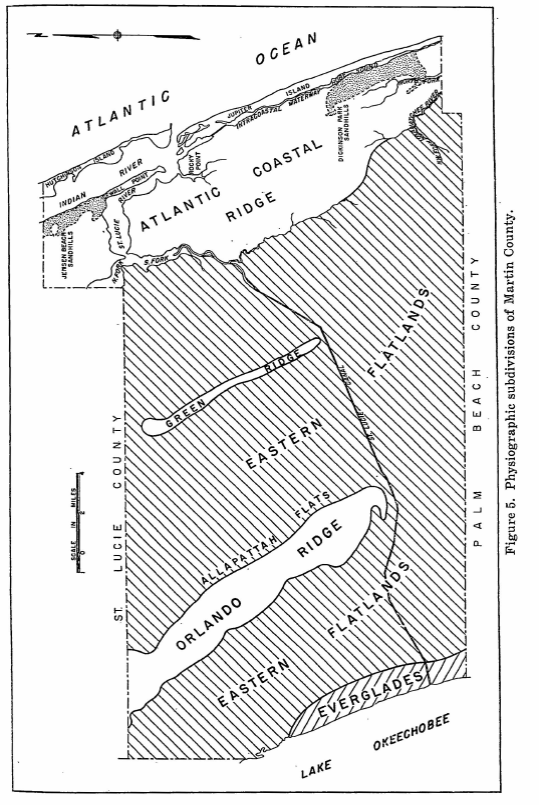
You may have recently read my post on Allapattah Flats where my brother utilized the map below from a 1960’s U.S.Geological Survey, “Martin County” report, on water resources prepared by William F. Lichtler? This report gives an excellent breakdown on pages 7-11; but even if you don’t read it, you can see it!

The Green Ridge guided waters south as they traveled slowly through the marshy Eastern Flatlands being deepest closest to the Orlando Ridge, Allapattah Flats. (For reference, today Indiantown lies in the southern portion of the Orlando Ridge.)

When the St Lucie Canal, (C-44) was cut ca. 1914-1923 and then deepened, widened, and “improved” many times since, it caused the waters moving southeast to shoot down into the St Lucie. Today, due to agriculture and development, these water are polluted and basically unfiltered and have been allowed to be so for many, many years.

And when Lake Okeechobee is opened into the St Lucie Canal…we all know what happens then. Complete destruction from a water source, Lake Okeechobee, that also was never connected to the St Lucie!

For years I tried to understand the Green Ridge, and it’s importance, now I think I do. In restoring our waters it is helpful to be able to envision how Nature functioned before humans altered the landscape to the point that she is almost unrecognizable. 

-Red baloon designates the Green Ridge


What is, what was, Allapattah Flats?

-Photo credit: Martin County: Chair Martin County Commission, Stacey Heatherington in red, and SFWMD Governing Board, ribbon-cutting Allapattah Flats 1-21-21Yesterday, the South Florida Water Management District held a ribbon-cutting for Allapattah Flats. The celebration was for over 6000 acres of wetland restoration work completed through a partnership: specifically the South Florida Water Management Distirct, the Natural Resources Conservation Service, a division of the U.S. Department of Agriculture, and Martin County who for a over a generation has provided leadership for natural land purchases. 

 As this recent op-ed of longtime Martin County Commissioner, Mrs Maggy Hurchalla states, bringing back wetlands is the most on the ground, real way to restore the Everglades. This means  the St Lucie River too. The beautiful bird life really appreciates this as post drainage, due to habitat destruction of wetlands, their numbers plummeted by the millions.

-Photo credit SFMWD: a juvenile little blue heron is released by Bush Wildlife Center!  -Renewed Partnerships: Rep. John Snyder; SFWWMD, JTL; MC Chair Stacy Heatherington; Comr. Doug Smith -JTL, MC Comr. Sarah Heard-SFWMD Executive Director, Drew Bartlett, JTL, & Mr. Jaun Hernandes, NRCSSo what was Allapattah Flats?

Since drainage, the lands, flora, and fauna have changed so much! It’s almost unrecognizable. To get a good idea of what it used to be, so as to understand the ribbon- cutting within the context of toady and yesterday, I knew if I was to well prepared for the event, I had to inquire with my history and map loving brother, Todd Thurlow. I am including Todd and my correspondence on this issue because it is so interesting and helpful in understanding “what is, what was, Allapattah Flats”. Our email exchange is below: 

J: “Todd tomorrow is the ribbon-cutting for Allapattah Flats. Was Allapattah Flats part of the Alipatiokee Swamp or was it separate? Was it a pine flatwoods area with small marshes or what. All these historic names sound the same. – Allapattah, Halpatiokee, Alpatiokee. I’m looking at that 1839 Gen. Z. Taylor map. Thanks.”

Above: portion of 1839 Gen. Zachary Taylor map. Allapattah and derivatives mean “Alligator” in Seminole.

Below: portion of “old” Florida map- one can see the former extent and connection of Allapattah Flats running along the inner east coast that the C-44 /St Lucie Canal from Lake Okeechobee to South Fork of St Lucie dissects. Shared by Todd Thurlow.

T: “I think Allapattah Flats is one of those names that has moved around/changed over the years.  It’s the old Al-pa-ti-o-kee Swamp of my YouTube Video.  It was a wetland.  Not a pine forest.  It may have become a pine forest after it was drained – or had pine forests at its edges like the Savannas in Jensen.

I think of it as the area west of Green Ridge and East of the Orlando Ridge.  I don’t think it was called Flats because of the pine flatlands.  I think the name may have come from the fact that it was flat – water would slowly flow north OR south in the poorly drained marsh depending on the conditions at the time.  The excepts below speak of it including the Hungry Land Slough or being a slough itself.  The first reference shows it immediately east of the Orlando Ridge. But the Al-pa-ti-o-kee was the entire area.”

  1. Florida Geological Survey Report of Investigations no. 23 – May 16, 1960

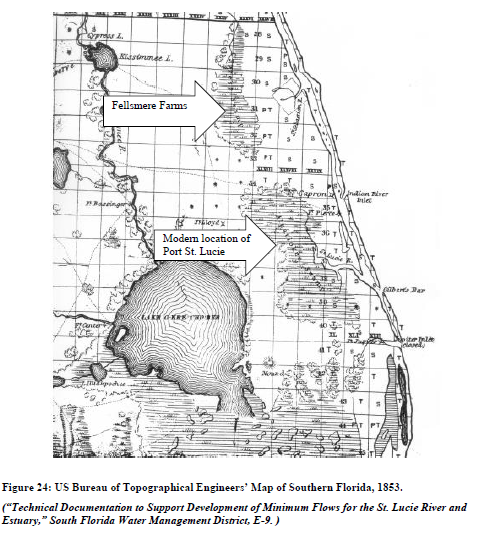
2. Oranges and Inlets – Nathaniel Osborn 2012. As the wetlands of the IRL were drained, the names of land features shifted over the decades to reflect their changing form. Today’s “Allapattah Flats” near the St. Lucie Estuary is undoubtedly a post-drainage name for the same feature listed on nineteenth century maps as “Halpatta Swamp” or “Alpatiokee Swamp,” but the lowered water table has left the area no longer resembling wetlands. Surveys of the lands west of the St. Lucie Estuary in the decade before the completion of the St. Lucie-Okeechobee Canal suggest that the land was covered with standing water for 8-10 months of each year. In the years which followed the post-1916 Drainage Act canalization, this drained region (like much of the IRL) became citrus groves, the town of Palm City, and the post-World War II development of Port St. Lucie (figure 24).273

————————————————————-

3. Bill Lyons, son of Ernie Lyons,  from your blog. “During summer, sheet-flow from the Allapattah Flats converged in tiny rivulets into a deep pool with a sand bottom, the first of a series of pools connected by shallow streams of clear water that formed the headwaters of the South Fork. Dad loved that place, not just for its beauty but for its solitude. Itcould only be reached by Jeep during the wet season, so we hitched rides with the local game warden, who would drop us o􀁷 and return for us later. Clyde Butcher’s photos of the upper Loxahatchee River are the nearest thing I’ve seen to what once was the upper South Fork. Then in the fifties, construction of the FloridaTurnpike cut off the flow of freshwater to the River. Soon saltwater intrusion crept up the South Fork,impeding the spawning of its fish, and the River began to die. In 1962, a friend and I drove to the former siteof the headwaters. The area had been bulldozed and the pool had become a cattle watering hole.”

4. Florida Everglades Report 1913 – Document 379, 63d Congress, 2d session

5. The New York Botanical Garden – Green Deserts and Dead Gardens, A Record of Exploration in Florida in the Spring of 1921

J: Todd this is incredible. Thank you!

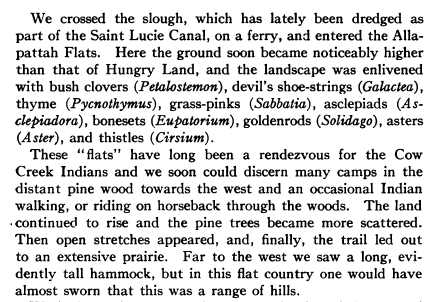
6. One more reference from The New York Botanical Garden, Old Trails and New Discoveries, A Record of Exploration in Florida in the Spring of 1919. It is pretty descriptive.  Hungry Land – southeast / Allapattah Flats northwest.This is the kind of stuff I love reading because you know what he is describing.  He describes the “distant pine wood towards the west” and a long evident tall hammock … one would have almost sworn … was a range of hills”.  He is looking at the Orlando Ridge, the southern tip of which is Indiantown.  You can still see what he sees when driving west on SR 70 or the stretch of turnpike that goes west though St. Lucie County.

J: So Todd, it sounds they drained Allapattah Flats and Hungry Land Slough in the 20s when they dredged  the St Lucie Canal from Lake Okeechobee to the St Lucie River. What a bargain! Aggg!  Thank God we are bringing some of it back! See you tomorrow!

Released juvenile little blue heron in wetlands Allapattah Flat, photo Todd ThurlowSo as you can see what is, what was Allapattah Flats is a long story! And we began to restore history!

Todd’s pictures:  http://www.thethurlows.com/2021-01-21_AllapattahFlatsRibbonCutting/

Jacqui’s speech: https://www.youtube.com/watch?v=AuklcguRVgY&feature=youtu.be

The official SFWMD stream:  https://www.youtube.com/watch?v=hg5MksxMbX0


Documenting the Discharges, December 2020

Documenting the Discharges, December 2020

Eyeonlakeo

I posted most of these photos on Facebook, but today I will give explanations and document on my blog. From above, our St Lucie/Indian River Lagoon remains beautiful, but we must be sensitive to the losses beneath the waters. These aerials were taken during  a “slack tide” between 12 and 2pm on December 9, 2020 by my husband, Ed Lippisch. December 9th was the last of five days the ACOE stopped discharging from Lake Okeechobee; however S-80 was discharging “local runoff.” (Click on chart above.) Unfortunately, due to high lake level and lack of storage reservoirs, since these aerials were taken, the ACOE has begun ramping up Lake discharges once again. 

Below Lawrence Glenn of the South Florid Water Management gives a comprehensive ecological report covering low-salinities and loss of oyster spat in the St Lucie and other aspects, positive and negative, for the entire Everglades system.

Below is an explanation of aerials documenting discharges December 9, 2020. All photos by Ed Lippisch.

-S-80 at St Lucie Locks and Dam discharging local basin S-80 runoff on December 9, 2020

S-308 at Port Mayaca, Lake Okeechobee closed on December 9, 2020. No algae visible. 

-Plume of along Jupiter Island south of St Lucie Inlet

-Dispersing plume in Atlantic Ocean just past Peck’s Lake in Jupiter Narrows

-St Lucie Inlet -St Lucie Inlet State Park, Sailfish Point, Sewall’s Point, Stuart, Jensen 

-Looking north to Sailfish Flats between Sewall’s Point and Hutchinson Island. This area has greatly degraded since 2013 as far as loss of seagrasses and fishing opportunities 

-The area below, especially around Sailfish Point, was once considered “the most biodiverse estuary in North America” as documented, first, by Grant Gilmore

-This photo reveals seagrass loss across many areas of the Sailfish Flats 

-Another view between Sewall’s and Sailfish Point, a seeming desert…

-Close up, Sailfish Point 

-Sewall’s Point, east Indian River Lagoon 

-Sewall’s Point is a peninsula surrounded by the St Lucie River on west side, and Indian River Lagoon on east side 

Ed Lippisch, selfie. Thank you Ed! 

As you can tell, I have lots of people helping me. Whether it is Ed flying or my brother Todd who provides an incredible easy to read website called EyeonLakeO. You can click below to check it out. The more we know, the more we document, the more we can overturn the destruction of our beloved estuary…

Eyeonlakeo website by my brother, Todd Thurlow. 

The Discharge/No Discharge Difference, St Lucie River/Indian River Lagoon

Looking back through my photo library, I was stuck by the color differences between these photos, so I decided to share….

The first two photos were taken recently, Saturday, December 5, 2020, the afternoon of the same morning the ACOE closed S-80 at the C-44 canal, and S-308 at Port Mayaca, Lake Okeechobee. This seems a bit quick for improvement, but so it was.

The second two photos were taken almost two months earlier, October 17, 2020 a few days after Lake Okeechobee discharges began and C-44 had already been discharging. 

The first three photos, taken by my husband, Ed Lippisch, feature the confluence of the St Lucie River and Indian River Lagoon between Sewall’s Point and Sailfish Point. The final  October 17 photos shows the plume from Lake O and basin runoff passing Peck’s Lake in the Jupiter Narrows. 

We all await the closing of both structures S-308 and S-80 for good. The issue at hand is always the height of the Lake Okeechobee and the story that accompanies such. 

Saturday, December 5, 2020, photo Ed Lippisch

October 17, 2020, photo Ed Lippisch

ACOE- Lake O discharges began Oct 14, 2020 and have stopped temporarily for 5 days, December 5, 2020. This is the most recent inflow chart, SFWMD.

Basin chart 

SFWMD basin map for SLR showing S-308 and S-80 along with other structures.


A Ten Year Calendar View, Discharges to the St Lucie Estuary

A Ten Year View, Discharges to the St Lucie Estuary

Today I share images that help tell the story of the St Lucie Estuary over the past ten years. The first image is from the website eyeonlakeo. My brother, Todd Thurlow, takes data from D-Hydro of the SFWMD and puts it into a format that the average person can understand. 

The chart above shows the “S-80 spillway at St Lucie Locks’ cumulative discharges by CALENDAR YEAR, 2011-2020.”

Scientists use Water Years, May 1 of one year, through April 30 of the next year. This splits up the years making it more confusing to remember or understand. We, as people, live our lives in calendar years. 

We can see by looking at Todd’s chart that 2016’s calendar year is highest overall discharge year with 842,775 acre feet (one foot of water covering one acre) of water going to the St Lucie from what is called “local runoff” (all canals and surrounding areas) as well as discharges from Lake Okeechobee.

How large is 842,775 acres? Comparatively, Martin County is 347, 520 acres. 2020 is 188,723 acre feet and climbing. We are talking tremendous amounts of water! 

In descending order, we see 2016; 2013; 2017; 2018; 2015; 2020; 2012; 2014; 2019; and 2011.  The brown of line of 2020 crests 2015 as when the year is completed, 2020 will more than likely be higher than 2015.

I also wanted to share some very helpful charts I recently requested -in my research- from the South Florida Water Management District.  

This was my request:

“Could you please get me a chart or graph showing discharges to the St Lucie River for 2012-2020 by month. Please present this information from January through December of each calendar year and break it out from S-80 and S-308 and also give a total combined number. Please also note for each of those calendar years, the highest level Lake Okeechobee got that year.” 

To view this information, click on Charts in red below for visuals, and data in red below for numerical charts. As mentioned this information below is from the SFWMD. This compiled information provides great perspective. 

Charts

data

I, as many, participated in yesterday’s Army Corp of Engineers‘ Periodic Scientist Call. During the course of the call, it was alluded that the ACOE may be letting up or halting Lake Okeechobee discharges to the St Lucie Estuary soon. As soon as they do, we will begin to chart calendar year 2021. All things considered, everything in me believes it will be better than 2020! 


Prohibiting Toxic Discharges, Would Change Everything

On almost any summer day, Lake Okeechobee is green with algae.

A recent press release states:

“Congressman Brain Mast has introduced legislation to prohibit toxic discharges from Lake Okeechobee to the St. Lucie Estuary and the Indian River Lagoon.  This legislation would make it illegal for the Army Corps of Engineers to discharge water containing algal blooms with a level of toxicity above the Environmental Protection Agency’s human health standard of 8 parts per billion microcystin.”

(Microcystins are hepatotoxins (liver toxins) produced by cyanobacteria, blue green algae.) 

Such a law regarding blue-green algae would push back and change everything. ~The toxic algae, the discharges, the years’ long built up non-point pollution that has made Lake Okeechobee eutrophic.

Let’s think about this.

The United States Environmental Protection Agency has codified exactly what level of microcystin is too toxic for human contact. The number is 8 parts per billion.

Some people in opposition to this bill say it is outlandish. I think it is outlandish that any business interests, neighboring communities, or level of government would think it is OK to literally dump toxic water onto the citizenry of Martin County.

Thank you Congressman Mast!

St Lucie River wide water, 2016.

Please be familiar with this press release and accompanying bill.

August 12, 2020

FOR IMMEDIATE RELEASE

CONTACT: Kyle VonEnde, 202-329-1890

                     Kyle.VonEnde@mail.house.gov

Mast Introduces Legislation Prohibiting Toxic Discharges


Stuart, Fla. – U.S. Congressman Brian Mast (FL-18) today introduced legislation to prohibit toxic discharges from Lake Okeechobee to the St. Lucie Estuary and the Indian River Lagoon.  This legislation would make it illegal for the Army Corps of Engineers to discharge water containing algal blooms with a level of toxicity above the Environmental Protection Agency’s human health standard of 8 parts per billion microcystin.

“The Army Corps has proven that if left to their own devices, they will continue to poison our communities with toxic discharges from Lake Okeechobee that they have acknowledged to be toxic.  No Floridian should tolerate being poisoned by their government,” Rep. Mast said. “The EPA has told us exactly what level of microcystin is too toxic for human contact, and now we must tell the Corps to stop these discharges that are destroying our waterways and putting our health at risk!”

The legislation is supported by Captains For Clean Water and Friends of the Everglades.

BACKGROUND


For decades, Florida’s coastal communities have been on the receiving end of toxic discharges, including recently discharges that have tested more than 60 times more toxic than the Environmental Protection Agency considers safe for human contact.  These discharges put public health at risk, damage the economy and destroy the environment.   Last year, Rep. Mast worked with the Environmental Protection Agency (EPA) to set a new public health standard for microcystin (8 parts per billion), which in turn forced the Army Corps of Engineers to admit to knowingly discharging toxic water to the coastal estuaries.  Despite acknowledging that these releases are toxic, the U.S. Army Corps of Engineers has continued to poison Americans.  

The legislation is attached: MAST_8ppb

_____________________________________________________

The photos below were taken just today, 8-12-20, at 9:30 am, by pilot Dr Scott Kuhns from the SuperCub. They show algae clusters in Lake Okeechobee. These algae clusters can grow very rapidly. Following are aerials of S-80 in the C-44 canal: when opened by the ACOE this structure allows water to discharge from Lake Okeechobee  into the St Lucie River.  Photo#1 JTL & Congressman Mast today at the Riverwalk along the St Lucie River, Stuart, Florida.  


C-44 Reservoir/STA Aerial Update -June 2020

C-44 Reservoir and Storm Water Treatment Area (STA) 

After weeks of algae Lake O shots, when my husband, Ed, went up in the Baron on June 17th, 2020,  I looked at him and said: “Could you please also take some photos of the C-44 Reservoir and STA for an update? I need a positive fix.”

Thus today’s photos of the C-44 Reservoir/STA in Martin County, off the C-44 canal near Indiantown, share good news. Most important for me, the pictures reveal that many more of the STA cells are slowly getting filled with water -in December 2019 they started with one as Governor DeSantis pulled the lever. One can see many more cells are now filled. When complete, these cells will cleanse tremendous amounts of nutrient polluted water prior to entry into the St Lucie River. The ACOE projects that construction will be completed by next year. It has been in progress for many years and is a” cooperative” between the ACOE (reservoir) and SFWMD (STA) and a component of CERP

Program: Comprehensive Everglades Restoration Plan (CERP)

“Located on approximately 12,000 acres on the northern side of the St. Lucie Canal in western Martin County, the C-44 Reservoir and Stormwater Treatment Area (STA) project will capture local basin runoff…”  ~SFWMD Achieve More Now” 

There are maps and links at the bottom of this post should you like to learn more. Thank you to all over the years and today helping with the completion of the C-44 Reservoir STA as we work to save the St Lucie River.  

LINKS

Computer Generated Model: (https://www.youtube.com/watch?v=4BsC0BoIPJ4

ACOE INFO SHEET:(https://usace.contentdm.oclc.org/util s/getfile/collection/p16021coll11/id/4599)Without

Martin County: “Martin County’s land acquisition efforts, this most critical and important project would not be under construction today.” (https://www.martin.fl.us/land-acquisition)

JTL  Past blog posts

SFWMD FIELD TRIP 2019 (https://jacquithurlowlippisch.com/2019/11/11/a-fly-over-a-field-trip-and-watching-the-governor-activate-the-c-44-sta/)

EARLY FLY OVER 2014 (https://jacquithurlowlippisch.com/tag/c-44-sta-and-reservoir/)

HISTORY: A LOOK BACK TO THE ORANGE GROVES OF TODAY’S C-44 RESERVOIR 1964 AERIALS: (https://jacquithurlowlippisch.com/2015/10/29/a-look-back-to-the-orange-groves-of-todays-acoe-sfwmds-c-44-reservoirsta-1964-slrirl/)

Red Balloon with black dot signifies footprint of former orange groves that became the footprint  of C-44 Reservoir STA approx. 10,000 to 12,000 acres

Documenting SLR and LO-June 2020

Documenting St Lucie River and Lake Okeechobee, Saturday, June 13, 2020

Today’s post includes two sets of photos taken from two different planes: the Supercub and the Baron. The Supercub is the classic yellow “River Warrior” open-air plane, and the Baron is a closed cockpit twin-engine with the distinctive upturned wing-tip. The Supercub can fly low and slow, the Baron can fly higher and faster. Both offer unique perspectives to photograph our waterways. 

I.

Dr. Scott Kuhns and Steve Schimming shared photos taken from the Supercub in the morning hours of Saturday, 6-13-20. Scott uses a quality Nikon camera thus his photos offer a wider or closer perspective. Thank you Scott and Steve, long time River Warriors and  friends. Their photos reveal the coffee color of the St Lucie following torrential rains.

Canal systems dumping fresh water into SLR  presently is primarily from C-23 and C-24. Good for the S.L. the SFWMD is advocating and the ACOE is allowing the water in the C-44 to run back into L.O. as lake was not in “ecological envelope.” Note: presently there are no discharges from LO into the SLR. ~Image SFWMD

St Lucie Inlet

Confluence SLR/IRL
Looking southt to St Lucie Inlet and Jupiter Narrows
Seagrasses looking bleak

Bird Island
Sailfish Point
Sailfish Point
Crossroads SLR/IRL

Sandbar
Sandbar
Sandbar
Bird Island IRL
Photos Dr Scott Kuhns: Sewall’s Point

II.

This next set of aerials was taken by my husband, Ed Lippisch, and myself the same day, 6-13-20,  a few hours later, closer to noon.  Again, it is important to note the St Lucie area recently experienced particularly heavy rains, only Broward County and parts of Miami- Dade had more. So we can learn about this, I am sharing the most recent Water Conditions Report of the SFWMD for details of all the St Lucie and all south and central Florida. See link under Rainfall Distribution Comparison slide below. 

The first group of photos from Ed and I in the Baron is of the St Lucie River and the second set is of algae blooms in Lake Okeechobee. NOTE THE ACOE IS NOT DISCHARGING INTO THE ST LUCIE AT THIS TIME.

We continue to document and thank all who are working towards projects and ways of life that better water quality in the state of Florida. We know what we need to do! 

https://apps.sfwmd.gov/webapps/publicMeetings/viewFile/25566


Sailfish Flats IRL
Exiting St Lucie Inlet looking south along Jupiter Narrows/Jupiter Island
Plume becoming visible
Looking back again into southern edge of SL Inlet

Now back at the St Lucie River and St Lucie Inlet at higher altitude
St Lucie River/Indian River Lagoon
Sailfish Point St Lucie River/Indian River Lagoon
Plume from higher perspective
Veteran’s Bridge in Palm City looking back to Stuart, note Witham Field and ocean in distance
Circling around- Hobe Sound looking north to St Lucie Inlet.
Heading west over Atlantic Ridge natural area
Approaching Lake O. FPL cooling pond visible.
S-308 at L.O. and C-44 Canal
My brother Todd Thurlow’s website shows that algae in L.O. is now showing on low resolution satellite imagery: Terra, Aqua, Suomi: http://eyeonlakeo.com/LakeO3x7days.html; http://eyeonlakeo.com
algae bloom southern rim
algae bloom like this was basically throughout southern area of lake, but denser in some areas and not so dense in others….
Ed’s palne GPS, present location south L.O.
South Lake O over southern rim
LakeO lapping towards Port Mayaca not FPL cooling pond, this area is by far the most algae ridden

Lake O
Lake O
Lake O
Lots of algae in Lake Okeechobee

MOVIE:

Now after flying west again over Lake Okeechobee algae here as well but more spread out

Another great SFWMD is the most recent Ecological Report as it discusses effects of water quantity and quality on fish and wildlife for all central and S.F.: (https://apps.sfwmd.gov/webapps/publicMeetings/viewFile/25567)

Like Night and Day, Reflections on a Once Toxic Marina

The St Lucie River-2018 to 2020. Like night and day.

The waters were fluorescent green-brown, and now they are clear.

It has been an amazing year. Even I have been surprised by the recent clarity of the St Lucie River and Indian River Lagoon. And what is really amazing, is that even the “worst of the worst” toxic areas of 2013, 2016, and 2018 now look “pretty good,” and life is returning.   

One of these areas is the Harborage Marina in Stuart under the Roosevelt Bridge. I recently took these photos as I felt even at night the reflection of the bridge shone brighter.

How things can change!

~Like night and day; like day and night…

As we enjoy the St Lucie River/Indian River Lagoon’s beautiful waters this year, we must not forget what we have gone through in 2013, 2016, and 2018. We can never take clean water for granted, we must continue the fight.

Like Night and Day, Reflections on a Once Toxic Marina

ROOSEVELT BRIDGE SOUTH DAY/NIGHT, APRIL 2020, JTL 


ROOSEVELT BRIDGE NORTH DAY/NIGHT APRIL 2020


WATER OF HARBORAGE MARINA APRIL 2020, OYSTERS COMING BACK. WATERS MUCH CLEARER. 


THESE PICTURES BELOW ARE FROM 2018 SHOWING SEAWALL AND ROOSEVELT BRIDGE AREA DURING TOXIC OUTBREAK. SAME PLACE DIFFERENT YEARS; DIFFERENT WATER MANAGEMENT. DAY CAN TURN TO NIGHT VERY QUICKLY SO PLEASE KEEP UP THE FIGHT.

MOVIE TOXIC ALGAE 2018 SLR HARBORAGE MARINA~IMG_4161


Beautiful -But I See Some Algae at Port Mayaca…

Family friend Scott Kuhns is a great dentist, pilot, and photographer. For years, Scott has been one of our “eyes in the sky,” taking flight over the St Lucie River-Indian River Lagoon -and west out to Lake Okeechobee. 

Today, Sunday, May 3, 2020, before noon, Scott forwarded these striking photos. He wrote “I can see some algae at Port Mayaca.”

When I first reviewed the impressive photographs -coast to lake- I found it hard to believe, but indeed looking very closely, there is a wisp of algae close to S-308 at Port Mayaca in Lake Okeechobee.

Can you see it? When things are so beautiful, like right now, it’s easy to miss!

Thanks Scott for your continued service “River Warrior” extraordinaire! We will continue to keep an eye on the water as we move closer to hurricane season. 

ST LUCIE INLET, CROSSROADS OF INDIAN AND ST LUCIE RIVERS DIVIDED BY SEWALL’S POINT, ~ALL PHOTOS BY DR SCOTT KUHNS

JUPITER NARROWS & ATLANTIC OCEAN SOUTH OF ST LUCIE INLET

C-44 CANAL at ST LUCIE LOCKS AND DAM, S-80

S-308, CONNECTION OF C-44 CANNAL to LAKE OKEECHOBEE 

VERY TIP of S-308 with ALGAE WISPS SLIGHTLY VISIBLE, BUT DEFINITELY THERE

INSIDE STRUCTURE S-308, PORT MAYACA LAKE OKEECHOBEE ALONG C-44 CANAL. S-53 ON ANOTHER CANAL. ALSO FPL COOLING POND SURROUNDED ON WEST BY WHAT APPEARS TO BE SUGARCANE FIELDS

REMNANTS OF THE ORANGE GROVE THAT IS NOW THE C-44 RESERVOIR AND STA.

SLR basins. SFMWD. You can see FPL cooling pond just northeast of S-308.


Aerials~St Lucie & LakeO-“After the Rain” 4-18-20

Last night, 4-18-20, after a hiatus, Mother Nature decided to “let it rain” and this morning friends Dr Scott Kuhns and daughter-in-law, Dr Mary Kuhns went for a flight over the St Lucie River and Lake Okeechobee to check things out.
Ed and I thank them for sharing their photographs!
Update-No visible algae at S-308 or along the C-44 canal. The waters of the St Lucie River are grayish from rain water runoff. Things look good, considering.  
~The rainfall numbers across the SFWMD can be viewed at the SFWMD’s 24 Hour Realtime Rain Gauge Site.
S-308 at Port Mayaca, Lake O
Along C-44 canal, do you see algae?
South Sewall’s Point, rain runoff visible
Hole in the wall & St Lucie Inlet
Rain plume exciting St Lucie Inlet

SFWMD 

Lake O 11.34 feet NVGD

JAXACOE

Canals in Martin & St Lucie Co.that are connected to the St Luice River: C-23, C-24, C-25 built in the 50s and 60s. C-44 is also connected to Lake Okeechobee constructed in the 1920s. The natural basins of the SLR have been tremendously enlarged damaging the river.

Thank you SFWMD & ACOE for info. 

Faint Algae Bloom at LakeO, S-308, C-44 Canal, Martin County

First of all, let’s recognize that we are stressed out enough social distancing due to the coronavirus. Nonetheless, for our waters, we must pay attention on every front. Right now, the St Lucie River and nearshore reefs are absolutely beautiful, and there is not a threat from Lake Okeechobee or area canals as it is not raining very much. Lake Okeechobee is at 11.85 feet NVGD, therefore, the chances of discharges into the St Lucie River are basically none. If another Hurricane Dorian comes this summer, that could be a different story.

SFWMD

SFWMD WEEKLY ENVIRONMENTAL CONDITIONS REPORT 3-25-20

SFWMD WEEKLY ENVIRONMENTAL CONDITIONS REPORT 4-1-20

We know our waters suffer from nutrient pollution overdose. Thankfully the State Legislature under the leadership of Governor DeSantis is now paying attention. It will take some time for the bills passed this past legislative session to bear fruit and some will need to be expanded, but when it comes to our waters we are in a better position politically this year and last year than in recent years. 

Nonetheless,  we must continue our advocacy and continue to document. 

The above Jacksonville Army Corp of Engineers map distributed during the March 31, 2020 Periodic Scientist Call shows how much water is going where from Lake Okeechobee. One can see that water for agricultural irrigation is being sent east into the C-44 Canal via S-308; at 191 cubic feet per second. This is fine, and I hope all the water users get the water they need, but algae blooms in our waters is a concern for me. 

ACOE Periodic Scientists Call 3-31-20

So to get tho the point, today I share my husband, Ed Lippisch and friend, Scott Kuhns’ flight photos taken today, April 2, 2020 around 11:00am. The aerials show the beginning of an algae bloom in Lake Okeechobee near the S-308 structure at Port Mayaca (Ed said it appeared much brighter than in the photos) as well as clearly in the C-44 Canal near the FPL retention pond and its structure S-153.

Continuing to fly east, there appears to be no algae at S-80, St Lucie Locks and Dam further down the C-44. Keep in mind, the water that is going into the C-44 canal via S-308 at Lake O, Port Mayaca  is not going east through S-80 but being used before it gets that far for water supply in the western part of the almost 30 mile C-44 canal.

~Confusing, I know! The C-44 is long and has multiple abilities. 

Here are the aerials, as long as possible, we will continue to document the St Lucie River and Lake Okeechobee. 

BELOW: LOOKING EAST OVER LAKE OKEECHOBEE, FPL COOLING POND VISIBLE 

BELOW: FAINT GREEN ALGAE CAN BE SEEN NORTH OF S-308 ALONG SHORELINE OF LAKE OKEECHOBEE FROM 2000 FEET. 

ALGE NORTH OF S-308 and RIM CANAL LAKE O  

BELOW: ENTRANCE OF S-308 AT LAKE O GOING INTO C-44 CANAL 

BELOW: S-80, St Lucie Locks and Dam, further east along the C-44 Canal, no algae visible

SFWMD basin map for SLR showing S-308 and S-80 along with other structures.

Color-coded Nutrient Pollution Maps Shine the Light! LakeO/SLE

I have been wanting to write about these water quality maps for months. Now that I am at home, social distancing, due to the coronavirus pandemic, I have no excuse. So today, we begin.

Some history: about six months ago my brother, Todd Thurlow and Dr Gary Goforth started collaborating to create nutrient pollution color coded maps. The data is compiled by Dr Gary Goforth via South Florida Water Management District’s DBHydro water quality database; and the graphics are generated by Todd. All of these computer generated images can be found on my brother’s website, eyeonlakeo. This is a site you are probably familiar with as it led the charge on Harmful Algal Bloom Lake O satellite imagery before that went public in 2018. My goal is to do the same with these maps. In time, have them “go public.” The form this data exists in the District’s reports today is very sophisticated and thus confusing for the general public. With help from Gary, Todd, and a former eighth grade teacher, (me) it doesn’t have to be!

So let’s start with overview color. Basically, any color other than green is a flashing light, especially orange-red, or dark russet! 

When looking at these maps, one must keep in mind that the map is in WATER YEARS. A water year begins on May 1 of a year and goes through the following year ending April 30th. The above map labeled “Lake Okeechobee Watershed Total Phosphorus Concentrations,” is Water Year 2019. (May1, 2018 – April30, 2019.)

Next, one must learn to think in terms of SUBWATERSHEDS and BASINS. The image above is for the entire 3.4-million acre watershed of Lake Okeechobee, and is broken into sub-watersheds and basins from large to small based on the way the water “flows” or used to. The sub watersheds are identified in bold in the table to the left and the basins are listed below.

The colors on the map are shown by scale at the bottom from green to dark red. You don’t have to be a genius to see that for instance S-154 Basin is one of the darkest color reds with a concentration of 857 “µg/L” (microgram per liter, commonly expressed as “parts per billion”, or “ppb”). In 2001, the State of Florida established a Target for the average phosphorus concentration in water entering Lake Okeechobee of about 40 ppb, so this basin’s concentration of 857 ppb is 21.4 times the Target concentration for the Lake; hence this basin has a “Target Multiple” shown in the table of 21.4.  

The color coding gives you a quick and easy way to identify which basins are close to the target (green basins) and which basins need a lot of improvement in their non-point source controls (red basins).  For a more quantitative assessment, you can check out the  “” values in the table for each basin.  It’s important to remember that while concentrations are very important to identify which basins need additional non-point source controls, such as farming or urban best management practices (BMPs), the “load” entering the lake from each basin is also important.  We’ll talk about loads in a future blog. Now let’s take a look above at map number two, the “St Lucie Estuary and Watershed Total Nitrogen Concentrations” map.   Nitrogen is the other important nutrient besides phosphorus that affects our water quality, including algae blooms.  Since we already know now how to interpret the color coding, we can easily see that the Tidal Basins – the largely urban areas around the estuary – has the lowest nitrogen concentration, i.e., the Tidal Basins has the best nitrogen water quality.  The Tidal Basin had a concentration of 824 ppb, and with a Target Multiple of 1.1 this concentration is still about 10% higher than the Target set by the State of 720 ppb.  So while this basin has the best nitrogen levels in the watershed, it still has some improvements to make in order to meet the nitrogen Target.  By contrast, Lake Okeechobee discharges, and runoff from the C-23 and C-24 basins are the darkest red and therefore have the poorest water quality, with nitrogen concentrations about 2 times the Target.    The orange to red colors for these and the C-44 and Ten Mile Creek basins indicate these basins need to implement considerably more effective source controls in order to meet the Target for the Estuary.

Todd’s website and Gary’s (http://garygoforth.net/Other%20projects.htm) show phosphorus and nitrogen maps for the Lake and St. Lucie Estuary watersheds.  They are working on maps for the Caloosahatchee River and Estuary Watershed.

In closing, these powerful visual maps give us the ability to easily “see” where the greatest problems of nutrient runoff are located; the nutrients come from many sources, including urban and agricultural activities, e.g., fertilizer application. And although the numbers and colors don’t tell us exactly where this pollution is coming from, we can determine it is problematic in the designated basins.

That’s enough for our first day. Hope it was a good one!

A Fly-over, a Field Trip, and Watching the Governor Activate the C-44 STA

Google Map area of C-44 Reservoir and STA in Indiantown, FL, Martin County.

Work on the C-44 Reservoir and Storm Water Treatment Area started back in 2004 and is one of a few gigantic water projects of the Army Corp of Engineers and South Florida Water Management District. The mammoth construction site is part of the Comprehensive Everglades Restoration Plan, Indian River Lagoon South. In Martin County, the foundation for this was laid back in 1996 and 1998, and then again in 2006 when the public supported environmental land purchases through a sales tax: https://www.martin.fl.us/land-acquisition

There were years of planning and design with stops and starts. Time has gone by and when funding has been in place, the Army Corp of Engineers has been building the reservoir (since 2015) and the South Florida Water Management District has been building the storm water treatment area (since 2014) : https://www.saj.usace.army.mil/Missions/Environmental/Ecosystem-Restoration/Indian-River-Lagoon-South/

Recently, the SFWMD has made great progress for water quality projects with strong backing from the public (fed up with toxic algae blooms), Governor Ron DeSantis and the Florida Legislature.

Today I will be sharing three things: a flyover with my husband Ed; a field trip led by the SFWMD to C-44 with Florida Sportsman Magazine; and the grand finale, the visit of Governor Ron DeSantis to allow the first waters of the C-44 Canal to flow into the STAs.

Why has everything taken so long? We’ll there are many reasons but we must note the 2008 Great Recession, politics, and most of all, the project’s size!

The map above and below can give you an idea of the project’s 12, 000 acres!

Years ago, I wrote a post about the Minute Maid Groves that were once on this property and shared awesome photos my mother gave me from 1964. Groves to Water, amazing how times change: “A Look Back to the Orange Groves of Today’s ACOE SFWMD C-44 Reservoir/STA, 1964, SLR/IRL” https://jacquithurlowlippisch.com/tag/c-44-storm-water-treatment-area-and-reservoir/

Looking at the Google Map, you’ll notice that you can easily see the outline of the former groves. Perusing the map below, you can see the reservoir will be in the north west corner and the six cells of the storm water treatment area on the east. You will also notice that Allapattah Flats, once a gigantic marsh through St Lucie and Martin County, is north of the project along with Troup’s – RB Ranch – upper east. Star Farms is west and grows sugar cane at the present time. There is a long intake canal off the C-44 canal that brings in the polluted water – primarily from local farm runoff. 2/3 of Martin County is agricultural. It is important to keep these lands in agriculture as developed lands would be even harsher on the  wildlife and the environment. We all, coast or inland, must work to clean things up!


SFWMD map of site
  1. FLYOVER C-44 RESERVOIR & STA,  ED LIPPISCH and JTL, SUNDAY, NOVEMBER 10, 2019.


on Sunday, November 10, Ed and I flew over and took aerial photos. Below you can see the airplane over the reservoir looking over the cells of the storm water treatment area. Also note the long intake canal to the C-44 Canal.

Looking over Cell 2 C44 STA

2. FIELD TRIP TO C-44 RESERVOIR & STA WITH FLORIDA SPORTSMAN MAGAZINE, and JTL led by Alan Shirkey, Bureau Chief, Engineering and Construction, SFWMD and Buff Searcy, Lead Engineer and Construction Manager, SFWMD. THURSDAY, NOVEMBER 7, 2019. This was a great opportunity and thank you to Blair Wickstrom for recommending we do such from the ground. This is were one really sees what is going on!


Entrance sign along Citrus Road in Indiantown
On Thursday, Blair Wickstrom and Tray Wheeler of Florida Sportsman Magazine and myself took a tour or the property and really got to see it from the ground.  Buff Search, JTL, Blair Wickstrom, Alan Shirkey
Pumps pull in water from below
Buff Searcy, Lead Engineer, Alan Shirkey, Bureau Chief SFWMD, Florida Sportsman publisher, Blair Wickstrom, reporter Tray Wheeler. Large gate strains.
Buff Searcy, Lead Engineer SFWMD with reservoir dike in background.
Buff Searcy, Blair Wickstrom, Tray Wheeler, Alan Searcy discuss…
Indigo Snakes are an endangered species and live in this area
The wildlife was most interesting to me as many types were in the area. We saw numerous deer resting in the grass. I was assured they would move when the reservoir and STA were up and running. It pains me they do not have more wild habitat.
Signs regarding threatened/endangered eastern indigo snake
Alan Shirkey explains the reservoir and STA.


3. GOVERNOR DESANTIS ACTIVATES THE C-44 STA, INDIANTOWN, FRIDAY, NOVEMBER 8, 2019. A great day and an honor for me to be there up close to our wonderful new Governor!

“The SFWMD recently completed three of the six cells of the 6,300-acre treatment area and expects to have the entire STA completed next year. The U.S. Army Corps of Engineers is building a 3,400-acre reservoir next to the STA that is expected to be completed in 2021.
The C-44 Reservoir will store 50,000 acre-feet of water, including local basin runoff and Lake Okeechobee releases. This will reduce harmful releases reaching the St. Lucie Estuary that can fuel harmful algal blooms. The C-44 STA will treat the water stored in the reservoir before it is released into the estuary.
“I can’t help but smile. Water flowing into this treatment area marks a momentous day in the history of the Everglades, the Treasure Coast, and the St. Lucie Estuary,” said SFWMD Governing Board Member Jacqui Thurlow-Lippisch. “This is the start of the road to a healthier estuary and Everglades. Under the leadership of Governor DeSantis, progress on Everglades restoration is moving at a rapid pace.”” 

Please see Press Release from the Governor’s Office: Governor Ron DeSantis Activates C-44 Stormwater Treatment Area

Cleaner water coming to St. Lucie River, Indian River Lagoon as SFWMD opens C-44 project, by Tyler Treadway:https://www.tcpalm.com/story/news/local/indian-river-lagoon/health/2019/11/08/water-pumped-into-sta-desantis-celebrates-lake-o-project-indiantown/2506354001/

The Governor hits the button and the first waters flow into the C-44 STA. It can take months for these to slowly fill. Later plants (mostly cattails) will grow and filter water before from the Reservoir before it goes back into the C-44 Canal and St Lucie River.

Water entering the STA

People gather to await the governor!

.

.

.

.

.

.

Gov. DeSantis speaks, photo Carolyn Timmann

Carolyn Timmann and Alan Shirkey stand before cell 2 of the C-44 STA as water enters for the first time

.

Former posts on C-44 Reservoir and STA

October 13, 2014: Seeing Results C-44: https://jacquithurlowlippisch.com/2014/10/13/seeing-results-c-44-storm-water-treatment-areareservoir-st-lucie-river-indian-river-lagoon/

Sept 15, 2015: Reaching the Finish Line: https://jacquithurlowlippisch.com/2015/09/15/reaching-the-finish-line-c-44-storm-water-treatment-areareservoir-slrirl/

October 29, 2015: A Look Back to the Orange Groves of Today’s ACOE SFWMD C-44 Reservoir/STA, 1964, SLR/IRL https://jacquithurlowlippisch.com/tag/c-44-storm-water-treatment-area-and-reservoir/

Sunrise Rotary’s 2nd Annual Water Forum, Public Health as it Relates to the River

Thank you to Rotarians Mr Larry Lavargna and Ms Elmira Gainey for co-chairing Stuart-Sunrise Rotary’s 2nd Annual Water Forum, Public Health as it Relates to the St Lucie River. There are few instances where so many influential water voices come together to speak on the river as it relates to public health and for a question/answer period after each to boot. A excellent public forum!

I noticed that of all the speakers, Dr Gary Goforth had written out his talk, thus in case you were unable to attend,  I asked if he would share. His words are included below. You can also find many of the presentations recorded and posted at Treasure Coast on Facebook.

The most powerful things happen when we all get involved and include others! Thank you Sunshine-Rotary!

2019 SSRC OUR WATER 2019 Booklet

2nd Annual Rotary Water Forum – October 5, 2019

Public Health as it Relates to the River

Gary Goforth

We are so blessed to live in Paradise!  Like you I love this river, its estuary, its mangroves, its beaches, its near-shore reefs. But as many of you know, it is a Paradise with a tragic problem. Below the surface of this serene river lies poison.

Ms. Sandra Thurlow recently provided the following treasure: In 1885, Homer Hine Stuart, Jr. for whom Stuart is named carried around a small woodcutting representing the confluence of the North Fork and South Fork of the St Lucie Rivers.  This carving showed the river as 20 feet deep at the location of the future Roosevelt Bridge.  Imagine that!

Thirty years later Ernie Lyons described looking down into the River 15-20 ft through clear tea-colored water to a sandy bottom below.

The area behind us was known worldwide as “Giant Tarpon Kingdom” with regular catches of silver kings above 175 pounds. The world record was reported as 220 pounds, caught just up river.

In 1913, the State of Florida decided to construct a canal connecting Lake Okeechobee with the Atlantic Ocean. The primary intent was to divert the overflow of Lake Okeechobee away from its natural course south through the Everglades, thereby allowing the sawgrass plains south of the lake to be developed for agriculture. A secondary benefit was to provide cross-Florida transportation of produce and other commerce.

On June 15, 1923, the first recorded discharges from Lake Okeechobee passed through the newly constructed St. Lucie Canal, which connected the St. Lucie Estuary to the Lake.  But an unintended consequence was the discharge of countless tons of muck and dirty freshwater from the Lake that forever changed the landscape of the St Lucie River and Estuary.

Within 10 years the Martin County Commissioners had asked the State to stop the discharges “for the reason that the continued discharge of a large volume of dirty freshwater has killed all the shell fish, driven all salt water fish from the river, filled the river with hyacinths and so polluted the St Lucie River as to completely take away the attractive features and ruin its commercial value to the community.” (December 15, 1930 MCBCC)

The lake discharges drove out the king tarpons – the 150-200 pounders – and the small city of Stuart recast itself as the “Sailfish Capital of the World.”

Ernie Lyons described the damage in this way:

“We turned our good, sweet water into a cup of poison and changed a laughing little river into a reeking abomination – in the latter part of an ordinary lifetime.  Clean rivers are not “forever and forever” like the sunrise.” (from The Last Cracker Barrel (1976) p 62)


As a professional engineer I’ve had the honor of working to protect the environment of south Florida for more than three decades – in the Everglades, in Lake Okeechobee, along the Kissimmee River and its headwaters, and in the magnificent estuaries –the St Lucie and Caloosahatchee. My wife and I raised three kids here along the St Lucie River and I’ve taught my two grandsons to fish and appreciate the incredible biological diversity throughout the river and estuary and near shore reefs.  But unfortunately, we don’t eat the fish we catch in the River because of the public health risk.

  1. I recently had the misfortune of being in the emergency room of our local hospital. One of the very first questions I was asked was if I had had any recent contact with the St Lucie River.
  2. During the 2016 discharges I walked along Stuart Beach with Jacqui Thurlow-Lippisch and we collected the names and stories of over 100 people who had gotten sick after coming in contact with the water.
  3. A beautiful dog, Finn, died that summer after morning frolic in the water. Several other dogs suffered acute liver failure, and suffer to this day.


2016 was a watershed year in understanding the relationship between the discharge of polluted water from the Lake and public health. The media began to focus on toxic blue green algae – particularly the microcystis form.   While parts of our beloved estuary were covered in foul smelling neon green guacamole, the media began reporting on the effects of microcystis and human health.  An Ohio State University study reported that those of us in Martin and St Lucie County have twice the national average rate of death for non-alcoholic liver disease.  They correlated this high rate with one thing – discharge of polluted water carrying blue green algae from Lake Okeechobee. This particular form of blue-green algae – microcystis – carries a dangerous toxin that can cause serious liver disease which can lead to death.  Additional human health risks have also been identified – Parkinson’s, Alzheimer’s and Lou Gehrig’s disease.

In the last year – thanks to the efforts of Congressman Brian Mast – the Corps of Engineers acknowledged for the first time that Lake discharges to the estuaries carrying microcystis are toxic to humans, and the US Government makes these discharges knowingly and with the understanding that they are poisoning us – the public that they serve.

Numerous public health advisories have been issued in our region in association with lake discharges – warnings to the public to avoid contact with the water.  But none have ever been issued when Lake water is sent south – the environmental conditions south of the lake are not advantageous for sustaining toxic blooms.  So the alternative to knowingly poisoning the public are clear – send the water south.

Col. Kelly is now in charge, and we are truly grateful for his leadership.  As the Corps revises its operation schedule of the Lake, I am sure that Col. Kelly will ensure that the public health, economies and environment of our region are given equal weight as the public health, economies and environment of the area south of the Lake.  Hundreds of millions of dollars in economic loss are felt by the regions around the estuaries during years of heavy lake discharges. Public health is adversely affected. There is no acceptable level of lake discharges.  There is no level of Lake releases to the St Lucie Estuary that is beneficial.

Lake discharges contain pollutants include toxic blue green algae, sediment (muck), low salinity water, and nutrients.  However, even if all the Lake water was sent south, our beloved St Lucie would still be in trouble.  Our local watershed has its challenges – particularly high levels of nitrogen and phosphorus in agricultural runoff.  Our watershed suffers from the same lack of pollution regulation as the Lake Okeechobee watershed: landowners are not held accountable for pollution from their property.

But the problem is not just ag runoff – WE ALL ARE RESPONSIBLE.  For the St Lucie Estuary, approximately 5-10% of the total nitrogen loading is from our septic tanks.  If you have a tank – have it inspected and maintained.  Water quality data show an improvement in nitrogen levels due to positive actions taken by the City of Stuart, Martin County, Port St. Lucie and homeowners – conversion of more than 8,000 septic tanks to centralized sewer.  The City of Stuart has one of the best programs for converting septic tanks to sewers: a voluntary system that allows homeowners the option of waiting until their tanks or drainfields need replacing before hooking up.  But converting septic to sewer doesn’t solve the problem of nutrient overload – it just moves the problem to other areas.  The majority of the residuals from wastewater treatment plants are returned to our watersheds as “biosolids” that contain high concentrations of phosphorus and nitrogen.  An article in this morning’s Stuart News documented the presence of antibiotic-resistant bacteria in dolphins, and the researchers attribute much of the problem to pharmaceuticals that pass generally untreated through centralized sewers and are returned to the watershed through biosolids.     We still need a better strategy for managing biosolids.  Sen. Harrell – we look to you for leadership in the Legislature to require additional oversight and regulation of the application of all biosolids in our watershed.

The Florida Legislature is the single most influential group that can positively affect the public health in the state of Florida.  The Legislature has an obligation to understand that allowing continued pollution of Lake Okeechobee and the estuaries will directly and adversely impact the health of the public you represent.  Unless the State begins holding landowners accountable for the pollution they generate, there is absolutely no reason to believe that our water quality will improve and as a result, our public health will continue to decline.  No matter if the Corps and SFWMD implement all the projects on the books – there will still be Lake discharges of toxic water to our estuaries – and unless the Legislature reverses its direction, the water quality and public health problems will persist.

I ask Sen. Harrell to work with the Legislature to hold the state’s Dept. of Environmental Protection (DEP) accountable for protecting our environment.  Their current program for improving water quality going into the Lake is terribly broken.  Pollution loading to the lake reached an all-time high in 2017.  And compounding this problem is that annual DEP reports to the Governor and legislature and public are misleading – as they allege that pollution loads are decreasing – when the reality – as documented by the SFWMD – is that average pollution loads are higher than the Starting Period.  For 2017 the measured phosphorus loads to the Lake were 60% greater than they reported in their annual report.  For 2018, the measured loads were 40% greater than they reported.  Who holds the DEP accountable for transparency and accuracy in reporting to the Governor, the Legislature and the public?  Sen. Harrell – please demand accountability on the part of DEP.

USEPA recently established draft guidelines for microcystin in water. We urge the legislature to direct DEP to expeditiously embrace and adopt those guidelines to protect human health. We support Col. Kelly’s efforts to prevent Lake discharges to our estuary that contain blue green algae, and urge him to adopt the microcystin guideline into the new version of the Lake operating manual.

I want to thank Ms. Thurlow-Lippisch on behalf of the SFWMD – for exploring more ways to sending Lake water south through the STAs, into the Everglades and on to Florida Bay. The SFWMD is also the agency responsible for collecting water quality data documenting the state of the water.  Thanks to the leadership of Ms. Thurlow-Lippisch, they are initiating steps to establish a regulatory program that if done properly will hold landowners accountable for reducing nutrient pollution.  The SFWMD will need our support as they develop an effective program – and we the public need to turn out and support them in their efforts.

We’ve heard Col. Kelly and others describe projects to be completed in the next 2-3 years.  Wouldn’t it be wonderful to celebrate the 100th anniversary of the first discharges from the Lake with a promise to stop the toxic discharges?!

I’d like to end with a challenge for all of us from an idol of mine – Timer Powers – Timer was a former Martin County commissioner and water management board member and Executive Director:

“The greatest challenge in front of us is to take the steps that are necessary to assure that our younger generation has the rivers, the creeks and the critters that are at the heart of our whole society.  There’s not many people representing the critters, and if we fail to represent those who can’t represent themselves, either nature or people, then we have failed.”

So to my fellow clean water advocates – let’s rise up to meet this challenge!  We can do this people!

Thank you all, and to the Rotary for bringing us all together on this beautiful day along side this beautiful estuary!