
Map of earliest canals built in 1911. The SL Canal was built in 1915-1923 and was then widened and deepened in the 1940s. Florida Archives.Close up of SFWMD map today showing S-structures south of LO. See rim of lake.South Florida has many “S” structures and S-333 is one of a few furthest south, south of WCA 3, allowing water to enter the Everglades and other areas.
Today’s blog will feature a common sense question. The question is basically why isn’t the dumping into the St Lucie River/Indian River Lagoon being alleviated by the large canals south of Lake Okeechobee, specifically the Miami and New River? Those two rivers were used before for drainage before our St Lucie canal was even constructed. The Miami River naturally had rapids before they were blown up with dynamite…Mother Nature had her way of dealing with the some of the spillover waters of Lake Okeechobee. Why aren’t we following that model?
I think a recent exchange between my brother Todd and Dr Gary Goforth gives insight into this question. I learned from it and the conversation is not yet over, thus I am posting it today.
By the way, just in case you don’t know, “S” means “structure” for water releases…. There are hundreds of structures that allow water to drain Lake Okeechobee and thus South Florida. The SFWMD deals with the structures south of the lake and the ACOE deals with the larger structures that go east west to the our northern estuaries.
Here we go:
TODD: http://www.thurlowpa.com/news.htm
“Right now… I am looking at the status map asking: “Why are the WCAs rising while very little water, if any, seems to go out to the New River (S-34) and the Miami River (S-31), which are historical tributaries of the Everglades (they even had rapids!) ?— all while we are getting dumped on because the Water Conservation Areas (WCAs) are over schedule?”
Recently, S-34 flowing into the New River was at 0 cfs. Now I see that it is at 233 cfs. A drop in the bucket compared to the 7523 cfs that has been hitting the St. Lucie for days.
That S-333 doesn’t seem to flow to the Park but instead to the Miami River also. (Someone correct me if I am wrong.) It was at 0 cfs on the 4th and is now at 1200 cfs. Even if that water isn’t going to the Park, at least it is going south and not east/west – but why the wait? The system is more complex than we will ever understand but the more we understand the better. Thank you, Gary, Mark Perry and others for keeping everyone informed.
DR GOFORTH:http://garygoforth.net
Todd – you’re absolutely correct – the New River and Miami Canal were historical tributaries of the Everglades.
“Why are the WCAs rising while very little water, if any, seems to go out to the New River (S-34) and the Miami River (S-31)?”
The short answer is that flood protection for the suburbs of Ft. Lauderdale and Miami takes precedence over conveyance of floodwaters from the water conservation areas. The intervening canals are operated to provide flood protection to the urban areas between S-31/S-34 and the tidal structures (S-26/ – similar to S-80 in the C-44). When heavy rains occur in the suburbs, the canal capacity is primarily devoted to moving the stormwater out of the basin. After the storm events and water levels in the canals subside, S-31 and S-34 can be opened to move so-called “regulatory releases” out of the water conservation areas. This is similar (although not exact) to how S-308/S-80 and the C-44 Canal is operated – flood protection of the local basin takes precedence over Lake releases.
“why the wait?”
Opening S-333 allows water from WCA-3 to move into the Tamiami Canal (aka L-29 Canal); the one-mile bridge along Tamimi Trail allows water from the Tamiami Canal to enter Northeast Shark River Slough (see the map). S-333 couldn’t open without special authorization from the Corps to allow the water level in L-29 Canal to rise, which Gov. Scott requested in his letter last week, and the corps granted this week.
Gary Goforth S-333.
Interesting to think about…maybe there is more to explore here….
Contact the SFWMD should you wish to get a Facility and Infrastructure Location Index Map: (561) 682-6262. The person at this number should be able to direct you.
Water Conservation Areas as seen below the Everglades Agricultural Area. South Florida is compartmentalized to control water to “protect” farms and people ….this does always work.
We are in rain-year not seen before….
The state is overflowing…..
Our St Lucie River/Indian River Lagoon is again being destroyed by too much fresh, dirty, water….
Why is it so hard to send this water south?
It is “so hard to move water south” because the state of Florida has been compartmentalized to protect the Everglades Agricultural Area south of Lake Okeechobee and to keep-dry much of the lands that we live on. And now our waters are polluted…
Imagine, if you would, what would be going on here in South Florida now if modern man had never “conquered” it….Basically it would be a clean free-flowing marsh all the way from Shingle Creek in Orlando through Lake Okeechobee to the Everglades.
Well that it is no longer the case, is it? Since the 1920s, and more so since the 1940s, these lands have been drained, and diked, and altered, so that humans can grow food, and live here –inadvertently polluting the system. It is an imperfect situation and we must try to understand it, so we can make it better as we all need clean water.
1850s map of FloridaToday’s flow into SLR and Caloosahatchee from Lake Okeechobee used to flow south.
So for the everyday person trying to figure out “what is going on” right now, let’s take a look at “today:”
It has been raining lot. Since the end of January, the St Lucie River/Indian River Lagoon and Caloosahatchee are being destroyed once again as the state of Florida and the U.S. Army Corp of Engineers dump incoming waters out of Lake Okeechobee so that the Everglades Agricultural Area south of the lake and surrounding communities are not flooded. Drainage and property in our area is part of this too.
A rare situation occurred this past week where Florida’s governor, Rick Scott, issued an order to release water south through a canal into the Everglades. He had to confer with the US ACOE to do this. (Due to poor water quality and safety, just “sending water south” is not allowed. But now with so much water, it is an emergency.)
The Water Conservation Areas south of the EAA, —these gigantic areas (see bottom slide) that are considered part of the Everglades and full of wildlife and in some places sacred Native American tree islands, are so full of water that they have to be dumped first. If they are lowered, then more water can enter from the Everglades Agricultural Area and hopefully Lake Okeechobee itself. Then, and only then, would there be less dumping into the St Lucie River/IRL and Caloosahatchee. We have a long way to go and its not even “rainy season.”
I commend all those working hard to alleviate the overflowing system and I encourage investment in working to improve this relic as well as investment in the children who must be part of the goal to re-plumb this system. Dr Gary Goforth shows us how it is working right now as I asked for a simple explanation to share with the River Kidz.
Gary Goforths’ image to explain “water going south.”
“Jacqui—
Due to increased stormwater pumping from the EAA and surrounding areas and direct rainfall, the water levels in the WCAs are too high. Last week the Gov. sent a letter to the Corps requesting authorization to raise water levels in the Tamiami Canal allowing increased flows into the Park through Northeast Shark River Slough. Yesterday the District began making those increased discharges through structure S-333. Whether or not the District will send additional Lake water south is yet to be seen – lowering the stage in the WCAs should help. See the map above. (from page 2 of the attached).”
FOR IMMEDIATE RELEASE
February 11, 2016
CONTACT: GOVERNOR’S PRESS OFFICE
(850) 717-9282
media@eog.myflorida.com
DEP and FWC Issue Orders to Allow Army Corps of Engineers to Ease Effects of Flooding
TALLAHASSEE, Fla. – Today, the Florida Department of Environmental Protection (DEP) and the Florida Fish and Wildlife Conservation Commission (FWC) issued orders that will allow the U.S. Army Corps to move more water south through Shark River Slough to ease the effects of flooding in South Florida. Click HERE (http://www.flgov.com/wp-content/uploads/pdfs/FFWCC.pdf)
to see the orders.
Earlier today, Governor Scott sent a letter to the U.S. Army Corps of Engineers to take immediate action to relieve the flooding of the Everglades Water Conservation Areas and the releases of water from Lake Okeechobee to the Caloosahatchee and St. Lucie Estuaries. To read the letter, click HERE (http://www.flgov.com/wp-content/uploads/2016/02/2.11.161.pdf).
Martin County Fair 2016Since my childhood the Martin County Fair has been one of my favorite times of year. US Sugar was not an advertiser when I was growing up here.First sign displayed upon entering fairgrounds., 2016
At the chance of sounding like “a sounding brass, or a clanging cymbal,” I would like to share my experience yesterday at the Martin County Fair.
Mind you, for me, the Martin County Fair is as apple pie as a once clean river. Growing up in Martin County the fair was THE event of the year. We waited all year for it to come to town!
It was the one place our parents would set us “free” to run around and visit our friends, go on the ferris wheel and the Zipper!—-Scrunched together in the gravity of middle school, this was about as much fun as could possibly be attained…..I have wonderful memories of the fair.
Most recently, I have gone to the Fair with my nieces, and last night by myself. My husband, Ed, wanted to piddle around at the airport just across the street….Well, yesterday when I walked through the fair’s gate there was a most prominently posted sign that read: “U.S. Sugar.”
Sign….
This surprised me. This bothered me.
I knew they were a sponsor for the fair but I was taken aback that this was the first sign one would see upon walking into the fairgrounds from the entrance gate. Thousands of parents and children saw that sign right before they had a ton of fun…
Hmmmm?
I complained to Ed later. “Jacqui are you really surprised?” he asked….”The fair needs sponsorships. U.S. Sugar is marketing…”
Maybe my eyes are not totally opened, but I do find a U.S.Sugar banner prominently displayed at the Martin County Fair odd and ironic.
I find this ironic as at this very moment the gates of S-80 are at “maximum capacity” forcing the polluted waters of the Lake Okeechobee into the St Lucie River/Indian River Lagoon. The lands of U.S. Sugar are blocking the flow south to the Everglades.
Often I hear that the fault lies north as those waters are coming from the Kissimmee basin not south of the lake. To me that is like stopping in traffic and blaming a car two miles up the road for the traffic jam.
Last year, U.S. Sugar did not support the purchase of option lands that could have eventually alleviated this problem. I don’t think it is morally right for them to advertise at our fair until they take leadership on this issue…but then…
—-“all is fair in love and war.”
And I will speak for love…
The red colored blocks south of Lake O. are the EAA-700,000 acres of sugar lands and vegetables. South of the EAA are the STAs and water conservation areas .(SFWMD map, 2012.)The big picture…the EAA blocks the water from flowing south into the Everglades. EF. The water is directed to the coasts through the St Lucie and Caloosahatchee.S-801st area to enter upon entering fairgrounds, with US Sugar banner prominently displayed. 2016.
History, “being changed,” is always uncomfortable….
—-Kudos to Adam Putnam, and —-Kudos to the River Warriors…
This is not an easy video to watch, and I apologize for the foul language, but I do think it is important we document this movement. Yesterday evening Florida’s Commissioner of Agriculture, and more than likely our next Governor, stood in a sea of angry River Warriors at an Economic Council dinner at the Elliott Museum in Martin County, Florida.
The crowd angry over the discharges once again killing the St Lucie River/Indian River Lagoon as well as their way of life and their businesses… –We see here how volatile and political the issue has become.
That Adam Putnam tried very hard to talk to the crowd and remained amongst them for such a length of time is to his credit. It is well-known that in the past politicians have run away. I do believe there is a silver lining here. I do believe this means that someone may have been found who is brave enough and versed enough to tackle this issue beyond “finishing the projects.”
For all involved, this is hard to do, but can be done.
We must find a way to sit at the table together to begin to solve this issue . May this difficult day have been the beginning. —-Hope.
Sunrise over the St Lucie River’s Willoughby Creek, by John Whiticar.
Today, I will once again feature the work of local photographer and famous Stuart boat building family member, Mr John Whiticar. I have shared his gorgeous photographs many times, but this time may be the most important.
This morning, as I walked to the mailbox—- in the darkness of Sewall’s Point—-the peninsula lying between the two massacred rivers of St Lucie and Indian, I saw the “rosy-fingered dawn” rising— silhouetted— against arching gumbo limbo and ancient oaks trees.
I thought to myself, “you know, on this day I shall not share more photos of destruction, but rather the recent sunrise photos of Mr Whiticar…..”
In the face of the present destruction, we will find inspiration for our rivers. We must not despair but be the light for a new generation.
St Lucie River, John Whiticar.St Lucie Sunrise, John Whiticar.Mangrove Indian River Sunrise, John Whiticar.
Mr John Whiticar, Feb 4th, 2016.
“The mangrove island is on the Indian River. The sad part is the water was finally starting to clear up only to get trashed again by new releases from the c-44 canal. The last release was bad but this may be the worst ever. Massive back-pumping to save crops from record-setting rain yields higher amounts of sediments and nutrients.
The second panorama was taken…on the St. Lucie… The location is a few blocks north of the (Whiticar) Boat Yard… sunrise was taken at the Boat Yard on Willoughby Creek.”
JW
Thank you to Mr Whiticar for his beautiful and inspirational photographs and for allowing me to share.
S-153 drains this area.S-153 drains into the C-44 canal and then the St Lucie RiverSFWMD canal and basin map. C-44 canal is the canal most southerly in the image. See S-153 northeast of the C-44 “basin” area.
Water, water everywhere….
The ACOE and South Florida Water Management District are scrambling….they will have to start dumping from the lake and the local basin runoff is exceeding targets ….But is all the runoff into the C-44 really from a local basin? No it’s not.
Let’s drill down a bit.
The ACOE’s recent press release reads:
“FOR IMMEDIATE RELEASE
Corps to increase flows from Lake Okeechobee
The U.S. Army Corps of Engineers Jacksonville District intends to release
more water from Lake Okeechobee starting this weekend as it continues to
manage the lake level in the midst of El Nino conditions.
Starting Friday (Jan. 29), the new target flow for the Caloosahatchee
Estuary will average 2,800 cubic feet per second (cfs) over seven days as
measured at W.P. Franklin Lock (S-79) near Fort Myers. The new target flow
for the St. Lucie Estuary is a seven-day average of 1,170 cfs as measured at
St. Lucie Lock (S-80) near Stuart. However, runoff from rain in the Caloosahatchee or the St. Lucie basins could occasionally result in flows
that exceed targets as the water passes through the spillway gates at the
Franklin or St. Lucie structures…”
What we have to remember is that the “basin,” the lands that water runs off of into the St Lucie River has been altered by agriculture and development ….so to call “all the water” going into the St Lucie its own basin water is really misleading and not respectful of history….
Let’s look at S-153 for instance, a spillway that is presently dumping approximately 1.2 billion gallons into the C-44 which then goes into the St Lucie River. If man had not altered this area, much of this water would naturally be flowing back into the lake…so again we really should not refer to it as “basin runoff” that belongs to the St Lucie River. Today large portions of this area are agriculture fields and an FPL energy plant so the run off water of this area has been redirected from the lake to us.
S-308 drain LO; S-153 drain area around FPL plant.
Hmmm?
Let’s reflect for a moment on this information from my brother Todd:
“Jacqui,
According to my C-44 page the gates at the locks are up 2ft and dumping 4451cfs which equals 2.8 billion gallons per day.
Nothing is coming from the lake so they will say that this is all local runoff because S-308 at Port Mayaca is at 0? That S-153 spillway is dumping 1.2 billion into C-44. It seems to pull water west of Indiantown that would have otherwise gone into the lake not to the St. Lucie?
Todd of course is right. And 1.2 billion gallons of extra fertilized, dirty water is worth noting. Don’t you think? The least they could do is filter it!
Todd and I will look into this further with historic maps of the old creek and ridge system prior to development and how the water historically flowed prior to S-153 flows, etc—– but for now, let’s not entirely be sold “up the creek,” by believing the all this water is “local” basin runoff.
Because it’s not. 🙂
Other basin changes are also bringing excess water into the river right now. This map shows general drainage changes to the SLR. Green is the original watershed. Yellow and pink have been added since ca.1920. (St Lucie River Initiative’s Report to Congress 1994.)
My Frances Langford theme continues. Today I will share some photos of Frances’ St Lucie River estate treasures given to me by blog reader and salvage director, Bobbi Blodgett. Bobbi recently contacted me. Not only did we have a very interesting conversation regarding the recent destruction of the Langford property and the difficulties of getting developers to “reuse and recycle,” but Bobbi also shared some good news about what was “salvaged” from the Langford Estate in 2008 when it was first being “deconstructed,” as part a tax write off for the developers via Habitat For Humanity.
Her email reads:
“Hi Jacqui,
Langford additional pics during 2008 deconstruction project. Frances was very into Polynesian style and the “tapa cloth” pictured, we salvaged also, It was all handmade and imported. It was laid on the bars, walls etc.
The long bar was in the river house. I believe it was purchased by a couple who bought the house she owned on Hutchinson Island, which is awesome.”
ReUse Salvage Inc.
Bobbi Blodgett, Director
“Green & Clean”
De-construction Services
Removal of Products for Reuse http://www.reusesalvage.com/
….
Thank you to Bobbi for allowing me to share so many pictures. It is fun just to look through them. So many memories! Thank you for this historic documentation. May everyone enjoy!
….…….….….….….…..….….….….….….….….…..….…….….………….
….….…..…….….….….Frances Langford 1913-2005….The estate2016 scraped clean for Langford Landing (Photo JTL and EL)
Frances Langford’s tiki hut on her estate as possibly portrayed by Emile Gruppe. (unsigned)
Sometimes things are a mystery and reveal themselves slowly through many days…such is the story of black and white sketch of “The Hut” you see above.
I first saw the piece in an email dated January 14th, 2016, sent to me by my mother, historian Sandra Thurlow. Her email read: “I came across this in a box of treasures. It was an invitation to a joint birthday party for Talley Crary, Frances Langford Stuart, and Jane Merrell. I guess it was “The, with a capital, Hut.” Mom
Prior to receiving this email I had traveled on a yacht up the St Lucie River with my next door neighbor Mr Rohloff—this was two days after Christmas. This was when Ed and I saw up close the destruction of the former Langford Estate. Cleared to the bone.
Scared clean, Frances Langford estate today. (Photo Jacqui Thurlow-Lippisch)the Tiki Hut and pond, Frances feeding her swans. (Aurthur Ruhnke courtesy o Sandra Thurlow, 1961)….
When the captain of Mr Rohloff’s yacht heard me gasping as I saw Mrs Langford’s wrecked estate he told me he used to live on there, and was married there, and that he actually worked for Mrs Langford for some time. His name is Rick Copeland. Captain Copland continued to talk about Mrs Langford throughout the trip and told stories of what a remarkable person she was.
He told a story that as she was aging she gathered all the painting of Emile Gruppe who she and her husband collected and gave them to the artist’ son. “These were very expensive paintings……” She wanted to make certain they were given to the right place and appreciated….
Now fast forward to last weekend. I attended an Environmental Studies Luncheon and sat next to Matt Kelly, who oversees the real estate for Martin Health Systems and years ago was my swimming coach. He took his phone out showing me the same ‘The Hut” piece going back in an email to the son of Emile Grippe and with my sister who works for MHS.
It’s a small world and the heart of Frances Langford lives on!
By just doing a quick search on the internet I found an article about an art show in 2013 in Naples of these Langford/Evenrude paintings! The Gruppe family is very famous and there were three generations of paintings as you will read.
It would be fun if I could find more of the the paintings to share. Here’s one I found. Mrs Langford called her house along the St Lucie River, the “River House,”—maybe this is hers?
Easter party at our Thurlow family home in 1971, St Lucie Estates, Stuart Florida. Students and Mrs Jernigan were from JD Parker Elementary School.…..
In celebration of Martin Luther King Jr. Day, I am going to write a short blog and share some pictures from my baby book about growing up in Martin County. Mind you, I was born in 1964. In 1971 I attended first grade at Parker Annex–J.D. Parker in Stuart.
When I attended J.D. Parker Elementary School in Stuart I was six years old, so I never thought about being black or white. I think very young kids innately realize that blood runs red in everyone. We are all the same until we are told we are different.
Although I did not feel “different” when listening to stories of the grown-ups I could tell it used to be very different.
I remember my father being disheartened and sharing stories about how when he was growing up in Stuart, Florida, in the 1950s, there were white and black water fountains, and the black community had to sit in a designated area at the Lyric Theater….Schools were separated. I remember going to the doctor’s office on East Ocean Blvd. and there were two sets of doors..I would ask: “Mom why are there two sets of doors?” Well Jacqui, not too long ago, one set was for blacks, and the other one was for whites.”
I remember hearing that there were certain beaches along Hutchinson Island and the Indian River Lagoon were for blacks only…even the water was segregated?
All this seemed crazy.
It was not until I became an adult that I realized how near all of this history is. Just one generation away. Hard to believe isn’t it?
When I finally grew up, I taught 9th grade English and German at Pensacola High School and one of my favorite readings for my English students was Martin Luther’s Kings’ “I Have a Dream.”
Every MLK Day I read it aloud and remember…..It is a great inspiration….today or yesterday…
“I have a dream that my four little children will one day live in a nation where they will not be judged by the color of their skin, but by the content of their character…I have a dream today….”
Frances Langford publicly photo.Standing before a giant photo of Frances Langford at Florida Oceanographic’s event 2013. (Photo Ed Lippisch)The former Langford Estate, cleared for development of Langford’s Landing, 2015. (Photo Jacqui Thurlow-Lippisch and Ed Lippisch)Local celebrity, Frances Langford, in her later years stands next to a pen containing peacocks on her property in Rio. The peacocks roamed freely on her land while she was alive. (Public photo)Sign in Rio.
As we all know, movie star and local philanthropists, Frances Langford, was and is very loved in Martin County. Nonetheless, recently her 53 acre river estate, in Rio, was mowed down for development to create ironically “Langford’s Landing.” Yes, it was legal, but what a shame. What a crime of local history. Part of that history included Frances’ flock of peacocks.
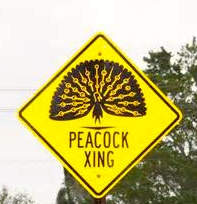
Invasive or not, Frances brought the exotic birds to her property in the 1940s and they had been happily living here ever since. They became part of the cultural landscape of the Rio area. Over the years the county even erected signs warning drivers about the birds.
After Frances’ death in 2005 there were tougher times for the peacocks, peahens, and peachicks but they managed to survive. They had become “wild” living off the land although some residents would joyfully feed them. Kind of like cardinals…. 🙂
Sometimes stopping traffic as they lollygagg across State Road 707, the birds cause smiles and sometimes cursing and horn blowing from drivers. Inconvenient? Maybe— but so cool! So local! So “Frances”…..a reminder of her philanthropic spirit and love for our area with every sighting!
Of course since the 53 acres has been clear-cut and scraped the peacocks have lost their home base habitat. Did anyone even think about this? I mentioned it at a county commission meeting years ago. Perhaps the county thought no one would notice when the birds fell on hard times or were possibly eradicated?
This was not the case. Not along the Indian River Lagoon…not in the land of River Warriors.
Yesterday there was a great win for the spirit of Frances Langford and the peacocks when resident Toni Rummo used social media to inform the public that a bank and real estate agency had “ordered the trapping of the peacocks at 1547 SW Sottlong Avenue.”
The house is in foreclosure and the cleaning people were apparently put off by all the birds. This led to the trapping or quote for such. According to Rummo some birds were trapped but after the outcry the others were left alone. Even the media, Sheriff’s department, and Martin County Commission got involved. It was crazy!
Than you to Toni Rummo and the others! Just to follow up, I spoke to Bill Dean head of Century 21 on Hutchinson Island whose company was incorrectly linked with the sale and he said it was a day like no other. The phone rang off the hook!
At the end of the conversation I said: “But isn’t it great? The love of Frances Langford and the people standing up for her spirit?”
We laughed. I recommended having a gin and tonic in her honor.
Thank you Toni for the peacock win! It was a win for the people of Rio. A win for the spirit of Frances Langford, and a win for the spirit of St Lucie River/ Indian River Lagoon!
One of Frances Langford’s peacocks in a royal poinciana tree on her estate.Rainbow over Langford Estate 2014. (Photo JTL)
Map showing Big Cypress Swamp next to the Everglades. Also note Lake Okeechobee.
The maps and information in today’s blog is taken from an article entitled “Big Cypress Swamp,” by Benjamin F. McPherson, that is included in the 1974, “Environments of South Florida Past and Present,” complied by Patrick J. Gleason. As I have mentioned previously this week, this text was lent to my by Dr Gary Goforth who gives insight into understanding our St Lucie River/Indian River Lagoon system and our Lake Okeechobee and canal issues.
….cover….The Everglades and Big Cypress Swamp.
This above map gives one an idea of how far east the Everglades used to go and how much development has crept in (see below)….how come agriculture and development didn’t totally take over Big Cypress? Well, perhaps they could not stop the water….
West of the red lines shows the edge of what was once the Everglades in South Florida. Development has crept and continues to creep over this edge. (Photo/map courtesy of Chappy Young,/GCY Surveyors, 2014.)
Big Cypress Swamp…we may not think of it too much over here on the east coast but we should study it as well. It is sister to the Everglades and people fought to save parts of it and were successful. It became one of our nation’s first national preserves in the same year Patrick Gleason’s text was published, 1974. I was ten years old and my family had just moved to a very undeveloped Sewall’s Point.
Today I will transcribe from the parts of the summary from McPherson’s work. I like reading the old texts. Sometimes they seem more clear and easier to understand. It helps us understand how things have changed looking an old book like we grew up with instead of today’s electronic media.
Excerpts from “Big Cypress Swamp,” by Benjamin F. McPherson
“The Big Cypress Swamp differs form the adjacent Everglades in topography, soil, water quality, and vegetation. Because the swamp has relatively more high land, inundation soil deposit are less extensive in the swamp than the Everglades. Soil in the swamp is usually a thin layer of marl sand or mixture of the two or is absent where limestone crops out where as soil in the Everglades is usually deeper organic peat. Vegetation in the swamp is closely associated with typography, water inundation, and soils, and is more diverse and forested than in the Everglades…
Big Cypress Swamp is a flat, swamp area of about 3120 square kilometers in SW Florida. It is seasonally inundated over as much as 90 % its surface area. Water moves slowly to the south by overland flow toward the estuaries. Fifty -six percent of the surface water that flows into Everglades National Park comes from the Big Cypress. A substantial amount of water also enters Conservation Area 3 from the Swamp. The western part of the Swamp is drained by canals and no longer floods extensively…
The quality of water in the big Cypress, particularly in the untrained parts is in generally of better quality that the water in the Everglades. Some contamination by metals pesticides and other potentially toxic chemicals does occur however….
Up close map 2 drainage of Big CypressFull summary from article
This week we will take a look back at Lake Okeechobee, a lake that since 1923–via the C-44 canal, has been connected to the St Lucie River/Indian River Lagoon.
Information for these posts is made possible through a book entitled “Environments of South Florida–Past and Present,” by Patrick J. Gleason. This text was lent to me by Dr Gary Goforth. I will transcribe portions of this rare and amazing text in order for us to contemplate the changes that have occurred and how those who first documented this once remote area experienced our region.
It continues to amaze me—the ability of the early map makers and surveyors who functioned without today’s technology.
For me it is noteworthy to notice how the original map of the lake “veers off to the south-east.” Looking below one can see that today this area is today’s Bell Glade and South Bay. These lands are the richest in “black gold” as they have the accumulation of thousands of years of muck. Now we can see why. Tremendous amounts of sugar and vegetable products are produced in this area. Also, I believe these lands are most valuable because they are less likely to freeze due to their proximity to the lake.
As we can see, although we must take the Captain’s map with a grain of salt–interestingly enough—this area was once the lake…
Today’s Google map, 2016.
Here are the words of Captain Backus for us to ponder as I transcribe:
In 1838 map produced by Captain E. Backus had produced a map of Lake Okeechobee, which for a long time remained buried in the national archives records of the Seminole War. It reveals the knowledge of the lake that time, and his version of the lower Kissimmee River shows graphically how that crooked meandering stream flowed thirty-five miles from Fort Basinger to reach the lake only eighteen miles away– as the crow flies… In a brief statement in the lower left portion of the map, Captain Backus writes: “Many small streams flow into the Okee-cho–bee on the North-East and West side and also on the South- East side, but it is not known that it has any outlet, and probably has none, except at the high water when Grassy Lake (The Everglades) and Okee-cho-bee are united, and probably empties thought some streams into the Atlantic. This is corroborated by the statements of different indians and negroes who profess to have crossed from one side to the other in a canoe at high-water, and to have carried and dragged a canoe many miles over the portage at low tide.”
I wonder how we would have seen the lake had we been there? Would you have crossed it in a canoe? What would you have dreamt it to become?
….The handwritten text….Book information and inside cover.
There are only a handful of people who are qualified to help us navigate the turbulent and murky waters of Lake Okeechobee and its effects on our beloved St Lucie River/Indian River Lagoon….
One of these rare individuals is Dr Gary Goforth. “Gary” has more than 30 years of experience in water resources engineering, encompassing strategic planning, design, permitting, construction, operation and program management.
For the last 25 years, his focus has been on large-scale environmental restoration programs in the Kissimmee-Okeechobee-Everglades ecosystem. He was the Chief Consulting Engineer during the design, construction and operation of the $700 million Everglades Construction Project, containing over 41,000 acres of constructed wetlands.
With all this experience Gary spends a tremendous amount of time at River Coalition and SFWMD meetings, and with every day people, advocating to local, state, and national officials telling the story in a manner that the average person can understand but with the power and expertise of a scientist.
Dr Goforth teaches us that we CAN HOLD THE ACOE, AND ESPECIALLY THE SOUTH FLORIDA WATER MANAGEMENT DISTRICT ACCOUNTABLE.
We can ask such questions as “are you sending the maximum practicable amount of water south?” “Is it 28% more than in 1994 as required by the Everglades Forever Act?” ” Is an average per year of 250,000 acre feet going south from the lake to the Everglades as required by the Everglades Forever Act?” “Are the Storm Water Treatment Areas being used to full capacity?” “Is the truth of the destruction of the estuaries being reported?” “Should 2008 LORS, Lake Okeechobee Regulation Schedule, been revised?” “Should the Everglades Settlement’s Q-Bell (limit of Phosphorus) be reviewed-is it realistic?” “Is a large reservoir being created in the Everglades Agricultural Area as is called for in the Central Everglades Restoration Plan?” “Who are the Lake and the STAs really serving?”
In order to hold the agencies accountable we must be educated! We must ask questions. We must look at the figures for water flowing south of the lake every year and compare.
Dr Goforth provides regular public updates on these issues, directly and indirectly holding the fire to the agencies. Today I am publishing in full his DRAFT–WET SEASON 2015 LAKE DISCHARGE report.
Please read it, study it, familiarize yourself with it. Dr Goforth has a website if you have any questions. Thank you Dr Goforth for the gift of shared knowledge. It is the greatest gift of all.
Draft – Wet Season 2015 Lake Discharges by Dr Gary Goforth:
Goforth – December 18, 2015
Flows into and out of Lake Okeechobee were examined for the period May 1, 2015 – October 31, 2015, corresponding to the first half of the annual water year (May 2015 to April 2016), and roughly corresponding to the south Florida wet season. The flows and associated Lake water levels were compared to same period from last year. In light of the influence of the current strong El Nino, Lake water levels were compared to the levels that occurred during May- November 1997 which preceded over 1 million acre feet (347 billion gallons) of destructive Lake releases to the St. Lucie Estuary between December 1997 and May 1998.
Flows into Lake Okeechobee – excluding rainfall. For the period May 1 to October 31, 2015, surface inflows to Lake Okeechobee amounted to 1.43 million acre feet (466 billion gallons) (Table 1). This is 20 percent less than for the same period in 2014 (Table 2 and Figure 1).
Flows out of Lake Okeechobee – excluding evapotranspiration. For the period May 1 to October 31, 2015, surface outflows from Lake Okeechobee amounted to 780,000 acre feet (254 billion gallons) (Table 3). This is 37 percent more than for the same period in 2014 (Table 4 and Figure 2). Approximately 30 percent more Lake water was sent to the EAA and L-8 Canals during 2015 than 2014, likely in response to higher water supply demands (due to lower rainfall than in 2014).
Lake Okeechobee water levels. The level of Lake Okeechobee varied from 13.81 ft on May 1 to 14.55 ft on October 31, 2015, reaching a low level of 11.96 ft on July 16 (Figure 3). For 2014, the level of Lake Okeechobee varied from 13.07 ft on May 1 to 15.85 ft on October 31, reaching a low level of 12.32 ft on June 11. Lake water levels rose only 0.74 feet during the 2015 wet season compared with a rise of 2.78 ft during the same period in 2014. The Lake level on October 31, 2015 was approximately 1.3 ft lower than it was a year earlier, and approximately 0.5 ft lower than October 31, 1997 (Figure 4). In addition, the Lake level on November 30, 2015 was approximately 1 ft lower than it was on November 30, 1997, which preceded over 1 million acre feet (347 billion gallons) of destructive Lake releases to the St. Lucie Estuary between December 1997 and May 1998. Two important differences between 1997 and today that could influence Lake discharges to the estuary include rainfall over the Lake Okeechobee watershed and the regulation schedules governing Lake operations. According to the South Florida Water Management District (District), November 2015 was the wettest November since 1998, indicating inflows to the Lake over the next month may be substantially larger than average. Additionally, the Lake is currently operated under the LORS2008 schedule which was anticipated to result in increased frequency and magnitude of Lake releases to the estuaries compared to the regulation schedule in place during 1997-1998.
Lake flows to the STAs. Beginning in August 2015, the District began operating the EAA A-1 Flow Equalization Basin (FEB), which is approximately 15,000 acres in size and can store water up to 4 feet deep. The FEB can receive Lake releases and EAA runoff, and distribute flows either to STA-2, STA-3/4 or to the EAA for irrigation. At this time incomplete flow records are available to the public through the District’s DBHYDRO database to fully account for the various flow paths, and until additional data are available, the estimates of Lake releases and runoff to STA-2 and STA-3/4 will be subject to revision. Using these preliminary estimates, approximately 13 percent less Lake water has been sent to the STAs in 2015 compared with 2014 (Figures 5 and 6 and Table 5). During the same period, approximately 32 percent less basin runoff was sent to the STAs, reflecting less wet season rainfall in 2015.
Flows to the estuaries. Lower rainfall in 2015 resulted in less basin runoff to the estuaries for the period May to October than occurred in 2014 (Table 6). However, due to the Lake releases that occurred during January through May 2015, Lake discharges to the estuaries in 2015 far exceeded Lake releases during 2014.
SUMMARY. Lower rainfall during the May to October 2015 period resulted in about 20 percent less inflows to Lake Okeechobee than in 2014. However, outflows from the Lake increased compared to 2014, likely in response to higher water supply demands (due to lower rainfall than in 2014). Lake water levels rose only 0.74 feet during the 2015 wet season compared with a rise of 2.78 ft during the same period in 2014. The Lake level at the end of October 2015 was about 1.3 ft lower than in 2014. In addition, the Lake level on November 30, 2015 was approximately 1 ft lower than it was on the same date on November 30, 1997, which preceded over 1 million acre feet (347 billion gallons) of destructive Lake releases to the St. Lucie Estuary between December 1997 and May 1998. However, differences in rainfall and Lake regulation schedules prevent a forecast of potential 2016 Lake discharges compared to the 1997-1998 discharges to the estuaries based on Lake levels at the end of November.
Dredge and fill, public photo, 2015.A multi-image of the area in the 1887 NOAA map, the 1925 shot (partially), 1940, a 1958 NOAA map, 1970 and today by Todd Thurlow.
Today’s blog is a full expansion of the 1925 aerial photo I wrote about last Friday.
My brother Todd took this photo creating a time line flight of 1925 and 1940 views of the Sailfish Flats, the Indian and St. Lucie Rivers, and the St. Lucie Canal (C-44).
Todd’s video is a history lesson in “dredge and fill” which was very common throughout all south Florida and the United States until national laws in the 1970s required more scrutiny and often no longer allow such due to heavy impacts and damages on waterways and the natural environment.
Our Martin and St Lucie County canals dug by the ACOE and water management entities C-44, C-23, C-24, C-25 are dredge and fill. Sailfish Point, Sewall’s Point, and Indian River Plantation, just to name a few, have large portions that are dredge and fill. The dike around Lake Okeechobee and the work abound the FPL plant in Indiantown by Barley Barber Swamp are dredge and fill. At the time, it was “how it was done.” People did not foresee the ramifications to the environment or to people living in these areas in the future.
The land was our Play Doh…
1925 aerial by Bob Higgins shared by Sandra H. Thurlow. SLR/IRL
I know you will learn a lot and enjoy watching Todd’s video. The link is above.
—My questions to Todd after I saw the video included:
Jacqui: “So Todd, what are the white lines on the edge of Stuart, Rocky Point etc…more piled white sand? Looks like Jupiter Island was smaller at one point…across from Sailfish…
So how in the world did they dig out the Sailfish Point Marina and what about the straight marina of Sailfish Point that was already there from the days of Mr Rand? Also what about the FPL Pond in Indiantown? Where do you think they put that fill? Holy cow! That’s a lot of fill!
(I have adapted Todd’s words after checking concepts with him so I could present info in a simple manner.)
Todd: “The lines on the edge of Rocky Point were probably a beachy shoreline. With it being more open water at the time and more exposed to the inlet; I’m sure there was more of a beach there. That shoreline matches perfectly the shoreline shown on the early NOAA maps – even before the inlet was there.
With respect to Jupiter Island, you are probably referring to all the spoil that was piled up at the entrance to the Great Pocket – some of that was put there when I was in middle school. The main part of Jupiter Island is more to the east and is now gone – and earlier connected to Hutchinson Island. The old Gilbert’s Bar Inlet was south of that point.
The marina on Sailfish Point was dredge fill. We have some aerials of it in the making. As was the case in areas of Sewall’s Point, the sand dug to build small marinas or subdivisions was piled on the land (Archipelago, Isle Addition) to make the land higher or to create completely new lands.
As far as the giant FPL pond, they probably just dug with a dragline and used the fill to make the dike around the outside of the pond and also to build up the land around FPL.”
Hmmm?
So we live in an environment altered by our forefathers, and now we are experiencing unintended consequences to the health of our St Lucie River/Indian River Lagoon. We must assist the next generation in understanding the past so that we and they can create a better water future. And that we can!
May 1925 aerial for the Sailfish Club by Bob Higgins shared by historian Sandra Henderson Thurlow.
This amazing 1925 aerial photograph of the confluence of the St Lucie River and Indian River Lagoon tells a story….I found this photo looking back through some old emails between me, my mother, and my brother dated 2010. At the time, I did not catch all of the nuances in the photograph….
For instance, look at the beautiful, healthy seagrasses hugging the elbow of the shoreline of Hutchinson Island; what about the dock in the midst of the seagrasses that is no longer there; the gentle, crashing waves over a thriving reef at “Bathtub Beach;” the entire area so pristine with extensive natural vegetation. Look at the wispy sandbars forming in the river… Nearby the St Lucie Inlet had been permanently opened, (1892), but also much “improved,” as 1925 was just before the real estate crash, great depression, and two hurricanes that altered Florida’s history forever.
In 1925, community leaders were actually planning a port, Port Sewall, one to complete with Miami and Jacksonville right in this area! In fact they dug a turning basin for ships just off the southern tip of Sewall’s Point and created Sandsprit Park with the fill. Can you imagine?
Back to the photo…
Notice there were no spoil islands off of Sewall’s Point–no Archipelago or Island Addition…Notice the sparse development of Stuart and the lack of an airport. Notice the basically undeveloped peninsula of Sewall’s Point, Rocky Point, and the even less developed— later named— “Sailfish Point.”….The Manatee Pocket just east of and beyond Sewall’s Point shows some signs of the coming future but not many….Do you see anything else?
For me the most interesting thing of all was caught by my brother Todd’s keen eye.
“What is that huge white stripe on the horizon??” He said. “It’s looks like a giant 20-mile-long spaceship runway. Well, it’s the spoil from the freshly-dug Okeechobee waterway. See it in the attached comparison from Google Earth.”
Looking upward and beyond in the 1925 photograph to the right of the clouds, Todd noticed the piled up sands of the C-44 canal—a long curving snake connecting Lake Okeechobee to the South Fork of the St Lucie River. Can you see them?
Of course we all know that this canal along with others and extensive development, over time, destroyed the healthy seagrasses, great fishing, negatively altering the beautiful paradise of the St Lucie River/Indian River Lagoon..
It’s fun to look back, but its even more fun to think about how we have the ability to improve things in the future.
….Google image 2010 showing C-44 canal to compare to 1925 aerial. (Todd Thurlow)
A photo with Senator Joe Negron at his designation as Senate President made to look “more historic.” 12-2-15. (Photo Ed Lippisch)
On December 2nd, 2015 my husband Ed and I flew to a historic event in Tallahassee, the designation of local politician, Joe Negron, as President of the Florida Senate.
To try to bring understanding and light to Joe’s accomplishment is really not possible for me… His world is one few know, including myself. I have supported Joe Negron all along the way, first working together in 2012 on Lake O issues when I was mayor of Sewall’s Point. Yes, the ACOE was releasing that year too and the River Kidz were protesting at the locks even then…..I believe in Joe. I believe too that that you have to cut people a break who are “in the Lion’s Den.” It is easy to sit outside of the cage and yell “how to tame,” “how to win,” and “how not to get eaten….”
I admire people who try tame lions…..Don’t you? Could you tame them?
Sitting in the balcony during the event, I recorded what I could of Senator Negron’s acceptance speech. He noted four goals: making Florida’s top universities even greater, dealing with the Lake Okeechobee dilemma, not criminalizing adolescence, and embracing the Constitution.
Today I have transcribed the part of Senator Negron’s speech from my iPhone recording. This part is about his goal for Lake Okeechobee. I am thankful “beyond words for these historic words…” “Thank you Joe!” Every one of us who were part of the fight to right the Lost Summer are part of the spirit of this historic speech! We have come a long way since 2013! And get ready for the ride of the future mostly in 2016-2017.
Here we go…
Words of Joe Negron 12-2-15, Florida Senate Chambers:
“Issue number two, let’s solve the Lake Okeechobee dilemma. …In the summer of 2013 there were near historic levels of rainfall in south Florida and Lake Okeechobee rose to the levels where the ACOE made the decision to have massive releases east and west in order to protect the integrity of the dike. And in the community that I represent, 136 billion gallons of water was sent from Lake Okeechobee into the St Lucie River and Indian River Lagoon.
It also had an adverse effect on southwest Florida with water going to the Caloosahatchee to the Ft Meyers area. Our community came together, and this Senate stepped up, and President Gates appointed a “select committee.” We met in Stuart, and I promised people “measurable progress in a reasonable time.” The then speaker of the house, Speaker Weatherford, also came to our community to visit. We had a group called the River Kidz that were young people who came together to support our efforts… there was some excellent reporting by the Stuart News on this issue that led to not only local coverage but also state coverage and national coverage which was very effective at bringing the attention of the state to our issue.
We funded 231 million dollars in projects. These were not studies, they were not groups sitting around talking about what to do. These were tangible things. Thanks to Governor Scott’s support for bridging two and a half miles of the Tamiami Trail so that water can flow south from Everglades National Park into Florida Bay. That’s going to be a step in the right direction. We just broke ground on the C-44 reservoir which will store basin run off and also assist our in not having water go into the lake….
My goal is before I finish my time in the senate and pack up boxes and put them in the Jeep and go back go Stuart—I have a personal goal/mission and that is to work with the agricultural community, to work with Florida’s best scientists, to work with all of us as a legislature who have background and knowledge on this issue and we will permanently protect our estuaries, protect our lagoons, come up with a way to not have these terrible discharges from Lake Okeechobee that destroy our environment. That’s one of my goals….”
Senator Joe Negron
Designee President to the Florida Senate
Joe Negron at River Kidz protests at St Lucie Locks and Dam because of Lake O releases in 2012..2013 Joe Negron at River Kidz protest at Locks.….2015 Senate chambers. Color guard.….2015 Senator Negron in his seat in Senate chambers.….2015, Gov. Scott and others…….2015 Joe Negron makes his acceptance speech for designated Senate President 2017-2018.…..The historic Florida capitol.….Today’s Florida capitol.
Audio file Jacqui Thurlow-Lippisch 12-2-15: (Go to website if not available)
Confluence of St Lucie River/Indian River Lagoon at St Lucie Inlet. This aerial shows mosquito ditches through mangroves and other vegetation on today’s Sailfish Point. Due to state and local protections, the mangroves could not be removed today as they were in Martin County in the late 70s and early 80s. Aerial dated 1952 courtesy of Thurlow Archives.
“A rose is a rose is a rose…”
The “Coral Strand” was a rose; “Seminole Shores” was a rose; “Sailfish Point is a rose…” and whatever Native American name the Indian’s had for this sacred area was also a rose….
In her poem’s famous first line: “a rose is a rose is a rose,” poet Gertrude Stein’s words are often interpreted as meaning “things are what they are”…”using a name of a thing already invokes the imagery and emotions associated with it..”
For me all these names are “a rose” evoking different images and times of Indian River Region history. The Coral Strand being the name given to the land by the McCoy brothers–famous rum runners and wheeler-dealer business men. Seminole Shores the name given by James Rand a wealthy eccentric of our area whose riches founded the Florida Oceanographic Society; and Sailfish Point the name given to the area after its development by Mobil Oil Corporation in the 1980s.
Will there be another name in the future? And if so what will it be? Well–a rose is a rose is a rose, always and forever…..no matter the name.
Picnicking at the Coral Strand 1927, “for sale/lease” sign in the background. Photo courtesy of Stuart the History of Martin County.According to the History of Martin County the Coral Strand was for sale for $25,000 in the 1920s.Wider view showing the SLR/IRL in all its former fishing riches, impacts from regional development agricultural canals, and area development with removal of vegetation have lessened water quality.
The Pettyway Grocery’s location has been in business serving the Gomez community since ca 1920s. Photo Duren Roofing, Facebook.Map today of inland area of the Gomez Grant. Town of Gomez in bottom right.
It was Sunday afternoon and I was driving south on Dixie Highway. Henry Flagler’s train tracks and the Indian River Lagoon were just east of my line of sight. From a distance, I saw the grocery’s signature blue trim. I’d driven by hundreds of times but never gone inside….in an instant, I knew this was the day.
I pulled over my car and walked inside. The bell clanged against the door and I could see an older pretty African-American woman doing paper work; I bent down and stared through the shelves…”
“This must be the matriarch of Gomez,” I thought. She looked up at me with sharp, clear eyes, like an eagle. When she saw me standing there, her expression softened and she smiled. “May I help you?”
“I am looking for Mrs Annie Pettway,” I said.
“That’s me,” she replied…
I told her who I was, why I’d come, and that I’d just recently met her niece , Mrs Ollie Harvey. Mrs Pettway invited me to sit in the chair by the side of her desk. We spoke and she told me of her long and change filled life in the Indian River Lagoon Region of Gomez in Hobe Sound.
She was born in 1941. She had been through segregation and desegregation. She had seen it all. Her mother Mattie Mae, and father, Bill Pettway moved to the area in 1909 from Alabama. They worked hard, purchased land, apartments, a trucking business, and the area’s first grocery store. Her father was the first black man to own his own business. Today, there is a park down the street named in the family’s honor…
“Were you born here I asked?” She smiled and hit her knee. “Yes mam; I was born right down the street!” She pointed southwest.
People came and went in the store, both black and white; everyone seemed in good spirits and the conversation was relaxed and familiar. I felt like I was in the Bahamas. I liked the feel. The bell would clang and Mrs Annie would get up and ring her customers out while I waited. While she worked, I watched her and I thought about all the history and all the people who had walked through those doors. I thought about how much things have changed along our Indian River Lagoon.
I also thought about what my mother and brother have taught me about this unique area of Martin County…
This land was part of the famous Spanish Gomez Land Grant preceding Florida’s stateship in 1845. Due to title/legal issues that eventually played out in the United States Supreme Court, the land was not surveyed in the 1850s like the rest of Florida. The Gomez Grant situation was eventually worked out, and then acquired by the Indian River and Pineapple Growers Association in 1893; later, the Indian River Association in 1904. It was really the Indian River Association that began “developing.”
When looking at a map you’ll notice that unlike most of the rest of Martin County, other than its sister “Hanson Grant,” the roads of Bridge and Pettway stand out. None of the Gomez Grant area roads run directly east/west or north/south. Instead, the east/west roads run at a roughly 66 degree northeast angle, which is perpendicular to the shoreline, following the old Spanish land grant. The north/south roads run approx 24 degrees west of north-south or perpendicular to the east-west roads…This makes this area unique and gives it a historical “signature.”
Gomez Grant from the book of Nathaniel Reed,” A Different Vision.”
I stopped day-dreaming…
Mrs Annie sat back down.
“Mrs Pettway, why don’t they call it “Gomez” anymore? Wasn’t this area called Gomez?
“That was the old name, and it is still Gomez, but today we call it all Hobe Sound. It’s all one name now; things have changed.” There was a twinkle in her eye, and I stopped asking questions. I suddenly knew that no amount time could really tell the amazing American story of Mrs Annie and the family of Pettway.
Annie Pettway in the 1960s. Photo from History of Hobe Sound, by Paula Mac Arthur Cooper.
Learning how to make cheese at Ground Floor Farm in Downtown Stuart with hostess Lindsey Donigan, guests, and owner Jackie Vitale.Located at 100 SE MLK Blvd. Stuart, FL 34994.Owners of Ground Floor Farm: Jackie Vitale, Micah Hartman, Mike Meier.The entrance to “the farm….”Inside, my husband ,Ed, learning about growing greens with minimal and non-synthetic fertilizers.Hydroponics teaches recycling and re-use of water and how to avoid use of pesticides.Busy Bees!
Over the past year, I have watched this new City of Stuart icon grow from the ground up, but not until yesterday did I enter. It is located right across the street from my father and brother’s law offices, Thurlow and Thurlow, so I have seen it many times. A large parcel that was formerly the Salvation Army is now painted green, fenced, and having a rebirth as the new urban chic “Ground Floor Farm.”
Yes, urban agriculture is hip and bringing a healthy, and community business minded spirit to the St Lucie/Indian River Lagoon Region. Words like homesteading, self-reliance, chickens, and interdependence ring with new meaning and inspiration. Making and growing your own food is cool. Hydroponics teaches about water quality, conservation, and re-use and no pesticides.
Learning how easy it is to make cheese from owner Jackie Vitale —the process of “curds and whey,” was the beginning of real understanding for me!
The event was hosted by Sewall’s Point residents Dean MacMillian and Lindsey Donigan. They invited about sixty of their closest friends to “Come Down on the Farm,” to showcase and help people learn about Ground Floor Farm. Owners Jackie Vitale, Micah Hartman, and Mike Meier shared their story of Ground Floor Farm and their vision for a hip and sustainable future for the City of Stuart, and for Martin County.
It was an amazing evening seeing the younger generation teach and inspire the older generation. As population continues to grow, and resources become more precious, a sustainable path to the future is finding its place. Such a path will continue to revitalize the City of Stuart, bring us all closer to home, and to each other. Kudos Jackie, Micah, and Mike for your creative business model and for your leadership!
To learn more about Ground Floor Farms if you have not visited stop by Wednesdays 3-7pm, October-May, and visit their farmstand. Their address is 100 SE MLK Blvd. in Downtown Stuart. To learn how to visit or become part: (http://www.groundfloorfarm.com)
Like them on Facebook: (https://www.facebook.com/groundfloorfarm/?fref=ts)
________________________ THEIR VISION:“We want Ground Floor Farm to be a part of a hometown renaissance, in which individuals focus their energy and creativity on the places they come from and through which the importance of a vibrant community center is reclaimed and revitalized. THEIR MISSION “Grow and produce delicious food and give others the tools and resources to do so themselves. Show that productive agriculture can take place in small spaces in urban centers and that it can be economically sustainable. Provide the space and resources for others to use their talents, skills, and interests to engage their community.Curate an exciting and diverse program of cultural and social events that engage the hearts and minds of our community.” GFF
Touring the farm.Ricotta cheese the group made all by itself was eaten along with other fresh foods for dinner.Deane MacMillan with Mark and Nancy Perry. Deane served as the chair of Florida Oceanographic.Jackie Vitale, Micha Hartman, JTL, Mike Meier.Interested? Attend the Make. Share. Do. Summit:(http://www.groundfloorfarm.com/makesharedotickets/)
The house built in the “outback” by Maggy’s mother in the early days of a growing Miami.……..The driveway leading to the house. (JTL)The porch.The grounds has many trees planted by Mrs Reno years ago that are now gigantic.Oolite rock on the grounds.The house only lost one shingle during Hurricane Andrew in 1992. This hangs on the wall as a testament to Mrs Reno and her husband.Cover of book. Mrs Jane Woods Reno.In 1994, when I was a much younger woman, my mother handed me a book entitled: “To Hell With Politics,” a compilation of the writings of Jane Wood Reno.
My mother noted that the author was an incredible woman. She had built her house with her own two hands; was a savant; she had had a career as a reporter for the Miami Herald; she once hiked many miles northward, for days and nights, along the Atlantic’s shoreline meeting, speaking, and writing about the people she met along the way; she had befriended the Miccosukee Indians and they considered her an “Indian Princess;” she raised peacocks on her very large parcel way out west of Downtown Miami; she was a dedicated mother and wife…..she was Martin County Commissioner Maggy Hurchalla’s mother.
To say the least, I found Mrs Reno’s story interesting and never forgot the book. Fast forward twenty years; I was invited to visit the house, and I did.
Driving down on October 24, 2015, I thought it would be a straight shot down the Turnpike from Stuart. But somehow I “took a wrong turn” and ended up in the craziness of Downtown Miami driving in carpool lanes as a single driver, cameras taking my picture, and barriers forcing me to stay in “my lane.” As I pulled off I-95 stressed out and sweating Siri’s voice rung in the tense air. Then I saw it, the mailbox.
Turning right down a long unpaved driveway I exited the bustle, excessive traffic, shopping malls, and crowded housing developments, and went back in time. Driving in I noticed wild coffee plants and gumbo limbo trees just like some areas of our St Lucie River/Indian River Lagoon. “Weird.” I thought. “Is there a creek around here somewhere? I wonder what Kendall looked like before they drained it, filled it, mowed it down, and planted hedges? A pine forest? An oak/palm hammock? Beautiful…”
I parked my car and looked around. Time stood still. A tropical breeze floated through the trees and the sun shined. Birds were chirping. Legend Maggy Hurchalla greeted me and I toured the grounds of her family home. She was there caring for her older sister, former U.S. Attorney General, Janet Reno. It was a day I will always treasure. A day a book I read as a younger woman came to life.
I think the photos will say it all, so I won’t write much more.
The house is an island. It is a symbol of what was, and what has become. Thank you to Maggy Hurchalla who helped keep what happened around her childhood home from happening in Martin County.
You can see the Reno parcel unchanged amoung the rampant development of Miami Dade. Google maps 2015Up close.Chickee built by Maggy’s brother. (Photo JTL)Maggy gives me a tour of the grounds.Mrs Hurchalla having a park named after her in Martin County 2013 for her work as a commissioner from 1974-1994. (MC Flicker photos.)Plaque in Maggy’s park, Photo Sandra Thurlow 2015.Sally Schwarz’ article about park in MC: (http://opinionzone.blog.palmbeachpost.com/2013/12/07/martin-county-names-park-after-maggy-hurchalla/)
Bobcat, Sewall’s Point, 2008. Photo courtesy of Jackie Pearson.
I have had many phones since 2008. I have dropped them, lost them, and forgotten them…Throughout all of my phones, only one image has graced its screen: the “Bobcat of Sewall’s Point,” by Jackie Pearson.
In this photo, the bobcat, in all its athletic beauty, looks up, as if recognizing a greater power…
In the hectic bustle of my days, I often look to this image as a reminder of what’s important to me.
Today I will share a few other bobcat images I have compiled over the years. If you are lucky enough to see one of these secretive and shy survivors that has adapted to our human world of the St Lucie River/Indian River Lagoon, don’t be afraid, be amazed!
Sewall’s Point bobcat 2008, Jackie Pearson.Bobcat up in oak tree, Sewall’s Point, 2010, Beverly Beavis Jones.Domestic cat juxtaposed to wild bob cat–drinking from my mother’s bird bath, Sewall’s Point. Sandy Thurlow, 2012.
Official seals are as ancient as Mesopotamia. Whether ancient or modern, seals symbolize what is important to us and how we see ourselves. Throughout history, seals are often recreated to represent new perceptions and values. All seals, of every era, hold great historic importance. Let’s take a look at the seals of Martin County, Florida, and its surrounding municipalities.
Recently my mother, historian Sandra Henderson Thurlow, gave a presentation at Indian River State College. I was intrigued by the early seal of Stuart and its changes throughout the years.
I was also struck that the St Lucie River, the original reason people moved to our area, was removed in favor of the sailfish and ocean sometime in the 1970s or 80s. I was also struck that the Railroad was so prominent, and today we are fighting it. —-Today the prominent symbol is a sailfish. A sailfish is certainly a wonderful and attractive symbol, however, it seems repetitive in that both Martin County and the City of Stuart use the sailfish. View both seals below.
Martin County sailfish.City of Stuart sailfish.
Let’ s reflect. Stuart became the sailfish capital of the world in the 1930s and 40s, very cool, but Stuart was originally named “Stuart on the St Lucie ” for the river….Stuart became a city if 1914; Martin became a county in 1925.
In any case, how much do we promote sports fishing since it is the symbol of both the city and the county? The sports fishing industry a huge money-maker and is directly related to the health of the St Lucie River/Indian River Lagoon. If the river is sick, and the polluted canal plume waters from C-23, C-24, C-25, C-44 and Lake Okeechobee are belching off our inlet, it is more difficult for the sailfish to have a successful spawning season.
Why isn’t the river at all represented anymore?
It’s all tied together— the river and the inlet ocean area…partially due to the degradation of our waterways we are really no longer truly the “Sailfish Capital of the World.” How can we become the sailfish capital of the world again?
How can we honor our sailfish history and have an eye for a better water future? Is it time for updated seals? Should Stuart and Marin County both be sailfish? What do you think? I suppose the most important questions are: “What is most important to us today, and what do we really stand for?”
Stuart City seal 1914 with East Coast Railroad Bridge over the St Lucie River and docks. No auto bridge. Image shared by Sandra Henderson Thurlow.City of Stuart seal showed the railroad and an auto bridge over the St Lucie River in 1978. Seal taken from city stationary. Courtesy of Sandra Henderson Thurlow.City of Stuart seal changed to sailfish sometime after 1978. (Sandra Henderson Thurlow)
Here are some other seals of Martin County’s incorporated cities and towns:
Town of Jupiter Island, palm tree and wavy waters, 2015.Town of Sewall’s Point seal brown pelican and satin leaf plant unique to its hammock, 2015.The Town of Ocean Breeze does not appear to have an official seal that I could find, but this image is displayed often, 2015.
Hutchinson Island is located on the east side of the Indian River Lagoon–
“Captain Billy Pitchford” with the black bear he killed with a .303 Savage when it was raiding bee hives on Hutchison Island opposite Jensen Beach. This was the last bear killed on Hutchinson Island, 1926. (Stuart (Florida) News, 1969, archives, historian Sandra Henderson Thurlow)FWC Conservation and Youth Camp Ocala, (JTL)Lake Eaton
I find myself thinking of bears…recently I was in Silver Springs with my UF Natural Resources Leadership Institute class. We were staying at the Florida Wildlife Commissions’ Ocala Conservation Center and Youth Camp. That night, I couldn’t sleep, tossing and turning—the springs under my mattress squeaked relentlessly through the dead-aired, dark, dusty cabin. I knew I was keeping my bunk-mates awake. It was 2:00AM. I decided to get up. Walking out the door into cool darkness the stars shone like diamonds in a velvet sky; Orion looked down on me as he has since my childhood.
Standing alone in glory of the night, I wondered if I would see a bear. After all, I was in “bear country”…There had been a lot of talk about bears and the controversies of hunting during our session. I imagined that if I did see a bear, I would do what they say to do. I would stand tall and slowly back up. I would not run.
Later that night I fell asleep in my car, and dreamt of bears. In my dream, I forgot the rules and I ran. The bear did not chase me, but rather stood up like a human and summoned me to a large rock; I went to him and he told me a story… his story of being the last bear shot on Hutchinson Island in Martin County, 1926…
Black Bear public image.Story: The Last Black Bear on Hutchison Island. Stuart (Florida) News, 1926. (Courtesy of historian, Sandra Henderson Thurlow’s archives)
The bear looked me straight in the eye and began speaking in a steady, low voice:
“For countless centuries there were black bears on Hutchinson Island…they co-existed with the Indians whose mounds are found there. We roamed the beaches on the long summer nights, digging up loggerhead turtle eggs. When the white settlers came a few sailed over from the mainland to put out bees on the island and we knocked over the hives to get the honey…
It was tough being a bear….white men and bears were enemies in a one-sided war. In 1926 I was shot by Captain Billy Pitchford. I was the last bear on Hutchinson Island…”
Suddenly I awoke. My car window was open; I heard owls hooting close by and the wind whistling through the spanish moss. My bones ached and moisture coated everything. I rolled on my side thinking about my dream. Thinking about the last bear shot on Hutchinson Island and the old Stuart News article my mother had given me…
Bears, I though…
“A one-sided war….”
That was the message.
The Florida Wildlife Commission sanctioned bear hunt, the first since 1994, will begin in two days on October 24th. There is nothing wrong with hunting, but a man of dignity should never take pride in winning a one-sided war.
_______________________________________
Winning art by 10-year-old Aiden Serafica, “Save the River” toilet seat in acrylics, Visionary School of the Arts, 2015.
Art has always been political. It is by nature. It makes us think. It makes us feel—whether we want to or not. Our reaction to art is ancient and deeply programmed into our innermost being….
Today, I say “Kudos!” to 10-year-old Aiden Serafica, a student at Lynn Barletta’s “Visionary School of the Arts,” in Stuart. As you probably know, the school is doing a wide range of amazing things with area youth. (http://www.visionaryschoolof-arts.org)
So this past Sunday, I was at Carson’s Tavern having dinner with my husband, Ed, and friends Anne and Peter Schmidt, when an adorable ten-year old boy walks up to me and says: “My grandmother told me I should show you this…”—he was smiling from ear to ear! He reaches out and shows me a phone, and this is what I saw:
…..……
“Aiden Serafica age 10 is in Miss Robyn’s Thursday class. Aiden was commissioned to paint a toilet seat in a “SAVE OUR RIVER” theme by local business owner Susan of Palm City Farms. Aiden received $100.00 for his beautiful rendition in acrylics. In addition this piece won first place in a contest at Martin County Fairgrounds as part of the best booth of the fairgrounds! Congratulations to Aiden on acompletely unique and daring project of creativity. Art is indeed everywhere!”
I was so excited by what I saw and read, and that this young man, Aiden, would share this with me.
“This is wonderful Aiden! Congratulations! Very powerful! So proud of your artwork and expression. Thank you for speaking out on behalf of our St Lucie River/Indian River Lagoon! ” Aiden and I shook hands. He was beaming; he even winked…
I think the Army Corp, the South Florida Water Management District, the state legislature and the Governor’s office are going to have to have a lot of pressure from future generations to “get the water right….” —-perhaps they too, if they see Aiden’s toilet art, will come up with some daring and creative ways to speed up fixing our rivers.
A mullet jumps in the St Lucie River off North River Shores. (Photo Todd Thurlow, 10-10-15.)
Mullet are famous for being excellent jumpers. In fact, Florida Fish and Wildlife states “it’s often easy to identify their locations by simply watching for jumping fish.” Me? When I see a mullet jump, I have a tendency to personify thinking, “now there’s a happy fish!”
This beautiful jumping mullet-sunset photo was taken by my brother, Todd Thurlow, this past Saturday evening, October 10th, 2015 just off of North River Shores.
Former Stuart News editor and river advocate Ernest Lyons wrote about mullet jumping in his essay ” Never a River Like the St Lucie Back Then.”
There was never a river to compare to Florida’s St Lucie I when I was young….the river fed us. You could get all the big fat mullet you wanted with a castnet or a spear. If you were real lazy, you could leave a lantern burning in a tethered rowboat overnight and a half-dozen mullet would jump in, ready to be picked off the boat bottom next morning….at the headwaters of the south fork of the St Lucie….the waters were clear as crystal… (Ernest Lyons 1915-1990)
Today, the water of St Lucie River/Indian River Lagoon are anything but clear, but “hail to the mullet that are still jumping!”
Sunset over the St Lucie, Todd Thurlow, 10-10-15.……….
What a wonderful world! Sunset on the St Lucie River, photo by Jenny Flaugh, 2009.
The words of Ernest F. Lyons, famed fisherman, environmentalist, and veteran editor of the Stuart News, can be used over, and over, and over again…
Lyons grew up in Stuart in the early 1900s and witnesses first hand the destruction of his beloved St Lucie River/Indian River Lagoon. In the 1940s and 50s, for “flood control” and EAA interests, he watched St Lucie Locks and Dam, C-44, and S-80 be “improved,” by the ACOE and SFWMD—-destroying fishing grounds that will never be replaced…He witnessed canals C-23, C-24 and C-25 be constructed to scar the land and pour poisonous sediment from orange groves and development into the North Fork and central estuary.
But even amongst this destruction, Lyons never stopped seeing the miracle of the world around him. And no where did life continue to be more miraculous than along his beloved river.
This week so far, I have written about things that bring light to the destruction of our rivers, I must not forget that in spite of this destruction, beauty and life still exist….To do our work as advocates for the St Lucie River/Indian River Lagoon we cannot become negative, we must be inspired….one of the best ways to achieve this is to recall the work and words of our forefathers….to “recycle inspiration.”
Although Ernie Lyon’s work was first read on the pages of the Stuart News, my mother historian Sandra Henderson Thurlow, has clipped old pages, been in touch with Ernie’s children, and transcribed many of Lyon’s columns as part of the work of Stuart Heritage. Stuart Heritage helps keeps our rich “river-heritage” alive. After all, our founding name was “Stuart on the St Lucie.”
……Ernest Lyons– copy of column, ca 1950.Copied from old Stuart News paper. Sandra H. Thurlow.
“What a Wonderful World”
I get an indescribable “lift” from the habit of appreciating life.
All of us, even the most harried, have moments when we are fleetingly aware of the glory that surrounds us. Like moles that occasionally break throughout their tunnels, we infrequently catch a glimpse of the natural beauty and awesome majesty outside the corridor within which we have bound ourselves.
And pop back into our holes!
The habit of appreciation—–the cultivation of the sense of awareness—are forgotten roads to enrichment of personal experience. Not money in the bank, or real estate, or houses, or the exercise of power are true riches. By the true tally, the only value is “how much do you enjoy life?”
All around each of us are the wonders of creation—the shining sun, a living star bathing us with the magic mystery of light…we look to the heavens at night and wonder at the glittering panoply of suns so distant and so strange, while accepting as commonplace our own.
We live in a world of indescribable wonder. Words cannot tell why beauty is beautiful, our senses must perceive what makes it so.
What we call art, literature, genuine poetry, and true religion are the products of awareness, seeing and feeling the magic which lies beyond the mole-tunnel view.
One man, in his mole-tunnel, says he is inconsequential, a slave to his job, of dust and to dust going. Another, poking his head our into the light, realizes that he is a miraculous as any engine, with eyes to see, a mind which to think, a spirit whose wings know no limitations.
The mole-man is bound to a commonplace earth and a commonplace life. He lives among God’s wonders without ever seeing them. But those who make a habit of appreciation find wonder in every moment, and every day, by the sense of participation in a miracle.
They see the glory of the flowers, the shapes and colors of trees and grass, the grace of tigers and serpents, the stories of selfishness or selflessness that are written on the faces men and women. They feel the wind upon their faces and the immeasurable majesty of distances in sky and sea.
And in those things there is the only true value. This a wonderful world. Take time to see it. You’re cheat yourself unless you appreciate it.—–E.L.
Ernest F. Lyons: (http://www.flpress.com/node/63)
This image shows St Lucie Farms separated from the entire land purchase of Disston to Reed. IRL east and PSL west.(Overlay created by Todd Thurlow)
Lands purchased by Sir Edward J. Reed from Hamilton Disston, as platted in the late 1880s/early 1900s. This land includes areas of Martin and St Lucie Counties…overlay on Google map by Todd Thurlow.
It all started with a recent comment by Bob Ulevich, at a Treasure Coast Regional Planning Council meeting. In the course of his presentation and questioning on the history of the water management districts, Bob noted that the EAA, the Everglades Agricultural Area, was not historically “just located” where it is today, south of Lake Okeechobee, but basically included all of Disston’s lands. Are you kidding me? “Gulp”….
The red colored blocks south of Lake O. are the EAA-700,000 acres of sugar lands and vegetables. South of the EAA are the STAs and water conservation areas .(SFWMD map, 2012.)
Hamilton Disston. Remember him? The “savior,” “the drainer” of our state—-who basically bought the entire state from a bankrupt entity, the Internal Improvement Fund? (https://en.wikipedia.org/wiki/Hamilton_Disston)
The more I read and think about it, I think what Bob meant was that almost of all the swamp lands sold to Disston and then others were marketed for people to purchase and farm….basically creating a giant Everglades agricultural area…but it wasn’t always so easy….
Orginal Everglades document of the state of Florida. (Downloaded by TT)Ddisston’s AGCCOL Co. (TT)
When I was trying to figure all this out, I went back to a map I had seen before, reread a chapter in my mother’s Jensen and Eden book, and contacted my brother, Todd, to help me answer a question.
Map of Disston’s lands.
“Todd, why isn’t St Lucie Gardens in pink on the Disston map? …And wasn’t this area supposed to be farmland?”
St Lucie Gardens was a huge subdivision in the region of the St Lucie River/Indian River Lagoon including the savannas filed in 1911 by the Franklin Land Company of Jacksonville. According to my mother’s book, “the land was advertised as far away a Kansas and a few families bought land and tried to make a living farming. However land that had been pine flat woods continued to have cycles of flooding a drought and was impossible to farm profitably. The families that came to farm in St Lucie Gardens either gave up or turned to other ways to make a living.”
St Lucie Gardens…overlay by Todd Thurlow.St Lucie Gardens plat map 1910. MC Property appraiser, via Todd Thurlow.The Waters family promoting St Lucie Gardens 1910. (Photo Reginald Waters Rice) from Jensen and Eden by Sandra Henderson Thurlow.Draining the savannas around St Lucie Gardens, 1911. Franklin Land Co. (Reginald Waters Rice) Jensen and Eden, Sandra Henderson Thurlow.Page listing lands of Disston, mind you county boarders were different at this time. Martin was Brevard. (TT)
Todd and I never found our why those lands of the St Lucie River/Indian River Lagoon were not included on the 1881 Disston lands map, and the people who created it are not around to ask, but Todd did create the awesome visuals at the beginning of this post and he did find the deed of the purchase of the lands in our region. To have this document is an incredible part of our history.
Deed of Disston lands sold to Reed, 1881, page 1. (TT)Page 2. (TT)Disston bought 4,000,000 acres from the state of Florida then sold half to Reed. Some of those lands included land in the SLR/IRL region. These lands are not shown on this map. ( Public map, 1881.)
And the EAA? With all the water problems we have today, I am glad it does not include everything in pink and green on the map and that something remains of our Savannas along the Indian River Lagoon.
____________________________________
An interesting email from Todd; Thank you Todd for all the research!
Jacqui,
It was fun to go through some of the stuff on my computer tonight. I just downloaded this publication “Disston Lands of Florida”, published 1885. I attached the intro page.
Disston had the pick of ALL the public lands owned by the state. It took three years to make the selection. Perhaps the pink area had been picked as of the date of the map and St. Lucie Gardens had not yet been picked?
Or maybe the St. Lucie Gardens land is not shown in pink on the map because Disston directed that the St. Lucie Gardens property be deeded directly from TIIF to Sir Edward James Reed. The Florida Land and Improvement Company never took title.
The TIIF deed that we pulled up for Sir Edward James Reed (attached) is dated 6/1/1881. In includes a little more land (21,577 Acres) than ended up in St. Lucie Gardens (e.g. Section 1, of T36S R40E is not part of St. Lucie Gardens but is included in the deed.)
St Lucie Inlet and Sailfish Point area after approximate 7-10 inches of regional rainfall in area 9-16-15. Photo taken on 9-23-15, Ed Lippisch.
“From 7 a.m. Wednesday to 7 a.m. Thursday, the heaviest rainfall was reported at the Savannas Preserve State Park in southeastern St. Lucie County, with 7.67 inches. Next highest in 24-hour rainfall, according to the Weather Service, was 6.87 inches at Hobe Sound.” —-from article y Elliot Jones, TCPalm, 9-17-15
SFWMD chart showing releases through canals recently. Note spike after recent rainfall.
Today I will share aerial photos of the St Lucie River/Indian River Lagoon taken by my husband, Ed, on 9-23-15. I asked Ed to document the after effects of the tremendous rainfall event in the region from September 16th through the 17th, 2015. After reviewing his photos, the St Lucie River/Indian River Lagoon has dark waters, this is evident, but first, let’s set some things straight….
We hear a lot about “local runoff,” however, it is becoming more and more understood, there is no such thing as “local runoff” for the St Lucie River/IRL…. The canals that dump into the St Lucie River/Indian River Lagoon are regional canals that have been “plumbed” over the past 100 years to drain and dump waters off the lands from as far away as western Martin County, Okeechobee County, and even what used to be the north flowing waters of the St Johns River in Indian River County! Then when things are really bad, since the water can’t flow south, “they” dump the overflow waters of Lake Okeechobee into the St Lucie River to boot.
The poor St Lucie River is inundated with “everyone’s water” not just “its own.”
Drainage changes to the SLR. Green is the original watershed. Yellow and pink have been added since ca.1920. (St Lucie River Initiative’s Report to Congress 1994.)SFWMD canal and basin map. The St Lucie’s natural basin as seen above in green has been very much enlarged by the C-44 canal built in the 1920s —with expanded basin and often Lake O overflow; also C-23, C-24 and C-25 were built ca. 1950 to drain lands in St Lucie County for orange groves/agricultural development and land development by General Development Corp and others.
It is critical that we study and understand what happens in our area after a huge rain, with or without the “extra-extra killing waters of Lake Okeechobee.” Why? Because maybe, just maybe, if the SFWMD, ACOE, as well as state and federal politicians will see how much the river is already suffering, they will do all they can, “not to kill it more.”
So here are Ed’s photos, taken one week after the rain event. It takes the water coming in through the canals some time to move through the St Lucie River; I imagine a lot had already exited the St Lucie Inlet. The 23rd was the soonest Ed could “get up in the air.”
I am thankful to my husband, as for me going up in that plane? It is really amazing to be flying, but also very stressful. Somehow to me it seems God only meant for birds to fly….
At least with the Cub, I feel like if something ever happened, over the ocean anyway…. we could just jump out!
2013 Ed Lippisch/Jacqui Thurlow-Lippisch.St Lucie Inlet at Sailfish Point. 9-23-15.Crossroads, Sewall’s Point and Sailfish Flats. 9-23-15.St Lucie Inlet 9-23-15.Water in Jupiter Narrows very close to St Lucie Inlet. 9-23-15.Unusual in that plume was flowing north and south. Here north at Sailfish Point at SL Inlet. 9-23-15.Northerly movement of plume. 9-23-15.Sailfish Flats of SLR/IRL confluence as seen from ocean over Hutchinson Island. 9-23-15.Heading back…9-23-15.On the way back to Witham Field. Sewall’s Point Crossroads 9-23-15.
“Indian River Reflections,” by Vera Zimmerman, 1987. (Collection of Tom and Sandra Thurlow) JTL, 2015.……
Recently at my parents’ home, I noticed a piece of artwork hanging the wall. I had seen it many times, but somehow this time, it looked different. Upon inspecting the title written at the bottom, I noticed that it read: “Indian River Reflections,” Vera Zimmerman, 1987.
The painting shows a menagerie of people standing by the river, their reflection shining in the shallow waters…
“Mom, tell me about this please. Who are these people?”
“Well these are the many people of the Indian River Lagoon. There are Native Americans, African-Americans, the Spanish, Jonathan Dickinson, the cattlemen, the “pioneers…”
….
My eye kept going to the little girl and the dog…
“Things are different but the same,” I thought.
“Who is Vera Zimmerman, the artist, again? I know you have told me about her before.”
“She is an artist and an archeologist up in Brevard County…”
My mother left to clear the table and I stood there looking at the sketch…thinking about all of the people who have gone before us…
We too stand on the edge of the Indian River Lagoon, our reflections staring back. I wonder how one day, we will be painted?
Map of Florida’s shoreline expanded and contracted over the millennium with various ice ages, rising and falling seas. BARR MAPS
__________________________________________________________________
Associations of Vera Zimmerman:
Mr Reginald Waters with black bears killed on Hutchinson Island, around 1930. (Photo credit Sandra Thurlow, Sewall’s Point,” A History of a Peninsular Community on Florida’s Treasure Coast”/Reginald Waters Rice)Photo from my mother: Bill Pitchford’s “last bear.”
A friend of mine, Mrs Mary Chapman, once described Stuart News reporter, Ed Killer, as “the only reporter in America who got her to read the sports page.” I feel the same way. Ed Killer’s past Sunday article entitled: “Bearing Down for the Bear Hunt,” was quite the read, and I have been thinking about it the past few days.
Bears….to think that they used to live right here in along the waters of the St Lucie River and Indian River Lagoon, and now there are none.
Today I thought I’d share a photo I have shared before, but it is certainly worth dusting off and bringing out of the archives again.
The above photos are from my mother’s book, “Sewall’s Point,” and shows Mr Reginald Waters with multiple black bears he killed on Hutchinson Island, a mother and two cubs, around 1918. The other is the “last bear shot on Hutchinson Island, 1926.” Historian, Alice Luckhardt, wrote a comprehensive piece on these black bears that once roamed our region. Here is an excerpt from a recent vignette:
“At one time, Florida black bears existed in fairly large numbers along the ocean coast between Jupiter and Fort Pierce, living in and among the mangroves and feeding on palmetto fruits and turtle eggs buried in the beach sand. However, as more people began settling the area, bears became unwelcome guests, and many were hunted and killed by early pioneers.
By the 1920s and early ’30s there were still a few wild black bears in the area. They found a tasty delight in honey and bee larvae from the numerous beehives in operation on Hutchinson Island at that time.
Jensen resident William Pitchford felt the only solution was to hunt down the bear that had been raiding his bee hives during the summer of 1931. Pitchford first thought to capture the bear using a steel trap he set out over several nights near the hives. The bear, however, was too smart to fall for that trap, avoiding it each night and still getting into the honey, destroying several hives.
Determined to end the bear’s raids, Pitchford, with the assistance of a neighbor, Vincent Wortham Sr., laid in wait one Saturday night, Aug. 8, 1931, with weapons in hand. As hoped, in the darkness of night, the bear appeared and the men turned on their flashlights. Pitchford immediately fired three times using his 303 Savage rifle, and Wortham fired his 32-20 Smith and Wesson revolver twice at the animal. The seriously wounded bear managed to scramble a short distance away before the two men later found him dead near the Pickerton farm. They managed to bring the 200-pound animal back to Jensen where photos documented the event, as this marked the last bear killed on Hutchinson Island.”
So, quite sad as far as I am concerned that we killed all the bears here. Let’s figure out how FWC, the Florida Wildlife Commission, the agency making the laws on bear hunting today “works.” —How do they fit into Florida government? How were they able to determine it is OK to shoot bears this season? For one thing FWC is not “under the governor,” a situation many state agencies would “kill for.” Oh, no pun intended… 🙂
Also, I must state that the structure of the agency is confusing like everything else in government.
There is “US Fish and Wildlife,” a federal agency, and then there is FWC, or the Florida Wildlife Commission, a state agency. One will also hear this same agency referred to as Florida Fish and Wildlife Conservation Commission. Why I am not sure. So Florida Wildlife Commission (FWC) and Florida Fish and Wildlife Conservation Commission (FFWCC) are the same thing. If anyone knows more about this please let me know….
In 2004 the agency, FWC. was restructured by an act of the Florida Legislature:
This excerpt below explains:
“The FWC was established with a headquarter in Tallahassee, the state capital on July 1, 1999 after an amendment to the Florida Constitution approved in 1998. The FWC resulted from a merger between the former offices of the Marine Fisheries Commission, Division of Marine Resources and Division of Law Enforcement of the Florida Department of Environmental Protection (DEP}, and all of the employees and Commissioners of the former Game and Fresh Water Fish Commission.
The Florida Department of Environmental Protection (DEP) serves as the environmental regulatory agency for the state, enforcing environmental legislation regarding air and water quality, for example. In 2004, the Florida Legislature approved a reorganization of the FWC that integrated parts of the Division of Wildlife, Division of Freshwater Fisheries, and the Florida Marine Research Institute to create the ‘Fish and Wildlife Research Institute’ (FWRI) in St. Petersburg, Florida.It has over 600 employees. As of 2014 FWC had over 2,000 full-time employees, maintained the FWRI, five regional offices, and 73 field offices across the state.”
FWC commission 2015Organizational Chart FWC 2015Organizational Chart DEP
Looking at the structure one can see that the commissioners are at the top of FWC chart and the “people” are over the governor for DEP chart….
Hmmmm?
If the bears had a seat at the table, I wonder where they would be?
Black bear sitting at a picnic table, a popular image on Facebook, 2014.
____________________________________
Full note from my historian mother when she sent the “last bear” photo:
“Jacqui, Here is a photograph of Bill Pitchford’s “last bear” that Alice Luckhart wrote about. I have a file on the Waters family who lived in Walton on Indian River Drive. The photograph of Russell Waters with the mother bear and two cubs had “1918” written on it. I am glad Ed Killer’s article explain that hunters will not be allowed to kill a mother with cubs. Reginal Waters Rice who supplied the photograph said his uncle Russell felt very bad about killing “the three bears.” Mom
Early rendition of a portion of the “Everglades” (Painting in my parents home, Tom and Sandra Thurlow.)Cover of book, 1910 by Walter Waldin.…..…..…….
This past Friday, I attended a Treasure Coast Regional Planning Council meeting and was treated to a wonderful presentation entitled: “A Brief History of Florida Water Management 1800-2000 Ponce to CERP.” The talk was given by Mr Bob Ulevich, president of Polymath Consulting Services, L.L.C. ” (http://polymathconsultingservices.com). Bob” is a beloved man who has a long history himself as senior water resources project manager for the South Florida Water Management District. Bob is considered the “father of water farming.”
His presentation left me speechless, once again being reminded of the history of agriculture in the state of Florida and its deep intertwinement with the state’s government and politicians….basically they are one in the same. This is how it is….St Lucie River/Indian River Lagoon and every inch of the rest of the state. “We” may not like this, but we must accept this…
With rumor that Adam Putnam, the Commissioner of Agriculture, could be our next governor, it is critical to refresh our memory on this historic relationship. Today I will share a book a from my historian mother’s shelf and also post the raw iPhone footage of Bob speaking before the council. It is my belief that we have got to learn to understand this historic relationship along with the power agriculture yields and “work with it,” in our quest for better water quality. They too are “naturalist” at heart….they are. Some of them in our South Floirda region have just “morphed,” and need some help getting back to their roots. 🙂 They hold the key to Florida’s water future.
The first page of the booklet talks about “getting back to nature” as farming is deeply intertwined with nature. Unfortunately today many of the intense practices of farming destroy nature and our water resources.
…
This is an another excerpt from the book:
….the independent countryman’s life must appeal, for he is a free man, master of himself, is conversant with nature in its many moods, enjoys the first fruits of the earth with the gleam still on them, and all its first impulses and pleasures….”
…..
“No wonder, then, the cry of today is, “Back to the back and nature.” And back we must and will go, for this threatening catastrophe is too appalling to be passed by unchallenged.”
The catastrophe Mr Waldin is speaking of is that so many people were leaving America’s lands to go to the cities, that the “vitality of our nation was being drained proportionately…” Mr Waldin feared the lands would be empty and all would move to the cities…..It basically has happened, hasn’t it!
Below are the links to Mr Ulevich’s presentation, his presentation does not encompass the little book. I added that. Bob speaks on “A Brief History of Water Management 1800-2000 and although my “Jacqui home videos” are poor quality, you can hear the message. I had to break the videos up into 15 minutes sections as my You Tube account is not set to post anything over 15 minutes…Bob’s presentation is excellent. For those of you who have time to listen, you will enjoy it very much and learn a ton! Bob will finish his presentation next month covering approximately from 1910 to today.——– And that’s where we get to hear “the rest of the story….” 🙂
Photo from central IRL near Cape Canaveral, Sandra and Tom Thurlow, 1994.
Today’s blog was inspired by a question on Facebook by beloved Stuart News reporter, Mr Ed Killer.
Yesterday in my blog post, I wrote that I would be going to Apalachicola this week with the UF Natural Resources Leadership Institute. “Ed” commented and this is what he said:
“Tcpalm Ekiller: I want you to think of something while in Apalachicola Jacqui Thurlow-Lippisch : That industry is about a $2 mill /yr industry statewide, with most of that impact in that area. While it stinks for the oyster men that lack of water is a problem, we haven’t been allowed to eat an oyster from our estuary since the 1970s because the DEP downgraded the health of our water to class D. We have (FOS & a few other groups) have added more than $2 million in oyster shell projects to the St. Lucie River to help clean our water knowing we can never harvest the oysters.” Ed Killer
This got me thinking, and I thought, “Yeah, what really did happen to our St Lucie River/Indian River Lagoon oysters and what is their history? In fact, if I think about it, we are surrounded by mounds of ancient oysters, “Indian mounds” that attest to how plentiful they used to be…
Did you know?
Mt Elizabeth, better known today as “Tuckahoe,” at Indian Riverside Park, is said to stands around 40 feet tall. It is a shell mound built up over thousands of years. It consists of oyster shells and some clam shells that come from the Indian River Lagoon region. You can still see the ancient oysters in the dirt under the modern landscaping today.
Tuckahoe 2010. You can see the oysters shells in the soil. (JTL )A view of the IRL from 60 feet at Tuckahoe an ancient Native American shell midden of mostly oyster shells. Shell can be seen i the soil. (JTL, 2010)Ancient oyster shells can still be found at Tuckahoe itself and along the shoreline as seen here. (2015)
The native people of our area did not have to hunt game full-time or at all as they had all they needed from the riches of the estuary. In those days the natural inlets opened and closed on their own as they broke through “Hutchinson Island.” Oysters would have been more plentiful when the inlets broke through as they live in brackish waters.
*Note that the first 1882 chart describes Mt. Elizabeth (Tuckahoe) as located at what is now the top of Skyline Drive (Mt Washington) at the location of Jensen Beach Community Church. The 1883 (lettered 1888) map locates Mt. Elizabeth at what is now Indian Riverside Park at the Tuckahoe Mansion. This can be confusing.
Front page of Todd’s video showing a historic view of seeing Mt Elizabeth from the Shoal off shore in the ocean. Some early sailors mixed up Mt Elizabeth (Tuckahoe with Mt Washington (Sky Line Drive).
So what about after the Native Americans? I remember my mother telling me stories of pioneer accounts, after the St Lucie Inlet was opened permanently in 1892, of people eating oysters “as big as a man’s hand.” One a meal in itself!
Obviously the oysters would grow most plentiful by the inlets, like near Sewall’s Point and today’s Hutchinson Island.
So yesterday I wrote my historian mother, “Mom, do you have any information on oysters in IRL?
And she sent a fabulous historic survey, an old post card from Sewall’s Point, and account from the House of Refuge. Basically at that time too, a lot depended upon the inlets. I am including a lot of information, and more than likely “just a read for the history hardcore,” but you’ll get the idea.
But then the decline….
Historic photo. Florid Memory project. C-44.Historic photo St Lucie Locks and Dam, Stuart Heritage.
—it began in the 1920s with C-44 and the connection to Lake Okeechobee and then was exacerbated by C-23, C-24 and C-25. “Canals of Death…”We over drained the land, we built houses and scraped the wetlands for agriculture fields….we threw poison and fertilizer on the lands so things would grow and pests would go away…slowly, ever so slowly it drained back into the rivers….For a time, we “flourished,” but it has caught up to us, and our rivers are dying, as Ed Killer said in we’ve been “downgraded to a Class D.” Oysters can’t live in that…
May we bind together and turn things around because no one is going to do it but us. Nature, just like people can heal. We just have to give her a chance.
Oysters in the IRL by Cape Canaveral. “Oyster bars were everywhere.” (Photo Sandy and Tom Thurlow, 1994) Look how clear the water was.Post card to Sandra Thurlow, 1987, from Glee Wright about the plentiful oysters growing on the mangroves around 1957 at the Kiplinger Property in Sewall’s Point. (Courtesy of Sandra H. Thurlow)
I. An 1898 excerpt from a magazine of the day about oyster stew made right at the house of Refuge...shared by Sandra Thurlow.
The Caribou
by John Danforth
Excerpted from “Florida Sport” an article in Shooting and Fishing
December 15, 1898
I have decided on one which happened in 1898 in Dade County, Florida. My wife and myself, in company with Ben Crafts, were living on board a twenty-five foot cabin sloop, which had all the conveniences of a shore camp. We cruised on the Indian River, but most of the time we spent on the St. Lucie River and its tributaries.
Our sloop was built by the Bessey brothers especially for cruising the in Florida waters. The Bessey brothers are educated gentlemen, who have modeled and built nearly all the sailing craft owned by the Gilbert’s Bar Yacht Club, and in our sloop they seemed to get as near perfection as one could ask. We had plenty of room for cooking, eating, sleeping and to carry fresh water, provisions, and tackle of all kinds. We had an outfit, so we could leave the sloop anchored, with the cabin locked, and go for a cruise in the woods for days. My object in securing such a boat was not for catching and killing all we could find, but to better support myself and family by becoming a guide for gentlemen who visit Florida for sport.
At the time of which I write the Caribou (our sloop) lay at anchor about a half mile off the mouth of Hup-pee creek in the full moon of June. I had planned to be on the ocean beach at night to welcome the big turtles which come there to deposit their eggs in the sand where they hatch. When their work is done they disappear and are not seen again until the next year at about the same time. From where we lay at anchor to the U. S. Government house of refuge was eight miles across the Indian River. At the house of refuge it was only a stone’s throw from the Indian River to the Atlantic Ocean. The wide sand beach extended north and south as far as the eye could reach was a good place for turtles to come.
We hoisted the mainsail, then the anchor, and as the Caribou moved out Ben set the jib. With the stiff breeze that was blowing we were soon bowling along at lively speed, and it was only a short time when I called Ben to let go the jib. We hove to just off the house of refuge, took in the mainsail, let go the anchor, and soon had things snug for the night. Ben shelled oysters, my wife lighted the gasoline stove, and in a short time we had an oyster stew that was what Ben called “real filling.”
II. 1883 Historic survey as shared by Sandra Thurlow, compliments of surveyor Chappy Young.
S. Coast and Geodetic Survey
E. Hilgard, Superintendent
State: Florida
Descriptive Report
Topographical Sheet No. 1652
Locality: South End of Indian River
1883 Chief of Party:
A. Colonna
S. Coast and Geodetic Survey Office
Washington, Feb. 7th, 1883
Plane Table Sheet No. 1652 Scale 1/20,000
East Coast of Florida Indian River
From Eden Post Office or Richards Southward to Pecks Lake, and including St. Lucie River
Surveyed by E. L. Taney Aid USC&GS in 1882-83, B. A. Colonna Asst. C&GS. Chief of Party
S. Coast and Geodetic Survey
E. Hilgard, Superintendent
State: Florida
On the west Shore of Indian River the ground rises eighty feet above the level of the ordinary height of water in Indian River the higher ridges give quite a pretty land fall when seen four or five miles off shore quite overtopping the land and forest between Indian River and the ocean. On the east shore of Indian River and between it and the ocean the mangrove swamp is about on a level with the water in the River at ordinary stages and near the beach is from 3 to 15 feet above ocean high tide. I had a signal scaffold 45 feet high on top of a hill 82 feet high on the West Side of Indian River (Blue Hill?) from this scaffold I had a fine view of the county to the westward which consisted of numerous parallel ridge of sand with intervening saw-grass ponds the major axis of all of which extended in a northerly & southerly direction. Cattle-men that I met at the St. Lucie P. O. informed me that it was a succession of these ridges back to Okeechobee and that the old government wagon road which ran north and south and was back about 4 to 12 miles from the river was still passable and ran for the most of the distance along such ridges. Nearly all of this country rest on a foundation of marine conglomerate called Cochina [coquina] which is at various depths but occasionally crops out rising from 3 to 5 feet above mean ocean tides. This cochina differs very much in structure from that of Beaufort N. C. and other places north of here, large shells are seldom found in it and some of it presents the appearance of course white or yellow sand stone. When burned it makes a fairly good shell lime and when wet can be readily cut into building blocks with an axe. The sand of which the soil is almost exclusively formed is white or yellowish, it underlies all of the streams, saw-grass ponds, mangrove swamps & two or three feet generally bringings (?) the white sand even in mangrove and other swamps. It is impracticable to dike any of the low grounds because the water on a rise would come in from the bottom. — Whenever pine is indicated there will be found a growth of underbrush of various kinds and ranging in height from 1 to 10 feet. The pine timber itself is of little or no value being of stunted growth and the underbrush is scrub oak, whorttlebun (?), low saw-palmetto etc. etc. Where hard wood is depicted, except the mangrove swamps, the land is always best for cultivation, such hard wood land is called “Hammock-land by the natives and seems to owe its fertility to the fact that cochina lies near the surface and like an impermeable clay holds those chemicals that are gathered from the decaying vegetation, among the trees growing in these hammocks are those locally known as Palmettos, Mastics, Rubber trees, Live Oaks, Iron wood trees, the Crabwood trees and a great variety of others. There are various course grasses growing along the Ocean shore, and several varieties of running cactus, prickly pear in se and mixed in every when, a decided feature on the level sand wastes and elsewhere along the ocean side and occasionally west of the Indian River is the Scrub palmetto, a species of palm that although it has a trunk from 4 to 8 inches in diameter and from 3 to 20 feet in length runs along the ground like a vine and among them progress is very difficult for their trunks cross each other in mast confusion and their leaves are just about 5 feet high and have sharp edges. On the west side of the river among the pines and in the lands along the edges of the saw grass ponds there was nice tender grasses on which deer feed, and I never ate more delicious venison than here. The Indians of whom there are 3 or 400 back in the Glades, remnants of the Seminoles, always burn off the underbrush as much as they can about January or February. The saw grass ponds to which I have alluded are of fresh water generally very shallow and cut up by narrow sloughs or streams, these streams are seldom over 4 feet deep and have hard sandy bottoms on which various water grasses grow. The sawgrass itself has generally in the dry season only 3 or 4 inches of water about its roots but in the wet season the water rises 2 or three feet, the blades of this grass are from 3 to 10 feet long, about an inch wide and their edges are serrated, touch and very sharp. They rapidly cut out the clothing. If there is any hotter place than one of these saw grass ponds when the sun shines down and the myriads of mosquitoes swarm in our face stinging by tens and twenties, I hope it is not on top of the earth. Wherever these saw grass ponds run parallel to the River and within a mile or so of it excellent water can be had had by setting a flour barrel at the river side along the foot of the bluff. But on the east side of Indian River and between it and the Ocean good water is unknown for when fresh it is so strongly impregnated with lime that it is far from wholesome. —The mangroves grow to a greater height here than elsewhere within my experience. The natives divide it into two varieties, the Black and the red. I had the black mangrove cut down from one of the lines of sight that measured 85 feet from roots to top. When season[ed] the mangrove wood looks much like mahogany and is very hard, it takes a high polish. When burned the ashes are very strong in potash, a fact that may prove of value some of these days because the trees are so assessable. The old Gilbert’s Bar entrance, now closed, is shown on this sheet. Whenever the salt and fresh waters meet the mangrove flourishes and such has been the case at Gilbert’s Bar. Once fine oysters grew there and all kinds of fish belonging in these waters were abundant but since the inlet closed the oysters have died and the fish are gone except a few bass and catfish. Just outside however and along the old Gilbert’s Bar (Cochina Reef) there are lots of them Barracuda, Pompano, Bluefish, Cavallies, Green Turtle, Mullet, Sea Bass and a beautiful fish much resembling our Spanish mackerel but having more beautiful colors and very game. Trolling them I have seen them take the hook and bound 5 to 10 feet clear of the water. I had thought the blue-fish game and the taking of it fine sport but one of these beauties far exceeds any thing I ever saw for punk rapidity of motion and beauty of form and color. From October to April the climate is delightful and Indian River is the boatman’s paradise, from May to Sept. the heat although seldom above 85˚ and the mosquitoes and other insets are very troublesome. In all of the waters represented on this sheet eelgrass grows luxuriantly and it is the favorite food and principal feeding ground of the manatee. I have seen a heard of ten feeding in the St. Lucie at one time, they go to bottom, eat, rise, blow the water in a spray from their nostrils and in a few seconds they sink again. Like other grazing animals they feed early in the morning and late after-noon principally. They are very careful of their young and I never saw one turn to flee until the calf was well started. There are a great number of Coots in these waters in the fall & winter and a few ducks. In the woods there are quail, or partridge, and wild turkeys. Very many small birds of various colors migrate from these shores to the Bahama Ids., every winter returning about the first of May. The country in 1880 had but one settlement, it now has several and the tide of immigration seems to be setting towards it. Settlers have located up the St. Lucie near the forks and they are prospecting in every direction. The influences of ocean tides are not felt within the limits of this sheet in the Indian River. During rainy season the water rises one or two feet higher than in the dry season and at all times the prevailing wind exercises great influence— A Northern making high water, a South Easter or S. Wester— making low water. The mean rise and fall of the ocean tide is about 1.8 foot and the prevailing current along the coast is to the Southward. The edge of the Gulf Stream is only 2 or 3 miles off shore and an easterly wind throws it much nearer in-shore the prevailing Southerly current is supposed to be the eddy from the Gulf Stream. The limit of this sheet marks what is probably the northern limit of the successful growth of the Cooco Nut Palm, Oranges, Pineapple, Bananas and sugar cane flourish. The tomato and other vegetables ripen in April, Sweet Potatoes grow the year round and I have eaten from one which I was informed was of two years growth. There was not a horse, an ox, a mule within the limits of this sheet, broken to harness in 1882-3.
House of Refuge No. 2 was the best dwelling within the limits of the sheet and Doctor Baker; was the only place that look[ed] like a home. The Rattle Snake and the largest I have ever seen being from 6 to 7 feet long but they are not very numerous, Alligators are no longer numerous and they have learned to be very shy. Raccoons and opossums are so thick that it is difficult to raise domestic fowls. The wild cats from about 4 ft. 6 ins. from tip to tip when extended, Black Bears come to the beach every year from about the 1st of June and comb it for turtle eggs. When they arrive they are nice and fat and are very good eating but after running (?) up and down the beach so much they get very thin. We were told that a bear could be seen almost any night and once we went over and got one but the mosquitoes were so bad that we did not try it again.
The prettiest land on this sheet is the peninsula laying between the St. Lucie River and the Indian River from Mt. Pleasant South to the point. It is high hammock land, with coquina, foundation and covered by a heavy growth of hard wood and underbrush with now and then a pine. This country had quite a population in it once, just before the Seminole outbreak, and for a time after it, the settlers had oranges, lemons and limes, some of the old trees are still to be found in the vicinity of Eden P. O. and the limes are very fine but the oranges are bitter and the lemons not bearing.
A. Colonna
Asst. U. S. G & C. S.
Chief of Party
_______________________________________________
Other Readings:
Thank you to Mark Perry and Florida Oceanographic who work tirelessly to restore oyster habit in the IRL today:(http://www.floridaocean.org) They often have deployments should you wish to volunteer!
Eagle Scout Project of Riley Carlson with River Kidz at FOS, 2013.
C-25 at Taylor Creek, exits into the IRL near Ft Pierce Inlet. (Photo Ed Lippisch 9-2-15)
On Wednesday, my husband Ed and I sat down for dinner. “Did you see my photos of the river? He asked.
“No, I’m sorry, I haven’t looked at them yet…”
“They are pretty dramatic,” he replied, taking a swig of his Lagunitas.
I didn’t think much more about it, but later that evening, when I reviewed his shots, I understood.
Today I will share Ed’s recent photos of the Indian River Lagoon and St Lucie River that he took on Wednesday, September 2nd between 11:30AM-1PM. The first set of photos are from the Ft Pierce area around Taylor Creek where canal C-25 dumps into the IRL near Ft Pierce Inlet. C-25’s discharge can also be from C-24 or C-23 as they are all connected and can be manipulated to flow in different ways by the South Florida Water Management District. C-25, C-24 and C-23 ARE NOT connected to Lake Okeechobee. These photos are just showing rain runoff and all that is carried along with it and brought in by rising ground waters.
Canal and basin map SLR/IRL. (Public, SFWMD)Drainage changes to the SLR. Green is the original watershed. Yellow and pink have been added since ca.1920. The watershed has been unnaturlaly expanded to include up to 5 times the amount of water in the natural watershed.LO is the final blow when it comes. (St Lucie River Initiative’s Report to Congress 1994.)SFWMD chart showing flow into C-25 over past days.
I believe there have been recent improvements made at Taylor Creek (C-25), but perhaps there should be more as the outflow still looks like an oil spill. A cocktail of agriculture, development, residential, and road runoff….a “river of death…”
Once a reader wrote me saying,” Jacqui I like your blog but when it rains anywhere in the world there are these freshwater plumes….you are being misleading….”
I nicely replied. “I agree there are freshwater plumes all over the world, but I have to say, ours in the SLR/IRL region are beyond freshwater-soil plumes…they are deadly, full of heavy pollution. You can read it on agency web sites if you look hard enough…It is unnatural…and it is killing the St Lucie River/Indian River Lagoon.”
C-25 Canal in Ft Pierce. 9-2-15. (EL)C-25 discharging into Taylor Creek and the Marina, IRL Ft Pierce. 9-2-15. (EL)9-2-15 EL9-2-15 EL9-2-15. EL
_____________________________________
This second set of photos is from the same day, but further south along the Indian River Lagoon where it meets the St Lucie River at Sewall’s Point. Here you will see a plume at Hell’s Gate, not so dramatic as the C-25 plume, but a definite plume nonetheless.
The ACOE did recently dump BASIN runoff from around the C-44 canal (see map above) in preparation for ERIKA, but they DID NOT dump from Lake Okeechobee. In fact the canal is higher than the lake. I think this blog makes clear we have enough problems even with out releases from Lake Okeechobee.
Well, hope you learned something. Have a good Labor Day weekend as we honor the American Labor Movement and the contributions laborers have made to the strength, prosperity, and well-being of our country. —Sounds like just who we need to rework our canals….
ACOE/SFWMD slide showing breakdown of runoff into SLR. (9-1-15)ACOE website shows no releases from S-308 or Lake O.
ACOE website does show releases from S-80. In this case this is from the C-44 basin only. The basin is huge and mostly agricultural. See above chart.Plume at Hell’s Gate St Lucie River, west side of Sewall’s Point. This water is from rain runoff probably from C-44, C-24, and C-23 unless the SFWMD is dumping C-23 and C-24 through C-25 in Ft Pierce. (Photo EL 9-2-15)9-2-15 EL Another angle of Hell’s Gate and SP, SLR9-12-15 ELIncoming tide still clear around southern tip of Sewall’s Point. 9-2-15 EL –Hell’s Gate jutting forward far left.Confluence of SLR/IRL between Sailfish Point and Sewall’s Point. St Lucie Inlet in full view. (Photo EL 9-12-15)EL 9-2-15. Another view. Sailfish Point, SLR/IRL This areas seagrasses have still not recovered from 2013 even though water is blue in this photo.Sailfish Flats in distance SLR/IRL EL 9-2-15.
Leon Abood served as the chair of the Rivers Coalition for 17 years. (1998-2015)
Today and will share some history, and today I will honor Mr Leon Abood, who has led the Rivers Coalition of Martin County for the past seventeen years…
In 1998 a terrible thing was happening. An uncanny number of fish in the St Lucie River had lesions, and for the very first time, numerous algae blooms were being reported the river. The ACOE and SFWMD had been releasing fresh water from Lake Okeechobee into the estuary for a longer period of time than “typical” due to high rains and high water levels in Lake Okeechobee; this had occurred before, but this time something was different. Really different.
“Fish with lesions? Disgusting. And those poor fish! What’s going on?”
RC handout 2005.
Fishermen were confused and furious; the public was just learning the extent of the problems in their beloved St Lucie River; and real estate agents were desperate because they could not sell houses. All were watching the economic vitality of Martin County and its essential natural system (that brought residents here in the first place) collapse.
The standing motto of the day became: ENOUGH IS ENOUGH!
Agencies as usual declared uncertainty of why the fish were so sickly, everyone looking at everyone else…In time, very quietly, studies did verify that high levels of fresh water in brackish systems allow a bacteria to grow that promotes lesions, as a fish’s delicate slime coat is compromised….It was Lake Okeechobee exacerbated by the other canals….
This is taken into account today before decisions are made…When possible, “pulse releases” became more common rather than giant long-lasting slugs of water into the system….
As far as “the river,” other groups had been fighting for the St Lucie River/Southern Indian River Lagoon since the 1950s, but now it was time for “business!”
In a fit of fury and desperation, the Realtor Association, on May 12th, 1998, formed the “Rivers Coalition.” The group was built from the earlier formed El Nino Task Force and focused on group rather than individual membership.
Founding members in 1998 included the St Lucie River Initiative, the Realtor Association of Martin County; Stuart/Martin Chamber of Commerce; Treasure Coast Builders Association; Martin County Conservation alliance; Economic Council; Florida Oceanographic Society; Marine Industries Association; Audubon of Florida; Audubon of Florida; and the Martin County Farm Bureau.
Leisoned fish St Lucie River, 1998, From FWC, RC files.Photograph of fish from SLR 1998, DEP C-44. See link above to read about this.
Leon has led the coalition through the horrors of fish lesions, toxic algae blooms, releases from Lake Okeechobee and area canals, along with Mr Karl Wickstrom–a law-suit against the federal government, and has been the face and front man of the river for a confused and desperate public. His calm and authoritative demeanor gives people confidence. He is a true leader, calm when surrounded by controversy and sharks at every turn.
Leon’s goal has always been that all stakeholders are to take part: business, environmental, and residential…. and to bring information forward for the public so they can make “logical and intelligent decisions about what is going on.” He has helped achieve this important goal. —And without information and discussion there is no change…
Quote
Since 1998, the Rivers Coalition has grown and evolved but always remained a consistent “voice for the river.” Without the voice the Rivers Coalition, our river situation would not have the statewide recognition and there would not be the pressure on government to fix the problems.
We all know, it is a problem of monumental proportion, TO MOVE WATER SOUTH and not through our estuary, that will take generations. Knowing this, Leon Abood gave the first “go ahead” to support the River Kidz in 2011 so they could one day “take the baton.”
River Kidz listen to Mr Abood at St Lucie Locks and Dam protest of Lake O. 2014.(Photo Darrell Brand)Leon Abood holds map of South Florida. Rally/protest St Lucie Locks and Dam 2103. (Photo Darrell Brand)
Please read more about Leon Abood and the accomplishments of the Rivers Coalition below on Rivers Coalition link.
Leadership for the future will be made soon. Leon will not walk-away until he has given his blessing and guided new leadership. After 17 years of investing heart and soul it’s not as easy as “passing the baton,” and the River Kidz are just a tad too young. We are going to need some leaders just a bit older….:) He has a few in mind…
Why is he leaving?
After 17 years, he is tired. And Leon simply wishes to spend more time with his wife Georgia, a well-known artist; they love to travel to Europe specifically Paris and Italy. What do they say in real estate? In life too, “Time is of the Essence….”
Thank you Leon, you will never be replaced, and you will always be remembered!
Know the Rivers Coalition will have a rebirth with you always at its side.
What is Pecha Kucha? JTL’s attempt, “Love the Everglades, 2015,” the Rights of Water, Miccosukki Tribe. (Still from Kenny Hinkle’s video with word overlay..)
________________________________________________________________
When Miccosukee Tribe member, Houston Cypress, recently informed me that I needed to prepare a “Pecha Kucha” for the “Rights of Water” symposium at Love the Everglades August 22, 2015, I was amiss.
“What’s Pecha Kucha? Or was that Pechu Kuchu? Pecha, what? ” I inquired, thinking it must be a Native American term.
Houston calmly replied:
“It is Japanese for “chit-chat,” Jacqui. It consist of 20 slides in power point format that run only 20 seconds each” It keeps presentations interesting and succinct. Pecha Kuchas are now a popular format all over the world.”
“Wow, that’s cool,” I replied.” Thinking to myself, “The Miccosukee—near Miami–ahead of the game—I live in Stuart, 30 years behind the curve….Hmmm? I’ll act like I get it….”
“This should be easy.” ….I said to Houston. “20 seconds, 20 slides? Sure! Count me in!”
The weeks went by and I realized, well, I was wrong! The fast-moving slides force a familiarly and adaptability that I had never before adjusted to while speaking. Practice took on a new meaning because you really couldn’t. You just had to know your subject. “Live” became the theme.
I was terrified and realized I could not look at notes or do what I usually do when I speak, especially in an unfamiliar place. My husband, Ed watched me sweat and stumble trying to prepare. Scratching my plan altogether at least twice. He smiled just telling me to “look it over….”My slides that is…
“PechaKucha Night,” now in over 800 cities, according to their web site, was devised in Tokyo in February 2003 as an event for young designers to meet, network, and show their work in public.
Today I will share my attempt of a Pecha Kucha for the St Lucie River/Indian River Lagoon at the Miccosukee’s “Love the Everglades Conference “and the RIGHTS OF WATER 2015. Thank you to Ed for helping me prepare; thank you to videographer, activist, and friend, Kenny Hinkle, for his finesse in taping this experience. Also thank you to those whose photographs and maps I used in my presentation and help me all the time: Joh Whiticar, Dr Gary Goforth, Ed Lippisch, Sandra Thurlow, Nic Mader and the River Kidz, Julia Kelly, Sevin Bullwinkle, Val Martin, and Greg Braun. The slides are below.
Last, thank you most of all to Houston Cypress and the Miccosukee Tribe of South Florida for the opportunity to grow and to share, because from what I am learning, getting out of one’s comfort zone is where it all begins as we continue “our war” of which we too, “will never surrender” —St Lucie River/Indian River Lagoon.
Pecha Kucha slides: 20×20
1. John Whiticar SLR/IRL2. John Whiticar SLR/IRL3. Ais, from Theodore Morris book of painting of “Florida'”native tribes, via Sandra Thurlow. 4. 1856 US Seminole war map. via Val Martin, Florida Classics Library.5. Gary Gorforth’s shared map of J.O. Wright 1909.6. Canals showing St Lucie (public)7.1920s C-44 St Lucie Connection, Ruhnke Collection/via Sandra Thurlow collection.8. Harry Hill/Florida Photographic Concern photo, White City, fishing along the SLR via Sandra Thurlow.Little boy and giant grouper Jenen Beach ca. 40 or 50s. Ruhnke Collection via Sandra Thurlow.
10. C-24 canal JTL/EL.11. SFWMD basin map for SLR.12. LO and other canals’ plume Jupiter Island 2013 (JTL/EL)13. Plume over nearshore reefs. (Martin County files)14. River Kidz member, Veronica Dalton, speaks, protest for SLR/IRL, St Lucie Locks, and Dam, 2013. At this event she spoke before more than 5000 people. (Photo Sevin Bullwinkle)15. Marty the Manatee, River Kidz work book 2015. (Julia Kelly.)16. RK oyster deployment with FOS, 2014. Nic Mader.17. Dolphin calf with mother 2014, SLR/IRL. Nic Mader.18. White Ibis, Bird Island, Greg Braun.19. Dirty Water Kills. River Kidz recycled FDOT sign, Rachel Goldman. 2013.20. Last slide: A Miccosukki word for the Everglades….left on screen.
The other day at a Martin County Commission meeting, I felt like a parent beaming with pride. I had been there about four hours when my mother popped into the meeting, then my sister, and then Evie, Jenny’s daughter who is now 15. This is the only child that I literally saw born into the world…
Following Evie were many of her team mates, young men and women. So cute! And to see them sitting there in the commission chambers, what a sight! When public comment came around my niece, Evie, confidently walked to the podium and ask the commissioners to support full funding of a dock at Leighton Park that would allow the youth and others not to have to walk on the river bottom to launch their skiffs. This area of the St Lucie River is has the highest bacteria levels and is ground zero for the polluted discharges from C-44 and Lake Okeechobee. Cutting feet on dead oysters is not a good idea and even with shoes is dangerous. As we know open wounds in filthy water can have devastating consequences.
I watched in awe.
Tears swelled up in my eyes seeing Evie unafraid to “go before the commission.” As a commissioner for the Town of Sewall’s Point myself and as someone who has spoken before commissions prior to my commissionership, I know the tortured feeling of inadequacy that can often come upon one in such a situation. The commissioners up high on the dais, peering down on you, like you are a mere peasant. It is very intimidating even for the most educated and confident.
Because Evie is a River Kid whose mission is to “speak up, get involved, and raise awareness,” she has been speaking before commissions, politicians, and high level agency leaders since she was 10 years old! Going before the Martin County Commission was “old hat” for her. “What a gift,” I thought. The gift of learning public speaking and being at ease with it….a skill that can be applied to all aspects of life.
Evie Flaugh, speaks on behalf of her team, before the commission. 8-18-15. (JTL)Evie’s notes she wrote herself to speak before the commission. (2015)“The team sitting in the commission chambers.” (JTL)Parental support staff, and coast Stefani Faulkner far right. (JTL)
Coach Stefani Faulkner, spokesperson Dr Eric Pheiffer, and parents accompanied these kids. Take a minute see the good work they are doing! They are winning state competitions. And the river, in spite of its challenges, is helping make winners of them all!
“The Treasure Coast Rowing Club (TCRC) was established to stimulate and foster interest in the sport of rowing among amateurs. We promote this interest through education and competitions using every reasonable endeavor for the advancement and up-building of amateur rowing in accordance with the best traditions of sportsmanship. Our goal is to have a safe and fun environment where both adults and youth rowers can enjoy the sport of rowing. We aim to teach the joys of rowing to anyone willing to learn and wanting to get behind an ore, or on the water. We welcome all athletes regardless of their ability or experience. If you are willing to show up and work hard, there is a place for you in our boats”. (TCRC website)
Close up, Herons. The Knockabout Club–Lake Okeechobee, 1887.
Beauty and adventure abound in the pages of a classic 1887 book known as the “Knockabout Club in the Everglades–Lake Okeechobee. ” A book from the days when it was “a man’s world,” it is one in a series of exotic hunting and survival tales, written, and “documented, ” by F.A. Ober and Estes Lauriat.
When reading this text about Florida, one is transported to a time when Lake Okeechobee and our Indian River Lagoon Region, easily competed with the continent of Africa in wonder and wildlife. Bears, panthers, alligators, crocodiles, wolves, native people, limitless fish, and a million birds in every different color, shape, and size. –Knobby-kneed trees stretching to heaven forcing the eye to God…
My mother shared this book with me awhile back, and although I have not read every page, I remain moved by its recollections, its revelations, and its confessions.
Today I will share a smidgen of its art work, and a whisper of its words. The entire book has been electronically preserved and even reprinted due to “its importance and value to society.” The link is below.
As with so many things relating to Florida, the text leaves one wondering….wondering how we perhaps unknowing destroyed such a paradise, and if one day our collective conscience will find redemption by restoring some of the destruction we have caused.
This excerpt is from page 196 of the electronic copy:
“As the sun came down, behind the pines, scattered groups of herons came flying towards the island where we were concealed. Now a great heron, now a small blue heron, and occasionally a night heron. The sun disappeared and the moon came out and shed a faint light over the marshes and the lonely island, disclosing to the waters there the hurrying dusky forms in the sky, many of which fell at the fire of the marauders stationed beneath the trees…
When we left (I now grieve to state) we had nearly a score of herons of various kinds. Gleaming white in the moonlight, our back loads of herons appeared more like sheeted ghosts and verily, if all wicked deeds are requited in kind, the slayer of these innocent birds deserved to have their nights disturbed during the remained of their lives by the apparitions of their victims.
Looking back on that heron hunt, I can say it was a shameful thing to do,–to shoot unsuspecting birds as they came winging their way joyfully home to their nests. It was a most inexcusable act; yet we did it in our search for the rare and curious, not giving heed to the chiding’s of conscience—-until we had shot the birds.”
Cover of 1887 book: The Knockabout Club in the Everglades. Library of Sandra and Thomas Thurlow.)1.Copyright page2. Title page3. Herons4. Flats and Prairie of the St Johns5. Herons and Alligator6. The Home of the Heron7. Indian Burial Place8. The Gloom of the Cypress9. Pelicans of the Great Okeechobee10.Little Bay at Oleander Point11. Contents12. Illustrations
Thank you to my mother, historian Sandra Henderson Thurlow, for sharing this book.
1909 map of South Florida from the State of Florida report: “Report on the Drainage of the Everglades of Florida, By J. O. Wright, Supervising Drainage Engineer.” (Courtesy of Dr Gary Goforth.)
Just say “No!” To wasteful canals that is….
There are over 2000 miles of canals draining precious fresh water off South Florida; it’s a good idea to know the main ones. I started thinking about this after going through some old files and finding this awesome 1909 Map Dr Gary Goforth shared with me showing a plan in 1909 to drain the Everglades and Lake Okeechobee WITHOUT killing the St Lucie River/Indian River Lagoon.
1909 map of South Florida from the 1909 State of Florida report on the Drainage of the Everglades of Florida, By J. O. Wright. (Goforth)
Well as they say: “The rest is history….” As we know, the C-44, or St Lucie Canal, was later built.
So when I was looking on-line for a good map to show the canals of South Florida today to compare to Gary’s canal map of 1909, believe it or not, I could not find one! One that was well labeled anyway. So I made my own.
It’s pretty “home-school” but its readable. From left to right, below, you will see canals Caloosahatchee, (C-43); Miami, (L-23); New River, (L-18); Hillsboro, (L-15); West Palm Beach, (L-12); L-8 that never got a name as far as I am aware; and St Lucie, (C-44.) I do not know why some are labeled “C” and others are “L,” but you can follow them to see where they dump.
I believe the first two built were the Miami and the New River— by 1911, as I often see those two on historic maps prior to 1920. Today our state canal plumbing system is outdated and wasteful sending on average over 1.7 billion gallons of fresh water to tide (to the ocean) every day. (Mark Perry, Florida Oceanographic.)
Even though I grew up in Stuart, I was never really taught about the canals. As a young adult and even older, I drove around for years not knowing about these canals and others like C-23, C-24, and C-25. If I “saw” them, I did not “recognize” them. I knew the land had been “drained” but really had no conception of what that meant or the extent thereof…
I remember my mom used to say if we were driving around in Ft Pierce in the 80s, “And to think there used to be inches of water covering all this land at certain times of the year….” I just stared at her but didn’t really “get it.” The pine trees flashed by and it seemed “impossible” what she was saying…
In any case, the young people today should be learning in detail about these canals so they can be “updated,” “refreshed,” “reworked,” and “replugged.” Say “no” to old-fashioned canals, and “hello” to a new and better South Florida!
South Florida major canals: L to R. Caloosahatchee, Miami, New River, Hillsboro, West Palm Beach, L-8, and St Lucie. (SFWMD canal map 2013)
Below is a history of the South Florida canals as written in an email to me by Dr Gary Goforth. It is very enlightening. Thanks Gary!
Hi Jacqui
As you know, plans to manage the level of Lake Okeechobee (by discharging to tide) in order to develop and protect the agricultural lands south of the lake were developed before 1850 and evolved through the mid-1950s.
1. Buckingham Smith, Esq. in 1848 proposed connecting the Lake with the Loxahatchee River and/or the San Lucia (report to the Sec. of the US Treasury; copy available).
2. In 1905, Gov. Broward rejected a proposal to lower the Lake with a new canal connecting to the St. Lucie River.
3. Attached is a 1909 map of South Florida from the 1909 State of Florida report “Report on the Drainage of the Everglades of Florida, By J. O. Wright, Supervising Drainage Engineer”. The importance of this map and report is the recommendation to manage the water level in Lake Okeechobee via drainage into multiple canals from the Lake to the Atlantic Ocean – but NOT the St. Lucie Canal. The primary canal for moving Lake water to the Atlantic was to be the Hillsboro Canal which would connect the Lake to the Hillsboro River in present day Deerfield Beach / Boca Raton. Note the recommendation is to construct what is now called the “West Palm Beach Canal” and route Lake water into the Loxahatchee River and then out to the ocean via the Jupiter Inlet – this is actually being accomplished as part of CERP and the Loxahatchee River restoration program.
4. In 1913, the State accepted the recommendation of an NY engineer (Isham Randolph) to construct a canal connecting the Lake to the St. Lucie River (report available). The Everglades Drainage District was formed the same year, and was responsible for the construction of the canal and associated locks/water control gates. (historical construction photos available). Construction lasted from May 1915 through 1924, and the first Lake discharges to the St. Lucie occurred June 15, 1923 (ref: Nat Osborn Master’s thesis 2012, copy available)
5. After the 1928 hurricane, the State asked for and received federal assistance. The canal was enlarged by 1938; new St. Lucie Locks was rebuilt in 1941; the new spillway was constructed in 1944. —Dr Gary Goforth (http://garygoforth.net)
A Lagoon on the Mt Pisgah Property, ca. 1950. (Photo Aurthur Ruhnke via Sandra Henderson Thurlow.)
When I was a young person growing up in Sewall’s Point, things were unlike today. Very few people lived here and some of the old estates sat empty for us kids to explore with out the Sewall’s Point cops arresting us for trespassing.
In the late 1970s and early 80s, I often rode my bike to what I called “Paradise Found,” or the “Secret Lagoon” which I later learned was part of the north Sewall’s Point Mt. Pisgah estate, last owned at that time, by Mr Louis Dommerich and his wife Margaret. This large parcel was later developed as “Plantation.” It is the northern most subdivision in Sewall’s Point. It is a lush amazing piece with all sorts of palms planted by the Dommerichs and many lagoons attached to the rising and falling tides of the St Lucie River.
After school, I would ride my bike up the long, winding driveway as fast as I could so my skinny 10-speed Schwinn wheels would not sink in the shell-like sand. Upon getting to the top of the hill, lay a veritable jungle, as beautiful a thing as one has ever seen. There were egrets and herons and jumping fish. I could think here; I could wander in the most gorgeous nature ever seen; I could be away from my “nagging” parents whom I now know were just trying to raise a disciplined and productive child.
An empty house sat like a lone sentinel amongst the vines and sweeping palm trees. I never approached the house as it seemed to hold too many memories, but I made the lagoons my second home.
Margaret and Louis Dommerich’s Sewall’s Point home. (Aurthur Ruhnke via Sandra Henderson Thurlow.)Shore birds–Florida Audubon photo.
In my mind of memories, this area is a sacred place and I feel so lucky that I was able to wander its magical shores. I somehow feel the spirit of the place helped form the person I am today.
A lot has changed since those day, but I still recall it all with great fondness…
Very recently my mother contacted me saying she had a hunch, and had it for quite some time. Her hunch was that the Dommerichs of Sewall’s Point may be related to Louis F. Dommerich and Clara J. Dommerich who founded Florida Audubon.
Wow that would be cool! Why wouldn’t we know this?!
It is well-known and written about recently in “Conservation in Florida, A History of Heroes,” by Gary L. White, that the Dommerichs of the United States became wealthy socialites, and used it for “good cause.”
“On March 1, 1900, in their Maitland, Florida home, near Orlando, they organized with friends the first Florida Audubon meeting. In time, Florida Audubon changed the world, and the fate of shore birds in Florida. Until the Florida Audubon campaign these birds were being recklessly slaughtered in late 1800s for their beautiful feathers. Their chirping, starving, chicks were left to rot in the sun. Thousands, and thousands, and thousands of birds were shot—entire rookeries decimated—all to adorn ladies hats….
Within a decade, through advocacy and education, Florida Audubon had turned this slaughter around. Today we protect birds, and ten percent of what once graced the skies is remaining…
What a legacy….saved by a shoe-string.
So back to our detective work. The couple that owned the Mt Pisgah property were Margaret and Louis Dommerich, Louis died in 1982. The older Louis F. must have died in the early 1900s. Could Louis be related to Louis?
I knew just who to contact to find out, my mom’s friend historian Alice Luckhardt who specializes in genealogy. I wrote her and she wrote back in one day. Mom’s hunch was right!
From: “Alice L. Luckhardt”
Subject: Dommerich Family
Date: August 1, 2015 at 4:31:49 PM EDT
To: Jacqui Thurlow-Lippisch <jthurlowlippisch@comcast.net>
Hi Jacqui –
As you and your Mom know finding information on families is my special area of research.
I have attached a MS Word document I did up of what I found and attached a photo of Louis Ferdinand Dommerich (1841-1912) – the one with his second wife, Clara who started the Florida Audubon Society – bring together many of the local branches across the state. In the Blake Library on microfilm are the obits (Stuart news issue dates) for Louis and his wife Margaret, who lived in Sewall’s Point, who both died in 1982.
Alice
Louis Ferdinand Dommerich (1841-1912) photo provided by historian Alice Luckhardt.
DOMMERICH, LOUIS F. November 14, 1982 Pg A8 OB DOMMERICH, LOUIS FERDINAND November 15, 1982 Pg A5 DA DOMMERICH, MARGARET WHITEHEAD October 29, 1982 Pg A8 OB
Louis Ferdinand Dommerich born Feb. 2, 1841 in Germany, died July 22, 1912 in NYC
Louis F. Dommerich was born on February 2, 1841 in Cassel Germany. His father was a college professor. In 1858-1859, Dommerich came over to the United States where he worked for as an apprentice in a German factory, Noell & Oelbermann, which served as a direct agent for a foreign manufacturing. He was employed there for ten years before becoming a partner in the renamed E. Oelbermann & Co. In 1889 the company was renamed once again to Oelbermann, Dommerich and Co. His company specialized in dry goods exchange and bank dealing in textile commerce, and became so successful that it had manufacturing companies all across the United States and Europe.
In 1885 Dommerich visited Florida for the first time, and two years later he visited Winter Park and stayed in the Seminole Hotel. In 1891 Dommerich bought 400 Acres of land in Maitland, Orange Co., Florida. His holdings included the orange groves on Lake Minnehaha. It was there that he built his first home in Maitland and called it “Hiawatha Grove” to serve as his winter residence. He kept also a home in NYC. The house constructed was a 30 room-mansion surrounded by 130 acres of landscaped grounds and 72 acres of citrus trees. The mansion was an impressive three-story frame house containing multiple turrets and gables. His wife, Clara J. Dommerich (his second wife, married in Oct. 1884) established the Maitland Public Library in 1896 — started with 360 books and Louis Dommerich was its major contributor. In 1907 he donated $3,000 in memory of his late wife, who died in 1900. From 1897 to 1904, Dommerich served on the Rollins College Board of Trustees. He and his wife founded the Florida Audubon Society in mid-1900 in the their home because of the all the bird feathers being used in fashion hats and served as president from 1901 to 1911. Supporters of the Florida Audubon Society in 1900 were President Theodore Roosevelt, railroad baron Henry M. Flagler, Gov. William Jennings, the presidents of Rollins and Stetson colleges and the editors of leading newspapers in the state. In 1903 Dommerich donated $5,000 towards Rollins College’s first endowment. In 1907 Dommerich donated $500 to help secure Carnegie Library and in 1910 he donated $1,000 to help secure a science building. Back on the Board in 1909, he remained a trustee until his death in 1912.
Louis Ferdinand Dommerich died at the age of 72 on July 22, 1912. His son Alexander Louis Dommerich served on the Board of Trustees as his other son Otto Louis Dommerich helped Hamilton Holt finance the College in 1927. By the time Louis Ferdinand Dommerich died, his company had become one of the most prominent commercial banking houses in the world. Hiawatha Grove stood until 1954, when the property was sold for $420,000, the house was torn down to make way for homes in the area.
Louis Ferdinard Dommerich and first wife Julie Louise Dommerich (1843-1882) – one of their sons was Otto Louis Dommerich (1871-1938). A son of Otto was Louis Ferdinard Dommerich, born May 4,1906 in NYC, married to Margaret, their had a home first in NYC and later in Deer Park Meadow in Conn. and on Sewall’s Point.
Louis F. Dommerich, born 1906 died in Martin County on Nov. 11, 1982. His wife Margaret died in 1982. This Louis was the grandson of Louis F. Dommerich who with his second wife, Clara started the Florida Audubon Society.
Their son was Louis Alexander Dommerich, born 1929 and died 2004.
Well thank you Alice and thank you mom! And thank you that I was born in a time when I got to experience “Paradise Found”, because so much of paradise has been lost.
The Google Map photo shows the lagoons today just along the curve of North Sewall’s Point. If you look closely, you will see them.Photo of Mt Pisgah area in 1957 featuring the Langford Estate. the Dommerich’s property can be seen in the upper right corner where the vegetation has not been cleared for orange groves. (Photo from “Sewall’s Point a History of a Peninsular Community of Florida’s Treasure Coast” written by Sandra Henderson Thurlow.)Geodetic marker at Mt Pisgah. This ancient sandbar rises 57 feet above today’s sea level. IT is the highest point in Sewall’s Point. (Photo Sandra H. Thurlow.)Today the lagoon and palm still remain. A 7 acres estate is now owned by friends Jack and Ceejay Heckenberg. Their home and surrounding acreage is perhaps the most beautiful in the Town of Sewall’s Point.
Thank you my mother’s (Sandra H. Thurlow) chapter on Mt Pisgah in her book Sewall’s Point, a History of a Peninsular Community on Florida’s Treasure Coast,” form which content and photos come.
Storm forming over the Indian River Lagoon around sunset, North Sewall’s Point. (Photo JTL 8-11-15.)
Low clouds of storm approaching over the IRL. (JTL)
Late yesterday afternoon, I walked the Ernest Lyons Bridge between Sewall’s Point and Hutchinson Island. There was a storm in the west–way off in the distance over Palm City perhaps. In what seemed like minutes the storm had flattened and stretched out over the St Lucie River and Indian River Lagoon. It was upon me.
For a moment I was scared. There was lightning in the near distance. Cold rain pelted down. The winds generated tremendous power and the birds flying back to Bird Island were caught in place suspended like mobiles.
I started running, not something I do ever anymore….
After stopping and starting, and taking photos….. 🙂 I got safely to the other side.
I had ‘made it.” I felt invigorated. It’s good to be aware of your smallness against nature every once in a while….
Today I will share “Reflections on Reflections on a Jungle River” written by famed environmentalist and “Stuart News” editor Ernest Lyons. The work is transcribed by my mother, historian Sandra Henderson Thurlow. I think Ernie’s essay “captures the storm better than I ever could…although he is writing about the St Lucie or Loxahatchee, the sister Indian River seems just the same…
Looking overhead –storm forming in iridescent blue and white. (JTL)
Drifting on the surface of a Florida jungle river, like the South Fork of the St. Lucie or the Northwest Branch of the Loxahatchee, I experience the feeling that nothing is ordinary, nothing is commonplace.
The onyx surface of the water reflects in perfect color the images of the bushy headed cabbage palms, the moss draped live-oaks and cypresses along the banks.
Cascading clumps of wild asters and a fragile white spider-lily are mirrored on the smooth blank film. I drift in my rowboat on top of an image of scenery. There is probably, a natural law which some logically minded egghead can recite to explain how a color image can be reflected on the face of a river, but please don’t quote it. I would rather marvel.
What has happened to awe? Where has wonder gone? I suspect that too much has been “explained” by the ignorant to the stupid. Modern man’s greatest loss of spirit may be that he has ceased to be amazed at the wonders all around him.
Looking up from the tunnel of trees one sees more intimately the blue sky and white clouds. Why blue? Why white? Why are the palm fronds that glittering green? Why is that crimson color on the air plant’s flowering spikes? I glance at the molten sun above the palm trees. Just a glance. What frailty is in us that we can not ever look the sun in the eye? I remember a snatch of Alfred Noyes’ poem to the sun: “My light upon the far, faint planets that attend me…whose flowers watch me with adoring eyes…”
A flower can do what a man cannot; it can look the sun in the eye. Mighty Ra to whom the ancient Egyptians built temples on the banks of the Nile. The Sun God who controlled the seasons, the droughts and the floods. We smile at the fantasies of the Pharaohs and have replaced them with plain, old ordinary sun among millions like it sending out radiation as it burns nuclear fuel. But it still does what Ra did — and sunlight remains as great a mystery now as then.
The river on which I drift begins in that distant flaming sphere pouring our rays of light that suck mists from the sea to make clouds in the sky.
So simple a process. There’s really nothing to it. Just done with light. All of the rivers and all of the clouds all over the world are children of a star. The sun is their father, the sea is their mother and they are born and reborn again so long as the light shines on the waters. We yawn at continuing creation. It is all explainable, if you just have a logical mind. I’m glad I don’t.
Storm in distance over Sewall’s Point. (JTL)Storm rapidly approaching, IRL. (JTL)
I would make a good Druid. I believe in magic and in miracles, in mysteries and wonders, and that trees, mountains, rivers, even clouds and certain secret places have personalities. I like storms. I enjoy watching the maneuvering of giant thunderheads, edging around each other, moving in closer, muttering and grumbling and threatening, coming together and destroying each other with furies of wind, crashes of lighting and deluges of rain.
They remind me of the ponderous movements of great governments coming in on each other toward a war which everyone wants to avoid —until caught in the thick of it, when all must make the best of it. One is a storm of mist, the other a storm of belief —and the second is the least tangible and the most destructive. The sun makes one from water; we from the other from thoughts and beliefs. As we believe, they are shaped. What a power for good or evil is the human mind, making its own storms, malignant and benign.
Storms up the river remind me of creatures that sneak up and pounce. You hear them muttering, you see them coming, you figure they are going to miss you—and there is a time when you could do something about avoiding them. Then there is a point of no return. You are definitely caught, can do nothing to escape. There is no place to go.
You look at the bright side. You are glad you are not in a small boat at sea. You are going to get wet, but you are not going to be drowned. You are, after all, a land creature, and having shielding trees and firm land close by is relatively comforting. How human it is that, our first thought about the threat of nuclear storms is that perhaps—just perhaps, but hopefully—we may burrow into the earth and escape.
Hauled under a leaning palm, I endure the storm, but it finds me out and soaks me to the skin. And it is gone. Nothing is so completely gone as a storm that has passed or Druids or Pharaohs or empires in which people have stopped believing.
There are trickles and rivulets and creeklets coming into the river, making it whole again, flowing to the sea to be warmed once more by the sun and made into clouds to fill the river again.
What is light? I glance at incandescent Ra, but dare not look him in the eye. “You wet me good,” I say, “Now warm me up.”