Up Close and Personal with “Clover,” the Newest Baby Dolphin, of the St Lucie River/Indian River Lagoon

Clover the baby dolphin next to mother, Shamrock, May, 2014, Crossroads, SLR/IRL. (Photo Nic Mader, Dolphin Ecology Project.)
Clover- the baby dolphin, next to mother, Shamrock, May, 2014, Crossroads, SLR/IRL. (Photo Nic Mader, Dolphin Ecology Project.)
Nic Mader, taking photos of dorsal fins to identify IRL dolphins. (Photo JTL, 2013.)
Nic Mader, taking photos of dorsal fins to identify SLR/IRL dolphins. (Photo JTL, 2013.)

Nic Mader has one of the coolest jobs in the world, and one of great importance to our St Lucie River/Indian River Lagoon. She volunteers for the Dolphin Ecology Project in conjunction with Harbor Branch’s photo ID program. She photographs the dorsal fins of all dolphins in our area. When one looks closely, each dorsal fin is unique.

S. IRL dolphins fins/names created by Nic Mader 2013.
S. IRL dolphins’ fins/names created by Nic Mader 2013.

Generally speaking,  the IRL bottle-nosed dolphins are “site specific,” they have a “territory.” Even during crisis, like heavy rains causing polluted discharges and toxic algae blooms in our river from our local canals and Lake Okeechobee, the dolphins remain in our area within a range of about thirty miles. Nic photographs these dolphins and knows them by name. Her newest dolphin is a baby named “Clover.” The mother’s name is Shamrock. Baby Clover will stay aside Shamrock and accompanying group females for up to three years.

Clover is the newest documented member of the group/family of dolphins that live in the “southern lagoon,”which includes the southern IRL and St Lucie River. There are are other groups in the central and northern lagoon as well, all the way up to Volusia County. Sometimes these different groups interact but not too often.

Also, very rarely would one go into the Atlantic ocean through an inlet or a larger oceanic dolphin come inside. The dolphins of the SLR/IRL feel protected here. The entire 156 mile lagoon has about 800-1000 dolphins.  Just over a hundred live in the southern area full time.

Even though the lagoon provides protection, there are numerous threats to Clover and her friends and family.

1. Boat hits: More dolphins are struck by boat hits in the southern IRL than any other part of the lagoon and unfortunately Clover’s mother Shamrock is raising the calf in the Crossroads area, the busiest boat traffic area in Martin County. Fishing is good in this area so Clover is being taught to fish, like her pod, in these dangerous waters. (FAU/Harbor Branch Dolphin Health and Boat Hits: (http://www.fau.edu/hboi/marine_mammals/pbbe_lab.php)

Dolphin in IRL whose dorsal fin has been split by boat hit. (Photo Nic Mader, HBOI/DEP.)

2.  Toxicity: Harbor Branch has documented that IRL dolphin have the highest levels of mercury in the southeastern US. As much as 14 times higher than “acceptable” by FDEP. In fact, it is well accepted that the first baby dolphin a mother has often dies as mothers offload acquired toxins into the first baby that are stored in the mother’s fat. Just horrific. (Dolphin and Human Mercury IRL, Schafer, HBOI, (http://www.cehaweb.com/documents/2_000.pdf)

3. Fishing line and hooks: Unfortunatley dolphins are so smart it often gets them in trouble like when they try to steal fish off a fisherman’s hook or curiously tamper with crab traps getting the band stuck over their head and neck.

4. Feeding by humans: One of the worst things that can happen to wild dolphins is for people to feed them, as this behavior teaches them not to feed themselves. (PSA,Don’t Feed Wild Dolphins: (https://www.youtube.com/watch?v=EjHNXbviACk)

5. Lobomycosis: Lobomycosis is a terrible skin disease only know to affect humans and bottle nosed dolphins. Harbor Branch has documented more lobomycosis in the southern IRL (17%) than anywhere in the entire IRL, west Florida,  and SE US. This is linked to polluted fresh water releases.  (Abstract “Lobomycosis,”  Dr Bossert, Harbor Branch: (http://link.springer.com/article/10.1007%2Fs10393-008-0187-8)

Lobomycois in S. IRL dolphins. Photo Dr Gregory Bossert, 2011)

6. Chemicals: Unfortunately, septic tanks do not filter drugs that we all take and these drugs, antibiotics, even caffeine, find their way into our rivers accumulating  in dolphins. Many are immune to antibiotics in the IRL. (Abstract, Anti-biotics IRL Dolphins, Dr Bossert, Harbor Branch: (http://www.ncbi.nlm.nih.gov/pubmed/19415386)

7. Morbillavirus: Morbillavirus is like dolphin measles. Presently there is an UME or “unusual mortality event” along the east coast of the US and thousands of dolphins have died. If there were contact between a sick oceanic dolphin and our IRL dolphins, our IRL dolphins could contract the deadly disease. (Abstract, Morbilliavirus IRL dolphins, Dr. Bossert, Harbor Branch: (http://www.sciencedirect.com/science/article/pii/S0378113509005732)

8. Tumors/Papillomaviruses: About 33% of IRL dolphins have been documented to have tumors linked to papillomaviruses.  (Abstract, Papillomaviruses IRL Dolphins, Dr Bossert, Harbor Branch: (http://www.sciencedirect.com/science/article/pii/S0378113512003574)

Most IRL dolphins have an average life span of 25 years – and a maximum life span of about 50 years. Dolphins living in the ocean have a longer average life span by about 15 years. Seems it would be the opposite as the lagoon is a “safe haven.” (Sea World, (http://www.animalsnetwork.org/wild-world/zoo-research/indian-river-project/dolphin-56.htm)

Clover, like all new life, has a mountain of obstacles to overcome, but making  that even more difficult is that, in today’s world, especially in the St Lucie River/indian River Lagoon, bottle-nosed dolphins’ immune systems are compromised due to poor water quality.

Let’s do what we can to help out. Please slow down if you are in the Crossroads, take the time to look around and see if you can find Clover playing in the waves or learning to hunt.  And most important, let’s not  accept the above list of 1-8 as “status quo;” let’s fight to give Clover a chance for a long and beautiful life along the Indian River Lagoon.

________________________________________________

Dolphin Ecology Project: (http://www.dolphinecology.org/FindOut/index.html) 

FAU/Harbor Branch and “Save Wild Dolphin” license plates: (http://www.fau.edu/hboi/)

The 1908 Great Jensen Fire, and the Benefits of Fire, along the Indian River Lagoon

"Jensen, Florida, After the Fire, May 3,1908." (Photo page 145, Historic Jensen and Eden on Florida's Indian River, by Sandra Henderson Thurlow.)
“Jensen, Florida, After the Fire, May 3, 1908.” (Photo page 145, Historic Jensen and Eden on Florida’s Indian River, by Sandra Henderson Thurlow.)

The front page of today’s Stuart News, reads: “40 Acres Burn in the Savannas.” The wind shifted causing a prescribed burn to jump control lines. Unfortunate. There have been other fires in the history of our area too, like the great fire of Jensen in 1908.

"Jensen in Ruins," Florida Photographic Concern, courtesy Sandra H. Thurlow.)
“Jensen in Ruins,” Florida Photographic Concern, courtesy Sandra H. Thurlow.)

Here is an anonymous account of the 1908 fire in my mother’s book. The account was published in the Jensen Beach Mirror in 1962.

“The town of Jensen is burning down this morning. The fire rages up and down Commercial Street, from the river to the railroad tracks and beyond. It seems certain that each of the seventeen stores…will be consumed. Jensen has no fire department. Men are trying to stem the holocaust with buckets of water and what little power can be built with hand pumps and windmills…”

The fire’s location at C.H. Munch & Co. was determined but the reason for the fire never was… Jensen business was slow to rebuild after the 1908 fire and two years later another fire brought down the iconic Al Fresco Hotel that was located closer to the river just off of Main Street.

Historic post card of the Al Fresco Hotel, Jensen, late 1800s. (Courtesy of Sandra H. Thurlow.)

Historic post card of the Al Fresco Hotel, Jensen, late 1800s. (Courtesy of Sandra H. Thurlow.)

Many fires in Florida and in Martin/StLucie Counties are made by Mother Nature and not humankind. Fire is actually a heathy and needed part of our area’s pine, scrub, hammock, and swamp system.  Fire naturally rejuvenates the land and habitat of  the native animals and birds. Many native trees and animals have evolved over thousands of years to live in harmony with this fire system. Gopher turtle holes can be very long and deep, providing protection during fires to many species.  Palmettos, sabal palms, and pines trees are “fire resistant.” Fire is nature’s way to bring nutrients (fertilizer) to the plants in a way that does not hurt the river as ash holds in the soil, and shortly after fires, a very obvious “rebirth” occurs.

This Florida Forest Service chart shows how frequently fires would occur if mankind was not suppressing them.

Chart by USDA showing frequency of wildfire in Florida if there were no human intervention.

Chart by Forest Service showing frequency of wildfire in Florida if there were no human intervention.

Prescribed burns are an attempt to help nature, not hurt it. Unfortunately, when playing with fire, things can get out of control quickly. At least we did not have a fire like the Great Jensen Fire of 1908. ___________________________________________________________________

University of Florida/Florida Wildfires/Forest Service: (http://www.srs.fs.usda.gov/factsheet/pdf/fire-considering.pdf)

Alice and Greg Luckhardt’s historical vignette of the Jensen Fire:  Google  “Jensen Fire Luckhardt” for a great story I cannot get to link to this page.

Florida Inland Navigation District, F.I.N.D., Maintaining the Okeechobee/Atlantic Waterways of the St Lucie River/Indian River Lagoon

The Okeechobee Waterway or Cross State Canal is managed through a partnership of  F.I.N.D.and the US government.
Parts of the Okeechobee Waterway or Cross State Canal, (partially C-44), is managed through a partnership of F.I.N.D.and the U.S. government, ACOE. (Photo Jacqui Thurlow-Lippisch, 2009.)

The Intracoastal and Okeechobee Waterways are important navigation channels and part of our country’s heritage.

Atlantic Intercoastal Waterway from Maine to South Floida. (Map, public.)
Atlantic Intracoastal Waterway from Maine to South Floida. (Map, public.)


Okeechobee Waterway from Atlantic to Gulf of Mexico. (Map, public)

The history of navigation in the United States is a long one that is difficult to put into perspective within the context of today’s modern world. Military, commercial and communication centers were imperative goals to the newly established United States and remain so today, but these things are now taken for granted and have also inadvertently caused massive environmental destruction.

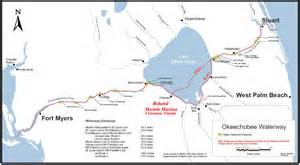
The Atlantic Intracoastal Waterway is a 3000 mile inland waterway along the east coast of the US from Maine to Florida. The Okeechobee Waterway is a few hundred miles across the state, from Stuart to Ft Meyers, linking the Atlantic to the Gulf of Mexico through canals and Lake Okeechobee.

These canals are directly supported by the public though a tax.  If you look at your tax bill you will notice you are charged a .3045 mill to maintain the Florida Atlantic and Okeechobee Intracoastal Waterways. After a long evolution, today, the state’s Florida Inland Navigational District or FIND is the entity that acts in cooperation with the US Government, Army Corp of Engineers,  to oversee these tax funds in order to maintain these important canals that serve many purposes.  Some we don’t like…

One of the purposes of the Okeechobee Canal, built in the late 1920s and “improved” many times since, by being deepened and widened,  is to release water from Lake Okeechobee into the St Lucie River/Indian River Lagoon when Lake Okeechobee gets too full, as the lake  has been diked for the safety of agricultural lands and urban communities living around and south of the lake.

The mission of FIND is very broad actually; if we look at the mission statement of FIND it reads:

“The Florida Inland Navigation District has two primary missions: (1) to perform the functions of the “local sponsor” of the Atlantic Intracoastal Waterway project and a portion of the Okeechobee Waterway project in Florida, both of which are State/Federal navigation projects, and (2) provide assistance to other governments to develop waterway access and improvement projects. As the local sponsor of the Waterway, the District provides all lands required for the navigation project including rights of way and lands for the management of dredged materials removed from the waterway channel during dredging activities.”(http://aicw.org/index.jsp)

FIND is overseen by commissioners from the twelve counties along Florida’s east coast. Commissioners are appointed by the Governor and approved by the Senate. Our local commissioner is friendly and well known,  Mr Don Cuozzo.

Don Cuozzo
Don Cuozzo

FIND also serves other purposes very close to the people and local communities that I do care about, such as providing grant funding for local waterways improvements, and maintaining the important manatee signage and protection zones. We all know this iconic and endanger species, a gentle, distant relative of the elephant, is often stuck by speeding boaters.

Award winning photo seen in National Geographic story on south Florida waters.
Award winning photo seen in National Geographic story on south Florida waters, 2012.) (Photo by Paul Niklin, friend of Nichole Mader.)

Thank you to FIND, but it sure would be nice if we could FIND another way to for the lake’s water to go than through the St Lucie/Indian River Lagoon.

For 2013, Ed and I paid $13.31 to FIND. Although I would prefer not to support the Okeechobee Waterway atrocity, I do like manatees, boating, and the Town of Sewall’s Point has benefited from FIND grant programs as well.  So, I guess, for now, Ed and I  will pay the tax; but one day, I have the feeling, I might just rebel!

_______________________________________________________

Atlantic Intercoastal Waterway (http://en.wikipedia.org/wiki/Atlantic_Intracoastal_Waterway) 

Okeechobee Waterway, ACOE: (http://www.saj.usace.army.mil/Missions/CivilWorks/LakeOkeechobee/OkeechobeeWaterway(OWW).aspx )

Breathtaking/Historical Indian River Drive Along the Indian River Lagoon

Antique post card of Indian River Drive. (Courtesy of Sandra Henderson Thurlow, ca. 1940s)
Antique post card of Indian River Drive. (Courtesy of Sandra Henderson Thurlow, ca 1940s.)
Writing on back of post card sent to Jensen Beach from Germany as a V.E. Day souvenir.
Indian River Drive today. (Photo Jacqui Thurlow-Lippisch, 2014.)

For six years I have driven north to Ft Pierce from the Town of Sewall’s Point, along Indian River Drive, to attend my meeting as a representative for the Treasure Coast Council of Local Governments.

I love this time. I love this road. It is a meditation, a prayer for me.

I know lots of stories that I heard throughout my childhood and they all seem to come alive as I drive through the cathedral of sabal palms, old plantations, and ancient live oaks;  my car creeps up the rising ridge rolling at the 25 mile an hour speed limit; I gaze over the lagoon itself, sometimes quiet, sometimes moody, but always beautiful. Ospreys keep their high perch or fly in circles over my head, egrets and herons stand along  the shallow shoreline; I pass ancient Indian mounds, and when I wave, the the warriors hold up their right arms in strength and friendship; I see old pioneers like Captain Richards, and Bahamian workers sweating buckets, as they labor to grow pineapples in the heat of the 1800s; I see their graveyards …Every once in a while, I have to stop day dreaming and let a family of sandhill cranes cross the road. Sometimes I think I see a pirate out of the corner of my eye…

The road is an old one, first an Indian trail on the pushed up Atlantic Ridge along the west side of the lagoon; later to become a river road for Florida’s early pioneers as they traveled along its “river highway,” trading supplies and establishing post offices.  After being a military/wagon trail it evolved with the modernization of the post World War II era, and the event of the automobile, into a “modern drive,” and its large parcels were sold off and eventually the “Indian River Freeholder Association” formed in St Lucie County, for its protection and order. (http://rickinbham.tripod.com/TownOfSIRD/SIRD_History_2.html)

Indian River Drive covers more than our shores going more or less the entire 156 mile length of the Indian River Lagoon from Stuart to St Augustine covering  five counties; thankfully it has been designated as a “Scenic Highway” in many areas. (http://www.floridascenichighways.com/indian-river-lagoon-national-scenic-byway/)

It is my favorite drive along our Treasure Coast.

If you have not driven it lately, on a beautiful morning please take a ride,  and if your imagination gets the best of you, don’t be afraid to wave!

IRD


___________________________________________

Visit Florida: “Treasure Coast Scenic Highway” Indian River Drive  (http://www.visitflorida.com/en-us/listings/002/a0t40000007qu8nAAA.html)

EAA/SFWMD, why isn’t more water going south, instead of into the SLR/IRL?

This chart shows how even though more Storm Water Treatment Areas came on line in 2004 and after, actually less water from Lake Okeechobee is "going south." Why? (Chart by engineer Gary Gorforth, formerly of the SFWMD.)
This chart shows that even though more Storm Water Treatment Areas (STAs) came on line (red) in 2004, actually less water is “going south,” (blue). Why? (Chart by engineer, Dr. Gary Gorforth, formerly of the SFWMD, 2014.)

The first time I saw Gary Goforth speak (http://garygoforth.net/services.htm) at Senator Joe Negron’s Senate Hearing on the Indian River Lagoon and Lake Okeechobee in 2013, I was very impressed. He was sitting next to Karl Wickstrom, the founder of Florida Sportsman Magazine, who I sit with on the Rivers Coalition Defense Fund. I knew if Dr Goforth had Karl’s “blessing” he belonged to an elite group of people in the River Movement, as Karl, who I love,  is understandably critical of everyone.

I came to learn that this accomplished and well spoken man, had worked at the South Florida Water Management District (SFWMD) as a Ph.D. engineer, most of his esteemed career and in fact “built” the Storm Water Treatment Areas (STA) in the Everglades Agriculture Area (EAA) as head engineer for the district’s projects in 2004 on onward. Today he runs his own engineering company here in Martin County independent of the district. (See link above.)

Map south of Lake O. showing EAA, STAs, and WCAs. (Map Everglades Foundation, public)
Map south of Lake O. showing EAA, canals, STAs, and Water Conservation Areas, (WCAs.) (Map SFWMD, public.)

An STA is an area that filters water through vegetation taking up nutrients like phosphorus and nitrogen and even pollution before it goes into a water conservation area and then to the Everglades.  It is an area engineered to do what Mother Nature did before we transformed her into farmlands and urban landscapes.

Aerial os STA in EAA surrounded by sugar fields. (Public photo.)
Aerial of STA in EAA surrounded by sugar fields, northern area. (Public photo.)

When the Everglades Forever Act was passed by the Florida legislature in 1994, and after Governor Chiles “laid down his sword,” the SFWMD was required to build more STAs to filter the polluted water running  into the Miccosukee lands and Everglades further south. The Miccosukee had sued the US government and the SFWMD, (a long, famous lawsuit starting in 1988), as specifically the high phosphorus from  fertilizers and pollution from  the EAA’s sugar farms was destroying their reservation’s waters and fauna and therefore all that lived there. The law suit accomplished two major things. It called for 10 parts per billion phosphorus rather than 200 plus so the STAs were built and it called for a certain amount of water to go south to sustain the life of the Everglades.

So in comes the law regarding amounts: In chapter 3773.4592, Florida Statues, “1994 Everglades Forever Act” the SFWMD was directed to send an additional 28 % water to the Everglades, including 250,000 acre feet of Lake Okeechobee water based on base flow statistics from 1979-1988. The Everglades needs water to live.

It is confusing, but although the STAs can send both EAA water and lake water south to the Everglades, the SFWMD gives the EAA water (from the lake, used to water their crops), priority in moving south. Lake water goes south only if the STAs have room….

OK. Here is the kicker.

Although in the recent past, the EAA spent tons of money removing toxic chemicals from the lands they had to give up for STAs and although the tax payers spent billions of dollars building the STAs on those lands for cleaning EAA water and Lake Okeechobee water, Gary Goforth’s charts and engineering show that since 2004, actually less lake water is going south to the Everglades. And most of the water going south is EAA water, very little Lake water comparatively ….Why?

Well, from what I think I understand, even though all this money has been spent in the EAA and tax payers building the STAs, the EAA and SFWMD who work together,  are “scared” to send too much water south  because if they go over the 10 parts per billion phosphorus limit (an annual limit) they could be sued again. Thus they hold the EAA water in the STAs letting it dribble out and therefore there is no room for Lake O’s water most of the time.

Hmmm?

As Dr Goforth points out,  it is the St Lucie River and Caloosahatchee that do not get what was legislated for them: a minimum of 250,000 acre feet of lake water sent south a year.

As  stated in an email to me:

“The 1994 Everglades Forever Act (Florida legislation Ch. 373.4592, F.S.) directed the South Florida Water Management District to send an additional 28 percent water to the Everglades, including 250,000 acre feet of Lake water. The 1979-1988 base period flows to the Everglades included an average of 100,931 acre feet from Lake Okeechobee – resulting in a targeted increase of Lake water to the Everglades of 148 percent.
For the most recent 10-year period (May 2005-April 2014) an average of 71,353 acre feet of Lake water was sent to the Everglades – or an average decrease of 29 percent from the 1979-1988 base period.

So – the target was a 148 percent increase – and the reality was a 29 percent decrease. This was in exchange for a billion dollars of public funding for the STAs. Who holds the State accountable?” Gary Goforth

Another chart showing the same ideas. )Gary Goforth 2014.)
Another chart showing the same ideas.) (Gary Goforth 2014.)

If you are like me, this all may remain confusing, but I think the point is made… I hope so anyway.

“Legally, not enough Lake O water is going south.”

This is a serious situation. Really, only the people can hold the state accountable, but do we really want to sue again? Can this be resolved?

Many say it is impossible to send the water south at 10 ppb. This may be the case. Nonetheless, I say the Miccosukee  Indians finally won something after generations of sadness to their people, after being forced to live on a postage stamp, so as “tough as it sounds,” I believe the EAA, the SFWMD,  and the state of Florida have some more work to do.

_________________________________________________________________

Florida Statutes, Everglades Forever Act, (Ch. 373.4592)(http://archive.flsenate.gov/statutes/index.cfm?App_mode=Display_Statute&URL=0300-0399/0373/Sections/0373.4592.html)

FDEP, Everglades Forever Act: (http://www.floridadep.org/everglades/efa.htm)

(Everglades Restoration:(http://en.wikipedia.org/wiki/Everglades_Forever_Act#Everglades_Forever_Act)

The City of Port St Lucie, a city along a dying “Aquatic Preserve” of the St Lucie River/Indian River Lagoon

Aerial of what was to become the City of Port St Lucie, 1957. (Photo Ruhnke/Thurlow collection, courtesy of Sandra Henderson Thurlow.)
Aerial of what was to become the City of Port St Lucie along the North Fork of the St Lucie River, 1957. (Photo Ruhnke/Thurlow collection, courtesy of Sandra Henderson Thurlow.)

Wow, look at this!  A 1957 aerial photograph of the beautiful North Fork of the St Lucie River and its surrounding virgin lands that would incorporate as the City of Port St Lucie in 1961.

This Aia Indian and Seminole wilderness became spotted with many ranch lands but there was foresight for “protections” for some areas as it was beloved by hunters and fisherman and “just people” that wanted to protect its resources. It was full of wildlife on land and in its waters, which had been considered the best mostly “fresh water” fishing in the area for decades.

Preserve sign in the the area of Pruitt's Fish Camp, near today's Club Med.
Preserve sign in the the area of Pruitt’s Fish Camp, near today’s Club Med, ca. 1960s. (Photos courtesy of  Sandra Henderson Thurlow.)

In 1972 local, federal and state agencies led by the Florida Department of Natural Resources cooperated to declare the North Fork of the St Lucie River an “Aquatic Preserve.” And in 1984 the Department of Natural Resource, which merged into today’s Department of Environmental Protection, created a management plan for the area. The plan states:

“The preserve is one of the last remaining freshwater/estuarine wilderness areas in this region of Florida. The major objectives of the aquatic preserve management program are to manage the preserve to ensure maintenance of essentially natural conditions, and to restore and enhance those conditions which are not in a natural condition. Management will also be directed to ensure public recreational opportunities while assuring the continued propagation of fish and wildlife.” (

http://www.gpo.gov/fdsys/pkg/CZIC-qh90-75-f6-g57-1984/html/CZIC-qh90-75-f6-g57-1984.htm

)

(NOTE: The Florida Department of Environmental Protection removed these links from public view in 2016. When I called they said the links were being archived. JTL)

I don’t know why really, but this plan was not implemented and unfortunately the area of the North Fork’s headwater’s at Five and Ten Mile Creek were contaminated by agricultural pesticides in 1995 in a formal document by the Florida Department of Environmental Protection. (

Click to access tenmile_creek.pdf

) In 2002 the St Lucie River including parts and beyond the “aquatic preserve” was designated an “impaired water body” by the same agency  in 2002. (

Click to access SLE_Impairment_Narrative_ver_3.7.pdf

)

All the while the city of Port St Lucie grew and grew…

Growth of City of City along Port St Lucie
Growth of PSL along North Fork of  St Lucie River, 1969 to 2000, from the book, Port St Lucie at 50, A City for all People, by Nina Baranski. photo

According to the US census there were 330 residents in 1970 and 88,769 in 2000. In 2012 there were over 250,000 residents. 

Over the years, the city and agencies did not pay attention to  how developers and people developed their homes along the river, and many were developed go right up the the shoreline of the Aquatic Preserve as this photo by the FDEP shows. This is how fertilizers and pesticieds run right into the water. Not smart.  (

http://www.dep.state.fl.us/coastal/sites/northfork/description/surroundings.htm

)

NF_grass1


The State of Florida projects that the City of Port St Lucie is to have have 400,000 residents by 2025. Presently with over 250,000 residents, they are the state of Florida’s ninth largest city.

As odd as it sounds, this population may be a key to turning things around for the St Lucie River/Indian River Lagoon. Our Treasure Coast area never had enough votes to get much attention until recently and some of the St Lucie city and county commissioners are some of the most vocal in the the Save the Indian River Lagoon movement.

Why the state and federal and local agencies allowed the degradation of lands they spent an enormous amount of time protecting is pathetic. As usual there is only one hope for change, the people pushing government to save what’s left and find ways to let the estuary recover, may be the only answer to saving the St Lucie River/Indian River Lagoon.


Coyotes of the Indian River Lagoon

Coyotes are one of the most adaptable animals on the planet and have made their way to the Indian River Lagoon. (Photos, public, Florida coyotes.)
Coyotes are one of the most adaptable animals on the planet and have made their way to the Indian River Lagoon. (Public photo, ” Florida coyotes.”)

Coyotes are here along the St Lucie River/Indian River Lagoon.

Coyotes were historically associated with the American West, but now they are now in most states and have been reported in 66 of 67 Florida counties, other than Monroe. There is no one to thank for this but humans. With the near eradication of the the American wolf and family of big cats related to the mountain lion since the 1800s, coyotes have no natural predators, other than man, and thus the coyote has flourished.

Most recently, along the Treasure Coast you many have read about Indian River County using cameras to see if coyotes are raiding sea turtle nests, or the controversial trapping and killing of the coyotes at Witham Field in Stuart interfering with plane landings, or the many residents in Palm City or western St Lucie County, who say they hear coyotes howling at night. Coyotes have also, within the past six months, been reported in the Town of Sewall’s Point, in the vicinity of South River Road on the south end, and Castle Hill in the north.

Photo of coyote in south Sewall's Point on River Road. (Courtesy of Sewall's Point Police Department.)
Photo of coyote in south Sewall’s Point on River Road. (Courtesy of Sewall’s Point Police Department, 2014.)

As a long time resident of Sewall’s Point, I love the wildlife and encourage all to live in harmony with these animals. They are God’s creatures and they keep the rat population down! I have seen both grey and red foxes, as well as many bobcats. I have friends who swear in Sewall’s Point’s earlier days, they witnessed panthers.

But I have yet to see a coyote. Unlike native bobcats who are solitary animals, unless mating or raising young, coyotes usually hunt in pairs and belong to a pack of about six members.

Coyotes are in the dog family and are related to wolves, foxes and domestic dogs. Coyotes and dogs can mate although this is unusual as coyotes have specific social ties and  mate only once a year. When dogs and coyotes do mate, the hybrid offspring is called a “coydog.” Coydogs are well documented out west and are said to make poor pets, as more often than not, they are very high strung.

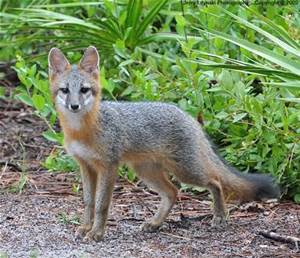
The photo below is a grey fox for comparison. Coyotes are taller and weigh more than foxes; in our area sometimes weighing up to 30 pounds, whereas  a fox may be closer to 12.

Grey fox. Both grey and red foxes are much smaller than coyotes. (Public photo.)

Should we be scared? I don’t think so. We just need to be smart, coy and cautious, like the coyote.

Many Native American myths laud the craftiness of “coyote” and often in Native American mythology, he is so respected, he is  portrayed as the “Creator.” He is respected for being “ubiquitous,” as he is so successful, “he appears to be everywhere at once,” or “seems to appear everywhere at the same time.” He is not to be outsmarted.

One thing for certain, now that coyote is here, chances are, he will not go away. We must learn to live with him by keeping our distance, not leaving pets out for long periods unattended, in the evening or early mornings,  and by not feeding him. He is smart enough to feed himself.

It is said we all have a bit of fear  in our inner most nature, as the collective memory recalls the earlier times of fires and wolves, but then humankind tamed the wolf and hence today, we have “man best friend,” our dogs.

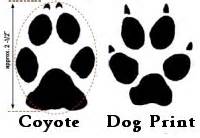
Coyote/Dog tracks
Coyote/Dog tracks

Remember that the coyote is related to dogs if you see him, and if you look him in the eye ask for a sliver of his adaptability and success surviving on an ever changing planet and an ever changing Indian River Lagoon.

__________________________________________

Florida Coyotes: (http://www.floridiannature.com/Coyote.htm)

Florid Wildlife Commission:(http://myfwc.com/wildlifehabitats/profiles/mammals/land/coyote/)

History, Eradication of Wolves/Rise in Coyote Population:(http://www.wolfweb.com/history2.html)

Coyote/Native American Mythology:(http://www.pantheon.org/articles/c/coyote.html)

______________________________________

I added this photo from Dr Gary Goforth 8-13-15 that was taken this February in Foxwood off 96 A in Martin County.

Shared by Dr Gary Goforth in Foxwood, Martin County.
MOULTRIE DIGITAL GAME CAMERA G. Goforth
 MOULTRIE DIGITAL GAME CAMERA by Dr Goforth.
MOULTRIE DIGITAL GAME CAMERA G.Goforth

_______________________________

I added this link on 8-13-15 written by my classmate Angeline Scotten whom I met last week at the UF Natural Resouces Leadership Institute. She is an expert on the subject of coyotes for the Florida Fish and Wildlife Commission. This article was written for Hernando County but certainly applies to us as well. I found it very informative. (http://hernandosun.com/coyotes_in_hernando)


1906-2014, Water Depth Changes in the St Lucie River/Indian River Lagoon

Hand drawn map Sewall's Point water depths created for Hugh de Laussat Willoughby ca. 1914. (Map and history courtesy of Todd Thurlow and Sandra Thurlow.)
Hand drawn map of Sewall’s Point’s water depths created for Hugh de Laussat Willoughby’s proposed New York Yacht Club at the southern tip of Sewall’s Point. Willoughby came to Sewall’s Point in 1906 in hopes of establishing a Southern New York Yacht Club. (Map and history courtesy of  Sandra Thurlow and Todd Thurlow.)

If Hugh Willoughby had not been searching for a southern location for the prestigious New York Yacht Club in 1906, we would not have the remarkable hand drawn map above. The New York Yacht Club’s southern headquarters was never established at the southern tip of Sewall’s Point, but we can see the water depths in the area were substantial, at 20 feet, around the tip of the protected west side of today’s High Point subdivision.

I stumbled upon the information about the New York Yacht Club again, because of trying to track water depths in the St Lucie River/Indian River Lagoon over the past century in my mother’s book, The History of Sewall’s Point.

From my parent’s old timer friends, over the years, I have heard stories about the the water depth and clarity being extensive in many areas of the St Lucie River, from Palm City to Stuart to Sewall’s Point, and how over time the sediment, due to canal run off from C-23, C-24 and C-44, has “filled the bottom of the river” in many areas, even forming “islands” north of the Palm City Bridge. C-44, connected to Lake Okeechobee, was first connected in 1923, and then deepened and widened again in the 1930s, and 50s and “improved since.” C-23 and C-24 were built in the 50s and 60s. Tremendous amounts of sediment and pollution has filled the river over time from these once thought “harmless” canals.

Today this sediment fill is often referred to as “muck.”

Anyway, for a baseline comparison of water depths, I started looking thorough my historian mother’s maps and asking questions to my attorney brother, who is a wiz at any type of map old or new, and although I did not get mapping for all of the the St Lucie River/Indian River Lagoon, I did for my own beloved Sewall’s Point. I imagine it is a microcosm of the rest.

Let’s take a closer look:

IMG_4928

(http://www.charts.noaa.gov/OnLineViewer/11428cgd.shtml)

Hand drawn map Sewall's Point water depths created for Hugh de Laussat Willoughby ca. 1914. (Map and history courtesy of Todd Thurlow and Sandra Thurlow.)

NOAA, 2014 electronic water depth map juxtaposed to hand drawn map of Sewall’s Point ca. 1906.

Comparing the two maps, one can see that the southern tip of Sewall’s Point in the NOAA map is not documented, I imagine because it is too far away from the Okeechobee Waterway. Disappointing. Nonetheless, if one looks at Sewall’s Point’s mid area, across and north of Hell’s Gate (the narrow part of the river) one can see water depth numbers like 19; 15; and 14 feet. Today those numbers on the NOAA chart read 4; 8; and 7.

Looking on the Stuart side, north of Hell’s Gate, the 1906 map reads 10; 8 and 12 feet. The 2014 NOAA map reads 2; 3; and 4 feet. Mind you, the channel has been dredged many times by the Army Corp, and Florida Inland Navigation District since 1906 and this certainly affects depths overall in the river as well. Nonetheless, for me, it is interesting to compare as even the channel depths in this area are no deeper than 11 feet and often more like 8 or 6  feet.

The famous mid 1900s environmentalist editor of the Stuart News, Mr Ernie Lyons, once said “Life too, is a changing river.” I  wonder if he knew how much we were going to fill it in…

___________________________________________________

After I wrote this blog , friend, Kevin Stinnette, sent me the insert for south Sewall’s Point as he has experience as an avid sailer. I am adding for interest although I will not adjust my blog. The same principles hold true. 🙂 Thank you Kevin!

InsertD-Chart 11472b SP


The “River Lady’s Neighborhood” along the the Indian River Lagoon


I taught middle and high school for many years, and I still have numerous friends in the profession. Last week, I received a phone call from teacher, Maureen Breslauer, whose son now attends Bessey Creek Elementary School in Palm City. She asked if I’d like to be filmed by the school’s media specialist, Kelly Middleton, creating  a River Kidz public service announcement, as the school, headed by outstanding, Principal Defenthaler, has been learning about river issues and were having a T-shirt day. I was grateful to Maureen for the opportunity to share the concept of “River Kidz” through the morning news. The product reminded me of who I am “most,” at heart, a teacher, and very funny in that in “a moment,” I became the “River Lady.” We did it in one take! For any you who watched Mr Roger’s Neighborhood growing up, I think you’ll get a kick out of the video.

*River Kidz, a division of the Rivers Coalition: (

Home

) See River Kidz tab.


Sugarland Road Trip to the Caloosahatchee, Celebrating 50 Years of Friendship along the St Lucie/Indian River Lagoon

Martin County High School Class of 82 friends celebrated their 50th birthday on the Caloosahatchee, the sister river to the St Lucie.
Girlfriends from the Martin County High School Class of 1982 celebrating our 50th birthdays in Sanibel/Captiva, the area of the Caloosahatchee River, Lee County, Florida.

This past weekend, my girlfriends from high school decided to travel across the state to celebrate our 50th birthdays!

photo

It was a great time. We stayed in the area of the Caloosahatchee River which is the sister river the the St Lucie River. Both rivers have been plumbed to take overflow waters from Lake Okeechobee that Nature meant to flow south to the Everglades. The Caloosahatchee, in fact, is the “bigger sister,” in that when the rains come, she takes three to four times as much polluted, fresh water as we do—she is longer and larger than ourself. Ironically now, year long,  the river needs constant small releases of fresh water from the lake as she becomes too saline. The system is suffering as is the St Lucie.

Caloosahatchee River was the first estuary to be channelized and connected to Lake Okeechobee in the late 1800s by Hamilton Disston.
Caloosahatchee River was the first estuary to be channelized and connected to Lake Okeechobee in the late 1800s by Hamilton Disston. (Photo, CRCA)

“Caloosahtchee” means “river of the Calusa,” after the native peoples who lived and thrived there thousands of years ago.

So how does the Calooshatchee compare to the St Lucie? Well, according to the Caloosahatchee River Citizens Association, (CRCA), as sea levels receded after the last ice age, a series of lakes connected by wet prairies fed a tiny lake in the center of a valley feeding a “tortuously” long, crooked river that flowed slowly west to the Gulf of Mexico. So the Calooshatchee like the St Lucie drained to the sea but was never “connected” to Lake Okechobee. 

But then entered “modern man.”

In 1881, investor and business man, Hamilton Disston, bought four million acres of Florida lands for development and agriculture getting the state out of debt.  His first project was to drain the land around lake Okeechobee.

He dynamited the water fall between Lake Flirt and the Caloosahatchee and connected an old Indian passage from the Caloosahtchee to the lake. With that and the dredging and channeling of the mouth of the Kissimmee, the lake dropped tremendously, and although Disston committed suicide in a bathtub after the Panic of 1893, he inspired those following him to continue the drainage machine that has formed the Florida  we know today.

After the floods and hurricanes of 1926 and 1928  the Caloosahatchee was straightened, deepened, and widened, draining surrounding agricultural lands and controlling flood waters.  The “improvements” continued again in the the 1950s as more people moved into the area.

The story of the Calooshatchee is very similar to the St Lucie.

On another note, one of the most interesting parts of getting to the Caloosahatchee with my friends was driving “under” Lake Okeechobee taking Highways 441, to 80, to 27 and passing through the sugar towns of Belle Glade, South Bay, Clewiston and La Belle. It was a  three and a half hour drive from Stuart to Captiva and most of the drive was through the Everglades Agricultural Area.

The Everglades Agricultural Area is 700,000 acres south of Lake Okeechobee.
The Everglades Agricultural Area (EAA) is 700,000 acres south of Lake Okeechobee. To drive through them one drives just south of the lake.

As we were driving through we were amazed to think that historically the waters of Lake Okeechobee went south,  as today, south of the lake,  it is sugar fields for as far as the eye can see! And for many, many miles you are driving right next to the dike.

“This is kind of weird…”

Mile upon mile of sugar fields is the view while  traveling south of the lake.
Mile upon mile of sugar fields is the view while traveling south of the lake.
Southern dike around Lake Okeechobee looks more like a hill of grass.

I reminded my friends of the hurricane of 1928 and the thousands of migrant workers that were killed with no alert of the coming doom. The small dike around the southern lake certainly did not look like it would hold if another monster storm came. We talked about how clueless we were as kids to the environmental effects of agriculture on our St Lucie River/Indian River Lagoon compared to what the children are learning today.

Of course we need agriculture but to have 700,000 acres completely cut off water flow south of the lake is an accident waiting to happen and a death sentence for our St Lucie Indian River Lagoon and for the Caloosahatchee.

As I talked about a possible third outlet to the lake, I told my friend Jill not to speed because if we were stopped, and I was in the car, we would all certainly go to jail!They laughed knowing I am an advocate for the St Lucie/Indian River Lagoon an often contentious issue when it comes to sugar farming.

Once in Captiva, we had a great time, paddle boarding, riding bicycles, swimming, and going out in Sanibel/Captiva Island.

Such a wonderful time would not have been possible had the Army Corp and South Florida Water Management District been releasing masses of polluted, fresh water from Lake Okeechobee. United  we are on both sides of the state, that there has to be another option for Lake Okeechobee’s water coming through our estuaries–we are sisters!

A beautiful sunset over the convergence of Pine Island Sound and the Caloosahatchee.
A beautiful sunset over the convergence of Pine Island Sound and the Caloosahatchee , our sister river.


The Spirit of Dugout Canoes and the Modern Paddleboard of the Indian River Lagoon

The dugout canoe is the precursor of today's paddle boards and was used by many Florida Native Tribes for transpiration along the Indian River Lagoon.
The hand made dugout canoe is the precursor of today’s paddle board and was used by many Florida Native American tribes for transportation along the Indian River Lagoon. (Painting, by Ted Morris, Ais Indian warrior hunting along lagoon. Courtesy of historian Sandra Thurlow.)
River Kidz member Mary paddle boards at Paddlefest 2013.
River Kidz member, Mary, paddle boards in the St Lucie River/Indian River Lagoon, at Paddlefest 2013.

I find the recent craze in paddle boarding fascinating and symbolic. The culmination of this craze locally occurred this past weekend with “Paddlefest 2014,” organized by Mike Flaugh and Cam Collins.  Hundreds of young people and adults were able able to get on the water, many for the very first time, to make a personal connection with the St Lucie River/Indian River Lagoon.

As we navigate our waters today, we must keep in mind the history of other Florida people’s who used  a similar, handmade, “standing,” basically flat board, hundreds of years  before us. Most notably, here in Stuart, the Ais Indians and later the Seminoles.

Florida Memory Project. Artist unlisted/subject Seminoles on dugout canoe,  near Lake Okeechobee.
“Florida Memory Project, “artist unlisted/subject, Seminoles on dugout canoe, near Lake Okeechobee.
Locations of the historic Native American Tribes in South Florida.
Locations of the historic Native American Tribes in South Florida. (Map, public.)

The Ais lived prior to the mid 1700s roughly from Stuart to Titusville, before their population was decimated by the Spanish; the Seminoles came to Florida from the Southeastern United States to avoid capture, and they too used dugout canoes, very similar to today’s paddle boards to move through the waterways and swamps.

Ebbs photograph of Seminole man in full regalia on dugout canoe, late 1800s early 1900s.

I think the fighting and earth protecting spirit of the Indians is coming back with each person who takes up paddle boarding. In the 1600s, Jonathan Dickinson and others documented the Ais as the most warlike of all Florida tribes never succumbing to their captors, the remaining few left for Cuba. And the Seminoles? We know that story, they outsmarted the US Government, retreating to the interior of the Everglades, and never surrendered.

With a blessing and a plea for forgiveness, for our Native Peoples’ exterminated by prior generations before us, may their spirt protect and inspire us, in our modern fight against our US and State Government, and in many ways ourselves, to save the beautiful, the sacred, the Indian River Lagoon.

hundreds of children and adults paddle boarded thanks to Costal Padleboarding at PADDLEFEST 2014, many for the very first time.
Hundreds of children and adults paddle boarded thanks to Costal Padleboarding at PADDLEFEST 2014, many for the very first time!

______________________________________________________


Ais Indians: (http://www.ancientnative.org/ais.php)

Ais Indians Genealogy/History : (http://www.accessgenealogy.com/native/ais-tribe-of-florida.htm)

Seminole Tribe of Florida: (http://www.semtribe.com)

Coastal Paddleboarding, Stuart, Florida  (http://coastalpaddleboarding.com)

Causeways Choking the Indian River Lagoon

The Jensen Beach Bridge's causeway, built in 1957-58, as all causewayed bridges to the sea, severely blocked the slow flow of the Indian River Lagoon impacting the health of the river. (Photo courtesy archives of Sandra Henderson Thurlow.)
The Jensen Beach Bridge’s causeway, built in 1957-58, severely blocked the flow of the Indian River Lagoon, impacting its flow like a choked artery.  Many causeways along the lagoon continue to do this  today. (Photo courtesy archives of Sandra Henderson Thurlow.)

“Take your hands off my neck, ” she whispers…

The Indian River Lagoon is not a “river;” she is a “lagoon.” She has no “headwaters “like a true flowing river, but is rather a 156 miles depression along 40% of the Florida’s east coast. The lagoon once contained naturally cleaned waters from surrounding vegetated lands, brooks, larger tributaries and had the benefit of naturally opening and closing inlets to the ocean.

Today not only are its inlet fixed, but the lagoon’s water contains run off from polluted/populated surrounding surface waters, naturally rising and falling salty/nutrient filled groundwaters, and those of impacted water bodies  like the Crane Creek in Melbourne or the St Lucie River in Stuart. These water bodies have been channelized and engineered to take on sometimes as much as 50% more fresh water through drainage of lands and lakes than than Mother Nature planned; of course, it ends up in the IRL as it goes to sea.

The lagoon’s water moves only through tides and wind. In some areas of the lagoon where there are no inlets, it is estimated that the water can remain “there” for over three years or more. Even close to an inlet, like here in Sewall’s Point, causeways heavily impact the ability of the lagoon’s water to move and flow cleaning itself, becoming  becoming stagnant.

The lagoon was formed over many ice-ages with the rise  and fall of the ocean. According to the History of Martin County, “evidence of comparatively recent rise of ocean levels during the past 10,00 years is frequently found in the spoil and dredging of operations along the Indian River through fossils of giant mammals.”

It may have taken thousands of years for Nature to form the lagoon but mankind is close  to destroying  it in just under 100; one of the primary ways of doing such was/is  through the building of causeways to support bridges to Hutchinson Island.

There have been and will be opportunities to improve this situation, most recently in 2004, in Martin County, when the Ernest Lyons Bridge located between Sewall’s Point and Hutchinson Island,  was being rebuilt, this problem was addressed, but not corrected, as the public at the time was unwilling to give up its access to  the causeways. The causeways were lessened but not removed.

The causeways don’t just impact the water flow but also the lagoon’s wildlife. I remember my parents telling me stories in my youth about the fisherman of early Jensen noting that the causeways sticking out into the “river”confused the migratory  fish that had followed its shoreline as navigation to the inlets for thousands of years.

We will have an opportunity to rebuild the bridges before the next thousand years, my vote is remove the causeways and stop choking the already suffocating Indian River Lagoon.

______________________________________________________________________

1985 SFWMD report notes   problems of causeways: (

Click to access appendixb.pdf

)

2014 Florida Today letter to the editor: (http://www.floridatoday.com/story/opinion/readers/letters/2014/05/19/letter-causeways-contribute-lagoon-pollution/9169601/)

The Comeback of the Snowy Egret and its Inspiration for the Comeback of the Indian River Lagoon

This snowy egret was visiting the retention pond across form Indialucie in Sewall's Point. This plume bird was the most hunted during the 1800s and lost up to 95 percent of its population. They have made a comeback. (Photo Sandra Thurlow, 2014.)
This snowy egret was visiting the retention pond, across from Indialucie, in Sewall’s Point. The bird exhibits some of the most excessive foraging behaviors and has what is considered the most  beautiful mating plumage of any wading bird and bright yellow feet!  It hunts in wetland habitats.  Plume hunters decimated its population by up to 95% but since protected, the birds have made a comeback. (Photo Sandra Thurlow, 2014.)

Every day, I look to nature for inspiration, hoping for a model of success to save the St Lucie River/Indian River Lagoon.

One of the “greats” is the little snowy egret. All wading birds were almost hunted to the point of extinction during the feathered ladies hat craze of the late 1800s and early 1900s, and because the snowy egret was the most desired of all birds for its beautiful nuptial plumes, it, more than any other wading bird, was hunted.

There was great motivation to hunt birds as at the time, their feathers were worth more than gold.

It is well documented that the plume hunters shot birds by the thousands in rookeries through out Florida, especially the Everglades, during breeding season when the birds’  feathers were most beautiful.  The birds were shot right off their nests with the baby birds left to die. Entire rookeries disappeared.

After witnessing such, many hunters reported feeling sick at the “sight of thousands of little hanging necks over the nests” and “repented,” refusing to go back after being part of such cold blooded carnage.

But times were tough and there were alway more men behind them to take their place. In the late 1890s the Ornithologists’ Union estimated that five million birds of all kinds were killed annually.

Snowy egret family. Parents in full plumage. (Public photo.)
“Little Snowy” was most hunted for its “nuptial feathers” that grow during mating and baby bird season. During the late 1800s and early 1900s the birds were commonly shot off their nests. (Public photo.)

The story of what birds remain and have rebounded is  yet another story of American inspiration though everyday people demanding more of their government.

In 1886, Forest and Stream editor, George Bird Grinnell, was “appalled by the negligent mass slaughter of birds.” Based on studies of painter John James Audubon from Ornithological Biography, he created an organization devoted to the protection of wild birds and their eggs. Within a year the the Audubon Society had over  39,000  members including very prominent figures of the day and eventually a US  president. Their numbers and financial support grew and the organization evolved throughout many states. Letter writing campaigns ensured, many from churches, state laws were passed starting in New York, banning the sale of plumes, and by 1920 similar laws were passed in other states. In 1918 US Audubon lobbied for the Federal “Migratory Bird Treaty Act” and convinced the US government to support the National Wildlife Refuge system, the first being Sebastian, Florida’s “Pelican Island.” Today migrating and resident birds are protected, or at minimum, regulated, by hunting license in all communities.


Snowy egret in breeding plumage and colors. (Public    "wallpaper" photo.)
Snowy egret in breeding plumage and colors. (Public “wallpaper” photo.)

So again, the stories are many of mankind’s propensity to kill the world around “him,” and then to pull back from the brink of total destruction by the intervention of a small group of people.

The story of the Indian River Lagoon will hopefully be a similar tale to tell. So when you are around town and see a little snowy egret, feel inspired!

__________________________________________________________________________

US Federal Migratory Bird Act: (http://www.fws.gov/laws/lawsdigest/migtrea.html)

FWC 2011 Report Snowy Egret: (http://www.myfwc.com/media/2273400/Snowy-Egret-BSR.pdf )

FWC Bird Regulations: (http://m.myfwc.com/hunting/regulations/birds/)

Birds of North America/Snowy Egret:(http://bna.birds.cornell.edu/bna/species/489/articles/introduction)

Wikipedia’s History of Plume Hunting in the US: (http://en.wikipedia.org/wiki/Plume_hunting)

Hotels at the Tip of Sewall’s Point along the Indian River Lagoon?

This aerial photograph is from Sandra Henderson Thurlow's  book, "Sewall's Point, the History of a  Peninsular  Community on Florida's Treasure Coast." The photo was taken by Dillon-Reynolds Aerial Photography in 1968, ten years after the "bridges to the sea" were built for transportation and development.
This aerial photograph is from Sandra Henderson Thurlow’s book, “Sewall’s Point, the History of a Peninsular Community on Florida’s Treasure Coast.” The photo was taken by Dillon-Reynolds Aerial Photography in 1968, ten years after the “bridges to the sea” were built to aid in  transportation and development of the area.

Imagine yourself a developer in Florida’s early days along the St Lucie River/Indian River Lagoon.  Land is cheap, people are coming, you can dredge and fill, you can create a marina, or bulkhead spoil islands filling and building on top of them, you can cut canals into the land creating more waterfront, and while you are smoking your cigar, you see the peninsula of Sewall’s Point. “Location! Magnificent! A perfect place for a series of hotels right at the tip of the lush pennisula surrounded by water…this would be, simply marvelous!” “Chi-$-Ching!”

Believe it or not, in 1957-1970  that scenario was very much the fate of the Sewall’s Point and the two islands off its tip. The 1957 zoning map, the year the town was incorporated, designated High Point, and the two islands at the southern tip of the peninsula as a “Business-2 Zoning District.”  This zoning designation permitted “hotels with not less than 25 rooms, clubs, multiple apartments, and municipal buildings.” (Historic legal documents referenced in Sewall’ s Point, Sandra  Henderson Thurlow).

Sewall's Point zoning map  1957.
Sewall’s Point zoning map 1957 shows the tip of High Point and two islands zoned for “business.” (Map, Sewall’s Point, Sandra Henderson Thurlow)

So why did not this developer’s dream come true?

“In 1970, a proposal to build multi-family dwellings on Sewall’s Point fell through when the members of the High Point Homeowners Association, working through the town government, defeated the the plan of Bessemer Properties.” (Thurlow)  This was a feat, in that Bessemer was controlled by the Phipps family with wealth from steel manufacturing; they were very powerful.

In 1970, after the confrontation, the town’s zoning map was changed to permit only R-1 residential zoning.

So, if you ever feel discouraged about the state of the Indian River Lagoon or other things,  think of the story of Sewall’s Point, and remember, a small group of determined people can certainly change their world!


Aerial of Sewall' Point, 1960 by Dillon-Reynolds Photography, showing new roads in Bessemer's High Point.
Aerial of Sewall’ Point, 1960 by Dillon-Reynolds Photography, showing new roads in Bessemer’s High Point sub-division.


Tumored Redfin Needlefish, Clues of Sickness in the Indian River Lagoon

Tumored needlefish are more common in the Indian River Lagoon than anywhere else in the state studied by the Florida Wildlife Commission. Why?
Tumored needlefish are more common in the Indian River Lagoon than anywhere else in the state. Why? (Photograph, public study, 1999-2009, by the Florida Wildlife Commission.)

I have decided to do a series of writings on the sick animals of the Indian River Lagoon because a “picture speaks a thousand words.” I am not trying to “focus on the negative,” or be a “hysterical woman.” I am trying to effect change.

I have heard about the sick animals, fish and bi-valves in the Indian River Lagoon “up close” at Harbor Branch Oceanographic Institute’s, “IRL Symposium” of  which I have attended the past three years, since it has been resurrected. At these symposiums, students, state agencies and others share information. In fact, all of these individual agencies and scientists share information on their websites, but for some reason, it never really goes “public.”

So I will post this on Facebook and see if these sad stories that should be a call to our state federal,and local governments, get a bit more coverage. As we know, it seems the people have to scream before the elected officials and agencies pay much attention to the fact that the beautiful Indian River Lagoon world  we are living in is contaminated and crumbling before our very eyes.

So, to get back to the study,  the Florida Wildlife Commission (FWC) did comprehensive  research between 1999 and 2009. Ironically, 2009 is also the year the seagrass started to dip, foreshadowing  the massive die off of seagrasses and marine mammals in  the northern lagoon. The FWC study focused on the “Distribution of Lymphosarcoma in Redfin Needlefish, in the Indian River Lagoon.”

Redfin needlefish are approximately 380 millimeters, to me they look like miniature barracuda with smaller teeth and  are pretty cool, shiny, little fish. They live about three years, commercially serve as bait fish for marlin fishing, and are an important shallow water predators, eating lots of little bottom living  critters, lower on the food chain.

Generally, tumors are caused by chemical carcinogens, radiation, and viruses and can be benign (OK) or malignant (bad). The study included Tampa Bay; Charlotte Harbor; Apalachicola; Cedar Key; the St Johns River, and the Indian River Lagoon. Tumors were found on jaws, flanks, the trunk dorsal fin, the pectoral fin area and the head. The prevalence of these usually malignant tumors, in over 20,000 needlefish studied, specifically and especially  in the Indian River Lagoon was astounding.

chart needlefish

The highest area of tumors was the Banana River. The Banana River is part of the IRL system and is located mostly south of NASA in Brevard County.  As mentioned, it is also where the highest seagrass loss was during the super-bloom of 2011. This super-bloom was followed by a secondary bloom and Brown Tide that spread south, just north of the Fort Pierce Inlet, also killing seagrasses and wildlife.

map

I am no scientist, but it seems like the Banana River has some serious issues. Of course we would not want to jump to any conclusions….We wouldn’t want to frighten the public…..We wouldn’t want to hurt tourism, especially now.” Shhhhh!”

Tumored needlefish were also found in the southern lagoon, but not the majority. I feel better already. NOT. The lagoon is a system, the animals and fish know no county lines nor do the tides, wind or water. Even if water does not move much, sickness can spread or point to latent problems of our own.  We must think as “one-system,” and help each other as one entity, if we are going to save this lagoon.

The study of which is included in this post below, has a bullet point that says “no tumors were found after 2009.”  Noting that there is no clue when the study ended, this seems odd.

Hmm….. I wonder if that’s because there was no money put forth by the state for more comprehensive studies after the financial crisis of 2008? I wonder if its because the wonderful hard working people at the state agencies were afraid if they were too brazen the state would fire them? Believe me this happens.

Personally, I think the State of Florida, local governments, and the Department of Environmental Protection have some information to share, and some more research to do, for the little fish, and for us.

___________________________________________________________________________

FWC’s Study Tumored Needlefish IRL, 1999-2009: (http://www.ircgov.com/Lagoon/Symposium/Presentations/Part3/3.pdf)

Not Only Have We Become a Political Force for the Indian River Lagoon; We are in the Driver’s Seat, So Drive!

Gubitorial candidates wrote directly to the residents of the St Lucie River/Indian River Lagoon area on May 8th, 2014.
Gubitorial candidates wrote directly to the residents of the St Lucie River/Indian River Lagoon area on May 8th, 2014 in the Stuart News.

I didn’t pick up Sunday’s Stuart News until Monday, as I had been out of town. Sipping my coffee and holding the old fashioned paper, I love so much, my lips curled in a broad smile. The opinion page juxtaposed articles by two candidates running for Florida governor: Nan Rich and Rick Scott.

These letters were not just broad sweeping letters; they were thoughtful and personal, they mentioned the River Warriors and direct stories of inspiration from local residents. Don’t get me wrong, I know it is an election year, but nonetheless, it is simply amazing. In one year, since the discharges from Lake Okeechobee and our local canals turned our world upside down, and news of such “went viral,” the people have accomplished the most impressive of our forefathers’ American expectations. Expectations that years of  social conformity and  acceptance of over-development and  pollution had overridden. The people of the Indian River Lagoon have stood up to their government.

The rebellion of the southern lagoon corresponded to the northern lagoon’s massive deaths of manatees, dolphins, pelicans and loss of almost 100% of its seagrasses. These die-offs and toxic algae blooms in the north, actually began happening in 2011 but did not come out publicly until the uprising in the southern lagoon blended the two tragedies.

I know for many of my friends the politics of the River Movement is hypocritical, frustrating and painful. I feel the same way. In fact lately I have been a bit depressed over the whole thing. But I am getting out of it. Boy is it a pleasure to see that paper, to be in the drivers seat, to have “them” writing letters, visiting, and actually thinking that there is no longer a “golden ticket” to pollute. I have been in Martin County many years, and on “this level,” “this” has never happened before.

Finally, even Senator Rubio is getting heat in the press; long standing Senator Nelson is happy he’s been around, but also nervous he is part of the lagoon “establishment;” Charlie Crist is taking out his old notes about US Sugar; Senator Negron is promising more for the lagoon in 2015; Congressman Murphy is regrouping and studying the Farm Bill after the ACOE refused CEPP on his watch; and the future speakers of the Florida house and senate are making their cases for the future of “water.”

Many times the lagoon has been defiled by our government, in fact 2013 was not the worst its ever been. But  I am telling you, this time it is different because of “us.”  This time we have exposed them. This time we are asking truly for government to do what it is supposed to: “protect the health; safety and welfare” of its people. This time we are united in a brotherhood and sisterhood of diverse backgrounds and interests. This time we have reached a tipping point, as has the lagoon.

And most important for change, this time, “they” are watching and listening to us.

Please take advantage of this opportunity. Don’t turn your back because the politics are so repulsive to watch. Look to the sky—look to the river ——write a letter or make a call and say : ‘thank you; we are happy you are taking an interest in the lagoon; I will be weighing who to vote for based on who really has the desire, passion and an honest heart.”

These politicians may never be able to reach perfection, their world is pretty insane,  but be grateful they are paying attention, and know you are a force for change in a way never before. Drive your points home!

A Report on the MRC’s “Lagoon Action Assembly” for the Indian River Lagoon

FIT In Melbourne is where the Marine Resources Lagoon Action Assembly was held.
FIT-Florida Tech, in Melbourne, is where the Marine Resources Council’s “Lagoon Action Assembly” was held. (Photo Jacqui Thurlow-Lippisch, 2014)

From what I understand, there had not been a “lagoon assembly” for seventeen years. The last assembly had been the genesis of the Indian River Lagoon’s National Estuary Program, NEP,  that is linked to the US Environmental Protection Agency, (EPA).

NEP/See IRL link)  (http://www.epa.gov/owow/estuaries/nep_home.html)

The IRL NEP, over the years, became linked and partially funded by the St Johns River Water Management District. Just recently there is gossip of “change” and major positions in the NEP have been “rearranged.”

Article: NEP Structure/Funding Changes: (http://www.news-journalonline.com/article/20140515/NEWS/140519632?p=all&tc=p)

In all honestly, this change was not discussed much at the IRL Assembly this past weekend, but it will affect the assembly either  way.

Thank you  to the Marine Resources Council, MRC, located in Melbourne, Brevard County, three counties north of Martin, also along the lagoon, who decided to take on the challenge of organizing the “IRL Action Assembly” for 2014. Dr Leesa Souto oversaw this enormous goal involving up to 100 delegates.

I was invited to attended the meeting and I thought I would give a short summary of my experience.

So, I went up Thursday evening to the “Lagoon House,” the home of the Marine Resources Council; there were introductions, and the primary speaker was Wayne Mills who spoke on the history and present of the Chesapeake Bay Foundation. Although the US’ largest estuary, Chesapeake Bay, remains terribly polluted, they are making calculable progress and have even been sued by the state of Florida and others because the foundation’s research is leading the way in limiting agricultural and other pollution into waterbodies, a frightening and expensive prospect for the states.

The following day, we met at Florida Tech, on a beautiful campus and a beautiful day. We gathered in the old lecture hall like students, under the eye of the periodic table, and listened to speakers: Virginia Barker, Brevard conservation; Dr Grant Gilmore, fish studies/habitats; Adam Schaefer, sickness in IRL dolphins, HBOI ; Dr Leesa Souto, MRC; Dr Charles Jacoby, seagrass loss, SJRWMD; Robert Weaver, FIT inlets/flushing; and Dr John Trefry, general lagoon health demise. Their presentations were excellent and disturbing.  The most interesting new piece of information for me came from Ms Barker’s statistics on how much groundwater goes into and affects the IRL along with surface water runoff. According to Ms Baker, groundwater holds pollutants that build up from the land, like fertilizers and septic seepage, and often tremendous amounts of salt. She says most canals are cut so deep in Brevard County that the groundwater is constantly “pulled up” and flowing back into the IRL.

Then they split us into groups. In my “A Group” were Dr Edie Widder, ORCA;  Matt Thorton, Syngenta; Ed Garland, SJRWMD communication; Jeff Beals, FFWC/SJRWMD; Tim Zorc, IRC Commissioner; Dr Jan Landsberg, Florida Fish and Wildlife Commission; Mike Merrifield, Wild Ocean Seafood Market, Titusville; and Carol Nobel, Cocoa Beach, Brevard County.

Classic “Dr George” from FIT was our facilitator and  two young and “wanting to please”  students were our scribes. We sat in a circle facing each other, tasks with “saving the lagoon.”

The group was led through a series of questions and then we had to address two of four topics: septic tanks; drainage canals; agricultural lands; and residential lands. After excruciating conversation, we addressed two topics: septic and ag lands. We wrote our outcomes on large pieces of paper to share with the other nine groups later on. This took two days and we also dealt with more questions and concepts. It was overwhelming and the task makes one realize the difficulty of the situation.

MRC IMG_4368

When we all reconvened in the lecture room we read each others sheets and voted on which ones we would support. At this point the MRC is compiling these goals and will summarize and prioritize consensus actions for the assembly.

I don’t know if the assembly will be able to save the IRL but I sure they will provide direction. Every time I attend these type of meetings I meet wonderful people, people who want to save the lagoon as much as I do from different backgrounds and areas than myself.

I really liked and learned from the people in my group.  As usual,  I felt like the “Good Lord and Universe” were on my side in that Dr Jan Landsberg was in my group.

Dr Landsberg is THE  person who has overseen the marine mammals deaths of manatees for the IRL and the Florida Fish and Wildlife Commission. She operates out of St Pete. Speaking to her at lunch I learned how low their funding is and how they have been dealing with the 150 plus dead, bleeding from the nose and eyes, manatees that have come into their agency in the past year mostly from Brevard County.

“The seagrass is completely gone, right? ” I asked.” Why are the manatees still up here? What are they eating?”

Jan replied, ” they are eating drift algae and some of that algae is toxic…”

“Gulp.”

Also, at lunch I learned from Dr Eddie Widder that once a waterbody is “seeded” with toxic algae it is forever there, in the sediments and soils. It never goes away. You could lessen it by removing muck but the seeds/spores will always be somewhere. She also mentioned, while eating her salad, that the pharmaceuticals people take also end up in the lagoon…

“Pass the ketchup, please.”

Mike Merrifeld, Titusville, who runs a seafood business told me he had seen my photos of the southern lagoon debacle last year, and “his” fishermen believe the pollution went up the Gulf Stream from the St Lucie Inlet and has majorly affecting fishing/shrimping productivity in the Brevard area. I believe him.

“I’m not really hungry anymore….”

So in the end, we must join together and force the US EPA and the FL DEP to do their job. And we too must do everything we can ourselves to save the IRL. Because one thing is for sure, “we are killing it.”

With the hope of the Chesapeake Bay model, goals from the Action Assembly and an infuriated public, our policy makers can no longer hide and must rise to create policy that many will not like, but of which all will benefit, in that our grandchildren, just might be able to fish and swim, or see a manatee or dolphin, in a beautiful Indian River Lagoon.

_____________________________________________________________________


Marine Resources Council: (http://www.mrcirl.org)


Giant Mammals 10,000 Years Ago Along the Indian River Lagoon

Ten thousand years ago some of the largest mammals ever known lived right here along the northern central Indian River Lagoon.
Ten thousand years ago some of the largest mammals ever known lived  along the  Indian River Lagoon. (Photo Jacqui Thurlow-Lippisch.)

I am in Melbourne, Florida, serving as a delegate for the Marine Resources Council’s  Action Assembly of the Indian River Lagoon. I got here early and started reading up on this area of the lagoon that is suffering from marine mammal deaths of manatees and dolphins. Brevard County holds 60% of the lagoon and basically just about all of their sea grasses are now dead and though over nitrified water certainly fed the super bloom that killed the sea grasses, scientists feel there is more to the story. But scientists are not allowed to just feel, they have to “prove” so the struggle to explain what happened continues…

The assembly is being held at Florida Tech, which sits close to Crane Creek, a tributary of the IRL. About 10,000 years ago Mammoths lived here and their gigantic skeletons have been excavated. Paleontologist have also found bones of mastodon, horses, camels, the 20 foot tall ground sloth (the largest mammal to ever roam North America) along with tapir, peccary, camel and my favorite, the incredible saber-toothed cat.

image

Image from (http://www.slothsanctuary.com)

Although humans also lived in this area 10,000 years ago, it was not until modern times that Crane Creek was drastically altered. In 1922, after the times of the pioneers, efforts to drain the area under Florida statute 298 were successful and the M-1 canal along with with feeder canals dried the lands of the surrounding area and inland along the St Johns River for agriculture that the real estate ads had promised.

Today the area is highly populated and is the home of a struggling NASA. A six lane highway abuts the once beautiful Indian River Lagoon and concrete is everywhere.

of course, times change, still it is hard to picture Mammoths walking around here! I wonder what this area will look like in another 10,000 years? Maybe something weirder than a 20 foot sloth or humans will walk or climb. Maybe something smarter? I hope.

The Fallout of CEPP/the 4th Seminole War of Florida and the Indian River Lagoon

The delay of CEPP, the Central Everglades Planning Project may end up symbolically being the beginning of Florida's  4th Seminole War.
The delay of CEPP, the Central Everglades Planning Project, may end up symbolically being the beginning of Florida’s 4th Seminole War as people fight for water to move south. (Photos public.)

I really did not want to write about the failure of the Central Everglades Planning Project, CEPP,  as I have been trying to forget about it. The whole thing is so depressing to me.  However, last night, before I went to bed, my husband said,  “Dan thinks you should write about what’s going to happen now that CEPP did not make it into the WRDA bill…” So, I had a long series of nightmares, now it’s morning, and for Dr Daniel Velinsky, I will do the right thing, and try to write this piece.

First some history.

It is well documented that Florida’s three Seminole Wars were the longest, bloodiest, and most costly of all the Indian wars fought by the United States, fought on and off between 1814 and 1858.  In the end, no treaty was signed and the few hundred remaining native peoples hid in their well known Everglades swamp to resurrect themselves as today’s Seminole,  Miccosukee, and unaffiliated Independent Seminole Tribes.

300px-Seminole_War_in_Everglades

They never surrendered and today their successful 1980s/1990s law suit against the Federal Government and the State of Florida requiring the polluting of Everglades Agricultural Area run off water onto their lands, to be reduced from sometimes over 300 to 10 parts per billion/phosphorus, in my opinion, is a key reason, along with its tartiness and other issues, why CEPP was not included in the Water Resources Development Act, WRDA, bill by the U.S. Army Corp of Engineers.

I can hear the D.C. ACOE  now: “Even if we had the designated land, the mass of water could not be sent south—it’s too dirty. We need so much more land to clean it.  So we’ll build all this structure but we won’t be able to send but a dribble of water south…Florida has to lessen the water quality requirements or …”

Well first of all, I say “kudos” to the Seminole  and Miccosucci for holding the state responsible for cleaning up its water, even if it is an”impossible” number to achieve under present circumstances. I’d say in the karma department, “we had it coming.”

So now what do we do? Well in my opinion a type of war is going to start, and I liken the people of the St Lucie River/Indian River Lagoon to the “Fourth Indian War Warriors.” We will not surrender.

The failure of CEPP to pass will historically be the beginning of this war. And like the Indians of the 1880s, we were indirectly lied to, and part of it was our fault for believing what we were told, knowing the facts of history.

We all watched and participated along with the South Florida Water Management District and the Jacksonville Army Corp of Engineers for three years, putting full concentration of resources and creativity– forcing dedicated staff from both agencies to produce a document, CEPP,  that the US Army Corp of Engineers more than likely knew, would never make it. So now,  “they” want us to continue rallying for another two years for next WRDA bill. “Oh sorry maybe it will be seven years….”

I don’t think so.

Guess what? The people are tired of waiting. They put their money on the state and federal governments’ horse, and our horse wasn’t  even allowed to run.

Do you feel the chain pulling and digging into your neck? I do.

This tactic is not new, and honestly I think it is simply part of a dysfunctional federal and state government. Let’s look back.

In the 1990s governor Lawton Childs had the state halt the famous water quality law suit and actually “laid down his sword” in a courtroom-how courageous, but look where we are now; in the mid 2000s Charlie Christ’s “Sugar Land Deal” was downsized due to the Economic Crisis of 2008 and other politics; before that, Jeb Bush started the “Acceler8 Program to quickly complete eight of over 60 Central Everglades Restoration Plan’s (CERP) projects. The SFWMD, functioning under the governor, worked diligently like they did recently for CEPP–the eight projects  were not completed; and since 2011/12, under the Rick Scott administration, the entire focus was on CEPP, which also would have bundled  some of the CERP projects to begin “moving faster” and to “move the water south.” After years of laser like dedication, for now, the project is “dead.”

Florida has water quality and quantity issues brewing like a hurricane, and our Indian River Lagoon area will be the eye in November of 2014, as former governor Charlie Christ runs against Governor Rick Scott. The race would have been messy anyway, but now it is going to be war as the different sides  configure how to “send the water south” with out CEPP.  Start thinking about how you want to send the water south or stored, and “never, never, never give up.”

__________________________________________________________________

History Florida WQ Law Suit:(http://www.peer.org/assets/docs/fl/08_14_8_epa_losing_water_quality_cases.pdf)

Seminole Tribe: (http://www.semtribe.com)

Miccosukee Tribe: (http://www.miccosukeetribe.com)


Charles Pierce’s Account of the Great Rain of 1884, and How it Relates to the Indian River Lagoon

"End of he Rainbow," South Florida. (Photo by John Whiticar, 2013.)
“End of the Rainbow,” South Florida. (Photo by John Whiticar, 2013.)

As we approach hurricane season, we must prepare for rain. Florida is more like Africa than the rest of the county in that there are really only two seasons: dry and rainy. “Officially,” rainy season runs from June 1st to November 30th, and dry season is from December 1st through the end of May.

One of the most interesting accounts I’ve ever read of a “great south Florida rain” was published in 1886 by pioneer  Charles Pierce, member the famous Hannibal Pierce family, to which our illustrious Indian Riverkeeper, Mr Marty Baum belongs. We along the St Lucie/Indian River Lagoon are part of the south Florida great rain system and there are reoccurring themes whether here or farther south, as  l think you’ll see as I share the story.

Charles Pierce is most well known for his book “Pioneer Life in Southeast Florida” written about the years 1870 through 1894, and published by Miami’s University Press in 1970. It is a five star classic. According to a write up on the book, during this era of Florida history  around 724 people were living between Stuart and Miami.

My mother, historian  Sandra Thurlow, shared an excerpt that Charles Pierce wrote for the Broward Legacy in 1886, as he was living and overseeing  the Biscayne House of Refuge at the time.

According to Pierce:

“In October of 1884 occurred the greatest and longest rainfall ever known on the east coast since its  earliest settlement. It poured down for eight days and nights, slacking at times for a few minutes, but never stoping; then came down harder if that were possible. The whole southern part of the state was inundated…

On the eighth day the rain stopped and the next day came in bright and clear, and the sun shone brightly on a rain-soaked Florida…

I was on the east porch looking out to sea…looking up the coast to the northward, I caught the glint of something white about four miles away. At first, I thought it was a sea gull, then it looked like striking fish. I was not certain which it was, so I went for the old long spyglass to get a close up view  of the scintillating white. What the spyglass revealed surprised me. The flickering white I had seen was now clearly shown to be whitecaps or breaking seas at the head of a dark body of water rushing down the coast….a mass of dark water some hundred feet in width rushing along to the south and with breaking seas over running the blue water in front.

It was a strange sight and at first we all wondered where it came from. My father Hannibal solved they mystery when he said, ‘It is fresh water from the New River Inlet.’ Could that be possible? It was fourteen miles away but there was no other solution to the phenomenon.

What a mighty volume of water must be coming out of the inlet and with tremendous velocity enough to overcome the resistance of wind and sea for so many miles. By night of that day the entire ocean in sight of the Station was covered with dark coffee-colored freshwater from the New River. Not a bit of blue water to be seen in any direction. Biscayne Bay was fresh for nearly a month after the week of rain.”

Incredible. So even before humankind diked and channelized the entirety of south Florida, when it  rained heavily, the black wave of fresh water pushed forth through the south eastern inlets to the ocean; it did not just “go south.” We see a similar but not as intense phenomenon today, although drainage has been modified, when a heavy rain gushes through the  St Lucie Inlet, Ft Pierce or Jupiter Inlets.  In any case,  when one hears a story such as Mr Pierce’s it makes one wonder, with all that water,  during a really “great rain” a rain that comes only once in a few hundred years, will our manmade structures hold?

We all know the Army Corp of Engineers, along with support from the South Florida Water Management District, is working diligently to harden the dike around Lake Okeechobee, but it seems that a third outlet, a flow way south, from the lake to the Everglades surely would alleviate some of that natural pressure, the pressure Charlie Pierce describes as  a
“tremendous velocity…”

If he were alive today, I wonder what Mr Charles Pierce would think?

_____________________________________________________________

Lake Worth Pioneer Association, (Charlie Pierce family): (http://www.lwpa.org/pioneer_hannibal_dillingham_pierce.html) 


The 1970s US Environmental Movement, Lessons for Today’s Indian River Lagoon

Stiller property and fish camp in 1964. This area was developed later as Mariner Cay and is located on St Lucie Boulvard on the Manatee Pocket. (Photo archives of Sandra Henderson Thurlow.)
Years ago, a  common sight, “dredge and fill. “Canals cut into the land prior to the United States’ “environmental movement” that affected Florida State law. Photo: Stiller property and fish camp in 1964. This area was developed later in 1973 as Mariner Cay and is located on St Lucie Boulvard on the Manatee Pocket, Stuart. (Photo archives of Sandra Henderson Thurlow.)

When it becomes discouraging and we feel as though we will “never” be able to fix the St Lucie River and Indian River Lagoon, it  is helpful to review environmental accomplishments of the past.

I was born in 1964 and a common thing to see in Martin County when I was growing up was development of coastal lands in a way that is rarely seen today-the cutting of canals right into the land abutting the river. Some of our most popular communities are based around the dredging and filling or the lands, or lands that had been cut earlier and then “improved.”  To name a few, North River Shores; Mariner Cay; Stuart Yacht and County Club; Archipelago, Sewall’s Point; Francis Langford’s Marina; Snug Harbor Marina; Sailfish Point and Marina; Indian River Plantation; Circle Bay Yacht Club. There are many more. The city of Ft Lauderdale was almost entirely developed and marketed this way, “Venice!”

Although the outcome is often “pretty,” in the long term, there are huge environmental consequences to dredge and fill and this type of work is not “encouraged” for riverfront residential development today. Why? How did this common practice, so destructive,   become more restrictive? This is the question I asked my attorney brother, Todd Thurlow, and this was his answer”

“Increased state regulation is probably in accordance with Federal Law. This is a whole area is study in federalism, environmental law and the federal government’s ability to influence the states to regulate themselves.”

Hmmm. To “regulate ourselves,” what a concept….

I started researching, and even though I was familiar, it helped to review the environmental movement of the United States. Historically, there had been conservationist like president Teddy Roosevelt and others but it was not until the late 1960s and1970s after an oil spill in Santa Barbara, California, that the US environmental movement really gained momentum. Remember it was the people who moved mountains not the government…

With pressure from the public, in 1969, what is considered the “magna carta” of US environmental law was passed, the National Environmental Policy Act (NEPA). NEPA  “established a U.S. national policy promoting the enhancement of the environment and also established the President’s Council on Environmental Quality (CEQ). It is one of the most emulated statutes in the world.”

NEPA’s most significant effect was to set up procedural requirements for all federal government agencies to prepare environmental assessments (EAs) and environmental impact statements (EISs). (We see the these requirements hold today even with All Aboard Florida.)

NEPA led to the creation of the US Environmental Protection Agency, EPA, along with the very important Clean Air and Water Acts of the 1970s. In response to this federal pressure, the state of Florida merged agencies creating the Department of Environmental Regulation in the mid 1970s. Today this agency has adapted to be the Department of Environmental Protection.

The apex of the movement was a book published  in 1962 by a former Fish and Wildlife employee and marine biologist, Rachel Carson, Silent Spring, that shined a light on pesticide use post World War II in the US and led to near banning of the common chemical DDT. Even though the powerful chemical companies fought the publication of the book, threatening to sue for libel, they lost and the pressure of the public’s “want to know” overcame….

The thread here? The people caused the change. Do not rely on the  government for change, create it yourself by exerting pressure on your government.  Whether this happens on the level of the United States environmental movement or the River Movement of 2013 here at home, the key to change is the people. Hope you learned or remembered something and that you feel inspired. Keep up the good work!

____________________________________________________________

History Department  of Environmental Regulation/Protection, Florida: (http://en.wikipedia.org/wiki/Florida_Department_of_Environmental_Protection)

History of NEPA, US Environmental law 1969 :(http://en.wikipedia.org/wiki/National_Environmental_Policy_Act)

History, Environmental Policy of the US: (http://en.wikipedia.org/wiki/Environmental_policy_of_the_United_States#Origins_of_the_environmental_movement)

“Port St Lucie” Originally Planned for “Martin County” Along the St Lucie River/Indian River Lagoon

Port St Lucie
An ad for the town of “Port St Lucie,” by Sewall’s Point Land Company that ran around 1913. It reads: ” Sewall’s Point Land Company is developing the new town of PORT ST LUCIE  in the northeasterly corner of Palm Beach County at the junction of the St Lucie and Indian rivers, directly opposite the St Lucie Inlet.” At the time, this area was Palm Beach County, today it is Martin. (Ad courtesy of Tom Thurlow)

I have often wondered why Port St Lucie is inland. Where’s the port?  Well apparently the name “Port St Lucie,” had been around before the City of Port St Lucie was incorporated in 1961, as originally Port St Lucie was going to be a town that would have been in today’s Martin, not St Lucie County.

The above ad ran around 1913 and was part of Henry Sewall and Hugh Willoughby’s  Sewall’s Point Company’s original development campaign to develop Port Sewall and Golden Gate as the “Great Port of Stuart.” At the time, this area was Palm Beach County but became Martin County in 1925.

Under the ad’s photo it reads: “Looking across one of the Lakes toward the St Luice River and the Inlet.” I imagine the lake was either North or West Lake, still located in today’s Willoughby Creek area. The ad also states that the location of Port St Lucie will be “directly opposite the St Lucie Inlet.” Viewing  a copy of the 1911 Port Sewall promotional map below, one can see exactly where that is located, Old St Lucie Boulevard, Stuart.

port sewall

The advertisement in the long winded style of the day continues:

“The lands west of the railway is laid out in tracts for FARMS and GARDENS. East of the railway are the business lots and large residence lot for the PORT OF ST LUCIE and the WATERFRONT is divied into lots of about two acres each for FINE RESIDENCES and WINTER HOMES. Ten acres are reserved for a PARK and five acres for a large TOURIST HOTEL on the water front. Situated at the junction of the St Lucie and Indian Rivers and St Lucie Inlet with a climate tempered by the soft breezes from the GULF STREAM and every month in the year a GROWING MONTH and FRUITS, FISH, FLOWERS and VEGETABLES in abundance….TENNIS, FISHING, MOTOR BOAT, SAILING RACES, CRUISING INLAND WATERS.

The kicker phrase: PROFIT AND PLEASURE combined in an IDEAL LOCATION…

Well, the land bust and the Great Depression came to Florida in the mid 1920s so the “Town of Port St Lucie” and its great port were never built, but let’s fast forward to 1961 a bit north in St Lucie County, and the “City of Port St Lucie” surely did!

Believe it or not, today Port St Lucie is the 9th largest city in the state of Florida. With their high population they are a bigger political player than Martin County and I am thankful for their commission’s support of strict fertilizer ordinances and pro river issues in this year’s legislative session. Port St Lucie is a key player today and in the the future for the St Lucie River/Indian River Lagoon. The county has also been very supportive!

Back to our history lesson…

Before the 1950s, Port St Lucie was mostly ranch and fishing camp lands as this photo from Bud Adams for the publication Port St Lucie at 50, A City for All People, by Nina Baranski shows.

PSL ranches

The story goes that in the 1950s the wilderness favored by hunters and anglers was discovered by Mike Cowles  whose company published Look Magazine and also had ties to the Ft Pierce Tribune. Cowles was “taken by the beauty of the St Lucie River and the land along its banks” buying eighty-five hundred acres south of Ft Pierce. In 1953 through his “St Lucie River Land Company,” he filed the River Park plat, and began to develop and promote it. (Port St Lucie at 50, A City for All People, Chapter 2.)

Cowles eventually traded  his land holdings for stock in, newcomer to the game, General Development Corporation, (GDC), becoming chairman in 1959. After acquiring more ranch tracks, GDC made plans to incorporate into a city and with “hardly any residents” did so with full support of the legislature in 1961.  And as we know, the rest is history…..

It’s interesting to note that the history of Martin and St Lucie Counties has always been intertwined, and that whether 1913, 1961, or today,  it is the beauty and attraction of the St Lucie River/Indian River Lagoon that on a core level connects us all. Our future long-term  job, together, is to save it.

Southern PSL 1957

This photo is not great quality but allows one to see  how undeveloped St Lucie County was…This photo is courtesy of Sandra Henderson Thurlow, and is on the inside cover of “Port St Lucie at  50.” It is a rare aerial of the southern portion of St Lucie County taken in 1957 before its incorporation and development.

_________________________________________________________________

The book Port St Lucie 50 Years, A City for All People, by Nina Baranski, can be purchased at the Historical Society of St Lucie County (http://www.stluciehistoricalsociety.org)

Bird Island, Indian River Lagoon, One of Florida’s Most Important Avian Breeding Grounds

Bird Island is one of the most productive breeding grounds for more than 15 species of birds and a rookery/visiting grounds to even more species. The island is owned by the state of Florida and managed by Martin County. It is located 400 feet from the Town of Sewall’s Point. (Most photos by Greg Braun, Sustainable Ecosystems International, story below.)

IMG_2346_3 IMG_2350 IMG_2353_2

Wood stork w nestling at MC-2 - GBraun OLYMPUS DIGITAL CAMERA OLYMPUS DIGITAL CAMERA Wood Stork w nesting material near MC-2 Braun

Just over three years ago, I was going through I guess a kind of mid-life crisis where I really was questioning what I was doing with my life. When I couldn’t seem to get it together, I decided to spend some time going back to “my roots,” to the things that made me happy as a kid. I called up family friend Nancy Beaver of Sunshine Wildlife Tours in Port Salerno, and asked her if I could volunteer on her boat a couple of times a week. She obliged, and slowly, I felt my passion for life return while being surrounded by the animals and birds in the St Lucie River/Indian River Lagoon. The highlight of every tour was “Bird Island,” located off my “very own” Sewall’s Point, as I was mayor of the town at the time.

I had seen the birds from far away, but to see the beautifully colored birds, especially their babies, through binoculars up close was incredible.

Bird Island, located in the Indian River Lagoon, just 400 feet off of the Sewall’s Point’s Archipelago is one of the most valuable nesting bird habitats along Florida’s east coast, really in all of Florida. Rarely are so many different kinds of birds in one location, breeding…

A wonder of nature, birds of all kinds fill the island, over 40 types visiting or roosting and at least 15 species of birds simultaneouly raising young.  At any time of late fall through spring hundreds of birds sometimes over a thousand, some say more, fill the island.

Greg Braun, of Sustainable Ecosystems International, was hired by Martin County for avian monitoring September 2011 thorough August 2012 and he documented observing 240  pairs of birds of 15 species nesting including the Wood Stork; Brown Pelican; Double-crested  Cormorant; Great Egret; Cattle Egret; Anhinga; Tri-colored Heron; Snowy Egret; Great Blue Heron; Litle Blue Heron; Black-crowned Night Heron; Great White Heron; Roseate Spoonbill; Black Vulture; Oystercatcher; and suspected White Ibis and a couple of  invasive Egyptian Geese.

So why this island? There are plenty of others to choose from in the area. Maybe it is for protection? Maybe its the eastern sandbar that keeps boaters at bay and gives the chicks a place to practice swimming and flying and the older birds can just hang out? Maybe its the nearby western seagrasses with its rich production of fish.

Nobody really knows but obviously the birds like it. Originally Bird Island, more scientifically known as “MC-2” was created in the 1940s as a by-product of dredging the Atlantic Intracoastal Waterway, (Braun, Avian Monitoring). My mother, historian, Sandra Thurlow, says there are verbal accounts of birds nesting on the island since the 60s and 70s, but again nobody is really sure when it began…

Man’s involvement remains controversial with the removal of tall Australian Pines a few years  back that the amazing Frigate Birds sat on, and then the building of a $600,000, 400 foot long rip-rap on the island’s northern side by Martin County to offset documented erosion. Now in the process is the Florida Wildlife Commission’s (FWC) possible creation of a  CWA or Critical Wildlife Area so that trespassing onto or very near the island would be a crime.

Personally, I think the  bird’s habitat should be very protected as the importance of the island is obvious and it is a rare thing. As far as the CRA status, the County is working through issues with local fishermen who use the area for bait catching, and other users of the area surrounding the island. I do hope some higher level of protection can be met.

Right now, signs surround the island in hopes of giving the birds the privacy they need to  raise their chicks, but curious kayakers and others often go very close flushing the birds off their nest, with masses of crows waiting  close by, putting the chicks at risk.  Sun exposure can also kill the young chicks. People don’t mean to but they often do disturb the island.

Another common problem is fishing line. Nancy Beaver and the FWC when in the area often see birds entangled in monofilament caught in the mangroves. Many birds are taken to the Treasure Coast Wildlife Center and saved; but many more are euthanized due to emaciation.

Bird Island was definitely affected by last year’s putrid release water from Lake Okeechobee and the other canals as is visible in an aerial photograph included in this blog.  During the releases, 85 percent of seagrasses died last summer according  to Florida Oceanographic Society. The bird’s feeding was/is certainly affected by such loss.

In the end, I do believe everyone agrees that Bird Island is an amazing place. Let’s get along like the many birds do and protect it! And if you have not seen it, maybe put it on your list of things to do!

___________________________________

Sunshine Wildlife Tours: (http://sunshinewildlifetours.com)

Audubon Martin County: (http://audubonmartincounty.org/index.php/home/item/51-bird-island-martin-countys-special-place)

Sustainable Ecosystems International: (http://sustainableecosystemsinternational.com)bird island releases

Bird Island, Greg Braun OLYMPUS DIGITAL CAMERA OLYMPUS DIGITAL CAMERA OLYMPUS DIGITAL CAMERA MC-2 GBraun Oystercatcher on beach - GBraun OLYMPUS DIGITAL CAMERA OLYMPUS DIGITAL CAMERA OLYMPUS DIGITAL CAMERA OLYMPUS DIGITAL CAMERA Green heron -GBraun Little Blue Heron - GBraun Frigatebirds at MC-2 GBraun greg, mike and pelican OLYMPUS DIGITAL CAMERA OLYMPUS DIGITAL CAMERA OLYMPUS DIGITAL CAMERA IMG_1092 IMG_1166 susan Bird Island DSC_9203e OLYMPUS DIGITAL CAMERA MC2 CWA Revised Boundary 5-20-13


May 8th, 2013, the Day Things Changed for the St Lucie River/Indian River Lagoon

Army Corp of Engineer Structure S-80 releases water from Lake Okeechobee in the the C-44 Canal that leads to the St Lucie River.
Army Corp of Engineers’ structure S-80 releases water from Lake Okeechobee into the the C-44 Canal that leads to the St Lucie River/S. Indian River Lagoon. (Photo Jacqui Thurlow-Lippisch, 2013.)

Today is what I consider the genesis of the Martin and St Lucie River movement, as last year, on this day, May 8th, 2013, the Army Corp of Engineers opened the gates of S-80 once again, but little did they know, this time things would never be the same….

Before we laud ourselves too much it is important to know our history and its not a fun one to study. Martin County and the C-44 Canal have a long history, in fact the canal, started in 1915 precedes Martin becoming a county which occurred in 1925. The City of Stuart though was incorporated in 1914, and it was their early leaders that supported the the building the C-44 canal.

Ironically most the early settlers wanted it, having no idea of its unintended consequences, and in 1915 even held  a celebration when construction began by featuring the high school band and a gathering at Woodmen Hall in downtown Stuart.

According to historian Sandra Thurlow’s book Stuart on the St Lucie:

“The Stuart Times pleaded for a canal in its early issues in 1913. The Stuart Commercial Club pushed for the canal and clashed with BW Mulford and and other promoters of Salerno who insisted that the best route for the proposed ship and drainage canal from Lake Okeechobee would be one cut into the Manatee Pocket.”

The canal was an economic issue and people wanted jobs and trade brought to the area.

After the Hurricane of 1928 the canal was widened and deepened, and the situation really got worse. “Silt and chemicals entered the St Lucie/Indian River and diminished the once teeming fish population.” Again according to Sandra Thurlow,  “because the the changes were gradual it took a while to notice that the abundance that had nourished the settlers and attracted the sports fishermen no longer existed.”

Hard to believe isn’t it? I have had some people tell me, “It’s better not to bring this up….” I disagree. Times change and values change. Our country is known for overcoming some of the most difficult of institutions such as slavery and women’s rights. Environmentalism is also a social issue. It is based on how one views the world, what is acceptable or not.

Today most Stuart and Martin/StLucie residents agree that it is no longer acceptable to have up to 9000 cubic feet per second  of dirty, tainted Lake Okeechobee water released into our St Lucie River. In 2013 the releases from Lake Okeechobee tipped the scale for toxic algae blooms in the estuary, (FOS, Mark Perry). And it was well known from sampling that the South Florida Water Management District (SFWMD) knew toxic algae was being released into the estuary at S-80.

In the early 1900 and even through the 1970s, not that many many people lived in Martin County. Having grown up here, I can attest to that. But, that is not the case today. Releases that were  simply “accepted” are now “unacceptable.”  Unlike years ago, with today’s high population and health and safety issues that are the responsibility of the state, the releasing of toxic waters from outside our basin is an embarrassment and seems illegal.

1930 was the first year the Martin County Commission asked the ACOE to stop discharging and passionate  people have been demanding such ever since. But at that time, there were not enough people to really have a voice and the general public was not screaming along side its leaders.  Today we are  are all on one page. Local elected officials and the public. And we also have tools that allow us to make our cause a state and national issue.

photo

If history has shown anything at all it is that things do change. I believe we are the generation that is in the right place at the right time to finally cause the turn of history for the St Lucie River/Indian River Lagoon. Happy May 8th, 2014!

________________________________________________

DEP Eco-summary C-44 Canal: (http://www.dep.state.fl.us/southeast/ecosum/ecosums/C-44%20Canal%20.pdf)

Impairment of C-44 Canal, DEP: (http://www.dep.state.fl.us/southeast/ecosum/ecosums/C-44_Impairment.pdf)

Lessons From a Baby Screech Owl Along the Indian River Lagoon

A baby screech owl sleeps in a tree the morning after its "bib jump." (Photo Jacqui Thurlow-Lippisch, 2014.)
A baby screech owl sleeps in a tree the morning after its “big jump.” (Photo Jacqui Thurlow-Lippisch, 2014.)

Recently, I have had the most amazing experience as a family of screech owls decided to use the nesting box that is literally right outside my bedroom window.

My husband helped me put up the box. We live in Sewall’s Point one lot off the St Lucie River/Indian River Lagoon. Screech owls are common here but never did I dream  of watching them so up close.

The family set up house about two months ago. The first owl I encounted was “Dad.” I noticed that every day, he was sitting in a vine growing in the strangler fig tree by our front door. At first, I did not know he was “dad,” but I soon figured this out. He was a funny little owl, standing about six inches, with crossed looking eyes and a flabbergasted  expression like Jack Nicholson. I tried not to scare him but soon realized he was not afraid and I could take photos. I took them quickly and darted away, thanking  him for living at my house.

dad screech owl

After a few weeks, my husband Ed, who gets up much earlier than I do, told me he thought he had seen the little owl flying into the nesting box in the dim light of morning. Within a week or so, one day I heard soft chirping inside the box. At that point, I knew there must be a mate and chicks, as I had read that screech owls are monogamous. Amazing!

Within another week or so, one Sunday afternoon,  the mom stuck her head out. She was much rounder than her counterpart and redder in color. She looked exasperated like the growing chicks were restless below her, pushing her up in the box.

mom owl nesting box


Within a few days, she flew and joined her mate in the tree. In the evenings or mornings chicks soon started to emerge and then would pop back inside.

baby in nesting box


The mother and father owls sat silently with great patience for many days waiting for the baby owls to leave the box.

mom owl in tree

Ed and I could never figure out how many babies were there were. We thought two or three, as some seemed bigger or smaller, and had different faces, but really, they all kind of looked the same!

Then one evening, on a Friday, Ed wanted to go out to dinner and as he went upstairs to get ready, I heard, “Jacqui! A baby is out of the box!” Outside, I threw down the hose, water gushing, leaving my flip flops behind and ran up the stairs as fast as I could to see a  fluffy owl sitting along the chair on the upstairs balcony just under the nesting box. It was as large, if not larger, than its parents!

baby on chair


I lay on the floor looking under the blinds and watched this baby owl decide to jump thirteen feet to the deck below. Incredible! I worried like a mother myself!

looking down

“Oh Ed, what if he gets hurt? What if he breaks a leg and we have to take him to the Treasure Coast Wildlife Hospital?”

“Why would you want to do that? ” asked Ed. You’re the one who aways  says ‘let nature take its course’…”

“That’s not funny Ed, it’s just a baby…”

“Let’s go to dinner,” Ed replied.

I knew I was pushing it, but this was a once in lifetime opportunity.

“Oh, I can’t yet, I have to watch it jump! Look it’s moving its head in circles like a chicken! Look! Oh it just crashed into the railing! It got up! It’s trying to jump! Oh my gosh! Should I take it down myself….? ”

Silence….

So Ed sat at his computer as dusk fell and I lay on my stomach watching and praying for the baby owl and restraining myself from messing with Nature.  I heard the mother and father calling and the baby owl inched closer to the edge of the balcony getting up his nerve, jumping high and then going low, sitting on a chair, walking the railing, flapping his little wings. And then finally, he looked down and just jumped!

“He jumped!” I screamed from the bedroom.

Ed came up the stairs, and we watched, in the dim light of evening the baby owl hop into the vine along side his parents. He had not hurt himself. He trusted his instincts and he succeeded.

Night came and the owls spoke to each other in a tongue I could not understand,  but I knew it must be a proud day for those  parents and for the baby owl too.

Ed and went to dinner, we toasted the baby owl, and all I talked the whole night was the power and faith, of being able to get up the nerve to jump, unafraid into one’s destiny…


Ten and Five Mile Creeks, the Once Glorious Headwaters of the North Fork of the St Lucie River

North Fork of the St Lucie River is fed by Five and Ten Miles Creeks in St Lucie County. Once the glorious headwaters, they are today hardly recognizable.
North Fork of the St Lucie River is fed by Five and Ten Mile Creeks in St Lucie County. Once the glorious headwaters, they are today hardly recognizable.(Photo by Jacqui Thurlow-Lippisch, 2010)

10 mile creek

Map, SLC, Ten and Five Mile Creeks are located in St Lucie County north of Midway Road.

Ernie Lyons wrote in the 1960s: “There was never anything more beautiful than a natural South Florida River, like the North and South Forks of the St Lucie…Their banks of cabbage palms and live oaks draped with Spanish moses and studded with crimson flowered air plants and delicate wild orchids were scenes of tropical wonder, reflected back from the mirror-like onyx surface of the water….”

A recent St Lucie County tourist publication goes back even further back: “Early Ten Mile Creek along with Five Mile Creek to the northeast form the headwaters of the North Fork of the St Lucie. These waters were originally comprised of a large area of interconnected march that eventually formed a creek. This marsh system in times of high water connected with the St Johns River, which flows north, allowing native peoples to  travel many miles by canoe. These native peoples lived and flourished in this area 3000 to 750 years BC.”

Although the north fork and attached waters were awarded the “Florida Outstanding Waters” designation in the 1970s, by 1995 the Department of Environmental Protection published a report on pesticide contamination in the area: (http://www.dep.state.fl.us/southeast/ecosum/ecosums/tenmile_creek.pdf)

Today the area is most well known for “Ten Mile Creek,” the failed storm water treatment area  built by the Army Corp of Engineers and the South Florida Water Management District (http://www.saj.usace.army.mil/Portals/44/docs/FactSheets/10Mile_FS_July2012_508.pdf) Thankfully after more than a decade, the agencies are moving forward on rectifying what they can of the project.

So what happened? How did this paradise die off? How did the “fresh water in the upper zones, furnishing some of the most marvelous sport fishing conceivable” pretty much disappear?

Again, I will quote Stuart News editor and environmentalist, Ernie Lyons: “Drainage canals mostly for agricultural purposes, cut the throats of the upper rivers. During periods of  heavy rainfall, muddy waters gushed down and turned the formerly clear streams into a turbid, silted mess. During dry spells, gated dams held back the water for irrigation. The water table was lowered. Salt marched upstream, turning the formerly fresh waters brackish and eventually so salty that fresh water fish could not procreate.”

As we know, humankind changes his/her environment. Not only were the canals cut in the northern creeks, but Gilbert’s Bar/St Lucie Inlet was opened permanently (by hand) in 1892, allowing salt water permanently into what used to be a fresh water river….the St Lucie.

Somehow it seems we should be able to change things with out creating so much destruction. I have hope our children will…


Aerial Tour of the Kissimmee River/Inspiration for the Indian River Lagoon

Aerial photo of positron of restored Kissimmee River. Note discolored filled in C-38 canal juxtaposed to winding restored oxbows. (Photo Jacqui Thurlow-Lippisch, 2014).
A portion of the restored Kissimmee River. Note discolored and filled C-38 canal juxtaposed to winding restored, greener oxbows. (Photo Jacqui Thurlow-Lippisch, 2014).

Last week, on a hazy smoked filled afternoon, Ed and I flew over Lake Okeechobee and the once mighty Kissimmee River. There was the normal stress involved with me giving Ed directions and the fun of an adventure. It went something like this:

“Oh there it is, the Kissimmee’s opening to the lake, over there!”

I can’t fly north of “over there,” it’s off limits; it’s a near a bombing range or air force base…” says Ed, shooting me a serious glance.

“What a bombing range-air force base? You’re kidding, close to of some of the state’s richest wildlife habitat? How symbolic…”

Ed rolls his eyes, I can feel it. But he tries harder…

Somehow, Ed talks to Miami Air Traffic Conrol and we get lucky.  It is  a Sunday and we are allowed to fly over at least part of the area I wish to see.

On the way, we fly over the southwest area of the lake’s agricultural lands. The hand of humankind is reflected in organized, perfect sized boxes of agriculture and straight canals.

SW Lake O. Ag

We veer off to the northwestern area of the Lake Okeechobee where earth and water meet; on this side of the lake the hand of the Creator still evident. Little specks of light blend together in a blinding symphony of light.

Fish-eating Creek

We near the area in Okeechobee County where the mouth of the once great Kissimmee meets Lake Okeechobee. The straightened canal looks out of place among the lush greenery and  a small town is evident. There are people here. Flooding is an issue.

mouth

It is great seeing “it all” from above as I have never really been able to figure out on a map where the Kissimmee River restoration is happening. It starts about 20 miles north of the lake.

The Kissimmee river was once 103 miles of wildlife/fish filled meandering oxbows, but it was canalized to a depth of 30 feet as C-38 from 1962-71. This was  part of the Army Corp of Engineers and the Central and South Florida “Flood Control Project” of 1954. The state had asked for help after two back to back hurricanes and wide spread flooding and destruction  in 1945. The state got help but with untended consequences…

The Kissimmee River that once meandered south to Lake Okeechobee as part of a two mile wide flood plane now shot down to the lake with grave environmental effects that included the destruction of the estuaries, St Lucie/Indian River Lagoon and Caloosahatechee.

Since 1994, around 23 miles of the now 56 mile long  canal, C-38,  from Lake Kissimmee to Lake Okeechobee has been/is being backfilled and considered part of “the” most ambitious environmental restoration project in the world.

IMG_3558

Recently, the ACOE and SFWMD  have been in a dispute over the completion of the restoration project.  The project is tremendously expensive requiring federal and state funding which has not come easy since 2008. The two agencies “cost share” in its completion. Word is they are “working things out…”

The long term goal is to continue the restoration of at least 20 miles more of the 56 miles of the canal.

In light of the dying Indian River Lagoon, it is important to see that restoration can be accomplished. Mother Nature is quick to rebound once given the chance.

The Kissimmee’s restoration is critical, as the polluted waters coming from Orlando south carry sediment, and urban and agricultural runoff  into the lake. As we know, when the lake gets too full the water is diverted to the estuaries because the water is not presently allowed to flow south, as the EAA (Everglades Agricultural Area) is located there along with cities of people.

So we here along the St Lucie Indian River Lagoon, are fighting a two front war. One north and the other south of the lake.  We are winning in the north because the ACOE and SFWMD recognized their/our mistakes, and have been working since 1994.  We are also getting closer in the to finding a safe way to “move the water south…” CEPP (Central Everglades Planning Project) is not looking good right now,  but the pressure is on, and even Tallahassee  is saying “move the water south!”

We must have inspiration or we will never complete our goal of saving the estuaries. The  Kissimmee River is a place to look and find hope.

15b869bc8b67d1256346bae6b672f40f

2014 Google Earth map of restored area of Kissimmee River.

___________________________________

LINKS:

SFWMD (http://www.sfwmd.gov/portal/page/portal/xweb%20protecting%20and%20restoring/kissimmee%20river)

Great write up on Kissimmee from  2006 SFWMD: (http://www.sfwmd.gov/portal/page/portal/xrepository/sfwmd_repository_pdf/krr_exec_summary.pdf)

Sun Sentinel photos: (http://www.orlandosentinel.com/news/local/orl-kissimmee-river-photos,0,460375.photogallery?index=orl-kissimmee-river-rend20100103202823)DEP ( http://www.protectingourwater.org/watersheds/map/kissimmee_river/)

The Rare 1883 Topographical Survey/Description, St Lucie River/Indian River Lagoon

1883 topographical map, sheet 1652, of the "South End of Indian River," Colonna. Survey, chief of Party, B.H. Colonna.
1883 topographical map. Sheet #1652: The “South End of Indian River.” Surveyor, Chief of Party, B.H. Colonna.

Imagine setting eyes on the surrounding lands of the beautiful St Lucie River/Indian River Lagoon, in virgin form, the year 1883. You are a surveyor, and your job is to create a map, a map showing the topography of  the area. It’s a jungle, the insects are singing, animal life is everywhere, there are even remnants of the Seminole Indians that appear and disappear  cutting back the palmettos so they can see you. There is venison, bear and many kinds of delicious fish. But there are also seven foot rattle snakes and mosquitoes  in the saw grass ponds that will cover your face and make you jump in  the river! Nonetheless, this Eden is a place of beauty.

How did I come upon this survey? Surveyor, Mr. Chappy Young, GCY Inc. of Palm City, has known my family for many years and recently sent me a copy of this original hand written part of the 1883 topographical survey completed by Chief  B.H. Colonna and his men. What an incredible thing to read, a first hand account of this area from over 120 years ago! It is a treasure.

survey cover

I will choose some highlights to quote and some I will summarize.  My excerpts come off a bit choppy but the accounts are still incredible.

The twelve page report is hand written in cursive and documents the “East Coast of Florida from Eden Post Office, or Richards, southward, to Peck’s Lake, including the St Lucie River.”

It begins:

“On the west shore of the Indian River the ground rises from five to eighty feet above the level of ordinary height of the water in Indian River, the higher ridges give quite a pretty landfall when seen from four or five miles off shore, quite outcropping the land, and found between Indian River and the ocean.”

Colonna talks of standing on the highest point of the west side of the Indian River, “Blue Hill,” and “looking westward to see a number of parallel ridges of sand, with intervening saw grass ponds;” he describes the yellowish-white Conchina sands and the roads as marine conglomerates.

“The vegetation is thick,” he writes, and “the many hammocks rise above the flatlands recognized by their palmettos (sable palms), mastics, rubber trees, live oaks, iron wood and crab-wood along with a great variety of other trees.”

The  St Lucie and Indian River Lagoon are filled with life. He describes a great number of coots and ducks on the rivers; as well as quail, partridge, and wild turkeys in the surrounding woods, and many small birds, just about everywhere, daring about. The waters are filled with luxuriant eel grass the favorite food of the manatee which also is abundant. 

He talks of giant sawgrass with blades in the ponds and fresh waters three to ten feet long and very sharp.  And further west soft,  sweet, moist grasses attracting deer.

You can image, Chief Colonna was camping for many months, maybe years with his team; so he  was able to document watching river waters rise 2-3 feet during rainy season, and  the lands being inches deep/sometimes feet deep, in water…

In 1883, the year this survey was taken, the inlet, Gilbert’s Bar, next to today’s Sailfish Point, was closed. He explains, mentioning fish on the reef that I have never heard of… 

Gilbert's Bar 1883

“The old Gilbert’s Bar entrance, now closed, is shown on the sheet. Whenever the salt and fresh waters meet, the mangrove flourishes and such has been the case at Gilbert’s Bar. Once fine oysters grew there and all kinds of fish belonging in these waters were abundant, but sine the inlet closed the oysters have died and the fish are gone except a few  bass and catfish. Just outside and along the old Gilbert’s Bar, (Conchina Reef). There are lots of fish, Barracuda, Pompins, Blue fish, Cavallis, Green Turtles, Mullet, Sea Bass, and a beautiful fish, much resembling our spanish mackerel, but it has more beautiful colors and is very tame. Trolling there I have seen them take the hook and bound  5-10 feet clear of the water.  I had thought the blue-fish game, and the taking of the fins for sport, but one of these beauties far exceeds anything I ever saw for pluck, rapidity of motion and beauty of form and color…”

According to Colonna, the “House of Refuge was the best dwelling on the sheet,” and  “Dr Baker’s house (in today’s Indialucie) was the only place that looked like a home.” This is interesting to me because I grew up there. His account of my former playground:

“In this area the rattle snakes are the largest I have ever seen being from 6-7 feet” but there are not many; alligators are no longer numerous and have become shy; but raccoons and opossums are so thick it is impossible  to raise fowl; “wild cats are 4′ 6″ from tip to tip,” and Black Bears come in June across the lands to comb the beaches for turtle eggs…”

I think I would have had fun living in the area in 1883, but I would have worn boots for sure!

And now the grand finale. On the final page of the handwritten piece, Chief Surveyor, Colonna proclaims:

“The prettiest land on the sheet is the peninsula laying between the St Lucie River and Indian River, from Mount Pleasant  south, to the the point. It is high hammock land with Cochina foundation and covered by a heavy growth of Hard Wood and underbrush with now and then a pine. This country had quite a population in it once, just before the Seminole outbreak and for a times after it, the settles had oranges, lemons, and limes, some of the old trees are sill to be found in the vicinity of Eden P.O. and the limes are very fine but the oranges are bitter and the lemons not bearing..”

 (Mount Pleasant is Francis Langford’s former high river property.) 

So congratulations to Sewall’s Point, the “prettiest” piece of land surveyed in 1883 and still known for her beauty today. All of our area around the Indian River Lagoon and stretching westward is beautiful, a changed but modern Eden. Let’s protect it  for the next 120 years. 


GCY Inc. (http://gcyinc.com/news_icon.htm)

Florida Classic Library has topographical maps: (http://www.floridaclassicslibrary.com)


The Irony of History, Drainage Districts to Saving Water, St Lucie River/Indian River Lagoon

Canals C-23, C-24 and C-25 were built as part of the Central and South Florida Control Flood Control Project. The project started in the 1940; however these canals were built in the 50s and 60s.
Canals C-23, C-24 and C-25 in St Lucie County were built in the 50s and 60s and are all connected. C-23 and C-24 release into the north fork of the St Lucie River leading to the S. Indian River Lagoon, but C-25 releases straight into the southern central Indian River Lagoon near Taylor Creek, close to the Fort Pierce Inlet.  These canals were built as part of the Central and South Florida Project of the 1940s that came into existence after a very large flood of central and south Florida. (Photo, Jacqui Thurlow Lippisch, 2013)

One of the things that is hardest for me to comprehend is that my ancestors worked as hard, if not harder, to get the water off the land as I am, trying to keep in on…

According to an article shared by my mother, historian Sandra Thurlow, by Charles S. Miley a newspaper man in Ft Pierce, “prior to the 1920s floods were a common occurrence in the area particularly in the back-coutry.”

The article discusses how a demand for drainage  began to develop  among land owners  as the growing of pineapples was no longer profitable and the people turned to citrus. In 1915 citizens in the area of Ft Pierce “held court” forming the North St Lucie River Drainage District. The headline in the News Tribune paper of 1921 read: ” Drainage of 75,000 Ares of Rich Land Now Under Way.”

I can just see it, “Sam, I think it’s time to form a flood district and utilize our lands.” Go forward just shy of 100 years and the conversation is : “Joe, I think it’s time we get the Army Corp to stop dumping this lousy water into the St Lucie River, ruining my riverfront property values.”

The North St Lucie River Water Control District is still in place today and was created, as all drainage districts of its time,  under the provisions of Chapter 298, Florida Statutes, commonly referred to as the “General Drainage Law of Florida.” Today the NSLRWCD falls under the authority of the South Florida Water Management District that historically began really as the Central and South Florida Project, C&SFP.

In 1945 there was massive flooding throughout central and south Florida so the state and its residents called for federal assistance. Sound familiar? It may if you recall that the Hurricane of 1928 caused an even more extreme reaction and the Herbert Hoover Dike was built around Lake Okeechobee by the Army Corp of Engineers. Thus our federal partnerships today. The one that we complain about all the time…Ironic, isn’t it?

ft pierce drainage maap

The green area is the NSLRWCD’s boundaries; the orange are is the Fort Pierce Farms Drainage District,  since 1976 under the South Florida Water Management District.

So, I drifted a bit, but I was talking about the Central and South Florida Project. This large project was formed after the great flood of the 1940s and three huge canals  were built during the 50s and 60s as part of this plan: C-23, C-24 and C-25. I drove over them for years with my parents as a kid and had no idea what they really were, I never learned about them in school, and I was 40 years old before I decided I needed to figure them out…

Canals

Map of canals system, Matin/St Lucie Counties.

I have not even mentioned the C-44 also known as the “St Lucie Canal” that is further south. This canal drains the basin lands around  it as well as being a dumping ground for “overflow waters” of Lake Okeechobee.

The South Florida Water Management’s web site says that after C-23, and C-24 were built, the north fork of the St Lucie River drained lands approximately four times its natural drainage size! That is not even counting C-44 and Lake Okeechobee. Oh, and by the way in 1892  we opened the St Lucie Inlet  permanently too.

We are living a  world very different than Mother Nature created. From what I’m told she’s moody and a bit irritated. I think I’ll keep working on getting her some of her water back!

______________

History SFWMD: (http://www.sfwmd.gov/portal/page/portal/xrepository/sfwmd_repository_pdf/nr_2009_0312_60anniversary_1949.pdf )

1988 SFWMD document documenting plans to hold water in the SRL/IRL area, this plan is still under way as part of CERP (Comprehensive Everglades Restoration Plan): (http://www.sfwmd.gov/portal/page/portal/pg_grp_tech_pubs/portlet_tech_pubs/dre-265.pdf) 

Sun Sentinel Story Flood of 1945, Florida: (http://articles.sun-sentinel.com/1990-09-09/features/9002130092_1_lake-okeechobee-water-hurricane)

ACOE, C&SFP History: (http://www.evergladesplan.org/about/restudy_csf_devel.aspx)

A Summary, 2013/14, the Year of the Indian River Lagoon

Last year, the people rose up giving the Indian River Lagoon her voice, and things will never be the same. (Drawing of Earth and water by Mary Thurlow, 11.)
Last year, people rose up giving the Indian River Lagoon her voice. Tallahassee has heard. (Drawing of Earth, people and waters by River Kidz member, Mary Thurlow, age 11.)

“Let us throw off everything that hinders, and run with perseverance, the race marked out for us…” Hebrews 

We might still be a long way from the finish line, but no one can say that the Indian River Lagoon hasn’t hasn’t been “heard.”  In 2012, few state legislators, not even the Governor, sitting in his chair in Tallahassee knew what, or even where, the St Lucie River/Indian River Lagoon was…  Today literally, “everyone” in Tallahassee knows about the, dying manatees, sick dolphins, toxic waters, the disappearing seagrasses, and deadly releases from Lake Okeechobee. On top of that “Tally” is watching the IRL positioned to walk away with a large chunk of the pie, a pie that others wanted too. Others who had been fighting longer than the IRL and were very much know by name… Remarkable.

image002

(Specifics of Negron’s Senate/House negotiated IRL/L.O. 3-year budget for 231.9 million dollars. This “recommendation” must still go before the Governor’s pen.)

How did this happen? How did the Indian River Lagoon get so well known so quickly?

This happened because the the people, River Kidz, and local officials of Stuart, Port St Lucie, eventually all eight counties along the lagoon, rose up, demanded change, exposed  health, safety, and moral issues, and then the local press, Scripps, took that flame of the people, threw kerosine on it, and has continued to keep the fire going. State and Congressional politicians along with state and federal agencies, usually free to do whatever they pleased, were taken off guard, suddenly their constituency was watching where officials got their money, how they were voting, and if they were supporting the lagoon.

Senator Joe Negron listened and made the Indian River Lagoon his first priority creating the budget list above, held a Senate Hearing that took the topic “viral,” possibly under-cutting  his Senate presidency because of his outspoken support, and then proceeded to tell the ACOE they needed to give up their control of the lake and that  they were “killing us;” Rep. Gayle Harrell made a memorial in DC her “top”priority; newcomer Rep. Larry Lee voted against party line for the sake of the lagoon; and freshman Rep. Mary Lynn Magar passed out bottles of muck ridden toxic river water and aerial photo booklets to her  colleagues, Rep. Debbie Mayfield called her closest contacts… At the federal level, Congressman Patrick Murphy did every single thing possible to familiarize the ACOE leaders with the C-44 IRL project, and even invited the public to DC for a special meeting. In walks Nancy Pelosi, and then this bipartisan group helps  get the WRDA (Water Resources Development Act) bill passed in the US House of Representatives where usually people can’t make a decision to save their lives.  Holy Cow!

OK, let’s pull back for a moment, because I come from a group of erudite and very skeptical river supporters. And although I am excited, I am not wearing rose colored glasses and never have. I know politicians can dance like marionettes  when they need to; I know that a lot more has to be done, like a flow way south;  I know that if it starts raining intensely tomorrow and doesn’t stop, a repeat of the “Lost Summer” will happen all over again. But Karl…Michael….the others….even you, the harshest, most honest critics, have to admit that the end of 2013, and so far 2014, has been one remarkable year. Less than a year actually…

Just May 8th of last year, the releases from Lake Okeechobee began releasing for 5 months, and set off a series of events that galvanized public outcry. Thousands of people rallied at the locks and shoreline; social media whipped the situation to a frenzy,  and today we are  still today talking about it, fighting for it,  and defining ourselves and our children by it. There are no social, age or economic boundaries. It is all of us. We are making history.

IMG_5787

Yes, a great disappointment, the ACOE’s recent denial of CEPP (Central Everglades Planning Project) into the WRDA Bill last week is a huge setback, but the Army Corp of Engineers has  forgotten something. When passions are repressed, they only get stronger.

This Saturday at 9 AM, locals have organized a “Funeral Services for the Lagoon” at St Lucie Locks and Dam in response to the ACOE’s inaction. (Go to Facebook for information.) Here again locals will plead  their case to “send the water south.”

When I reminisce about the past year and even present, I am reminded of Dr Suess’ famous children’s book, Horton Hears a Who. The story is about the miniature city of people who live on the speck of dust. After being lost, Horton the elephant and the other animals hear the screaming “We’re here!” “We’re here!” of the tiny people of Who-ville, and agree to protect them. But they wouldn’t have protected them if they did not hear them. Remember?

Like the story, the Indian River Lagoon has finally been heard! Be proud of this. It is a huge accomplishment. We are certainly not yet at the finish line, but let’s be happy that 2013/14 has been, “The Year of the Indian River Lagoon,” and that everyone knows our name!


Non-Native Species Along the Indian River Lagoon

Common orange rat snake and Knight Anole in a life or death struggle, Sewall's Point. (Photo by Nina B, 2014.)
Common red rat snake and knight anole fight to the death on the back porch, Sewall’s Point. (Photo by Nina Barsik, 2014.)

I believe that all animals are God’s creatures and I try to be kind to every single one, even snakes, lizards and ants. I drive my husband crazy, and he rolls his eyes if I scold him for killing a fly,  but I have been this way since I was a kid. All of the animals are my friends. I always wanted to be Snow White and have the birds land on my shoulder and talk to me. So far, the cardinals in my yard sometimes come close when I put out their sunflower seeds, but that’s about it.

Upon seeing this photograph yesterday, I wanted to share because if nothing else it reminded me that we are not the only ones fighting for our lives here along the Indian River Lagoon!

This photo, taken in Sewall’s Point, is of an red rat snake, a native, and a knight anole, a non-native, that according to the Florida Wildlife Commission has lived and bred in our area for around ten years. I have had  both species  in my aquarium at one point or another if they were injured to rehabilitate;  from what I was told, these two in the photograph were in a very healthy death grip, until one “won” of course….

By the way, in case this photo  freaks you out, snakes are great natural pest control of especially rodents; they will not attack a well cared for “Fido,” so please don’t kill them.

As afar as the knight anole, non-native species are not a problem unless they start to take over native  species to the point that the entire eco-system radically changes. For instance, many of you may be familiar with lion-fish which are now invading the lagoon and according to Harbor Branch Oceanographic kill/consume about 67 % of all life around them; or pythons in the everglades eating, deer, panthers, and alligators and now becoming the top predator. This is a problem… At the end of the day, it is usually humans that bring the animal into the non native area by releasing pets.

The Florida Wildlife Commission defines non-native animals as “exotic” saying:
“Exotic species are animals living outside captivity that did not historically occur in Florida. Most are introduced species, meaning they have been brought to Florida by humans. A few of Florida’s exotics arrived by natural range expansions, like cattle egrets which are native to Africa and Asia but flew across the Atlantic Ocean and arrived in Florida in the 1950s. Several common nonnative species, like coyotes, armadillos and red foxes, were not only introduced by humans but also spread into Florida by natural range expansions.”

So let’s know our environment, please be kind to all animals,  and let’s all help nature’s balance by not releasing exotic pets into the wild along the St Lucie River/Indian River Lagoon.

Who won? I knew you were wondering about that…the snake!

Florida Wildlife Commission/FWC: (http://myfwc.com/wildlifehabitats/nonnatives/exotic-information/)

FWC Knight Anole: (http://myfwc.com/wildlifehabitats/nonnatives/reptiles/knight-anole/)

FWC Red/(Orange) Rat/AKA “corn snake” Snake:http://myfwc.com/wildlifehabitats/imperiled/profiles/reptiles/red-rat-snake/)

_______________________________________________________

2-11-15:  Just to follow up and note how small the world is– as well as how much can happen through social media… a Harvard Professor and Curator of Herpetology, at the Museum of Comparative Zoology, at Harvard University, Johathan Losos, saw this IRL blog post above on the invasive Knight Anole and native Rat Snake fight in Sewall’s Point. He then got in touch with me, spoke to the woman at whose home this occurred, and  published his own blog post for his Herpetology community. Read his blog here! Thank you Dr Losos! (http://www.anoleannals.org/2015/02/09/knight-anole-vs-red-rat-snake-who-will-win/)

Understanding How to Derail All Aboard Florida Along the St Lucie River/Indian River Lagoon

The movement to derail all Aboard Florida is gaining momentum. (Photo Peter Schmidt, United Yacht Sales . (Photo Jacqui thurlow-Lippisch)
The movement to derail All Aboard Florida is gaining momentum. (Photo of Peter Schmidt, owner, United Yacht Sales. Peter and his wife Anne attended the Florida NOT all Aboard Flotilla. (Photo, Jacqui Thurlow-Lippisch.)

Yesterday morning, over 100 boats gathered at the Roosevelt Bridge in Stuart, forming a flotilla in opposition to “All Aboard Florida’s” high speed train which would close the bridges over the St Lucie River for unacceptable periods of time. A large red sign on Angie and Jeff Swenson’s boat read NO TRAINS.

photo 2

(Above photo by Ed Lippisch and Scott Kuhns)

Just in case you are not familiar with the project,  I thought today I would describe the basics of how All Aboard Florida’s father company, Fortress Investment Group, is structured, as the best ways to garner change, is to understand “how it works.”

We here in Martin County have certainly learned this with our St Lucie River/Indian River Lagoon Issues. In fact, the river issues have  already galvanized our community so it has not been that difficult to do the same for the train.

In my opinion, in order to derail All Aboard Florida, there are two options: to stop the line at its source, (Orlando) or to get it to “go west.”

To begin with, one must understand the basic structure of Fortress Investment Group of which “All Aboard Florida” is part. Fortress consists of four divisions: 1. Flagler-the real estate entity; 2. All Abroad Florida-supposedely the first “private” rail system in America; 3. Flagler Global Logistics-a logistics solution group; and 4. ROW (Right of Way) Management Services.

Fortress Investment Group: (http://www.fortress.com/Default.aspx)

All Aboard Florida (http://www.allaboardflorida.com)

Keep in mind, Florida southern rail lines now consist of three main parts: 1. the Cocoa/Melbourne area to Orlando line or Highway 528/the money for the Orlando Train Depot; 2. the Florida East Coast Railway tracks  that run from Jacksonville to Miami (the ones that go through Stuart) and 3. the CSX tracks that run west from West Palm Beach to Orlando. 

Now we must go back in the story a bit to get perspective. Last year, “All Aboard Florida” was able to secure the right of way along Highway 528 from approximately Cocoa to Orlando, to lay tracks to the Orlando airport. Fortress had to get a “right of way” from the Florida Department of Transportation to lay tracks in order to do this.  On top of this a bit later,  they were granted funds from the state of Florida to build a rail “depot” station at Orlando International Airport. This Orlando element is actually the “All Aboard Florida” piece even though we keep using it for “down here.”

The second part of the puzzle, the Florida East Coast Railway tracks, are historical and owned by Fortress, these tracks run from Jacksonville to Miami. There is nothing we can do about this, except be vocal or rip the tracks out which would not be a good idea.

And last are the CSX tracks. These tracks run out west away from “us” starting in  West Palm Beach and going to  Orlando; they are not  owned by Fortress. They are owned by another company called CSX, a cargo company.  At this point, there is no plan to purchase these tracks to send the All Aboard Florida project west to Orlando rather than through our eastern cities.

photo tracks

Securing ROW Highway 528: (http://www.progressiverailroading.com/passenger_rail/article/All-Aboard-Florida-secures-right-of-way-for-OrlandoMiami-passengerrail-project–37920)

Funding of Orlando Depot: (http://articles.orlandosentinel.com/2014-02-17/news/os-orlando-international-scott-20140217_1_all-aboard-florida-rick-scott-depot)

In summary, it is clear that the only reason All Aboard Florida is “going south” at all is because the state of Florida has supported Fortress Investment Group with the Cocoa to Orland piece, Highway 528,  and the building of the train depot in Orlando.  This is the piece/s that must be derailed. I am not sure how to achieve this, however, if the northern piece goes kaputt so will the journey south-east. 

Train travel is actually a great benefit for people and the environment, having lived in Europe, I can attest to this. Nonetheless, the present All Aboard Florida plan is unacceptable with its negative effects on property values and businesses west of the Roosevelt Bridge, particularly  the marine industry. Let your local delegation know how you feel. We are important to them, between the river and the train, we have a lot to  say about their reelection, and believe me they need us.

LOCAL DELEGATION TO WRITE:

Fl. Senator Negon: negron.joe.web@flsenate.gov

House Rep. Harrell: gharrell@gayleharrell.com

Fl. House Rep. Magar : marylynn.magar@myfloridahouse.gov

Fl. Governor Scott: rick.scott@eog.myflorida.com

US Congressman Murphy: congressmanpatrick.murphy@mail.house.gov


The Coral Strand’s Fishing Riches; Today’s Sailfish Point, Along the Indian River Lagoon

1950 map by Ben McCoy of the "Coral Strand" and its riches,  today known as Sailfish Point.
1950s map of Hutchinson Island’s “Coral Strand.” Today, known as “Sailfish Point.” (Map, Ben McCoy, courtesy historic archives of Sandra Henderson Thurlow.)

How romantic, the “Coral Strand…” Like a string of pearls the riches of Hutchinson Island’s coast strung along the blue waters of the Atlantic and Indian River Lagoon. The crowing jewel, today,  known as Sailfish Point.

The above promotional map by Ben McCoy, brother, of the infamous rum runner, Captain Bill McCoy, highlights some of our area’s best features, most interesting history, and even an excerpt from a novel by Faith Baldwin:

” It was a long jut of land running into the water, upon one side was the ocean, upon the other, an inlet forming a small quiet bay. It was colored like a lithograph, strong blinding colors. The beach was so white that it dazzled, water and sky so blue they seemed unreal…”

If one looks closely at the map, fish of the area are listed around the point: Blue Fish; Sheepshead; Bass; Snapper; Pompano; Spanish Mackerel; and Tarpon everywhere…the Indian River is not noted just as the” Indian River” but the “Famous Indian River,” for fishing of course!

IMG_3626


The publication notes that five presidents, Arthur, Cleveland, Roosevelt, Taft, and Harding,  as well as Joe Jefferson, beloved  disciple of Izaak Walton, fished these waters as “who indeed among fisherman has not heard of the famous St Lucie Region, rendezvous for more than half a century for anglers  from all over the world!”

Believe it or not, according to The History of Martin County, the McCoy’s land, today’s Sailfish Point, was listed for $25,000.

It is fun to visit the dream like past, but soon or later, reality always sets in. In the 1950s the Coral Strand was sold to eccentric entrepreneur and Florida Oceanographic Society founder, James Rand, for its limited development the name was marketed as “Seminole Shores.” Later in the 1960s, the the Hutchinson Island property was sold by Harvard University to a group of Boston investors and eventually to Mobil Oil who legally tore the mangroves from the land, scared off the mosquitoes and filled it. Eventually, in the 80s the land was developed as exclusive “Sailfish Point.”

According to Dr Grant Gilmore, most famous for his long career at Harbor Branch Oceanographic, the waters/seagrasses surrounding Sailfish Point, the old Coral Strand, are truly the most diverse in the North America with over 800 types of fish, often growing baby fish, documented in these waters.

It is a crime that during rainy season, the Army Corp of Engineers often releases water from Lake Okeechobee exacerbating the pollution from our local canals killing the seagrasses in these waters, thus fish habitat destroyed. Last year, in 2013,  according to Mark Perry of Florida Oceanographic, approximately 85% of the seagrasses were destroyed.

Yes, this has happened many times, but one day, it may not come back.

For history, for today, we must fight to protect our “Coral Strand,” and our pearl, our incredibly bio-diverse waters…

___________

The History of Martin County can be purchased at the Historical Society of Martin County: (http://www.martincountyhistoricalsociety.com)


Understanding High Bacteria Levels in the St Lucie River/Indian River Lagoon

Clear water off of the Stuart Sandbar, but is it clean?
Clear beautiful water off the Sandbar, Stuart; but is safe to swim? (Photo, Jacqui  Thurlow-Lippisch, St Lucie River/Indian River Lagoon, 2012)

Enterococcus: Bacteria normally found in the feces. Two types, Enterococcus fecalis and Enterococcus fecium, cause human disease, most commonly in the form of urinary tract and wound infections. Other infections, including those of the blood stream (bacteremia), heart valves (endocarditis), and the brain (meningitis) can occur in severely ill patients in hospitals. Enterococci also often colonize open wounds and skin ulcers, and are among the most common antibiotic-resistant bacteria. Medicine-Net

*The Martin County Health Department tests for Enterococcus (E) in area waters: According to their interpretation, 0-35 cfu of E./100 ml  river water =GOOD; 36-104 cfu E/100 ml river water=MODERATE; and 105  cfu E./ml River water is POOR (“cfu” relates to number of viable cells per milliliter.)

In November 2012, some members of the public were worried that the Martin County Health Department (MCHD) did not have enough support. Due to the pushing of a few members at a Rivers Coalition meeting, Senator Joe Negron, during the legislative budgeting process, added specific funding for MCHD to sample three new sites weekly. In turn, with input from the Rivers Coalition and the help of Bob Washam of the MCHD, the three test locations were chosen and the public began regularly checking bacteria levels in the St Lucie River/Indian River Lagoon on the MCHD website. 

Before the senator intervened, the sites being tested in the river were the Roosevelt Bridge; the Jensen and Stuart Causeways, and the north fork of the St Lucie River in St Lucie County. 

The new test sites included Bessey Creek, close to the mouth of the C-23 canal, in Palm City;  Leighton Park, at the base of the Palm City Bridge;  and Sandsprit Park, near the Manatee Pocket in Stuart, close to the inlet. The Department of Environmental Protection also conducted/s periodic testing.

In early June of the 2013, the bacteria numbers really spiked. This occurred after heavy rains caused storm water to run through local canals C-23, C-24, and C-44 into the river, as well as polluted fresh water discharges from Lake Okeechobee through C-44, that had begun on May 8, 2013 by the Army Corp of Engineers.

The areas waters were looking dark and ugly, and most of the river was off limits to the public due to high Enterococcus levels.  By mid June, there were a number of reports from people that had visited the Sandbar, located just inside the mouth of the St Lucie Inlet, that they and their children were feeling ill with stomach aches and diarrhea after contact with the water.

photo of algae

(Photo of water in St Lucie River two miles from Sandbar w/ high bacteria and toxic blue green algae, photo by Jenny Flaugh, July 2013.)

Because of the popularity of the Sandbar area and the complaints to the health department, Bob Washam, MCHD,  together with Mark Perry, of Florida Oceanograpic, decided to drop the Bessey Creek site and change testing to the Stuart Sandbar. When the tests came back, the Sandbar reading was a high 192 cfu/100 ml river water/or POOR. So signs were posted at the Sandbar, at the hight of the summer season; it was off limits to the public. Shocking.

Just for comparison, I am going to share the highest readings at the other sites in June and July of 2013.  The highest readings were as follows: Roosevelt, 1620 cfu; Sandsprit, 640 cfu; Leighton, 3020 cfu; and Bessey Creek, 1560 cfu. As mentioned about 105 cfu per 100 ml of river water is considered POOR.

For a comparison to “today,” the latest readings on April  21, 2014 were:  Roosevelt, 58 cfu; Sandsprit, 7cfu ; Leighton Park, 94 cfu and the Sandbar, 30 cfu . So even without super heavy rains or releases from Lake Okeechobee, readings can be  moderate to borderline poor. (The Leighton site had been in the poor range just a few just weeks ago but is coming down…)

It is important to know that bacteria levels are absolutely exacerbated by the releases from Lake Okeechobee that bring in polluted fresh water from outside of our basin as far away as from Orlando,  but Lake Okeechobee is not the only cause. Local canals’ runoff, poorly cared for septic tanks, farm and domestic animals, along with other sources in both Marin and St Lucie Counties, even Okeechobee, anywhere water runs into our rivers from a basin, play an important role in the bacteria water puzzle.

To understand the sources of fecal pollution, Martin County is presently conducting a water quality monitering study in partnership with Florida Atlantic University’s Harbor Branch. The study is tracking  DNA results leading “back,” through attachment to isotopes, to either human, cow, horse, dog  and/or bird feces.

At this point, studies are inconclusive, and helpful data is not expected until rainy season begins June 1st through November 30th.

We can’t dream that things here in Stuart used to be “perfect.” When I was a kid growing up in Martin County in the 60s and 70s there were some businesses that legally dumped their raw sewage into the St Lucie River and boaters were allowed to dump waste straight into the river. There were fewer people here then, yes, but it is still disgusting by today’s standards.  I grew up swimming and water skiing in these waters. I never got sick and back then no one was monitoring the bacteria in the river

In conclusion, we don’t need to panic, we just need to be careful, and to be thankful for the progress we have made; most important, we must continue to improve the situation and “fix it.”

______________________________

Thank you to Bob Washam, formerly of the MCHD, for his years of dedication and for his help with composing specifics of this article.

To check bacteria levels, visit the Martin County Health Department’s website (http://www.floridahealth.gov/CHD/Martin/MCHD_Internet_Site.htmland look for “river and beach water sampling results.”

ACOE’s Refusal of CEPP, and the Future of the Indian River Lagoon

Topographical map of EAA shows elevations. CEPP would  move some lake water south, rather than through the northern estuaries.  Through canals in the EAA to other structures this water would be cleaned and then directed to the Everglades. The ACOE refused to sign off on CEPP 4/22/14.
Topographical map of EAA showing elevations. CEPP would move  approximately 15% of Lake Okeechobee’s overflow water south and build a basis for future increases, rather than sending all water through the northern estuaries. By means of canals in the EAA and other structures, this water would be cleaned and then directed to the Everglades. The ACOE refused to sign off on CEPP 4/22/14. (Map courtesy of INTER-MAP via Kevin Henderson)

CEPP=Central Everglades Planning Project, 2014,( contains elements of CERP); CERP=Comprehensive Everglades Restoration Plan of 2000.

To every action, there is a reaction, and in the case of the ACOE refusing to sign off on CEPP, the reaction here in Martin, St Lucie, and Lee County across the state certainly will not be “good.”

Mind you there is a Jacksonville ACOE, who works with “us”  and then the ACOE in DC. They are the same but different…

Let’s start at somewhat of the beginning so we can get a grip on this always terribly confusing, multi-layered attempt to fix our estuaries and restore the Everglades.

Around 2000, long before I was involved with the River Movement directly, a group of Florida stakeholders, including environmentalists, the agriculture industry, tribes, utilities, users,  and government agencies miraculously agreed on something called CERP, or the Comprehensive Everglades Restoration Plan.  This plan consisted of at least 68 projects to “fix the Everglades.” It was historical and celebrated by all. Congress approved and eventually appropriated some funds that would be shared in costs with the South Florida Water Management District, (SFWMD) towards “CERP.”

Now, 14 years later, some work has been done, but not one of the 68 projects has been completed.

OK now we move to 2010, 2011… still in the sinkhole of 2008 Great Recession, the SFWMD, the local ACOE Jacksonville team, and the stakeholders decide sitting with “nothing” is not an option and determine to do something unprecedented and “speed things up.” They work like crazy, often being criticized by those same stakeholders, to package some of the CERP ideas into CEPP (the Central Everglades Planning Project) to sell to the DC ACOE and Congress again, in a different form, and get things going.

Although often behind, the Jacksonville ACOE appears to almost meet their deadline of 18 months and finally, two weeks ago the SFWMD is able to sign off on cost sharing (not an easy task and not all supported the move) on the local Jacksonville  ACOE completed CEPP project— which of course has to meet every Tom, Dick and Harry regulation you can possibly imagine. A neurotic situation for sure.

So yesterday, Earth Day, the Washington D.C. ACOE office refuses to sign off on CEPP, saying they need more time to review the documents they have had since last August.

As of yet,  no official statement has been given, but the local press and the Everglades Foundation’s Eric Eichenberg  call the move “a staggering failure of duty and responsibility.” I would imagine the main concern here is that the Water Resources Development Bill (WRDA) that only comes around once every 5-7 years these days, must include CEPP for it to be funded (appropriated) by Congress. Now it seems CEPP will certainly not make the deadline, which is really “now.”

So is there hope? We all know, that “it’s not over until its over,” and until the WRDA is officially closed, perhaps some political miracle could  ensue. Is it likely? I would doubt it. But I do not know.

What I do know is that Florida has been really dependent on the Federal Government since 1933 when the Florida Legislature and the people of Florida convinced the US Government to build the Herbert Hoover Dike around Lake Okeechobee and the ensuing flood control projects over the years to protect the important growing agriculture industry south of the lake and thousands of people who were allowed to build and develop inside the Everglades’ historical flow area, especially south from Palm Beach to Dade counties. At this time there was no thought of the estuaries.

So in many ways we want our cake and to eat it too….”protect us from the waters of Lake O but don’t hurt the estuaries….” Something is going to have to give.

For almost four years, Senator Joe Negron has been pushing for less involvement of the ACOE. Whether one likes Senator Negron or not, I agree with his philosophy.  Congress/ the US ACOE is no longer supporting the dredging of our state inlets which they did for almost 100 years, and they most likely not going to support the restoration of the Everglades and the betterment of the estuaries through changing our pluming system and sending more water south. After 14 years of of begging, and celebrating crumbs, you’d think we’d get the message.

Is this the Jacksonville local ACOE’s fault? Not really as the Federal Government is simply terribly dysfunctional so it is hard for the ACOE to do its job, plus they are broke.

In conclusion, yes, we have to finish what’s been started, and I recognize the difficulty of “us” fixing our own problems, however; if we really take a hard look in the mirror, there may not be a choice but to try.

______________

ACOE CEPP: (http://www.saj.usace.army.mil/Portals/44/docs/FactSheets/CEPP_FS_September2013_508.pdf)

SFWMD/ACOE  CEPP: (http://www.evergladesplan.org/pm/projects/proj_51_cepp.aspx)

Waldo Sexton’s Vero Mountain/Harry Lyons’ Stuart Mound and the Spirits of the Indian River Lagoon

An artist's drawing of Harry's Lyon's Mound to be located on Bessey Edition, Stuart, Florida, 1941. (Drawing Courtesy of Rick Crary)
An artist’s drawing of Harry Lyon’s mound, overlooking the St Lucie River and Indian River Lagoon, near today’s St Lucie Crescent at  Bessey Point, Stuart, Florida, 1941. Artist, Charles Morgan, father of Mrs Arthur Dehon. (Drawing Courtesy of Rick Crary.)

Personalities taller than mountains are part of the history of our Indian River Lagoon Region and their spirits are still with us today.  Let me explain…

In the early 1920s Harry Lyons, ( Ernie Lyons’ father) was a dreamer and promoter of Stuart. If you are a regular reader of my blog, you may recall his promotional song for the Great Port of Stuart. Harry had many ideas to promote Stuart and another occurred around 1941 when the drawing of the Stuart Mound above was composed.

My mother, historian, Sandra Thurlow, transcribed the following from Mr Harry Lyon’s memoirs regarding the building of his gigantic mound at Bessey Point  near today’s road, St Lucie Crescent,  that was to overlook the St Lucie River:

“The proper material is at hand in abundance, and the bulk of it could be delivered by barge (dredged from the river). Most states, including Florida, have numerous ancient earth mounds, some very large indeed, so nothing could be more ‘American.’ The mound would be a must for tourist and home-folk alike who would ascend and spend hours at the summit, paying .50 cents or $1.00  charge….” to the City of Stuart no less…

Well fortunately, or unfortunately, Mr Lyon’s name is still around but his mound “never got off the ground,” although in 1960 his northern neighbor,  Waldo Sexton’s did.

Sexton, the legendary eccentric salvager/builder of Vero Beach, is well known for his creations and influences including the Driftwood Inn, McKee Jungle Garden, the Patio Restaurant, and many other creations which have shaped the ambiance of Vero Beach.

His finale was “Waldo Sexton’s Mountain,” that he created from dredge fill at Bethel Creek, adjacent to  the Indian River Lagoon. It was touted as a tourist attraction but for Sexton, the impressive mound  was to also be his burial ground.  This drawing by Mittnach displays what it looked like.

photo

In time, the mountain thrived but eventually fell into disrepair and was pillaged for its beautiful tiles. As mentioned, Patriarch Sexton, used to getting what he wanted,  had the dream of being buried under the mound, but this dream did not come true.

Sr. Sexton passed in a nursing home and later, Ralph, his son, during a severe northeastern storm in 1972, in distress, decided to use the mound’s fill to reinforce the foundation of his father’s beloved Driftwood Inn, located across the street.

According to an article written by Denis McCarthy years ago, after destroying the mountain, “terrible things ensued.”  Eventually Ralph along with The Driftwood Inn, so beautifully located between the Indian River Lagoon and the Atlantic Ocean, became a “distressed” property.

Then a series of odd tragedies occurred leading people to believe that Waldo’s ghost had truly cursed the great mound for those who were going to misuse it.

First, a  developer trying to purchase the “denuded” mountain property had a heart attack; the next wealthy  businessman “buyer” was killed in a plane crash on his way home after visiting and deciding to buy the property; later, one who did buy, fell ill, got divorced  and went broke. Eventually a Mrs Heusen purchased The Driftwood Inn as the mound property sat empty and weedy. But Heusen took a different approach and decided to work “with” the ghost of Waldo Sexton keeping his signature style for all to see.

Waldo seemed pleased. Mrs Heusen publicly claimed she saw his ghost and that he often opened the door for her in the restored restaurant….

“I know this sounds weird, she said in McCarthy’s interview, but these things are real…”

Another thing to note is that according to McCarty’s article, Sexton was a “guru of environmentalism” in that he, like Frank Lloyd Wright, built with nature instead of against it. McCarty thought that perhaps Sexton’s ghost  was telling us “enough is enough.” –No shopping centers on my mound. “Stop, before it’s too late!”

In conclusion, McCarthy says Sexton’s message most simply stated was: “Follow my example, and build in harmony with nature, not opposed to it…”

So if you believe in ghosts or spirits, you may want to take heed. 🙂


Understanding South Florida’s Canal Systems, Storing/Sending More Water South to Save the Indian River Lagoon

Understanding sending water south requires understanding  the canal structures north and south of Lake Okeechobee and how they can be altered. ACOE map, April 18th, 2014.
Understanding sending water south and storing north requires familiarity with the canal structures and pump systems  north and south of Lake Okeechobee. ACOE, April 18th, 2014.

I have been getting a lot of calls asking me to explain how South Florida’s canal systems work; how more water will be stored north of Lake Okeechobee and more sent south to the Everglades in light of everything that is recently in the newspapers.  So in this short space, I will attempt to give just an overview of South Florida’s canal and drainage system. Mind you, you may come up with some of your own ideas to add to what is already being proposed…

As an aside, I must note that the main way the “powers that be” keep the public from changing “things” is that they don’t talk a lot about “how things work.” So it is our job to be proactive and figure this our by ourselves. There are many resources at our disposal should we seek, and if we help each other interpret the data.

EVERGLADES RESTORATION: (http://www.evergladesplan.org/about/landing_about.aspx)

SFWMD:(http://www.sfwmd.gov/portal/page/portal/sfwmdmain/home%20page)

ACOE J-V: (http://www.saj.usace.army.mil)

First of all, the natural water system of Florida has been completely altered since the early 1900s and even more so since World War II.  Look below at the pink line surrounding the lake; this is the approximate boundary of the original greater everglades drainage basin. Look at all of the houses built inside the pink line from Palm Beach County south. Next, look at the yellow line inside of the pink line, on the right side; this is the East Coast Protective Levee, a giant concrete permeable slab along with pumps, that keeps the natural ground water from “seeping permanently” into the area built inside the drainage basin. 

photo

Now we will look north of Lake Okeechobee to see the Kissimmee River, that has was channelized, or made straight,  in the 60s and 70s that dumps tons of water into Lake Okeechobee, that in turn is diverted to our estuaries. The great river once had a wide, winding, drainage basin that held water, but it was straightened so now it all pours quickly into the lake full of agricultural and urban filth. An approximate 20 mile long section is  now slowly being restored as best possible, in light of ranching and regaining right of ways. We must encourage them to restore it all in time.

photo 4

Now let’s take a good look south of the lake. One can see that the entire area is now the EAA, or Everglades Agricultural Area. This area has very productive land, as it, like the Nile River in Egypt, naturally floods and overflow its banks, enriching the surrounding areas with layers of rich soil. But rather than just grow crops when the river receded, we diked the lake permanently and now grow crops year-round south of the lake, not allowing the waters to flow south if the lake starts to overflow.

Agriculture is the monetary and cultural heritage of Florida but it is interesting to note that today agriculture is the second biggest industry in Florida after tourism. With the estuaries areas growing population, today, there is substantial tourism money connected to the estuaries; there was not in the 1900 through the 1970s. But the canal system is still set up for the agriculture industry to thrive as it has since about World War II and we do need  agriculture. Here in lies the tension.

Also, of course,  the water being diverted into the estuaries protects people south of the lake inside that pink area from being flooded as well. So figuring “this one”out is very tricky business. Nonetheless, we must create a flow way south as hopefully CEPP will start to do.

CEPP Central Everglades Planning Project: (http://www.evergladesplan.org/pm/projects/proj_51_cepp.aspx)

photo 1

What a change to Mother Nature. Is this now a permanent system or could it be altered to accommodate changes in values and concerns for today? Like all things, in order to survive, it must adapt.

So slowly a flow way south of the lake must be the goal; the Kissimmee River must be fully restored so its flood plain can hold and filter more water; the St Lucie River and Caloosahatchee Rivers must be restored.

I think we have all noticed that, the River Movement is finally catching traction, and we must  not let up. We are excited for our seeming progress but remember, “smoke and mirrors” will appear. But this is no magic trick to be amazed by, this is real.

We are making progress. Let’s keep educating ourselves, and continue fighting and inspiring our government and our children to keep working to store more water through the restoration of the Kissimmee and send more water south. Let’s learn about South Florida’s canal and drainage system and think of ways to adapt it for a better future.

photo 5

*Most of these maps can be purchased through the South Florida Water Management District or at Val Martin’s bookstore in Hobe Sound, Florida Classics Library: (http://www.floridaclassicslibrary.com)

An 1890s “Song of the Indian River Lagoon”

Song of the Indian River Lagoon, copyright 1890, G.D. Ackerly, Jacksonville, Florida
“Song of the Indian River Lagoon,” by Ada Stewart Shelton, copyrighted 1890, G.D. Ackerly, Jacksonville, Florida. (Booklet library of Sandra Henderson Thurlow.)

As we well know, the Indian River Lagoon moves people to do great things, especially lately in the face of its destruction.

Today, during holy week, I decided it is a good time to share this little booklet, “Song of the Indian River,” that was given to me by my mother, historian Sandra Thurlow. Although the booklet is not religious in nature, for me it is about “rebirth.” And I believe the people who were coming down to Florida in the late 1800s/early 1900s were looking for a kind of rebirth, along the beautiful healing waters of the Indian River Lagoon; they were leaving the cold industrialization of the north for what they dreamed was “paradise.” And it was…

Times have changed, but we are still looking for that today; the only difference is today we are also fighting for it.

The pamphlet’s author is Ada Stewart Shelton; it was composed in 1890; copyrighted by G.D. Ackerly of Jacksonville; printed by Matthews Northrup Company, Buffalo New York; and given away by northeast Passenger Agent, Chas W. Gray, 211 Washington Street, Boston to those on the train south to a new and better life…

I hope you enjoy the poetry of the historical booklet and may the “Song of the Indian River Lagoon” give you new strength to save her.

IMG_3263

IMG_3264

IMG_3265

IMG_3266

IMG_3267

IMG_3268

IMG_3269

IMG_3262


Understanding the Water Resources Development Act, (WRDA), and the Indian River Lagoon

Congressman Patrick Murphy speaking, Kiwanis luncheon, 4/15/14, 2014.
Congressman Patrick Murphy speaking, Kiwanis luncheon, 4/15/14, 2014. (Photo by Jacqui Thurlow-Lippsich)

One of the nicest things lately is spending time with my father. He is a long time member of Kiwanis and has invited me to be a guest three times this year. Yesterday, he invited me because Congressman Murphy was speaking, and my dad  knows I like politics, especially “river politics,” of which Congressman Murphy has been very supportive.

In the relatively small group I had the opportunity to ask a direct question. One thing I am very aware of is that even though I study this water “stuff” all the time, I literally understand the only “tip of the iceberg.” This is confusing and I know if I don’t know, there  are plenty of others who don’t know either.

So today, I am going to try to explain what I think I know, and what Congressman Murphy explained yesterday about the Water Resources Development Act (WRDA) that we keep hearing so much about.

First of all, the federal government is a black hole and just because they vote on something does not insure it will happen. As in “authorizing”–or agreeing to spend money on projects. Let’s keep this in the back of our minds….

So WRDA is a bill that is only passed ever so often, in which Congress “authorizes” (kind of promises to give money, over time) to the Army Corp of Engineers, so the Army Corp can do their work. So far, there have been a number WRDA acts since 1974-2007, but none lately. (http://en.wikipedia.org/wiki/Water_Resources_Development_Act)

The proposed WRDA bill that is being worked on right now, for 2014, (it was  2013), “promotes critical investment in the nations water infrastructure:”,  (http://www.epw.senate.gov/public/index.cfm?FuseAction=Files.View&FileStore_id=1db8714f-ac01-4253-8c9f-367d09d6f573). The projects referred to in this bill are mostly structural and not environmental, as in improving ports and the moving agricultural product. Nonetheless, we can benefit from this bill.

From what I understand CEPP, or the Central Everglades Planning Project, that the South Florida Water Management District just voted 5-0 last week to “recommend,” (a big deal), can now go to the Army Corp of Engineers to be included the Corps “final report,”  to hopefully be included in WRDA 2014. CEPP is the first part of “moving more water south” from Lake Okeechobee to the Everglades and is critical to the beginning betterment of the St Lucie River and Indian River Lagoon.

(http://www.evergladesplan.org/pm/projects/proj_51_cepp.aspx)

So this was my question to Congressman Murphy yesterday: ” You just now said WRDA passed, but whenever I hear the ACOE talking about it, it sounds like they are still waiting  for it and hoping to “tag on,” as it is possible to still “get in…?”

Congressman Murphy explained that WRDA passed the US HOUSE with flying colors, (he serves in the House), and then later passed the US Senate, but that the language although similar was not the same, so the bills, together, had to go “to committee” and are still being hashed out–blending House and Senate language and goals for a final bill.

So WRDA  2014 is not yet passed or final…

OK….that makes sense but what is confusing to the public and to me is when they say “it passed.” I guess this is not too much different than in municipal government when an ordinance “passes first reading,” but it still has to go through “second reading” to  “really” pass….

It’s  all very confusing, but WRDA is one of our greatest tools to fix the lagoon, so don’t give up. Keep pushing for WRDA and CEPP’s inclusion, and if you really want to help, write Congressman Murphy to thank him for WRDA passing just the House.  Then egg  him on for Easter and Passover to keep pushing for WRDA, and our river, in ways bigger than he already has.  (FLMurphyPatrick@mail.house.gov)

Developing a Habit of Checking Lake Okeechobee’s Level in Light of the Indian River Lagoon

My niece Evie stands at the manicured edge of the east side of Lake Okeechobee at Port Mayaca. (Photo Jacqui Thurlow-Lippisch 2013)
My niece, Evie, stands at the manicured, “parking lotted” edge of the east side of Lake Okeechobee, Port Mayaca. (Photo Jacqui Thurlow-Lippisch 2013)

Last year, when I was in Clewiston, I thought it was really amazing how everyone, and I mean just about everyone, was aware of the level of Lake Okeechobee. In fact, the local bank on the main drive through town had the lake level flashing on its information screen the way we in Stuart might see temperature. “LAKE OKEECHOBEE 14 FEET” FLASH, FLASH, FLASH…

Of course Clewiston is located at the southern edge of the lake, so for them it is critical to know the lake level as  they are more at risk of flooding and mayhem the higher the lake gets. In fact, according to a Palm Beach Post article last year by Christine Stapelton: “At  15.51 feet, the Corps considers the probability of a breach at about 3 percent; probability rises increasingly faster with each inch. At 16.9 feet it climbs to 10 percent. At 18 feet, to 45 percent. At 21 feet, the dike would fail, causing widespread flooding.”

We here in Stuart, are also affected by the level of lake as when it gets over 15.5 feet the Army Corp’s LORS Lake Okeechobee Regulation Schedule is getting close or telling them to  “dump” to the estuaries. So if one is watching the “writing is on the wall.” There is no need to be surprised when news comes of the dumping if we’re paying attention….

In a perfect world, residents of Martin County would check and know the level of Lake Okeechobee. Last year I asked my husband if he would consider putting a flashing sign of the lake level on his office building on East Ocean. He smirked, laughed out loud but didn’t say “no,” so I am still waiting.

In the meantime, the easier way to check Lake Okeechobee’s level, to see if it is nearing “dump level”, is to go to the Army Corp of Engineers’ Lake Okeechobee web site: (http://w3.saj.usace.army.mil/h2o/currentLL.shtml)

Today the lake is at 13.3, below 15.5. Although this level seems “good” for  Martin County, it is actually only  a few tenths away from where it was last year at this time. If a huge tropical storm or rain event came it could easily increase the level of the lake  by three to four feet. This has happened many times.

So why isn’t the lake lower? Why don’t “they” let it drain to the Everglades now? Well obviously there are other interests than just “ours.” Agriculture in the EAA likes to insure that there is enough water in the lake, because they know that  just as quickly as a  storm could fill the lake, drought could ensure, and not only would the agriculture community be lacking needed water for crops but some of the utilities on the southeast coast may go short on drinking water.  For the wildlife agencies, they are cognizant of  the need of water, but not too much, for wildlife to survive, especially birds and fish.

It is a delicate balance that really Mother Nature and God should be working out but since the mid 1900s “we” have really completely taken over, or so we think…

So let’s be aware of the “bigger picture” and know how we fit into that picture, and in the meanwhile, get into the habit of regularly checking the lake level. Also take time to write your legislators and insist that more water flow south and be stored, and that Kissimmee River be fully restored to hold more water in its flood plain. If they say, “there’s no place to store or clean the water, and there’s no money,” tell them nicely to “figure it out…”and remind them of the great things this county has done in its past.

And last, if you see my husband around town, would you please ask him if he is ever going to put up the electronic sign outside at his office? I’d appreciate it!