Feeding the Hungry, 1 Wild Hog at a Time

~Dr Gary Goforth displays two hand made bows, Atlantic Ridge. “Hiking with our kids on public lands throughout Florida opened my eyes to the extensive damage caused by feral hogs. Beautiful pristine landscapes all over the State were being destroyed by their aggressive rooting and predation.  As an omnivore, they are opportunistic eaters – and are known to eat turkey eggs, beneficial snakes and even small fawns – in addition to roots and grubs. After seeing extensive hog damage during a hike at DuPuis Wildlife Management Area, my wife, Karen, turned to me and said – “You’ve got a bow – you should start hunting them!” So I did and we have enjoyed wonderful lean additive-free pork for years; now I feed the hungry.” Gary Goforth 

Dr Gary Goforth is an incredible person with more than thirty-five years of experience in water engineering. I met Gary through the St Lucie River Movement. Recently he has been devoting time as a volunteer at Atlantic Ridge State Preserve. On March 10, 2021, I joined Gary; John Lakich, Johnathan Dickinson Park manager; Rob Rossmanith, Johnathan Dickinson Park biologist; and two South Florida Water Management representatives, Rory Feeney, bureau office chief-land management; and Gene Colwell, senior scientist. We met in the early morning at the entrance of Atlantic Ridge State Preserve off Paulson Road in Martin County. 

Atlantic Ridge contains 5,747 acres and was acquired in 1999 with funding from the CARL/P2000 program, assistance of the South Florida Water Management District, and Martin County. The park is still coming into its own and updating its management plan, thus the help from Johnathan Dickinson. 

Gary invited me as a governing board member of the SFWMD to see the beauty of these lands, but also to witness the overpopulation of feral hogs that is threatening the area. The goal? To turn a negative into a positive. Could we help spread the word about Atlantic Ridge and could we help Gary feed the hungry?” 

 ~Below, JDSP, biologist, Rob Rossmanith briefs the group about hog destruction within  Atlantic Ridge State Preserve  within the context of the park’s  Management Plan.Map of Atlantic Ridge Preserve State Park

After our briefing, I followed Gary to a monster vehicle, climbed atop, and held on tight! As the rest of the crew took their spots we eased off into the pine forest and adjacent wetlands. I looked over the remarkable landscape of undeveloped pristine land. “This is beautiful!” I exclaimed. My heart stopped. I noticed very large areas of torn earth and uprooted vegetation. My eyes moved toward the horizon. Pocks filled the landscape. -Atop the monster vehicle: JTL, Rory Feeney, SFWMD; Rob Rossmanith, biologist JDSP; Gary Goforth, volunteer Atlantic Ridge; Park Ranger, John Lakich, JDSP.-Note destruction of lands due to wild hogs along  pathway and deep within forest.The joy I felt earlier had diminished. After a about twenty minutes, we disembarked.

“We have one large electronic trap on the property” Gary explained. “I manage it on my cell phone.  We could use five more.”

I listened.

The men talked of various types of traps. 

Gene Colwell and Rory Feeney shared tips of the trade. John spoke about long-standing hog issues at Jonathan Dickinson. As they interacted, I kept hearing expressions like “out-smart,” “probably in the palmettos,” “intelligent,” “cannot eradicate.”

I continued walking; the damage was everywhere I looked. I took pictures and searched for hiding hogs. I brushed a palmetto bush, hoping one would come crashing out. They remained quiet. I looked up to the sky. I love all God’s creatures, but this hog destruction situation was truly horrible. Where would it stop? -SFWMD senior scientist, Gene Colwell, shares tips form the SFWMD. The SFWMD is partial owner of the Atlantic Ridge lands. Wild pigs were introduced to Florida in the 1500 by the Spanish and no one can deny them their success. The problem is, they’ve been so successful that they are wrecking it for everything else. 

The photograph below from the Florida Wildlife Commission  displays the pointed snout, a multi-use tool, that allows hogs to be very successful. 

Gary taught me that a group of females and piglets is called a “sounder.” Males are solitary except during breeding season. A female has two litters of 1–13 piglets per year, usually 5-7. She can bear young at 6-8 months and her gestation period is 114 days. According to the 2020 Feral Pig Working Group, Florida is only second to Texas in wild hog population.  2020-WPC-State-Update_Florida

Gary and the officials from JDSP also explained that public hunting in Florida state parks is forbidden. So the hogs that Gary hunts by bow are hunted outside of the park. As an Atlantic Ridge volunteer, Gary captures the wild hogs in traps, humanely euthanizes them, and then shares the meat with those in need. 

Gary explains: 

“As a volunteer with Atlantic Ridge Preserve State Park I helped with hog trapping and it was heartbreaking to see the ranger dispatch the trapped hogs and then leave this wonderful meat for the coyotes and vultures.  The nearest butcher associated with a wild game food bank was in Arcadia, and I actually made the 5-hr round trip to deliver a dispatched hog.  I couldn’t find any local or statewide food bank that would accept wild hog.  There are a lot of misperceptions about the potential risk of human diseases from eating wild hog.  It is true that, just like domestic pets and livestock, small percentages of wild hogs carry brucellosis and trichinosis.  The good news is that observing common sanitary practices while handling the animals and preparing the meat are adequate to ensure minimal risks.  Nationwide, the CDC estimates that of the 3,000 deaths associated with food-borne diseases, it is likely that only 1 is related to brucellosis and trichinosis – and this could have been from contact with domestic animals.  Statewide, the Florida Game Commission estimates that 40,000-50,000 wild hags are harvested by hunters each year, and the Dept. of Health reports deaths from hog-related disease is exceptionally rare (1 hunter in the last 10 years.)

In the last couple of months I renewed my efforts to find charitable organizations that would accept wild hogs.  After countless phone calls, I located three organizations that feed the hungry with wild hogs I’ve trapped at Atlantic Ridge Park.  In the last month I’ve delivered over 1,500 lbs of hog – enough fresh lean meat to serve over 2,100 meals!” ~Gary Goforth 

What can people do to help?  Help us connect organizations that feed the hungry with great free range, locally sourced lean meat!

  • If they belong to an organization that feeds the hungry (a church, charity, etc.) and have the ability to process a whole hog into meals, have them contact me at 772 223-8593!
  • If they are a butcher and would be willing to donate a couple of hours to process a whole hog into roasts, shoulders and other cuts, have them contact me at 772 223-8593! Once processed the meat would be donated to organizations that feed the hungry.
  • If they could ask their butcher if they would be willing to donate a couple of hours to process a whole hog into roasts, shoulders and other cuts, have them contact me at 772 223-8593! Once processed the meat would be donated to organizations that feed the hungry.
  • If they have a pickup truck and would be willing to deliver dispatched hogs from AR Park to a butcher or charitable organization, have them contact me at 772 223-8593!

Kudos to Gary Goforth, feeding the hungry, one wild hog at a time, and keeping Atlantic Ridge beautiful!


15 Days After the Discharges~2021

Ed and I continue to  document the discharges by air – “a picture speaks 1000 words…” ACOE continues discharging from Lake Okeechobee at 500 cubic feet per second as reported last week and week before.  Lake Okeechobee is going down, and today, 3-22-21, sits at 14.79 feet.

Previous Posts:  

Day Before the Discharges, March 5, 2021

7 Days After the Discharges

Information: 

~Most recent ACOE Periodic Scientist Call, 3-10-16: Periodic_Scientists_Call_2021-03-09

~SFWMD 3-16-21: Ops_Position_Statement__Mar_16_22_2021

~Florida Oceanographic Society  WQ Report, 3-11-21/3-17-21

Aerials taken over St Lucie River/Southern Indian River Lagoon on 3-21-21, 12.30 pm, incoming tide,  over St Lucie Inlet and Sailfish Flats between Sewall’s Point and Hutchinson Island, Martin County, Florida. One can see the effects with sediment cloud discharging into Atlantic Ocean and darkening waters. Nonetheless, salinity conditions are safe for oysters and Florida Oceanographic has water quality at a B-. Please read information section above for details.

See you next week. 

J&E 

Aerials 3-21-21 E&J Lippisch


Beyond Pythons

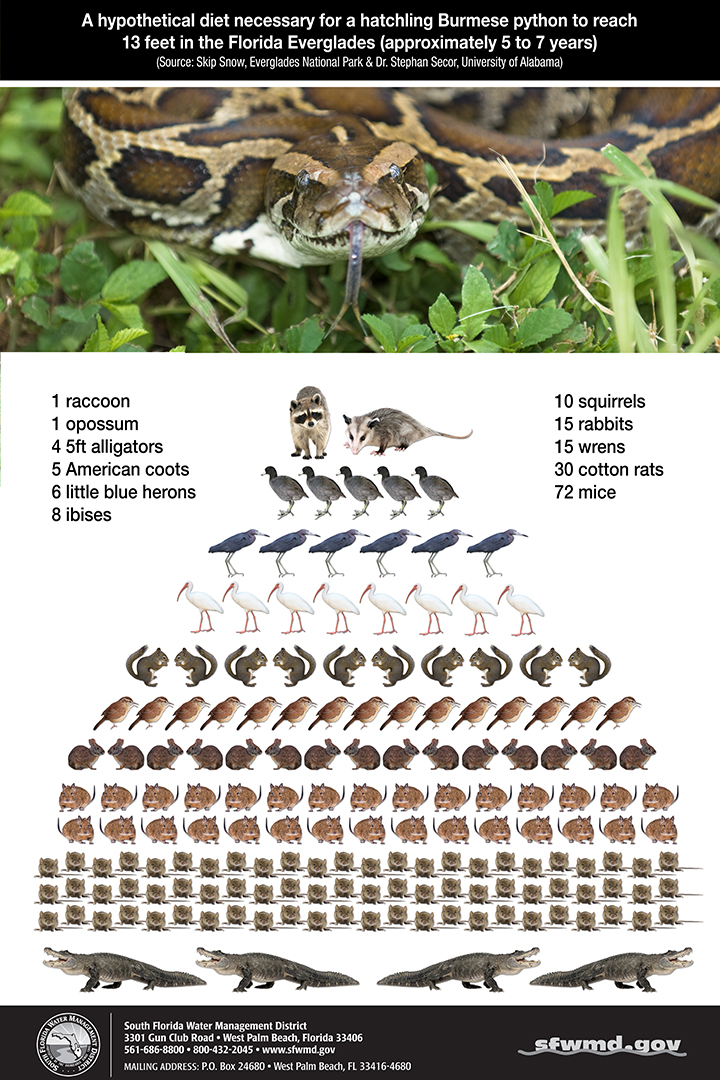
The first time I became interested in pythons was the day I saw this chart. The year was 2016, my husband Ed and I were visiting Everglades National Park, and the ranger informed us that 98% of the small mammals were gone…Terrible! 

In 2019, when I was appointed by Governor DeSantis to the Governing Board of the South Florida Water Management District, he made the SFWMD Python Elimination Program a priority. Those involved in this program hunt to remove these incredible animals. The largest caught was just under 18 feet 9 inches. So the connection? At Governor DeSantis’ announcement of this program, I met Mrs Donna Kalil. “If you ever want to go, let me know,” she said smiling in her trademark pink shirt. Just recently, on March 8, 2021, I took her up on it.

-Everglades Holiday Park, Governor DeSantis announces expansion of the SFMWD Python Elimination Program, August 8, 2019. ~Photo SFMWD.Ed and met Donna at the same place she and I met, Everglades  Holiday Park. Gregarious,  and easy to talk to, Ed and I felt like we’d known her for years, by the time we got to the L-28 canal -running north almost between Big Cypress Park and Water Conservation Area 3, just north of Tamiami Trail. She unlocked the gate, and we began our adventure.

My not being a hunter, not being able to even step on an ant, I was glad that if we caught a python, it would be bagged, and humanly -under strict rules- euthanized. I thought about how the first pythons released into the Everglades in the 1970s had been pets that somebody loved, pets that outgrew their terrariums. Now we have a major wildlife disaster on our hands. A disaster that could end in many of our back yards

Ed and I grabbed the rail atop of Donna’s SUV and stared down. We looked until our eyes popped! Donna had taught us how to distinguish the shiny skin pattern of a python in the vegetation, and immediately one saw how well they are camouflaged! 

It was a beautiful, very cool day and I found myself looking beyond the roadside to the gorgeous scenery. We came upon a rookery of maybe a hundred birds. -Wood storks, great egrets, anhingas, little blue herons, white egrets, great blue herons, ibis, and others I did not know. Alligators were nearby, abundant, black and shining, with their classic grins. As we slowly approached, they stayed either completely still or rushed the waters like angry bulls, branches crashing! After we went by, we could hear them grunting in the deep marsh. Cypress trees were getting their foliage and tender, light-green branches emerged against a blue-clouded sky. It was early morning and everything was just coming alive. 

“Oh!” I thought, “I am supposed to be looking for pythons!” I looked at Ed, and he was glued to the levee bank like a hawk. “Thankfully, he’s with me, I thought, I am a terrible spotter!” But I had never witnessed these Everglades lands. Spectacular!  

Donna was looking too. Suddenly, she jumped out of the vehicle. “Oh my gosh, she going to get one, I thought.” She gracefully came out of the woods with a huge yellow rat snake. “Just like our yard!” I yelled, snapping shots of her smiling and the snake looking very calm. I am not afraid of snakes, but 18 feet? 

“She’s a snake charmer,” I said to Ed. He smiled. “Just like when she told us she ran that program of parents at the PTA.” I laughed. I was so glad Ed was with me to experience this. Our next stop was also beautiful, in the classic Everglades way. We headed south into Everglades National Park from the SFWMD S-333 structure and Old Tamiami Trail. It was exciting to see the trail as it being removed to allow more water to enter the park. Even now, the water flowed south like a river,  Ed took pictures of me beaming.

The air was fresh and cool. The tall grasses and tree islands looked otherworldly waving in the afternoon light. As the clouds floated by, purples, burnt oranges, and greens took on one hue and then another. “A Monet painting,” I thought. “The Creator’s palate.” Cool winds blew, I zipped up my jacket and tightened my scarf. 

“Look at the road!” I heard myself think.“Pythons, I am supposed to be looking for pythons!” Ed smiled. “This is incredible,” he said. I grabbed his hand across our station top the vehicle. 

We did not find a python that day. I’m not sure if it is because it was in the 60 and 70s and the pythons couldn’t get moving, or if I missed about twenty of them. One thing is for sure, they are there. Donna is a top producer! Ed and I plan on going back out with Donna. She is looking for volunteers, so if you think you can keep your eyes on the road and off the stunning scenery contact her! ~join Donna Kalil, python huntress, on Facebook. 

In the meanwhile, I will be happily remembering my day “beyond pythons.” 

I. L-28 Canal between Big Cypress Preserve and Water Conservation Area 3/4. -Donna looks along the levee for pythons warming themselves in the sun II. Canal south at S-333 and Tamiami Trail, Everglades National Park

-Donna points to the an round impression in the grass from a python; she is constantly reading the environment for clues! 

-Farewell to a beautiful day! -Jacqui and Ed before the SFWMD S-334 Structure at Tamiami Trail “Hey Ed, is do you think this water is moving south?!”

VIDEOS

1.-Alligators are eaten by pythons; until now, they were the top predator. Luckily, in this video they look like they are having a very good day. 

2. “Sending water south” Old Tamiami Trail!


7 Days After ~Discharges March 2021

~Ed takes a picture at 3000 feet

I. HELPFUL INFORMATION:

1. ACOE Statement regarding discharging March 5, 2020

2. Lake Okeechobee level 15.06 feet

3. ACOE Pulse Release Schedule: 4.SFWMD staff’s recommendation to the Corps regarding Lake Okeechobee operations       for the period March 2 to March 8, and March 9 to March 15, 2021: Ops_Position_Statement__Mar_02_08_2021 

Ops_Position_Statement__Mar_09_15_2021 

5. Florida Oceanographic’s Weekly Water Quality Report 

6. HAB update and science data: Todd Thurlow’s website eyeonelakeo

II. DOCUMENTING THE DISCHARGES -all photos taken 3-13-21 by J&E on outgoing tide around 1pm. Friday, March 5, my husband Ed and I , took aerials of the St Lucie River/Indian River Lagoon just one day before the Army Corps of Engineers began discharging to the St Lucie River on March 6, 2021. I can’t say that in all our years of taking photographs since 2013, we have done so just one day before discharges began. Thus, now Ed and my goal is to take photos every week as long as the discharges continue. This will give us a really good opportunity for visual comparison.

We all know a picture speaks a thousand words…

Today, Saturday, March 13, 2021, is exactly one week after discharges began-(this time). You can see last week’s photos here! Do you think they were prettier than todays? I must admit, today, the water coloring looked better than I anticipated and that’s good news. This may not be the case in the coming weeks especially if the ACOE ups the discharge level.

We shall see.

~Jacqui and Ed

-St Lucie Inlet and Sailfish Flats at Sailfish Point-Sailfish Flats with no visible seagrass-St Lucie Inlet -A faint plume is visible going south along Jupiter Island-St Lucie River and Indian River Lagoon-Looking south over Hutchinson Island at St Lucie Inlet-Views north along Indian River Lagoon -At St Lucie Inlet looking over Jupiter Narrows to Port Salerno and Stuart-Water just outside St Lucie Inlet on north side, reefs visible as is sediment exiting inlet -Another view encompassing almost all: St Lucie River, Southern Indian River Lagoon -Looking south towards Palm City where the South Fork connects to the C-44 and Lake Okeechobee when structure S-80 and S-308 are open. -Looking east toward the cross shape and forks of the St Lucie River. IRL in foreground. Sewall’s Point lies between the St Lucie and IRL.

Day Before the Discharges, March 5, 2021

Yesterday, Friday, March 5, 2021, around 3:30pm, my husband Ed and I, took a flight over St Luice River/Indian River Lagoon. We knew we needed to document because word on the street had been that there was a good chance, with Lake Okeechobee over 15.00 feet, and rainy season approaching, the SFWMD and ACOE would soon be recommending a special HAB DEVIATION-discharging to the estuaries. Since 1948, the two agencies have worked together to manage the Central and South Florida System

In any case, when Ed and I heard the announcement 4:48pm, less than an hour after arriving home from our flight, -that the ACOE would open S-80 at St Lucie Locks and Dam from Lake Okeechobee- “tomorrow, March 6th,” we were speechless. 

“Wow. Thank God we got up in the plane,” I said to Ed. 

Today, I offer our St Luice/Indian River aerials as a visual day-before-discharges baseline.  Of course I am terribly disappointed. Ed keeps telling me I need to cheer up. I doubt that  I will, but I can say that  I am grateful that now water will also start going south, and that natural resources are being taken into consideration by the agencies. Unfortunately, there are not so many natural resources left. 

~As we have since 2013, Ed and I will continue to document the discharges. 

Please read the ACOE March 5, 2021  announcement to begin Lake O discharges to the estuaries.

For the technical, please read the SFWMD Operation Position Statement March 4, 2021: Ops_Position_Statement__Mar_02_08_2021

SFWMD image: C&SFFCP’s canals to the St Lucie. The western C-44 and Lake Okeechobee had no historic connection the the St Lucie River. The first five photos were taken in the area of the St Lucie Inlet over Sailfish Flats between Sewall’s and Sailfish Points. The flats presently are devoid of seagrasses. -Looking east over the St Lucie/Indian River estuary from Stuart to the Atlantic Ocean.-Looking south to Jupiter Narrows of the Indian River Lagoon. The St Lucie enters around the peninsula of Sewall’s Point. -St Lucie Inlet and “Crossroads/” Where the St Lucie and Indian River meet and exit the St Lucie Inlet.  -Close up of St Lucie Inlet and Crossroads.-Looking north, up the Indian River Lagoon.  -Jupiter Narrows looking south over Peck’s Lake. Note a controlled burn in Hobe Sound in the distance. -North fork of the Loxahatchee River lies in Hobe Sound and Jupiter just south of the St Lucie River. -Circling back over the St Lucie Inlet near St Lucie Inlet State Park on Jupiter Island. Here you can clearly see the waters that lie between Sewall’s Point and Sailfish Point at the Crossroads of the SLR/IRL. -Looking west over Sewall’s Point and Witham Field towards Stuart one sees the north and south fork of the St Lucie River and the Indian River Lagoon on the west side of the peninsula. Look hard and you will see the straight line of the C-23 canal-the boarder of Martin and St Lucie Counties.

Snow Moon ~ Hideaway Hammock

Hideaway Hammock is open to the public for events and special evenings.On February 27, 2021, a Snow Moon rose over Hideaway Hammock. This ancient prairie hammock lies in western St Lucie County off of Highway 70 and Carlton Road. Ed and I had been invited to partake in this memorable evening by Mrs Joanne Carlton Humphries and her husband Fred Humphries. Ed and I were delighted to attend.

The evening was a  special one, just the drive was an inspiration -to get out of the city and see the open land. When we arrived, we fetched a drink and introduced ourselves to strangers that soon enough were friends – realizing family and business connections as conversations unfolded. There were about thirty people from near and far. Some as far away as Maine who were very happy to escape the cold weather. 

The hammock is dedicated to the memory of Mr and Mrs Humphries late son, Clay. Certainly he is smiling upon this beautiful place. The meal was really spectacular. Though I most enjoyed taking photos of the incredible trees in the setting sun, and then, later in the evening, during the hay-ride, I watched in amazement as mother cow mooed as her new born calf stood-up proudly for the very first time! 

Ed and I had so much fun!

The moonlight washed over the place like a sentinel, reminding us of Florida’s rich ranching heritage. It was a beautiful evening, listening to Fred and Joanne, around the campfire, share their family histories that in some cases go back to before the statehood of Florida. It was an evening I will always treasure. So incredible that a  Land Remembered exist right here at home. -What is a hammock anyway?-Hideaway Hammock is dedicated to the memory of Joanne and Fred Humphries son, Clay.-Evening falls…-A delicious steak dinner with all the fixings was served on beautiful China!-Mrs Joanne Carlton Humphries and JTL -Jacqui and Ed on the hay-ride! -Passing cows in the moonlight! -Look at those trees! -Back to the hammock for storytelling….

A Land Remembered…

Click here to learn more about Hideaway Hammock.


Seagrasses? What seagrasses?

In spite of Florida’s significant development, the health of estuarine seagrass is something we expect and treasure. Being the home of baby fish and wildlife, estuaries are often called the “cradle of the ocean.”

According the the USDA, “estuaries are among the most productive natural systems on earth.” Their value? Perhaps priceless. And we are losing money fast. 

Today I wanted to share information presented at a Rivers Coalition meeting now posted for the St Lucie/Indian River Lagoon estuary;  I will touch on four other sister estuaries as well: Caloosahathcee; Lake Worth Lagoon; Biscayne Bay; and Florida Bay. Being familiar with each, can help us advocate for the value of the greater whole. 

I. St Lucie/Indian River Lagoon

Last week, my brother Todd Thurlow, shared satellite and GIS images that show a story of seagrass loss in the St Lucie River/Indian River Lagoon estuary in an area known to locals as Sailfish Flats. I have taken screen shot images of Todd’s website below. The first image was taken in 2007 and the second on 2-24-2021. In spite of yearly variations due to season, temperature, and other natural changes,  I think it is clear that seagrass has declined. The real killer is that the St Lucie River/Indian River Lagoon had once attained the greatest species diversity of any estuary in North America, (Lodge, The Everglades Handbook, 4th Edition, page 175).

Right now, it appears that seagrasses have disappeared in the Sailfish Flats region. The reason? Certainly there are many including the damaging discharges from Lake Okeechobee, and canals C-44, C-23 and C-24. ~Hurricanes? Climate Change? Sea level rise? Fertilizers from local runoff? Destruction of native trees and vegetation? Earlier dredge and Fill? Septic Tanks? Dredging? Beach Renourishment? But some of these things have gone on for decades, so why now such a difference? Please share your ideas and experiences. 

To see all images throughout many years visit Todd’s website eyeonlakeo.

-Seagrass loss a visual survey, Sailfish Flats, SLR/IRL, 2007 compared to 2021

II. Caloosahatchee  

I am no expert in the Caloosahatchee, but it is commonly known that if it gets too saline in the upper estuary, the underwater grasses there can die. I am sharing the most recent Sanibel Captive Conservation Foundation “Caloosahatchee Conditions Report” as it shows the organization recommending 2000 cfs from the ACOE (Lake Okeechobee) but will be recommending less or none  in the future.

III. Lake Worth Lagoon 

Lake Worth Lagoon, once a huge freshwater lake, is now open to the sea. LWL has many  issues, but sediment covering seagrasses -especially from the C-51 canal- is a big one. You can learn more at the Palm Beach County’s Environmental Resource Management website.

IV. Biscayne Bay

The South Florida Water Management had an outstanding workshop on Biscayne Bay last December. Seagrass loss was a big topic and they had just had a fish kill. You can learn more here.

V. Florida Bay 

Florida Bay has endured significant seagrass loss, especially, most recently in 2015. This year due to 2020 rains, the Bay is having a very good year as recently reported by the SFMWD. (See page 24).  Audubon’s Everglades Science Center is a good website to learn about issues of seagrass loss and others facing Florida Bay.  

“Seagrasses? What seagrasses?” It must be “Seagrasses! What Seagrasses!” 


SLR/IRL up to 7000 feet

~Documenting the St Lucie/Indian River Lagoon. Sewall’s Point, Ed and my home, lies between the St Lucie & Indian River Lagoon. My husband, Ed Lippisch, flew high, up to 7000 feet, to take photos of the St Lucie River/Indian River Lagoon, and S-80 (St Lucie Locks and Dam), on Sunday, February 21. The pictures were taken around 2:45pm on a very windy day. (Thus I declined an invitation!) Ed basically made a big circle. 

I am including all 52 photos as each one presents a slightly different perspective. Ed flew from the Crossroads and inlet of the SLR/IRL west to S-80 along the C-44 canal. There he saw no discharges coming through the gates from either the C-44 basin or Lake Okeechobee. Most recently, the ACOE halted discharges on January 9th, 2021 after 3 months of discharging. The river is starting to recover in appearance, but not soul.

Today, Lake Okeechobee is at 15.42 feet.

Tomorrow at 3pm the ACOE will hold a media call to announce their operational decisions for the coming week/s. James Yochem, spokesman for the Corp, has shared the following media advisory. The public usually does not speak on these calls but can listen-in. 

MEDIA ADVISORY:

The U.S. Army Corps of Engineers Jacksonville District will conduct a briefing with interested media representatives regarding water management for Lake Okeechobee and south Florida. The media briefing will be held Feb. 25 at 3 p.m.

Please join the call using this information:

US Toll Free    844-800-2712
Access code     199 453 9583

If you are asked for an attendee ID number, dial #

It is very important that we are paying attention to “all things river”and “speaking up for the St Lucie” when possible as we approach wet and hurricane seasons. 

Thank you Ed for the recent aerials!

~To view Ed’s photo essay documentation prior to this one on February 3, 2021, see Milky Waters!

~To review what happened to the St Lucie in Toxic 2016, see Too Unthinkable.

About Jacqui Thurlow-Lippisch 

Simplifying LOSOM

-Lake Okeechobee’s northwestern shoreline on a beautiful day, 2020. Photo Ed Lippisch and Jacqui Thurlow-Lippisch “LOSOM.” Sounds rather ominous doesn’t it? 

You may have heard the acronym recently and wanted to get involved. Today, I will try to simplify the major aspects of LOSOM best known as the “Lake Okeechobee System Operation Manual,” by splitting the process into three sections, past, present and future. It is my hope that this helps the everyday-person make sense of a complicated process and provides tools for effective advocacy.

Getting involved with LOSOM is about the most important thing we can do to “be a voice for the estuaries” because it means influencing a very complex lake operating system that for years has favored water users at the expense of the estuaries. Over time, priorities change, it is time to be fair, and now is an opportunity to speak-up. This occasion comes along only every decade, or two…

So here we go! 

I. Past 

The ACOE’s lake operation systems entail a lot of complicated science, however, one thing we can all understand is lake level. The modern lake regulation schedules began in the 1970s. Outstanding author and scientist, Thomas E. Lodge, states on page 153, in his book, The Everglades Handbook, Fourth Edition : “Since the 1930s, Lake Okeechobee’s water levels, or stages, have been regulated in an effort to balance often conflicting goals.” 

These original goals were defined back in 1948 in the“Comprehensive Report on Central and Southern Florida for Flood Control and Other Purposes,” when the ACOE reworked (some would say overworked) South Florida’s canal system. These goals or priorities  remain with us today as we work through LOSOM. Understanding these goals gives us solid ground to stand on in an often shifting arena.            

-1948 C&SFP map (Revised, 1982) 

The goals/so called benefits of expanding the canal system and draining Florida were the following: 1. Flood control; 2.Land Use (creation of the Everglades Agricultural Area, and more drained land for development throughout the system);  3. Navigation;  4. Fish and Wildlife; 5. Water Supply, and 6. Recreation.

What is not mentioned, nor was considered in times past, is “Health.” 

In recent years, poor water quality, due to non-point and point source pollution build-up over many years, has led to large toxic algae blooms on Lake Okeechobee;  unfortunately due to irresponsibility and carelessness, it has reached mammoth proportions. When discharged to the estuaries, St Lucie, Caloosahatchee, and the Lake Worth Lagoon (not yet formally considered an “estuary”) local economies, as well as wildlife and human health is threatened to the point of catastrophe. 

The NOAA satellite image below shows a cyanobacteria bloom on Lake Okeechobee in July of 2016.  Absolutely unbelievable. To deal with this dangerous situation, over the past couple of years, the Army Corp has implemented a Harmful Algae Bloom Deviation. It will more than likely become part of LOSOM.

-Lake O, NOAA satellite image 2016. Table 11.2 below  is an excerpt from Dr Lodge’s  book and is extremely  helpful in understanding the history of the Army Corp of Engineers’ regulation schedules and management of Lake Okeechobee. LOSOM will come next, starting in 2022. 

-According to Dr Lodge, a 1913 Corp of Engineers’ report “established the wet season level of Lake O at 20.6 feet NGVD. Seasonal low was 19.2 feet. Since 1913 the lake has multiple canal outlets and is now smaller and enclosed by a dike (1933). Regulation schedules since the 1970s are listed below. CLICK TO ENLARGE TABLE BELOW. 

After studying the chart, one can see that we are entering the 6th modern Lake Okeechobee regulation schedule. 

 As mentioned, right now 1. Flood control (this includes dike and flood water safety); 2. Land Use; 3. Navigation; 4. Fish and Wildlife; 5. Water Supply and 6. Recreation are the goals lake regulation schedules of the past have worked under. But as the HAB deviation tells us, times are changing and priorities must be defined by the times we live in.

Let’s think…

Which category do think has priority now? Which one/s had priority in the distant past? Why? Where do you want the priorities in the future? Should there be yet another priority such as health?

Now is the time! 

II. Present

The image below, LAKE OKEECHOBEE SYSTEMS OPERATION MANUAL UPDATE, is from Feburary’s  SFWMD Governing Board meeting (go to 133.38-205.25 to hear the discussion from Mr John Mitnick, P.E. Chief District Engineer, and the board.)  If you have the time, watching this will be very helpful. 

Mr Mitnick shared the slide below during this WATER CONDITIONS SUMMARY, which now includes LOSOM. Notice the word “health” is used a lot. Interesting.  

The world of LOSOM is a world of scientific models. And it is these scientific models that will help determine the future. The South Florida Water Management District’s expertise as a local sponsor of the Central and Southern Florida Plan puts them in charge of the modeling for the Army Corp of Engineers. Groups of volunteer and experts have been discussing these models since January of 2019. They have narrowed the models down from over 120,000. Now you can jump in too! 

Note the numbers to left of each sub-objective or goal. For instance, the number next to “Enhancing ecology in the St Lucie” is 4C. The scientific models that benefit the St Lucie are 4C models. The number next to “Enhancing ecology in the Caloosahatchee” is 4B. The models that benefit the Calooshachee most are 4Bs. The ideal lake operation conditions for these two estuaries are not quite the same. For instance, the St Lucie wants 0 discharges, but the Caloosahatchee needs some discharges due to salinity issues. When the LOSOM process gets to “balancing” these things will have to be worked out along with all the other stakeholder goals and wishes. Get the idea? 

So here’s your chance. What is your priority for your water body or other? Of course they are all important but what stands out for you TODAY? 1. Flood control; 2. Land Use; 3. Navigation; 4. Fish and Wildlife; 5. Water Supply; and 6. Recreation and/or 7. Health. 

Think Estuaries: St Lucie, Caloosahatcee, Lake Worth Lagoon, Biscayne Bay, Florida Bay, Lake Okeechobee itself? Once upon a time, Lake Okeechobee was once part of the greatest estuary in the world-our River of Grass! 

In the art of negotiating, or “balancing,” as the ACOE calls it, start strong with your first priority. Ask yourself which category has taken a back seat? Maybe you are not pleased with any of them. Which priority should come forward?  Perhaps its a combination. You decide! 

III. Future

So where are we in this complicated process? The SFWMD will hold workshops for the board and public in the coming months. But consider getting involved now. 

The SFWMD image below shows that we are in the green phase: January 2021-May 2021, where 13 models will be chosen from the 27,000. This is too much to think about. Just focus on your goal. Your number from the above chart.

The yellow rectangle that is so hard to read says: “Iteration 2, Balanced Array of Lake Schedules” (May 2021-July 2021). After July we will enter the orange phase and all of the feedback (advocacy and input)  will be “balanced.” Negotiated. 

Negotiated in the public arena! When all is said and done, the new lake plan —the Lake Okeechobee System Operating Manual (LOSOM) —will take effect in 2022.

So speak up now! Write the Army Corp, the address is below or better yet, attend Monday’s February 22, 2021 meeting if possible. There will be others, but put your foot in the water now. 🙂

Even though, this has been a relatively complicated post, I hope it has helped simply the LOSOM process: thank you for being a voice for the estuaries and our waters!  


IV. ACTION ITEM

PLEASE READ BELOW

Let’s seize this moment to advocate! 
Join the Army Corps LOSOM meeting!
 
When: 10 a.m.-noon Monday, Feb. 22 
 
Or call in by phone at (844) 800-2712.
The dial in access code is 199 737 9512. The password is 1234. 
 
Can’t make the meeting?
If you’d prefer to send written comments, you can email them to Lisa.E.Aley@usace.army.mil.
 
Thank you!
 
-Lake O’s northwestern shoreline on a not so beautiful day, 2020. Photo EL & JTL
 
Jacqui Thurlow-Lippisch is a member of the SFWMD Governing Board


EAA Reservoir/STA, Modern Progress and a Real Reason for Hope

-Looking towards a future where progress means water flowing south. EAA Reservoir /STA 2021. Photo credit, Libby Pigman, SFWMD. What do they say? “There is no stopping progress!” And the definition of progress changes throughout the ages…

Monday, February 15, 2021, was an Everglades “progress” inspiration for me. The last time I had visited this area was October of 2019. There were vast sugar fields as far as the eye could see. Today, the area is a field of dreams, a goal of collective effort, the lynchpin for sending more water south and significantly alleviating  a hundred years of destruction to the Northern Everglades: St Lucie, Caloosahtchee, and often Lake Worth Lagoon.

The trip to the Everglades Agricultural Area Reservoir/Stormwater Treatment Area is an experience in and of itself. The District is in charge of building the giant marsh or Stormwater Treatment Area (STA.) South Florida Water Management District  Communications Director, Sean Cooley and I met as the sun rose, and then drove west in a truck from South Florida Water Management District Headquarters through West Palm Beach and the Everglades Agricultural Area, to meet Regional Representative Libby Pigman and Hendry County Commissioner, Carson Turner – who chairs the powerful 16 County Coalition. I have known Commissioner Turner since 2008 and it was fantastic to see him. He is a wealth of knowledge and perspective that I very much appreciate. 

The highlight of the day? Because of my SFWMD Governing Board status, I was allowed to push the button to detonate the dynamite blast. Not really my cup of tea, but it was exciting! And oh my gosh, the shells! Boring 18 feet into the cap rock, thousands of years of ancient earth and shell come to surface.  

As we walked through the piles of rock and shell after the blast, I thought about how this area was once the flooded southern sawgrass plains leading to the Ridge and Slough and Shark River Slough, rising to replenish Florida Bay. I envisioned millions of beautiful wading birds and rookeries doting the spectacular and rare landscape. I thought of how in the name of “progress” humankind drained and destroyed the Everglades. I thought about how priorities change over time. I smiled thinking about how the EAA Reservoir and Storm Water Treatment Area is a real reason for hope, an attempt to return a connection to this sacred River of Grass. In the name of modern progress let’s keep going! For the birds, for the wildlife, for our children, indeed, for all of us. 

Enjoy the photos and blast videos! And thank you to SFWMD staff and RYAN for the tour. -Map of EAA Reservoir/STA. Our location A-2 STA, C-623

*Click here for February 2021 SFWMD EAA Reservoir/STA  construction details and update: Bill_20210216_0001

-A red-eared slider turtle greets us at the gate! “Hurry up…” he says!  -“We want the STA” cried  the wading birds! “We need an upgrade!” -We arrive at the EAA STA construction worksite. -David Anderson, RYAN inspector, reviews safely and the day.-Comr. Turner and I look at a map. Carson shares perspective. I learned a lot. -Amid EAA STA construction: David Anderson, RYAN Inspector; Libby Pigman, Regional Rep, SFWMD, Sean Cooley, Communications Dir. SFWMD, Carson Turner, Hendry County Comr. Dist. 5, JTL GB SFWMD.-Site of detonation that will be part of an intake canal system for the EAA STA (pink highlighter pen, upper left corner, on above map shows approximate location). -Muck, ancient deteriorated sawgrass, scraped from cap rock and piled up will be re-laid after construction in STA for plant growth that will filter the water before it goes to the reservoir.-Ancient shells. Florida is of course, an ancient sea…The Everglades is estimated to be “only” 6000 years old.-Dynamite container bored 18 feet into rock. -RYAN’S Mahmound Khalaifa saw I was looking for shells so he showed me what he had found! Ancient coral head and various bivalves. Beautiful! -More review on safety and blast from true professionals.-JTL prepares to hit the button! 

  1. CLICK HERE FOR AWESOME MOVIE #1 OF DYNAMITE BLAST CREATING THE INTAKE CANAL EAA STA 2021.
  2. CLICK HERE FOR MOVIE #2 EAA STA BLAST 2021  – JTL SCREAMING WITH DELIGHT!

POST BLAST

-Sean Cooley, Communications Director SFWMD and Comr. Turner walk carefully amid the mountainous post-blast site. -Carson Turner & JTL pose for the camera. Jacqui is finding fossils and cool rocks.-Carson found an ancient coral head and gifted it to me. Thank you Comr. Turner! -Driving a short distance from the blast site one sees the infamous “pyramids” against the horizon. This is rock that has been crushed and ground down. It will be used to create the canal edges and levees. Nothing on site is wasted. -Final explanations, questions, and wrap-up! A great day! Rock crusher in background.-The road home …-Treasures from the Earth… Thank you Everglades….-General location of EAA Reservoir STA on Google Maps. It lies between the Miami and New River Canals. The perfect place to reconnect! 

More photos of EAA Reservoir’s STA blast canal digging with explanations, January 2021, TCPalm, photographer, Leah Voss article Max Chesnes.


What is a HAB Deviation?

-Shadow in Toxic algae, Central Marine, St Lucie River, Stuart, FL 2016. Photo JTLSince February 1, 2021, the St Lucie River has fallen under an Army Corp of Engineer’s “HAB Deviation” or Harmful Algae Bloom Deviation. If you are not familiar with it, this is a complex situation, and it took a lot to get there; however, I am going to try to explain it in easy terms.

Basically, HAB Deviation means that the ACOE has the authority to discharge from Lake Okeechobee in order to avoid another toxic summer. The HAB Deviation gives the ACOE the ability,  if necessary, to discharge more flexibly than is documented in the present Lake Okeechobee Regulation Schedule, or LORS 2008. The HAB Deviation may dovetail with new requirements in 2022, when a new, updated lake regulation schedule called LOSOM, is delivered. The HAB Deviation may or may not exist then. But for now, it does.

“Why?” you may ask. 

Because actually the ACOE is trying to protect the estuaries from a precarious future. For example, this year, today, (2-14-21) Lake Okeechobee, is at 15.40 feet. This is considered “high” from a St Lucie/Caloosahatchee point of view because looking forward to June 1st 2021, when rainy season begins, it appears the estuaries may be receiving discharges. 

Again, the purpose is for the ACOEs to be able to discharge -to get the lake down early- so they don’t “have” to massively discharge come summer -when the lake undoubtably will have algae blooms. The goal is to avoid discharging algae. Thus the term HAB DEVIATION.

As we can tell from this UF thesis (Gayle) written in 1975, algae blooms have been documented in Lake Okeechobee since 1967. Water Quality is the responsibility of the State, but things got so bad in 2016 and 2018 for the St Lucie and Calooshatchee that the ACOE stepped in and created the HAB DEVIATION SCHEDULE. 

So far the ACOE has not started discharging to the St Lucie River under the HAB DEVIATION, but we should be prepared. 

“Is it better to get the discharges during the winter months when there is not algae in Lake Okeechobee?” This is a difficult question. 

Best would be not to get any at all…

Today, I share because it is all so confusing. At a recent SFWMD meeting, I realized that I didn’t even understand that although the St Lucie is not receiving discharges, the deviation has already begun…

Approved Planned Deviation from LORS 2008 to reduce risk from Harmful Algal Blooms

2020 Planned Deviation to the Water Control Plan for Lake Okeechobee and Everglades Agricultural Area (LORS 2008)

Glades, Hendry, Martin, Okeechobee, and Palm Beach counties

Final Supplemental Environmental Assessment and Finding of No Significant Impact (Oct. 8 2020)

Supplemental EA and FONSI

Appendix A

Appendix B

Appendix C.1

Appendix C.2

Appendix D

NOTE: very large files may take several minutes to open and download.

-2016 Toxic Algae Bloom, St Lucie River at Central Marine. The algae blooms start in Lake Okeechobee. When discharged to the St Lucie River the blooms are exaserbated by poor water quality and the freshness of the once brackish estuary due to long releases from the Lake Okeechobee. This pattern must stop. More water must flow south. Photo JTL 


On A “Perfect” Day

My husband Ed, and friend, Dan Velinsky, went fishing yesterday (2-9-21) at “Sailfish Flats” between Sewall’s and Sailfish Point. It was indeed a spectacular day, and Ed returned home smiling even though they didn’t catch any fish. “It was beautiful.” He exclaimed. “But no seagrass, no fish, except hiding by the islands…” Then he turned with wide smile“We even saw seven dolphins and two turtles! I taped them!”

 The whole time Ed was speaking, I couldn’t help it…

I saw a number flashing in my head: 15.41, the level of Lake Okeechobee on February 9, 2021. This number is high from a St Lucie point of view for this time of year. In June will come rainy season….

As ACOE’s Col. Kelly reported last week, the lake is going dow, but: “Today, the lake stage is at 15.42 feet, which is still 2.5 feet higher than it was one year ago, and 2.7 feet higher than it was two years ago.”

FLASH! FLASH! 

I share Ed photos “on a perfect day,” to document-  knowing – we must keep an eye on Lake Okeechobee and the decisions of  Army Corp of Engineers .

Click here to see Lake Okeechobee Level in graph format  

Both videos of dolphins in bluish waters 


Thousands of Flying Fish Crows!

Yesterday, February 7, 2021, before the Super Bowl, Ed and I took the binoculars and walked to watch sunset at Bird Island. The Indian River Lagoon on the east side of Sewall’s Point is always spectacular at this time of day. Once we took a seat, we were amazed to see an almost endless flock of cawing fish crows making their way to roost somewhere south of Bird Island, maybe in the area of St Lucie Inlet State Park. We could see the shifting shape flying from the horizon miles away. They appeared like little mosquitoes approaching from the distance! There were thousands and thousands of fish crows! 

Although I was born in 1964, and grew up in Sewall’s Point and Stuart, the first time I noticed the massive flocks was along the St Lucie River in North River Shores back in the late 90s. I would watch with amazement for hours as they steadily made their way across the sky. “Where are they going?” I thought. “Where do they come from?” Although Fish Crows are listed as being at risk due to Climate Change, it certainly seems that their numbers are increasing. 

I include a couple of videos and encourage comments on what readers may know of this  incredible phenomenon. This survivor of a bird! 

Video 1: Thousands of fish crows fly over east Sewall’s Point near Bird Island. Video 2. Same but even better view hundreds more in the near distance. Incredible! 

Fish Crows: John J. Audubon

Milky Waters

~St Lucie Inlet with Crossroads of SLR/ILR at Sewall’s Point Ed’s February 3, 2021 photos of the St Lucie River & Indian River Lagoon at the St Lucie Inlet are unusual. Taken during cold temperatures and windy conditions at 2:15pm – at “dead high tide,” they show the incoming blue waters with a milky quality juxtaposed to the darker estuarine. This combination is one I have never seen, ever. Ed and I have been documenting  since 2013. When I first saw these photos, I posted a few on Facebook stating: “Interesting…”

Later, my brother Todd wrote back: 

“I just saw Ed’s pictures of the river.  When we were out last weekend the St. Lucie was that milky blue.  With the pounding waves offshore, the water was full of suspended sand.  You would think that sand is actually beneficial when it is transported inside the estuaries to settle on top of the muck bottom.  I did YouTube videos of the Bahamas after Dorian when the entire Bahama bank and outer reefs were that same milky blue.”

So that’s what’s going on! Interesting! 

Today I share more of Ed’s recent photos. They are taken from 4000+ feet which gives a much broader perspective and highlights the beauty of the St Lucie Inlet region in spite our struggle to revive our seagrasses and protect our water from discharges, especially those of Lake Okeechobee. On February 3, when these aerials were taken, the ACOE was not discharging having halted January 9th, 2021 after 3 months. At the present moment the ACOE does not have plans to discharge from Lake Okeechobee. The lake is presently sitting at 15.37 feet. 

This could be problematic for the St Lucie come summer…

*Thank you to my husband, Ed Lippisch for taking these photos! 


Walking for Panthers

~Above photo: FWC public records. FWC officer documents young male Florida Panther hit on Hwy. 710, November 2, 2019. 

I waited a long time to share this photograph. It’s almost too much to take.

This panther was hit and killed November 2, 2019, on Highway 710, less than a mile south of Indiantown in Martin County, Florida. Today I share this photo because of an article I read in TCPalm by environmental reporter, Max Chesnes. The title of the article is Man Walking From Vero Beach to Key West to Tallahassee for Panther Donations.

It is a story of loss and inspiration.

Mr Chesnes explains that when tragedy struck, Mr Steve Fugate “hit the road.” Fugate had lost his son to suicide and his daughter to accidental drug overdose To cope, the 74 year old Vero Beach native, began walking, finding solace and inspiration in Nature along the way…

There are panthers in Martin County.

In 2016, I wrote about one sighted in Allapattah Flats – ten miles west of Palm City, where in fact, SFWDM just held a Ribbon-Cutting. But because Panthers are few and far between compared to the south west coast of Florida, in my opinion, they do not get the government press or the protection via fencing and wildlife underpasses they should here. There is no urgency anyway.

“It was just one hit in twenty years.” I’ve heard. “Most are on the west coast…”

I think there should be signs, underpasses, fencing, and press on the east coast as well. For Mr Fugate and others, every life counts. Thank you to reporter, Max Chesnes and thank you to Mr Fugate, I am inspired!  I will be making a donation on the panther’s behalf! 

TCpalm: In an effort to raise awareness, and funding for the critically endangered Florida Panther, Vero Beach native, Steve Fugate has partnered with the Fish & Wildlife Foundation of Florida and started on a nearly three-week, 1,600mile walk around Florida. Photo PATRICK DOVE/TCPALM. Click here for full article. 

Chesnes writes:

“Now, Fugate hopes to give back to the natural world and its inhabitants that embraced him throughout the years. His latest walk, which started Saturday, will take him from Vero Beach — through St. Lucie, Martin and Palm Beach counties — to Key West, then up Florida’s west coast from Naples to Tallahassee.

The nearly three-week, 1,600-mile journey is meant to raise awareness and funding for the critically endangered Florida panther, he said. 

“They’re just gorgeous animals,” Fugate said of the species, named in 1982 as Florida’s official state animal. There are only an estimated 120 to 230 wild panthers left, according to data from the Florida Fish and Wildlife Conservation Commission.

More:FLorida panther deaths map and details”

~Florida Panther, Florida public photo


There’s A lot More to it Than Mowing…

It may seem like a small thing, but it’s actually a big thing. How does the South Florida Water Management District (SFWMD) manage mowing responsibilities for the Central and South Florida Project?

The Central and South Florida (C&SF) Project, first authorized by Congress in 1948, is a multi-purpose project that provides flood control, water supply for municipal, industrial, and agricultural uses, prevention of saltwater intrusion, water supply for Everglades National Park, and protection of fish and wildlife resources. The primary system includes more than 1,000 miles each of levees and canals, 150 water control structures, and 16 major pump stations.

~The ACOE built this system and the SFWMD was created to manage it. 

-S-308, C-44, & S-153 in Martin County are part of the vast Central and South Florida ProjectIn December 2020, item 19 of the SFWMD Consent Agenda read:

“Maintenance of District Lands is required to ensure that vegetation is controlled at the appropriate height to provide for optimal performance and operational efficiency of the District’s flood control system.”

I had inquired. I had questioned…

I had visions of the District mowing down every blade of grass. I asked what was done for the ecology? “Does the District leave any flowering weeds for bees or butterflies?” “Does the the District think about vegetation for the wildlife or do we just mow it all down in the name of flood control?” 

I figured it would be the later…I was wrong. 

On January 28, 2021, I got the tour of a lifetime and learned that there was more to it than mowing. A lot more.I met the heads of departments at DuPuis Wildlife Management Area near Indiantown in Martin County. The goal of my tour was to visit levees and canals and learn about SFWMD mowing practices. Photo: South Florida Florida Management Leadership, L-R back to front: Francois Laroche, Vegetation Mgt. Section Administrator; Rich Virgil, Field Ops. Division Director; Rory Feeney, Land Resources Bureau Chief; Chris Edelstein, Field Ops. Bureau Chief; LeRoy Rodger, Invasive Species Unit Lead; and me, JTL, SFWMD Governing Board.

I.

First we drove to the C-44 canal near S-308, an area I know well. The S-308 structure allows the Army Corp of Engineers to discharge water from Lake Okeechobee into the St Lucie River. The C-44 was first constructed from ca. 1913 to 1923 and over the years widened and “improved.” This repetitive disruption of the soil allows invasive plants to move in each time.

I did not realize the extent until SFWMD’s LeRoy Rodgers, Invasive Species Unit Lead,  and Francois Laroche, Vegetation Management Specialist, told me the story and showed me the back side of the C-44 canal near S-308. 

NAPIER GRASS: Introduced as a forage grass for cattle in the early 1900s; this African grass is extremely invasive.  It grows best along disturbed canal edges eventually hindering flood control by blocking access to canals and impeding water flow. It has been here for decades.Over the years, C-44  levees near S-308  have become covered with Napier Grass also known as “Elephant Grass.”

-Canal C-44 at S-308 coved in Napier Grass -Rory Feeney, Land Resources Bureau Chief,  tugs on a Napier plant. ~The Rhizome structure makes the grass very difficult to “just pull out.”The tall grass is mowed intermittently on a schedule. The roots go wide and deep into the ground making it impossible to pull out without compromising the integrity of the Central and South Florida Project at C-44. All that can be done is to manage this explosion of grass. 

I looked around. The tall Napier Grass reached as far as my eye could see. I thought about history. I though about time. I thought about responsibility. I asked if there were any benefits for wildlife. 

LeRoyRodgers, Invasive Species Unit Lead answered. He said certainly, animals could hide there, but it was not a preferred habitat except for one, another invasive, the Burmese Python. He noted that when the SFWMD mowing crews started finding chopped-up python down in Homestead, a few years ago, that was when the District became aware of the python population issue down there.

Not a good visual…

The men compared areas showing me how the grass does respond to more frequent mowing. They explained how when it is mowed, some is cut short, some is left long and some is cut more often than other.

Closest to the road, where it can be mowed more frequently, I could see other plants and weeds not just Nadier Grasses coming in.  Weed-like flowers bloomed here and there. Francois Laroche, Vegetation Management Specialist explained the ways of nature. With the more frequent mowing, other plants could “compete.”

I started to get the picture…

-LeRory Rodgers, Invasive Species Unit Lead, points to other plants coming in when Napier Grass is more frequently mowed along flat areas.

II.

Next, we drove just a bit further to the intersection of the C-44 and the  S-153 Structure. This structure controls the water inside a canal parallel to Highway 98 and the FPL cooling pond.  It was explained to me that this levee is a second line of defense should the waters of Lake Okeechobee pour over. A levee holds water back and a canal moves water. We were here to look at the levee. However, keep in mind, there is a “canal” where dirt is dug to build a levee…-S-153 intersects with C-44 canal; it is an area full of wildlife and displays both native and non-native plants along the canal used to build the levee.

-LeRoy Rodgers & Rich Vigil observe a fern; this one is not native, used in landscaping yards. -S-153 at C-44 canal Looking around I was happy to see more flowering weeds and plants, and less invasive Napier Grass. This wasn’t the “flowering prairie” I had hoped for, but after my lesson on invasives, I was a bit more open minded. As I looked around, small birds darted away, quickly taking cover. A fish jumped close to a mass of dollar weeds that were wedged up against a floating rope. Some wildlife lives here! 

I was starting to consider the balance.  Where there was mowing, there were more flowering weeds and other plants. As Francois had said, mowing allowed competition.  

To answer my question about plants for pollinators, we found numerous native Spanish Needles. These native blooms are highly visited by a range of pollinators and butterflies. There were others I did not recognize flowering as well. I saw a yellow butterfly, maybe a sulphur. Dragonflies were everywhere. I could hear insects chirping. 

Mr LeRoy and the others picked flowers saying the names in Latin. We discussed the various vegetation, some native, some not, along the levee. It was a mix.

We kept walking.

“O.K. there’s ding,” said Chris Edelstein, Field Ops Bureau Cheif.

“What’s a ding?” I inquired. 

“Something the Army Corp would mark against us. See the dug out areas? That’s from wild hogs foraging for roots and worms.” LeRoy said the name of the long roots left behind in Latin. “This agressive digging is problematic to the integrity of the levee.”

“A ding!” I replied, noting the District’s legal obligation to the Army Corp. of Engineers.

“At least there’s life here,” I repeated. “And I do adore those little piglets!” 

We continued looking at plants and weeds. “Oh and here is another ding,” said Chris. 

I looked up seeing nothing more than a pile of sand.

Rich Virgil, Field Ops Division Director  explained: “That’s a gopher tortoise  burrow…their burrows can be over 15 feet long and 6 feet deep. This can definitely be an issue for the integrity of the levee.” 

I thought about the possibility of a hurricane and Lake Okeechobee overtaking its dike,  the waters pouring east towards the levee. As the men had explained, this levee would be a line of defense. 

I got down on the ground, and took a picture. The men talked. It sounded that a threatened gopher tortoise was not as easy to remove as the wild hogs.

The area was very interesting and definitely more wildlife friendly than our first stop. The mowing pattern again showed some vegetation left alone, some mowed shorter, and wild plants growing along the edge of the canal. The edge of the canal is mowed most infrequently by a special contractor when the plants get “too woody.” Otherwise it is left to grow….

I was somewhat impressed. 

-Gopher Tortoise burrow in the levee -Edge of canal connected to S-153 displays ferns and other plants, many flowering. I did see a few clumps of the invasive Nadier Grass, but not much.

III.

Last but not least, we drove to Lakeside Ranch, a Storm Water Treatment Area (STA) for nutrient reduction near Taylor Creek, northeast of Lake Okeechobee. In this area the levees of the STA were only a couple of years old; flowering weeds and “good” plants totally outnumbered the small clumps of Nadier Grass. The men talked about the importance of staying on top of the mowing so the Nadeir Grass and other invasive plants wouldn’t take over this area that is now habitat to an extensive number of birds and other wildlife.

“You have to stay on top of it.” Rich said looking from horizon to horizon. 

The place was beautiful. As we continued down the path, I laughed out loud at seeing a pile of apple snails, the trash midden of Snail Kites. Rory Feeney, Land Resources Bureau Chief, explained: “You can tell by the shape that these snails are not native, some can become  invasive, but for the endangered snail kite, it’s been a life saver. The native Florida apple snail lives in a very limited habitat, whereas the invasive  species tolerate more diverse conditions, including human-made impoundments.”  

Wow. An invasive apple snail as a life-saver? The metaphor hit me hard. Non-native species are not always a bad thing, I guess. 

 And mowing?

I’m not as judgmental as I was before the field trip. There’s a lot more to it than just mowing!

-Staring down at piles of invasive apple snail shells left by endangered Snail Kites-I hold an empty, non-native, invasive apple snail shell, the snails that helps the Snail Kite survive in a changing Everglades environment. If only the invasive Nadier Grass could do so much good!

*Thank you to staff! 

The Green Ridge

Although I first took this photo on January 21, 2021 to document the layer of smoke hovering at the horizon due to the burning sugarcane fields, I later noticed the clear aerial composition of the Green Ridge. Thus I share today…

Looking even briefly at the photograph, you will notice that this ridge is scraped flat by agriculture fields and 1-95 swinging over it – to take advantage of the high 30-35 foot topography.

So what is the Green Ridge and why is it important to the St Lucie River?

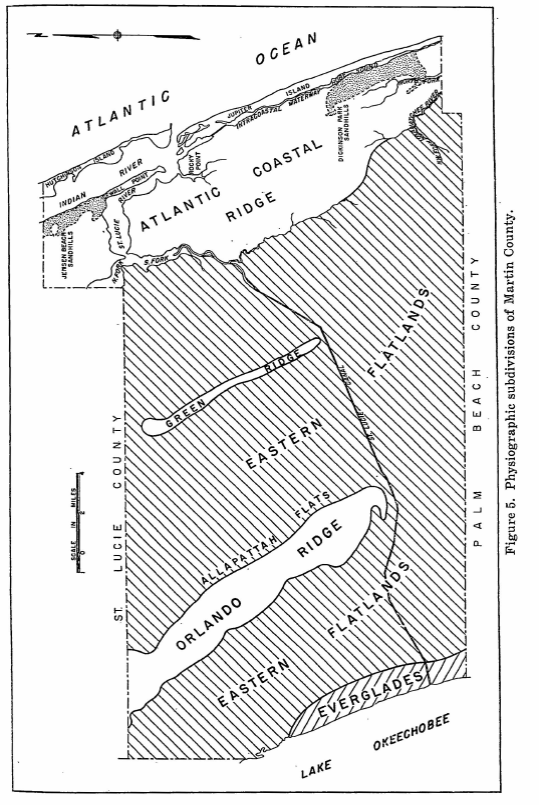
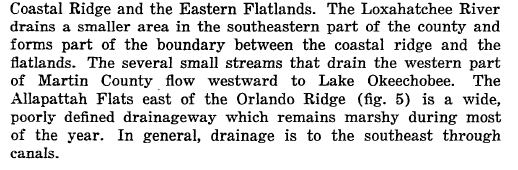
You may have recently read my post on Allapattah Flats where my brother utilized the map below from a 1960’s U.S.Geological Survey, “Martin County” report, on water resources prepared by William F. Lichtler? This report gives an excellent breakdown on pages 7-11; but even if you don’t read it, you can see it!

The Green Ridge guided waters south as they traveled slowly through the marshy Eastern Flatlands being deepest closest to the Orlando Ridge, Allapattah Flats. (For reference, today Indiantown lies in the southern portion of the Orlando Ridge.)

When the St Lucie Canal, (C-44) was cut ca. 1914-1923 and then deepened, widened, and “improved” many times since, it caused the waters moving southeast to shoot down into the St Lucie. Today, due to agriculture and development, these water are polluted and basically unfiltered and have been allowed to be so for many, many years.

And when Lake Okeechobee is opened into the St Lucie Canal…we all know what happens then. Complete destruction from a water source, Lake Okeechobee, that also was never connected to the St Lucie!

For years I tried to understand the Green Ridge, and it’s importance, now I think I do. In restoring our waters it is helpful to be able to envision how Nature functioned before humans altered the landscape to the point that she is almost unrecognizable. 

-Red baloon designates the Green Ridge


An Aerial View- Our Remaining “River of Grass”

-Looking southerly towards White Water Bay in Everglades National Park

These photos are the second part of Ed and my flight reported on January 21, 2021. The first part focused on “Finding the Shark River.”

I wanted to include these aerials in my blog as well as they too are interesting to see. This set begins near White Water Bay at the southwestern tip of Florida and travels northeast over the remaining River of Grass. I will note areas based on the FWC map below that compartmentalizes the Everglades, our remaining River of Grass into Everglades National Park and the Water Conservation Areas.

During the flight, in the northern areas especially, there was a lot of smoke in the air as the sugarcane fields were burning in the Everglades Agricultural Area that was once the  sawgrass “southern heart” of the River of Grass. Over time agriculture, roads, development, and so called conservation areas have divided her.

-Enjoy the flight.

…As we envision what more we can do to restore this natural wonder. 

(You can click on image to enlarge)

-Turning over White Water Bay-Flight GPS -Shark River Slough/Southern Everglades/Everglades National Park -Looking north east over the upper Southern Everglades/Shark River Slough area-Continuing north, note Tamiami Trail that divides Conservation Area 3 from Everglades National Park -Tamiami Trail: water is stacked north due to road-Conservation Area 3 Alligator Alley further north also dissects the River of Grass -Now over Everglades Agricultural Area fields; note Water Conservation Area 2 and Water Conservation Area 1. -Mostly Water Conservation Area 1-Everglades Agricultural Area -Tuning east over Water Conservation Area 1-Approaching the coast near Jupiter, note land changes -Jupiter Inlet over the Loxahatchee River an area that was once connected to the Everglades…

Finding the Shark River

When Ed and I recently visited Flamingo and rented a boat to explore White Water Bay, my goal had been to find the Shark River. I never found it…

I had wanted to see this river because although there are many Everglades’ rivers, the Shark is the most associated with Shark River Slough. Even though this slough, this river of grass, has been amputated by the Everglades Agricultural Area, Tamiami Trail, and eastern coastal development, getting waters into Shark River Slough and the Shark River still translates and is actually improving: “Sending Water South.”

So we took a flight…

Ponce de Leon Bay, where much of this water exits, is particularly breathtaking to see. The geometric shapes, shades of green, brown, and blue create a giant puzzle. It makes me want to put all the pieces back tother again.

It was so wonderful to finally find the Shark River!  I wanted you to see it too! The primary goal remains, to send more water south; this we must envision…

-Everglades Rivers flowing southwest out of Shark River Slough 1-21-21, photos JTL&EL -Ponce de Leon Bay where Shark River exits into Florida Bay The Shark River is the primary river you see coming into this area of Ponce de Leon Bay. White Water Bay  is to the right. It all kind of blends together. 

  1. Shark River, red dot follow northeast; 2. Shark River Slough, large most far right area above shark river -seemingly brownish green – running into Shark River 3. Water Water Bay appears as a dark green depression southeast of and connected to the Shark River; 4. Shark River exits at Ponce de Leon Bay into Florida Bay. Florida Bay is in dire need of more fresh water. 

What is, what was, Allapattah Flats?

-Photo credit: Martin County: Chair Martin County Commission, Stacey Heatherington in red, and SFWMD Governing Board, ribbon-cutting Allapattah Flats 1-21-21Yesterday, the South Florida Water Management District held a ribbon-cutting for Allapattah Flats. The celebration was for over 6000 acres of wetland restoration work completed through a partnership: specifically the South Florida Water Management Distirct, the Natural Resources Conservation Service, a division of the U.S. Department of Agriculture, and Martin County who for a over a generation has provided leadership for natural land purchases. 

 As this recent op-ed of longtime Martin County Commissioner, Mrs Maggy Hurchalla states, bringing back wetlands is the most on the ground, real way to restore the Everglades. This means  the St Lucie River too. The beautiful bird life really appreciates this as post drainage, due to habitat destruction of wetlands, their numbers plummeted by the millions.

-Photo credit SFMWD: a juvenile little blue heron is released by Bush Wildlife Center!  -Renewed Partnerships: Rep. John Snyder; SFWWMD, JTL; MC Chair Stacy Heatherington; Comr. Doug Smith -JTL, MC Comr. Sarah Heard-SFWMD Executive Director, Drew Bartlett, JTL, & Mr. Jaun Hernandes, NRCSSo what was Allapattah Flats?

Since drainage, the lands, flora, and fauna have changed so much! It’s almost unrecognizable. To get a good idea of what it used to be, so as to understand the ribbon- cutting within the context of toady and yesterday, I knew if I was to well prepared for the event, I had to inquire with my history and map loving brother, Todd Thurlow. I am including Todd and my correspondence on this issue because it is so interesting and helpful in understanding “what is, what was, Allapattah Flats”. Our email exchange is below: 

J: “Todd tomorrow is the ribbon-cutting for Allapattah Flats. Was Allapattah Flats part of the Alipatiokee Swamp or was it separate? Was it a pine flatwoods area with small marshes or what. All these historic names sound the same. – Allapattah, Halpatiokee, Alpatiokee. I’m looking at that 1839 Gen. Z. Taylor map. Thanks.”

Above: portion of 1839 Gen. Zachary Taylor map. Allapattah and derivatives mean “Alligator” in Seminole.

Below: portion of “old” Florida map- one can see the former extent and connection of Allapattah Flats running along the inner east coast that the C-44 /St Lucie Canal from Lake Okeechobee to South Fork of St Lucie dissects. Shared by Todd Thurlow.

T: “I think Allapattah Flats is one of those names that has moved around/changed over the years.  It’s the old Al-pa-ti-o-kee Swamp of my YouTube Video.  It was a wetland.  Not a pine forest.  It may have become a pine forest after it was drained – or had pine forests at its edges like the Savannas in Jensen.

I think of it as the area west of Green Ridge and East of the Orlando Ridge.  I don’t think it was called Flats because of the pine flatlands.  I think the name may have come from the fact that it was flat – water would slowly flow north OR south in the poorly drained marsh depending on the conditions at the time.  The excepts below speak of it including the Hungry Land Slough or being a slough itself.  The first reference shows it immediately east of the Orlando Ridge. But the Al-pa-ti-o-kee was the entire area.”

  1. Florida Geological Survey Report of Investigations no. 23 – May 16, 1960

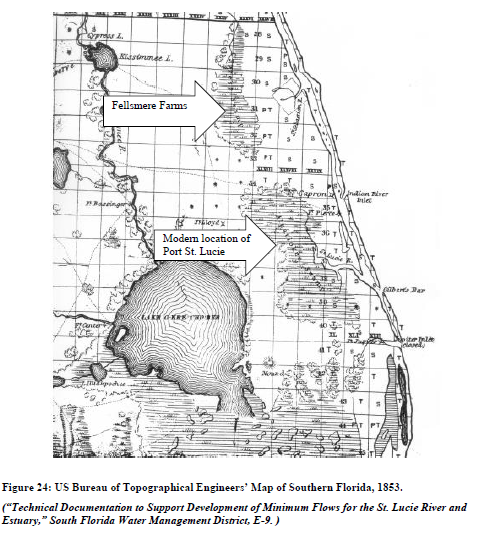
2. Oranges and Inlets – Nathaniel Osborn 2012. As the wetlands of the IRL were drained, the names of land features shifted over the decades to reflect their changing form. Today’s “Allapattah Flats” near the St. Lucie Estuary is undoubtedly a post-drainage name for the same feature listed on nineteenth century maps as “Halpatta Swamp” or “Alpatiokee Swamp,” but the lowered water table has left the area no longer resembling wetlands. Surveys of the lands west of the St. Lucie Estuary in the decade before the completion of the St. Lucie-Okeechobee Canal suggest that the land was covered with standing water for 8-10 months of each year. In the years which followed the post-1916 Drainage Act canalization, this drained region (like much of the IRL) became citrus groves, the town of Palm City, and the post-World War II development of Port St. Lucie (figure 24).273

————————————————————-

3. Bill Lyons, son of Ernie Lyons,  from your blog. “During summer, sheet-flow from the Allapattah Flats converged in tiny rivulets into a deep pool with a sand bottom, the first of a series of pools connected by shallow streams of clear water that formed the headwaters of the South Fork. Dad loved that place, not just for its beauty but for its solitude. Itcould only be reached by Jeep during the wet season, so we hitched rides with the local game warden, who would drop us o􀁷 and return for us later. Clyde Butcher’s photos of the upper Loxahatchee River are the nearest thing I’ve seen to what once was the upper South Fork. Then in the fifties, construction of the FloridaTurnpike cut off the flow of freshwater to the River. Soon saltwater intrusion crept up the South Fork,impeding the spawning of its fish, and the River began to die. In 1962, a friend and I drove to the former siteof the headwaters. The area had been bulldozed and the pool had become a cattle watering hole.”

4. Florida Everglades Report 1913 – Document 379, 63d Congress, 2d session

5. The New York Botanical Garden – Green Deserts and Dead Gardens, A Record of Exploration in Florida in the Spring of 1921

J: Todd this is incredible. Thank you!

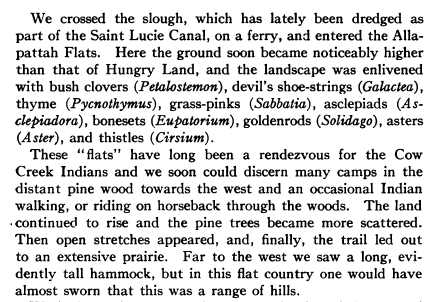
6. One more reference from The New York Botanical Garden, Old Trails and New Discoveries, A Record of Exploration in Florida in the Spring of 1919. It is pretty descriptive.  Hungry Land – southeast / Allapattah Flats northwest.This is the kind of stuff I love reading because you know what he is describing.  He describes the “distant pine wood towards the west” and a long evident tall hammock … one would have almost sworn … was a range of hills”.  He is looking at the Orlando Ridge, the southern tip of which is Indiantown.  You can still see what he sees when driving west on SR 70 or the stretch of turnpike that goes west though St. Lucie County.

J: So Todd, it sounds they drained Allapattah Flats and Hungry Land Slough in the 20s when they dredged  the St Lucie Canal from Lake Okeechobee to the St Lucie River. What a bargain! Aggg!  Thank God we are bringing some of it back! See you tomorrow!

Released juvenile little blue heron in wetlands Allapattah Flat, photo Todd ThurlowSo as you can see what is, what was Allapattah Flats is a long story! And we began to restore history!

Todd’s pictures:  http://www.thethurlows.com/2021-01-21_AllapattahFlatsRibbonCutting/

Jacqui’s speech: https://www.youtube.com/watch?v=AuklcguRVgY&feature=youtu.be

The official SFWMD stream:  https://www.youtube.com/watch?v=hg5MksxMbX0


Biting News at Peck’s Lake

Ed and I disagree on a number of things, but we are always in agreement about our pets! We had decided to take them with us for an overnight in the trawler at Peck’s Lake. 

I laughed and smiled. It was a beautiful and very cold day. I was so glad Ed had some time off. We were both having such a good time until I looked at the alert that came up on my phone…

“Ed you’re never going to believe this. There is an insurrection in Washington D.C.. A sea of Trump supporters are attempting to break into the Capitol.

It was January 6, 2021 and I knew for Ed this brought back terrible memories. In the 1960s Ed’s family had emigrated from Argentina to the United States to escape a series of military coups. 

Ed and I spoke for hours about the situation in the United States. Not much could be more depressing. Having Luna and Okee with us took off the edge. Before we all went to bed, Ed and I promised to get up tomorrow and enjoy Peck’s Lake. Peck’s Lake, as most all of us know, lies within the Jupiter Narrows and once was an inlet to the sea. Yes, historic maps show that many times the Atlantic has breeched this shoreline, most recently twice in the 1960s. The ACOE filled in this gap and today Nathaniel Reed Hobe Sound National Wildlife Refuge sits on these sands. You can reach this place by boat or a long walk north from Hobe Sound Beach in Martin County. If you like to canoe, you can put in at Cove Road. Peck’s Lake is one of 560 U. S. National Wildlife Refuges and lies in Martin County. Birds, mammals, reptiles, amphibians, and fish call this refuge home. 

A long walk along the beaches on the Atlantic side of the refuge is incredible, probably one of the only desolate beaches to be found on all of Florida’s east coast. Certainly, the area doesn’t look too different from 1696 when Jonathan Dickinson was escorted by the Ais Indians north.   Tooling around on the Jupiter Narrows side, Ed and I encountered wonderful things and weird things. We witnessed many osprey nests; we saw an otter surface and dive alongside an oyster covered mangrove forest, we also saw seagulls eating from a strange looking, large-eyed fish carcass. When I called Indian Riverkeepeeper, Mike Connor to find out what this cut-up was he said it was a swordfish! Ed and I threw the fish back into the water and seagulls dove for it from every direction.-Below: Osprey nest. Above: Ed drives dingy with trawler, Adrift in background at Peck’s Lake-Look! An otter! -Swordfish head floating. Very strange! -Seagulls dive   When Ed and I got home that evening, we also experienced no seeums or sand fleas and it was torture! 

“Are you getting bitten?” Ed asked coming into the cabin.

“Not really. Let me go outside and check.”

By the time I had been outside for thirty seconds, my hair was full of sand fleas and I was slapping and scratching myself everywhere at once. 

“Unbelievable! It’s been a long time since I felt them! When I was a kid growing up in Sewall’s Point and Stuart they were here!”

Ed and I ran inside and  barred the door as the tiny creatures made their way through anyway covering the lights of the cabin. Ed and I ate by flashlight that evening and Okee and Luna thought they were in heaven. Ed and I didn’t even think about the state of the world, we were too busy scratching…

Videos: 1. Cove, Peck’s Lake; 2. Mangrove Tour, Jupiter Narrows, Peck’s Lake

*Pets stayed on boat. They are not allowed in the wildlife refuge 🙂

*Thank you to my mother who shared to old add about sand fleas from First National Bank, forerunner of Seacoast. 


As Far Away As One Can Go, Flamingo…

My primary 2021 New Year’s resolution was to write more, however my angst over our country’s political, social unrest and the worsening Covid-19 epidemic has caused me to experience  “writer’s block.” Nonetheless, today I will try to get going with my resolution. 

On January 9th, 2021, my husband, Ed, looked at me, “I’ve got a few days off; do you want to stick around Stuart or do you want to go somewhere?”

“Hmmm? Let’s go as far away as one can go, Flamingo.”  I replied.

“Flamingo?” Ed looked like he wasn’t quite sure…

“Yes, Flamingo, at the very southern tip of Florida.”

-Flamingo lies in Monroe County, inside the boundary of Everglades National Park (ENP)

The following day, Ed and I packed up and drove from Stuart to Lake Okeechobee taking Highway 27 south until we arrived in Florida City, just south of Homestead. Next, we drove about an hour along the historic Ingram Highway. It was a beautiful drive – like going into Florida’s past with marl prairies, slash pines, and tremendous bird life.

About forty miles later, we finally arrived in Flamingo. Now a ghost town, Flamingo was once the home of the American Flamingo -thus the name. Although these spectacular long legged, pink birds were all killed for their spectacular feathers a over a century ago, today there have been reports of a few returning. Most of us are familiar with the story of  Guy Bradley, the first Audubon warden hired to protect Everglades wading birds from poachers. This is his land.

Back in the early1900s when Bradley was trying to protect the birds, Flamingo, as all of South Florida, was thoughtlessly being sliced and diced with canals. Today, one can see this most pronounced at the Flamingo Welcome Center along the Flamingo, more modernly called the Buttonwood Canal.  Here lies a “plug” between Florida Bay and the mosaic of fresher/fresh waters in and near Flamingo.

According to our ENP tour guide, Mr Nick, this “Flamingo” or “Buttonwood Canal” was dug by Henry Flagler in the early 1900s and later abandoned when Flagler realized the canal failed to drain the land – instead, due to the tides and topography of the area, bringing  too much salt water from Florida Bay. A cement plug was later placed to ward off this saltwater intrusion.

I was pleased to see that a family of Ospreys had built their nest right on this plug in the midst of much human activity! The female osprey was hard at work, peeking over the side, protecting and incubating her eggs while the male intermittently delivered fish. The large birds appeared absolutely unaffected by people!

FLAMINGO or BUTTONWOOD CANAL                                                                                                                                                                                                                                                          -Salt water, Florida Bay side of plug-Below: brackish/fresher water on estuary/marsh side of plug leading to Coot Bay (Coots no longer come in droves as the water is still too salty.)-The cement plug cutting off salt water of Florida Bay from canal, note osprey nest! -Our ENP guide, NickThe first day Ed and I took a tour and Mr. Nick was our guide. The second day, we rented a Mako flats boat and followed the same path ourselves. We learned so much. It was incredible. While Ed looked for places to fish, I searched for the Shark River. The Shark River is one of many that extends out from Shark River Slough, the remaining ridge and slough, “river of grass,” of the Everglades. Some of its waters lead to Florida Bay. Taylor Slough, on the other hand, has shamelessly been cut off by development.


Flamingo Canal was full of wildlife: wading birds, manatees, and by far the most interesting, crocodiles, of which I had never seen. These southern waters of Florida are one of the only places on Earth where both Alligators and Crocodiles live together. This canal is so salty the crocs have the edge. Our tour led from Flamingo Canal, to Coot Bay, to yet another canal, and then into Whitewater Bay. This track is referred to as the “Wilderness Waterway.” (See map below.)

American crocodile, an endangered species -The most prevalent wading bird by far was the tri-colored heron-There were many baby crocodiles along the Flamingo Canal warming in the sun. It was 37 degrees in the morning of our second day at ENP! -Because of the plug, manatees must enter the protection of the Flamingo Canal by swimming into the rivers entering Florida Bay that lead eventually into  Whitewater Bay! A very long journey. 20 miles? -Our tour guide, Nick, called this tree along the Flamingo Canal  the “perfect mangrove.” -Flamingo/Buttonwood Canal opening to Coot Bay-Entering Whitewater Bay on a cold day!It is very hard to explain how gigantic this area is! Over ten miles long and more than half that wide. Irregular in shape. It was truly “liquid land,” with mangrove forests everywhere and smaller even more beautiful mangrove islands dotting the horizon. One thing was for sure, it would be very easy to lose one’s sense of direction and get lost in Whitewater Bay. No thank you! 

Ed and I spent hours tooling around but never made it to the Shark River as access is limited. Nonetheless, I got a much better idea of the lay of the land for sending water south. I am hoping Ed and I can one day return in a canoe.

I was happy to go as far away as one can go-FLAMINGO!-Learning about a Florida I did not know- Whitewater Bay islands of Flamingo -Ed practices casting-Islands within Whitewater Bay; all of Florida must once have looked this way! -Back on Land: A Walk down the Guy Bradley Trail-Ed watches a fisherman cast in Florida Bay-Moonvine once covered the southern rim of Lake O’s pond apple forest, now gone.-Ed poses with a giant Buttonwood tree-Morning Glory. Is there a more gorgeous flower?-Guy Bradley Trail and an end to a wonderful day!

VIDEOS: 1. FLAMINGO/BUTTONWOOD CANAL; 2. MANATEES; 3. CROCODILE 

Africa’s North Fork of the St Lucie

I felt like I was in Africa…

It’s strange to find perhaps the most untouched part of the St Lucie River in the heart of Florida’s eighth largest city, Port St Lucie. In fact a full trip up the North Fork goes all the way to Ft Pierce. Although many of the trickling branches once running to the river have been developed, some have not, and the immediate area around the oxbows was left wild. 

Poor water quality from agriculture and development’s runoff plague this 1972 designated Aquatic Preserve but nonetheless it is an incredible relic! Today I share phots and videos of this remarkable place. The photos of mangroves and sable palms look a bit flat and repetitive, but the videos really reveal the dimension of the experience. 

Port St. Lucie 1957, mouth of North Fork looking  from south, St Lucie River- Photographer,  Aurthur Ruhnke, Thurlow Archives, Sandra Henderson Thurlow

Ed and I took put the Maverick in at Leighton Park in Palm City. Other than screaming a few times when gigantic wakes almost enveloped us, it was a great trip- a trip I have not taken in many, many years.

This excerpt from  the 1984 Aquatic Preserve Management Plan notes that the North Fork was straightened and channelized by the U.S. Army during World War II, nonetheless much of the fork has the wonderful oxbows as you can see from my phone’s screenshot below. These oxbows are an incredible thing to see and definitely give one the feel of someplace wild and exotic like Africa. Like Florida was not too many years ago…

“Water is the one resource whose characteristics most directly affect this

             estuary’s habitability and healthiness for the plants and animals naturally

             adapted to living there. The drainage basin of the entire St. Lucie River has

             been modified by agricultural drainage and residential development. The North-

             Fork-St. Lucie River receives the outfall of two major drainage canals (C-23

             and C-24) and many other drainage sources in the upper headwaters. The

             freshwater flow from the St. Lucie Canal on the South Fork may also affect the

             North Fork indirectly. The uplands surrounding the preserve area are also

             modified by the extensive Port St. Lucie residential development and the other

             residential developments along the river. The North Fork was also modified by

             the U. S. Army during World War II. Those modifications involved the

             straightening and channelization of the upper section of the river

             (Environmental Quality Laboratory, 1980). The result of all of these

             modifications to the river and its basin is that rainfall that may have taken

             months to get to the river by natural drainage now takes only hours. The

             river that once meandered through a broad floodplain now flows down a deep

channel.” -1969 Internal Improvement Fund via 1984 N.F.A.P.M.P. 

Photos North Fork, St Lucie River January 3, 2021

-Pond Apple 

-My favorite photo! A turtle sunning itself! 

Videos St Lucie North Fork Oxbows

List of Birds/Wildlife/Plants seen 1-3-21 SLR and North Fork

Seagull
Great Egret
5 ibis
Little Blue Heron
Blue Heron (young) 
Pair ospreys
2 Little Blue Herons
Turkey vulture
Floating flock of seagulls
Floating flock of pelicans
Cormorant
Kingfisher-N. Fork
Turtle
Little Blue Heron
7 mullet jumping- Mud Cove
Little Blue Heron and ibis 
Little Blue
Pond Apple 
Frilly fern?
Leather fern
Saw palmetto
Seagulls hunting  S. of PC Bridge


Nature’s Ultimate Transformation

-Newly born MonarchFor me, there have been a few positive aspects regarding “Terrible 2020. “Covid-19’s Zoom World  isolation has given me time to learn to cook and also to study butterflies.

Recently, I decided to learn the difference between the celebrated and now endangered Monarch and the lesser known Queen. Walking my garden, I had noticed two similar but different caterpillars on milkweed that I had not seen together before. When the weather got unusually cold, I decided to bring them inside on their hosts plants.

“You are going to make those butterflies weak!” My husband Ed told me.

I smiled, replying, “Well at least they will live.” I had researched and learned that about ten percent overall make it due to predation and the elements. 

-Queen rust colored (below) all photos JTL-Monarch orange (below) both have white dots and stain glass window patternWith a little convincing, Ed helped me carry a heavy, old, lidded aquarium into my office, and the magic began. Within a few days all of the caterpillars were hanging upside down and turning into chrystalises. I noticed right away that the Queen’s case, although almost identical to the Monarch’s, was smaller and sometimes a cream-pinkish color rather than bright green. All had the distinctive and beautiful gold dots!Ed look!” Suddenly, he was captivated! 

“What are those gold dots for?” He asked.

“Perhaps camouflage, coloring -like many things with these butterflies, science doesn’t really know. An article in Scientific America says, best understood, to transform into a butterfly, a caterpillar first digests itself. But cells called imaginal disks survive, turning the soup into eyes, wings, antennae and other structures. When I look at the gold dots, they seem to line up with designs on the wings. But who knows? “

Ed quietly studied the gold spots and the emerging transformed creature. He like me, was intrigued!

So the original goal, the simple visual difference between the two?

The easiest way to show the basic differences between the Monarch and the Queen is to share some photos. It’s very clear when they are not flying around! Seventeen were born by yesterday, December 30th, 2020: seven Queens and ten Monarchs.

Ed and I released them all and all were healthy. It took about twelve days to witness Nature’s ultimate transformation. Certainly an inspiration for whatever is coming in 2021. Transform we must indeed!

-Queen -Above, newly born Queen. Below, Queen & Monarch chrystalises/markings the same but Queen smaller and sometimes cream in color rather than green-Monarch with one Queen and one Monarch broken casings/Monarch caterpillar gets ready to change -Queen caterpillar (below)-Monarch caterpillar (below) -Monarch more orange (below) -Queen more rust colored (below) -Can you tell the difference between the Queen and Monarch? I bet you can! -Release! Videos Queen opens wings to fly off; mating Monarchs in my yard:

Renewal By Fire

Born in the 1960s, I am a child of the Smokey Bear generation taught -at all costs- to avoid forest fires. Times have changed and we now know that fire is a necessary part of Florida’s ecology bringing renewal. As a Governing Board member of the South Florida Water Management District, I decided before 2020 ended, I should learn about this first hand.

Recently, Section Leader, Jim Schuette,  Land Management Department,  was my guide. We met near Cypress Creek in Palm Beach County near the Loxahatchee. We arrived early and were greeted by a small herd of adorable Zebu cattle – like miniature Cracker Cattle! 

Shortly thereafter, Gene Colwell, Senior Scientist, and Land Management Techs, Hal Camp and Marshall Davis arrived. Gene led the detailed safety/info briefing. “I hope I can do this,” I thought. Jim gave me some fireproof clothing and a hard hat. Suddenly, I was just “one of the guys.”

-Senior Scientist, Gene Caldwell leads briefing-Loxahatchee River Area near border of Martin & Palm Beach countiesThe fires were set with cans of diesel and gas and I noticed the pine needles that carpeted the forest burned slowly first. I was concerned about the wildlife. 

When the animals smell this they leave the area,” Jim said. 

“Are there any gopher holes for the smaller animals to hide in?” I inquired. 

“Yes, and the ground is moist.” He placed a handful of soil into my hand and explained that due to time of year and wet conditions, it would not be a towering fire. Jim noted that the team always worked to protect the canopy of the pine trees. I knew that in spite of the best circumstances, sometimes, there must be casualties, but for the health of the forest over-all it’s beneficial. 

Stepping away from the heat, I read my UF handout:” Ecological research shows that fire is an integral component in the function of natural habitats and that the organisms within these communities have adapted to withstand, and benefit from wildfires. In fact, many Florida habitats only exist due to the presence of wildfires. Some were created by frequent fires, others by a few big fires decades apart.” 

As time went on things heated up; I watched as Marshall and Hal used fire guns that ignited diesel filled ping-pong balls that were shot into the woods. Later in the day, I was asked if I wanted to participate under the supervision of the team. 

Getting my nerve up, I grabbed one of the heavy fire-lighting containers.

Mr Calwell instructed me to start the fires a good distance apart along the edge of the forest. The pine needles ignited first, cracking and moving like a living organism all its own. It felt strange lighting the woods on fire.

“There were a lot of things we believed in the 1960s that we no longer hold true.” I thought to myself.

The can was heavy and I used both arms. My neck ached. The sound of the fires popped and cracked as tall tongues hissed in the oily palmettos. Suddenly, liquid like flames traversed the bark of the pine trees creating a windstorm of fiery renewal. I was told the new growth would start coming back within just two days…

-Hal Camp with fire gun-Jim Schuette reports smoke situation on 1-95 “visibility is good” -Palmettos and sable palms are oily and burn quickly  -Post burn using water to cool hot spots-Fire brings renewal. Within just days green sprouts will emerge!  Above Jim wets embers

FIRE VIDEOS: IMG_7289

Thank you to Jim Schuette and the SFWMD Land Management team for this experience! 


Cusp Anastasia, Final Full Moon Rise of 2020

Cusp Anastasia, eve of Final Full Moon Rise, 2020. Photos JTL

Is it a moonscape? Perhaps a foreign land? Another planet? No, these sunset-moonrise pictures are of  the backbone of the the Atlantic Ridge, also known as the Anastasia Formation. This ancient coral rock lines much of Florida’s east coast and is dramatically revealed along the ocean shoreline of south Hutchinson Island, Martin County, Florida.

The photos are taken with an iPhone and untouched. During the golden-hour the rock reveals a warm, rich palate absorbing and reflecting the ocean and sky’s stunning sun and moonlight.

Although these  photographs were taken on the eve of the full moon, December, 28, tonight may be even more beautiful as the last full moon of 2020 will rise this evening, December 29, 2020.

It is said that “Anastasia” is a Greek name with roots in the word “resurrection.” For me, especially with a year like 2020, I am thankful for the beauty of Nature that gives opportunity to be reborn.

Wishing everyone a wonderful 2021.

Other posts Anastasia


Expanding My Environmental Education of Lake Worth Lagoon!

Lake Worth Lagoon Tour with ERM Director, Deborah Drum

December 14th, 2020. What a beautiful day!

Deborah Drum, Director of Palm Beach County’s Environmental Resource Management Department, ERM, invited me in my capacity as a SFWMD Governing Board member, to tour the Lake Worth Lagoon. I first met “Deb” when she was the ecosystems manager for Martin County. Today she oversees a much larger piece of the water pie. Palm Beach is Florida’s third largest county and has over 1.4 million people! Martin County? Ranking, I’m unsure, but we have just over 161,000 people…

After a quick Covid greeting elbow-bump at Bryant Park, of course we abided by social distancing rules, Deb introduced me to five of her 140 person staff. They were delightful and they informed me of the mission of ERM:  to establish, maintain, and implement programs for the protection, preservation, and enhancement of the land and water resources of Palm Beach County. 

This philosophy really translates into building restoration projects and is a shift from what I’m used to for the St Lucie River where the focus is more on managing and advocating against the ongoing crisis of poor water quality. Today I will give an overview of some of the hundreds of projects that have been constructed costing millions of dollars.  This is a complicated generational feat and today occurs with the coordination of Palm Beach County’s Deb Drum and Staff, and the complex help of hundreds of hands-on volunteers and members of the business community. See “mission” link above for more information on the history of this program. 

So how does it work in Palm Beach County? 

FOCUS ON PROJECTS 

Since the 1990s, the Palm Beach County environmental resources department has implemented hundreds of projects. In order to achieve this, relationships have been forged with the business and development community that in turn, indirectly, provide millions of dollars in materials for creating habit and other environmental projects in Palm Beach County. 

As an example, Jennifer, Baez, Environmental Program Supervisor explained that it is more cost effective for developers to share such materials for island or reef building, than to dispose of such items. Wow. Developers helping the environment? Now that’s a paradigm shift for my thinking!

-Jennifer Baez 

~This cooperation has been forged over decades and is now ingrained in Palm Beach County culture.

For example, if FDOT is building a new bridge, they save and coordinate with the county for the best pieces of throw-away cement to be used for an inland or offshore reef. Or say a new marina is being built, or expanded, by Rybovich Super Yacht Marina, and there is tons of sand and rock that have been excavated- well rather than throw it away or haul it to the dump, the business contacts the county and this material is put to work for the environment! I guess one could say it is “give and take.” In any case, for Palm Beach County this model is working. 

Once riding along the beautiful lagoon in the boat, I was fascinated to listen as Deb’s’ staff, TJ Steinhoff, Environmental Technician; Jennifer Baez, Environmental Program Supervisor; Jeremy McByran, Palm Beach County Water Resource Manager; and Mathew Mitchell, Environmental Manager as they told me the story of their years of building Lake Worth Lagoon creations and the measurable benefit to fish, birds and wildlife.

Amazing! 

“It must be fun to know you are doing something positive every day. And then seeing those results.” I noted.

All four agreed. They love working for Deb and for Palm Beach County. But let me be clear, just because the focus is one projects,  this does not mean there are no water quality issues…  

-Bryant Park, Lake Worth Lagoon

-Staff ready for boat tour covered for Covid-19: TJ Steinhoff, Environmental Technician; Jennifer Baez, Environmental Program Supervisor; Jeremy McByran, Palm Beach County Water Resource Manager; and Mathew Mitchell, Environmental Manager

-Rip-rap in from of a hardened shoreline, the beginnings of a Living Seawall project at Bryant Park

-A look at the water of the Lake Worth Lagoon on December 14, 2020 

-The 5 photos below are of large human-created Islands, restoration projects, in the Lake Worth Lagoon.

Below: Jennifer Baez, PBC Environmental Project Supervisor points to one of the many mangrove, native vegetation, sand islands built on top of “dead holes.” These areas were once devoid of life because they are so deep,  and were the unintended consequences of dredge and fill in the Lake Worth Lagoon that took place many decades before environmental laws regulated such activities.  

Jennifer explained how ERM identifies these deep holes, carefully works around muck, and then fills the depression with sand -in turn forming  an island-  that creates wildlife habit, seagrass beds, and eventually mangrove forests. She says one very obvious benefit of theses projects has been that Palm Beach County now has the most southerly nesting/foraging area of American Oyster Catchers. 

In springtime, the bright orange, black and white birds with their fluffy, adorable chicks are attracted to these human made islands near Bryant Park.

Learn about ERM Project on Facebook https://www.facebook.com/PBCERM/

Deb Drum, Director ERM and yes she is smiling under that mask! 🙂 -Showing off more project islands! 

-The Southern Boulvard Bridge rebuild (below) is an example of materials used for a reef in Lake Worth Lagoon as seen on depth finder screen of Mathew Mitchell below. Mathew said he is very proud to be part of this project and explained that through technology and hands on visits he is documenting how the reef is improving fish habitat.

ISSUES OF WATER QUALITY 

As I mentioned, just because Palm Beach County primarily focuses on restoration, doesn’t mean that the Lake Worth Lagoon doesn’t have water issues. Before the late 1800s, Lake Worth was a many miles long fresh water lake with no outlet to the ocean. Today there are two inlets and  although the water body is now technically an estuary, salinities can be as high as the ocean due to heavy flushing from its inlets. Also due to fresh water inputs, like the C-51 Canal, salinity can swing up and down.

-The SFWMD measures saqilinties in the LWL 

Lake Worth Lagoon Water Quality issues are most affected by canal, area runoff, and sometimes Lake Okeechobee discharge into the lagoon. The C-51 is the canal of that continually drains unfiltered and untreated into the Lake Worth Lagoon. The C-51 carries contaminants and nutrient pollution from agriculture and urban development into the lake-lagoon-estuary. Deb Drum explained that sediment coming from this canal is extremely problematic causing a muck-layer throughout the lagoon. This impedes seagrass development and is a serious issue that is being addressed. 

Although the Lake Worth Lagoon was not built as am overflow water outlet for the Central and South Florida Plan, like the St Lucie and Calooshahatee were, Lake Okeechobee discharges are sometimes directed its way through the C-51 canal.  This is a controversial issue and of course local advocates of the Lake Worth Lagoon would prefer not to have this excessive polluted fresh water.  

-Jennifer and Deb in front of the C-51 Canal structure opening into Lake Worth Lagoon, note look of water. The C-51 basins are tremendous. All this runoff all ends up in the LWL.

C-51 Canal is the long blue line coming from the west connected to other interior canals. It then runs along Southern Boulvard as in the image below. The curve south occurs around the  Palm Beach International Airport, then turns east discharging into the LWL. Water Quality is being address methodically through Basin Management Action Plans.

KEEP ON RESTORING! 

So in the meantime, Lake Worth Lagoon’s water quality ails, but Palm Beach County keeps restoring…

Below shows a recent island restoration project near Southern Boulvard. This project addresses resiliency by protecting a nearby neighborhood seawall. In time, native plants will grow in and wildlife will arrive. People are allowed on beach area but if OysterCatchers are nesting, the area is taped off by FWF so the birds can nest in peace.

-Jeremy McBryan, Palm Beach County Water Resource Manager. 

Well, I could go on and on but the bottom line is that Palm Beach County is proactive. I am impressed! I learned so much about the mission of ERM and the Lake Worth Lagoon.  I really had no idea about all of the amazing restoration work being done by Palm Beach County.  Now for us all to push the state on Water Quality and to do our own part in our own backyards by avoiding fertilizer and chemicals that run right off into the water. This would actually be a huge start. 

Very impressive Deb! Thank you to you and to your amazing ERM staff! 

~Jacqui TL 

Documenting the Discharges, December 2020

Documenting the Discharges, December 2020

Eyeonlakeo

I posted most of these photos on Facebook, but today I will give explanations and document on my blog. From above, our St Lucie/Indian River Lagoon remains beautiful, but we must be sensitive to the losses beneath the waters. These aerials were taken during  a “slack tide” between 12 and 2pm on December 9, 2020 by my husband, Ed Lippisch. December 9th was the last of five days the ACOE stopped discharging from Lake Okeechobee; however S-80 was discharging “local runoff.” (Click on chart above.) Unfortunately, due to high lake level and lack of storage reservoirs, since these aerials were taken, the ACOE has begun ramping up Lake discharges once again. 

Below Lawrence Glenn of the South Florid Water Management gives a comprehensive ecological report covering low-salinities and loss of oyster spat in the St Lucie and other aspects, positive and negative, for the entire Everglades system.

Below is an explanation of aerials documenting discharges December 9, 2020. All photos by Ed Lippisch.

-S-80 at St Lucie Locks and Dam discharging local basin S-80 runoff on December 9, 2020

S-308 at Port Mayaca, Lake Okeechobee closed on December 9, 2020. No algae visible. 

-Plume of along Jupiter Island south of St Lucie Inlet

-Dispersing plume in Atlantic Ocean just past Peck’s Lake in Jupiter Narrows

-St Lucie Inlet -St Lucie Inlet State Park, Sailfish Point, Sewall’s Point, Stuart, Jensen 

-Looking north to Sailfish Flats between Sewall’s Point and Hutchinson Island. This area has greatly degraded since 2013 as far as loss of seagrasses and fishing opportunities 

-The area below, especially around Sailfish Point, was once considered “the most biodiverse estuary in North America” as documented, first, by Grant Gilmore

-This photo reveals seagrass loss across many areas of the Sailfish Flats 

-Another view between Sewall’s and Sailfish Point, a seeming desert…

-Close up, Sailfish Point 

-Sewall’s Point, east Indian River Lagoon 

-Sewall’s Point is a peninsula surrounded by the St Lucie River on west side, and Indian River Lagoon on east side 

Ed Lippisch, selfie. Thank you Ed! 

As you can tell, I have lots of people helping me. Whether it is Ed flying or my brother Todd who provides an incredible easy to read website called EyeonLakeO. You can click below to check it out. The more we know, the more we document, the more we can overturn the destruction of our beloved estuary…

Eyeonlakeo website by my brother, Todd Thurlow. 

The Discharge/No Discharge Difference, St Lucie River/Indian River Lagoon

Looking back through my photo library, I was stuck by the color differences between these photos, so I decided to share….

The first two photos were taken recently, Saturday, December 5, 2020, the afternoon of the same morning the ACOE closed S-80 at the C-44 canal, and S-308 at Port Mayaca, Lake Okeechobee. This seems a bit quick for improvement, but so it was.

The second two photos were taken almost two months earlier, October 17, 2020 a few days after Lake Okeechobee discharges began and C-44 had already been discharging. 

The first three photos, taken by my husband, Ed Lippisch, feature the confluence of the St Lucie River and Indian River Lagoon between Sewall’s Point and Sailfish Point. The final  October 17 photos shows the plume from Lake O and basin runoff passing Peck’s Lake in the Jupiter Narrows. 

We all await the closing of both structures S-308 and S-80 for good. The issue at hand is always the height of the Lake Okeechobee and the story that accompanies such. 

Saturday, December 5, 2020, photo Ed Lippisch

October 17, 2020, photo Ed Lippisch

ACOE- Lake O discharges began Oct 14, 2020 and have stopped temporarily for 5 days, December 5, 2020. This is the most recent inflow chart, SFWMD.

Basin chart 

SFWMD basin map for SLR showing S-308 and S-80 along with other structures.


A Ten Year Calendar View, Discharges to the Caloosahatchee

A Ten Year Calendar View, Discharges to the Caloosahatchee

Today’s post is in response to a question by blog reader, Mike Downing. Based on Monday’s December 2, 2020 post:  A Ten Year Calendar View, Discharges to the St Lucie, Mike wrote:

“Thank you Jacqui! While this is bad for the East Coast, the West Coast has been inundated with nonstop discharges from Lake O. Can your brother update his Caloosahatchee chart to include 2020?” Mike Downing

Thanks to my brother, Todd, for replying to Mike’s question right away. (Chart above)

Mind you, these numbers measured from S-79 (comparable to the St Lucie’s S-80) include basin runoff and Lake Okeechobee discharges. As of 12-1-20, the brown line of 2020 is creeping higher, just under 2018, to 1,409,269 acre feet! That’s one foot of water on 1,409,269 acres of land!  

If we want to see a break-out of basin and Lake O discharges to the Caloosahatchee, we can view SFWMD, Division Director of Water Resources, Lawrence Glenn’s draft slide for the upcoming, December 10, South Florida Water Management District Meeting. (See below.)  

In a color coordinated way, Lawrence’s chart splits out the basin and Lake Okeechobee discharges over the course of 2020.  Look at all the dark blue representing Lake O in late October, November, and December. Also, look at all the basin runoff (green and gray)For Lawrence’s entire presentation -which includes the St Lucie- click here.

As a non scientist, non-technical type, what I notice looking at Todd and Lawrence’s charts is that although there has been notable discharge in 2020, the water was released by the ACOE later in the year. This is significant. 

Back to Todd’s chart:

If you want to learn even more, use my brother’s eyeonlakeo acre feet calculator to get a visual for 1,409,269 acre feet of water. 1,409,262 acre feet would put 33.66 inches of water on the land area of Lee County and 48.66 inches of water on land area of Martin County!! Mind boggling! See here or chart below.

What helps keep things in perspective for me is a map created in 2019 by the SFWMD based on the famous historic 1913 Harshberger map that makes very clear -colored in light baby blue- the water that once covered the central and southern portion of Florida. The majority of this water is now sent through the Calooshahatee and St Lucie Estuaries… 

Historic Phytogeography of South Florida with Present Day SFWMD Features Map, 2019

And in this crazy year of 2020, let’s try to follow the old-fashioned journalism model and end on some good news! Yesterday the ACOE announced it will be lessening discharges to the estuaries: (https://www.saj.usace.army.mil/Media/News-Releases/Article/2433860/corps-to-start-reducing-flows-out-of-lake-okeechobee/) 🙂 Thank you and we await the closing of the gates entirely!

A Ten Year Calendar View, Discharges to the St Lucie Estuary

A Ten Year View, Discharges to the St Lucie Estuary

Today I share images that help tell the story of the St Lucie Estuary over the past ten years. The first image is from the website eyeonlakeo. My brother, Todd Thurlow, takes data from D-Hydro of the SFWMD and puts it into a format that the average person can understand. 

The chart above shows the “S-80 spillway at St Lucie Locks’ cumulative discharges by CALENDAR YEAR, 2011-2020.”

Scientists use Water Years, May 1 of one year, through April 30 of the next year. This splits up the years making it more confusing to remember or understand. We, as people, live our lives in calendar years. 

We can see by looking at Todd’s chart that 2016’s calendar year is highest overall discharge year with 842,775 acre feet (one foot of water covering one acre) of water going to the St Lucie from what is called “local runoff” (all canals and surrounding areas) as well as discharges from Lake Okeechobee.

How large is 842,775 acres? Comparatively, Martin County is 347, 520 acres. 2020 is 188,723 acre feet and climbing. We are talking tremendous amounts of water! 

In descending order, we see 2016; 2013; 2017; 2018; 2015; 2020; 2012; 2014; 2019; and 2011.  The brown of line of 2020 crests 2015 as when the year is completed, 2020 will more than likely be higher than 2015.

I also wanted to share some very helpful charts I recently requested -in my research- from the South Florida Water Management District.  

This was my request:

“Could you please get me a chart or graph showing discharges to the St Lucie River for 2012-2020 by month. Please present this information from January through December of each calendar year and break it out from S-80 and S-308 and also give a total combined number. Please also note for each of those calendar years, the highest level Lake Okeechobee got that year.” 

To view this information, click on Charts in red below for visuals, and data in red below for numerical charts. As mentioned this information below is from the SFWMD. This compiled information provides great perspective. 

Charts

data

I, as many, participated in yesterday’s Army Corp of Engineers‘ Periodic Scientist Call. During the course of the call, it was alluded that the ACOE may be letting up or halting Lake Okeechobee discharges to the St Lucie Estuary soon. As soon as they do, we will begin to chart calendar year 2021. All things considered, everything in me believes it will be better than 2020! 


Tales of the Southern Loop, Cape Sable, Marco Island, Ft Meyers, Moore Haven, Clewiston, Stuart

Tales of the Southern Loop, Stuart to Boyton, Part 1

Tales of the Southern Loop, Boyton to Miami, Part 2

Tales of the Southern Loop, Miami to Tavernier, Part 3

Tales of the Southern Loop, Tavernier to Marathon, Part 4    

Tales of the Southern Loop, Marathon to Key West, Part 5

Tales of the Southern Loop, Key West to Cape Sable, Part 6

Tales of the Southern Loop, Cape Sable, Marco Island, Ft Meyers, Moore Haven, Clewiston, Stuart, Part 7

I’m a bit late in getting this final Southern Loop published. Between the presidential election, Tropical Storm Eta, seemingly endless overcast skies, ACOE discharges from Lake Okeechobee, and resurging Covid-19, I have had a hard time keeping myself on track!

This post is split into seven sections for dates 9-17-20 though 9-22-20. It shares highlights of the second half of the Southern Loop along the waters of Cape Sable, Marco Island, Ft Meyers, Moore Haven, Clewiston, and back to Stuart. A fantastic trip! 

I. MARCO ISLAND, GULF OF MEXICO 

 Having left Cape Sable, approaching from the Gulf of Mexico, Marco Island looked like a city rising from the water. It is actually the first and largest of a chain, that beyond it, comprises Ten Thousand Island National Wildlife Refuge and is adjacent to Everglades National Park.

Well before the era of high rise resort hotels, the island’s beach was surrounded by mangrove forests, and the Calusa Indians thrived here for possibly thousands years. Docking at Marco Island Marina was one of Ed and my most difficult experiences with the winds tearing along the seawalled canal as we struggled for direction. Once there, it was paradise. We wish to go back.

-Approaching Marco Island in the Gulf of Mexico-Marco Island is part of 10,000 Islands

II. FT MEYERS, CAPE CORAL, CALOOSAHATCHEE 

The following day, after running just offshore in the Gulf of Mexico, Adrift arrived at Tarpon Point Marina, and docked with out issue- a familiar spot as this is where Ed and I had taken trawler classes in 2018. We had reached the Caloosahatchee!

That afternoon, Ed and I arranged a visit with Cape Coral resident, friend, and long time River Warrior pilot, Dave Stone. Also joining us was advocate and west coast fishing expert, Captain Chris Wittman, Captains for Clean Water.

Dave and Chris reminisced their history together documenting the blue-green algae discharges from Lake Okeechobee that exacerbated the horrific red tide in the Gulf of Mexico in 2018. Dave and Chris’ Facebook Live  images helped turn the tide with the election of Governor Ron DeSantis and Executive Order 19-12.-

-Dave Stone and Chris Wittman visit Adrift In the following days, Ed and I made our way to Moore Haven. The channelized Caloosahatchee is 67 miles long with quiet, rural towns “Olga” and “Alva,” and two locks (Franklin and Ortona), along the way. During the course of this lasting and beautiful day, I actually heard Ed say: “I think I could retire here.” That was a first! 

Of course like everything else, although there remains great beauty, from an ecological view, the story of the Caloosahatchee is a bit depressing . In the late 1800s, it was the first water body altered as Hamilton Disston plowed through the oxbows to change its course and blew up the rapids to drive the river through the sawgrass marsh at Lake Hipochee and then on to Moore Haven. This unnaturally connected the Caloosahatchee to Lake Okeechobee. Like the St Lucie, the Caloosahatchee has been plumbed to drain diked, and polluted Lake Okeechobee. This drain the swamp “progress” of the time, affects Florida’s waters today at great cost.

-The Caloosahatchee connects the Gulf of Mexico to Lake Okeechobee-The Olga bascule bridge-A lovely home along the channelized Caloosahatchee River-Cows cooling off. Hey! What about Best Management Practices? 🙂-Ed talking to the ACOE at Franklin Locks  -Historic swing bridge at Fort Denaud, near La Belle; prior to dredging and drainage, just north of here were the rapids of the Caloosahatchee-Ed and I hold the ropes, Ortona Locks and Dam, near Ortona Prehistoric Village

III.MOORE HAVEN AT CALOOSAHATCHEE & LAKE OKEECHOBEE 

By the time we reached Moore Haven at the mouth of Lake Okeechobee, the sun was getting ready to set over the Moore Haven Bridge. Hospitality was in the air and Ed and I  were immediately assisted to dock by fellow travelers John and Susan Brady of Kemah, Texas,  who now live on their boat Sunset Drifter. We had a delightful visit and got great tips for “living aboard.”

As I looked out towards the lake, I was ecstatic to see the famous “Lone Cypress” tree was only a stone’s throw away. This tree has been a Lake Okeechobee landmark for hundreds of years. I found it rather ironic that it now has a sprinkler next to it! Considering it was living in a sawgrass marsh in more than a foot of water 140 years ago, this is the ultimate metaphor for Everglades’ change.

-Visiting with the Bradleys at the Public Docks of Moore Haven-Sunset over the Moore Haven Bridge, also known as, Highway 27-Me standing with the Lone Cypress today, 2020  -A sprinkler!? -Historic marker-Post card of the Lone Cypress at mouth of Lake Okeechobee ca. 1880, Florida Memory.

IV.MOORE HAVEN LOCK ENTERING LAKE O RIM CANAL 

In the morning Ed and I waved goodby to the Lone Cypress and to the Bradleys. Then the craziest thing happened. We were going through the locks at Moore Haven and there was substantial floating vegetation. To my surprise, I saw many marsh rabbits floating on water hyacinth or actually in the water literally up to their ears. We have marsh rabbits at home along the Indian River Lagoon, but I have never seen them in deep water. My emotions got the best of me and I did the unthinkable. I abandoned my post.

“Where is the net?” I shouted as I climbed the stairs leaving the rope hanging against the lock’s tall cement wall. “Ed I’m going to save the drowning rabbits!

Ed was not pleased, yelling, “Jacqui, rule number one, never abandon your post!”

The trawler banged against the lock, the waters rushed in, and I could not reach the bobbing rabbits, so finally I gave up and re-grabbed the line. We passed through the lock into the rim canal of Lake Okeechobee. I silently watched as the rabbits floated by. Ed gave me that look that means he is “not happy.” 

-Marsh rabbit with only ears and face above water -Video of marsh rabbits trapped on floating vegetation below, hit arrow

-After the fiasco at the Moore Haven Locks, Ed and I continued towards Clewiston. We didn’t speak for hours. I actually sat on the bow and cried thinking about how much humankind has altered this planet. But I got ahold of myself. The wind was picking up and many birds were flying overhead -a sign of changes to come.

I checked to see if there was cell service. There was, so I looked up marsh rabbits and to my chagrin, I learned that they are “excellent swimmers.” I looked towards the helm. 

Hey Ed?”

“What?” 

Marsh rabbits can swim!” 

His laugh echoed over the water. “Good thing you didn’t pull them onto the boat!”

“I guess so. But nonetheless, that was NOT NORMAL! ” 

-The rim canal

V. CLEWISTON RIM CANAL/LAKE O 

When Ed and I arrived in Clewiston it was very stormy, we took refuge at Roland Martin Marina. Captain Sam, a war veteran with feathers in his cap, helped us dock. I knew with this weather we’d be here for a few days so I got out my phone and called Clewiston Mayor, Mali Gardner who I’ve known for many years. Over the coming days, she and her husband displayed the warmest hospitality taking Ed and I on a tour of the area. So nice! 

-After docking with the help of Captain Sam, Roland Martin’s Marina, Clewiston-Tour with Mayor of Clewiston, Mali Gardner. We sometimes have different interests, but we have great respect for one another. 

Welcome to Clewiston-Famous Clewiston Inn with wildlife mural-Mayor Gardner shows us the original shoreline of Lake Okeechobee where today many beautiful houses sit-Historic Clewiston homes and drainage system-Ed at the Clewiston Museum that houses the mind blowing fossil findings of Mark Renz from LaBelle-With Mary Anne Martin owner of Roland Martin Marina in Clewison. Ms Martin is a huge advocate for Lake Okeechobee. For years she has voiced against spraying of chemicals on floating vegetation, and works for the burning of lands when lake levels are low to regenerate Lake Okeechobee’s ecosystem. Lake Okeechobee is famous for its bass fishing. -Merchandise for sale and for display at Roland Martin Marina

VI. LAKE O 

-After three days the wind died down and the S-310 lock to Lake Okeechobee was opened. It had been closed for high water for the first time in years. Ed and I headed home to Stuart. Lake Okeechobee was wild and windy, like an ocean itself.  A flock of seagulls followed us 25 miles ! I threw bread from the upper helm and the talented birds, like acrobats, caught pieces in mid air. It was so much fun.

During the trip,  I looked for algae on the lake but saw none and pondered the changes that have altered this liquid heart of the Everglades… 

-S-310 to Lake O-Ed on open Lake O! -Flock of seagulls followed us all the way home across Lake Okeechobee!

This Google Earth image shows our path from Clewiston, across Lake O to the C-44 canal adjacent to Indiantown. The C-44 connects to the St Lucie River bringing us home to Stuart, Florida, in Martin County. 

VII. STUART, C-44 Canal, ST LUCIE RIVER 

S-308 Port Mayaca locks at Lake O to C-44 canal -Trees along the banks of the C-44 CanalS-80 St Lucie Locks and Dam, continuing C-44 to St Lucie River-C-44 is very impaired from Lake O, and basin agricultural and development runoff -After a long journey, a familiar sight, the Roosevelt Bridge opens to welcome us home to the Harborage Marina. Much of the C-44 Canal and upper St Lucie River were under water due to King Tides. This salt infusion is healthy for the St Lucie River as like the Caloosahatchee it is unnaturally connected to Lake Okeechobee.

-Roosevelt Bridges, Stuart, home sweet home back at the Harborage Marina After the almost three week trip, it was wonderful to be home. Ed and I had accomplished our goal and our promise to each other. Working together and experiencing our state’s waters first-hand was a life changing experience.

When we docked with out a hitch like pair of old pros, we  both became strangely quiet. Home is wonderful, but somehow, we knew from here on out, there was nothing that could compare to being Adrift. 


Tales of the Southern Loop, Key West to Cape Sable, Part 6

Tales of the Southern Loop, Stuart to Boyton, Part 1

Tales of the Southern Loop, Boyton to Miami, Part 2

Tales of the Southern Loop, Miami to Tavernier, Part 3

Tales of the Southern Loop, Tavernier to Marathon, Part 4    

Tales of the Southern Loop, Marathon to Key West, Part 5

Tales of the Southern Loop, Key West to Cape Sable, Part 6-Sunrise and setting moon, Key West

September 15, 2020

Before Ed and I left Key West, we were able to rid the trawler of the smell coming from the head’s sanitation system. It took three trips to West Marine, multiple pump-outs, flushing with extra water, enzyme cleaners, and most important, changing the vent filter. The whole situation made us much more careful and aware.

Excited to overcome yet another obstacle, Ed and I pulled away from a rooster crowing sunrise for what would be the most memorable leg of our trip, Key West to Cape Sable. This was unlike any other in that it was eight hours, alone, in wide Florida Bay for about 70 miles at 7 knots!

We saw pretty clouds, blue skies, turquoise-blue waters, bobbing seagulls, cormorants flying as fast as ducks, two pleasure crafts, one crab boat, and one shrimp trawler. But that was it, most of the time it was just Ed, me, and crab pots as far as the eye could see!

-Happy to be safe at seaAfter about an hour, the wind started picking up. I put on a life vest as the sea began to swell. I imagined that if I did fall in there would be no way to be rescued as I would quickly be carried off. My imagination started to roam. Staring out to the empty horizon, I started to think, about pirates…

-A shrimp boat in the Gulf of Mexico/Florida Bay off Key West“Ed what would happen if someone came up to the boat and asked us for all of our valuables.”

“It won’t happen.” Ed replied.

“How do you know?”I asked looking off into the wide distance.

“Because I’ve read.  Pirates don’t frequent these waters, and if they did, they wouldn’t be attracted to a boat like ours.”

“Why do you say that? We’d be perfect. We can’t speed away.”

“Don’t worry so much Jacqui.”

“Why shouldn’t I? 

“There’s nothing to worry about; plus I brought a gun.” Ed slowly replied. 

“A gun!” I exclaimed. “If we’re not going to get approached by pirates, why did you bring a gun?” 

“Just in case.”

“Holy —- Ed! That certainly doesn’t make me feel any better!”

I exhaled, trying to calm down. 

During the course of our conversation the swells got steadily larger, up to 5 feet coming from our stern, and off to the side, our beam. Adrift was dancing in the motion! 

“I didn’t know waves in Florida Bay could be so big. I exclaimed. “Why didn’t you tell me?” 

“Jacqui, come on,  it’s part of the Gulf of Mexico.” Ed peered through binoculars.“What are you looking for? Pirates?”

“No, just looking.” Ed replied. 

“Ed, I’m not feeling so good. These waves. This is crazy.”

“Do you want me to turn around?” He asked, getting irritated. 

“No.” I conceded. “Since we’ve been out here this long, we might as well go the whole way.” 

The trawler hit hard against the ocean, fear got the best of me and I wondered if the boat might eventually break into pieces. 

“Could this thing start coming apart?  I inquired, holding my hand over my mouth. Metal creaked and the hull hit relentlessly. With each strike I daydreamed of balancing on a piece of the crushed hull in my bright yellow life vest of course surrounded by sharks.

“I don’t think so,” replied Ed. 

“I’m going down; I think I’m going to be sick.”

“Holding on for dear life, I stumbled down the stairs from the upper helm to the stern. 

“Oh no,” I thought to myself, “I don’t feel good at all.” I walked into the cabin and then into the head, sat down on the toilet, and  suddenly projectile vomited. It was bright red as I had been drinking tropical punch Gatorade and raspberry yogurt. I stared in disbelief.  I felt terrible. The exaggerated wave motion was even more pronounced in the cabin. I held on for dear life.

 “This is unbelievable; this is no fun!” I got myself together, stumbled through the cabin hitting walls. With one arm always holding on to something,  I grabbed a hand towel, wiped my face, and struggled up the stairs to the upper upper helm.

And there I saw him. Ed was in his element! Loving it! Like a cowboy on a wild mustang. I sat myself down, holding on to a metal post that was creeping like a Halloween set. I looked up: “Ed, “I puked.”

“I figured as much. Feel better? “

“Oh no! It’s happening again!” Adrift sunk deep into a wave then popped back up. I leaned over, and let go. Ruminants of tropical punch Gatorade and yogurt splattered everywhere. This was not good. I was embarrassed. 

Ed softened. “Babe lay down; I’ll clean it up  later. It will be less bouncy up here.” Ed and I had been through such exercises many times as I had thrown up in the plane over the years when flying over Lake Okeechobee to take pictures of harmful algae blooms. 

I put my head down on the cushion but no matter how hard I tried, I could not rest. The seas tossed and slowed our progress. 

I raised my head. “How much longer?”

” A couple hours….” I lay down again praying for it to be over. 

As I lie in agony, I asked the same questing multiple times – about two hours apart: “How much longer?” Ed’s answer was always the same. “Two hours.” I eventually realized that if that were true, we would have already been there! This was the most extended motion sickness episode of the many I had had in my life. I couldn’t wait for it to be over. 

Eventually, the waters started to calm down and our destination, Cape Sable, came into to focus before us. As always, as soon as I was on stable ground, I felt better. My spirts rose, we easily dropped anchor, and planned an excursion. Looking towards the untouched shoreline was incredible! 

“This must be what Ponce de Leon felt like.” I said beaming.

-Map 1859

“Hey, isn’t this where that little tongue-twister of a bird is originally from?” Ed asked.

“Good job Ed! Yes!”  The endangered and controversial Cape Sable Seaside Sparrow! It was the changes and destruction brought to its habitat from the 1935 Labor Day Hurricane, and Hurricane Donna in 1960, that caused it to adapt further up the Florida peninsula-where the Central & South Florida Plan had drained the Everglades. Unfortunately the little bird chose to live just south of Tamiami Trail where we now want to move more water south.” 

“I wonder who will win that one?”  Ed joked. “The Endangered Species Act is sacred for you environmentalists.”  Like young kids, Ed and I explored a dying mangrove forest, endless shells, flora, and wildlife around Ingraham Lake. Just north-interior lie famous Whitewater Bay and Shark River Slough, all within dingy distance. A veritable eco-playground! 

I found the sands most beautiful, crushed shells from millions of years all mixed together. This makes sense as Cape Sable is the southernmost point in the United States, all left to flow, flows here. Thankfully it lies protected within Everglades National Park. And thought humankind and Climate Shifts are rapidly changing its nature, Cape Sable remains absolutely stunning  in its timeless and weathered beauty.

-Cape Sable, Everglades National Park-Taking the dingy to Cape Sable’s  shore. Ed wondered why the water was so murky. “It’s an estuary!”  Water coming from Shark River Slough into Florida Bay.-Adrift at her destination, Cape Sable-On the desolate beach, Cape Sable-Shells, and ancient Inidan midden remains -Dead and dying but strikingly beautiful mangroves like art from many hurricanes -Land snails -Many shells were pierced and attached to the weathered mangroves  -On the other side of this marsh lies Lake IngrahamThe whole experience was otherworldly- as if Ed and I were the only people in the world! As the sun set we made dinner and drank wine – watching the stars appear one by one until the entire Milky Way shone above us like a glistening blanket. Just incredible! We sat in the upper helm and discussed philosophy like we were students of Plato or Galileo. I had no memory of my motion sickness earlier in the day…

A gentle breeze blew, Ed held me under the stars…

“I love you.” I said softly into to his ear…

And then I continued…

“but I might as well tell you right now, you’ll be sleeping with the gun, by the door, in the cabin tonight, just in case the pirates do arrive.” 🙂“Sea you next time! Cape Sable to Marco Island!” 🙂


Tales of the Southern Loop, Marathon to Key West, Part 5

Tales of the Southern Loop, Stuart to Boyton, Part 1

Tales of the Southern Loop, Boyton to Miami, Part 2

Tales of the Southern Loop, Miami to Tavernier, Part 3

Tales of the Southern Loop, Tavernier to Marathon, Part 4    

Tales of the Southern Loop, Marathon to Key West, Part 5

The trip from Marathon to Key West was stunning. The sun was shining, it was the 11th of September, 2020, and the water was turquoise blue. Ed rounded Adrift under the Seven Mile Bridge, once the area of Henry Flagler’s famous Oversees Railroad. 

-Entering the Atlantic- going under the 7 Mile Bridge, Key WestAfter about an hour, I noticed something. I walked up the ladder to the upper helm.

“Babe when you come down can you tell me if it smells down here?” 

“What smells,” Ed asked.

“The cabin.”

“The salon? It smells? Did you flush properly?” he inquired. 

I rolled my eyes, “yes,” I replied, wondering if I did hold the foot pedal down long enough to draw water. 

We had another five hours before we reached Key West; I decided to put “the smell” out of my mind. As we looked out upon liquid glass water, I could see Ed smiling, stress free.

-Ed looks upon the blue Atlantic! The trip was absolutely beautiful. It was quiet and the water was almost like a blue mirror. I knew that the Keys, like all Florida, has water issues, but on a day like today you would never know. Ed and I enjoyed looking back and forth at each other so pleased that we had decided to actually take this trip. Taking three weeks off was something Ed had never done before; we both agreed  to do it NOW as “we’re not getting any younger.”

I climbed around the bow and again walked up the ladder. “On my deathbed I am going to be so glad we took this trip!” I shouted.

Ed smiled,“Always the optimist!” he replied.

I laughed and returned to the kitchen to make lunch.

“I think this is the prettiest kitchen anyone could have,” I said to myself. I looked for dolphins and sea turtles while I made peanut butter and jelly sandwiches. 

-Looking out the window-Approaching Key WestThe time flew by and as we reached Key West I worried about docking as it was getting windy. A&B Marina dockhands, Ty and Kyle, ran out to greet us and thus docking was a non-issue. We did notice right away that we were one of the smallest crafts in the marina; it was filled here mostly with super yachts and large sports fishing vessels.

“I think I’m beginning to suffer from an inferiority complex.” Ed noted looking around.

“I bet they’e not having as much fun as we are!” I quickly replied. 

Ed smiled. 

“Ty please bring us two bags of ice.” I was thinking of happy hour.

“Yes mam.” He said. 

-One of many yachts at A&B MarinaTrue happiness always seems to be short lived, doesn’t it? 

Ed rounded the corner. “What’s that smell?” He inquired.

“I told you, it’s coming out of the bathroom or bedroom. I can’t tell. This trawler should be able to hold more than a few days….” I complained.

“Well, we better pump out.”

“We just pumped out before we left.” I wined.

Ed retrieved a pair of gloves from under the sink and didn’t answer.

When Ty returned with the ice, we told him we wanted to pump out too. Living on the boat really mades one conscious of one’s footprint: water usage, food, plastic bottles, cans, waste, soap… It created an awareness I hoped to bring back to my household. 

Ed and Ty hooked up the giant vacuum. The large yellow tube looked like a fat winding snake. The apparatus slurped and groaned sucking all out of the holding bin. “Gross!” Hard to believe that it wasn’t until the Clean Water Act and the environmental movement of the 1970s that dumping human waste directly into the oceans began to change. Today we are still dealing with the residual problems that accompany our latest way to deal with sewage sludge, Biosolids.

-Ed pumping out sewage
After we pumped out, we decided to take a walk to allow Adrift to air out! Due to Covid-19, the cruise ships had not come into Key West so Ed and felt like we had this historic city all to ourselves. We took a few hours to enjoy the architecture, shared a couple of beers on Duval Street, visited the Ernest Hemingway estate, and laughed at the plethora of chickens, and roosters that greeted us at every corner who thankfully had escaped a tradition of cock-fighting.

-Photos from the Historic District of Key West  Thank God we had pumped out because by the next day, September 12, the storm that had been brewing behind us since Tavernier edged up to Key West. Hurricane Sally was forming just next to us!

“I’m really glad we left Tavernier when we did,” said Ed.

And you guessed it. What was the number one question while we were in lock-down inside the boat?

“What’s that smell?”

Obviously it was more than a pump out issue!

One thing that worried me more than smells, was hurricanes. I was very aware that our trip was taking place at the height of hurricane season, but it was the only time Ed could get away from the office. Thunder rattled the dishes and lightning lit up the sky. The trawler repetitively hit up against the dock. We held our noses finally falling asleep. By morning eleven inches of rain had fallen and much of Key West was flooded. But boy was it good to get out into the fresh air! 

Ed and I decided to not yet work on “the smell,” but we did immediately resume our roles as tourists! 

Hurricane Sally formed just northeast of Key West from a tropical storm, September 11th and 12.

Click her for video of Hurricane Sally forming!

-A very wet rooster the morning after tropical storm’s torrential rains-Ed at the laundry matt and enjoying ourselves as TOURISTS!The Key West Butterfly & Nature Conservancy  -Key West Trolly Tours – sight seeing! -A modern day conversation with Henry Flagler 🙂-View of the Key West Lighthouse from the Hemingway Home  & photos of 2 of 60 cats, most with 6 toes!-Mural on Duval Street-The classic Key West tourist photo: Southern Most Point USA -Resident iguana on ONE HUMAN FAMILY art After sightseeing, Ed and I went to West Marine and bought a filter to hopefully fix the toilet. But to take advantage of good weather, we first we took a spin in the dingy to check out the water. Amazingly enough, it looked terrific. There were queen conch hiding in lush seagrass beds, many water birds diving, and minnows and other fish jumping. The water appeared healthy in spite of the large mooring area, marinas, and heavy boat traffic.

I thought about the all of history I had learned in Key West. As with most places there was an earlier era where people thought there were no limitations of their natural resources, and Key West was one of those places! 

-The large sign below is erected in the heart of the city called the Historic Seaport of Key West. This area was once known as the Key West Bight where green sea turtles, pink shrimp, and sponges were harvested until exhaustion. Basically until no more were left…

This is not a part of Key West history we like to brag about, but perhaps it’s the most important story of all. The story of change, the story of recognizing poor practices and changing one’s ways. 

It might not be a perfect story but like the Atlantic’s blue glass water it reflects a beauty. Human beauty. The beauty to be able to do better,  to change. 

Ed looked at me, “Speaking of change, let’s go change that filter!”  🙂


FIU historic photos Key West, FL, ca. 1907


Key West Aquarium 2020, Educating People About & Protecting Sea Turtles

“See you next for part 6, Key West to Cape Sable” 


Tales of the Southern Loop, Tavernier to Marathon, Part 4

Tales of the Southern Loop, Stuart to Boyton, Part 1

Tales of the Southern Loop, Boyton to Miami, Part 2

Tales of the Southern Loop, Miami to Tavernier, Part 3

Tales of the Southern Loop, Tavernier to Marathon, Part 4

When Ed and I awoke, it was September 7, 2020. Even though rain and low visibility lie ahead, we decided to move towards Marathon. If we remained in Tavernier, the weather would only get worse.

Today, we would be passing some of the most famous areas of the Florida Keys such as Islamorada, where a memorial stands in remembrance those who perished in the all time historic Labor Day Hurricane of September 2, 1935. The tropics were buzzing this 2020 as well as Ed and I inched southwest through the drizzle. 

Within a few hours the weather was mostly behind and a family of dolphins welcomed us to their home of Florida Bay.  Florida Bay, a magnificent body of water that for centuries has cast its spell upon multitudes. A water body that now has its fair share of ecological issues due to Florida’s extensive agriculture and development that has basically stopped the flow of fresh water from the once Everglades, “River of Grass. “

-Historic Florida map, 1884. Interacting with the bottle nosed dolphins was a fun contrast to the stressful broken-generator-scenario that had consumed us in Tavernier and put me in a really good mood. 

  1. Dolphins jumping in our wake, Florida Bay with video! 

2. Before us was beautiful…3. Behind us looked ominous…It was a spectacular trip! Six hours later we arrived at Marlin Bay Marina in Marathon.  Everything was first class. Dockhands Gilde and Frances ran out to meet us so docking was a non-issue; Barbara checked us in with a friendliness not often anymore experienced. Nonetheless, a couple of  things were clear: not that many people were there, and in public places, even outside when in public, we would be wearing a mask. Covid-19 was taken very seriously here in Monroe County especially because Hurricane Irma had wiped out their hospital in 2017. Ed and I thanked Barbara and walked out carefully into the lightning and drizzle, a hint of things to come.4. Ed checking in and standing on wall at Marlin Bay MarinaEd and I were overnighting longer in Marathon because I had a week of meetings for the South Florida Water Management District. With the Zoom format trawler lifestyle was no big deal, but having reliable wi-fi was. Marlin Bay Marina turned out to be the perfect place for everything.  All technology worked and Ed went snorkeling while I zoomed. 

When time and weather allowed, Ed and I spun around in the dingy.  We saw iguanas, darting Northern Rough Winged swallows, minnows, nurse sharks, parrot fish, loads of penguin like cormorants, American egrets, white egrets, various herons, ospreys, magnificent frigate birds, pelicans, an island rookery, and visited a place achieving “ecological sainthood,” the world famous Marathon Sea Turtle Hospital. 

5. Sea Turtle Hospital display, Marathon Ed and I took long masked walks to the Fish Market on 35th Street and beyond, taking note of the thousands of crab and lobster traps lining the streets. Of course fishing and crabbing is a longstanding Keys’ industry. Thankfully, today there is more pressure for sustainable methods. In any case, its a way of life that will not be given up. 

6. Crab and lobster traps lined the streets/lots of Marathon  7. In spite of Covid, the Fish Market and other restaurants and shops at 35th Street were busy 8. Goofing around at the Fish Market

The water in Marathon looked as healthy as anywhere we’d seen with lush seagrass beds and substantial wildlife. The only thing we noticed was that there were not many pelicans flying in formation as we regularly see along the Treasure Coast. Here, if we saw a brown pelican, it was flying alone. 

10. Dingy adventure reveals seagrass beds, rookeries, and wildlife-Lush manatee grass-Magnificent frigate birds-An invasive but cool looking iguana -Minnows eating what looked to be periphyton 

Towards the end of our stay, Ed and I  walked at least a mile along US1 to Publix. We wore our masks the whole way;  it was so hot! I felt miserable. Cars zoomed by along a busy road that could have been anywhere. It was hard to believe all of this was all once mangroves and a native wildlife habitat. I really wanted to take off my mask. But I didn’t. Ed and I knew the importance of keeping them on, plus, in Monroe County the fine for not wearing a mask was $250.00.

11. Ed walking along US 1 in Marathon  As we neared home, we saw that the clouds we’d watched building over the past few days were lending themselves to the beginnings of a beautiful sunset.  Even though we were dripping sweat, we ran as fast as we could. When we got to the marina the sky was silver but ablaze. 

“Ed! Take off your mask!” I said to Ed. “Let’s take a selfie!”

We took off our masks, came together, and smiled. I thought about the smiles on the faces of the dolphins that had greeted us and I was eternally grateful for the beauty around Ed and me. Hurricanes, pandemics, changing landscapes, and impaired waters…the world remained a beautiful place!

Documenting the Discharges 2020

Today is October 26, these photos/videos were taken over the weekend on October 24, 2020. The first is the St Lucie River looking off the Evan’s Crary Bridge at Sewall’s Point; the second is a video of the St Lucie River taken between Rio and Stuart; and the third is a video of a brown ocean at Peck’s Lake. The St Lucie River/Indian River Lagoon and much of the east coast of South Florida have endured tremendous, repetitive downpours in 2020, causing massive “local basin runoff.” The St Lucie has been stressed for months, and since October 14, there are also discharges from Lake Okeechobee. Prior to that, there had been no Lake O discharges since March of 2019. This post is written to document this discharge era for today and for later reference.

1-Video visual water quality from boat, wide St Lucie River near Rio 10-24-20


2-Video visual water coloring, Atlantic Ocean at Peck’s Lake, south of St Lucie Inlet 10-24-20


DOCUMENTING THE DISCHARGES 2020

Map SFWMD showing canals and basins. C-44 is designed to discharge both basin and Lake O water, depending. When flowing, C-23 and C-24 are constant polluted discharges. More often than not, the St Lucie receives more polluted fresh water discharges from these canals than the river can handle.

Covid-19, an active hurricane season, and the 2020 presidential election have captured our attention, but most of know, as this Tyler Treadway Stuart News article reports, much to our dismay, due to a high rate of Lake Okeechobee rise, and after weeks of media briefings, and warnings, a reluctant  ACOE started discharging to the St Lucie River on October 14th. Thankfully, for much of the time, it has been difficult due King Tides. The discharges are expected at least another week longer if not a month depending weather and rainfall from Tropical Storm Zeta. See link below from the ACOE’s  most recent, 10-20-20, Periodic Scientist Call for more info. 

Periodic_Scientists_Call_2020-10-20

EASY REFERENCE FOR ALL 

The most comprehensive place to keep track of all this is Todd Thurlow’s website  (http://eyeonlakeo.com) that provides a multitude of easily interpreted information. Check it every day, especially LIVE DATA and Satelitte NCCOS HAB images of Lake Okeechobee.

FACEBOOK UPDATES

Michael Conner, THE INDIAN RIVERKEEPER keeps an active Facebook page on Lake O discharge and other local issues and is often on the ground reporting.


I am not happy about the discharges, however, I am pleased to report that the SFWMD has created a transparent website page where one can learn all that is being doing to try to curb the harmful discharges to the estuaries. The SFWMD is working hard to send water south even during this very rainy hurricane season. And each year we must figure out how send even more water south. https://www.sfwmd.gov/content/district-actions-reduce-harmful-discharges-northern-estuaries

Also on 10-14-20 The Florida Department of Environmental Protection put out a press release: “Governor Ron DeSantis Announces Preparation for Algae Bloom Mitigation Following Announcement by Corps of Releases From Lake O.” This technology has not been needed thus far. 

I can’t forget to include that October 11, 2020, right before the discharges began,  Ed and I took this video documenting a significant algae bloom in the middle of Lake Okeechobee. Since that time it has been too stormy, or cloudy to go up. Usually, rain and lack of sunshine minimize visual blue-green algae blooms as can be seen on Todd’s website. The algae does remain in the water column. This image/video was shared by many news stations and posted on Facebook.

3-Large algae bloom in middle of Lake Okeechobee, 10-11-20.

Next , I would like to document  Florida Oceanographic CEO, Mark Perry’s recent op-ed as it gives us pause. “Why can’t, why aren’t we able to send more water south?” We know a lot has been done, and we are grateful, however,  2020 is not 1948, we must continue to advocate for a better water future…

OP-ED MARK PERRY,  PUBLISHED IN STUART NEWS, October 15, 2020

Lake Okeechobee discharges can go south now.

As the water level rises in Lake Okeechobee, the U.S. Army Corps of Engineers is considering discharges to the coastal estuaries, the St. Lucie to the east and Caloosahatchee to the west.

According to the Lake Okeechobee Regulation Schedule, the Corps considers where the lake level is at this time of year within the “operational band,” which ranges from 10.50 to 17.25 feet of elevation. Then, based on the rainfall outlook and tributary conditions, they determine “allowable Lake Okeechobee releases” to the water conservation areas and to the estuaries.

The water conservation areas (900,000 acres) are the remnant Everglades, south of the Everglades Agricultural Area (EAA) which is the 700,000 acres immediately south of the lake used primarily for growing sugarcane.

For “allowable Lake Okeechobee releases” to the estuaries, the Corps has specify flow amounts going to each estuary, which can be “up to 4,000 cubic feet per second (cfs) to the Caloosahatchee and 1,800 cfs to the St. Lucie.” 

That is where they are right now with the lake at 16.02 feet elevation.

But the “allowable” releases to the water conservation areas are always “up to maximum practicable.” What does that mean? Well, they rarely talk about how much they can release to the water conservation areas, and never tell us how much should be considered to go south.

In fact, water has been flowing south into the water conservation areas all throughout this wet season, May through October.

But it is not coming from the lake.

About 955,000 acre feet (311 billion gallons) has been going into the water conservation areas from the EAA basin runoff. This means that they are keeping the EAA water table down to 10.5 feet — ideal for crops — by draining all this water through our 57,000 acres of stormwater treatment areas and into the water conservation areas — the Everglades.

Meanwhile, the Corps says they must discharge Lake Okeechobee to the estuaries because they can’t release it to the south. Well, they can — they have been doing it for months and they still are today, but it is all coming from the EAA basin runoff!

All this time, we could have been releasing lake water to the water conservation areas, and we could do the same right now instead of killing the estuaries with releases and wasting this water to tide.

But for that to happen, we need to tell the EAA to store and treat runoff on their own land so the stormwater treatment areas can be used for water flowing south from Lake Okeechobee.

The Corps and South Florida Water Management District are jointly responsible for managing water in south Florida. We need to have them focus on restoring more natural water storage and treatment north of the lake, in the 2.5 million acre watershed, so the lake doesn’t fill up so fast.

But we must also get them to flow south from the lake to the Everglades during the wet and dry seasons. We don’t have to wait for huge regional projects to be authorized and completed, we can do this now.

The lake is rising quickly because the EAA is using the capacity to send water south. Agricultural interests would like it to stay high because during the dry season, November thru April, the EAA will demand water from the Lake, about 350,000 acre feet, as water supply for their crops.

These are ideal conditions for the EAA, but not so good for the lake, the greater Everglades ecosystem and the coastal estuaries.

Mark Perry is executive director of the Florida Oceanographic Society in Stuart.

Below are Florida Oceanographic’s most recent St Lucie River/Indian River Lagoon water quality reports

October 14, 2020:

October 21, 2020

—————–

Finally: During Rivers Coalition meeting 10-22-20 more expansive documentation/reporting  of on-going seagrass loss/slow recovery in the St Lucie River/Indian River Lagoon was requested. It was noted that SFWMD “Ecological Reports” cover only two historical seagrass areas of the once lush and healthy Sailfish Flats. 

Tales of the Southern Loop, Miami to Tavernier, Part 3

Tales of the Southern Loop, Stuart to Boyton, Part 1

Tales of the Southern Loop, Boyton to Miami, Part 2

Tales of the Southern Loop, Miami to Tavernier, Part 3A cloud covered sun and a silver moon coated Biscay Bay with a metallic morning light. Today was September 6th, and last night something had changed.

At 3am Ed had shot out of bed. “It’s too quiet in here.”

“It is. That’s why we’re sleeping.” I rolled over putting the pillow over my head.

Ed returned a few minutes later. “The generator stopped working.”

“Oh,”I mumbled and quickly went back to sleep. When I awoke, I found Ed inside the engine room. 

“Good morning,” I said. He looked up.  “So maybe it’s not such a good morning; the generator doesn’t work.” I tried to smile. “But let’s not let this ruin our trip.” 

“Jacqui the oven/stove wont work, the refrigerator and the air-conditioning won’t work, and forget easily charging the phone or computer. We wont be able to anchor out. I was really looking forward to more of that.”

“Yeah, it’s a bummer. But it will still be fun. So we’ll have to depend on marinas to plug in that shore power thing.”

Ed smirked. “I’m surprised you remember- shore power.- In any case, let’s get ADRIFT underway.” Ed closed up the engine room, headed to the helm, and hit the button to raise the anchor. The clickity-clack sound of metal hitting metal echoed throughout the bow and upper helm.

“At least the anchor still works!” I yelled to my Captain. 

ADRIFT crept south in the direction of Tavernier. Once again, it was turning out to be a beautiful day. -Leaving Miami, Biscayne Bay-Card Sound, Biscayne Bay, heading south to the Florida KeysBiscayne Bay was stunning and huge. As we exited the bridge at Card Sound, the waterway started to narrow. Some boats were going very fast. I decided to continue reading my new favorite book, Landscapes and Hydrology of the Predrainage Everglades,  rather than complain. I knew Ed was thinking about the generator…

“Hey Ed!” I yelled towards the upper helm. “Did you realize we have been passing the marl transverse glades?”

“Hadn’t really been thinking about them,”  he replied. 

I walked up the ladder and sat beside him. “I’m going to read to you, OK?”

“In contrast to the unobstructed, rimless, and continuously flowing Peat Transverse Glades, the Marl Transverse Glades were raised spillways, receiving water from the Everglades only during the wet season…The significance of of the Marl Transverse Glades for understanding predrainage Everglades hydrology lies not in their volumes of outflow but instead in their indication that Everglades waters from Rockland Marl Marsh typically rose high enough each year to flow out….” 

“Do you know what this means Ed?” 

“No idea…” 

“It means that when the Everglades were high, like now, during hurricane season, water oozed through to Biscayne Bay not just from areas around Ft Lauderdale, but also from south of Miami  to about Homestead. Today that stretch includes cities like Kendall, Palmetto Bay, Cutler Bay, Naranja, and Homestead Air Force Base.”

“That is pretty surprising.” Ed replied, seeming to be in better spirits. “So – another reason Biscayne Bay doesn’t get enough fresh water.”

“Look at you!” I lovingly mocked. “I’m surprised you remember!”

-Compare predrainage “marl transverse glades” (southern most arrows) pg. 48 & to post drainage developed areas today, pg. 49 -between Miami and Homestead. In predrainage times, this area McVoy calls the “marl transverse glades,” filled up/flowed over with high Lake O and rain waters oozing through to Biscayne Bay. Today due to development, pumps, and drainage this does not occur. Landscapes and Hydrology of the Predrainage Everglades, McVoy, 2011.I looked up from my book. We were in a narrow waterway of mangroves and approaching Key Largo. “Why are those boats going so fast?!” I complained. I couldn’t hold back anymore.

“Because they are allowed to.” Ed replied. “They are in the channel.” Wakes hit up hard against the shoreline.

“They shouldn’t be allowed to go so fast in here. I don’t see how a manatee could survive. And it’s dangerous.” I agonized. 

“Just smile Jacqui!” 

Ed remained silent looking straight ahead. ADRIFT plodded along in repetative wakes while swirling through boat traffic. And I decided – I better just smile…When we arrived in Tavernier, at Mangrove Marina, Ed was once again focusing on the broken generator. Docking was not so easy this time. The winds had kicked up and I was in charge of the lines. I wondered how I’d jump off to the dock if necessary. The engine ground as Ed moved forwards and backwards trying to back into the slip.  We almost smacked into the dock and I yelled loudly realizing the fender was caught on a neighboring house boat. Thankfully, at the last minute, two young dockhands saved us. We thanked them profusely and Ed handed them a tip. 

“Thank God they were here,” I grumbled.

“One day they wont be.” Ed replied. 

“How would I have jumped on that high dock?” 

Ed did not answer. 

“I’m going to open the lazarette to look at this generator again.” I knew Ed would be obsessed until this was resolved.

“OK. I’m going to take a walk,”  I said. I’ll see you in a little bit.”

It was good to get on land and good for Ed and I to take a break from each other. 

Walking the marina, the first thing I noticed, were these weird and beautiful sea anemone like things on the floor of the shallow docking areas. I got down on my stomach to look closer. -It looks like the DREAM OF THE SLEEPING JELLYFISH. Over the course of our stay, I became totally preoccupied with them, checking on them throughout the day and evening. My blog post is above.I continued my walk. Quaint houses lined the streets. “I love it here.” I thought. “There is absolutely nothing like the Florida Keys.” Once my stroll was over, I knew it was time to make it back to see Ed. He was not a happy camper.

“What’s wrong hunny?” I inquired. 

“I’m not sure I will be able to fix the generator, but the marina office gave me a number of a guy to call. It’s Labor Day weekend. I’m not going to bother him.”

“Come on babe, all the days blend together in a place like the Keys. Let’s call him.” Before we called, we decided to take the inflatable canoe out into a small cove. It was so beautiful! The seagrass was lush and Ed thought he saw an otter but it ended up being a mother manatee and and her young calf poking their noses out to breathe.  It was so joyous to just be there next to them as they came up for air. I though about the fast speed boats we’d seen by the mangroves and prayed the mother and calf would be safe. The sun set , we made dinner,  and retired early. I dreamt of sleeping jellyfish and baby manatees.

In the morning I convinced Ed to take a walk, meet my jellyfish, and see the adorable Keys houses. Lo and behold there was a sign! A sign on a red truck that just happened to be the number the marina had given Ed for someone to fix the generator. Ed left a message and Larry Heimer, Blue Earth Marine Services, returned the call! Soon after we met Larry and Wendy. Wonderful people! Ed learned a lot watching and asking questions. Thanks to Larry the generator got fixed!   Ed after the generator was fixed by Larry Heimer and Wendy 🙂Stormy weather forms… I was so happy! Ed was smiling again!

But there was another issue brewing…

We looked up. “Where is this weather coming from?”  

“There’s a system forming,” Larry replied. “You best leave tomorrow if you can.” 

Night fell; Ed and I listened to the band playing.

Lights reflected off the water and I thought about the jellyfish sleeping on their heads on the milky limestone bottom and the thousands of years of time, tide, and water that had formed this remarkable place.

Ed and I watched the heat lightning and toasted our good fortune to find Larry and  Wendy to fix the generator. 

We decided that unless it was really storming, we would head out first morning light….


Tales of the Southern Loop, Boyton to Miami, Part 2

Tales of the Southern Loop, Stuart to Boyton, Part 1

Tales of the Southern Loop, Boyton to Miami, Part 2

It was September 4th, early morning, we’d  had our first cup of coffee, the engine was yawning, and Ed was at the helm. Today was part two, Boyton to Miami…

“You know what to do right?” Ed jokingly mocked from the helm. He was way too chipper.

I rubbed my eyes. “Yes Captain.”

There wasn’t much wind or tide; I easily removed the spring, bow, and stern lines in that order.

ADRIFT inched off the dock.

“Good job mate.” Ed yelled.

“It’s easy on a day like today!” I replied, knowing the entire Southern Loop adventure would not be so easy.

It was an absolutely beautiful morning. Ed made the radio request on Channel 9 to open Boyton’s Ocean Bridge; we waited, and as the draw raised up the trawler slid into the long man-made cut of the Intercostal Waterway.

The scene was almost surreal, especially the reflections; the water itself did not look great -trapped inside seawalls, houses, and lawns gushing fertilizer.

Ed yelled,” Look at the man cutting the mangroves!”

I turned to see a worker balancing  atop rocks holding  a trimmer over his head.

“Unbelievable!” I sarcastically yelled back. “You’ve got to love South Florida!”

The sun shone hotter and hotter.  We passed Delray Beach, Highland Beach, Boca Raton, Deerfield Beach, Hillsboro Beach, and Lighthouse Point.

“Hey Ed,”Hillsboro Inlet and lighthouse is coming up. The pre-drainage Hillsboro River was about the north mark of the historic east coast seepage of the Everglades!”

I was referring to my new favorite book, Landscapes and Hydrology of the Predrainage Everglades.

As we slowly made our way, I saw finger canals everywhere…

Construction to channelize the Hillsboro River and the Miami River had first begun in 1910. The New River, in 1906. It wasn’t just the most southern coastline that was wet either, apparently the region from the Jupiter Inlet to the Hillsboro Inlet was once so marshy people canoed between the two- and out into the Everglades- regularly. That was until drainage lowered the water table six feet! Crazy isn’t it!

“Everglades eastern flow was directed towards numerous natural outlets piercing the Atlantic Coastal Ridge, specifically Cypress Creek, (region of Hillsboro River JTL) Middle River, New River, Snake River, Arch Creek, Little River, and the Miami River.” These flows eventually made it to the Atlantic Ocean and  Biscayne Bay.” Pg 262, Landscapes & Hydrology of the Predrainage Everglades, 2011. 

It is strange to think that there are no natural flows through these once cypress forests and rivers, but rather a channelized construction of canals, pumps, and structures kept in place by the South Florida Water Management District.

We forget that the Everglades’ waters, beginning in Lake Okeechobee, once seeped through, on and off, around today’s Pompano Beach; Ft Lauderdale to Miami; and even at South Miami to about Leisure City. Today ADRIFT would only make it to Miami.

  1. 1850s undeveloped South Florida: Cypress Strands, the Peat Transverse Glades; and the Marl Transverse Glades were once natural seepage areas from the Everglades. Landscapes and Hydrology of the Predrainage Everglades pgs. 49, 48, & 266. Notice how canals were constructed to these natural outlets. (3)

2. Modern satellite image of of S. Florida, note areas that once flowed through near Pompano (Cypress Strands); Ft Lauderdale area (Peat Transverse Glades); and further south of Miami (Marl Transverse Glades). Compare image 1 &2.

3.  Earliest canals New River to Ft Lauderdale 1906; Hillsboro & Miami 1910. (Boyton for reference.) These canals led to where the water was naturally exiting the east coast.

“Hey First Mate!”

“Captain!”

“Get your head our of that book and look around!”

“Holy cow!” I screamed. It looked like we were going to be swallowed up by the wake of a cargo ship!


4. Near Ft Lauderdale’s Port Everglades

5. Condos along the ICW near Ft Lauderdale

6. North area of Biscayne Bay, Broad Causeway Drawbridge at Bay Harbor

I was speechless. We had entered Ft Lauderdale. The modern Transverse Peat Glades! I watched in total amazement.

“Come up on to the helm,” Ed yelled. “We’re in Biscayne Bay almost to Miami.”

I put my book aside and crawled up the ladder. Even though I despise over development , it was very exciting. Huge ships went by and multi million dollar boats were docked everywhere.

“I think this is near the area of  the recent fish kill.” I said. I showed Ed my phone pointing to the area between Highway 934 and 1-95. “The bay has polluted stormwater runoff problems and also it doesn’t get all the fresh water it historically received because we have cut off its flow connection of the cypress, peat and marl transverse glades.”

Ed looked at me through his sunglasses. “You read too much. Just enjoy!”

7. Further south in Biscayne Bay

8. Port of Miami

9. Ed smiling

10. Miami shoreline near Miami River/Maimi Canal outlet

11. Some wildlife! Yeah! Cormorants!

“Wow. This is amazing I said. My book was put away under the cushions.

“Where are we going to park? Make sure we don’t damage any seagrass.”

Ed rolled his eyes. “Not “park,” “anchor!”

We made our way just southeast of the Magic City and Rickenbacker Causeway. Remarkably, we anchored without a blip on a sandy/muddy bottom.

ADRIFT relaxed and found her direction in the tropical breezes. The whole thing was rather otherworldly. “God I love South Florida,” I thought,” even with all its water and drainage issues, she’s beautiful!”

12. A homemade dinner on the ship!

13. The Magic City arises…as night falls.

Tales of the Southern Loop, Stuart to Boyton, Part 1

Tales of the Southern Loop, Stuart to Boyton, Part 1

It was 9:36 am, September 3, 2020, and we were preparing to leave the Harborage Marina in our hometown of Stuart. The sun blazed down upon me as I  stood on the bow of the Mainship 400 trawler we had christened ADRIFT. The day had arrived. Ed and I were off -for three weeks- to experience our first real boating adventure- the Southern Loop. 

Ed yelled down from the helm. “So you know what to do, right?”

“Of course Captain!” I reviewed: 1. Check wind and tide direction. 2. Release the stern spring line. 3. Release the the bow spring line. 4. Release the bow line. 5. Release the stern line. 6. Make sure boat is clearing the dock. 7. Relay message to Captain. 

“Aye, Aye, Captain!” I yelled back over the sound of the diesel engine. Then just to tease him, I asked: “Is it the front, or back spring line first?”

Ed did not smile…the motor growled, I moved starboard, quickly, carefully, and methodically removing some lines from their cleats and bringing others on board.

The trawler inched forward like a sputtering whale. 

“You’re clear!” I yelled, watching the transom just miss the dock piling.  

We slowly motored out against the tide, and our adventure had begun. I walked to the bow looking over the wide and beautiful St Lucie. The trip through the St Lucie, the Jupiter Narrows, the Loxahatchee, Lake Worth, and the canal-like portion of the Intercostal Waterway to Boyton would be familiar, but from there it was all new territory.

  1. St Lucie/Indian River Lagoon looking towards St Luice Inlet

2. Jupiter Narrows entering Loxahatchee and Jupiter Inlet area

3. Jupiter Lighthouse first lit in 1860, Loxahatchee River

4. Channelized ICW from Loxahatchee River in Jupiter south to Lake Worth

5. Lake Worth

6. Port of Palm Beach just west of Peanut Island and inlet

7. Lake Worth, the Alba Hotel, built in 1926, is today’s Biltmore Condominium 

Ed, and I planned for our Southern Loop adventure for over a year. We took hands-on classes. We altered our schedules. We read books. Most important, we promised not to kill each other. 

This blog series is meant to share our adventure and learn about our South Florida  waterways with the help of an incredible book I read along the way, Landscapes and Hydrology of the Predrainage Everglades, written by five South Florida Water Management District scientists, led by Christopher McCoy. 

By the time we arrived at Boyton Harbor Marina the sun was setting. It was time to have a cocktail at a classic establishment, the Banana Boat or TWO GEORGES, historically Lyman’s Commercial Fishing Dock, now part of the Community Redevelopment Area. 

A moist breeze filled the air. Ed inquired. “What’s our water lesson today?”

I took a deep swig of my daiquiri, “Well something new I learned is that there used to be a chain of ponds just west of here. Extensive. 20 miles of them! 2 miles wide…

Boyton sits not too far below Lake Worth in Palm Beach County. Chris McVoy’s book notes that in this area, not only was Lake Worth opened up to the ocean, and the gigantic arm of the Loxahatchee Slough -once connected with the Everglades- swallowed up by development, but  there was a  twenty mile chain of freshwater ponds – also described as a sawgrass marsh- just west of here, and now it’s the area of Congress Boulevard!”

“Really,” replied Ed. He took a swig of his beer. We drained the swamp right?”

My brain was frozen. “Sometimes I wish we didn’t. Not so much anyway…”

The two images above are from Landscapes and Hydrology of the Predrainage Everglades and compare the area from the Loxahatchee to the Freshwater Ponds east of the Northern Everglades from 1850 to present. The contrasting images reveal many aspects of the environment that we don’t think about today. Going clockwise from noon. The connection of the C-44 to the St Lucie River; the channelization for the ICW along Florida’s east coast; the cutting of pine and cypress forests; the “disappearance” of the Loxahatchee Slough’s giant red arm up from the Everglades and across Palm Beach County to the Loxahatchee River in Jupiter; the replacement of the sawgrass plains with the Everglades Agricultural Area; the man-made inlets and the opening to the ocean of Lake Worth; and last but not least, the very rarely talked about chain of freshwater ponds that that have been drained and are now the area of Congress Boulvard. All of the drainage allows us to live here and helped agriculture in the past; however we have impaired our waters. Images, pages 48 &49, Landscapes and Hydrology of the Predrainage Everglades, SFWMD, Christopher McVoy and others, 2011. 

Red lines equal pre-drainage boarder of the Everglades; yellow lines equal pre-drainage landscape boundaries: primarily sawgrass plains and Ridge and Slough with visible tree islands of which east coast development has heavily encroached. You can see the WCA (water conservation areas) along eastern Atlantic Ridge. You can recognize this because they are the only areas with ridge and slough water pattern remaining. These areas, although protected, are now water impoundments since the ACOE built the Central and South Florida Project after the 1947 flood. Tomorrow, we will learn how the Everglades’ waters once exited to the Atlantic Ocean right through parts of Florida’s east coast when we continue our trip from Boyton to Biscayne Bay/Miami! 


The Dream of the Sleeping Jellyfish

When I saw them I was immediately struck by their shapes. They looked like hundreds of snowflakes lying at the bottom of the mudflats in the Florida Keys’ Tavernier mangrove swamp.

I became preoccupied with them, checking them during different times of day.

“I’ll be there in a few minutes, I’m going to visit those underwater snowflakes.” I told my husband, Ed.

“Are they sea anemones?” I wondered. “Are they some kind of tropical underwater flower?”

I lay prone on the dock, staring. And there I saw it. I saw upside down jellyfish- yes standing on their heads as if they were sleeping. I realized the beautiful geometric shapes, the snowflakes, were their out folded branching tentacles.

How bizarre!

Some of the jellyfish were “breathing,” their heads expanding and contracting, pushing water, while others seemed completely comatose, not moving at all.

A few smaller ones were actually swimming heads-up the way I would expect a jellyfish to!

I took lots of photos while hoping no boat would disturb their slumber.

I read, laughing, when I learned that they are indeed known as Cassiopea, the “upside down jellyfish,” ironically, all part of a symbiotic relationship with algae. (https://en.m.wikipedia.org/wiki/Cassiopea)

I really fell in love with this snowflake jelly forest. Now, before I go to bed, I often wonder what they are dreaming about.

Perhaps clean water and a healthy sea…

https://jacquithurlowlippisch.com/wp-content/uploads/2020/09/img_1105-1.mov