Muck from the SLR/IRL region. Muck holds pesticides and other chemical residue. Public photo.
When I got up this morning, I saw a Facebook post by Delta Gamma sorority sister, Katie Schwader. Katie, who runs a page entitled “Love Your Neighbor,” had posted: “As September wraps up, I encourage all to join the Support Peyton McCaughey Facebook page. ” (https://www.facebook.com/PeytonRecovery?fref=ts)
According to TC Palm reporter Paul Ivice: “...the three-bedroom house was fumigated for termites by Terminix in August 2014, but the termites returned. “Under the direction of Terminix, the home was re-tented and fumigated” on Aug. 14 by Sunland…Zythor was used..Sunland didn’t use the proper dosage…and “didn’t properly ventilate what was pumped into the home to kill the termites…”
Now this 10 year old child is “not able to walk, or even lift his own head,” according to Ed Gribben Jr., the brother of mother and Martin County Hight School assistant principal, Lori Ann McCaughey.
Is there any greater nightmare than this? I cannot imagine…We all must support this family.
Family photo of Peyton Mc Caughey as shared on the Facebook page for his families’ fundraiser.
Chemicals and pesticides are very dangerous. And many of them are lurking in our river…
Image from USGA DEP report SLR pesticide contamination, 2003.Cover of USGS/DEP Report, 2003.
High levels of pesticides also exist in areas of our St Lucie River/Indian River Lagoon, and many of us are not even aware of this. Most of the chemicals end up in the sediment or “muck” at the bottom of the river, so even if issues of contamination are addressed, the river bottom remains poisonous.
The following is an excerpt from a the “Water Resources Investigations Report Occurrence and Distribution of Pesticides in the St Lucie River Watershed” prepared by A.C. Lietz, of the US Geological Survey, in cooperation with the Florida Department of Environmental Protection, in 2003. I wonder how much has changed in just over ten years? I could not find a follow-up report.
An excerpt reads:
“The St. Lucie River watershed is a valuable estuarine eco- system and resource in south- central Florida. The watershed has undergone extensive changes over the last century because of anthropogenic activities. These activities have resulted in a complex urban and agricultural drainage network that facilitates the transport of contaminants, including pesticides, to the primary canals and then to the estuary. Historical data indicate that aquatic life criteria for selected pesticides have been exceeded. To address this concern, a reconnaissance was conducted to assess the occurrence and distribution of selected pesticides within the St. Lucie River watershed.” –A.C. Lietz, USGA, 2003
If you take a look at this write-up, you will see the pesticide contamination and locations listed, and the “BMPs,” Best Management Practices, recommended to correct the situation. These pesticides have killed and distorted many fish and other species that used to live at the bottom of this area of the river. As the river bottom remains full of chemicals and grasses can’t grow, many animals and fish never came back. Some that remain have been reported sick and malformed.
The second publication we should all be familiar with is the 1995 DEP report “Pesticide Contamination in 10 Mile Creek” by Gregory A. Graves and Douglas G. Stone. This report is about the agricultural contamination of Ten Mile Creek, the headwaters of the north fork of the St Lucie River, in St Lucie County—- this creek runs south into Martin County. Believe it or not, the North Fork of the St Lucie River is a state designated “aquatic preserve.”
An aquatic preserve! Sometimes things just don’t make sense, do they?
Conclusion from report:
” Fourteen separate pesticides were detected in the water and sediment of Ten Mile Creek, several at concentrations exceeding applicable water quality standards. Some of these concentrations appear to be the highest found anywhere in Florida surface waters (Storet). ….The true scope of the adverse impact upon the resident biota may be underestimated due to unobserved events. Ten Mile Creek is classified by the State of Florida as Class III waters. As such, these waters are presumed suitable for “recreation, propagation. (FAC 62-302.530). The contamination and resultant biological impairment documented constitutes a loss of Class III function for Ten Mile Creek waters.”
(This link below was removed by the Florida Dept of Environmental Protection in 2016. When I asked why they said they were archiving. At least I saved a quote. This info should always be made available to the public JTL)
How was the situation resolved? The report states:
“Several State of Florida biological and chemical water quality standards were violated. Recommendations include application of best management practices (BMP), review of pesticide use within the basin, regional water management and expanded study of the implications of pesticides entering the North Fork St .Lucie River OFW. (Outstanding Florida Waters). A cooperative panel including local agricultural concerns is recommended to resolve this situation with minimal conflict.”
That’s nice they resolved this terrible situation with “minimal conflict,”but I do hope the situation has been resolved; I would like to get my hands on a follow-up report that is easy to access on-line…
Miami-Dade sewage treatment report, photo 2014.Sign in Polk County, public photo.
Years ago when I started trying to learn about the issues facing the St Lucie River/Indian River Lagoon, Gary Roderick, who worked for Martin County, started educating me. One of the first things he shared was the term “biosolids,” or “residuals,” which I learned were other words for “treated sewage leftovers….” or as the state used to call it: “domestic wastewater residuals.”
The state of Florida actually changed the name it used with the public beginning in 2010. Why? Probably because the state would prefer the public doesn’t wish to engage in a conversation about “how it is being fertilized,” and how its waters are being poisoned by the public’s own “poop.”
Perhaps I am exaggerating, but it is worth thinking about….talk about “one big circle!”
To make a long story short, prior to the 1970s, in many cities and counties, sewage went directly into the water–rivers, lakes, and the ocean. In some places this still occurs….However, in the 1970s the federal government passed laws requiring this practice to halt, and states had to change their ways. This is good. But the outcome of this, many years of biosolids’ land application, may have reached a saturation point we can no longer tolerate—- as our waters receive too much nitrogen, phosphorus, and other pollutants as it is.
The other question to seriously consider is: “Does the pressure to get rid of human waste, and any money being made in transportation and application, incentivize the process or skew the law?
Yes, we know the Florida Department of Environmental Protection “checks” this and laws are slowly getting tougher, but does the Dept of Agriculture and DEP really have the good of our state waters at heart or are they more motivated by business?
Internet photo, public. Sewage treatment plant.Public photo biosolids’ land application.
To repeat myself, in case your jaw has dropped, after the EPA’s 1970s requirement, state water treatment plants started beginning the expensive process of adapting their plants, refining the sewage, and creating “fertilizer.” This comes in different forms like AA, and A, and B but that is too confusing to go into right now.
What is important, is that this refined sludge was/is produced, and “cleaned,” (although many metals and prescription drug residuals cannot be removed) and then shipped in trucks to various counties throughout Florida. Sometimes we buy biosolids from other states—then these biosolids, almost 100,000 dry tons a year, are spread on the land to “enrich the soil.”
In fact from what I’m told sometimes land owners are paid to put it on their land. Hmmmm?
I guess we have to get rid of it. This is true. And it is a problem. So much and growning! But where does it go after it is spread on the land? During rain events, it flows right back into our waterways. From Orlando to Lake Okeechobee to us…Kind of a disgusting thought, isn’t it?
Thankfully, since 2013 there is a special protection zone for the watersheds of the St Lucie River/IRL and Lake Okeechobee, but from what I have read, the practice of applying “biosolids” or refined human waste sludge, has not stopped completely. Our waterways are still impacted from upstream by this practice.
So when I really ponder all of this on a personal level, it means I worked tremendously hard with the commission in the Town of Sewall’s Point to pass a fertilizer ordinance in 2010 to protect our rivers, and all the while, the (blank) is just flowing right back in…..
2009 map, the last year made available. Where Class AA biosolids are distributed and manufactured. Key below.(via Gary Roderick, source Biosolids in Fl 2009, DEP 2010.)Key to above.DEP chart breakdown 2014.Public photo of sewage treatment for biosolids.
(7) For application sites located in geographic areas that have been identified by statute or rule of the Department as being subject to restrictions on phosphorus loadings (such as the Everglades Protection Area as set forth in Section 373.4592, F.S., the Lake Okeechobee watershed as set forth in Section 373.4595, F.S., Lake Apopka as set forth in Section 373.461, F.S., and the Green Swamp Area as set forth in Section 380.0551, F.S.), the NMP shall:
(a) Base application rates on the phosphorus needs of the crop; and
(b) Address measures that will be used to minimize or prevent water quality impacts that could result from biosolids application areas to surface waters.
The NMP for a proposed site located within the Lake Okeechobee, St. Lucie River, or Caloosahatchee River watersheds, shall also include the demonstration required by subsections 62-640.400(11) and (12), F.A.C., as applicable. Any permit issued based on such a demonstration shall require monitoring and record keeping to ensure that the demonstration continues to be valid for the duration of the permit. Documentation of compliance with the demonstration shall be submitted as part of the site annual summary submitted under paragraph 62-640.650(5)(d), F.A.C.
Summary of Biosolids Use and Disposal
In 2013, approximately 178,511 dry tons of Class AA biosolids products were distributed and marketed in Florida, approximately 97,880 dry tons of Class B biosolids were land applied to sites in Florida, and an estimated 111,923 dry tons of biosolids were disposed of in landfills. Compared to 2012, this represents a 16 percent decrease in Class AA biosolids products distributed and marketed, a 10 percent decrease in land application, and no change in the quantity of biosolids sent to landfills. Although it would appear there was a decrease in biosolids generated in Florida in 2013, these estimated quantities of biosolids and biosolids products used or disposed by Florida and out-of-state facilities differ from the estimated quantities of raw biosolids generated by Florida facilities. Charts are provided in this report to illustrate these differences. There is no indication the quantity of raw biosolids generated by Florida facilities decreased in 2013.
EPA http://water.epa.gov/polwaste/wastewater/treatment/biosolids/genqa.cfm
3) Why do we have biosolids?
We have biosolids as a result of the wastewater treatment process. Water treatment technology has made our water safer for recreation and seafood harvesting. Thirty years ago, thousands of American cities dumped their raw sewage directly into the nation’s rivers, lakes, and bays. Through regulation of this dumping, local governments now required to treat wastewater and to make the decision whether to recycle biosolids as fertilizer, incinerate it, or bury it in a landfill.
This image shows St Lucie Farms separated from the entire land purchase of Disston to Reed. IRL east and PSL west.(Overlay created by Todd Thurlow)
Lands purchased by Sir Edward J. Reed from Hamilton Disston, as platted in the late 1880s/early 1900s. This land includes areas of Martin and St Lucie Counties…overlay on Google map by Todd Thurlow.
It all started with a recent comment by Bob Ulevich, at a Treasure Coast Regional Planning Council meeting. In the course of his presentation and questioning on the history of the water management districts, Bob noted that the EAA, the Everglades Agricultural Area, was not historically “just located” where it is today, south of Lake Okeechobee, but basically included all of Disston’s lands. Are you kidding me? “Gulp”….
The red colored blocks south of Lake O. are the EAA-700,000 acres of sugar lands and vegetables. South of the EAA are the STAs and water conservation areas .(SFWMD map, 2012.)
Hamilton Disston. Remember him? The “savior,” “the drainer” of our state—-who basically bought the entire state from a bankrupt entity, the Internal Improvement Fund? (https://en.wikipedia.org/wiki/Hamilton_Disston)
The more I read and think about it, I think what Bob meant was that almost of all the swamp lands sold to Disston and then others were marketed for people to purchase and farm….basically creating a giant Everglades agricultural area…but it wasn’t always so easy….
Orginal Everglades document of the state of Florida. (Downloaded by TT)Ddisston’s AGCCOL Co. (TT)
When I was trying to figure all this out, I went back to a map I had seen before, reread a chapter in my mother’s Jensen and Eden book, and contacted my brother, Todd, to help me answer a question.

Map of Disston’s lands.
“Todd, why isn’t St Lucie Gardens in pink on the Disston map? …And wasn’t this area supposed to be farmland?”
St Lucie Gardens was a huge subdivision in the region of the St Lucie River/Indian River Lagoon including the savannas filed in 1911 by the Franklin Land Company of Jacksonville. According to my mother’s book, “the land was advertised as far away a Kansas and a few families bought land and tried to make a living farming. However land that had been pine flat woods continued to have cycles of flooding a drought and was impossible to farm profitably. The families that came to farm in St Lucie Gardens either gave up or turned to other ways to make a living.”
St Lucie Gardens…overlay by Todd Thurlow.St Lucie Gardens plat map 1910. MC Property appraiser, via Todd Thurlow.The Waters family promoting St Lucie Gardens 1910. (Photo Reginald Waters Rice) from Jensen and Eden by Sandra Henderson Thurlow.Draining the savannas around St Lucie Gardens, 1911. Franklin Land Co. (Reginald Waters Rice) Jensen and Eden, Sandra Henderson Thurlow.Page listing lands of Disston, mind you county boarders were different at this time. Martin was Brevard. (TT)
Todd and I never found our why those lands of the St Lucie River/Indian River Lagoon were not included on the 1881 Disston lands map, and the people who created it are not around to ask, but Todd did create the awesome visuals at the beginning of this post and he did find the deed of the purchase of the lands in our region. To have this document is an incredible part of our history.
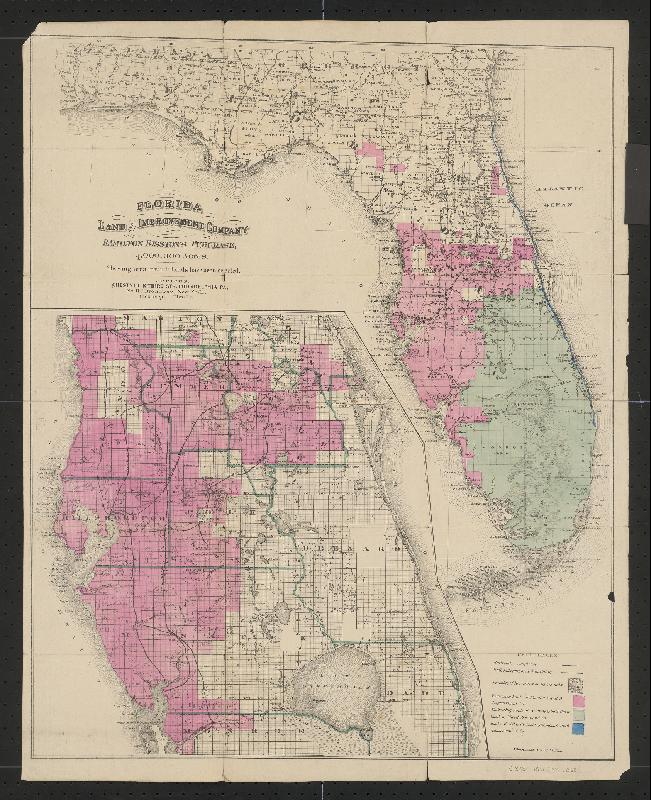
Deed of Disston lands sold to Reed, 1881, page 1. (TT)Page 2. (TT)Disston bought 4,000,000 acres from the state of Florida then sold half to Reed. Some of those lands included land in the SLR/IRL region. These lands are not shown on this map. ( Public map, 1881.)
And the EAA? With all the water problems we have today, I am glad it does not include everything in pink and green on the map and that something remains of our Savannas along the Indian River Lagoon.
____________________________________
An interesting email from Todd; Thank you Todd for all the research!
Jacqui,
It was fun to go through some of the stuff on my computer tonight. I just downloaded this publication “Disston Lands of Florida”, published 1885. I attached the intro page.
Disston had the pick of ALL the public lands owned by the state. It took three years to make the selection. Perhaps the pink area had been picked as of the date of the map and St. Lucie Gardens had not yet been picked?
Or maybe the St. Lucie Gardens land is not shown in pink on the map because Disston directed that the St. Lucie Gardens property be deeded directly from TIIF to Sir Edward James Reed. The Florida Land and Improvement Company never took title.
The TIIF deed that we pulled up for Sir Edward James Reed (attached) is dated 6/1/1881. In includes a little more land (21,577 Acres) than ended up in St. Lucie Gardens (e.g. Section 1, of T36S R40E is not part of St. Lucie Gardens but is included in the deed.)
St Lucie Inlet and Sailfish Point area after approximate 7-10 inches of regional rainfall in area 9-16-15. Photo taken on 9-23-15, Ed Lippisch.
“From 7 a.m. Wednesday to 7 a.m. Thursday, the heaviest rainfall was reported at the Savannas Preserve State Park in southeastern St. Lucie County, with 7.67 inches. Next highest in 24-hour rainfall, according to the Weather Service, was 6.87 inches at Hobe Sound.” —-from article y Elliot Jones, TCPalm, 9-17-15
SFWMD chart showing releases through canals recently. Note spike after recent rainfall.
Today I will share aerial photos of the St Lucie River/Indian River Lagoon taken by my husband, Ed, on 9-23-15. I asked Ed to document the after effects of the tremendous rainfall event in the region from September 16th through the 17th, 2015. After reviewing his photos, the St Lucie River/Indian River Lagoon has dark waters, this is evident, but first, let’s set some things straight….
We hear a lot about “local runoff,” however, it is becoming more and more understood, there is no such thing as “local runoff” for the St Lucie River/IRL…. The canals that dump into the St Lucie River/Indian River Lagoon are regional canals that have been “plumbed” over the past 100 years to drain and dump waters off the lands from as far away as western Martin County, Okeechobee County, and even what used to be the north flowing waters of the St Johns River in Indian River County! Then when things are really bad, since the water can’t flow south, “they” dump the overflow waters of Lake Okeechobee into the St Lucie River to boot.
The poor St Lucie River is inundated with “everyone’s water” not just “its own.”
Drainage changes to the SLR. Green is the original watershed. Yellow and pink have been added since ca.1920. (St Lucie River Initiative’s Report to Congress 1994.)SFWMD canal and basin map. The St Lucie’s natural basin as seen above in green has been very much enlarged by the C-44 canal built in the 1920s —with expanded basin and often Lake O overflow; also C-23, C-24 and C-25 were built ca. 1950 to drain lands in St Lucie County for orange groves/agricultural development and land development by General Development Corp and others.
It is critical that we study and understand what happens in our area after a huge rain, with or without the “extra-extra killing waters of Lake Okeechobee.” Why? Because maybe, just maybe, if the SFWMD, ACOE, as well as state and federal politicians will see how much the river is already suffering, they will do all they can, “not to kill it more.”
So here are Ed’s photos, taken one week after the rain event. It takes the water coming in through the canals some time to move through the St Lucie River; I imagine a lot had already exited the St Lucie Inlet. The 23rd was the soonest Ed could “get up in the air.”
I am thankful to my husband, as for me going up in that plane? It is really amazing to be flying, but also very stressful. Somehow to me it seems God only meant for birds to fly….
At least with the Cub, I feel like if something ever happened, over the ocean anyway…. we could just jump out!
2013 Ed Lippisch/Jacqui Thurlow-Lippisch.St Lucie Inlet at Sailfish Point. 9-23-15.Crossroads, Sewall’s Point and Sailfish Flats. 9-23-15.St Lucie Inlet 9-23-15.Water in Jupiter Narrows very close to St Lucie Inlet. 9-23-15.Unusual in that plume was flowing north and south. Here north at Sailfish Point at SL Inlet. 9-23-15.Northerly movement of plume. 9-23-15.Sailfish Flats of SLR/IRL confluence as seen from ocean over Hutchinson Island. 9-23-15.Heading back…9-23-15.On the way back to Witham Field. Sewall’s Point Crossroads 9-23-15.
“Indian River Reflections,” by Vera Zimmerman, 1987. (Collection of Tom and Sandra Thurlow) JTL, 2015.……
Recently at my parents’ home, I noticed a piece of artwork hanging the wall. I had seen it many times, but somehow this time, it looked different. Upon inspecting the title written at the bottom, I noticed that it read: “Indian River Reflections,” Vera Zimmerman, 1987.
The painting shows a menagerie of people standing by the river, their reflection shining in the shallow waters…
“Mom, tell me about this please. Who are these people?”
“Well these are the many people of the Indian River Lagoon. There are Native Americans, African-Americans, the Spanish, Jonathan Dickinson, the cattlemen, the “pioneers…”
….
My eye kept going to the little girl and the dog…
“Things are different but the same,” I thought.
“Who is Vera Zimmerman, the artist, again? I know you have told me about her before.”
“She is an artist and an archeologist up in Brevard County…”
My mother left to clear the table and I stood there looking at the sketch…thinking about all of the people who have gone before us…
We too stand on the edge of the Indian River Lagoon, our reflections staring back. I wonder how one day, we will be painted?
Map of Florida’s shoreline expanded and contracted over the millennium with various ice ages, rising and falling seas. BARR MAPS
__________________________________________________________________
Associations of Vera Zimmerman:
Double rainbow over Atlantic Ocean, Jensen Beach, Hutchinson Island– just on the other side of the Indian River Lagoon. Photo JTL, 2015.
Hope (noun) 1. “a feeling of expectation and desire for a certain thing to happen”. b. “grounds for believing that something good may happen.” 2. archaic “a feeling of trust.”
CEPP, ACOE
When looking at the water issues facing the St Lucie/Indian River Lagoon, it sometimes appears that we are doomed to an endless repetition of discharges from Lake Okeechobee and regional canals for ourselves, our children, and our grandchildren. We are not; we must have hope.
I am clearly aware that the Central Everglades Planning Project, (CEPP) will not alleviate all of the waters killing our rivers. In fact, from what I think I understand, it will deal with about 250,000 acre feet of water of a needed at least 200 million. US Sugar Corporation will probably quote 450 million. For me, the number is not the issue right now, the issue is getting started. By getting started, a groundwork is laid for “more” in the future.
Yes, I wish that the state of Florida had purchased the US Sugar option lands and we could have storage and a “flow way south” to the Everglades from Lake O of sorts, but the state did not. We must still fight for this concept, but also for CEPP.
As right now, CEPP is the only thing “on the books” to send water south and thus our only hope for “sending water south” in the future. The last time I wrote about CEPP I was furious because after all of the hard collective advocacy work to get it in the Water Resources Development Act of 2014, it did not make it. Well now we have another chance, and I have hope that it will.
CEPP was intensely reviewed across South Florida by many. It was led by environmental lead Dr Gretchen Ehlinger, ACOE/Jacksonville, and locally, by West Palm Beach’s, project supervisor, Kim Taplin/ACOE. Both tirelessly worked this project. It was truly a miracle in itself that the project was fast tracked. As we know, government is the world of molasses and quicksand….
To review CEPP:
“The goal of the Central Everglades Planning Project (CEPP) is to deliver a finalized plan, known as a Project Implementation Report (PIR), for a suite of restoration projects in the central Everglades to prepare for congressional authorization, as part of the Comprehensive Everglades Restoration Plan (CERP). The Central Everglades Planning Project will identify and plan for projects on land already in public ownership to allow more water to be directed south to the central Everglades, Everglades National Park and Florida Bay….”
Dr. Gretchen Ehlinger, (second from right), U.S. Army Corps of Engineers environmental lead for CEPP. Her office is in Jacksonville. (ACOE website)Kim Taplin is in the red shirt . Kim worked with stakeholders in CEPP’s review here in South Florida. Her office is in West Palm Beach. (ACOE website)Map CEPP component of CERP ACOE, 2009
On August 31st, 2015, something big happened. Jo-Ellen Darcy, Assistant Secretary to the Army, finally signed the “record of decision” for the project. Thank you.
…..…………..
So now the project is approved to “move forward” by the Army Corp. The Final Integrated Project Implementation Report and Environmental Impact Statement has been “approved.” (Please read document above.) So what has to happen now? A lot! The project has to become part of the next Water Resources Development Act, (WRDA), that moves through the US Congress only once every 2-7 years….
If CEPP becomes part of the next WRDA bill, then it would have funding to start with, then the funding has to be continued of course….as politics shift and sands sink and rise…. and yes, the project has to be built….and the water has to be there to flow!….Excruciating isn’t it? But we are on our way. ——The business of hope is not for the weak of heart, it is for the strong.
Mr Reginald Waters with black bears killed on Hutchinson Island, around 1930. (Photo credit Sandra Thurlow, Sewall’s Point,” A History of a Peninsular Community on Florida’s Treasure Coast”/Reginald Waters Rice)Photo from my mother: Bill Pitchford’s “last bear.”
A friend of mine, Mrs Mary Chapman, once described Stuart News reporter, Ed Killer, as “the only reporter in America who got her to read the sports page.” I feel the same way. Ed Killer’s past Sunday article entitled: “Bearing Down for the Bear Hunt,” was quite the read, and I have been thinking about it the past few days.
Bears….to think that they used to live right here in along the waters of the St Lucie River and Indian River Lagoon, and now there are none.
Today I thought I’d share a photo I have shared before, but it is certainly worth dusting off and bringing out of the archives again.
The above photos are from my mother’s book, “Sewall’s Point,” and shows Mr Reginald Waters with multiple black bears he killed on Hutchinson Island, a mother and two cubs, around 1918. The other is the “last bear shot on Hutchinson Island, 1926.” Historian, Alice Luckhardt, wrote a comprehensive piece on these black bears that once roamed our region. Here is an excerpt from a recent vignette:
“At one time, Florida black bears existed in fairly large numbers along the ocean coast between Jupiter and Fort Pierce, living in and among the mangroves and feeding on palmetto fruits and turtle eggs buried in the beach sand. However, as more people began settling the area, bears became unwelcome guests, and many were hunted and killed by early pioneers.
By the 1920s and early ’30s there were still a few wild black bears in the area. They found a tasty delight in honey and bee larvae from the numerous beehives in operation on Hutchinson Island at that time.
Jensen resident William Pitchford felt the only solution was to hunt down the bear that had been raiding his bee hives during the summer of 1931. Pitchford first thought to capture the bear using a steel trap he set out over several nights near the hives. The bear, however, was too smart to fall for that trap, avoiding it each night and still getting into the honey, destroying several hives.
Determined to end the bear’s raids, Pitchford, with the assistance of a neighbor, Vincent Wortham Sr., laid in wait one Saturday night, Aug. 8, 1931, with weapons in hand. As hoped, in the darkness of night, the bear appeared and the men turned on their flashlights. Pitchford immediately fired three times using his 303 Savage rifle, and Wortham fired his 32-20 Smith and Wesson revolver twice at the animal. The seriously wounded bear managed to scramble a short distance away before the two men later found him dead near the Pickerton farm. They managed to bring the 200-pound animal back to Jensen where photos documented the event, as this marked the last bear killed on Hutchinson Island.”
So, quite sad as far as I am concerned that we killed all the bears here. Let’s figure out how FWC, the Florida Wildlife Commission, the agency making the laws on bear hunting today “works.” —How do they fit into Florida government? How were they able to determine it is OK to shoot bears this season? For one thing FWC is not “under the governor,” a situation many state agencies would “kill for.” Oh, no pun intended… 🙂
Also, I must state that the structure of the agency is confusing like everything else in government.
There is “US Fish and Wildlife,” a federal agency, and then there is FWC, or the Florida Wildlife Commission, a state agency. One will also hear this same agency referred to as Florida Fish and Wildlife Conservation Commission. Why I am not sure. So Florida Wildlife Commission (FWC) and Florida Fish and Wildlife Conservation Commission (FFWCC) are the same thing. If anyone knows more about this please let me know….
In 2004 the agency, FWC. was restructured by an act of the Florida Legislature:
This excerpt below explains:
“The FWC was established with a headquarter in Tallahassee, the state capital on July 1, 1999 after an amendment to the Florida Constitution approved in 1998. The FWC resulted from a merger between the former offices of the Marine Fisheries Commission, Division of Marine Resources and Division of Law Enforcement of the Florida Department of Environmental Protection (DEP}, and all of the employees and Commissioners of the former Game and Fresh Water Fish Commission.
The Florida Department of Environmental Protection (DEP) serves as the environmental regulatory agency for the state, enforcing environmental legislation regarding air and water quality, for example. In 2004, the Florida Legislature approved a reorganization of the FWC that integrated parts of the Division of Wildlife, Division of Freshwater Fisheries, and the Florida Marine Research Institute to create the ‘Fish and Wildlife Research Institute’ (FWRI) in St. Petersburg, Florida.It has over 600 employees. As of 2014 FWC had over 2,000 full-time employees, maintained the FWRI, five regional offices, and 73 field offices across the state.”
FWC commission 2015Organizational Chart FWC 2015Organizational Chart DEP
Looking at the structure one can see that the commissioners are at the top of FWC chart and the “people” are over the governor for DEP chart….
Hmmmm?
If the bears had a seat at the table, I wonder where they would be?
Black bear sitting at a picnic table, a popular image on Facebook, 2014.
____________________________________
Full note from my historian mother when she sent the “last bear” photo:
“Jacqui, Here is a photograph of Bill Pitchford’s “last bear” that Alice Luckhart wrote about. I have a file on the Waters family who lived in Walton on Indian River Drive. The photograph of Russell Waters with the mother bear and two cubs had “1918” written on it. I am glad Ed Killer’s article explain that hunters will not be allowed to kill a mother with cubs. Reginal Waters Rice who supplied the photograph said his uncle Russell felt very bad about killing “the three bears.” Mom
Early rendition of a portion of the “Everglades” (Painting in my parents home, Tom and Sandra Thurlow.)Cover of book, 1910 by Walter Waldin.…..…..…….
This past Friday, I attended a Treasure Coast Regional Planning Council meeting and was treated to a wonderful presentation entitled: “A Brief History of Florida Water Management 1800-2000 Ponce to CERP.” The talk was given by Mr Bob Ulevich, president of Polymath Consulting Services, L.L.C. ” (http://polymathconsultingservices.com). Bob” is a beloved man who has a long history himself as senior water resources project manager for the South Florida Water Management District. Bob is considered the “father of water farming.”
His presentation left me speechless, once again being reminded of the history of agriculture in the state of Florida and its deep intertwinement with the state’s government and politicians….basically they are one in the same. This is how it is….St Lucie River/Indian River Lagoon and every inch of the rest of the state. “We” may not like this, but we must accept this…
With rumor that Adam Putnam, the Commissioner of Agriculture, could be our next governor, it is critical to refresh our memory on this historic relationship. Today I will share a book a from my historian mother’s shelf and also post the raw iPhone footage of Bob speaking before the council. It is my belief that we have got to learn to understand this historic relationship along with the power agriculture yields and “work with it,” in our quest for better water quality. They too are “naturalist” at heart….they are. Some of them in our South Floirda region have just “morphed,” and need some help getting back to their roots. 🙂 They hold the key to Florida’s water future.
The first page of the booklet talks about “getting back to nature” as farming is deeply intertwined with nature. Unfortunately today many of the intense practices of farming destroy nature and our water resources.
…
This is an another excerpt from the book:
….the independent countryman’s life must appeal, for he is a free man, master of himself, is conversant with nature in its many moods, enjoys the first fruits of the earth with the gleam still on them, and all its first impulses and pleasures….”
…..
“No wonder, then, the cry of today is, “Back to the back and nature.” And back we must and will go, for this threatening catastrophe is too appalling to be passed by unchallenged.”
The catastrophe Mr Waldin is speaking of is that so many people were leaving America’s lands to go to the cities, that the “vitality of our nation was being drained proportionately…” Mr Waldin feared the lands would be empty and all would move to the cities…..It basically has happened, hasn’t it!
Below are the links to Mr Ulevich’s presentation, his presentation does not encompass the little book. I added that. Bob speaks on “A Brief History of Water Management 1800-2000 and although my “Jacqui home videos” are poor quality, you can hear the message. I had to break the videos up into 15 minutes sections as my You Tube account is not set to post anything over 15 minutes…Bob’s presentation is excellent. For those of you who have time to listen, you will enjoy it very much and learn a ton! Bob will finish his presentation next month covering approximately from 1910 to today.——– And that’s where we get to hear “the rest of the story….” 🙂
Riverview and South Sewall’s Point Road flooded in the Town of Sewall’s Point 9-16-15 (JTL)
When I was a kid growing up in Indialucie, named so as it is located between the Indian River Lagoon and the St Lucie River….it flooded a lot. We kids loved it. We would play and play! Just like kids did in the Town of Sewall’s Point when it rained so hard the past couple of days. I was told yesterday by Pam Hopkins, water quality specialist, at Florida Oceanographic that their gauge showed 8.5 inches!
Kids play in the retention pond in Sewall’s Point, 9-16-15. (Photo courtesy of Simone McPhee)
Rain is not the problem. It’s the drainage…
Florida was drained so agriculture and development could flourish. But we have literally outgrown the plumbing system of the 1920, 30s, 40, 50, 60, and 70s….we must begin to think anew.
Rain events like the past couple of days allow us to clearly see the problem and to be creative in thinking about solutions. —-One thing is clear, when Lake Okeechobee’s water is added on top of such events, “not only are we flooded, but we are drowning.”
Whether it is the overflow waters of Lake Okeechobee, runoff from area canals, or “local flood waters,” such experiences highlight the need for storage, as fresh water is a resource and should not be wasted.
I have used the basin/canal map a lot recently as it applies to just about everything. Here you can see the drainage system draining the lands into the SRL/IRL; of course there is other local infrastructure drainage such as street “gutters,” drains, and underground piping that do not show up on this map. In any case, the goal is to “get the water off the land as soon as possible” and drain it to the lowest point, the river……
Well that has got to change.
SFWMD canal and basin map. C-44 canal is the canal most southerly in the image.South Sewall’s Point Road 9-16-15….(JTL)…….……………….
BELOW, HUTCHINSON ISLAND, FLORIDA OCEANOGRAPHIC AREA/PUBLIX
……..……..A flooded Publix parking lot on Hutchinson Island….Oil atop the water from parking lot and street. This all drains into the river.
To get the current conditions of drainage from canals around Lake O excluding C-23, C-24, and C-25 see this ACOE link; also the drainage from around the coastal area like Stuart, Sewall’s Point etc…is not shown here but estimated in other models.
Current Conditions report ACOE drainage: (http://w3.saj.usace.army.mil/h2o/reports/StatusDaily_files/slide0178.htm)
Sunrise over Florida’s “Waters of the State,” SLR/IRL region.
The more I learn about water, “the more I learn what I don’t know”…Federal laws….state laws…and local governments living with the “sins of the fathers,” —just trying to keep up…
Because I taught eighth and ninth grade for so many years, it is my training to try to break down complicated information, so that it can be understood on a basic level and shared. Obviously, I am no expert on water law so please chime in!
Today’s lesson? CLASSIFICATION OF FLORIDA SURFACE WATERS
Classifications and designated uses of water by the state of Florida are required by the Clean Water Act of the United States. “The act requires that the surface waters of each state be classified according to “designated uses.” Florida has six classes with associated designated uses, which are arranged in order of degree of protection required.” DEP
Classification, Waters of the State, FAQ Fl. Dept. of Environmental Protection, 2012.
Class III Fish Consumption, Recreation, Propagation and Maintenance of a Health, Well-Balanced, Population of Fish and Wildlife
Class III-Limited the same Class III but “with limited physical/habitat conditions…
Class IV Agriculture Water Supplies
Class V Navigation, Utility and Industrial Use.
I wonder what category the St Lucie River/ Indian River Lagoon falls under? This is not easy to find on-line. Let’s guess….Look at the chart above closely….
What do you think?
My guess would be Class III-Limited, but I don’t know. I could not find it “for sure” on-line.
Looking at the chart and reading the DEP website, it sounds like all waters of the state of Florida are “Class III” regular “unless otherwise specified….”
—–Finding a simple list of class designations for waters of the state is not easy. This download is what I found and it does not make sense.
Now to complicate the issue, certain classes of water that are listed as Class III or otherwise can also be listed separately as “Outstanding Waters of the State,” or as “Aquatic Preserves.” How can this be?
—–For instance, the North Fork of the St Lucie River is listed as an “Aquatic Preserve” and “Outstanding Water” of the State. Also the Indian River Lagoon has parts, including parts in St Lucie and Martin Counties, that are also Aquatic Preserves. This doesn’t make sense to me. These bodies of water have been designated as “protected” since the 70s but they are not protected with canals dumping pollution into them. We all see that!
SFWMD canal and basin map.C-24 dumps pollution into North Fork of SLR, C-23 dumps into main area of SLR, C-44 dumps into South Fork, and C-25 into IRL near Ft Pierce. The North Fork of the SLR and parts of the IRL are Aquatic Preserves/and or Outstanding Florida Waters…..this makes no sense.Aquatic Preserves of the IRL as shown in DEP’s IRL Management Plan draft June 2014.
Now I am going to share some photos of the Southern Indian River Lagoon, (an Aquatic Preserve), that my husband, Ed, took last Sunday, September 13th. The photos are of the C-25 canal which is dumping into the Indian River Lagoon in Ft Pierce. I don’t know about you, but I don’t think it makes sense to dump pollution into an aquatic preserve, no matter what class the waters are.
To be fair, I must mention that I recently received an email from Mr Glenn Henderson, the senior grants writer for St Lucie County. He noted that a blog reader sent him the shocking photographs of C-25 recently published. Mr Henderson noted that he and others are working together with the St Lucie Issues Team to get a grant from the state for the San Lucie storm water detention project. The San Lucie is an old subdivision that has dirt roads, few swales and no structures to hold stormwater — and it’s less than a mile from the IRL. This is one of the many things running into the lagoon.
Thank you Glenn and everyone! And the state? “Let’s get back to class!”
Algae fills C-25 as this water is dumped into the IRL in Ft Pierce, an aquatic preserve. (Photo Ed Lippisch 9-13-15)C-25 9-13-15 (EL)C-25 9-13-15 (EL)C-25 9-13-15 (EL)
Horses were used to patrol the Indian River Lagoon region’s area beaches during WWII. (Photo untitled: http://olive-drab.com/od_army-horses-mules_ww2.php)Men on horseback looking for enemy invaders, Hutchinson Island. “Historic Jensen and Eden on Florida’s Indian River,” Sandra Henderson Thurlow,. Photo James W. Harrington.1945 US Coast Guard Station and stables for horses were later converted to the Kensington Club located in the area where Jensen beaches are today. (Photo Dale Hipson via Sandra H. Thurlow.)US Coast Guard patrol and former “snack shop” at Jensen Beach. 1943. (Thurlow Collection.)“Jensen residents could hear explosions and see billowing smoke from freighters torpedoed by German U boats. in 1942.” SHT (Florida Photographic Archives via Sandra Henderson Thurlow’s book “Eden and Jensen.”
I love animals whether they walk, fly, hop, slither, swim, run, or trot…
As a young person growing up along the St Lucie River/Indian River Lagoon, one of my very finest memories is riding horses along the beaches of Hutchinson Island. My friend Michelle White whose father still lives on McArthur Boulevard, had horses at their ranch in Palm City and would often bring them to —keeping them under the shade at the “beach house.” Michelle and I would get up at the crack of dawn and ride these horses bareback along the beach. It was wondrous. Obviously, the laws were not as restrictive then. We even got our picture in the Stuart News!
Stuart News photo ca 1980, Joseph Noble. Michelle White and Jacqui Thurlow ride along the beach Hutchinson Island.(Sandra Thurlow’s photo archives)
So horses……
Today, I will share a story sent to me by blog reader Stan Field, A.K.A. Anthony Stevens who is a professional writer who lives in Rio and friend of my family.
When he sent me this excerpt about the beach horses of WWII, I wrote back: “I do hope none of the horses were hurt jumping off the Jensen Beach Bridge.” He assured me all were fine. Here is his amazing story:
Horse Patrols on Hutchinson Island “Early in the war, it was decided that they needed to maintain regular patrols of the Atlantic beaches. Someone in Washington thought that horse patrols would be a good idea.
“In September 1942, horses were authorized for use by the beach patrol. The mounted portion of the patrol soon became the largest segment of the patrol. For example, one year after orders were given to use horses, there were 3,222 of the animals assigned to the Coast Guard. All came from the Army. The Army Remount Service provided all the riding gear required, while the Coast Guard provided the uniforms for the riders. A call went out for personnel and a mixed bag of people responded. Polo players, cowboys, former sheriffs, horse trainers, Army Reserve cavalrymen, jockeys, farm boys, rodeo riders and stunt men applied. Much of the mounted training took place at Elkins Park Training Station and Hilton Head, the sites of the dog training schools.” – US Coast Guard One of these horse patrols groups was stationed on Hutchinson Island. What is not generally mentioned is one of those horrible snafus that always happen during wartime. Well, they arranged for a large herd of horses to be delivered by the Florida East Coast Railroad and a corral and stables was built on Hutchinson Island, near the old wooden bridge in Jensen. Seaman from the Coast Guard base in Fort Pierce would be stationed there and at the House of Refuge and they would patrol the entire island. Now since there were no roads on the island from Jensen north, this seemed like a great idea. The soft sand was murder on jeeps and mounted riders would be able to cut around swampy areas and investigate in the woods, if needed. They asked for volunteers for the first herd and there was only one real cowboy in the base. There were only a few more who had pleasure riding experience. Well, everyone was pretty excited when the big day came and several railroad cars were delivered to the siding just north of Jensen Beach Blvd. A temporary corral had been built there to hold them for inventory and basic tack was in the back of trucks, ready to mount the animals and ride them over to their permanent duty station, on the island. There was an immediate problem when they opened the doors, however. In its infinite wisdom, the Government had decided that purchasing trained horses was too expensive. And since a lot of wild horses lived for free on Government land out west, they just rounded up a herd of wild ones, packed them onto cattle cars and shipped them to Jensen. Not one of them had ever been in close contact with a man before… much less a saddle. Riding them to the island was out of the question. So the one loan cowpoke arranged a ‘drive’ and the entire community was drafted into helping with the operation. Well, things seemed to be going pretty well, until they got to the old wooden bridge that led to the island. This was more than a mile and a quarter long, two narrow lanes wide and the decking has ½” gaps between each plank. The horses did NOT want to cross it! About half of them were driven over by the shoving, shouting crowds behind. The other half jumped the sides of the bridge and the banks of the Indian River and swam for freedom. Most of the next couple of days was spent with the Pitchfords and other boat owners chasing them around the river and running them down on land. Eventually they all made it to the island and the serious breaking and training started. The one loan cowhand and the base officers appealed to the locals for help once more and older cowhands, both male and female, volunteered to teach the Coast Guard people how to break and train the wild herd.
There is not a lot of information available on the mounted patrols of World War II. They did setup training facilities in Hilton Head, SC.” —-written by Anthony Stevens, in a letter to JTL August, 2015
Wow. Can you imagine all those poor horses jumping off the bridge into the Indian River Lagoon? Crazy! And wild ones at that. Wonder what happened to them all after the war?
Well today horses are allowed on the beaches in St Lucie County and horseback riding is a very popular and extremely well rated experience. When my husband Ed flys the cub looking for pollution plumes in the Indian River Lagoon and area inlets, he often sees horseback riders from his plane. There is some romance left in the world…
—–Right here along the Indian River Lagoon…I wonder if any of those horses’ ancestors patrolled the beach? If only a horse could talk!
Horseback riding along the beaches of St Lucie County. Cover photo of website, 2015.
View of new intake canal far right and lands to be used for C-44 STA/Reservoir. C-44 canal in foreground. Near Indiantown.(Photo 2014, JTL)Intake canal for C-44 STA/R.(JTL)
Today’s blog is a review of something we have been talking about for a long time now. Something that is in the news once again. The C-44 Storm Water Treatment Area and Reservoir, a component of the Indian River Lagoon South, CERP project.
Today we will break down this project into chucks so we can understand what is happening, and what has already happened, and clarify some terminology.
The term “C-44” can be confusing as C-44 is a canal but is applied to others things and used as a “nickname” for an entire, multi-layered project. First, the C-44 is a canal that was built from 1915 to 1923 by the flood control district of the era and later by the Army Corp of Engineers. This canal has dual purposes. It allows water from the C-44 basin to run into and be released into the North Fork of the St Lucie River, and it allows overflow water from Lake Okeechobee to be released into the North Fork of the St Lucie River. “All this water” plasters the bottom of the estuary with silt and pollution from surrounding lands, in this case mostly from agricultural runoff.
There are two structures along the C-44 canal that release the water: structure 308 (S-308) at Lake Okeechobee, “Port Mayaca,” and S-80 at St Lucie Locks and Dam in Tropical Farms.
Believe it or not, the canal can “run in both directions, dumping water to the lake or to the St Lucie. The ACOE is in charge and works together with the South Florida Water Management District to manage this canal that is part of Florida’s history for “water supply” of agriculture and “flood control” for agricultural lands that later became populated by people other than just farmers…..
SFWMD canal and basin map. C-44 canal is the canal most southerly in the image.
So the “C-44 STA/R.,” as I will call it, has been in the works conceptually since the Comprehensive Everglades Restoration Plan or CERP that was agreed on by stakeholders in 2000. There are/were 68 project components of CERP, none are 100% complete. C-44 STA/R is part of “Indian River Lagoon South” a part of CERP that got a jump-start in 2007 and moved up on the list of 68.
Why haven’t all these projects been approved and funded? In the insane and fickle world of federal and state politics there is never a guarantee. So the ACOE and SFWMD live in a state of flux as do we, the public. This is why we must fight so hard, elect the right legislators, and “never give up.”
An overview of C-44 STA/R can be read about here:(http://www.martin.fl.us/web_docs/eng/web/EcoSystem_Restoration_and_Management/Water_Quality/Indian_River_Lagoon_South_Fact_Sheet.pdf)
Martin County and the public have done a great job supporting the SFWMD and advocating for the C-44 STA/R. As reporter, Tyler Treadway, stated in his recent Stuart News, article: “The C-44 project began in 2007 when the South Florida Water Management District spent $173 million and Martin County kicked in $27 million through a special 1-cent sales tax to buy and clear 12,000 acres for the facility.”
In 2011, after a couple of false starts the ACOE held a groundbreaking for the C-44 STA/R project. This was a happy day. I was mayor of the Town of Sewall’s Point at the time and participated in the groundbreaking event. This was Contract 1 and there are many components to this contract, but the most visible one is the building of the INTAKE CANAL from C-44 canal into the interior of the lands where the STA and Reservoir are to be built.
As you can see from this breakdown the project below, C-44 STA/R has multiple “contracts.” This is why we keep hearing about it “again and again.” The chart below is very helpful in understanding a timeline of the contracts. Each is funded separately. For fun, I have also included some pictures of the 2011 groundbreaking event. You can see how many people involved are not “here” anymore….
Breakdown of Contracts, C-44 STA/R.Sign for groundbreaking, 2011.Conceptual rendering 2011 event.Unidentified gentleman, Lt Col. Kinard, and Col Pantano. 2011. (Photo JTL)Agency leadership, groundbreaking 2011.Martin County Commissioners, 2011.Agency, regional leadership, and local leadership pose for the camera, groundbreaking, 2011.
OK so now fast forward to 2013. A year that rings like torture for those of us who lived here in Martin and St Lucie Counties during that time. It was the “Lost Summer” when the waters of Lake Okeechobee and C-44, C-23, C-24, and C-25 just about killed us and did kill our economy and the St Lucie River Southern Indian River Lagoon. It was during this time that Governor Rick Scott and the state legislature put 40 million towards “the C-44” to speed up construction of the STAs. This was wonderful cooperation between state and federal agencies. Entities that sometimes are at odds. This cooperation shined light on the agreed importance of improving water quality in the St Lucie River/Indian River Lagoon system, a yes…it WAS an election year! 🙂
Sewall’s Point confluence of SLR/IRL 2013. (JTL)Toxic algae SLR, photo Mary Ratabaugh 2013.Plume along Jupiter Island, Lost Summer 2013. (JTL)The people rally for the river, Stuart Beach. Over 2000 people docuemtned. (Sevin Bullwinkle, 2013.)
There were also other local politicians that were very vocal and helpful during this 2013 time. Florida Senator Joe Negron; Congressional Representative Patrick Murphy, there were others too like Senator Bill Nelson; Senator Marco Rubio even visited- and others….the public though was what really shined as they rallied and advocated on behalf of the river.
Now we are hearing about C-44 STA/R in the news AGAIN. So what are they talking about now? They are talking about the next part of the “contract sequence,” or phase…this time to build the reservoir as seen in light blue below. This is where the water will be held before going to he STA to be cleaned before again being released into the canal and then the river….
The reservoir is in light blue on left. The canal and storm water treatment area is in blue. The water is pulled out of the C-44 canal as seen in bottom of image.(ACOE)Palmar on far bottom right is part of the water quality component of the C-44 STA/R as seen on north side of C-44 canal.(ACOE)….
So as you can see, the building and funding of the C-44 STA/Reservoir is not an event but rather a story. “Reaching the finish line” includes many chapters….Considering so many other Everglades Restoration projects are not even close to getting this kind of attention and funding is something we must appreciate and be proud and thankful for.
What we must also understand is this is just the beginning and will not alone fix our water problems. In a bad year maybe 1.5 to 2 million acre feet— (one foot of water on one acre of land) ——-of water goes into Lake Okeechobee from the Kissimmee River alone. This amount of water is basically unfathomable. Picture all the water that used to be on the lands of central Florida each wet season before we drained them and straightened the Kissimmee River….not to mention “Disney”….
And since the Everglades Agricultural Area (EAA) south of Lake Okeechobee blocks the flow of water south to the Everglades this water is redirected to the St Lucie River/IRL and to the Calooshahatchee. The C-44 STA/R is meant to clean water from the C-44 basin alone. A reservoir of 50,600 acre feet will help the C-44 basin problems but not the releases from Lake Okeechobee. Only an outlet south of the lake, and a tremendous amount of storage can do that. —-So in essence, our race has just begun…
This satellite photo shows water on lands in 2005. One can see the lands in the EAA are devoid of water. This water has been pumped off the lands into the Water Conservation Areas, sometimes back pumped into the lake, and also stored in other canals. (Captiva Conservation 2005.)
Foam floating on water at C-24 Spillway. (Photo Dr.Dave Carlson, September 9, 2015)
FOAM!
Just a few days ago, friend, and sometimes vet to our dogs, Dr Dave Carlson, sent me some unusual photographs of foam pouring out of the St Lucie River’s C-24 spillway, managed by the South Florida Water Management District.
Dave wrote: “Hi Jacqui, was out this am and shot these on the C24 canal. “Iceburgs” in the canal! Real time follow-up to your blogs on these canals.”
“That’s really weird,” I thought. “Foam everywhere!”
I remember foam building up along the shoreline at Stuart Beach periodically when I was a kid. We would pick it up in our cupped hands and throw it at each other; it was great fun. I never knew what formed it though. Was it pollution? It looked kind of gross….
I wrote Dave. “Where is it; and what is it?” I asked.
He replied: “At the spillway going into the North Fork. Are a result of decayed plant and animal protein according to SFWMD. Tyler Treadway did a piece on this after tropical storm Fay, 2008.”
Hmmm? I thought. Decaying plants and animals?…Bizarre. I looked up the TCPalm article, it had one quote regarding foam:
Foam C-24 photo by Dave Carlson, 9-9-15.Form at C-24 spillway. (Photo Dave Carlson 9-9-15.
“What you’re seeing is denatured protein,” said Boyd E. Gunsalus, lead environmental scientist for the South Florida Water Management District’s office on the Treasure Coast, “which is the result of decaying plants and animals.”
That’s nice, and Boyd is awesome. But what does that mean? What are “denatured proteins” and how do they get “denatured?” So I looked them up too. You have to put on your eighth grade science cap! Basically, I think, a denatured protein is an unfolded protein that can then bond with other things to form something else…..in this case causing foam.
Now we have to learn, or remember, yet another odd word…. 🙂
In order for the foam to form, and the proteins to “denatureate,” there has to be a “surfactant,” in the water.
Yikes! This sounds like a project for the River Kidz! My science skills are rather rusty! Please share more if you know how this all works!
A surfactant is something that lessens the surface tension on the surface of the water….
According to my reading, the natural surfactant is called DOC (dissolved organic carbon). DOC comes from the decomposition of a wide variety of plant material including algae, decaying animal protein, and aquatic plants…
So to summarize: the surfactant effect caused by decaying protein bonds and agitation of wind and rain forms foam. This is the basically same phenomenon that happens with detergents and “dirt.” Detergents are also surfactants. There are natural and man-made surfactants. What’s occurring in the SLR is “natural.”
Well that was fun. Leaning about something that looks like pollution in the St Lucie River but isn’t, what a rarity. Nonetheless, I would think all the pollution in the water really helps “stir things up!” Read about it here, these DEP reports are “old” but nothing has changed much so they still apply:
Fresh water plume flowing past Sailfish Point at St Lucie Inlet 9-3-15. (Ed Lippisch)
Fresh water plumes flowing out of estuaries into the ocean are, of course, noted all over the world. There are even accounts from early Florida pioneers in the 1800s documenting such phenomenon. The difference with the “freshwater plumes” in our area of the St Lucie River/Indian River Lagoon, is that the watershed has been radically altered over time to take on more than its fair share of water and the plumes are not just sediment and organic material but often toxic.
As we are aware, canals C-44, C-23, C-24, and C-25 expanded the watershed of the SLR/IRL by more than five times its God-given capacity, plus in the case of C-44 the overflow waters of Lake Okeechobee. Yes we live in a “swamp.” But our South Florida swamp has been over-drained.
Drainage changes to the SLR. Green is the original watershed. Yellow and pink have been added since ca.1920. (St Lucie River Initiative’s Report to Congress 1994.)
Today I will share photos my husband Ed Lippisch took on September 3rd, and September 7th, 2015, and then contrast then with a few taken in September of 2013 during the “Lost Summer.” My point being, even our rain plumes, like “now,” are not natural to our watershed as the watershed has been expanded so much. Add Lake Okeechobee to it, and a really bad summer like 2013, and the plumes are visibly “different.”
Of course lighting and timing have a lot to do with a photograph.
A photograph is an image in time; it is not necessary “scientific,” but no one can say, a picture doesn’t “speak a thousand words.”
9-3-15 SL Inlet.9-3-15. SL Inlet.9-3-15 Close up freshwater plume exiting SL Inlet.
_______________________________________________
9-7-15 By Over Stuart Harbor looking north towards the North Fork. Plume seeming to be coming from South Fork, C-44. (bottom brown) (Ed Lippisch)Over Rocky Point looking to Sewall’s Point, 9-7-15.SL Inlet near Jupiter Narrow’s opening 9-7-15.Sailfish Flats between Sewall’s Point and Sailfish Point 9-7-15.Sailfish Flats…9-7-15.Sewall’s Point storm approaching, 9-17-15.SLR near Willoughby Creek a polluting outfall into river, water from Airport and surrounding area….This is just on the west side of South Sewall’s Point, 9-7-15.
_______________________________________
Map. Sewall’s Point is the peninsula. Inlet is to east. (Google maps) 2013.Plume in 2013, during the LOST SUMMER along Jupiter Island coming form SLI.C-23, C-24 , C-44 and mostly Lake O.9-13 St Lucie Inlet with plume exiting…JTL C-23, C-23, C-244 and mostly Lake O.Plume in 9-13 coming form C-23, C-24, C-44 and mostly Lake O. (JTL)
Photo from central IRL near Cape Canaveral, Sandra and Tom Thurlow, 1994.
Today’s blog was inspired by a question on Facebook by beloved Stuart News reporter, Mr Ed Killer.
Yesterday in my blog post, I wrote that I would be going to Apalachicola this week with the UF Natural Resources Leadership Institute. “Ed” commented and this is what he said:
“Tcpalm Ekiller: I want you to think of something while in Apalachicola Jacqui Thurlow-Lippisch : That industry is about a $2 mill /yr industry statewide, with most of that impact in that area. While it stinks for the oyster men that lack of water is a problem, we haven’t been allowed to eat an oyster from our estuary since the 1970s because the DEP downgraded the health of our water to class D. We have (FOS & a few other groups) have added more than $2 million in oyster shell projects to the St. Lucie River to help clean our water knowing we can never harvest the oysters.” Ed Killer
This got me thinking, and I thought, “Yeah, what really did happen to our St Lucie River/Indian River Lagoon oysters and what is their history? In fact, if I think about it, we are surrounded by mounds of ancient oysters, “Indian mounds” that attest to how plentiful they used to be…
Did you know?
Mt Elizabeth, better known today as “Tuckahoe,” at Indian Riverside Park, is said to stands around 40 feet tall. It is a shell mound built up over thousands of years. It consists of oyster shells and some clam shells that come from the Indian River Lagoon region. You can still see the ancient oysters in the dirt under the modern landscaping today.
Tuckahoe 2010. You can see the oysters shells in the soil. (JTL )A view of the IRL from 60 feet at Tuckahoe an ancient Native American shell midden of mostly oyster shells. Shell can be seen i the soil. (JTL, 2010)Ancient oyster shells can still be found at Tuckahoe itself and along the shoreline as seen here. (2015)
The native people of our area did not have to hunt game full-time or at all as they had all they needed from the riches of the estuary. In those days the natural inlets opened and closed on their own as they broke through “Hutchinson Island.” Oysters would have been more plentiful when the inlets broke through as they live in brackish waters.
*Note that the first 1882 chart describes Mt. Elizabeth (Tuckahoe) as located at what is now the top of Skyline Drive (Mt Washington) at the location of Jensen Beach Community Church. The 1883 (lettered 1888) map locates Mt. Elizabeth at what is now Indian Riverside Park at the Tuckahoe Mansion. This can be confusing.
Front page of Todd’s video showing a historic view of seeing Mt Elizabeth from the Shoal off shore in the ocean. Some early sailors mixed up Mt Elizabeth (Tuckahoe with Mt Washington (Sky Line Drive).
So what about after the Native Americans? I remember my mother telling me stories of pioneer accounts, after the St Lucie Inlet was opened permanently in 1892, of people eating oysters “as big as a man’s hand.” One a meal in itself!
Obviously the oysters would grow most plentiful by the inlets, like near Sewall’s Point and today’s Hutchinson Island.
So yesterday I wrote my historian mother, “Mom, do you have any information on oysters in IRL?
And she sent a fabulous historic survey, an old post card from Sewall’s Point, and account from the House of Refuge. Basically at that time too, a lot depended upon the inlets. I am including a lot of information, and more than likely “just a read for the history hardcore,” but you’ll get the idea.
But then the decline….
Historic photo. Florid Memory project. C-44.Historic photo St Lucie Locks and Dam, Stuart Heritage.
—it began in the 1920s with C-44 and the connection to Lake Okeechobee and then was exacerbated by C-23, C-24 and C-25. “Canals of Death…”We over drained the land, we built houses and scraped the wetlands for agriculture fields….we threw poison and fertilizer on the lands so things would grow and pests would go away…slowly, ever so slowly it drained back into the rivers….For a time, we “flourished,” but it has caught up to us, and our rivers are dying, as Ed Killer said in we’ve been “downgraded to a Class D.” Oysters can’t live in that…
May we bind together and turn things around because no one is going to do it but us. Nature, just like people can heal. We just have to give her a chance.
Oysters in the IRL by Cape Canaveral. “Oyster bars were everywhere.” (Photo Sandy and Tom Thurlow, 1994) Look how clear the water was.Post card to Sandra Thurlow, 1987, from Glee Wright about the plentiful oysters growing on the mangroves around 1957 at the Kiplinger Property in Sewall’s Point. (Courtesy of Sandra H. Thurlow)
I. An 1898 excerpt from a magazine of the day about oyster stew made right at the house of Refuge...shared by Sandra Thurlow.
The Caribou
by John Danforth
Excerpted from “Florida Sport” an article in Shooting and Fishing
December 15, 1898
I have decided on one which happened in 1898 in Dade County, Florida. My wife and myself, in company with Ben Crafts, were living on board a twenty-five foot cabin sloop, which had all the conveniences of a shore camp. We cruised on the Indian River, but most of the time we spent on the St. Lucie River and its tributaries.
Our sloop was built by the Bessey brothers especially for cruising the in Florida waters. The Bessey brothers are educated gentlemen, who have modeled and built nearly all the sailing craft owned by the Gilbert’s Bar Yacht Club, and in our sloop they seemed to get as near perfection as one could ask. We had plenty of room for cooking, eating, sleeping and to carry fresh water, provisions, and tackle of all kinds. We had an outfit, so we could leave the sloop anchored, with the cabin locked, and go for a cruise in the woods for days. My object in securing such a boat was not for catching and killing all we could find, but to better support myself and family by becoming a guide for gentlemen who visit Florida for sport.
At the time of which I write the Caribou (our sloop) lay at anchor about a half mile off the mouth of Hup-pee creek in the full moon of June. I had planned to be on the ocean beach at night to welcome the big turtles which come there to deposit their eggs in the sand where they hatch. When their work is done they disappear and are not seen again until the next year at about the same time. From where we lay at anchor to the U. S. Government house of refuge was eight miles across the Indian River. At the house of refuge it was only a stone’s throw from the Indian River to the Atlantic Ocean. The wide sand beach extended north and south as far as the eye could reach was a good place for turtles to come.
We hoisted the mainsail, then the anchor, and as the Caribou moved out Ben set the jib. With the stiff breeze that was blowing we were soon bowling along at lively speed, and it was only a short time when I called Ben to let go the jib. We hove to just off the house of refuge, took in the mainsail, let go the anchor, and soon had things snug for the night. Ben shelled oysters, my wife lighted the gasoline stove, and in a short time we had an oyster stew that was what Ben called “real filling.”
II. 1883 Historic survey as shared by Sandra Thurlow, compliments of surveyor Chappy Young.
S. Coast and Geodetic Survey
E. Hilgard, Superintendent
State: Florida
Descriptive Report
Topographical Sheet No. 1652
Locality: South End of Indian River
1883 Chief of Party:
A. Colonna
S. Coast and Geodetic Survey Office
Washington, Feb. 7th, 1883
Plane Table Sheet No. 1652 Scale 1/20,000
East Coast of Florida Indian River
From Eden Post Office or Richards Southward to Pecks Lake, and including St. Lucie River
Surveyed by E. L. Taney Aid USC&GS in 1882-83, B. A. Colonna Asst. C&GS. Chief of Party
S. Coast and Geodetic Survey
E. Hilgard, Superintendent
State: Florida
On the west Shore of Indian River the ground rises eighty feet above the level of the ordinary height of water in Indian River the higher ridges give quite a pretty land fall when seen four or five miles off shore quite overtopping the land and forest between Indian River and the ocean. On the east shore of Indian River and between it and the ocean the mangrove swamp is about on a level with the water in the River at ordinary stages and near the beach is from 3 to 15 feet above ocean high tide. I had a signal scaffold 45 feet high on top of a hill 82 feet high on the West Side of Indian River (Blue Hill?) from this scaffold I had a fine view of the county to the westward which consisted of numerous parallel ridge of sand with intervening saw-grass ponds the major axis of all of which extended in a northerly & southerly direction. Cattle-men that I met at the St. Lucie P. O. informed me that it was a succession of these ridges back to Okeechobee and that the old government wagon road which ran north and south and was back about 4 to 12 miles from the river was still passable and ran for the most of the distance along such ridges. Nearly all of this country rest on a foundation of marine conglomerate called Cochina [coquina] which is at various depths but occasionally crops out rising from 3 to 5 feet above mean ocean tides. This cochina differs very much in structure from that of Beaufort N. C. and other places north of here, large shells are seldom found in it and some of it presents the appearance of course white or yellow sand stone. When burned it makes a fairly good shell lime and when wet can be readily cut into building blocks with an axe. The sand of which the soil is almost exclusively formed is white or yellowish, it underlies all of the streams, saw-grass ponds, mangrove swamps & two or three feet generally bringings (?) the white sand even in mangrove and other swamps. It is impracticable to dike any of the low grounds because the water on a rise would come in from the bottom. — Whenever pine is indicated there will be found a growth of underbrush of various kinds and ranging in height from 1 to 10 feet. The pine timber itself is of little or no value being of stunted growth and the underbrush is scrub oak, whorttlebun (?), low saw-palmetto etc. etc. Where hard wood is depicted, except the mangrove swamps, the land is always best for cultivation, such hard wood land is called “Hammock-land by the natives and seems to owe its fertility to the fact that cochina lies near the surface and like an impermeable clay holds those chemicals that are gathered from the decaying vegetation, among the trees growing in these hammocks are those locally known as Palmettos, Mastics, Rubber trees, Live Oaks, Iron wood trees, the Crabwood trees and a great variety of others. There are various course grasses growing along the Ocean shore, and several varieties of running cactus, prickly pear in se and mixed in every when, a decided feature on the level sand wastes and elsewhere along the ocean side and occasionally west of the Indian River is the Scrub palmetto, a species of palm that although it has a trunk from 4 to 8 inches in diameter and from 3 to 20 feet in length runs along the ground like a vine and among them progress is very difficult for their trunks cross each other in mast confusion and their leaves are just about 5 feet high and have sharp edges. On the west side of the river among the pines and in the lands along the edges of the saw grass ponds there was nice tender grasses on which deer feed, and I never ate more delicious venison than here. The Indians of whom there are 3 or 400 back in the Glades, remnants of the Seminoles, always burn off the underbrush as much as they can about January or February. The saw grass ponds to which I have alluded are of fresh water generally very shallow and cut up by narrow sloughs or streams, these streams are seldom over 4 feet deep and have hard sandy bottoms on which various water grasses grow. The sawgrass itself has generally in the dry season only 3 or 4 inches of water about its roots but in the wet season the water rises 2 or three feet, the blades of this grass are from 3 to 10 feet long, about an inch wide and their edges are serrated, touch and very sharp. They rapidly cut out the clothing. If there is any hotter place than one of these saw grass ponds when the sun shines down and the myriads of mosquitoes swarm in our face stinging by tens and twenties, I hope it is not on top of the earth. Wherever these saw grass ponds run parallel to the River and within a mile or so of it excellent water can be had had by setting a flour barrel at the river side along the foot of the bluff. But on the east side of Indian River and between it and the Ocean good water is unknown for when fresh it is so strongly impregnated with lime that it is far from wholesome. —The mangroves grow to a greater height here than elsewhere within my experience. The natives divide it into two varieties, the Black and the red. I had the black mangrove cut down from one of the lines of sight that measured 85 feet from roots to top. When season[ed] the mangrove wood looks much like mahogany and is very hard, it takes a high polish. When burned the ashes are very strong in potash, a fact that may prove of value some of these days because the trees are so assessable. The old Gilbert’s Bar entrance, now closed, is shown on this sheet. Whenever the salt and fresh waters meet the mangrove flourishes and such has been the case at Gilbert’s Bar. Once fine oysters grew there and all kinds of fish belonging in these waters were abundant but since the inlet closed the oysters have died and the fish are gone except a few bass and catfish. Just outside however and along the old Gilbert’s Bar (Cochina Reef) there are lots of them Barracuda, Pompano, Bluefish, Cavallies, Green Turtle, Mullet, Sea Bass and a beautiful fish much resembling our Spanish mackerel but having more beautiful colors and very game. Trolling them I have seen them take the hook and bound 5 to 10 feet clear of the water. I had thought the blue-fish game and the taking of it fine sport but one of these beauties far exceeds any thing I ever saw for punk rapidity of motion and beauty of form and color. From October to April the climate is delightful and Indian River is the boatman’s paradise, from May to Sept. the heat although seldom above 85˚ and the mosquitoes and other insets are very troublesome. In all of the waters represented on this sheet eelgrass grows luxuriantly and it is the favorite food and principal feeding ground of the manatee. I have seen a heard of ten feeding in the St. Lucie at one time, they go to bottom, eat, rise, blow the water in a spray from their nostrils and in a few seconds they sink again. Like other grazing animals they feed early in the morning and late after-noon principally. They are very careful of their young and I never saw one turn to flee until the calf was well started. There are a great number of Coots in these waters in the fall & winter and a few ducks. In the woods there are quail, or partridge, and wild turkeys. Very many small birds of various colors migrate from these shores to the Bahama Ids., every winter returning about the first of May. The country in 1880 had but one settlement, it now has several and the tide of immigration seems to be setting towards it. Settlers have located up the St. Lucie near the forks and they are prospecting in every direction. The influences of ocean tides are not felt within the limits of this sheet in the Indian River. During rainy season the water rises one or two feet higher than in the dry season and at all times the prevailing wind exercises great influence— A Northern making high water, a South Easter or S. Wester— making low water. The mean rise and fall of the ocean tide is about 1.8 foot and the prevailing current along the coast is to the Southward. The edge of the Gulf Stream is only 2 or 3 miles off shore and an easterly wind throws it much nearer in-shore the prevailing Southerly current is supposed to be the eddy from the Gulf Stream. The limit of this sheet marks what is probably the northern limit of the successful growth of the Cooco Nut Palm, Oranges, Pineapple, Bananas and sugar cane flourish. The tomato and other vegetables ripen in April, Sweet Potatoes grow the year round and I have eaten from one which I was informed was of two years growth. There was not a horse, an ox, a mule within the limits of this sheet, broken to harness in 1882-3.
House of Refuge No. 2 was the best dwelling within the limits of the sheet and Doctor Baker; was the only place that look[ed] like a home. The Rattle Snake and the largest I have ever seen being from 6 to 7 feet long but they are not very numerous, Alligators are no longer numerous and they have learned to be very shy. Raccoons and opossums are so thick that it is difficult to raise domestic fowls. The wild cats from about 4 ft. 6 ins. from tip to tip when extended, Black Bears come to the beach every year from about the 1st of June and comb it for turtle eggs. When they arrive they are nice and fat and are very good eating but after running (?) up and down the beach so much they get very thin. We were told that a bear could be seen almost any night and once we went over and got one but the mosquitoes were so bad that we did not try it again.
The prettiest land on this sheet is the peninsula laying between the St. Lucie River and the Indian River from Mt. Pleasant South to the point. It is high hammock land, with coquina, foundation and covered by a heavy growth of hard wood and underbrush with now and then a pine. This country had quite a population in it once, just before the Seminole outbreak, and for a time after it, the settlers had oranges, lemons and limes, some of the old trees are still to be found in the vicinity of Eden P. O. and the limes are very fine but the oranges are bitter and the lemons not bearing.
A. Colonna
Asst. U. S. G & C. S.
Chief of Party
_______________________________________________
Other Readings:
Thank you to Mark Perry and Florida Oceanographic who work tirelessly to restore oyster habit in the IRL today:(http://www.floridaocean.org) They often have deployments should you wish to volunteer!
Eagle Scout Project of Riley Carlson with River Kidz at FOS, 2013.
I am a 2015/16 Fellow for UF/IFAS Natural Resources Leadership Institute:(http://nrli.ifas.ufl.edu/)
NRLI stands for UF/IFAS Natural Resouces Leadership Institute.At NASA. Standing under where the rocket’s fire comes out upon take off. (Photo NRLI classmate August 2015 at NASA)Before walking into the building. (Selfie August 2015)
As part of my University of Florida “Natural Resources Leadership Institute” program, I will be leaving this Wednesday for five days to Apalachicola Bay in Florida’s panhandle where the historic oyster industry is dying due to lack of upstream fresh water from Georgia. Last month, I traveled to Titusville, along the Indian River Lagoon, to learn about NASA, Space Florida, and serious concerns over possible future land use inside the Merritt Island National Wildlife Refuge.
I have been waiting to write about my experience in Titusville until now. It was rather intense, and I wanted time to think. Also our NRLI Class XV newsletter came out recently and provides perspective and background on the visit and the program.
On the second day of NRLI, after much preparation, our class was driven to NASA to visit the assembly building for the rockets and to take a tour of the grounds. Nothing would have prepared me for walking into that building. I can only liken it to the cathedrals in Belgium and Germany I saw when I was younger whose Gothic architecture “forced my eye to God.”
Upon entering the building, I was struck by a feeling of awe. It hit me, the creative force of humanity necessary to organize and go into space. The successes and the failures. Lives lost and new perspective of the universe gained….and what about the future?
The image of the Earth from space. (NASA )
I felt proud to be American, my eyes teared up, and I turned away from my fellow classmates for fear they would think me nuts. Later on, I learned that many others had the same experience.
Looking up, where the Saturn rockets and Space Shuttles would have been….(Photo JTL)…..…..Signature of those who worked on the shuttle program.NRLI Class VX, newsletter 2015, September.Area of IRL where NASA and the Merritt Island National Wildlife Refuge is located…Google Maps.
It is very difficult in a blog post to get into all the detail of my visit, but I can share that NASA’s Kennedy a Space Center is presently located in the area where you see Highway 528 on the above map. NASA is recreating itself since the Federal Government basically shut down the space program here just a few years ago, and around 8000 people lost their jobs. According to NASA’s literature:
“Kennedy Space Center will pursue transformation through consolidation of NASA operations, asset partnering, and agreements development in order to preserve the Center’s and nations crucial launch infrastructure. The transformation to a multi-user spaceport will allow NASA to subsidize costs of expensive infrastructure and facilities and still maintain the country’s ability to push the boundaries of our understand of the universe.
KSC was established in 1962; is a 6 billion $ asset; 140,000 acres; 55,000 acres of submerged wetlands; 3500 acres of development. “
In 1963, NASA realized it had so much land, as only a small part is developed, that they asked it to be managed as a national wildlife refuge… and thus it has been for over 50 years.
“The Refuge, which is an overlay of the John F. Kennedy Space Center, was established in August 1963 to provide a buffer zone for the National Aeronautics and Space Administration (NASA) in the quest for space exploration.”
Mario Busacca , Chief Spaceport Planning, NASA before the NRLI. (From newsletter, September 2015.)
So jumping to Space Florida…
“Space Florida is the aerospace economic development agency of the State of Florida. The agency was created by consolidating three existing space entities into a single new organization via the Space Florida Act, enacted in May 2006 by the Florida Legislature.”
Space Florida is proposing to put a launch pad at Shiloh north of Titusville in an area of the wildlife refuge along the lagoon that is very sensitive as it contains many endangered species, historic cultural resources, as well as Native American historic resources. This area is utilized by fishermen and “recreationalist” today. You can see this location near the red pin in the Google Maps image above. Some say they “couldn’t have chosen a more sensitive area….”
Proposed Shiloh site. Image from preliminary impact statement doc.Image/map showing impacts to wetlands and cultural areas in Shiloh area. Preliminary environmental impact statement.
I did not go to Titusville to have an opinion on what is right or wrong concerning this situation. But I have thought on it, and those of you who know me can probably guess where I ended up with my position. But this is only for me personally, not for what I am supposed to learn at NRLI.
At NRLI, I am there to learn how to be a “leader in collaborative decision-making.”
NRLI puts it like this:
“We are all dependent on Florida’s natural resources. Decisions about natural resources involve complex sets of issues and stakeholders. Expensive and time-consuming disputes often emerge over issues such as endangered species, land use, coastal and marine resources, and water quality and quantity. Effective leadership in managing such issues requires a specialized set of skills, tools, and strategies to build trust and promote collaboration among competing interests. In recognition of this, the Florida Natural Resources Leadership Institute (NRLI) was founded in 1998 to bring together professionals in sectors that impact or are impacted by natural resource issues to develop the skills required to work towards collaborative solutions.
Vision NRLI seeks to impact decision-making in Florida by creating a network of professionals prepared to effectively address natural resource issues through conflict management and collaborative leadership.”
(http://nrli.ifas.ufl.edu/)
Well, I hope I gave you enough information to get started on your own opinion.
I am looking forward to my second NRLI session this week. There are great people from many backgrounds in the program and I learn from them just as much as anything…For it is really through building relationships that we will better the condition of our state and our Indian River Lagoon.
C-25 at Taylor Creek, exits into the IRL near Ft Pierce Inlet. (Photo Ed Lippisch 9-2-15)
On Wednesday, my husband Ed and I sat down for dinner. “Did you see my photos of the river? He asked.
“No, I’m sorry, I haven’t looked at them yet…”
“They are pretty dramatic,” he replied, taking a swig of his Lagunitas.
I didn’t think much more about it, but later that evening, when I reviewed his shots, I understood.
Today I will share Ed’s recent photos of the Indian River Lagoon and St Lucie River that he took on Wednesday, September 2nd between 11:30AM-1PM. The first set of photos are from the Ft Pierce area around Taylor Creek where canal C-25 dumps into the IRL near Ft Pierce Inlet. C-25’s discharge can also be from C-24 or C-23 as they are all connected and can be manipulated to flow in different ways by the South Florida Water Management District. C-25, C-24 and C-23 ARE NOT connected to Lake Okeechobee. These photos are just showing rain runoff and all that is carried along with it and brought in by rising ground waters.
Canal and basin map SLR/IRL. (Public, SFWMD)Drainage changes to the SLR. Green is the original watershed. Yellow and pink have been added since ca.1920. The watershed has been unnaturlaly expanded to include up to 5 times the amount of water in the natural watershed.LO is the final blow when it comes. (St Lucie River Initiative’s Report to Congress 1994.)SFWMD chart showing flow into C-25 over past days.
I believe there have been recent improvements made at Taylor Creek (C-25), but perhaps there should be more as the outflow still looks like an oil spill. A cocktail of agriculture, development, residential, and road runoff….a “river of death…”
Once a reader wrote me saying,” Jacqui I like your blog but when it rains anywhere in the world there are these freshwater plumes….you are being misleading….”
I nicely replied. “I agree there are freshwater plumes all over the world, but I have to say, ours in the SLR/IRL region are beyond freshwater-soil plumes…they are deadly, full of heavy pollution. You can read it on agency web sites if you look hard enough…It is unnatural…and it is killing the St Lucie River/Indian River Lagoon.”
C-25 Canal in Ft Pierce. 9-2-15. (EL)C-25 discharging into Taylor Creek and the Marina, IRL Ft Pierce. 9-2-15. (EL)9-2-15 EL9-2-15 EL9-2-15. EL
_____________________________________
This second set of photos is from the same day, but further south along the Indian River Lagoon where it meets the St Lucie River at Sewall’s Point. Here you will see a plume at Hell’s Gate, not so dramatic as the C-25 plume, but a definite plume nonetheless.
The ACOE did recently dump BASIN runoff from around the C-44 canal (see map above) in preparation for ERIKA, but they DID NOT dump from Lake Okeechobee. In fact the canal is higher than the lake. I think this blog makes clear we have enough problems even with out releases from Lake Okeechobee.
Well, hope you learned something. Have a good Labor Day weekend as we honor the American Labor Movement and the contributions laborers have made to the strength, prosperity, and well-being of our country. —Sounds like just who we need to rework our canals….
ACOE/SFWMD slide showing breakdown of runoff into SLR. (9-1-15)ACOE website shows no releases from S-308 or Lake O.
ACOE website does show releases from S-80. In this case this is from the C-44 basin only. The basin is huge and mostly agricultural. See above chart.Plume at Hell’s Gate St Lucie River, west side of Sewall’s Point. This water is from rain runoff probably from C-44, C-24, and C-23 unless the SFWMD is dumping C-23 and C-24 through C-25 in Ft Pierce. (Photo EL 9-2-15)9-2-15 EL Another angle of Hell’s Gate and SP, SLR9-12-15 ELIncoming tide still clear around southern tip of Sewall’s Point. 9-2-15 EL –Hell’s Gate jutting forward far left.Confluence of SLR/IRL between Sailfish Point and Sewall’s Point. St Lucie Inlet in full view. (Photo EL 9-12-15)EL 9-2-15. Another view. Sailfish Point, SLR/IRL This areas seagrasses have still not recovered from 2013 even though water is blue in this photo.Sailfish Flats in distance SLR/IRL EL 9-2-15.
Crowd having fun surrounded by hanging home made coconut heads at Pitchford’s Bar, Jensen Beach, ca. 1950s. Billy Pitchford is behind the bar. (Photo shared by Bob Washam/info. from historian Sandra Thurlow)1943 aerial photograph: Indian River Drive shoreline along the Indian River Lagoon approaching today’s Downtown Jensen Beach. Wooden bridge in distance. As shown on page 20 of “Historic Jensen Beach and Eden on Florida’s Indian River,” by Sandra Thurlow-Henderson, 2004.(Jensen School in center.)
Recently, I visited Bob Washam and his wife Cynthia in their home along the Indian River Lagoon in Jensen Beach. Because Bob has recently retired and had a very long career at the Martin County Health Department, I wanted to interview him about the river and the history of toxic algae blooms. Obviously this is a very serious topic, and I kept trying to ask him questions, but I couldn’t keep my eyes off the coconut head hanging in his kitchen.
“Sorry to go off topic, but what’s the story with the coconut head in the kitchen Bob? It looks authentic. Old. It’s really cool.”
“Oh that’s Connie.” He matter-a-factly replied…
“Connie the coconut head” belonging to and photographed by Bob Washam. The now historic coconut head once hung in the old Pitchford’s Bar that used to be on Indian River Drive in Jensen. (Photo Bob Washam)
Bob told me that when he was a young man and went to college at FIT in Jensen in 1975 Pitchford’s Bar was closed, “but the heads were still hanging there.” Eventually he was given one. It’s a special reminder of Jensen’s earlier days…Bob took out some old photos and allowed me to share them with you today.
Jensen establishments, Seymour’s Inn, Pitchford’s Bar, and Poor Bobs were all located right next to each other on Indian River Drive, just north of the Jensen (Frank Wacha) Bridge. Their popularity somewhat overlapped, but over the years they all deteriorated. Nonetheless, these establishments left wonderful memories for thousands of people. Bob Washam also has great memories. He told me a story about “Pineapple Louie,” a Jensen Beach local character from the 70’s.
“One day when I was working at Poor Bob’s, he ran into kitchen, grabbed a big knife and chased another bar patron onto Indian River Drive. That was our big excitement back in those days. That and dancing with…ladies at Seymours after our work shift. ” –Bob Washam
Poor Bobs. (Bob Washam and Sandra Thurlow) ca. 1950s.Poor Bobs. (Courtesy of Bob Washam) ca. 1950s.Pitchford’s Bar. (Courtesy of Bob Washam)ca. 1950s.Seymour’s Inn ca. 1950s. (Photo courtesy of Bob Washam. Taken by Art Ruhnke)Even famous Francis Langford would come by for a cocktail! Here with Seymour Giddeon, who became a Martin County Commissioner, and an unidentified man who certainly looks like a movie star. (Photo archives Sandra Thurlow, ca 1940/50s)
My mother writes more historically about Seymour’s Inn in her book “Historic Jensen and Eden on Florida’s Indian River.”
“Jensen’s main attraction was its wonderful fishing. The mile long bridge was not only lined with fishermen on both rails, it was a social gathering place. What was needed was a place to enjoy a cold beer after a day of fishing…
Seymour’s Inn officially opened on December 13th, 1936 in the former filling station building and grew through the years with numerous additions. Seymour’s became the “fun spot” of Martin County. There was square dancing, round dancing, and mixers seven days a week. Seymour, the owner, played harmonica, musical groups performed, and there were Sunday afternoon jam sessions and costume parties…
…War came in the 1940s and Seymour’s became a popular place with servicemen stationed in the area in the 1940s during World War II. Following the war, Seymour’s continued to be popular and drew people from miles around…
Today, times have changed, but the spirit of these places along Indian River Drive absolutely lives on….next time you drive by, if you slow down and listen, you may even hear the music and laughter of the age. 🙂
Close-up from “Historic Jensen and Eden on Florida’s Indian River Lagoon.” Sandra Henderson Thurlow. Page 23. Notice clear water and healthy seagrasses.Full page 23 with text. SHT
Seymour’s Inn is-now popular attraction Conchy Joes owned by the famous and generous Fred Ayres; Pitchford’s Bar much later became Dena’s Restaurant, and now is under new ownership with the funny huge shark with a ladies legs hanging out on the facade; and Poor Bob’s is an empty lot just north of the bridge.
*All of Sandra Thurlow Henderson’s books on local areas, Stuart, Jensen, Sewall’s Point and the House of Refuge can be purchased at Barnes and Noble on US 1 in Stuart, near Jensen Beach Boulvard.
Leon Abood served as the chair of the Rivers Coalition for 17 years. (1998-2015)
Today and will share some history, and today I will honor Mr Leon Abood, who has led the Rivers Coalition of Martin County for the past seventeen years…
In 1998 a terrible thing was happening. An uncanny number of fish in the St Lucie River had lesions, and for the very first time, numerous algae blooms were being reported the river. The ACOE and SFWMD had been releasing fresh water from Lake Okeechobee into the estuary for a longer period of time than “typical” due to high rains and high water levels in Lake Okeechobee; this had occurred before, but this time something was different. Really different.
“Fish with lesions? Disgusting. And those poor fish! What’s going on?”
RC handout 2005.
Fishermen were confused and furious; the public was just learning the extent of the problems in their beloved St Lucie River; and real estate agents were desperate because they could not sell houses. All were watching the economic vitality of Martin County and its essential natural system (that brought residents here in the first place) collapse.
The standing motto of the day became: ENOUGH IS ENOUGH!
Agencies as usual declared uncertainty of why the fish were so sickly, everyone looking at everyone else…In time, very quietly, studies did verify that high levels of fresh water in brackish systems allow a bacteria to grow that promotes lesions, as a fish’s delicate slime coat is compromised….It was Lake Okeechobee exacerbated by the other canals….
This is taken into account today before decisions are made…When possible, “pulse releases” became more common rather than giant long-lasting slugs of water into the system….
As far as “the river,” other groups had been fighting for the St Lucie River/Southern Indian River Lagoon since the 1950s, but now it was time for “business!”
In a fit of fury and desperation, the Realtor Association, on May 12th, 1998, formed the “Rivers Coalition.” The group was built from the earlier formed El Nino Task Force and focused on group rather than individual membership.
Founding members in 1998 included the St Lucie River Initiative, the Realtor Association of Martin County; Stuart/Martin Chamber of Commerce; Treasure Coast Builders Association; Martin County Conservation alliance; Economic Council; Florida Oceanographic Society; Marine Industries Association; Audubon of Florida; Audubon of Florida; and the Martin County Farm Bureau.
Leisoned fish St Lucie River, 1998, From FWC, RC files.Photograph of fish from SLR 1998, DEP C-44. See link above to read about this.
Leon has led the coalition through the horrors of fish lesions, toxic algae blooms, releases from Lake Okeechobee and area canals, along with Mr Karl Wickstrom–a law-suit against the federal government, and has been the face and front man of the river for a confused and desperate public. His calm and authoritative demeanor gives people confidence. He is a true leader, calm when surrounded by controversy and sharks at every turn.
Leon’s goal has always been that all stakeholders are to take part: business, environmental, and residential…. and to bring information forward for the public so they can make “logical and intelligent decisions about what is going on.” He has helped achieve this important goal. —And without information and discussion there is no change…
Quote
Since 1998, the Rivers Coalition has grown and evolved but always remained a consistent “voice for the river.” Without the voice the Rivers Coalition, our river situation would not have the statewide recognition and there would not be the pressure on government to fix the problems.
We all know, it is a problem of monumental proportion, TO MOVE WATER SOUTH and not through our estuary, that will take generations. Knowing this, Leon Abood gave the first “go ahead” to support the River Kidz in 2011 so they could one day “take the baton.”
River Kidz listen to Mr Abood at St Lucie Locks and Dam protest of Lake O. 2014.(Photo Darrell Brand)Leon Abood holds map of South Florida. Rally/protest St Lucie Locks and Dam 2103. (Photo Darrell Brand)
Please read more about Leon Abood and the accomplishments of the Rivers Coalition below on Rivers Coalition link.
Leadership for the future will be made soon. Leon will not walk-away until he has given his blessing and guided new leadership. After 17 years of investing heart and soul it’s not as easy as “passing the baton,” and the River Kidz are just a tad too young. We are going to need some leaders just a bit older….:) He has a few in mind…
Why is he leaving?
After 17 years, he is tired. And Leon simply wishes to spend more time with his wife Georgia, a well-known artist; they love to travel to Europe specifically Paris and Italy. What do they say in real estate? In life too, “Time is of the Essence….”
Thank you Leon, you will never be replaced, and you will always be remembered!
Know the Rivers Coalition will have a rebirth with you always at its side.
Gulfstream Goodwill industries, Inc. Stuart, Fl. The group has been studying the river for months and now advocates for its goodwill. Group photo with guest speaker JTL, photo, Irene Laverty 9-1-15.)
GULFSTREAM GOODWILLS’ MISSION STATEMENT: “Gulfstream Goodwill Industries, Inc., assists people with disabilities and other barriers to employment to become self-sufficient, working members of our community.” (http://www.gulfstreamgoodwill.com)
I am certain the St Lucie/Indian River Lagoon has a new group of outspoken advocates. And let me tell you, they know their river stuff!
Yesterday, I spoke before sixty Martin and St Lucie County residents with disabilities at Gulfstream Goodwill Industries, in Stuart. The coordinator of “Adult Day Training Services” is Mr Tony Polito; he was fantastic with me and with his group. My visit was a remarkable experience, one I shall always cherish. —-The river brings all people, yes, all people together for a common good.
Before I got there, I was nervous. I taught eighth and ninth grade for many years, but never had more than thirty in a classroom and knew I’d be speaking an hour and a half. I never taught students with disabilities. I wondered if they would like me… If they would pay attention…
I awkwardly entered through the back, schlepping in my giant basket full of all my workbooks, maps, markers, pens, paper, giant photographs, and River Kidz FDOT signs. Many came to help me. The group all sat perfectly ready for me. All eyes were upon me….some were in wheel chairs, some had assistants, one lady was blind, others has nerve issues. There were young and old. They were smiling and happy to see me. I waved and introduced myself, and then it the magic began.
I lectured for a few minutes and then we discussed what they had been learning the past month studying the River Kidz/Rivers Coalition workbooks. I talked. They talked. They told stories about the river and animal life. They raised their hands. They were the patient. They were opinionated. They were excited to share. We spoke of the impacts to seagrasses and the river due to population, pollution, fertilizer, storm-water runoff, trash, oil from cars, as well as the long-term impacts of canals C-23, C-24,C-25, C-44 and the awful discharges from Lake Okeechobee. We spoke about what we can do to help.
Recycled FDOT stop sign. STOP pollution of the River! Created by Ms. Walker’s art class of River Kidz at the Pine School, 2012.
A young man by the name of D.J. told me the group has been directly affected by the poor state of the St Lucie River in that Tony, their coordinator, can no longer take the group fishing at the Roosevelt Bridge. They had done this for years. This had been one of their favorite activities. We decided to write Senator Joe Negron letters, and we did. He will receive all sixty in the next few days.
Many told me they had actually waved signs for the river on the Roosevelt Bridge! They were brought before the group and applauded!
Of course, the daycare group at Goodwill Industries are voters, but now they are also advocates.
Together we all memorized the River Kidz mission statement changing one word to fit them: OUR MISSION IS TO SPEAK OUT, GET INVOLVED, AND RAISE AWARENESS, BECAUSE WE BELIEVE ADULTZ SHOULD HAVE A VOICE IN THE FUTURE OF OUR RIVERS!
And they my friends, —they will! 🙂
Fishing poles sitting on the wall, no longer used due the to condition of the fish of the SLR/IRL. (Photo, Goodwill Industries, 2015.)Receiving River Kidz certificate.2.3.4.5.6.7.8.Coordinator, Tony Polito; helper Ann Marie; JTL.Letter to Senator Negron.Letter to Senator Negron.