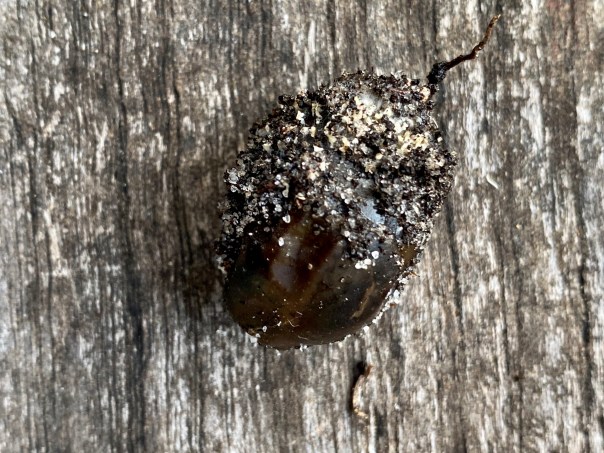
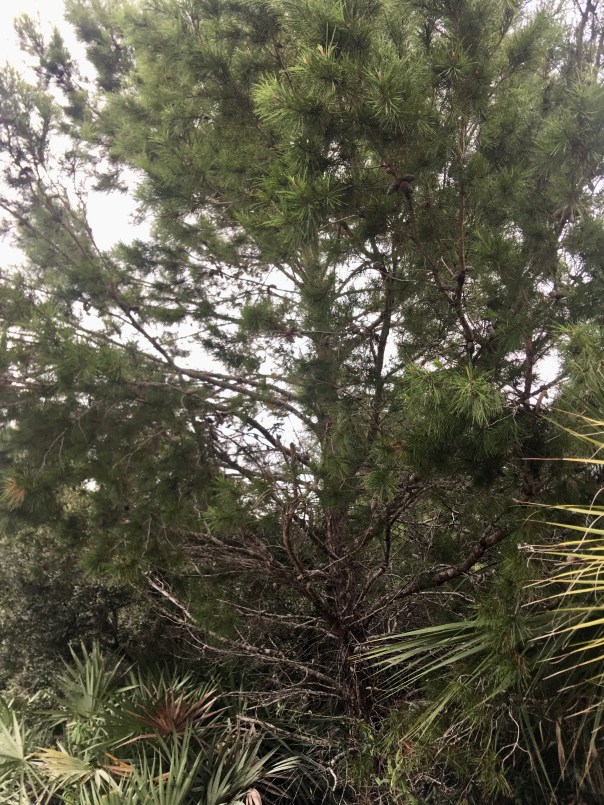
Since I was a kid growing up in Martin County, I have been excited to hear stories about hail. Hail is really the closest thing to snow down in these parts. I remember once, in the 1970s, when our family lived at 109 Edgewood Drive, in Stuart, it hailed and we kids ran outside and collected it in our sweaty palms dumping it into Tupperware that ended up in the freezer. Those hail pieces sat in there for years, and every now and then we would climb on a squeaky high chair, when mom wasn’t looking, and take the cold frozen memory out, just to revel. Amazing! As a kid, I never knew what else to do with the hail, and in time, I’m sure my mother removed it to make room for ice cream.
Yes hail.
As I got older and my mother’s local history books were being published. I was struck by one photograph of the 1934 Roosevelt Bridge in Stuart overflowing with hail -looking like, yes,- like a snowstorm had come!
In this photo by Frances Carlberg King in “Stuart on the St. Lucie: A Pictorial History” by Sandra Henderson Thurlow, hail covers the old Roosevelt Bridge on Feb. 10, 1934. A hailstorm covered Stuart with ice, creating street scenes that some say looked like “someplace up North.”
Hail, though it can be destructive is a novelty, one to be appreciated, even celebrated.
Just last Sunday, April 19, 2020, month two coronavirus containment, it stormed wildly and hailed in south Sewall’s Point. The noise on our metal roof was deafening! Right after, I ran out and collected the hail pieces just like I had when I was a kid. The air was so chilly! My bare feet were cold against the deck and wet earth. Somehow, the whole thing was exhilarating!
When I brought my hail inside, I quickly put the bowl in the freezer and looked for my husband, Ed.
“Ed! Come look! I collected some hail!”
There was silence for a bit, and then I heard him slowly ask, “what are you going to do with it Jacqui ?” Ed grew up in Chicago so ice is not so unusual.
“I have a surprise!”
That evening after dinner, I said, “I recommend we do something special with this hail. I think we should make real cocktails with it, you know, like the kinds from the 1950s? And then, we are going to toast Mother Nature.”
Ed laughed and we did just that, “for the hail of it!”
If you live in Martin County, you may have experienced a short lived violent storm this past Sunday, April 26th, 2020. In south Sewall’s Point, early afternoon, the winds exploded in a crash of falling branches, rain, thunder, and hail! Under the deafening sound of our metal roof, Ed and I stood on the porch in amazement, looked at each other and said, “well at least it’s raining,” as presently drought conditions cover much of the state.
The following day, Ed took wing taking these aerial photographs. They are a good example of “local runoff.” No Lake Okeechobee thankfully! Lake O too though looked beautiful after the storm as displayed at the end of this aerial series. Somehow, it always seems most beautiful after the storm…
L-R: ST LUCIE RIVER, SEWALL’S POINT, INDIAN RIVER LAGOON, HUTCHINSON ISLAND, ATLANTIC OCEAN, by Ed Lippisch 4-27-20
INDIAN RIVER LAGOON, ST LUCIE COUNTY, HUTCHINSON ISLAND ~NOTE ST LUCIE POWER PLANT AND SAVANNAHS ON MAINLAND TO WEST
Earth Day 2020 will certainly go down in the history books. The worldwide outbreak of Covid-19 gives all of us a new lens to view the world, our fragile blue planet… Certainly everyone sees “change” differently. For those of us along the Treasure Coast, when we think of Earth Day we may think of water. Since 2013, thousands of us have come together amplifying a longstanding fight for clearer, cleaner water. We started a modern movement that caught traction, and indeed, changed the political landscape and perceptions of Floridians. We are making progress! But big change comes slowly, thus we must do all we can ourselves right now. It must start with “little things,” like with how we think about pollution; how we live; how we use, develop, and protect ours lands; how we manage our pesticide-fertilizer-water-hungry lawns, or get rid of them all-together; how we think about food, transportation, and most important, our expectations of large scale agricultural production. It’s overwhelming really. But it’s a must. Earth Day cannot just be a celebration, a recognition, it has to bring real change, right now.
2013, 2016, 2018 JTL/EL: St Lucie River/Indian River Lagoon and Lake Okeechobee during multiple toxic algae crises, not long ago, a strong reminder of the need for continued change. We cannot ever again allow such polluted waters upon our Earth.
I don’t know about you, but since the coronavirus pandemic has relegated me to my home, I have been going though my closets. In fact, after I was done with mine, I called my mother and asked her to go through her’s as well. She always wins when it comes to finding cool forgotten stuff tucked away in the closet!
Yesterday, she found the family fossil box. She left it out front of her house for me to pick up. It was very heavy and FOSSILS was neatly written atop. It was a timely find as I have been blogging about Lake Okeechobee’s ancient inland sea. Lake Okeechobee and beyond offer not just shelling but incredible fossil hunting as well.
Yes, almost all of Florida was once an ancient sea, not just Lake Okeechobee…Florida in various forms has been in and out of the water many times…
Many of the fossils from my mom’s fossil closet are from Gainesville where she grew up and where my grandparents lived. My cat Okee was very interested in the fossils too! They must still smell! She was bating an ancient shark tooth around like it was a toy. She loved when I laid out the contents of the fossil closet.
As you may have guessed, the saber-tooth cat skull above is not one from the Thurlow fossil closet! This is from the Clewiston Museum that has one of the state’s very best fossil collections containing all the fantastic megafauna that used to roam. In 2012, Ed and I went fossil hunting with the famous Mark Renz -in the area of the Peace River. So weird and incredible! Ed and I had a blast, Mark showed us some of his great finds when we were there, and Ed and I found some fossils too. Fossils are fun, and again kind of put things in, what should I say? Perspective…
Last night, 4-18-20, after a hiatus, Mother Nature decided to “let it rain” and this morning friends Dr Scott Kuhns and daughter-in-law, Dr Mary Kuhns went for a flight over the St Lucie River and Lake Okeechobee to check things out.Ed and I thank them for sharing their photographs!Update-No visible algae at S-308 or along the C-44 canal. The waters of the St Lucie River are grayish from rain water runoff. Things look good, considering. ~The rainfall numbers across the SFWMD can be viewed at the SFWMD’s 24 Hour Realtime Rain Gauge Site. S-308 at Port Mayaca, Lake OAlong C-44 canal, do you see algae?South Sewall’s Point, rain runoff visibleHole in the wall & St Lucie InletRain plume exciting St Lucie Inlet
Canals in Martin & St Lucie Co.that are connected to the St Luice River: C-23, C-24, C-25 built in the 50s and 60s. C-44 is also connected to Lake Okeechobee constructed in the 1920s. The natural basins of the SLR have been tremendously enlarged damaging the river.
After my most recent blog post, people were asking me about the shells I found along the eastern shoreline of Lake Okeechobee. My mother even shared a rare visit to her collection-closet revealing a huge ten-inch Busycon contrarium ~also known as a whelk. She brushed the dust off the amazing “fossil.” On it, a shiny pink ribbon held a note that read:
“This Busycon contrarium blank was purchased from Lottie Huff a Seminole at the Brighton Reservation. She had a little craft store on highway 721 that runs through the reservation from State Road 70 to State Road 78. Her husband Stanley found it in some material dug up by heavy equipment. She had cleaned it up. 7/3/95.”
Then she emailed me: “So are those shells in Lake Okeechobee from the years when the ocean covered Florida, like the shark teeth found in today’s freshwater creeks and streams?”
I did not know. I do not know. I started researching and I still don’t know!
Florida is an amazing place with so much history. Now if only I can get answers about those shells I found! Do you know the answer? Please write me if you do. I will continue the hunt myself, but in the meanwhile, let’s admire my mother‘s incredible busycon contrarium!
SHELLS COLLECTED FROM THE SHORELINE OF LAKE OKEECHOBEE 4-5-20
With time on my hands, I have started rereading “The Boyer Survey: An Archaeological Investigation of Lake Okeechobee” by Christian Davenport, Gregory Mount and George Boyer, Jr., written in 2011 and begun in 2006. I have written extensively on this publication before and find it one of the best historical accounts of our Great Lake Okeechobee.
What got me thinking about it again was a recent visit with my husband and our dog Luna. While we were there, I saw the wide exposed eastern shoreline of Lake Okeechobee for the very first time. Due to a lake level of about 11.70 feet on April 5th, part of the shoreline was beach like and exposed. I felt compelled to walk on it, and dreamt of what the surrounding may have looked like hundreds of years ago. Of course a true ancient shoreline would have been located further east. Drainage, the Herbert Hoover Dike, and Conners Highway give the illusion that things “always looked this way.”
I was struck by the multitude of small clams shells and snail shells covering the entire shoreline. Some appeared ancient and others not. In any case, I had never seen them before either. They were beautiful even though some were draped in blue-green algae. It was a rare experience. I even found a green piece of “sea-glass along the beach!”
So back to the Boyer Survey. Today for some insight on Lake O’s ancient beach, we will review the Chapter 1, Introduction, of the Boyer Survey. The first paragraph reads:
“The circumstances that led to the Boyer Survey of Lake Okeechobee began in the fall of 2006. South Florida water managers lowered the level of Lake Okeechobee behind the Herbert Hoover Dike in anticipation of a predicted severe hurricane season accompanied by a potentially unprecedented amount of rainfall. Neither the hurricanes not the rainfall materialized. In fact, a severe drought set in. This lowered water levels throughout south Florida and combined with the already lowered water levels of Lake Okeechobee, reduced the lake’s depth from a normal 5.49 to 6.10 m (18-20 feet) to a record low of 2.69m (8.8 feet). (Obviously this the ACOE was not following LORS 2008 at this time.)
A concerned citizen called Palm Beach County in February 2007 to report that ancient human remains and artifacts were exposed on the lakebed…
The Boyer Survey project area is situated in the southeast section of Lake Okeechobee encompassing about 42,092 square miles.
…The lake is a low lying basin with unique features near its south end that helped shape and contain it. These include the Okeechobee Ridge, the Southern Ridge the Spillover Lands, and the fossilized coral ridge.
The Okeechobee Ridge is a sand ridge that extends from the Martin County /Palm Beach county line to just north of Pahokee. This ridge is thought to represent an old shoreline of the lake. The only place there is a gap in the ridge is around the modern hamlet of Sand Cut. Smith (1848) stated only the eastern shore of Lake Okeechobee was well defined by a hard sand shore….
A lower lake has positive and negative effects. Let’s look at one that is positive. While it has been documented by the ACOE and SFWMD that record amounts of submerged aquatic vegetation are growing in the north western and western areas of Lake Okeechobee, the eastern shoreline is ailing as the photos below document.
I do hope that one day there will be more of an effort to create a modern eastern shoreline, an Okeechobee Ridge, that mimics the ancient lake okeechobee shoreline as referred to in the historic Lake Okeechobee account of the Boyer Survey. As the lake shells tell, the Okeechobee Ridge is there, somewhere. The eastern beach of Lake Okeechobee must have been miraculous indeed!
Apparently a “pink moon” is just nickname from folklore for the first full moon of Spring, but yesterday evening the pink moon was real. My husband, Ed, convinced me to go up in the airplane to watch the moon rise over the St Lucie River/Indian River Lagoon. It was April 8, 2020, one day after full. “It is still supposed to be pink,” Ed said smiling…Though a beautiful night flight, it was very hazy and there was no moon to see. All was dark over the Atlantic Ocean. Just when we had given up, turning around to land, there it was! Not just a moon. But a completely pink moon! The atmospheric conditions must have been right. Mesmerized, I have never seen anything like it in my life.I texted the whole family to make sure they ran out to see. My mother wrote” “Wow, I’m glad I came out to the intersection.” My brother Todd Thurlow, took wonderful pictures along the St Lucie River in North River Shores, and my sister, Jenny Flaugh, shot from Indialucie, Sewall’s Point. ~I noticed that as the moon rose it turned from rose to orange…so pretty. ~It was an amazing night, a pink moon flight!
VIDEO OF FLIGHT AND PINK MOON
NORTH RIVER SHORES, TODD THURLOW
INDIANLUCIE, JENNY FLAUGH
VIDEOS OF PINK MOON OVER THE ST LUCIE RIVER INDIAN RIVER LAGOON LANDING AT WITHAM FIELD, STUART, FL.
Hi. Today I will provide a water update. Some is good; some is not so good.
St Lucie River
Although the coronavirus and social distancing is hampering everyones’ ability to visit the St Lucie in large groups, the water in the St Lucie River -at least near the inlet- remains beautiful right now. If you have not been out, you can witness this blue water in photos taken by my husband and me on Saturday, April 4, 2020.
Lake Okeechobee. 11.70 feet.
The South Florida Water Management District and Army Corp of Engineers report Lake Okeechobee’s submerged aquatic vegetation, SAV, is really expanding the sun can reach the grass; this is fantastic for fish and wildlife and water quality, however the closely diked east side of the lake does not get the SAV benefit as it is too deep; the slight algae bloom reported there last week remains. We must be honest and recognize many people feel the lake is too low, but fortunately, there is little chance of discharges from Lake O to the St Lucie and this is a good thing.
~We must note that today the SFWMD made a call for water conservation as much of South Florida is very dry.
~We most keep in mind that predictions are for an above normal hurricane season. It should start raining in the coming weeks.
LOOKING BLUE! ST LUCIE RIVER AND INDIAN RIVER LAGOON BETWEEN SEWALL’S POINT AND SAILFISH POINT, AN AREA KNOWN AS THE SAILFISH FLATS. SEAGRASS SLOWLY RETURNING. 4-4-20 JTL/EL
ST LUCIE INLET AS SEEN FROM ATLANTIC
LAKE O
Submerged Aquatic Vegetation has greatly improved in Lake Okeechobee; this is great news. The grasses are located in shallow areas but not along the eastern edge where S-308 opens to the St Lucie. The lake is 730 square miles, topography varies. The lake was reported by the ACOE to be 11.70 feet NVGD on 4-6-20. Areas along the shallow western shore look like below.
LAKE OKEECHOBEE’S EASTERN SHORELINE, 5000 FT. THIS SHORELINE WAS DIKED CLOSE IN, THE EDGE IS DEEP SO NO SAV GROWS HERE. 4-4-20JTL/EL.
FPL COOLNG POND EASTERN SHORE, ST LUCIE CANAL or C-44 Canal. S-308 at Lake O. YOU DON’T SEE ALGAE FROM THIS FAR UP. JUST A SHADE OF GREEN.
KISSIMMEE RIVER ENTERS LAKE O. LAND EXPOSED DUE TO LOWER LAKE LEVEL. PRETTY HERE. 4-4-20 JTL/EL.
BUCKHEAD RIDGE
Below: THESE PHOTOS WERE TAKEN THE FOLLOWING DAY, SUNDAY,4-5-20 ON THE GROUND CLEARLY SHOW BLUE GREEN ALGAE ALONG THE EASTERN SIDE OF LAKE OKEECHOBEE AND THE S-308 STRUCTURE THAT ALLOWS WATER INTO THE C-44 CANAL FOR AGRICULTURAL IRRIGATION.
AT THIS TIME NO WATER FROM LAKE O IS GOING THROUGH S-80 AT THE ST LUCIE LOCKS AND DAM TO THE ST LUCIE RIVER. WE WILL CONTINUE TO REMEMBER THE ALAGE BLOOMS BROUGH ON BY LAKE O IN 2016 AND 2018 AND KEEP OUR EYE ON LAKE O.
EASTERN SHORELINE OF LAKE O ALGAE IS APPARENT! VERY DARK WATERS.
SITTING ON ROCKY SHORELINE OF EAST LAKE OKEECHOBEE, SUGARCANE BURNING BEHIND ME, ANCIENT SHELLS IN HAND. ~Photo Ed Lippisch
WALKING THE EASTERN SHORELINE OF LAKE O (VIDEO)
SHELLS ALONG AN EXPOSED BEACH DUE TO LOWER LAKE LEVEL
BLUE GREEN ALGAE INSIDE S-308 STRUCTURE/C-44 CANAL
INSIDE C-44 NEAR A CULVERT
LOOKING OUT OF THE C-44 CANAL TO OPENED S-308 STRUCTURE FOR BOATS
BACK OF S-308
INSIDE S-308
LOOKING SOUTH WEST, LAKE O. THE S-308 STRUCTURE IS TO THE LEFT OUT OF PICTURE
ED AND OUR GERMAN SHEPHERD LUNA LOOK ON
Thank you to my brother Todd Thurlow for his web site http://www.eyeonelakeo and thank you to my husband Ed Lippisch for being on this journey with me for the past twelve years. Onward!
*Friend Paul Millar shared these photos of S-308 today, 4-6-20 3:30pm, so this post is now very updated. Thank you Paul!
I hope everyone is in good health and doing well. Last week I published an outstanding 1959 aerial from my mother, Sandra Henderson Thurlow’s Shanley Collection entitled Looking Wide West 1959 Aerial~South Fork to Lake Okeechobee. It was very popular, so today, I wanted to post the four remaining aerials that make up that collection. All of the photos are remarkable documenting a “time gone by.”
I find the photos really interesting to look at…
What do you see? What don’t you see? How would you develop it, or not develop it if we could start over? Me? I would never have cut that C-44 Canal connecting Lake Okeechobee to the St Lucie River!
Since a picture speaks a thousand words, I’ll stop here and let you begin your visual tour of yesteryear.
“~One with Roosevelt Bridge in the center is Feb, 9, 1971
~The on showing the South Fork and the new Turnpike is Dec. 5, 1957
~The one looking all the way to Lake Okeechobee is Oct. 26, 1959.
~The one looking from Palm City toward the airport and inlet is Jun. 13, 1957.
~The one looking along Dixie Highway A1A and US 1 toward the ocean is Dec. 19, 1958
The donor is William Shanley who used to live in the Stucco house across from the Quisenberry property on Sewall’s Point. He was in real estate and he and Dan Deighan bought the Real Estate office of C. O. Rainey on Colorado that had the aerials on the wall.” ~Mom
Below: (L) Area where St Lucie Canal (C-44 Canal) connects to the South Fork of the St Luice River. Here one can also see the New Turnpike, the “Sunshine Parkway,” and how beautiful the remaining wetlands were in the area of the South Fork. December 5, 1957.
Below: An “old” Roosevelt Bridge, connecting the shortest distance over the St Lucie River; North River Shores over the bridge and west is already developed with canals; Lighthouse Point is being built (L) in Palm City; most of Rio is empty to the east of US1 to the ocean; Stuart is built out as it is the County Seat and the heart of Martin County and our history. February 9, 1971
Below: Looking from Palm City to the Airport. Hutchinson Island’s Indian River Plantation and Sailfish Point are not yet developed. The glaring white sands of the Stuart Causeway can be seen at what will become the Ernest Lyons Bridge (A1A) connecting Sewall’s Point to Hutchinson Island; seeing lots of greenery we can tell Sewall’s Point had many river to river estates remaining; in 1957 the town did incorporate and subdivision followed; Cabana Point Circle jutting forward is clearly seen as white fill in the St Lucie River south of the Palm City Bridge. Dredge and fill was not outlawed until the 1960/70s as its destructive environmental issues became clear especially for the marine environment. June 13, 1957.
Below: Dixie Highway A1A and US1 looking towards the ocean one sees that the Hobe Sound area is wide open and natural. Dixie Highway was the most traveled prior to US1 (R) Note the fires burning in the upper right corner. Sugarcane? Burning tree trunks? Something else? December 19, 1958
First of all, let’s recognize that we are stressed out enough social distancing due to the coronavirus. Nonetheless, for our waters, we must pay attention on every front. Right now, the St Lucie River and nearshore reefs are absolutely beautiful, and there is not a threat from Lake Okeechobee or area canals as it is not raining very much. Lake Okeechobee is at 11.85 feet NVGD, therefore, the chances of discharges into the St Lucie River are basically none. If another Hurricane Dorian comes this summer, that could be a different story.
We know our waters suffer from nutrient pollution overdose. Thankfully the State Legislature under the leadership of Governor DeSantis is now paying attention. It will take some time for the bills passed this past legislative session to bear fruit and some will need to be expanded, but when it comes to our waters we are in a better position politically this year and last year than in recent years.
Nonetheless, we must continue our advocacy and continue to document.
The above Jacksonville Army Corp of Engineers map distributed during the March 31, 2020 Periodic Scientist Call shows how much water is going where from Lake Okeechobee. One can see that water for agricultural irrigation is being sent east into the C-44 Canal via S-308; at 191 cubic feet per second. This is fine, and I hope all the water users get the water they need, but algae blooms in our waters is a concern for me.
So to get tho the point, today I share my husband, Ed Lippisch and friend, Scott Kuhns’ flight photos taken today, April 2, 2020 around 11:00am. The aerials show the beginning of an algae bloom in Lake Okeechobee near the S-308 structure at Port Mayaca (Ed said it appeared much brighter than in the photos) as well as clearly in the C-44 Canal near the FPL retention pond and its structure S-153.
Continuing to fly east, there appears to be no algae at S-80, St Lucie Locks and Dam further down the C-44. Keep in mind, the water that is going into the C-44 canal via S-308 at Lake O, Port Mayaca is not going east through S-80 but being used before it gets that far for water supply in the western part of the almost 30 mile C-44 canal.
~Confusing, I know! The C-44 is long and has multiple abilities.
Here are the aerials, as long as possible, we will continue to document the St Lucie River and Lake Okeechobee.
BELOW: LOOKING EAST OVER LAKE OKEECHOBEE, FPL COOLING POND VISIBLE
BELOW: FAINT GREEN ALGAE CAN BE SEEN NORTH OF S-308 ALONG SHORELINE OF LAKE OKEECHOBEE FROM 2000 FEET.
ALGE NORTH OF S-308 and RIM CANAL LAKE O
BELOW: ENTRANCE OF S-308 AT LAKE O GOING INTO C-44 CANAL
BELOW: S-80, St Lucie Locks and Dam, further east along the C-44 Canal, no algae visible
SFWMD basin map for SLR showing S-308 and S-80 along with other structures.
I have been wanting to write about these water quality maps for months. Now that I am at home, social distancing, due to the coronavirus pandemic, I have no excuse. So today, we begin.
Some history: about six months ago my brother, Todd Thurlow and Dr Gary Goforth started collaborating to create nutrient pollution color coded maps. The data is compiled by Dr Gary Goforth via South Florida Water Management District’s DBHydro water quality database; and the graphics are generated by Todd. All of these computer generated images can be found on my brother’s website, eyeonlakeo. This is a site you are probably familiar with as it led the charge on Harmful Algal Bloom Lake O satellite imagery before that went public in 2018. My goal is to do the same with these maps. In time, have them “go public.” The form this data exists in the District’s reports today is very sophisticated and thus confusing for the general public. With help from Gary, Todd, and a former eighth grade teacher, (me) it doesn’t have to be!
So let’s start with overview color. Basically, any color other than green is a flashing light, especially orange-red, or dark russet!
When looking at these maps, one must keep in mind that the map is in WATER YEARS. A water year begins on May 1 of a year and goes through the following year ending April 30th. The above map labeled “Lake Okeechobee Watershed Total Phosphorus Concentrations,” is Water Year 2019. (May1, 2018 – April30, 2019.)
Next, one must learn to think in terms of SUBWATERSHEDS and BASINS. The image above is for the entire 3.4-million acre watershed of Lake Okeechobee, and is broken into sub-watersheds and basins from large to small based on the way the water “flows” or used to. The sub watersheds are identified in bold in the table to the left and the basins are listed below.
The colors on the map are shown by scale at the bottom from green to dark red. You don’t have to be a genius to see that for instance S-154 Basin is one of the darkest color reds with a concentration of 857 “µg/L” (microgram per liter, commonly expressed as “parts per billion”, or “ppb”). In 2001, the State of Florida established a Target for the average phosphorus concentration in water entering Lake Okeechobee of about 40 ppb, so this basin’s concentration of 857 ppb is 21.4 times the Target concentration for the Lake; hence this basin has a “Target Multiple” shown in the table of 21.4.
The color coding gives you a quick and easy way to identify which basins are close to the target (green basins) and which basins need a lot of improvement in their non-point source controls (red basins). For a more quantitative assessment, you can check out the “” values in the table for each basin. It’s important to remember that while concentrations are very important to identify which basins need additional non-point source controls, such as farming or urban best management practices (BMPs), the “load” entering the lake from each basin is also important. We’ll talk about loads in a future blog. Now let’s take a look above at map number two, the “St Lucie Estuary and Watershed Total Nitrogen Concentrations” map. Nitrogen is the other important nutrient besides phosphorus that affects our water quality, including algae blooms. Since we already know now how to interpret the color coding, we can easily see that the Tidal Basins – the largely urban areas around the estuary – has the lowest nitrogen concentration, i.e., the Tidal Basins has the best nitrogen water quality. The Tidal Basin had a concentration of 824 ppb, and with a Target Multiple of 1.1 this concentration is still about 10% higher than the Target set by the State of 720 ppb. So while this basin has the best nitrogen levels in the watershed, it still has some improvements to make in order to meet the nitrogen Target. By contrast, Lake Okeechobee discharges, and runoff from the C-23 and C-24 basins are the darkest red and therefore have the poorest water quality, with nitrogen concentrations about 2 times the Target. The orange to red colors for these and the C-44 and Ten Mile Creek basins indicate these basins need to implement considerably more effective source controls in order to meet the Target for the Estuary.
Todd’s website and Gary’s (http://garygoforth.net/Other%20projects.htm) show phosphorus and nitrogen maps for the Lake and St. Lucie Estuary watersheds. They are working on maps for the Caloosahatchee River and Estuary Watershed.
In closing, these powerful visual maps give us the ability to easily “see” where the greatest problems of nutrient runoff are located; the nutrients come from many sources, including urban and agricultural activities, e.g., fertilizer application. And although the numbers and colors don’t tell us exactly where this pollution is coming from, we can determine it is problematic in the designated basins.
That’s enough for our first day. Hope it was a good one!
Nature is full of surprises that amaze and inspire…
But sometimes we have to LOOK.
I wanted to share these wonderful nature photos taken by my brother Todd, March 28, 2020, near the House of Refuge and the Crossroads of the St Lucie River-Indian River Lagoon. Birds, blue water, and for me, the best of all, the determined eyes of this handsome brown-orange colored fighting conch? Incredible!
This post is a precursor, as later this week I will begin a water quality series that will open our eyes to a “better water future.”
How so? ~My brother Todd Thurlow, creates water quality maps with the help of Dr Gary Goforth and these maps really give insight into nutrient pollution and how it gets into our state waters. I will be sharing and explaining these maps. I figure many of us have some time as most of us are at home due to the coronavirus pandemic. ” We can learn something while doing the right thing for our country.
~Until then, enjoy Todd’s photos, and may we all, human and mollusk alike, keep our eyes out and keep fighting for a better water future!
Fighting Conch in area of the Crossroads, Martin County, FL ~always return sea snails to the water!
HOUSE OF REFUGE, BLUE KEY, CLEAN WATER #LakeO discharge free ~going on 2 years….
A BROWN PELICAN DIVES FOR FISH NEAR INDIAN RIVER PLANTATION, MARRIOTT
A TALL LEGGED “SANDPIPER” FEELS FOR FOOD (WILLET) 🙂
After almost two years of no discharges from Lake Okeechobee and minimal rain in the past couple of months, Martin County’s waters are clearer than any time I have documented from 2013. Yesterday’s tail-end flight, 3-25-20, took Ed and I north along the coast from Bridge Road in Hobe Sound, to the St Lucie Inlet in Stuart.
For the first time I can ever remember, Ed and I could CLEARLY see the reefs below a sapphire-turquoise sea. We were amazed. “Can you believe this?” Ed and I repeated again and again during the windy flight. It was crystalline.
Yesterday’s fly-over was a sight for sore eyes; I am thankful for this time of healing for our ecosystem.
VIDEOS
Below: SEWALL’S POINT as we approach Witham Field in Stuart. Sewall’s Point is a peninsula lying between the St Lucie River and Indian River Lagoon. The nearby St Lucie Inlet is the confluence of these two waterbodies that take on the discharges from Lake Okeechobee. Great to have a break!
“The donor is William Shanley who used to live in the Stucco house across from the Quisenberry property on Sewall’s Point. He was in real estate and he and Dan Deighan bought the Real Estate office of C. O. Rainey on Colorado Blvd. that had the aerials on the wall.”~Historian, Sandra Henderson Thurlow
When my mom handed me the original photograph my jaw dropped. The photo is huge, 16 x 20 inches, its unique perspective capturing at least thirty miles from the South Fork of the St Lucie River west to Lake Okeechobee!
This style of photograph looks like it was made using a plane and camera typical of the WWII era. These cameras were used after the war to help promote development especially here in Florida.
Even though taken sixty-one years ago, the photo reveals many familiar landmarks that define Martin County today, or once did: the winding South Fork of the St Luice River; the St Lucie Canal (C-44) connecting Lake Okeechobee to the South Fork; the dreaded St Lucie Locks and Dam (S-80); Highway 76 running from Stuart all the way to the Lake; the Florida Turnpike; Lake Okeechobee itself; the straight east west lines of Cove and Salerno Roads, the tropical fish farm between the two, and Paulson Road -today, near the bridge at Halpatiokee Park.
In modern times, development covers much of the wetlands in the forefront of the photo but back then….Harris Ranch, a beautiful area, along Roebuck Creek, sold in 1972; and good old fashioned Florida farms are also part of the historic mosiac. The most prominent farming taking place atop the high Green Ridge near Indiantown -at the sharp west turn of the St Lucie Canal.
This morning, Ed and I had some time, so we flew the “River Warrior” to get a glimpse of the modern view in mom’s photograph. An iPhone and an open air plane at 1000 feet wasn’t the same as a high flying spy plane with advanced camera equipment, but it was great fun to compare. We used the figure eight oxbow in the South Fork as the guide to find our way. It is circled it in red below for you to use too.
Whether 1959 or 2020, looking wide west, remains a sight to see!
~Click on images to enlarge.
Above: Oxbow in red circle above, today clearly seen in aerial Below. You can follow the St Luice Canal, (C-44 Canal) above the oxbow to identify today’s I-95, the Florida Turnpike, and St Lucie Locks and Dam.
Below: Close up, beyond I-95 and Turnpike sits St Luice Locks and Dam.
Flying southwest along most South Fork of the St Lucie River…
Thank you to pilots Scott Kuhns and Steve Schimming for providing a “wider perspective.” This morning, March 18th, their photos reveal an unravaged St Lucie River-Indian River Lagoon ~from 2500feet. These are shots I definitely could not get with my iPhone!
Thank you for the good news that shall be documented for all. ~The St Lucie, Indian River Lagoon -a year and a half into no Lake Okeechobee discharges- looks GREAT!
CROSSROADS ST LUCIE RIVER/INDIAN RIVER LAGOON, ST LUCIE INLET, MARTIN COUNTY, FL
SAILFISH POINT, HUTCHINSON ISALND
THE FAMOUS HOUSE OF REFUGE, BUILT IN 1876, HUTCHINSON ISLAND ocean and IRL
JUPITER NARROWS, INDIAN RIVER LAGOON SOUTH OF ST LUCIE INLET, ST LUCIE INLET STATE PARK
THE ST LUCIE RIVER-INDIAN RIVER LAGOON, COMING BACK, WHEN ALLOWED TO BE, IT IS “THE MOST BIO-DIVERSE ESTUARY IN NORTH AMERICA!”
I have always looked to Nature for inspiration and “regeneration.” A short walk in my yard, my neighborhood, or over the bridge almost always brings positive results.
Today, I wanted to share photos from a recent outing where I unexpectedly came upon a multitude of nine-armed starfish at Stuart Causeway, St Lucie River, Indian River Lagoon. I had not seen them for many years during the almost decade of discharges from area canals and especially Lake Okeechobee. To see these striking creatures once again is a very good sign for the recovery of our waterways! And how cool is it that when they lose an arm they can regenerate?
A powerful story indeed!
“The starfish is a resilient creature that constantly regenerates, intuitively navigates the sea, and directly impacts its ecological community. An ancient name for the Virgin Mary, the Star of the Sea symbolizes guidance, intuition, and vigilance.” ~Ancient saying
PICTURE c. 1974, MY SISTER JENNY THURLOW FLAUGH HOLDS A FIVE ARMED STAR FISH, STUART, FL photo Sandy Thurlow. In any era, kids always are amazed by starfish!
ST LUCIE INLET STATE PARK, ST LUCIE INLET & SAILFISH POINT, MARTIN COUNTY 3-14/15-2020, photos Ed and Jacqui Lippisch
It is an amazing thing, what happens, when you give something time to heal. Life rises from the ashes, it returns. After some of the worst toxic discharge years -2013, 2016, 2018- the St Lucie River/Indian River Lagoon in Martin County is healing.
Let’s be clear. ~She is not flush, but she is healing.
Ed and my weekend aerials and boat excursion show absolutely beautiful water and God’s creatures on the rise! Seagrasses, once completely gone, are visible, but dormant from winter months, it still looks pretty barren. Hopefully, upcoming visits to the same area will reveal plush meadows by June or July.
These are awkward and difficult times, with Coronavirus restrictions quickly bearing down on us; so I wanted to share some “good news.”
We must not forget to focus on the gift of blue water and the miracle of resurgent life. Life that always returns if given the chance. ~It is all around us.
SEAGRASS EAST OF SAILFISH POINT & MANY BOATING FAMILIES ENJOYING THE SANDBAR AT CONFLUENCE ST. LUCIE RIVER AND INDIAN RIVER LAGOON
BABY QUEEN CONCH ARE RETUNING TO THE SANDBAR! SUCH BEAUTIFUL COLORS!
BIRD ISLAND, JUST OFF SEWALL’S POINT, SEE THE HUNDREDS OF WHITE SPECKS!
CROSSROADS AREA 2019-20 OFFERS BLUE WATER FLOWING IN FROM INLET RATHER THAN TOXIC BROWN OUTGOING FROM LAKE OKEECHOBEE WORSENED BY AREA CANALS
SOUTH- DOWN JUPITER NARROWS -PASSING ST LUCIE INLET STATE PARK & ARRIVING AT PECK’S LAKE ~A CONTINUATION OF THE INDIAN RIVER LAGOON. ~SLOW SPEED ZONES, MANY OSPREYS, JUMPING FISH, A FEW MANATEES &DOLPHINS. PEACE AND QUIET. ~SO NICE TO RETURN AT SUNSET KNOWING LIFE IS SLOWLY RETURNING TO THE ST LUCIE. LIFE RETURNS.
My husband Ed’s aerials of the St Lucie River/Indian River Lagoon show a positive picture of area waters that in 2013, 2016, and 2018 were black and green with the repeated bruises of Lake Okeechobee’s toxic algae blooms. This is not the case last year in 2019, and so far in 2020. We must celebrate these wonderful times for our waters by enjoying them. Healthy breezes float by, fish are jumping, and a blue lavender sky beckons you…
Most important, sea grasses are recovering. ~Although dormant in winter like the plants in our yards, they bloom forth now; “spring has sprung!” Signs of life are everywhere from pink and orange, protected baby queen conch at the Sandbar, to 9 armed starfish walking about, and even the recent rare sighting of critically endangered Right Whales, ~a mother with her calf swam slowly across St Lucie Inlet. Thank God the water was clean!
We are thankful for these times of bluer and clearer water and we will never give up the fight! Enjoy the the flight and if you can, go visit our beautiful river.
~STARTING OUT AT C44STA/RESERVOIR, WESTERN MARTIN COUNTY, this project cleans water from the C-44 Canal before it enters the SLR
~FLYING EAST OVER THE TOWN OF SEWALL’S POINT and HUTCHINSON ISLAND provides a familiar view of the confluence of the St Luice River and Indian River Lagoon where the water bodies converge to exit at the St Lucie Inlet. Although the upper St Lucie is always ailing from years of damage, the lower St Lucie and Indian River Lagoon is very flushed by the sea. Seagrasses in the area of the Sandbar and Sailfish Flats have been dormant during winter months and are blooming out now-just like plants and flowers in our yards. It will be important to compare these photos to summer to see true recovery.
~FLYING SOUTH ALONG ST LUCIE INLET STATE PARK, JUPITER ISLAND and then swinging north we see Hutchinson Island’s Bathtub Beach, being restored AGAIN, the 1876 House of Refuge where the mother Right Whale and calf were just a couple of weeks ago, and the nearshore reefs VISIBLE and not under black green toxic water.
~GETTING READY FOR LANDING the plane swings back over the SLR/ILR, Sewall’s Point, towards Witham Field. ~Thank you Ed! It was a beautiful flight!
In the 1970s, my girl scout troop often spent the night in Jonathan Dickinson State Park. At the time, almost all of Martin County was undeveloped so it really didn’t hit me – the value in this very special place.
We girls collected dried flowers, seeds, and grasses to be bound with ribbons and given to our mothers; we lay our packs on bunk beds in musty cabins; we hiked through the pines; we sat around the campfire telling ghosts stories and speaking of bears until too scared to sleep; we sat in a rare silence, together, staring at the bright stars while eating marshmallows…
Last weekend, I went back to Jonathan Dickinson ~45 years later, this time with my husband Ed, and our dog, Luna.
Although I have aged, the place was even more beautiful! Almost immediately, I knew that even though I hadn’t walked it’s piney paths in such a long, long time, it had been an inspiration all my life. A seed growing within me.
Ed and I chose to walk the trail of Kitching Creek. My attention was captured by the beauty of the small flowers and I took as many pictures as I could. Slash pine trees abounded, like sentinels, second generation, the magnificent virgin forest cleared in the the 1920s. Woodpeckers flew from tree to tree looking for insects or maybe a place to set up house. Ed walked far ahead with Luna, stopping every time he came upon a number; I would catch up and read aloud from a pamphlet available at the trail head.
On our walk, I recognized some of the same grasses I used for my bouquet in 1974. But I knew this time I would not pluck them from the Earth, but take them to heart as inspiration in our fight for clean water, -the St Luice and Loxahatchee-, and the future of Florida.
~I then I realized that long ago, I already had.
Before drainage there were times the surrounding wetlands, the St Luice, and the Loxahatchee Rivers were wet enough that people could paddle between them. Today the Loxahatchee suffers from too little water and the St Lucie too much.
Historic 1909 Drainage Map- Kissimmee and Caloosahatchee Rivers, and Lake Okeechobee, Florida. Captain J.R. Slattery, Corps of Engineers U.S. Army.
This post is for the map lover!
Realtor, Stephen Dutcher, shared this 1909 U.S. Army Corps of Engineers War Department Map with my historian mother years ago. To see in all detail click again to enlarge image.
The patient viewer will be amazed at the simple black and white map’s level of detail.
You’ll see the documentation of the upper Kissimmee Chain of Lakes being drained and connected via canals, as was the condition of Lake Okeechobee west to the Caloosahatchee River. However, at this time, looking east, there was no connecting canal from Lake Okeechobee to the St Lucie River!
Reading between the lines, one notes words not of agriculture or development but of Nature: “Pine; marsh; prairie; pine slough; cane slough; cypress; ponds…” many colors, full of birds and wildlife!
~Studying near today’s Stuart, the discerning eye will see that the famous Allapattah Flats ran from the upper St Johns River basin near Ft. Pierce south many, many miles, all the way to the headwaters of the St Luice River! These clear waters flowed not into the Atlantic Ocean through the St Lucie Inlet as this sandbar was closed, but rather traveled north through St Lucie Sound (today’s Southern Indian River Lagoon) emptying at Ft. Pierce Inlet.
~The haunting names of the lakes reflect Indian wars of the past: Tohopekaligo, Kissimmee, Hicpochee, Hatcheneha, just to name a few. In neat, handwritten print, a chart at the bottom of the page juxtaposes the levels of the lakes, “Ordinary Low Water” to “Extremely High Water” revealing depths certainly not found today.
~Lake Okeechobee? 20.6 to 24.4 feet!
~And in closure, the eye sweeps south; an open Everglades lies unmapped. A mystery for another day…
So 110 years of “progress” has slipped by, the stately virgin pines have been harvested, the coastlines scraped and modernized, the marshes, lakes, and rivers drained, and the prairies converted to pasture and farmland, but looking at this map, we can dream. We can dream beyond black and white~of what our dear Florida looked like, before she was changed…
In early 2020 Right Whale sightings were reported along the northeastern coast of Florida apparently this year the whales are taking their young further south…
Right Whale with Calf Travels past the House of Refuge, Martin County (NMFS/NOAA permit No. #19674 by Jim Moir)
Today’s photos may be the most wonderful I have ever had the privilege to share. Researcher, Jim Moir, for years has told me stories about his experiences at sea untangling and assisting the most critically endangered whale species on Earth, the North Atlantic Right Whale. Named the Right Whale because for yesteryears’ whaling industry, they were the “right” species to kill; they remain on the brink of extinction today with an estimated 400 remaining, visiting Florida’s waters usually north of Cape Canaveral, only to bear their young.
A a recent Rivers Coalition meeting Jim said “Hey Jacqui, I’ve got to show you something.” He took out his cell phone and showed me a photo of a mother Right Whale and Calf swimming past the House of Refuge in Martin County. My jaw dropped. “Are you kidding me? ” I almost screamed. “Here in Martin County? I didn’t think they came down this far.” Jim just smiled.
I was completely blown away. What a picture!
Today, I along with others in the press share Jim’s photographs of these incredible mythical creatures living day-to-day, struggling for their lives in a changing world that you and I hold in our hands. In my conversations with Jim I came to understand that perhaps we all must modify our behaviors and attitudes if these great creatures are to avoid extinction. Plastics, boat collisions, human harassment, and how we treat our planet. Climate Change not only affects human food sources, the animals too.
I am including some of Jim and my exchange below. Thank you Jim Moir! What special pictures!
Text conversation:
Hi Jacqui, I’ve got clearance to release some whale photos. I’m about to leave for St. Pete and I haven’t been able to process the photos in order to affix a watermark “taken under NMFS/NOAA permit No. #19674 under the authority of the Marine Mammal Protection Act and the U.S. Endangered Species Act.” I will release the photos to the media with that watermark. You’re right about needing to balance research protection and public information/education. One of the biggest local threats are curiosity seekers hoping for an interesting selfie or social media post and inadvertently harassing the animals. These are the most critically endangered great whale species they are 50 ton mommas nurturing their infant babies (2-4 ton babies) they are not feeding so unlike sea turtles or rays they are unlikely to signal schools of Cobia or other sport fishes. Boaters are legally prohibited from approaching closer than 500 yards. If the animals approach them or they accidentally get too close the should (if safe to do so) go engine off, and enjoy a memorable experience. Call FWC and MRC. Under no circumstances should anyone consider touching or swimming with these wild mothers and their infant calves a swipe of their tail or head on collision have been fatal. These animals are the size of semi tractor trailers. And incredibly powerful. They occasionally come this far south but usually stay north of Cape Canaveral. There are fewer than 400 of these animals left their problem is us, fishing gear entanglement and collisions with vessels killed more each year than are born extinction is a very real outcome Florida waters are the only known calving grounds. They eat coepepods in New England and Canada. There are 11 other species of whale and dolphins that live around Florida too. ~Jim
Jim thanks so much! I promise to be very careful, mindful, and respectful with how I post. I in no way would wish to endanger these very endangered species. I will be sure that the public knows how critically endangered the whales are and that they must be left alone to survive and successfully raise their claves. The permit for the photographs will be displayed. Thank you Jim ~Jacqui
Sign as displayed as Stuart Causeway along the Indian River Lagoon close to St Lucie Inlet.
Ed Lippisch -eye in the sky- St Luice River/Indian River Lagoon 2-26-20 3pmOfcouse, it’s important to document from the air during this great new era of no Lake Okeechobee discharges. In any case, the St Luice River is plagued by too many human made canals. The SFWMD basin map below reveals all.Ed’s photos are beautiful but the color of the water is not striking as area runoff from rain is visible in grayish tones. Still, a good time to go outside and enjoy! Thank you to my husband, Ed for flying over the St Lucie River/Indian River Lagoon as I can write all day long, but “a picture speaks a thousand words!” And we will continue to work a thousand times harder to save her.St Lucie InletSailfish Flats IRL east of Sewall’s PointApproaching St Lucie Inlet, Sailfish PointSailfish Flats over Hutchinson Isl.Atlantic & SL Inlet, Sailfish PointLooking south to Crossroads SLR/IRL
The Remarkable Restoration of the Kissimmee River, a Modern Flyover
Recently, I featured my brother Todd Thurlow’s extremely popular time capsule flight, “The Destruction of the Kissimmee River.” Today, I present the remarkable antithesis, “Restoration of the Kissimmee River.”
As Todd notes, Kissimmee restoration began in 1999 with phases 1 and 4 completed first. Phases 2 and 3 are expected to be completed by 2020. You will see as you travel up the winding river the long gash of the C-38 Canal backfilled with the same soils that were dug from its own flesh, and the winding oxbows, like capillaries, filling-up to come back to life!
Here’s a map to reference. Amazing! This restored habitat will help replenish wading bird communities and naturally filter water as it flows south to Lake Okeechobee rather than mainlining pollutants. My favorite shot comes at the end where an aerial view of gigantic dump trucks looks like a collection of children’s toys. We can now begin to grasp the scale of this massive project!
When we watch this video we know Ernest Lyons’ words “what men can do, they can undo,” is no longer just a saying, but a reality and we are empowered to do the same! Please click on image with arrow or link below.
This video compares 1940 and 1999 aerials of the Kissimmee River with current Google Earth Imagery to show The Kissimmee River Restoration project, which began in 1999. Phases 1 and 4, at the northern end of the project, were completed in 2010. Phases 2 and 3, on the southern end, are expected to be completed in 2020. When finished, the U.S. Army Corps. of Engineers and the South Florida Water Management District will have restored 44 miles of winding river, over 12,000 acres of wetlands and 40 square miles of floodplain. ~Todd Thurlow
My mother, historian Sandra Henderson Thurlow, sent me this remarkable 1911 magazine promoting the wonders of the Kissimmee Valley as seen in 1911; I think you’ll enjoy it too! Click on images to enlarge and view as gallery. Magazine is organized into four sections due to length. After viewing gallery section, X out in upper right corner to be able to enter next galley section.
KISSIMMEE VALLEY GAZETTE, 1911
Jacqui,
I have this over-size magazine published in 1911. Since you are working on the Kissimmee it might interest. Believe it or not, there is an aerial of Lake Tohopekaliga–oblique. I wonder why Miami is misspelled on “Miam” on map page 9? Notice no St. Lucie Canal. Interestingly, P. A. Vans Agnew ended up here and was involved in the formation of Martin County. ~Mom
Only for the Hardcore! SFWMD February 19, 2020 Ecological Conditions Report
As I mentioned in a recent blog post, when I read the weekly SFWMD Ecological Report, I “start with the end in mind.” Reading the recommendation at the end of the thirty plus page weekly document gives me a hook to keep in mind while reading everything else. I read, or at least peruse, this document because I want to know not just about the St Lucie, my hometown, but the entire Everglades System, especially my friends the animals.
This just came out, so I am sharing it now with you! There is a lot of science, but also pictures too! Nonetheless, this post is for the hardcore student of the St Lucie River and Entire Everglades System! Give it a try!
Images below are screenshots from report with final recommendation and images that struck me first. Included is a helpful image showing rough boundary of SFMWD, Everglades National Park, & Water Conservation Areas for understanding.
The February 19, 2020 Ecological Conditions Report is posted to the portal:
Our recent focus on the Kissimmee River has inspired my brother Todd Thurlow to create a very special Time Capsule Flight. He has geo-referenced more than twenty 1940s historic aerials and topography maps revealing the destruction of this once remarkable, not just river, but vast floodplain. The outcome is epic! You will see this historic mistake as you’ve never seen before.
The 1962-1971 channelization of the two mile wide Kissimmee floodplain into a thirty foot deep C-38 Canal was perhaps the all-time worst act of the State of Florida and the Army Corps of Engineers. Why was the channelization of the Kissimmee any more destructive than any other of the Central and South Florida Plan atrocities? Because the Everglades south of Lake Okeechobee was already very compromised. This act not only killed the Kissimmee, but just about everything below it.
Like a knife through flesh, the engineers cut deep, draining the life blood, water, from the surrounding marshes and curves to now shoot down, unfiltered into the Lake. In short order, with devastating ecological consequences, over ninety percent of the waterfowl that once graced the region, disappeared. Fish and other wildlife’s health and bio-diversity plummeted. Today the ACOE and SFWMD recognize this huge mistake and are working hard to restore parts of the Kissimmee. But before we witness that, Todd will lead you through a time capsule flight of what indeed, we did do…
Please watch video directly below.
(The Destruction of the Kissimmee River, click here for YouTube with Todd’s full write up: https://youtu.be/xChsxU8Nv5s)
This video compares 23 USDA aerials from 1941 and 1944 to historical aerials from 1999. The early aerials predate the transformation of the river into a canal in the 1960s. The 1999 aerials show the canal before recent restoration efforts. Beginning in 1999, the U.S. Army Corps. of Engineers began restoring sections of the river by dismantling the canal. Twenty-four miles of river have been restored. Aerials of those restoration projects will be the subject of future videos. ~Todd Thurlow
One thing is for sure, the South Florida Water Management District puts out a lot of information. One publication I am slowly acquiring the patience to read in the weekly “Environmental Conditions Report.” The District has been great about sharing this important information on Twitter and Facebook, but it is still difficult to find on the website.
Today I am going to share how I read this report hoping that you will start to read it too. You’ll notice that right off the bat there is a disclaimer: “Information contained in the report addresses environmental conditions only and is not the official South Florida Water Management District operations recommendation or decision.”
Disclaimer or not, this document is very important because it is given from the perspective of the entire environment of the Everglades System and of the wildlife if they could talk. The report is 30 pages long and scientific; how can we make it easier for the layperson to read?
For me, as I begin, I ask myself, “What is this week’s problem?” “What should I know first?” To get myself engaged, I have started reading at the bottom of the document first. I go directly the last page where it says “…Recommendations.” Then I read it all.
The first sentence under the February 13, 2020 Water Management Recommendations reads: “Current stages in WCA-3A are low for this time of year and salinities are high in Florida Bay.” Hmmm. I know high salinities are not good for Florida Bay because it can cause a massive sea grass die off, and what is this about WCA-3A? What is a WCA?
WCA means “Water Conservation Area.”
Below is the SFWMD recommendation and a map from the National Academies showing the three Water Conservation Areas. WCAs are protected just like the Everglades and they are part of the Central and South Florida Project of 1948. They have many important functions for people and for wildlife: https://www.sfwmd.gov/sites/default/files/documents/fyi_wca_management.pdf
So now with these “problems” in mind and of course thinking about the importance of my own St Lucie River. (I am so thankful we have not had toxic algae discharges from Lake Okeechobee this year!) I read it all because I want to know about the environment for the entire Everglades as I’m sure you do as well!
Aerial, Kissimmee River restoration, Gary Goforth, 2-9-20
My most recent blog post included the above photograph of Kissimmee River Restoration north of Lake Okeechobee taken by Dr Gary Goforth. My mother, Sandy Thurlow, commented: “ I would so like for Dr. Goforth to explain what we are seeing in his aerial of the restoration of the Kissimmee River.”
I wrote Gary on behalf of my mother and he provided such comprehensive and helpful insight that today I am sharing not just for my mother, but for everyone! Please read below.
~Dear Gary,
When time allows my mother was hoping to get an explanation of the wonderful Kissimmee River restoration photo you shared in my blog post. Could you please write something? Thank you so much.
Jacqui
~From Gary
Hi Jacqui,
The Kissimmee River Restoration (KRR) Project is one of my favorite projects on the planet!In the 1960s, the historic 105-mile meandering Kissimmee River was transformed into a 56-mile ditch by the Corps of Engineers at the request of the State of Florida to help relieve flooding upstream.Public activism convinced Gov. Bob Graham to support restoration of the River in the 1980s, and as a US Senator he was instrumental in having Congress authorize the Corps to proceed with restoration.The SFWMD was way out ahead of the Corps (again) and had completed several phases of engineering design and prototype testing.The initial backfilling of the C-38 Canal was begun in 1999, and when completed later this year, the project will re-establish flow in 40 miles of the old river and rehydrate about 12,400 acres of former wetlands that were over-drained by the canal.
There are many reasons I love the picture taken Sunday as Ed was flying Mark and I north of the Lake:
·In the foreground of the photo you see a section of the meandering restored Kissimmee River!The construction work in this section of the river consisted of backfilling the 300-ft wide and 30-ft deep canal.It also included “re-carving” some sections of river channel that were destroyed during C-38 canal construction.This work has routed water to the native channel and floodplain of the Kissimmee River, and reestablished hydrologic continuity between the river and floodplain for the first time since the C-38 canal was completed in 1971!How amazing!
·The photo also shows smaller secondary river channels and a colorful mosaic of wetlands on their way to restoration!What has been amazing is that despite almost 50 years of over-drainage, there are tens of thousands (maybe millions) of resilient seeds of the former marsh vegetation in the soil that have regenerated upon reflooding!This is truly amazing!
·The photo shows the restoration area known as Phase II, located roughly in the middle of the KRR project.This phase is almost complete, with the remaining canal backfilling to be completed later this year.By the way, the balance of the restoration project should also be completed this year!!!
·The left hand side of the photo, where the road crosses the floodplain, shows the location of what was the water control structure and navigation locks known as S-65C.As part of the restoration project, structure S-65C was demolished in 2017.For spatial reference, the old structure was located about 5 miles upriver from the Hwy 98 bridge and about 23 miles upstream of where the C-38 canal empties into the Lake.About 30 miles to the north (left in the photo) is where the C-38 Canal exits Lake Kissimmee.
·A Google Earth image taken in 2017 is attached below.This image shows the S-65C structure prior to demolition.
·In the photo taken on Sunday you can see the footprint of the backfilled C-38 canal in the center of the photo – on either side of the rectangular open water. You’ll need to zoom in to make out this detail since the inundated floodplain has almost covered up the former canal footprint!
Pilot my husband, Dr Ed Lippisch, Dr Gary Goforth, Mark Perry Feb. 9, 2020
Between the rain and the FAA’s Presidential Temporary Flight Restrictions, it has been difficult this Florida winter to get photos of the St Lucie River/Indian River Lagoon. Luckily, yesterday, there was an opportunity to get up in the air!
Ed took Florida Oceanographic https://www.floridaocean.org Executive Director, Mark Perry, and board member, Dr Gary Goforth up for a ride. Mark wanted to check on the seagrasses and near shore reefs. Gary – the restored Kissimmee https://www.sfwmd.gov/our-work/kissimmee-river as he was very much part of this success that is still underway. As it was quite windy and I have a delicate stomach, I stayed on the ground. I didn’t want to ruin the outing asking for an air-sick bag!
Today, I share some rare photos of the St Lucie River after being “Lake Okeechobee discharge free” for almost one year. As you can see, her seagrass beds still need a few more years to recover, but rhizomes and grasses are back in some areas, ~but not what we want- historic “all.” The ocean waters were very turned up so it was hard to see the reefs, but the water sure was blue and for that we are beyond thankful!
Ed and I and the River Warrior Community will continue to document and fight for the continued health of our St Lucie River/Indian River Lagoon!
South of Sewall’s Point, Crossroads, photo Gary Goforth
St Lucie Inlet, near shore reefs, photo Ed Lippisch
Another view, photo Ed Lippisch
Indian River Lagoon, Sailfish Flats, photo Ed Lippisch
Sailfish Point, IRL/SLR Crossroads, photo Ed Lippisch
Restored area of the Kissimmee River, photo Gary Goforth
Thank you to Mayor Greg Oravec and the City of Port St Luice for welcoming the South Florida Water Management District https://www.sfwmd.gov to the Treasure Coast in order to hold a “Consumptive Use Permits” Workshop on Friday, January 31st, and a Governing Board Business Meeting on Saturday, February 1st. Wonderful, unconventional meeting dates for an unconventional time in history as Governor DeSantis’ 2019 appointed Governing Board, led by Chairman Mr Chauncey Goss, reaches out throughout South Florida to build relationships and transparency. It was so special to have many area local elected officials, the new IndianRiver Keeper, and members of the public participate in “our own back yard.”
Now that the economy is much improved, the city’s literature proudly touts “Growing Together,” and that they are. Over the past decade, the affordability of Port St Lucie compared to other Treasure Coast areas has brought in a tremendous number of young professionals and modern-families looking for a better water future and a place to call “home.” This vision is apparent in the cities elected officials and staff.
On a personal note, I am proud to call Mayor Oravec my friend having known him since my Treasure Coast Council of Government days beginning in 2008. We have watched a long needed cultural shift occur regarding water. The mayor is a true visionary and has been a huge inspiration in this hard fought movement.
Thank you for hosting the new SFWMD. Tother with Martin, Palm Beach, Okeechobee, and Indian River counties, we are building a Treasure Coast future, as part of a greater South Florida, of which our children and grandchildren will be proud.
Shared below are LINKS TO THE WORKSHOP & MEETING.
JTL & Mayor Oravec 2020
Basin map: the C-23 canal boarders St Luice and Martin County.
*Congratulations to the Kansas City Chiefs for their Super Bowl win last evening ~even though I was born at Travis Air Force Base next to San Francisco!
~For all of us, it’s about getting the ball to the finish line!
The mastic tree had been in my yard for many years before I noticed it. Cradled next to a giant strangler fig, the trees’ high branches are mixed together in a very high canopy. Over the years, I realized it was a special tree that I should know more about. Mastic trees are high hammock trees native to Florida, attracting much wildlife and growing slowly to great size. The mastic tree, the hammock tree, the forgotten tree, the tree mindlessly chopped down in my hometown of Sewall’s Point…
There used to be a large mastic at the entrance to High Point at River Road. It was cut a few years ago in favor of pentas and mulch. A few months ago, I discovered another one on an empty lot located at about Ridgeview and River Roads. Covered in a thorny vine, few would notice the huge trunk covered in different colored fungi, like a piece of God’s art. Ancient and otherworldly. A reminder of days long past before non-native plants, floratam grass, fertilizers, and pesticides would replace a tangled forest and contribute to the death of the St Lucie River.
Just recently, my mastic dropped gooey, orange berries and the wildlife ate them with relish. I have been trying to grow the seeds, now wrinkled and brown, in my quest to bring my yard closer to what it was prior to development and help the river and soil, but the squirrels and raccoons raided my pots! Proud to outsmart my four-legged friends, I “ingeniously” figured out how to protect the seeds in an old aquarium. But just today, I learned that mastic trees are male and female. Dropping the orange seeds, I believe I have a female.
I am afraid I might have one of the last mastic trees in Sewall’s Point. She needs a companion if there is to be the return of the majestic mastic. We are calling your name…
Historic photo of Sewall’s Point’s once “tangled forest”: Andrews in Sewall’s Point Hammock, approaching a giant mastic tree, 1905. Courtesy Thurlow Archives, Sandra Henderson Thurlow.
Greetings to my blog readers! Hope your new year is off to a good start.
For me, 2020 started with the Everglades Coalition (EVCO) Conference January 9-11 at South Seas Island Resort in Captiva Island, Florida. The theme for the conference was “All Hands on Deck,” and I would certainly say that the inspirational event achieved such! (https://www.evergladescoalition.org)
As a member of the South Florida Water Management District, (https://www.sfwmd.gov), I was asked by EVCO Co-Chair Mark Perry, to sit on the panel “Lake Okeechobee Management, The Big Water.” Other panelist were: Dr Dale Gawlik, Director and Professor, Environmental Science Program, Florida Atlantic University; Dr Paul Gray, Everglades Science Coordinator Audubon Florida; David E. Hazellief, Okeechobee County Board of County Commissioners; and Col. Andrew Kelly, Jacksonville District Commander, U.S. Army Corps of Engineers.
Thank you to long time River Warrior, Gayle Ryan, for taping and you can find the entire panel video taped on her Facebook page dated January 10, 2:07pm. To say the least, I felt very privilege to sit with such a group. Today, I would like to share my slides and the 13 minute recorded talk below. Thank the Everglades Coalition for the opportunity to share and the SFWMD for helping me prepare.
I am ready. Both of my hands are on deck!
Historic Phytogeography of South Florida with Present Day SFWMD Features Map, 2019
Rock Road, Stuart, Martin County, FL ca. 1907. Courtesy archives Sandra Henderson Thurlow.
“This is thought to be our school house where the courthouse is today. So this would be today’s South East Ocean Boulevard. I would say the year is about 1907.” Mom
This quaint photograph is a far cry from what one sees toady. It was taken along the well traveled South East Ocean Boulvard near today’s Martin County Court House. The photo is believed to have been taken around 1907 and reveals that the area was a sand pine habitat with an understory of palmettos and other scrub like plants. These sandy soils are ancient sandbars. They remain today under inches of fill, floratam grass, and pavement.
Roads…
They are interesting because we are traveling along them “all the time.”
According to the History of Martin County one of the reasons there were rumbling in our area, starting around 1915, -to brake away from Palm Beach County- was that there were no paved roads:
The book states on page 441: “There were no paved roads, for example, between Stuart and Indiantown, or between Jensen and Stuart, or from Palm City to Tequesta. The roads that had been built were narrow “shell” roads. ~By the middle 20s then citizens of this area were tired of getting stuck in the sand. They decided the only way they would get good roads was to break away and form their own county.”
*Today this habitat is endangered as most all sand pine scrub types along Florida’s east coast have been developed. Certainly, prior to development, there were many scrub jays and gopher turtles that had lived and adapted to changes in this area for thousands of years
Antique Stuart, Fl postcard ca. early 1900s, with native Sand Pines, courtesy Sandra Henderson Thurlow.
Photo of Downtown Stuart area. The house now is owned by the law offices of John Sherrard. This is 6th Street. Note sand pines and white sand. The building being constructed is today a yoga studio 2019. Photo courtesy of Sandra Henderson Thurlow.
Jacqui, This looks like the same image of Avenue E. Look what Josephine Kitching Taylor wrote on it.” Mom
When you are driving around today, do you ever wonder what things looked like before humans changed things so much? I do.
I think about it mostly in the context of deteriorating water quality and trying to wrap my head around the story of how we got to where we are today.
My mother, historian Sandra Henderson Thurlow, recently shared these photos. I think they make a point. Both photos belonged to Stuart’s renowned pioneer Kitching family. The first photo was hand titled “Lover’s Lane,” by Josephine Kitching and is marked 1907. That same photo was used by Mr Stanley Kitching to made into a beautiful color postcard to market our area. According to my mother, the quality color printing was only offered in Germany pre World War 1, (1914-1918).
Compare the images. You can see that the second post card is the same image as the first, but now colorized and professionally entitled: “Tall Trees through the Pines, Stuart, Fla.”
My mother wrote of this photo: “Jacqui, This postcard was printed in Germany so it was before WWI. I think it was printed around 1907. It was one of a series ordered by Stanley Kitching and is very early. I think this is the trail that became U. S. 1 (Avenue E.) Mom”
In any case, if indeed this is the old Avenue E that became Stuart’s US1 look what it used to be – a Sand Pine Community, now one of the the rarest in the world. A community whose white sands used to clean and purify the water…There were thousands of acres in today’s Stuart, Martin County, and along all of Florida’s east coast and central high ridges. (https://ufdc.ufl.edu/UF00000505/00001/1x)
I am thankful for those who saved these habitats so we can see how rain water was once cleansed, naturally.
German printed post card, Stuart, FL c. 1907 ordered by Stanley Kitching
Sand Pine Habitat has a fascinating ecological history. Our history. You can read more here:
“Scrubs dominated by a canopy of sand pine are usually found on the highest sandy ridgelines. The pine canopy may range from widely scattered trees with a short, spreading growth form, to tall thin trees forming a dense canopy of uniform height. The sand pine scrub understory is characterized by either scrub oaks or Florida rosemary.”(https://www.fnai.org/PDF/NC/Scrub_Final_2010.pdf)
Deer Camp in Stuart, FL when pine forests were prevalent, historic postcard, date unknown, possibly pre-1900 as identified by Richard Roberts. Courtesy archives Sandra Henderson Thurlow.
For a number of weeks now, I have been on this quest to be able to identify pine trees as the history of our forests are connected to the our St Luice River. To get me started, my mother, historian Sandra Henderson Thurlow, lent me a number of books, historic photographs, and great old newspaper articles. What I thought would be easy has ended up being hard.
Today, I am going to begin my pine tree series, asking for your help, starting with the example of the post card above. This ca. pre 1900 post card shows something we do know: Stuart, Martin County was once covered in pine forests, mostly sand pines or slash pines, but throughout varied texts that are references to other types of pines too.
According to column entitled “Memories of Early Forests In This Area” written on January 24th, 1974 by Stuart News editor, Ernie Lyons “most of the virgin longleaf yellow pines…were logged off from 1918-1928.”It has been confusing to me that Mr Lyons an avid naturalist, mentions longleaf yellow pines, rather than slash pines, but as all the trees were cut, I doubt I will ever know for sure the answer to this question: “Were there any longleaf pines in the lands that became Martin County?
Mr Lyons also notes: “They were magnificent trees, some towering to 60 feet. Where the big pines prevailed there was almost no undergrowth , just a forest floor carpeted with pine needles and giant cones.“
Pine identification is hairsplitting but it is easy to see that the longleaf pine has the giant pine cones, not the two varieties of slash pine, nor a sand pine. This leaves one wondering, could Ernie Lyons possibly be talking about longleaf pine? https://edis.ifas.ufl.edu/pdffiles/FR/FR00300.pdf
Below is Ernie Lyons’ column. What pine or pines do you think he is taking about? 🙂
Most of the virgin longleaf yellow pines in this part of Florida were logged off form 1918 to 1928. They were magnificent trees, some towering to 60 feet. Where the big pines prevailed there was almost no undergrowth, just a forest floor carpeted with pine needles and giant cones.
The big stands were practically immune to the ravages of fire. There simply wasn’t enough undergrowth to send the flames high enough to reach viable limbs and branches. But the lumberman’s crosscut saw was a different matter.
This not to say that all of Martin and St Lucie counties was tall yellow pine country. The big pines did not favor high water tables. The were most avoidant on the high ground along the North and South Forks of the St Luice. There were scattered strands on high ridges in western Martin County and dense forests between Indiantown and Okeechobee.
Three big mills operated in the area at that time. One of the largest was at Rio, with a logging railroad which ran from there across the North Fork at about the site of the present Port St. Lucie bridge over the river. Another mill, which left a giant pile of sawdust was located on the upper North Fork about half a mile west of the present mouth of C-24, then called Cane Slough Creek. There was a giant lumber and turpentine operation at Sherman west of Indiantown.
By the time the Florida Boom collapsed in 1928, there were not enough big trees left to make it worthwhile to operate large mills and the bottom had fallen out of lumber prices.
Then began the era of the small “hit and run” portable saw mills. These gathered in the few big trees overlooked becasue they were in dense hammocks and so hard to get out that the effort had not been worth the trouble.
The small operators cut anything big enough to saw a two-by-four from. Timber leasing was often overlooked entirely. If leasing was observed, the usual practice was to lease a quarter section and then timber the sections around it on all sides.
By the early 1940s, the county was practically denuded of pines bigger than three or four inches in diameter. It was a scraggly, ugly county, its natural beauty demolished shamefully. There has been a remarkable recovery in the past 34 years, but the pines of any size that you see now are mostly second growth and will never equal the old virgin forests.
The only evidence of the the former forests in most of the county is pitch pine stumps, and in recent years most of these have been removed and shipped off to make resin, turpentine, and dynamite.
I saw the virgin yellow pine forests up the North Fork and they are a marvelous sight to remember. They were the haunt of the huge Florida fox squirrels, big as cats- black, black and white, grey and reddish. When the big pines went, fox squirrels became scarce.
Some of he tallest pines, especially near lakes and along the river, had stick nests of bald eagles in their crowns. One over near the south end of Mile Lake, had a pair of the most aggressive eagles I ever saw, especially when there were newly hatched eagles up above. I discovered it was not safe to come within a few hundred feet of that tree without being dive -bombed in turn by Ma and Pa.
Wild turkeys used to stroll singe file through the tall pine forests as also did sandhill cranes.
“1905, the Andrews walk through Sewall’s Point’s hard wood hammock, note the giant mastic tree.” Courtesy, Thurlow Archives.
“This 1905 photo is of Margaret Andrews and Rudolph Tietig walking through the property that, at the time, belonged the Twichells – located between today’s Hillcrest and Heritage subdivisions.” Historian, Sandra Henderson Thurlow
Today’s historic photographs, shared by my mother, allow us to imagine what the high west side of Sewall’s Point in Martin County looked like before it was cleared for agriculture and development. Yes, although today a few prize trees remain, once, the peninsula’s entire high west side was covered in a hardwood hammock: https://edis.ifas.ufl.edu/pdffiles/UW/UW20600.pdf; https://edis.ifas.ufl.edu/uw206
We still see many Live Oaks, Sabal Palms, and a few Gumbo Limbo, but other names such as Paradise Tree; Mastic; Srangler Fig; Hickory; Satin Leaf; Marlberry, Myrsine, Ironwood, and Pigeon plum are much more rare.
As was the custom of the day, and remains so, these trees were cleared. Perhaps some were used for lumber. But for the most part, there was little thought of saving them, nor of the birds and wildlife that depended on the tangled forest for shelter and food.
I think this is worth thinking about. We walk about today somewhat unaware of what the land previously looked like, forgetting forest’s relationship to water, and how many creatures have been impacted by these human changes.
Could we recreate the forests? This is doubtful, but we could bring some of it back. In order to do this, we need more than photographs, we need a native hardwood hammock -“to see.”
The St. Lucie River bank in today’s Hillcrest ca. 1907, album found by historian Alice Luckhardt on eBay. Much of the hammock was still in tact in this Sewall Point ca. 1950 aerial by Aurthur Rhunke. Courtesy, The History of Sewall’s Point, by Sandra H. Thurlow.
2019 Google showing a almost completely developed Sewall’s Point with little of original hard wood hammock remaining. The town today https://sewallspoint.org is a TREE CITY 🙂
We are very lucky to live in Martin County, a county that has a history of conservation. When researching the Sewall’s Point hammock, I realized I had never visited Maggy’s Hammock Park in Port Salerno. (https://www.martin.fl.us/MaggysHammock). Named after environmentalist and long time county Martin County commissioner, Maggy Hurchalla, this park is a treasure, a walk back into time. This native site, just a few miles south and across the St Lucie River from Sewall’s Point, preserves ancient live oaks, paradise trees, strangler figs, and many, many others as well as the important understory.
It is a true hardwood hammock!
.
Considering the location, these trees must be similar to native Sewall’s Point’s. This was my first visit and I will be back as I try to rediscover the beauty and the benefits of the “Once Tangled Forest.”
.Martin County 20 year commissioner & environmentalist Maggy Hurchalla Walking path Marlberry Paradise trees
. Inside the Hammock
Gumbo limbo Snowberry Wild coffee up close . Wild coffee . Not sure what this is… .Large Oak and Paradise trees inside the hammock . Tall strangler fig, sabal palm, spanish moss Strangler fig with wild coffee and resurrection fern Strangler fig and ferns Strangler fig trunk swallowing an oak tree . Strangler fig and oak with other trees and underbrush Beauty berry leaf cover on ground . Not sure Hickory Spanish moss . Young marlberry, vines and budding sabal palms . Cathedral in the hammock Wild lime Hickory Saw palmetto . Wild lime and marlberry with others Air plant Vines . Various inside the hammock Resurrection fern . Oak or bay tree . Oak or bay tree . Wild coffee and other budding plants .Air plants .looks like boston fern .Light is what all are fighting to capture as branches and leaves are raised .There are many lichens and such on the large trees Cocoplum .Strangler fig
Google Map area of C-44 Reservoir and STA in Indiantown, FL, Martin County.
Work on the C-44 Reservoir and Storm Water Treatment Area started back in 2004 and is one of a few gigantic water projects of the Army Corp of Engineers and South Florida Water Management District. The mammoth construction site is part of the Comprehensive Everglades Restoration Plan, Indian River Lagoon South. In Martin County, the foundation for this was laid back in 1996 and 1998, and then again in 2006 when the public supported environmental land purchases through a sales tax: https://www.martin.fl.us/land-acquisition
Recently, the SFWMD has made great progress for water quality projects with strong backing from the public (fed up with toxic algae blooms), Governor Ron DeSantis and the Florida Legislature.
Today I will be sharing three things: a flyover with my husband Ed; a field trip led by the SFWMD to C-44 with Florida Sportsman Magazine; and the grand finale, the visit of Governor Ron DeSantis to allow the first waters of the C-44 Canal to flow into the STAs.
Why has everything taken so long? We’ll there are many reasons but we must note the 2008 Great Recession, politics, and most of all, the project’s size!
The map above and below can give you an idea of the project’s 12, 000 acres!
Years ago, I wrote a post about the Minute Maid Groves that were once on this property and shared awesome photos my mother gave me from 1964. Groves to Water, amazing how times change: “A Look Back to the Orange Groves of Today’s ACOE SFWMD C-44 Reservoir/STA, 1964, SLR/IRL” https://jacquithurlowlippisch.com/tag/c-44-storm-water-treatment-area-and-reservoir/
Looking at the Google Map, you’ll notice that you can easily see the outline of the former groves. Perusing the map below, you can see the reservoir will be in the north west corner and the six cells of the storm water treatment area on the east. You will also notice that Allapattah Flats, once a gigantic marsh through St Lucie and Martin County, is north of the project along with Troup’s – RB Ranch – upper east. Star Farms is west and grows sugar cane at the present time. There is a long intake canal off the C-44 canal that brings in the polluted water – primarily from local farm runoff. 2/3 of Martin County is agricultural. It is important to keep these lands in agriculture as developed lands would be even harsher on the wildlife and the environment. We all, coast or inland, must work to clean things up!
SFWMD map of site
FLYOVER C-44 RESERVOIR & STA, ED LIPPISCH and JTL, SUNDAY, NOVEMBER 10, 2019.
on Sunday, November 10, Ed and I flew over and took aerial photos. Below you can see the airplane over the reservoir looking over the cells of the storm water treatment area. Also note the long intake canal to the C-44 Canal.
Looking over Cell 2 C44 STA
2. FIELD TRIP TO C-44 RESERVOIR & STA WITH FLORIDA SPORTSMAN MAGAZINE, and JTL led by Alan Shirkey, Bureau Chief, Engineering and Construction, SFWMD and Buff Searcy, Lead Engineer and Construction Manager, SFWMD. THURSDAY, NOVEMBER 7, 2019. This was a great opportunity and thank you to Blair Wickstrom for recommending we do such from the ground. This is were one really sees what is going on!
Entrance sign along Citrus Road in Indiantown On Thursday, Blair Wickstrom and Tray Wheeler of Florida Sportsman Magazine and myself took a tour or the property and really got to see it from the ground. Buff Search, JTL, Blair Wickstrom, Alan Shirkey Pumps pull in water from below Buff Searcy, Lead Engineer, Alan Shirkey, Bureau Chief SFWMD, Florida Sportsman publisher, Blair Wickstrom, reporter Tray Wheeler. Large gate strains. Buff Searcy, Lead Engineer SFWMD with reservoir dike in background. Buff Searcy, Blair Wickstrom, Tray Wheeler, Alan Searcy discuss… Indigo Snakes are an endangered species and live in this area The wildlife was most interesting to me as many types were in the area. We saw numerous deer resting in the grass. I was assured they would move when the reservoir and STA were up and running. It pains me they do not have more wild habitat. Signs regarding threatened/endangered eastern indigo snake Alan Shirkey explains the reservoir and STA.
3. GOVERNOR DESANTIS ACTIVATES THE C-44 STA, INDIANTOWN, FRIDAY, NOVEMBER 8, 2019. A great day and an honor for me to be there up close to our wonderful new Governor!
“The SFWMD recently completed three of the six cells of the 6,300-acre treatment area and expects to have the entire STA completed next year. The U.S. Army Corps of Engineers is building a 3,400-acre reservoir next to the STA that is expected to be completed in 2021. The C-44 Reservoir will store 50,000 acre-feet of water, including local basin runoff and Lake Okeechobee releases. This will reduce harmful releases reaching the St. Lucie Estuary that can fuel harmful algal blooms. The C-44 STA will treat the water stored in the reservoir before it is released into the estuary. “I can’t help but smile. Water flowing into this treatment area marks a momentous day in the history of the Everglades, the Treasure Coast, and the St. Lucie Estuary,” said SFWMD Governing Board Member Jacqui Thurlow-Lippisch. “This is the start of the road to a healthier estuary and Everglades. Under the leadership of Governor DeSantis, progress on Everglades restoration is moving at a rapid pace.””
The Governor hits the button and the first waters flow into the C-44 STA. It can take months for these to slowly fill. Later plants (mostly cattails) will grow and filter water before from the Reservoir before it goes back into the C-44 Canal and St Lucie River.
Water entering the STA
People gather to await the governor!
.
.
.
.
.
.
Gov. DeSantis speaks, photo Carolyn Timmann
Carolyn Timmann and Alan Shirkey stand before cell 2 of the C-44 STA as water enters for the first time
Today is November 6th. On November 4th, friend, Clerk of Court Carolyn Timmann contacted me noting that the Florida Wildlife Commission https://myfwc.com had reported that on November 2, a panther was hit and killed in Martin County.
“The remains of an adult male Florida panther, UCFP368, were recovered on 11/2/2019 in Martin County, Florida (558227, 2984817). The suspected cause of death was vehicle collision.”
Where: About two miles south of Indiantown on Highway 710 known as Beeline Highway
Sometimes we do not realize that these spectacular and rare creatures usually associated with West and Central Florida are sometimes also in our eastern Martin County ~ in our presence. While driving (especially through a Wildlife Management Area) we must be looking; be aware; slow down; and share the road. In this unfortunate instance, Highway 710 (Beeline Highway) cuts right through prime wildlife habitat and is very near Indiantown, Florida. I have written earlier blog post about panthers being reported in western Palm City. They are here…
Comments of interests of my conversations with very helpful FWC. Thank you to FWC for all of your work.
1.
“It is not rare for it to be uncollared. In fact, most panthers are not radiocollared. Currently we only have 7 panthers radiocollared; the current population range is 120-230. In years past, we had many more panthers collared. But our research focus has changed over the years and we don’t need to have as many collared at the moment.
We don’t have many panthers in that part of the state (Martin County) but they can turn up just about anywhere. We had a couple of recent sightings (trail camera photos) from Corbet (management area south of there) so we knew at least one was in that general area. There’s no way to know if this was the same one photographed. Only time will tell if we get any more photos from there.
I’ve attached our data sheet (above) that we fill out when we recover panther carcasses. Because of the location, this panther never passed through our office so we don’t have much of the information we typically collect (age, weight, etc). That information will be determined when a necropsy is performed. An FWC officer recovered the carcass and took it to a nearby field office. The location information is on here though.”
Mark Lotz, Panther Biologist, Florida Fish & Wildlife Conservation Commission, Naples
______________________________
2.
Here is what I got from our panther team:
FWC recovered the remains of an adult male Florida panther (Puma concolor coryi), UCFP368, on 2 November 2019 in Martin County, Florida. The suspected cause of death for UCFP368 is vehicular trauma. The carcass was recovered at these coordinates: UTM easting 558227, northing 2984817. The carcass is currently at the FWC Fish Eating Creek Field Office and will be sent to the FWC Research Lab in Gainesville for a complete necropsy.
We had received a couple of trail camera photos from the Dupuis WMA back in August so this road kill could possibly be that panther.
[The identifier UCFP368 stands for Uncollared Florida Panther Number 368]
Kipp Frohlich, Director, Division of Habitatand Species Conservation, Florida Fish and Wildlife Conservation Commission, Tallahassee
When I was a kid, my brother, sister and I lived on Edgewood Drive in Stuart. My parents were great about teaching us to appreciate, respect and love wildlife. Today, many of our actions would be frowned upon. We fed the animals, and at one time or another, had wild pets. It was wonderful!
This weekend unable to garden trapped inside by relentless rain, I started thinking to myself “what did the ecosystem of my childhood backyard really look like?” That was the late 1960s and early 1970s.
Could I find anything that looked like it today? Does my yard, today, resemble it at all?
So I took a drive to the old neighborhood.
St Lucie Estates looks a lot the same but our family house has been knocked down and replaced by one much larger. Also every lot is developed. When I was growing up, our house was surrounded by a number of empty lots and as kids we roamed freely. These undeveloped lots allowed my siblings and I to have native nature right in our “backyard.”
I racked my brain to think of where I might find a comparable lot to the ones in St Lucie Estates. I wanted to see what plants were on it. What trees. The color of the sand.
I drove east on East Ocean Boulevard.
Near Kingswood Condominium I found one lot that looked a lot like the ones I ran around in as a kid. Although drained and full of invasives, the space held a few recognizables: a sand pine, a stand of sand oaks, yucca, palmettos, prickly pear cactus, and other flowering plants and grasses whose names I never learned.
Seeing the Kingwood lot brought back a lot of memories and I thought about how this once familiar habitat is basically gone. This rare Florida Scrub has been covered with shopping malls and subdivisions most sporting heavily fertilized floratam along with a variety of ornamentals.
I wondered why developers just cleared the natives. I am realizing that my childhood home must have been a Florida Scrub environment. For goodness sake, one of our favorite wild friends was the very smart Scrub Jay! We never thought that our house may have destroyed their favorite bushes. We just smiled and lifted our arms strong and high -palms perfectly flat balancing one nut. Always, they came. So smart! So consistent!
Of course Scrub Jays are now a threatened species whose habitat is considered to be one of the most endangered in the world…
~The location of my childhood backyard.
After getting the photos from Kingwood, I decided to drive north to Jensen to visit Hawk’s Bluff off of Savannah Road. Here I could walk and remember the some of the sights of my childhood. This is one of the few places the Florida Scrub Ecosystem has been saved.
~The wind whistled through the trees. I felt timeless. The rain had brightened the usually muted colors. I sat on the bench. Lake Henderson’s grey and purple reflection resembled a Monet. It was beautiful!
I was alone in my childhood backyard…
I raised my arms above my head, hands upright bent -perfectly flat.
Would a Scrub Jay come to visit?
I held my arms up until I could no longer -putting them down- I got up to walk my adult path.
My little sister, Jenny, proudly feeds a neighborhood Scrub Jay, St Lucie Estates, Edgewood Drive, Stuart, ca.1972. (Family Album)
Cousin Drew Hudson and I feed the Scrub Jays 1972, St Lucie Estates, Stuart, FL (Family Album)
Visit #1 one of the last undeveloped lots near Kingswood Condominium, East Ocean Drive, Stuart, Florida, still reveals native scrub vegetation:
Somehow this cactus garden has grown and survived! Prickly pear is a common scrub plant and a favorite of gopher turtles.
Prickly pear.. Ouch!
Scrub oak and palmetto in a remaining lot off East Ocean Blvd.
A rare sand pine of the Florida Scrub was once prolific requiring fire for pine cones to open and take seed.
Flower of the scrub
Prickly pear in sandy soil with other ground cover


 JTL & Mayor Oravec 2020