Tag Archives: Lake Okeechobee

A Summary, 2013/14, the Year of the Indian River Lagoon

Last year, the people rose up giving the Indian River Lagoon her voice, and things will never be the same. (Drawing of Earth and water by Mary Thurlow, 11.)
Last year, people rose up giving the Indian River Lagoon her voice. Tallahassee has heard. (Drawing of Earth, people and waters by River Kidz member, Mary Thurlow, age 11.)

“Let us throw off everything that hinders, and run with perseverance, the race marked out for us…” Hebrews 

We might still be a long way from the finish line, but no one can say that the Indian River Lagoon hasn’t hasn’t been “heard.”  In 2012, few state legislators, not even the Governor, sitting in his chair in Tallahassee knew what, or even where, the St Lucie River/Indian River Lagoon was…  Today literally, “everyone” in Tallahassee knows about the, dying manatees, sick dolphins, toxic waters, the disappearing seagrasses, and deadly releases from Lake Okeechobee. On top of that “Tally” is watching the IRL positioned to walk away with a large chunk of the pie, a pie that others wanted too. Others who had been fighting longer than the IRL and were very much know by name… Remarkable.
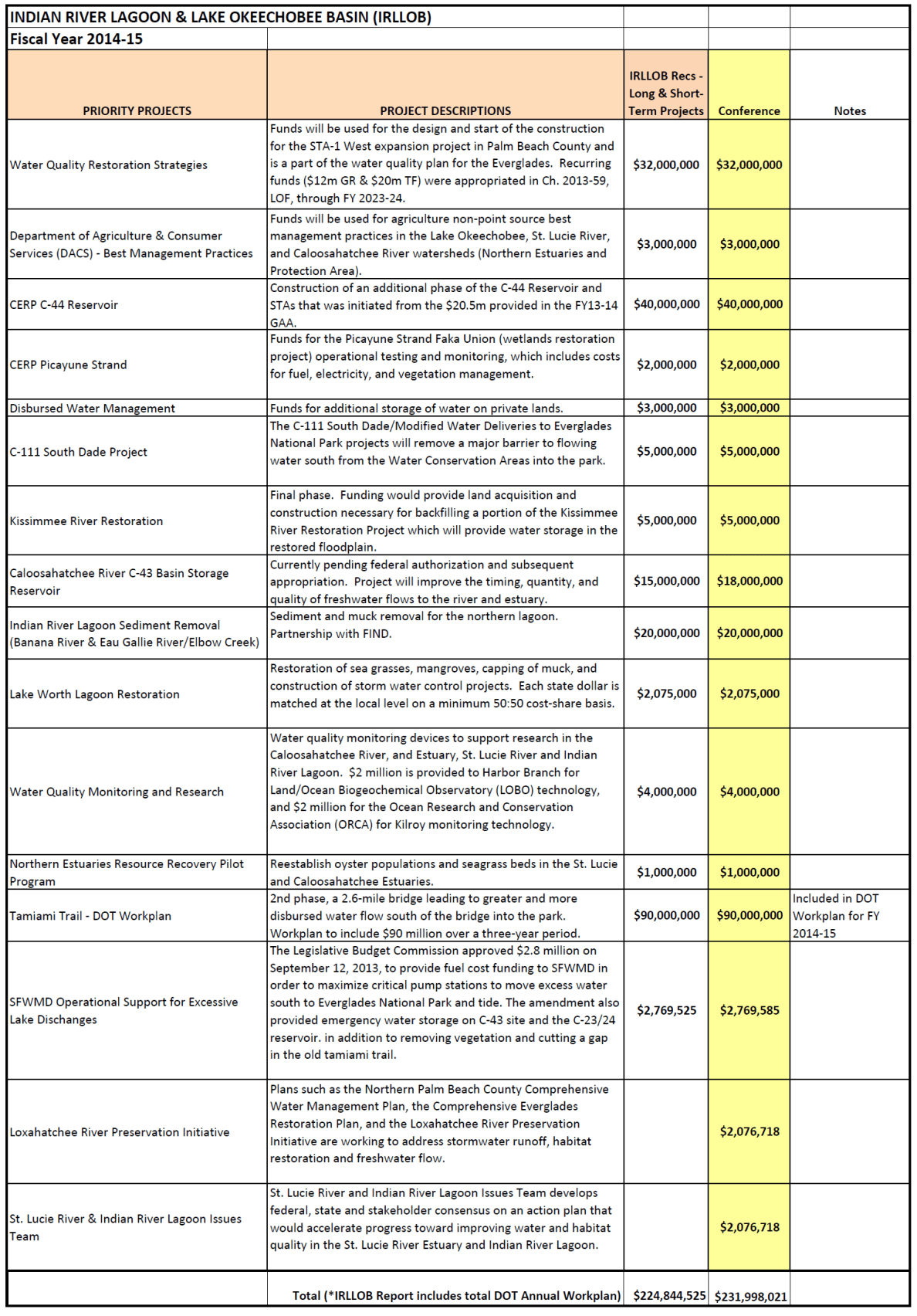
image002

(Specifics of Negron’s Senate/House negotiated IRL/L.O. 3-year budget for 231.9 million dollars. This “recommendation” must still go before the Governor’s pen.)

How did this happen? How did the Indian River Lagoon get so well known so quickly?

This happened because the the people, River Kidz, and local officials of Stuart, Port St Lucie, eventually all eight counties along the lagoon, rose up, demanded change, exposed  health, safety, and moral issues, and then the local press, Scripps, took that flame of the people, threw kerosine on it, and has continued to keep the fire going. State and Congressional politicians along with state and federal agencies, usually free to do whatever they pleased, were taken off guard, suddenly their constituency was watching where officials got their money, how they were voting, and if they were supporting the lagoon.

Senator Joe Negron listened and made the Indian River Lagoon his first priority creating the budget list above, held a Senate Hearing that took the topic “viral,” possibly under-cutting  his Senate presidency because of his outspoken support, and then proceeded to tell the ACOE they needed to give up their control of the lake and that  they were “killing us;” Rep. Gayle Harrell made a memorial in DC her “top”priority; newcomer Rep. Larry Lee voted against party line for the sake of the lagoon; and freshman Rep. Mary Lynn Magar passed out bottles of muck ridden toxic river water and aerial photo booklets to her  colleagues, Rep. Debbie Mayfield called her closest contacts… At the federal level, Congressman Patrick Murphy did every single thing possible to familiarize the ACOE leaders with the C-44 IRL project, and even invited the public to DC for a special meeting. In walks Nancy Pelosi, and then this bipartisan group helps  get the WRDA (Water Resources Development Act) bill passed in the US House of Representatives where usually people can’t make a decision to save their lives.  Holy Cow!

OK, let’s pull back for a moment, because I come from a group of erudite and very skeptical river supporters. And although I am excited, I am not wearing rose colored glasses and never have. I know politicians can dance like marionettes  when they need to; I know that a lot more has to be done, like a flow way south;  I know that if it starts raining intensely tomorrow and doesn’t stop, a repeat of the “Lost Summer” will happen all over again. But Karl…Michael….the others….even you, the harshest, most honest critics, have to admit that the end of 2013, and so far 2014, has been one remarkable year. Less than a year actually…

Just May 8th of last year, the releases from Lake Okeechobee began releasing for 5 months, and set off a series of events that galvanized public outcry. Thousands of people rallied at the locks and shoreline; social media whipped the situation to a frenzy,  and today we are  still today talking about it, fighting for it,  and defining ourselves and our children by it. There are no social, age or economic boundaries. It is all of us. We are making history.

IMG_5787

Yes, a great disappointment, the ACOE’s recent denial of CEPP (Central Everglades Planning Project) into the WRDA Bill last week is a huge setback, but the Army Corp of Engineers has  forgotten something. When passions are repressed, they only get stronger.

This Saturday at 9 AM, locals have organized a “Funeral Services for the Lagoon” at St Lucie Locks and Dam in response to the ACOE’s inaction. (Go to Facebook for information.) Here again locals will plead  their case to “send the water south.”

When I reminisce about the past year and even present, I am reminded of Dr Suess’ famous children’s book, Horton Hears a Who. The story is about the miniature city of people who live on the speck of dust. After being lost, Horton the elephant and the other animals hear the screaming “We’re here!” “We’re here!” of the tiny people of Who-ville, and agree to protect them. But they wouldn’t have protected them if they did not hear them. Remember?

Like the story, the Indian River Lagoon has finally been heard! Be proud of this. It is a huge accomplishment. We are certainly not yet at the finish line, but let’s be happy that 2013/14 has been, “The Year of the Indian River Lagoon,” and that everyone knows our name!


The Coral Strand’s Fishing Riches; Today’s Sailfish Point, Along the Indian River Lagoon

1950 map by Ben McCoy of the "Coral Strand" and its riches,  today known as Sailfish Point.
1950s map of Hutchinson Island’s “Coral Strand.” Today, known as “Sailfish Point.” (Map, Ben McCoy, courtesy historic archives of Sandra Henderson Thurlow.)

How romantic, the “Coral Strand…” Like a string of pearls the riches of Hutchinson Island’s coast strung along the blue waters of the Atlantic and Indian River Lagoon. The crowing jewel, today,  known as Sailfish Point.

The above promotional map by Ben McCoy, brother, of the infamous rum runner, Captain Bill McCoy, highlights some of our area’s best features, most interesting history, and even an excerpt from a novel by Faith Baldwin:

” It was a long jut of land running into the water, upon one side was the ocean, upon the other, an inlet forming a small quiet bay. It was colored like a lithograph, strong blinding colors. The beach was so white that it dazzled, water and sky so blue they seemed unreal…”

If one looks closely at the map, fish of the area are listed around the point: Blue Fish; Sheepshead; Bass; Snapper; Pompano; Spanish Mackerel; and Tarpon everywhere…the Indian River is not noted just as the” Indian River” but the “Famous Indian River,” for fishing of course!

IMG_3626


The publication notes that five presidents, Arthur, Cleveland, Roosevelt, Taft, and Harding,  as well as Joe Jefferson, beloved  disciple of Izaak Walton, fished these waters as “who indeed among fisherman has not heard of the famous St Lucie Region, rendezvous for more than half a century for anglers  from all over the world!”

Believe it or not, according to The History of Martin County, the McCoy’s land, today’s Sailfish Point, was listed for $25,000.

It is fun to visit the dream like past, but soon or later, reality always sets in. In the 1950s the Coral Strand was sold to eccentric entrepreneur and Florida Oceanographic Society founder, James Rand, for its limited development the name was marketed as “Seminole Shores.” Later in the 1960s, the the Hutchinson Island property was sold by Harvard University to a group of Boston investors and eventually to Mobil Oil who legally tore the mangroves from the land, scared off the mosquitoes and filled it. Eventually, in the 80s the land was developed as exclusive “Sailfish Point.”

According to Dr Grant Gilmore, most famous for his long career at Harbor Branch Oceanographic, the waters/seagrasses surrounding Sailfish Point, the old Coral Strand, are truly the most diverse in the North America with over 800 types of fish, often growing baby fish, documented in these waters.

It is a crime that during rainy season, the Army Corp of Engineers often releases water from Lake Okeechobee exacerbating the pollution from our local canals killing the seagrasses in these waters, thus fish habitat destroyed. Last year, in 2013,  according to Mark Perry of Florida Oceanographic, approximately 85% of the seagrasses were destroyed.

Yes, this has happened many times, but one day, it may not come back.

For history, for today, we must fight to protect our “Coral Strand,” and our pearl, our incredibly bio-diverse waters…

___________

The History of Martin County can be purchased at the Historical Society of Martin County: (http://www.martincountyhistoricalsociety.com)


Understanding High Bacteria Levels in the St Lucie River/Indian River Lagoon

Clear water off of the Stuart Sandbar, but is it clean?
Clear beautiful water off the Sandbar, Stuart; but is safe to swim? (Photo, Jacqui  Thurlow-Lippisch, St Lucie River/Indian River Lagoon, 2012)

Enterococcus: Bacteria normally found in the feces. Two types, Enterococcus fecalis and Enterococcus fecium, cause human disease, most commonly in the form of urinary tract and wound infections. Other infections, including those of the blood stream (bacteremia), heart valves (endocarditis), and the brain (meningitis) can occur in severely ill patients in hospitals. Enterococci also often colonize open wounds and skin ulcers, and are among the most common antibiotic-resistant bacteria. Medicine-Net

*The Martin County Health Department tests for Enterococcus (E) in area waters: According to their interpretation, 0-35 cfu of E./100 ml  river water =GOOD; 36-104 cfu E/100 ml river water=MODERATE; and 105  cfu E./ml River water is POOR (“cfu” relates to number of viable cells per milliliter.)

In November 2012, some members of the public were worried that the Martin County Health Department (MCHD) did not have enough support. Due to the pushing of a few members at a Rivers Coalition meeting, Senator Joe Negron, during the legislative budgeting process, added specific funding for MCHD to sample three new sites weekly. In turn, with input from the Rivers Coalition and the help of Bob Washam of the MCHD, the three test locations were chosen and the public began regularly checking bacteria levels in the St Lucie River/Indian River Lagoon on the MCHD website. 

Before the senator intervened, the sites being tested in the river were the Roosevelt Bridge; the Jensen and Stuart Causeways, and the north fork of the St Lucie River in St Lucie County. 

The new test sites included Bessey Creek, close to the mouth of the C-23 canal, in Palm City;  Leighton Park, at the base of the Palm City Bridge;  and Sandsprit Park, near the Manatee Pocket in Stuart, close to the inlet. The Department of Environmental Protection also conducted/s periodic testing.

In early June of the 2013, the bacteria numbers really spiked. This occurred after heavy rains caused storm water to run through local canals C-23, C-24, and C-44 into the river, as well as polluted fresh water discharges from Lake Okeechobee through C-44, that had begun on May 8, 2013 by the Army Corp of Engineers.

The areas waters were looking dark and ugly, and most of the river was off limits to the public due to high Enterococcus levels.  By mid June, there were a number of reports from people that had visited the Sandbar, located just inside the mouth of the St Lucie Inlet, that they and their children were feeling ill with stomach aches and diarrhea after contact with the water.

photo of algae

(Photo of water in St Lucie River two miles from Sandbar w/ high bacteria and toxic blue green algae, photo by Jenny Flaugh, July 2013.)

Because of the popularity of the Sandbar area and the complaints to the health department, Bob Washam, MCHD,  together with Mark Perry, of Florida Oceanograpic, decided to drop the Bessey Creek site and change testing to the Stuart Sandbar. When the tests came back, the Sandbar reading was a high 192 cfu/100 ml river water/or POOR. So signs were posted at the Sandbar, at the hight of the summer season; it was off limits to the public. Shocking.

Just for comparison, I am going to share the highest readings at the other sites in June and July of 2013.  The highest readings were as follows: Roosevelt, 1620 cfu; Sandsprit, 640 cfu; Leighton, 3020 cfu; and Bessey Creek, 1560 cfu. As mentioned about 105 cfu per 100 ml of river water is considered POOR.

For a comparison to “today,” the latest readings on April  21, 2014 were:  Roosevelt, 58 cfu; Sandsprit, 7cfu ; Leighton Park, 94 cfu and the Sandbar, 30 cfu . So even without super heavy rains or releases from Lake Okeechobee, readings can be  moderate to borderline poor. (The Leighton site had been in the poor range just a few just weeks ago but is coming down…)

It is important to know that bacteria levels are absolutely exacerbated by the releases from Lake Okeechobee that bring in polluted fresh water from outside of our basin as far away as from Orlando,  but Lake Okeechobee is not the only cause. Local canals’ runoff, poorly cared for septic tanks, farm and domestic animals, along with other sources in both Marin and St Lucie Counties, even Okeechobee, anywhere water runs into our rivers from a basin, play an important role in the bacteria water puzzle.

To understand the sources of fecal pollution, Martin County is presently conducting a water quality monitering study in partnership with Florida Atlantic University’s Harbor Branch. The study is tracking  DNA results leading “back,” through attachment to isotopes, to either human, cow, horse, dog  and/or bird feces.

At this point, studies are inconclusive, and helpful data is not expected until rainy season begins June 1st through November 30th.

We can’t dream that things here in Stuart used to be “perfect.” When I was a kid growing up in Martin County in the 60s and 70s there were some businesses that legally dumped their raw sewage into the St Lucie River and boaters were allowed to dump waste straight into the river. There were fewer people here then, yes, but it is still disgusting by today’s standards.  I grew up swimming and water skiing in these waters. I never got sick and back then no one was monitoring the bacteria in the river

In conclusion, we don’t need to panic, we just need to be careful, and to be thankful for the progress we have made; most important, we must continue to improve the situation and “fix it.”

______________________________

Thank you to Bob Washam, formerly of the MCHD, for his years of dedication and for his help with composing specifics of this article.

To check bacteria levels, visit the Martin County Health Department’s website (http://www.floridahealth.gov/CHD/Martin/MCHD_Internet_Site.htmland look for “river and beach water sampling results.”

ACOE’s Refusal of CEPP, and the Future of the Indian River Lagoon

Topographical map of EAA shows elevations. CEPP would  move some lake water south, rather than through the northern estuaries.  Through canals in the EAA to other structures this water would be cleaned and then directed to the Everglades. The ACOE refused to sign off on CEPP 4/22/14.
Topographical map of EAA showing elevations. CEPP would move  approximately 15% of Lake Okeechobee’s overflow water south and build a basis for future increases, rather than sending all water through the northern estuaries. By means of canals in the EAA and other structures, this water would be cleaned and then directed to the Everglades. The ACOE refused to sign off on CEPP 4/22/14. (Map courtesy of INTER-MAP via Kevin Henderson)

CEPP=Central Everglades Planning Project, 2014,( contains elements of CERP); CERP=Comprehensive Everglades Restoration Plan of 2000.

To every action, there is a reaction, and in the case of the ACOE refusing to sign off on CEPP, the reaction here in Martin, St Lucie, and Lee County across the state certainly will not be “good.”

Mind you there is a Jacksonville ACOE, who works with “us”  and then the ACOE in DC. They are the same but different…

Let’s start at somewhat of the beginning so we can get a grip on this always terribly confusing, multi-layered attempt to fix our estuaries and restore the Everglades.

Around 2000, long before I was involved with the River Movement directly, a group of Florida stakeholders, including environmentalists, the agriculture industry, tribes, utilities, users,  and government agencies miraculously agreed on something called CERP, or the Comprehensive Everglades Restoration Plan.  This plan consisted of at least 68 projects to “fix the Everglades.” It was historical and celebrated by all. Congress approved and eventually appropriated some funds that would be shared in costs with the South Florida Water Management District, (SFWMD) towards “CERP.”

Now, 14 years later, some work has been done, but not one of the 68 projects has been completed.

OK now we move to 2010, 2011… still in the sinkhole of 2008 Great Recession, the SFWMD, the local ACOE Jacksonville team, and the stakeholders decide sitting with “nothing” is not an option and determine to do something unprecedented and “speed things up.” They work like crazy, often being criticized by those same stakeholders, to package some of the CERP ideas into CEPP (the Central Everglades Planning Project) to sell to the DC ACOE and Congress again, in a different form, and get things going.

Although often behind, the Jacksonville ACOE appears to almost meet their deadline of 18 months and finally, two weeks ago the SFWMD is able to sign off on cost sharing (not an easy task and not all supported the move) on the local Jacksonville  ACOE completed CEPP project— which of course has to meet every Tom, Dick and Harry regulation you can possibly imagine. A neurotic situation for sure.

So yesterday, Earth Day, the Washington D.C. ACOE office refuses to sign off on CEPP, saying they need more time to review the documents they have had since last August.

As of yet,  no official statement has been given, but the local press and the Everglades Foundation’s Eric Eichenberg  call the move “a staggering failure of duty and responsibility.” I would imagine the main concern here is that the Water Resources Development Bill (WRDA) that only comes around once every 5-7 years these days, must include CEPP for it to be funded (appropriated) by Congress. Now it seems CEPP will certainly not make the deadline, which is really “now.”

So is there hope? We all know, that “it’s not over until its over,” and until the WRDA is officially closed, perhaps some political miracle could  ensue. Is it likely? I would doubt it. But I do not know.

What I do know is that Florida has been really dependent on the Federal Government since 1933 when the Florida Legislature and the people of Florida convinced the US Government to build the Herbert Hoover Dike around Lake Okeechobee and the ensuing flood control projects over the years to protect the important growing agriculture industry south of the lake and thousands of people who were allowed to build and develop inside the Everglades’ historical flow area, especially south from Palm Beach to Dade counties. At this time there was no thought of the estuaries.

So in many ways we want our cake and to eat it too….”protect us from the waters of Lake O but don’t hurt the estuaries….” Something is going to have to give.

For almost four years, Senator Joe Negron has been pushing for less involvement of the ACOE. Whether one likes Senator Negron or not, I agree with his philosophy.  Congress/ the US ACOE is no longer supporting the dredging of our state inlets which they did for almost 100 years, and they most likely not going to support the restoration of the Everglades and the betterment of the estuaries through changing our pluming system and sending more water south. After 14 years of of begging, and celebrating crumbs, you’d think we’d get the message.

Is this the Jacksonville local ACOE’s fault? Not really as the Federal Government is simply terribly dysfunctional so it is hard for the ACOE to do its job, plus they are broke.

In conclusion, yes, we have to finish what’s been started, and I recognize the difficulty of “us” fixing our own problems, however; if we really take a hard look in the mirror, there may not be a choice but to try.

______________

ACOE CEPP: (http://www.saj.usace.army.mil/Portals/44/docs/FactSheets/CEPP_FS_September2013_508.pdf)

SFWMD/ACOE  CEPP: (http://www.evergladesplan.org/pm/projects/proj_51_cepp.aspx)

Developing a Habit of Checking Lake Okeechobee’s Level in Light of the Indian River Lagoon

My niece Evie stands at the manicured edge of the east side of Lake Okeechobee at Port Mayaca. (Photo Jacqui Thurlow-Lippisch 2013)
My niece, Evie, stands at the manicured, “parking lotted” edge of the east side of Lake Okeechobee, Port Mayaca. (Photo Jacqui Thurlow-Lippisch 2013)

Last year, when I was in Clewiston, I thought it was really amazing how everyone, and I mean just about everyone, was aware of the level of Lake Okeechobee. In fact, the local bank on the main drive through town had the lake level flashing on its information screen the way we in Stuart might see temperature. “LAKE OKEECHOBEE 14 FEET” FLASH, FLASH, FLASH…

Of course Clewiston is located at the southern edge of the lake, so for them it is critical to know the lake level as  they are more at risk of flooding and mayhem the higher the lake gets. In fact, according to a Palm Beach Post article last year by Christine Stapelton: “At  15.51 feet, the Corps considers the probability of a breach at about 3 percent; probability rises increasingly faster with each inch. At 16.9 feet it climbs to 10 percent. At 18 feet, to 45 percent. At 21 feet, the dike would fail, causing widespread flooding.”

We here in Stuart, are also affected by the level of lake as when it gets over 15.5 feet the Army Corp’s LORS Lake Okeechobee Regulation Schedule is getting close or telling them to  “dump” to the estuaries. So if one is watching the “writing is on the wall.” There is no need to be surprised when news comes of the dumping if we’re paying attention….

In a perfect world, residents of Martin County would check and know the level of Lake Okeechobee. Last year I asked my husband if he would consider putting a flashing sign of the lake level on his office building on East Ocean. He smirked, laughed out loud but didn’t say “no,” so I am still waiting.

In the meantime, the easier way to check Lake Okeechobee’s level, to see if it is nearing “dump level”, is to go to the Army Corp of Engineers’ Lake Okeechobee web site: (http://w3.saj.usace.army.mil/h2o/currentLL.shtml)

Today the lake is at 13.3, below 15.5. Although this level seems “good” for  Martin County, it is actually only  a few tenths away from where it was last year at this time. If a huge tropical storm or rain event came it could easily increase the level of the lake  by three to four feet. This has happened many times.

So why isn’t the lake lower? Why don’t “they” let it drain to the Everglades now? Well obviously there are other interests than just “ours.” Agriculture in the EAA likes to insure that there is enough water in the lake, because they know that  just as quickly as a  storm could fill the lake, drought could ensure, and not only would the agriculture community be lacking needed water for crops but some of the utilities on the southeast coast may go short on drinking water.  For the wildlife agencies, they are cognizant of  the need of water, but not too much, for wildlife to survive, especially birds and fish.

It is a delicate balance that really Mother Nature and God should be working out but since the mid 1900s “we” have really completely taken over, or so we think…

So let’s be aware of the “bigger picture” and know how we fit into that picture, and in the meanwhile, get into the habit of regularly checking the lake level. Also take time to write your legislators and insist that more water flow south and be stored, and that Kissimmee River be fully restored to hold more water in its flood plain. If they say, “there’s no place to store or clean the water, and there’s no money,” tell them nicely to “figure it out…”and remind them of the great things this county has done in its past.

And last, if you see my husband around town, would you please ask him if he is ever going to put up the electronic sign outside at his office? I’d appreciate it!

Lt. Governor, Carlos Lopez-Cantera and the Indian River Lagoon

14 year old Natalie and new Lt Governor, Carlos Lopez-Cantera

Last week, I took my fourteen year old niece, Natalie, to a meeting with me, to meet  Florida’s brand new, only seven weeks old in the position of Lieutenant Governor, Carlos Lopez-Cantera of Miami; he is the first hispanic ever to hold this office.

(http://en.wikipedia.org/wiki/Carlos_López-Cantera); (http://www.flgov.com/meet-lieutenant-governor-carlos-lopez-cantera/)

The purpose of the meeting was to “educate” the new lieutenant  governor about issues concerning the St Lucie River/Indian River Lagoon. I had Natalie for Spring Break and since she has  been a member of River Kidz (http://riverscoalition.org) since she was ten, I figured I’d put her to work.

I said, “Natalie, just be honest and polite. Shake his hand, look him in the eye, smile and then tell him how you and your family were affected by the releases from Lake Okeechobee and the other  canals last summer, the “Lost Summer.”

When it was our turn, Natalie went first. She did exactly what I had asked.  She shook his hand, looked him in the eye and smiled saying:” My name is Natalie and I live in North River Shores. Last summer, because of the releases from Lake Okeechobee, my family and I could not use the new wakeboard we got for Christmas, because the river was  off limits with toxic algae blooms.  Also we did not go fishing like we usually do. The water was gross…”

At this point, as there were others standing around listening and waiting to meet Mr Lopez-Cantez too,  I did my typical control-freak move and “nicely” butted in just to qualify a piece of information so my comrades couldn’t claim I was using Natalie for purposes of propaganda.

“Natalie, we should mention, that the other canals were releasing too; you know the C-23 and C-24; the C-23 is the one your sister did her Science Fair Project on…”

Natalie looked and me and the Lieutenant Governor looked at me. Natalie nodded her head, and Mr Lopez-Cantera honestly asked: “Don’t all the canals here connect to Lake Okeechobee?” Silence.

“I’m glad you asked, I  said. It’s all very confusing.” I drew a picture as Natalie explained that C-44 does connect to the lake, but C-23 and C-24 do not. She also explained that the C-23 and C-24 are very polluting canals, but it has been only when the heavy releases from Lake Okeechobee come, on top of the releases from our local canals, that the river goes completely toxic.

I told a story that is well known.  Prior to the releases from Lake Okeechobee, the South Florida Water Management District had taken samples of  toxic algae, “microcystis aeruginosa,”  a type of cyanobacteria,  from Lake Okeechobee at Port Mayaca , and the Army Corp of Engineers knew this,  before they opened the gates at  S-308 and S-80 allowing the water to flow into the St Lucie Canal and St Lucie River/Indian River Lagoon.

Images: (https://www.google.com/search?q=toxic+algae+st+lucie+river&client=safari&rls=en&tbm=isch&tbo=u&source=univ&sa=X&ei=tmA5U6yLIpTzrAGY7YGwDw&ved=0CHAQsAQ&biw=1598&bih=803)

I relayed that Mark Perry speaks on this situation often, reiterating again, that the river became toxic not while our own, although they be disgusting  canals, were releasing, but only when the massive water from the Lake Okeechobee was allowed in…

The Lieutenant Governor looked surprised, “Who is Mary Perry? ” he asked. “Mark Perry is the executive director for Florida Oceanographic,” I replied. Mr. Lopez-Cantera wrote down Mark’s name.

Our fifteen minutes were up, I gave the Lieutenant Governor  a booklet of  aerial photos my husband and I took of the river during the summer of 2013; he did a double take when he saw the cover but it was time to go.

Nonetheless,  he did not rush us off, and as we were getting up to go, he told Natalie about being a big wake boarder himself in Miami in younger days. We took a photo for Natalie’s album and then Natalie and I were off to walk the dogs and bake cookies since it was too windy to go to the beach.

I commend the Lieutenant Governor for coming to Stuart and meeting with local stakeholders to learn about the Indian River Lagoon, St Lucie River and Lake Okeechobee. I’m sure he has people pulling at him from all directions, but he came here.

As distasteful as politics is, at the end of the day, change for our rivers will come through the steady work of building relationships. By knowing our politicians, whether they be republican or democrat, the  face to face experience makes it harder for them to forget us when the vote is before them.

I’m hoping when it comes time for a vote, or in the future when the possibility of sending the water south is real, Lieutenant Governor Lopez-Cantera, or what ever his position is at that time, will remember the nice kid named Natalie from Stuart, and her story about not being able to wakeboard in  the toxic St Lucie River during the lost summer of 2013.


Restoration of the Kissimmee & Indian River Lagoon

ACOE Lt. Col. Greco explains restoration of the Kissimmee River
ACOE Lt. Col. Greco explains restoration of the Kissimmee River at a River Coalition meeting in Stuart, 3-26-14. (Photo JTL)

At the request of the Florida and US government, the Army Corps of Engineers channelized the Kissimmee River between 1962 and 1970 to improve flooding that had specifically occurred in 1947. Almost immediately this channelization was recognized as problematic to Lake Okeechobee and the estuaries. In 1997 Congess approved efforts to restore parts of the Kissimmee to its natural design.

With ranch, agricultural and other land purchases that were made in the former flood plains, restoration is/was complex and difficult. Nonetheless the ACOE has completed an approximate twenty mile restoration. This is one of the few great accomplishments made so far to improve the misjudgments of the Central and South Florida Flood Project of 1948.(http://www.evergladesplan.org/about/restudy_csf_devel.aspx)

The problem with the Kissimmee was that it was straightened, let’s try to simplify what has led to the destruction/problems of the Indian River Lagoon by listing what has led to its poor health:

too much shoreline development, building the C-44 canal from Lake Okeechobee to the St Lucie a River, diking Lake Okeechobee, channelizing the creeks that are now the C-23 and C-24 canals, the channelizing of the Kissimmee River, dredging a channel in the lagoon and St Lucie River, runoff from agriculture and urban development that runs into the lagoon, automobiles and the thousands of Department of Transportation canals that also lead to lagoon, causeways that block the flow of water in the lagoon, marinas and boat traffic, fishing line and trash left to harm wildlife, rains that may carry mercury and other pollutants from thousands of miles away, inlets that have been dug and made permanent or at least not allowing the ocean to break through when and where it desired as it did for tens of thousands of years, the invention of synthetic fertilizer and septic tanks, suburbia, herbicides and pesticides and even laundry detergent, drugs and antibiotics that many of us take that seep into the waters of the lagoons causing disfunction to animal life like antibiotic resistant dolphins, (http://www.cehaweb.com/documents/2_000.pdf) the list goes on…

Fixing the Indian a River Lagoon is actually more historic and multilayered than fixing the Kissimmee River. Thankfully we know we have the will to make our government and to make ourselves fix it.

Aerials, “Never Forget the Lost Summer” St Lucie River/Indian River Lagoon

On September the releases were at their worst.
 Aerial photos of releases at St Lucie Inlet, Sewall’s Point and Jupiter Island at the height of releases from Lake Okeechobee. Area canals were also releasing at this time.  This era became known as the “Lost Summer, as waters were toxic for almost three months and visibly disgusting the two months before. The releases themselves began May 8th and stopped October 21, 2013. (Photos taken in August/September by Jacqui Thurlow-Lippsich and Ed Lippisch )

These shocking photos taken last summer have helped to keep up the pressure on Martin and St Lucie’s counties legislative delegation and others in both Tallahassee and Washington DC for change along water bodies releasing into the St Lucie River and Indian River Lagoon and future hope for future water storage and a flow way south.

Also, the Stuart News and Scripps Newspapers continues to post lagoon article almost every day. The business community, students, and retired, everyday people are still up in arms.

There are  both short and long term goals to save the Indian River Lagoon and St Lucie River, but the public’s collective memory is the greatest hope for a better future as we advocate, partake, and lobby for clean water.

As you go out this weekend and Spring Break begins for our area young people, recall last year’s late spring, summer and fall when the public  could not go out or into  our area waters.

And when you have a chance, call your local, state and federal officials and nicely ask: “How’s it coming with those  water issues,  and when are you up for reelection?”

IMG_8250 IMG_8254 IMG_8256 IMG_8259 IMG_8274IMG_3351 IMG_3361 IMG_7312 IMG_7314 IMG_7421 IMG_7435

Tallahassee’s Dolphins and the Sadness of the Indian River Lagoon

Stormsong

The last time I was in Tallahassee was I eighteen and there to cheer on the Florida Gators.Today I was there to visit the Capitol and  the city looked very different with thirty plus years under my belt.

I noticed the city was actually quite beautiful, very southern, with magnificent, awe inspiring oak trees, tall stately buildings, and dolphins.

At the back of the Capitol, which today almost acts like the front of the Capitol, there is a large statue called “Stormsong” composed of stainless steel dolphins. The animals seem to soar joyously in invisible waves.(http://www.floridamemory.com/items/show/17019) The large piece is beautiful.

The statue is by Hugh Bradford and is a “celebration of Florida’s wildlife.” A public private partnership, from Florida’s  Bush administration, that was started in 2000 and completed in 2008, made the work possible.

As breathtaking as the statue is, I could not help but be saddened knowing that the dolphins who live in my home town of Sewall’s Point in Martin County are probably the sickest in the state. These dolphins suffer from suppressed immune systems, multiple sicknesses and more than anywhere else, lobomycosis. This has all been written about and documented by Dr Gregory Bossert previously of Harbor Brach Oceanographic Institute. His research states that it is believed the filthy fresh water releases from Lake Okeechobee exasperate an already toxic water system in the southern Indian River Lagoon.
(http://avmajournals.avma.org/doi/abs/10.2460/javma.228.1.104)

On top of this the northern and central lagoon has had a UME or “unexplained morality event” since 2013 and over 90 dolphins have died, “mysteriously.”
(http://www.nmfs.noaa.gov/pr/health/mmume/floridadolphins2013.html)

It is time for the Capitol’s politicians to look deep within themselves and out the widows and start working for the irreplaceable wildlife in our state instead of against it.

The Black Bobcats of the St Lucie Region and Indian River Lagoon

Melanistic bobcat caught in Martin County (Photo Busch Wildlife Center)
Captured melanistic bobcat from Martin County (Photo courtesy of Busch Wildlife Center, 2007) 

The Martin County Difference” is an expression that one often hears from locals that means exactly what it says, “things are different here…”

Not only are the different, they are exceptional. We have the beautiful St Lucie River and Indian River Lagoon, a four story height limit, a strong urban service boundary, great public schools,  a strong fertilizer ordinance, public beaches and black bobcats…

When I was a kid growing up in Stuart, one sometimes heard stories from the kids that lived in Indiantown or Palm City about “black panthers.” And someone who had seen them would swear on their mother’s grave this to be true. Supposedly these stories had been around for many, many years coming down from parents and grandparents.

More recently in 2008, my first year on the Sewall’s Point commission, the town had  at least  three “normally colored” bobcats and multiple kittens. The sightings were very exciting but scared some residents who had moved here  from up north so I started reading about bobcats in great detail. Eventually we had Dan Martinelli of the Treasure Coast Wildlife Center speak before the commission and things calmed down but my fascination with these beautiful creatures did not.

I talked about bobcats a lot during this time and in the course of a discussion, one of my husband’s physician friends who lived in Palm City, with great excitement told a story of  seeing a black bobcat in Palm City walk across his yard. That same year one of the Guatemalan landscape workers in the town, knowing I loved animals, struggled wide eyes to tell me about the black panther he had seen walking along a fence, close to Lake Okeechobee and the St Lucie Canal, that he had seen while fishing with his son.

According to my reading there have been more reports of melanistic bobcats in Martin County than anywhere else in the country, mostly near the area of the St Lucie Canal, Lake Okeechobee and Loxahatchee.

If you want to find these reports, google “melanistic bobcats martin.” These posts are not entirely scientific but they are documented. They say there have been sightings for the past 80 years.

Although I never seen a black bobcat, popular lore says the exist, I believe it, and it’s certainly better documented than Sasquatch who many of my high school friends claimed to see too.

What an incredible place to live! The “Martin County Difference!”

__________________________________________________________________

According to the Florida Wildlife Commission black panthers  do not exist  but black bobcats do!

FLORIDA PANTHERS:(http://www.fws.gov/floridapanther/panther_faq.html) 

FLORIDA BOBCATS:(http://myfwc.com/wildlifehabitats/profiles/mammals/land/bobcat/)

Sugar, the Indian River Lagoon, and the Changing Hurricane Winds of 1928

Historical marker of mass burial site, 1928 hurricane, Indiantown, near Port Mayaca. (Photo by Evie Flaugh)

Historical marker of mass burial site for  Florida’s 1928 hurricane, near Port Mayaca, Indiantown. (Photo by Evie Flaugh)

If you drive west from Stuart, on Highway 76  towards Port Mayaca,  you’ll eventually see a large graveyard on the left hand side of the road. It is well kept and reminiscent of an old Florida, a Florida of pioneers, the Klu Klux Clan, and the Indian Wars. Large oak trees line the property and the unusually massive grave stones stand like sentinels to a time long past.

At the entrance is a memorial sign dedicated to the approximately 3000 people who were killed in the Florida hurricane of 1928. An earthen dike, barely holding back the waters that had naturally flowed south for thousands of years, breeched, killing mostly black agricultural migrant workers, while flooding sugar, vegetable farms, and personal property built in the  path of the natural flow way south of the lake. Thousands of bodies were  laboriously  buried in mass graves, one in Martin and another in Palm Beach County. (http://www.srh.noaa.gov/mfl/okeechobee)

African American, Etonville writer, Zora Neale Hurston, http://en.wikipedia.org/wiki/Zora_Neale_Hurston) writes in her classic novel, Their Eyes were Watching God, about migrant workers “looking back” as they were running to escape the furry of the 1928 hurricane. 

“Above all the drive of the wind and the water…and the lake. Under its multiplied roar could be heard the almighty sound of grinding rock and timber and a wail….people trying to run in raging waters and screaming…The monstropolous beast had left his bed. The two hundred miles an hour winds has looses his chains. The sea was walking the earth, with a heavy heel.”

All work for blacks during the late 1920s was difficult and filled with the prejudice and hardship of the Jim Crow Laws. In the sugar industry  there were complaints of “controlling” black harvest labor, aided by law enforcement, debt peonage, forced labor and even killings.

Today when people speak about the hurricane of 1928, the death of the workers south of the lake is credited as the source for pushing for “flood protection.”  This is not full disclosure. 

The truth of the matter is that the storm was also an opportunity for the struggling sugar industry, south of Lake  Okeechobee, not only to “protect” their poorly treated laborers, but to rally local, state and national government officials to support legislation to “invest” in  the area against future flooding for the benefit of their fields, and the future riches of the industry.  (Source Raining Cain in the Glades, Hollister, http://www.press.uchicago.edu/ucp/books/book/chicago/R/bo5704198.html)

This was no easy feat and insanely expensive in a time around the U.S. Great Depression. Politicians and businessmen were creative and put emphasis the  Okeechobee Waterway for “navigation, “rather than focusing solely on “flood protection.” At the time, navigation funds were much easier to get from the federal government than funds for “drainage” or flood control of the newly created Okeechobee Flood District.

These funds came to fruition in the construction of the  “Cross State Canal,” also known as  the “Okeechobee Waterway, “which links the Caloosahatchee River to Lake Okeechobee,  to the St Lucie River and Indian River Lagoon and conveniently doubles as a giant drainage canal for the sugar industry, diverting as much a 92% of the flow of water south of Lake Okeechobee.  

You may have seen an arch in Rio that says “Gateway to the Atlantic.” That arch was built in celebration of he Cross State Canal…

Local people at the time had no of idea the greater repercussions of such to their greatest local resource, the St Lucie River, Indian River Lagoon. We still sit open mouthed today when S-308 at Port Mayaca is opened by the Army Corp of Engineers, and our area’s river resources are destroyed. Certainly we have our own local canal and runoff problems, but Lake Okeechobee’s tremendous waters, all the way from Orlando, are most destructive. 

It’s exhausting. The Cross State Canal was completed  in 1937, and we in Martin County have been fighting ever since, the changing winds of Florida’s hurricane of 1928. 


Cinnamon Toast and the Indian River Lagoon

The Ship and the Oak Tree
The Ship and the Oak Tree (Photo JTL)

In the late 1960s, one of the best things about Christmas, was that old Christmas trees reinforced our fort under the old oak tree, we pretended was a ship, along the St Lucie River.  I remember going to my neighbors, the Schramm’s house, with all their brothers and sisters, to have cinnamon sugar toast for breakfast around this time of year.

Mrs Schramm’s cinnamon toast was like nothing I had ever had: butter, sugar and cinnamon on Wonder Bread toast. Delicious! Little did I know, that one day I would be criticizing  the sugar industry for not doing enough to help us save the Indian River Lagoon.

Recently, I have been reading the book, Raising Cane in the Glades,  The Global Sugar Trade and the Transformation of Florida, by Florida International University professor, Gail M. Hollander. http://www.press.uchicago.edu/ucp/books/book/chicago/R/bo5704198.html

The book is credited as the first “to study the environmental transformation of the Everglades within the economic and historical geography of global sugar production and trade.” It is an “environmental history,” a discipline that is becoming more studied and written about: how we as humans effect change in our environment.

The book’s history is amazing and so far the story that has hit me the most is one about Mr Bohr Dahlberg who in the late 1920s owned Southern Sugar Company  before it went into “receivership” and was purchased by Stewart Mott who created the United States Sugar Corporation. http://www.ussugar.com/downloads/ussc-history.pdf

Although Mr Dahlberg’s  company went broke by 1928, the year of the great hurricane, he managed to break the Democratic hold on the “South” and form relationships with Republicans across the country for the benefit of the sugar industry in South Florida by supporting the successful presidential campaign of Herbert Hoover. Mr Hoover was a man who came to the support of those who had supported him, and it is he who authorized the building of the Herbert Hoover Dike around Lake Okeechobee, to protect the sugar industry’s lands and the labor. The dike was completed in 1933 and changed forever the fate of the Everglades, the St Lucie River, and the Caloosahatchee River.

The politics of this book will make your jaw drop. Expressions such as: structure of the world system, national and global importance for presidents, national interest and world unrest, supposed and real issues of national security, using drainage and navigation to nationally fund the Okeechobee Flood District, the Army Corp of Engineers, the  Cross State Canal that opened up the major draining of Lake Okeechobee into the St Lucie River/Indian River Lagoon.

All of this happened thirty years before I ate that cinnamon toast at the Schramms; there are fifty more years of politics that have come into play since then!  The whole thing is rather daunting, but whether a kid, or a 50 year old today, I think the Sugar Industry owes the St Lucie River/Indian River Lagoon something, after all we take their drainage and I ate all that toast as a kid.

Why “River Kidz” is Different, and Making a Difference

1509780_739521082727667_910170737_n

River Kidz-St Lucie County member, Adian Lewy, 10, speaks at the Clean Water Rally in Tallahassee 2-18-14 as Indian Riverkeeper, Marty Baum, proudly looks on…

River Kidz, a program that was started by two Sewall’s Point fifth grade girls in 2011, now has hundreds of members,  has a workbook, is taught in many private and public schools, and has divisions in St Lucie and Lee counties. Kids have been taught about the environment for years, so why is River Kidz different?

River Kidz is different because it teaches kids how to advocate. River Kidz’ mission is to “speak out, get involved and raise awareness because we believe kids should have a voice in the future of our rivers.”

All the River Kidz do includes “art, action, and advocacy.” Kids create art in the classroom and in public about the Indian River Lagoon, St Lucie River, focusing on its animals, seagrasses, as well as the damaging discharges  from the canals and especially releases from Lake Okeechobee. This artwork is compiled by teachers and parents along with letters the children write and sent, or personally given,  to local commissioners, mayors, policy makers, congressmen and women, state representatives, senators and even the president of the United States.

Kidz learn to speak in public. Last summer in 2013, 11 year old Veronica Dalton, ask if she could speak at the River Rally at the St Lucie Locks. She delivered her own speech in front of 5000 people.

When I was a kid they taught us about sea grasses and seahorses and it was fun; I learned to love the St Lucie River and Indian River Lagoon but today’s children, if they are going to have the river for their children, have to learn early about its  wonders and its issues, environmental and political,  so they are prepared to protect  and creatively save it in the future.

As a former teacher I know, a child likes nothing more than to have a purpose, responsibility, to be trusted. These kids are rising to the occasion and learning at a young age, to write letters to politicians, to speak out in public, “to do” by deploying  oysters and reef balls and to create art to  get their message across. If  this is what they are accomplishing at ten, what will they do in the future?

River Kidz is my best hope for the future.

River Kidz  is a division of the Rivers Coalition: http://www.riverscoalition.org and RIVER KIDZ Facebook.

“Golden Handcuffs, our Federal/State Partnership”

C-44 STA Groundbreaking 2011, a Federal/State partnership
C-44 STA Groundbreaking 2011, a CERP project

In 2000, after many years of compromise and work, the stakeholders of WRAC, or the Water Resource Advisory Committee, of the SFWMD, “agreed” on a monumental Everglades restoration project called CERP, or the Central Everglades Restoration Project. This accomplishment, and that it was, was approved and celebrated through the WRDA bill signed by our federal government, with the State of Florida, giddy, cheering on.  Unfortunately, only one of the 60 projects of CERP, Spreader Canal 111, has been completed in fourteen years. Moving forward with projects is  torturously slow. Time goes on, people, positions, the economy, and politicians change; and we forget…http://www.evergladesplan.org/about/rest_plan_pt_01.aspx

To overcome this molasses like state/federal partnership, in 2011, the SFWMD and the ACOE came up with CEPP, fast tracking of some of the components of CERP, “to move more water south…” The goal was to complete the study and recommend to Congress in 18 months. http://www.evergladesplan.org/docs/fs_cepp_jan_2013.pdf  This goal was accomplished but another Federal WRDA bill and a final OK, presently “await.”

Absolutely,  Florida’s government has its problems, but in essence, the fast tracking stopped as soon as CEPP got to the Federal Government causing the  people of Florida to wonder what is happening and continue fighting at home.  Recently, our state government complained that “the feds” have not come forward with their promised share, and “being credited” it is an issue.  Also, you hear about “cost sharing,” a complicated arrangement where the  state cannot outspend the feds or visa versa. So if the feds don’t move forward after the state has spent money, the State has to just wait, and wait,  and wait…

On its most basic level, the state and federal arrangement is a relationship of sorts. CERP/WRDA is a contract, kind of like a marriage or business document.  In the end, if both parties don’t  contribute, things go sour. The biggest  problem for us in this relationship is that we are so dependent on the Federal Government and their money, ironically, just like the Sugar Farmers are dependent for their price limits through the US Farm Bill. And just like the Farm Bill, WRDA  is so intertwined other other things/dependencies  that have nothing to do with the original contract, that we can’t pull away, we can’t let go. We are handcuffed waiting for the money…

So the years go by, and a child grows up and votes and serves our county and has children before another Everglades CERP project is built.  I say our best chance of throwing off the golden handcuffs and  saving the Everglades and our dying estuary, the St Lucie River, Indian River Lagoon, is truly educating our youth on the faults and dreams of our system. They certainly can come up with something better.

The River Warrior Plane

The little yellow cub-the River Warrior

On any given day around Stuart, you may hear the buzz of the engine overhead, or see the unmistakeable bright yellow plane fly past; many know the plane as the “River Warrior.”

This plane  is one I never  thought I would fly in,  as I do not like to fly.  In fact, when up in personal aircraft, belonging to my my husband, I am usually saying the Lord’s Prayer and preparing for my death as he rolls his eyes at me. But last summer, the day came when I knew I did not have a choice, that fear had to take a back seat. I knew in an instant that I had to overcome my insecurities, for the benefit of the river.

Then from May, through October 2013 , Ed and I started going up every Saturday, rain or shine and taking photos of the destruction of the St Lucie River and Indian River Lagoon, due to the Lake Okeechobee releases  and C-23, C-24 and C-25 as well. These photos have been shared on Facebook, gone to many state agencies and politicians, have been shared with children in classrooms, and more.

Ed and his friend Scott Kuhns have also  photographed “The River Beach Protest,” “Hands Across the Lagoon,” “Blessing of the Fleet and River,” and other river events. If you would like your pro-river event photographed just  email jthurlow@me.com. Today, Ed and I  still go up after big rains or just for fun to spot migrating sharks, turtles, manatees, schools of fish, birds, and dolphins.

I do believe the photos of the river’s destruction, and the ones we will take in the future, made, and will make, a  huge difference, in educating, and showing the river’s health, destruction and importance in our lives.

I wouldn’t say I have overcome my fears, and every time we are up there, I  am praying that if something happens we live; but I am grateful  to the little yellow plane for giving me wings to see and to share.  Next time you see it from afar,  please wave and say to yourself, the little yellow “River Warrior….” and if you don’t mind, go ahead, just in case, and say a prayer for me…

The Only Constant is Change…

Map of Seat of War, 1839, East of Lake Okeechobee
Change on the Map “Seat of War, 1839,” East of Lake Okeechobee

I use my mother a lot when I speak about myself because  she has had such a profound impact on me. She and my father taught me to like maps, to like history, to like the stories of the people of today and of those that were pioneers, in our once great wilderness. And my mother, unlike me, is much more accepting of our area’s change. “It’s history,” she says….

I look at this 1839 map excerpt,  I see so many changes,  and I wonder  if the history we are creating  is going awry. This 1839 map was a war map because we were at war with the Seminoles pushing them further into the interior of the Everglades. They never surrendered….but we took most of the lands they lived on and changed them.

In 1892 we dug, by hand, the St Lucie Inlet, once Gilbert’s Bar,  that had closed up since this map was drawn, creating the most bio diverse estuary in North America, as salt water and fresh water of the ocean, and St Lucie River/ Indian River Lagoon, mixed; in 1923 we dug the C-44 canal from  Lake Okeechobee to the St Lucie River as an outlet for a “diked” lake that had been created for agriculture south of the lake, the first and “most important” industry in our state; in the 1930s and 40s we built C-23 and C-24 to drain the “useless”  Alpatiokee  Swamp meandering through “Martin and St Lucie Counties,” once known as “Mosquito County;”  we “moved” the Indian River Inlet,  creating the Ft Pierce Inlet; we built bridges, houses, roads, schools, churches and other places of worship, and finally we built shopping malls. We fought wars, had children, we had grandchildren, farmed, started businesses, went through desegregation and women’s rights. And along the way we loved and cherished what we had created, although it was hard: “a human paradise,” a veritable Garden of Eden.

And what do we have today? For me, it is still paradise, with a couple of  caveats, a dying river, children who can’t swim or catch fish with out the possibility of a tumor or lesion, a lot of people on the road….  Can we  turn back? Or is this change going to be constant? I think even my mother would say: “the river’s history, is a history to  change.”

“Fish Tumors/Lesions, Visual Common Sense for SLR/IRL”

Sheepshead with tumor from North Fork of St Lucie River found 2-8-14
Sheepshead with tumor from North Fork of St Lucie River caught  2-8-14 by Dave Smith

This photo showed up on the Rivers Coalition facebook page yesterday. The fisherman reported catching the sheepshead near the mouth of Bessey Creek, close to the hugely polluting C-23 canal. Within minutes, the photo had been shared  30 times and numerous  comments ensued.

Unfortunately, tumors and lesions are not new or unique to our time. In fact, the Rivers Coalition formed in 1998  when the locks were opened from Lake Okeechobee to a level  rarely experienced. So many fish had lesions  that the cover of the Rivers Coalition handout included the photos  below.

As usual  the  government did a “study” to determine the “possible” causes: SLR/IRL fish lesion studies and the study did  state “water quality” was the cause—polluted water from Lake Okeechobee; C-23; C-24 and others local runoff. Years of destruction to fish habitat.

Today,we seem to be making progress as people, as voters, but policy makers and politicians  continue to ask for more studies, more science. I completely respect science, and yes, science changes over time, however; you don’t have to be a scientist to “know/see” there is a problem and have the common sense just to fix it.

855b8b3ca64deb9f901aa0f96f020fb05b46923756add17bd68b7679910bcc2a

EAA Fills Up STAs so the Water Can’t Flow South

2005 Satellite Map showing Water Location. Notice EAA South of Lake is Dry.

This 2005 map from the water districts shows where the water is located. Although it is now 2014, a map of today would show a similar situation, a feat of American engineering that unfortunately is to the detriment of the St Lucie and Caloosahatchee Estuaries.

The Everglades Agricultural Area south of Lake Okeechobee is allowed  by law to  pump the water off their lands into the STAs (Storm Water Treatment Areas) south of the lake.  They do this  so as not to flood their crops. Once these STAs are full, there is no way to send the overflow water  in Lake Okeechobee through the STAs to be cleaned before it goes to the Everglades.

The real pinch here is that mostly public tax dollars and yes, some monies from the EAA paid for the STAs. So why do “they” get 100% of the storage in rainy times and why do we get  100% of the discharges reeking havoc on our economy and our bio-divese/dying treasure, the St Lucie River /Indian River Lagoon?

The government, the ACOE  and the SFWMD and even local entities don’t often point this out; they simply say “there is no place for the water to go but through the estuaries.”

This model may have worked in the 1960s but it is not working today.  Especially since much of the EAA is subsidized through our Federal Government. “Feed the world” or not, this is government sponsored ecological destruction in an era where we need to  rethink the model not embrace it.

The ACOE may need to start dumping 1170 cubic feet per second into the St Lucie River/Indian River Lagoon starting tomorrow as “there is no where for the water to go but through the estuaries….”

Progress by 1970s Standards vs Today

St Lucie River Photos  display Local runoff from C-24, C-23, C-44 basin and Willoughby Creek in St Lucie and Martin Counties. All runoff flows to the St Lucie River/IRL (Photos by Jacqui Thurlow-Lippisch and Ed Lippisch, 2-2-14) 

IMG_3404 IMG_3408 IMG_3417 IMG_3420 IMG_3423 IMG_3441 IMG_3455 IMG_3458 IMG_3460

Our beautiful St Lucie River on a gorgeous winter day,  a week or so after extremely heavy rains that flooded parts of Port Saint Lucie and Martin County. An eighty foot section of Indian River Drive collapsed. It rained  6-11 inches, I  have read. All that rain has to go somewhere since manmade canals don’t allow it to stay on the land as nature planned.

Viewing a map of Florida from the 1800s one sees that Port St Lucie and parts of western Martin County were in a swamp, Alpatiokee, that stretched from about the mid eastern inland coast of Lake Okeechobee to north of Ft Pierce.

Most of these wetlands, like the Everglades, were drained for agriculture and development in the 30s and 40s.  Most of us live on “these lands.” The C-23, C-24 and C-25 are not connected to Lake Okeechobee but they too destroy the St Lucie River and Indian River Lagoon. There is no turning back but there must be room for improvement.

When I was a kid growing up here in the early 1970s, I was never taught about the canals really. I remember driving in the family Pontiac “Catalina “around Ft Pierce and my mother would point out a rolling dry lands and say: “This all used to be  swampland; a layer of water  used to flow across these lands to the river during rainy season, but now they are drained.”  “What about all the animals?” I would ask. “Jacqui, it’s progress.” Mom then turned looking straight ahead and kept on driving.

It’s been 40 years since those days. I’ve  kept my mouth shut for a long time. But today I speak out.  For me it won’t be progress until we re-look at the destruction we have caused and really improve the situation. Mom, I love you, but times have changed and  progress is never progress if you are soiling your own nest.

Willoughby Creek/Canal Runoff, Stuart

Warner Creek and surrounding runoff into the St Lucie River Indian River Lagoon 2-2-14
Willoughby Creek’s surrounding runoff into St Lucie River/ Indian River Lagoon 2-2-14

Dark waters stained from deteriorating vegetation and full of sediment, phosphorus, fertilizer, pesticides, pet waste and other pollutants seep out into the the St Lucie River from Willoughby Creek in Stuart near St Lucie Boulvard and Indian Street.  After hard rains last week the runoff makes its way to the Indian River Lagoon and St Lucie River. Dirty waters are also rounding the corner here at Hell’s Gate, shown in this photo, from “up stream” at C-44,  C-23 and C-24 canals. This is basin water runoff, not from Lake Okeechobee. One notices the runoff more  as one approaches the St Lucie Inlet, as the incoming ocean waters are bluer and cleaner. During this photo, it was an incoming tide. Lake Okeechobee is not being released into the C-44 canal/SLR at this time. As you can see, even without Lake Okeechobee we are killing the river all by ourselves.  Nonetheless, the last thing we need is releases from Lake Okeechobee during the summer rainy season. Please be vocal to our local state and US delegation in letting  them know “clean water is business” in Florida.  We expect them to vote for policies in favor of the SLR/IRL. As  for ourselves, let’s start doing our own part by slowly removing  turf grass in our yards and replacing it with native and Florida Friendly plantings and thus stop throwing pollutants on our lawns as in the end, all water runs to the river…

Willoughby Creek runoff
Willoughby Creek runoff 2-2-14. Hell’s Gate and Sewall’s Point in view, Hutchinson Island and Ernie Lyon’s Bridge in the distance.

So Much Water, One Day, a Third Outlet South of the Lake, a “Flowway…”

Flow-way South

A flow-way south of one kind or another is the only way the St Lucie and Caloosahatchee estuaries will survive. Lake Okeechobee is 730 square miles and it is necessary to take the lake down by three to four feet during rain event. No reservoir will do enough…

JACQUI THURLOW-LIPPISCH

At Senator Joe Negron’s IRL Senate Hearing in August, I made a statement about eminent domain. If one listens carefully, I stated that there is an option to purchase the lands south of the lake, and if that is not enough to send water south, then “take” the rest.

This seems wise considering water is the “new oil” and many parts of our state do not have enough, and yet the ACOE is dumping 1.75 billions gallons of fresh water to tide a day, on average, through the the St Lucie and Caloosahatchee estuaries.

Any way one looks at it, the only long term solution for the St Lucie River and the Caloohasatchee, and for a thirsty and growing state, is a “flow way south.” And the only way to ever achieve this is through purchasing the sugar lands that are on the table today at an agreed price of $7400 per acre. Tomorrow will be too late.

The first rule of real estate is to “buy low and sell high.” Right now at $7400 an acre, the lands south of the lake could be purchased “low.” Just this year the land market is starting to go up. Time is of the essence. In the future, these lands will be too expensive to purchase.

It seems counter intuitive for the state to buy when it feels poor.  But if the price is right there is no other option to achieve one’s goal. This is how investors make money or government entities achieve big item tickets like under grounding power lines or buying lands. Smart governments, governments serving their voters responsibly, think ahead.

So, 48,600 acres would cost the state $359,640,000. 153,000 acres would cost $1,132,200,000. An enormous sum, yes, but within the state’s reach with land prices still suffering from the Great Recession.

It is also good to keep in mind, that once this purchase is made into a flow way it achieves more than saving the estuaries. It will recharge the aquifer for millions of  south Floridians; it will restore Everglades National Park; it will provide jobs to thousands of people; it will help create a future for tourism and for our children who are watching our every move.

Please tell the Governor that the  purchase of the sugar lands south of the lake is an investment, not a waste. Write to Governor Scott at 400 S Monroe Street, Tallahassee, Florida, 32399; emails at rick.scott@eog.myflorida.com and/or call him at 850-488-7146. The option to buy at $7400 expires on October 12th. Time is of the essence…

It’s a “Riverlution,” St Lucie River/Indian River Lagoon in 2013

1850s map of Florida

OVERVIEW: The water system for South Florida starts in the chain of lakes, just south of Orlando.  This water runs south, along the canalized  Kissimmee River, making it to Lake Okeechobee in just a few days, a trip that took months before the snake like river was turned into a canal by the Army Corp and the State of Florida in the 1960s. The now unfiltered water is full of pollutants, nitrogen and phosphorus  it picks up along the way.

The giant lake, once open to the south to nourish the Everglades, has been closed off by a dike since the late 1920s. Thus when the lake water rises too high for the  “safety” of agriculture, mostly sugar,  south of lake, the water is diverted east and west through the estuaries: the Caloosahatchee and the St Lucie.

From this diverted water, billions of gallons goes to tide through the Gulf of Mexico on the west, and the Atlantic Ocean on the east. Along the way, the estuaries are destroyed of all life and the economies of the surrounding cites are decimated.

At South Florida Water Management meetings, stakeholders fight over water rights…

For the St Lucie, dumping billions of gallons to tide, there are toxic algae warnings from the health department and state; salinity is  so low oysters and seagrasses have died off by 99%;  wildlife suffers and dies;  business and recreation are at a standstill; children go  back to school speaking of the “lost summer…”

Yes, the estuaries have been the dumping ground for Lake Okeechobee since the 1920’s when the estuaries were canalized by the State of Florida and the Army Corp of Engineers…

And yes, Martin County residents have fought against this destruction before, but this time it is different…

This summer a  “Riverlution” began….

Right now, this “Riverlution” is building and organizing….

This new blog is dedicated to the “Riverlution” of  Martin County, Florida, 2013.  May it educate and inspire you….as you inspire me!

For the Estuaries,

Jacqui Thurlow-Lippisch, Commissioner, Town of Sewall’s Point