Monthly Archives: July 2026

Call of the Baby Sea Turtle

Daybreak Chastain Beach, Martin Co. FL

It was day like another day, except I was up at 5:30 am. I’m never up at 5:30 am unless my husband Ed has convinced me to go fishing, or years ago when I was teaching high school.

My husband Ed was snoring in neutral and Diesel, our corgi, was peacefully lying by. I lay there eyes wide open. “What’s going on with me”? I thought. I shut my eyes hard trying to get back to sleep. I heard a little voice in my head: “Why don’t you get up and do something”? I closed my eyes even harder. Then for some reason I sat straight up, got dressed, and headed for the beach.

The morning was so peaceful. Being a night owl, morning is a time of day I rarely experience. As I pulled out of South Sewall’s Point onto AIA I thought, “You know Jacqui, you really don’t take advantage of this beautiful place you live. The call of the ocean is just moments away, everyday.”

Dustin showing me how to blow into a conch shell…

Turning onto MacAurthur Boulvard I drove through the old Indian River Plantation and out to Chastain Beach. It was like going to Church after a long absence. Scott David, the “mayor” was there filming wildlife with his drone, a young man named Dustin was blowing into a conch shell – its ancient sound reverberating  across the water – and Dr. Duke Duncan was happily paddle boarding surrounded by friendly sharks. It was glorious!

The sun was rising and I was surprised to see young and old wading through the gentle waves so early in the morning.  Looking around, I noticed multiple sea turtle tracks. A young woman and her friends were gathered watching a baby loggerhead sea turtle lying limp in the sand. I watched, thinking how good it was these young people were out caring about Nature. I approached.

“He’s alive,” she said, “he’s just too tired…”Screaming seagulls darted overhead, hungry  for breakfast. The heat of the sun was slowly intensifying.

A false crawl – -when the sea turtle turns around having changed her mind…
Scott David is the “mayor” of Chastain Beach. See his incredible nature photography on Instagram, saltlife66, or Facebook, Scott David Butler. Amazing!
A very tired baby sea turtle
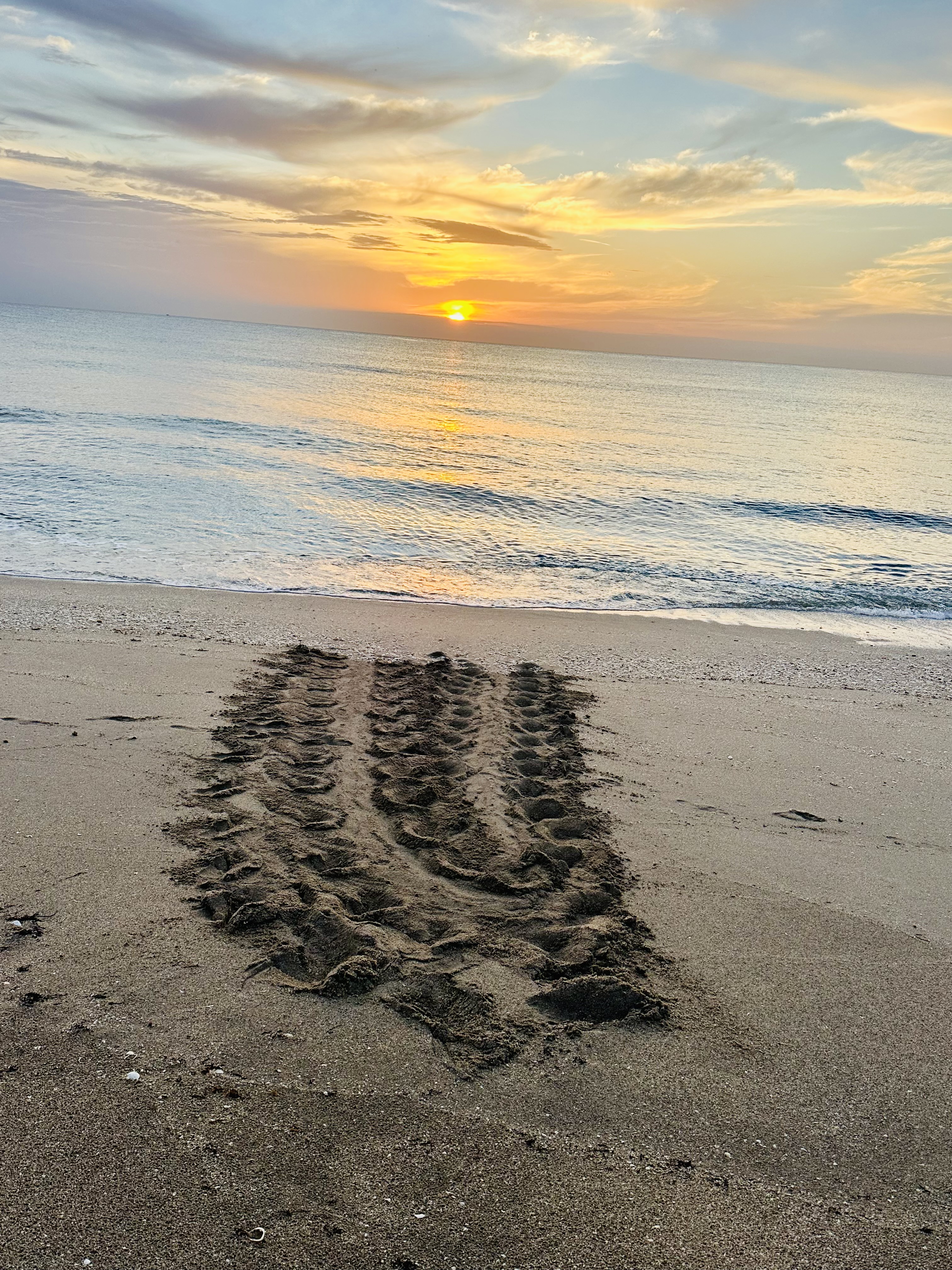
Turtle tracks

“Hmmm,” I said. “What should we do?

“Well I know we are not supposed to touch them…” the girl said. “But it’s definitely going to die or get eaten. Many don’t make it I guess.”  The kids looked at one another.

“Would you want to take the hatching to the Loggerhead Marine Center?” I asked.

“Oh we don’t know about that.” A boy replied.

“That’s a good idea,” said the girl, ” but we are just visiting the area, could you do it?”

“Of course I can”, I said. So I did.

The kids watched as I dumped out the tea that was in my Gator cup and filled it  with seawater. We packed in some seaweed too which was everywhere along the shoreline.  I wanted to help the little sea turtle keep its head up. Sea turtles breathe air; we didn’t want it to drown. “Yes thousand of years ago they lived on the land,” said the boy.

Baby sea turtle atop seaweed as can breathe and not drown
Lower right of baby loggerhead sea turtle notice the umbilical/yolk sac attachment trailing from the underside’s “belly button”. This provides nutrition for the first hectic days of the hatchling’s life as it goes to sea. I had no idea!

I went home to tell Ed where I was and was going. When putting the little sea turtle into a larger bucket, I noticed he or she had  something like a placenta coming out of its stomach. “Ed do sea turtles have belly buttons”?

“Look it up ,” he mumbled making his coffee.

I read out loud: “Loggerhead hatchlings have a temporary “belly button” or umbilical scar – on the center of their lower shell (plastron). This small protrusion or dimple marks where the hatchling was attached to their yolk sac in the egg. This sac provides them with vital energy for about the first 3 days as they dig to the surface, make it to the ocean, and swim out to sea — sometimes continuously for over 48 hours tor more towards the Gulf Stream. — Only about  1 in 1000 baby hatchings make it to maturity.”

“One in a thousand?” Ed said, perking up and then helping me and the sea turtle into the car.

Carefully balancing a small bucket and making sure the little sea turtle’s nose was positioned on the seaweed so it could breathe, I drove south on US 1 from Sewall’s Point  to Juno Beach. Every once in a while the little turtle lifted its head and its tiny flippers shook with what appeared to be excitement.

“Stay alive, little guy. We’re almost there,” I said, as traffic clogged the highway and gas fumes filled the air. I thought about how sea turtles have been swimming in Earth’s oceans for about 120 million years. With a little bit of help, they just may make it another million, I mused. I may have been dreaming but I swear I thought I head the hatchling say: “But will you?”

I looked down at the baby sea turtle incredulously. “Thanks for calling me this morning; I’m not sure if humans will make it or not, I said, but in any case, “I hope to see you again.”

Dropping off at the sea turtle at the Loggerhead Marine Center, Juno Beach, FL. A really nice touch, a certificate!

Drought, Doubt and Florida Bay

Dead seagrass in the shallows  of Florida Bay, Flamingo, Everglades National Park, FL 6-26.
Mangroves along Florida Bay are packed full of dead seagrasses, even so, I smile for the camera to alleviate the continual mosquito attack, June 2026. Photo Ed Lippisch.
Hardened shoreline and unhealthy looking waters of Florida Bay, Flamingo, ENP, June 2026.

As I write, the skies above me are electrified. Thor is throwing bolts angrily and I am wondering if my ancient oak trees might get struck. Rain is coming, again, to Martin County, Florida. Martin has been fortunate this year to receive these waters from Heaven while much of the state has not.

On my recent trip with my husband Ed in June to Florida Bay, the waters  looked thick and chalky. There were no manatees floating about lazily as in years past. Dead stinking seagrasses lifted from the bottom packed and covered the shoreline. Not a pretty sight.

As we all know, years ago, in an effort to develop our state, humans broke the flow of water flowing south from Lake Okeechobee to the Everglades, channelized the serpentine Kissimmee, and dug out multiple other canals to drain the state. The Buttonwood Canal connecting Coot and White Water Bay in Flamingo was one of the worst, injecting salt water into fresh and not allowing fresh to run into saline. A concrete barrier separates the two. The fallacy of this becomes especially evident during drought times.

According to the South Florida Water Management District’s DROUGHT IN SOUTH FLORIDA 2000-2001 “drought visits North America almost every year in some part of the United States and in nearly every decade. In Central and South Florida several droughts were reported:  in 1932, 1955-1957, 1961-1963, 1971-1972, 1973-1974, 1980-1982, 1985, 1988-1989, 1990, 2001-2001” and in 2011 the Boyer Survey, an Archaeological Investigation of Lake Okeechobee was conducted as the lake was so low ancient Indian burial grounds were exposed.

Drought visual FL, July 7, 2026.

Always, south of Lake Okeechobee is one of the most important areas for wading birds. This year it has been very dry, not good nesting conditions, as shown in red by the US. Drought Monitor for Florida.

The sun does shine though…

Much good work has occurred since the 1970s trying to improve Florida’s water disconnect and in wet years so long as the rain “falls in the right place” water can be sent south to Florida Bay. But in years like 2026, there really was not enough water to send as is reflected in this July 9th SFWMD chart as presented at the Governing Board Meeting. Not to mention the thirsty and politically savvy sugar fields are unquestionably first in line with permits, political contributions and history ….

SFWMD chart reflecting water sent south. 2026 so far is not much.

But there are alternatives….

Gil Smart and Eve Samples of Vote Water and Friends of the Everglades located in Stuart have been politely presenting a theory, really an old theory in new form. Their RESCUE THE RIVER OF GRASS campaign advocates for the public acquisition of at least 100,000 acres in the Everglades Agricultural Area for storage, treatment and to send clean water south to Florida Bay.

Of course the EAA Reservoir, which I completely support is the “crown jewel” of Everglades Restoration and the DeSantis Administration has done great job keeping this fire burning and funding this hard fought necessity. But I am worried that when this administration turns the page in November, that “the powers that be” could highjack the EAA Reservoir to service agricultural needs over sending water south to Florida Bay – the Savings Clause.

Maybe I’m paranoid? Maybe I’m afraid history will repeat itself?Maybe I’m right?

As we turn the corner this General Election, let’s keep our eye on restoring the River of Grass and the EAA Reservoir and all the politics that surround it. We have to.

An osprey perched above  Florida Bay looking  for fish…


The Best Fruit Stand in North America, “Robert is Here”

“Gateway to the Glades” Robert is Here Fruit Stand and Farm Est. 1959.

On our recent trip to Everglades National Park, Ed and I stumbled upon what I consider to be the best fruit stand in North America. On our American Great Loop Journey, Ed and I visited quite a few, but none compare to this. The name of the stand is “Robert is Here”  and it’s located in Homestead, Florida. If you want to visit, I’d go now as Robert’s is surrounded by conspicuous newly constructed  apartment buildings in just about every direction. As they used to say at the South Florida Water Management District, “houses, the final crop…”

Apartment buildings can be seen encroaching from every direction. Here just across the street

Ed and I stopped by on our way back to Stuart from fishing in White Water Bay. We’d noticed the fruit stand coming in, in fact I’d seen it multiple times over the years, but I’d never stopped. Ed is always in a hurry to get home…

“Hey Ed, for my birthday, let’s stop at this fruit stand”. He threw me a glance, then smiled, he knew he had to capitulate.

It was a Sunday and people were swarming the place. Finding a parking place was not easy. Once inside, we understood why. It was amazing!

There were tropical fruits of all kinds, some the size of footballs. Apparently Robert, standing behind the cash register in the photo below, established the stand by himself in 1959 when he was just six years old. His father, disappointed that little Robert had not sold the cucumbers given him, constructed a sign to accompany the boy at the table. The sign read: “ROBERT IS HERE.” By noon, all of the boy’s cucumbers were sold, and as they say, “the rest is history”.

Robert who started the fruit stand in 1959, stand behind the counter today. He added up what we bought on a paper bag and did the math in his head. Pretty cool!

The same corner little Robert stood on in 1959  is today the best fruit stand in North America..along with a petting zoo, wood carvers, artist, and specialty vendors. Like a time warp, one is transported back in time when Florida was Florida. So refreshing!

Jackfruit is the larges tropical fruit that grows on trees and can read 80 pounds.
I think this fruit is a sapodilla. It tasted like kind of like a pear and the flesh was a beautiful color.
Robert obviously bought up more than the corner, and today the fruit stand covers much land featuring artists and a petting zoo. Robert’s last name is Moehling.
The zoo included a number of emus of which the public, mostly joyful little kids, could feed fresh watermelon!

I cannot imagine that this iconic South Florida fruit stand, the best in North America, would ever be sold and turned into characterless apartment buildings, but in Florida, who knows. It seems in the present state we’re selling our soul for a bunch of houses.

Hand out available at check out
Inside cover