Category Archives: wildlife

Concerns-Overfull WCAs & Lake O Discharges

Yesterday, I listened to the South Florida Water Management District’s Governing Board meeting via Zoom. The overriding issue, besides the fact the St. Lucie River system’s  C-44 Reservoir is not working, Lake O is over 16 feet and discharges could soon be imminent, was “high water in the Water Conservation Areas.”

What are WCAs anyway?

They were built as part of the giant drainage system of Florida that “over did it.”

The Water Conservation Areas were built to hold water because we had over-drained, but now sometimes they get too full…

https://eros.usgs.gov/media-gallery/earthshot/canals-and-levees

In 1947 there was “the great flood,” that destroyed lands and properties in the seventeen counties of the Everglades Drainage District. This led to the U.S. Army Corps building the monstrosity named the Central and Southern Florida Project for Flood Control and Other Purposes (C&SFP.) The S.F.W.M.D. is the local sponsor. The two agencies work together.

United States Geological Survey explains:

“Historically, water flowed slowly southward through the Everglades in a wide swath. Record floods in 1947 and 1948 led to the construction of a massive flood control project. It served to prevent flooding and store water during dry periods. It also allowed for further development of the growing urban area on the Atlantic coastal ridge.

The project established three Water Conservation Areas (WCAs), one of which is the Loxahatchee National Wildlife Refuge. These areas are delineated in the Landsat images, clearly divided by the levees and canals. Also visible are the Big Cypress National Preserve, Everglades National Park, and Everglades Agricultural Area.Another part of the project is the 100-mile-long eastern perimeter levee, a 3- to 6-meter high earthen berm built to prevent flooding of farmland and urban areas. It runs along the eastern edge of the WCAs, marking a clear separation between the WCAs and urban areas such as Miami, Fort Lauderdale, and Coral Springs.

Along with facilitating the further growth of the urban areas of greater Miami, the other upshot of the project was that the natural flow of water was interrupted, changing the hydrology of the region. The gradual sheet flow of freshwater is diminished, and instead sudden pulses of water are delivered by the canals. These sudden releases caused decreases in the numbers of fish species.”

The bottom line is that when there has been significant rain, like now, the WCAs overfill and the fur bearing  animals are seriously at risk, unnaturally surrounded by rising water with no access to their habitat. Deer and other mammals have to take refuge on sacred Native American tree islands or on levees. Often, many species are desperately standing together. Friend and foe. All stressed, all scared, and all hungry.

In 1982 there was a so called “mercy-killing” of over 700 deer that were “starving” in the flooded Water Conservation Area 3.   There are concerns that this year a similar situation could arise. I recommend watching the SFMWD meeting under section 28 and all public comments and more if you have the time. This is a very serious issue and no way to treat God’s creatures. How we treat humans during Lake O discharge events is bad enough. It is time to undo the past.

A Tough Year for Everglades’ Nesting Birds

Abandoned stork nests, Jetport S colony, WCA 3A, as presented 5-11-23 SFWMD GB

Today I am going to put aside the St. Lucie Canal to discuss another very important subject, the birds of the Everglades. Since the late 1800s drainage, farming, and development  has drastically altered the avian environment. As we try to restore what we can, each year the SFWMD reports on nesting outcomes in SFER or the “South Florida Environmental Report.” This is done in “Water Years” that run from May 1 of one year to April 30th of the next.

At the May 11th, 2023 meeting of the South Florida Water Management District, I asked a question to presenter Lawrence Glenn about the “Ecological Conditions Update.” Mr. Glenn was explaining sensitivity to water/food levels and why it had been observed that hundreds to thousands of wood storks and white ibis in Water Conservation Area 3-A of the Everglades had evacuated their nests abandoning their young.

Mr. Glenn’s chart specifically focused on wood storks (WOST) and white ibis (WHIB).  I inquired about other birds nesting in the Everglades. Mr. Glenn explained that for purposes of this scientific report wood storks and white ibis were the sentinel species.

~Note the decline of these species nests below below.

On May 24, 2023, about two weeks after the governing board meeting, I received an email in response to my question from SFWMD avian expert Dr. Mark Cook.  I had had the pleasure of meeting and flying with Dr. Cook in a rare banner-nesting year, in 2021. Dr. Cook who oversees the SFER nesting bird reports gave an in depth explanation to my question about “other birds,” and how the science works. Thank you to the SFWMD and Dr. Cook for allowing me to reprint below. I wanted to share it with you!

Wood storks, roseate spoonbills, white ibis, courtesy SFWMD


Subject: Following up on your question about nesting in the Everglades (May GB)


Good morning, Ms. Thurlow-Lippisch.  At the May Governing Board Meeting you asked Lawrence Glenn if there were other types of birds nesting in the Everglades aside from white ibis and wood storks.  Dr. Mark Cook has responded to your question (below).


Yes, we have about 14 species of wading birds nesting in the Everglades, all of which are monitored to some degree for the wading bird report.


However, there are four species that are used specifically as indicator species to gage restoration success of the freshwater Everglades and to help guide water management: white ibis, wood storks, snowy egrets and great egrets. Multiple aspects of their reproduction are monitored including nesting effort, timing of nesting, location of nesting and reproductive success (numbers of offspring produced per nest). Of these four species, the stork and ibis are particularly useful for understanding the health of the everglades because they are tactile foragers (feed by touch) meaning they need higher densities of prey to feed effectively compared to the visually feeding egrets and in turn their nesting patterns are highly dependent on getting the water right – the right amount of water at the right time and place. Historical hydrological conditions were particularly conducive to successful nesting of these two species. A good example of this was the relatively wetter conditions on the coastal marshes and western prairie marshes in Everglades National Park that promoted good prey production and allow for early nesting of storks and massive super colonies of white ibis in the coastal colonies.


For Florida Bay we have a single indicator species, the roseate spoonbill. This pink beauty is also a tactile forager and as such is highly sensitive to hydrological conditions within the coastal marshes of eastern Florida Bay. This species was almost exclusively restricted to nesting and foraging in Florida Bay but within the past decade it has moved inland to the freshwater Everglades probably because sea level rise has increased water levels in the coastal foraging areas. This species is generally doing poorly in the bay but relatively well in the freshwater Everglades.


As predicted given the relatively dry antecedent conditions, this nesting season has not been a great year for the five indicator species. Nesting effort (numbers of nests) was about average but nest success has ben very low for all species except perhaps the snowy egret. White Ibis and great Egrets started abandoning nests in March-April probably because prey was limited in the Everglades after last year’s extensive drying of WCA-3A. In addition, extensive rain-driven reversals (loss of concentrated prey) in April finished off many of the remaining ibis and egret nests and led to the complete abandonment of wood stork nests in WCA-3A and significantly reduced their nests in ENP. Surprisingly, snowy egrets seem to be doing quite well, possibly because they are feeding in the STAs or elsewhere. My colleagues from University of Florida, who monitor nesting on the ground, have reported very poor growth rates of nestling and high levels of starvation in all species except snowy egrets. Nesting data are currently being processed and will be available as soon as possible.

Roseate spoonbills, courtesy SFWMD
Group shot, SFWMD
Great Egret, SFWMD
Snowy egret, Audubon


Visual Seagrass Comparison -August 2022 to January 2023 SLR/IRL

After a stretch of hurricane and rains since October 2022, the St Lucie River/Indian River Lagoon is clearing up. The river has endured the “usual suspects” C-44 basin, C-23 canal, C-24 canal, and stromwater runoff; however, luckily no damaging discharges from Lake Okeechobee.

With my husband Ed’s most recent flight, I was pleased to see the blue, clear waters returning to the Sailfish Flats and surrounding waters of the St Lucie Inlet in the vicinity of Sewall’s Point. But I was surprised and a bit disturbed to see a “seagrass desert” once again. Of course seagrass, like all plants, is more abundant and lush in summer months, but to see “nothing?”  This seems strange. I need to get in the water with a mask for a closer look!

Let’s compare two photographs, one taken in August 2022 and another taken in January 2023.

I. AERIAL TAKEN January 8, 2023. Water looking clearer but no visible seagrasses.

II. AERIAL TAKEN AUGUST 26, 2022.  This photos show regrowth of seagrasses.

As the August 26, 2022 photograph shows, seagrasses had rebounded in the southern Indian River Lagoon after years of damaging discharges. The worst recent Lake Okeechobee discharges were between the years of 2013 and 2018.

St. Lucie seagrasses are critical water and wildlife habitat. Especially as the seagrasses in the central northern lagoon have disappeared at such an alarming rate that a high number of manatees have starved to death.  

In recent years FWC has been feeding Indian River Lagoon manatees romaine lettuce as they have no secure seagrass food source. This is not sustainable. All political policy must specifically support the betterment of water quality and the return of seagrasses of the Indian River Lagoon. This began yesterday with an Executive Order  of Governor Ron DeSantis. See section 2.

-ALL OF ED’S AERIALS January 8, 2013, around 12:30pm.

-EXTRA and WONDERFUL NEWS. Click on photos to enlarge.

The next day, January 9th, Ed went flying with artist and friend Geoffrey Smith to relocate a very endangered Right Whale and her calf that Geoffrey had spotted in the Hobe Sound area just south of the St. Luice Inlet, on January 8, 2023. With his permission, I am sharing Geoffrey’s photos.

Wonderful news that our St Lucie is looking better. We must continue to take the protection of seagrasses and water quality seriously.

-Photos and mapping of Right Whale and Calf off of Hobe Sound in Atlantic Ocean.  Geoffrey Smith, January 9, 2023.

AREA CANALS DRAINING TO SLR/IRL

SFWMD canal map showing canals that drain lands and thus negatively affect water quality in the St Lucie River.

A Florida River, St Lucie 1950-2050?

Looking up the North Fork of the St Lucie River towards what became Port St. Lucie 1957, Ruhnke Collection, courtesy Sandra Thurlow.

A Florida River, A Look at Wildlife 1950, by E.W. Dutton.

“This film shows a trip down the St. Lucie River with E.W. Dutton. Viewers see gators, blue herons, and many plants and flowers. The film also shows a red-shoulder hawk, sandhill crane, armadillo, black bear and cub, rattlesnake, land crab, and a gator being fed by hand. “Now a NO! NO! “Viewers see pelicans, mullet, cormorant, deer and a Florida panther.” ~Florida Memory.

Click on arrow below or the link here to view short film. 

Recently, my mother sent me this wildlife video filmed by E.W. Dutton, well known for his work of the St Lucie River and for area Chambers. His films bring one back to a time when not as many people lived here, and wildlife was prolific including animals unable to live along the river today such as deer, bears, and panthers. At this time the North Fork was a game sanctuary and conservation laws were respected in the South Fork.

E.W. Dutton, Ruhnke-Thurlow Collection

Wikipedia shows the population of St Lucie County as 20,180 in 1950.

And the population of Martin County as 7,807 in 1950.

The UF Bureau of Economic and Business Research projected population leads me to think that by 2050 there may no wildlife left anywhere in the region of the St Lucie River unless we curb development, work to “wild” our yards, work to live with wildlife rather that eradicate it, get more serious about highway over and underpasses and promoting and supporting the Florida Wildlife Corridor, including parts of Martin and St Luice County. Let’s make 2023 a turn in that direction! Kudos to the Loxa-Lucie Headwaters Initiative in Hobe Sound that added lands this year.

PROJECTED POPULATION COMPARED TO 1950 ST LUCIE RIVER REGION

St Luice County:  1950 population 20,180; 2020, 329,226; high projected  population by 2050, 601,400.

Martin County:  1950 population 7,807; 2020, 158,431; high projected population by 2050 – 277,700.

*Sources: Wiki and UF Bureau of Economic and Business Research

12-27-22 bio E. W. Dutton

At Mid Tide

In July a post I wrote, “At Low Tide, made many waves of happiness as our seagrass recovery (albeit with macro-algae) was suddenly visible. Today I share “At Mid Tide,” not as dramatic, but certainly worth documenting as it too shows the improving state of our St Lucie River/Indian River Lagoon since the damaging and toxic Lake O discharges of 2013, 2016 and 2018 eradicated all seagrasses.

These photos were taken at different times of day on Sunday, August 14, 2022 in the area of the St Lucie Inlet between Sewall’s Point and Hutchinson Island – an area often locally referred to as the “Sand Bar,” including Sailfish Flats.

Incorporated are photos from my sister Jenny, my brother Todd, friend Mary Radabaugh, and me. All on the water with family/friends on the same day! Ed and I were late getting out, and the tide was receding. While about, Ed and I are very careful not to disturb the budding seagrasses -staying on the edge.  All mollusks/sea life if photographed is immediately returned to its original location. This habitat is delicate!

Yet another recent wonderful day on the St Lucie River/Indian River Lagoon since there have been no major damaging discharges from Lake Okeechobee in over three years and Mother Nature has not thrown a hurricane our way…

Enjoy!

Approaching Ernie Lyons Bridge from Jensen Boat Ramp Do you see the fighting conch’s blue eyes? Video below gives perspective:

Almost home! 

II.

My sister’s photos: Zella-Sand Bar, earlier incoming tide, Jenny Flaugh

III.

My brother’s photos: Todd Thurlow – daughter Julia water skiing off the House of Refuge

IV.

Mary Radabaugh, friend and nature photographer: Osprey & blue sky near Boy Scout Island

~Our wildlife, sea and sky,  needs our continued support for a healthy St Lucie!

Thousands of Roosting Swallow-tailed Kites

At 4am my alarm rang. I was headed to Lykes Bros. near the western edge of Lake Okeechobee’s Fisheating Creek. Here were gathered, for their annual assembly, thousands of roosting Swallow-tailed Kites. As a kid, growing up in Stuart, I don’t remember ever seeing these, gorgeous, black and white birds, but today they can be seen gliding almost everywhere: over the woodlands on the side of I-95, around the edge of the Indian River Lagoon, and near Lake Okeechobee. No matter where I see them, time stops. Their graceful beauty surreal, their sharp forked tails unforgettable. These large dove-like birds are raptors in the family of hawks and owls, but eating mostly insects.

Credit: Audubon image, Swallow-tailed KiteYesterday, Lykes Bros., one of Florida’s largest landowners, invited me to visit their land and water resource project, Nicodemus Slough, where an estimated 2500-5000 swallow-tailed kites are roosting. This only occurs sometime between July and August before the birds migrate 10,000 miles to Central and South America. Thank you to Lyke’s Noah Handley, Director of Engineering and Land Management, for being the guide of this field-trip. Thank you to Lykes Bros. for giving shelter and protection to Florida’s wildlife. It was a sight to see. In the early morning hours the birds sat quietly. As the day warmed up, one at a time, they rose in groups of up to a thousand flying like a vortex in the thermals, calling to each other, finally dispersing. A memory for a lifetime! Today I share my photos of this special day.

-A video and close ups of hundreds of dying oak trees where the swallow-tailed kites are roosting. The trees are dying because these lands are being brought back to their natural wetland status inside 15, 858 acres of Nicodemus Slough, a section that the Herbert Hoover Dike had destroyed. My phone camera only captured what was in front of me. This scene went on for miles. Video in slow motion and not the best quality, but it gives the best idea  of the extensive area the birds were in.  

-Kathy LaMartina, SFMWD Region Representative listens to Lykes Bros Director, Noah Handley explain how the company supports wildlife like the swallow-tailed kites. Researchers and scientist study and learn about their not totally understood 10,000 mile migration. -Part of the Herbert Hoover Dike between Fisheating Creek and Lykes Bros. -Noah Handley and JTL This cypress wood carving shows better than any map where Lykes Bros.’ extensive land holdings exists and where the roosting area of the swallow-tailed kite exist.


At Low Tide

This post is meant to document the life seen July 2022 On Saturday, 7-9-22, Ed made me promise I would be ready on time. He wanted to take me out in the Maverick to show me the St Lucie River/Indian River Lagoon’s seagrass/macro-algae flats at low tide. Very low tide. “Exactly 12.37pm.”

I was ready on time, but I don’t think I was ready for what I witnessed. With the seagrass and macro-algae totally exposed, one could see the extent of the recovery; wading birds feasted everywhere -over one-hundred of various species.

Ed and I did not walk out into the delicate grass flats, but anchored and explored along the edge. From where we were, in the distance, we could see many boats at the Sandbar, Sailfish Point, and the St Lucie Inlet. Carefully, we photographed and returned the creatures living on the edge of the seagrass/macro-algae flats. It definitely does not look entirely healthy, like it did when I was a kid,  but nonetheless life reigns. The extreme low tide lasted about an hour. Then the ocean tide came rushing in…

Of the critters  I knew were fighting conchs, living sand-dollars, hermit crabs, inky sea slugs, olive snail mollusks, clams, shrimp, and pen shell mollusks bivalves. Many others were present that I could not identify. There were at least two kinds of seagrasses.

Historically, this is a small amount of seagrass life for the Indian River Lagoon. These flats were completely decimated by long-duration Lake Okeechobee discharges, some toxic, in 2013, 2016, and 2018. Three years without major Lake Okeechobee discharges has allowed some life to return.A reader of my blog recently asked if I thought our water improvements were policy driven or luck. My answer? “Both.”

-Fighting Conch says “hello, remember wildlife is protected!” -Watch video of the fighting conch walking

-Video of low tide exposure

-Ed is happy I was on time! -Various photographs 7-9-22 around 1pm. Looking east towards Sandbar (L) and Hutchinson Island’s Sailfish Point (R) visible behind a stunning mangrove island and ibis rookery. Note all the specks, they’re birds! -Ibis-Ed and I did not walk out on the delicate beds but could see many birds feasting in the distance. -Little blue herons happily eating-Living sand-dollar -Fighting conch covered in sandy mud-A clam excretion? Very strange- and a sea-slug.-A hollow tube formation.-Here one can see two kinds of seagrasses, maybe manatee and johnson. -There were hundreds of these piles of sand. Not sure what they are. -When disturbed, a sea slug excretes beautiful purple ink- kind of like an octopus. I put him right back! -A convention of sea slugs!-Baby olive mollusk makes a path through the sand.-Small clams. There were blue crabs, and tiny crabs about but they were too fast to photograph! -Sand dollar. Amazing they are breeding here! -Ed and I though this might be a baby queen conch due to spikes but the more we looked we thought it was yet another fighting conch.-There were many hermit crabs in many different shells. At one point, after the long Lake O discharges, there were no hermit crabs to be seen. Terrible. Glad to see them back! -I think this fighting conch was eating this little shrimp.-Pen shell mollusk bivalve-A living olive mollusk! A rare sight! Beautiful! -Note macro algae on top of seagrass. This is getting to be more and more due to over nutrification (nitrogen and phosphorus) of our waters. -Hermit crab in macro algae and seagrass.-Ed and I at “high noon.”-Surrounding water looking clear! 


For the Baby Box Turtle – reworking our yards

I found this tiny Florida box turtle in December of 2021 while I was out in my yard. It was so small, I was nervous to let it walk back into the wild – but I did. I couldn’t believe it was so small -just a tad larger than a silver dollar. I immediately realized, “box turtles are breeding in our yard!” Over sixteen years,  I have seen adult box turtles occasionally, but not often, maybe once every five years. As box turtles wait until their late teens to reproduce and can live to the ripe age of eighty, I imagine box turtles lived at Riverview before Ed and I did. But I like to think that Ed and I helped them recently -have this baby- by naturalizing our yard.

Last night I was reading and it made me think about the baby box turtle…

In his best selling book, Nature’s Best Hope, A New Approach to Conservation That Starts in Your Yard, Douglas W. Tallamy writes about the population demise of the Eastern Box Turtle – there are six types in North America. The one I found was a Florida Box Turtle. Tallamy discusses a better wildlife future if we all would offset the “isolation” of our modern (large lawns and ornamental landscaping) and “create connectivity.” This is not a difficult thing to do. By “shrinking our lawns,” and adding more native, and thus wildlife valuable landscaping, we create connectivity, like wildlife corridors -giving the box turtles and other wildlife a large area to live and breed- rather than thinking they can live and breed endlessly on a sterile postage stamp.

I have written many times, that Ed and I stopped fertilizing in 2008, and then slowly expanded our planting beds, adding more native plants. By 2018 we had no grass, added rocks for walking paths and native plants for a butterfly garden. This has really paid off as far as bringing more birds and wildlife! It’s more healthy. No fertilizer. No pesticides. Considerably less watering. And now a baby box turtle!

Sewall Point, Aurthur Ruhnke ca.1950, Thurlow Archives.

This 1950’s Aurthur Ruhnke Sewall’s Point aerial from my mother, Sandra Thurlow’s book of the same name, reveals the peninsular Sewall’s Point landscape between the St Lucie River/Indian RiverLagoon of the 1950s before major subdividing. Other than the naive people, Sewall’s Point’s first residents settled in the late 1800s when Sewall’s Point was a natural coastal landscape, and on higher ground, a hardwood hammock. Today, practically no natural landscape is left. Hundreds of wildlife habitat acres developed, now filled with sterile, water demanding lawns, and mostly “ornamentals” that hold no wildlife value. Luckily, there remain quite a few giant trees such as oak, gumbo limbo, strangler-fig, satin leaf, paradise, mastic, and hickory. Replanting with natives and less lawn would look more like the photo above and less like the Google Earth image below. So, to Mr Tallamy’s point, if we all planted more natives (and I know many of you have! 🙂 and less grass in our yards, even though we are now so split up (isolated) we could build connectivity for wildlife throughout Sewall’s Point and everywhere. He notes nature doesn’t just belong in parks!

Having spent the last sixteen years fighting for the St Lucie River, I have come to understand the important connection of the land to the water. The little box turtle may not live in the river, but the baby turtle is a sign of health for the lands that are connected to the waters. And this really makes me smile.

Baby turtle going back to from where it had come after I photographed it. It’s a big world out there! Good luck little box turtle!

A Picture Speaks a 1000 Words

-Martin County Manatee educational sign in the IRL at Joe’s Point Understandably, many are concerned about manatees. Today, I share the most recent 12/29/21 Florida Wildlife Commission (FWC) video update by Dr Tom Reinard. Please click on below.

12/29/21 FWC MANATEE MORTALITY EVENT and FEEDING UPDATE

This FWC site is updated weekly, and previous updates are available. Here one can view the Temporary Field Response Station in Brevard County where only FWC, at a large distance, will interact with these marine mammals, by law, the public cannot. Manatees, as wild creatures, should never associate humans with food. You will see in the video how FWC has made this a priority.

In Florida, presently, the stats for manatee deaths are highest in Brevard County, but also higher by year in many other counties like Martin. Stuart resident and world famous wildlife artist Geoffrey Smith is a friend, and on 12/30/21 he shared some photos that he took of a deceased manatee that had recently washed up on the shores of St Lucie Inlet State Park. With Geoffrey’s permission, I share these photos below. Beware, you may find them disturbing. Geoff reported the carcass to FWC. Please do the same by calling 1-888-404-3922 press 7 for Operator– if you encounter such.

I am also including photos taken by my husband, Ed Lippisch, out on the Sailfish Flats of the St Lucie and Indian River Lagoon. These photos show seagrass cover on Thursday, December, 30, 2021. Readers of my blog will know that since 2013, Ed and I have religiously documented the discharges and cyanobacteria blooms entering the St Lucie River through C-44 and Lake Okeechobee. I believe that the seagrass loss near the St Lucie Inlet is connected to the many years of reoccurring destruction particularly in 2013, 2016, and 2018 as the long lasting discharges kept sunlight from reaching the seagrasses. In Brevard County, seagrass loss is linked to little flushing in the IRL as there are few inlets, and thousands of septic tanks’ nutrient pollution adds to decades of stormwater and ignites algae blooms – also keeping light from the the seagrasses. Scientist note it is all much more complicated than this, however there are certain things we can do to improve the situation- like stop/lessen discharges and make sure septic is working properly and or changed out to sewer.

My hope in sharing Geoffrey Smith’s photographs and getting my husband to regularly visually check up on the seagrass beds is to continue to inspire change. Since 2019 more state and federal funding has been made available for improvements to our waterways than ever before. We inspired that! Now we just have take it to the finish line.

ST LUCIE INLET STATE PARK, MANATEE REMAINS, GEOFFREY SMITH shared 12-30-21.

-“Hi, Jacqui. Manatee on beach St Lucie Inlet State Park the other day.” Geoffrey Smith wrote that these images remind him of poached African Elephants. “So sad.”  St Lucie Inlet State Park lies south of the St Lucie Inlet in Martin County, Fl.

SEAGRASS PHOTOS, Ed Lippisch

The following photos of seagrass beds were taken by my husband Ed Lippisch on 12-30-21. Seagrasses, like plants in our yards, naturally grow more in warmer months and less in cooler/cold months. So these photos will be a baseline for 2022 to see how the seagrass grows throughout 2022. Since the heavy discharges from Lake Okeechobee and area canals (Lake O is worse as it does not let up and ofter goes on for many months unlike a rain event) the seagrass has lost its lushness but remains visible as in Ed’s photos.

Manatees need lush seagrass for their survival.

-Ed’s location around blue dot; note this area is an Aquatic Preserve


SFWMD Seagrass Presentation Town of Seall’s Point


Manatee Mortality Event Along the East Coast 2020-2021

-Manatees eating off the seawall in Flamingo, FL. May, 2021. Photo JTLYesterday I called Dr Tom Reinard, South Regional Director for the Florida Wildlife Commission, and asked for an update on the manatee situation. He forwarded me this most recent update that includes an educational video about state and federal agencies- an emergency station, feeding, and observation.

As we know, the Florida manatees are experiencing an unprecedented Mortality Event. Most of the deaths are occurring in Brevard County, three counties north of Martin, along the Indian River Lagoon; but there are above average deaths in many counties. You can view the chart below to find your county and FWC Mortality Statistics to compare years. This event is due to lack of food to be found when manatees, with memories like elephants as they are related, return to find their historic seagrass meadows gone.

-2021 Manatee Mortality Table

-PBP article by Kimberly Miller

Recently, Dr Jessica Frost of the South Florida Water Management District presented about SEAGRASS along to the Sewall’s Point Commission in the Town of Sewall’s Point, Martin County. Her overall message was optimistic for the return of seagrass in our St Lucie/Indian River region in that seagrass is resilient. She pointed out that seagrass growth is seasonal and stochastic (randomly determined; having a random probability distribution or pattern that may be analyzed statistically but may not be predicted precisely.)

One thing that seemed simple to understand was the requirement of light for seagrass. We can all think of many reasons our various waters are blocked of light, such as algae blooms from nutrient pollution. For seagrasses to grow, there must be light.

“Let there be light…”

I share Dr Frosts’ powerpoint for reference and documentation. It is a good reference for all the lagoon. May 2022 be better than 2020 and 2021. From River Kidz to FWC we all must work to bring back the health of our seagrasses for our iconic manatee!

VIDEOS OF MANATEES EATING OFF THE SEAWALL IN FLAMINGO, FL MAY, 2021. HEAR THEM BREATH!

SAVE THE MANATEES, RIVER KIDZ, 2021 On January 26, 2022, 7PM, there will be a presentation SAVE OUR MANATEES at the Lyric Theatre in Stuart, Florida. Ticket are free.

Black Bobcats – Reports Near and Far

As we approach the end of 2021, I’ve been looking back. Amazingly enough, I have been writing my blog “Indian River Lagoon,” since 2013. I have now written over one-thousand posts and one of the most popular is not about toxic algae, Lake Okeechobee, or even the St Lucie River/Indian River Lagoon. One of my top posts is about black bobcats -properly called, melanistic bobcats.

I wrote my first black bobcat post in 2014 specifically about the high documentation in my home of Martin County, Florida. Since then, many readers have contacted me about melanistic bobcat sightings outside of Martin County. Most recently, two more from Georgia.

Today, I share these two reports, one from 2019 and the other from 2021. These special creatures are a rare sight to see and of unforgettable beauty.

I.

The gorgeous photograph of the melanistic bobcat above was taken in Georgetown, Georgia, in 2019. I learned about the sighting this December at a baby christening in Stuart, Florida. Mrs Kight was nice enough to find the photo and send to me after we got on the subject of all things -black bobcats!

II.

This next photo, above, is a screen shot of a “doorbell” black bobcat -2021- sighting in Waleska, Georgia. CLICK HERE TO VIEW VIDEO OF BLACK BOBCAT.

Mr Kaiser, of Waleska, Georgia, who sent the doorbell video, wrote interesting observations included below.

Mr Kaiser:  “Greetings. We live in north Georgia on the east side of Pine Log Mtn. Have recent video of what could to be a melanistic bobcat in our front yard. We have seen it twice and saved on Ring video. Would like to share it with you and your thoughts. Thanks.”

JTL: “Dear Mr Kaiser, I am so glad you contacted me. I can’t wait to see the video of this incredible creature. Please send.” 

Mr Kaiser: “Hi Jacqui. Wondering if you got the brief video and thoughts. I took down 2 Ring cameras today (temporarily) while they were cleaning up our yard. When I went back outside I saw the animal walking right down the middle of our quiet street. (that gets maybe 12 cars a day). The animal looked at me briefly and it appeared to have yellowish/greenish eyes. It looked all black with apparently no charcoal or grey. It had a knob for a tail and the upper hind legs looked a little bigger. We do have a few neighbors as we live in the higher elevation end of our community and so far no one has identified it as a pet or seen it before. Thanks.”

JTL: “I did receive. Thank you so much. What a creature to behold and see eye to eye! Where do you live?”

Mr Kaiser: “We live in Waleska GA (Cherokee County) in the foothills of the Blue Ridge Mtns. and on the east side of Pine Log and Bear Mountain.  Please feel free to share this information on your blog. My wife and I are surrounded with all this fascinating wildlife and this is so educational studying their seasonal habits. Any information you can share would be appreciated and likewise I can certainly pass on to you with updated pictures/ video clips. This is our 3rd sighting of this animal and we don’t know bobcat habits. When it walked by yesterday it looked at me briefly but didn’t stop or act afraid or defensive. That is when I got a split second look at the eyes.”

JTL: “This is so amazing. Thank you so much for sharing and letting me share! Tell me more!”

Mr Kaiser: “We set this Ring camera up to video the black bears that visit us. Never seen this before and shared with 2 wildlife experts. I do have another separate video and would like your take. Both sightings were midday and have the camera mounted on the front porch hopefully for more views. It appears to have a firmer walking stance on the hind legs. Also have pictures and videos of our visiting black bear. We have various animals that live and roam our property including a fun to watch fox family. If you think this video is of interest I can keep you updated.”

JTL: “Please do. ! I hope in the future to see more including bears and foxes. Love the wildlife, especially the melanistic bobcat, people are really fascinated by them. A mythical creature indeed!”

Thank you to Mrs Kight and Mr Kaiser for sharing and I hope more people, inside or outside of Florida, will tell of their black bobcat sightings too!

~Jacqui

PREVIOUS POST ON BLACK BOBCATS

1.https://jacquithurlowlippisch.com/2014/03/07/the-black-bobcats-of-the-st-lucie-region-and-indian-river-lagoon/

2. https://jacquithurlowlippisch.com/2016/04/21/two-black-bobcat-cubs-and-mom-happily-strolling-around-western-martin-county-slrirl/

3. https://jacquithurlowlippisch.com/2017/02/24/black-bobcat-hit-by-car-in-sebring-please-drive-with-care-slrirl/

Reintroducing Myself to Pelican Island’s Paul Kroegel

Reintroducing Myself to Pelican Island’s Warden, Paul Kroegel

-A 30 year old Jacqui meets the Paul Kroegel statue, Pelican Island National Wildlife Refuge, Sebastian, Florida, 1994.  Photo by mother, Sandra Thurlow.  -A 57 year old Jacqui reintroduces herself to the Paul Kroegel statue, Pelican Island National Wildlife Refuge, Sebastian, Florida, 2021. Photo by husband, Ed Lippisch.

The Story of Recreating the Photo

Last week, when I told my mother I had an Indian River Lagoon Council meeting in Sebastian, she forwarded me a 1994 photograph of me with my hand on the shoulder of statue Paul Kroegel. I vaguely recalled visiting the statue twenty-seven years ago during a family outing to the St Sebastian River.

“You’ll have to reintroduce yourself to our friend, Mr Paul Kroegel,” mom said. “You know, the man who inspired Theodore Roosevelt to create the Pelican Island Reservation that became the nation’s first National Wildlife Refuge in 1903. Mr Kroegel was appointed the United State’s first warden. He loved and protected thousands of pelicans!”

“I’ll do that mom. I’ll find the statue. I do remember that day,” I replied. “You, dad and I were canoeing and got caught in a thunderstorm.” It all started coming back to me…

The more I thought about it, the more I stared getting excited about finding the statue…

On Friday, August 13, I attended the Indian River Lagoon Council National Estuary meeting. Afterwards, using Google Maps, a devise not available in 1994, I found the Kroegel statue in Riverview Park just down the road from Sebastian City Hall.

There Warden Kroegel stood smoking his pipe, pelicans at his feet,  just a shiny as ever! Someone had patriotically placed an American flag in his arms. It blew in the wind as pelicans and wading birds flew by. I took a deep breath, stood tall, and using my best manners reintroduced myself to Warden Kroegel. Looking into his bronze eye was almost real. We looked at each other for a long time. I placed my hand on his shoulder as in the original shot but had to turn around to take a modern day selfie. No one was there to take my picture, so I was unable to recreate the 1994 photo for my mother.

-Sculpted by Rosalee T. Hume

Luckily when I got home that night at dinner, I convinced Ed to drive up with me to Sebastian on the weekend, Sunday, August 15, to recreate the photo. We had a blast! First, it is such a beautiful drive to Sebastian from Sewall’s Point along historic Indian River Drive. Second, Sebastian is small and beautiful.  A lot like Stuart was when I was a kid. We really enjoyed our visit there. After finding Riverview Park and enjoying the scenery, I introduced Ed to Warden Kroegel and we took the picture!

-Riverview Park, Indian River Lagoon -Ed looks out to the Pelican Island National Wildlife Refuge, Indian River Lagoon -Standing at Paul Kroegel’s statue  -Ed takes the iconic recreation photo of Jacqui and Warden Kroegel 27 years later! 

Pelican Island and the legacy of Paul Kroegel are on display in Sebastian just about everywhere, but first and foremost at the remains of his Homestead at Kroegel Produce, right at the corner of Indian River Drive and U.S. 1. Pelican Island proper  is “right behind” the old Homestead out in the Indian River. On land, the tomatoes were the best I’ve ever had! If you visit Sebastian, please take a photo with Mr Kroegel and send it my way. I’ll share it with my mother too.

And thanks to my husband, Ed, for helping me recreate the 1994 photo with Paul Kroegel. For mom, for fun, for history!

Information on Pelican Island today, Sebastian Chamber of Commerce.

Meeting up with Cinnamon Girl to Document the IRL

Friday night, August 6, 2021, Ed, Luna, Okee and I spent the night on Adrift, after meeting up with “Cinnamon Girl,” the craft of Dutch and Mary Radabaugh. Their name may ring a bell as Dutch and Mary were the face of Central Marine during the infamous toxic algae outbreaks of 2005, 2013, 2016 and 2018. Fortunately, there is no blue-green algae bloom  in the St Lucie/Indian River Lagoon today as they ACOE has not discharged from Lake Okeechobee since April 10, 2021 due to algae sitting at the gate of Port Mayaca.

As mentioned in my previous blog post, the rains have begun, rainy season is upon us, and although stormwater runoff and C-23/24 are tainting the river brown, it is remains beautiful and safe so Ed and I decided to take Mary and Dutch up on their offer to meet and anchor in the IRL near Boy Scout Island. We had done this two years ago. How time flies!

It turned out to be a wonderful weekend and we got to observe. The seagrasses were no where close to as thick as they were in 2019, but they were there, and and recovering.  Macroalgae coated everything. This is disappointing but is happening across the entire Indian River Lagoon due to nutrient conditions. Nonetheless, thankfully, at low tide the wading birds were abundant. We also saw manatees, sea turtles, stingrays, snook, hermit crabs, one large conch and hundreds of shiny minnows. I was impressed!  I think there is no more beautiful place that the Indian River Lagoon at sunrise or sunset. Glorious…

We must remain vigilant.

Lake Okeechobee reached 13.87 feet over the weekend, eyeonlakeo, thus the C-44 canal with its surrounding runoff will start flowing to the St Lucie once the lake achieves 14 feet. So is the operation of the Central and South Florida System. This will certainly affect the clarity of our waters. Thankfully there is still #NoLakeO.

I share these photographs to document and to celebrate a good year thus far in 2021. Let’s continue “Riverlution” to keep it that way!

-St Lucie River -headed southeast into Indian River Lagoon Indian River Lagoon. There’s Cinnamon Girl! -Ed with Luna going to say “hi!”-Dutch with Holly-Okee stays inside Adrift. She likes sitting on maps.-IRL at sunset, silvery. -After a peaceful night’s sleep under the stars, Okee awakes to watch a golden sunrise -Sun’s up! Time to paddleboard and check out the conditions. JTL, Mary, Dutch and Ed. -Ed takes a break-Water brownish from rain and canals C-23/24. Greenish in bright light. -Mangrove island in the area known as the Sandbar. Many birds roosting! Mostly ibis. -Bare bottom with a some seagrasses surrounding mangrove island and sandbar area. Mary noted in 2007 this area had very lush seagrasses that have since been destroyed by Lake O discharges. Today there are sprigs. -Water looking greenish in bright light -Ed checking out the conditions and happy as a clam-Macroalgae (below) coats everything ground and seagrasses- not good. Many believe this system is replacing seagrasses through out the IRL. Water quality is key to keeping seagrasses! After our journey out we return to Cinnamon Girl. There are visitors!-Nic Mader and I relax. Nic is a dolphin specialist.  Bottlenose dolphins like all creatures of the IRL are intricately connected to the seagrass habitat and the life that grows there.-Getting some exercise-Rains are beautiful falling in giant sheets from the sky! -Nic paddles towards home while looking for dolphins. 

-Mary Radabaugh is a very good photographer always carrying her camera. She captured these images. The roseate spoonbills and American egret were on the sandbar along many other wading birds. Wonderful to see! Watch the link below (in red) to watch a manatee video Mary took as well.

What a place of beauty. The St Lucie River/Indian River Lagoon  was once considered “the most bio-diverse estuary in North America.” Let’s continue to fight to regain that status! We are on our way back. Such a stunning, special place! Thank you for getting us on the ground out to see.  We love you Cinnamon Girl!

MANATEE SWIMMING IRL  IMG_0638

-Saturday afternoon, on our way back to the Harborage Marina in Stuart. Another memorable sunset…

This is the Life

On Saturday, June 5, 2021, Ed took me for a ride in the Maverick. Sometimes I am fussy, refusing to go if the waves are too big or the wind is too strong. But on Saturday, conditions were perfect.

It was a beautiful day, and I was grateful. I was grateful that the St Lucie River/Indian River Lagoon was not a toxic soup this year. I was grateful for the small amount of life in the river. Ed and I  put in at the Jensen Beach Boat Ramp and it was crowded. Resident wading birds were there waiting to see if someone would throw them a fish. I noticed, thankfully, the county had put up a sign since the last time Ed and I had visited. Once Ed and I got beyond the docks and out into the Indian River Lagoon the wind picked up and I held on tight! I Suddenly it seemed we were weaving in and out of other boats. I kept yelling “Be careful of manatees!”

“I’m in the channel!” Ed replied, looking at me  incredulously.

First we visited Boy Scout Island between Sewall’s and Sailfish Points as I wanted to check out the seagrass or lack thereof. It was growing! There were different kinds, one like a feather, (Johnsons) the other like a thick hair (Shoal). I saw blue crabs and hundreds of small snails. I was so happy to see this. I remember other times recently when there was not one bit of life. Still, it hurts that I have to “be happy” for such a small banquet of what I experienced in my childhood.

“If we can just hold off Lake Okeechobee releases…” I thought and was pleased the ACOE has done so for most of this year. Lake Worth Lagoon and the Caloosahatchee have not been so lucky.

Here, the rains began in late May and the river’s a little darker, not the turquoise blue you sometimes see. Nonetheless, the water looked good and and many families were enjoying themselves. Ed anchored being careful of grasses. I took a walk while he fished. Together we photographed the area.

-Boy Scout Island lies between Sewall’s and Sailfish Points near the Sailfish Flats and St Lucie Inlet -Seagrass beds slowly recovering  just off Boy Scout Island 6-5-21 -Excessive sargassum weed and macro-algae not as welcome to see a budding seagrasses-Head  of horseshoe crab – maybe molted. Good sign they are still here! -Thousands of snails leaving paths in the sand-A small hermit crab took someone’s shell. A nice one! -Little snails up close-Hand sized hermit crabs, old friends. Once there were thousands. We held races on the beach.-Boy Scout Island is a mangrove island with tidal areas for wildlife. We visited at low tide.Next, Ed and I got back in the boat and jutted through the Crossroads, me holding on for dear life again, -Ed in his glory! Spray on our faces! We arched off around the sea of boats onto a large sandbar close to the St Lucie Inlet.

It was a great adventure anchoring and then walking in the waist high water to the sandbar. I felt like I was a kid again roaming around, looking for shells, breathing in the clear air, lost in the happiness of the experience. We found quite a few fighting conch, pin shells, and clam like creatures all alive inside their shells! But no queen conch. Ed decided to go check that the anchor still held.

I wandered around losing track of time. I don’t think think there is anything more I love than this. I collected shells. Looked in holes. Birds rested and hunted for food. I even saw an osprey catch a fish in the lagoon’s shallow waters. The cloud formations were unbelievable.

When I finally returned to the boat, Ed was asleep. What a classic!

“This is the Life.”

This is the life indeed!-Pin shell and mollusk-Fighting Conch – orange in color -Tiny bit of seagrass and macroalge -Ed sleeps, Sandbar, St Lucie Inlet 


A Little Piece of Florida Along US1

I had driven past hundreds of times, but never stopped. Mostly because of the traffic and because by the time I noticed the sign, it was well in my rear view mirror as I navigated a sea of cars. This small section of Savannas Preserve State Park lies on the west side of US1 just south of Crosstown Parkway not too far from the boarder of Martin and St Lucie counties.

This past weekend, I passed it again and was determined this time to visit. It required a few back and forths,  but finally I turned into the “Savannas Preserve State Park, Evan’s Creek.

There were no signs of people. I put a few dollars into the state payment box and tore off the lip of the baby-blue envelope to hang on my mirror.

“Wow. This is cool I thought. I’m finally here.”

I noticed a sheriff car. I drove down a winding road through the middle of Florida scrub and what was perhaps once pine flatwoods. As in all Florida, drainage and development has altered the landscape but here there was plenty of “Old Florida” remaining. I felt relaxed and a hundred miles away from civilization!I drove slowly hoping to see a gopher turtle, noticing a sign to share the road.“This is amazing,” I thought. Once, all along US1 was scrub habitat. Think of all the animals. Think of all the birds. Think of the Native People. Think of the pioneers who where the first to clear this land…

I saw beautiful white sand, pine trees, woodpeckers, and little sparrow like birds I didn’t know. I saw sand pines and slash pines. One slash pine so large I wondered if it had escaped the loggers and turpentine men. I turned my head to see an osprey gliding over the savannas.

-A sand pine-Scrub habitat-white sands-a slash pine“Praise to the people who saved these places.” I thought. I could hear the hum of US1 in the near distance…

Finally,  I made it down to the end of the road, maybe a half mile or so, and there was a cul-de-sac and neatly folded information under a shaded area.

“Oh my gosh” I thought, “I’m at the river. I’m at the North Fork of the St Lucie River!”

I guess I knew that, but I certainly wasn’t thinking I was that close to the north fork every time I drove down busy US1 to Stuart. Somehow with all the cars, with all the noise, with all the technology, with all the billboards, it seemed much further away.

I parked, got out of the car, and walked around. I looked in the tannin waters. I thought about how great it was that no houses were here. “All these years; my whole life really, and I have never visited this place! Incredible.” It was so good to see fish jumping and wading birds hunting in almost total privacy. And for people there was a great canoe/kayak launch. As I walked back towards my car, I couldn’t believe my luck. A gopher turtle was happily eating along the dunes. I pondered the passage of time knowing this gopher’s ancestors also ate from these dunes, hundreds of thousands of years ago when they were islands in an inland sea…

It felt magical to be here knowing a busy modern world was only feet away. A little piece of Florida along US1 can go a long way.

“When Flows Return to the River of Grass” -Dr Mark Ian Cook

Dr Mark Ian Cook is smiling. And he should be. It is looking like the the birds and wildlife of the Everglades may end up having one of the best years ever! Dr Cook is the Scientific Section Lead of the Systemwide Everglades Group for the South Florida Water Management District. He received his B.S. at Bangor University; his M.S. at the University of Durham; his Ph.D at the University of Glasgow; completed Post Doc work at UC Berkley;  then in 2004 was hired SFWMD Lead Scientist rising to his position today. Cook’s seventeen years of SFWMD scientific photography and publication has required him to take hundreds of helicopter flights throughout the greater Everglades-and literally hundreds of thousands of aerial photographs (data). Dr Cook has seen it all. He was there last year when the rains came early and thousands of wood storks and other wading birds watched their almost fully fledged chicks starve. But this year, this year is different! This year, more chicks may fledge than Mark has ever witnessed…

Before I wrote this post we spoke by phone. “Hello Dr Cook,” I said. “Please call me Mark,” he replied. “We just landed in Homestead to fuel up.” I could hear the helicopter blades swishing.

“How are the birds? Are they still doing well? “ I asked, speaking very loudly.

“They are phenomenal! They are in heaven!” He replied in a wonderful English accent.

“That’s great!” I said.“Tell them hello!” I heard him laughing.

Thank you to the Arts Council of Martin County for featuring Dr Cook’s 2021 Virtual Gallery, “When Flows Return to the River of Grass.” I invite you to partake in this wonderful year for our Everglades wildlife. Take a look at what happens “When Flows Return to the River of Grass.”

(Click on highlighted link above to walk through virtual galley)

Roseate Spoonbills feeding at sunset. Dr Mark Ian Cook.
A Great Egret on its way to build a nest. Photograph Dr Mark Ian Cook

*You can also learn and enjoy from Dr Cook’s work on Facebook.

Protecting Bird Island from Kayakers and Lake Okeechobee Discharges

Bird Island, officially known as MC2, is a “no trespassing zone,” with ten large signs around it stating Critical Wildlife Area or (CWA). Recently, there have been complaints to the Florida Wildlife Commission from Sewall’s Point residents that kayakers have been getting on the island to view the birds flushing them from their nests. Terrible! Exposed chicks and eggs are a delicacy for crows and other predators. Bird Island is a state recognized breeding ground for multiple species of endangered and threatened wading birds. It is protected.

This past Wednesday, April 13, 2021, I accompanied the Florida Wildlife Commission and Martin County to do an official state bird count. There were over 300 birds mid-day and the number of nests will be estimated next week. The sound of the nestlings was unceasing with chicks begging for food as parents chirped and clapped back. Incredible! Chicks were hidden down in the mangroves but older ones were perched outside looking around, looking a lot like their parents. I was told it appeared to be an “average year.” It looked pretty good to me!

Today, I share photos and videos. Hopefully these will quench the thirst of those who may want to break the law. Bird Island can be viewed from outside the sign area, but not inside. FWC law enforcement is increasing visibility in the area and hopefully anyone out and about who sees a disturbance will call 1-888-404-3922. 

The most wonderful thing I learned was that since 2010, when I first met Ricardo Zambrero of FWC and the idea with the Town of Sewall’s Point, Nancy Beaver of Sunshine Wildlife Tours, and Martin County crystalized into a hard fought CWA-designation in 2014 ~ the beautiful pink roseate spoonbills have gone from rookery visitors to successful nesters! Last year over thirty roseate spoonbills were reported on the island, young and mature. I saw many the day of the count. Younger birds are lighter in color and one adult bird I saw sitting on a nest was almost red where body met wings.

This incredible place must be protected from curios visitors, just as we must protect if from polluted discharge waters from Lake Okeechobee!

Thank you FWC.

-Approaching Bird Island off South Sewall’s Point in the Indian River Lagoon-A menagerie of birds! A very diverse crew! Strength in numbers!-Wood storks, and roseate spoonbills-Magnificent frigate birds-Wood storks and frigate birds-Signs are posted around the entire island-Martin County works to protect the island from erosion caused by boat wakes and storms

-Wood storks on nests on black mangroves-Another view. Two large black mangroves died in Hurricane Irma in 2017. A huge loss of habitat.-JTL, SFWMD; Ricard Zambrero & Andrea Peyeyra, FWC; and Mike Yustin, M.C.-A pink rosette spoonbill against a blue sky-I think these are cormorants but they sure look like loons!INCREDIBLE VIDEOS

-Bird Island south side distant and up close

-Roseate Spoonbill flies overhead

-Many types especially wood storks, great egrets, and a juvenile  brown pelican

-Brown pelican flies from island – view of many birds

-East side of island rocks to protect from erosion. Oyster catchers have nested here!


-Earlier blog post about Bird Island and diversity of species. 

Feeding the Hungry, 1 Wild Hog at a Time

~Dr Gary Goforth displays two hand made bows, Atlantic Ridge. “Hiking with our kids on public lands throughout Florida opened my eyes to the extensive damage caused by feral hogs. Beautiful pristine landscapes all over the State were being destroyed by their aggressive rooting and predation.  As an omnivore, they are opportunistic eaters – and are known to eat turkey eggs, beneficial snakes and even small fawns – in addition to roots and grubs. After seeing extensive hog damage during a hike at DuPuis Wildlife Management Area, my wife, Karen, turned to me and said – “You’ve got a bow – you should start hunting them!” So I did and we have enjoyed wonderful lean additive-free pork for years; now I feed the hungry.” Gary Goforth 

Dr Gary Goforth is an incredible person with more than thirty-five years of experience in water engineering. I met Gary through the St Lucie River Movement. Recently he has been devoting time as a volunteer at Atlantic Ridge State Preserve. On March 10, 2021, I joined Gary; John Lakich, Johnathan Dickinson Park manager; Rob Rossmanith, Johnathan Dickinson Park biologist; and two South Florida Water Management representatives, Rory Feeney, bureau office chief-land management; and Gene Colwell, senior scientist. We met in the early morning at the entrance of Atlantic Ridge State Preserve off Paulson Road in Martin County. 

Atlantic Ridge contains 5,747 acres and was acquired in 1999 with funding from the CARL/P2000 program, assistance of the South Florida Water Management District, and Martin County. The park is still coming into its own and updating its management plan, thus the help from Johnathan Dickinson. 

Gary invited me as a governing board member of the SFWMD to see the beauty of these lands, but also to witness the overpopulation of feral hogs that is threatening the area. The goal? To turn a negative into a positive. Could we help spread the word about Atlantic Ridge and could we help Gary feed the hungry?” 

 ~Below, JDSP, biologist, Rob Rossmanith briefs the group about hog destruction within  Atlantic Ridge State Preserve  within the context of the park’s  Management Plan.Map of Atlantic Ridge Preserve State Park

After our briefing, I followed Gary to a monster vehicle, climbed atop, and held on tight! As the rest of the crew took their spots we eased off into the pine forest and adjacent wetlands. I looked over the remarkable landscape of undeveloped pristine land. “This is beautiful!” I exclaimed. My heart stopped. I noticed very large areas of torn earth and uprooted vegetation. My eyes moved toward the horizon. Pocks filled the landscape. -Atop the monster vehicle: JTL, Rory Feeney, SFWMD; Rob Rossmanith, biologist JDSP; Gary Goforth, volunteer Atlantic Ridge; Park Ranger, John Lakich, JDSP.-Note destruction of lands due to wild hogs along  pathway and deep within forest.The joy I felt earlier had diminished. After a about twenty minutes, we disembarked.

“We have one large electronic trap on the property” Gary explained. “I manage it on my cell phone.  We could use five more.”

I listened.

The men talked of various types of traps. 

Gene Colwell and Rory Feeney shared tips of the trade. John spoke about long-standing hog issues at Jonathan Dickinson. As they interacted, I kept hearing expressions like “out-smart,” “probably in the palmettos,” “intelligent,” “cannot eradicate.”

I continued walking; the damage was everywhere I looked. I took pictures and searched for hiding hogs. I brushed a palmetto bush, hoping one would come crashing out. They remained quiet. I looked up to the sky. I love all God’s creatures, but this hog destruction situation was truly horrible. Where would it stop? -SFWMD senior scientist, Gene Colwell, shares tips form the SFWMD. The SFWMD is partial owner of the Atlantic Ridge lands. Wild pigs were introduced to Florida in the 1500 by the Spanish and no one can deny them their success. The problem is, they’ve been so successful that they are wrecking it for everything else. 

The photograph below from the Florida Wildlife Commission  displays the pointed snout, a multi-use tool, that allows hogs to be very successful. 

Gary taught me that a group of females and piglets is called a “sounder.” Males are solitary except during breeding season. A female has two litters of 1–13 piglets per year, usually 5-7. She can bear young at 6-8 months and her gestation period is 114 days. According to the 2020 Feral Pig Working Group, Florida is only second to Texas in wild hog population.  2020-WPC-State-Update_Florida

Gary and the officials from JDSP also explained that public hunting in Florida state parks is forbidden. So the hogs that Gary hunts by bow are hunted outside of the park. As an Atlantic Ridge volunteer, Gary captures the wild hogs in traps, humanely euthanizes them, and then shares the meat with those in need. 

Gary explains: 

“As a volunteer with Atlantic Ridge Preserve State Park I helped with hog trapping and it was heartbreaking to see the ranger dispatch the trapped hogs and then leave this wonderful meat for the coyotes and vultures.  The nearest butcher associated with a wild game food bank was in Arcadia, and I actually made the 5-hr round trip to deliver a dispatched hog.  I couldn’t find any local or statewide food bank that would accept wild hog.  There are a lot of misperceptions about the potential risk of human diseases from eating wild hog.  It is true that, just like domestic pets and livestock, small percentages of wild hogs carry brucellosis and trichinosis.  The good news is that observing common sanitary practices while handling the animals and preparing the meat are adequate to ensure minimal risks.  Nationwide, the CDC estimates that of the 3,000 deaths associated with food-borne diseases, it is likely that only 1 is related to brucellosis and trichinosis – and this could have been from contact with domestic animals.  Statewide, the Florida Game Commission estimates that 40,000-50,000 wild hags are harvested by hunters each year, and the Dept. of Health reports deaths from hog-related disease is exceptionally rare (1 hunter in the last 10 years.)

In the last couple of months I renewed my efforts to find charitable organizations that would accept wild hogs.  After countless phone calls, I located three organizations that feed the hungry with wild hogs I’ve trapped at Atlantic Ridge Park.  In the last month I’ve delivered over 1,500 lbs of hog – enough fresh lean meat to serve over 2,100 meals!” ~Gary Goforth 

What can people do to help?  Help us connect organizations that feed the hungry with great free range, locally sourced lean meat!

  • If they belong to an organization that feeds the hungry (a church, charity, etc.) and have the ability to process a whole hog into meals, have them contact me at 772 223-8593!
  • If they are a butcher and would be willing to donate a couple of hours to process a whole hog into roasts, shoulders and other cuts, have them contact me at 772 223-8593! Once processed the meat would be donated to organizations that feed the hungry.
  • If they could ask their butcher if they would be willing to donate a couple of hours to process a whole hog into roasts, shoulders and other cuts, have them contact me at 772 223-8593! Once processed the meat would be donated to organizations that feed the hungry.
  • If they have a pickup truck and would be willing to deliver dispatched hogs from AR Park to a butcher or charitable organization, have them contact me at 772 223-8593!

Kudos to Gary Goforth, feeding the hungry, one wild hog at a time, and keeping Atlantic Ridge beautiful!


Beyond Pythons

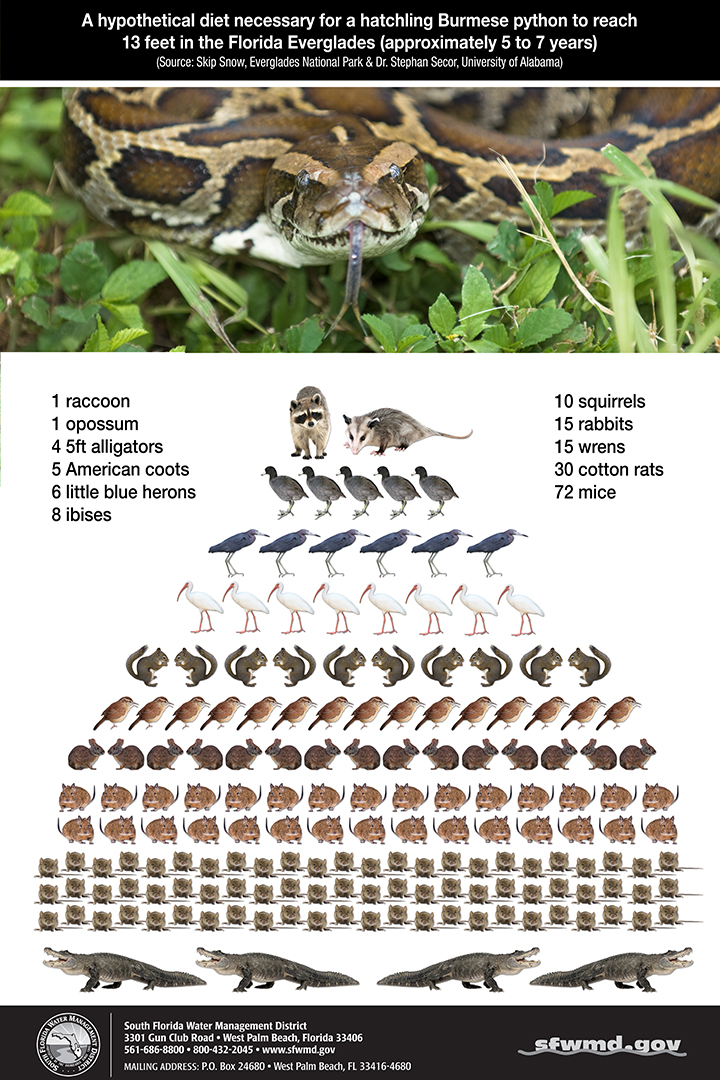
The first time I became interested in pythons was the day I saw this chart. The year was 2016, my husband Ed and I were visiting Everglades National Park, and the ranger informed us that 98% of the small mammals were gone…Terrible! 

In 2019, when I was appointed by Governor DeSantis to the Governing Board of the South Florida Water Management District, he made the SFWMD Python Elimination Program a priority. Those involved in this program hunt to remove these incredible animals. The largest caught was just under 18 feet 9 inches. So the connection? At Governor DeSantis’ announcement of this program, I met Mrs Donna Kalil. “If you ever want to go, let me know,” she said smiling in her trademark pink shirt. Just recently, on March 8, 2021, I took her up on it.

-Everglades Holiday Park, Governor DeSantis announces expansion of the SFMWD Python Elimination Program, August 8, 2019. ~Photo SFMWD.Ed and met Donna at the same place she and I met, Everglades  Holiday Park. Gregarious,  and easy to talk to, Ed and I felt like we’d known her for years, by the time we got to the L-28 canal -running north almost between Big Cypress Park and Water Conservation Area 3, just north of Tamiami Trail. She unlocked the gate, and we began our adventure.

My not being a hunter, not being able to even step on an ant, I was glad that if we caught a python, it would be bagged, and humanly -under strict rules- euthanized. I thought about how the first pythons released into the Everglades in the 1970s had been pets that somebody loved, pets that outgrew their terrariums. Now we have a major wildlife disaster on our hands. A disaster that could end in many of our back yards

Ed and I grabbed the rail atop of Donna’s SUV and stared down. We looked until our eyes popped! Donna had taught us how to distinguish the shiny skin pattern of a python in the vegetation, and immediately one saw how well they are camouflaged! 

It was a beautiful, very cool day and I found myself looking beyond the roadside to the gorgeous scenery. We came upon a rookery of maybe a hundred birds. -Wood storks, great egrets, anhingas, little blue herons, white egrets, great blue herons, ibis, and others I did not know. Alligators were nearby, abundant, black and shining, with their classic grins. As we slowly approached, they stayed either completely still or rushed the waters like angry bulls, branches crashing! After we went by, we could hear them grunting in the deep marsh. Cypress trees were getting their foliage and tender, light-green branches emerged against a blue-clouded sky. It was early morning and everything was just coming alive. 

“Oh!” I thought, “I am supposed to be looking for pythons!” I looked at Ed, and he was glued to the levee bank like a hawk. “Thankfully, he’s with me, I thought, I am a terrible spotter!” But I had never witnessed these Everglades lands. Spectacular!  

Donna was looking too. Suddenly, she jumped out of the vehicle. “Oh my gosh, she going to get one, I thought.” She gracefully came out of the woods with a huge yellow rat snake. “Just like our yard!” I yelled, snapping shots of her smiling and the snake looking very calm. I am not afraid of snakes, but 18 feet? 

“She’s a snake charmer,” I said to Ed. He smiled. “Just like when she told us she ran that program of parents at the PTA.” I laughed. I was so glad Ed was with me to experience this. Our next stop was also beautiful, in the classic Everglades way. We headed south into Everglades National Park from the SFWMD S-333 structure and Old Tamiami Trail. It was exciting to see the trail as it being removed to allow more water to enter the park. Even now, the water flowed south like a river,  Ed took pictures of me beaming.

The air was fresh and cool. The tall grasses and tree islands looked otherworldly waving in the afternoon light. As the clouds floated by, purples, burnt oranges, and greens took on one hue and then another. “A Monet painting,” I thought. “The Creator’s palate.” Cool winds blew, I zipped up my jacket and tightened my scarf. 

“Look at the road!” I heard myself think.“Pythons, I am supposed to be looking for pythons!” Ed smiled. “This is incredible,” he said. I grabbed his hand across our station top the vehicle. 

We did not find a python that day. I’m not sure if it is because it was in the 60 and 70s and the pythons couldn’t get moving, or if I missed about twenty of them. One thing is for sure, they are there. Donna is a top producer! Ed and I plan on going back out with Donna. She is looking for volunteers, so if you think you can keep your eyes on the road and off the stunning scenery contact her! ~join Donna Kalil, python huntress, on Facebook. 

In the meanwhile, I will be happily remembering my day “beyond pythons.” 

I. L-28 Canal between Big Cypress Preserve and Water Conservation Area 3/4. -Donna looks along the levee for pythons warming themselves in the sun II. Canal south at S-333 and Tamiami Trail, Everglades National Park

-Donna points to the an round impression in the grass from a python; she is constantly reading the environment for clues! 

-Farewell to a beautiful day! -Jacqui and Ed before the SFWMD S-334 Structure at Tamiami Trail “Hey Ed, is do you think this water is moving south?!”

VIDEOS

1.-Alligators are eaten by pythons; until now, they were the top predator. Luckily, in this video they look like they are having a very good day. 

2. “Sending water south” Old Tamiami Trail!


Thousands of Flying Fish Crows!

Yesterday, February 7, 2021, before the Super Bowl, Ed and I took the binoculars and walked to watch sunset at Bird Island. The Indian River Lagoon on the east side of Sewall’s Point is always spectacular at this time of day. Once we took a seat, we were amazed to see an almost endless flock of cawing fish crows making their way to roost somewhere south of Bird Island, maybe in the area of St Lucie Inlet State Park. We could see the shifting shape flying from the horizon miles away. They appeared like little mosquitoes approaching from the distance! There were thousands and thousands of fish crows! 

Although I was born in 1964, and grew up in Sewall’s Point and Stuart, the first time I noticed the massive flocks was along the St Lucie River in North River Shores back in the late 90s. I would watch with amazement for hours as they steadily made their way across the sky. “Where are they going?” I thought. “Where do they come from?” Although Fish Crows are listed as being at risk due to Climate Change, it certainly seems that their numbers are increasing. 

I include a couple of videos and encourage comments on what readers may know of this  incredible phenomenon. This survivor of a bird! 

Video 1: Thousands of fish crows fly over east Sewall’s Point near Bird Island. Video 2. Same but even better view hundreds more in the near distance. Incredible! 

Fish Crows: John J. Audubon

Walking for Panthers

~Above photo: FWC public records. FWC officer documents young male Florida Panther hit on Hwy. 710, November 2, 2019. 

I waited a long time to share this photograph. It’s almost too much to take.

This panther was hit and killed November 2, 2019, on Highway 710, less than a mile south of Indiantown in Martin County, Florida. Today I share this photo because of an article I read in TCPalm by environmental reporter, Max Chesnes. The title of the article is Man Walking From Vero Beach to Key West to Tallahassee for Panther Donations.

It is a story of loss and inspiration.

Mr Chesnes explains that when tragedy struck, Mr Steve Fugate “hit the road.” Fugate had lost his son to suicide and his daughter to accidental drug overdose To cope, the 74 year old Vero Beach native, began walking, finding solace and inspiration in Nature along the way…

There are panthers in Martin County.

In 2016, I wrote about one sighted in Allapattah Flats – ten miles west of Palm City, where in fact, SFWDM just held a Ribbon-Cutting. But because Panthers are few and far between compared to the south west coast of Florida, in my opinion, they do not get the government press or the protection via fencing and wildlife underpasses they should here. There is no urgency anyway.

“It was just one hit in twenty years.” I’ve heard. “Most are on the west coast…”

I think there should be signs, underpasses, fencing, and press on the east coast as well. For Mr Fugate and others, every life counts. Thank you to reporter, Max Chesnes and thank you to Mr Fugate, I am inspired!  I will be making a donation on the panther’s behalf! 

TCpalm: In an effort to raise awareness, and funding for the critically endangered Florida Panther, Vero Beach native, Steve Fugate has partnered with the Fish & Wildlife Foundation of Florida and started on a nearly three-week, 1,600mile walk around Florida. Photo PATRICK DOVE/TCPALM. Click here for full article. 

Chesnes writes:

“Now, Fugate hopes to give back to the natural world and its inhabitants that embraced him throughout the years. His latest walk, which started Saturday, will take him from Vero Beach — through St. Lucie, Martin and Palm Beach counties — to Key West, then up Florida’s west coast from Naples to Tallahassee.

The nearly three-week, 1,600-mile journey is meant to raise awareness and funding for the critically endangered Florida panther, he said. 

“They’re just gorgeous animals,” Fugate said of the species, named in 1982 as Florida’s official state animal. There are only an estimated 120 to 230 wild panthers left, according to data from the Florida Fish and Wildlife Conservation Commission.

More:FLorida panther deaths map and details”

~Florida Panther, Florida public photo


Africa’s North Fork of the St Lucie

I felt like I was in Africa…

It’s strange to find perhaps the most untouched part of the St Lucie River in the heart of Florida’s eighth largest city, Port St Lucie. In fact a full trip up the North Fork goes all the way to Ft Pierce. Although many of the trickling branches once running to the river have been developed, some have not, and the immediate area around the oxbows was left wild. 

Poor water quality from agriculture and development’s runoff plague this 1972 designated Aquatic Preserve but nonetheless it is an incredible relic! Today I share phots and videos of this remarkable place. The photos of mangroves and sable palms look a bit flat and repetitive, but the videos really reveal the dimension of the experience. 

Port St. Lucie 1957, mouth of North Fork looking  from south, St Lucie River- Photographer,  Aurthur Ruhnke, Thurlow Archives, Sandra Henderson Thurlow

Ed and I took put the Maverick in at Leighton Park in Palm City. Other than screaming a few times when gigantic wakes almost enveloped us, it was a great trip- a trip I have not taken in many, many years.

This excerpt from  the 1984 Aquatic Preserve Management Plan notes that the North Fork was straightened and channelized by the U.S. Army during World War II, nonetheless much of the fork has the wonderful oxbows as you can see from my phone’s screenshot below. These oxbows are an incredible thing to see and definitely give one the feel of someplace wild and exotic like Africa. Like Florida was not too many years ago…

“Water is the one resource whose characteristics most directly affect this

             estuary’s habitability and healthiness for the plants and animals naturally

             adapted to living there. The drainage basin of the entire St. Lucie River has

             been modified by agricultural drainage and residential development. The North-

             Fork-St. Lucie River receives the outfall of two major drainage canals (C-23

             and C-24) and many other drainage sources in the upper headwaters. The

             freshwater flow from the St. Lucie Canal on the South Fork may also affect the

             North Fork indirectly. The uplands surrounding the preserve area are also

             modified by the extensive Port St. Lucie residential development and the other

             residential developments along the river. The North Fork was also modified by

             the U. S. Army during World War II. Those modifications involved the

             straightening and channelization of the upper section of the river

             (Environmental Quality Laboratory, 1980). The result of all of these

             modifications to the river and its basin is that rainfall that may have taken

             months to get to the river by natural drainage now takes only hours. The

             river that once meandered through a broad floodplain now flows down a deep

channel.” -1969 Internal Improvement Fund via 1984 N.F.A.P.M.P. 

Photos North Fork, St Lucie River January 3, 2021

-Pond Apple 

-My favorite photo! A turtle sunning itself! 

Videos St Lucie North Fork Oxbows

List of Birds/Wildlife/Plants seen 1-3-21 SLR and North Fork

Seagull
Great Egret
5 ibis
Little Blue Heron
Blue Heron (young) 
Pair ospreys
2 Little Blue Herons
Turkey vulture
Floating flock of seagulls
Floating flock of pelicans
Cormorant
Kingfisher-N. Fork
Turtle
Little Blue Heron
7 mullet jumping- Mud Cove
Little Blue Heron and ibis 
Little Blue
Pond Apple 
Frilly fern?
Leather fern
Saw palmetto
Seagulls hunting  S. of PC Bridge


Nature’s Ultimate Transformation

-Newly born MonarchFor me, there have been a few positive aspects regarding “Terrible 2020. “Covid-19’s Zoom World  isolation has given me time to learn to cook and also to study butterflies.

Recently, I decided to learn the difference between the celebrated and now endangered Monarch and the lesser known Queen. Walking my garden, I had noticed two similar but different caterpillars on milkweed that I had not seen together before. When the weather got unusually cold, I decided to bring them inside on their hosts plants.

“You are going to make those butterflies weak!” My husband Ed told me.

I smiled, replying, “Well at least they will live.” I had researched and learned that about ten percent overall make it due to predation and the elements. 

-Queen rust colored (below) all photos JTL-Monarch orange (below) both have white dots and stain glass window patternWith a little convincing, Ed helped me carry a heavy, old, lidded aquarium into my office, and the magic began. Within a few days all of the caterpillars were hanging upside down and turning into chrystalises. I noticed right away that the Queen’s case, although almost identical to the Monarch’s, was smaller and sometimes a cream-pinkish color rather than bright green. All had the distinctive and beautiful gold dots!Ed look!” Suddenly, he was captivated! 

“What are those gold dots for?” He asked.

“Perhaps camouflage, coloring -like many things with these butterflies, science doesn’t really know. An article in Scientific America says, best understood, to transform into a butterfly, a caterpillar first digests itself. But cells called imaginal disks survive, turning the soup into eyes, wings, antennae and other structures. When I look at the gold dots, they seem to line up with designs on the wings. But who knows? “

Ed quietly studied the gold spots and the emerging transformed creature. He like me, was intrigued!

So the original goal, the simple visual difference between the two?

The easiest way to show the basic differences between the Monarch and the Queen is to share some photos. It’s very clear when they are not flying around! Seventeen were born by yesterday, December 30th, 2020: seven Queens and ten Monarchs.

Ed and I released them all and all were healthy. It took about twelve days to witness Nature’s ultimate transformation. Certainly an inspiration for whatever is coming in 2021. Transform we must indeed!

-Queen -Above, newly born Queen. Below, Queen & Monarch chrystalises/markings the same but Queen smaller and sometimes cream in color rather than green-Monarch with one Queen and one Monarch broken casings/Monarch caterpillar gets ready to change -Queen caterpillar (below)-Monarch caterpillar (below) -Monarch more orange (below) -Queen more rust colored (below) -Can you tell the difference between the Queen and Monarch? I bet you can! -Release! Videos Queen opens wings to fly off; mating Monarchs in my yard:

Renewal By Fire

Born in the 1960s, I am a child of the Smokey Bear generation taught -at all costs- to avoid forest fires. Times have changed and we now know that fire is a necessary part of Florida’s ecology bringing renewal. As a Governing Board member of the South Florida Water Management District, I decided before 2020 ended, I should learn about this first hand.

Recently, Section Leader, Jim Schuette,  Land Management Department,  was my guide. We met near Cypress Creek in Palm Beach County near the Loxahatchee. We arrived early and were greeted by a small herd of adorable Zebu cattle – like miniature Cracker Cattle! 

Shortly thereafter, Gene Colwell, Senior Scientist, and Land Management Techs, Hal Camp and Marshall Davis arrived. Gene led the detailed safety/info briefing. “I hope I can do this,” I thought. Jim gave me some fireproof clothing and a hard hat. Suddenly, I was just “one of the guys.”

-Senior Scientist, Gene Caldwell leads briefing-Loxahatchee River Area near border of Martin & Palm Beach countiesThe fires were set with cans of diesel and gas and I noticed the pine needles that carpeted the forest burned slowly first. I was concerned about the wildlife. 

When the animals smell this they leave the area,” Jim said. 

“Are there any gopher holes for the smaller animals to hide in?” I inquired. 

“Yes, and the ground is moist.” He placed a handful of soil into my hand and explained that due to time of year and wet conditions, it would not be a towering fire. Jim noted that the team always worked to protect the canopy of the pine trees. I knew that in spite of the best circumstances, sometimes, there must be casualties, but for the health of the forest over-all it’s beneficial. 

Stepping away from the heat, I read my UF handout:” Ecological research shows that fire is an integral component in the function of natural habitats and that the organisms within these communities have adapted to withstand, and benefit from wildfires. In fact, many Florida habitats only exist due to the presence of wildfires. Some were created by frequent fires, others by a few big fires decades apart.” 

As time went on things heated up; I watched as Marshall and Hal used fire guns that ignited diesel filled ping-pong balls that were shot into the woods. Later in the day, I was asked if I wanted to participate under the supervision of the team. 

Getting my nerve up, I grabbed one of the heavy fire-lighting containers.

Mr Calwell instructed me to start the fires a good distance apart along the edge of the forest. The pine needles ignited first, cracking and moving like a living organism all its own. It felt strange lighting the woods on fire.

“There were a lot of things we believed in the 1960s that we no longer hold true.” I thought to myself.

The can was heavy and I used both arms. My neck ached. The sound of the fires popped and cracked as tall tongues hissed in the oily palmettos. Suddenly, liquid like flames traversed the bark of the pine trees creating a windstorm of fiery renewal. I was told the new growth would start coming back within just two days…

-Hal Camp with fire gun-Jim Schuette reports smoke situation on 1-95 “visibility is good” -Palmettos and sable palms are oily and burn quickly  -Post burn using water to cool hot spots-Fire brings renewal. Within just days green sprouts will emerge!  Above Jim wets embers

FIRE VIDEOS: IMG_7289

Thank you to Jim Schuette and the SFWMD Land Management team for this experience! 


The Dream of the Sleeping Jellyfish

When I saw them I was immediately struck by their shapes. They looked like hundreds of snowflakes lying at the bottom of the mudflats in the Florida Keys’ Tavernier mangrove swamp.

I became preoccupied with them, checking them during different times of day.

“I’ll be there in a few minutes, I’m going to visit those underwater snowflakes.” I told my husband, Ed.

“Are they sea anemones?” I wondered. “Are they some kind of tropical underwater flower?”

I lay prone on the dock, staring. And there I saw it. I saw upside down jellyfish- yes standing on their heads as if they were sleeping. I realized the beautiful geometric shapes, the snowflakes, were their out folded branching tentacles.

How bizarre!

Some of the jellyfish were “breathing,” their heads expanding and contracting, pushing water, while others seemed completely comatose, not moving at all.

A few smaller ones were actually swimming heads-up the way I would expect a jellyfish to!

I took lots of photos while hoping no boat would disturb their slumber.

I read, laughing, when I learned that they are indeed known as Cassiopea, the “upside down jellyfish,” ironically, all part of a symbiotic relationship with algae. (https://en.m.wikipedia.org/wiki/Cassiopea)

I really fell in love with this snowflake jelly forest. Now, before I go to bed, I often wonder what they are dreaming about.

Perhaps clean water and a healthy sea…

https://jacquithurlowlippisch.com/wp-content/uploads/2020/09/img_1105-1.mov

119 Miles and Only a Barracuda?

My brother Todd took a family fishing expedition on Saturday, June 28, 2020. 119 miles! His journey may not have revealed many fish out in the deep ocean, but there was tremendous visible life in the Indian River Lagoon and nearshore ocean. Good to see!

http://www.thethurlows.com/Fishing06282020/360%20Pictures/index.html#img=IMG_20200628_120339_00_674.jpg

Todd:

“Beautiful flat day. 119 miles and only a barracuda, but it was fun.

Saw hundreds of Pelicans diving on the silver minnows near the power plant. That is probably to most Pelicans I have ever seen in one place locally, including bird island.

Also in all my life I have never seen the fin of a shark at the sandbar. After looking at my photos, I am pretty sure is was a little Scalloped Hammerhead. I cropped a comparison from the online guide and a link to the entire guide. I couldn’t see the head but the fins seem to match. The few people who saw it thought it was a Bull Shark but I didn’t think so. A Bull Shark fin isn’t as sharp.”

Below are photos of the hundreds of happy brown pelicans and also photos of the juvenile scalloped hammerhead shark. Don’t be scared! It’s just  a young shark. The estuaries are their home. These and all sharks are protected species and many like the scalloped hammerhead, globally endangered due to overfishing. Mostly for shark fin soup! Awful.

Well, there’s nothing like a day on the water! Fish or no fish. 119 miles is never for nothing around here!

The Power of Regeneration; Our Indian River Lagoon 9-Armed Starfish

I have always looked to Nature for inspiration and “regeneration.” A short walk in my yard, my neighborhood, or over the bridge almost always brings positive results.

Today, I wanted to share photos from a recent outing where I unexpectedly came upon a multitude of nine-armed starfish at Stuart Causeway, St Lucie River, Indian River Lagoon. I had not seen them for many years during the almost decade of discharges from area canals and especially Lake Okeechobee. To see these striking creatures once again is a very good sign for the recovery of our waterways! And how cool is it that when they lose an arm they can regenerate?

A powerful story indeed!

“The starfish is a resilient creature that constantly regenerates, intuitively navigates the sea, and directly impacts its ecological community. An ancient name for the Virgin Mary, the Star of the Sea symbolizes guidance, intuition, and vigilance.~Ancient saying

9-armed starfish

______________________________________________________________________

PICTURE c. 1974, MY SISTER JENNY THURLOW FLAUGH HOLDS A FIVE ARMED STAR FISH, STUART, FL  photo Sandy Thurlow. In any era, kids always are amazed by starfish!

Life Returns to the St Lucie River-Indian River Lagoon

ST LUCIE INLET STATE PARK, ST LUCIE INLET & SAILFISH POINT, MARTIN COUNTY 3-14/15-2020, photos Ed and Jacqui Lippisch

It is an amazing thing, what happens, when you give something time to heal. Life rises from the ashes, it returns. After some of the worst toxic discharge years -2013, 2016, 2018- the St Lucie River/Indian River Lagoon in Martin County is healing.

Let’s be clear. ~She is not flush, but she is healing.

Ed and my weekend aerials and boat excursion show absolutely beautiful water and God’s creatures on the rise! Seagrasses, once completely gone, are visible, but dormant from winter months, it still looks pretty barren. Hopefully, upcoming visits to the same area will reveal plush meadows by June or July.

These are awkward and difficult times, with Coronavirus restrictions quickly bearing down on us; so I wanted to share  some “good news.”

We must not forget to focus on the gift of blue water and  the miracle of resurgent life. Life that always returns if given the chance. ~It is all around us.

SEAGRASS EAST OF SAILFISH POINT & MANY BOATING FAMILIES ENJOYING THE SANDBAR AT CONFLUENCE ST. LUCIE RIVER AND INDIAN RIVER LAGOON

LIGHTNING WELCK & EGG CASING  and other critters by my brother Todd Thurlow-RETURN ALL CRITTERS;THEY ARE PROTECTED BY LAW 🙂

VIDEO OF REDFISH

HERMIT CRAB STOLE A HAWKWING CONCH SHELL! 🙂

BABY QUEEN CONCH ARE RETUNING TO THE SANDBAR! SUCH BEAUTIFUL COLORS!

BIRD ISLAND, JUST OFF SEWALL’S POINT, SEE THE HUNDREDS OF WHITE SPECKS!

CROSSROADS AREA 2019-20 OFFERS BLUE WATER FLOWING IN FROM INLET RATHER THAN TOXIC BROWN OUTGOING FROM LAKE OKEECHOBEE WORSENED BY AREA CANALS

SOUTH- DOWN JUPITER NARROWS -PASSING ST LUCIE INLET STATE PARK & ARRIVING AT PECK’S LAKE ~A CONTINUATION OF THE INDIAN RIVER LAGOON.  ~SLOW SPEED ZONES, MANY OSPREYS, JUMPING FISH, A FEW MANATEES &DOLPHINS. PEACE AND QUIET. ~SO NICE TO RETURN AT SUNSET KNOWING LIFE IS SLOWLY RETURNING TO THE ST LUCIE. LIFE RETURNS.


From Girl Scout to Activist, Rediscovering the Seeds of Jonathan Dickinson State Park

In the 1970s, my girl scout troop often spent the night in Jonathan Dickinson State Park. At the time, almost all of Martin County was undeveloped so it really didn’t hit me – the value in this very special place.

We girls collected dried flowers, seeds, and grasses to be bound with ribbons and given to our mothers; we lay our packs on bunk beds in musty cabins; we hiked through the pines; we sat around the campfire telling ghosts stories and speaking of bears until too scared to  sleep; we sat in a rare silence, together, staring at the bright stars while eating marshmallows…

Last weekend, I went back to Jonathan Dickinson ~45 years later, this time with my husband Ed, and our dog, Luna.

Although I have aged, the place was even more beautiful!  Almost immediately, I  knew that even though I hadn’t walked it’s piney paths in such a long, long time, it had been an inspiration all my life. A seed growing within me. 

Ed and I chose to walk the trail of Kitching Creek. My attention was captured  by the beauty of the small flowers and I took as many pictures as I could. Slash pine trees abounded, like sentinels, second generation, the magnificent virgin forest cleared in the the 1920s.  Woodpeckers flew from tree to tree looking for insects or maybe a place to set up house. Ed walked far ahead with Luna, stopping every time he came upon a number; I would catch up and read aloud from a pamphlet available at the trail head. 

On our walk, I recognized some of the same grasses I used for my bouquet in 1974. But I knew this time I would not pluck them from the Earth, but take them to heart as inspiration in our fight for clean water, -the St Luice and Loxahatchee-, and the future of Florida.

~I then I realized that long ago, I already had. 

Before drainage there were times the surrounding wetlands, the St Luice, and the Loxahatchee Rivers were wet enough that people could  paddle between them. Today the Loxahatchee suffers from too little water and the St Lucie too much. 

The Return of the Majestic Mastic

The mastic tree had been in my yard for many years before I noticed it. Cradled next to a giant strangler fig, the trees’ high branches are mixed together in a very high canopy. Over the years,  I realized it was a special tree that I should know more about. Mastic trees are high hammock trees native to Florida, attracting much wildlife and growing slowly to great size. The mastic tree, the hammock tree, the forgotten tree, the tree mindlessly chopped down in my hometown of Sewall’s Point…

There used to be a large mastic at the entrance to High Point at River Road. It was cut a few years ago in favor of pentas and mulch. A few months ago, I  discovered another one on an empty lot located at about Ridgeview and River Roads. Covered in a thorny vine, few would notice the huge trunk covered in different colored fungi, like a piece of God’s art. Ancient and otherworldly. A reminder of days long past before non-native plants, floratam grass, fertilizers, and pesticides would replace a tangled forest and contribute to the death of the St Lucie River.

Just recently, my mastic dropped gooey, orange berries and the wildlife ate them with relish. I have been trying to grow the seeds, now wrinkled and brown, in my quest to bring my yard closer to what it was prior to development and help the river and soil, but the squirrels and raccoons raided my pots! Proud to outsmart my four-legged friends, I “ingeniously” figured out how to protect the seeds in an old aquarium. But just today,  I learned that mastic trees are male and female. Dropping the orange seeds, I believe I have a female.

I am afraid I might have one of the last mastic trees in Sewall’s Point. She needs a companion if there is to be the return of the majestic mastic. We are calling your name…

http://sfrc.ufl.edu/extension/4h/ecosystems/_plants/Mastic/index.html

Historic photo of Sewall’s Point’s once “tangled forest”: Andrews in Sewall’s Point Hammock, approaching a giant mastic tree, 1905. Courtesy Thurlow Archives, Sandra Henderson Thurlow.

Remembering the Scrub Jays of Our Childhood Backyard

A Florida Scrub Jay: https://www.allaboutbirds.org/guide/Florida_Scrub-Jay/id

When I was a kid, my brother, sister and I lived on Edgewood Drive in Stuart. My parents were great about teaching us to appreciate, respect and love wildlife. Today, many of our actions would be frowned upon. We fed the animals, and at one time or another, had wild pets. It was wonderful!

This weekend unable to garden trapped inside by relentless rain, I started thinking to myself “what did the ecosystem of my childhood backyard really look like?” That was the late 1960s and early 1970s.

Could I find anything that looked like it today? Does my yard, today, resemble it at all? 

So I took a drive to the old neighborhood.

St Lucie Estates looks a lot the same but our family house has been knocked down and replaced by one much larger. Also every lot is developed. When I was growing up, our house was surrounded by a number of empty lots and as kids we roamed freely.  These undeveloped lots allowed my siblings and I to have native nature right in our “backyard.” 

I racked my brain to think of where I might find a comparable lot to the ones in St Lucie Estates. I wanted to see what plants were on it. What trees. The color of the sand.

I drove east on East Ocean Boulevard.

Near Kingswood Condominium I found one lot that looked a lot like the ones I ran around in as a kid. Although drained and full of invasives, the space held a few recognizables: a sand pine, a stand of sand oaks, yucca, palmettos, prickly pear cactus, and other flowering plants and grasses whose names I never learned.  

Seeing the Kingwood lot brought back a lot of memories and I thought about how this once familiar habitat is basically gone. This rare Florida Scrub has  been covered with shopping malls and subdivisions most sporting heavily fertilized floratam along with a variety of ornamentals.

I wondered why developers just cleared the natives. I am realizing that my childhood home must have been a Florida Scrub environment. For goodness sake, one of our favorite wild friends was the very smart Scrub Jay! We never thought  that our house may have destroyed their favorite bushes. We just smiled and lifted our arms strong and high -palms perfectly flat balancing one nut. Always, they came. So smart! So consistent!

Of course Scrub Jays are now a threatened species whose habitat is considered to be one of the most endangered in the world…

~The location of my childhood backyard.

After getting the photos from Kingwood, I decided to drive north to Jensen to visit Hawk’s Bluff off of Savannah Road. Here I could walk and remember the some of the sights of my childhood. This is one of the few places the Florida Scrub Ecosystem has been saved.

~The wind whistled through the trees. I felt timeless. The rain had brightened the usually muted colors. I sat on the bench. Lake Henderson’s grey and purple reflection resembled a Monet. It was beautiful!

I was alone in my childhood backyard…

I raised my arms above my head, hands upright bent -perfectly flat.

Would a Scrub Jay come to visit?

I held my arms up until I could no longer -putting them down- I got up to walk my adult path.

My little sister, Jenny, proudly feeds a neighborhood Scrub Jay, St Lucie Estates, Edgewood Drive, Stuart, ca.1972. (Family Album)

Cousin Drew Hudson and I feed the Scrub Jays 1972, St Lucie Estates, Stuart, FL (Family Album)

Visit #1 one of the last undeveloped lots near Kingswood Condominium, East Ocean Drive, Stuart, Florida, still reveals native scrub vegetation:

Somehow this cactus garden has grown and survived! Prickly pear is a common scrub plant and a favorite of gopher turtles.

Prickly pear.. Ouch!

Scrub oak and palmetto in a remaining lot off East Ocean Blvd.

A rare sand pine of the Florida Scrub was once prolific requiring fire for pine cones to open and take seed.

Flower of the scrub

Prickly pear in sandy soil with other ground cover

Florida Scrub:

http://www.sfrc.ufl.edu/Extension/florida_forestry_information/forest_resources/scrub.html

https://www.worldwildlife.org/ecoregions/na0513

Scrub Jays:

https://www.audubon.org/field-guide/bird/florida-scrub-jay

https://en.wikipedia.org/wiki/Florida_scrub_jay


Visit #2 Hawk’s Bluff in Savannas Preserve Park is rare gem of the Florida Scrub landscape and it’s wildlife:

New signs including Scrub Jay and Florida Scrub Habitat signs, Florida Park Service, photo album below from Hawk’s Bluff, 11-3-19


Backyard Pythons? SLR/IRL

Skilled hunters, Burmese Pythons are one of the five largest species of snakes in the world and native to South and Southeast Asia. They are a threatened species in their native lands, but today there are breeding populations in a new environment, the Florida Everglades.  Image public domain.

I have this dream that I am enjoying walking around in my garden,  I look down, and there is a seventeen-foot python curled up under my house. Sounds ridiculous, but one day this may not be that far fetched.

This past week, the Florida Wildlife Commission (FWC) https://myfwc.com held their meeting at the Hutchinson Island Marriott, just over the Ernest Lyons Bridge from Sewall’s Point. One of the things they discussed was the overpopulation of Burmese Pythons that are ravaging native wildlife in Everglades National Park and other parts of South Florida.

I have been vaguely aware of this for years. My previous Sewall’s Point neighbor was a python enthusiast. Around 2012, he wrote TCPalm a letter to the editor in the python’s defense arguing that the Burmese Python did not bring itself to South Florida, people did! According to FWC pet pythons have been released since the 1960s but it was after Hurricane Andrew’s 1992 destruction that a breeding facility was destroyed, pythons escaped, the population exploded, and a breeding community arose.

I do believe “in all God’s Creatures,” but this is a nightmare-dynamic for Florida’s native wildlife. Public speakers noted Everglades National Park is “devoid of small mammals.” This is not an exaggeration, perhaps down 98%, and “small mammals” are not just what’s for dinner. Meals also include birds, eggs, bobcats, deer, alligators and who knows what else. Mr. Kipp Frohlich of FWC estimates a range from tens-of-thousands to over three-hundred-thousand snakes could be living in the Everglades. We really don’t know. One was even found in Florida Bay all curled up on a buoy. Oh yes, they can swim.

If I were a python and my friends and I  had eaten everything down south, what would I do? I’d slither north…

Opossums, armadillos, and families of raccoons visit my yard a few times a week. ~For now…

python-snake, public image


Please see links to learn about what is being done to controll and educate ourselves on the python:

FWC Presentation

Division: Habitat and Species Conservation
Authors: Sarah Funck, Kristen Sommers, and Melissa Miller, Ph.D. Report date: July 2019

Click to access 10b-presentation-python.pdf


Smithsonian article shared by SFWMD:  Snake Landia_Smithsonian Article_07-2019

*Florida still allows breeders of Burmese Pythons in Florida, but they can only sell the animals outside of the state. All things considered, at the meeting, FWC Commissioner Gary Lester questioning the wisdom in this. I agree. Considering this is how pythons got out of control in the first place.

The Florida Channel videos of FWC meetings in Hutchinson Island; pythons: day 2:

https://thefloridachannel.org/videos/7-17-19-florida-fish-wildlife-conservation-commission-part-2/

https://thefloridachannel.org/videos/7-18-19-florida-fish-wildlife-conservation-commission/

Silver Manatees Inspire, SLR/IRL

Silver Springs, photo Dr Robert Knight

With the mid-term election behind us, it’s time to get to work, and along the Indian River Lagoon and St Lucie River that means it’s time to get reconnected to Nature during the cool season before the Algae Monster arrives again.

Last week, as the keynote speaker for the Florida Springs Restoration Summit in Ocala, I had an amazing back to nature experience.  On a Silver River Guided Paddle Adventure with Dr Robert  Knight leading the way, five manatees swam underneath my kayak!

Five manatees!

They looked so beautiful, so graceful, so confident, and so powerful!

I could see them perfectly through the clear water of Silver Springs. During the summit, I learned that only recently the spring’s water magnitude had increased to historic levels ~after aquifer recharge of a very rainy 2017, thanks to Hurricane Irma.

Florida springs suffer from lack of water because the Water Management Districts, at the direction of their leaders, over-permit water extraction for more agriculture and development. Also, nutrient pollution haunts the spring-shed due to nitrate leaching of old septic tanks. When flow is low and nitrate high, benthic algae grows on the once white sand bottom of the springs. Almost all Florida springs deal with this issue.

Manatees, Silver River, Dr Robert Knight

But on this recent day, the day of my tour,  Silver Springs was glistening, and its bottom bursting with eel grass. The manatees munched at their leisure, mothers and calves reflecting a bluish hue underneath the clear, streaming water.

As the manatees swam under my little boat, I felt a joy unknown since childhood. “An ancient herd of elephants just swam under my kayak!” I thought, laughing out loud.

And in this moment of pure inspiration, I recalled an image from home of a starving manatee struggling to eat weeds and grasses along the Intercostal. Of course after years of harsh discharges from Lake Okeechobee and area canals, the sea grass forests are dead.

Beyond heartbreaking…

I brought my mind back to this present gift before me. And told the Silver manatees I would  return home inspired to fight for all, and that were were indeed, one Florida water family.

Image pulled off my iPhone, #Toxic18 site 10-28-18, Rita Hendricks Salazar


Links:

Silver Springs: http://www.silversprings.com

Springs Institute:https://floridaspringsinstitute.org

2018 Springs Restoration Summit:
https://www.springsrestorationsummit.org

Dr Knight Bio: https://floridaspringsinstitute.org/our-team/

Silver Springs Study Delayed, Gainesville Sun, Dr Robert Knight,:https://www.gainesville.com/opinion/20180118/robert-knight-silver-springs-study-delayed-restorative-action

An Owl In My Kitchen, SLR/IRL

A rather remarkable thing happened. There was an owl in my kitchen. Yes, an owl, a real owl.

I woke up, went outside to get the newspaper, and then I fed my fish. When I looked from the dining room into the kitchen, I saw the silhouette of a little owl patiently seated on the back of a chair in our sunroom open to the kitchen. Of course, I did a double-take! And then I thought to myself: “Is it that owl? Is Ed playing a trick on me….?”

Why a trick?

Just a few days ago, I had bought a fake, feathered owl at the Lamp Shop. I attached it to a fake palm tree in my sunroom. You know, the kind of thing with wire for feet, so you can twist it around the branches?

So, in the darkness of early morning, I wondered if Ed had put that thing on the back of the chair just to freak me out.

He had not. I looked again and again, and for certain, a living screech-owl was sitting in my sunroom, in my kitchen. Unbelievable!

I quietly snuck over and closed the surrounding pocket doors to that area. And then quickly went to find my husband, Ed.

From afar, I whispered sounding panicked: “Eddie! Eddie!”

Ed got up out of his chair, leaving the computer with the dogs gleefully trailing behind him.

“Put the dogs in the crates, now!” I said.

Ed looked at me,  confused.

“In their crates! ” Again, I stated.

“O.K. he said.” Looking bewildered.

“Turning around, Ed took Luna, an 80 pound, black, German Shepard, and Bo, an old and now crippled Corgi, to the other side of the house…

Ed returned.

“What’s up with you?” He inquired, irritated. Not even a  “good morning” ?”

“Ed, there’s an owl in our kitchen.”

“What?” He inquired.

“An owl!”

“Do you mean that owl you bought at the store?” Ed snickered.

“No.  A real owl. I think it was attracted to the other owl.”

“What are you talking about?….” He said…

I slowly slid open one of the pocket doors. Sure enough, the beautiful little owl sat there with its head turned towards the fake owl.

Ed let out an explicative and shut the door.

“The owl must have seen the other owl from outside.” I whispered.

” How did it get in?” Ed quietly asked.

“I don’t know, from you? When you let the dogs out? I don’t know, but we have an owl in our kitchen!”

Ed and I looked incredulously at one another, then smiled.

Gently opening the door, we slowly snuck over, as quiet as could be. Ed started removing the screen from behind the joulosy windows. The owl lifted off the chair and flew about the kitchen landing by the fake owl, but the plastic branch sunk under its weight so it flew off and around the kitchen in high circles without a whisper. Ed and I were transfixed, fascinated. When it landed, we took pictures.

Ed  finally got the screen off and cranked the window. It popped open, braking the silence of the morning. Wind blew inside the room.

The owl looked back to its friend, and then, without a sound, flew through the window, and was gone.

same owl with ears up and lit up when it landed a top the refrigerator arrangement

The River of No Return, Idaho

Boundary Creek, Middle Fork/Salmon River, Idaho. Photo courtesy of Jeanne Gasiorek.

I am back from the “River of No Return,” and before I return to writing about the toxic algae crisis, I’d like to share my experience…

Camping? Are you kidding me?! I had not been camping since my parents took the family to Boy Scout Island to see the full moon over the Indian River Lagoon ca. 1978. Five nights, six days camping and rafting in Idaho with friends, the Wigleys, was great fun, but I am certainly aware that I am in no condition to survive in the wilderness!

Let’s remind ourselves – Where’s Idaho? Far out west, just east of Washington and Oregon, and just west of Montana and Colorado. Although a different world, dealing with fires not hurricanes, we do have a connection. We both have federally protected scenic rivers.

The Middle Fork of the Salmon River, A.K.A. the “River of No Return,” was one of the first eight rivers to be protected under the federal Wild & Scenic Rivers Act in 1968: (https://rivers.gov). In Florida, we have two designated Scenic Rivers: Indian River Lagoon neighbor, the Loxahatchee River,  and the north central Florida’s Wekiva River: (https://www.rivers.gov/florida.php). Only a handful of U.S. rivers hold this special, protected status.

The Middle Fork of the Salmon with clean, clear water, challenging rapids, and spectacular mountain and desert scenery flows free for 104 miles. Nonetheless, due to dams along the connected Snake River, the salmon, for which the river is named, are far and few between compared to the pre-gold rush times when the native Shoshone “Sheepeater” people could “walk across” this river of salmon.

There is much talk in Idaho about removing dams, and of course a huge conflict with stakeholder farming entities. Sound familiar? Whether is the Florida Everglades’ River of Grass diversion to the St Lucie and Caloosahatchee Rivers, or Hells Canyon Dam in Idaho, people are looking for ways to undo some of what has been done to kill the rivers of the United States. Water is meant to flow, and when it does not, eventually sickness sets in, not only for wildlife and fauna, but for people too. It was Stuart’s famed environmentalist and Stuart News editor, Ernie Lyons, who said it best: “What people do, they can undo…” and this I believe is our journey, everywhere.

Since pictures speak louder than words, I will stop here, and say that even though the river was beautiful, and I was super excited to sees two bears, mountain sheep, eagles, and a plethora of other awesome animals – the most memorable experience I have no photo of, ~just a memory~ of endless stars in a black velvet sky with the Milky Way so thick and bright I felt like I could touch it, that I was it…

Remembering that we all are but a flicker in the grand scale of time, and most certainly, part of something much greater than ourselves.

Mexican night. Thank you to the Wigley family for inviting us on this trip!

Links:

USDA, Salmon River – Middle Fork, IDAHO: https://www.fs.usda.gov/detail/scnf/recreation/wateractivities/?cid=stelprdb5302105

The Middle Fork of the Salmon River is not dammed ~running free, but connected to the Snake River that is: Dammed Rivers of the US: https://en.wikipedia.org/wiki/List_of_dams_and_reservoirs_in_United_States

Breaking Through Water and Sky, Believe

If you feel anything like me, you’re not just tired, but sick of heart from looking at dead animals. The atrocities of our estuaries this year, especially for the Caloosahatchee, are Armageddon like in nature.

It is natural to be saddened, but we must stay strong and find inspiration. When we look around, even on the bloody environmental battlefield, it is there.

Today, I share the beautiful photos of local St Lucie River photographer Stephen Duffy, his Anhinga series shows this symbolic bird in all its glory. These special, yet common birds have no oil on their feathers, so they can both swim underwater and fly above the Earth. Thus the Native People held them sacred.  ~The bird that can fly and swim. The bird that can do “anything.” The bird that breaks the wall of water and sky.

When you see the anhinga remember: fly, swim, break through walls, and most important, believe.

Links:

https://www.nps.gov/ever/learn/nature/anhinga.htm

https://childrenofthesunnativeculture.com/cosnc/?q=node/187

Documenting the Discharges, June 2018, SLR/IRL

When the St Lucie River/Indian River Lagoon start to deteriorate due to discharges, things start going downhill fast. And when my husband Ed and I start taking and sharing aerial photos, my world becomes a bit chaotic.

Sometimes there are days of hundreds of photos to look through, and knowing the importance of getting them out immediately, choices have to be made. Facebook is a better medium than my blog for real-time info as it takes less time, but my blog is better for historic documentation as it is “permanent.”

So today I am sharing more of Ed’s photos from 6-5-18, and some you may have already seen. Mind you, after heavy rains, stormwater has been pouring in from many canals but, always, like clockwork, after the ACOE starts discharging from Lake Okeechobee, the river looks not just cloudy-coffee brown, but contaminated.

The ACOE started discharging from Lake Okeechobee on  6-1-18, and as most of you know, now, there are not only algae blooms spotted in the lake, as Ed accidentally found on 6-2-18, and others also documented, but also in the St Lucie River. More than likely, there will be more and more  algae bloom popping up as the Lake O water makes its way down the estuary, over the tip of Sewall’s Point, towards the St Lucie Inlet. Algae floating down the river is disgusting enough, but toxicity is the real question…

Ed and I will take and share more aerials  in the future, to document the algae blooms should they explode, but until then, here are some photographs from 6-5-18 that I had not yet archived on my blog. Sadly enough, although there is no algae in these pictures, I cannot say they will make you feel any better.

Never take the pressure off politicians to build the EAA Reservoir and get it to where it needs to be to clean and filter this water to send south as Nature intended.  Government knowingly contaminating its citizens is not an option. Health, Safety and Welfare is a responsibility.

Photos taken 6-5-18 showing SLR/ILR near Sewall’s Point; Jupiter Narrows; Atlantic Ocean/beach over nearshore reefs along Jupiter Island just south of St Lucie Inlet; out in ocean near Peck’s Lake; Sailfish Point/Sailfish Flats area; and Bird Island, a Critical Wildlife Area, for many threatened and endangered birds.

SLR on west /IRL on east – looking towards Sewall’s Point

Jupiter Narrows near St Lucie Inlet

A Coffee Ocean along Jupiter Island just south of St Lucie Inlet

Discharges in waves looking east to Peck’s Lake

Discharges going over near shore “protected” reefs

Discharge plume

Plume out about 2 miles in Atlantic/documented at 5 over days by fisher people

Similar photos give felling of flying over

Reefs with plume coming on

Selfish Point and Sailfish Flats area one the “most biologically diverse in North America.” Seagrass is gone due to receptive discharges episodes

Circling home- close up souther tip of Sewall’s Point

Again circling ove Sailfish Flats on way back to Witham Field.

Bird Island just off of southeast Sewall’s Point is home to hundreds/thousands of birds. Many threatened and endangered species raise their young on this island that was designated a CWA or Critical Wildlife Area by FWC in 2014. At the time it was the first to be designated in 20 years.

Our Most Beautiful Bird of Prey, Right in Our Backyard! SLR/IRL

Steve Duffy, taking photos in his backyard, Stuart, Florida.

I don’t ever remember seeing them here when I was a kid. But then in the 1970s there were no osprey in Stuart either …

The first time I saw a Swallow-Tailed Kite, “our most beautiful bird of prey,” was in Okeechobee. The distinctive soft-feathered black and white hawks fly in broad circles. Their sharp forked-tails gliding them stealth-like over the pine trees….

Just a few years ago, seeing my first one, I pulled over my car. “What is that?” I thought , not thinking much more about it. Thinking it must be a bird of Lake Okeechobee.

And then somehow over the years they seemed to pop up everywhere, not just at Lake Okeechobee. I saw when driving north on I95, driving south to West Palm Beach, and yes, even driving in the my hometown region of South Sewall’s Point! I came to consider them a new gift, a good luck symbol. Something beautiful. Something to give me hope as the river dies before me.

But I really did not know anything about them. Until recently that is….

At last month’s March for Maddy, (https://www.crowdrise.com/marchformaddie), I ran into an old friend from Martin County High School, Steve Duffy. He was carrying a camera around his neck and shared some of his photographs. I was astounded. There were photos of hummingbirds, dragonflies, and other animals, but what really caught my eye was what I was calling a “Kite.” That beautiful bird.

I thought Steve must be going somewhere distant to get such shots, but he laughed and told me they were taken right in his backyard!

“Where do you live?” I asked.

“Near North River Shores.”

Thank you to Steve who agreed to share his photos on my blog of the rare and properly named Swallow-Tailed Kite, also known as the Swallow-Tailed Hawk. And it’s clear. We may see more of them. They love it here! 🙂

“Our most beautiful bird of prey, striking in its shape, its pattern, and its extraordinarily graceful flight. Hanging motionless in the air, swooping and gliding, rolling upside down and then zooming high in the air with scarcely a motion of its wings, the Swallow-tailed Kite is a joy to watch. At one time it was common in summer over much of the southeast, but today it is found mostly in Florida and a few other areas of the deep south.” Audubon Society, 2018

Audubon 1: https://www.audubon.org/field-guide/bird/swallow-tailed-kite

Audubon 2: https://www.audubon.org/birds-of-america/swallow-tailed-hawk

Jacqui:

All of these pics are taken just off my back patio are with my Nikon D5500 camera and telephoto lens. These are a pair of swallow-tailed kites courting then mating above the tree approximately 100-150 ft away. And then to my delight the pair landed and mated in my pines.

Swallow-tailed Kites are raptors (birds of prey) very distinct because of their black and white color and forked-tails with wing spans of 3.5 – 4.5 feet.

“Our lives are not our own. We are bound to others, past and present, and by each crime and every kindness, we birth our future.”
― David Mitchell, Cloud Atlas

Steve 

In the Garden of Impatience, SLR/IRL

“Patience is a virtue…” 

Yesterday, I went to my garden. A garden for butterflies that I planted in 2011 during my mayorship for the Town of Sewall’s Point.

It was at this time, that I realized I needed a place to go, close to home, to get away, when I was grinding my teeth so hard at night that I would awake with headaches. This garden has calmed many nerves, and brought both beauty and delight to Ed and my home.

I learn a lot of lessons from my garden. But I still have a lot to learn…

…Upon getting the newspaper from the driveway, I noticed a monarch butterfly that had just emerged from its chrysalis drying its wings on the shrimp plant by my front door. The orange, black, and white pattern against green and red was quite striking. I decided to do something I have never done, watch the butterfly dry its wings, and to wait to watch it fly off.

Every few minutes its stain-glassed wings would open to the sun and wind, and then it would sit motionless. When its wings opened again, I could see its body tighten and contort, pumping liquid deep into its wings. It looked uncomfortable this miraculous metamorphosis. Finally, it seemed erect and proud; I kept waiting for it to fly off, but it didn’t.

I counted the white spots on its wings and body to pass time. I studied its bizarre mouth and antennae. I laid on the ground. I took pictures. I tried to be patient. I thought about all I needed to do. I thought about how I would be breaking a deal with myself ~to see a newborn butterfly fly away, if I walked off.

“Come on butterfly!” I said. “You can do it!” But it did not fly off. It just sat there.

I thought about how in the garden there is no rush, as in my own life, to finish the “task.”  Things take the time needed to take, and that is all…

I waited. I wondered. I wished.

I started to get impatient.

“I can’t believe I am losing my patience with a butterfly,” I thought. “This is not good; my plan is backfiring.”

I took some breaths, calmed myself down, and tried to be like nature. Ever-present. Ever-enduring, patient in my Garden of Impatience…

It did not work. I noticed I was grinding my teeth. ” I’ve got so much to do!” I walked two steps towards the rose-bush, just to regroup, taking my eyes off the butterfly for the very first time… It could not have been more than a second.

When I turned around, the butterfly was gone!

I smiled, in disbelief, thinking for a moment “I can’t believe I wasted all this time,” looking into the sky for fluttering wings, but there were none. There was just the sound of the wind and the warmth of the sun — the eternal.

There is no time wasted in the lessons of nature, I suppose…

I walked back into the house “to get things done.”  🙂

Monarch Butterflies, Florida,IFAS, UF:http://edis.ifas.ufl.edu/uw311