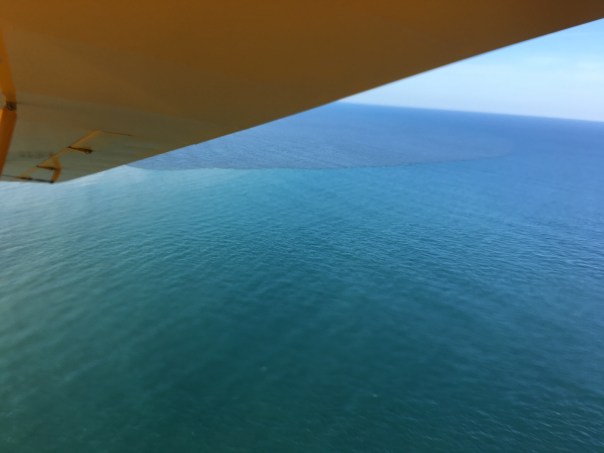
I guess one could say the St Lucie River is getting a new year’s present in that yesterday was the last scheduled release from Lake Okeechobee by the Army Corp of Engineers. The entire situation has a similar theme to an abusive relationship where the beaten thanks their oppressor for finally halting…
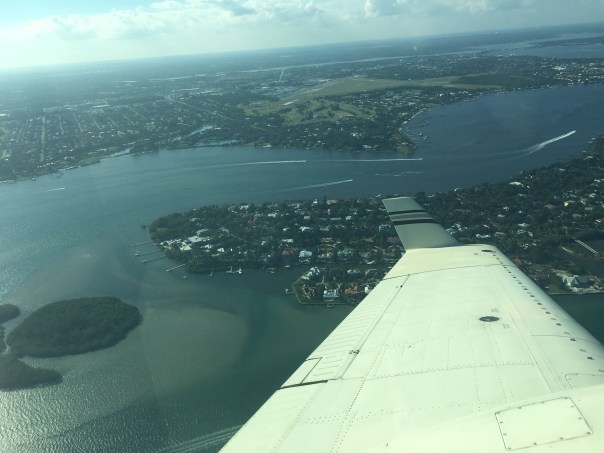
Due to Temporary Flight Restrictions (TFR) because of the President’s visit to Palm Beach, it was not possible to fly south along Jupiter Island from Witham Field in Stuart, however, when the wind and runway changed my husband, Ed, was able to get a few aerials at the Crossroads of the St Lucie River and Indian River Lagoon around Sewall’s Point. No seagrass, but the water already looks better.
After being decimated in 2013; part of 2015; toxic in 2016; and experiencing a no-holds-barred discharge rate since September 20, 2017, post Irma; we will continue to fight for the EAA Reservoir’s success and a better 2018 for our St Lucie River.
We shall never, never, never, give up!
Please see links to my brother Todd Thurlow’s website for St Lucie Canal Real Time Flows S-80 Cumulative 2017 and Latest Lake O Satellite Imagery
As the year 2017 comes to a close, we had a special guest sighted in our offshore waters. On December 17th, a Humpback whale was seen breaching in the Atlantic off of Stuart!
Although these mammoth creatures do migrate, and thus navigate our seas, this is a special and rare site.
Perhaps this is time for reflection…
Just as with the Biblical story of Jonah and the Whale, the Native People also give whale sightings and experiences special significance.
According to native lore, “whales visitors/spirits were used to convey a message of power and might, representing the need for strong, silent deliberation.”
Native Images, whales
In the story of Jonah, having turned away from responsibility, and being thrown as “bad luck” from a ship, Jonah is swallowed by a giant whale, reflects, repents, is renewed, is given a second chance, is ejected, and fulfills his responsibilities….
Perhaps there is a lighter message from our visiting whale, like “Happy Holidays,” and “Merry Christmas,” or a fun breach-splash saying “Yahoo! Keep up the fight for clean water!”
For me, the whale visitation made me reminisce on Ed and my visit to Baja, in 2013, to visit the Grey Whales once slaughtered, and now a great tourist attraction, and how this experience of seeing these huge mammals adapt to our human world, especially the mothers with their calves,–the controversy, and alteration in both human and whale actions—– changed my life, and my outlook forever.
In any case, the season is upon us and I am grateful for all of the work done this year for our waters and for our Florida. Thank you River Warriors! Thank you Bullsugar! Thank you Captains for Clean Water! Thank you people of Florida! Thank you President Negron! Thank you all, so many others across our great state! And in closing, thank you visiting whale!
Sometimes it is hard to stay motivated, but like Winston Churchill said: “Never Give Up.” Our work is so important!
…Yes, in 2018, in spite of the difficulties, we will continue to be the strong, silent or screaming giant that dominates the conscience of Florida…
Video credit:
Mattanza Charters, based in Pirates Cove Resort and Marina in Port Salerno, posted video taken Sunday, Dec. 17, 2017, of humpback whales breaching near Eight Mile Reef in the Atlantic. VIDEO PROVIDED BY CAPT. MIKE MURRAY Wochit
Tallahassee is a beautiful place. Having spent more time there recently, I have grown to appreciate it. Sometimes, in the early morning, as the sun is rising over the hills, I envision Apalachee warriors and families approaching “Anhaica,” their capital. There is a lot of sacred ground here…
Today, I will summarize week 12-11-17. For me, there were battles won, and cease-fires. And the war for Florida’s environment will continue. Thank you to all who wrote members of committees in support in the previous weeks!
St Lucie River/Indian River Lagoon. Photo Jenny Flaugh.
On Tuesday, December 12th, I presented proposal P23, ” A Right to a Clean and Healthful Environment,” to the Judicial Committee (https://www.flcrc.gov/Committees/JU/). I am proud to say P23 has caused a stir, is making people think, and generating tremendous resistance from the “entrenched-status-quo-power” of the government and business communities as it would give every-day Floridians more standing in court for a clean environment. Power would shift to the judicial, rather than the executive and legislative branches of government, and some agencies would be no longer be “puppets.”
The presentation went well, however, based on comments from many members of the committee, and feedback, I felt the vote would not pass. I was offered a “TP” or “temporary postponement” in order to work on the language as I had not been successful at this —with the opposition —-who refused to do so the previous two weeks. They want “no part of P23 in the constitution.”
Unlike local government, where a commission or council can adjust the language of an ordinance during the meeting, this cannot occur during a CRC committee meeting, so the only way to achieve such is to “postpone” and “work on” prior to the next meeting— and try again. (Very inefficient)…
So, I look forward to working on the language, but I am concerned that ameliorating the language to an acceptable point for the opposition will be so far away from the spirit of the original proposal it may not be recognizable or effective. This would not be good.
In the end, it will be the students of Stetson and Barry Universities and their professors who created P23, a totally public proposal, who will give me final direction.
P23 will go before the Judicial Committee again when called. Chances are this will be in January 2018. It could pass; it could die; it could be withdrawn. Should it pass, it will have to go also to the General Provisions committee, and then to the full CRC for a final vote to go to ballot.
The greatest aspect of P23 is working with young people who are our future generation of leaders because as the proposal states: “the natural resources of the state are the legacy of present and future generations…”
On Wednesday, 12-13-17, I presented P46, to the Legislative Committee (https://www.flcrc.gov/Committees/LE/) to “Clarity Language in Article X, Section 28, of the Florida Constitution, Land Acquisition Trust Fund.” Ms. Sue Mullins, who came to my attention through Stuart’s Joan Bausch and the Native Plant Society, was very helpful and knowledgeable and assisted during the presentation. Again, the proposal was “TP-ed” as Chair Pepe Diaz and others such as former Senate President, Tom Lee said they could not support P46 as written and recommended working together on the language. I am confident they meant this, and we shall try between now and when the committee meets again in January. Their concerns are funding requirements, appropriations, of the state legislature; and our concern is the Legislature ignoring a 2014 citizen initiative that passed by 75% for land conservation. P46 too must go to General Provisions should it pass, and then to the whole CRC for a vote to possibly go on ballot.
OILED SCARLET IBIS – Lindsay Carr Created in response to the BP Gulf Oil Spill and auctioned off in support of the clean up operation. In the style of John James Audubon.
On Thursday, 12-14-17, I presented P91 “No Oil or Gas Drilling in Florida’s Territorial Waters.” This was an interesting experience as I was presenting to the committee I chair, General Provisions. (https://www.flcrc.gov/Committees/GP/)
As a presenter, I am just like anybody else.
Mr David R. Mica, Executive Director of the Florida Petroleum Council, AIF, and other business interests spoke against, but fortunately, Mr Manley Fuller, president of the Florida Wildlife Federation, the Sierra Club, and citizens spoke “for,” and were quite convincing. There were even two young children in the audience rooting me on! I was very pleased when the committee voted 5 to 2 in favor of P91! P91 will now go to the Declaration of Rights Committee (https://www.flcrc.gov/Committees/DR/) in January, and then if passes, again, to the full commission to possibly go on 2018 ballot.
OILED SCARLET IBIS – “Notes on a Disaster.” Lindsay Carr created this painting in response to the BP Gulf Oil Spill and auctioned off in support of the clean up operation. In the style of John James Audubon.
CRC Proposal #91, No Oil and Gas Drilling, Yes or No?
This coming Thursday, December 14th, I will be presenting CRC proposal #91 to the General Provisions committee, the committee I chair. For the presentation and vote, I will be turning this part of the meeting over to Vice-Chair, Emery Gainey as is proper form. Just as with any other proposal, #91 needs your support! Please write the members of the committee here to make your support and concerns known or attend the meeting and speak briefly during public comment: http://flcrc.gov/Committees/GP/
With every passing day, I feel more strongly about this proposal. As we are witnessing right now, long-standing, pristine lands across our country are being tapped for oil and gas. Florida’s tourist, beach, and water-economy, and its abundant coastal wildlife, demand there is no oil and gas drilling in the territorial waters of the state.
CRC - 2017P 91By Commissioner Thurlow-Lippisch
thurlowlj-00106-17 201791__
1 A proposal to amend
2 Section 7 of Article II of the State Constitution to
3 prohibit oil drilling for exploration and extraction
4 in specified coastal waters.
5
6 Be It Proposed by the Constitution Revision Commission of
7 Florida:
8
9 Section 7 of Article II of the State Constitution is
10 amended to read:
11 ARTICLE II
12 GENERAL PROVISIONS
13 SECTION 7. Natural resources and scenic beauty.—
14 (a) It shall be the policy of the state to conserve and
15 protect its natural resources and scenic beauty. Adequate
16 provision shall be made by law for the abatement of air and
17 water pollution and of excessive and unnecessary noise and for
18 the conservation and protection of natural resources.
19 (b) Those in the Everglades Agricultural Area who cause
20 water pollution within the Everglades Protection Area or the
21 Everglades Agricultural Area shall be primarily responsible for
22 paying the costs of the abatement of that pollution. For the
23 purposes of this subsection, the terms “Everglades Protection
24 Area” and “Everglades Agricultural Area” shall have the meanings
25 as defined in statutes in effect on January 1, 1996.
26 (c) To protect the people of Florida and their environment,
27 oil drilling for exploration or extraction is prohibited in and
28 beneath all state waters between the mean high tide line and the
29 outermost boundaries of the state’s territorial seas. This
30 prohibition does not apply to the transportation of oil and gas
31 products produced outside of such waters. This section is self
32 executing.
Deepwater Horizon, Gulf of Mexico. Images of disaster, AP 2010.
Adams Ranch, wild turkey in the shade of oak trees, photo courtesy of the late Bud Adams, St Lucie County.
CRC Proposal #46, Land Acquisition Trust Fund, ~Clarifying Language in the Constitution for Citizen Initiative, Amendment 1, of 2014
I will present proposal #46 to the CRC Legislative Committee this Wednesday. You can support this proposal, or express your thoughts on the issue by writing the members of the Legislative Committee: https://www.flcrc.gov/Committees/LE/, or by attending the meeting and speaking briefly during public comment. The Chair is Jose Felix Diaz.
In summary, it is to clarify language so that funds do not include agency salaries, risk management costs, the purchase of vehicles, etc…and clearly states that “no less than one-third of doc-stamp revenue must be deposited into the Florida Forever Trust Fund.”
CRC - 2017P 46By Commissioner Thurlow-Lippisch
thurlowlj-00052-17 201746__
1 A proposal to amend
2 Section 28 of Article X of the State Constitution to
3 revise the manner of the distribution of funds that
4 are deposited into the Land Acquisition Trust Fund
5 from a portion of the net revenues derived from the
6 excise tax on documents.
7
8 Be It Proposed by the Constitution Revision Commission of
9 Florida:
10
11 Section 28 of Article X of the State Constitution is
12 amended to read:
13 ARTICLE X
14 MISCELLANEOUS
15 SECTION 28. Land Acquisition Trust Fund.—
16 (a) Effective on July 1 of the year following passage of
17 this amendment by the voters, and for a period of 20 years after
18 that effective date, the Land Acquisition Trust Fund shall
19 receive no less than 33 percent of net revenues derived from the
20 existing excise tax on documents, as defined in the statutes in
21 effect on January 1, 2012, as amended from time to time, or any
22 successor or replacement tax, after the Department of Revenue
23 first deducts a service charge to pay the costs of the
24 collection and enforcement of the excise tax on documents.
25 (b) Funds in the Land Acquisition Trust Fund shall be
26 expended only for the following purposes:
27 (1) No less than one-third of the revenue must be deposited
28 into the Florida Forever Trust Fund, as defined by the statutes
29 in effect on January 1, 2017.
30 (2) The remainder must be expended as provided by law, to
31 finance or refinance: the acquisition and improvement of land,
32 water areas, and related property interests, including
33 conservation easements, and natural resources for conservation
34 lands including wetlands, forests, and fish and wildlife
35 habitat; wildlife management areas; lands that protect water
36 resources and drinking water sources, including lands protecting
37 the water quality and quantity of rivers, lakes, streams,
38 springsheds, and lands providing recharge for groundwater and
39 aquifer systems; lands in the Everglades Agricultural Area and
40 the Everglades Protection Area, as defined in Article II,
41 Section 7(b); beaches and shores; outdoor recreation lands,
42 including recreational trails, parks, and urban open space;
43 rural landscapes; working farms and ranches; historic or
44 geologic sites; together with management, restoration of natural
45 systems, and the enhancement of public access or recreational
46 enjoyment of conservation lands.
47 (3)(2) To pay the debt service on bonds issued pursuant to
48 Article VII, Section 11(e) as may be required.
49 (c) The moneys deposited into the Land Acquisition Trust
50 Fund, as defined by the statutes in effect on January 1, 2012,
51 shall not be or become commingled with the general revenue fund
52 of the state.
A mullet jumps at sunset, St Lucie River, photo taken by my brother Todd Thurlow
CRC Proposal #23, A Right to A Clean and Healthful Environment; “Any Citizen of the State of Florida, but not a Corporation”
Next week, the Constitution Revision Commission (CRC) will once again be in committee. Today, I will provide an update of proposal #23, “A Right to a Clean and Healthful Environment” and new thoughts:
#23 will be heard, December 12, 2017, between 1-5pm in the Judicial Committee. You can write committee members to support this proposal here or speak during public comment: (http://flcrc.gov/Committees/JU/)
This proposal was already “presented” to the Judicial Committee on November 28th, 2017, just over a week ago. As mentioned, on December 12, it will go before the committee once again, but this time is will be voted upon.
If the proposal passes through the Judicial Committee, the next stop will be the General Provisions committee. If it passes the General Provisions Committee, the proposal will go before the entire CRC for a vote to determine if it will go on the 2018 ballot.
In spite of tremendous opposition from Affiliated Industries of Florida who hired four, high-powered, Gunster attorneys to speak in opposition to the proposal, along with the Florida Chamber and others, I thought the November 28th presentation went great. As I had hoped, students were a part of the presentation for the proposal with Kai Su, a law student from Stetson University, who helped research the proposal, and the founders of the River Kidz sharing their public policy paper written on the subject for a duel enrollment class at Indian River State College.
I presented briefly myself, but had to leave the meeting early to run my own. Later, when I watched the Florida Channel’s video and saw the idealistic young people juxtaposed to the hard-edged lawyers, and self-focused business interests, I knew the proposal had been successful in spite of whatever its final outcome…
—#23, a proposal that would give more standing in a court of law to citizens of Florida over the all-powerful state agencies and those hand-picked by them to benefit from holding and executing “environmental” permits. Many members of the Judicial Committee asked hard and insightful questions to the attorneys, and I am deeply appreciative of their serious involvement and interest in the subject.
I was taken with this particular proposal because it was a collaboration of students and their professors from Barry and Stetson University. As a former eighth and ninth grade teacher, I liked the idea of youth being involved. The decisions made through the CRC process are indeed meant to be forward thinking for the next twenty years. Youth should be part of this conversation.
One thing is certain, this proposal has struck a chord. I am proud of that. I am proud for the young people for the conversation this proposal is inspiring. I also believe we must ask ourselves why were four Gunster attorneys hired, costing hundreds of dollars per hour, to speak against this CRC proposal? Is it because it would shift power from the legislative and executive branches of government to the judicial branch ~causing a more balanced “scale of justice?” It is because if #23 “A Right to a Clean and Healthful Environment” were to go on the ballot, it would likely pass?
Of course if would. The people of Florida do want a right to a clean and healthful environment; feel like environmental interests have been kicked to the curb; and should as taxpaying citizens of the state of Florida have fair standing in a court of law. Is this really asking too much?
Student Kai Su pointed out that the language is “subject to the reasonable limitations as provided by law.” This would not be a litigation free for all, but rather the judicial branch would decide certain issues considering the present laws on the books. Right now this is not really a possibility. People have to sue together under groups like the Sierra Club. Use the Federal Clean Water Act. It’s so hard, individually, people don’t even try.
Why shouldn’t citizens have standing on their own? As mentioned, the present scale is tipped so that state agencies, talking direction from the executive and legislative branches, have full authority to give protection to polluters under Florida Statues 403.412 (e), and the Florida Constitutions is so vague –offering only “adequate provision” it is really useless. Today, the Department of Environmental Protection joyfully gives out permits to corporations and business entities while the concerns of the people of Florida’s are mostly ignored.
I recognize that Great Dragon and its armies are against this proposal, but I see the light. I see the faces of the young people and their desire for the their children and grandchildren to be able to jump into a clean river or spring; catch a fish they can eat; hold the miracle of a seahorse in the palm of their hand; to feel the speed of boating without contaminated toxic algae spray against their face.
Kids in Florida springs, photo courtesy of John Moran.
Before Tuesday’s meeting I felt it was important to try to compromise, so I did reach out. I asked a representative from the opposition if there was any common ground we could work on together for future generations. I waited a few days for an answer. The answer was there was no interest in any part of this proposal going into the Florida constitution…
Hmmm…
I think will go forward the best I can with proposal #23 . Head up…My job is to herald this through for future for future generations. And although rejected in compromise, we will ameliorate the language to strike the words: scenic, historic, and aesthetic values of the that most concerned the opposition and rewrite “any person” to read:
“Any citizen of the state of Florida, but not a corporation, may enforce this right against any party, public or private, subject to reasonable limitations as provided by law.”
Because every citizen does have the right to a clean and healthful environment.
Kids jumping near Sandbar, Martin County, Fl. photo shared Barbara Osbourne
____________________________________
Original proposal:
CRC - 2017P 23
By Commissioner Thurlow-Lippisch
thurlowlj-00038-17 201723__
1 A proposal to amend
2 Section 7 of Article II of the State Constitution to
3 establish that every person has a right to a clean and
4 healthful environment.
5
6 Be It Proposed by the Constitution Revision Commission of
7 Florida:
8
9 Section 7 of Article II of the State Constitution is
10 amended to read:
11 ARTICLE II
12 GENERAL PROVISIONS
13 SECTION 7. Natural resources and scenic beauty.—
14 (a) It shall be the policy of the state to conserve and
15 protect its natural resources and scenic beauty. Adequate
16 provision shall be made by law for the abatement of air and
17 water pollution and of excessive and unnecessary noise and for
18 the conservation and protection of natural resources.
19 (b) Those in the Everglades Agricultural Area who cause
20 water pollution within the Everglades Protection Area or the
21 Everglades Agricultural Area shall be primarily responsible for
22 paying the costs of the abatement of that pollution. For the
23 purposes of this subsection, the terms “Everglades Protection
24 Area” and “Everglades Agricultural Area” shall have the meanings
25 as defined in statutes in effect on January 1, 1996.
26 (c) The natural resources of the state are the legacy of
27 present and future generations. Every person has a right to a
28 clean and healthful environment, including clean air and water;
29 control of pollution; and the conservation and restoration of
30 the natural, scenic, historic, and aesthetic values of the
31 environment as provided by law. Any person may enforce this
32 right against any party, public or private, subject to
*Thank you for the many emails I have received from every-day people in support on Proposal #23! Here are a couple:
St Lucie River at sunset, photo by Todd Thurlow.
Jacqui Thurlow-Lippisch is a commissioner on the 2017/18 Constitution Revision Commissioner; *this proposal will go before the Judicial Committee 12-12-17. You can support or voice concerns about this proposal by writing the Judicial Committee here: http://flcrc.gov/Committees/JU/
12-4-17, ca. 2:45 pm, photos: Ed Lippisch & Jacqui Thurlow-Lippisch
The Army Corp of Engineers has lessened but not stopped Lake O discharges that started September 20th, 2017 just prior to Hurricane Irma. Perhaps as the discharges have gone on at such a high rate for a comparatively long time, the plume has had a chance to extend its territory. In yesterday’s photos, the dark, filthy plume is reaching clearly south beyond the exclusive Town of Jupiter Island.
Yesterday was a beautiful day, but the river and ocean waters of our entire region were ugly, possibly contaminated. How are we to enjoy our property and lives here?
When viewing the aerials below, please note the blue, sapphire-colored water just on the edge of the discharge plume. Yes, of course all estuaries put forth darkened fresh water after a rain event, and Ed and I could see this occurring just south at Jupiter Inlet. Nonetheless, the black, gigantic plume that we repeatedly endure for the St Lucie River/Indian River Lagoon due to discharges from Lake Okeechobee is an aberration.
Please let’s all support Joe Negron and the public’s work to build the EAA Reservoir; clean & send the water south!
Lake O discharges: http://w3.saj.usace.army.mil/h2o/reports.htmLooking south along the southern most area of Jupiter Island.Looking north along Jupiter Island-dark ocean waters. Jupiter Narrows an extension of the IRL on left.Plume -looking north along Atlantic coastEdge of plume; note clean sapphire colored water juxtaposed to dark Lake O/canal plumeAnother angle, Jupiter Island, looking south-blur due to wind and camera movementBack at St Lucie InletIRL, note bare bottom. This area is known as the Sailfish Flats and once had hundreds of acres of seagrass beds.The Sandbar, a popular weekend recreational area for boaters, especially families, surrounded in dark Lake O discharge waters. This is a health issue.Barren Sailfish FlatsSand bottom with no seagrass between Sewall’s Point and Sailfish Point. An area once teaming with life.The Crossroads — no seagrass beds just sand bottomIRL looking northSt Lucie River near St Lucie Inlet dark as coffeeNorth of St Lucie Inlet the plume covers near shore protected reefs as it does south of the inlet.Blue!The plume as viewed from under the wing of the CubPlume edge: The tainted water we are given by our government; the blue –the water we should have by God & Nature.




 This proposal was already “presented” to the Judicial Committee on November 28th, 2017, just over a week ago. As mentioned, on December 12, it will go before the committee once again, but this time is will be voted upon.