Monthly Archives: December 2021

Great Water Projects on the Horizon for 2022

-A bit overwhelmed, Okee reviews the ACOE’s Integrated Delivery Schedule As the final days of 2021 come to a close, it is natural to be asking: “what is in line for 2022?” And although the world may seem as confusing as ever, and trying to read the Army Corp of Engineers’ -“List of Things to Do 2021 – that will be followed in 2022,” known formally as the “IDS,” or Integrated Delivery Schedule,”- impossible – things are looking really good for water.

IDS FINAL 2021 ACOE 

Historic funding is in place for Everglades restoration, and a lot of that work will be happening right here at home in Martin and St Lucie Counties. There have been a few ups and downs, but now the IDS looks more favorable than ever.

Today, I am going to hone in on two areas of the IDS. The first, Indian River Lagoon South, that county commissions are owed the most thanks for their leadership; and the EAA Reservoir, that the River Movement of the Lost Summer of 2013, with the leadership of Senate President Joe Negron, made happen.

When these two major projects are fully completed, the St Luice River/Indian River Lagoon will have an opportunity to heal. As a postscript, I must mention some of my readers have said I appear to be completely “sold by the engineering – the problem that got us where we are in the first place.” And I must say, that is not the case. I agree, engineering alone is not enough. We all must do our part on our own postage stamp of land. These postage stamps add up to millions of acres and they all flow to the river.  A great book about this is called “Nature’s Best Hope” A New Approach to Conservation That Starts in Your Yard, by Douglas W. Tallamy. Fixing Florida is a team sport and must include everybody!

So, back to our engineering team of the Army Corp of Engineers and the South Florida Water Management District’s CERP or  Comprehensive Everglades Restoration Plan, let’s take a look. If you are like most people, when you look at this long list your eyes glaze over. So let’s zoom in.

The green area, two sections down, includes Indian River Lagoon South. This is a huge project that includes both Martin and St Lucie counties and the St Lucie River and Indian River Lagoon. When we peruse the green section, we see C-44 Reservoir; C-23/C-24 Reservoir; and C-25 Reservoir. Other major factors listed such as Storm Water Treatment Areas, an Interconnect Canal, Natural Water Quality Storage, Muck Removal, and Artificial Habitat Creation are also broken out. For simplicity, I will focus on the reservoirs as all else accompanies them.

You can study the entire list to see when the project goal of completion falls. All is before 2031. Mind you these projects are gigantic and complex. Like nothing else in the entire world. The C-44 Reservoir, the southern project of Indian River Lagoon South, in Martin County,  went on line just recently as the first major completed CERP project. Incredible! Now to get C-23/C-24 and C-25- the rest of “Indian River Lagoon South-” to the finish line!

INDIAN RIVER LAGOON SOUTH, PART OF CERP -LEARN MORE BELOW.

A. -IRLS C-44 Reservoir ACOE 

IRLS C-44 Reservoir ACOE Ribbon Cutting

The rest of IRLS that will be completed

B. IRLS C-23/24 Reservoir

C. IRLS C-25 Reservoir (SFWMD completes land purchase 2021)

The next section to focus on is the forth section down in a cream color;  it includes the EAA Reservoir that is located south of Lake Okeechobee near the southern part of Palm Beach County. This project  is dear to my heart as this is why I entered the fight, in 2008, in the first place. Sending more water south is the best way to send less water to the estuaries and open up the system to get water south to the Everglades as Nature would have…

Below we see different components of the EAA Reservoir; it too, is planned to be complete by 2031. 2031 may seem a long way from 2022, but in CERP time, it is “tomorrow.”

We must continue to fight in 2022 and beyond to keep this IDS “as-is” and complete these projects. In the meanwhile, please make your yard a conservation area. Individually and collectively, there are many reasons to be optimistic in 2022 about Florida’s Water Future.

EAA RESERVOIR, PART OF CERP. LEARN MORE BELOW.

-EAA RESERVOIR ACOE 

FLOW AFTER CERP:

MAPS FLORIDA SFWMD – See how Florida used to be and more.

Manatee Mortality Event Along the East Coast 2020-2021

-Manatees eating off the seawall in Flamingo, FL. May, 2021. Photo JTLYesterday I called Dr Tom Reinard, South Regional Director for the Florida Wildlife Commission, and asked for an update on the manatee situation. He forwarded me this most recent update that includes an educational video about state and federal agencies- an emergency station, feeding, and observation.

As we know, the Florida manatees are experiencing an unprecedented Mortality Event. Most of the deaths are occurring in Brevard County, three counties north of Martin, along the Indian River Lagoon; but there are above average deaths in many counties. You can view the chart below to find your county and FWC Mortality Statistics to compare years. This event is due to lack of food to be found when manatees, with memories like elephants as they are related, return to find their historic seagrass meadows gone.

-2021 Manatee Mortality Table

-PBP article by Kimberly Miller

Recently, Dr Jessica Frost of the South Florida Water Management District presented about SEAGRASS along to the Sewall’s Point Commission in the Town of Sewall’s Point, Martin County. Her overall message was optimistic for the return of seagrass in our St Lucie/Indian River region in that seagrass is resilient. She pointed out that seagrass growth is seasonal and stochastic (randomly determined; having a random probability distribution or pattern that may be analyzed statistically but may not be predicted precisely.)

One thing that seemed simple to understand was the requirement of light for seagrass. We can all think of many reasons our various waters are blocked of light, such as algae blooms from nutrient pollution. For seagrasses to grow, there must be light.

“Let there be light…”

I share Dr Frosts’ powerpoint for reference and documentation. It is a good reference for all the lagoon. May 2022 be better than 2020 and 2021. From River Kidz to FWC we all must work to bring back the health of our seagrasses for our iconic manatee!

VIDEOS OF MANATEES EATING OFF THE SEAWALL IN FLAMINGO, FL MAY, 2021. HEAR THEM BREATH!

SAVE THE MANATEES, RIVER KIDZ, 2021 On January 26, 2022, 7PM, there will be a presentation SAVE OUR MANATEES at the Lyric Theatre in Stuart, Florida. Ticket are free.

Mom’s Christmas Gift: “Beyond the Fourth Generation”

Last night, I began reading the book, BEYOND THE FOURTH GENERATION, by Lamar Johnson. My mother gave me this 1974 book as a Christmas gift. On the package was written, “Recommended by Howard Ehmke.”

“Wow.”  I thought. “Mr Ehmke is an institution of the South Florida Water Management District, – forever – lead surveyor and mapper, and designer of the agency’s beloved logo.”

I read late into the night, and recognized early in chapter one, that author, Lamar Johnson’s childhood account of the 1921 Everglades was absolutely captivating and included an event that I had attended “100 years later,” -through the South Florida Water Management District in 2021.Lamar Johnson tells many incredible stories. The one that follows his dog, Lassie, getting dragged down deep to her death in the Miami Canal by a giant alligator includes his boyhood account of the murder of G.C. Douglas, the first Deputy Sheriff in Lake Harbor, once near Bare Beach, in Palm Beach County. As alluded to, I had been exposed to this story of the Deputy – and invited in August of 2021, to the 100 year later – memorial – by my parent’s dear friend, Chappy Young, GCY INC.

It really made the event come to life, reading “Beyond The Fourth Generation.” As I told my mother today, I worried about the incident within those times, as it was like the wild west. It remains a remarkable historical break-through that Deputy Douglas was researched and  honored along the banks of the old Miami Canal one-hundred years later. Thus, today, I share my photos from August 2021. You can learn more by watching the video at the end of this post.

-Group shot -SFWMD Board Members, Ben Butler, JTL,  and Exec. Dir. Drew Bartlett-Photos from the area, Lake Harbor, just east of Clewiston along Lake Okeechobee. -The old Miami Locks. Lake Okeechobee met the canal here in 1921. -Location of event as shown on Google Maps, easy to see how the lake once reached this area and beyond during wet season, then flowed south through the River of Grass.-This Google Map close up shows the Old Miami Locks from above at Azalea Court and Weaver Lane; note width of original canal compared to today. Thankfully this has been preserved as a state historic site. -Arriving with Regional Rep. Sherry McCorkle -The Riderless Horse awaits its que -Getting ready to start the ceremony  -Looking around-People begin to gather -Family of Deputy Douglas-JTL -Ben Butler, Chappy Young, and JTL -Chappy and members of Douglas Family -Libby Pigman, Regional Rep. SFWMD -The ceremony begins   -Dog belonging to a member of the crowd, left its owner during gunshots, hiding in next to Ben Butler. So cute!  -Sheriffs/organizers with Chappy  Young  -Old Miami Locks – far right

Video of event PBC Sheriffs Dept tells the story of researching Dept. Sheriff Douglas 

Beautiful Christmas Season Above the St Lucie

-Ed in his favorite Bullsugar shirt and FOS Chair, Mr Bob Mathias smile for a selfie pre-flightWell the weather has been fabulous! Ed and I wish everyone a very Merry Christmas and Happy Holidays!

To document the end of the 2021, Ed and the Chair of Florida Oceanographic Society’s Board of Directors, Mr Bob Mathias, flew over the region on December 23 at 2:00 pm with Ed giving his best history lesson of the Central and South Florida Project that so negatively affects the health of our St Lucie River/Indian River Lagoon.

Most recently, since 2019, there have been some, but no major discharges from Lake Okeechobee as in 2013, 2016 and 2018. However, intermitent heavy rains have overwhelmed the estuary through C-23, C-24, C-44 and area stormwater runoff. We must remember that originally, prior to drainage the St Lucie received filtered water and less than half the amount being dumped into it today.

Above: drainage changes to the SLR. Green is the original watershed. Yellow and pink have been added since ca.1920. (St Lucie River Initiative’s Report to Congress 1994.)

As you know, because of recent record state and federal funding and Governor DeSantis, massive efforts are finally underway by the ACOE and SFMWD to improve the situation for the entire Everglades region, and the C-44 Reservoir came on-line in Martin County as the first major completed CERP Project  this year. More good news is that the C-23, C-24 Reservoirs are in design by the ACOE, and the C-25 land purchase became complete by the South Florida Water Management District just two weeks ago!

With lots of work to do, we are heading in the right direction and must continue to do more, more, more to get water quality right and seagrass lushly growing again for Florida’s iconic manatees that are not having a happy holiday season.

Good new year’s resolutions we can achieve right in our own backyards to help are to give up fertilizer and plant native and Florida Friendly, and to keep pushing politicians on all levels to “work for water.”

The recent “Riverlution,” 2013, due to the LOST SUMMER,  started  right here in Matin County and it has spread to the entire state! WE MUST KEEP THE WAVE GOING!

~Merry Christmas and Happy Holidays as we all continue to work for clean waters!

~Jacqui & Ed

St Lucie Inlet: St Lucie Inlet State Park, Sailfish Point, Hutchinson Island, Sewall’s Point, Stuart, Rio, Jensen and Port St Lucie in the distance. This area is the St Lucie/Indian River Lagoon confluence. The inlet was dug by pioneers in 1892.

SFWMD basin map for SLR showing S-308 and S-80 along with other structures.

-Various views -Stuart and Rocky Point looking towards St Lucie Inlet and Atlantic Ocean  -Looking up the Indian River Lagoon that is 156 miles long -the St Lucie is east of the peninsula of Sewall’s Point.

-Lake Okeechobee’s Port Mayaca S-308 and C-44 Canal 

Everglades Project Numbers – SFWMD 2019-2021

Mission Statement: Our mission is to safeguard and restore South Florida’s water resources and ecosystems, protect our communities from flooding, and meet the region’s water needs while connecting with the public and stakeholders.” 

Strategic Plan 2022-2027 

-Ms Jennifer Reynolds, Director of Ecosystem Restoration and Capital Projects, presents to the Governing Board, Okeechobee, October, 2021.I am proud to serve on the Governing Board of the South Florida Water Management District. As 2021 comes to a close, I would like to document what the board and staff with the help, firstly, of Governor Ron DeSantis, and also South Florida residents, organizations, and state and federal government investment have accomplished since 2019. This list was compiled by Communications Director, Mr Sean Cooley, after the November meeting in West Palm Beach, as brought to our attention by Vice-Chair Scott Wagner.

Flicker SFMWD 2019-2021

Since January 2019, 37 Everglades restoration projects have broken ground, hit a major milestone, or finished construction.

Construction – Broken Ground

  1. EAA Reservoir Project’s Stormwater Treatment Area
  2. 8.5 Square Mile Area Seepage Wall
  3. Lake Okeechobee Watershed Restoration Project’s Aquifer Storage and Recovery (ASR) Wells
  4. C-139 Flow Equalization Basin
  5. C-139 Annex Restoration Phase 2 and Agricultural Area Stormwater Rerouting
  6. Tamiami Trail Next Steps – Phase II
  7. Stormwater Treatment Area 1-West Expansion #2
  8. Biscayne Bay Coastal Wetlands – L31-East Flowway
  9. Picayune Strand Restoration Project Flood Protection Features

Moved to Next Phase or Hit Major Milestone

  1. Started final phase of construction for the Caloosahatchee (C-43) Reservoir
  2. C-25 Reservoir/STA, completed land acquisition and starting design
  3. Loxahatchee River Watershed Restoration Project, started design
  4. CEPP North, started design
  5. S-332B and S-332C Pump Station Replacements, started design
  6. Lake Hicpochee Expansion Phase II, started design
  7. Began operations at Picayune Strand Restoration Project of the first of three pumps to rehydrate drained wetlands
  8. Broward County C-11 Impoundment, started design
  9. S-356 Pump Station, started design
  10. Biscayne Bay Coastal Wetlands – Cutler Wetlands, started design
  11. Boma Flow Equalization Basin, started design
  12. C-23/C-44 Interconnect Canal in the Indian River Lagoon-South Project, started design


Completed

  1. Caloosahatchee (C-43) Reservoir Water Quality Study Analysis
  2. Brighton Valley Dispersed Water Management Project
  3. Scott Water Farm Project
  4. Bluefield Grove Water Farm Project
  5. Allapattah Flats Wetland Restoration, a component of the Indian River Lagoon-South Project
  6. S-191A Pump Station and Lakeside Ranch Stormwater Treatment Area
  7. Kissimmee River Restoration Construction
  8. C-44 Reservoir and STA
  9. Old Tamiami Trail Roadbed Removal
  10. S-333N Structure
  11. Tamiami Trail Next Steps – Phase I
  12. Combined Operating Plan (COP), Modified Water Deliveries (ModWaters), and C-111 South Dade Project
  13. Stormwater Treatment Area 1-West, Expansion #1
  14. Stormwater Treatment Area 5/6, Retrofit
  15. Stormwater Treatment Area 1-East, Retrofit
  16. Lake Hicpochee Phase I Restoration


Other SFWMD Everglades Accomplishments, in Partnership with DEP

  • Purchased 20,000 acres of sensitive Everglades wetlands to permanently conserve them and prevent oil drilling
  • Doubled water quality monitoring efforts
  • Created a rapid response team to immediately respond to blue-green algae incidents

Black Bobcats – Reports Near and Far

As we approach the end of 2021, I’ve been looking back. Amazingly enough, I have been writing my blog “Indian River Lagoon,” since 2013. I have now written over one-thousand posts and one of the most popular is not about toxic algae, Lake Okeechobee, or even the St Lucie River/Indian River Lagoon. One of my top posts is about black bobcats -properly called, melanistic bobcats.

I wrote my first black bobcat post in 2014 specifically about the high documentation in my home of Martin County, Florida. Since then, many readers have contacted me about melanistic bobcat sightings outside of Martin County. Most recently, two more from Georgia.

Today, I share these two reports, one from 2019 and the other from 2021. These special creatures are a rare sight to see and of unforgettable beauty.

I.

The gorgeous photograph of the melanistic bobcat above was taken in Georgetown, Georgia, in 2019. I learned about the sighting this December at a baby christening in Stuart, Florida. Mrs Kight was nice enough to find the photo and send to me after we got on the subject of all things -black bobcats!

II.

This next photo, above, is a screen shot of a “doorbell” black bobcat -2021- sighting in Waleska, Georgia. CLICK HERE TO VIEW VIDEO OF BLACK BOBCAT.

Mr Kaiser, of Waleska, Georgia, who sent the doorbell video, wrote interesting observations included below.

Mr Kaiser:  “Greetings. We live in north Georgia on the east side of Pine Log Mtn. Have recent video of what could to be a melanistic bobcat in our front yard. We have seen it twice and saved on Ring video. Would like to share it with you and your thoughts. Thanks.”

JTL: “Dear Mr Kaiser, I am so glad you contacted me. I can’t wait to see the video of this incredible creature. Please send.” 

Mr Kaiser: “Hi Jacqui. Wondering if you got the brief video and thoughts. I took down 2 Ring cameras today (temporarily) while they were cleaning up our yard. When I went back outside I saw the animal walking right down the middle of our quiet street. (that gets maybe 12 cars a day). The animal looked at me briefly and it appeared to have yellowish/greenish eyes. It looked all black with apparently no charcoal or grey. It had a knob for a tail and the upper hind legs looked a little bigger. We do have a few neighbors as we live in the higher elevation end of our community and so far no one has identified it as a pet or seen it before. Thanks.”

JTL: “I did receive. Thank you so much. What a creature to behold and see eye to eye! Where do you live?”

Mr Kaiser: “We live in Waleska GA (Cherokee County) in the foothills of the Blue Ridge Mtns. and on the east side of Pine Log and Bear Mountain.  Please feel free to share this information on your blog. My wife and I are surrounded with all this fascinating wildlife and this is so educational studying their seasonal habits. Any information you can share would be appreciated and likewise I can certainly pass on to you with updated pictures/ video clips. This is our 3rd sighting of this animal and we don’t know bobcat habits. When it walked by yesterday it looked at me briefly but didn’t stop or act afraid or defensive. That is when I got a split second look at the eyes.”

JTL: “This is so amazing. Thank you so much for sharing and letting me share! Tell me more!”

Mr Kaiser: “We set this Ring camera up to video the black bears that visit us. Never seen this before and shared with 2 wildlife experts. I do have another separate video and would like your take. Both sightings were midday and have the camera mounted on the front porch hopefully for more views. It appears to have a firmer walking stance on the hind legs. Also have pictures and videos of our visiting black bear. We have various animals that live and roam our property including a fun to watch fox family. If you think this video is of interest I can keep you updated.”

JTL: “Please do. ! I hope in the future to see more including bears and foxes. Love the wildlife, especially the melanistic bobcat, people are really fascinated by them. A mythical creature indeed!”

Thank you to Mrs Kight and Mr Kaiser for sharing and I hope more people, inside or outside of Florida, will tell of their black bobcat sightings too!

~Jacqui

PREVIOUS POST ON BLACK BOBCATS

1.https://jacquithurlowlippisch.com/2014/03/07/the-black-bobcats-of-the-st-lucie-region-and-indian-river-lagoon/

2. https://jacquithurlowlippisch.com/2016/04/21/two-black-bobcat-cubs-and-mom-happily-strolling-around-western-martin-county-slrirl/

3. https://jacquithurlowlippisch.com/2017/02/24/black-bobcat-hit-by-car-in-sebring-please-drive-with-care-slrirl/

Holiday Reading, Historic Documents of the SFWMD

-Everglades Drainage District Map 1914, Florida MemoryI love historic documents! In case you enjoy reading them too, I am sharing three that I have recently studied that come from the South Florida Water Management District’s archives – perhaps not “seen” since the 1940s, 50s or 60s.

The first two are very similar. These notebooks were compiled by the Everglades Drainage District, precursor of the South Florida Water Management District, to document and explain South Florida’s great physical and monetary losses due to the rains, flooding, storms, and hurricanes of 1947. Using the technology available of the day, I see these documents as a “local call for help” to the State of Florida and the U.S. Federal Government.

Starting around 1914, first, was the Everglades Drainage District; second, 1948, the Central and South Florida Flood Control District; and third, 1977, the South Florida Water Management District. Due to the photographs in these two reports, I believe they were  precursors to the famed Crying Cow Report that inspired the Central and South Florida Project– what allows us to live here today -while trying to improve the project’s over-drainage and sometimes ecologically destructive side-effects.

-CSFFCP map ca. 1948

I. BLACK NOTEBOOK #1

To access link this notebook, click on #1 link below. These documents are large and may be slow to open.

#1 Brochure, Everglades Drainage District, 1947

II. BLACK NOTEBOOK #2

Next, notebook #2,  is very similar to #1, but more comprehensive. Please view link below to peruse this document that is noted as “tentative,” whereas number #1 is referred to as a”brief brochure hurriedly prepared.”  This is also a large file and will be slow to open.

#2 Tentative Report, Everglades Drainage District, 1947

III. BOUND BROWN/ORANGE REPORT

Third, is a more modern looking report, not from the Everglades Drainage District, but compiled by Dr Gordon Gunters, written for the District Engineer of the Jacksonville Corps of Engineers. Dr Gunter was a Biological Consultant of the Gulf Coast Research Laboratory, Ocean Springs, Mississippi. The bound report is entitled “Biological Investigations of St Lucie River Estuary in Connection with Lake Okeechobee Discharges Through St Lucie Canal, October 15, 1960” – replacing the orange report inside dated October 15, 1959.

Link to access below. Again slow to open.

I really enjoyed reading starting on page 2. As page 7 references the “Stuart News and St Lucie-Indian Rivers Restoration League,” I have to wonder if this is the report that in local Stuart history lore was so excitedly accomplished, but “then they walked away and nothing ever happened.” Well, thank God today things are happening and we are not relegated to notebooks!

Wishing you enjoyable reading for this holiday season and always! 

#3 Biological Investigation of St Lucie Estuary -St Lucie Canal Discharges 1960

* We create a better future, by understanding our past. Thus now these are “out there.” Thank you to Librarian Diaz at the SFWMD for helping me find these rare and interesting documents! Enjoy.


A River Kid Grows Up – Connor Murphy

My interview with Connor Murphy is part of  “A River Kid Grows Up” series. Connor joined River Kidz at ten years old, today he is twenty-one and attending the United States Merchant Marine Academy in  Kings Point, New York. Connor grew up in Stuart, Florida, and is the son of Dr. Frank and Mrs. Ellen Murphy. It was wonderful to speak with Connor. It was clear that River Kidz and the waters of the St Lucie River very much affect how he views the world today.

JTL: “Hi Connor. So great to talk to you again. Please remind us, how did you became a River Kid in the first place?”

Connor: “Well, really, it was Mrs. Nichole Mader. She visited the Pine School and really pumped up the organization. A lot of my classmates got involved, so I started going to a lot of the rallies. I was in fourth or fifth grade which makes my nine or ten. Now I’m twenty-one. I  remember so many of the events.”

JTL: “I remember first meeting you when you were part of the group that advocated against House Bill 421, a bill that would have allowed the state to preempt the power of local governments to pass fertilizer ordinances. Something very dear to me in the protection of our waters.”

-A young River Kid, Connor Murphy, sits directly below Martin County Commissioner, Sarah Heard, holding a sign, advocating against HB421, 2012.Connor: “Yeah, I remember that one and a lot of others. Especially the ones at the Stuart Causeway and the St Lucie Locks and Dam. I remember, once, in Downtown Stuart there was an army of us Kidz bringing oyster shells -for spat- to St Lucie River – in bags. We brought loads of them. You can probably still see some of those bags with oysters on them today.”

-Connor, far right, listens to Senator Bill Nelson at ribbon-cutting. During this era, Martin County and others received 4 million dollars in federal grant monies to put toward oyster restoration of the St Lucie River, 2012.-Connor, far left, and fellow River Kidz, haul bags of oyster shells to the St Lucie River for oyster restoration, 2012. (Photos taken from cover of Stuart News) JTL: “Connor, were you connected to the water before joining River Kidz”

Connor: “Absolutely. I went to the U.S. Sailing Center in Jensen Beach since my youngest years and I worked there over the summers. Also, I fished, went kayaking, and camping. Everything revolved around water. At the height of River Kidz, I remember the U.S. Sailing Center was considering shutting down camp because of the blue-green algae that had contaminated the river- mostly – from discharges of Lake Okeechobee. This had a big effect on me.”

JTL: “Connor explain how you decided to take your Merchant Marine life path?”

Connor: “So, I was sailing as a sport for a long time and I had learned a lot about water issues from River Kidz. The sailing world is a very small, close-knit group. I made friends from all over the county and the world really. As I got older, I thought I would go into the Coast Guard Academy. But one of my friends went into the Merchant Marine Academy, and invited me to visit. I immediately fell in love. I loved the location! I got there on a snowy day; the snow had just begun to fall. It was really nice. I can’t say I wasn’t cold, but it was really beautiful to see. I got to meet a lot of the midhipmen. I met the sailing coach. I just loved everything about it. I just loved the opportunities they told me I could have. Every box was checked, and I knew I wanted to go there.  So as soon as Congressman Rooney nominated me, I could apply, I got in, and I immediately accepted my  appointment.”

JTL: “That’s exciting. Connor, honestly,  I don’t know that much about the Merchant Marine. For example, is it co-ed now?”

Connor: “Yes. Eighteen to twenty percent women.”

JTL: “That’s good. I’m sure it wasn’t that way when I was a kid. What is your education like?”

Connor: “Our education, right now, engineering and navigation, is split up between campus and at sea. So last year, I was sophomore, and I went out to sea on a commercial shipping vessel. I was a cadet, a midshipman. When I got on board, it was a  culture shock for sure. You really don’t know what to expect  until you’re r on the ship. You look out the window and see the giant containers being being moved on and off…”

-Cadet Connor Murphy at sea-Cargo ship, Ft Lauderdale-A beautiful sunset at seaJTL: “Where did the ship go?”

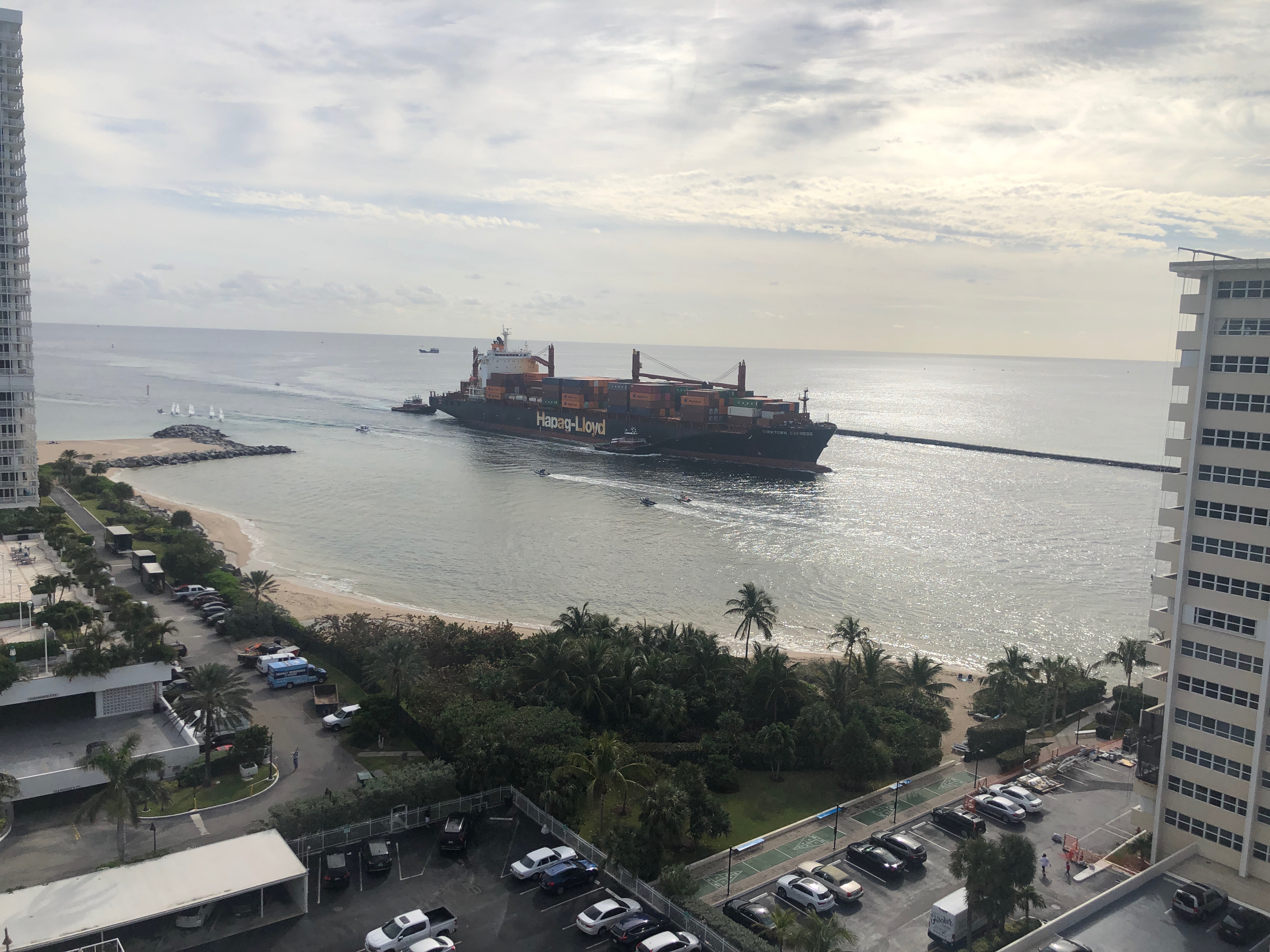
Connor: “My ship went around the east coast of the United States. We stopped in Savannah, Georgia; Charleston, South Carolina; Northfolk, Virginia. Later, Ft Lauderdale and Belliston, Texas. Then the ship traveled to northern Europe: Antwerp, Belgium; Hamberg, Germany; and then we stopped in London on the way back. At this point, I’ve crossed the Atlantic four times.”

JTL:  “Wow. What about simple requirements? Do you have to wear a uniform?”

Connor: “On campus, I wear a uniform. On the ship its standard work attire but there is no set uniform.”

JTL: “Was there ever bad weather? Did you ever get sea sick?”

Connor: “Well, there were heavier seas in the North Atlantic. It definitely got a lot wavier! The ship was really rolling. It was really cool just to see how big the waves could be. It was wild. The waves  made the ship look so much smaller because they were so much bigger.”

JTL: “Do you have any type of motion sickness, like me? What do you see when you are at sea?”

Connor: “No. I do not have montion sickness. I’m lucky. What do we see? Well, I have this really cool video. We were in the very middle of the Atlantic where you expect no life, or anything, and we saw this dolphin riding the front wake out in the middle of nowhere. I took this video as far from land as can be!”

JTL: “Incredible! A friend visiting you from your River Kidz days. Connor thank you so much for your time today. Before we close is there anything else you’d like to share? Maybe something you would say to the next generation of River Kidz?”

Connor: “I do. I have to say that something I’ve been thinking a lot more about lately. My whole life, I’ve been really into salt water aquariums. And because I grew up in Stuart where the St Lucie Inlet was often full of polluted discharge water, and this water was flowing over and destroying the nearshore reefs -well, through all that, I realized how much coral we’ve lost. This gave me a sense of how easy it is to lose a coral reef and how hard it is to get it back. Keeping an aquarium teaches about water quality- testing the water for PH and other components. One learns how important it is for the water to be stable. I think if I were ever to start an organization, it would would be an organization to grow corals to restore the reefs. I know people are working on this and I think there should be more of this. I think this would allow more kids to get connected, to see the coral improving, and work to grow it back. This would inspire kids to get involved, like River Kidz got us involved.

When I was a River Kid, in the moment, I didn’t know the entirety of what was going on. But now that I’m older, I can really see its importance. River Kidz and sailing helped me understand the value, the worth of our waters, and I still love these water today.”


An After Thanksgiving Flight

-C-44 Reservoir filling up…Greetings. These aerials were taken November 26, 2021, the day after Thanksgiving, by my husband, Ed Lippisch, and his niece Darci. They took an after Thanksgiving flight and I made sure they took some pictures. It was a glorious Florida day!

Today, I am sharing Ed and Darci’s flight photos of the following:

-S-308 at Lake Okeechobee and Port Mayaca

-The C-44 Canal

-The ACOE’s recently completed  C-44 Reservoir, part of the Comprehensive Everglades Restoration Plan’s INDIAN RIVER LAGOON SOUTH projectbeing filled with C-44 Canal water- in Indiantown. 

-The South Florida Water Management District’s C-44 Reservoir Storm Water Treatment Area-receiving the water from the reservoir and cleaning it before it is returned to the canal and thus the St Lucie River

-Wonderfully performing Caulkins Water Farm

-S-80 at St Luice Locks and Dam (gate open for C-44 basin runoff)

-And finally,  the skinny, but very visible plume exiting at the confluence of the St Lucie River/Indian River Lagoon exiting the St Luice Inlet. 

The water quality grade from Florida Oceanographic Society ending November 24th was a “B.” This is good news, however, seagrasses remain sparse and manatees are migrating due to colder weather, hungry, and deaths are way above average due to loss of seagrass throughout the Indian River Lagoon and other parts of the state.

The C-44 Reservoir will very much help improve water quality from the C-44 canal into the St Lucie River/Indian River Lagoon. This is a huge step and will be be majorly complemented by the EAA, and C-23/24 Reservoirs in the future. The C-44 Reservoir is being filled incrementally, checking for the structure’s  integrity, and is expected to be in full service by the end of next year. Improved water quality is the only way to heal our waters and we need the EAA Reservoir to send the water south!

-Lake Okeechobee appears algae free. Looking east over Structure 308 and the C-44 Canal. FPL Cooling Pond left surrounded by agriculture, mining, and DuPuis Management Area.

-C-44 Reservoir is two and one half miles wide, and two miles long. Note pump station in left foreground. It is being filled slowly by the Army Corp of Engineers. The STA is in closest foreground. -Another angle -Back to pump station view

-C-44 Storm Water Treatment Area’s 6 cells cleansing and treating C-44 water were built by the SFWMD. Reservoir is visible far upper left. Note speck of pump station in the distance.

-Caulkin’s Water Farm is remarkably successful. It cleanses and stores water and was once a citrus grove. Such projects are funded by the Florida Legislature and managed by the SFWMD.

-Various angels of the C-44’s Structure 80, or “The Seven Gates of Hell” that allow both C-44 basin water and Lake Okeechobee water to disrupt salinity and pollute the St Luice River. The gate open in this photo is for C-44 basin water only. Many call this “local basin runoff,” but it is not. In 1916 C-44 busted through the natural ridge that historically separated the St Lucie from Lake Okeechobee.

-St Lucie Inlet looking north towards Sailfish Point. The runoff is from Canals C-44, C23, C-24 and runoff from all our our homes and streets, etc. Pick up dog waste! Don’t fertilize! Go to native and Florida Friendly plants; get on sewer if on septic; demand Agriculture follow Best Management Practices and prove accountability. SAVE OUR RIVERS! -St Lucie River at Witham Field. See you next flight!

The St Lucie River was originally a large fresh water “stream” that ran into the Indian River Lagoon. An inlet was cut in 1892.