Monthly Archives: January 2021

The Green Ridge

Although I first took this photo on January 21, 2021 to document the layer of smoke hovering at the horizon due to the burning sugarcane fields, I later noticed the clear aerial composition of the Green Ridge. Thus I share today…

Looking even briefly at the photograph, you will notice that this ridge is scraped flat by agriculture fields and 1-95 swinging over it – to take advantage of the high 30-35 foot topography.

So what is the Green Ridge and why is it important to the St Lucie River?

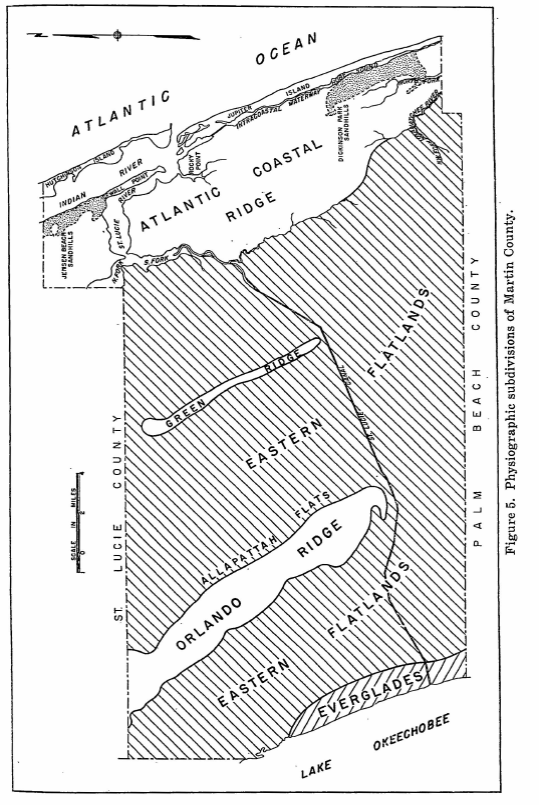
You may have recently read my post on Allapattah Flats where my brother utilized the map below from a 1960’s U.S.Geological Survey, “Martin County” report, on water resources prepared by William F. Lichtler? This report gives an excellent breakdown on pages 7-11; but even if you don’t read it, you can see it!

The Green Ridge guided waters south as they traveled slowly through the marshy Eastern Flatlands being deepest closest to the Orlando Ridge, Allapattah Flats. (For reference, today Indiantown lies in the southern portion of the Orlando Ridge.)

When the St Lucie Canal, (C-44) was cut ca. 1914-1923 and then deepened, widened, and “improved” many times since, it caused the waters moving southeast to shoot down into the St Lucie. Today, due to agriculture and development, these water are polluted and basically unfiltered and have been allowed to be so for many, many years.

And when Lake Okeechobee is opened into the St Lucie Canal…we all know what happens then. Complete destruction from a water source, Lake Okeechobee, that also was never connected to the St Lucie!

For years I tried to understand the Green Ridge, and it’s importance, now I think I do. In restoring our waters it is helpful to be able to envision how Nature functioned before humans altered the landscape to the point that she is almost unrecognizable. 

-Red baloon designates the Green Ridge


An Aerial View- Our Remaining “River of Grass”

-Looking southerly towards White Water Bay in Everglades National Park

These photos are the second part of Ed and my flight reported on January 21, 2021. The first part focused on “Finding the Shark River.”

I wanted to include these aerials in my blog as well as they too are interesting to see. This set begins near White Water Bay at the southwestern tip of Florida and travels northeast over the remaining River of Grass. I will note areas based on the FWC map below that compartmentalizes the Everglades, our remaining River of Grass into Everglades National Park and the Water Conservation Areas.

During the flight, in the northern areas especially, there was a lot of smoke in the air as the sugarcane fields were burning in the Everglades Agricultural Area that was once the  sawgrass “southern heart” of the River of Grass. Over time agriculture, roads, development, and so called conservation areas have divided her.

-Enjoy the flight.

…As we envision what more we can do to restore this natural wonder. 

(You can click on image to enlarge)

-Turning over White Water Bay-Flight GPS -Shark River Slough/Southern Everglades/Everglades National Park -Looking north east over the upper Southern Everglades/Shark River Slough area-Continuing north, note Tamiami Trail that divides Conservation Area 3 from Everglades National Park -Tamiami Trail: water is stacked north due to road-Conservation Area 3 Alligator Alley further north also dissects the River of Grass -Now over Everglades Agricultural Area fields; note Water Conservation Area 2 and Water Conservation Area 1. -Mostly Water Conservation Area 1-Everglades Agricultural Area -Tuning east over Water Conservation Area 1-Approaching the coast near Jupiter, note land changes -Jupiter Inlet over the Loxahatchee River an area that was once connected to the Everglades…

Finding the Shark River

When Ed and I recently visited Flamingo and rented a boat to explore White Water Bay, my goal had been to find the Shark River. I never found it…

I had wanted to see this river because although there are many Everglades’ rivers, the Shark is the most associated with Shark River Slough. Even though this slough, this river of grass, has been amputated by the Everglades Agricultural Area, Tamiami Trail, and eastern coastal development, getting waters into Shark River Slough and the Shark River still translates and is actually improving: “Sending Water South.”

So we took a flight…

Ponce de Leon Bay, where much of this water exits, is particularly breathtaking to see. The geometric shapes, shades of green, brown, and blue create a giant puzzle. It makes me want to put all the pieces back tother again.

It was so wonderful to finally find the Shark River!  I wanted you to see it too! The primary goal remains, to send more water south; this we must envision…

-Everglades Rivers flowing southwest out of Shark River Slough 1-21-21, photos JTL&EL -Ponce de Leon Bay where Shark River exits into Florida Bay The Shark River is the primary river you see coming into this area of Ponce de Leon Bay. White Water Bay  is to the right. It all kind of blends together. 

  1. Shark River, red dot follow northeast; 2. Shark River Slough, large most far right area above shark river -seemingly brownish green – running into Shark River 3. Water Water Bay appears as a dark green depression southeast of and connected to the Shark River; 4. Shark River exits at Ponce de Leon Bay into Florida Bay. Florida Bay is in dire need of more fresh water. 

What is, what was, Allapattah Flats?

-Photo credit: Martin County: Chair Martin County Commission, Stacey Heatherington in red, and SFWMD Governing Board, ribbon-cutting Allapattah Flats 1-21-21Yesterday, the South Florida Water Management District held a ribbon-cutting for Allapattah Flats. The celebration was for over 6000 acres of wetland restoration work completed through a partnership: specifically the South Florida Water Management Distirct, the Natural Resources Conservation Service, a division of the U.S. Department of Agriculture, and Martin County who for a over a generation has provided leadership for natural land purchases. 

 As this recent op-ed of longtime Martin County Commissioner, Mrs Maggy Hurchalla states, bringing back wetlands is the most on the ground, real way to restore the Everglades. This means  the St Lucie River too. The beautiful bird life really appreciates this as post drainage, due to habitat destruction of wetlands, their numbers plummeted by the millions.

-Photo credit SFMWD: a juvenile little blue heron is released by Bush Wildlife Center!  -Renewed Partnerships: Rep. John Snyder; SFWWMD, JTL; MC Chair Stacy Heatherington; Comr. Doug Smith -JTL, MC Comr. Sarah Heard-SFWMD Executive Director, Drew Bartlett, JTL, & Mr. Jaun Hernandes, NRCSSo what was Allapattah Flats?

Since drainage, the lands, flora, and fauna have changed so much! It’s almost unrecognizable. To get a good idea of what it used to be, so as to understand the ribbon- cutting within the context of toady and yesterday, I knew if I was to well prepared for the event, I had to inquire with my history and map loving brother, Todd Thurlow. I am including Todd and my correspondence on this issue because it is so interesting and helpful in understanding “what is, what was, Allapattah Flats”. Our email exchange is below: 

J: “Todd tomorrow is the ribbon-cutting for Allapattah Flats. Was Allapattah Flats part of the Alipatiokee Swamp or was it separate? Was it a pine flatwoods area with small marshes or what. All these historic names sound the same. – Allapattah, Halpatiokee, Alpatiokee. I’m looking at that 1839 Gen. Z. Taylor map. Thanks.”

Above: portion of 1839 Gen. Zachary Taylor map. Allapattah and derivatives mean “Alligator” in Seminole.

Below: portion of “old” Florida map- one can see the former extent and connection of Allapattah Flats running along the inner east coast that the C-44 /St Lucie Canal from Lake Okeechobee to South Fork of St Lucie dissects. Shared by Todd Thurlow.

T: “I think Allapattah Flats is one of those names that has moved around/changed over the years.  It’s the old Al-pa-ti-o-kee Swamp of my YouTube Video.  It was a wetland.  Not a pine forest.  It may have become a pine forest after it was drained – or had pine forests at its edges like the Savannas in Jensen.

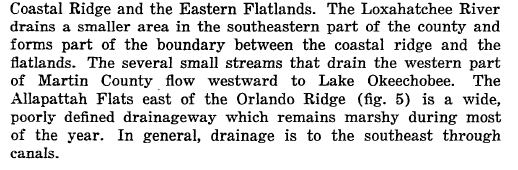
I think of it as the area west of Green Ridge and East of the Orlando Ridge.  I don’t think it was called Flats because of the pine flatlands.  I think the name may have come from the fact that it was flat – water would slowly flow north OR south in the poorly drained marsh depending on the conditions at the time.  The excepts below speak of it including the Hungry Land Slough or being a slough itself.  The first reference shows it immediately east of the Orlando Ridge. But the Al-pa-ti-o-kee was the entire area.”

  1. Florida Geological Survey Report of Investigations no. 23 – May 16, 1960

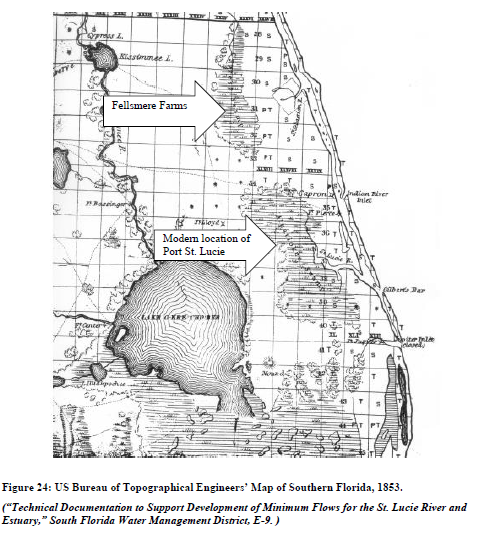
2. Oranges and Inlets – Nathaniel Osborn 2012. As the wetlands of the IRL were drained, the names of land features shifted over the decades to reflect their changing form. Today’s “Allapattah Flats” near the St. Lucie Estuary is undoubtedly a post-drainage name for the same feature listed on nineteenth century maps as “Halpatta Swamp” or “Alpatiokee Swamp,” but the lowered water table has left the area no longer resembling wetlands. Surveys of the lands west of the St. Lucie Estuary in the decade before the completion of the St. Lucie-Okeechobee Canal suggest that the land was covered with standing water for 8-10 months of each year. In the years which followed the post-1916 Drainage Act canalization, this drained region (like much of the IRL) became citrus groves, the town of Palm City, and the post-World War II development of Port St. Lucie (figure 24).273

————————————————————-

3. Bill Lyons, son of Ernie Lyons,  from your blog. “During summer, sheet-flow from the Allapattah Flats converged in tiny rivulets into a deep pool with a sand bottom, the first of a series of pools connected by shallow streams of clear water that formed the headwaters of the South Fork. Dad loved that place, not just for its beauty but for its solitude. Itcould only be reached by Jeep during the wet season, so we hitched rides with the local game warden, who would drop us o􀁷 and return for us later. Clyde Butcher’s photos of the upper Loxahatchee River are the nearest thing I’ve seen to what once was the upper South Fork. Then in the fifties, construction of the FloridaTurnpike cut off the flow of freshwater to the River. Soon saltwater intrusion crept up the South Fork,impeding the spawning of its fish, and the River began to die. In 1962, a friend and I drove to the former siteof the headwaters. The area had been bulldozed and the pool had become a cattle watering hole.”

4. Florida Everglades Report 1913 – Document 379, 63d Congress, 2d session

5. The New York Botanical Garden – Green Deserts and Dead Gardens, A Record of Exploration in Florida in the Spring of 1921

J: Todd this is incredible. Thank you!

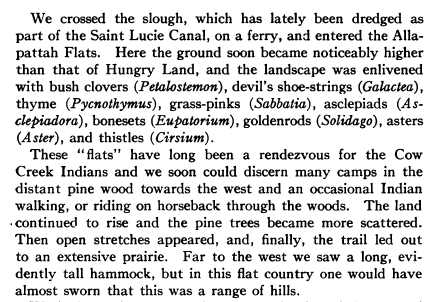
6. One more reference from The New York Botanical Garden, Old Trails and New Discoveries, A Record of Exploration in Florida in the Spring of 1919. It is pretty descriptive.  Hungry Land – southeast / Allapattah Flats northwest.This is the kind of stuff I love reading because you know what he is describing.  He describes the “distant pine wood towards the west” and a long evident tall hammock … one would have almost sworn … was a range of hills”.  He is looking at the Orlando Ridge, the southern tip of which is Indiantown.  You can still see what he sees when driving west on SR 70 or the stretch of turnpike that goes west though St. Lucie County.

J: So Todd, it sounds they drained Allapattah Flats and Hungry Land Slough in the 20s when they dredged  the St Lucie Canal from Lake Okeechobee to the St Lucie River. What a bargain! Aggg!  Thank God we are bringing some of it back! See you tomorrow!

Released juvenile little blue heron in wetlands Allapattah Flat, photo Todd ThurlowSo as you can see what is, what was Allapattah Flats is a long story! And we began to restore history!

Todd’s pictures:  http://www.thethurlows.com/2021-01-21_AllapattahFlatsRibbonCutting/

Jacqui’s speech: https://www.youtube.com/watch?v=AuklcguRVgY&feature=youtu.be

The official SFWMD stream:  https://www.youtube.com/watch?v=hg5MksxMbX0


Biting News at Peck’s Lake

Ed and I disagree on a number of things, but we are always in agreement about our pets! We had decided to take them with us for an overnight in the trawler at Peck’s Lake. 

I laughed and smiled. It was a beautiful and very cold day. I was so glad Ed had some time off. We were both having such a good time until I looked at the alert that came up on my phone…

“Ed you’re never going to believe this. There is an insurrection in Washington D.C.. A sea of Trump supporters are attempting to break into the Capitol.

It was January 6, 2021 and I knew for Ed this brought back terrible memories. In the 1960s Ed’s family had emigrated from Argentina to the United States to escape a series of military coups. 

Ed and I spoke for hours about the situation in the United States. Not much could be more depressing. Having Luna and Okee with us took off the edge. Before we all went to bed, Ed and I promised to get up tomorrow and enjoy Peck’s Lake. Peck’s Lake, as most all of us know, lies within the Jupiter Narrows and once was an inlet to the sea. Yes, historic maps show that many times the Atlantic has breeched this shoreline, most recently twice in the 1960s. The ACOE filled in this gap and today Nathaniel Reed Hobe Sound National Wildlife Refuge sits on these sands. You can reach this place by boat or a long walk north from Hobe Sound Beach in Martin County. If you like to canoe, you can put in at Cove Road. Peck’s Lake is one of 560 U. S. National Wildlife Refuges and lies in Martin County. Birds, mammals, reptiles, amphibians, and fish call this refuge home. 

A long walk along the beaches on the Atlantic side of the refuge is incredible, probably one of the only desolate beaches to be found on all of Florida’s east coast. Certainly, the area doesn’t look too different from 1696 when Jonathan Dickinson was escorted by the Ais Indians north.   Tooling around on the Jupiter Narrows side, Ed and I encountered wonderful things and weird things. We witnessed many osprey nests; we saw an otter surface and dive alongside an oyster covered mangrove forest, we also saw seagulls eating from a strange looking, large-eyed fish carcass. When I called Indian Riverkeepeeper, Mike Connor to find out what this cut-up was he said it was a swordfish! Ed and I threw the fish back into the water and seagulls dove for it from every direction.-Below: Osprey nest. Above: Ed drives dingy with trawler, Adrift in background at Peck’s Lake-Look! An otter! -Swordfish head floating. Very strange! -Seagulls dive   When Ed and I got home that evening, we also experienced no seeums or sand fleas and it was torture! 

“Are you getting bitten?” Ed asked coming into the cabin.

“Not really. Let me go outside and check.”

By the time I had been outside for thirty seconds, my hair was full of sand fleas and I was slapping and scratching myself everywhere at once. 

“Unbelievable! It’s been a long time since I felt them! When I was a kid growing up in Sewall’s Point and Stuart they were here!”

Ed and I ran inside and  barred the door as the tiny creatures made their way through anyway covering the lights of the cabin. Ed and I ate by flashlight that evening and Okee and Luna thought they were in heaven. Ed and I didn’t even think about the state of the world, we were too busy scratching…

Videos: 1. Cove, Peck’s Lake; 2. Mangrove Tour, Jupiter Narrows, Peck’s Lake

*Pets stayed on boat. They are not allowed in the wildlife refuge 🙂

*Thank you to my mother who shared to old add about sand fleas from First National Bank, forerunner of Seacoast. 


As Far Away As One Can Go, Flamingo…

My primary 2021 New Year’s resolution was to write more, however my angst over our country’s political, social unrest and the worsening Covid-19 epidemic has caused me to experience  “writer’s block.” Nonetheless, today I will try to get going with my resolution. 

On January 9th, 2021, my husband, Ed, looked at me, “I’ve got a few days off; do you want to stick around Stuart or do you want to go somewhere?”

“Hmmm? Let’s go as far away as one can go, Flamingo.”  I replied.

“Flamingo?” Ed looked like he wasn’t quite sure…

“Yes, Flamingo, at the very southern tip of Florida.”

-Flamingo lies in Monroe County, inside the boundary of Everglades National Park (ENP)

The following day, Ed and I packed up and drove from Stuart to Lake Okeechobee taking Highway 27 south until we arrived in Florida City, just south of Homestead. Next, we drove about an hour along the historic Ingram Highway. It was a beautiful drive – like going into Florida’s past with marl prairies, slash pines, and tremendous bird life.

About forty miles later, we finally arrived in Flamingo. Now a ghost town, Flamingo was once the home of the American Flamingo -thus the name. Although these spectacular long legged, pink birds were all killed for their spectacular feathers a over a century ago, today there have been reports of a few returning. Most of us are familiar with the story of  Guy Bradley, the first Audubon warden hired to protect Everglades wading birds from poachers. This is his land.

Back in the early1900s when Bradley was trying to protect the birds, Flamingo, as all of South Florida, was thoughtlessly being sliced and diced with canals. Today, one can see this most pronounced at the Flamingo Welcome Center along the Flamingo, more modernly called the Buttonwood Canal.  Here lies a “plug” between Florida Bay and the mosaic of fresher/fresh waters in and near Flamingo.

According to our ENP tour guide, Mr Nick, this “Flamingo” or “Buttonwood Canal” was dug by Henry Flagler in the early 1900s and later abandoned when Flagler realized the canal failed to drain the land – instead, due to the tides and topography of the area, bringing  too much salt water from Florida Bay. A cement plug was later placed to ward off this saltwater intrusion.

I was pleased to see that a family of Ospreys had built their nest right on this plug in the midst of much human activity! The female osprey was hard at work, peeking over the side, protecting and incubating her eggs while the male intermittently delivered fish. The large birds appeared absolutely unaffected by people!

FLAMINGO or BUTTONWOOD CANAL                                                                                                                                                                                                                                                          -Salt water, Florida Bay side of plug-Below: brackish/fresher water on estuary/marsh side of plug leading to Coot Bay (Coots no longer come in droves as the water is still too salty.)-The cement plug cutting off salt water of Florida Bay from canal, note osprey nest! -Our ENP guide, NickThe first day Ed and I took a tour and Mr. Nick was our guide. The second day, we rented a Mako flats boat and followed the same path ourselves. We learned so much. It was incredible. While Ed looked for places to fish, I searched for the Shark River. The Shark River is one of many that extends out from Shark River Slough, the remaining ridge and slough, “river of grass,” of the Everglades. Some of its waters lead to Florida Bay. Taylor Slough, on the other hand, has shamelessly been cut off by development.


Flamingo Canal was full of wildlife: wading birds, manatees, and by far the most interesting, crocodiles, of which I had never seen. These southern waters of Florida are one of the only places on Earth where both Alligators and Crocodiles live together. This canal is so salty the crocs have the edge. Our tour led from Flamingo Canal, to Coot Bay, to yet another canal, and then into Whitewater Bay. This track is referred to as the “Wilderness Waterway.” (See map below.)

American crocodile, an endangered species -The most prevalent wading bird by far was the tri-colored heron-There were many baby crocodiles along the Flamingo Canal warming in the sun. It was 37 degrees in the morning of our second day at ENP! -Because of the plug, manatees must enter the protection of the Flamingo Canal by swimming into the rivers entering Florida Bay that lead eventually into  Whitewater Bay! A very long journey. 20 miles? -Our tour guide, Nick, called this tree along the Flamingo Canal  the “perfect mangrove.” -Flamingo/Buttonwood Canal opening to Coot Bay-Entering Whitewater Bay on a cold day!It is very hard to explain how gigantic this area is! Over ten miles long and more than half that wide. Irregular in shape. It was truly “liquid land,” with mangrove forests everywhere and smaller even more beautiful mangrove islands dotting the horizon. One thing was for sure, it would be very easy to lose one’s sense of direction and get lost in Whitewater Bay. No thank you! 

Ed and I spent hours tooling around but never made it to the Shark River as access is limited. Nonetheless, I got a much better idea of the lay of the land for sending water south. I am hoping Ed and I can one day return in a canoe.

I was happy to go as far away as one can go-FLAMINGO!-Learning about a Florida I did not know- Whitewater Bay islands of Flamingo -Ed practices casting-Islands within Whitewater Bay; all of Florida must once have looked this way! -Back on Land: A Walk down the Guy Bradley Trail-Ed watches a fisherman cast in Florida Bay-Moonvine once covered the southern rim of Lake O’s pond apple forest, now gone.-Ed poses with a giant Buttonwood tree-Morning Glory. Is there a more gorgeous flower?-Guy Bradley Trail and an end to a wonderful day!

VIDEOS: 1. FLAMINGO/BUTTONWOOD CANAL; 2. MANATEES; 3. CROCODILE 

Africa’s North Fork of the St Lucie

I felt like I was in Africa…

It’s strange to find perhaps the most untouched part of the St Lucie River in the heart of Florida’s eighth largest city, Port St Lucie. In fact a full trip up the North Fork goes all the way to Ft Pierce. Although many of the trickling branches once running to the river have been developed, some have not, and the immediate area around the oxbows was left wild. 

Poor water quality from agriculture and development’s runoff plague this 1972 designated Aquatic Preserve but nonetheless it is an incredible relic! Today I share phots and videos of this remarkable place. The photos of mangroves and sable palms look a bit flat and repetitive, but the videos really reveal the dimension of the experience. 

Port St. Lucie 1957, mouth of North Fork looking  from south, St Lucie River- Photographer,  Aurthur Ruhnke, Thurlow Archives, Sandra Henderson Thurlow

Ed and I took put the Maverick in at Leighton Park in Palm City. Other than screaming a few times when gigantic wakes almost enveloped us, it was a great trip- a trip I have not taken in many, many years.

This excerpt from  the 1984 Aquatic Preserve Management Plan notes that the North Fork was straightened and channelized by the U.S. Army during World War II, nonetheless much of the fork has the wonderful oxbows as you can see from my phone’s screenshot below. These oxbows are an incredible thing to see and definitely give one the feel of someplace wild and exotic like Africa. Like Florida was not too many years ago…

“Water is the one resource whose characteristics most directly affect this

             estuary’s habitability and healthiness for the plants and animals naturally

             adapted to living there. The drainage basin of the entire St. Lucie River has

             been modified by agricultural drainage and residential development. The North-

             Fork-St. Lucie River receives the outfall of two major drainage canals (C-23

             and C-24) and many other drainage sources in the upper headwaters. The

             freshwater flow from the St. Lucie Canal on the South Fork may also affect the

             North Fork indirectly. The uplands surrounding the preserve area are also

             modified by the extensive Port St. Lucie residential development and the other

             residential developments along the river. The North Fork was also modified by

             the U. S. Army during World War II. Those modifications involved the

             straightening and channelization of the upper section of the river

             (Environmental Quality Laboratory, 1980). The result of all of these

             modifications to the river and its basin is that rainfall that may have taken

             months to get to the river by natural drainage now takes only hours. The

             river that once meandered through a broad floodplain now flows down a deep

channel.” -1969 Internal Improvement Fund via 1984 N.F.A.P.M.P. 

Photos North Fork, St Lucie River January 3, 2021

-Pond Apple 

-My favorite photo! A turtle sunning itself! 

Videos St Lucie North Fork Oxbows

List of Birds/Wildlife/Plants seen 1-3-21 SLR and North Fork

Seagull
Great Egret
5 ibis
Little Blue Heron
Blue Heron (young) 
Pair ospreys
2 Little Blue Herons
Turkey vulture
Floating flock of seagulls
Floating flock of pelicans
Cormorant
Kingfisher-N. Fork
Turtle
Little Blue Heron
7 mullet jumping- Mud Cove
Little Blue Heron and ibis 
Little Blue
Pond Apple 
Frilly fern?
Leather fern
Saw palmetto
Seagulls hunting  S. of PC Bridge