Monthly Archives: November 2019

The Once Tangled Forest of Sewall’s Point

“1905, the Andrews walk through Sewall’s Point’s hard wood hammock, note the giant mastic tree.” Courtesy, Thurlow Archives.


“This 1905 photo is of Margaret Andrews and Rudolph Tietig walking through the property that, at the time, belonged the Twichells – located between today’s Hillcrest and Heritage subdivisions.” Historian, Sandra Henderson Thurlow

Today’s historic photographs, shared by my mother, allow us to imagine what the high west side of Sewall’s Point in Martin County looked like before it was cleared for agriculture and development. Yes, although today a few prize trees remain, once, the peninsula’s entire high west side was covered in a hardwood hammock: https://edis.ifas.ufl.edu/pdffiles/UW/UW20600.pdf; https://edis.ifas.ufl.edu/uw206

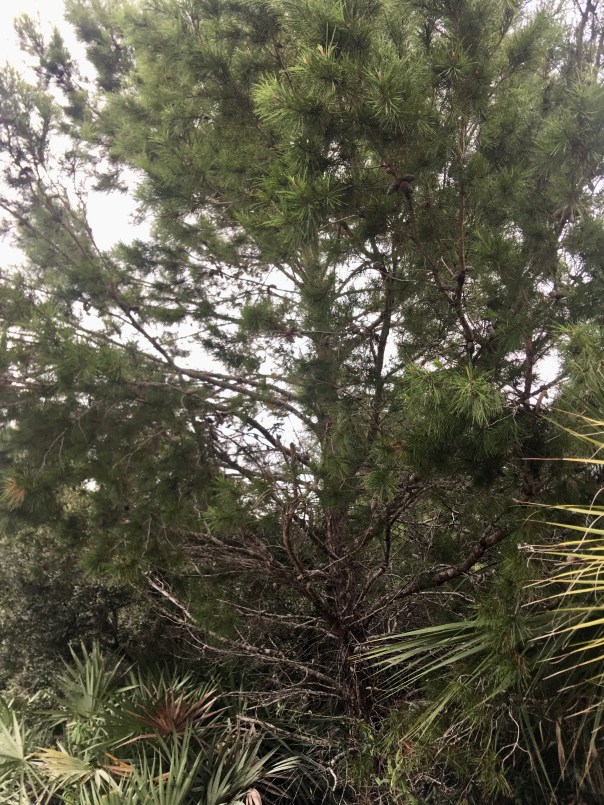
We still see many Live Oaks, Sabal Palms, and a few Gumbo Limbo, but other names such as Paradise Tree; Mastic;  Srangler Fig; Hickory; Satin Leaf;  Marlberry,  Myrsine, Ironwood, and Pigeon plum are much more rare.

As was the custom of the day, and remains so, these trees were cleared. Perhaps some were used for lumber. But for the most part, there was little thought of saving them, nor of the birds and wildlife that depended on the tangled forest for shelter and food.

I think this is worth thinking about. We walk about today somewhat unaware of what the land previously looked like, forgetting forest’s relationship to water, and how many  creatures have been impacted by these human changes.

Could we recreate the forests? This is doubtful, but we could bring some of it back. In order to do this, we need more than photographs, we need a native hardwood hammock -“to see.”

The St. Lucie River bank in today’s Hillcrest ca. 1907, album found by historian Alice Luckhardt on eBay.
Much of the hammock was still in tact in this Sewall Point ca. 1950 aerial by Aurthur Rhunke. Courtesy, The History of Sewall’s Point, by Sandra H. Thurlow.
2019 Google showing a almost completely developed Sewall’s Point with little of original hard wood hammock remaining. The town today https://sewallspoint.org is a TREE CITY 🙂

We are very lucky to live in Martin County, a county that has a history of  conservation.  When researching the Sewall’s Point hammock, I realized I had never visited Maggy’s Hammock Park in Port Salerno. (https://www.martin.fl.us/MaggysHammock). Named after environmentalist and long time county Martin County commissioner, Maggy Hurchalla, this park is a treasure, a walk back into time. This native site, just a few miles south and across the St Lucie River from Sewall’s Point, preserves ancient live oaks, paradise trees, strangler figs, and many, many others as well as the important understory.

It is a true hardwood hammock!

.

Considering the location, these trees must  be similar to native Sewall’s Point’s. This was my first visit and I will be back as I try to rediscover the beauty and the benefits of the “Once Tangled Forest.”

.Martin County 20 year commissioner & environmentalist Maggy Hurchalla
Walking path
Marlberry
Paradise trees

. Inside the Hammock

Gumbo limbo
Snowberry
Wild coffee up close
. Wild coffee
. Not sure what this is…
.Large Oak and Paradise trees inside the hammock
. Tall strangler fig, sabal palm, spanish moss
Strangler fig with wild coffee and resurrection fern
Strangler fig and ferns
Strangler fig trunk swallowing an oak tree
. Strangler fig and oak with other trees and underbrush
Beauty berry
leaf cover on ground
. Not sure
Hickory
Spanish moss
. Young marlberry, vines and budding sabal palms
. Cathedral in the hammock
Wild lime
Hickory
Saw palmetto
. Wild lime and marlberry with others
Air plant
Vines
. Various inside the hammock
Resurrection fern
. Oak or bay tree
. Oak or bay tree
. Wild coffee and other budding plants
.Air plants
.looks like boston fern
.Light is what all are fighting to capture as branches and leaves are raised
.There are many lichens and such on the large trees
Cocoplum
.Strangler fig
.Walkway to yesteryear that is still here!

A Fly-over, a Field Trip, and Watching the Governor Activate the C-44 STA

Google Map area of C-44 Reservoir and STA in Indiantown, FL, Martin County.

Work on the C-44 Reservoir and Storm Water Treatment Area started back in 2004 and is one of a few gigantic water projects of the Army Corp of Engineers and South Florida Water Management District. The mammoth construction site is part of the Comprehensive Everglades Restoration Plan, Indian River Lagoon South. In Martin County, the foundation for this was laid back in 1996 and 1998, and then again in 2006 when the public supported environmental land purchases through a sales tax: https://www.martin.fl.us/land-acquisition

There were years of planning and design with stops and starts. Time has gone by and when funding has been in place, the Army Corp of Engineers has been building the reservoir (since 2015) and the South Florida Water Management District has been building the storm water treatment area (since 2014) : https://www.saj.usace.army.mil/Missions/Environmental/Ecosystem-Restoration/Indian-River-Lagoon-South/

Recently, the SFWMD has made great progress for water quality projects with strong backing from the public (fed up with toxic algae blooms), Governor Ron DeSantis and the Florida Legislature.

Today I will be sharing three things: a flyover with my husband Ed; a field trip led by the SFWMD to C-44 with Florida Sportsman Magazine; and the grand finale, the visit of Governor Ron DeSantis to allow the first waters of the C-44 Canal to flow into the STAs.

Why has everything taken so long? We’ll there are many reasons but we must note the 2008 Great Recession, politics, and most of all, the project’s size!

The map above and below can give you an idea of the project’s 12, 000 acres!

Years ago, I wrote a post about the Minute Maid Groves that were once on this property and shared awesome photos my mother gave me from 1964. Groves to Water, amazing how times change: “A Look Back to the Orange Groves of Today’s ACOE SFWMD C-44 Reservoir/STA, 1964, SLR/IRL” https://jacquithurlowlippisch.com/tag/c-44-storm-water-treatment-area-and-reservoir/

Looking at the Google Map, you’ll notice that you can easily see the outline of the former groves. Perusing the map below, you can see the reservoir will be in the north west corner and the six cells of the storm water treatment area on the east. You will also notice that Allapattah Flats, once a gigantic marsh through St Lucie and Martin County, is north of the project along with Troup’s – RB Ranch – upper east. Star Farms is west and grows sugar cane at the present time. There is a long intake canal off the C-44 canal that brings in the polluted water – primarily from local farm runoff. 2/3 of Martin County is agricultural. It is important to keep these lands in agriculture as developed lands would be even harsher on the  wildlife and the environment. We all, coast or inland, must work to clean things up!


SFWMD map of site
  1. FLYOVER C-44 RESERVOIR & STA,  ED LIPPISCH and JTL, SUNDAY, NOVEMBER 10, 2019.


on Sunday, November 10, Ed and I flew over and took aerial photos. Below you can see the airplane over the reservoir looking over the cells of the storm water treatment area. Also note the long intake canal to the C-44 Canal.
Looking over Cell 2 C44 STA

2. FIELD TRIP TO C-44 RESERVOIR & STA WITH FLORIDA SPORTSMAN MAGAZINE, and JTL led by Alan Shirkey, Bureau Chief, Engineering and Construction, SFWMD and Buff Searcy, Lead Engineer and Construction Manager, SFWMD. THURSDAY, NOVEMBER 7, 2019. This was a great opportunity and thank you to Blair Wickstrom for recommending we do such from the ground. This is were one really sees what is going on!


Entrance sign along Citrus Road in Indiantown
On Thursday, Blair Wickstrom and Tray Wheeler of Florida Sportsman Magazine and myself took a tour or the property and really got to see it from the ground.  Buff Search, JTL, Blair Wickstrom, Alan Shirkey
Pumps pull in water from below
Buff Searcy, Lead Engineer, Alan Shirkey, Bureau Chief SFWMD, Florida Sportsman publisher, Blair Wickstrom, reporter Tray Wheeler. Large gate strains.
Buff Searcy, Lead Engineer SFWMD with reservoir dike in background.
Buff Searcy, Blair Wickstrom, Tray Wheeler, Alan Searcy discuss…
Indigo Snakes are an endangered species and live in this area
The wildlife was most interesting to me as many types were in the area. We saw numerous deer resting in the grass. I was assured they would move when the reservoir and STA were up and running. It pains me they do not have more wild habitat.
Signs regarding threatened/endangered eastern indigo snake
Alan Shirkey explains the reservoir and STA.


3. GOVERNOR DESANTIS ACTIVATES THE C-44 STA, INDIANTOWN, FRIDAY, NOVEMBER 8, 2019. A great day and an honor for me to be there up close to our wonderful new Governor!

“The SFWMD recently completed three of the six cells of the 6,300-acre treatment area and expects to have the entire STA completed next year. The U.S. Army Corps of Engineers is building a 3,400-acre reservoir next to the STA that is expected to be completed in 2021.
The C-44 Reservoir will store 50,000 acre-feet of water, including local basin runoff and Lake Okeechobee releases. This will reduce harmful releases reaching the St. Lucie Estuary that can fuel harmful algal blooms. The C-44 STA will treat the water stored in the reservoir before it is released into the estuary.
“I can’t help but smile. Water flowing into this treatment area marks a momentous day in the history of the Everglades, the Treasure Coast, and the St. Lucie Estuary,” said SFWMD Governing Board Member Jacqui Thurlow-Lippisch. “This is the start of the road to a healthier estuary and Everglades. Under the leadership of Governor DeSantis, progress on Everglades restoration is moving at a rapid pace.”” 

Please see Press Release from the Governor’s Office: Governor Ron DeSantis Activates C-44 Stormwater Treatment Area

Cleaner water coming to St. Lucie River, Indian River Lagoon as SFWMD opens C-44 project, by Tyler Treadway:https://www.tcpalm.com/story/news/local/indian-river-lagoon/health/2019/11/08/water-pumped-into-sta-desantis-celebrates-lake-o-project-indiantown/2506354001/
The Governor hits the button and the first waters flow into the C-44 STA. It can take months for these to slowly fill. Later plants (mostly cattails) will grow and filter water before from the Reservoir before it goes back into the C-44 Canal and St Lucie River.
Water entering the STA
People gather to await the governor!
.
.
.
.
.
.
Gov. DeSantis speaks, photo Carolyn Timmann
Carolyn Timmann and Alan Shirkey stand before cell 2 of the C-44 STA as water enters for the first time
.

Former posts on C-44 Reservoir and STA

October 13, 2014: Seeing Results C-44: https://jacquithurlowlippisch.com/2014/10/13/seeing-results-c-44-storm-water-treatment-areareservoir-st-lucie-river-indian-river-lagoon/

Sept 15, 2015: Reaching the Finish Line: https://jacquithurlowlippisch.com/2015/09/15/reaching-the-finish-line-c-44-storm-water-treatment-areareservoir-slrirl/

October 29, 2015: A Look Back to the Orange Groves of Today’s ACOE SFWMD C-44 Reservoir/STA, 1964, SLR/IRL https://jacquithurlowlippisch.com/tag/c-44-storm-water-treatment-area-and-reservoir/

Panther Hit and Killed in Martin County


Florida Panther, photo FWS.

FWC Florida Panther: https://myfwc.com/wildlifehabitats/wildlife/panther/

Today is November 6th. On November 4th, friend, Clerk of Court Carolyn Timmann contacted me noting that the Florida Wildlife Commission https://myfwc.com had reported that on November 2, a panther was hit and killed in Martin County.

“The remains of an adult male Florida panther, UCFP368, were recovered on 11/2/2019 in Martin County, Florida (558227, 2984817). The suspected cause of death was vehicle collision.”

FWC: Panther Pulse reporting deaths and births: https://myfwc.com/wildlifehabitats/wildlife/panther/pulse/

What a tragedy! Here in Martin County?

What: Male panther

When: 11-2-19

Time: approx. 1 am

Where: About two miles south of Indiantown on Highway 710 known as Beeline Highway

Sometimes we do not realize that these spectacular and rare creatures usually associated with West and Central Florida are sometimes also in our eastern Martin County ~ in our presence. While driving (especially through a Wildlife Management Area) we must be looking;  be aware; slow down; and share the road. In this unfortunate instance, Highway 710 (Beeline Highway) cuts right through prime wildlife habitat and is very near Indiantown, Florida. I have written earlier blog post about panthers being reported in western Palm City. They are here…

UCFP 368 PantherMortalityForm

Comments of interests of my conversations with very helpful FWC. Thank you to FWC for all of your work.

1.

“It is not rare for it to be uncollared.  In fact, most panthers are not radiocollared.  Currently we only have 7 panthers radiocollared; the current population range is 120-230.  In years past, we had many more panthers collared.  But our research focus has changed over the years and we don’t need to have as many collared at the moment.

We don’t have many panthers in that part of the state (Martin County) but they can turn up just about anywhere.  We had a couple of recent sightings (trail camera photos) from Corbet (management area south of there) so we knew at least one was in that general area.  There’s no way to know if this was the same one photographed.  Only time will tell if we get any more photos from there.

I’ve attached our data sheet (above) that we fill out when we recover panther carcasses.  Because of the location, this panther never passed through our office so we don’t have much of the information we typically collect (age, weight, etc).  That information will be determined when a necropsy is performed.  An FWC officer recovered the carcass and took it to a nearby field office.  The location information is on here though.”

Mark Lotz, Panther Biologist, Florida Fish & Wildlife Conservation Commission, Naples

______________________________

2.

Here is what I got from our panther team:

FWC recovered the remains of an adult male Florida panther (Puma concolor coryi), UCFP368, on 2 November 2019 in Martin County, Florida.  The suspected cause of death for UCFP368 is vehicular trauma.   The carcass was recovered at these coordinates: UTM easting 558227, northing 2984817.  The carcass is currently at the FWC Fish Eating Creek Field Office and will be sent to the FWC Research Lab in Gainesville for a complete necropsy. 

 We had received a couple of trail camera photos from the Dupuis WMA back in August so this road kill could possibly be that panther.

[The identifier UCFP368 stands for Uncollared Florida Panther Number 368]

Kipp Frohlich, Director, Division of Habitat and Species Conservation, Florida Fish and Wildlife Conservation Commission, Tallahassee

_________________________________

Like Facebook page for Panther Refuge:
https://www.facebook.com/FloridaPantherNWR/

Wildlife underpasses, the best alternative: https://www.bradenton.com/opinion/opn-columns-blogs/article159037664.html; https://www.fwfonline.org/site/Articles/ArticleId/27/letter-to-the-editor-august-2018;

Remembering the Scrub Jays of Our Childhood Backyard

A Florida Scrub Jay: https://www.allaboutbirds.org/guide/Florida_Scrub-Jay/id

When I was a kid, my brother, sister and I lived on Edgewood Drive in Stuart. My parents were great about teaching us to appreciate, respect and love wildlife. Today, many of our actions would be frowned upon. We fed the animals, and at one time or another, had wild pets. It was wonderful!

This weekend unable to garden trapped inside by relentless rain, I started thinking to myself “what did the ecosystem of my childhood backyard really look like?” That was the late 1960s and early 1970s.

Could I find anything that looked like it today? Does my yard, today, resemble it at all? 

So I took a drive to the old neighborhood.

St Lucie Estates looks a lot the same but our family house has been knocked down and replaced by one much larger. Also every lot is developed. When I was growing up, our house was surrounded by a number of empty lots and as kids we roamed freely.  These undeveloped lots allowed my siblings and I to have native nature right in our “backyard.” 

I racked my brain to think of where I might find a comparable lot to the ones in St Lucie Estates. I wanted to see what plants were on it. What trees. The color of the sand.

I drove east on East Ocean Boulevard.

Near Kingswood Condominium I found one lot that looked a lot like the ones I ran around in as a kid. Although drained and full of invasives, the space held a few recognizables: a sand pine, a stand of sand oaks, yucca, palmettos, prickly pear cactus, and other flowering plants and grasses whose names I never learned.  

Seeing the Kingwood lot brought back a lot of memories and I thought about how this once familiar habitat is basically gone. This rare Florida Scrub has  been covered with shopping malls and subdivisions most sporting heavily fertilized floratam along with a variety of ornamentals.

I wondered why developers just cleared the natives. I am realizing that my childhood home must have been a Florida Scrub environment. For goodness sake, one of our favorite wild friends was the very smart Scrub Jay! We never thought  that our house may have destroyed their favorite bushes. We just smiled and lifted our arms strong and high -palms perfectly flat balancing one nut. Always, they came. So smart! So consistent!

Of course Scrub Jays are now a threatened species whose habitat is considered to be one of the most endangered in the world…

~The location of my childhood backyard.

After getting the photos from Kingwood, I decided to drive north to Jensen to visit Hawk’s Bluff off of Savannah Road. Here I could walk and remember the some of the sights of my childhood. This is one of the few places the Florida Scrub Ecosystem has been saved.

~The wind whistled through the trees. I felt timeless. The rain had brightened the usually muted colors. I sat on the bench. Lake Henderson’s grey and purple reflection resembled a Monet. It was beautiful!

I was alone in my childhood backyard…

I raised my arms above my head, hands upright bent -perfectly flat.

Would a Scrub Jay come to visit?

I held my arms up until I could no longer -putting them down- I got up to walk my adult path.

My little sister, Jenny, proudly feeds a neighborhood Scrub Jay, St Lucie Estates, Edgewood Drive, Stuart, ca.1972. (Family Album)
Cousin Drew Hudson and I feed the Scrub Jays 1972, St Lucie Estates, Stuart, FL (Family Album)

Visit #1 one of the last undeveloped lots near Kingswood Condominium, East Ocean Drive, Stuart, Florida, still reveals native scrub vegetation:

Somehow this cactus garden has grown and survived! Prickly pear is a common scrub plant and a favorite of gopher turtles.
Prickly pear.. Ouch!
Scrub oak and palmetto in a remaining lot off East Ocean Blvd.
A rare sand pine of the Florida Scrub was once prolific requiring fire for pine cones to open and take seed.
Flower of the scrub
Prickly pear in sandy soil with other ground cover

Florida Scrub:

http://www.sfrc.ufl.edu/Extension/florida_forestry_information/forest_resources/scrub.html

https://www.worldwildlife.org/ecoregions/na0513

Scrub Jays:

https://www.audubon.org/field-guide/bird/florida-scrub-jay

https://en.wikipedia.org/wiki/Florida_scrub_jay


Visit #2 Hawk’s Bluff in Savannas Preserve Park is rare gem of the Florida Scrub landscape and it’s wildlife:

New signs including Scrub Jay and Florida Scrub Habitat signs, Florida Park Service, photo album below from Hawk’s Bluff, 11-3-19